ARTICLE · 1303331
No Warehouse. No Office. And Still a Real Business.
LIGHT-ASSET EXPORT · START-UP CAPITAL · 9 MIN READ
No Warehouse. No Office.And Still a Real Business.
What it actually costs to start exporting from a spare room — line by line, and which four expenses you can never cut.
THE SHORT VERSION
Export can start with no stock, no office and no staff. It cannot start without an entity, a receiving account, samples, and float for freight. A workable budget is US$1,400–4,200; under US$1,400 one late payment ends the business. The work runs in five steps — product, buyers, payment terms, fulfilment, rebate — and each step has to fund the next.
The question lands every few weeks, always in the same shape.
“I do not want to hold stock. I do not want to rent an office. I am not putting US$30,000 into inventory. Can I still do export?”
Yes. But the question is aimed at the wrong target.
Nothing about going light is about spending less in total. It is about spending in a different order — cheap where the buyer cannot see, expensive where they can.
A buyer in Hamburg does not care that you work from a spare room. He cares that the invoice is real, the sample matches, the carton arrives, and the money he wired landed in an account with a company name on it.
Four things carry that weight. Everything else can be rented, borrowed, postponed or skipped.

The entire fixed cost of a first export operation: one desk, one carton, one tape measure.
First, kill the “zero cost” fantasy
“Light asset” gets translated in people’s heads into “no cost”. That translation is where most first attempts die.
Export is a business of two gaps. An information gap: you know which factory makes the thing at a price the buyer cannot find. And a service gap: you are willing to handle the sample, the inspection, the paperwork, and the awkward message at 11pm. Those two gaps are the product. The warehouse never was.
So the light model removes three heavy cost centres — inventory, floor space, headcount. It leaves four that decide whether you get paid at all:
customer acquisition · proof of trust · compliant collection · physical delivery
Cut any one of those four and you are not saving money. You are buying a loss with a delay on it.
The original budget, stated in RMB: RMB 10,000–30,000 is enough to start; above RMB 50,000 you can move without flinching. At roughly 7.1 CNY to the dollar, that is US$1,400 to begin and US$7,000 to breathe.
THE FLOOR
“Below US$1,400 you are not under-capitalised. You are uninsured — one customer who pays 30 days late, one sample batch held at customs, and the operation stops mid-sentence.”
Where the money actually goes
Two buckets: the lines that are not negotiable, and the lines that are. Most people invert them — they spend on the platform and skip the inspection.
Grey rows are optional. Red rows are not.
Add the top four: US$740 to US$2,220 before you own a single buyer. The distance between that and the US$1,400 floor is float — and float is the line people quietly delete, then discover they needed at the worst possible hour.
Never pay the fee before the trade.Platform fee, franchise fee, course fee — if the entry price of the advice is larger than the entry price of the business, the advice is the business.

Four lines, one notebook: the budget that decides whether month two exists.
The five steps, in order
Most people who stall do not lack money. They lack sequence. Each step below produces the input the next one needs — do them out of order and you pay twice.
01 · PRODUCT — 70% OF THE OUTCOME
Small, light, hard to break, slow to expire. Freight is a percentage of value, so a heavy cheap item is a donation to the courier. Avoid the red-ocean standards — cases, cables, anything the marketplaces already fight over. Your edge is not a hot product, it is a narrow one: everyone sells pet supplies, you sell training gear for large dogs. Fewer buyers, far fewer competitors, better margin. Validate with Google Trends, marketplace search volume, and by reading what already sells.
02 · BUYERS — WHERE A BEGINNER WINS
Rank by return on effort. Free, and worth 80% of your hours: search country plus product keyword, open dealer and importer sites, find the purchasing manager on LinkedIn, write to him. Free and slower: content on LinkedIn, TikTok, YouTube — buyers arrive already warm. Paid: B2B marketplaces, added after the free channel has produced its first reply, never before. And one rule for the first email — solve one of his problems. Templates get deleted; a sentence about his current supplier’s lead time gets answered.
03 · PAYMENT — TRUST, NOT PRICE
The fear is never your price. It is whether the money evaporates. Small orders: PayPal or card — fast, expensive, fine under a few hundred dollars. Serious orders: company account T/T, either 100% before shipment or 30% deposit against 70% on the bill of lading copy. High-risk corridors: letter of credit or a third-party guarantee, and no improvisation. The safety line of a light operation is one sentence: no deposit, no purchase order to the factory. Not a discount, not a promise — nothing.
04 · FULFILMENT — THE POINT OF NO STOCK
Order from the factory or 1688. Negotiate terms if you can, assume you cannot. Then inspect — go yourself, or pay a few hundred yuan for a third-party inspection. It is the cheapest insurance in the whole chain, and the one beginners skip. Ship by courier for samples, air for urgency, LCL sea for the main volume. The three documents — invoice, packing list, bill of lading — an export agent produces for you.
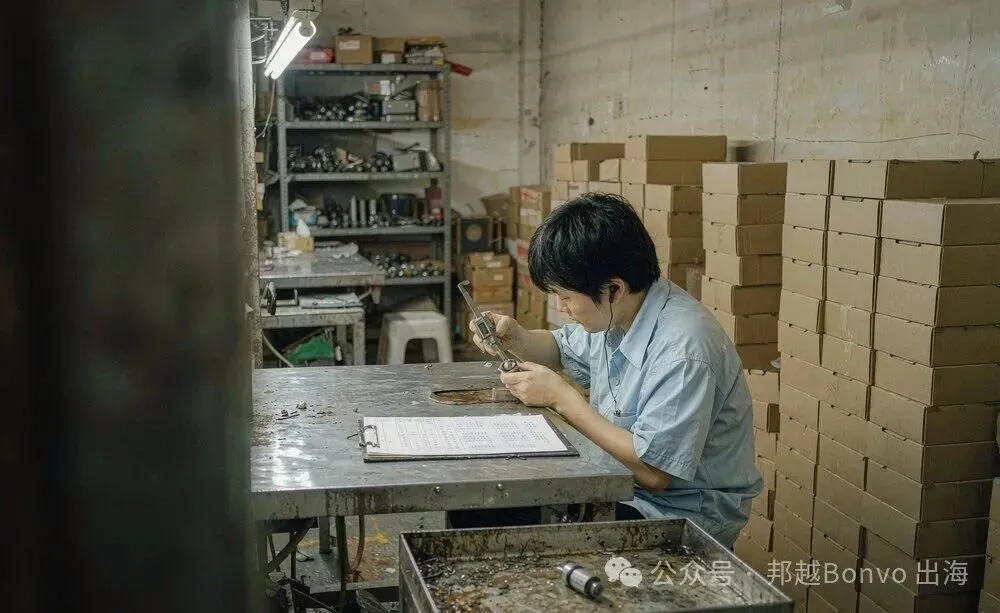
Step four, in one frame: the few hundred yuan that stops a refund.
05 · REBATE & SETTLEMENT — THE PROFIT NOBODY COUNTS
Export rebate runs 9–13% on many product categories — on a US$10,000 order that is a second margin sitting behind the first. An agent can process it and split the rebate with you; agree the split before the first shipment, not after. Then keep the trade background: contract, bill of lading, chat logs. Cross-border platforms freeze accounts over missing paper, not over bad intent.
Three traps, all of them expensive
Zero stock is not zero float. A customer stretching his terms is normal, not an insult. Keep a reserve you never touch — the first order usually eats more working capital than the spreadsheet says.
Do not touch a category you do not understand. Medical, children’s products, food-contact goods: the certification cost is larger than the margin, and a single claim can take back every order you ever shipped.
Customer one can be a thin-margin customer. The process has to be complete, not profitable. Run development letter, deposit, purchase, inspection, shipment, rebate once end to end — that run-through is what you are buying with your first US$1,400.
Before you spend anything, answer this.
Which of the four — entity, samples, float, proof — would you cut last?
If you cannot answer, you are not ready to register a company. You are ready to pick a product.

The only fixed asset in this model is other people’s shipping capacity.
The first customer may take three months to arrive.
The second and third come faster — by then you are not learning the process, you are repeating it.
邦越 Bonvo 出海Sourcing and export notes for buyers and sellers who would rather see the numbers.
Data source: GC外贸说 (WeChat), “No stock, no office: how an ordinary person starts exporting from zero”, 24 October 2026. RMB budgets converted at approximately 7.1 CNY per US$ for readability; no figures have been added beyond that conversion. Figures are as reported by the original author and have not been independently verified.
FOLLOW US
邦越 Bonvo 出海

One cost breakdown a week, for people who ship things.
长按识别二维码 · 关注「邦越Bonvo出海」