ARTICLE · 1393963
宏观经济学习题及解答01 | Solow & RCK Model


宏观经济学习题及解答01 | Solow & RCK
Problem 2.1
Question
There are firms with the same constant-returns production function
All firms face the same rental rate , wage per unit of effective labor , and technology level .
1. Show that a firm's cost-minimizing capital-effective-labor ratio is unique and independent of its output level. 2. Show that aggregate output from the cost-minimizing firms equals the output of one firm using their aggregate inputs.
Solution
Part (a)
Let effective labor be
Then
To produce a fixed quantity , the firm must use
and therefore
The firm's total cost is
Substituting the conditional input requirements gives
For a given , cost minimization is equivalent to minimizing
The first-order condition is
or
Rearranging,
Define
Its derivative is
Because , , and ,
Thus is strictly increasing. The equation
has at most one solution. Under the usual Inada conditions, it has exactly one interior solution.
The output level does not appear in this equation. Hence the cost-minimizing value is independent of . Since all firms face the same , , and , every firm chooses the same .
Part (b)
For firm ,
and
Aggregate capital and labor are
Since every firm uses the same ,
Aggregate output is
Thus the sum of the firms' outputs equals the output of a single firm using the aggregate quantities of capital and labor.
Problem 2.2
Question
A two-period consumer has CRRA utility
and budget constraint
Find the optimal consumption choices and show that the intertemporal elasticity of substitution is .
Solution
Part (a)
The Lagrangian is
The first-order conditions are
Dividing the second condition by the first gives
Therefore,
Define
Then . Substituting into the budget constraint,
Hence
and
Equivalently,
Part (b)
From the optimality condition,
Taking logarithms,
Therefore,
Thus the elasticity of substitution between consumption in the two periods is
A larger means that the household is less willing to shift consumption across dates.
Problem 2.3
Question
At a known future date , the government confiscates wealth.
1. It takes one-half of each household's own wealth. 2. It takes from each household an amount equal to one-half of average household wealth.
Determine whether consumption jumps at in each case.
Solution
Let
Part (a): proportional confiscation of each household's own wealth
An additional unit of saving carried across becomes only one-half unit after the confiscation. Thus the discrete gross return associated with crossing the confiscation date contains a factor of .
Optimality requires the marginal utility cost immediately before the event to equal the marginal utility benefit immediately after it:
With CRRA utility,
Therefore,
Rearranging,
Because , consumption falls discontinuously at .
The jump arises because the confiscation changes the marginal payoff from transferring one unit of consumption across .
Part (b): confiscation based on average household wealth
An individual household treats average wealth as given. Its tax liability is therefore independent of its own marginal saving decision.
An extra unit saved immediately before still produces one full unit, apart from the ordinary infinitesimal interest earned, immediately after . The marginal intertemporal return is not discretely altered.
Hence the standard no-arbitrage condition across an instant implies
Since marginal utility is strictly decreasing,
Consumption is continuous at .
The anticipated lump-sum wealth loss affects consumption before the confiscation date, but it does not cause a jump exactly at the date of confiscation.
Problem 2.4
Question
Assume instantaneous utility is . Find the household's optimal consumption path as a function of total lifetime wealth, the interest-rate path, and the preference parameters.
Solution
Let household size at time be
Let total lifetime wealth, measured in time-0 goods, be
where
The household chooses to maximize
subject to
The first-order condition is
Household size cancels:
Substitute this expression into the budget constraint:
For ,
Thus
The optimal path is
Its growth rate is
which is the log-utility version of the Euler equation.
Problem 2.5
Question
Assume CRRA utility, a constant real interest rate , and lifetime wealth . Find the optimal path of consumption.
Solution
The Euler equation for consumption per person is
Define
Then
The present-value budget constraint is
Therefore,
The integral is finite when
Under this condition,
Hence
Substituting gives
An equivalent expression for the coefficient is
For , this reduces to the result in Problem 2.4 with constant :
Problem 2.6
Question
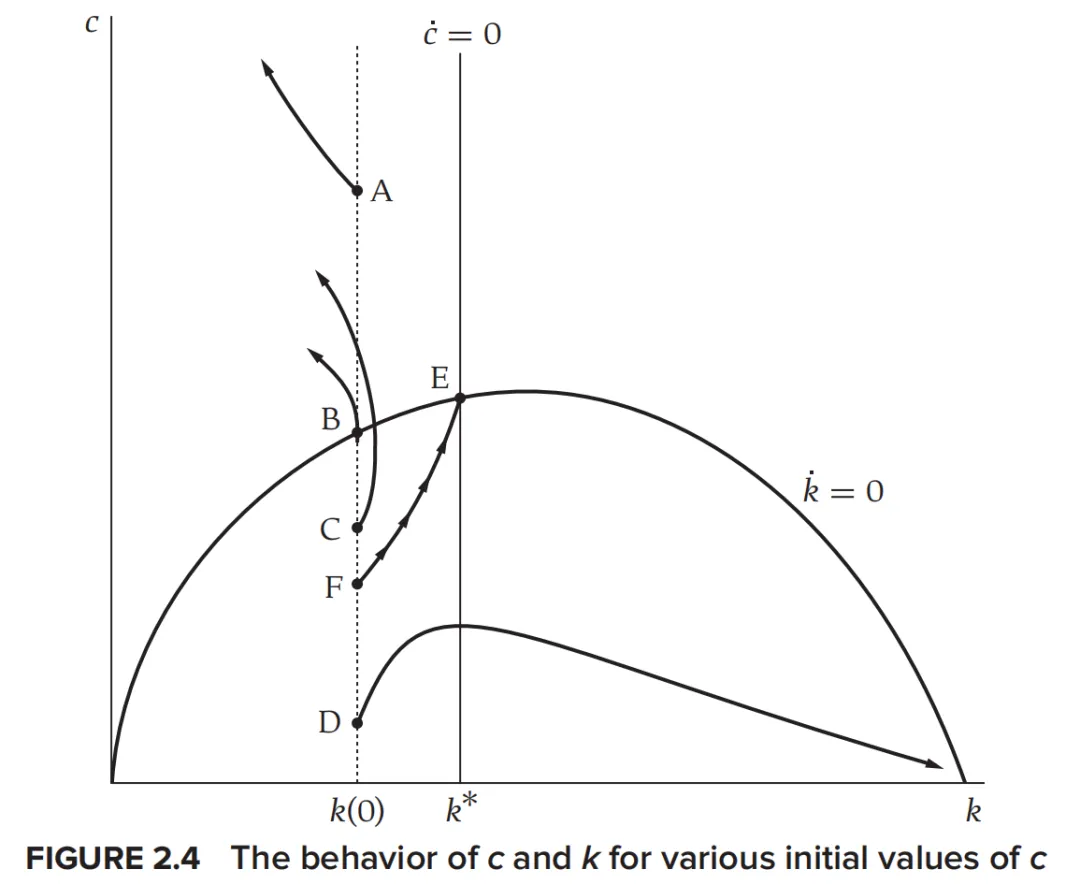
A Ramsey-Cass-Koopmans economy is initially on its balanced growth path. The exogenous growth rate of technology, , falls permanently. Analyze the phase diagram, the initial response, , and the balanced-growth saving rate.
Solution
Part (a): effect on the curve
The curve is
For a fixed ,
Thus a fall in shifts the curve upward.
Its peak satisfies
A fall in lowers the right-hand side. Since is decreasing, rises. The peak of the curve moves to the right.
Part (b): effect on the curve
The condition is
Differentiating,
so
Therefore, a fall in raises . The vertical locus shifts to the right.
Part (c): impact effect on
Capital is predetermined, but consumption can jump when the change is announced.
Two forces operate:
1. Lower reduces break-even investment, tending to raise feasible current consumption. 2. Lower productivity growth reduces the present value of future labor income, tending to lower current consumption.
The location of the new saddle path at the old value of depends on the model's parameters and the shape of . Therefore,
The impact change in is ambiguous in general.
Part (d): impact effect on
At the instant of the change, cannot jump. Hence
is unchanged on impact. Since falls,
Part (e): long-run effect on
On the balanced growth path,
Therefore,
Thus
For a fall in :
• If , rises. • If , is unchanged. • If , falls.
Hence the long-run effect is ambiguous without a restriction on .
Part (f): effect of on the balanced-growth saving rate
On the balanced growth path,
Differentiate with respect to :
Using
we obtain
The first term is positive. The second term is negative because
and
Therefore the sign is ambiguous in general.
Part (g): Cobb-Douglas production
Let
The balanced-growth condition is
Thus
The saving rate is
Differentiating,
Therefore:
• if . • if . • if .
A fall in has the opposite effect.

往期内容推荐
微观经济学 | Lexicographic Preferences