厦门双十中学 2026 届高三上第一次月考英语试卷
(考试时间:120 分钟 试卷满分:150 分)
第一部分 听力 (共两节,每题 1.5 分,满分 30 分)
第一节 (共 5 小题;每小题 1.5 分,满分 7.5 分)
听下面 5 段对话。每段对话后有一个小题。每段对话仅读一遍。
1. What did the man do over the weekend?
A. He saw a movie. B. He played a match. C. He went to the hospital.
2. What day is it today?
A. Monday. B. Tuesday. C. Wednesday.
3. What is happening near the park?
A. People are giving away their books.
B. The police are searching for a thief.
C. There is a new restaurant opening up.
4. What is the most unbearable thing for the woman?
A. Mosquito bites. B. Horrible snakes. C. High temperatures.
5 What does the man mean?
A. Leave the cat alone. B. Choose another time. C. Consider other vehicles.
第二节 (共 15 小题;每小题 1 分,满分 22.5 分)
听第 6 段材料,回答第 6-7 题。
6. What is the probable relationship between the speakers?
A. A couple. B. Neighbors. C. Colleagues.
7. When did Mr. Thompson arrive home today?
A. At 6:30 p.m. B. At 6:15 p.m. C. At 5:45 p.m.
听第 7 段材料,回答第 8-9 小题。
8. What did the woman want to do when she was a child?
A. Create new musical pieces. B. Become a singer. C. Play the piano.
9. What is probably the man?
A. An educator. B. A musician. C. An astronaut.
听第 8 段材料,回答第 10-12 小题。
10. What did the woman do before lunchtime?
A. She tidied a place up. B. She bought some fruit. C. She sang a song to the elderly.
11. What does the man decide to do?
A. Play basketball. B. Go to hospital. C. Join the woman.
12. What do the speakers mainly talk about?
A. Respect for the old. B. The holiday plan. C. Housework chores.
听第 9 段材料,回答第 13-16 小题。
第 1页/共 12页13. Who is Tom Lee?
A. A movie character. B. A TV actor. C. A journalist.
14. What do we know about Tom Lee?
A. He grew up in China. B. He is humorous and wise. C. He dreams of becoming a hero.
15. What suggestion does the man give to kids?
A. Learning from obstacles. B. Keeping positive all the time. C. Being brave to seek support.
16. What is the woman doing?
A. Chairing a meeting. B. Conducting an interview. C. Explaining film plots.
听第 10 段材料,回答第 17-20 小题。
17. Why does the speaker give the talk?
A. To introduce some new authors.
B. To share book reviews.
C. To promote some new books.
18. Which book is suitable for people who are interested in time-traveling adventures?
A. This Again? B. Daughters of the Lamp. C. The Partition Project.
19. What can we learn about Sahara?
A. She lost a necklace in Cairo.
B. She moved from India to Pakistan.
C. She is fascinated by adventure stories.
20. Who attaches great importance to family in the book?
A. Adam Borba. B. Nedda Lewers. C. Saadia Faruqi.
第二部分 阅读理解 (共 2 节,满分 50 分)
第一节 (共 15 小题,每题 2.5 分,满分 37.5 分)
A
Shared mobility: Making travel easier for all
In major cities across Europe and the US, shared bikes and cars seem to be everywhere. Yet for disabled,
elderly, low-income individuals, or those without a smartphone or credit card, these services are practically out of
reach. Such services tend to gather in wealthy urban areas, leaving users largely young, wealthy, and able-bodied.
第 2页/共 12页Shared mobility could be a key part of a more sustainable transportation system. But to be most effective, it
needs to include everyone. For-profit shared mobility providers have largely failed to deliver on this, but various
initiatives and projects are finding creative solutions to reach under-served communities.
●Buffalo’s E-Bike Library: Organizes training, group rides and educational events to familiarize people
with cycling culture and safety, with 71% of members being first-time riders.
●Mobitwin’s car-share service: Prioritizes email-and phone-based bookings over apps to extend reach to a
wider share of the population lacking digital literacy, helping them access the service more easily.
● U. S. bike-sharing policy: Provides fare reductions for low-income groups, with cash payment options and
non-smartphone access as key measures to broaden adoption, which has shown promise in increasing the use of
shared bikes while decreasing the use of personal vehicles.
●Graz’s car-share initiatives: Add wheelchair-accessible vehicles, child seats, and station-based booking to
suit diverse users’ trip-chaining needs, such as mid-route pickups and multi-destination trips.
The future of shared mobility relies on making inclusive design a top priority. As Esen Köse, project manager
at Mpact, puts it, “It’s about starting with people’s needs.”
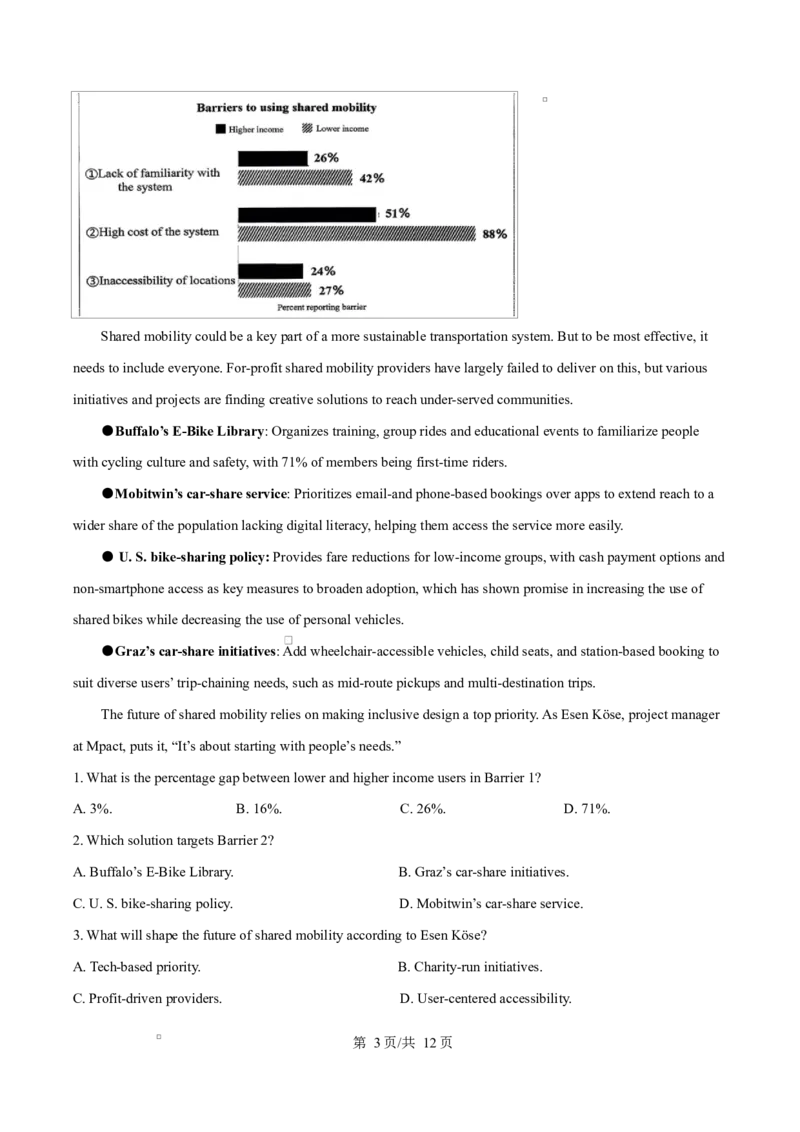
1. What is the percentage gap between lower and higher income users in Barrier 1?
A. 3%. B. 16%. C. 26%. D. 71%.
2. Which solution targets Barrier 2?
A. Buffalo’s E-Bike Library. B. Graz’s car-share initiatives.
C. U. S. bike-sharing policy. D. Mobitwin’s car-share service.
3. What will shape the future of shared mobility according to Esen Köse?
A. Tech-based priority. B. Charity-run initiatives.
C. Profit-driven providers. D. User-centered accessibility.
第 3页/共 12页B
On a recent weekday, I sent an Instagram message to a friend of mine, an art adviser in New York named
Stephen Truax, to chat about an exhibition. Instead of messaging me back in the app, he texted me to say that he’d
blocked Instagram on his smartphone during daytime working hours.
Impressed, I asked him how he was accomplishing such a challenge. Truax said he was using Opal, an app that
makes your smartphone a little more like a so-called dumbphone (功能机). He said that several of his friends swore
by the app, and so he had begun using it, too. I took this word of mouth as evidence that it might actually work. I
downloaded it without any particular optimism, considering my phone addiction an incurable case.
Opal, I found, provides something like gentle parenting for your smartphone habits: you set up a daily
schedule of which apps to block, and then the app guides you into sticking with it. As the app suggested, I set up a
recurring “Work Time” block from 9 a.m. to 5 p.m. and selected every social app I ever use. At the scheduled time,
those apps go gray on my home screen and remain that way all day.
Every time I’m upset that I can’t look at Instagram on my phone, I just think, surely I, a human adult, can wait
a few more hours to see my friends’ dog photos—5 p.m. isn’t that far away. Crucially, Opal also allows users to
suspend the block for short periods of time without feeling like failures; when the scheduled break time passes, the
blockage automatically continues.
I find comfort in the fact that my mind feels clearer after a full workday without checking social media, and an
added bonus is that once the block ends I can mainline all the good posts that I missed. As Truax told me, “The
flood of content that happens after dinner is wild.” The addiction is not cured, perhaps, but at least it’s finally
managed.
4. How did the author feel when downloading Opal?
A. Impressed. B. Hopeful. C. Doubtful. D. Disappointed.
5 What does Opal do according to the passage?
A. Block any incoming texts. B. Prevent users from using Instagram.
C. Turn smartphones into dumbphones. D. Limit access to certain apps in given time.
6. Why does Opal allow temporary lift of the blockage?
A. To extend block duration. B. To offer guilt-free flexibility.
C. To improve app performance. D. To suspend all phone functions.
7. What can we learn from the text?
第 4页/共 12页A Surfing the web makes the mind clearer. B. Practising self-control deepens enjoyment.
C. It’s best to surf the latest news after supper. D. It is impossible to ease phone addiction.
C
As dust from the Sahara blows thousands of kilometers across the Atlantic Ocean, it becomes progressively
more nutritious for marine microbes (海洋微生物), a new study suggests.
“Dust clouds settling on the Atlantic can generate phytoplankton (浮游植物) blooms that support marine
ecosystems,” said Timothy Lyons, a scientist at the University of California, Riverside. “Iron in the dust is
incredibly important for life,” he said. Phytoplankton require it to change carbon dioxide into sugars.
Over 240 million metric tons of Saharan dust blows over the Atlantic Ocean each year. To know whether the
types of dust settling on the Atlantic had changed over the past 120,000 years, Lyons and the marine geologist
Jeremy Owens, analyzed dust-derived (灰尘衍生的) minerals in four cores collected from the muddy seafloor —
two in the eastern Atlantic near Africa, and two from farther west near North America.
In dust worldwide, approximately 40% of iron is ordinarily present within “reactive” minerals like pyrite. This
kind of iron can break down with weak acids and potentially be used by life. In the core samples from the bottom of
the Atlantic, only about 9% of iron in the dust minerals sampled from farther west consisted of reactive iron
minerals, compared with about 18% in dust minerals taken from closer to Africa.
“There’re photochemical transformations that tend to make the iron more soluble (可溶解的) in water,” said
Lyons. He and Owens concluded that during the dust’s several-day trans-Atlantic flight, more and more of its
reactive iron was changed — attacked by acids and radiation. As that improved iron later settled into the ocean, it
was eaten directly by phytoplankton. The only reactive iron that made it to the seafloor was the stuff that wasn’t
changed during air transport, and wasn’t taken in later.
“The new results are plausible because previous studies have shown that iron minerals react in the atmosphere,”
said Natalie Mahowald, an atmospheric scientist who studies dust at Cornell University. “Their conclusion goes
along with what I thought was happening,” she said.
8. Why is iron important for marine ecosystems?
A. It helps dust clouds settle. B. It generates phytoplankton.
C. It changes CO₂into sugars. D. It boosts phytoplankton growth.
9. What can be concluded from the findings of the research?
A. Weak acids seldom change reactive iron minerals.
B. The dust minerals from farther west are rich in iron.
第 5页/共 12页C. The fewer minerals there are, the more sensitive weak acids are.
D. The farther the desert dust flies, the less the reactive iron is left.
10. What does paragraph 5 mainly talk about?
A. How phytoplankton makes it to the seafloor. B. How reactive iron cooperates with radiation.
C. How iron in dust becomes easier to absorb. D. How atmospheric chemical reactions fail.
11. What does the underlined word “plausible” in the last paragraph mean?
A reliable. B. uncertain. C. abstract. D. Contradictory.
D
Anyone who has taken a standardized test knows that writing an essay in 20 minutes or less takes serious brain
power. Having access to artificial intelligence (AI) would certainly lighten the mental load. But as a recent study by
researchers at the Massachusetts Institute of Technology (MIT) suggests, that help may come at a cost.
Over the course of a series of essay-writing sessions, students working with as well as without an AI chatbot
had their brain activity measured. Across the board, the AI users exhibited markedly lower brain activity in areas
associated with creative functions and attention.
Whether AI will leave people’s brains weak in the long term remains an open question. Researchers behind
this study have stressed that further work is needed to establish a definitive causal link between increased AI use
and weakened brains. After all, the study had a tiny sample size and focused on a single narrow task.
Moreover, generative AI tools clearly seek to lighten people’s mental loads, as many other technologies do.
Concerns about this kind of offloading aren’t new. As long ago as the 5th century BC, Socrates was quoted as
complaining that writing is not “a potion (神药) for remembering, but for reminding”. Calculators spare cashiers
from computing a bill. Navigation apps remove the need for map-reading. And yet few would argue that people are
less capable as a result.
There is little evidence to suggest that letting machines handle users’ mental tasks alters the brain’s capacity
for thinking. But the worry is that generative AI allows one to offload a thought process. And once the brain has
developed a taste for offloading it can be a hard habit to kick. As one user put it, “I rely so much on AI that I don’
t think I’d know how to solve certain problems without it.”
The technology is so young that, for many tasks, the human brain is still the sharpest tool in the toolkit. But in
time both the consumers of AI and its regulators will have to assess whether its wider benefits outweigh any
cognitive (认知) costs. If stronger evidence emerges that AI makes people less intelligent, will they care?
第 6页/共 12页12. What did the MIT study find?
A. AI users showed less mental engagement. B. AI left people’s brains weak.
C. AI lightened the mental load in writing. D. AI users associated creativity with attention.
13. According to Socrates, what negative consequence could writing have?
A. People would avoid using reminders. B. People would stop thinking independently.
C. People would rely less on their own memory. D. People would care less about the spoken word.
14. What point does the user’s remark in paragraph 5 illustrate?
A. AI can change users’ mental capacity. B. AI is not widely available to the public.
C. AI can encourage users’ mental laziness. D. AI is not capable of solving every problem.
15. What can be a suitable title for the text?
A. Will AI Make You Stupid? B. How AI Lets You Offload Tasks
C. Why AI Affects Your Thinking Abilities D. Is AI a Mental Shortcut You Can easily Quit?
第二节 (共 5 小题,每小题 2.5 分,满分 12.5 分)
根据短文内容,从短文后的选项中选出能填入空白处的最佳选项。选项中有两项为多余选项。
Are you as good at things as you think you are? While knowing how competent one is helps make important
decisions, research suggests that people are not very good at evaluating themselves accurately. ____16____
Researchers have a term for this phenomenon, the Dunning-Kruger effect.
____17____ They judge themselves as better than others to a degree that violates the laws of math. When
software engineers were asked to rate their performance, 42% put themselves in the top 5%. This is not an isolated
finding. On average, people tend to rate themselves better than most in health, leadership skills, and beyond. What’
s particularly interesting is that those with the least ability often overrate their skills to the greatest extent.
____18____ When psychologists Dunning and Kruger first described the effect in 1999, they argued that poor
performers lack the very expertise needed to recognize how badly they’re doing. The Dunning-Kruger effect isn’t a
question of ego (自尊) blinding us to our weaknesses. People usually do admit their deficits once they can spot
them. That may be why people with a medium amount of expertise often have less confidence in their abilities.
____19____
Meanwhile, experts tend to be aware of just how knowledgeable they are. But they often assume that everyone
else is knowledgeable, too. ____20____ When they’re unskilled, they can’t see their own faults. When they’re
exceptionally competent, they don’t perceive how unusual their abilities are.
So what can we do? First, ask for feedback from other people, even if it’s hard to hear. Second, keep learning.
第 7页/共 12页The more knowledgeable we become, the less likely we are to have invisible holes in our competence.
A. But why?
B. Do people know how badly they are doing?
C. People in various fields tend to be overconfident.
D. In fact, they frequently overestimate their own abilities.
E. They know enough to know that there’s a lot they don’t know.
F. The result is, one way or another, people are caught in an inaccurate self-perception.
G. This effect explains why over 100 studies show people display imaginary superiority.
第三部分 语言运用 (共 2 节,满分 30 分)
第一节 完形填空 (共 15 题,每题 1 分,满分 15 分)
Bonnie forever remembered her mother’s kindness through the handmade sweaters she grew up in. That same
warm ___21___ beyond their home — her mother often volunteered to sew clothes for the needy. Every stitch (针
脚 ) witnessed her ___22___ to the community. When an accident ___23___ her mother’s life, Bonnie felt
something important was missing in her heart.
While sorting through her late mother’s belongings, she found an ___24___ sweater labeled with “Bonnie”.
Her heart ached the instant she recognized its ___25___. The warmth of her mother’s sweaters ___26___ her not to
cast it aside and to finish it. She searched for solutions online and ___27___ on Loose ends, a nonprofit ___28___
partly-finished projects with skilled volunteer knitters (编织者).
Through Loose ends, Bonnie was linked to a nearby ___29___ Anna, who took great pleasure in ____30____
her mother’s work. Anna spent weeks knitting into the small hours and ____31____ to finish the project. When the
sweater was passed to her, Bonnie threw her arms around it, jumping at the chance to ____32____ with her mother
across time.
Hugging the finished piece, Bonnie realized the beauty and ____33____ in the finisher’s rhythm of knitting. It’
s not just about being kind, but about making sure people have ____34____ objects they can hug when missing
someone. For Bonnie, holding that completed sweater finally filled the emptiness in her heart with genuine
____35____.
21. A. ceased B. hatched C. extended D. originated
22. A. reaction B. commitment C. adjustment D. promise
23. A. suspended B. celebrated C. transformed D. claimed
24. A. unrepaired B. unpacked C. unfolded D. uncompleted
第 8页/共 12页25. A. influence B. intention C. history D. choice
26. A. urged B. warned C. allowed D. dared
27. A. commented B. relied C. chanced D. reflected
28. A. replacing B. matching C. comparing D. rewarding
29. A. coworker B. shopkeeper C. teacher D. finisher
30. A. testing out B. taking over C. preparing for D. figuring out
31. A. managed B. pretended C. happened D. offered
32. A. argue B. compete C. engage D. negotiate
33. A. courage B. challenge C. profit D. value
34. A. random B. unique C. physical D. premier
35. A. warmth B. truth C. depth D. growth
第二节 单句语法填空 (共 15 题,每题 1 分,满分 15 分)
36. The new community center will be ________ (joint) funded by the government and several private sponsors.
(所给词的适当形式填空)
37. Countless species ________ (sample) in this grand ecosystem now serve as crucial data for conservation. (所给
词的适当形式填空)
38. The monthly sales of the shopping mall near our school ________ (dive) by nearly 40% in the past three
months because of online shopping. (所给词的适当形式填空)
39. She went to fetch him a warm blanket on the cold night, not out of care alone but partly out of ________
(guilty). (所给词的适当形式填空)
40. If you want to really take in the full experience, you should go to the fish market in Sydney early in the
morning and watch the fish ________ (prepare) for sale. (所给词的适当形式填空)
41. The ________ (fiction) character from the classic novel was portrayed so vividly in the play that audiences
forgot he wasn’t real. (所给词的适当形式填空)
42. She remembered ________ (log) the meeting minutes yesterday but forgot to share them with team members.
(所给词的适当形式填空)
43. The Eiffel Tower, known as an iconic landmark in France, is one of the most ________ (visit) monuments in
the world. (所给词的适当形式填空)
44. The sensitive artist, feeling profoundly misunderstood by the critics, ________ (withdraw) her application for
the upcoming exhibition the other day. (所给词的适当形式填空)
第 9页/共 12页45. Within the ant colony, the complex ________ (divide) of labor, which comes from a natural drive, guides all
tasks from searching for food to caring for the young. (所给词的适当形式填空)
46. The new trade agreement remains ________ negotiation, with both parties working to resolve key differences
in market access regulations. (用适当的词填空)
47. They calculated there were 38 million pieces of plastic, ________ (weigh) almost 18 tons, with thousands of
new pieces washing up each day. (所给词的适当形式填空)
48. These potential side effects, however rare they might occur, would be risky ________ (dismiss) without
considering the long-term well-being of the patients. (所给词的适当形式填空)
49. The project will proceed as planned, unless ________ (suspend) due to unforeseen circumstances beyond our
current control. (所给词的适当形式填空)
50. Mastering a new language can prove ________ mentally demanding and time-consuming to achieve as solving
a complicated puzzle with no answer key. (用适当的词填空)
第四部分 写作 (共两节,满分 40 分)
第一节 应用文写作 (满分 15 分)
51. 假设你是校英文报《校园之声》的记者。你校“绿色未来”俱乐部于上周六组织了一次主题为“Clean
the Beach, Guard the Blue”的志愿者活动。请为校英文报写一篇新闻报道,内容包括:
1. 活动过程;
2. 反响与收获:
注意:1. 字数不超过 100 个单词;
2. 为使行文流畅可适当增加细节;
3. 题目已拟好不计入字数。
____________________________________________________________________________________________
____________________________________________________________________________________________
____________________________________________________________________________________________
____________________________________________________________________________________________
___________________________
第二节 读后续写 (满分 25 分)
52. 阅读下面材料,根据其内容和所给段落开头语续写两段,使之构成一篇完整的短文。
At first, Surrell didn’t see the black smoke or flames shooting from the windows of his neighbors’ home. He
and his wife were just having a dinner in their own house in Allentown, Pennsylvania, when they heard someone
第 10页/共 12页screaming: “The house is on fire!” He went to investigate. That’s when he saw two women and a girl crazily at a
loss on their porch (走廊). It was his neighbour’s house.
“The baby’s inside there!” one of the women cried. Though the fire department had been called, Surrell, then
64, instinctively (本能地) ran inside. “The baby” was 8-year-old Tiara Roberts, who always called him Uncle
Surrell. She was the woman’s granddaughter and a playmate of Surrell’s three youngest kids, 8, 10, and 12. The
other two on the porch were Tiara’s aunt and cousin.
Entering the burning house was like running into “ a bucket of black paint ”. The thick smoke caused Surrell to
walk blindly around, burned his eyes, and made it impossible for him to breathe. He felt his throat and lungs burned,
and every blink stung (蛰) his eyes. The conditions would have been very dangerous for anyone, but for Surrell,
who has chronic obstructive pulmonary disease (慢性阻塞性肺病) and was in hospital just half a year ago, they
were life-risking.
After a few minutes in the smoke-filled house searching but in vain, he ran outside to catch his breath. “Where
is Tiara?” he asked desperately.
“The second floor,” her aunt shouted back.
Surrell knew he couldn’t hold his breath for long. So he uttered a little prayer: “Well, God, this is it. You got to
help me, because I’m not coming out without that little girl.”
注意:
1.续写词数应为 150 左右;
2.请按如下格式作答。
Taking a deep breath, he went in a second time.
____________________________________________________________________________________________
____________________________________________________________________________________________
____________________________________________________________________________________________
____________________________________________________________________________________________
____________________________________________________________________________________________
____________________________________
Surrell woke up in the hospital a couple of days later.
____________________________________________________________________________________________
____________________________________________________________________________________________
____________________________________________________________________________________________
第 11页/共 12页____________________________________________________________________________________________
____________________________________________________________________________________________
____________________________________
第 12页/共 12页