2024 届高三 11 月模拟测试英语试题
注意事项:
1. 答卷前,考生务必将自己的姓名、考生号等填写在答题卡和试卷指定位置上。
2. 回答选择题时,选出每小题答案后,用铅笔把答题卡上对应题目的答案标号涂黑。如需改动,用橡皮擦干
净后,再选涂其他答案标号。回答非选择题时,将答案写在答题卡上。写在本试卷上无效。
3. 满分150分,考试时间120分钟。
第一部分 听力(共两节,满分30分)
做题时,先将答案标在试卷上。录音内容结束后,你将有两分钟的时间将试卷上的答案转涂到答题卡上。
第一节 (共5小题;每小题1.5分,满分7.5分)
听下面5段对话。每段对话后有一个小题,从题中所给的A、B、C三个选项中选出最佳选项,并标在试卷的
相应位置。听完每段对话后,你都有10秒钟的时间来回答有关小题和阅读下一小题。每段对话仅读一遍。
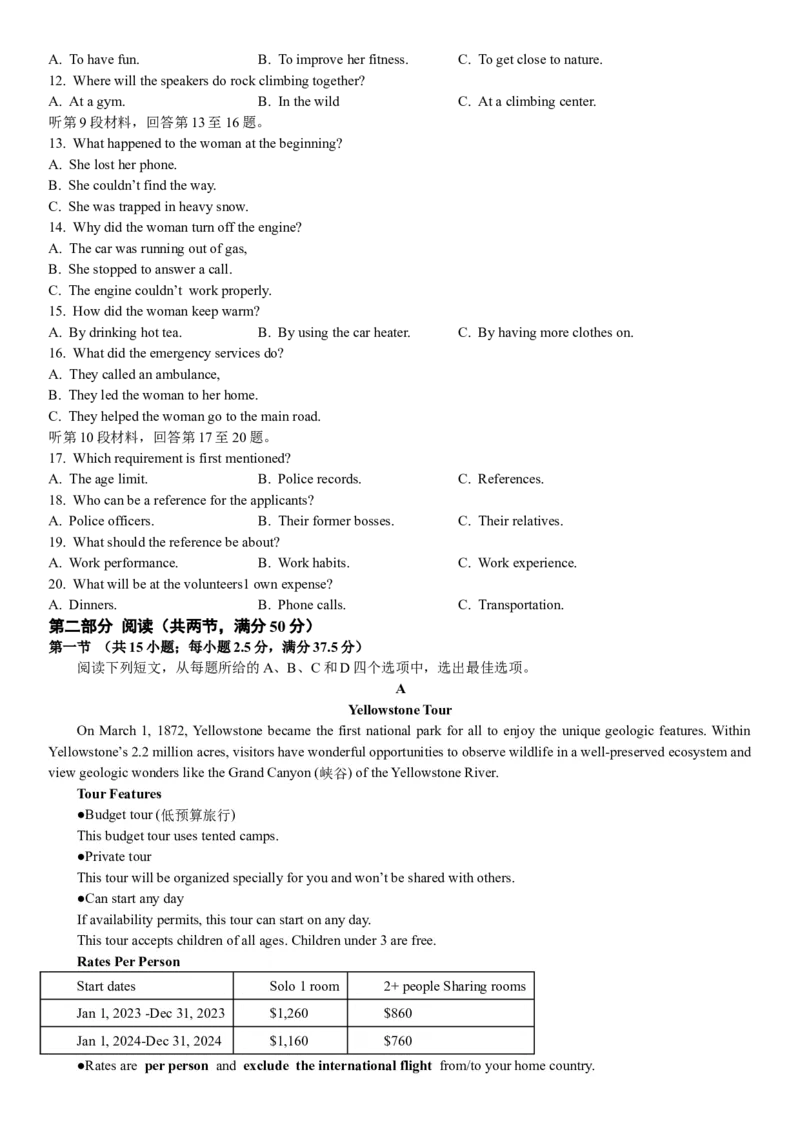
1. Why was the man late for work?
A. He was stuck in traffic,
B. He had a traffic accident.
C. His car broke down on the road.
2. Where is the woman probably from?
A. Peru. B. Britain. C. Mexico.
3. What is the man doing?
A. Placing an order,
B. Complaining about an item.
C. Inquiring about a delivery service.
4. What do we know about Jim?
A. He has a leg injury.
B. He withdrew from the football team.
C. He spent his holiday with his teammates.
5. Who might Lily be?
A. The woman’s babysitter. B. The woman’s boss. C. The woman’s child.
第二节(共15小题;每小题1.5分,满分22.5分)
听下面5段对话或独白。每段对话或独白后有几个小题,从题中所给的A、B、C三个选项中选出最佳选项,
并标在试卷的相应位置。听每段对话或独白前,你将有时间阅读各个小题,每小题5秒钟;听完后,各小题将给
出5秒钟的作答吋间。每段对话或独白读两遍。
听第6段材料,回答第6、7题。
6. What was the woman doing when it started raining?
A. She was walking home. B. She was playing football, C. She was chatting with a friend.
7. What did the woman fail to do?
A. Find a shelter B. Contact her mom, C. See the lightning.
听第7段材料,回答第8、9题。
8. When does the conversation take place?
A. In the morning. B. At noon. C. In the afternoon.
9. Why doesn’t the man go to the conference room now?
A. He needs to meet the clients.
B. He is working on another task.
C. He has checked the heater before.
听第8段材料,回答第10至12题。
10. What is the woman doing?
A. Borrowing a tent. B. Packing a tent. C. Returning a tent.
11. What is the woman’s motivation for climbing?A. To have fun. B. To improve her fitness. C. To get close to nature.
12. Where will the speakers do rock climbing together?
A. At a gym. B. In the wild C. At a climbing center.
听第9段材料,回答第13至16题。
13. What happened to the woman at the beginning?
A. She lost her phone.
B. She couldn’t find the way.
C. She was trapped in heavy snow.
14. Why did the woman turn off the engine?
A. The car was running out of gas,
B. She stopped to answer a call.
C. The engine couldn’t work properly.
15. How did the woman keep warm?
A. By drinking hot tea. B. By using the car heater. C. By having more clothes on.
16. What did the emergency services do?
A. They called an ambulance,
B. They led the woman to her home.
C. They helped the woman go to the main road.
听第10段材料,回答第17至20题。
17. Which requirement is first mentioned?
A. The age limit. B. Police records. C. References.
18. Who can be a reference for the applicants?
A. Police officers. B. Their former bosses. C. Their relatives.
19. What should the reference be about?
A. Work performance. B. Work habits. C. Work experience.
20. What will be at the volunteers1 own expense?
A. Dinners. B. Phone calls. C. Transportation.
第二部分 阅读(共两节,满分50分)
第一节 (共15小题;每小题2.5分,满分37.5分)
阅读下列短文,从每题所给的A、B、C和D四个选项中,选出最佳选项。
A
Yellowstone Tour
On March 1, 1872, Yellowstone became the first national park for all to enjoy the unique geologic features. Within
Yellowstone’s 2.2 million acres, visitors have wonderful opportunities to observe wildlife in a well-preserved ecosystem and
view geologic wonders like the Grand Canyon (峡谷) of the Yellowstone River.
Tour Features
●Budget tour (低预算旅行)
This budget tour uses tented camps.
●Private tour
This tour will be organized specially for you and won’t be shared with others.
●Can start any day
If availability permits, this tour can start on any day.
This tour accepts children of all ages. Children under 3 are free.
Rates Per Person
Start dates Solo 1 room 2+ people Sharing rooms
Jan 1, 2023 -Dec 31, 2023 $1,260 $860
Jan 1, 2024-Dec 31, 2024 $1,160 $760
●Rates are per person and exclude the international flight from/to your home country.21. How much will a couple pay at least in September 2024?
A. $860. B. $1160. C. $1520. D. $1720.
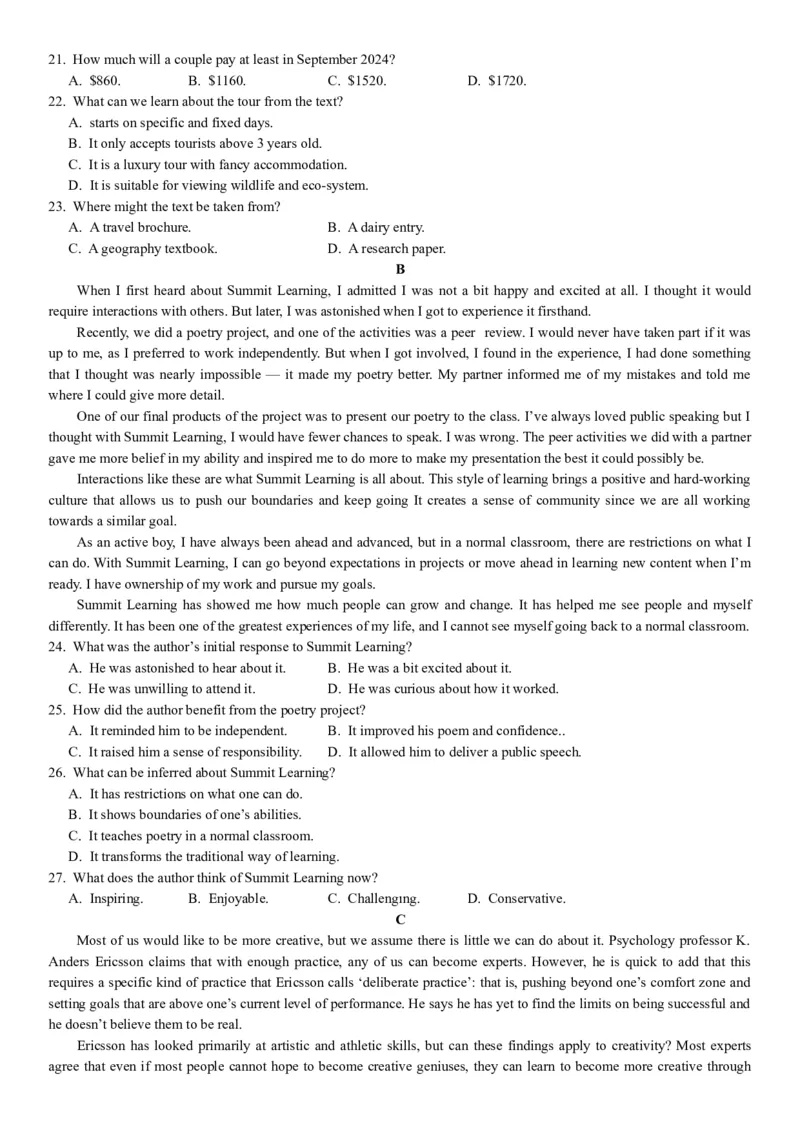
22. What can we learn about the tour from the text?
A. starts on specific and fixed days.
B. It only accepts tourists above 3 years old.
C. It is a luxury tour with fancy accommodation.
D. It is suitable for viewing wildlife and eco-system.
23. Where might the text be taken from?
A. A travel brochure. B. A dairy entry.
C. A geography textbook. D. A research paper.
B
When I first heard about Summit Learning, I admitted I was not a bit happy and excited at all. I thought it would
require interactions with others. But later, I was astonished when I got to experience it firsthand.
Recently, we did a poetry project, and one of the activities was a peer review. I would never have taken part if it was
up to me, as I preferred to work independently. But when I got involved, I found in the experience, I had done something
that I thought was nearly impossible — it made my poetry better. My partner informed me of my mistakes and told me
where I could give more detail.
One of our final products of the project was to present our poetry to the class. I’ve always loved public speaking but I
thought with Summit Learning, I would have fewer chances to speak. I was wrong. The peer activities we did with a partner
gave me more belief in my ability and inspired me to do more to make my presentation the best it could possibly be.
Interactions like these are what Summit Learning is all about. This style of learning brings a positive and hard-working
culture that allows us to push our boundaries and keep going It creates a sense of community since we are all working
towards a similar goal.
As an active boy, I have always been ahead and advanced, but in a normal classroom, there are restrictions on what I
can do. With Summit Learning, I can go beyond expectations in projects or move ahead in learning new content when I’m
ready. I have ownership of my work and pursue my goals.
Summit Learning has showed me how much people can grow and change. It has helped me see people and myself
differently. It has been one of the greatest experiences of my life, and I cannot see myself going back to a normal classroom.
24. What was the author’s initial response to Summit Learning?
A. He was astonished to hear about it. B. He was a bit excited about it.
C. He was unwilling to attend it. D. He was curious about how it worked.
25. How did the author benefit from the poetry project?
A. It reminded him to be independent. B. It improved his poem and confidence..
C. It raised him a sense of responsibility. D. It allowed him to deliver a public speech.
26. What can be inferred about Summit Learning?
A. It has restrictions on what one can do.
B. It shows boundaries of one’s abilities.
C. It teaches poetry in a normal classroom.
D. It transforms the traditional way of learning.
27. What does the author think of Summit Learning now?
A. Inspiring. B. Enjoyable. C. Challengıng. D. Conservative.
C
Most of us would like to be more creative, but we assume there is little we can do about it. Psychology professor K.
Anders Ericsson claims that with enough practice, any of us can become experts. However, he is quick to add that this
requires a specific kind of practice that Ericsson calls ‘deliberate practice’: that is, pushing beyond one’s comfort zone and
setting goals that are above one’s current level of performance. He says he has yet to find the limits on being successful and
he doesn’t believe them to be real.
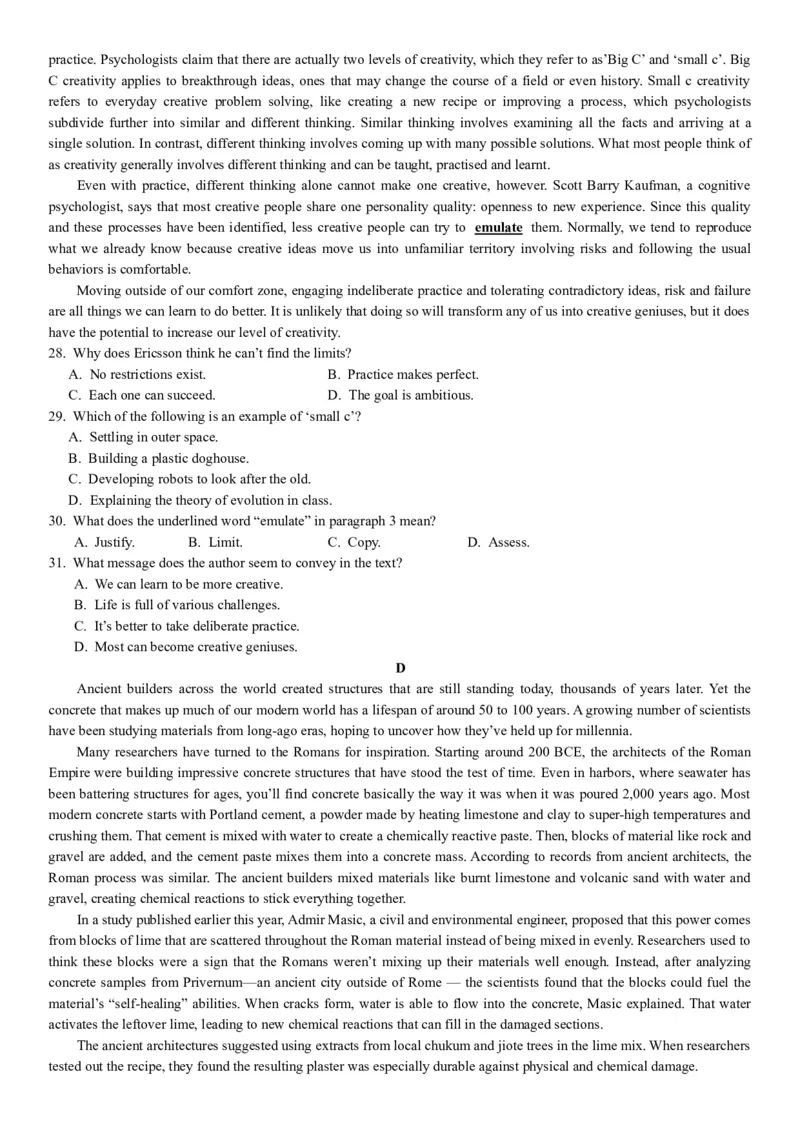
Ericsson has looked primarily at artistic and athletic skills, but can these findings apply to creativity? Most experts
agree that even if most people cannot hope to become creative geniuses, they can learn to become more creative throughpractice. Psychologists claim that there are actually two levels of creativity, which they refer to as’Big C’ and ‘small c’. Big
C creativity applies to breakthrough ideas, ones that may change the course of a field or even history. Small c creativity
refers to everyday creative problem solving, like creating a new recipe or improving a process, which psychologists
subdivide further into similar and different thinking. Similar thinking involves examining all the facts and arriving at a
single solution. In contrast, different thinking involves coming up with many possible solutions. What most people think of
as creativity generally involves different thinking and can be taught, practised and learnt.
Even with practice, different thinking alone cannot make one creative, however. Scott Barry Kaufman, a cognitive
psychologist, says that most creative people share one personality quality: openness to new experience. Since this quality
and these processes have been identified, less creative people can try to emulate them. Normally, we tend to reproduce
what we already know because creative ideas move us into unfamiliar territory involving risks and following the usual
behaviors is comfortable.
Moving outside of our comfort zone, engaging indeliberate practice and tolerating contradictory ideas, risk and failure
are all things we can learn to do better. It is unlikely that doing so will transform any of us into creative geniuses, but it does
have the potential to increase our level of creativity.
28. Why does Ericsson think he can’t find the limits?
A. No restrictions exist. B. Practice makes perfect.
C. Each one can succeed. D. The goal is ambitious.
29. Which of the following is an example of ‘small c’?
A. Settling in outer space.
B. Building a plastic doghouse.
C. Developing robots to look after the old.
D. Explaining the theory of evolution in class.
30. What does the underlined word “emulate” in paragraph 3 mean?
A. Justify. B. Limit. C. Copy. D. Assess.
31. What message does the author seem to convey in the text?
A. We can learn to be more creative.
B. Life is full of various challenges.
C. It’s better to take deliberate practice.
D. Most can become creative geniuses.
D
Ancient builders across the world created structures that are still standing today, thousands of years later. Yet the
concrete that makes up much of our modern world has a lifespan of around 50 to 100 years. A growing number of scientists
have been studying materials from long-ago eras, hoping to uncover how they’ve held up for millennia.
Many researchers have turned to the Romans for inspiration. Starting around 200 BCE, the architects of the Roman
Empire were building impressive concrete structures that have stood the test of time. Even in harbors, where seawater has
been battering structures for ages, you’ll find concrete basically the way it was when it was poured 2,000 years ago. Most
modern concrete starts with Portland cement, a powder made by heating limestone and clay to super-high temperatures and
crushing them. That cement is mixed with water to create a chemically reactive paste. Then, blocks of material like rock and
gravel are added, and the cement paste mixes them into a concrete mass. According to records from ancient architects, the
Roman process was similar. The ancient builders mixed materials like burnt limestone and volcanic sand with water and
gravel, creating chemical reactions to stick everything together.
In a study published earlier this year, Admir Masic, a civil and environmental engineer, proposed that this power comes
from blocks of lime that are scattered throughout the Roman material instead of being mixed in evenly. Researchers used to
think these blocks were a sign that the Romans weren’t mixing up their materials well enough. Instead, after analyzing
concrete samples from Privernum—an ancient city outside of Rome — the scientists found that the blocks could fuel the
material’s “self-healing” abilities. When cracks form, water is able to flow into the concrete, Masic explained. That water
activates the leftover lime, leading to new chemical reactions that can fill in the damaged sections.
The ancient architectures suggested using extracts from local chukum and jiote trees in the lime mix. When researchers
tested out the recipe, they found the resulting plaster was especially durable against physical and chemical damage.Studies have found all kinds of natural materials mixed into structures from long ago: fruit extracts, milk, cheese curd,
beer, even dung and urine. The paste that holds together some of China’s most famous structures—including the Great Wall
and the Forbidden City — includes traces of sticky rice.
“Some of these ancient builders might have just gotten lucky”, said Cecilia Pesce, a materials scientist at the University
of Sheffield in England, “They’d throw just about anything into their mixes, as long as it was cheap and available.”
Today’s builders can’t just copy the ancient recipes. Even though Roman concrete lasted a longtime, it couldn’t hold up
heavy loads: “You couldn’t build a modern skyscraper with Roman concrete,” Cecilia said. “It would collapse.” Instead,
researchers are trying to take some of the ancient material’s specialties and add them into modern mixes.
32. Which of the following statements is TRUE according to the passage?
A. Lime blocks in Roman concrete indicate poor mixing of materials.
B. Ancient Roman concrete structures have witnessed a long history.
C. Modern builders are confused about the Roman method of construction.
D. The concrete used in modern structures has a lifespan of over 200 years.
33. What is proposed as a possible explanation for the self-healing abilities of Roman concrete?
A. The uniform mixing of lime in the concrete.
B. The use of extracts from chukum and jiote trees.
C. The addition of whatever was within reach in the mix.
D. The scattering of blocks of lime throughout the material.
34. The passage mentions that today’s builders can’t simply copy ancient recipes because ______.
A. ancient recipes were not well-documented
B. ancient materials were too expensive
C. ancient materials couldn’t hold up heavy loads
D. ancient builders used materials that are no longer available
35. According to the passage, why do some researchers believe ancient builders included various natural materials in their
mixes?
A. To enhance the beauty of the structures.
B. To make the construction process more cost-effective.
C. To create structures that were resistant to chemical damage.
D. To follow ancient traditions without considering effectiveness.
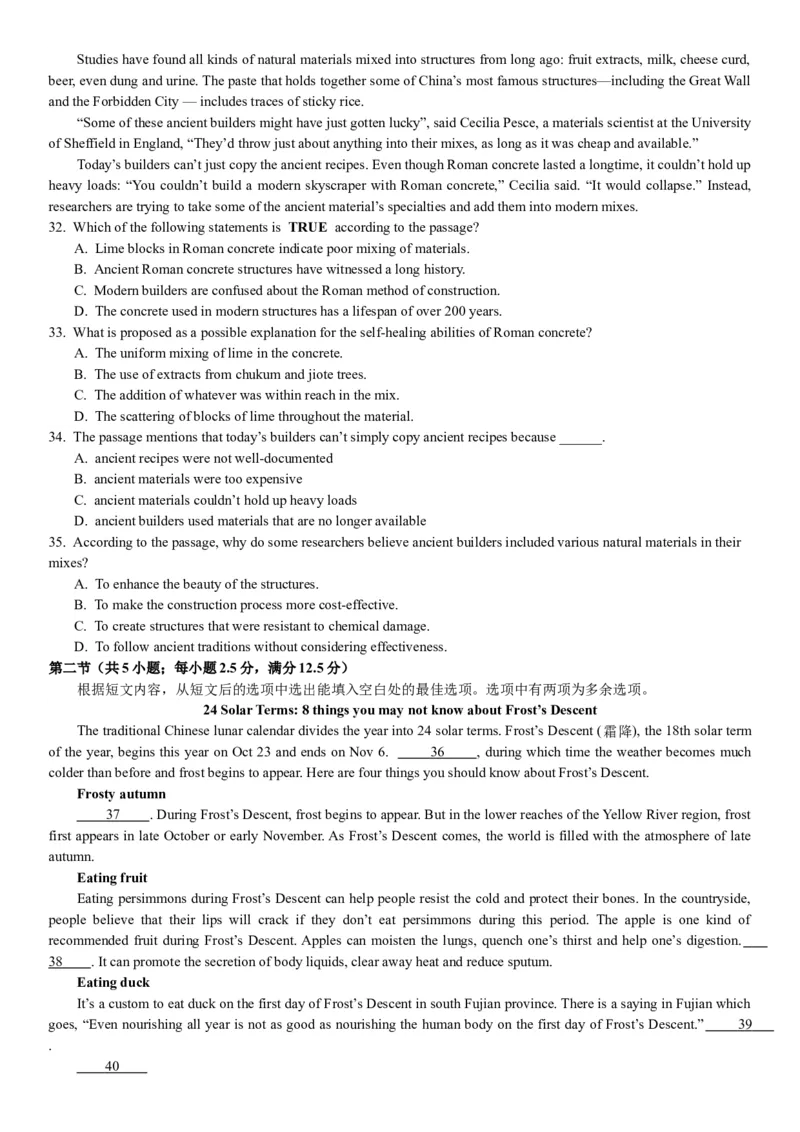
第二节(共5小题;每小题2.5分,满分12.5分)
根据短文内容,从短文后的选项中选出能填入空白处的最佳选项。选项中有两项为多余选项。
24 Solar Terms: 8 things you may not know about Frost’s Descent
The traditional Chinese lunar calendar divides the year into 24 solar terms. Frost’s Descent (霜降), the 18th solar term
of the year, begins this year on Oct 23 and ends on Nov 6. 3 6 , during which time the weather becomes much
colder than before and frost begins to appear. Here are four things you should know about Frost’s Descent.
Frosty autumn
3 7 . During Frost’s Descent, frost begins to appear. But in the lower reaches of the Yellow River region, frost
first appears in late October or early November. As Frost’s Descent comes, the world is filled with the atmosphere of late
autumn.
Eating fruit
Eating persimmons during Frost’s Descent can help people resist the cold and protect their bones. In the countryside,
people believe that their lips will crack if they don’t eat persimmons during this period. The apple is one kind of
recommended fruit during Frost’s Descent. Apples can moisten the lungs, quench one’s thirst and help one’s digestion.
3 8 . It can promote the secretion of body liquids, clear away heat and reduce sputum.
Eating duck
It’s a custom to eat duck on the first day of Frost’s Descent in south Fujian province. There is a saying in Fujian which
goes, “Even nourishing all year is not as good as nourishing the human body on the first day of Frost’s Descent.” 3 9
.
4 0People in areas such as Daxin county in Guangxi Zhuang autonomous region celebrate the first day of Frost’s Descent.
In the Frost’s Descent Festival, the Zhuang people offer sacrifices, dance and sing folk songs. With a history of more than
360 years, the festival is to commemorate Cen Yuyin, a heroine in battles against foreign aggression.
A. Eating chestnuts
B. Frost’s Descent Festival
C. But eating too many could be harmful
D. Frost’s Descent is the last solar term of autumn
E. Eating duck is a way for people there to gain weight
F. The pear is another recommended fruit during Frost’s Descent
G. Frost consists of white ice crystals of frozen water vapor near the ground
第三部分 语言运用 (共两节,满分30分)
第一节 (共15小题;每小题1分,满分15分)
阅读下面短文,从每题所给的A、B、C、D四个选项中选出可以填入空白处的最佳选项。
The days that make us happy make us wise.
--- John Masefield
When I first read this line by England's Poet Laureate, it 4 1 me. What did Masefield mean? Without
thinking about it much, I had always assumed that the 4 2 was true. But his serious assurance was 4 3 . I
was deeply attracted by it.
Slowly, I seemed to 4 4 his meaning and realized the wisdom that happiness makes possible lies in clear
perception, not 4 5 by anxiety nor dimmed by despair and boredom, and without the blind 4 6 caused by
fear.
Active happiness---not mere satisfaction or 4 7 ---often comes suddenly, like an April shower or the unfolding
of a bud. Then you discover what kind of wisdom has 4 8 it. Amazingly, in your eyes, the grass is greener;
bird songs are sweeter; the 4 9 of your friends are more understandable, and more forgivable. Happiness is like a
pair of eyeglasses correcting your 5 0 vision.
Nor are the 5 1 of happiness limited to what is near around you. Unhappy, with your thoughts focused on
your emotional woes (痛苦) , your vision is cut short as though blocked by a wall. Happy, the wall 5 2 .
Consequently, the long vision is there for the seeing. The ground at your feet, the world about you---people, thoughts,
emotions, pressures---are now 5 3 a larger scene. Everything covers a fairer 5 4 . Everything
around you, whether it is encouraging or frustrating, no longer seems such a big deal. And here is the beginning of 5 5
.
41. A. terrified B. satisfied C. surprised D. upset
42. A. other B. opposite C. view D. contrast
43. A. arresting B. amazing C. interesting D. disturbing
44. A. handle B. observe C. appreciate D. seize
45. A. iced B. clouded C. rained D. snowed
46. A. roads B. paths C. spots D. places
47. A. fulfillment B. sorrow C. disappointment D. entertainment
48. A. embraced B. interrupted C. responded D. accompanied
49. A. brightness B. stupidity C. shortcomings D. memories
50. A. physical B. sharp C. spiritual D. solid
51. A. insights B. impressions C. attentions D. expectations
52. A. extended B. collapsed C. witnessed D. withdrew
53. A. got out B. stayed on C. kept off D. fitted into
54. A. proportion B. position C. explanations D. duty
55. A. happiness B. wisdom C. ability D. life
第二节 (共10小题;每小题1.5分,满分15分)阅读下面短文,在空白处填入1个适当的单词或括号内单词的正确形式。
China’s newest online sensation is a pink fox called LinaBell from Shanghai Disneyland. After 5 6 (make) her
debut (初次登台) on September 29, the life-size figure has taken the Chinese social media. Unlike other Disney 5 7
(character), LinaBell has never been on the big or small screen. All we know is that she met Duffy, Mickey Mouse’s teddy
bear gifted to him by his sweetheart Minnie, in the forest and 5 8 (help) him find his way home, according to
Disney’s introduction video of the character. Since her first debut, the fluffy (毛茸茸的) character 5 9 (win) the
hearts of many visitors that were attracted by her unique personality and 6 0 (adore) appearance.
Footage of meet-and-greets with the pink fox are all over the Internet and LinaBell can be seen communicating 6 1
every visitor through expressive body language. She corrects those visitors 6 2 mispronounce her name, shows love
for those queuing up for hours to meet her and hands out free candy.
Visitors to Shanghai Disneyland were the first people 6 3 (meet) LinaBell as she made her global debut from
the Chinese city. As a “ 6 4 (local) born” character, LinaBell can understand different Chinese dialects beyond that of
Shanghai, and can interact with visitors from different parts of China.
Disney’s localization efforts, including the company’s IP products have resulted in its popularity in China. Shanghai
Disneyland has been 6 5 considerable financial success compared to Paris and Hong Kong.
第四部分 写作(共两节,满分40分)
第一节(满分15分)
你们学校正在举办“我最喜欢的格言”的征文活动,内容包括:
1. 对格言进行解释;
2. 结合个人经历谈论意义或启示。
注意:1.词数80词左右;
2.可选择参考内容以外的格言;
3.题目已为你写好My Favourite Proverb。
参考内容: 1. A thousand-mile journey begins with the first step. — Laozi
2. Whatever is worth doing is worth doing well.
My Favourite Proverb
___________________________________________________________________________________________________
___________________________________________________________________________________________________
___________________________________________________________________________________________________
___________________________________________________________________________________________________
_______________________________________________________________________________
第二节 (满分25分)
阅读下面材料,根据其内容和所给段落开头语续写两段,使之构成一篇完整的短文。
A dandelion (蒲公英) kept in my dictionary always reminds me of my lunchtimes with my mother.
When I was in the third grade, I was picked to be the princess in the school play, and for weeks my mother had
practised my lines (台词) so hard with me. But no matter how easily I delivered them at home, as soon as I stepped onstage,
every word disappeared from my head. Finally, my teacher took me aside. She explained that she had written a narrator’s
(旁白) part to the play, and asked me to switch roles.
I didn’t tell my mother what had happened when I went home for lunch that day. But she sensed my pain, and instead
of suggesting we practice my lines, she asked if I wanted to walk in the yard.
It was a lovely spring day and the rose vine (藤蔓) was turning green. Under the huge trees, we could see yellow
dandelions popping through the grass in bunches, as if a painter had touched our landscape with a little bit of gold. I
watched my mother casually bend down by one of the dandelions. “I think I’m going to dig up all these weeds,” she said,
suddenly pulling a flower up by its roots. “From now on, we’ll have only roses in this garden.”
“But I like dandelions,” I protested (抗议). “All flowers are beautiful---even dandelions.” My mother looked at me
seriously. “Yes, every flower has its own beauty, doesn’t it?” she asked thoughtfully. I nodded, feeling pleased that I had
won her over. “And that is true of people too,” she added. “Not everyone can be a princess. Hence, there is no shame in
that.”
Relieved that she had sensed my pain, I started to cry when I told her what had happened. She listened and smiled.注意: 1.续写词数应为 150左右;
2.请按如下格式在以下位置作答。
Paragraph1:
“You will be a beautiful narrator,” she comforted.
___________________________________________________________________________________________________
___________________________________________________________________________________________________
___________________________________________________________________________________________________
___________________________________________________________________________________________________
_______________________________________________________________________________
Paragraph2:
Backstage on the night of the performance, I still felt nervous.
___________________________________________________________________________________________________
___________________________________________________________________________________________________
___________________________________________________________________________________________________
___________________________________________________________________________________________________
_______________________________________________________________________________2024 届高三 11 月模拟测试英语试题参考答案
听力:1—5:ABCAC 6—10:ACABC 11—15:BCBAC 16—20:CABBA
阅读:21—25:CDACB 26—30:DAABC 31—35:ABDCB 36—40:DGFCB
完型:41—45:CBADB 46—50:CADCC 51—55;ABDAB
语法填空:
56. making 57. characters 58. helped 59. has won 60. adorable
61. with 62. who/that 63. to meet 64. locally 65. a
应用文范文:
My Favourite Proverb
My favourite proverb is “A thousand-mile journey begins with the first step.”, which means we should take the first
step with courage to pursue our dream rather than just shout empty slogans without taking any action.
My personal experience is a case in point. At senior 1, I had difficulty keeping up with others in English. At that time, I
had two choices. I could choose to give up and also I could choose to find out the root of the problem and seek solutions. I
chose the latter. I took immediate steps and made determined efforts to improve my English step by step. I began with
reciting words and reviewing them several times. To others, it was seemingly too easy to mention. But to me, it was a key
step for me to improve my English. If excelling at English is my long journey, I am glad that I took the first step bravely and
determinedly in senior 1.
This proverb can serve as a reminder that long and arduous as the journey ahead is, we can be closer to our dream as
long as we are brave enough to take action.
读后续写:
“You will be a beautiful narrator,” she comforted. Upon hearing her comforting words, I held back my bitter tears, lost
in deep thought. Hardly had she noticed the sadness on my face soften a little when she caressed my hair, adding, “No one is
born to be a princess. Why not take advantage of narrator’s part?” With mother’s encouragement, I began to accept that the
narrator’s part was of vital significance. In the following weeks, every lunchtime with my mother witnessed my mighty
effort to practice my part of lines. So fast did time pass that the performance day arrived.
Backstage on the night of the performance, I still felt nervous. Sweat oozing from my palms, it was at that very
moment that I found a dandelion in my pocket. In a flash, I realized my mother had passed the flower to me, which meant to
be in company with me. Consumed with courage and confidence, I concentrated on my part and the performance turned out
to be a great success, the audience standing up and bursting into thunderous applause. After the play, I put the dandelion into
my dictionary, which was a reminder of our precious lunchtimes, bathed in the soft midday light.
听力原文:
Text 1
M: Getting to work in the morning seems to take longer each day. I was late again this morning.
W: Are you still driving in?
M: Yes. The traffic was so bad in the morning. It’s just one traffic jam after another on the road (1).
❖ a traffic jam 交通堵塞
Text 2
W: Have you noticed that people here in Mexico stand very close together?
M: Yes. It’s the same in Peru too.
W: It’s the opposite in Britain. I was a little uncomfortable here at first (2). But after a few days, I’m gelling used to it.
Text 3
M: Hi, I ordered a book from Justin Lewis Iasi week. I was wondering if it has come in yet (3). My name is Peter
学科网(北京)股份有限公司Schneider.
W: Lei me check it for you, Mr. Schneider. Yes, the book has arrived this morning and should be ready for you to pick up
this afternoon.
Text 4
W: Have you seen Jim since it happened?
M: Yes. He was hoping to spend his holiday touring with his football team but he had to pull out.
W: When will he be able to play again?
M: It takes months for a broken leg lo recover fully (4).
❖ pull out从某事物中退出
Text 5
W: I wish I had more time to spend with Lily. She has to go to a babysitter every morning.
M: It’s tough when you work so much.
W: Well, sometimes I have to ask my boss for a leave lo look after her (5).
❖ babysitter临时保姆:(居家)保姆
Text 6
M: Did you see that thunderstorm yesterday afternoon? The lightning was amazing.
W: I was walking home from football practice when the rain started (6).
M: It was really heavy.
W: Yeah. When it began I’d just left the sports center, so I was able to go back and take cover inside. I called my mum to
say I’d be home late. Anyway, I met a friend who was still there so we just chatted and waited till it was over. Shame I
missed seeing the lightning though (7). I heard ii was very impressive.
❖ shame遗憾
Text 7
W: Oh, Jeremy, there you arc. Have you had a chance to check out the problem I mentioned yesterday? I think
there’s an issue with the heater in the conference room.
M: Ah ... not yet. I’ve been setting up the new workspaces for the part-time workers we recently hired (9).
W: I’m planning to host our visiting clients in that room this afternoon, so I’ll change the location if it’s still cold in there.
M: OK, I’ll get to the conference room as soon as I finish.
W: Great. And let me know if it can’t be fixed by noon (8).
Text 8
W: Thanks for letting me borrow the lent, Sam (10).
M: No problem, Tara. I was worried it’d be too small.
W: It was a little tight but we managed. We’ll have to get a big one for next time. Anyway, it was a great
camping trip!
M: Are you going again soon?
W: No, we’re practicing our rock climbing for a little while to get into shape (11).
M: It’s great for building strength! Me and Shelly do ii at the climbing center just out of town. It’s fun solving the puzzle of
how to get up, and exciting too!
W: True that! My gym has a practice wall but we’d like to do it in the wild one day!
M: I have a guide I can recommend. He’ll take you to the best climbing spot and it has all the equipment too!W: Great! Do you want to practice together?
M: Sure, I’m going with Shelly at 6 pm tonight.
W: Excellent. I’ll meet you at the center then! (12)
Text 9
M: So Olivia, tell us how that happened.
W: Well, when I was driving in the mountain road, I took a wrong turning and got completely lost (13).
M: Was that frightening?
W: Yeah. While I was trying to decide how to get back to the main road, some heavy snow started coming
down.
M: I was quite certain it wouldn’t last long. It was March in Italy.
W: I wasn’t worried at first, but I didn’t have much petrol left so I switched off the engine (14). I tried to phone for help but
couldn’t get through.
M: How did you stay warm? With the car heater?
W: That meant having the engine on so I only used it a bit. Instead I got all of my jumpers and trousers from my suitcases
and wore them all night (15). I was still frozen, though, and wished I had some coffee or tea with me.
M: So you spent the whole night inside the car?
W: Yes. I managed to contact the emergency services finally. They knew my location from my phone signal. They’d called
to ask if I needed an ambulance and luckily I didn’t need it, so they just cleared the snow and led me along the road back
to the main road (16).
Text 10
M: Continuing our broadcast of public service announcements, Worldwide Helpers announces upcoming openings for a
number of volunteer worker positions. All applicants must meet the following requirements.
First of all, applicants must be over 18 years of age (17). The company apologizes, but there can be no
exceptions to this rule. Second, people interested in these positions may not have police records. A parking ticket
and things like that are, of course, no problem. The employer will, of course, check with the police to confirm your
clean record.
In addition, applicants must supply references from past or present employers or teachers along with their recent CV
(18). These references must be relevant to the applicant’s work habits (19). Remember, these are references from
employers or teachers. A note from your dear old Mum won’t do. Worldwide Helpers assures me that they will contact
these references to confirm they are genuine.
Although all positions are volunteers, the employer will cover some of your expenses. For example, they will pay for
transportation to and from the job site. Aside from that, the cost of phone calls is covered. But I’m sorry to say that you
have to have dinner at your own home (20).
答案解析:
A
【导语】本文是一篇应用文。文章介绍了黄石国家公园旅游信息。
21. 细节理解题。根据Rates Per Person(人均费用)部分表格中信息可知,在2024年1月1日到2024年12月31日期
间的2人以上共用房间是760美元每人,所以,在2024年9月,一对夫妇两人至少要付:760*2=1520美元。故选
学科网(北京)股份有限公司C项。
22. 细节理解题。根据第一段中“Within Yellowstone’s 2.2 million acres, visitors have wonderful opportunities to
observe wildlife in a well-preserved ecosystem and view geologic wonders like the Grand Canyon (峡谷) of the
Yellowstone River.(在黄石公园220万英亩的土地上,游客们有绝佳的机会在保存完好的生态系统中观察野生动物,
并欣赏黄石河大峡谷等地质奇观。)”可知,黄石国家公园旅游适合观赏野生动物和生态系统。故选D项。
23. 推理判断题。根据文章标题“Yellowstone Tour(黄石公园之旅)”和文中“Tour Features(旅游特色)”和“Rates Per
Person(人均费用)”可推知,本文可能出自一本介绍了黄石国家公园旅游信息的旅游手册。故选A项。
B
【导语】这是一篇记叙文。文章主要讲述了作者参加Summit Learning课程的经历和感受。
24. 细节理解题。根据第一段的“When I first heard about Summit Learning, I admitted I was not a bit happy and excited
at all.(当我第一次听说Summit Learning的时候,我承认我一点也不高兴和兴奋)”和第二段的“I would never have
taken part if it was up to me, as I preferred to work independently.(如果由我来决定,我绝不会参加,因为我更喜欢独立
工作)”可知,作者对Summit Learning的第一反应是不想参加。故选C。
25. 细节理解题。根据第三段的“The peer activities we did with a partner gave me more belief in my ability and
inspired me to do more to make my presentation the best it could possibly be.(我们和一个伙伴一起做的同伴活动让我对
自己的能力更有信心,并激励我做更多的事情,使我的演讲尽可能最好)”可知,诗歌活动提高了作者的诗歌和信心。
故选B。
26. 推理判断题。根据倒数第二段“As an active boy, I have always been ahead and advanced, but in a normal
classroom, there are restrictions on what I can do. With Summit Learning, I can go beyond expectations in projects or move
ahead in learning new content when I’m ready. I have ownership of my work and pursue my goals.(作为一个好动的男孩,
我一直走在前面,不断进步,但是在一个正常的教室里,我所能做的是有限制的。有了Summit Learning,我可以
在项目中超越预期,或者在我准备好的时候继续学习新内容。我对自己的工作有主人翁精神,并追求自己的目标)”
推知,Summit Learning转变了学习的方式。故选D。
27. 推理判断题。根据最后一段“Summit Learning has showed me how much people can grow and change. It has helped
me see people and myself differently. It has been one of the greatest experiences of my life, and I cannot see myself going
back to a normal classroom.(峰会学习向我展示了人可以成长和改变多少。它帮助我以不同的方式看待别人和自己。
这是我一生中最伟大的经历之一,我无法想象自己会回到正常的教室)”可推知,作者认为Summit Learning非常有
启发意义的。故选A。
C
【导语】本文是一篇说明文,主要讲的是通过练习,我们可以提高我们的创造力。
28. 细节理解题。根据第一段“He says he has yet to find the limits on being successful and he doesn’t believe them to be
real. (他说他还没有找到成功的限制,他不相信这些限制是真的。)”可知,埃里克森认为他找不到极限是因为不存
在任何限制。故选A。
29. 推理判断题。根据第二段“Small c creativity refers to everyday creative problem solving, like creating a new recipe
or improving a process, which psychologists subdivide further into similar and different thinking. (小创造力指的是日常创
造性地解决问题,比如创造一个新配方或改进一个过程,心理学家将其进一步细分为相似和不同的思维。)”可知,
建一个塑料狗窝是“小c”的例子,因为这是创造一个新东西的过程,故选B。
30. 词句猜测题。根据倒数第二段的“Normally, we tend to reproduce what we already know because creative ideas
move us into unfamiliar territory involving risks and following the usual behaviors is comfortable. (通常情况下,我们倾
向于复制我们已经知道的东西,因为创造性的想法会把我们带入一个充满风险的陌生领域,而遵循通常的行为是
舒适的。)”可知,划线词所在句子的意思是“由于这种品质和这些过程已经被确定,缺乏创造力的人可以尝试模仿
他们”,划线词的意思是“模仿,复制”,和copy意思相近,故选C。
31. 主旨大意题。根据最后一段的“Moving outside of our comfort zone, engaging indeliberate practice and tolerating
contradictory ideas, risk and failure are all things we can learn to do better. It is unlikely that doing so will transform any of
us into creative geniuses, but it does have the potential to increase our level of creativity. (走出我们的舒适区,进行不经
意的练习,容忍矛盾的想法,风险和失败,这些都是我们可以学会做得更好的事情。这样做不太可能把我们中的任何一个人变成有创造力的天才,但它确实有可能提高我们的创造力水平。)”可知,本文主要讲的是通过练习,我
们可以提高我们的创造力,因此本文主要想表达的是“我们可以学着更有创造力”。故选A。
D
【导语】本文是一篇说明文。文章介绍了世界各地的古代建筑者所建造的建筑在几千年后的今天仍然屹立不倒的
原因。
32. 细节理解题。根据第二段中的“Starting around 200 BCE, the architects of the Roman Empire were building
impressive concrete structures that have stood the test of time. Even in harbors, where seawater has been battering structures
for ages, you’ll find concrete basically the way it was when it was poured 2,000 years ago.(从公元前200年左右开始,罗
马帝国的建筑师们开始建造令人印象深刻的混凝土结构,这些结构经受住了时间的考验。即使是在海港里,海水
冲刷建筑物已经有很长时间了,你也会发现混凝土基本上还是2000年前浇筑时的样子)”可知,古罗马混凝土结构
见证了悠久的历史。故选B。
33. 细节理解题。根据第三段“In a study published earlier this year, Admir Masic, a civil and environmental engineer,
proposed that this power comes from blocks of lime that are scattered throughout the Roman material instead of being
mixed in evenly. Researchers used to think these blocks were a sign that the Romans weren’t mixing up their materials well
enough. Instead, after analyzing concrete samples from Privernum — an ancient city outside of Rome — the scientists
found that the blocks could fuel the material’s “self-healing” abilities. When cracks form, water is able to flow into the
concrete, Masic explained. That water activates the leftover lime, leading to new chemical reactions that can fill in the
damaged sections. (在今年早些时候发表的一项研究中,土木和环境工程师Admir Masic提出,这种能量来自分散在
罗马材料中的石灰块,而不是均匀混合在一起。研究人员过去认为,这些石块表明罗马人没有很好地混合材料。
相反,在分析了Privernum——罗马以外的一个古老城市——的混凝土样本后,科学家们发现这些砖块可以促进材
料的“自我修复”能力。Masic解释说,当裂缝形成时,水就会流入混凝土中。这些水激活了剩余的石灰,导致新
的化学反应,可以填补受损的部分)”可知,遍布材料的石灰块使得罗马混凝土具有自我修复的能力。故选D。
34. 细节理解题。根据最后一段中的“Even though Roman concrete lasted a longtime, it couldn’t hold up heavy loads:
“You couldn’t build a modern skyscraper with Roman concrete,” Cecilia said. “It would collapse.”(尽管罗马混凝土使用了
很长时间,但它无法承受沉重的负荷:“你无法用罗马混凝土建造一座现代摩天大楼,”塞西莉亚说。“它会崩
溃。”)”可知,今天的建造者不能简单地复制古代的方法,因为古代的材料不能承受沉重的负荷。故选C。
35. 推理判断题。根据倒数第二段““Some of these ancient builders might have just gotten lucky”, said Cecilia Pesce, a
materials scientist at the University of Sheffield in England, “They’d throw just about anything into their mixes, as long as it
was cheap and available.”(英国谢菲尔德大学的材料科学家Cecilia Pesce说:“一些古代建造者可能只是运气好,他
们会把任何东西都扔进混合物里,只要便宜、容易买到。”)”可推知,一些研究人员认为,古代建筑者在他们的混
合物中加入了各种天然材料,以使施工过程更具成本效益。故选B。
七选五
【导语】这是一篇说明文。作者介绍了秋天的最后一个节气霜降的时间,特点以及习俗。
36. 根据前文“The traditional Chinese lunar calendar divides the year into 24 solar terms. Frost’s Descent (霜降), the 18th
solar term of the year, begins this year on Oct 23 and ends on Nov 6. (中国传统的农历把一年分为24个节气。霜降,一
年中的第18个节气,从今年10月23日开始,到11月6日结束) ”以及后半句“during which time the weather
becomes much colder than before and frost begins to appear (在此期间天气变得比以前冷得多,开始出现霜冻)”可知,
D项:Frost’s Descent is the last solar term of autumn(霜降是秋天的最后一个节气)承接前文霜冻的话题,引出后句介
绍霜降时天气的变化。故选D。
37. 根据后文“During Frost’s Descent, frost begins to appear. (在霜降期间,霜冻开始出现)”可知,G项:Frost
consists of white ice crystals of frozen water vapor near the ground(霜是由靠近地面的水汽凝结而成的白色冰晶)符合语
境,介绍霜冻的成因,故选G。
38. 根据前文“The apple is one kind of recommended fruit during Frost’s Descent. Apples can moisten the lungs, quench
one’s thirst and help one’s digestion. (苹果是霜降期间推荐的水果之一。苹果可以润肺、止渴、助消化)”可知,F项:
The pear is another recommended fruit during Frost’s Descent(霜降期间,梨是另一种推荐的水果)承接前文,介绍霜降
学科网(北京)股份有限公司期间推荐的另一种水果。故选F。
39. 根据前文“It’s a custom to eat duck on the first day of Frost’s Descent in south Fujian province. There is a saying in
Fujian which goes, “Even nourishing all year is not as good as nourishing the human body on the first day of Frost’s
Descent.”(在福建省南部,霜降第一天吃鸭子是一种习俗。福建有句谚语说:“即使是一年的滋养,也不如霜降第
一天的滋养人体。”)”可知,C项:But eating too many could be harmful(但是吃太多可能是有害的)承接前文,与上
文形成转折关系,说明不要吃太多的鸭肉,故选C。
40. 设空处概括本段内容,为本段小标题,根据后文“People in areas such as Daxin county in Guangxi Zhuang
autonomous region celebrate the first day of Frost’s Descent. In the Frost’s Descent Festival, the Zhuang people offer
sacrifices, dance and sing folk songs. (广西壮族自治区大新县等地的人们庆祝霜降的第一天。在霜降节,壮族人祭祀,
跳舞,唱民歌。)”介绍霜降节里的活动可知,B项:Frost’s Descent Festival(霜降节)概括本段的主题。故选B。
完形填空
【导语】本文是一篇夹叙夹议文。主要论述了作者对“使我们快乐的日子使我们聪明”这句话的深刻认识。
41. 考查动词词义辨析。句意:当我第一次读到英国桂冠诗人的这句话时,我很惊讶。A. terrified使害怕;B.
satisfied使满意;C. surprised使惊讶;D. upset使心烦意乱。根据“Without thinking about it much, I had always
assumed that the 2 was true.(没有仔细考虑,我一直认为事实正好相反。)”可知,因为和作者一直认为的
事实正好相反,所以作者感到惊讶。故选C。
42. 考查名词词义辨析。句意:没有仔细考虑,我一直认为事实正好相反。A. other两者中的另一个(代词);B.
opposite相反的人或物、对立面;C. view观点,看法;D. contrast差异,对比。根据上文“When I first read this line
by England's Poet Laureate, it 1 me. (我第一次读到英国桂冠诗人的这句话时,我很惊讶。)”可知,作者惊
讶的原因是,这句话和作者认为的事实正好相反。故选B。
43. 考查形容词词义辨析。句意:但他那严肃的保证却引人注目。A. arresting醒目的;引人注意的;B. amazing惊
人的,了不起的;C. interesting有趣的;D. disturbing令人不安的。根据“I was deeply attracted by it.(我被它深深吸
引了)”可知,他那严肃的保证引人注目,是作者被深深吸引。故选A。
44. 考查动词词义辨析。句意:慢慢地,我似乎领会了他的意思,意识到幸福所带来的智慧在于清晰的洞察力,不
为焦虑所笼罩,不为绝望和厌倦所蒙蔽,也没有因恐惧而产生的盲点。A. handle处理,应付;B. observe观察;C.
appreciate感激;D. seize领悟,理解。根据“and realized the wisdom that happiness makes possible lies in clear
perception(洞察力)(意识到幸福所带来的智慧在于清晰的洞察力)”可知,作者慢慢领悟到幸福所带来的智慧在于清
晰的洞察力。故选D。
45. 考查动词词义辨析。句意:慢慢地,我似乎领会了他的意思,意识到幸福所带来的智慧在于清晰的洞察力,不
为焦虑所笼罩,不为绝望和厌倦所蒙蔽,也没有因恐惧而产生的盲点。A. iced杀死;结冰;B. clouded破坏,
给……蒙上阴影;C. rained下雨;D. snowed下雪。根据“and realized the wisdom that happiness makes possible lies
in clear perception(洞察力)(意识到幸福所带来的智慧在于清晰的洞察力)”可知,幸福所带来的智慧在于清晰的洞察
力,不为焦虑所笼罩。故选B。
46. 考查名词词义辨析。句意:慢慢地,我似乎领会了他的意思,意识到幸福所带来的智慧在于清晰的洞察力,不
为焦虑所笼罩,不为绝望和厌倦所蒙蔽,也没有因恐惧而产生的盲点。A. roads道路;B. paths通道;C. spots点;
斑点;D. places地方。根据“caused by fear(因恐惧而产生)”可知,幸福所带来的智慧在于清晰的洞察力,没有因恐
惧而产生的盲点。故选C。
47. 考查名词词义辨析。句意:积极的快乐——不仅仅是满足或实现,往往来得突然,就像四月的阵雨或花蕾的绽
放。A. fulfillment实现;满足(感);B. sorrow悲哀;C. disappointment失望;D. entertainment娱乐,娱乐表演。
根据“Active happiness---not mere satisfaction(积极的快乐——不仅仅是满足)”可知,积极的快乐不仅仅是满足或实
现。故选A。
48. 考查动词词义辨析。句意:然后你会发现伴随它而来的是什么样的智慧。A. embraced拥抱;B. interrupted打断;
中断;C. responded回答,回报;D. accompanied伴随。此处it指代上句的“Active happiness(积极的快乐)”以及根
据“Amazingly, in your eyes, the grass is greener; bird songs are sweeter; the 9 of your friends are more
understandable, and more forgivable. (令人惊奇的是,在你的眼里,草更绿了;鸟儿的歌声更甜美;朋友的缺点更容易
理解,也更容易原谅。)”可知,你会发现伴随积极的快乐而来的智慧是在你的眼里,草更绿了;鸟儿的歌声更甜美;朋友的缺点更容易理解,也更容易原谅。故选D。
49. 考查名词词义辨析。句意:令人惊奇的是,在你的眼里,草更绿了;鸟儿的歌声更甜美;朋友的缺点更容易理
解,也更容易原谅。A. brightness聪明,活泼;B. stupidity愚蠢,糊涂;C. shortcomings缺点;D. memories记忆。
根据“your friends are more understandable(更容易理解)”可知,朋友的缺点更容易理解。故选C。
50. 考查形容词词义辨析。句意:快乐就像一副眼镜,可以矫正你的精神视力。A. physical身体的,肉体的;B.
sharp锋利的;C. spiritual精神的,心灵的;D. solid坚硬的;固体的。根据“Amazingly, in your eyes, the grass is
greener; bird songs are sweeter; the 9 of your friends are more understandable, and more forgivable. (令人惊奇
的是,在你的眼里,草更绿了;鸟儿的歌声更甜美;朋友的缺点更容易理解,也更容易原谅。)”可知,快乐让自己
的精神更加的富足。故选C。
51. 考查名词词义辨析。句意:对快乐的洞察并不局限于你周围的事物。A. insights洞察力;B. impressions印象;
C. attentions 注意;D. expectations期待。根据“of happiness(对于幸福)”可知,是对快乐的洞察力并不局限于周围
的事物。故选A。
52. 考查动词词义辨析。句意:高兴的时候,墙倒了。A. extended扩大,延长;B. collapsed倒塌;崩溃;C.
witnessed目击,亲眼看到;D. withdrew收回。根据“Unhappy, with your thoughts focused on your emotional woes (痛
苦) , your vision is cut short as though blocked by a wall.(当你不快乐时,你的思想集中在你的情感悲伤上,你的视野
就像被一堵墙挡住了一样)”可知,你不快乐时,你的思想集中在你的情感悲伤上,视野就像被一堵墙挡住,当高兴
的时候,墙倒了。故选B。
53. 考查动词短语词义辨析。句意:你脚下的土地,你周围的世界——人、思想、情感、压力——现在都融入了一
个更大的场景。A. got out离开,逃脱;B. stayed on继续从事某项工作;C. kept off远离,不接触;D. fitted into适
应,融入。根据“Everything around you, whether it is encouraging or frustrating, no longer seems such a big deal.(你周
围的一切,无论是令人鼓舞的还是令人沮丧的,都不再显得那么重要。)”可知,当周围的一切,都融入了一个更大
的场景的时候,都不再显得那么重要。故选D。
54. 考查名词词义辨析。句意:每件事都有一个公平的比例。 A. proportion部分,份额;B. position位置;C.
explanations解释;D. duty职责。根据“Everything around you, whether it is encouraging or frustrating, no longer seems
such a big deal.(你周围的一切,无论是令人鼓舞的还是令人沮丧的,都不再显得那么重要。)”可知,你周围的一切,
都不再显得那么重要,因为每件事都有一个公平的比例。故选A。
55. 考查名词词义辨析。句意:这就是智慧的开端。A. happiness快乐;B. wisdom智慧;C. ability能力;D. life生
活。根据“Everything around you, whether it is encouraging or frustrating, no longer seems such a big deal.(你周围的一
切,无论是令人鼓舞的还是令人沮丧的,都不再显得那么重要。)”可知,你周围的一切,都不再显得那么重要,因
为每件事都有一个公平的比例。这就是智慧的开始。故选B。
语法填空
【导语】本文一篇新闻报道。文章主要报道了中国最新的网络红人——上海迪士尼乐园的粉红狐狸LinaBell。
56. 考查非谓语动词。句意:自9月29日首次亮相以来,这个真人大小的人偶已经登上了中国的社交媒体。介词
after后用动名词作宾语。故填making。
57. 考查可数名词单复数。句意:与其他迪士尼角色不同,LinaBell从未出现在大屏幕或小屏幕上。形容词other
意为“其他的”,只修饰复数名词。故填characters。
58. 考查时态语态。句意:我们所知道的是,根据迪士尼的角色介绍视频,她在森林里遇到了达菲,这是米老鼠的
爱人米妮送给他的泰迪熊,并帮助他找到了回家的路。提示词与动词met是并列关系,作谓语动词,与主语she之
间是主动关系,讲述过去的事情用一般过去时态。故填helped。
59. 考查时态语态和主谓一致。句意:自从她首次亮相以来,这个毛茸茸的角色就赢得了许多游客的心,他们被她
独特的个性和可爱的外表所吸引。win(赢得)是主句中谓语动词,与主语the fluffy (毛茸茸的) character之间是主动
关系,句中有时间状语Since her first debut,应使用现在完成时态,又因主语是单数名词,所以谓语动词也应使用
单数形式。综上,谓语应用现在完成主动语态,单数形式。故填has won。
60. 考查形容词。句意:自从她首次亮相以来,这个毛茸茸的角色就赢得了许多游客的心,他们被她独特的个性和
可爱的外表所吸引。提示词作定语修饰名词appearance,用形容词adorable,意为“可爱的”。故填adorable。
学科网(北京)股份有限公司61. 考查介词。句意:网上到处都是LinaBell与粉红狐狸见面打招呼的视频,可以看到LinaBell通过富有表现力的
肢体语言与每一位访客交流。communicate with是固定搭配,意为“与……交流”。故填with。
62. 考查定语从句。句意:她会纠正那些念错她名字的游客,对那些排了几个小时队想见她的人表示爱,并发放免
费糖果。分析句子可知,空格处单词引导限制性定语从句,修饰先行词visitors,关系词代替先行词在定语从句中
作主语,应使用关系代词who或者that引导该从句。故填who/that。
63. 考查非谓语动词。句意:上海迪士尼乐园的游客是第一批见到LinaBell的人,这是她在中国城市的首次全球亮
相。“the+序数词+(名词)+to do”是固定搭配,意为“第几个做……的……”,不定式作后置定语。故填to meet。
64. 考查副词。句意:作为一个“本地出生”的角色,LinaBell可以听懂上海以外的不同中国方言,并可以与来自
中国不同地区的游客互动。提示词修饰形容词born,用副词locally,意为“本地,本土”,作状语。故填
locally。
65. 考查冠词。句意:与巴黎和香港相比,上海迪士尼乐园在财务上取得了相当大的成功。可数名词success在句
中表示“一次成功”,泛指,considerable发音以辅音音素开头,用不定冠词a修饰。故填a。