文档文本内容
第一部分 听力(共两节,满分30分)
做题时,先将答案标在试卷上,录音结束后,你将有两分钟的时间将试卷上的答案转涂到答题卡上。
第一节 (共5小题,每小题1.5分,满分7.5分)
听下面5段对话。每段对话后有一个小题,从题中所给的A、B、C三个选项中选出最佳答案。听完每段对话后,你
都有10秒钟的时间来回答有关小题和阅读下一小题。每段对话仅读一遍。
例: How much is the shirt?
A. £ 19.15. B. £9.18. C. £9.15.
答案是C.
1. What does the man want to do?
A. Take photos. B. Buy a camera. C. Help the woman.
2. What are the speakers talking about?
A. A noisy night. B. Their life in town. C. A place of living.
3. Where is the man now?
A. On his way. B. In a restaurant. C. At home
4. What will Celia do?
A. Find a player. B. Watch a game. C. Play basketball.
5. What day is it when the conversation takes place?
A. Saturday. B. Sunday. C. Monday.
第二节 (共15小题:每小题1.5分,满分22.5分)
听下面5段对话或独白。每段对话或独白后有几个小题,从题中所给的A、B、C三个选项中选出最佳选项,并标在
试卷的相应位置。听每段对话或独白前,你将有时间阅读各个小题,每小题5秒钟;听完后,个小题将给出5秒钟
的作答时间。每段对话或独白读两遍。
第1页 | 共15页听第6段材料,回答6、7题。
6. What is Sara going to do?
A. Buy John a gift. B. Give John a surprise. C. Invite John to France.
7. What does the man think of Sara’s plan?
A. Funny. B. Exciting. C. Strange.
听第7段材料,回答第8、9题。
8. Why does Diana say sorry to peter?
A. She has to give up her travel pan.
B. She wants to visit another city.
C. She needs to put off her test.
9. What does Diana want Peter to do?
A. Help her with her study.
B. Take a book to her friend.
C. Teach a geography lesson.
听第8段材料,回答第10至12题。
10. Why does the man call the woman?
A. To tell her about her new job.
B. To ask about her job program.
C. To plan a meeting with her.
11. Who needs a new flat?
A. Alex. B. Andrea. C. Miranda.
第2页 | 共15页12. Where is the woman now?
A. In Baltimore. B. In New York. C. In Avon.
听第9段材料,回答第13至16题。
13. What does Jan consider most important when he judges a restaurant?
A. Where the restaurant is.
B. Whether the prices are low.
C. How well the food is prepared.
14. When did Jan begin to write for a magazine?
A. After he came back to Sweden.
B. Before he went to the United States.
C. As soon as he got his first job in 1982.
15. What may Jan do to find a good restaurant?
A. Talk to people in the street.
B. Speak to taxi drivers.
C. Ask hotel clerks.
16. What do we know about Jan?
A. He cooks for a restaurant.
B. He travels a lot of his work.
C. He prefers American food.
听第10段材料,回答第17至20题。
17. What do we know about the piaza Leen?
第3页 | 共15页A. It’s new building. B. It’s a small town. C It’s public place.
18. When do parents and children like going to the Piaza Leen?
A. Saturday nights. B. Sunday afternoons. C. Fridays and Saturdays.
19. Which street is known for its food shops and markets?
A. Via dei Mar Street. B. Femando Street. C. Hemandes Street.
20. Why does the speaker like Horation Street best ?
A. It has an old stone surface.
B. It is named after a writer.
C. It is a famous university.
第三节 语法和词汇知识(共15小题;每小题1分,满分15分)
从每小题的A、B、C、D四个选项中,选出可以填入空白处的最佳选项,并填在答题卡上将该选项涂黑。
25. everyone here,I wish you a pleasant journey back to your journey.
A.By means of B.On behalf of C.In search of D.For fear of
26.At no time the rules of the game.It was unfair to punish them.
第4页 | 共15页A.they actually broke B.do they actually break
C.did they actually break D.they had actually broken
27.Everything seemed to be going for the first two days after I arrived in New York.
A.vividly B.generally C.frequently D.smoothly
28.Lauro was away in Paris for over a week.When she got home,there was a pile of mails for her
A.waited B.to wait C.waiting D.was waiting
29.To her joy,Della earned first the trust of her students and of her collegues.
A.that B.one C.ones D.those
II.完形填空(共20小题;每小题1.5分,满分30分)
第5页 | 共15页阅读下面短文,从短文后各题的A、B、C、D四个选项中,选出适合填入对应空白处的最佳选项,并在答题
卡上将该选项涂黑。
A little girl lived in a simple and poor house on a hill.Usually she 36 play in the small garden.She could see over the
garden fence and across the valley a wonderful house with shining golden windows high on another hill.37 she loved her
parents and her family, she desired to live in such a house and 38 all day about how wonderful and exciting 39 must feel to
live there.
36.A.might B.should C.would D.must
37.A.Unless B.Although C.Since D.But
38.A.dreamed B.worried C.asked D.shouted
39.A.this B.that C.it D.which
40.A.different B.scientific C.musical D.basic
41.A.begged B.blamed C.invited D.paid
42.A.inside B.outside C.through D.along
43.A.insisting on B.relying on C.arguing about D.wondering about
44.A.travelling B.running C.riding D.walking
45.A.madly B.rapidly C.exactly D.possibly
46.A.Over B.Down C.Around D.Beside
47.A.windows B.steps C.center D.gate
48.A.Until B.As C.While D.Because
第6页 | 共15页49.A.getting B.introducing C.leading D.moving
50.A.felt B.learned C.concluded D.found
51.A.transparent B.bright C.plain D.wide
52.A.anxious B.angry C.serious D.sad
53.A.turned around B.cheered up C.settled down D.dropped in
54.A.hill B.valley C.background D.sight
55.A.imagined B.decided C.realized D.guessed
第三部分 阅读理解(共两节,满分40分)
第一节(共15小题;每小题2分,满分30分)
阅读下列四篇短文,从每小题后所给的A、B、C、D四个选项中,选出最佳选项,并在答題卡上将该选项涂
黑。
A
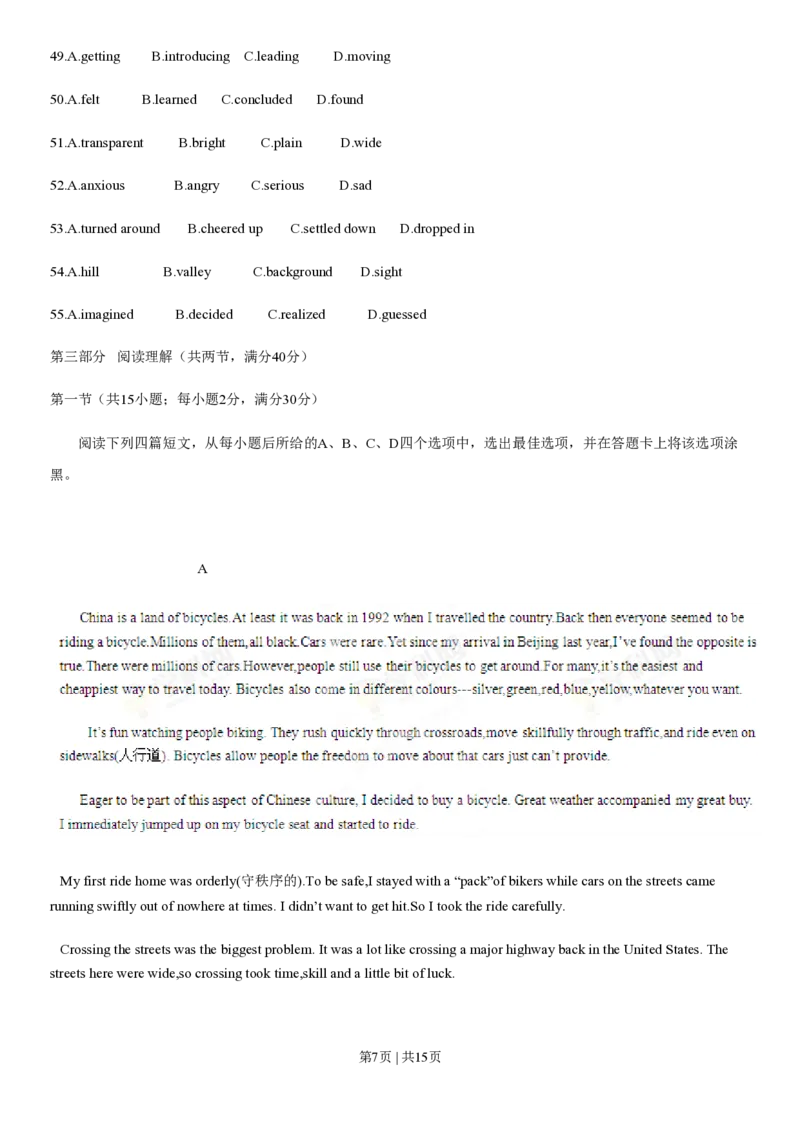
My first ride home was orderly(守秩序的).To be safe,I stayed with a “pack”of bikers while cars on the streets came
running swiftly out of nowhere at times. I didn’t want to get hit.So I took the ride carefully.
Crossing the streets was the biggest problem. It was a lot like crossing a major highway back in the United States. The
streets here were wide,so crossing took time,skill and a little bit of luck.
第7页 | 共15页I finally made it home. The feeling on the bicycle was amazing. The air hitting my face and going through my air was
wonderful. I was sitting on top of the world as I passed by places and people.Biking made me feel alive.
58.How did the suthour feel about his street crossing?
A.It was boring.
B.It was difficult.
C.It was lively.
D.It was wonderful.
59.Which of the following best describes the authour’s biking experience?
A.The authour enjoyed showing off his biking skill.
B.The author was annoyed by the air while riding.
C.The authour was praised by the other bikers.
D.The authour took great pleatsure in biking.
B
第8页 | 共15页60. What might be the best title for the passage?
A.Going green
B.Protecting the planet
C.Keeping Open-Minded
D.Celebrating Our Green Year
61.It was difficult for the couple to live a green life for the whole year because_______.
A.they were expected to follow the green fad
B.they didn’t know how to educate other people
C.they were unwilling to reduce their energy
D.they needed to perform unusual green tasks
第9页 | 共15页C
Here is an astonishing and signficant fact:Mental work alone can’ t make us tired. It sounds absurd. But a few years
ago, scientists tried to find out how long the human could labor without reaching a stage of fatigue(疲劳). To the
amazement of these scientists, they discovered thett blood passing through the brain, when it is active, shows no fatigue at
all! If we took a drop of blood from a day labourer, we could find it full of fatigue toxins(毒素) and fatigue products. But if
we took blood from the brain of Albert Einstein, it would show no fatigue toxing at the end of the day.
So far as the brain is concerned, it can work as well and swiftly at the end of eight or even twelve hours f efforts as at the
beginning. The brain is totally tireless. So what makes us tired.
64.What surprised the scientists a few years ago?
A.Fatigue toxinscould hardly be found in a labour’s blood.
第10页 | 共15页B.Albert Eistein didn’t feel worn out after a day’s work.
C.The brain could wrk for many hours without fatigue.
D.A mental worker’s blood was filled with fatigue toxins.
65.According to the authour,which of the following can make sitting worker tired?
A.Challenge mental work.
B.Unpleasant emotions.
C.Endless tasks.
D.Physical labor.
66.What’s the authour’s attitude towards the scientists’ ideas?
A.He agrees with them.
B.He doubts them
C.He argues against them.
D.He hesitates to accept them.
67.We can infer from the passage that in order to stay energic, sitting workers need to ______.
A.have some good blood
B.enjoy their work
C.exercise regularly
D.discover fatigue toxin
D
第11页 | 共15页68.We learn from Paragraph 1 that .
A.American had difficulty in learning to use the word “bug”.
B.George Washinton was the first person to call the insect a bug.
C.the word bug was still popularly used in England in the nineteenth century.
D.both the Englishmen and Americans used the word bug in the gighteen century.
69.What does the word “flaw” in the last paragraph mean?
A.Explanation.
B.Finding.
C.Origin.
D.Fault.
第12页 | 共15页第二节 (共5个小题,每小题2分,满分10分)
根据短文内容,从下框的A~F选项中选出能概括每一段主题的最佳选项,并在答题卡上将该选项涂黑。选项
中有一项为多余项。
Forgiveness
To forgive is a virtue,but no one has ever said it is easy.When someone has deeply hurt you,it can be extremely difficult
to let go of your hate.However,forgiveness is possible, and it can be surprisingly beneficial
to your physical and mental health.People who forgive show less sadness,anger and stress and more hopefulness,according
to a recent research.
71 Try the following steps.
Calm yourelf. 72 You can take a couple of breaths and think of something that gives you pleasure: a beautiful scene in
nature or someone you love.
Don’t wait for an apology.Many times the person who hurt you does not intend to apologize. They may have wanted to
hurt you or they just don’t see things the same way. _73__Keep in mind that forgiveness does not necessarily mean
becoming friends again with the person who upset you.
Take the control away from your offender(冒犯者).Rethinking about your hurt gives power to the person who caused
you pain.Instead of focusing on your wounded feelings,learn to look for the help,beauty and kindness around you.
第13页 | 共15页第二卷
第四部分 写作(共两节,满分35分)
第一节 短文改错(共10小题;每小题1分,满分10分)
假定英语课上老师要求同桌之间交换修改作文,请你修改你同桌写的以下作文。文中共有10处语言错误,每
句中最多有两处。错误涉及一个单词的增加、删除或修改。
增加:在缺词处加一个漏词符号(A ),并在其下面写出该加的词。
删除:把多余的词用斜线(\ )划掉。
修改:在错的词下划一横线(一),并在该词下面写出修改后的词。
注意:1.每处错误及修改均仅限一词;
2.只允许修改10处,多者(从第11处起)不计分。
第14页 | 共15页第二节 书面表达(满分25分)
一个英文网站面向中学生征稿。请你写一篇英语稿件,介绍“中秋节”及这个节日里的主要活动。
写作要点:
1.它是中国传统节日之一;
2.家人团聚;
3.赏月、吃月饼;
4.还有旅游、访友等其他活动。
注意:1.词数100左右;
2.可以适当增加细节,以使行文连贯。
3.开头语已经为你写好,不计入总词数。
参考词汇:中秋节 the Mid-Autumn Festival 农历 lunar calendar 赏月 enjoy the full moon
月饼 moon cake
第15页 | 共15页