2015年12月英语六级真题及答案
Part I Writing (30 minutes)
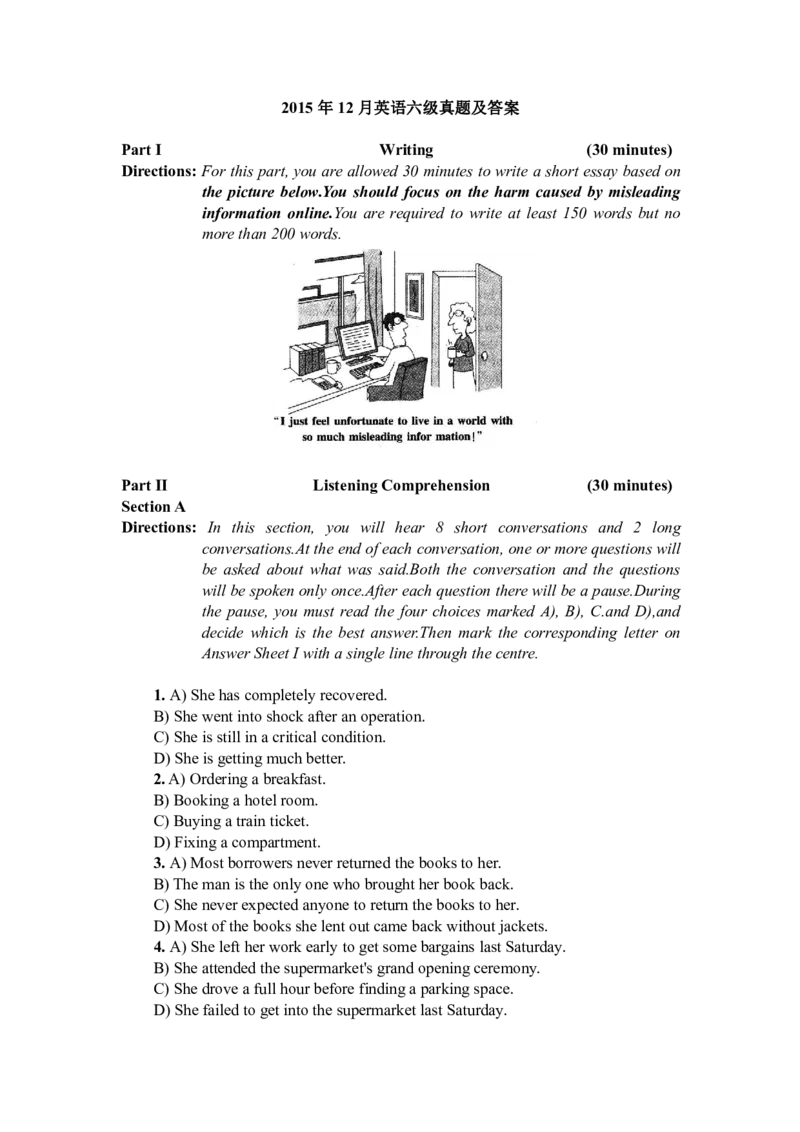
Directions: For this part, you are allowed 30 minutes to write a short essay based on
the picture below.You should focus on the harm caused by misleading
information online.You are required to write at least 150 words but no
morethan 200words.
Part Ⅱ ListeningComprehension (30 minutes)
SectionA
Directions: In this section, you will hear 8 short conversations and 2 long
conversations.At the end of each conversation, one or morequestions will
be asked about what was said.Both the conversation and the questions
will be spoken only once.After each question therewill be a pause.During
the pause, you must read the four choices marked A), B), C.and D),and
decide which is the best answer.Then mark the corresponding letter on
Answer Sheet I with asinglelinethrough thecentre.
1.A)Shehas completely recovered.
B)Shewent into shockafter an operation.
C)Sheis still ina critical condition.
D)Sheis getting much better.
2.A)Ordering abreakfast.
B)Booking a hotel room.
C)Buying a train ticket.
D)Fixing acompartment.
3.A)Most borrowers never returned thebooksto her.
B)Theman is the onlyone who brought herbookback.
C)Shenever expected anyone to return the books toher.
D)Most ofthebooks she lent outcame back without jackets.
4.A)Sheleft herwork early to get somebargains lastSaturday.
B)Sheattended the supermarket's grand opening ceremony.
C)Shedrovea full hourbefore findingaparking space.
D)Shefailed to get intothe supermarket last Saturday.5.A)He is bothered bythe paininhis neck.
B)Hecannot dohis report without acomputer.
C)Hecannot afford tohave acoffee break.
D)He feels sorry to have missedthereport.
6.A)Only topart studentscan showtheir works in thegallery.
B)Thegallery space is bigenough for theman's paintings.
C)Thewoman would liketohelp withtheexhibition layout.
D)The man is uncertain howhis art works willbe received.
7.A)The woman needs atemporary replacement for herassistant.
B)Theman works inthesamedepartment as thewoman does.
C)Thewoman willhave to stay in hospitalfor a fewdays.
D)The man is capableof dealing with difficultpeople.
8.A)It was better than theprevious one.
B)It distorted themayor's speech.
C)It exaggerated thecity's economic problems.
D)It reflected theopinions ofmosteconomists.
Questions9to 12arebased onthe conversation you havejustheard.
9.A)Toinform himof aproblem theyface.
B)Torequest himto purchase control desks.
C)Todiscuss thecontent of aproject report.
D)Toask him toflXthe dictating machine.
10.A)They quotethebest pricein themarket.
B)They manufacture and sell office furniture.
C)They cannot deliverthe steel sheets ontime.
D)They cannot produce the steel sheets needed.
11.A)By marking down thetrait price.
B)By accepting thepenalty clauses.
C)By allowingmore timefordelivery.
D)By promisingbetter after-sales service.
12.A)Give thecustomera ten percent discount.
B)Claimcompensation from thesteel suppliers.
C)Ask theBuying Department to change suppliers.
D)Cancel thecontract with thecustomer.
Questions13to 15arebased onthe conversation you havejustheard.
13.A)Stockbroker.
B)Physicist.
C)Mathematician.
D)Economist.
14.A)Improve computer programming.
B)Explain certain natural phenomena.
C)Predict global population growth.
D)Promotenational financial health.
15.A)Their different educational backgrounds.
B)Changing attitudestoward nature.C)Chaos theory and itsapplications.
D)The current global economic crisis.
Section B
Directions : In this section, you will hear 3short passages.At the end of each passage,
you will hear some questions.Both the passage and the questions will be
spoken only once.After you hear a question, you must choose the best
answer from the four choices marked A), B),C.and D ).Then mark the
corresponding letter on Answer Sheet 1 with a single line through the
centre.
Questions16to 18arebased onthe passageyouhavejustheard.
16.A)They lay great emphasis onhard work.
B)They name 150star engineers each year.
C)They require high academicdegrees.
D)They have peoplewith a very high IQ.
17.A)Long years of jobtraining.
B)High emotional intelligence.
C)Distinctiveacademicqualifications.
D)Devotion to theadvance ofscience.
18.A)Good interpersonal relationships.
B)Rich working experience.
C)Sophisticated equipment.
D)High motivation.
Questions19to 21arebased onthe passageyouhavejustheard.
19.A)Adiary.
B)Afairy tale.
C)Ahistory textbook.
D)Abiography.
20.A)He was a sports fan.
B)Heloved adventures.
C)Hedisliked school.
D)He liked hair-raising stories.
21.A)Encourage people toundertake adventures.
B)Publicizehis colorful and uniquelifestories.
C)Raisepeople's environmental awareness.
D)Attract people toAmerica's national parks.
Questions22to 25arebased onthe passageyouhavejustheard.
22.A)The first infected victim.
B)Acoastal village inAfrica.
C)Thedoctor who lustidentified it.
D)Ariverrunning through the Congo.
23.A)They exhibit similar symptoms.
B)They can be treated withthe samedrug.C)They have almost thesame mortalityrate.
D)They have bothdisappeared for good.
24.A)By inhaling airpolluted with thevirus.
B)By contacting contaminated bodyfluids.
C)By drinkingwater from theCongo River.
D)By eating food grown inSudan and Zalre.
25.A)More strains will evolvefrom theEbolavirus.
B)Scientistswill eventually fred cures for Ebola.
C)Another Ebolaepidemic may erupt sooner orlater.
D)Once infected, onewill become immuneto Ebola.
Section C
Directions: In this section, you will hear a passage three times.When the passage is
read for the irst time, you should listen carefully for its general
idea.When the passage is read for the second time, you arerequired to fill
in the blanks with the exact words you have just heard.Finally, when the
passage is read for the third time, you should check what you have
written.
The ideal companion machine would not only look, feel, and sound friendly but
would also be programmed to behave in an agreeable manner.Those 26 that make
interaction with other people enjoyable would be simulated as closely as possible, and
the machine would 27 charming, stimulating, and easygoing. Its informal
conversational style would make interaction comfortable, and yet the machine would
remain slightly 28 and therefore interesting.In its first encounter it might be somewhat
hesitant and unassuming, but as it came to know the user it would progress to a more
29 and intimate style.The machine would not be a passive 30 but would add its own
suggestions, information, and opinions; it would sometimes 31 developing or
changing theto picand would have apersonality of itsown.
The machine would convey presence: We have all seen how a computer's use of
personal names often 32 people and leads them to treat the machine as if it were
almost human.Such features are easily written into the software.By introducing 33
forcefulness and humor, the machine could be presented as a vivid and unique
character.
Friendships are not made in a day, and the computer would be more acceptable
as a friend if it 34 the gradual changes that occur when one person is getting to know
another.At an 35 time it might also express the kind of affection that stimulates
attachment and intimacy.
Part III Reading Comprehension (40 minutes)
SectionA
Directions: In this section, there is a passage with ten blanks.You are required to
select one word for each blank from a list of choices given in a word bank
following the passage.Read the passage through carefully before makingyour choices. Each choice in the bank is identified by a letter.Please mark
the corresponding letter for each item on Answer Sheet 2 with a single
line through the centre.You may not use any of the words in the bank
morethan once.
Questions36to 45arebased onthe followingpassage.
As it is, sleep is so undervalued that getting by on fewer hours has become a
badge of honor.Plus, we live in a culture that 36 to the late-nighter, from 24-hour
grocery stores to online shopping sites that never close.It's no surprise, then, that more
than half of American adults don't get the 7 to 9 hours of shut-eye every night as 37
bysleep experts.
Whether or not we can catch up on sleep--on the weekend, say--is a hotly 38
topic among sleep researchers.The latest evidence suggests that while it isn't 39 , it
might help.When Liu, the UCLA sleep researcher and professor of medicine, brought
40 sleep-restricted people into the lab for a weekend of sleep during which they
logged about 10 hours per night, they showed 41 in the ability of insulin (胰岛素) to
process bloodsugar.That suggests that catch-up sleep may undosome
but not all of the damage that sleep 42 causes, which is encouraging, given how
many adults don't get the hours they need each night.Still, Liu isn't 43 to endorse the
habit ofsleeping less and making upforit later.
Sleeping pills, while helpful for some, are not 44 an effective remedy either."A
sleeping pill will 45 one area of the brain, but there's never going to be a perfect
sleeping pill, because you couldn't really replicate (复制) the different chemicals
moving in and out of different parts of the brain to go through the different stages of
sleep," says Dr.Nancy Coll op,directorof theEmory University Sleep Center.
A) Alternatively
B) Caters
C) Chronically
D) Debated
E) Deprivation
F) Ideal
G) Improvements
H) Necessarily
I) Negotiated
J) Pierce
K) Presumption
L) Ready
M) Recommended
N) Surpasses
O) Target
Section B
Directions: In this section, you are going to read a passage with ten statements
attached to it.Each statement contains information given in one of theparagraphs.Identify the paragraph from which the information is
derived.You may choose a paragraph more than once.Each paragraph is
marked with a letter. Answer the questions by marking the corresponding
letter onAnswer Sheet 2.
Climate changemay bereal, butit's still noteasy beinggreen
How do we convince our inner caveman to be greener?We ask some outstanding
social scientists.
[A] The road to climate hell is paved with our good intentions.Politicians may
tackle polluters while scientists do battle with carbon emissions.But the most
pervasive problem is less obvious: our own behaviour.We get distracted before we can
turn down the heating.We break our promise not to fly after hearing about a
neighbour's trip to India.Ultimately, we can't be bothered to change our attitude.
Fortunately for the planet, social science and behavioural economics may be able to
dothat forus.
[B] Despite mournful polar beats and charts showing carbon emissions soaring,
most people find it hard to believe that global warming will affect them
personally.Recent polls by the Pew Research Centre in Washington, DC, found that
75-80 per cent of participants regarded climate change as an important issue.But
respondents ranked itlast onalist ofpriorities.
[C] This inconsistency largely stems from a feeling of powerlessness."When we
can't actually remove the source of our fear, we tend to adapt psychologically by
adopting a range of defence mechanisms," says Tom Crompton, change strategist for
theenvironmental organisationWorldWideFund for Nature.
[D] Part of the fault lies with our inner caveman.Evolution has programmed
humans to pay most attention to issues that will have an immediate impact."We worry
most about now because if we don't survive for the next minute, we're not going to be
around in ten years' time," says Professor Elke Weber of the Centre for Research on
Environmental Decisions at Columbia University in New York.If the Thames were
lapping around Big Ben, Londoners would face up to the problem of emissions pretty
quickly.But in practice, our brain discounts the risks and benefits associated with
issues that liesomeway ahead.
[E] Matthew Rush worth, of the Department of Experimental Psychology at the
University of Oxford,sees this in his lab every day."One of the ways in which all
agents seem to make decisions is that they assign a lower weighting to outcomes that
are going to be further away in the future," he says."This is a very sensible way for an
animal to make decisions in the wild and would have been very helpful for humans
forthousands of years."
[F] Not any longer.By the time we wake up to the threat posed by climate change,
it could well be too late.And ff we're not going to make rational decisions about the
future, others may have to help us todoso.
[G] Few political libraries are without a copy of Nudge: Improving Decisions
About Health, Wealth and Happiness, by Richard Thaler and Cass Sunstein.They
argue that governments should persuade us into making better decisions--such assaving more in our pension plans--by changing the default options.Professor Weber
believes that environmental policy can make use of similar tactics.If, for example,
building codes included green construction guidelines, most developers would be too
lazyto challenge them.
[H] Defaults are certainly part of the solution.But social scientists are most
concerned about crafting messages that exploit our group mentality ."We need to
understand what motivates people, what it is that allows them to make change," says
Professor Neil Adger, of the Tyndall Centre for Climate Change Research in
Norwich."It is actually about what their peers think of them, what their social norms
are, what is seen as desirable in society." In other words, our inner caveman is
continually lookingover his shoulderto see what therest of thetribeare upto.
[I] The passive attitude we have to climate change as individuals can be altered
by counting us in--and measuring us against--our peer group."Social norms are
primitive and elemental," says Dr.Robert Cialdini, author of Influence: The
Psychology of Persuasion."Birds flock together, fish school together, cattle herd
together...just perceiving norms is enough to cause people to adjust their behaviour in
thedirection of thecrowd."
[J] These norms can take us beyond good intentions.Cialdini conducted a study
in San Diego in which coat hangers bearing messages about saving energy were hung
on people's doors.Some of the messages mentioned the environment, some financial
savings, others social responsibility.But it was the ones that mentioned the actions of
neighbours that drove down power use.
[K] Other studies show that simply providing the facility for people to compare
their energy use with the local average is enough to cause them to modify their
behaviour.The Conservatives plan to adopt this strategy by making utility companies
print theaverage local electricity and gas usage onpeople's bills.
[L] Social science can also teach politicians how to avoid our collective capacity
for serf destructive behaviour.Environmental campaigns that tell us how many people
drive SUVs unwittingly (不经意的) imply that this behaviour is widespread and thus
permissible.Cialdini recommends some careful framing of the message."Instead of
normalising the undesirable behaviour, the message needs to marginalise it, for
example, by stating that if even one person buys yet another SUV, it reduces our
abilitytobeenergy-independent."
[M] Tapping into how we already see ourselves is crucial.The most successful
environmental strategy will marry the green message to our own sense of
identity.Take your average trade union member, chances are they will be politically
motivated and be used to collective action much like Erica Gregory.Aretired member
of the Public and Commercial Services Union, she is setting up one of 1,i00 action
groups with the support of Climate Solidarity, a two-year environmental campaign
aimed at trade unionists.
[N] Erica is proof that a great-grandmother can help to lead the revolution if you
get the psychology right--in this case, by matching her enthusiasm for the
environment with a fondness for organising groups."I think it's a terrific idea," she
says of the campaign."The union backing it makes members think there must besomething in it." She is expecting up to 20 people at the first meeting she has called,
at her local pubin theCornish village ofPolperro.
[O] Nick Perks, project director for Climate Solidarity, believes this sort of
activity is where the future of environmental action lies. "Using existing civil society
structures or networks is a more effective way of creating change.., and obviously
trade unions are one of the biggest civil society networks in the UK," he says. The "
Love Food, Hate Waste" campaign entered into a collaboration last year with another
such network--the Women's Institute.Londoner Rachel Taylor joined the campaign
with the aim of making new friends.A year on, the meetings have made lasting
changes to what she throws away in her kitchen."It's always more of an incentive if
you're doing it with other people," she says."It motivates you more if you know that
you'vegot toprovidefeedback to agroup."
[P] The power of such simple psychology in fighting climate change is attracting
attention across the political establishment.In the US, the House of Representatives
Science Committee has approved a bill allocating $10 million a year to studying
energy-related behaviour.In the UK, new studies are in development and social
scientists are regularly spotted in British government offices.With the help of
psychologists,there is fresh hopethat we might go green after all.
46. When people find they are powerless to change a situation, they tend to live
withit.
47.Tobe effective, environmental messages shouldbe carefully framed.
48. It is the government's responsibility to persuade people into making
environment-friendly decisions.
49. Politicians are beginning to realise the importance of enlisting psychologists'
help in fighting climate change.
50. To find effective solutions to climate change, it is necessary to understand
what motivates people tomake change.
51. In their evolution, humans have learned to pay attention to the most urgent
issues instead oflong-term concerns.
52. One study shows that our neighbours' actions are influential in changing our
behaviour.
53. Despite clear signs of global warming, it is not easy for most people to
believeclimate change will affect theirown lives.
54. We should take our future into consideration in making decisions concerning
climatechange before it is toolate.
55. Existing social networks can be more effective in creating change in people's
behaviour.
Section C
Directions: There are 2 passages in this section.Each passage is followed by some
questions or unfinished statements.For each of them there are four
choices marked A), B), C.and D ).You should decide on the best choice
and mark the corresponding letter on Answer Sheet 2 with a single line
through thecentre.PassageOne
Questions56to 60arebased onthe followingpassage.
More than a decade ago, cognitive scientists John Bransford and Daniel
Schwartz, both then at Vanderbilt University, found that what distinguished young
adults from children was not the ability to retain facts or apply prior knowledge to a
new situation but a quality they called "preparation for future learning." The
researchers asked fifth graders and college students to create a recovery plan to
protect bald eagles from extinction. Shockingly, the two groups came up with plans of
similar quality(although the college students had better spelling skills ). From the
standpoint of a traditional educator, this outcome indicated that schooling had failed
tohelp studentsthink about ecosystems and extinction, majorscientific ideas.
The researchers decided to go deeper, however.They asked both groups to
generate questions about important issues needed tocreate recovery plans.On this task,
they found large differences.College students focused on critical issues of
interdependence between eagles and their hab/tats (栖息地).Fifth graders tended to
focus on features of individual eagles ( "How big are they?" and "What do they
eat?").The college students had cultivated the ability to ask questions, the cornerstone
ofcritical thinking.They had learned howtolearn.
Museums and other institutions of informal learning may be better suited to teach
this skill than elementary and secondary schools.At the Exploratorium in San
Francisco, we recently studied how learning to ask good questions can affect the
quality of people's scientific inquiry.We found that when we taught participants to ask
"What if?" and "How can?" questions that nobody present would know the answer to
and that would spark exploration, they engaged in better inquiry at the next
exhibit--asking more questions, performing more experiments and making better
interpretations of their results.Specifically, their questions became more
comprehensive at the new exhibit.Rather than merely asking about something they
wanted to try, they tended to include both cause and effect in their question.Asking
juicy questions appears to be a transferable skill for deepening collaborative inquiry
intothescience content found inexhibits.
This type of learning is not confined to museums or institutional
settings.Informal learning environments tolerate failure better than schools.Perhaps
many teachers have too little time to allow students to form and pursue their own
questions and too much ground to cover in the curriculum.But people must acquire
this skill somewhere.Our society depends on them being able to make critical
decisions about their own medical treatment, say, or what we must do about global
energy needs and demands.For that, we have a robust informal learning system that
gives nogrades, takes all comers,and is available even onholidays and weekends.
56. What is traditional educators' interpretation of the research outcome
mentioned inthe firstparagraph ?
A)Students are not ableto apply priorknowledge to new problems.
B)College students are nobetterthan fifth graders in memorizing facts.
C)Education has not paidenough attention tomajor environmental issues.
D)Education has failed to lead students to thinkabout majorscientific ideas.57.Inwhatwayare collegestudents differentfromchildren?
A)They have learned to thinkcritically.
B)They are concerned about social issues.
C)They are curious about specific features.
D)They have learned to work independently.
58.Whatis thebenefitof askingquestionswith noready answers?
A)It arouses students' interest in things around them.
B)It cultivates students' abilitytomake scientificinquiries.
C)It trains students' abilityto design scientific experiments.
D)It helps students realizenot every questionhas ananswer.
59.Whatis saidto betheadvantageof informal learning?
A)It allows for failures.
B)It isentertaining.
C)It charges notuition.
D)It meets practical needs.
60. What does the author seem to encourage educators to do at the end of the
passage?
A)Train studentsto thinkabout global issues.
B)Design more interactiveclassroom activities.
C)Makefull use ofinformal learning resources.
D)Include collaborativeinquiry in thecurriculum.
PassageTwo
Questions61to 65arebased onthe followingpassage.
"There's an old saying in the space world: amateurs talk about technology,
professionals talk about insurance." In an interview last year with The Economist,
George White sides, chief executive of space-tourism fu'm Virgin Galactic, was
placing his company in the latter category.But insurance will be cold comfort
following the failure on October 31st of VSS Enterprise, resulting in the death of one
pilotand the severe injury to another.
On top of the tragic loss of life, the accident in California will cast a long shadow
overthe futureof space tourism,even before it has properly begun.
The notion of space tourism took hold in 2001 with a $ 20 million flight aboard a
Russian spacecraft by Dennis Tito, a millionaire engineer with an adventurous
streak.Just haft a dozen holiday-makers have reached orbit since then, for similarly
astronomical price tags. But more recently,companies have begun to plan more
affordable "suborbital" flights--briefer ventures just to the edge of space's vast
darkness.Virgin Galactic had, prior to this week's accident, seemed closest to starting
regular flights.The company has already taken deposits from around 800 would-be
space tourists,including Stephen Hawking.
After being dogged by technical delays for years, Sir Richard Branson, Virgin
Galactic's founder,had recently suggested that a Space Ship Two craft would carry its
first paying customers as soon as February 2015. That now seems an impossible
timeline. In July, a sister craft of the crashed space plane was reported to be abouthalf-finished.The other half will have to walt, as authorities of America's Federal
Aviation Administration (FAA.and National Transportation Safety Board work
out:what went wrong.
In the meantime, the entire space tourism industry will be on tenterhooks (坐立
不安).The 2004 Commercial Space Launch Amendments Act, intended to encourage
private space vehicles and services, prohibits the transportation secretary (and thereby
the FAA.from regulating the design or operation of private spacecraft, unless they
have resulted in a serious or fatal injury to crew or.passengers.That means that the
FAA could suspend Virgin Galactic's licence to fly.It could also insist on checking
private manned spacecraft as thoroughly as it does commercial aircraft.While that
may:make suborbital travel safer, it would add significant cost and complexity to an
emerging industry that has until now operated largely as the playground of billionaires
and dreamy engineers.
How Virgin Galactic, regulators and the public respond to this most recent
tragedy will determine whether and how soon private space travel can transcend that
playground.There is no doubt that space flight entails risks, and to pioneer a new
mode of travel is to face those risks, and to reduce them.with the benefit of hard-won
experience.
61. Whatissaid aboutthefailureofVSS Enterprise?
A)It may lead tothebankruptcy ofVirgin Galactic.
B)It has a strong negativeimpact onspace tourism.
C)It maydiscourage rich peoplefrom space travel.
D)It has aroused publicattentiontosafety issues.
62.Whatdowelearn aboutthespace-tourism firmVirginGalactic?
A)It has justbuilta craft for commercial flights.
B)It has sent half adozen passengers intospace.
C)It was about ready tostart regular business.
D)It is thefirst to launch "suborbital" flights.
63. What is the purpose of the 2004 Commercial Space Launch Amendments
Act?
A)Toensure space travel safety.
B)TolimittheFAA's functions.
C)Tolegalizeprivatespace explorations.
D)Topromote thespace tourism industry.
64.WhatmighttheFAAdoaftertherecent accidentin California?
A)Impose morerigid safety standards.
B)Stopcertifying newspace-tourist agencies.
C)Amend its2004Commercial Space LaunchAmendmentsAct.
D)SuspendVirgin Galactic's licence to takepassengers into space.
65.Whatdoes theauthorthinkofprivate spacetravel?
A)It is worth promoting despitetherisks involved.
B)It shouldnot be confined tothe rich only.
C)It shouldbe strictly regulated.
D)It is too risky to carry on.Part IV Translation (30 minutes)
Directions: For this part, you are allowed 30 minutes to translate a passage from
ChineseintoEnglish.You shouldwriteyour answer onAnswer Sheet 2.
在帮助国际社会于2030 年前消除极端贫困过程中,中国正扮演着越来越重
要的角色。
自20世纪70年代未实施改革开放以来,中国已使多达四亿人摆脱了贫困。
在未来五年中,中国将向其他发展中国家在减少贫困、发展教育、农业现代化、
环境保护和医疗保健等方面提供援助。
中国在减少贫困方面取得了显著进步,并在促进经济增长方面做出了不懈努
力,这将鼓励其他贫困国家应对自身发展中的挑战。在寻求具有自身特色的发展
道路时,这些国家可以借鉴中国的经验。
【 参 考 答 案 】
【参考范文】
As is revealed in the picture, a man is sitting in front of the computer searching
information from the Internet, while a woman is standing by the door, holding a cup
of coffee. The most striking feature is the caption under the picture, which reads “I
justfeel unfortunate toliveina world with so much misleading information!”
Simple as it is, what the picture conveys to us is thought-provoking. By no
means can we deny that the Internet is playing such an increasingly important role in
our information society that we couldn’t be away from it in every way. For instance,
we deal with all kinds of data and information everyday by the Internet. Nevertheless,
with a large amount of information coming up, the severity of misleading information
arises. Unfortunately, if we lack the ability to distinguish the true information from
the misleading one, we will finally fall prey to it, because the misleading information
may get people into bad habits, even make them commit crimes. Numerous network
fraud isa livingexample.
From what have been discussed above, it is therefore, necessary that some
effective measures be taken to prevent ourselves from being misled by junk
information. And in my opinion, learning to identify the authenticity of information
onlineisthe mostpractical measure.
【1-5】DCADC 【6-10】AABAC 【11-15】BBDBC 【16-20】DBADB
【21-25】CDABC
【26-30】qualities、appearto be、unpredictable、relaxed、participant
【31-35】take theinitiativein、fascinates、a degree of、simulated、appropriate
【36-40】BMDFC 【41-45】GELHO
【46-50】CLGPH 【51-55】DJBFO
【56-60】DABAC 【61-65】BCDDA【翻译参考译文】
China is playing an increasingly important role in helping the international
communitytoeliminateextremepoverty by2030.
Since the implementation of the reform and opening up in the late of 1970s, China has
helped as many as four hundred million people out of poverty. Over the next five
years, China will provide assistance to other developing countries in poverty
reduction,education development,agricultural modernization,environmental protection
and health care.
China has made remarkable progress in reducing poverty, and has made
unremitting efforts to promote economic growth, which will encourage other poor
countries to respond to the challenges of their own development. These countries can
learn from the experience of China when they seek to develop their own
characteristics.