2020 年包头市中考
英语
注意事项:
1. 本试卷共12页,包括第Ⅰ卷(选择题)和第Ⅱ卷(非选择题),满分120分,考试时间120
分钟。
2. 答题前,考生务必先将自己的考生号、姓名、座位号等信息填写在试卷和答题卡的指定位
置。请认真核对条形码上的相关信息,将条形码粘贴在答题卡的指定位置。
3. 答选择题时,必须使用2B铅笔将答题卡上对应题目的答案标号涂黑,修改时用橡皮擦干净,
再选涂其他答案。
4. 答非选择题时,必须使用0.5毫米的黑色字迹签字笔书写,要求字体工整,笔迹清晰,严
格按题号所示的答题区域作答,超出答题区域的答案无效;在试卷、草稿纸上答题无效。
5. 保持答题卡清洁、完整,严禁折叠、损坏。严禁在答题卡上做任何标记,严禁使用涂改液、
胶带纸、修正带。考试结束后,将本试卷和答题卡一并交回。
第I卷 选择题
第一部分 听力(共两节)
听录音,根据各题要求选择最佳答案,并将答题卡上对应题目的答案标号涂黑。每项内容读
两遍。
第一节
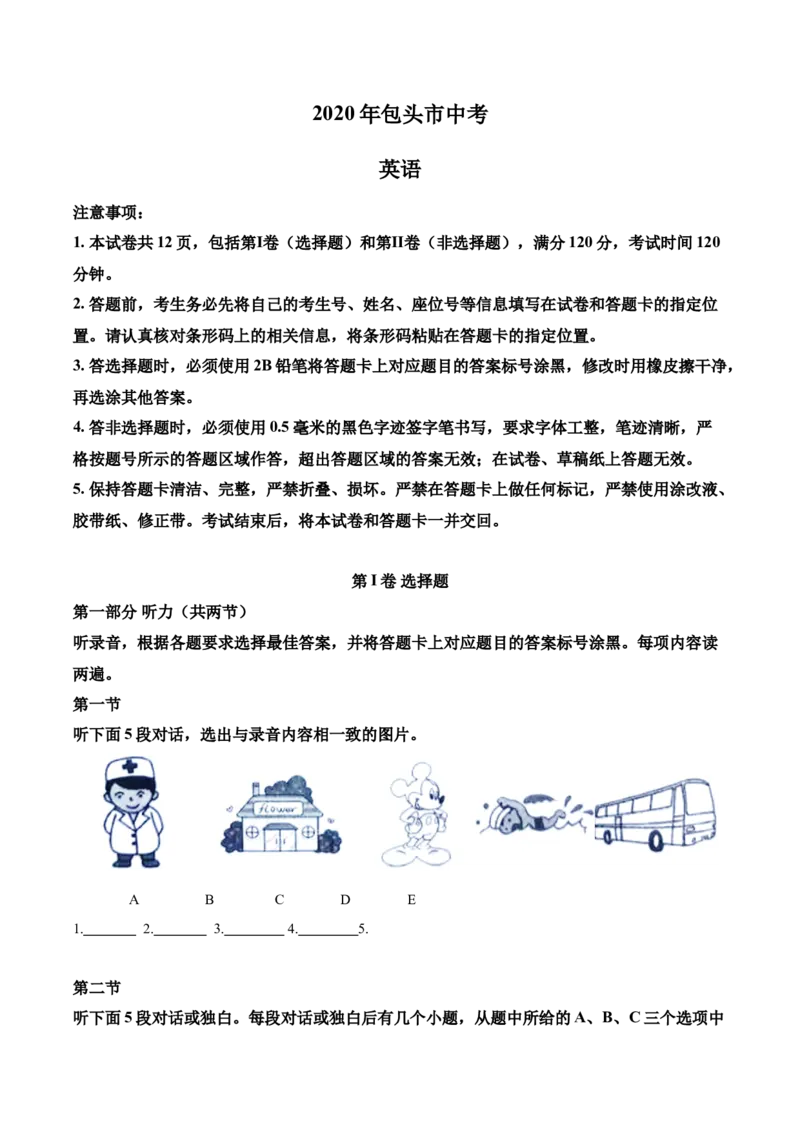
听下面5段对话,选出与录音内容相一致的图片。
A B C D E
1. 2. 3. 4. 5.
第二节
听下面5段对话或独白。每段对话或独白后有几个小题,从题中所给的A、B、C三个选项中选出最佳选项。听每段对话或独白前,你将有时间阅读各个小题,每小题5秒钟;听完后,
各小题将给出5秒钟的作答时间。
听第6段材料,回答下面小题。
6. What did Daniel think of his trip?
A. Relaxing and interesting B. Exciting and enjoyable C. Surprising and exciting
7. Who did Daniel travel with?
A. His parents B. His mother C. His father
8. What did Daniel do in London?
A. He made a travel plan. B. He bought air tickets C. He visited famous places.
听第7段材料,回答下面小题。
9. When did they start to watch TV?
A. At 9:30. B. At 9:00 C. At 10:00
.
10 What kind of TV programs does the boy like?
A. Cartoons B. Talk shows C. Game shows
11. What will they do next?
A. Do homework. B. Play tennis C. Play volleyball
听第8段材料,回答下面小题。
12. Where does the girl work?
A. In the school dining hall. B. In the school library C. In the school radio station
13. How often does Peter write to his pen pal?
A. Once a week B. Twice a week. C. Once a month.
14. What do they often talk about in the English Corner?
A. Games B. Cultures C. Places
听第9段材料,回答下面小题。
15. When will the speakers go to the theater?
A. On Thursday. B. On Friday C. On Saturday
16. Where will the speakers sit?
A. At the front B. In the middle C. At the back
17. How much is a student ticket?A. £ 7 B. £ 10 C. £ 12.5.
听第10段材料,回答下面小题。
18. What festival was it?
A. It was Father's Day B. It was Mother's Day C. It was May D Day
19. Who swept the floor?
A. Mr. Smith B. Mrs. Smith C. Tom Smith
20. Where did the Smiths have dinner?
A. At home B. In a restaurant C. In a friend's home
第二部分 英语知识运用
第一节
从每题后所给的四个选项(A、B、C和D)中选出可以填入空白处的最佳选项,并在答题卡
上将该项涂黑。
1.It's nice to hear from her again. ______, we last met more than ten years ago
A. What's worse B. Believe it or not C. In other words D. That's to say
2.—Hello, my name is John Smith. And I' m calling to ask about the position in your school.
—Yes, the position is still open. You could come over and have a talk ______ us.
A. with B. about C. through D. away
3.While she was in Milan, she developed a ______ for fine art.
A. way B. relation C. taste D. habit
4.______ the project as planned, they need to work two more hours a day.
A. To finish B. Finishing C. Finish D. To be finished
5.—Tomorrow I'll take the final examination, and I feel nervous.
—Don't worry. It's ______ to have butterflies in your stomach before an exam.
A. rude B. exciting C. perfect D. natural
6.He ______ sleep, although he tried to. One cup of coffee in the late afternoon caused him to stay awake almost
all night.
A. wouldn't B. shouldn't C. couldn't D. mustn't
7.He's already playing in a band, and he only ______ playing the guitar a year ago!
A. took up B. set up C. put up D. gave up
8.The girl used to be shy, but she is ______ getting active in team work and willing to make friends.
A. usually B. gradually C. mainly D. seldom9.She says that she'll have to close the restaurant ______ business improves.
A. if B. after C. unless D. when
10.Corn production ______ nearly 125 percent over the past 25 years in China.
A. jumped B. jumps C. will jump D. has jumped
11.Sophia waited for a reply, but ______ came.
A. either B. another C. neither D. none
12.Livestreaming (直播)______ a new chance for traditional culture artists.
A. practices B. provides C. promises D. protects
13.Earth Day ______ in 1970 for the first time, and the Day now includes events in more than 190 countries and
regions (地区).
A. celebrated B. was celebrated C. is celebrated D. has been celebrated
14.It's not easy to change habits, ______ with strong will and self-control, it is possible.
A. for B. or C. but D. so
15.—Don't worry, Mom. The doctor said it was only the flu.
—______ I'll tell Dad there's nothing serious.
A. What a relief B. Congratulations! C. What for? D. I'm sorry to hear that
第二节
阅读短文,从短文后各题所给的四个选项(A、B、C和D)中,选出可以填入空白处的最佳
选项,并在答题卡上将该项涂黑。
Silent and calm, 25-year-old Linda looks out of the window. She may be smiling now, but it's been a long,
hard road to ___16___. Today, she is an author of a best-seller and also a famous artist. Her story is about
overcoming ___17___and encouraging others to do the same.
Linda did not begin talking ___18___ she was two and a half years old. ___19___, it was found that she had
autism(自闭症)and had difficulty in social communication. Linda's mother taught her the ___20___ of
independence by example and encouraged her to learn how to do things ___21___
Growing up, she was ___22___ bullied (欺凌).She was called an alien and some kids would even steal her
snacks. She tried changing schools, but she never seemed to be ___23___.The bullying ___24___. She also had
trouble with tests. But she didn't let them stop her. With the help of her parents, Linda received speech and
communication treatment.
After a long period of treating, doctors said that Linda would not succeed or finish her studies. But she proved
(证明)them ____25____. Linda worked hard to build up her confidence and found her ability—creating beautifulpaintings. And at 18, Linda went to art college to study painting and was later ____26____ by the local volunteers
to join them on community visits where she could ____27____ her story.
Now she has gone through the ____28____ times. And she has come to ____29____ that she is not useless. At
25, Linda sells her books and some of her paintings to help herself and her family. By sharing her experience, Linda
is not only____30____ others, but also changing their lives.
16. A. wealth B. politeness C. sadness D. happiness
17. A. decisions B. conditions C. difficulties D. discussions
18. A. if B. because C. until D. so
19. A. Honestly B. Unluckily C. Clearly D. Suddenly
20. A. progress B. meaning C. instruction D. interest
21. A. by the way B. right away C. in a hurry D. on her own
22. A. hardly B. secretly C. recently D. seriously
23. A. welcomed B. refused C. treated D. allowed
24. A. received B. developed C. continued D. studied
25. A. wrong B. right C. clever D. silly
26. A. interviewed B. invited C. trusted D. tested
27. A. share B. cover C. copy D. complete
28. A. quiet B. dark C. safe D. comfortable
29. A. realize B. guess C. doubt D. remember
30. A. teaching B. saving C. influencing D. controlling
第三部分 阅读理解
阅读短文,从每题所给的四个选项(A、B、C和D)中,选出最佳选项,并在答题卡上将该
项涂黑。
A
Find a Job This Summer
This summer there are things that students can do to earn some pocket money or to help others. Also, many
programs are offered by provincial government and its partners to help students find summer jobs. Here are a few
ideas.
Deliver Newspapers
Teenagers can deliver newspapers—usually you ride a bike around a neighborhood and leave the newspaper at
each house. Normally you have to have your own bike—and you have to get up early too, because people wanttheir newspapers to read with their breakfast. If you are 15-18 and return to school this fall, you can find jobs of
this kind.
Wash Cars
It's crazy for adults to drive to an expensive car wash when they can get a teenager to do the job for less
money. Wash the car well and carefully and people will want you to do it again. Then you've got customers!
Give Older People a Hand
,
Lots of older people are happy for teenagers to help them carry their shopping or do small things for them
like washing or keeping them company (陪伴). You earn money or not, and people in the neighborhood get your
help.
Job Programs
If you are a student living in certain communities of the province, you are lucky. There are programs that
provide four weeks of paid jobs along with training. After that, you can start and run your own summer business,
and you have a chance of winning awards of up to $1000. Go to the government website to learn more about these
programs. People under 25 could build skills, find a job or start businesses all year round.
They are all great ideas. Just choose one of them to make some money. Then spend it or save it. But don't
forget it's important always to tell an adult where you are going.
31. What is special about Deliver Newspapers?
A. It requires one to get up early. B. It needs patience and strong body.
C. It offers help to neighbors. D. It gives training before work.
32. Which one provides training?
A. Deliver Newspapers. B. Wash Cars. C. Give Older People a Hand. D. Job Programs.
33. What can you learn from the passage?
A. It's hard for teenagers to find jobs. B. The elders don't want help from teenagers.
C. Washing cars is the best choice for teenagers. D. Whatever you want to do, safety comes first.
B
On a windy day in June, Fourth Class took the train to Chinatown. We had begun to learn Putonghua and our
teacher said this excursion would let us practice our language skills and learn more about Chinese culture.
We entered Chinatown through the arched (拱形的) entrance gate with red painted wooden pillars (柱子) . Big
stone lions sat on each side. Then I noticed that the street signs were written in both Chinese and English. I
photographed the sign for Hay Street.
The next place we visited was the Chinese Garden of Friendship which was very peaceful. There werewaterfalls, hidden stone paths and a beautiful teahouse. We had a wonderful time there.
At last it was time for our Chinese lunch. We entered a big restaurant that had red lanterns hanging from the
roof and red dragons on the walls. The waiters greeted us in Putonghua and we answered them in Putonghua. We
were shown how to use chopsticks and how to choose from the menus with Chinese writing.
At 2:30 we left Chinatown. We were all very tired. On the train, our teacher told us her experience in China.
She was just back from seeing the Great Wall of China. It's like a long dragon winding its way. We were told it is
the longest wall in the world. As we were listening, one student, who I couldn't name, fell asleep on the train and
snored loudly. His face turned red when he woke up!
In the past, I often told my Chinese classmates how to speak English .Now there are more people than ever
who are studying Chinese. I can understand why—it's a fascinating language, and there are always new words to be
discovered! I cannot forget our excursion to Chinatown. Tom Green, Fourth Class
34. The underlined word "excursion" in Paragraph 1 means __________.
A. train B. trip C. place D. day
35. What was the first thing connected with Chinese culture that the students saw in Chinatown?
A. The beautiful teahouse.
B. Chopsticks used in the restaurant.
C. The street signs written in both Chinese and English.
D. The arched entrance gate with stone lions on each side.
36. The color red is mentioned four times in the text. Which example is different from the others?
A. The red painted pillars of the entrance gate. B. The red dragons in the restaurant.
C. The red lanterns in the restaurant. D. The student's red face.
37. What is the main purpose of this text?
A. To describe Chinese culture.
B. To describe Tom's favorite Chinese meals.
C. To retell what happened on Tom's trip to Chinatown.
D. To give information about Chinese eating customs.
C
Last week, some German parents who took their kids out of school early were stopped by the police at the
airport. The police were making reports on students who didn't have permission (许可) to miss school.
Like many places, it is against the law to skip (不参加) school in Germany. Children over the age of 9 can't
miss classes without permission from the school. But during busy travel time, some parents take their children outof school early to save money on vacations. People can often save a lot of money on flights and hotels by going at a
different time than others.
Last weekend was the beginning of an important holiday period in Germany. People in charge of the schools
asked the police to check and make sure that students weren't leaving for vacations before they were allowed to.
Police officers at three German airports looked for families with school-aged children. When they found them,
the police pulled the families out of lines to talk with them. They wanted to find out if the parents had permission
for the children to be out of school. If the children did not have permission, the police reported the families to their
schools and to the government. In all, the police reported about 20 families.
These families will have two weeks to show that it was okay for their children to miss school. If they can't,
they may have to pay as much as $1,200 as a fine (罚款), or receive some other punishment.
Germany is not the only place where parents have to pay fines if their children miss school. Many other
countries and many of the states in the U.S. have similar laws.
The good news is that the families were allowed to go on vacation after they talked to the police. But they
might have a big bill waiting for them when they get back.
38. Why do some German parents take their children out of school early during busy travel times?
A. They can spend more time with their children.
B. Their children will study by themselves.
C. They want to save money.
D. Their children can take online courses.
39. In Paragraph 4, police officers at three German airports wanted to ______.
A. find students who skipped school without permission
B. give punishment to the students there
C. take students back to school
D. wait for school managers
40. Which of the following can be the best title for the text?
A. Laws on Vacations in Germany B. Give Your Family a Perfect Vacation
C. Don't Skip School in Germany D. Punishment Goes to Families
41. Where does this text probably come from?
A. A newspaper. B. A science report. C. A travel guide. D. A textbook.
D
Maybe you should sit down before you read this. It's a little frightening. Your sitting may be killing you.
Health experts say the U.S. adult now sits about 6.5 hours a day. That is up about an hour a day compared to2007. The news is even worse for teens. They sit eight hours each day. The information was put out by the National
Center for Health Statistics. It has collected the numbers for the past 16 years. It is worried about what it has found.
Research shows that people who are not active can get sick. Their bones get weaker. They burn fewer calories
(卡路里). That makes them more likely to put on too much weight. They might even get diabetes (糖尿病). They
are at risk for high blood pressure and heart problems, too.
Some experts also think sitting too much can influence how your blood moves through your body and how
well your body fights off illness. Being active helps in lots of ways. It can make you happier, burn more calories
and give you more energy. It can also help you sleep better.
About 60% of people in the U.S. watch at least two hours of TV each day. That number has stayed about the
same in recent years.
Computers are the biggest reason for more hours spent sitting. Computer use outside of work or school has
gone up for all age groups. Now, 50% of adults spend at least an hour of their free time on a computer each day.
That is up from 29% in 2003.
About 53% of teens now spend at least an hour of free time on computers. So do 56% of kids. As many as 1 in
4 people who use computers use one for three hours or more outside of work and school.
,
So get up take some breaks and go outside. You might save your life by doing outdoor activities.
42. The text is especially helpful for those who care about ______.
A. their body shape B. their home comforts C. their health D. their food
43. Being active can help people ______.
A. bum more calories B. forget their pressure C. get sick D. treat heart problems
44. What is the text mainly about?
A. Computers are causing health problems. B. Too much sitting is influencing our health.
C. Being more active is good for you and me. D. Sitting means killing.
45. Which one of the following is most probably to be discussed next?
A. The cause of diabetes.
B. Introduce some outdoor activities.
C. Give some examples of losing weight successfully.
D. List some disadvantages of playing computer games.
第II卷 非选择题
第一部分 词语运用
第一节用括号中所给单词的适当形式完成句子(每空仅限1个单词)。
46.There isn't a cloud in the sky. It's going to be ______ tomorrow. (sun)
47.He's a quiet artist and doesn't like to talk much, but his work ______. (shout)
48.People who are warm-hearted set good examples to society because they pass on their ______ to people around
them. (kind)
49.—What's your plan after the exam?
.
—We are going to take a ______ flight to Chengdu when the exam is over (direct)
50.It's late autumn now. The tree has lost all of ______ leaves. (it)
51.As I was trying to find my way out, I suddenly ______ some noise. (hear)
52.When you visit New York, don't miss Broadway. It has been famous for its theaters since the early ______
century. (twenty)
53.—What are you going to do with the clothes?
—Some clothes will be given to the poor and the others will be sent to factories for ______. (recycle)
54.They hoped to see the problem solved ______. (peaceful)
55.In order to live in a better place, the natural environment must be ______ by all the people. (protect)
第二节
阅读短文,在没有汉语提示的空格处,根据首字母、音标或语境的提示填入1个适当的单词;
在有汉语提示的空格处,填入适当的短语,使短文语意连贯,意思完整。
Last Saturday morning, the head teacher called a meeting of parents. On behalf of (代表) the students, I made
___56___ speech, and I felt very proud of ___57___.
Now my middle school life comes to an end. This summer, I will go to the U.S. and stay for one year to
s___58___at an American high school. There I will be in Grade 10. I excited. ___59___ (同时), I am a little sad
because I have to s___60___ goodbye to my old friends and teachers. I want to t___61___ some photos with them
before I leave and I Will ___62___ (赠送) many gifts to my friends as well. We will ___63___ (保持联系) With
each other by sending emails, making phone calls or w___64___ letters.
In the past three years, I have learned a lot ____65____ my teachers and have had a great time at school.
Although we'll set out on our new journey, I will never forget ____66____ I come from. In the future, I will work
m____67____ harder. I hope to be a doctor when I ____68____ (长大). My parents ____69____ [sə'pɔ:t] me all
the time. I believe my dream will ____70____ (实现, 成为现实)!
第二部分 书面表达71.假定你是李华,你校将举办校园音乐节(music festival)。请给你的好友Alan写一封电子邮件,
介绍音乐节的相关内容和主要活动,并邀请他与你一起参加此次音乐节。邮件内容包括:
Time 10 a.m. next Sunday
Place school sports field
sell tickets, work at food stands… (all of the money will go to charity)
play the violin, piano…
Activities for students
sing songs, dance to music…
…
注意:
l. 词数90左右,开头和结尾己经写好,不计入总词数;
.
2 可适当增加细节,以使行文连贯;
3. 文中不得出现反映考生信息的真实人名、地名等内容。
参考词汇:摊位 stand 慈善charity
Dear Alan,
How is it going?
____________________________________________________________________________________________
____________________________________________________________________________________________
____________________________________________________________________________________________
____________________________________________________________________________________________
____________________________________________________________________________________________
____________________________________________________________________________________________
_______________________________________________________________________________________
Looking forward to your reply.
Yours,
Li Hua