关注公众号:陆陆高分冲刺 ~领取:最新版“小中高考-总复习”、最新试卷下载
文化理解力
第一部分 真题考查分析
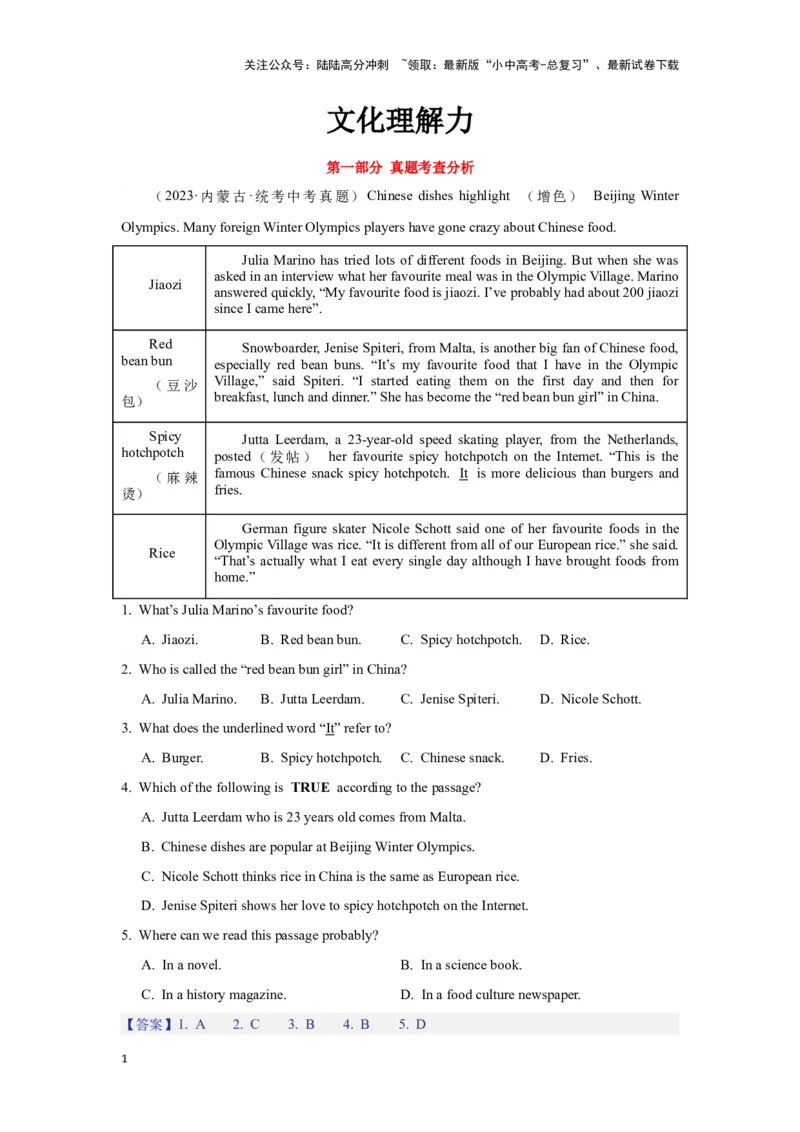
(2023·内蒙古·统考中考真题)Chinese dishes highlight (增色) Beijing Winter
Olympics. Many foreign Winter Olympics players have gone crazy about Chinese food.
Julia Marino has tried lots of different foods in Beijing. But when she was
asked in an interview what her favourite meal was in the Olympic Village. Marino
Jiaozi
answered quickly, “My favourite food is jiaozi. I’ve probably had about 200 jiaozi
since I came here”.
Red Snowboarder, Jenise Spiteri, from Malta, is another big fan of Chinese food,
bean bun especially red bean buns. “It’s my favourite food that I have in the Olympic
Village,” said Spiteri. “I started eating them on the first day and then for
(豆沙
breakfast, lunch and dinner.” She has become the “red bean bun girl” in China.
包)
Spicy Jutta Leerdam, a 23-year-old speed skating player, from the Netherlands,
hotchpotch posted(发帖) her favourite spicy hotchpotch on the Intemet. “This is the
(麻辣 famous Chinese snack spicy hotchpotch. It is more delicious than burgers and
烫) fries.
German figure skater Nicole Schott said one of her favourite foods in the
Olympic Village was rice. “It is different from all of our European rice.” she said.
Rice
“That’s actually what I eat every single day although I have brought foods from
home.”
1. What’s Julia Marino’s favourite food?
A. Jiaozi. B. Red bean bun. C. Spicy hotchpotch. D. Rice.
2. Who is called the “red bean bun girl” in China?
A. Julia Marino. B. Jutta Leerdam. C. Jenise Spiteri. D. Nicole Schott.
3. What does the underlined word “It” refer to?
A. Burger. B. Spicy hotchpotch. C. Chinese snack. D. Fries.
4. Which of the following is TRUE according to the passage?
A. Jutta Leerdam who is 23 years old comes from Malta.
B. Chinese dishes are popular at Beijing Winter Olympics.
C. Nicole Schott thinks rice in China is the same as European rice.
D. Jenise Spiteri shows her love to spicy hotchpotch on the Internet.
5. Where can we read this passage probably?
A. In a novel. B. In a science book.
C. In a history magazine. D. In a food culture newspaper.
【答案】1. A 2. C 3. B 4. B 5. D
1关注公众号:陆陆高分冲刺 ~领取:最新版“小中高考-总复习”、最新试卷下载
【解析】本文主要介绍了北京冬奥会期间,很多外国人为中国美食感到着迷。
1. 细节理解题。根据“My favourite food is jiaozi”可知她最喜欢的食物是饺子。故选A。
2. 细节理解题。根据“Snowboarder, Jenise Spiteri, from Malta...She has become the ‘red bean
bun girl’ in China.”可知Jenise Spiteri被成为“红豆包女孩”。故选C。
3. 词义猜测题。根据“This is the famous Chinese snack spicy hotchpotch. It is more delicious
than burgers and fries.”可知这是中国著名的麻辣火锅,它比汉堡和薯条更美味,故此处it指
代“麻辣火锅”。故选B。
4. 细节理解题。根据“Many foreign Winter Olympics players have gone crazy about Chinese
food.”可知中国菜在北京冬奥会上很受欢迎。故选B。
5. 推理判断题。本文主要介绍了北京冬奥会期间,很多外国人为中国美食感到着迷,故文
章可能出现在饮食文化报纸上。故选D。
第二部分 备考策略解析
【素材积累】
15个考点话题了解传统文化
1.长城(The Great Wall)
The Great Wall is one of the wonders of the world that were created by human beings! If you
come to China without climbing the Great Wall, it’s just like going to Paris without visiting the
Eiffel Tower, or going to Egypt without visiting the Pyramids! Men often say, “He who does not
reach the Great Wall is not a true man.”In fact, it began as independent walls for different states
when it was first built, and did not become the “Great Wall” until the Qin Dynasty. However, the
wall we see today, starting from Shanhaiguan Pass in the east to Jiayuguan Pass in the west, was
mostly built during the Ming Dynasty.
长城是人类创造的世界奇迹之一!如果你到了中国却没爬长城,就像到了巴黎没有去看
看埃菲尔铁塔,或者就像到了埃及没有去看金字塔一样!人们常说:“不到长城非好汉。”实际
上,长城最初只是作为不同国家的独立城墙而建的,直到秦朝才成为“长城”。然而,今天我
们看到的长城——东起山海关,西至嘉峪关——大部分都是在明代修建的。
2.饺子(Dumplings)
Dumplings are one of the Chinese people’s favorite traditional dishes. According to an
ancient Chinese legend, dumplings were first made by the medical saint—Zhang Zhongjing. There
are three steps involved in making dumplings: (1) make dumpling wrappers out of dumpling flour;
(2) prepare the dumpling stuffing; (3) make dumplings and boil them. With thin and elastic dough
2关注公众号:陆陆高分冲刺 ~领取:最新版“小中高考-总复习”、最新试卷下载
skin, fresh and tender stuffing, delicious taste, and unique shapes, dumplings are worth eating
hundreds of times. There’s an old saying that claims, “Nothing could be more delicious than
dumplings.”During the Spring Festival and other holidays, or when treating relatives and friends,
Chinese people like to follow the auspicious custom of eating dumplings. To Chinese people who
show high reverence for family love, having dumplings at the moment when the old year is
replaced by the new is an essential part of bidding farewell to the old and ushering in the new year.
饺子是深受中国人民喜爱的传统食品之一。 相传为古代医圣张仲景发明。饺子的制作
包括三个步骤:(1) 用饺子粉擀饺子皮;(2) 准备饺子馅;(3) 包饺子和煮饺子。其特点是皮薄
馅嫩,味道鲜美,形状独特,百食不厌。民间有“好吃不过饺子”的俗语。中国人逢年过节、
接亲待客都有吃饺子的习俗,寓意吉利。对崇尚亲情的中国人来说,“更岁交子”吃饺子,更是
欢度除夕、辞旧迎新必不可少的部分。
3.筷子(Chopsticks)
The Chinese way of eating with chopsticks is unique in the world. The recorded history of
chopsticks started more than three thousand years ago. Chopsticks were named zhu in ancient
Chinese. They look deceptively simple to use but possess multi-various functions, such as
clamping, turning over, lifting up, raking, stirring, scooping, poking, tearing, and so on.
Chopsticks were taken as an auspicious mascot by ordinary people in ancient China. For example,
the partial tone of chopsticks is often used by people as a metaphor at weddings to indicate a
blessing or benediction for the couple to have a baby soon. Unlike using a knife and fork or one’s
own hands, a pair of chopsticks also implies the meaning of “Harmony is what matters”.
Chopsticks are highly praised by Westerners as a hallmark of ancient oriental civilization.
中国人使用筷子就餐的方式在世界上独树一帜。有史记载用筷的历史已有三千多年。
筷子古时称为箸,它看似简单,却同时具有夹、拨、挑、扒、拌、撮、戳、撕等多种功能。古
代中国民间视筷子为吉祥之物,如婚俗中将筷子隐喻为快生贵子的祝福。与使用刀叉以及手
抓的方式不同,成双结对的筷子含有“和为贵”的意蕴。西方人赞誉筷子是古老的东方文明。
4.中国功夫(Chinese Kung Fu)
Chinese kung fu, or Chinese martial arts, carries traditional Chinese culture in abundance. It
is a traditional Chinese sport which applies the art of attack and defence in combat and the
motions engaged with a series of skill and tricks. The core idea of Chinese kung fu is derived from
the Confucian theory of both “the mean and harmony” and “cultivating qi” (otherwise known as
3关注公众号:陆陆高分冲刺 ~领取:最新版“小中高考-总复习”、最新试卷下载
nourishing one’s spirit). Meanwhile, it also includes thoughts of Taoism and Buddhism. Chinese
kung fu has a long history, with multi-various sects and many different boxing styles, and
emphasizes coupling hardness with softness and internal and external training. It contains the
ancient great thinkers’ pondering of life and the universe. The skills in wielding the 18 kinds of
weapons named by the later generations mainly involve the skills of bare-handed boxing, such as
shadow boxing (Taijiquan), form and will boxing (Xingyiquan), eight trigram palm (Baguazhang),
and the skills of kung fu weaponry, such as the skill of using swords, spears, two-edged swords
and halberds, axes, tomahawks, hooks, prongs and so on.
中国功夫即中国武术,承载着丰富的中华民族传统文化。它是将攻防竞技寓于搏斗和套
路运动之中的中国传统体育项目,其核心思想是儒家的“中和养气”之说,同时兼容了道家、
佛教的思想。中国武术源远流长、流派林立、拳种繁多,讲究刚柔并济、内外兼修,蕴含着先
哲们对生命和宇宙的参悟。后世所称十八般武艺,主要指:徒手拳艺,如太极拳、形意拳、八
卦掌等;器械功夫,如刀枪剑戟、斧钺钩叉等。
5.汉字(Chinese Characters)
Chinese characters were initially meant to be simple pictures used to help people remember
things. After a long period of development, it finally became a unique character system that
embodies phonetic sound, image, idea, and rhyme at the same time. The writing system, which
was extremely advanced in ancient times, began with inscriptions on bones and tortoise shells, and
these are regarded as the original forms of Chinese characters. Afterwards, Chinese characters
went through numerous calligraphic styles: bronze inscriptions, official script, regular script,
cursive script, running script, etc. Chinese characters are usually round outside and square inside,
which is rooted in ancient Chinese beliefs of an orbicular sky and a rectangular Earth. The five
basic strokes of Chinese characters are “—” (the horizontal stroke) ,“│” (the vertical stroke),
“/”( the left-falling stroke), “\” (the right-falling stroke), and “乙” (the turning stroke).
汉字是从原始人用以记事的简单图画,经过长时间演变发展最终成为一种兼具音、形、
意、韵的独特文字。现存中国古代最早成熟的文字是甲骨文,被认为是现代汉字的雏形。此
后,汉字又经历了金文、隶书、楷书、草书、行书等不同的阶段。汉字结构“外圆内方”源
于古人“天圆地方”的观念。汉字有五种基本笔画,即:横、竖、撇、捺、折。
6.秧歌舞(Yangko)
Yangko is one of the traditional folk dances of Han in China.It is usually performed in
4关注公众号:陆陆高分冲刺 ~领取:最新版“小中高考-总复习”、最新试卷下载
northern provinces. The dancers usually wear colorful and light costumes, and the performance is
powerful and rapid. During some festivals such as Spring Festival, Lantern Festival, if people hear
the sound of drum and gong, no matter how cold the weather is, they will come to street and
appreciate the Yangko. Recent years, the old people in city of east-northern of China organized the
team of Yangko by themselves, and the teamers keep their health by dancing Yangko the whole
year.
秧歌舞是中国汉族的一种民间传统舞蹈,通常在北方省份表演。秧歌舞者通常穿上明亮
多彩的表演服装,他们的表演动作有力迅速。在春节、元宵节等节日期间,人们一旦听到锣鼓
声,不管天气有多冷,他们都会蜂拥到街上看秧歌舞表演。近年来,中国东北的城市的老年人
自发组织了秧歌队,队员整年通过跳秧歌舞来保持健康。
7.针灸(Acupuncture)
Acupuncture is an important part of traditional Chinese medicine (TCM). In accordance with
the “main and collateral channels” theory in TCM, the purpose of acupuncture is to dredge the
channel and regulate qi and blood, so as to keep the body’s yin and yang balanced and achieve
reconciliation between the internal organs. It features in traditional Chinese medicine that “internal
diseases are to be treated with external therapy”. The main therapy of acupuncture involves using
needles to pierce certain acupoints of the patient’s body, or adopting moxibustion to stimulate the
patient’s acupoints so as to stimulate the channels and relieve pain. With its unique advantages,
acupuncture has been handed down generation after generation and has now spread all over the
world. Nowadays, acupuncture, along with Chinese food, kung fu (otherwise known as Chinese
martial arts) and traditional Chinese medicine, has been internationally hailed as one of the “four
new national treasures”.
针灸是中医学的重要组成部分。按照中医的经络理论,针灸疗法主要是通过疏通经络、
调和气血,来达到阴阳归于平衡,使脏腑趋于调和之目的。中医学的特点是“内病外治”。针
灸的主要疗法是用针刺入病人身体的一定穴位,或用艾灸刺激病人的穴位,以达到刺激经络、
缓解病痛的目的。针灸以其独特的优势代代相传并传播到了全世界。如今,针灸与中餐、功
夫、传统中医学一起被国际誉为中国的“新四大国粹”。
8.中国龙(Chinese Dragon)
Dragon totem worship in China has been around for the last 8,000 years. The ancients in
China considered the dragon (or loong) as a fetish that combines animals including the fish, snake,
5关注公众号:陆陆高分冲刺 ~领取:最新版“小中高考-总复习”、最新试卷下载
horse and ox with cloud, thunder, lightning and other natural celestial phenomena. The Chinese
dragon was formed in accordance with the multicultural fusion process of the Chinese nation. To
the Chinese, the dragon signifies innovation and cohesion.
对龙图腾的崇拜在中国大约已绵延了八千多年。中国古人认为龙是将鱼、蛇、马、牛
等动物与云雾、雷电等自然天象集合而成的一种神物。 中国龙的形成与中华民族的多元文
化融合过程同步。在中国人的心目中,龙具有振奋腾飞、开拓变化的寓意和团结凝聚的精神。
9.中国印章(Chinese Seals)
A seal can also be defined as a stamp. Both the Chinese official and private seals of various
dynasties have different titles, such as stamp, zhu note, contract, fu, lease and others. The seals
used by the emperors of ancient China were called xi, yin, bao, etc. According to historical
records, seals were widely used during the Warring States Period. The making of a seal is to
engrave fonts, such as seal characters and official script and so on,or images in the form of intaglio
and embossment into the seal, basically shaped as round or square. Covered with a vermilion
overlay, the Chinese seal is not only used in daily life, but it is also used to represent signatures on
paintings and calligraphies. It is gradually becoming one of China’s unique artworks.
印章就是图章。中国历代官、私所用的印章有印信、朱记、合同、符、契等不同的称
谓,而帝王所用的印章古时称玺、印、宝等。据史料记载,印章在战国时代已普遍使用。印章
的制作是将篆、隶等字体、图像用阴、阳的形式雕刻而成,形状以圆、方为主。印章用朱色
钤盖,除日常应用外,又多用于书画题识,逐渐成为中国特有的艺术形式之一。
10.京剧(Beijing Opera)
Praised as “Oriental Opera”, Beijing Opera is a genuine national quintessence of China. It
originated from many kinds of ancient local operas, especially huiban in southern China. At the
end of the 19th Century, Beijing Opera evolved and took shape, becoming the greatest kind of
opera in China. Beijing Opera is a blend of performing arts—song, speech, performance, acrobatic
fighting and dance. Beijing Opera portrays and narrates the plot and characters through stylized
acting. The main types of roles in Beijing Opera are sheng(male),dan (young female), jing
(painted face, male), and chou( clown, male or female).
京剧被誉为“东方歌剧”, 是地道的中国国粹。它起源于中国多种古老的地方戏剧,特
别是南方的“徽班”。到了19世纪末,京剧形成并成为中国最大的戏曲剧种。京剧是综合
6关注公众号:陆陆高分冲刺 ~领取:最新版“小中高考-总复习”、最新试卷下载
性表演艺术,集唱(歌唱)、念(念白)、做(表演)、打(武打)、舞(舞蹈)为一体,通过程式化的表
演手段,叙述故事,刻画人物。京剧中的角色主要分生(男性)、旦(年轻女性)、净(花脸男性)、
丑(小丑,男性女性皆有)四大行当。
11.中国成语(Chinese Idioms)
Chinese idioms refer to comprehensive and integrated fixed phrases and expressions. Idioms
are established and accepted by constant usage and common practice. An idiom is a language unit
that is larger than a word, but has the same grammatical function as a word. Most Chinese idioms
consist of four characters. For example, ziqiangbuxi(make unremitting efforts to improve
oneself), qingchuyulan(bluer than indigo), and houjibofa (success comes with time and effort).
Idioms are extracted from folk proverbs, ancient works of literature, poems, fables, allusions, and
well-known sayings. Idioms are a part of the Chinese language that are concise and have great
vitality.
中国成语是汉语中意义完整的表示一般概念的固定词组或短语。“成语”中的“成”
即是约定俗成。成语是比词大而语法功能又相当于词的语言单位。绝大多数的中国成语由
四个汉字组成,例如:自强不息、青出于蓝、厚积薄发。成语主要从民间谚语、古代文学作品、
诗歌、寓言、典故、名言警句等方面提炼而成,是汉语语言中精炼而又富有生命力的一部分。
12.丝绸(Silk)
China is the home of silk. Mulberry planting, sericulture, silk reeling and thickening are all
great inventions of the ancient Chinese. As early as the Shang and Zhou Dynasties, the Chinese
people’s silk-weaving techniques had reached an extremely high level. During the Western Han
Dynasty, Zhang Qian, an outstanding diplomat, travelled around central Asia and connected China
with the Persian Gulf and the Mediterranean, opening up a new era of Sino-foreign trade,
exchange and communication. From then on, China’s silk became well known for its
extraordinary quality, exquisite design and color, and abundant culture connotations. Hitherto,
Chinese silk has been accepted as a symbol of Chinese culture and the emissary of oriental
civilization.
中国是丝绸的故乡。栽桑、养蚕、缫丝、织绸是中国古代人民的伟大发明。商周时期
中国人的丝绸生产技术就已发展到相当高的水平。西汉时一位杰出的外交家张骞出行到中
亚,把中国与波斯湾、地中海紧密联系起来,开辟了中外贸易交流的新纪元。从此中国的丝绸
7关注公众号:陆陆高分冲刺 ~领取:最新版“小中高考-总复习”、最新试卷下载
以其卓越的品质、精美的设计和花色以及丰富的文化内涵闻名于世,成为中国文化的象征、
东方文明的使者。
13.中国古典园林(Chinese Classical Garden)
The Chinese classical garden is a precious treasure of our ancient Chinese architecture. It is a
kind of environment art, which systematically combines artificial mountains and rivers, plants and
buildings with the natural landscape. The construction standard of a Chinese classical garden is
“artificial as it is, the garden must look ingenious and natural”. When you go sightseeing in a
Chinese classical garden, you should be able to appreciate its artistic concept which “makes use of
the natural landscape to create the real fun of mountains and rivers for viewers”. Among the
world’s three major garden systems, the Chinese classical garden is hailed as one of the origins of
the world’s garden due to its long history and abundant connotations.
中国古典园林是把人造的山水、植物、建筑与自然地貌有机结合的环境艺术,是我们中
国古代建筑艺术的珍宝。其建造原则是“妙极自然,宛自天开”。游赏中国古典园林,你能充
分领略“假自然之景,创山水真趣”的园林意境。在世界三大园林体系中,中国古典园林历史
悠久、内涵丰富,被誉为世界造园史上的渊源之一。
14.文房四宝(The Four Treasures of the Study)
The writing brush, ink stick, ink stone, and paper were requisite treasures in the study of the
scholars of ancient China, and they are often referred to as the “Four Treasures of the Study”.The
writing brush and ink stick have been used by the Chinese to write and paint since 5,000 years
ago. In the Qin Dynasty, people already used feathers of different hardness and bamboo trunks to
make brushes. During the Han Dynasty, man-made ink was used instead of natural ink. After
paper was invented by the Chinese, bamboo slips, wooden tablets, brocade and silk, which
originally functioned as writing surfaces, gradually faded out. The ink stone was first developed
with the use of writing brushes and ink. After the Song Dynasty, the“Four Treasures of the Study”
particularly referred to hubi, the writing brush produced in Huzhou, Zhejiang Province; huimo,
the ink stick produced in Huizhou, Anhui Province; xuan paper, a kind of paper produced in
Xuanzhou, Anhui Province; and duanyan, the ink stone made in Zhaoqing, Guangdong Province
(Zhaoqing was earlier called Duanzhou). Indeed, the “Four Treasures of the Study” have written
the whole Chinese civilization, as it is.
笔墨纸砚是中国古代文人书房中必备的宝贝,被称为“文房四宝”。用笔墨书写和绘画
8关注公众号:陆陆高分冲刺 ~领取:最新版“小中高考-总复习”、最新试卷下载
在中国可追溯到五千年前。秦朝时,人们已用不同硬度的毛和竹管制笔;汉代以人工制墨替代
了天然墨;中国人发明纸张以后,起初作为书写载体的简牍锦帛逐失其用;砚台则随笔墨的使
用而发展。 “文房四宝”到宋朝以后特指湖笔(产于浙江省湖州)、徽墨(产于安徽省徽州)、
宣纸(产于安徽省宣州)、端砚(产于广东省肇庆,肇庆以前叫端州)。可以说“文房四宝”书
写了整个中华文明。
15.天干地支(Chinese Era)
The Chinese era is the symbol that the Chinese calendar uses for recording and naming years.
The ten Heavenly Stems are: jia, yi, bing, ding, wu, ji, geng, xin, ren, gui. The twelve
Earthly Branches are: zi,chou, yin, mao, chen, si, wu, wei, shen, you, xu, hai. After
observing the lunar month, the ancients found that the moon always waxes and wanes roughly 12
times a year, and two lunar months account for about 60 days, so the order of the ten Heavenly
Stems and the order of the twelve Earthly Branches are properly matched in turn. In terms of
recording date, 60 years is considered to be a full time cycle. The Chinese era chronology was first
invented in ancient times and is still in use now.
天干地支是中国历法中用以记录和命名年岁的方法。十天干为:甲、乙、丙、丁、戊、
己、庚、辛、壬、癸;十二地支为:子、丑、寅、卯、辰、巳、午、未、申、酉、戌、亥。古
人观测朔望月,发现月亮圆缺12次大体上是一年的天数,而两个朔望月约是60天。古人以十
天干与十二地支的顺序依次相配,记录不同年份,60年为一个轮回。干支纪年法从古沿用至
今。
【词汇积累】
lofty character 高尚的品格 the traditional story-telling in Beijing dialect
opera highlights 折子戏 with drum accompaniment 京韵大鼓
stilt walk 踩高跷 shaanxi opera 秦腔
pantomime; mime 哑剧 sealcutting 篆刻
pantomimist 哑剧演员 characters cut in intaglio 阴文
skit 戏剧小品 characters cut in relief 阳文
circus show 马戏 seal 图章
monologue comic talk, standup comedy 单口 graver 刻刀
相声 making rubbings from stone inscriptions 拓碑
stunt 特技表演 rubbing 拓片
witty dialogue comedy, comic cross talk 相声 workmanship/craftsmanship 工艺,手艺
9关注公众号:陆陆高分冲刺 ~领取:最新版“小中高考-总复习”、最新试卷下载
handicraft 手工艺品 Yixing pottery 宜兴陶
wood carving 木雕 folding fan 折扇
boxwood craft 黄杨木雕 Wickerwork 枝编工艺
carved lacquerware 雕漆 tapestry 织锦,挂毯
stone carving 石雕 papier mache 纸工艺品
miniature engraving 微雕 Chinese painting 中国画
ivory carving 象牙雕 三、
bamboo engraving 竹雕 folklores 民间传说
shell carving 贝雕 fable 寓言
ice sculpture 冰雕 legend 传说
painted sculpture 彩塑 mythology 神话
enamel 瓷釉 God of Heaven 玉皇大帝
embroidery 刺绣 the Eight Immortals 八仙
scroll 卷轴 Chang’e, the Chinese moon goddess 嫦娥
batik 蜡染 Fu Xi, God of Fishery and Husbandry 伏羲
clay figure 泥人 god of fortune, god of prosperity, and god of
lacquer painting 漆画 longevity 福禄寿三星
lacquer ware 漆器 god of fortune 财神
celadon 青瓷色 god of the kitchen 灶神
two-sided embroidery 双面绣 Gonggong, God of Water 公神
landscape/ink painting 水墨画 Houyi (a legendary hero who shot down nine
Suzhou embroidery 苏绣 suns) 后羿
sandalwood fan 檀香扇 Yellow Emperor 黄帝
trio-colored glazed pottery of the Tang Kuafu (a fabled sun-chasing giant ) 夸父
Dynasty 唐三彩 Nuwa: a goddess who patches up the sky 女
pottery 陶器 娲
Ceramics 制陶业 Pan Gu, creator of the universe 盘古
the four stationery treasures of the Chinese Patron of Agriculture 神农
study—a writing brush, an ink stick, an ink Yu, the reputed founder of the Xia Dynasty
stone and paper 文房四宝 禹
inkslab engraving 砚刻 Zhurong, God of Fire 祝融
10关注公众号:陆陆高分冲刺 ~领取:最新版“小中高考-总复习”、最新试卷下载
make the past serve the present and the Eve of Chinese New Year 除夕
foreign serve China 古为今用,洋为中用 Spring couplets 春联
inscribe a poem 赋诗 ring out the old year and ring in the new 辞旧
matching an antithetical couplet 对对联 迎新
solar calendar 阳历 Jiaozi, boiled dumpling 饺子
gregorian calendar 公历 pot sticker 锅贴
lunar calendar 阴历 temple fair 庙会
heavenly stem 天干 ring out the old year 鸣钟辞旧岁
earthly branch 地支 (traditional) New Year pictures 年画
leap year 闰年 the Eve Feast; family reunion dinner on Lunar
the twenty-four solar terms 二十四节气 New Year’s Eve 年夜饭
zodiac 十二生肖 year-end household cleaning 年终大扫除
rat 鼠 stay up late on the New Year’s Eve 守岁
ox 牛 family reunion dinner 团圆饭
tiger 虎 New Year gift-money; money given to
hare 兔 children as a New Year gift 压岁钱
dragon 龙 dragon dance 舞龙
snake 蛇 Lantern Festival (15th day of the first lunar
horse 马
month) 元宵节
sheep 羊
sweet sticky rice dumplings 元宵
monkey 猴
festival lantern 花灯
rooster 鸡
lantern riddle 灯谜
dog 狗
lion dance 狮子舞
pig 猪
stilt walking 踩高跷
year of monkey 猴年
Pure Brightness Festival/Tomb-sweeping Day
one’s year of birth considered in relation to the
(April the 5th) 清明节
12 Terrestrial Branches 本命年
sweep tomb sites of loved ones 扫墓
traditional holidays 传统节日
offer sacrifices to the ancestors 祭祖
Spring Festival 春节
go for an outing in spring 踏青
pay a New Year visit 拜年
dragon Boat Festival (5th of the fifth lunar
firecracker 鞭炮,爆竹
month) 端午节
11关注公众号:陆陆高分冲刺 ~领取:最新版“小中高考-总复习”、最新试卷下载
dragon boat race 赛龙舟 体
zongzi (pyramid-shaped dumpling made by seal script/seal character篆书
glutinous rice wrapped in reed or bamboo official script/clerical script 隶书
leaves) 粽子 running script/semi-cursive script 行书
Departed soul 亡灵 cursive script 草书
loyal minister 忠臣 regular script/standard script 楷书
Quyuan the poet 诗人屈原 traditional Chinese painting 中国画
Chinese brush painting; ink and wash painting
Moon Festival/Mid- Autumn Day (15th of
eighth lhunar month) 中秋节 水墨画
mooncake 月饼 traditional Chinese realistic painting 工笔
appreciate the glorious full moon 赏月 Chinese character 汉字
reunion 团圆 stroke (汉字)笔画
sweet osmanthus 桂花 radical 偏旁部首
Double Ninth Day/the Aged Day 重阳节 writing system 书写体系
admire the beauty of chrysanthemum 赏菊 Sino-Tibetan 汉藏语系
climb mountain 登高 Sinologist/Sinologue 汉学家
TCM (traditional Chinese medicine) 中药 Sinomania 中国热
gifted scholars and beautiful ladies 才子佳人 of the same origin 同宗同源
cradle of civilization 文明摇篮 the Chinese ancestors 华夏祖先
Xia Dynasty 夏朝 single syllable 单音节
(of) Ming and Qing dynasties 明清两代 Chinese language is “soberly logical” 汉语有
Chinese civilization 中华文明 “合理的逻辑性”
Sichuan, Szechwan, Szechuan 四川 the four tones of Chinese characters 汉语四
Shaanxi 陕西 声调
Research Center for Ancient Civilizations 古 level tone 阴平
文明研究中心 rising tone 阳平
Chinese and overseas scholars 中外学者 falling-rising tone 上声
archaeologists 考古学家 falling tone 去声
anthropologist 人类学家 martial art 武术
historian 历史学家 Kung fu 中国武术
five major styles of calligraphy 书法五大书 styles or schools of martial art 武术门派
12关注公众号:陆陆高分冲刺 ~领取:最新版“小中高考-总复习”、最新试卷下载
practice martial art for fitness 习武健身 bridge 桥
ancient form of combat 古代格斗术 stone boat 石舫
Chinese Martial Art Association 中国武术协 grotto 石窟
会 pavilion on the water 水榭
top martial artist 武林高手 pagoda; tower 塔
Qigong; deep breathing exercises 气功 terrace 台
judo 柔道 altar 坛
karate 空手道 pavilion 亭阁
tae kwon do 跆拳道 bell tower 钟楼
boxing 拳击 pillar, column, post 柱
wrestling 摔跤 emperor's mausoleum/tomb 陵墓
fencing 击剑 major cultural heritage 重要文化遗产
walk the earth (with a sword) 仗剑走天涯 outstanding folk arts 优秀民间艺术
Chinese architecture 中国建筑 cultural relics 文物
Quadrangle, the traditional Chinese single- Chinese knot 中国结
story houses with rows of rooms around the Cheongsam 旗袍
traditional Chinese garments (clothing), Tang
four sides of a courtyard 四合院
(Mongolian) yurt 蒙古包 suit 中山装
inscriptions on a tablet 碑刻,碑文,碑铭 cloisonné 景泰蓝
the forest of steles, tablet forest 碑林 royal court envoy 朝廷使者
Taoist temple 道观 men of letter 文人
hall 殿 refined scholar 雅士
beacon tower 烽火台 culture industry 文化产业
drum tower 鼓楼 cultural deposit 文化底蕴
ornamental column 华表 cultural undertaking 文化事业
corridor 回廊 cross-cultural communication 文化交流
altar 祭坛 culture shock 文化冲突
rockery 假山 national culture 民族文化
watchtower 角楼 folk culture 民间文化
corridor 廊 urban culture 城镇文化
pailou, decorated archway 牌楼 rural culture 乡村文化
13关注公众号:陆陆高分冲刺 ~领取:最新版“小中高考-总复习”、最新试卷下载
native culture 当地文化 composition 构图
performing art 表演艺术 engraving 雕刻艺术,镌版术;亦指雕版印
popular art, pop art 现代流行艺术 刷品,版画
high art 纯艺术 etching 蚀刻版画,蚀刻术,铜版画
refined art 高雅艺术 foreshortening effect [绘画]通过透视原理表
cinematographic art 电影艺术 现立体空间
theatrical art 戏剧艺术 fresco [绘画]在灰泥的墙壁上作的水彩画,
male (the positive male role) 生(男性正面
壁画
角色) highlight [绘画]高光
female (the positive female role) 旦(女性正 high relief 高浮雕
面角色) impasto [绘画]厚涂颜料的绘画法,厚涂的
a supporting male role with striking character 颜料
净(性格鲜明的男性配角) inlaying 镶嵌
a clown or a negative role 丑(幽默滑稽或 landscape 风景画,山水画
反面角色) lithography 石印(平版印刷)术;平版印
painted role 花脸 刷品
monodrama; one-man show 独角戏 modeling 建模,造型
musical 歌舞喜剧 monochrome 单色画(由一种颜色的不同
shtick 滑稽场面,搞笑小噱头 色度制作出的图片,尤指图画)
skit 滑稽短剧 pastel 浅淡的色调,柔和而悦目的色彩
amateur performer of Beijing Opera/Peking perspective [绘画]透视
Opera fan 京剧票友 primary colors 三原色
Peking Opera Mask 京剧人物脸谱 relief 浮雕(效果)
ventriloquism 口技 sketching 写生,写生画
puppet show 木偶戏 still life 静物
voice over 旁白 tempera 蛋彩画(用蛋清代油调和的鸡蛋水
shadow play; leather-silhouette show 皮影戏 胶养料画法)
story-telling 说书 texture 质地,纹理
make a human pyramid 叠罗汉 tone 色调
colors, primary 红、黄、蓝三原色 trompe l’oeil 一种给人以摄影作品般真实感
colors, secondary 合成色,间色 觉的绘画风格
14关注公众号:陆陆高分冲刺 ~领取:最新版“小中高考-总复习”、最新试卷下载
the four great inventions of ancient China 四 paper-making 造纸术
大发明 the compass 指南针
gunpowder 火药 Ancient Chinese Philosophers中国古代哲学
printing 印刷术 家
【真题演练】
1
(2023·内蒙古呼和浩特·统考中考真题)You must have read or heard of the sad love story
between Jia Baoyu and Lin Daiyu. But can you imagine the two singing opera in English instead
of speaking poetic Chinese?
Jia and Lin are two characters from the classic Chinese novel A Dream of Red Mansions
(《红楼梦》), written by Cao Xueqin(1715—1763). Now the book has been made into an
English-language opera. After being performed in San Francisco, the US, the performance came to
Beijing, Changsha and Wuhan in 2017.
Many of the opera’s creators have backgrounds in both Chinese and American cultures,
including the director and playwrights(剧作家). Their understanding of both cultures helped
them change a Chinese classic into a foreign-language opera.
The book, which covers the rise and fall of the Jia family, has 120 chapters and hundreds of
characters. But opera writer David Henry Hwang cut down the number of characters to just seven.
Hwang, a Chinese-American, focused on the love story between Jia and Lin and tried to write a
tragedy(悲剧)that everyone would understand.
The art director Timmy Yip, from Hong Kong, tried to help foreign people understand the
characters using costumes and stage decorations. He compared Lin to water and gave her a light
green costume. When Lin showed up on stage, there was usually water around her on the stage.
The creators considered the work of introducing a Chinese classic to Western audience was
worth doing. Hwang told China Daily he was happy to “have made a contribution(贡献)to the
land where my parents were born”.
1. Where was the opera first performed?
A. In Beijing. B. In Changsha. C. In San Francisco. D. In Wuhan.
2. What do we know about A Dream of Red Mansions from Paragraph 4?
A. It is mainly about the rise and greatness of the Qing Dynasty. B. It tells the happy-ending
15关注公众号:陆陆高分冲刺 ~领取:最新版“小中高考-总复习”、最新试卷下载
love story between Jia and Lin.
C. The book is long and rich in characters. D. The book has seven characters in total.
3. The art director compared Lin to water probably because of her ________.
A. dressing style B. character C. appearance D. life habits
4. What can we infer from the passage?
A. A Dream of Red Mansions has been translated into English. B. Hwang’s parents were
born in America.
C. The English-language opera was on tour in the US. D. Timmy Yip knows a lot about
Chinese culture as well as American culture.
5. What do creators of the opera think of their job?
A. Difficult and unbelievable. B. Stressful and tough. C. Satisfying and
meaningful. D. Painful and challenging.
2
(2023·湖北荆门·中考真题)When Xiong Chuanfa, 34, blows a lifelike tiger out of sugar
in just minutes, thinking he is a magician.
Xiong has been blowing sugar figurines(吹糖人) for twenty years. Blowing sugar
figurines is a Chinese traditional folk art with a history of over 600 years and has been listed as a
state-level intangible cultural heritage(非物质文化遗产).
Every morning, Xiong prepares the sugar and drives to different markets in Nanchang to star
this magic show.
He heats the sugar, pulls off a little to make a ball and blows it into different shapes—a
rabbit, a monkey, and even Bing Dwen Dwen, the mascot of the Beijing 2022 Winter Olympics.
However busy he is, he often spares time to drop by colleges to make young people know
more about the folk art. Many college students have been drawn(吸引) to the art. Simon, a
foreign student, he found it difficult to make it. Thanks to Xiong’s help, Simon finally saw a horse
slowly taking shape.
Simon was deeply moved after learning about the art. “I just can’t believe the traditional folk
art can be kept so well here. I love it. Chinese culture should be spread around the world,” he said.
This art has been passed down for four generations (代) in Xiong’s family. His 6-year-
old son often blows sugar balloons, just like what he used to do as a child.
“We will pass on the intangible heritage,” said Xiong.
16关注公众号:陆陆高分冲刺 ~领取:最新版“小中高考-总复习”、最新试卷下载
6. From the passage we can learn that Xiong Chuanfa began blowing sugar figurines at the age of
________.
A. 6 B. 14 C. 20 D. 34
7. Which of the following can be the possible reason for Xiong Chuanfa to visit colleges?
A. To help young people learn drawing skills.
B. To sell his sugar figurines.
C. To draw young people closer to the folk art.
D. To show his magic skills.
8. According to the passage, we can infer (推断) that Simon will most probably ________.
A. learn more about Chinese culture
B. offer Xiong a helping hand in class
C. stay in China to blow sugar figurines
D. blow perfect sugar figurines next time
9. Which of the following can be the best title for the passage?
A. Xiong and His Folk Art of Sweet Blow
B. The History of Blowing Sugar Figurines
C. Xiong’s Family and Sugar Figurine Skills
D. A Guide and the Intangible Heritages
第三部分 综合运用巩固
一、阅读理解
1
In the famous British Museum, there was a special Chinese jade teapot (玉壶) named Li. It
was on show for a long time and missed its family a lot, China.
One night, when the museum was quiet, Li decided to run away. It walked quietly out of its
glass case and started an exciting journey to find its way back to China.
During its running away in the museum, it faced many difficulties like avoiding alarms and
cameras. It used its small size and quick movements to stay hidden. At the same time, Li also saw
many unbelievable things from different countries such as Ancient Egyptian relics (历史遗物),
sculpture (雕塑), and Roman artifacts (文物). At last, Li went on a long trip across the big oceans.
It traveled on a ship going through faraway places until it finally reached China. It hid in a
visitor’s bag and successfully got off the ship. Then Li was put in a museum where Chinese people
17关注公众号:陆陆高分冲刺 ~领取:最新版“小中高考-总复习”、最新试卷下载
and foreign visitors could enjoy it more closely. Li told visitors that it felt comfortable being with
its family, knowing that they kept it safe.
The story of Li, the Chinese jade teapot, encourages people all over the world to pay attention
to cultural treasures and understand the importance of their rightful ownership (合法所有权). The
British Museum has 8, 000, including 23, 000 Chinese relics on show. If the cultural relics from
all over the world can speak, the phrase “go home” must be a common voice.
1. Why did the jade teapot Li want to go back to China?
A. It wanted to meet its family. B. It wanted to see other foreign artifacts.
C. It wanted to have a journey. D. It wanted to travel across the big oceans.
2. What is the right order of Li’s coming back to China successfully according to the text?
①Li hid in a visitor’s bag.
②Li went through many faraway places.
③Li walked quietly out of its glass case.
④Li faced many difficulties like avoiding alarms and cameras.
A. ①②③④ B. ①③②④ C. ③④①② D. ③④②①
3. How did Li finally reach China?
A. It flew to China. B. It took a ship to China.
C. It walked across the oceans to China. D. It made a telephone call magically to China.
4. What happened when Li was in China?
A. It was lost in the forest.
B. It was sold to a collector.
C. It was put in a museum for people to enjoy.
D. It was kept in an unsafe place for people to enjoy.
5. What can we infer (推断) from the last paragraph?
A. The cultural relics in the British Museum are meaningless.
B. The Chinese artifacts in the British Museum are well-kept.
C. The British Museum is not interested in keeping Chinese relics.
D. The British Museum should return the relics from all over the world.
2
Tests can be stressful. But don’t worry! You’re not alone! Tests have been stressing people
out for thousands of years. Here’s one man’s story about test stress.
18关注公众号:陆陆高分冲刺 ~领取:最新版“小中高考-总复习”、最新试卷下载
During the Tang Dynasty (朝代) there was a poor man named Meng Jiao. He loved studying
and writing poems. Though his hard work helped him become a talented poet, he needed to make
more money. He decided to take the Ke Ju exams. The exams were open for anyone to take.
Whoever passed could get an official (官方的) job.
Meng Jiao studied hard for the tests. He took them several times. Each time, he failed. But
Meng Jiao never gave up. He studied harder and harder. He took the tests over and over again.
Finally, when he was 46 years old, Meng Jiao passed the test! He was so happy! He put on
new clothes. He tied on red flowers to celebrate. Then he rode on a horse through Chang’an City.
During his ride, Meng Jiao wrote a poem. In English, it reads, “Horseback riding swiftly (迅
速地) through the spring breeze (微风), while seeing all the flowers of Chang’an in one day.”
Meng Jiao’s poem tells about his feelings on that exciting day. His words describe the feeling
of enjoying the flowers and Chang’an City in a day.
The poem became famous. But people said it would be impossible to really enjoy everything
in one day. This led to the phrase (成语) “seeing flowers while riding a horse swiftly.” It describes
giving something a quick look without noticing the details (细节).
6. Meng Jiao decided to take the Ke Ju exams because he _______.
A. needed to make more money B. wanted to write poems
C. wanted to enjoy the flowers D. had to deal with the stress
7. The third paragraph (段落) tells us _______.
A. stress is bad for study
B. we should give up when we fail
C. it was not easy to pass the Ke Ju exams
D. Meng Jiao was so clever that he succeeded
8. Meng Jiao’s poem on horseback expressed _______.
A. the beauty of Chang’an City
B. his excitement after his success
19关注公众号:陆陆高分冲刺 ~领取:最新版“小中高考-总复习”、最新试卷下载
C. his stress from the Ke Ju exams
D. the difficulty he had during his study
9. Which of the following comes from the story?
A. 鸟语花香 B. 五花杀马 C. 走马观花 D. 落花流水
3
When eating out, people want to have a great experience. This means that they want not only
nice food but also polite and considerate (考虑周到的) people in the restaurant.
One thing people shouldn’t do at a table is talking on a mobile phone. Such action is thought
to be impolite to the people around you. Some restaurants have rules against mobile phones. But
whether there are rules or not, you should set your phone to the silent or vibrate mode (振动模式).
If you get an important phone call and have to talk on it while eating, leave the table to answer it.
Remember to talk in a quiet and weak voice even if you’re not at the table.
It is important to use good manners with everyone in the restaurant, including the people who
are serving you. Always say “please” and “thank you” to the servers. These simple words can
improve or speed up your service for you.
Kids should not get up and run around the tables in a restaurant. They should stay in their
seats during the meal. Make sure they don’t make noise or cause trouble for other people.
Being polite can help everyone have a good time, not only in a restaurant. If people are more
polite and respectful to others, everyone will have fun.
10. According to the text, you’d better ________ when you are at a table
A. leave the phone at home B. eat up all the delicious food
C. set the phone to the silent D. talk with your friends all the time
11. In paragraph 3, what may speed up the service for you in a restaurant?
A. Treat the waiters politely. B. Order your food quickly.
C. Read the menu carefully. D. Say simple words slowly.
12. What can we learn after reading the text?
A. It’s hard to cause trouble for others. B. It’s never too old to learn.
C. It’s wrong to take kids with you. D. It’s important to be polite.
13. How is the text organized?
(① = paragraph 1, ② = paragraph 2, …)
20关注公众号:陆陆高分冲刺 ~领取:最新版“小中高考-总复习”、最新试卷下载
A. B. C. D.
4
You’ve finished eating a delicious meal in a British restaurant and the bill has been paid. But
why are people giving more money? Are they mad? Not at all. They’re leaving a tip!
A tip is a small amount (数量) of money that you give to someone to say “thank you” for
good service. Tipping is very common in many places in Britain. For example, it’s common to tip
in restaurants, taxis, hotels and so on! People give 15 percent of the final bill as a tip. Sometimes
the tip is added to the bill. Other times you leave the money after having paid.
These days, it can be impolite not to give a tip. It’s normal now to tip people even if you
haven’t had good service! This new custom has come from America. Tipping like this has only
been in Britain for the last 20 years. Lots of British people do not agree with this. Once, British
people would only tip if they had very good service. British people also tip other people, like
window cleaners and the postman as a way of thanking them for doing a good job. People usually
do this at a special time of the year, such as Christmas. This is an old British custom.
14. What is a tip for?
A. Saying “thank you” for good service. B. Saying “thank you” for British people.
C. Saying “thank you” for a job. D. Saying “thank you” for a British restaurant.
15. If your dinner costs you $200, how much tip had you better leave?
A. $20. B. $30. C. $40. D. $50.
16. Where may people not tip?
A. In a restaurant. B. In a taxi. C. In a hotel. D. In a free park.
17. What does the underlined word “This” mean in the last paragraph?
A. Tip if you haven’t had good service. B. It can be impolite not to give a tip nowadays.
C. Lots of British people do not agree. D. British people tip other people at a special
time of the year.
5
21关注公众号:陆陆高分冲刺 ~领取:最新版“小中高考-总复习”、最新试卷下载
China is a nation of etiquette (礼仪). Chinese people are among the most hospitable (好客的)
people in the world. If foreigners visit a Chinese family, they would be surprised at the warmth
that they would receive as guests.
When you visit a Chinese family, the host usually makes tea for you. Then he will serve you
snacks like biscuits or candy. Someone in the family will also chat with you, never letting you feel
lonely.
At the same time, other family members will prepare a meal for you. Chinese people treat
their guests with a big meal. They always present more food than the guests can eat. And the
guests must be the first to eat. Perhaps one of the things that surprise Western guests most is that
the Chinese host likes to pick up food for visitors, which won’t happen at Western tables. The
Chinese family go out of their way to make you feel at home. As you finish eating, the host
usually says, “It seems that you didn’t eat much. Please have more. ”Although you tell them you
are full, they still put more food in your bowl.
Being warm and hospitable has long been an important part of Chinese culture and tradition.
As Confucius (孔子) said thousands of years ago, “To meet friends from afar, how happy we are!”
18. As a guest in a Chinese family, you are usually offered ________ by the host.
A. coffee and candy B. juice and hamburgers
C. tea and biscuits D. milk and bread
19. What the Chinese family do for the guests is to ________.
A. make them feel at home B. show that they have lots of money
C. make them feel uncomfortable D. show their cooking skills
20. How is the text organized? (①=Paragraph 1, ②=Paragraph 2,...)
A. B. C. D.
21. The text mainly tells us about ________.
A. where Chinese people usually go
B. how Chinese people treat the guests
C. what food Chinese people like to eat
D. why Chinese people invite the guests to their homes
22关注公众号:陆陆高分冲刺 ~领取:最新版“小中高考-总复习”、最新试卷下载
6
The Lantern Festival falls on the 15th of the first month of the lunar calendar. This day is
always the first full moon in the new year, Ancient people also called it Shangyuan Festival.
Celebrations and traditions on this day began from the Han Dynasty and became popular in the
Tang Dynasty.
Watching the red lanterns is one of the main traditions. Lanterns of different shapes and sizes
are usually put in trees, or along river banks on show. It is said that sky lanterns were first used by
Zhuge Kongming to ask for help when he was in trouble. Today, when the lanterns slowly rise into
the air, people make wishes.
Another tradition is guessing lantern riddles. The riddles are usually short, wise and
sometimes humorous. The answer to a riddle can be a Chinese character , a famous person’s name
or a place name.
The most important thing is to eat sweet dumplings with different tastes. In northern China,
they are called yuanxiao while in southern parts they’re named tangyuan. Because making sweet
dumplings is like a game or an activity, they are usually done happily by a group of friends or
family members.
In old times, the Lantern Festival was also romantic. Watching lanterns gave young people a
chance to meet each other. A line from Xin Qiji, a poet during the Song Dynasty, shows this:
Hundreds and thousands of times I searched for her in the crowd. Suddenly I turned, and there she
stood, in the dim (暗淡的) light.
22. When did celebrations and traditions of the Lantern Festival start from?
A. The Han Dynasty. B. The Tang Dynasty.
C. The Song Dynasty. D. The Ming Dynasty.
23. In ancient times, sky lanterns were first used for _________ by Zhuge Kongming.
A. making wishes B. celebrating birthdays
C. asking for help D. guessing lantern riddles
24. Which of the following is NOT true about sweet dumplings?
A. They have different tastes.
B. They are named “yuanxiao” all over the country.
C. People enjoy the process of making them.
23关注公众号:陆陆高分冲刺 ~领取:最新版“小中高考-总复习”、最新试卷下载
D. People usually make them with family and friends.
25. The line from Xin Qiji in the passage shows the Lantern Festival was ________ in old times.
A. boring B. humorous C. romantic D. important
26. If we put the passage into three parts. which of the following is the best?
(①=Para. 1 ②=Para. 2 ③=Para. 3 ④=Para. 4 ⑤=Para. 5)
A. B. C. D.
二、完形填空
Chinese New Year is one of the most important celebration in the Chinese calendar. It is also
known as the Spring Festival because it celebrates the start of new life and the 27 for
planting crops.
Chinese New Year starts with the new moon on the first day of the new year and it doesn’t
end 28 the moon is the brightest 15 days later.
Just before Chinese New Year, people clean their houses. They decorate them with pieces of
paper with 29 meaning “Happiness” and “Wealth” written on them. Some couplets (对
联) are often 30 on the front door. On Chinese New Year’s Eve, families get together
and have an unusual meal. Of course, the most popular food is dumplings.
Chinese New Year lasts 31 days. So during these days, people always visit their
relatives and friends. It is a good time for them to relax 32 . Children always feel excited
because they can get some lucky money in 33 paper bags.
One of the most interesting parts of Chinese New Year is the dragon dance or lion dance. The
dragons made out of paper, silk and bamboo are really lively. Chinese people think of dragons as
helpful and 34 animals which symbolize (象征) long life and wisdom (智慧). At the
same time, people also like to set off fireworks to welcome the new year. The year of the 35
is coming. I can’t 36 .
27. A. reason B. season C. tradition D. position
28. A. unless B. although C. until D. if
29. A. words B. pictures C. songs D. poems
24关注公众号:陆陆高分冲刺 ~领取:最新版“小中高考-总复习”、最新试卷下载
30. A. put down B. put off C. put away D. put up
31. A. thirty B. seven C. fifteen D. five
32. A. yourself B. themselves C. himself D. ourselves
33. A. black B. yellow C. red D. white
34. A. friendly B. scary C. useless D. lazy
35. A. water B. tree C. stone D. dragon
36. A. wait B. stand C. wonder D. understand
25