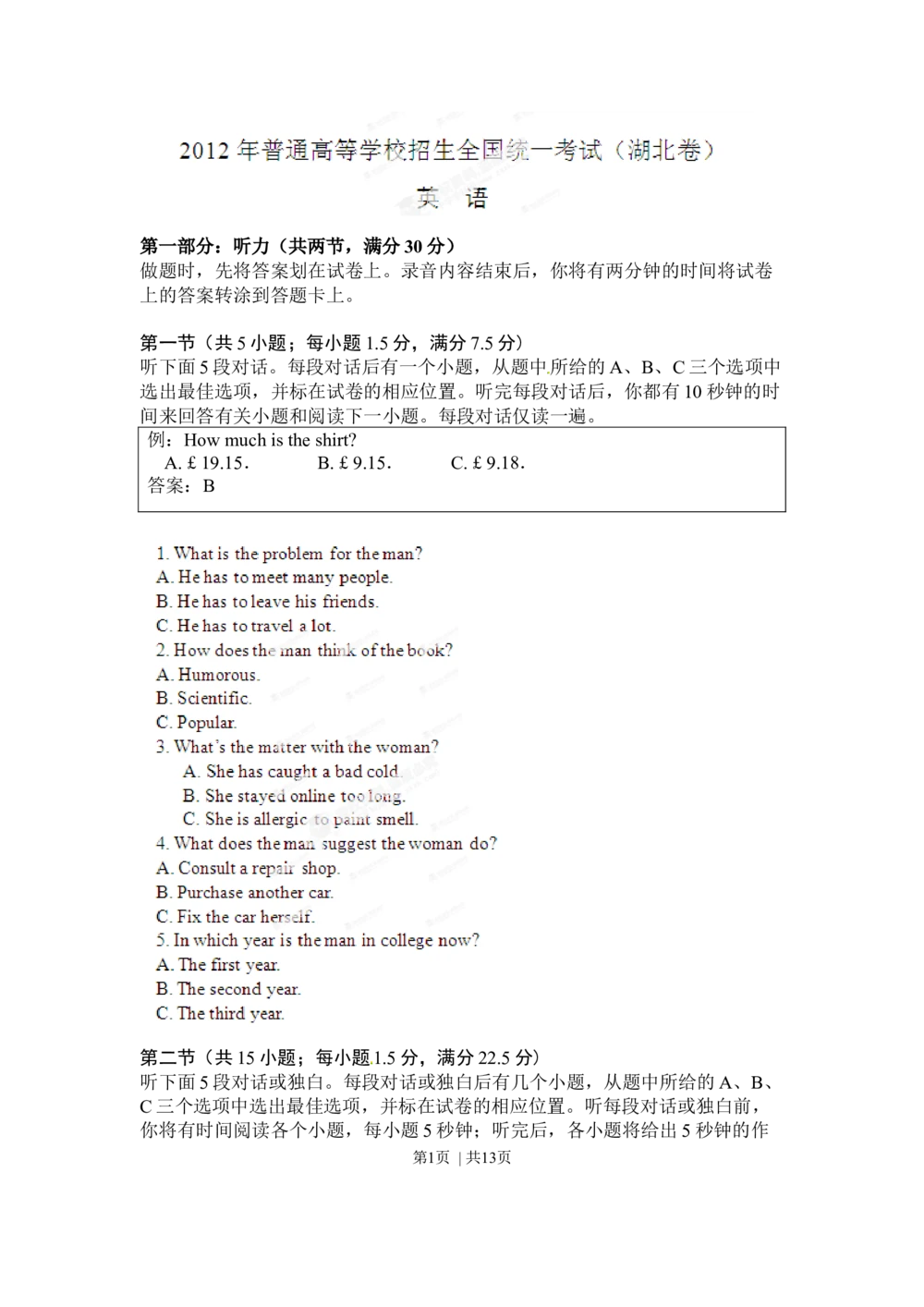
第一部分:听力(共两节,满分30分)
做题时,先将答案划在试卷上。录音内容结束后,你将有两分钟的时间将试卷
上的答案转涂到答题卡上。
第一节(共5小题;每小题1.5分,满分7.5分)
听下面5段对话。每段对话后有一个小题,从题中所给的A、B、C三个选项中
选出最佳选项,并标在试卷的相应位置。听完每段对话后,你都有10秒钟的时
间来回答有关小题和阅读下一小题。每段对话仅读一遍。
例:How much is the shirt?
A. £ 19.15. B. £ 9.15. C. £ 9.18.
答案:B
第二节(共15小题;每小题1.5分,满分22.5分)
听下面5段对话或独白。每段对话或独白后有几个小题,从题中所给的A、B、
C三个选项中选出最佳选项,并标在试卷的相应位置。听每段对话或独白前,
你将有时间阅读各个小题,每小题5秒钟;听完后,各小题将给出5秒钟的作
第1页 | 共13页答时间。每段对话或独白读两遍。
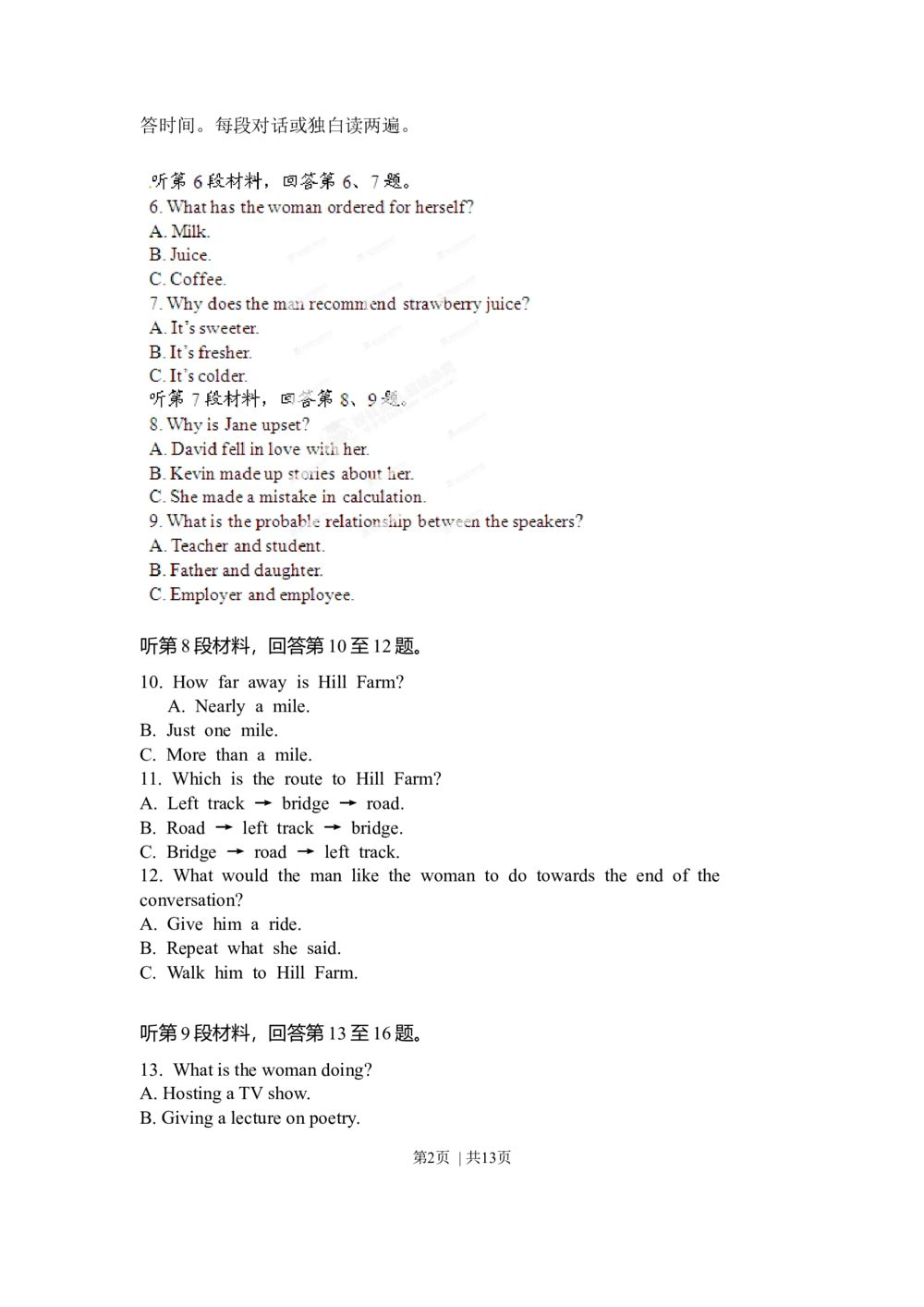
听第8段材料,回答第10至12题。
10. How far away is Hill Farm?
A. Nearly a mile.
B. Just one mile.
C. More than a mile.
[来源:Zxxk.Com]
11. Which is the route to Hill Farm?
A. Left track → bridge → road.
B. Road → left track → bridge.
C. Bridge → road → left track.
12. What would the man like the woman to do towards the end of the
conversation?
A. Give him a ride.
B. Repeat what she said.
C. Walk him to Hill Farm.
听第9段材料,回答第13至16题。
13. What is the woman doing? [来源:学科网ZXXK]
A. Hosting a TV show.
B. Giving a lecture on poetry.
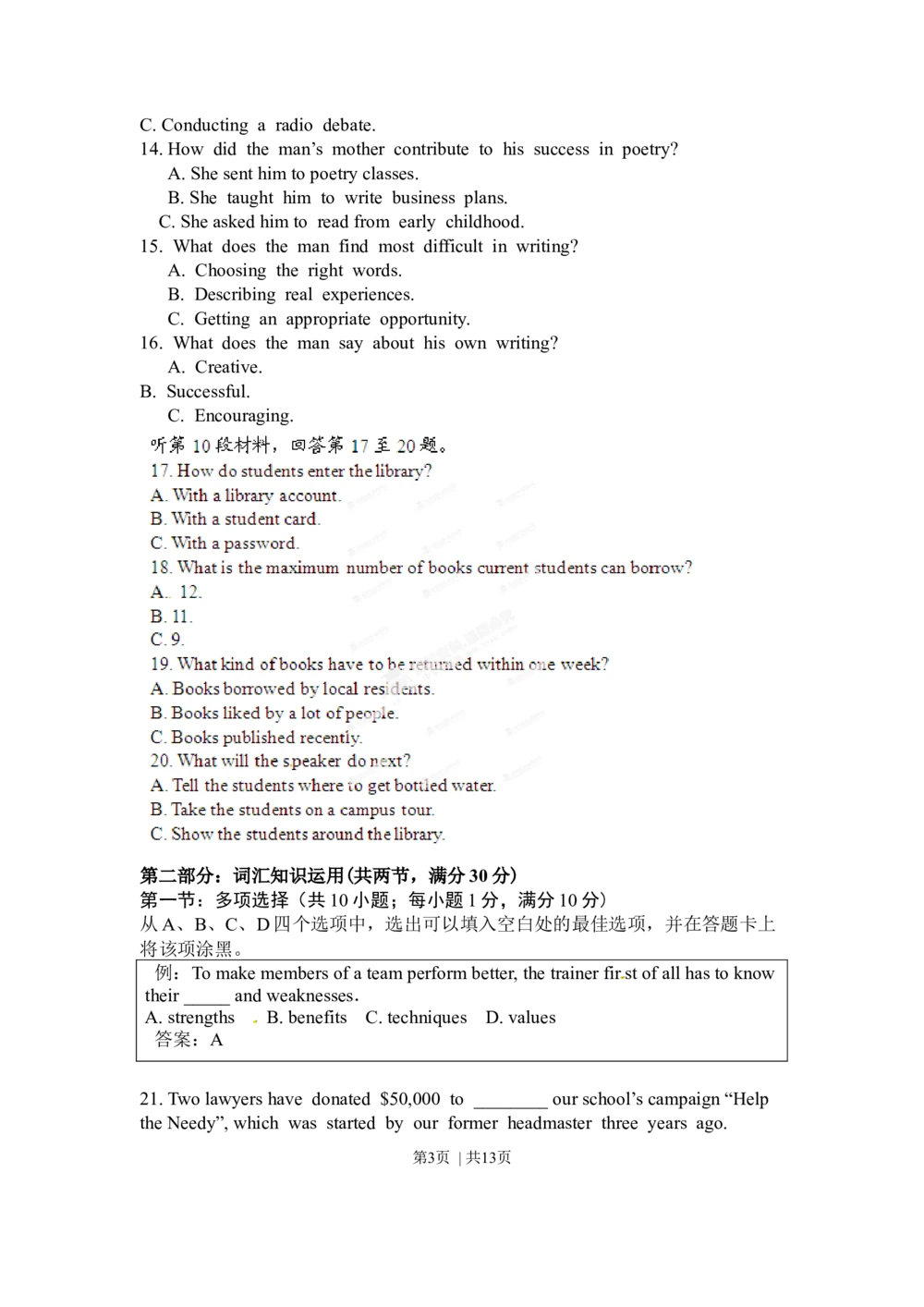
第2页 | 共13页C. Conducting a radio debate.
14. How did the man’s mother contribute to his success in poetry?
A. She sent him to poetry classes.
B. She taught him to write business plans.
C. She asked him to read from early childhood.
15. What does the man find most difficult in writing?
A. Choosing the right words.
B. Describing real experiences.
C. Getting an appropriate opportunity.
16. What does the man say about his own writing?
A. Creative.
B. Successful.
C. Encouraging.
第二部分:词汇知识运用(共两节,满分30分)
第一节:多项选择(共10小题;每小题1分,满分10分)
从A、B、C、D四个选项中,选出可以填入空白处的最佳选项,并在答题卡上
将该项涂黑。
例:To make members of a team perform better, the trainer first of all has to know
their _____ and weaknesses.
A. strengths B. benefits C. techniques D. values
答案:A
21. Two lawyers have donated $50,000 to ________ our school’s campaign “Help
the Needy”, which was started by our former headmaster three years ago.
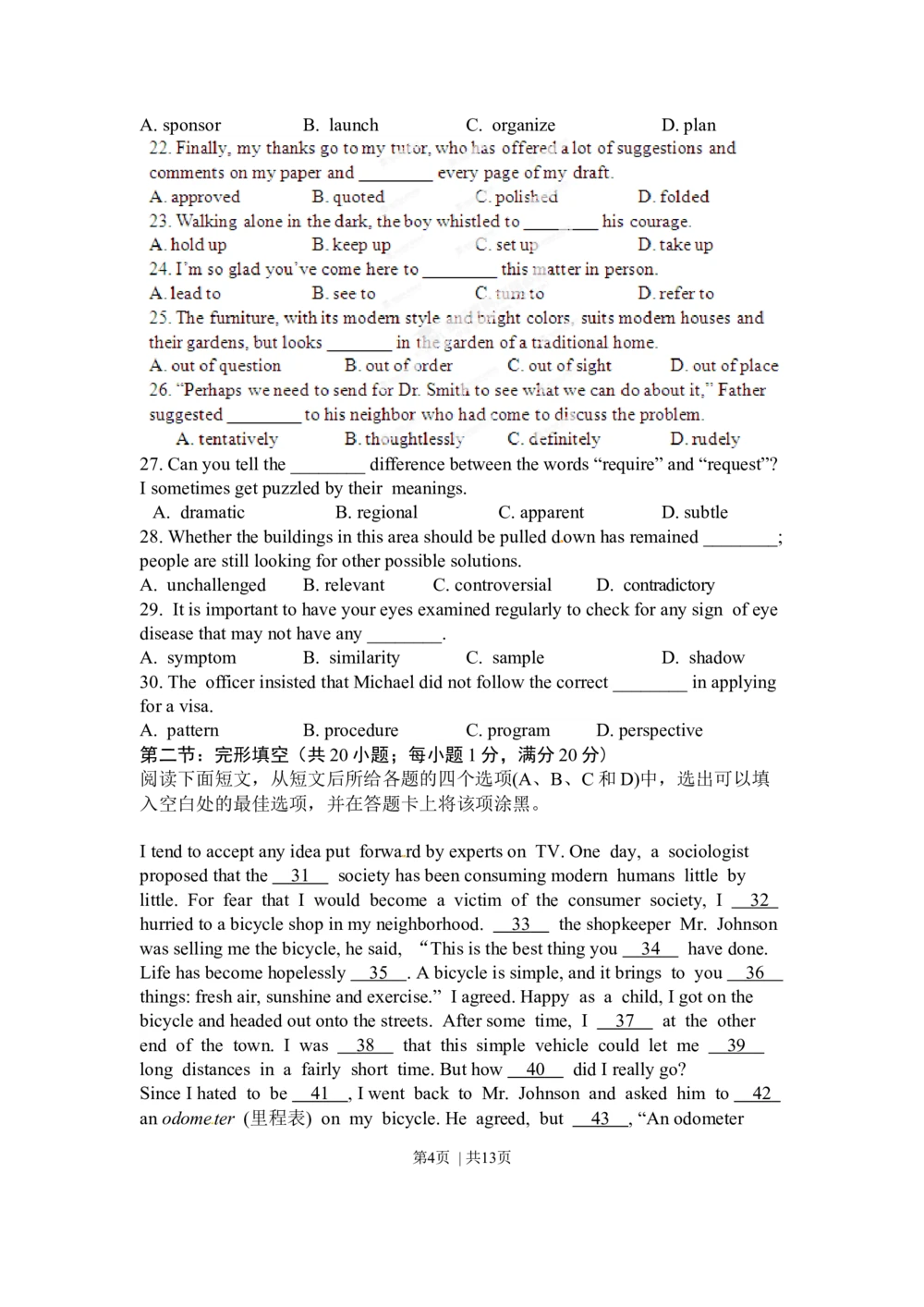
第3页 | 共13页A. sponsor B. launch C. organize D. plan
27. Can you tell the ________ difference between the words “require” and “request”?
I sometimes get puzzled by their meanings.
A. dramatic B. regional C. apparent D. subtle
28. Whether the buildings in this area should be pulled down has remained ________;
people are still looking for other possible solutions.
A. unchallenged B. relevant C. controversial D. contradictory
29. It is important to have your eyes examined regularly to check for any sign of eye
disease that may not have any ________.
A. symptom B. similarity C. sample D. shadow
30. The officer insisted that Michael did not follow the correct ________ in applying
for a visa.
A. pattern B. procedure C. program D. perspective
第二节:完形填空(共20小题;每小题1分,满分20分)
阅读下面短文,从短文后所给各题的四个选项(A、B、C和D)中,选出可以填
入空白处的最佳选项,并在答题卡上将该项涂黑。
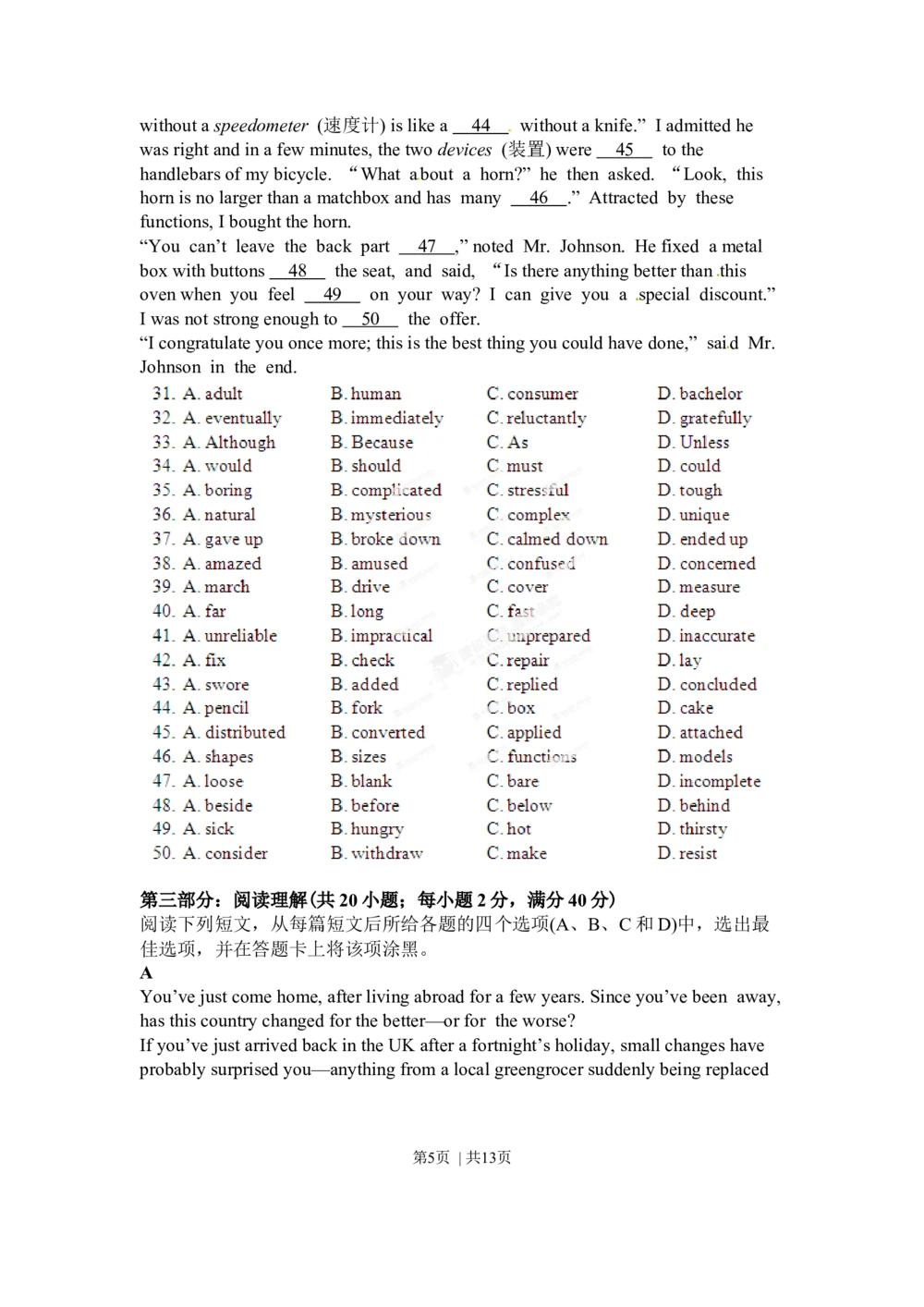
I tend to accept any idea put forward by experts on TV. One day, a sociologist
proposed that the 3 1 society has been consuming modern humans little by
little. For fear that I would become a victim of the consumer society, I 3 2
hurried to a bicycle shop in my neighborhood. 3 3 the shopkeeper Mr. Johnson
was selling me the bicycle, he said, “This is the best thing you 3 4 have done.
Life has become hopelessly 3 5 . A bicycle is simple, and it brings to you 3 6
things: fresh air, sunshine and exercise.” I agreed. Happy as a child, I got on the
bicycle and headed out onto the streets. After some time, I 3 7 at the other
end of the town. I was 3 8 that this simple vehicle could let me 3 9
long distances in a fairly short time. But how 4 0 did I really go?
Since I hated to be 4 1 , I went back to Mr. Johnson and asked him to 4 2
an odometer (里程表) on my bicycle. He agreed, but 4 3 , “An odometer
第4页 | 共13页without a speedometer (速度计) is like a 4 4 without a knife.” I admitted he
was right and in a few minutes, the two devices (装置) were 4 5 to the
handlebars of my bicycle. “What about a horn?” he then asked. “Look, this
horn is no larger than a matchbox and has many 4 6 .” Attracted by these
functions, I bought the horn.
“You can’t leave the back part 4 7 ,” noted Mr. Johnson. He fixed a metal
box with buttons 4 8 the seat, and said, “Is there anything better than this
oven when you feel 4 9 on your way? I can give you a special discount.”
I was not strong enough to 5 0 the offer.
“I congratulate you once more; this is the best thing you could have done,” said Mr.
Johnson in the end.
第三部分:阅读理解(共20小题;每小题2分,满分40分)
阅读下列短文,从每篇短文后所给各题的四个选项(A、B、C和D)中,选出最
佳选项,并在答题卡上将该项涂黑。
A
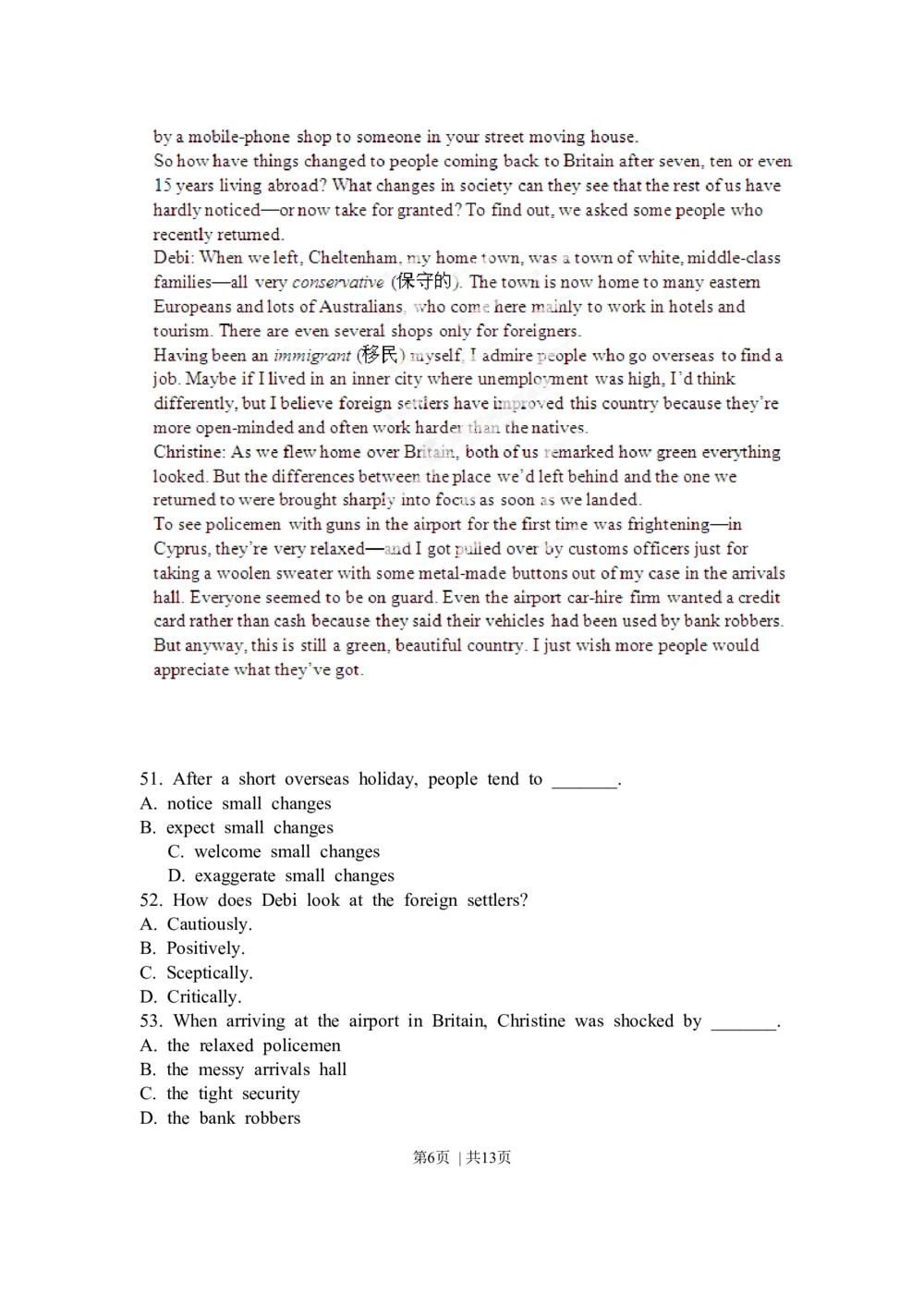
You’ve just come home, after living abroad for a few years. Since you’ve been away,
has this country changed for the better—or for the worse?
If you’ve just arrived back in the UK after a fortnight’s holiday, small changes have
probably surprised you—anything from a local greengrocer suddenly being replaced
第5页 | 共13页[来源:Zxxk.Com]
51. After a short overseas holiday, people tend to _______.
A. notice small changes[来源:Z.xx.k.Com]
B. expect small changes
C. welcome small changes
D. exaggerate small changes
52. How does Debi look at the foreign settlers?
A. Cautiously.
B. Positively.
C. Sceptically.
D. Critically.
53. When arriving at the airport in Britain, Christine was shocked by _______.
A. the relaxed policemen
B. the messy arrivals hall
C. the tight security
D. the bank robbers
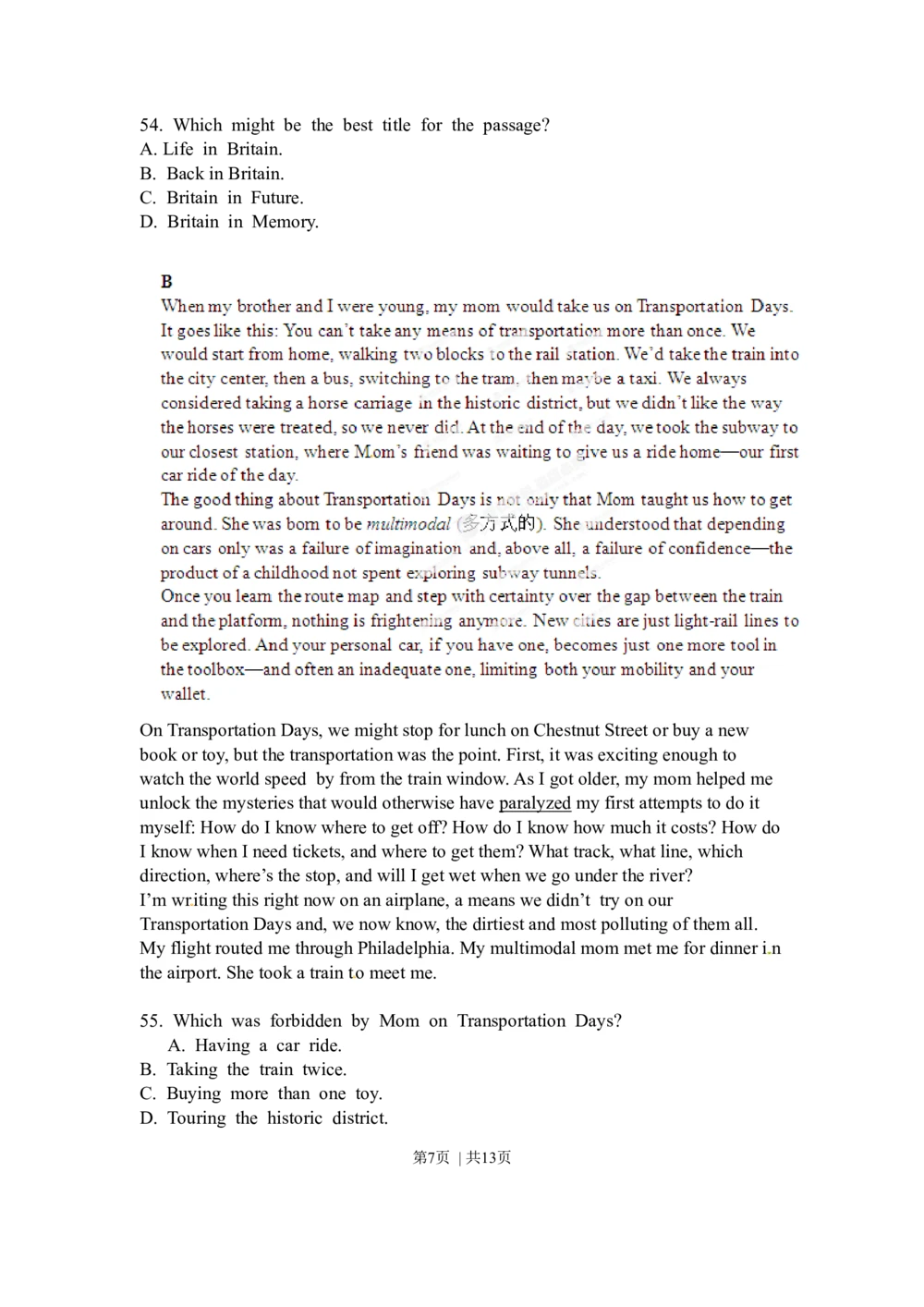
第6页 | 共13页54. Which might be the best title for the passage?
A. Life in Britain.
[来源:学科网]
B. Back in Britain.
C. Britain in Future.
D. Britain in Memory.
On Transportation Days, we might stop for lunch on Chestnut Street or buy a new
book or toy, but the transportation was the point. First, it was exciting enough to
watch the world speed by from the train window. As I got older, my mom helped me
unlock the mysteries that would otherwise have paralyzed my first attempts to do it
myself: How do I know where to get off? How do I know how much it costs? How do
I know when I need tickets, and where to get them? What track, what line, which
direction, where’s the stop, and will I get wet when we go under the river?
I’m writing this right now on an airplane, a means we didn’t try on our
Transportation Days and, we now know, the dirtiest and most polluting of them all.
My flight routed me through Philadelphia. My multimodal mom met me for dinner in
the airport. She took a train to meet me.
55. Which was forbidden by Mom on Transportation Days?
A. Having a car ride.
B. Taking the train twice.
C. Buying more than one toy.
D. Touring the historic district.
第7页 | 共13页C
It was a simple letter asking for a place to study at Scotland’s oldest university which
helped start a revolution in higher education. A 140-year-old letter written by a lady
calling for her to be allowed to study medicine at St Andrews University has been
discovered by researchers. Written by Sophia Jex-Blake in 1873, the seven-page
document, which urged the university to allow women to study medicine at the
institution, was released yesterday on International Women’s Day.
The document was discovered buried in the university archives (档案) by part-
time history student Lis Smith, who is completing her PhD at St Andrews Institute of
Scottish Historical Research. She said: “We knew that Sophia Jex-Blake and her
supporters, in their effort to open up university medical education for women, had
written to the Senatus Academicus (校评议委员会) at St Andrews in an attempt to
gain permission to attend classes there, but we didn’t know documentary evidence
existed. While searching the archives for information about the university’s higher
certificate for women, I was astonished to come across what must be the very letter
Jex-Blake wrote.”
In the letter, Sophia and her supporters offered to hire teachers or build suitable
buildings for a medical school and to arrange for lectures to be delivered in the
subjects not already covered at St Andrews. Although her letter was not successful, it
eventually led to the establishment of the Ladies Literate in Arts at St Andrews, a
distance-learning degree for women. The qualification, which ran from 1877 until the
1930s, gave women access to university education in the days before they were
admitted as students. It was so popular that it survived long after women were
admitted as full students to St Andrews in 1892.
第8页 | 共13页Ms Jex-Blake went on to help establish the London School of Medicine for Women in
1874. She was accepted by the University of Berne, where she was awarded a
medical degree in January 1877. Eventually, she moved back to Edinburgh and
opened her own practice.
D
How is it that siblings (兄弟姐妹) can turn out so differently? One answer is that in
fact each sibling grows up in a different family. The firstborn is, for a while, an only
child, and therefore has a completely different experience of the parents than those
born later. The next child is, for a while, the youngest, until the situation is changed
by a new arrival. The mother and father themselves are changing and growing up too.
One sibling might live in a stable and close family in the first few years; another
might be raised in a family crisis, with a disappointed mother or an angry father.
Sibling competition was identified as an important shaping force as early as in
1918. But more recently, researchers have found many ways in which brothers and
sisters are a lasting force in each others’ lives. Dr. Annette Henderson says firstborn
children pick up vocabulary more quickly than their siblings. The reason for this
might be that
第9页 | 共13页63. The underlined part “in a different family” (in Para. 1) means “_______”.
A. in a different family environment
B. in a different family tradition
C. in different family crises
D. in different families
64. In terms of language development, later-borns ________.
A. get their parents’ individual guidance
B. learn a lot from their elder siblings
C. experience a lot of difficulties
D. pick up words more quickly
65. What was found about fights among siblings?
A. Siblings hated fighting and loved playing.
B. Siblings in some families fought frequently.
C. Sibling fights led to bad sibling relationships.
D. Siblings learned to get on together from fights.
66. The word “feminine” (in Para. 4) means “_______”.
A. having qualities of parents
B. having qualities of women
C. having defensive qualities
D. having extraordinary qualities
第10页 | 共13页67. According to the author, we are more creative when we are _______.
A. focused
B. relaxed
C. awake
D. busy
68. What does the author imply about newspapers?
A. They are solution providers.
B. They are a source of inspiration.
C. They are normally full of bad news.
D. They are more educational than websites.
69. By “tune into your wandering mind” (in Para. 2), the author means
“_______”.
A. wander into the wild
第11页 | 共13页B. listen to a beautiful tune
C. switch to the traffic channel
D. stop concentrating on anything
70. The author writes the last paragraph in order to _______.
A. offer practical suggestions
B. summarize past experiences
C. advocate diverse ways of life
D. establish a routine for the future
第四部分:书面表达(共两节,满分50分)
第一节:完成句子(共10小题;每小题2分,满分20分)
阅读下列各小题,根据汉语提示,用句末括号内的英语单词完成句子,并将答
案写在答题卡上的相应题号后。
例:______ was that the young player performed extremely well in the table
tennis
tournament. (delight)
令球迷欣喜的是那位年轻的球员在乒乓球锦标赛中表现得极为出色。
答案:What delighted the fans/made the fans delighted
78. The soldier was absent from his camp for three days without ________.
(ask)
这个士兵没有请假就离开营地三天。
79. Our understanding of education, work and society is ________ of the earlier
generation. (different)
我们对教育、工作和社会的认识和我们上一代人的不同。
第12页 | 共13页[来源:学,科,网]
第13页 | 共13页