文档文本内容
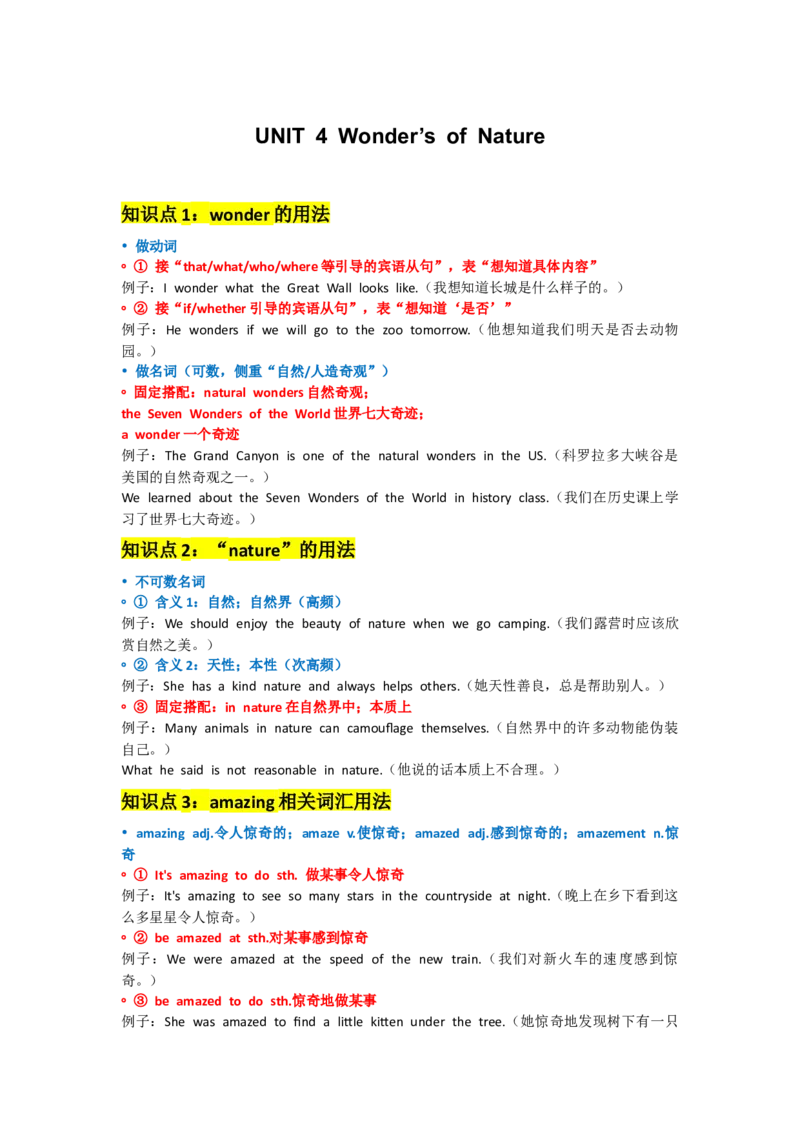
UNIT 4 Wonder’s of Nature
知识点1:wonder的用法
• 做动词
◦ ① 接“that/what/who/where等引导的宾语从句”,表“想知道具体内容”
例子:I wonder what the Great Wall looks like.(我想知道长城是什么样子的。)
◦ ② 接“if/whether引导的宾语从句”,表“想知道‘是否’”
例子:He wonders if we will go to the zoo tomorrow.(他想知道我们明天是否去动物
园。)
• 做名词(可数,侧重“自然/人造奇观”)
◦ 固定搭配:natural wonders自然奇观;
the Seven Wonders of the World世界七大奇迹;
a wonder一个奇迹
例子:The Grand Canyon is one of the natural wonders in the US.(科罗拉多大峡谷是
美国的自然奇观之一。)
We learned about the Seven Wonders of the World in history class.(我们在历史课上学
习了世界七大奇迹。)
知识点2:“nature”的用法
• 不可数名词
◦ ① 含义1:自然;自然界(高频)
例子:We should enjoy the beauty of nature when we go camping.(我们露营时应该欣
赏自然之美。)
◦ ② 含义2:天性;本性(次高频)
例子:She has a kind nature and always helps others.(她天性善良,总是帮助别人。)
◦ ③ 固定搭配:in nature在自然界中;本质上
例子:Many animals in nature can camouflage themselves.(自然界中的许多动物能伪装
自己。)
What he said is not reasonable in nature.(他说的话本质上不合理。)
知识点3:amazing相关词汇用法
• amazing adj.令人惊奇的;amaze v.使惊奇;amazed adj.感到惊奇的;amazement n.惊
奇
◦ ① It's amazing to do sth. 做某事令人惊奇
例子:It's amazing to see so many stars in the countryside at night.(晚上在乡下看到这
么多星星令人惊奇。)
◦ ② be amazed at sth.对某事感到惊奇
例子:We were amazed at the speed of the new train.(我们对新火车的速度感到惊
奇。)
◦ ③ be amazed to do sth.惊奇地做某事
例子:She was amazed to find a little kitten under the tree.(她惊奇地发现树下有一只小猫。)
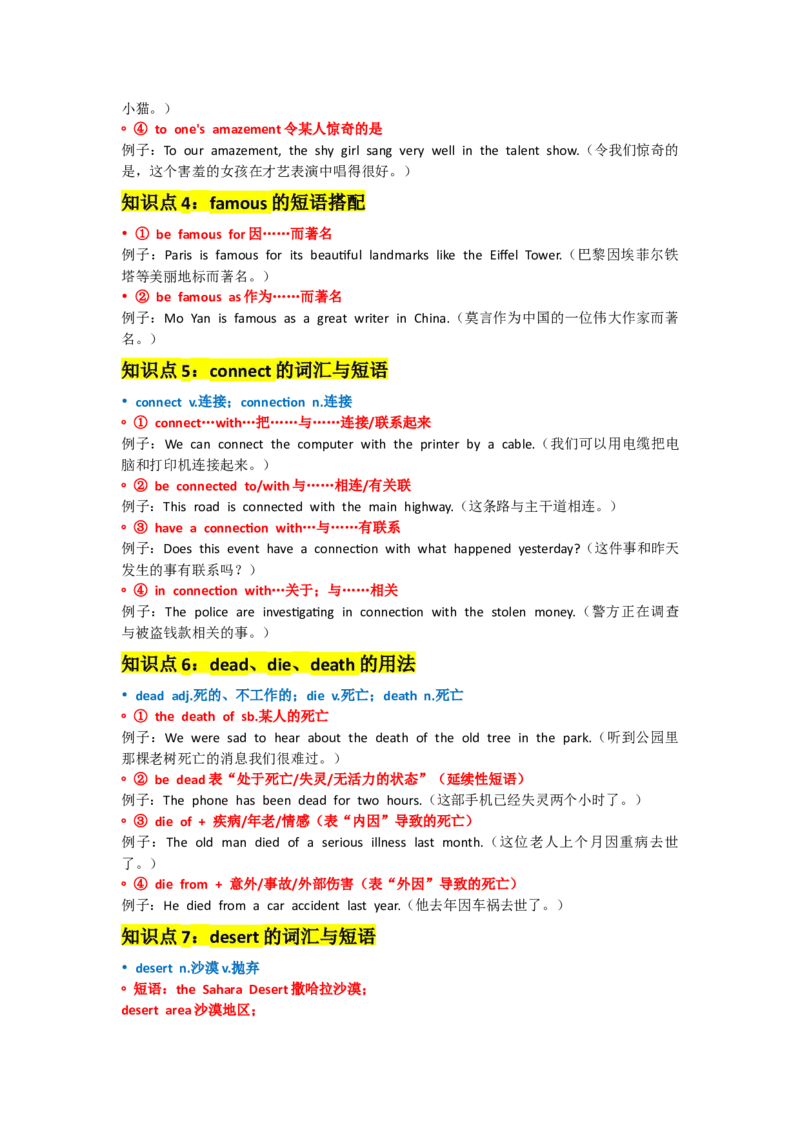
◦ ④ to one's amazement令某人惊奇的是
例子:To our amazement, the shy girl sang very well in the talent show.(令我们惊奇的
是,这个害羞的女孩在才艺表演中唱得很好。)
知识点4:famous的短语搭配
• ① be famous for因……而著名
例子:Paris is famous for its beautiful landmarks like the Eiffel Tower.(巴黎因埃菲尔铁
塔等美丽地标而著名。)
• ② be famous as作为……而著名
例子:Mo Yan is famous as a great writer in China.(莫言作为中国的一位伟大作家而著
名。)
知识点5:connect的词汇与短语
• connect v.连接;connection n.连接
◦ ① connect…with…把……与……连接/联系起来
例子:We can connect the computer with the printer by a cable.(我们可以用电缆把电
脑和打印机连接起来。)
◦ ② be connected to/with与……相连/有关联
例子:This road is connected with the main highway.(这条路与主干道相连。)
◦ ③ have a connection with…与……有联系
例子:Does this event have a connection with what happened yesterday?(这件事和昨天
发生的事有联系吗?)
◦ ④ in connection with…关于;与……相关
例子:The police are investigating in connection with the stolen money.(警方正在调查
与被盗钱款相关的事。)
知识点6:dead、die、death的用法
• dead adj.死的、不工作的;die v.死亡;death n.死亡
◦ ① the death of sb.某人的死亡
例子:We were sad to hear about the death of the old tree in the park.(听到公园里
那棵老树死亡的消息我们很难过。)
◦ ② be dead表“处于死亡/失灵/无活力的状态”(延续性短语)
例子:The phone has been dead for two hours.(这部手机已经失灵两个小时了。)
◦ ③ die of + 疾病/年老/情感(表“内因”导致的死亡)
例子:The old man died of a serious illness last month.(这位老人上个月因重病去世
了。)
◦ ④ die from + 意外/事故/外部伤害(表“外因”导致的死亡)
例子:He died from a car accident last year.(他去年因车祸去世了。)
知识点7:desert的词汇与短语
• desert n.沙漠v.抛弃
◦ 短语:the Sahara Desert撒哈拉沙漠;
desert area沙漠地区;natural desert天然沙漠;
desert landscape沙漠景观;
desert sb./sth.抛弃某人/某物
例子:The Sahara Desert is the largest hot desert in the world.(撒哈拉沙漠是世界上最
大的热沙漠。)
No one should desert their friends when they are in need.(没人应该在朋友需要时抛弃
他们。)
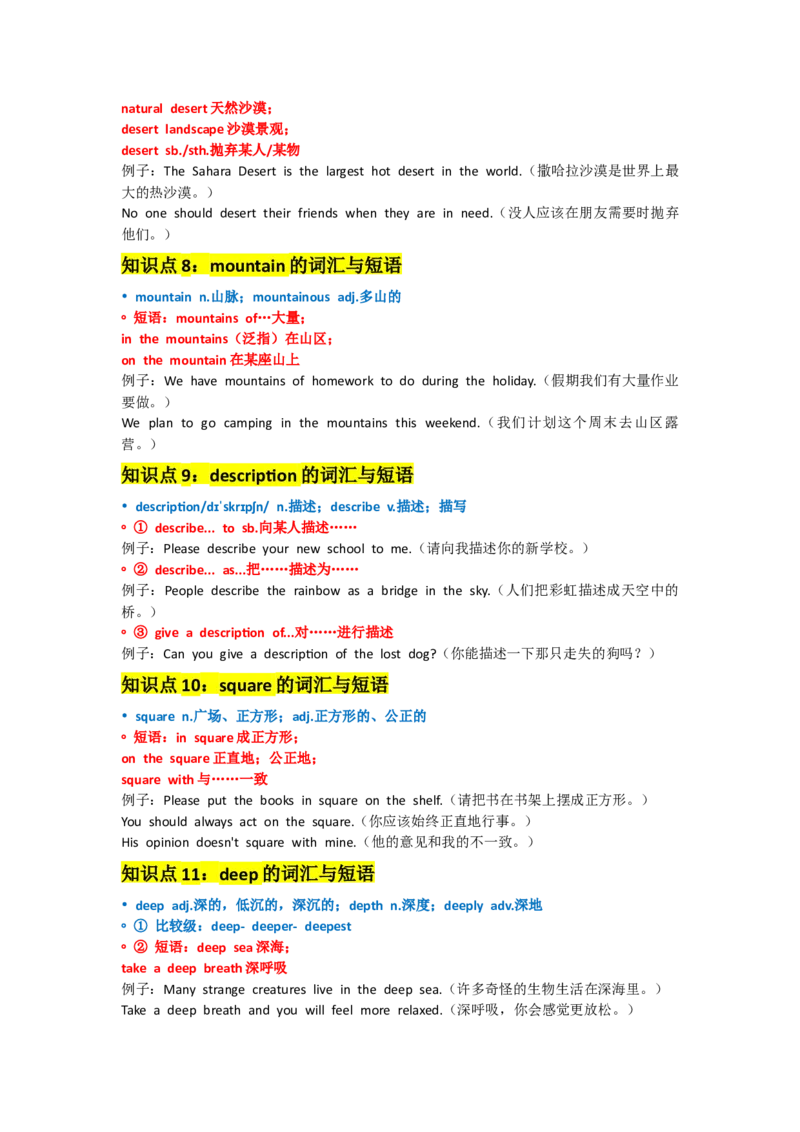
知识点8:mountain的词汇与短语
• mountain n.山脉;mountainous adj.多山的
◦ 短语:mountains of…大量;
in the mountains(泛指)在山区;
on the mountain在某座山上
例子:We have mountains of homework to do during the holiday.(假期我们有大量作业
要做。)
We plan to go camping in the mountains this weekend.(我们计划这个周末去山区露
营。)
知识点9:description的词汇与短语
• description/dɪˈskrɪpʃn/ n.描述;describe v.描述;描写
◦ ① describe... to sb.向某人描述……
例子:Please describe your new school to me.(请向我描述你的新学校。)
◦ ② describe... as...把……描述为……
例子:People describe the rainbow as a bridge in the sky.(人们把彩虹描述成天空中的
桥。)
◦ ③ give a description of...对……进行描述
例子:Can you give a description of the lost dog?(你能描述一下那只走失的狗吗?)
知识点10:square的词汇与短语
• square n.广场、正方形;adj.正方形的、公正的
◦ 短语:in square成正方形;
on the square正直地;公正地;
square with与……一致
例子:Please put the books in square on the shelf.(请把书在书架上摆成正方形。)
You should always act on the square.(你应该始终正直地行事。)
His opinion doesn't square with mine.(他的意见和我的不一致。)
知识点11:deep的词汇与短语
• deep adj.深的,低沉的,深沉的;depth n.深度;deeply adv.深地
◦ ① 比较级:deep- deeper- deepest
◦ ② 短语:deep sea深海;
take a deep breath深呼吸
例子:Many strange creatures live in the deep sea.(许多奇怪的生物生活在深海里。)
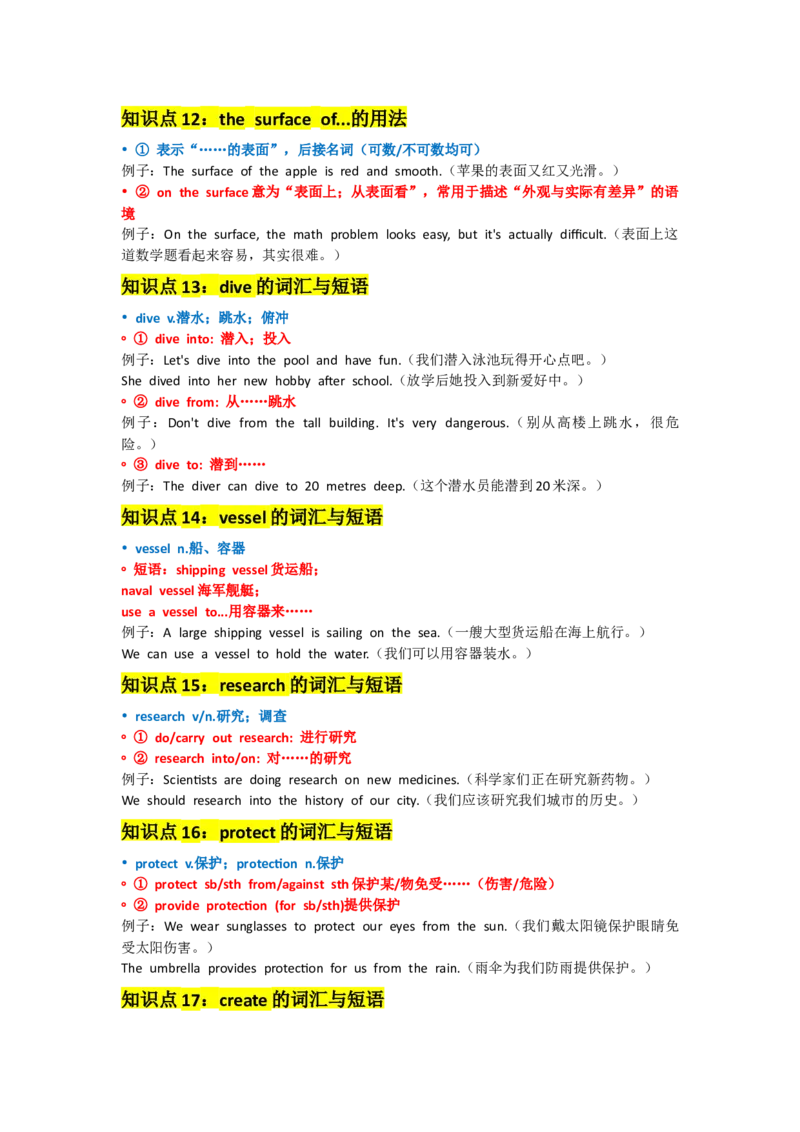
Take a deep breath and you will feel more relaxed.(深呼吸,你会感觉更放松。)知识点12:the surface of...的用法
• ① 表示“……的表面”,后接名词(可数/不可数均可)
例子:The surface of the apple is red and smooth.(苹果的表面又红又光滑。)
• ② on the surface意为“表面上;从表面看”,常用于描述“外观与实际有差异”的语
境
例子:On the surface, the math problem looks easy, but it's actually difficult.(表面上这
道数学题看起来容易,其实很难。)
知识点13:dive的词汇与短语
• dive v.潜水;跳水;俯冲
◦ ① dive into: 潜入;投入
例子:Let's dive into the pool and have fun.(我们潜入泳池玩得开心点吧。)
She dived into her new hobby after school.(放学后她投入到新爱好中。)
◦ ② dive from: 从……跳水
例子:Don't dive from the tall building. It's very dangerous.(别从高楼上跳水,很危
险。)
◦ ③ dive to: 潜到……
例子:The diver can dive to 20 metres deep.(这个潜水员能潜到20米深。)
知识点14:vessel的词汇与短语
• vessel n.船、容器
◦ 短语:shipping vessel货运船;
naval vessel海军舰艇;
use a vessel to...用容器来……
例子:A large shipping vessel is sailing on the sea.(一艘大型货运船在海上航行。)
We can use a vessel to hold the water.(我们可以用容器装水。)
知识点15:research的词汇与短语
• research v/n.研究;调查
◦ ① do/carry out research: 进行研究
◦ ② research into/on: 对……的研究
例子:Scientists are doing research on new medicines.(科学家们正在研究新药物。)
We should research into the history of our city.(我们应该研究我们城市的历史。)
知识点16:protect的词汇与短语
• protect v.保护;protection n.保护
◦ ① protect sb/sth from/against sth保护某/物免受……(伤害/危险)
◦ ② provide protection (for sb/sth)提供保护
例子:We wear sunglasses to protect our eyes from the sun.(我们戴太阳镜保护眼睛免
受太阳伤害。)
The umbrella provides protection for us from the rain.(雨伞为我们防雨提供保护。)
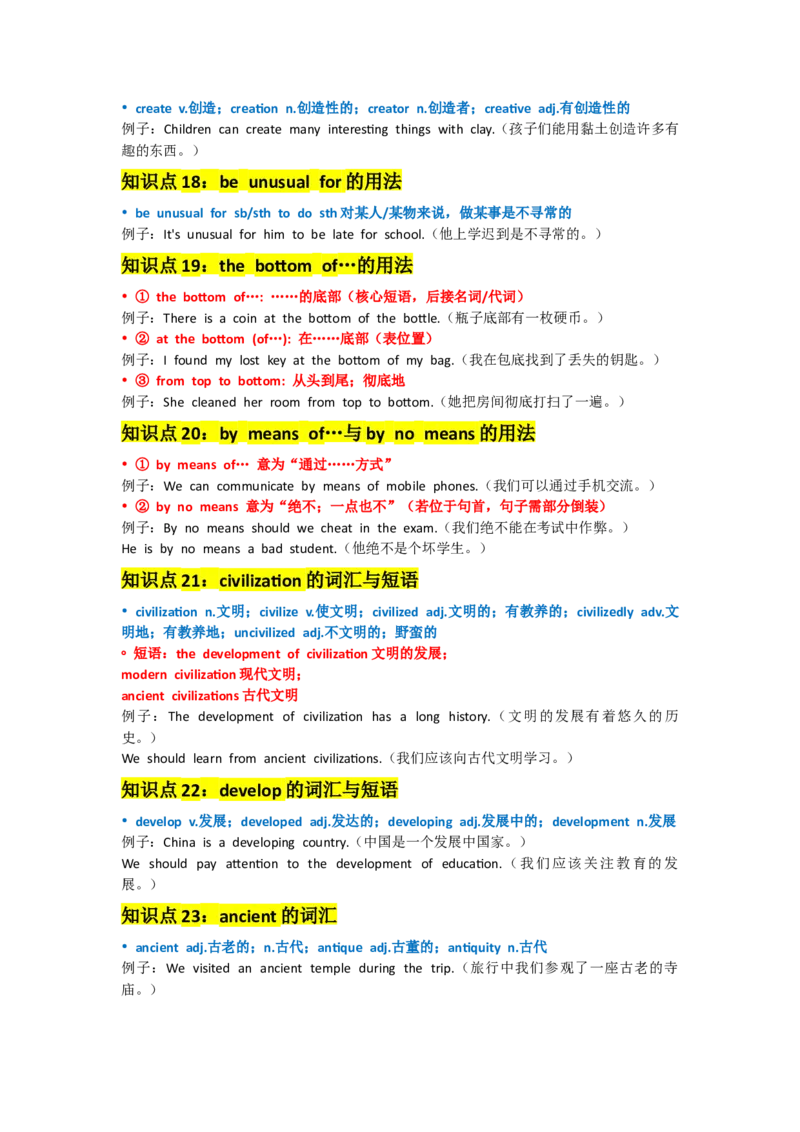
知识点17:create的词汇与短语• create v.创造;creation n.创造性的;creator n.创造者;creative adj.有创造性的
例子:Children can create many interesting things with clay.(孩子们能用黏土创造许多有
趣的东西。)
知识点18:be unusual for的用法
• be unusual for sb/sth to do sth对某人/某物来说,做某事是不寻常的
例子:It's unusual for him to be late for school.(他上学迟到是不寻常的。)
知识点19:the bottom of…的用法
• ① the bottom of…: ……的底部(核心短语,后接名词/代词)
例子:There is a coin at the bottom of the bottle.(瓶子底部有一枚硬币。)
• ② at the bottom (of…): 在……底部(表位置)
例子:I found my lost key at the bottom of my bag.(我在包底找到了丢失的钥匙。)
• ③ from top to bottom: 从头到尾;彻底地
例子:She cleaned her room from top to bottom.(她把房间彻底打扫了一遍。)
知识点20:by means of…与by no means的用法
• ① by means of… 意为“通过……方式”
例子:We can communicate by means of mobile phones.(我们可以通过手机交流。)
• ② by no means 意为“绝不;一点也不”(若位于句首,句子需部分倒装)
例子:By no means should we cheat in the exam.(我们绝不能在考试中作弊。)
He is by no means a bad student.(他绝不是个坏学生。)
知识点21:civilization的词汇与短语
• civilization n.文明;civilize v.使文明;civilized adj.文明的;有教养的;civilizedly adv.文
明地;有教养地;uncivilized adj.不文明的;野蛮的
◦ 短语:the development of civilization文明的发展;
modern civilization现代文明;
ancient civilizations古代文明
例子:The development of civilization has a long history.(文明的发展有着悠久的历
史。)
We should learn from ancient civilizations.(我们应该向古代文明学习。)
知识点22:develop的词汇与短语
• develop v.发展;developed adj.发达的;developing adj.发展中的;development n.发展
例子:China is a developing country.(中国是一个发展中国家。)
We should pay attention to the development of education.(我们应该关注教育的发
展。)
知识点23:ancient的词汇
• ancient adj.古老的;n.古代;antique adj.古董的;antiquity n.古代
例子:We visited an ancient temple during the trip.(旅行中我们参观了一座古老的寺
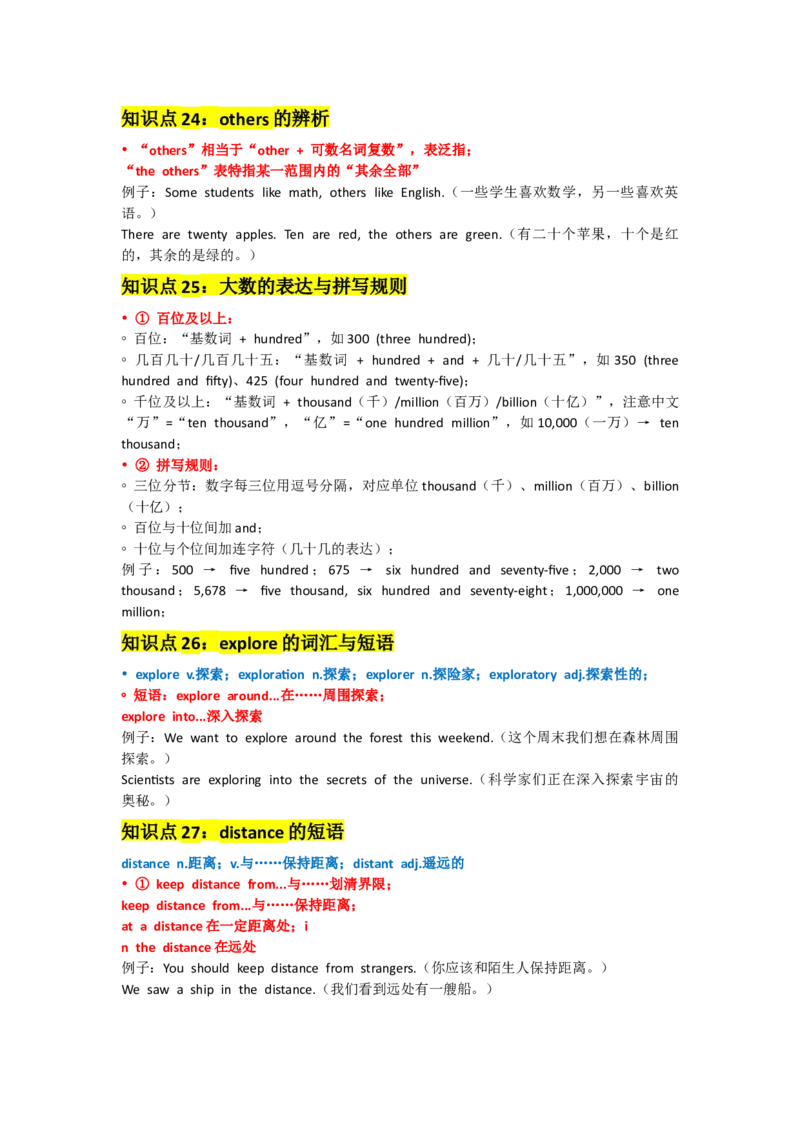
庙。)知识点24:others的辨析
• “others”相当于“other + 可数名词复数”,表泛指;
“the others”表特指某一范围内的“其余全部”
例子:Some students like math, others like English.(一些学生喜欢数学,另一些喜欢英
语。)
There are twenty apples. Ten are red, the others are green.(有二十个苹果,十个是红
的,其余的是绿的。)
知识点25:大数的表达与拼写规则
• ① 百位及以上:
◦ 百位:“基数词 + hundred”,如300 (three hundred);
◦ 几百几十/几百几十五:“基数词 + hundred + and + 几十/几十五”,如350 (three
hundred and fifty)、425 (four hundred and twenty-five);
◦ 千位及以上:“基数词 + thousand(千)/million(百万)/billion(十亿)”,注意中文
“万”=“ten thousand”,“亿”=“one hundred million”,如10,000(一万)→ ten
thousand;
• ② 拼写规则:
◦ 三位分节:数字每三位用逗号分隔,对应单位thousand(千)、million(百万)、billion
(十亿);
◦ 百位与十位间加and;
◦ 十位与个位间加连字符(几十几的表达);
例子:500 → five hundred;675 → six hundred and seventy-five;2,000 → two
thousand;5,678 → five thousand, six hundred and seventy-eight;1,000,000 → one
million;
知识点26:explore的词汇与短语
• explore v.探索;exploration n.探索;explorer n.探险家;exploratory adj.探索性的;
◦ 短语:explore around...在……周围探索;
explore into...深入探索
例子:We want to explore around the forest this weekend.(这个周末我们想在森林周围
探索。)
Scientists are exploring into the secrets of the universe.(科学家们正在深入探索宇宙的
奥秘。)
知识点27:distance的短语
distance n.距离;v.与……保持距离;distant adj.遥远的
• ① keep distance from...与……划清界限;
keep distance from...与……保持距离;
at a distance在一定距离处;i
n the distance在远处
例子:You should keep distance from strangers.(你应该和陌生人保持距离。)
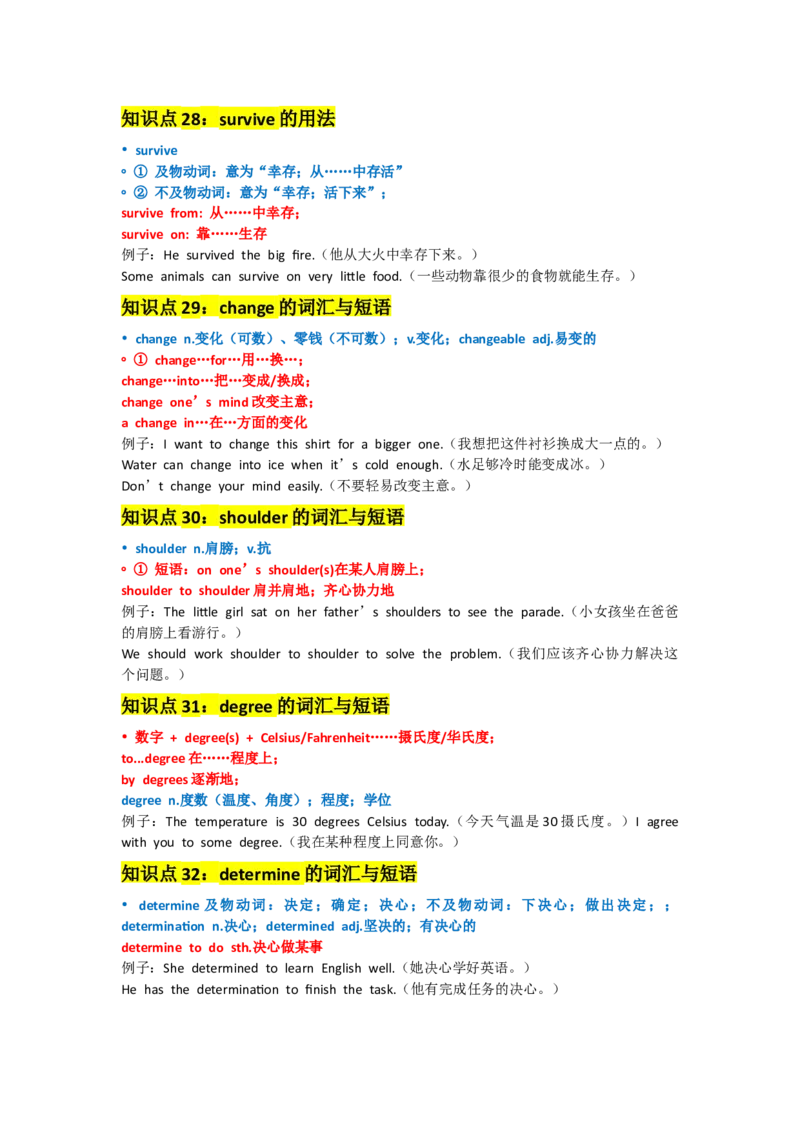
We saw a ship in the distance.(我们看到远处有一艘船。)知识点28:survive的用法
• survive
◦ ① 及物动词:意为“幸存;从……中存活”
◦ ② 不及物动词:意为“幸存;活下来”;
survive from: 从……中幸存;
survive on: 靠……生存
例子:He survived the big fire.(他从大火中幸存下来。)
Some animals can survive on very little food.(一些动物靠很少的食物就能生存。)
知识点29:change的词汇与短语
• change n.变化(可数)、零钱(不可数);v.变化;changeable adj.易变的
◦ ① change…for…用…换…;
change…into…把…变成/换成;
change one’s mind改变主意;
a change in…在…方面的变化
例子:I want to change this shirt for a bigger one.(我想把这件衬衫换成大一点的。)
Water can change into ice when it’s cold enough.(水足够冷时能变成冰。)
Don’t change your mind easily.(不要轻易改变主意。)
知识点30:shoulder的词汇与短语
• shoulder n.肩膀;v.抗
◦ ① 短语:on one’s shoulder(s)在某人肩膀上;
shoulder to shoulder肩并肩地;齐心协力地
例子:The little girl sat on her father’s shoulders to see the parade.(小女孩坐在爸爸
的肩膀上看游行。)
We should work shoulder to shoulder to solve the problem.(我们应该齐心协力解决这
个问题。)
知识点31:degree的词汇与短语
• 数字 + degree(s) + Celsius/Fahrenheit……摄氏度/华氏度;
to...degree在……程度上;
by degrees逐渐地;
degree n.度数(温度、角度);程度;学位
例子:The temperature is 30 degrees Celsius today.(今天气温是30摄氏度。)I agree
with you to some degree.(我在某种程度上同意你。)
知识点32:determine的词汇与短语
• determine 及物动词:决定;确定;决心;不及物动词:下决心;做出决定;;
determination n.决心;determined adj.坚决的;有决心的
determine to do sth.决心做某事
例子:She determined to learn English well.(她决心学好英语。)
He has the determination to finish the task.(他有完成任务的决心。)知识点33:measure的词汇与短语
• measure v.测量;measurement n.测量;尺寸;measure up to: 达到;符合;
take measures to do sth.: 采取措施做某事
例子:We should take measures to protect the environment.(我们应该采取措施保护环
境。)
This product measures up to the international standards.(这个产品达到国际标准。)
知识点34:curiosity的词汇与短语
• curiosity n.好奇心;curiously adv.好奇地;curious adj.好奇的
◦ ① be curious about 对……好奇
;be curious to do sth.极想做某事;
It’s curious that... ……是奇怪的;
arouse one’s curiosity引起某人的好奇心;
out of curiosity出于好奇
例子:Children are always curious about everything around them.(孩子们总是对周围的
一切好奇。)
I’m curious to know what’s in the box.(我极想知道盒子里有什么。)
It’s curious that the cat likes swimming.(这只猫喜欢游泳,真奇怪。)
知识点35:simple的词汇与短语
• simple adj.简单的;simply adv.简单地;
as simple as…像……一样简单;be + simple + to do sth做某事是简单的
例子:This question is as simple as ABC.(这个问题像ABC一样简单。)
It’s simple to make a paper plane.(做纸飞机很简单。)
知识点36:succeed的词汇与短语
• succeed v.成功;success n.成功;successful adj.成功的;successfully adv.成功地;[反义
词]fail;
make a great / huge success in ... 在……方面取得巨大的成功;
succeed in (doing) sth. = be successful in (doing) sth.成功做(做)某事
例子:He succeeded in passing the exam.(他成功通过了考试。)
She is a successful singer.(她是一位成功的歌手。)
知识点37:risk的词汇与短语
• risk n.风险;v.冒…风险;risky adj.冒险的;
take a risk / take risks冒险;
at risk处于危险中;
the risk of (doing) sth.……的风险;
risk doing sth.冒险做某事
例子:Don’t risk swimming in the deep river.(不要冒险在深河里游泳。)
It’s risky to drive too fast.(开太快很冒险。)
知识点38:地理专有名词冠词用法• 地理专有名词中,“湖、山”等若为“Lake/Mount + 名称”结构,一般不用“the”;
若为“the + 复数/类别名词”(如the Great Lakes, the Himalayas)则需加“the”
例子:Mount Everest is the highest mountain in the world.(珠穆朗玛峰是世界上最高的
山。)
The Himalayas are very famous.(喜马拉雅山脉很有名。)
知识点39:locate的词汇与短语
• locate v.位于;location n.位置;located adj.位于…的;
be located in/at/on…某物坐落于/位于某地;
the location of… …的位置
例子:Beijing is located in the north of China.(北京位于中国北部。)
Can you tell me the location of the library?(你能告诉我图书馆的位置吗?)
知识点40:alive、live、living、lively的辨析
• ① alive adj.活着的〔后置定语〕
例子:There is a fish alive in the river.(河里有一条活鱼。)
• ② live adj.现场直播〔前置定语〕
例子:We watched a live concert last night.(昨晚我们看了一场现场直播的音乐会。)
• ③ living adj.活着的(强调生存/生存方式)〔前置定语〕
例子:We should protect living things.(我们应该保护生物。)
• ④ lively adj.充满活力的〔前置定语〕
例子:She is a lively girl who likes singing and dancing.(她是个喜欢唱歌跳舞的活力女
孩。)
• ⑤ live v.生活;living adj.活着的;n.生活
例子:We live in a happy family.(我们生活在一个幸福的家庭里。)
知识点41:structure的词汇与短语
• structure作名词(意为“结构;建筑物”)
◦ ① 不可数:表“结构、构造”(抽象概念)
例子:The structure of the human body is very complex.(人体的结构非常复杂。)
◦ ② 可数:表“建筑物;具体结构”
例子:This steel structure is very strong.(这个钢结构很坚固。)
◦ ③ 作动词(意为“组织;安排”)
例子:Teachers should structure their lessons well.(老师应该好好组织课程。)
• structural adj.结构的;建筑的
知识点42:province的词汇与短语
• province n.省;provincial adj.省的;in a province在一个省;
provincial capital省会
例子:Sichuan is a province in China.(四川是中国的一个省。)
Chengdu is the provincial capital of Sichuan.(成都是四川的省会。)单元短语总结
1. The Wonders of Nature 自然奇观
2. connect with nature 与自然连接
3. geography facts 地理事实
4. natural wonders 自然奇观
5. famous places 著名地点
6. large numbers 大数字
7. Nile River 尼罗河
8. Angel Falls 安赫尔瀑布
9. Mount Qomolangma 珠穆朗玛峰
10. Dead Sea 死海
11. Sahara Desert 撒哈拉沙漠
12. Mariana Trench 马里亚纳海沟
13. game show 游戏节目
14. deep sea 深海
15. Fendouzhe reached “奋斗者”号抵达
16. deep sea begins 深海起始处
17. Titanic rests 泰坦尼克号残骸处
18. deepest dive of a whale 鲸鱼最深潜水记录
19. deep-sea researcher 深海研究员
20. Yellow River 黄河
21. Yangtze River 长江
22. ancient civilizations 古代文明
23. mother river 母亲河
24. Grammar Focus 语法聚焦
25. compare things 比较事物
26. compare actions 比较动作
27. compare places 比较地方
28. the biggest desert 最大的沙漠
29. the deepest point 最深点
30. as well as 也;和……一样好
31. growing taller 不断长高
32. travels the farthest 流经最远
33. Victoria Falls 维多利亚瀑布
34. magical experience 神奇的经历
35. right before our eyes 就在我们眼前
36. as ... as the eye could see 一望无际
37. special pool 特殊的水池
38. rush past 疾驰而过
39. Reaching New Heights 攀登新高度(文章标题)40. greatest wonders 最伟大的奇观
41. highest place 最高的地方
42. touch the sky 触摸天空
43. terrible conditions 恶劣的条件
44. thin air 稀薄的空气
45. high cliffs 高悬崖
46. changeable weather 多变的天气
47. Death Road 死亡之路
48. climbing team 登山队
49. Chinese climbing team 中国登山队
50. Second Step 第二步(珠峰地形)
51. national flag 国旗
52. did research 进行研究
53. do research 做研究
54. do some research 做一些研究
55. Chinese Ladder 中国梯
56. bring a ladder 带梯子
57. use the “Chinese Ladder” 使用“中国梯”
58. measure its height 测量它的高度
59. climb Qomolangma 攀登珠穆朗玛峰
60. reach the top 登顶
61. risk their lives 冒着生命危险
62. human curiosity 人类的好奇心
63. human ambition 人类的雄心
64. human curiosity and ambition 人类的好奇心和雄心
65. Vocabulary in Use 词汇运用
66. opposites 反义词
67. freshwater lake 淡水湖
68. reach the bottom 到达底部
69. covers ... square kilometres 覆盖……平方公里
70. different types of animals 不同种类的动物
71. natural wonder 自然奇观
72. Great Barrier Reef 大堡礁
73. coral reef 珊瑚礁
74. white sand beaches 白色沙滩
75. living structure 活的结构
76. clear water 清澈的水
77. schools of colourful fish 成群的彩色鱼
78. salt lake 盐湖
79. wildlife (fish and birds) 野生动物(鱼和鸟)
80. ride a bike or horse 骑自行车或马
81. make notes 做笔记
82. note down the details 记下细节
83. give a report 做报告84. comparatives 比较级
85. superlatives 最高级
86. comparatives and superlatives 比较级和最高级
87. Amazon Rainforest 亚马逊雨林
88. the world's biggest rainforest 世界上最大的雨林
89. 5.5 million square kilometres 550万平方公里
90. "the lungs of the earth" “地球之肺”
91. the largest variety of plants and animals 种类最多的动植物
92. write some questions 写一些问题
93. ask a partner 问搭档
94. tell a partner 告诉搭档
95. scan the article 浏览文章
96. read the article again 再读文章
97. find the information 找信息
98. find the answers 找答案
99. circle T for true or F for false 圈T(正确)或F(错误)
100. correct the false statements 改正错误陈述
101. discuss the questions 讨论问题
102. match...with... 把……和……匹配
103. make more sentences 造更多句子
104. complete the passage 完成短文
105. the correct forms of ……的正确形式
106. read the advertisement 读广告
107. circle the numbers 圈出数字
108. underline the adjectives and adverbs 给形容词和副词下划线
109. rewrite...in full sentences 用完整的句子重写
110. write an advertisement 写一则广告
111. explain why 解释为什么
112. work in a group 小组合作
113. choose a natural wonder 选择一处自然奇观
114. make a poster 制作海报
115. refer to the example 参考例子
116. pay attention to 注意
117. the use of ……的使用
一、形容词和副词的比较级
1. 定义:用于两者比较,表示“一方比另一方更……”。
2. 构成规则◦ ①一般词尾直接+er
例:smart→smarter(更聪明的);fast→faster(更快的)
◦ ②以不发音的“e”结尾,词尾+r
例:wide→wider(更宽的);large→larger(更大的)
◦ ③“辅音字母+y”结尾,变y为i+er
例:happy→happier(更开心的);easy→easier(更容易的)
◦ ④重读闭音节且末尾只有一个辅音字母,双写辅音字母+er
例:thin→thinner(更瘦的);fat→fatter(更胖的)
◦ ⑤部分双/多音节词,原级前+more
例:carefully→more carefully(更仔细地);important→more important(更重要的)
◦ ⑥不规则变化
例:well→better(更好地);bad→worse(更差的);many/much→more(更多的);
little→less(更少的);far→farther(更远的,表距离)/ further(更深入的,表程度);
old→older(更老的,表年龄)/ elder(年长的,表亲属)
3. 用法
◦ ①两者比较(标志词:than)
例:She runs faster than her brother.(她比她弟弟跑得快。)
◦ ②两者间选择(句式:Which/Who is + 比较级, A or B?)
例:Which is bigger, the apple or the orange?(苹果和橙子,哪个更大?)
◦ ③两者中“较……的一个”(结构:the + 比较级)
例:Lily is the taller of the two girls.(莉莉是两个女孩中更高的那个。)
◦ ④比较级前加修饰语(much/a lot/a little/even等,表程度)
例:This bag is much bigger than that one.(这个包比那个大得多。)
◦ ⑤“越来越……”(结构:比较级+and+比较级;多音节词用more and more+原级)
例:The tree is growing taller and taller.(树长得越来越高。);Our city is becoming
more and more modern.(我们的城市变得越来越现代化。)
◦ ⑥“越……,越……”(结构:the+比较级, the+比较级)
例:The harder you study, the better grades you will get.(你学习越努力,成绩就越
好。)
◦ ⑦原级比较
◦ 两者“一样……”(结构:as+原级+as)
例:Tom is as tall as Jim.(汤姆和吉姆一样高。)
◦ 一方“不如”另一方(结构:not as/so+原级+as)
例:This book isn’t as interesting as that one.(这本书不如那本有趣。)二、形容词和副词的最高级
1. 定义:用于三者或三者以上比较,表示“最……的”(结构:the+最高级)。
2. 构成规则
◦ ①一般词尾直接+est
例:smart→smartest(最聪明的);fast→fastest(最快的)
◦ ②以不发音的“e”结尾,词尾+st
例:wide→widest(最宽的);large→largest(最大的)
◦ ③“辅音字母+y”结尾,变y为i+est
例:happy→happiest(最开心的);easy→easiest(最容易的)
◦ ④重读闭音节且末尾只有一个辅音字母,双写辅音字母+est
例:thin→thinnest(最瘦的);fat→fattest(最胖的)
◦ ⑤部分双/多音节词,原级前+most
例:carefully→most carefully(最仔细地);important→most important(最重要的)
◦ ⑥不规则变化
例:well→best(最好地);bad→worst(最差的);many/much→most(最多的);
little→least(最少的);far→farthest(最远的,表距离)/ furthest(最深远的,表程度);
old→oldest(最老的,表年龄)/ eldest(最年长的,表亲属)
3. 用法
◦ ①三者及以上比较(结构:the + 最高级+in/of + 范围)
例:She is the tallest girl in our class.(她是我们班最高的女生。)
◦ ②三者及以上间选择(句式:Which/Who is the+最高级, A, B or C?)
例:Which is the biggest, the elephant, the tiger or the lion?(大象、老虎和狮子,哪个
最大?)
◦ ③“最……之一”(结构:one of the+最高级+可数名词复数)
例:Beijing is one of the most beautiful cities in China.(北京是中国最美丽的城市之
一。)
◦ ④“第几最……”(结构:序数词+the+最高级)
例:She is the third shortest girl in her team.(她是她队里第三矮的女生。)
◦ ⑤比较级与最高级互换
例:Lily runs faster than any other student in her class. = Lily runs the fastest in her
class.(莉莉是她班跑得最快的学生。)