义 务 教 育 教 科 书
英 语
八年级
下册
ENGLISH义 务 教 育 教 科 书
八年级
下册
人民教育出版社课程教材研究所 编著
·北京 ·主 编:刘道义 郑旺全
分册主编:张献臣
编写人员(以姓氏笔画为序):
宇文利 李 晓 吴莎莎 宋春燕
张琳琳 陆锡钦 林玉琴 周宁之
责任编辑:熊金霞
责任设计:胡白珂
责任校对:李嘉楠
责任印制:王 超
义务教育教科书 英语八年级 下册
人民教育出版社 课程教材研究所 编著
出 版 人民教存水所社
(北京市海淀区中关村南大街17号院1号楼 邮编:100081)
网 址 http://www.pep.com.cn
重 印 ×××有限公司
发 行 ××××有限公司
印 刷 ××××有限责任公司
版 次 ××××年×月第1版
印 次 ××××年×月第1次印刷
开 本787毫米×1092毫米1/16
印 张
字 数 千字
书 号 ISBN 978-7-107--
定 价 x.×× 元
价格依据文件号:×××
版权所有·未经许可请勿擅用本书制作各类出版物·违者必究
如发现印、装质量问题,影响阅读,请与××××公司联系。电话:××××-×××××××致同学
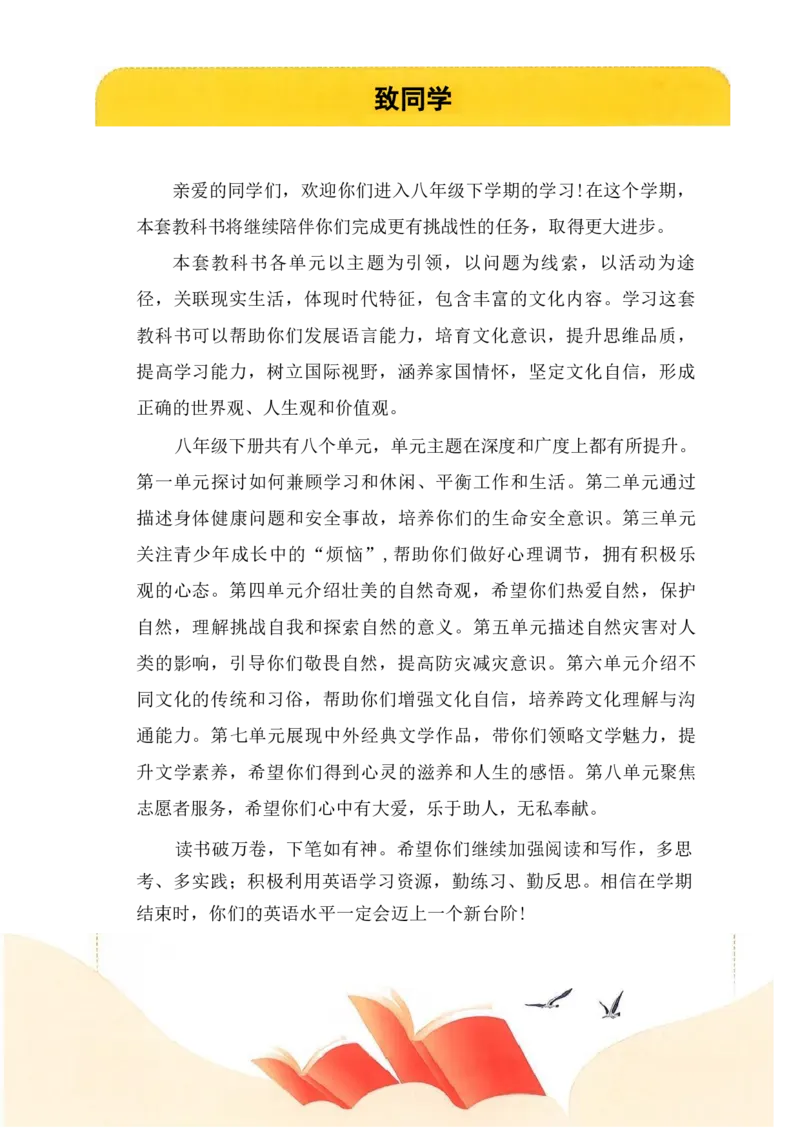
亲爱的同学们,欢迎你们进入八年级下学期的学习!在这个学期,
本套教科书将继续陪伴你们完成更有挑战性的任务,取得更大进步。
本套教科书各单元以主题为引领,以问题为线索,以活动为途
径,关联现实生活,体现时代特征,包含丰富的文化内容。学习这套
教科书可以帮助你们发展语言能力,培育文化意识,提升思维品质,
提高学习能力,树立国际视野,涵养家国情怀,坚定文化自信,形成
正确的世界观、人生观和价值观。
八年级下册共有八个单元,单元主题在深度和广度上都有所提升。
第一单元探讨如何兼顾学习和休闲、平衡工作和生活。第二单元通过
描述身体健康问题和安全事故,培养你们的生命安全意识。第三单元
关注青少年成长中的“烦恼”,帮助你们做好心理调节,拥有积极乐
观的心态。第四单元介绍壮美的自然奇观,希望你们热爱自然,保护
自然,理解挑战自我和探索自然的意义。第五单元描述自然灾害对人
类的影响,引导你们敬畏自然,提高防灾减灾意识。第六单元介绍不
同文化的传统和习俗,帮助你们增强文化自信,培养跨文化理解与沟
通能力。第七单元展现中外经典文学作品,带你们领略文学魅力,提
升文学素养,希望你们得到心灵的滋养和人生的感悟。第八单元聚焦
志愿者服务,希望你们心中有大爱,乐于助人,无私奉献。
读书破万卷,下笔如有神。希望你们继续加强阅读和写作,多思
考、多实践;积极利用英语学习资源,勤练习、勤反思。相信在学期
结束时,你们的英语水平一定会迈上一个新台阶!CONTENTS
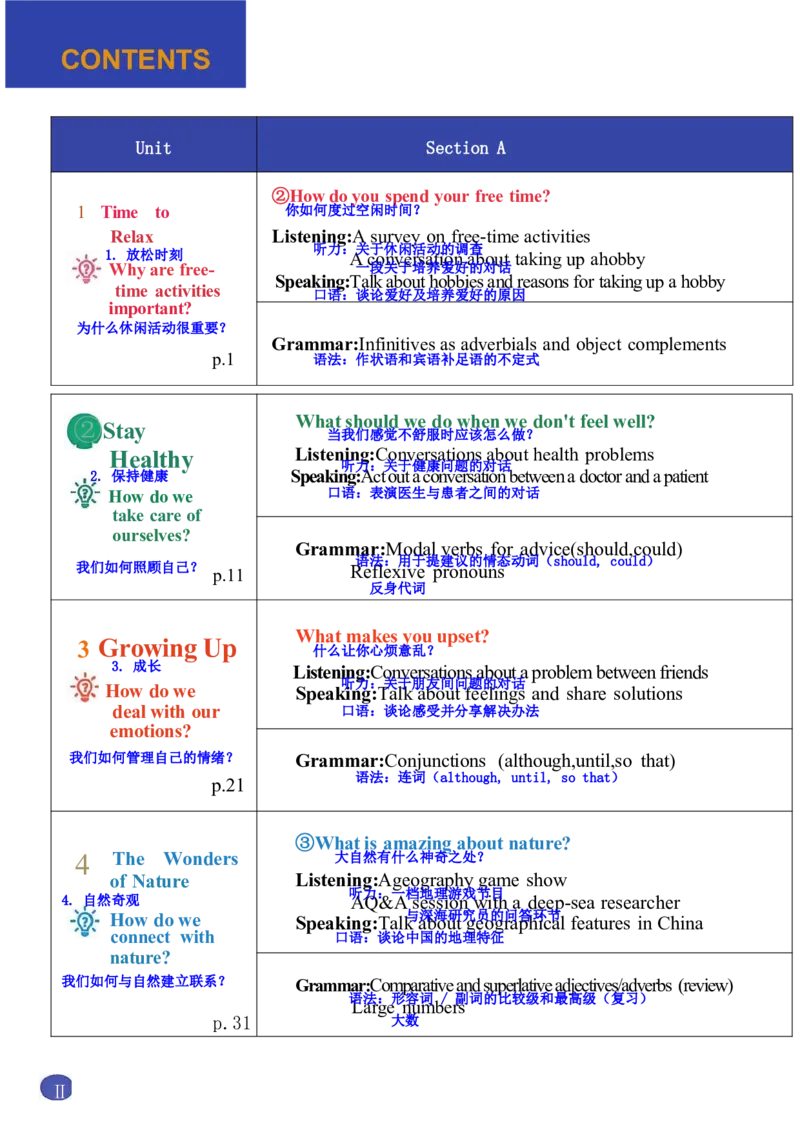
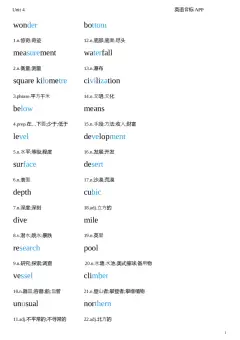
Unit Section A
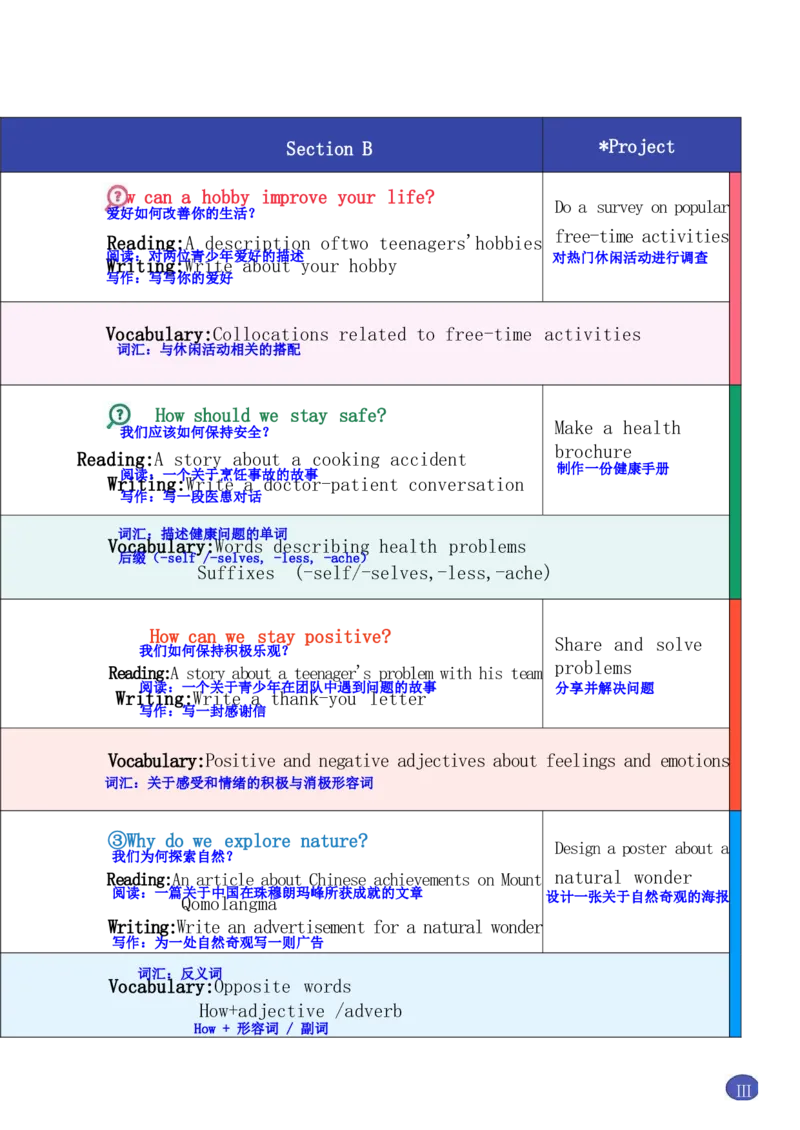
②Howdoyou spend your free time?
1 Time to 你如何度过空闲时间?
Relax Listening:A survey on free-time activities
听力:关于休闲活动的调查
1. 放松时刻
A conversation about taking up ahobby
Whyare free- 一段关于培养爱好的对话
Speaking:Talkabouthobbiesandreasonsfor takingup a hobby
time activities 口语:谈论爱好及培养爱好的原因
important?
为什么休闲活动很重要?
Grammar:Infinitives as adverbials and object complements
p.1 语法:作状语和宾语补足语的不定式
② What should we do when we don't feel well?
Stay
当我们感觉不舒服时应该怎么做?
Healthy Listening:Conversations about health problems
听力:关于健康问题的对话
2. 保持健康 Speaking:Actoutaconversationbetweena doctorandapatient
口语:表演医生与患者之间的对话
How dowe
take care of
ourselves?
Grammar:Modal verbs for advice(should,could)
语法:用于提建议的情态动词(should, could)
我们如何照顾自己?
Reflexive pronouns
p.11
反身代词
What makes you upset?
3 Growing Up 什么让你心烦意乱?
3. 成长
Listening:Conversationsaboutaproblembetweenfriends
听力:关于朋友间问题的对话
How dowe Speaking:Talk about feelings and share solutions
dealwith our 口语:谈论感受并分享解决办法
emotions?
我们如何管理自己的情绪? Grammar:Conjunctions (although,until,so that)
语法:连词(although, until, so that)
p.21
③Whatis amazing about nature?
4 The Wonders 大自然有什么神奇之处?
of Nature Listening:Ageography game show
听力:一档地理游戏节目
4. 自然奇观 AQ&A session with a deep-sea researcher
与深海研究员的问答环节
How dowe Speaking:Talk about geographical features in China
connect with 口语:谈论中国的地理特征
nature?
我们如何与自然建立联系? Grammar:Comparativeandsuperlativeadjectives/adverbs (review)
语法:形容词 / 副词的比较级和最高级(复习)
Large numbers
p.31 大数
ⅡSection B *Project
How can a hobby improve your life?
Do a survey on popular
爱好如何改善你的生活?
free-time activities
Reading:A description oftwo teenagers'hobbies
阅读:对两位青少年爱好的描述 对热门休闲活动进行调查
Writing:Write about your hobby
写作:写写你的爱好
Vocabulary:Collocations related to free-time activities
词汇:与休闲活动相关的搭配
How should we stay safe?
Make a health
我们应该如何保持安全?
brochure
Reading:A story about a cooking accident
制作一份健康手册
阅读:一个关于烹饪事故的故事
Writing:Write a doctor-patient conversation
写作:写一段医患对话
词汇:描述健康问题的单词
Vocabulary:Words describing health problems
后缀(-self /-selves, -less, -ache)
Suffixes (-self/-selves,-less,-ache)
How can we stay positive?
Share and solve
我们如何保持积极乐观?
problems
Reading:A story about a teenager's problem with his team
阅读:一个关于青少年在团队中遇到问题的故事 分享并解决问题
Writing:Write a thank-you letter
写作:写一封感谢信
Vocabulary:Positive and negative adjectives about feelings and emotions
词汇:关于感受和情绪的积极与消极形容词
③Why do we explore nature?
Design a poster about a
我们为何探索自然?
Reading:An article about Chinese achievements on Mount natural wonder
阅读:一篇 Q 关 o 于 mo 中 l 国 an 在 g 珠 m 穆 a 朗玛峰所获成就的文章 设计一张关于自然奇观的海报
Writing:Write an advertisement for a natural wonder
写作:为一处自然奇观写一则广告
词汇:反义词
Vocabulary:Opposite words
How+adjective /adverb
How + 形容词 / 副词
ⅢUnit Section A
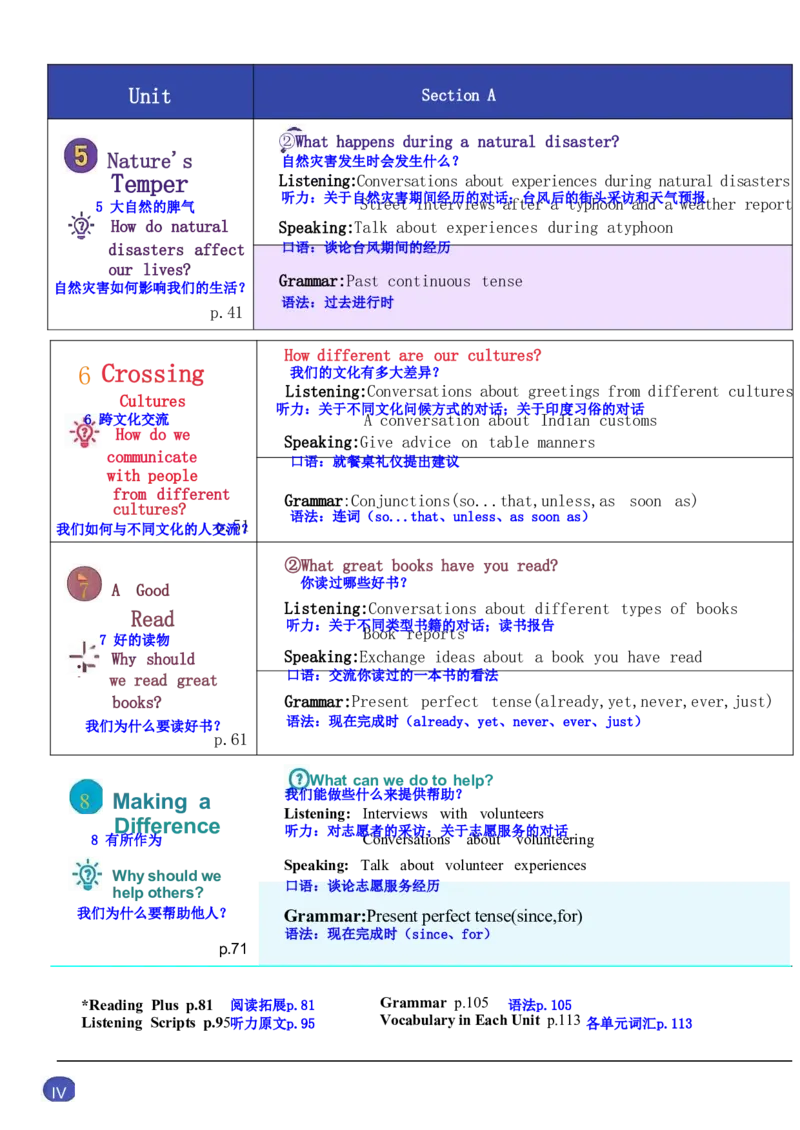
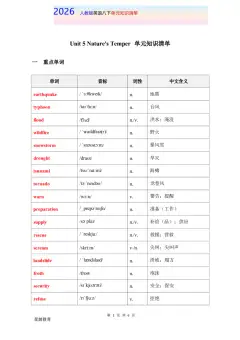
②What happens during a natural disaster?
Nature's
自然灾害发生时会发生什么?
Temper Listening:Conversations about experiences during natural disasters
听力:关于自然灾害期间经历的对话;台风后的街头采访和天气预报
Street interviews after a typhoon and a weather report
5 大自然的脾气
How do natural Speaking:Talk about experiences during atyphoon
disasters affect 口语:谈论台风期间的经历
our lives?
Grammar:Past continuous tense
自然灾害如何影响我们的生活?
语法:过去进行时
p.41
How different are our cultures?
6 Crossing 我们的文化有多大差异?
Listening:Conversations about greetings from different cultures
Cultures
听力:关于不同文化问候方式的对话;关于印度习俗的对话
6 跨文化交流 A conversation about Indian customs
How do we
Speaking:Give advice on table manners
communicate
口语:就餐桌礼仪提出建议
with people
from different
Grammar:Conjunctions(so...that,unless,as soon as)
cultures?
语法:连词(so...that、unless、as soon as)
p.51
我们如何与不同文化的人交流?
②What great books have you read?
7 A Good 你读过哪些好书?
Listening:Conversations about different types of books
Read
听力:关于不同类型书籍的对话;读书报告
Book reports
7 好的读物
: Why should Speaking:Exchange ideas about a book you have read
we read great 口语:交流你读过的一本书的看法
books? Grammar:Present perfect tense(already,yet,never,ever,just)
语法:现在完成时(already、yet、never、ever、just)
我们为什么要读好书?
p.61
What can we do to help?
我们能做些什么来提供帮助?
8 Making a
Listening: Interviews with volunteers
Difference 听力:对志愿者的采访;关于志愿服务的对话
8 有所作为 Conversations about volunteering
Speaking: Talk about volunteer experiences
Whyshouldwe
口语:谈论志愿服务经历
helpothers?
我们为什么要帮助他人? Grammar:Presentperfecttense(since,for)
语法:现在完成时(since、for)
p.71
*Reading Plus p.81 阅读拓展p.81 Grammar p.105 语法p.105
Listening Scripts p.95听力原文p.95 VocabularyinEachUnit p.113 各单元词汇p.113
IVSection B *Project
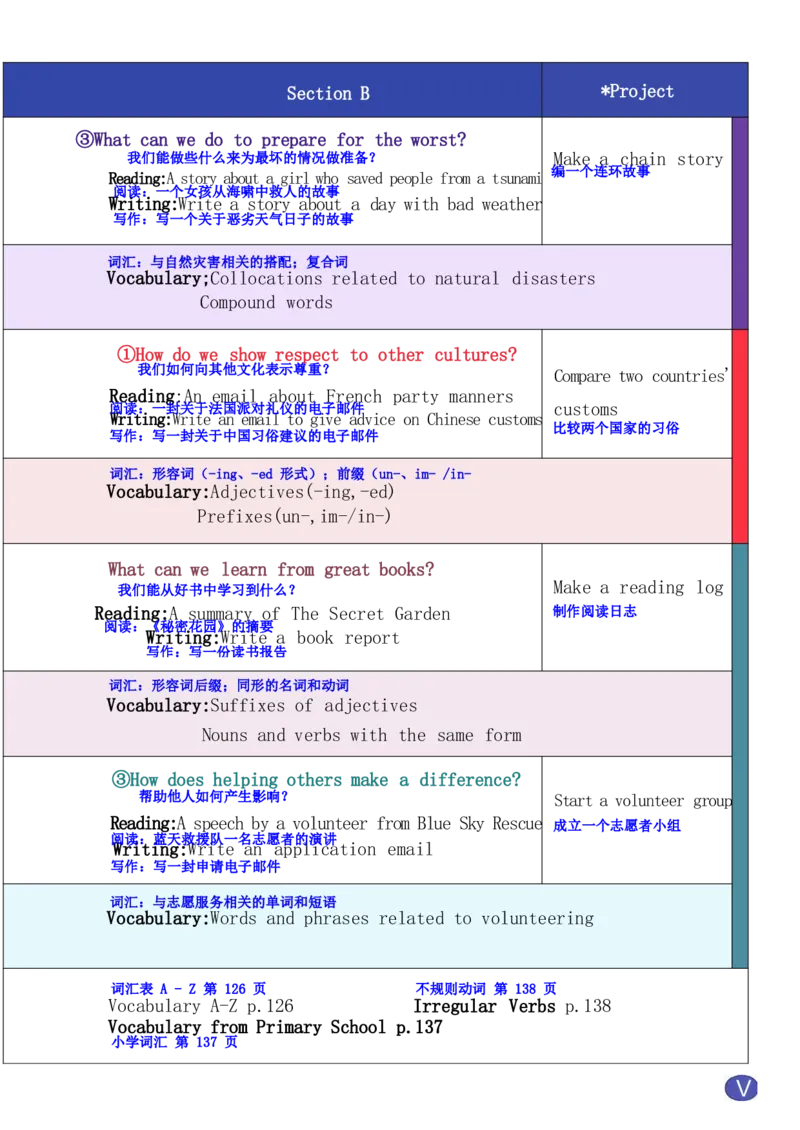
③What can we do to prepare for the worst?
我们能做些什么来为最坏的情况做准备? Make a chain story
编一个连环故事
Reading:A story about a girl who saved people from a tsunami
阅读:一个女孩从海啸中救人的故事
Writing:Write a story about a day with bad weather
写作:写一个关于恶劣天气日子的故事
词汇:与自然灾害相关的搭配;复合词
Vocabulary;Collocations related to natural disasters
Compound words
①How do we show respect to other cultures?
我们如何向其他文化表示尊重?
Compare two countries'
Reading:An email about French party manners
阅读:一封关于法国派对礼仪的电子邮件 customs
Writing:Write an email to give advice on Chinese customs
比较两个国家的习俗
写作:写一封关于中国习俗建议的电子邮件
词汇:形容词(-ing、-ed 形式);前缀(un-、im- /in-
Vocabulary:Adjectives(-ing,-ed)
Prefixes(un-,im-/in-)
What can we learn from great books?
Make a reading log
我们能从好书中学习到什么?
Reading:A summary of The Secret Garden 制作阅读日志
阅读:《秘密花园》的摘要
Writing:Write a book report
写作:写一份读书报告
词汇:形容词后缀;同形的名词和动词
Vocabulary:Suffixes of adjectives
Nouns and verbs with the same form
③How does helping others make a difference?
帮助他人如何产生影响? Start a volunteer group
Reading:A speech by a volunteer from Blue Sky Rescue
成立一个志愿者小组
阅读:蓝天救援队一名志愿者的演讲
Writing:Write an application email
写作:写一封申请电子邮件
词汇:与志愿服务相关的单词和短语
Vocabulary:Words and phrases related to volunteering
词汇表 A - Z 第 126 页 不规则动词 第 138 页
Vocabulary A-Z p.126 Irregular Verbs p.138
Vocabulary from Primary School p.137
小学词汇 第 137 页
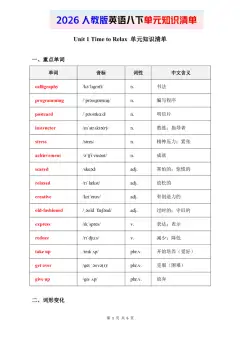
VTime to Relax
UNIT
本单元语法:动词不定式作目的状语和宾语
It's time to do sth.=It's time for sth.
是时候做某事 / 该做某事了
★relax v. 放松;休息
现在分词:relaxing 过去式 / 过去分词:relaxed
用法:
作不及物动词:表示 “放松;休息”,常用于引导身体或
精神的放松。
eg. Please take a deep breath and relax.
在本单元,你将谈论: 请深呼吸并放松。
1.你如何度过你的空闲时间。 及物动词:可接名词或代词作宾语,表示 “使某人 / 某物
2.描述不同的业余活动和爱好。 放松”
3.使用不定式来表明目的,或为句子的宾语提 eg. Relax your shoulders. 放松你的肩膀。
供更多信息。
4.探索人们为什么需要时间去放松。 ★free-time 指 “空闲时间”,常用于描述个
人可自由支配的时间段。
常见搭配:
in one's free time 在某人的空闲时间
eg. I usually read books in my free time.
我空闲时间通常会看书。
spend free time 度过空闲时间
eg. How do you spend your free time?
你如何度过你的空闲时间?
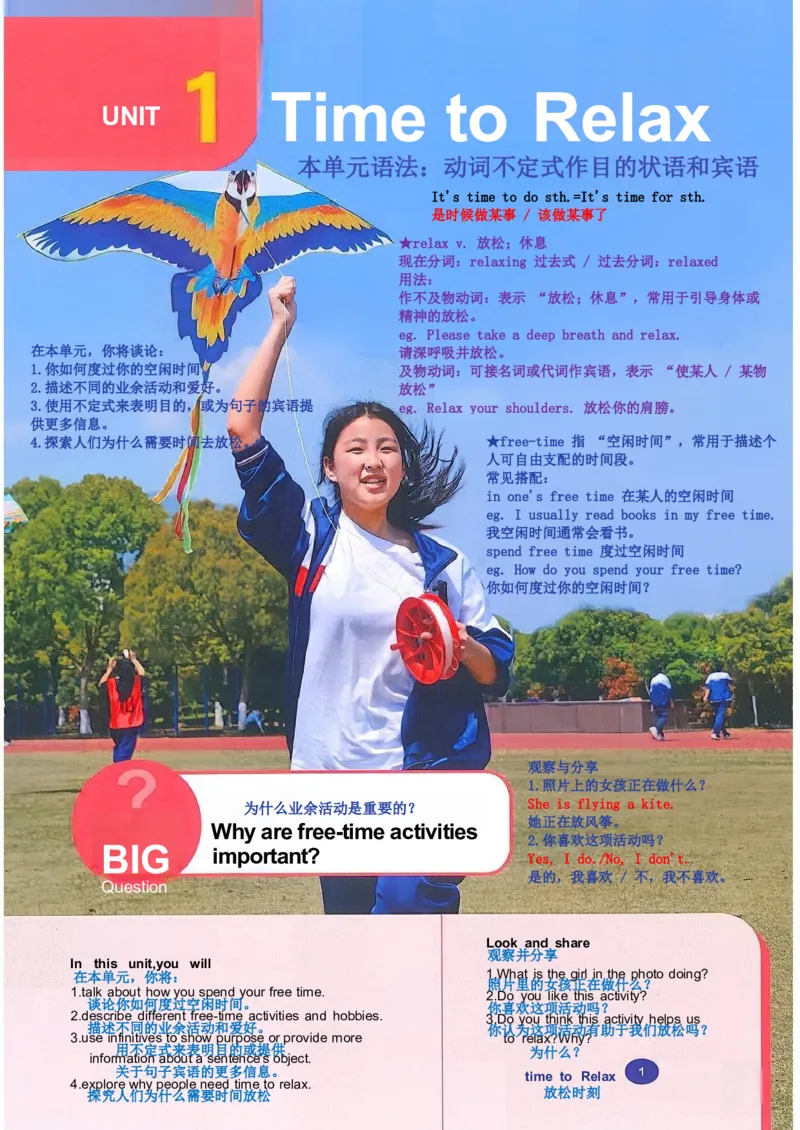
观察与分享
1.照片上的女孩正在做什么?
She is flying a kite.
为什么业余活动是重要的?
她正在放风筝。
Why are free-time activities
2.你喜欢这项活动吗?
BIG important? Yes, I do./No, I don't.
是的,我喜欢 / 不,我不喜欢。
Question
Look and share
观察并分享
In this unit,you will
在本单元,你将: 1.What is the girl in the photo doing?
照片里的女孩正在做什么?
1.talk about howyouspend yourfree time.
2.Do you like this activity?
谈论你如何度过空闲时间。 你喜欢这项活动吗?
2.describe different free-time activities and hobbies. 3.Do you think this activity helps us
描述不同的业余活动和爱好。 你认为这项活动有助于我们放松吗?
3.use infinitivestoshow purposeorprovide more to relax?Why?
用不定式来表明目的或提供 为什么?
informationaboutasentence'sobject.
关于句子宾语的更多信息。
time to Relax
4.explorewhypeopleneed timeto relax.
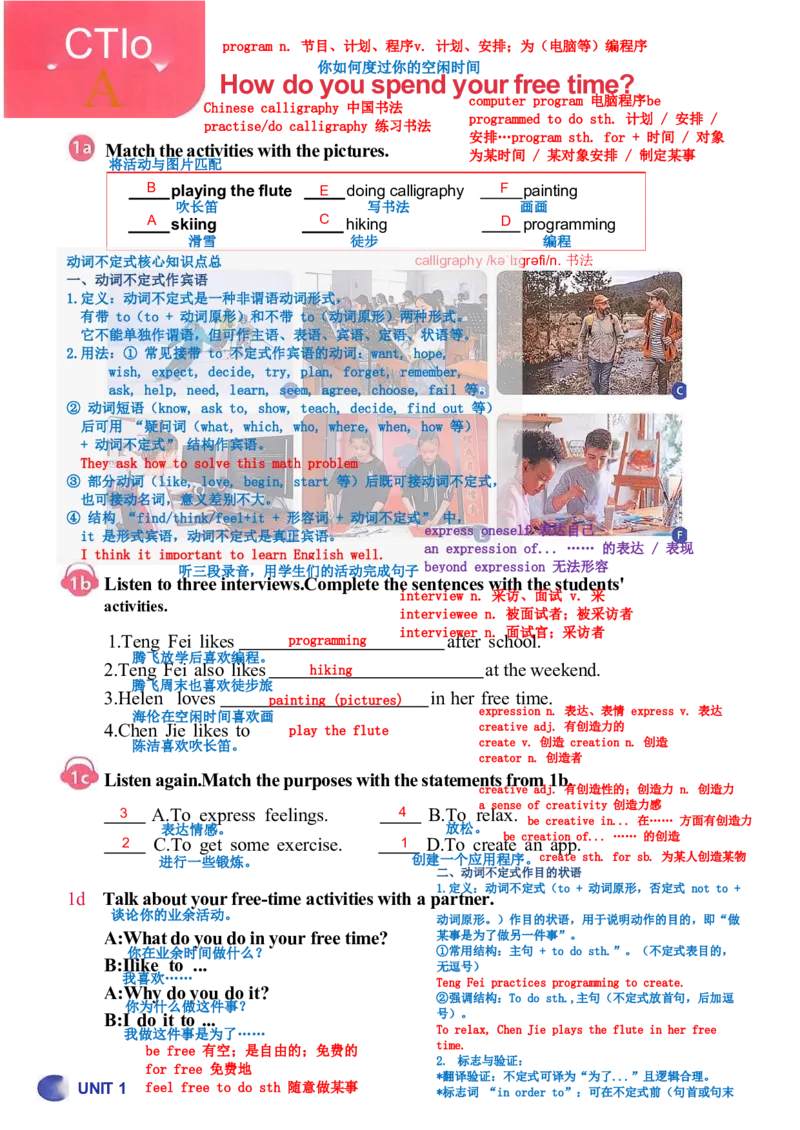
探究人们为什么需要时间放松 放松时刻CTIo
program n. 节目、计划、程序v. 计划、安排;为(电脑等)编程序
你如何度过你的空闲时间
A
How do you spend your free time?
computer program 电脑程序be
Chinese calligraphy 中国书法
programmed to do sth. 计划 / 安排 /
practise/do calligraphy 练习书法
安排…program sth. for + 时间 / 对象
Matchtheactivitieswiththepictures.
为某时间 / 某对象安排 / 制定某事
将活动与图片匹配
B playing theflute E doingcalligraphy F painting
吹长笛 写书法 画画
A skiing C hiking D programming
滑雪 徒步 编程
动词不定式核心知识点总 calligraphy /kəˈlɪɡrəfi/n.书法
一、动词不定式作宾语
1.定义:动词不定式是一种非谓语动词形式,
有带 to(to + 动词原形)和不带 to(动词原形)两种形式。
它不能单独作谓语,但可作主语、表语、宾语、定语、状语等。
2.用法:① 常见接带 to 不定式作宾语的动词:want, hope,
wish, expect, decide, try, plan, forget, remember,
ask, help, need, learn, seem, agree, choose, fail 等。
② 动词短语(know, ask to, show, teach, decide, find out 等)
后可用 “疑问词(what, which, who, where, when, how 等)
+ 动词不定式” 结构作宾语。
They ask how to solve this math problem
③ 部分动词(like, love, begin, start 等)后既可接动词不定式,
也可接动名词,意义差别不大。
④ 结构 “find/think/feel+it + 形容词 + 动词不定式” 中,
express oneself 表达自己
it 是形式宾语,动词不定式是真正宾语。
an expression of... …… 的表达 / 表现
I think it important to learn English well.
beyond expression 无法形容
听三段录音,用学生们的活动完成句子
Listentothreeinterviews.Completethesentenceswiththestudents'
interview n. 采访、面试 v. 采
activities.
interviewee n. 被面试者;被采访者
interviewer n. 面试官;采访者
1.Teng Fei likes programming after school.
腾飞放学后喜欢编程。
2.Teng Fei also likes hiking at the weekend.
腾飞周末也喜欢徒步旅
3.H 行 ele 。 n loves painting (pictures) in her free time.
expression n. 表达、表情 express v. 表达
海伦在空闲时间喜欢画
4.Chen Jie likes to play the flute creative adj. 有创造力的
画。
陈洁喜欢吹长笛。 create v. 创造 creation n. 创造
creator n. 创造者
Listenagain.Matchthepurposeswiththestatementsfrom 1b.
creative adj. 有创造性的;创造力 n. 创造力
a sense of creativity 创造力感
3 A.To express feelings. 4 B.To relax.
be creative in... 在…… 方面有创造力
表达情感。 放松。
be creation of... …… 的创造
2 C.To get some exercise. 1 D.To create an app.
进行一些锻炼。
创建一个应用程序。create sth. for sb. 为某人创造某物
二、动词不定式作目的状语
1.定义:动词不定式(to + 动词原形,否定式 not to +
1d Talkaboutyourfree-time activitieswith a partner.
谈论你的业余活动。
动词原形。)作目的状语,用于说明动作的目的,即“做
A:Whatdoyoudoinyour free time? 某事是为了做另一件事”。
你在业余时间做什么? ①常用结构:主句 + to do sth.”。(不定式表目的,
B:Ilike to ... 无逗号)
我喜欢……
Teng Fei practices programming to create.
A:Why do you do it?
②强调结构:To do sth.,主句(不定式放首句,后加逗
你为什么做这件事?
号)。
B:I do it to ...
我做这件事是为了…… To relax, Chen Jie plays the flute in her free
time.
be free 有空;是自由的;免费的
2. 标志与验证:
for free 免费地
*翻译验证:不定式可译为“为了...”且逻辑合理。
feel free to do sth 随意做某事
2 UNIT 1 *标志词 “in order to”:可在不定式前(句首或句末
)强化目的,句子意思不变。challenge n. 挑战;challenging adj. 富有挑战的
face /overcome/meet a challenge 面对 / 迎接挑战accept /take up a challenge 接受一项挑战
It is a challenge to do sth. 做某事是一项挑战
Whatarethechallengesofdoingthesetwoactivities?Shareyourideas.
做这两项活动的挑战是什么?分享你的想法。
游泳
to scare v. 使害怕;n. 恐惧scared
adj. 害怕的scary adj. 令人害怕的 centre n. 中心;central adj. 中心的
be scared of + 名词 / 代词 / 动名 in the centre of... 在…… 的中心
词害怕某人 / 某物 / 做某事 at the centre 在中心位置
be scared to + 动词原形(do sth.)
unexpected adj.出乎预料的;
因害怕而不敢做某事
expectation n.期待expectv.期待;
be scared that + 从句
expectedadj.意料之中的
害怕……(发生某事)
expecttodo sth.期待做某事
perfectadj.完美的;perfectionn. 完美
perfectfor 对…… 来说很完美perfectthe
滑冰
artofdoing sth精通做某事的技巧be +
perfect+todo sth做某事很合适/完美
ListentoaconversationbetweenFuXingandEmma.Tick the things they
talkabout. 听付兴和艾玛之间的一段对话。在他们谈论的内容旁打勾。
encourage v. 鼓励
□ what they are going to do the next day
他们第二天打算做什么 encouragement n. 鼓励
☑ challenges of free-time ctivities encouraging adj. 令人鼓舞的
业余活动的挑战
☑ what Emma did at the weekend encouraged adj. 受鼓舞的encourage
他们不喜欢的业余活动 sb. to do sth. 鼓励某人做某事
□ free-time activities they don't like
be encouraged by sth. 被…… 激励
他们不喜欢的业余活动
□ their friends'favourite free-time activities
他们朋友最喜欢的业余活动
☑ what they like about their free-time activities
他们喜欢自己业余活动的哪些方面
Listen again and complete the sentences.
再听一遍并完成句子。
1.Emma went to the sports centre to try ice skating
艾玛想去市中心试试滑冰
_·
2.Emma didn't want to go ice skating again at first.
艾玛起初不想再去滑冰了
3.Fu Xing told Emma that no one expected her to be perfect
傅星告诉艾玛一开始没有人期望她是完美的
from the start.
instruction/ɪnˈstrʌktʃn/n.指导;instructv. 指导、教
4.The instructor told Emma not to give up so easily .
教练告诉艾玛不要轻易放弃
5.Fu Xing used to be scared of water,but she started swimming to
福星过去很怕水,但她开始游泳来克服她的恐惧
get over her fear.
6.Fu Xing encouraged Emma to try ice skating again.
福星鼓励艾玛再试一次滑冰
Whatwasitlike whenyoudidyourfavouritefree-time activityfor the first
当你第一次做你最喜欢的业余活动时是什么感觉?分享你的经历。
time?Share your experiences.
perform v.表演、执行;performer n.执行者、表演者;performancen. 表演、表现
A:I love singing and performing now.But I was afraid to sing in front of
我喜欢唱歌和在别人面前表演。但是一开始我不敢在别人面前唱歌。
others at first.
B:Oh,I didn’t know that.What helped you to get over your fear?
哦,我不知道。什么帮助你克服了恐惧?
A:I practised by performing in front of my friends.That helped me to get
我通过在朋友面前表演来练习。这帮助我很快进步了!
better quickly!
afraidadj.害怕的;fear n.害怕;fearfuladj.极害怕的
fearful ofsth对…… 极度恐惧
be afraid of sth/be afraid ofdoingsth 放松时间
害怕某物 /害怕做某事 Timeto Relax 3
be afraid to dosth不敢做某事character n. 角色、性格、特点、文字; single adj. 单一的,唯一的single out 挑
characteristic adj. 典型的;n. 特征;in 选出a single one 唯一一个;
character 符合性格;哪怕一个out of character in single file 成单列;排成一队
Read the conversation.CirclePeter'sand Yaming's free-time activities.
当你第一次做你最喜欢的业余活动时是什么感觉?分享你的经历。 step v. 迈步;n. 脚步、步骤;
step into 踏入;
Peter: Hey Yaming!What are you up to?
嘿,亚明!你在忙什么呢? be up to 正在忙 step out 走出;
Yaming:Hi Peter.I’m doing calligraphy.
step by step 逐步;
嗨,彼得。我正在写书法。
Peter: It's beautiful!What are you writing?
真漂亮!你在写什么
Yaming:It's a poem by Li Bai.My grandmother
这是李白的一首诗。我奶奶教我怎么写的。
taught me how to write it.
Peter: What's this character?
这个字是什么?
Yaming:It's yue.It means “moon”.
是 “月” 字。它的意思是 “月亮”
It's nice!I like watching you write
Peter:
很不错!我喜欢看你那样写字。 choicen.选择(chosen过去分词);make
like that.But it looks difficult.
但这看起来很难。
achoice选择;chooseadj.挑剔的;
Yaming:Well,the first step is always the choose- chose -chosen;have nochoice
嗯,万事开头难嘛。
buttodo sth.除了做某事,别无选择
hardest.When I started to do
当我开始写书法时,
calligraphy,I spent hours practising single strokes.
我花了好几个小时练习
Peter: I know how that feels!My dad's teaching me to play the guitar.It's
我懂那种感觉! 我爸爸在教我弹吉他。
difficult,but he always encourages me not to give up.
这很难, 但他总是鼓励我不要放弃。Even(副词,意为甚至,用于加强语气,位置在实义动词like之前)
Yaming:Exactly.Now I do calligraphy to relax.I even like how the ink smells!
确实如此。现在我写书法是为了放松。 我甚至喜欢墨水的味道!
Why did you choose to play the guitar?
poem n. 诗;poet n. 诗人
你为什么选择弹吉他?
Peter:: I think playing the guitar is cool.Will you teach me to write a poem?I
我觉得弹吉他很酷。 你能教我写诗吗?作为回报,
can teach you to play a song in return.
我可以教你弹一首歌。 return sth. to sb. 向某人描
deal v. 处理,应对;
Yaming:It's a deal!
述……;return sb. sth. 把
就这么定了!n. 大量;deal - dealt -
某物归还给某人
dealt;deal with = do with
处理,解决;
3b Read again and answer the questions.
再读一遍并回答问题 description /dɪˈskrɪpʃn/n. 描述;describe v. 描述;描写
describe...as...把… 描述为…;
1.What words does Peter use to describe Yaming's work?
彼得用什么词来描述亚明的作品? be similar to 与……相似;
2.What does Yaming like about his hobby? give a description of...对……
亚明喜欢他的爱好的哪些方面?
3.What are the similarities between Yaming's and Peter's hobbies? 进行描述
亚明和彼得的爱好有什么相似之处?
4.What do you think“The first step is always the hardest”means?
你认为 “万事开头难” 是什么意思?
5.How do you usually feel when you manage to do something difficult?
当你成功做成某件困难的事时,你通常感觉如何?举个例子。
Give an example.
similar adj. 相似的;
similarity n. 相似性;
similarly adv. 相似地
Listen to the conversation.Then role-play it.
听这段对话,然后分角色表演。
Discuss the reasons why you do your hobbies.You can use the expressions
讨论你从事自己爱好的原因。你可以用这些表达来帮助自己。
to help you.
● It makes me feel happy to ... ● It helps me to ...
做…… 让我感到开心。 它帮助我……
● It'sagreatwayto... ● When I started to...,I...
这是…… 的好方法。 当我开始…… 的时候,我……
when 引导从句说明动作发生的时间,从句用一般过去时 started,主句用相应时态
UNIT 1thanks (a lot) for (doing) sth.
Grammar Focus
(非常)感谢(做)某事
语法聚焦
thanks for sb.'s help感谢某人的帮助
Readthesentences.Decideifeachinfinitiveinboldfunctionsas an object
读这些句子。判断每个加粗的不定式是用作宾语补足语还是状语。
complementoradverbial.
What do you do in your free time? I play the flute to relax.
你在业余时间做什么? 我吹长笛来放松。
How did you spend your weekend? I went to the sports centre to ice skate.
你是怎么度过周末的? 我去体育中心滑冰了。
How did you get into painting? Isaw my motherpaint.I decided to give it a go.
你是怎么开始画画的? 我看到我妈妈画画。我决定试一
What did your instructor say? She told me not to give up so easily.
你的教练说了什么? 她告诉我不要那么轻易放弃。
thanks for: 核心表 “因…… 而感谢”,侧重 “感谢的具体原因”thanks to: 核心表 “多亏 /
幸亏……”,侧重 “借助某人 / 某物,才达成某结果”
Completetheconversationswiththecorrectformsoftheverbsin brackets.
用括号中动词的正确形式完成对话。
1. A:Thanks for your advice!It made me decide (decide)to try skiing.
谢谢你的建议!它让我决定尝试滑雪。
B:You're welcome.Try to forget (forget)your fears and have fun!
不客气。试着忘掉你的恐惧,好好享受吧!
2.A:My cousin often asks me to fly (fly)kites with her when it's
windy.我表妹 / 表姐经常让我在刮风的时候陪她放风筝。
B:That sounds fun!I'd love to watch you fly (fly)kites sometime.
听起来很有趣!我很想有机会看你放风筝(放风筝)。
3.A:Ilove to watch kung fu movies to relax (relax).
我喜欢看功夫电影来放松。
B:Really?When I want to relax (relax),I watch animal videos.
真的吗?当我想放松(放松)的时候,我会看动物视频。
4.A:My parents told me not to push (not push)myself too hard.
我的父母告诉我不要把自己逼得太紧。
B:Yes,it's important not to forget (not forget)to relax once in a while.
是的,偶尔不要忘记(不忘记)放松是很重要的。
4c Complete the passage with the infinitive forms ofthe verbs in the box.What
用方框中动词的不定式形式完成短文。你通常在户外做什么?聊天(不来)做 听 玩
doyouusuallydo outdoors?
度过 停留 观看
决定做某事:~
decide to do 聊天 (不)来 做 听 玩 花费 停留 观看
chat (not)come do listen play spend stay watch
sth. ~ make a
decision to
instead of + 宾语(不能接句子)
do sth.decide
v. 决定 My twin brother and I look alike,but we are so different.I love sport,and I
我和我的双胞胎兄弟长得很像, 但我们很不一样。 我喜欢运动,
decision n.
often meet my friends to play football and tennis.My brother joined
决定 经常和朋友们见面 踢足球、 打网球。 我弟弟
us to play football once or twice,but he decided not to come after that.
曾经和我们一起踢过一两次足球, 但在那之后他决定不再来了。
He doesn't like sport very much!Instead,he likes to stay at home
他不太喜欢运动。 相反,他喜欢待在家里,播放音乐、
and to watch movies, to listen music,and to chat with friends
看电影、听音乐,还和朋友们在网上聊天。
online.Our parents were worried about him staying home too much. They
我们的父母担心他待在家里的时间太多他们也希望我们一家人能多花些时间在一起,
also wanted us to spend more time together as a family.So,now they
let us do our favourite activities on Saturdays,but on Sundays, we go on a
所以现在周六我们可以做自己喜欢的活动, 但周日,我们一起去家庭郊游!
family outing together!
push sth. for sth. 努力争取 / 推
be alike 相似look alike 看起来相似like 动某事push sb. to do sth. 催促 /
可作介词 “像……”,如 look like “看 促使某人做某事push oneself too
起来像”,后接名词 / 代词alike 仅作形 hard 把自己逼得太紧
容词(表语)或副词,
Timeto Relax 5CTIo
B 爱好如何改善你的生活?
How can a hobby improve your life?
improve v. 改变
stress n. 压力 v. 强调 stressed adj. 感到有压力的
improvement n. 改变
stressful adj. 有压力的under stress 处于压力之下
stress the importance of... 强调…… 的重要性 improved adj. 改进的
In what ways does your hobby help to make your life better?Tick the ones
你的爱好在哪些方面有助于让你的生活更美好?
that apply.You may add more.skill n. 技巧
skilled adj. 熟练的(强调 “经过训练后掌握技能”)
My hobby helps me ... skillful adj. 灵巧的(更强调 “天生或后天形成的灵巧性”)
我的爱好帮助我……
□ to relax □ to make new friends
结交新朋友
放松
□ to reduce stress
□ to learn a new skill
学习一项新技能 缓解压力
□ to try new things identify v. 识别identification n. 识别;身份证明identifiable
去尝试新事物 adj. 可识别的;可辨认的identify sb./sth. 识别、确认某人 / 某物
have a skill in... 在…方面有技能
identify sb./sth. as... 认出某人 / 某物是……It's + 形容词 + to
be skilled in/at... + identify... 识别…… 是…… 的(形式主语句型)
擅长……;在……方面熟练 ldentifyingfactsandopinions
辨别事实与观点 statement n. 陈述 state v. 陈述
Facts are statements that are true.On the
阅读文本。划出这两名学生的观点 事实是真实的陈述。 另一方面,
other hand,opinions express a feeling or
Readthetext.Underline 观点表达一种感觉或信念,
belief,They may or may not be true.Lookfor
thetwostudents'opinions. 它们可能是真的,也可能不是。
key words like “think”or "believe"to help you
寻找像 “think(认为)” 或 “believe(相信)”
identify whether a statement is an opinion.
这样的关键词来帮助你辨别一个陈述是否是观点。
physics n. 物理 whether 引导宾语从句,含“是否”含义,可与 if 互换
be good for 对…… 有好处
physical adj. 物理的、身体的
be good at 擅长……
Hobbies That Are Good for You
be good to 对…… 友好
从句放主句前,主句开头需加逗号(若从句可放主句后,逗号可省略)
When work or schoolis over,whatdoyoudotopassthetime?Do you spend
工作或学校的事情结束后, 你会做些什么来打发时间呢? 你会把时间花在
time on hobbies you love?Reading or listening to music can help us to calm
自己热爱的爱好上吗? 阅读或听音乐能帮助我们在忙碌的一天后平静下来。
down after a busy day.Physical hobbies,such as playing tennis or doing
像打网球或做瑜伽这类体育爱好,
yoga,can help us to keep fit.And some hobbies are creative.For example,
能帮助我们保持健康。 还有一些爱好富有创造性。 例如,
people sometimes paint pictures to remember a beautiful landscape or
object, or reduce 人们有时会画画, 以此来记住美丽的风景或物体, find it+形容词+不
stress.object n. object,or reduce stress.object to sth./doing sth. 反对某事 / 做某事
物体、目标 v. 反对 或者缓解压力。 objective facts 客观事实 定式(形式宾语+真
objection n. 反对 have an objection to sth./doing sth. 反对某事 / 做某事 正宾语)
Luca Bruno likes to be creative in his free time.But he doesn't make art or
卢卡・布鲁诺喜欢在空闲时间发挥创造力。 但他不创作艺术品或音乐。
write stories.Instead,this Italian teenager finds it fun to make mobile phone
相反,他喜欢使用应用程序!应用程序是一种计算机程序,你可以在智能手机或平板
apps.He thinks that apps can be a great way to help people.He started
电脑上使用。他认为应用程序很有趣,并且是帮助人们的好方式。
so + 形容 programming when he was ten,after he read about famous businessmen who
词 / 副词 他十岁时开始编程,在他读了关于以程序员身份开始的著名商人的书之后。
started out as programmers.His latest app allows people around the world
+ that 从 他的最新应用程序允许世界各地的人们同时 allow sb. to do sth.
to find study partners for learning Italian.They can learn Italian and make
句 如此… 允许某人
学习意大利语! 他们可以学习意大利语并结交学习伙伴
… 以至于 friends at the same time! 做某事
…I…t gives sb. sth. to do sth. sensory adj. 感官的、感觉的 sense n. 感官 sensible 明智的 sensitive 敏感的
它给某人某物去做某事。 make sense 有意义 make sense of 理解 a sense of + 抽象名词…… 的感觉
"It gives me such a sense of achievement to see people using the app,"says
“看到人们使用我的应用程序,我有一种强烈的成就感,”
Luca.“I believe I’m helping people around the world to learn Italian!”
卢卡说。“我相信我正在帮助世界各地的人学习意大利语。”
宾语从句的时态需与主句时态匹配,本句主句 “believe” 是一般现在时,从句时态不受限制(“主观从任” 原则)
Some people prefer not to make things.They prefer to collect them!In
有些人不喜欢制作东西。 他们更喜欢收集东西!
India,Maya Badal doesn't collect coins or stamps.Instead,this teenage girl
在印度,玛雅・贝迪不收集硬币或邮票。 相反,
collects postcards! such + a/an + 形容词 + achieve v. 实现;取得
这个十几岁的女孩收集明信片! 可数名词单数 achievement n. 成就;实现
be alike 相似look alike 看起来相似like 可作介词
such + 形容词 + 不可数 make an achievement 取得一项
“像……”,如 look like “看起来像”,后接名词
名词 / 可数名词复数 成就the achievement of sth.
/ 代词alike 仅作形容词(表语)或副词,
某事的实现 / 完成
UNIT 1“know” 后接宾语从句,从句是陈述句,引导词“that” 可省略(陈述句
作宾语从句,“that”可省,“think”后接宾语从句,“that”同样可省略。
"I know some people think postcards are rather old-fashioned,but I think
玛雅说:“我知道有些人认为明信片相当过时, 但我觉得
they're a good way to learn about different places,"Maya says."I think it's
它们是了解不同地方的好方式。 我觉得
interesting to see the beautiful buildings and landscapesin foreigncountries.”
观赏外国的漂亮建筑和风景很有趣。”
foreigner n. 外国人 foreign adj. 外国的
Maya's first postcard shows the Mogao Caves in Dunhuang.Her dad sent
玛雅的第一张明信片展示的是敦煌的莫高窟, 她爸爸
it to her when she was five,and she liked it so much that she put it up on
在她五岁时把它寄给了她, 她非常喜欢, 就把它贴在
her bedroom wall!Now there are over one hundred postcards from thirty-two
了卧室的墙上!现在玛雅的墙上有来自 32 个国家的一百多张明信片,
countries on Maya's walls.She dreams of travelling to these places in the future!
她梦想将来去这些地方旅行!“so + 副词 / 形容词 + that 从句” 是结果状语从句,表
“如此…… 以至于……”;修饰词:so much(so 修饰 “副
词 much”,表 “程度深”)
in fashion 流行dream to do sth.out of fashion 过时;不流行 = dream of doing sth. 梦
想做某事n... fashion 以…… 的方式 have a dream 做梦
fashionable adj. 时尚的 fashion n. 时尚、方式 follow one's dream 追逐梦想
再读一遍课文,完成思维导图。
Readthetextagainandcompletethe mind map.
Making mobile What his What her Collecting
phone apps postcards
hobby is hobby is
When he
When she
When he
was ten Whenshe was five
started it Luca Hobbies Maya started it
He thinks apps She thinks postcards
can help people help her learn about
Why he Whyshe
greatly and it different places and
gives him a sense likes it likes it Find it interesting to
of achievement see foreign buildings
and landscapes
What new hobby Readagainandcompletethesentenceswith differentpurposes.Thenwrite
would you like to 再读一遍,用不同的目的完成句子。然后写下来.
aboutyourself.
take up and why?
Share your ideas.
1.Some people listen to music to calm down after a busy day.
I would like to
take up gardening 2.O 有 th 些 er 人 s 在 pl 忙 ay 碌的 te 一 nn 天 is 后 t 听 o 音 ke 乐 e 来 p 放 fit 松 。 。
as a new hobby.
另一些人打网球来保持健康。
Because it allows
3.Sometimes people paint pictures to remember a beautiful landscape or object,
me to connect with
or reduce stress. 有时候人们画画是为了记住美丽的风景或事物,或者缓解压力。
nature, grow
beautiful flowers
4.Luca developed his latest app to allow people around the world to find study
and fresh
partners for learning Italian.卢卡开发了他最新的应用程序,让世界各地的人都能找到学习意大利
vegetables, and
语的学习伙伴。
it's a relaxing 5.Maya collects postcards to learn about different places and see beautiful
way to reduce
buildings and landscapes in foreign countries.
stress after
玛雅收集明信片是为了了解不同的地方,看看外国美丽的建筑和风景。
school. Also, 6. I
seeing plants grow
under my care
Whatnewhobbywouldyouliketotakeupandwhy?Shareyourideas.
gives me a strong
sense of Timeto Relax( 7
accomplishment.inspire v. 激励 inspired adj. 受激励的 inspiring adj. 令人激励的
Vocabulary in Use
inspiration n. ① 激励;鼓舞(不可数名词)② 灵感(可数)inspire sb.
实用词汇 to do sth. 激励 / 启发某人做某事inspire sth. in sb. /inspire sb. with
sth. 在某人心中激发起某种情感 / 想法be inspired by 被…… 激励 / 启发
Matchthewordsintheboxwiththeverbsbelow.Somewordscan gotogether
将方框中的单词与下面的动词进行匹配。有些单词可以与多个动词搭配。
withmorethanone verb.
calligraphy coins poems football ice skating hiking
书法 硬币 诗歌 足球 滑冰 徒步旅行
stories tennis stamps postcards guitar skiing
故事 网球 邮票 明信片 吉他 滑雪
collect do go play write
coins, calligraphy ice kating, football, poems,
stamps, hiking, tennis, stories
postcards skiing guitar
Completetheconversationwiththephrasesinthebox.Usethecorrect forms
ofthe verbs.用方框中的短语完成对话。使用动词的正确形式。
get over take up give up reduce stress find itfunto(do sth)
克服 开始从事 放弃 减轻压力 觉得(做某事)有趣
surprisen./v. 惊喜
A:Hey,I heard you're thinking about taking up a hobby?
surprisingadj. 令人惊讶的
嘿,我听说你在考虑培养一个爱好?
B:Yes,I am.Any suggestions? surprisedadj. 感到惊讶的
对,我是。有什么建议吗?
A:Well,I find it fun to_paint.It's a great wayto reduce stress and express
myself. 嗯,我觉得画画很有趣。这是一种很好的减压和表
条件状语从句(as long
B:That sounds fun,but I’m worried about not being good at it. as/if 引导)需用 “一般
那听起来不错,但我担心自己不擅长。 现在时”表 “将来的条件
A:Don't worry,Everyone starts somewhere.As long as you don't
”,即 “主将从现”
别担心。每个人都是从某个起点开始的。只要你不放弃,随着时间的推移
you'llget better at it over time. “as long as” 引导条件状语从句,表 “满足‘不放弃’
你会做得更好的。 这个条件,就会有‘得到 / 变得更好’的结果”
B:You're right!I shouldget over my fear offailure andjust tryto have fun.
你说得对!我应该克服对失败的恐惧,只是试着享受乐趣。 inspire v. 激励
A:Exactly!Painting is a great way to discover your creative side too.
完全正确!画画也是发现你创造性一面的好方法。 inspired adj. 受激励
的 inspiring adj. 令人
2c Completethepassagewiththecorrectforms ofthewordsinthe box.
激励的inspiration n.
用方框中单词的正确形式完成短文。
① 激励;鼓舞(不可数
achievement instructor chat similarity perform 名词)
成就 指导者 聊天 相似性 表演
② 灵感(可数)inspire
One ofthe people who inspires me the most is my dance instructor .sWb.heton do sth. 激励 /
最能激励我的人之一是我的舞蹈教练。 当
启发某人做某事
I first started dancing,I was really scared to perform in front of others.I
我刚开始跳舞时, 我真的很害怕在别人面前表演。 inspire sth. in sb.
didn’t want to talk to my instructor about it because he /inspire sb. with sth.
我不想和我的教练谈谈这件事,但是我有点紧张,因为他似乎非常严格。
seemed very strict.However,we chatted after class 在某人心中激发起某种情
然而,下课后我们聊了聊,
感 / 想法
one day,and I realized that he was surprisingly nice!He
我惊讶地发现他出人意料地友好! 他 be inspired by 被……
told me that a lot ofhis students had similar fears.
告诉我,他的很多学生都有类似的恐惧。 激励 / 启发
He helped me to get over my fear.My greatest
他帮我克服了恐惧。 到目前为止,我最大的It seems that + 从句 似乎…;看起来…
achievement so far is dancing in front ofhundreds of
成就就是去年在数百人面前跳舞。 seem like + 名词 / 代词 似乎像…
people last year.I was quite calm when I danced on
seem + 形容词 似乎 / 看起来…(状态)
我在舞台上跳舞时非常平静,而且总的来说,
stage,andI had a great time after all! seem + to do sth 似乎要做某事
我玩得很开心!hundreds of 大量;许多;
成百上千hundred, thousand 或 million 前有具体的数词时,常用单数形
8 UNIT 1 式,前面不加 the,hundreds of 后接可数名词的复数形式。常用搭配:
thousands of(成千上万的),millions of(数以百万计的)。Readtheposts.Completethemindmapwiththeinformationabout Shuyin's
阅读这些帖子。用关于淑音最喜欢的业余活动的信息完成
favourite free-time activity.
你最喜欢的业余活动是什么?
What is your favourite free-time activity?
Hi,everyone!I'd like to take up a new free-time activity,and
贾森 大家好!我想开始一项新的业余活动,
I'm hoping to get some ideas.What do you do?Why do you
英国
希望能得到一些灵感。你们都做些什么呢? 为什么
nature n. 自然
like it?Please tell me more!
Jason
喜欢它?请多告诉我一些吧! natural adj. 自然的;天生的
UK
such + a/an + 形容词 + 可数名词单数 naturally adv. 自然地;天生地
whenever 相当于 “no matter
such + 形容词 + 不可数名词 / 可数名词复数by nature 天生
when”,表 “无论何时”,引 I have many free-time activities,like painting,writing poems,
导让步状语从句,强调 “无论 我有很多业余活动,比如绘画、写诗和阅读。
and reading.But my favourite free-time activity is horse riding.
我什么时候拜访(visit)” 表
但我最喜欢的业余活动是骑马。
“将来的动作”,因为主句是一 When I was six,I visited my grandfather's farm,and he took
般现在时,从句用一般现在时符 我六岁的时候,参观了爷爷的农场,他带我
me to ride a horse.It was such an amazing experience!Nowl
合 “主将从现” 的延伸规则(
去骑马。 那是一次非常奇妙的经历! 现在
do it at his farm every weekend with my favourite horse,Nini.
让步 / 时间状语从句也常用一
我每个周末都去他的农场和我最喜欢的马妮妮一起骑马。
般现在时表将来)
I love horse riding because l enjoy being in nature.Horse
Shuyin 我喜欢骑马,因为我喜欢亲近大自然。
riding also helps me stay fit.But most importantly,it lets me
China 骑马也有助于我保持健康。 但最重要的是, 它让我
spend time with Nini!She's my best friend.She's happy to
舒茵 有时间和妮妮在一起! 她是我最好的朋友。
see me whenever I visit,especially when I bring her some
中国
每当我去看望她,尤其是当我给她带些胡萝卜当零食时,
carrots for a snack!I'm lucky to have herin my life.
她都很高兴!我很幸运能有她在我的生命中。
especially + 名词 / 代词 / 介词短语(for sb/sth) 对于某人 / 某物来说尤其如此
especially + when/if 引导的从句 在特定时间 / 条件下,情况尤其明显
shuyin
Whenshewas six, her grandfather tookher to
did it start?
HOW rideahorse onhis farm.
Every weekend
WHEN does she do it now?
Ather grandfather'sfarm.
doesshe do it now?
WHERE
Enjoys beinginnature.
horseriding WHY
Helps her stayfit.
doesshe like it?
Letsher spend timewith Nini(her bestfriendhorse).
Createasimilarmindmapforyourownfavouritefree-time activity.
为你自己最喜欢的业余活动创建一个类似的思维导图。
WriteareplytoJason'spostbyintroducingyourfavourite free-time activity.
写一篇回复杰森的帖子,介绍你最喜欢的业余活动。你可以用这些表达来帮助自己。
Youcanusetheexpressions to helpyou.
● My favourite free-time activity is .….· I find it fun to ...
我最喜欢的业余活动是…… 我觉得…… 很有趣
● I started this activity when I was ... · It makes me really happy when ...
当我…… 岁时开始这项活动 当…… 的时候,这让我非常
● I like to do it because... ● I enjoy….when I.
我喜欢它是因为…… 当…… 的时候,我喜欢……
● It lets me...
它让我……
Timeto Relax ( 9Do a survey on popular free-time
*Project
8
课题 开展关于热门业余活动的调查
activities
Ingroups,askoneanotherthefollowingquestions.Note downthe answers
in atable. 分组互相询问以下问题并记录答案:
● Whatfree-time activitiesdo you like?
你喜欢哪些业余活动?
● Whydoyou like each activity?
你为什么喜欢每项活动?
姓名 业余活动 原因
Name Free-time activity Reason
playing football It's a great wayto exercise.
踢足球 这是一种很好的锻炼方式。
弗兰克
Frank listening to music It helps him to relax.
听音乐 这能帮助他放松
going to the cinema It's fun.
去看电影 这很有趣
Createachartthatshowsyourgroup's results.Belowis an example.
制作一个图表来展示你们小组的结果。下面是一个
听音乐listening to music
做运动 playing a sport
看电视 watching TV
阅读reading
演奏乐器playing an instrument
去看电影 going to the cinema
画画 drawing or painting
0 1 2 3 4 5 6 7 8
Presentyourchartandexplainitto the class.
向全班展示并解释你们的图表。
In our group,eight people like listening to music.It is the most popular free-time
例如,在我们组,八个人喜欢听音乐。它是最受欢迎的业余活动。我们喜欢它是因为……
activity.We like it because...
反思
Reflecting
1.What free-time activities have you learnt about?
你了解了哪些业余活动?
2.What free-time activities do you,your friends,and your family do?
你、你的朋友和家人都做哪些业余活动?
3.Which two functions of infinitives have you learnt?Can you use them
你学习了不定式的哪两种功能?你能正确使用它们吗?
properly?
4.Why do you do free-time activities?How do they help you?
你为什么参加业余活动?它们如何帮助你?
5.Why do you think we need time to relax?
你认为我们为什么需要时间放松?
All work and no play makes Jack a dull boy.
(谚语)只工作不玩耍,聪明孩子也变傻。
10 UNIT 1保持健康
2
UNIT Stay Healthy
本单元语法知识点:情态动词与反身代词
1.health problems 健康问题
在本单元,你将:
2.physical conditional 身体状况
1.谈论健康问题和身体状况。
3.give advice to + 人称 (给某人建议)
2.给身体不适的人提供建议。
3.在句子中使用反身代词来指代主语。
4.讨论保持健康和安全的方法。
stay 在英语中既可以作为系动词也可以作为动词。 观察并分享:
1.作系动词:stay 可以和形容词一起构成系表结构,用 你觉得照片里的男孩感觉如何?
来说明主语的状态。如 “stay healthy 保持健康”“s I think he feels sick.
tay safe 保持安全” 我觉得他感觉不舒服。
★stay 可以和地点名词构成短语,表示待在某地,如 他为什么会这样的感觉呢?
“stay at home 待在家里” Because he is ill.
2.作动词:① 不及物动词,保持某种状态,如 “stay 因为他生病了。
calm 保持冷静” 你认为他应该做什么?
② 及物动词,后面跟宾语,表示阻止或阻止某事的发生 I think he should see a doctor and take
,如 “The judge granted a stay of execution. medicines.我认为他应该看医生并吃药。
法官准予延缓执行。”
我们如何照顾我们自己?
How do we take
BIG
care of ourselves?
Question
Lookandshare
Inthis unit,youwill
观察并分享
在本单元,你将:
1.talk about health problems and physical conditions. 1.How do you think the boy in the photo
谈论健康问题和身体状况。 你觉得照片里的男孩感觉怎么样?
is feeling?
2.give advice to people who are not feeling well.
给身体不适的人提建议。
2.Why does he feel that way?
3.use reflexive pronouns to refer to the subject in a
在句子中用反身代词指代主语。 他为什么会有那样的感觉?
sentence. 3.What do you think he should do?
你认为他应该怎么做?
4.discusswaystostayhealthyandsafe.
讨论保持健康与安全的方法。
Stay Healthy 11
保持健康CTI o
当我们感觉不舒服时应该怎么做?
A
What should we do when we don't
“a cut on + 身体部位”:某部位的伤口
feel well?
“make a cut”:划一个口子
cut school 旷课、消减、中断 n. 伤口
Matchthehealthproblemswiththepictures.
将健康问题与图片匹配。
D sore throat A stomachache E headache
喉咙痛 胃痛 头痛
B toothache C backache F cut
牙痛 背痛 割伤
反身代词
一、核心定义反身代词核心是 “指代主语本身”,表 “自己、亲自”,【不能单独作主语,需绑定主语使用,避免指代模糊
(如 “她自己整理书包”,明确动作执行者是 “她” 而非他人)。】
二、人称对应表
第一人称:单数(myself 我自己)、复数(ourselves 我们自己)
第二人称:单数(yourself 你自己)、复数(yourselves 你们自己)
第三人称:单数(himself 他自己、herself 她自己、itself 它自己)、复数(themselves 他们 / 她们 / 它们自己)
三、 类高频用法 helponeself to请随便用/某物
作宾语:跟在动词或介词后,强调 “动作作用于自己”。 enjoyoneself玩得开心、过得愉快
动词后:He washes himself every morning.(他每天早上自己洗澡)
lookafter oneself照顾自己
介词后:We should look after ourselves.(我们要照顾好自己)
teachoneself自学
作同位语:跟在主语 / 宾语后,起 “强调” 作用,省略后不影响句意。
主语后:My mother herself made this cake.(我妈妈亲自做的这个蛋糕) learn sth.by oneself自己学习
作表语:置于系动词(be、feel、seem 等)之后,说明主语的身份、状态,强调 “主语本身”makeoneselfathome别拘束、像
*核心用法: 在自己家一样
系动词为 be 时,表 “主语就是自身”,例:“It's myself.”(是我本人。) loseoneself in沉浸于……、全神贯
系动词为 feel、seem 等感官动词时,表 “主语的身体状态(是否正常)”,
注于……
例:“I don't feel myself today.”(我今天感觉不舒服 / 不像自己。)
introduceoneself自我介绍
牙痛 saytooneself 自言自语
Listentofourconversations.Writethehealthproblemsnextto the students.
dressoneself穿衣服
devoteoneself to贡献、将自己致
Name Health problem Cause 力于……、投身于……
beoneself 常来常往、保持本色
stomachache
David ate too much at a friend's birthday party
在朋友的生日排队上吃太多
backache
Ben fell during a football game
在一场足球比赛中摔倒
Nancy toothache ate too many
sweetthings
吃了太多甜食
Judy sore throat talked too much and didn't
drinkenoughwater
说话太多且没喝足够的水
adj. + enough 足够… 的
再听一遍,找出每个学生健康问题的原因并完成 1b 中 enough + n. 足够的…
Listenagain.Findoutthecauseofeachstudent'shealthproblem and
do wrong 做错事be wrong
completethetablein 1b.
with... …… 有问题 / 故障
go wrong 出问题
从听力中选一段对话进行角色扮演
in the wrong 有错;理亏
Choose one conversation fromthe listening and role-play it.
A:What's wrong?/What's the matter?/Are you OK?cause n.原因V.导致
你还好吗?/ 出什么事了?/ 你怎么了? cause adj.因果关系的:原因的
B:I have a stomachache/...
cause sb.to do sth.导致某人做某事
我胃疼了。
A:Whathappened? the cause of... ...的原因
发生什么事了?
B:I..
我... matter v. 要紧;有关系 n. 要紧事;麻烦事;事情;问题;物质
sth. matters (a lot) to sb. 某事对某人很重要
12 UNIT2press v. 按、催促 press sth. against sth. 把…… 压在……上
pressure n. 压力 press sb. to do sth. 催促某人做某事
pressing adj. 急迫的 under pressure 处于压力之下 put pressure on sb. 给某人施加压力
Matchthehealthproblemswiththethingsyoushoulddo.
将健康问题与你应该做的事情匹配起来。
medicine n. 药
D1.sore throat A.clean the area and cover it
medicate v. 用药治疗
喉咙痛 清洁伤口并包扎
avoidance n. 避免 F2.stomachache B.press down on your nose medical adj. 医学的
avoidable adj. 可避免的胃痛 按住并轻压你的鼻子 medical care 医疗护理
avoid v. 避免avoid E3.toothache C.rest and drink enough water
take medicine 吃药
doing sth. 避免做某事 牙痛 休息并喝足够的水
avoid from sth A4.cut D.drink some water with honetyraditional Chinese
从…… 中避开 割伤 喝些温蜂蜜水 medicine 中药
B5.nosebleed E.see a dentist
the avoidance of sth
流鼻血 看牙医
避免……
C6.fevercover V.覆盖 n.盖子 F.put something warm on your stomach
发烧 cover sth. (with sth.) (用……)be在肚子上敷些暖和的东西
covered (with/by) 被…… 覆盖覆盖某物
Listentothreeconversations.Circlethehealthproblemsthestudents have
in2a.Whogotsomemedicinefromthe school nurse?
听三段对话,圈出 2a 中学生们的健康问题。谁从校医那里拿了药?
Listenagain.Completetheschoolnurse'sadviceforeach student.
advice n. 建议(不可数名词)
再听一遍,完成校医给每个学生的建议。
advise v. 建议
Name Advice advise sb. to do sth. 建议某人做某事
an accident happens
事故发生 follow one's advice 听从某人的建议
sb. has/had an accident ●You shouldn't eatsomuch next time.下次你不应该吃这么多。
某人出事故 David ●Avoid softdrinks for now as the gas could make the ache worse.
sb. meets with an accident 要避免喝软饮料,因为气体会让疼痛加重。
某人遭遇事故
● You might need an X-ray.你可能需要拍个 光片。
sb. is in an accident X
在事故中 ● You could eat some soft food,but no moresweet things.
Nancy
by accident 意外地 你可以吃些软的食物,但不要再吃甜食了。
● Remember to brushyourteeth carefully.记住要认真刷牙。
按住你的鼻子。等几分钟。
● Pressdownon your nose.Waitfor a few minutes.
Jeff
● You should be morecarefulnext time.Accidents can happen when we're
careless.下次你应该更小心。当我们粗心时意外就会发生。
结对练习,轮流针对不同的健康问题询问同伴并给出建议
Workinpairs.Taketurnstoaskforandgive advicefor different health
suggest v. 建议 suggestion n. 建议(可数)
problems.
suggest doing sth. 建议做某事
suggest + that 从句(虚拟语气:should + 动词原形,should 可省略)
headache fever runnynose cough bruisedknee
suffering 可数名词 “苦难的经历” 不可数名词 “痛苦”adj. 痛苦的suffer v. 承受、经历
the suffering of sb 某人的痛苦
end one's suffering 结束某人的痛苦
suffer + 名词(病痛 / 困难类)
suffer + 具体名词(痛苦 / 损失类)
A:I’m suffering from/I have a very bad headache.
我头痛得很厉害。我该怎么办?
What can I do?
B:You should go to the doctor.You could get some rest
你应该去看医生。你现在可以先休息一下。
for now.
bruise v. (使)身体淤青、擦伤;(水果)撞磕伤
bruised adj. (身体部位)有淤青的、擦伤的;(水果 / 物品)有碰痕的
Stay Healthy( 13unbelievable adj. 难
询问温度用 “What's the temperature...?”
以置信的
have a high temperature /have a fever 发烧
belief n. 信念,相信
at a temperature of... 在…… 温度下take one's temperature 量体温
Readtheconversation.What'sthematterwithHelen? believe v. 相信
阅读这段对话。海伦怎么了? energy n. 精力、能量
Doctor:Take a seat,Helen.How are you feeling?
energetic adj. 精力充沛的
海伦,请坐。你感觉怎么样?
energize v. 给…… 提供能量
Helen:Not good...I have a runny nose and a fever.
我感觉不太舒服。我流鼻涕,还发烧。 full of energy 充满精力
Doctor:Let me take your temperature...Oh,it's
lack of energy 精力不足
让我给你量一下体温……哦,温度很高。
quite high. with energy 精力充沛地
Helen:Yes,it started yesterday.I felt so cold,and
hurt 受伤
是的,昨天开始的。我觉得很冷,
I didn’t have much energy.When I tried hurt one's feelings 伤害某人的感情
而且没什么力气。 当我试图
to get out ofbed,I almost fell and hurt get hurt 受伤
起床时,我几乎摔倒了,
myself.My throat hurts too. stop sb. from doing sth.(from
喉咙也疼。 可省略)阻止某人做某事
Doctor:Let's see.Yes,the back of your throat looks
让我看看。是的,你喉咙后面看起来很红。 prevent sb. from doing sth.(fro
very red.We'll need to do a test,but I
m 可省略)
我们需要做个检查,但我
believe you have the flu.It's flu season. keep sb. from doing sth.(from
觉得你得了流感。现在是流感季节。
不可省略)(省略 from 则意为 “
Helen:What should I do,Doctor?
医生,我该怎么办? 使某人一直做某事”)
Doctor:You should take some medicine and drink enough water.
你应该吃点药,多喝水。
Helen: OK,thank you.Can I go to school tomorrow?
好的,谢谢。我明天能上学吗?
Doctor:No,you should rest at home.When you're outside,please wear a mask.
不行,你应该在家休息。当你在外面时,请戴口罩。
Itstopsusfrompassingthefluvirusto others easily.
这能阻止我们轻易地把流感病毒传给别人。
Helen:I will!
我会的。
Doctor:And remember,your health is in your hands.Ifyou take good care of
你要掌握你自己的健康。如果你好好照顾自己,很快就会好起来的。 terrible adj.恐怖的
yourself,you'll get better soon.
firm belief坚定的信念 terror n.恐惧
再读一遍,在表格中做笔记。 believeitornot信不信由你 terribly adv.恐怖地
Readagainandwritenotes in the table.
terrifyv. 使恐惧
海伦对自己问题的描述 医生的建议
Helen's descriptions of her problems The doctor's advice
I have a runny nose and a fever. 1. You should take some medicine and drink
I felt so cold and didn't have much energy. enough water.
When I tried to get out of bed, I almost fell 2. You should rest at home.
and hurt myself. My throat hurts too. 3. When you're outside, please wear a mask.
description/dɪˈskrɪpʃn/n.描述
Listentotheconversation.Thenrole-playit。
describev.描述;描写
表演一段医生和病人之间的对话,用下面的表达帮助你
describe...tosb.向某人描述……
Actoutaconversationbetweenadoctor and a patient.Use the expressions
表演一段医生和病人之间的对话。用下面的表达 describe...as... 把…… 描述为……
来
b
帮
el
助
ow
你。
to helpyou. giveadescriptionof...对……进行描述
When+ 一般过去时从句,+一般过去时主句:体现 “主从句时态一致” 的规则
Doctor Patient
Asking about injuries/illnesses Describing injuries /illnesses
.
How are you feeling? Ifeelterrible./I don't feelwell
What's the matter with your...?
I have...
Does your...hurt?
My..hurts.
Giving advice: Askingfor advice:
You should/shouldn't exercise. Should Istay inside?
Don't go to school. Can l go to school tomorrow?
interror 恐惧地、害怕地 fill sbwithterror 使某人充满恐惧 be terrifiedof sth害怕某物
beterrible at + 名词/动名词(doingsth)不擅长……、在…… 方面做得很差
14 UNIT 2beterrible for +名词/对……有(造成)…… 不利
beterrible todosth 做某事很糟糕/难受certainty n. 确定性
Grammar Focus certain adj. 确定的
certainly adv. 确定地
certify v. 证明
Read the sentences.Underline the modal verbs for advice and circle the
读这些句子。在表示建议的情态动词下面画线,并圈出反身代词。
reflexive pronouns.
我昨晚吃得太多了。现在我的胃疼
What's wrong? 。 l ate too much last night Now You shouldn't eat so much next time.
my stomach aches. 下次你不应该吃那么多。
怎么了?
我牙疼得厉害。
You should see the dentist
I have a really bad 你应该去看牙医,拍个 X 光片。
and get an X-ray.You could eat some
What's the matter?
toothache. 你现在可以吃些软的食物。
怎么了? soft food for now.
我从自行车上摔下来的时候伤
Be more careful next time.f we are
How did you hurt yourself? Ihurt myself when Ifell off
你是怎么伤到自己的? my bike.
n下
到
ot次
自
要
己
c更
。
a小re心fu点l,。w如e果我c们an不小e心a,si很ly容易h伤urt
ourselves.
到了自己。
be used to do sth.(被动语态)被用来做某事
用正确的反身代词完成句
used to do sth. 过去常常做某事(现在不做了)
Co子m。plete the sentences using the correct reflexive pronouns.
be used to (doing) sth. 习惯于(做)某事
1.The girl cleaned the cut on her arm by herself.
那个女孩自己清理了胳膊上的伤口
2.Be careful when you’re using the knife!Don’t cut yourself.
用刀的时候要小心!别割到自己。
3.We couldn't enjoy. ourselveswhile our mother was in hospital.
妈妈住院的时候,我们玩得不尽兴。
4.Mr Liu knows how to take care of his health because he used to be a
刘先生知道如何保养自己的身体,因为他自己以前是医生。
doctor himself.
5.The students are young,but they know how to protect themselves.
学生们虽然年纪小,但他们知道如何保护自己。
6.Her clearest memory is not of the race herself ,but the terrible pain in
她最清晰的记忆不是关于比赛本身,而是第二天腿上那种剧烈的疼痛。
her legs the next day.
“not... but...” 并列结构表 “不是…… 而是……”,强调对比关系。
4c Complete the passage with should,shouldn't,or could.
用 should、shouldn't 或 could 完成短文。
Mobile phones are useful,but you should use them wisely.To protect your
手机很有用,但你应该明智地使用它们。 为了保护眼睛,
eyes,every 20 minutes,you should rest your eyes and look at
每 20 分钟, 你应该让眼睛休息一下, 看看
something far away.What's more,you could change your screen's
远处的东西。此外,你可以调整屏幕亮度以使其与环境相匹配,
brightness to try and match your environment and make the words on the
并把屏幕上的字调大一些。
screen bigger.Of course,you shouldn't look at your phone just before you
当然,你不应该在睡前看手机,
go to bed,and you certainly. shouldn't look at it when you cross
过马路时当然也绝对不应该看手机!
the road!In fact,you should avoid using your phone too often.You
事实上,你应该避免过于频繁地使用手机。
could listen to music instead of watching videos.You could also talk to your
你可以听音乐,而不是看视频。 你也可以和朋友
friends instead of sending them messages.
certify to sth. 为某事作证 / 证明
聊天,而不是给他们发信息。
certify sb. as... 证明某人是...
4d Act out an illness or injury.Have the others guess what it is and give
表演出一种疾病或伤痛。让其他人猜测是什么 uncertain about sth. 对某事不确定
advice.
,并给出建议。 uncertain whether/if + 从句 不确定是否…
be uncertain to do sth. 做某事没把握 / 不确定
● Do you have a sore throat/bad cold/...?
你嗓子疼 / 得了重感冒 /…… 吗? the certainty of sth. 某事的确定性
● Did you fall from your bike /cut yourself/...?
with certainty 确定地
你从自行车上摔下来了 / 割伤自己了 /…… 吗
● Y?ou should.…/You could...
screen n. 屏幕、检查
你应该……/ 你可以…
… screen sb. for sth. 为某事给某人做筛查 StayHealthy 15
screen out 屏蔽
off the screen 屏幕外ECTION
我们应该如何保持安全?
B How should we stay safe?
save v.节省;挽救;储存 saving n. 节约;存
款 safe adj. 安全的
讨论这些问题 save sb. from sth. 从…… 中拯救某人的生命
Discuss the questions.
save money for sth. 为某事存钱
save/lose one's life 拯救 / 失去某人的生命
1.Look at the picture in 1b.Can you describe what is happening?
看 1b 中的图片。你能描述正在发生的事情吗?
2.Do you know what to do ifoil catches fire?
你知道如果油着火了该怎么办吗
prepare v. 准R备eadthestoryandfindout howthe fire started.
preparation n.准备 读这个故事,弄清楚火灾是怎么开始的。 burn v. 烧伤 burn - burnt
一起烹饪事故
prepared adj. 有准备的 /burned - burnt /burned
ACookingAccident
prepare to do sth. 准备做某事 burn energy 燃烧能量
prepare for… 为…… 做准备
James lived in the city with his friend Allen.It was their first time living
詹姆斯和他朋友艾伦住在城市里。 这是他们第一次远离家人生活,
away from their families,and they enjoyed learning how to do many things
他们喜欢自己学习做很多事情。
themselves.
One Saturday,James decided to make fried chicken.First,he poured
一个周六,詹姆斯决定做炸鸡。 首先,他往
oil into a pan.Then he turned on the stove and left the oil to heat while he
平底锅里倒了油。然后他打开炉子,让油加热,同时他准备鸡肉。就在这时,
prepared the chicken.Just then,he heard the front door open,followed by
他听到前门开了,接着是艾伦唱歌的声音。
the sound ofAllen singing.while 强调 “主句和从句动作同时进行”,遵循 “主从
句时态一致” 规则
“Guess what,"Allen called out happily."We won!”
“猜猜怎么了,”艾伦高兴地喊道,“我们赢了!”
"No way!"James followed him into the living room.He wanted to hear
“没可能吧!”詹姆斯跟着他走进客厅。all of a sudden突然=suddenly 他想听听
all about the football game!Suddenly,Allen stopped talking and looked up.
足球比赛的全部经过! 突然, 艾伦停住了说话,抬头看了看。
right away
"Hey,do you smell something burning?"
get burned 被烫伤
= right now “嘿,你闻到什么烧焦的东西了吗?”
= at once “Oh no!” burn energy燃烧能量
“哦不!” banic about/over sth 对某事的恐慌
= immediately
They both rushed back into the kitchen.The pan was on fire!Large
= 马上
他们俩都冲回厨房。 平底锅着火了!
flames were jumping into the air.In a panic,James turned off the stove at
巨大的火焰跳向空中。 詹姆斯惊慌失措,立刻关掉了炉子。
once.But he was so close to the pan that a flame jumped onto his shirt.
但他离平底锅太近了,一簇火焰溅到了他的衬衫上。
James cried out and threw himself to the floor.He put out the fire by rolling
詹姆斯叫了一声, Throw-threw-thrownv.扔 扑倒在地。他通过在地上打滚扑灭了身上的
on the ground,but the pan was still burning! throw away丢弃
火,但平底锅还在燃烧!
throw forward向前扔
“Get water,quick!”he shouted.
“快拿水来!”他喊道。 throw oneself on the ground
Allenwasabouttodosowhen he stopped 扑倒在地上投身于;全力投入
艾伦正要这么做,却停住了脚步。
short.Thanks to the first aid and safety classes
多亏了学校上的急救和安全课,
he took at school,he knew that water could
他知道水会让油火变得更糟!
make oil fires much worse!Instead,he ran to
于是,他跑去
the living room to get the fire extinguisher.
客厅拿灭火器。
In seconds,the fire in the burning pan was
几秒钟后,燃烧平底锅里的火就被扑灭了。
put out. In aid of 为了帮助……
aid sb. in doing sth. 帮助某人做某事
“Are you OK?”Allen asked his friend.
aid sb. to do sth. 帮助某人做某事
“你还好吗?”艾伦问他的朋友。
“m}ake sth. + 形容词比较级”“使某物变得更……”“让某物变得更……”
经常搭配 “much, even, a little” 等程度副词,放在 “形容词比较级” 前,进一步加强 “更…
…” 的程度
UNIT 2"I think so,"James said.It was lucky that his shirt wasn’t too thin!His
我想是这样,"詹姆斯说。幸好他的衬衫不薄!
arm was red,but it didn't hurt very much.
他的胳膊红了,但疼得不厉害。
"Maybe we should eat out tonight,"James said as he ran cool water over
"也许今晚我们应该出去吃, "詹姆斯一边用凉水冲胳膊一边说。
his arm.
“"Sure,we could do that.What do you want?”
"当然可以,我们可以去。你想吃什么?"
“Anything but fried chicken,”he said sadly.
"只要不是炸鸡就行,"他难过地说。
anything but 根本不;绝不;除了…… 之外什么都可以
Readthestoryagain.Numbertheeventsinthe correct order.
再读一遍这个故事。按正确的顺序给这些事件编号。
8 Allen put out the fire with the fire extinguisher.
艾伦用灭火器扑灭了火。
2 James followedAllen into theliving room.
詹姆斯跟着艾伦进了客厅。 point at 指向(具体人或物,侧重指的动作)
1 James heated oil on the stove.point to 指向(方向或远处事物,侧重指的对象)
詹姆斯在炉灶上热油
6 James rolled on the ground. point out 指出;指明
詹姆斯在地上打滚 key point 关键点
4 James turned offthe stove.
詹姆斯关掉了炉灶
7 Allen ran to the livingroom to get the fire extinguisher.
艾伦跑到客厅去拿灭火器 summary n. 总结
5 James'sshirt caught fire.
summarize v. 总结
詹姆斯的衬衫着火了
3 The pan caught fire. summarize sth for sb 为某人总结某
平底锅着火了。 in summary 总之;概括地说
再读一遍。用 1c 中的细节完成这个故事 Summarizing a text
1d Read again,Complete the summary of 文本概括
的总结。然后复述这个故事。 When you summarize a text,
the story using the details in 1c.Then 当你概括一段文字时,
youleaveoutdetailsthatare
retell the story. 你会省略不重要的细节,
not importantandonlytell
只讲述
the main points of the story.
James lived with his friend Allen in the 故事的主要要点。
詹姆斯和他朋友艾伦住在城里。 Summarizing what you read
city.One day,he decided to make a 对所读内容进行概括有助于你更好地
will help you understand and
一天,他决定做一顿饭。 理解和记忆故事。
meal.He heated oil on the stove and remember the story better.
他在炉子上热油,
prepared some chicken.When Allen
又准备了一些鸡肉。 当艾伦回家时,
returned home,James followed him into the living room to talk about a
詹姆斯跟着他走进客厅,谈论一场
football game. Suddenly,they smelt smoke and found the pan was on fire.
比赛。 突然,他们闻到烟味,发现锅着火了。
James rushed to turn off the stove .Unfortunately,his shirt caught fire, SO he
詹姆斯冲过去关掉炉子。 不幸的是,他的衬衫着了火,所以他
dropped to the ground and rolled on the ground until the fire was out.
扑倒在地,在地上打滚直到火灭。
Allen quickly got the fire extinguisherand put out the fire.Luckily,James
艾伦赶紧拿起灭火器把火扑灭了。 幸运的是,詹姆斯
wasn't badly hurt. act v. 表演、行动
没有受重伤。 action n. 行动
actor n. 演员actress n. 女演员
1e Discussthequestions.
active adj. 活跃的
1.What do you think ofJames's and Allen's actions in the story?
你对故事中詹姆斯和艾伦的行为有什么看法?
2.What dos and don'ts did you learn from the story?
从故事中你学到了哪些应该做和不应该做的事情?
3.What could start a fire at home?What should we do to keep ourselves safe
家里什么东西可能会引发火灾?我们应该怎么做才能保护自己免受伤害?
from harm? act as 担任
take an active part in 积极参与
take action 采取行动
Stay Healthy( 17ache: 可作名词或动词。
Vocabulary in Use作名词:常构成复合词,如 “headache(头痛)”“backache(背痛)”
正在使用的词汇 作动词: “ache + 身体部位”(某部位酸痛)。
2a Whatdoeseachsuffixin the box mean?Complete the tablewiththe correct
框中的每个后缀是什么意思?用正确的后缀完成表格。 pain: 可作名词或动词。
suffixes.
作名词:常用搭配 “in pain”(处于疼
痛中)、“have pain”(感到疼痛)
-self/-selves -less -ache
作动词: “pain sb.”(使某人痛苦)。
(without) (pain) (a person or thing on their own)
(没有) (疼痛) (独自的人或事物)
colourless backache myself ourselves injury: 仅作名词。常用搭配:
无色的 腰痛 我自己 我们自己
careless headache yourself yourselves “get an injury”受伤、
粗心的 头痛 你自己 你们自己 “suffer an injury”遭受损伤、
harmless stomachache itself themselves
无害的 胃痛 它自己 它们自己 “minor/major injury”轻 / 重伤。
painless
toothache
himself
无痛的 牙痛 他自己 若描述 “全身的、突发
的疼痛”(如摔倒后的剧
痛)用 pain;
2b Completethesentenceswiththecorrectwordsinbrackets.
用括号中的正确词语完成句子。 若描述 “局部的、持续
1.The little boy fell offhis chair and cried out in pain .(pain/ache的) 酸痛”(如久坐后的背
小男孩从椅子上摔下来,疼得大叫 痛)用 ache;
2.If you don't wear a mask,you might catch the flu.(have/catch)
若描述 “具体的身体损
如果你不戴口罩,可能会感染流感
3.Be careful when you do sport.If you get a(n). injury ,you'll have伤to/ 伤势”(如骨折、
运动时要小心。如果你受伤了,就
rest for some time.(injury/pain) 割伤)用 injury。
4.Tom's ear hurt ,so the doctor gave him some pills for it.
汤姆的耳朵疼,所以医生给他开了
(painful/hurt)
5.Don't lie down for too long as it could make your back feel sore .
不要躺太久,因为这会让你的背部感到酸痛。
(harmful/sore)
as,作为连词,引导原因状语从句
2c Completethepassagewiththecorrectformsofthewordsinthebox.
用方框中单词的正确形式完成短文。
injury suffer X-ray avoid aid throw colour
受伤 受苦 X光 避免 援助 投掷 颜色
Kelly looked at her phone.She was late,
凯莉看了看手机。 她迟到了,
and her exam was starting in 10 minutes!
考试还有10分钟就要开始了!
Suddenly,something hit her hard and throw
突然,有什么东西狠狠地撞了她一下,把她摔倒在地。
her to the ground.
“Are you all right?”the driver cried out.
“你还好吗?”司机喊道。
His face was coloured with fear.But Kelly
他的脸上写满了恐惧。 但凯莉
didn't say anything.She wassuffering from shock and her arm was bleeding.
什么也没说,她因受到惊吓而失语,手臂还在流血。
"Don't worry.I know first aid !I'll call for help too!”the driver
“别担心,我会急救!我也会叫人来帮忙!”司机说。 blood n. 血液 bleed v. 流血
said.
At the hospital,the doctor checked Kelly's arm carefully.AnX-ray showed
在医院里,医生仔细检查了凯莉的胳膊。X光显示
that her right arm was broken,“You're lucky that your injury wasn't
她的右臂骨折了。 “幸运的是你的伤势没有更严重,”
worse,"said the doctor.
医生说。
“You're right,"Kelly said.“I’llavoid looking at my phone while
“您说得对,”凯莉说,“下次过马路时我会避免看手机。”
crossing the road next time.”
18 UNIT2stranger n. 陌生人
order n. 顺序、命令、秩序 v.命令
strangely adv. 奇怪地、陌生地
in disorder 处于混乱状态out of order 出故障
strange adj. 奇怪的;陌生的
in order to do sth 为了做某事
Readtheshortstory.Retellwhathappenedtoapartner
b。e strange to... 对…… 陌生
disorder n. 混乱 ,命令
be nervous to do sth.做某事时感到紧张
order sb to do sth 命令某人做某事
One Saturday,Julie invited Mark and Lucy to her house for
一个周六,朱莉邀请马克和露西去她家吃午饭。
lunch.Her parents weren't home,so they had it all to themselves.
她的父母不在家, 所以就只有他们几个。
They ordered pizza,salad,and juice.But in the middle of the meal,Mark
他们点了披萨、沙拉和果汁。 但吃到一半时, 马克
started to feel strange.His face felt warm,and his throat felt tight.
开始感觉不对劲。 他的脸发烫, 喉咙发紧。
"Were there any peanuts in our food?"he asked nervously.
tight adj./adv. 紧紧的(地)
“我们的食物里有花生吗?” 他紧张地问。
tighten v. 拉紧、绷紧be"I think I tasted peanuts in the salad,"said Julie.“What's the matter?”
tight with sb 和某人关系亲密“我觉得沙拉里有花生味,” 朱莉说, “怎么了?”
“Oh no,I’m allergic to peanuts!”Mark cried.His friends jumped into
“哦不,我对花生过敏,” 马克大喊道。他的朋友们立刻
action and took him to the hospital at once.
allergy n. 过敏 行动起来,马上送他去了医院。 make a promise (to sb.)(向某人)
At the hospital,Mark's friends told Dr
allergic adj. 过敏的 在医院, 马克的朋友 许下诺言
Cooper what happened,and she gave Mark keep one's promise 遵守诺言
把事情经过告诉了库珀医生,
some medicine right away.When Mark felt break one's promise 违背诺言
医生立刻给马克开了些药。马克感觉好些后, promise to do sth. 承诺做某事
better,the doctor asked him some questions
医生问了他一些问题,
and gave him some advice.
并给了他一些建议。
“I'll take better care ofmyselffrom now
“从现在起我会更好地照顾自己,”
on,"Mark promised.It was a day he would
马克保证道。这是他永远不会忘记的一天。
never forget. be allergic to+具体名词 对某物过敏
be allergic to+抽象名词 / 动名词(doing sth)
对某事 / 行为反感
ReadDrCooper'squestionsandadvicefor Mark.Imagine howMark
阅读库珀医生对马克的问题和建议,想象马克是如何回答的,做笔记。
responded.Make notes.
DrCooper Mark
ate something at my friend's place; felt
Whathappened justnow?
刚才发生了什么? strange 在朋友家吃了点东西;感觉不对劲
Doyouknowwhatyouareallergicto? I'm allergic to peanuts
我对花生过敏
你知道自己对什么过敏吗?
In themiddleofthemeal
Whendid you start to feel sick?
在吃饭的中途
你什么时候开始感觉不舒服的?
Somesalad
Howmuch saladdid you eat?
你吃了多少沙拉? 一些沙拉
My face felt warm and my throat felt
Whathappenedafteryouatethesalad?
你吃完沙拉后发生了什么? tight. 我的脸感觉发烫,喉咙也发紧。
OK,I will.Thank you foryour advice.
You should check the ingredients of anything
好的,我会的。谢谢你的建议。
you eat or drink.
你应该检查你吃喝的任何东西的成分。
Useyournotesin3btowriteaconversationbetweenDr Cooper andMark。
用你在 3b 中的笔记写一段库珀医生和马克之间的对话
Mark: Thank you,Dr Cooper.I feel much better now.
谢谢您,库珀医生。我现在感觉好多了。
Dr Cooper:That's good.What happened just now?
那就好。刚才发生了什么事?
Mark: Well,I ate something at my friend's place,and then I started to feel
嗯,我在朋友家吃了点东西,然后就开始感觉不对劲
strange.
Dr Cooper:Do you know what you were allergic to?
你知道自己对什么过敏吗? ingredient /ɪnˈɡriː diənt/n. 原料
Mark: Yes,I..
key ingredient 关键成分
知道,我……
ingredient in...…… 中的成分
Stay Healthy
ingredient for... 制作…… 的原料aware adj. 意识到的;知道的 lack of awareness 缺乏意识
unawareness n. 无意识 unaware adj. 未意识到的;未察觉的
*Project Make a health brochure
制作一份健康宣传册
想象一下,你的学校正在举办一场健康意识活动。分组合作,选择一个健康问题作为关注焦点。
Imagineyourschoolisholdingahealthawareness event.Workin agroup
and choose a health problem to focus on。 focus on … 专注于……
●food allergy食物过敏●toothache牙痛 ●headache头痛 ●backache背痛
●eye strain眼疲劳 ●cut 伤口 ●burn烧伤
对你所在小组选择的健康问题做一些研究。利用这些问题来帮助你。
Dosomeresearchonthehealthproblemyour group chose.Usethe
treat v./n. 对待;款待;v. 治疗
questionstohelpyou.
treat sb. as/to be… 把某人当作…… 对待
● What causes this health problem? treat sb. for sth. 因某事 / 某病治疗某人
是什么导致了这个健康问题
treat oneself to sth. 犒劳自己
●Howmightyoufeelwhenyouhave it?
当你患有这种健康问题时,你可能会有什么样的感觉?treat sth. seriously 认真对待某事
●Why is it important to deal with it?
the treatment of sth. …… 的处理 / 治疗
为什么处理它很重要?
● What shouldwe dototreat it and avoid it?treat sb. to sth. 用某物款待某人;请某人吃某物
我们应该做些什么来治疗它并避免它呢?
●What other facts doyou know about it?
关于它,你还知道其他哪些事实?
4c Createahealthbrochureasagroup.Thenpresentit tothe class.
小组合作制作一份健康宣传册。然后向全班展示这份宣传册。
WHYit is importanttoact now:
为向现在采取行动很重要
E ④ Vision Care 101 ● Eyestraincan causeourvisionto
眼疲劳会随着时间的推移导致我们的视力变差
3 山 get worse over time.
。
E Protectyoureyesfrom
WHATyoucando:
E 你可以做的事情:
Ⅲ DIGITAL EYE STRAIN
●Reducescreentime・.减少屏幕使用时间。
● Look away from devices frequently.
你可能如何患上它:长时间使用手机或电脑 经常将目光从电子设备上移开。
● Visit an eye doctor ifyou often suffer
HOWyoumayget it:
如果你经常眼疲劳,去看眼科医生。
● Using a phone or computer for from eye strain.
a long time
你可能出现的问题:眼疲劳、眼干、头痛、复视
WHAT problemsyoumay have:
● Tired eyes ● Dryeyes
Takea Every 20 Look at something
●Headache ● Double vision 20-second break minutes 20 feet away
每 20 分钟看 20 英尺外的东西
vision n. 视力、构想、景象
思考 visual adj. 视觉的;看得见的
Reflecting have good/poor vision 视力好 / 差
lose one's vision 失明
a vision of sth. …… 的构想 / 愿景
1.Can you identify different health problems? share one's vision 认同某人的愿景
你能识别不同的健康问题吗?
beyond one's vision 超出某人的视线
2.Can you describe how you feel when you are sick?
你能描述自己生病时的感受吗? ;看不见
3.What advice can you give for the health problems covered in this unit?
对于本单元涉及的健康问题,你能给出什么建议?
4.How do you think we can stay healthy and keep ourselves safe?
你认为我们可以如何保持健康并保护自己的安全?
Health is not everything,but you have
健康不是一切,但没有健康你就一无所有。
nothing without it.
strain v. 拉紧;绷紧(物体);使承受压力;连累(人 / 事物)
strain oneself 尽力;勉强自己
strain one's eyes 眯眼看
20 UNIT 2长大 / 成长
Growing Up
3
UNIT
★“deal with” 的用法:
本单元重点语法:
1.deal with + 名词:表示 “处理某个问题或
时间状语从句、让步状语从句和目的状 情况”。
如:We need to deal with this customer
语从句。
complaint as soon as possible.
★“growing up” 表示 “成长 / 长大”,通常用来描述人或 我们需要尽快处理这个客户的投诉。
动物从小到大逐渐成长、发育的过程。具体用法如下: 2.deal with + 动名词:表示 “处理某个具体
1.表示生理成长。如:I grew up in a small town. 我在一 的动作或活动”。
个小镇长大。 如:I'm good at dealing with difficult
2.表示心智成熟 customers.
如:It's time for you to grow up and take 我擅长应对难缠的客户。
responsibility for your actions. 3.deal with + 人或组织:表示 “与某个人或
是你成熟并对自己的行为负责的时候了。 组织打交道”。
3.表示社会经验积累 如:I don't like dealing with that
如:He needs to grow up and start makeing better supplier.
dicisions. 我不喜欢和那个供应商打交道。
他需要成熟并开始了做出更好的决定。 4.deal with + 情感或感觉:表示 “处理某种
情感或情绪”
如:She doesn't know how to deal with her
anger.
他不知道如何处理她的愤怒。
观察与分享
在本单元,你将: 1.你认为照片里的人相处得好吗?
1.谈论生活中不同的情绪。 I think they get along very well with
2.使用带 “although”、“until” 和 “so that” each other.
来表达让步、时间和目的。 2.我认为她们相处得非常融洽。
3.给处于低谷的朋友提出建议。 当你遇到问题时,通常会和谁倾诉?
4.寻找更多的方式控制你的情绪和保持乐观。 I often speak to my parents when I have
problems.
当我遇到问题时,我通常会和我的父母倾诉。
我们如何处理自己的情绪?
How do we deal with
BIG
our emotions?
emotion n. 情感,情绪
Question
show emotion 表达情感
strong emotion 强烈情
In this unit,you will Lookandshare
在本单元,你将: 观察并分享
1.talk about different emotions in life. 1.Do you think the people in the photo
谈论生活中不同的情绪。 你认为照片里的人相处得好吗?
2.use adverbial clauses with although,until,and so that get along?
用带有 although、until 和 so that 的状语从句
to show concession,time,or purpose. 2.Who do you often speak to when you
来表示让步、时间或目的。 当你遇到问题时,你经常和谁交流?
3.provide advice to a friend who is feeling down. have problems?
给情绪低落的朋友提供建议。
4.find more ways to manage your emotions and stay 3.How does it help you?
找到更多管理情绪并保持积极心态的方法。 这对你有什么帮助?
positive. Growing Up
成长CTIo be upset about/at sth. 因某事难过 / 不安
hurt (adj.):侧重 “(人) 处
be upset with sb. 对某人心烦
什么让你心烦
于受伤状态”
A
W?hat makes you upset?
be hurtful to sb./sth. 对某
return to + 地点 返回某地in return 作为回报
人 / 某物有害 / 伤人hurtful
lend sth. to sb.=lend sb. sth. 把某物借给某人
(adj.):侧重 “(事物) 具有
return sth. to sb./return sb. sth. 把某物归还给某人
伤害性”,修饰言语、行为
1a Lookatthewordsunder the pictures.Which situations giveyou these
feelings?Matchthefeelingswiththesituationsinthebox。
让步状语从句(核心:回答 “主句动作不顾什么阻碍发生”)
核心定义:先承认一个 “阻碍事实”,再强调 “主句动作仍发生”,即 “尽管……”“即使……”。
常考引导词(2 类)
・(1) though/although:表 “虽然、尽管”,用法一致,可互换,从句可放句首 / 句中;
例:Though he is weak in math, he studies hard.(尽管他数学弱,仍努力学)。
・(2) even if/even though:表 “即使、纵然”,让步语气比 though 更强,常假设极端情况;
例:Even if it snows, we will go to school.(即使下雪,我们也上学)。
易错点 ・though/although 与 but 连用(冗余);
・althoueghxc不it能ed放句末(though 可a以fr)ai。d shy upset
错:He is tired, although.(正:He is tired, though.)
目的状语从句(核心:回答 “主句动作为什么发生”)
核心定义:说明 “主句动作的目的”,即 “为了……”“以便于……”,初中考频低但易混淆,抓 “情态动词” 标志。
常考引导词(2 类)
・(1) so that:表 “为了”,从句常接 can/could/may 等情态动词(表 “期望实现的目的”);
例:She studies hard so that she can get good grades.(她努力学习是为了考高分)。
・(2) in order that:语气比 so that 强,用法完全一致,从句也接情态动词,可互换;
例:He gets upaneagrrlyy in order that helocannelcyatch the bus.(他s早h起oc是k为ed了赶公交)。 worried
易错点
与 “结果状语从句 (so)” 混淆:so that 表 “目的 (有情态动词,译‘为了’)”,so 表“结果 (无情态动词,译‘所以’)”;
例:He reads to know more (目的,so that he can know more); He reads, so he knows more (结果)。
D.upset(心烦的)failingatest B.afraid(害怕的)watchinga scary
F.lonely(孤独的)living alone E.angry(生气的)fightingwithafriend
H.worried(担心的)hearingaboutasick friendG.shocked(震惊的)seeing an accidenthappen
A. excited(兴奋的)meetingold friends C.shy(害羞的)meetinganewperson
Alonewithsb./sth. 与......单独在一起 scare v. 使害怕;n. 恐惧
isten to the conversation.Circle Peter's feelings. scared adj. 害怕的
听这段对话,圈出彼得的感受。 scary adj. 令人害怕的
1.Peter was shy/worried when he talked to Ella. (be) scared of + 名词 / 代词 / 动名词
彼得和艾拉交谈时,(表现得)害羞/担忧。
(doing sth.)害怕某人 / 某物 / 做某事
2.Peter couldn't control his fear/anger when he talked to Harry.
彼得和哈利交谈时,无法控制自己的恐惧/愤怒
3.Peter felt upset/shocked after his fight with Harry.
be scared + 动词原形 (do sth.)害怕而
彼得和哈利吵架后,(感觉)心烦/震惊。
4.Peter felt excited/afraid to talk to Harry. 不敢做某事
彼得(感觉)兴奋/害怕和哈利交谈。
be scared that + 从句害怕……(发生某
事)
Listenagain.Number the sentences inthecorrect order.
再听一遍。按正确顺序给这些句子编号。 out of control 失控control oneself 控制自己
5 Ella advised Peter to call Harryb.e controlled by 被…… 控制take control of 控制
艾拉建议彼得给哈利打电话。
1 Harry borrowed a guitar from Peter advice n. 建议(不可数名词)advise v. 建议
哈利向彼得借了一把吉他。 advise sb. to do sth. 建议某人做某事
3 Harry stopped speaking to Peter.
哈利不再和彼得说话了。 take/follow one's advice 采纳某人的建议
2 Peter said hurtful things to Harry.
follow sb.'s advice 采纳某人 / 某地借入某物
彼得对哈利说了伤人的话。
4 Peter found an ugly mark on his guitar when Harry returned it.
当哈利归还吉他时,彼得发现他的吉他上有一个难看的印记
1d Role-playa conversationbetweenPeter andElla.Give Peter more advice.
角色扮演彼得和艾拉之间的对话。给彼得更多建议。
A:If you did something wrong,maybe you should say sorry first.
如果你可以那样做,但我不知道怎么做。
B:I guess I could do that.But I don’t know how.
我想我可以那么做。但我不知道该怎么做。
A:You could ...
你可以……
22 UNIT3mean to do sth. 打算做某事
the meaning of…… 的意思 meaningn. 意思,意义
be mean to sb. 对某人刻薄 含义meaningfuladj.有意义的meaninglessadj.
mean doing sth. 意味着做某事 无意义的meanv. 意思是;意味着(meant- meant)adj.刻薄的
YouaregoingtohearaconversationbetweenPeter andHarry.Tickthe
你将会听到彼得和哈里之间的一段对话。给每个人可能会说的句子打勾。
sentenceseachpersonmight say.
forgive v. 原谅
forgiveness n. 原谅 What might they say? Peter Harry
forgiving adj. 宽容的
forgive sb for doing I'm sorry. 对不起 √ √
sth. 原谅某人做了某事
Ifeel bad about it.我对此感到很抱歉
futuren.未来
√
the forgiveness or futuristn.未来主义者
sb/sth(对某人 / 某事的 Don't worry about it. 别担心 futuristicadj.未来主义者
原谅)
I'llbe more careful in future. 今后我会更加小心的。 √
inthe future在未来 infuture今后;从今以后
I forgive you. 我原谅你 √
It was my fault. 这是我的错 √
I didn't mean to do it.我不故意的 √
It's one's fault(to do sth)是某人的错;怪某人 / 某物的茬
It's one's fault that……(重句)是某人的错某事是不对的
Listentotheconversation.CircleT fortrue orF for false.
你将会听到彼得和哈里之间的一段对话。给每个人可能会说的句子打勾。
1.Harry called Peter first to say sorry. T F
哈利先给彼得打电话道歉。
2.Peter and Harry said sorry to each other. T F
彼得和哈利互相道了歉
3.Harry didn't care about the fight. T F
哈利并不在意那次争吵。
4.Peter got the guitar on his eighth birthday. T F
彼得八岁生日时得到了吉他
5.Both Peter and Harry thought their friendship was important.T F
彼得和哈利都认为他们的友谊很重要。
Listen again.Complete the summaryoftheconversation.
系表结构
PeListenagain.Complete the summary ofthe conversation.
,用来描
系表结构
述主语的 Peter accepted Ella's suggestion and called Harry so that he could say sorry.
,用来描 彼得接受了埃拉的建议,给哈里打了电话,以便能道歉。
状态
述主语的 Harry also felt bad about the fight and wanted to talk to Peter so
哈里也对这场争执感到难过,想和彼得谈谈,
状态 that they could clear the air.Peter told Harry the guitar was a birthday
好消除误会。彼得八岁生日时收到了祖父送的吉他,
present from his grandfather ,and it meant a lot to him.After saying
这把吉他对他意义重大。
sorry, Harry told Peter he would be more careful in future.
道歉之后,哈里告诉彼得他以后会更加小心。
Tickthesituationsyouhaveexperiencedbefore.Howdidthey makeyou
勾选你以前经历过的情况。
feel?Whathappenedintheend?Talktoapartner aboutthem.
这些情况让你感觉如何?最后发生了什么?和同伴聊聊这些经历
定。语后置;feel/What/happen(to do)要放在代词后面,不能前置
□ argued with a friend □ talked to a stranger
和朋友争吵过 和陌生人交谈过
□lost something special □hurt someone you were close to
丢失了重要的东西 伤害了亲近的人
□heard something hurtful □lost a game or match
听到了伤人的话 输掉了一场比赛
suggest+ doingsth.建议做某事
A:I once lost a watch my dad gave me.
我曾经弄丢了爸爸给我的一块 suggest+ 建议从句(虚拟语气
B:How did that make you feel? should+ v.动词原形,should可省略
那让你感觉怎么样
A:I was very upset,and I was afraid to tell my dad about it too.
我真的很伤心,而且也很害怕告诉爸爸这件事。
B:Did you find the watch in the end?
最后你找到那块手表了吗?argue v. 争论、说服argument n. 不可数名词:争论的状态或行为
A:No,I didn't. 可数名词:一次具体的争论
没有,我没找到
B:That's too bad! argue with/over sb. 争论 argue about sth. 和某人就某事争论
那太糟糕了! argue with sb about/over sth. 和某人就某事争论
argue sb into doing sth. 说服某人做某事 Growing Up 23
argue sb out of doing sth. 说服某人不做某事How about + 名词 / 代词 / 动名词(d sothat 能引导目的状语从句,区别于“so...that...”(引导结果
oing sth.),意为 “…… 怎么样?” 状语从句)“表‘唯恐;目的’时,sothat 引导目的状语从句,常
语气比 “Why don't you...?” 更随意 搭配‘incase’‘for fear that’等”“请求动词(如
Readtheconversation.DoyouthinkJudyandherparents
阅读这段对话。你认为朱迪和她的父母沟通得好吗?
communicate well? ask/beg/request/require等)+ sothat 从句”“表‘能够,可以
’,体现‘通过主句动作,能达成从句的目的’”
Lily: What's wrong,Judy?
阅读这段对话。你认为朱迪和她的父母沟通得好吗? although 引导让步状语从句“虽然
Judy: Well,my parents aren't happy with my
…… 但是……”,不能和 but 同
阅读这段对话。你认为朱迪和她的父母沟通得好吗?
grades. 时使用,否则构成语法错误
副词pretty 修饰形容词good,表示相当好
Lily: Really?Weren't they pretty goodthis
阅读这段对话。你认为朱迪和她的父母沟通得好吗?
term?
Judy: Yeah,but my parents have very high
当主句为否 阅读这段对话。你认为朱迪和她的父母沟通得好吗?
standards.They often compare me
定形式时,
时间状语从 with my cousin,Kate.She gets better
句中常用一 grades,plays the piano well,often wins awards ...
般现在时表
Lily: I’m sorry to hear that.But I’m sure your parentsjust want you to do
示将来动作 阅读这段对话。你认为朱迪和她的父母沟通得好吗?
well,although they may not show it.Why don't you talk to them?
Until you talk to them,they might not know how you feel.
Judy:I gues ...I know my parents love me,but sometimes I think they love
阅读这段对话。你认为朱迪和她的父母沟通得好吗?
Kate more.I’m afraid I'll cry if we talk.
Lily: How about writing them a letter so that you can get your message
阅读这段对话。你认为朱迪和她的父母沟通得好吗?
comparative adj. 比较的
across clearly?
compare v. 比较comparison
Judy: Oh,that's a good idea.
n. 比较compare...with...
阅读这段对话。你认为朱迪和她的父母沟通得好吗?
Lily: Writing things down can also make you feel better. 将…… 与…… 比较
阅读这段对话。你认为朱迪和她的父母沟通得好吗?
Judy: Thanks!Just talking to you makes me feel better already!
阅读这段对话。你认为朱迪和她的父母沟通得好吗? make a comparison between
A and B 在 A 和 B 之间做比
Readtheconversationagainandcompletethe mindmap. 较
阅读这段对话。你认为朱迪和她的父母沟通得好吗?
award v. 授予;n. 奖
award sb. sth. = award sth. to sb. 授予某人某
Judy's problem
●Judy's parents havevery Lily'sopinion Lily'sadvice
high standards.
· Judy can talk to her
Judy's parents _·
· Judy's parents often parents.
just want her to
compare herwith her do well
·Judy can also
cousin,Kate.
pressure n. 压力(如气压、水压;也指心理压力)
pressured adj. 有压力的
stress the importance of... 强调…… 的重要性
Listentotheconversation.Thenrole-playit.
先听对话,然后进行角色扮演。
Workinpairs.ImagineoneofyouisJudyandthe otheris her parent.
Role-playaconversationafterJudy'sparentsreadtheletter.
两人一组练习,一人扮演朱迪(Judy),另一人扮演她的家长。在朱迪的父母读完信后,进行对话角色扮演。
A:I’m sorry,Judy.I didn't realize you were so stressed.Would you like to
对不起,朱迪。我之前没意识到你压力这么大。你愿意聊聊吗?
talk about it?
B:OK,Mum/Dad.I’m feeling a lot or pressure because ...
好的,妈妈 /爸爸。我现在感觉压力很大,因为……
standard n. 标准;adj. 标准的meet the standard 达到标准
UNIT3 above standard 高于标准below standard 低于标准up to standard 符合标准reduction n. 减少(不可数)作可数名词时,表 “具体的一次减少、一项减免
reduce sb. to doing sth. 使某人陷入 / 被迫做某事
Grammar Focus
reduce sth. to + 数字 / 程度 减少到……(数量 / 程度)
reduce from... to... 从…… 减少到……
a reduction in + 名词 …… 方面的减少
Readthesentences.Payattentiontothewordsinbold andtranslatethe
读这些句子。注意粗体的单词,并把这些句子翻译成中文。 主句含情态动词(should)
sentencesintoChinese.
时,从句用一般现在时(fe
尽管你们争吵过,但你们仍然非常亲密的朋友 el 是一般现在时),如果
Although you argued,you are still very close friends.
你对某事感到心烦,你应该
直到和他交谈,你才会知道他的感受。
You won't know how he feels until you talk to him. 和你信任的人谈谈这件事。
你可以给父母写信,以便他们了解你的感受。 从句用一般现在时表将来)
You can write to your parents so that they'll know how you feel.
。
如果你做了或说了错误的事情,你应该道歉。
If you did or said something wrong,you should say sorry.
用 although尽管、until直到、so that以便,为了或者 if如果完成句子
4b Complete the sentenceswith although,until,sothat,orif.
Although引导的从句不能与but同时出现在一个复合句中
1. If you feel upset about something,you should speak to a person
whenever引导的时间
如果你对某事感到心烦,你应该和你信任的人谈谈这件事。
you trust about it.
状语从句,相当于“
虽然人们有时可能会伤害你,但这并不总是意味着他们是故意的
no matter when”无2. Although people might hurt you sometimes,it doesn't always
论如何,强调“任何 mean that they did it on purpose.
时间点”时态规则: 无论你心情好坏,都要和你爱的人聊聊,这样你的快乐会加倍,你的烦恼会减少。
3.Talk to your loved ones whenever you feel good or bad so that your joy
从句用一般现在时(
feel)表将来,因主 will be doubled,and your problems will be reduced by half.
如果你道歉,对方可能不想和你说话。
句是祈使句,遵循“4. If you apologize,the other person might not want to talk to you.
主将从现”(祈使句 除非你设身处地为她着想,否则你不会明白她为什么心烦。
5.You won't understand why she got upset until you put yourselfin her
/含情态动词的主句 apologize v. 道歉 /apology n. 道歉
,从句用一般现在时 shoes. apologize to sb for sth = make an apology to sb for sth 因某事向某人道歉
表将来) apologize to sb for doing sth 因做了某事向某人道歉
Read the passage about managing stress.Then complete the sentences.
阅读这篇关于管理压力的文章,然后完成句子
There are many things you can do when you feel stressed.First,you can
当你感到有压力时,你可以做很多事情。 首先,你可以
take a break from what you are doing.This will help you clear your mind.
从正在做的事情中休息一下。 这将帮助你理清思绪。
You can listen to music or go for a walk.Next,share your problems with
你可以听音乐或去散散步。 或者,和你信任的人分享你的问题。
someone you trust instead of shutting yourself away.The person might not
这个人可能没有
have any advice for you,but talking about your problems can help you feel
任何建议给你, 但谈论你的问题可以帮助你感觉更好。
better.Lastly,remember to take care of yourself.Eat healthy food,exercise,
最后,记得照顾好自己。 吃健康的食物,锻炼,
and get enough sleep.These three things alone are great for reducing stress!
并保证充足的睡眠。这三件事就对减压很有帮助!
1.If you feel stressed you shouldtakeabreakfromwhat you are doing.
如果你感到有压力,就应该从正在做的事情中停下来休息一下。
2.You can talk to a person you trust,althoughhe/she might not have any advice for you.
你可以和你信任的人聊聊,尽管他 / 她可能给不了你任何建议
3.You might not feel better until you talk about your problems (with someone you
trust).也许直到你(和你信任的人)谈论自己的问题,你才会感觉好一些。
4.You should eat healthy food,get plenty ofsleep,and exercise so thatyou can reduce
stress! 你应该吃健康的食物、保证充足的睡眠并进行锻炼,这样才能减轻压力!
4d Completethesentencesandshareyourideas.
完成句子并分享你的想法。
1.IfI spend more time studying, I will get better grades.
如果我花更多时间学习,我会取得更好的成绩
2. Wait a minute untilyoucancontrolyouranger.
。
等一会儿,直到你能控制住自己的愤怒。
3.Althoughothersmightsaybadthingsaboutyou,you should still be yourself.
尽管其他人可能会说你的坏话,你还是应该做自己。
4.I will spend more time with my friends sothat I'llbehappier.
我会花更多时间和朋友们在一起,以便自己能更开心。
Growing Up 25positive attitude 积极的态度
section
be positive about 对…… 乐观 / 肯定
be negative about 对…… 悲观 / 否定
B 我们如何保持积极乐观?
negative effect 消极影响
How can we stay positive?
spirit n. 精神、情绪 spiritual adj. 精神的
in high/low spirits 情绪高 / 低落
in the spirit of 本着…… 的精神
Readthe idioms.Underline the ones that are negative.Doyou know other
1a
阅读习语。在表示消极的习语下画线。你还知道其他描述情绪的习语吗?
idioms thatdescribe feelings?
1.a light heart/a heavy heart 2.feel blue/feel on top of the world
轻松的心情 / 沉重的心情 满脸愁容 / 笑容满面
3.have a long face/be all smiles 4.in low spirits/in high spirits
满脸愁容 / 笑容满面
闷闷不乐 / 兴高采烈
Readthestory.WhatmistakedidMattmake atthebasketball game?
阅读故事。马特在篮球比赛中犯了什么错误?
make a mistake 犯一个错误
enter v. 进入、加入、登记 《你不可能赢得所有比赛》
by mistake 错误地;无意中
enter for 报名参加比赛/活动等 You Can't Win Them All
mistake A for B 把 A 错认为 B
enter into 开始
When the bell rang,Matt entered the
point at:指向(具体人或物,侧重指的动作)
铃响时, 马特怀着沉重
point to:指向(方向或远处事物,侧重指的对象)classroom with a heavy heart.“Hey,Matt,”
的心情走进教室。“嘿,马特,”
point out:指出;指明
his best friend Tom greeted him.He and
key point:关键点 他最好的朋友汤姆跟他打招呼道。他和
Tom were in the school's basketball team.
汤姆都是学校篮球队的队员。
“Why the long face?Are you still feeling
“为什么你愁眉苦脸的? 你还在为
dare: blue about Saturday night's game?”Tom
做情态动词:敢于(侧重 “意愿”,无实际意 周六晚上的比赛感到难过吗?” 汤姆问道。
asked.
义,仅表语气) as + 形容词原级 + as:和…… 一样…
作实义动词(vt.):敢于;挑战(侧重“动 "Of…course I am,"Matt said quietly.He
“我当然是,” 马特轻声说。他
作”,有实际意义)
didn’t dare to look at Tom as he spoke."I’m
说话时不敢看汤姆。
be hardon oneself:对自己苛刻 /严厉 really sorry about letting everybody down.
“我真的很抱歉让大家失望了。
The other team got those points because of me.”
另一队因为我才拿到那些分的。”
"Don't be too hard on yourself!”Tom said.“Although you pushed their
别对自己太苛刻了,” 汤姆说,“虽然每个人都知道你们队的球员因为你得到了那些分数。
player,it was just an accident.Everyone knows that!”
learn from + 宾语(sb./sth./one's mistakes):从某人 / 某事 / 某人的错误中学习
Tom was a good friend.But Matt knew the referee didn't share Tom's
“汤姆是个好朋友。 但马特知道裁判和他看法不同。
opinion.When the referee saw Matt push another player,he gave the other team
当裁判看到马特推了另一名球员时, 给了对方两次罚球机会。
two free throws.Matt was as shocked as anyone when the accident happened,
take pride in:以…为傲=proud of以...为傲
事故发生时, 马特和其他人一样震惊,
but it was too late.He couldn't take it back. be proud of sb./sth.:为…… 感到自豪
但为时已晚。 他无法挽回了。
be proud to do sth.:做某事感到自豪
"I guess we have to respect his decision,”Matt said after a while.“But we
“我想我必须尊重我的决定,” 过了一会儿马特说,“但我们
had a good chance to win untilImade that mistake.Why wasn’'t I more careful?I
本来有很好的获胜机会! 我犯了那个错误。 我为什么不更小心点?
could just kick myself!I really could.”
the +形容词最高级+我真该好好责怪自己!我真的应该。”
范围状语(in/of...)“Listen,Matt,"said Tom,“try to look on the bright side.The other team is
“听着,马特,” 汤姆说, “试着往好的方面想。 对方球队
:在某范围内t最he…b…est in our area,but our scores were really close.I'm proud of us,and I know
离我们的比分非常接近。 他们是我们地区最好的,但我们的分数真的很接近。
our coach and everyone else in our schoolare as well.”
我为我们感到骄傲,我知道我们的教练和学校里的其他人也为我们感到骄傲。”
Matt felt a bit better.“Thanks,Tom.I guess it's just hard to lose.”
马特感觉好多了。“谢谢,汤姆。我想我也应该为我们感到骄傲。”
"Hey,you can't win them all,"said Tom.“It's more important to learn
“嘿,你不可能赢得所有比赛,” 汤姆说, “更重要的是从错误中学习,
from your mistakes so that you don’t repeat them in future.We'll keep working
这样你以后就不会再犯了。repeat after sb:跟着某人重复 我们将
together as a team.One for all,and all for one,right?”
repeat sth to sb:把某事重复给某人
继续作为一个团队一起努力,对吗?”
“You're right.If we pull together,we should win next time,”Matt smiled
“你说得对。如果我们齐心协力,下次我们应该会赢的,” 马特笑了。
He was lucky to have a friend like Tom!
score n. 分数、比分 v. 得分、给…… 打分
他很幸运有汤姆这样的朋友!
get a good/bad score:得高 / 低分
score a goal/point:进球 / 得分
UNIT3 score + 数字 + in + 科目 / 比赛:在某科目 / 比赛中得…分
the score (between A and B):A 与 B 的比分1.TomknewMattwassadbecauseMatthadaheavyheart,alongface,andwasfeelingblue.
2.Therefereegavetheotherteamtwofreethrows.
3.Tomfeltproudbecausetheotherteamwasthebestintheirarea,buttheirscoreswerereally
Readthestoryagain.Answer the questions.
再读一遍这个故事。回答这些问题。
1.How did Tom know that Matt was sad when he saw him?
汤姆看到马特时,是怎么知道他难过的?
2.What did the referee do when he saw Matt push another player?
当裁判看到马特推另一名球员时,他做了什么?
3.Why did Tom feel proud of their team even though they lost?
尽管球队输了,汤姆为什么还为他们的球队
4.What did Tom mean by“You can't win them all”?
“你不可能赢得所有比赛” 是什么意思?
4.Hemea5n.Wtthhaetnit'saimfprioesnsdiblefeteolwsibnaedvearybogaumtem,aankdinitg'samomreisitmapkoer,twanhtatotlaedarvnicfreomcamnisytaokues.
当朋友因为犯了错误而心情不好时,你能给出什么建议来帮助他们感觉好一些?
offer to help them feel better?
5.Icanadvisethemnottobetoohardonthemselves,tolookonthebrightside,andtolearnfromthemistakesotheywon'trepeatit.
Readagain.Completetheproblemsandsolutions.
再读一遍。完成问题和解决办法部分。
PROBLEM SOLUTION
马特为让自己的球队失望而感到抱歉 汤姆建议马特不要对自己太苛刻。
Mattfelt sorryaboutlettinghis Tom advised Matt not to be too
teamdown. hard on himself.
当裁判判给对方球队两次罚球时
马特努力尊重裁判的决定。
Matt felt shocked when the
, Matt tried torespect the
referee gave the other team
referee's decision.
two free throws.
马特因为不够小心而导致球队失利, 汤姆帮助马特认识到,
Matt felt bad about not being Tom helped Matt to realize that
为此感到难过。 大家仍然为他们的球队感到骄傲。
more careful and causing his everyone was still proud of their
team to lose. team.
汤姆告诉他,
马特很难接受失败。 Tom told him that he couldn't
他不可能总是赢,而且他们
Matt found it hard tolose always win ,and that they
expression n. 表达、表情 会继续一起努力。
wouldkeepworking together
express v. 表达
disappointment n. 失望. ;disappoint v.(使)失望
expressive adj. 有表现力的
disappointing adj. 令人失望的;disappointed adj. 感到失望的
Replacetheunderlinedwordswiththeidiomsfromthestory.
用故事中的习语替换下划线的单词。
1.Edward noticed that his friend
识别习语
had a sad expression. longface Recognizing idioms
爱德华注意到他的朋友面带愁容。 习语能让文本更具感染力。
Idioms can make a text more
2.The musician apologized for 习语的含义与其字面意思不同,
powerfuL.The meaning of idioms
这位音乐家为让大家失望而道歉, 但构成这些表达的词汇能提供有价值的线
disappointing everyone when di 索 ffe 。 rs from their literal meaning,
因为他生病无法参加演出。 but the words that make up these
ehe fell sick and couldn't
expressions provide valuable clues.
attend the show.lettingeveryonedown
当事情出错时,很容易生气。但如果你在糟糕的处境中想到好的方面,你会感觉好一些。
3.When something goes wrong,it's easy to get angry.But ifyou think about
the good things in that bad situation,you'll feel better.lookonthebright
即使你尽了最大努力,你也不可能赢得所有比赛。
4.Even if you try your best,you can't always succeed or win. youcan'twin
当我们作为一个团队齐心协力时,你们可以取得伟大的成就。
5.When you work together as a group,you can achieve great things. pulltogether
“the situation is that...”(表 “情况是……”,用于描述现状)
be disappointed at /with ...
Role-playaconversationbetweenMattand his coach. 对…… 感到失望
分角色表演马特和他教练之间的对话。
to one's disappointment 令人
A:I’m sorry I made a mistake on Saturday,Coach.
失望的是
教练,很抱歉我周六犯了错。
B:It's OK.I was disappointed,but I know you didn’t mean to do it.
没关系,马特。我知道你不是故意的。
A: .v..a..l.ued n. 价值;valuable adj. 有价值的 of value 有价值的
invaluable /ɪnˈvæljuəbl/adj. 极宝贵的 be valuable to... 对… 有价值
valueless adj. 无价值的;没用的 value sth/sb (as sth) 把…(视为…)
value doing sth 重视做某事 place value on... 重视…… Growing Up 27belong v. 属于;belonging n. 归属感;belongings n. 财物
Vocabulary in Use take one's belongings 带好个人财物
belong to + 名词 / 代词宾格 属于……
没关系,马特。我知道你不是故意的。
belong to 强调 “所属关系”(动作性弱,呈状态)。
没关系,马特。我知道你不是故意的。
Putthewordsintheboxintothecorrect groups.
快乐的 生气的 震惊的 有压力的 伤人的 感恩的
joyful angry shocked stressed hurtful thankful
兴奋的
upset lonely afraid proud calm
excited
心烦的 孤独的 害怕的 骄傲的 平静的
Positive Negative
joyful, thankful, excited, proud, calm angry, shocked, stressed, worried,
own 是及物动词,强调 “拥有”(动作性强)。 hurtful, upset, lonely, afraid, shy
例:I own a car. = A car belongs to me.(我有一辆车。)
没关系,马特。我知道你不是故意的。
Completethesentenceswiththecorrectformsofthewordsin brackets.
1.A:What should I do if I feel lonelyafter moving to a new city?
A: 如果我搬到新城市后感到孤独,我该怎么办?
B:Try to make new friends.A sense ofbelonging can help you to fight
B: 试着交新朋友。归属感可以帮助你对抗孤独感。
the feelingof loneliness.(lonely)
2.A:Did you hear the news?I was shockedto hear about the fight
A: 你听说那个打斗了吗?听到昨天的打架事件我很震惊。
yesterday.
B:It was a shock to me too.We should say no to bullying.(shock)
B: 对我来说也是个震惊。我们应该对欺凌说不。
3.A:I’m sorry I shouted at youjust now.I wasjust feeling stressed.
A: 我知道你不是那个意思!我只是压力很大
B:Iknow you didn't mean to do that.People can behave differently
B: 我知道你不是故意的。人们在压力下表现会不同。
under stress.(stress)
4.A:I’m really worriedabout failing physics.The exam yesterday was very
A: 我真的很担心物理不及格。昨天的考试非常难。
hard.Last night,I couldn't get any sleep,and I lay awake most of the
昨晚,我睡不着觉,大部分时间都醒着。
night.
B:That can happen.Don't worry.I know you tried your best.If you
B: 那种情况可能会发生。别担心。我知道你已经尽力了。如果你不及格,
fail,you can take the exam again.(worry)
你可以再考一次。
20 Readthepassage.Replacetheunderlinedwordswiththecorrectformsofthe
阅读短文。用方框中单词的正确形式替换下划线的单词。
wordsinthebox。
deep(adj. 深的,低沉的,深沉的);depth(n. 深度);deeply(adv. 深地)
决定 伤害 愤怒 放松的 有点 消极的
decision hurt anger relaxed bit negative
get mad at sb.: 对某人生气 instead of doing sth.: 代替;而不是
Although it is normal to get mad at others from time to time,
less angry:不那么生气
虽然时不时对别人生气是很正常的,
we should always try our best to control our anger instead of
3
但我们应该始终尽力控制自己的愤怒,
expressing it in bad ways.When we’re mad, we might shout at
而不是用不好的方式去表达。当我们生气时,可能会对别人大喊大叫,
other people or say mean things to them.After all,anger is like
或者对他们说刻薄的话。 毕竟,愤怒就像
a fire.It can make you hurt others or yourself!Luckily,there
一团火,它会让你伤害别人,也会伤害自己! 幸运的是,
are a few simple things you can do to stay calm. For example,
有一些简单的方法可以让你保持冷静。 例如,
try taking a deep breath.That gives you an opportunity to calm
试着深呼吸, 这会给你一个冷静下来、
down and become a little less angry.You can also take a walk,go
让怒气稍微消减一点的机会。 你也可以散散步、跑跑步,
for a run,or write about your feelings.Getting angry is normal,
或者把自己的感受写下来。 生气是正常的,
but what you choose to do with your anger is up to you!
但你选择用什么样的方式来处理愤怒,取决于你自己。
a bit 是副词短语,有 “一点;稍微;有点” 的意思,修饰形容词比较级
breath(n. 呼吸);reathe(v. 呼吸) opportunity to do sth.: 做某事的机会
breathedeeply/hard/heavily: 深 / 急促 / 沉重呼吸 It's an opportunity for sb. to do sth.:
28 bUrNeaITth3e a sigh of relief: 松一口气 对某人来说,这是做某事的机会
It'sanopportunityfor sb.todosth.: 对某人来说,这是做某事的encourage:v. 鼓励;encouragement:n. 鼓励;encouraging:adj. 令人鼓舞的;encouraged:adj. 受鼓舞的
encourage sb. to do sth.:鼓励某人做某事;be encouraged by sth.:被…… 激励
阅读凯莉写给她老师的感谢信。凯莉为什么心怀感激?
Read Kelly's thank-you letter to her teacher.Whyis Kelly thankful?
confidence:n. 自信;confident:adj. 自信的;with confidence:自信地
have confidence in sb./sth.:对…… 有信心;build up confidence:树立信心
DearMrs Thompson,
尊敬的汤普森夫人:
I want to thank you for being my teacher.You took the time to help me,
我想感谢您成为我的老师。 尽管您非常忙碌,还是抽出时间帮助我。
although you were so busy. take the time to do sth.花时间做某事
used to do sth.:过去常常做某事(现在已不做)
Your classes always made me happy.I used to think that science was
您的课总是让我很开心。 我以前觉得科学既无聊又难,
boring and difficult,and I did badly in class.I never liked science until l
上课表现也不好。 在选您的课之前,我
took your class.You encouraged me and made science lessons fun,and
一直不喜欢科学。 您鼓励我,让科学课变得有趣,慢慢地,
slowly,I grew more confident. do well in...:在…… 方面做得好
我变得更自信了,科学也学得很好。
thank sb. for doing sth.:因做某事感谢某人
l also want to thank you for being kind to me.You helpedfor是介词,后接动
我还想感谢您对我的友善。 您帮了
词(此处being是be
me a lot,especially after my grandmother passed away.
我很多, 尤其是在我爷爷去世之后。 pass away:去世 的动名词)
I couldn't talk about my feelings to anybody until you
我当时非常伤心,找不到任何人倾诉自己的感受,
sat with me during lunch that day.You listened to me
直到那天午餐时您坐在我身边。您倾听我的心声,
and talked with me so that I felt much better.That
和我聊天, 让我感觉好多了。 那
day will always remain in my mind.Thank you so much
一天将永远留在我的记忆中。 非常感谢您,remain:v. 保持
for being not only my teacher but also my friend.
remain to be done:有待被做
您不仅是我的老师,也是我的朋友。
sincere:adj. 真诚的;sincerely:adv. 真诚地
Sincerely,
sincerity:n. 真诚
此致,诚挚的敬意
in all sincerity:真心实意地
KellySmith
be sincere about...:对…… 是真诚的
你最想感谢谁?做好记录
Who would you like to thank the most?Make notes.
The person lwanttothank: My English teacher,Ms.Liu
我想要感谢的人:我的英语老师,刘老师
Whatdifficultieslfaced How he/she helped me
Iwasveryshyandafraidtospeak SheencouragedmetoparticipateinEnglish
Englishinclass.MyEnglishspeaking debatesandconversations.Shespentextratime
andlisteningskillswerepoor helpingmepracticelisteningandspeakingafter
class.Shealwayspraisedmysmallprogress,
in all sincerity 真心实意地
whichmadememoreconfident.
be sincere about... 对…… 是真诚的
She is sincere about her love for music.(她对音乐的热爱是真诚的。)
be sincere in doing sth. 真诚地做某事
He is sincere in helping the homeless.(他真诚地帮助无家可归的人。)
Writeyourownthank-youletter.Youcanuseyournotesin3b andthe
写一封你自己的感谢信。你可以用 3b 中的笔记和下面的表达来帮助你。
expressionsbelowtohelpyou.
● Thank you for helping me to ... ●Thankyou very much foryour...
感谢你帮我…… 非常感谢您的……
●On that day,I…,andyou helped me to ... ●I am very thankful because ...
那天,我…… 而你帮我… 我非常感激,因为……
●I didn't/couldn't….,but you ... ● WhenI…,you were there to ..
我没有 / 没能……,但你…… 当我…… 的时候,您就在那里……
GrowingUp (relation n. 关系、亲戚;related n. 相关的、亲戚的;relative adj. 相对的
relate v. 与…… 有关;relate to 涉及;与…… 有关;be related to 与…… 有关
Project Share and solve problems
分享并解决问题
Thinkaboutaproblemthatmakesyou
青少年常见问题
Commonteenageproblems
worriedorupset.Writeiton a piece of
paper.Donotincludeyourname. ● too much stress太多压力
思考一个让你担忧或难过的问题,把它写在
● poor relationships 人际关系不佳
一张纸上,不要写你的名字
● worries about the future 对未来的担忧
Collectallthepiecesofpaper andputthem
in abox.收集所有纸张并把它们放进一个盒子里。 ● school bullying 校园欺凌
Workingroups.Takeonepieceofpaperfromtheboxeachtime.Discussthe
problemandprovideyoursuggestions.
分组活动。每次从盒子里拿一张纸,讨论这个问题并提出你们的建议。
find it + 形容词 + to do sth. 发现做某事是…… 的
I find ithard to make friends.I'm afraid to talk to
others, although Iwant to get to know them better.
我发现交朋友很难。我害怕和别人交谈,尽管我更想好好了解他们
be afraid to do sth. = be afraid of doing sth. 害怕做某事(侧重因恐惧而不敢做)
Present the problem and your suggestions to the class.
向全班展示这个问题和你们的建议。
The problem our group received is:“I find it hard to
我们小组抽到的问题是:“我发现交朋友很难。”
make friends."Here are some of our suggestions to
这里有一些给这位朋友的建议。
this friend.First,you can join a sports club.Ifyou are
首先,你可以加入一个运动俱乐部。如果你
afraid to talk to others,you could focus on the sport
害怕和别人说话, 你可以先专注于运动。
first.You can work together with a team and get to
你可以和团队一起合作,
know more people later.Second,you could...
之后再认识更多人。其次,你可以……
join in:加入 “组织 / 团体” 或 “加入某人”
join in:加入 “正在进行的活动”
反思 take part in:参与 “活动 / 事件”,强调 “积极参与”
Reflecting
attend:“出席” 正式场合,强调 “到场”
1.Can you talk about positive and negative emotions?
你能谈论积极和消极的情绪吗?
2.Can you understand and use clauses with although,until,and so that?
你能理解并使用带有 although、until 和 so that 的从句吗?
3.What support or advice can you give others when they are angry,upset,or
当别人生气、难过或有压力时,你能给他们什么支持或建议?
stressed?
4.What can you do to manage your own emotions and stay positive?
你能做些什么来管理自己的情绪并保持积极?
A problemshared is a problem halved.
分享一个问题,问题就解决了一半。
UNIT3The Wonders
UNIT
of Nature
第四单元 自然奇观
本单元重点语法:形容词 / 副词比较级、最高级及数词
在本单元,你将: wonder 的用法:
1.谈论关于自然奇观的地理事实。 1.作动词:表示 “想知道;感到疑惑”
2.比较著名景点的相关信息。 后接疑问词(what/who/whether 等)引导的宾语从句,或搭
3.用大数字分享地理知识。 配 if/whether 表达 “是否”,从句需要用陈述语序。
4.探索人们怎样和为什么要与大自 如:I wonder what the secret is.
然建立联系? 我好奇这个秘密是什么。
She wonders if we can finish on time.
她想知道我们是否能准时完成。
connect 用法:
2.作名词:表示 “奇迹;景观”,通常是可数名词,常指自然
1.v. 连接;接通
或人造景观。
如:connect with people 与人建
如:The Great Wall is a wonder of China.
立联系
长城是中国的一大奇迹。
2.n. 连接;联系
如:The bridge is a connect
between two cities. 这座桥是两 nature(不可数名词)
座城市之间的连接。 表示 “大自然;自然界”
固定搭配: 指生物及山脉、河流等自然世界。
1.connect to... 连接到 表示 “性质;天性”,指事物的特征或人的本性。
2.connect with 与 --- 联系 ★常见搭配:
3.connect up 接上;接上 in nature 本质上;事实上
by nature 生来;天生
观察与分享
我们如何与大自然建立联系?
你知道图片中瀑布的名字吗?
Howdowe connect
你认为它有什么特别之处?
BIG
with nature? 你还知道哪些自然奇观呢?
Question
Inthis unit,youwill Look and share
在本单元,你将: 观察并分享
1.talk about geography facts about natural wonders. 1.Doyou knowthe nameofthewaterfall in
谈论关于自然奇观的地理事实。 你知道照片中瀑布的名字吗?
2.compare facts about famous places. the photo?
比较著名景点的相关情况。
3.share geography facts using large numbers. 2.What do you think is special about it?
用大数字分享地理知识。 你认为它有什么特别之处?
4.explore how and why people connect with nature. 3.What other natural wonders do you know?
探究人们如何以及为何与大自然建立联系。 你还知道哪些其他的自然奇观?
The Wonders of Nature
《自然奇观》dead adj. 死的、不工作的;die v. 死亡
CTlo
death n. 死亡;die of + 疾病 / 年老 / 情感(表 “内因” 导致的死亡)
die from + 意外 / 事故 / 外部伤害(表 “外因” 导致的死亡)
What is amazing about nature?
大自然的神奇之处在哪里 desert n. 沙漠;v. 抛弃mountain n. 山
mountainous adj. 多山的
把地方和图片匹配起来。 in the mountains (泛指)在山区
Match the places with the pictures.
on the mountain 在某座山上
Nile River尼罗河 Angel Falls安赫尔瀑布 Mount Qomolangma 珠穆朗玛峰
Dead Sea 死海 Sahara Desert撒哈拉沙漠 Mariana Trench 马里亚纳海沟
形容词和副词的最高级
定义:当三个或三个以上的人或事物进行比较时,用形容词或副词的最高级。
构成:单音节词:一般在词尾加-est:tall-tallest;long-longest
以不发音的字母e结尾的,词尾加-st:nice-nicest;late-latest
以辅音字母+y结尾的,把y变为i,再加-est:heavy-heaviest;busy-busiest
重读闭音节,末尾只有一个辅音字母,双写该辅音字母,再加-est:big-biggest;hot-hottest
部分双音节词和多音节词:在原级前加most构成比较级+slowly-moreslowly
不规则变化:good/well-better-best;bad/ill/badly-worse-worst
用法:形容词、副词最高级的用法(表示三者或三者以上的人或事物进行比较时用最高级the+最高级+in/of+范围)
例:Thepictureisthebestofall.(这幅画是所有画中最好的。)
形容词最高级前必须加定冠词the,但如果最高级前有物主代词、指示代词、名词所有格等修饰时,则不用定冠词。
例:Whoisthetallest,Tom,JackorBill?(汤姆、杰克或比尔,谁最高?)
表示“最……之一”用“oneof+the+最高级+可数名词复数”
例:Maryisoneofthemostpopularteachersinourschool.(玛丽是我们学校最受欢迎的老师之一。)
形容词最高级前面加序数词,表示“第几……”
例:Heisthesecondtallestboyinourclass.(他是我们班第二高的男孩。)
比较级和最高级之间的互换:
Heistallerthananyotherboyinourclass.(形容词比较级+thananyother+单数名词)
=HeisLtailsletretnhatnothtehoethgearbmoyessinhoouwrc.Clasosm.( p 形 l 容 et 词 e 比 th 较 e 级 d+etshcarnitphetiootnhesro+f 复 th 数 e 名 p 词 l ) aces.
=Heisthetallestboyinourclass.(他是我们班最高的男孩。)
Place Description Measurement
世界上最高的山峰
Mount
thehighest mountain in the world 8848.86 metreshigh
Qomolangma
8848.86 米高
珠穆朗玛峰
世界上最大的沙漠 about square
9,000,000
SaharaDesert thebiggest desert in the world kilometres in size
撒哈拉沙漠
面积约 900 万平方公里
地球上最低的地方
416metresbelow sealevel
Dead Sea 死海 thelowest place on earth
海平面以下 416 米
海洋中最深的点
MarianaTrench about11000metresdeep
马里亚纳海沟 thedeepest pointin the ocean 约 11000 米深
description /dɪˈskrɪpʃn/n. 描述;describe v. 描述;描写
square n. 广场、正方形;adj. 正方形的、公正的
1c Listenagain.Completethemeasurementsin 1bwiththe numbers below.
deep adj. 深的、低沉的;
再听一遍,用 1b 中的数字完成测量。
depth n. 深度;deeply adv. 深地
416 8,848.86 11,000 9,000,000 deep - deeper - deepest
deep sea 深海
take a deep breath 深呼吸
1d Talkaboutthe placesyou have learnt about.
谈论你所了解到的地方。 the Sahara Desert 撒哈拉沙漠;desert area 沙漠地区
A:What's the lowest place on earth?
natural desert 天然沙漠;desert landscape 沙漠景观
地球上最低的地方是什么?
B:It's ... desert sb./sth. 抛弃某人 / 某物;in square 正方形
它是… on the square 正直地;公正地;square with 与…一致
A:How low is it?
它有多低? describe... to sb. 向某人描述……
B:Its surface is ..metres below sea level. describe... as... 把…… 描述为;
它在海平面以下…… 米。
A:Now,what's ... give a description of... 对…… 进行描述
它的面积是……
the surfaceof...表示“……的表面”,后接名词(可数/不可数均可)。
例:The surfaceof thelake is covered withice inwinter.(冬天湖面结满了冰。)
32 UNIT4onthe surface 意为“表面上;从表面看”,常用于描述“外观与实际有差异”的语境。
例:Onthe surface,the questionissimple,but it'sreally hard.(表面上这个问题很简单,但其实很难。dive v. 潜水;跳水;俯冲 dive into:潜入;投入
dive from:从…… 跳水 dive to:潜到……
Whatdoyouknowaboutthedeep sea?Tryto label the depths in the
你对深海了解多少?试着用左边的信息给图中的深度标注。
picture withthe informationon theleft.
海洋深度
OCEAN DEPTHS m
奋斗者号到达的深度
vesseln.船;容器
深海开始的深度 Heightofshippingvessel:货运船高度
navalvessel:海军舰艇
useavesselto...:用容器来……
泰坦尼克号所处的深度
researchv./n.研究;调查
do/carry out research:进行研究
researchinto/on:对……的研究
鲸鱼最深的潜水深度
Aclassisaskingadeep-searesearcher some questions after histalk。
一个班级在深海研究员的讲座后向他提问。听录音并勾选他们讨论的话题。
Listenandtickthetopicsthey discuss.protect v. 保护;protection n. 保护
protect...from/against sth:保护某人 / 某
□ where the deep sea begins 物免受……(伤害 / 危险)
深海从哪里开始
provide protection (for sb/sth):提供保护
☑ why people are researching the deep sea
人们为什么进行海洋探索
☑ which Chinese vessel dived deeper in the water than many others
哪艘中国船只比许多其他船只潜入更深的水域
☑what deep-sea animals are like
深海动物是什么样的
□ how everyone should protect the deep sea
每个人应该如何保护深海 for sb/sth to do sth 对某人 / 某物来说,做某事是不寻常的
Listen again.Complete the sentences with the facts from the conversation.
再听一遍。用对话中的事实完成句子。
1.People stilldon't know much about the ocean floor.
人们对洋底仍了解不多。
2.In 2020 ,China's Fendouzhe dived into the deep sea and filmed it.
2020 年,中国 “奋斗者” 号潜入深海并拍摄了它。
3.Many deep-sea animals are large and unusual .
许多深海动物体型庞大且形态奇特。
4.Some animals have unusual abilities.Some are blind but can “see
一些动物有特殊能力。有些是盲的,但能 “看见”。有些甚至能自己发光。
".Some caneven create
5.There is rubbish even at 11,000 metres deep.
即使在 11,000 米深的地方也有垃圾。
Read the questions and think ofmore you would like to ask the deep-sea
阅读这些问题,思考更多你想问深海研究员的问题。研究答案,然后和搭档一起提问并回答。
researcher.Research the answers.Then ask and answer the questions with a
the bottom of...:…… 的底部(核心短语,后接名词 / 代词)
partner.
深海中最大的鲨鱼是什么?例:There is some sand at the bottom of the box.
● Whatisthelargestsharkinthe deep sea?
(盒子底部有一些沙子。)
深海的底部是什么样的? from top to bottom:从头到尾;彻底
● Whatisthebottom ofthe deep sea like?
还有其他什么船只潜到过海洋底部? 例:I cleaned my room from top to bottom
● What other vessels dived to the bottom ofthe ocean?
yesterday.我昨天把房间彻底打扫了
深海对我们为什么重要?
●Whyisthe deep sea important to us?
一遍。
at the bottom (of...):在…… 底部(表位置)
例:She found a small key at the bottom of her bag.
The Wonders of Nature
她在包底找到了一把小钥匙。by means of…:意为 “通过…… 方式”
例:We can keep in touch by means of WeChat.(我们可以通过微信保持联系。
Readtheconversationandunderlinethethreerivers mentioned.
阅读这段对话,并在提到的三条河流下面划线。
by no means:意为 “绝不;一点也不”(若位于句首
Yaming:Welcomeback,Ella!Howwasyourtrip?
亚明:欢迎回来,埃拉!你的旅行怎么样? ,句子需部分倒装)
Ella: Itwasgreat!Wesawthe HukouWaterfallon
埃拉:太棒了!我们看到了黄河的柳口瀑布。 例:He is by no means lazy.他绝不是懒惰的。
theYellowRiver.Isthatthe longest river
那是中国最长的河流吗?
in China?
Yaming:No,the Yangtze River is the longest
亚明:不是,长江是中国最长的河流。
river inChina.Ittravelsthefarthest and is
它流程最远,
about 6,300 kilometres long.The
大约有 6300 公里长。
YellowRiveris5,464kilometreslong and is
黄河长 5464 公里,是
the secondlongest.Bytheway,doyouknow
第二长的河流。 对了,你知道
why it's called the Yellow River?
它为什么叫黄河吗?
Ella: Becauseit'syellow?
埃拉:因为它是黄色的?
Yaming:Right.Some parts of the river carry brown
亚明:没错。这条河的一些河段携带褐色
and yellow earth.
和黄色的泥土。
Ella: That’s interesting!I like learning aboutrivers.My favourite istheNile.Did you
埃拉:真有意思!我喜欢了解河流。我最喜欢的是尼罗河
know it's thelongestriverinAfrica?
。你知道它是非洲最长的河流吗?
Yaming:Yes,it's 6,671kilometres long.It's veryimportantinEgypt'shistory.
亚明:知道,它有 6671 公里长。它在埃及的历史上非常重要。
Ella: That's right.BoththeNileandtheYellow River helped ancient
埃拉:说得对。尼罗河和黄河都帮助了古代文明的发展。
civilizations to develop.Andthey're still very important today.
而且它们在今天仍然非常重要。
Yaming:Yes.In China,we even call the Yellow River our“mother river”!
亚明:是的。在中国,我们甚至称黄河为我们的 “母亲河”!
Ella: We should protect them by all means.
埃拉:我们无论如何都应该保护它们。
WhatdoYamingandEllaknowaboutthese rivers?Read the conversation
again and complete the table. 阅读这段对话,并在提到的三条河流下面划线。
River Country Length Importance
YellowRiver China 5,464 km
helped inthe development of
NileRiver Egypt 6,671 km ancientcivilizations
the development of civilization:文明的发展
Listen to the conversation.Then role-play it.
modern civilization:现代文明
听这段对话并进行角色扮演。
ancient civilizations:古代文明
3d ImaginethatyouareYamingorElla.Continuetheconversationwith a
想象你是亚明或埃拉。继续和同伴谈论中国的其他地理特征。
partneraboutothergeographicalfeaturesin China.
Ella: Could you tell me more about China,Yaming?
埃拉:亚明,你能多给我讲讲中国吗?
Yaming: Sure!What would you like to know?
亚明:当然可以!你想知道些什么?
Ella: What's the biggest desert in China?
埃拉:中国最大的沙漠是什么?civilization n. 文明;civilize v. 使文明
Yaming: It'stheTaklimakanDesert.
civilized adj. 文明的;有教养的
亚明:是塔克拉玛干沙漠
Ella: Do you know...? civilly adv. 文明地;有礼貌地
埃拉:你知道…… 吗?
uncivilized adj. 不文明的;野蛮的
develop v. 发展;developed adj. 发达的;
developing adj. 发展中的;development n. 发展
ancient adj. 古代的;n. 古人;antique adj. 古董的
antiquity n. 古代
34 UNIT4“as + 动词原形 + as”,此处 “well” 是副词,修饰动词 “see”
,表示 “(看)得一样好”。
Grammar Focus
“be 动词(is) + 现在分词(growing)”,表示动作正在持续进行,
“still”(仍然)强化了 “增长” 这一动作的持续性。
Read the sentences.Circle the adjectives which compare things.Underline
读这些句子。圈出用来比较事物的形容词。在用来比较动作的副词下面划线。
the adverbs which compare actions.
世界上最大的沙漠是什么?
Whatis thebiggestdesert intheworld? It is the Sahara Desert. 是撒哈拉沙漠
It isabout 9,000,000 squarekilometres in size.
Howbig is it? 它有多大 它的面积约为 900 万平方公
Whereisthedeepestpoint intheocean? It is in theMariana Trench.在马里亚纳海沟。
海洋的最深处在哪里?
How deep is it? 它有多深? It is about 11,000metres deep.大约有 11000 米深。
Someblind animals can"see"aswell as others. 一些失明的动物能和其他动物看得一样好
MountQomolangma is still growing taller.
珠穆朗玛峰还在不断变高长
TheYangtzeRivertravelsthefarthestinChinaandisabout6,300kilometreslong
长江是中国流程最远的河流,长约 6300 公里。 .
“others” 相当于 “other + 可数名词复数”,
Write or spell out the numbers. 泛指 “others” 表泛指;
读这些句子。圈出用来比较事
1.Mount Kilimanjaro is 5,895 (five thousand,eight hundred and
ninety-five)metres high.乞力马扎罗山高 5895 米(五千八百九十五米)。
2. 25,768 (twenty-five thousand,seven hundred and sixty-eight)cubic
每秒有 25768 立方米(二万五千七百六十八立方米)的水从因加瀑布倾泻而下。
metres of water pours down Inga Falls each second.
3.The East African Rift Valley is about 4,000(four thousand ) miles long.
东非大裂谷长约 4000 英里(四千英里)。
4.The Taklimakan Desert has a total area of about 337,000( three
塔克拉玛干沙漠的总面积约为 337000 平方公里(三十三万七千平方公里)
hundred and thirty - seven thousand)square kilometres.
形容词修饰可数名词单数时,常遵循 “冠词 + 形容词 + 名词” 的顺序,不可颠倒。
④c Complete the passage with the correctforms ofthe words in the box。
读这些句子。圈出用来比较事
One word is used more than once.
As 引导时间状语从句时,“as” 意为 “
large scary amazing 就在我们眼前”,从句动作多为短暂性动作
,与主句动作同时发生;
far close loud
“as” 作 “当…… 时”,“主从一致”
My friends and I visited Victoria Falls in ;介词短语作插入语,插入主句中间,不改
去年我和朋友们参观了非洲的维多利亚瀑布。 变主句结构。
Africa last year.Visiting one ofthe world's
参观世界上
most amazing waterfalls was a magical
最令人惊叹的瀑布之一是一次奇妙的经历。
experience.As we went got close to the
当我们靠近瀑布时,
falls,the noise of the water slowly grewlouder and louder .Then, right before
水声慢慢变得越来越大。 然后,
our eyes,the waterfall appeared.It went on for as far as the eye could
就在我们眼前,瀑布出现了。 它一直延伸到目之所及的地方。
see.Later,we sat in a special pool at the top of the falls.There, we felt the
后来,我们坐在瀑布顶端的一个特殊水池里。 在那里,我们感觉
water rush past us and become a part of the waterfall.It was the
水流从我们身边奔腾而过,我们也仿佛融入了瀑布之中。
scariest but also the most experience of our trip!
这是我们旅途中最惊险但也最奇妙的经历!
Write some questions to compare places.Then ask a partner your questions.
写一些用于比较不同地方的问题。然后向同伴提出你的这些问题。
● Whatisthehighest...? ● Whichparkisbigger,...or ...?
读这些句子。圈出用来比较事 读这些句子。圈出用来比较事
百位及以上:百位:“基数词 + hundred”,如 300(three hundred);几百几十 / 几百几十五:“基数词 + hundred + and +
几十 / 几十五”,如 350(three hundred and fifty)、425(four hundred and twenty - five);千位及以上:“基数词 +
thousand(千)/million(百万)/billion(十亿)”,注意 “万” 是 “ten thousand”,“亿” 是 “one hundred million
”,如:10,000(一万)→ ten thousand。
1,000,000(一百万)→ one million;1,234,567(一百二十三万四千五百六十七)→ one million, two hundred and thirty -
four thousand, five hundred and sixty - seven。 The WondersofNature 35
拼写规则:三位数三位用逗号分隔,对应单位 thousand(千)、million(百万)、billion(十亿);十位与个位间加连字符(
几十几的表达)。explore v. 探索;exploration n. 探索;explorer n. 探险家
CTlo
exploratory adj. 探索性的distance n. 距离;v. 与…… 保持距离
B distant adj. 遥远的
Why do we explore nature?
我们为什么探索自然? distance oneself from... 与…… 划清界限
keep distance from... 与…… 保持距离
WhatdoyouknowaboutMountQomolangma?Tellapartner.
1a
关于珠穆朗玛峰,你知道些什么?和同伴说说。 at a distance 在一定距离处
in the distance 在远处
1b Scanthearticletofindtheinformationbelow.
浏览文章,找出以下信息。
1. DeathRoad: what climbers called the way
Scanning
upthenorthernsideofthemountain 略读:
死亡之路:登山者对从北侧攀登路线的称呼 Youcanreadatextquicklytofind
2.8,600metres:the distance between the 你可以快速阅读文本以找到
specificinformation,suchsnumbers,
second Step and sea level
特定信息。你可以阅读文本以
8600 米:第二步与海平面的距离
years,names,andplaces.Numbers
3.25May1960:when the first Chinese
寻找特定信息,例如数字、
teamreached the top of Qomolangma andyearsareusuallyin Arabic
1960 年 5 月 25 日:中国第一支登山队登顶
年份、名称和地点。数字、年
4.1975:whenthe secondChinese team reached
numerals,whilenamesandplaces
珠穆朗玛峰的时间
the top of Qomolangma 份和地点通常在句首。阿拉伯
1975 年condition n. 状况;air usuallystartwithcapitalletters.
数字通常以小写字母开头,而
5.8,848.86metres: the height of Qomolangma
in 2020 地点通常以大写字母开头。
8848.86 米:2020 年珠穆朗玛峰的高度
condition n. 状况;air condition v. 空调;in good condition 状况良好
Reaching New Heights
勇攀高峰
To most people,Mount Qomolangma is one of the greatest wonders of the world.
对大多数人来说,珠穆朗玛峰是世界上最伟大的奇迹之一。
Onthehighestplaceonearth,youwillfeellikeyouare ableto touch the sky.But
在地球上最高的地方,你会感觉自己仿佛触摸到天空。
only the best climbers reach the top,and that is only if they survive the terrible
但只有最优秀的登山者才能登顶,而且这还得是他们首先能在恶劣的环境中存活下来才行。
conditions first.On the mountain,temperatures can fall to-30 degrees.Climbers
在这座山上,气温能降到零下 30 度。登山者还
must also deal with thin air,high cliffs,and changeable weather.
必须应对稀薄的空气、高耸的悬崖和多变的天气。
Before 1960,no one was able to reach the top of Qomolangma from the northern
1960 年以前,没有人能从北侧登顶珠穆朗玛峰。
side.Mountain climbers even called that way the
survive
登山者们甚至将那条路线称为
"Death Road",but a Chinese climbing team was 及物动词:意为“幸存;从……中
“死亡之路”, 但一支中国登山队决心完成这一攀登。 存活”
determined to make the climb.
不及物动词:意为“幸存;活下来”
survivefrom:从…… 中幸存
On 24 May 1960,climbers Liu Lianman,Wang Fuzhou,
1960 年 5 月 24 日,登山队员刘连满、王富洲、 surviveon:靠……生存
Qu Yinhua,and Gong Bu arrived at the Second Step.
屈银华和贡布抵达了 “第二台阶”。
It was 8,600 metres above sea level.People said it was
它海拔 8600 米。 人们说它
so high that even birds could not reach it.Liu allowed
太高了,就连飞鸟都到不了那里。 刘连满
his teammates to step on his shoulders.Bit by bit,the
让队友们踩在他的肩膀上。
climbers pulled themselves up,and they made it past
登山队员们一点一点地往上攀登, 最终成功通过了
the Second Step.At 4:20 a.m.on 25 May,the Chinese to...degree 在…… 程度上
“第二台阶”。5 月 25 日凌晨 4 点 20 分,
national flag flew above the world's highest mountain degree n. 度数;程度;学位
中国国旗首次在世界最高峰上空飘扬。
by degrees 逐渐地
for the first time.
determine v. 决定;确定;决心
change n. 变化;v. 换(不可数);v. 变化
及物动词:下决心;做出决定
changeable adj. 易变的
不及物动词:to do sth. 决心做某事
change...for... 用…… 换……
determination n. 决心
change...into... 把…… 变成 / 换成……
determined adj. 坚决的;有决心的
change one's mind 改变主意
a change in... …… 方面的变化 on one's shoulder (s) 在某人肩膀上shoulder n. 肩膀
v. 承担shoulder to shoulder 肩并肩地;齐心协力地measure up to:达到;符合
take measures to do sth. 采取措施做某事
measure v. 测量measurement n. 测量;尺寸
In 1975,another Chinese team climbed to thetop
1975 年,另一支中国登山队登上了珠穆朗玛峰峰顶。
of Qomolangma to do research.This time,they
所有队员都成功抵达了山顶。 这一次,
brought a ladder to the Second Step.Until 2007,
他们带了一个梯子到 “第二台阶”。直到 2007 年,
almost all climbers from the northern side used
几乎所有从北侧攀登的登山者都会使用这个
this“ChineseLadder”toreachthetopmuchfaster.
“中国梯”,从而更快地登顶。 arouse one's curiosity 引起某人的好奇心
In 2020,a third team returned to Qomolangma to
2020 年,第三支队伍重返珠穆朗玛峰, curiosity n. 好奇curiously adv. 好奇地curious adj. 好奇的
measureitsheight—8,848.86metres.
be curious about 对…好奇be curious to do sth. 极想做某事
测量其高度为 8848.86 米。
It's curious that...…是奇怪的
Climbing Qomolangma is dangerous.Some climbers reach the top successfully,
攀登珠穆朗玛峰是很危险的。 有些登山者成功登顶,
but many fail.Why do people still risk their lives to climb the highest mountain in
但很多人失败了。为什么人们仍然要冒着生命危险去攀登这座世界最高峰呢?
the world?It is because human curiosity and ambition cannot be stopped.Or,as
因为人类的好奇心和雄心是无法被阻挡的。 或者
the English explorer George Mallory put it,it is simply“because it's there”!
正如英国探险家乔治・马洛里所说,原因很简单,“因为它就在那里”!
It’s because...是固定结构,用于回答“why”引导的问句
simple adj. 简单的simply adv. 简单地”be + simple to do sth. 做某事是简单的
as 是连词,引导方式状语从句,意为 “正如…… 所说
1c Readthearticleagainandfindthe answers to these questions.Write the
再读一遍文章,找到这些问题的答案。写下段落编号并记录细节。
paragraphnumbersandnotedownthe details.
1.Why is it difficult to climb Qomolangma?
Paragraph(s): 1
Details:Temperaturescanfallto-30degrees.Climbersmustdealwiththinair,highcliffs,andchangeable
weather.
2.What achievements did China's climbing teams make?
Paragraph(s): 2、3、4
Details: In1960,thefirstChineseteamreachedthetop.In1975,anotherteambroughta"ChineseLadder"
totheSecondStep.In2020,athirdteammeasureditsheightas8,848.86metres.
3.Why do people risk their lives to climb Qomolangma?
Paragraph(s): 5
Details: Becausehumancuriosityandambitioncannotbestopped.
Readagain.CircleTfortrueorFforfalse.Then correctthefalse statements.
再读一遍文章,找到这些问题的答案。写下段落编号并记录细节。
1.To reach the top of Qomolangma,one needs both a strong body T F
要登上珠穆朗玛峰峰顶,一个人既需要强壮的身体,也需要坚强的意志。
and a strong mind.
2.TheclimberGongBu helpedhisteammatesgopastthe SecondStep. T F
登山者贡布帮助他的队友们通过了第二台阶。
3.More than one Chinese team used the "Death Road"to reach the
不止一支中国队伍通过 “死亡之路” 登上了珠穆朗玛峰峰顶。
top of Qomolangma. T F
4.Two Chinese teams reached the top of Qomolangma in 1975. T F
1975 年,两支中国队伍登上了珠穆朗玛峰峰顶。
5.Climbers first started to use the“Chinese Ladder”in 2007. T F
登山者于 2007 年首次开始使用 “中国梯”
1e Discuss the questions.
讨论这些问题
1.How do you think the Chinese climbers felt when they placed the national
你认为中国登山者把国旗插上珠穆朗玛峰山顶时是什么感受?
flag on top ofQomolangma?
2.What do you think George Mallory meant by“because it's there”?
你认为乔治・马洛里所说的 “因为山就在那里” 是什么意思?
3.What qualities do you think a good mountain climber needs to have?
你认为一名优秀的登山者需要具备哪些品质?
1. Ithinktheyfeltextremelyproudandexcited.Placingthenationalflagontheworld'shighestmountainwasagreat
achievementforthemandforChina.
2. GeorgeMalloryprobablymeantthatpeopleclimbQomolangmasimplybecausethechallengeitselfisthereason.It's
abouthumandesiretoexploreandconquerwhat'sthere.
3. Agoodmountainclimberneedstohavephysicalstrength,mentaltoughness,teamworkspirit,andastrongwillto
facedifficultiesanddangers.risk n. 风险;v. 冒…… 风险 risky adj. 冒险的
Vocabulary in Use take a risk /take risks 冒险 at risk 处于危险中
词汇运用 the risk of (doing) sth. …… 的风险
risk doing sth. 冒险做某事
2a Matchthewordsontheleftwiththeiroppositesonthe right.
将左边的单词与右边它们的反义词配对。
D1.below B5.top A.safe E.unusual
E2.common C6.northern B.bottom F.living
G3.low A7.risky C.southern G.high
F4.dead H8.survive
D.above H.die
Readtheexamplesandmakemoresentences using howandthewordsin
2b
读这些例子,并用 how 和方框里的单词造更多的句子。
thebox.
Howfarisitfromyourhometoschool? Howheavyisabluewhale?
从你家到学校有多远? 蓝鲸有多重?
Howlargeisyourcountry? Howoften doyou exercise?
你的国家有多大 你多久锻炼一次?
长 高 深 低 快 快
1. How long is the Yangtze River ? 4. How low is the ceiling ?
长江有多长? 天花板有多低?
2. How high is the tree? 5. How fast can you type ?
这棵树有多高? 你打字有多快?
3. 6. ?
How deep is the well? How soon will the movie start
这口井有多深? 电影多久开始?
2c
Completethepassagewiththecorrectformsofthewordsinthe box.
用方框中单词的正确形式完成短文
深的 环境 生存 极好的 表面 潜水
deep environment survive wonderful surface dive
Located in Siberia,Russia,Lake Baikal is one of the world's most famous
位于俄罗斯西伯利亚的贝加尔湖是世界上最著名的湖泊之一。
lakes.It is the deepest freshwater lake in the world.To reach the
它是世界上最深的淡水湖。
bottom,you must 1,620 metres!It is also larger than most other
dive
要到达湖底,你必须下潜 1620 米。 它也比大多数其他湖泊更大,
lakes.Its surface covers 31,500 square kilometres.That is bigger than
湖面面积达 31500 平方公里, 比比利时这个国家还要大!
the country of Belgium!Lake Baikal is very cold for most of the
贝加尔湖一年中大部分时间都非常寒冷,
year.But over 1,200 different types of animals can still in
environment
但仍有超过 1200 种不同的动物能在这样的环境中生存。
this .Today,the lake still attracts many curious travellers.After all,it
survive
如今,这个湖泊仍然吸引着许多好奇的游客。 毕竟,它
is a great natural !
wonder
是一处了不起的自然奇观!
“Its” 是形容词性物主代词,修饰名词 “surface”,表 “(贝加尔湖的)表面”。
“of + 名词” 用于无生命事物的所属关系,结构为 “事物 + of + 所属者”。
地理专有名词中,“湖、山” 等若为 “Lake/Mount + 名称” 结构,一般不用 “the”;若
为 “the + 复数 / 类别名词”(如 the Great Lakes, the Himalayas)则需加 “the”。
38alive adj. 活着的〔后置定语〕 live adj. 现场直播〔前置定语〕live v. 生活;
lively adj. 充满活力的〔前置定语〕;living adj. 活着的;n. 生活
living adj. 活着的(强调生存 / 生存方式)〔前置定语〕
Read the advertisement.Circle the numbers and underline the adjectives
阅读这则广告。圈出数字,并在用于描述大堡礁的形容词和副词下面划线。
and adverbs used to describe the Great Barrier Reef.
locate v. 位于;location n. 位置;located adj. 位于… 的
be located in/at/on… 坐落于 / 位于某地;the location of… …… 的位置
Do you love the ocean?Do you want to visit one of the natural wonders of
你喜欢大海吗? 你想参观世界自然奇观之一吗?
the world?If so,visit the Great Barrier Reef!
如果想的话,那就去大堡礁吧!
Located on the northeastern coast of Australia,the Great Barrier Reef is
大堡礁位于澳大利亚东北海岸,
one of the most amazing places to visit.It is the biggest coral reef in the
是最值得游览的奇妙之地之一。 它是世界上最大的珊瑚礁,
world.It takes up an area of 345,000 square kilometres and includes over
占地 34.5 万平方公里,包含 900 多个岛屿和白色沙滩。
900 islands and white sand beaches.
The Great Barrier Reef is also alive!If you visit it,you will see the largest
大堡礁也充满生机! 如果您去参观,会看到地球上最大的活体结构
living structure on earth.Here,you can swim,
。 在这里,您可以在清澈的水中游泳 副词 “also” 在句中通常位于 “系动
dive,or snorkel in the clear water and see 词 / 助动词 / 情态动词之后,实义动
、潜水或浮潜,观赏到珊瑚、植物以及一群群
词之前”,本句中 “is” 是系动词,
coral,plants,and schools of colourful fish.
因此 “also” 放在其后方。
色彩斑斓的鱼。
If you dive deeper,you might even see large
如果潜得更深, 您甚至可能看到大型鱼类、 “Here” 是地点副词,作地点状语,说
fish,turtles,and sharks.For people who love
明动作发生的位置,可放句首、句中或
海龟和鲨鱼。 对于热爱海洋的人来说,
the ocean,visiting the Great Barrier Reef is 句末,句首时常用逗号隔开。
参观大堡礁是一生的梦想!
the dream ofa lifetime! “might” 是情态动词,表 “可能”,后接动词原形 “see
”,遵循 “主情从现” 规则,即条件从句用现在时,主句
利用这些笔记写出完整的句子。用 “情态动词 + 动词原形” 表可能性。
Reada student'snotesonQinghaiLake.Rewrite them in full sentences.
province n. 省;provincial adj. 省的;provincial capital 省会
一、作名词(意为“结构;建筑物”)
Qinghai Lake 青海湖 a province一个省
可数与不可数用法
不可数:表“结构、构造”(抽象概念),如:thestructureofa
cell(细胞的结构);socialstructure(社会结构) · What::a saltlake
是什么:一个盐湖
可数:表“建筑物;具体结构”,如:asteelstructure(一座钢结 :
· Where Qinghai Province,China
构建筑);thestructureof………的结构 在哪里:中国青海省
作动词(意为“组织;安排”) · Specialfact: thelargestlake in China
及物动词
特别之处:中国最大的湖泊(4340 平方公里)
(4,340km²)
短语:structure…into…把……组织/安排成某种结构;
structuretheprojectintothreephases(把项目分为三个阶段) · Thingstodo: photographwildlife(fishand
可以做的事:拍摄野生动物(鱼类和鸟类)
structuraladj.结构的;建筑的
birds),visit islands,ride a bike orhorse
、游览岛屿、骑自行车或骑马
1.Qinghai Lake is asalt lake in QinghaiProvince,China.
青海湖是中国青海省的一个盐湖。
2.Qinghai Lake is the largest lake in China.
青海湖是中国最大的湖泊。
3.It is 4,340 km² in size. 在尺寸方面;在大小上
它的面积为 4340 平方公里
4.If you visit Qinghai Lake,you can photograph wildlife (fish and birds), visit
如果你去青海湖游玩,可以拍摄野生动物(鱼类和
islands, and ride a bike or horse.
鸟类)、游览岛屿,还可以骑自行车或骑马。
WriteanadvertisementforQinghaiLake or anothernaturalwonder.
3C
为青海湖或其他自然奇观撰写一则广告。
Describeit andexplainwhypeople shouldvisit it.Tryto make your
描述该景观并解释人们为何应该前往游览。尽量让你的广告具有说服力。
advertisement aspersuasiveaspossible.
TheWondersofNature 39设计一张关于自然奇观的海报
*Project Design a poster about a natural wonder
Workina group.Choosea natural wonder(ariver,lake,mountain,forest,
小组合作。选择一处自然奇观(河流、湖泊、山脉、森林、瀑布等)。然后开展研究并做笔记。
waterfall,etc.).Thendosomeresearchandmake notes.
名称 位置和大小 动植物 特别的事实
●name ●locationandsize ●plants and animals ●special facts
Makeaposter aboutthe
制作关于你所选自然奇观的
Amaaon Raingorest
naturalwonderyouchose.
海报。参考右侧的示例。 亚马逊雨林
Refertotheexample onthe
● the world's biggest rainforest
right.
世界上最大的雨林
● 5.5 million square kilometres in size
面积 550 万平方公里
Asagroup,give a reportto ● in Brazil,Peru,Colombia,andfive other
位于巴西、秘鲁、哥伦比亚及另外五个国家
以小组为单位,向全班做报
theclass.Payattention to countries
告。注意大数、比较级和最
theuseoflarge numbers, ● called“the lungs of the earth”
高级的运用。 被称为 “地球之肺
comparatives,and
● the largest variety of plants and
superlatives. 拥有世界上种类最丰富的植物和动物
animals in the world
TheAmazon Rainforest is the
亚马逊雨林是世界上最大的
world's biggest rainforest.
雨林。
It covers 5.5 million square
它占地 550 万平方公里。
kilometres.You can see most
你可以在巴西、
of it in three countries,Brazil,
秘鲁、哥伦比亚这三个国家
Peru,and Colombia..
看到它的大部分……
反思
Reflecting
1.What new facts about natural wonders have you learnt?
关于自然奇观,你学到了哪些新知识?
2.Can you make comparisons when talking about natural wonders?
谈论自然奇观时,你能进行比较吗?
3.Can you use large numbers to give some geography facts?
你能使用大数来介绍地理事实吗?
4.Can you explain how and why people connect with nature?
你能解释人们如何以及为何与自然产生联系吗?
5.What are some achievements that people have made while exploring
人们在探索自然的过程中取得了哪些成就?
nature?
“location(位置)”“size(大小)”“plants and animals(动植物)”
“special facts(特别的事实)”“in size(在尺寸 / 大小方面)”
“cover(覆盖,此处指面积覆盖)” 等,用于说明自然奇观的位置、规模、生物和特色等
。
Nature makes us wonder.That is why
自然让我们惊叹。这就是它的美妙之处。
it is wonderful.
UNIT4第五单元
大自然的脾气
5 Nature's
UNIT
Temper
temper 本单元语法:过去进行时
词性一:名词(n.)脾气;性情
lose one's temper(发脾气)
keep one's temper(忍住脾气;不发火)
例:He often loses his temper with his little sister.(他经常跟妹妹发脾气。)
例:Try to keep your temper when you are angry.(生气时尽量忍住脾气。)
变形形容词:temper → temperate(adj. 温和的;不极端的)
变形形容词:temper → temperamental(adj. 性情多变的;易怒的)
词性二:动词(v.)使缓和;使温和
temper sth with sth(用…… 缓和……)
例:She tempered her criticism with kindness.(她用善意缓和了批评的语气。)
disaster
名词(n.)灾难;灾祸
natural disaster(自然灾害)
face a disaster(面对灾难)
cause/lead to a disaster(引发灾难)
名词(disaster)→ 形容词(disastrous)灾难性的;极糟的
形容词(disastrous)→ 副词(disastrously)灾难性地;糟糕地
初中易混辨析:disaster vs. accident
disaster:侧重 “大规模灾难”,伤亡 / 损失大(自然 / 人为均可)
例:A big flood is a disaster, not an accident.(洪水是灾难,不是意外事故。)
accident:侧重 “个人层面的意外事故”,规模小、损失轻(如车祸、摔倒)
例:He had a small traffic accident on his way to school.(他上学路上出了点小交通事故。)
affect
动词(v.)影响(侧重对人 / 事物的状态、功能产生作用,直接接宾语。)
affect sb/sth(影响某人 / 某物)
be affected by sth/sb(受…… 影响 / 被…… 打动)
例:Many plants are affected by the cold winter.(很多植物受寒冬影响。)
名词(effect)影响;效果
have an effect on sb/sth(对某人 / 某物有影响)
初中易混辨析:affect (v.) vs effect (n.) —— 必考难点
affect:动词,“影响”,搭配是 “affect + 宾语(sb/sth)”,直接 “作用于” 人 / 物;
例:The noise affects my study.(噪音影响我学习。)
effect:名词,“影H响o”w,d搭o配是na“tuharvaeladnisefafesctte(rosn + 宾语(sb/sth))”,需先加 “have an”,
再B接 “IoGn”;
affect our lives?
例:The noise has an effect on my study.(噪音对我学习有影响。)
Qu9stlon
自然灾害如何影响我们的生活?
in this unit,you will lookand share
在本单元中,你将 看一看并分享
1.talk ahout diflerent natural disasters and their impacts. 1.What natural disaster is happenning
谈论不同的自然灾害及其影响
inthephoto?
2.describe things that people dobefore,during,ang 照片中正在发生什么自然灾害?
描述在自然灾害前、中、后人们所做的事
afteranatural dissler. 2.Whenandwhereisitlikelyto happen?
它可能发生在何时何地?
3.talkaboutacontinuousactionataparticulartimIn the
3.Howdoes this photo make you feel?
past. 谈论过去某个特定时间正在进行的动作。 fee这i?张照片让你感觉如何?
6learnhowto prepare forbadweatheror naturaldisasters.
学习如何为恶劣天气或自然灾害做准备。 Tempcl Noture's自然灾害发生时会发生什么?
What happens during a natural disaster?
storm n.暴风雨inastorm 在暴风雨中be caughtin astorm 遭遇暴风雨
wild adj. 野生的、疯狂的; wildness n. 野性; natural n. 洪水;
in the wild 在野外 be wild about sth/sb 对…… 极为狂热
将自然灾害与图片匹配。
Matchthenaturaldisasterswiththepictures. be wild to do sth 渴望做某事
floodingn.泛滥(不可数)
Bearthquake地震 Ftyphoon 台风 Awildfire 野火
heavyflood洪水;
inflood 泛滥;涨水
Csnowstorm暴风雪 Eflood 洪水 Ddrought 干旱 long/seriousdrought 长期
/严重的干旱
过去进行时 naturalflood自然洪水
1.核心定义:表示 “过去某个特定时间点(或时间段内),正在进行或发生的动作”,强调 “动作的‘进行中’状态”(而非 “动作完成与否”)。
2.核心结构基本结构:主语 + was/were + 动词的现在分词(V-ing)。
人称搭配规则(初中高频易错,记牢 “单唯 was,复全 were”):
主语为 “第一、三人称单数(I/she/he/ 人名)”:用 was;
主语为 “第二人称(you)/ 第三人称复数(they / 复数名词)”:用 were;
否定句:在 was/were 后加 not,常可缩写为 wasn't/weren't;
一般疑问句:将 was/were 提前至句首,主语紧随其后;
3.高频标志词:常以以下词 / 短语,优先考虑用过去进行时,分两类记忆:
明确的 “过去时间点”(某一时刻):at 8 o'clock last night(昨天 8 点) at this time yesterday(昨天这个时候);just now(刚才,特指 “刚
才这个时候”,而非 “刚才整体”);
明确的 “过去时间段”(某段时间内持续进行):from 6 to 8 last Sunday morning(上周日早上 6 点到 8 点)
during the summer holidays last year(去年暑假期间)
从句引导词(常与一般过去时连用,重点场景):when(当…… 时,引导 “短暂动作” 的从句) while(当…… 时,引导 “持续动作”
的从句)
4.初中核心用法(3 类,按考频排序)
用法 1:描述 “过去某一具体时间点” 正在做的动作(最高频)
用短语 “时间点标志词 + 瞬时动作” 的 “进行状态”。
例:My mom was cooking dinner at 6:30 yesterday evening.(昨晚 6 点半,我妈妈正在做晚饭。)
用法 2:描述 “持续动作”,用 while 连接(while 为核心用法)
两个动作为 “过去两个动作同时进行”,两个动作都用过去进行时(结构:while + 主语 + was/were doing, 主语 + was/were doing。
例:While my father was reading newspapers, my brother was playing the piano.(我爸爸在看报纸时,我弟弟正在弹钢琴。)
用法 3:描述 “过去一个动作发生时,另一个动作正在进行”(when 为核心用法)
用短语 “when + 主语 + 动词过去式(短暂动作),主语 + was/were doing(持续动作)”(when 动作 “刚过去进行时;when + 主语 + 过去式(短暂动
作),主语 + was/were doing(持续动作)”。
例:When the rain started, we were walking to school.(下雨的时候,我们正在步行去学校。) “下雨(started)” 是短暂动作,“步行(were
walking)” 是持续动作。
Listento threeconversations.Whatnaturaldisastersdidthe people face?
听对话,人们遭遇了哪些自然灾害?
1. flood 2. earthquake 3. snowstorm
prepare v. 准备;preparation n. 准备;prepared adj. 有准备的prepare to do sth. 准备做某事
be prepared for 为…… 做好准备make preparations for 为…… 做准备
Listenagain.Circlewhateachpersonwasdoingwhenthenatural disaster
再听一遍。圈出每个人在自然灾害发生时正在做的事。
happened.
对比示例:
I watched TV last night.(我昨晚看
1.Xinyi was warning a neighbour/having dinner.
了电视。)—— 一般过去时,只说 “
欣怡正在提醒邻居 / 吃晚饭
2.Kate was doing homework /calling her mother.看了”,不强调 “何时正在看”;
凯特正在做作业 / 给妈妈打电话 I was watching TV at 8 last night.
3.Jiaming was doing chores /preparing lunch.
佳明正在做家务 / 准备午餐 (我昨晚 8 点正在看电视。)—— 过
4.Liu Yun was staying in a hotel /taking a train.
去进行时,明确 “8 点那一刻正在看
刘云正在住酒店 / 乘火车
”,强调 “过程”。
Askandanswerquestionsaboutthepeopleinthe conversations.
询问并回答关于对话中人物的问题。
A:What was Xinyi doing at the time of....
欣怡在…… 的时候正在做什么?
B:She was..动词现在分词(V-ing)拼写错误要记牢基础规则(初中必写):
她正在... ●一般动词直接加 ing:work→working, play→playing;
●以不发音的 “e” 结尾,去 e 再加 ing:write→writing, dance→dancing;
●以 “重读闭音节,结尾是‘辅音元辅’结构,且末尾只有一个辅音字母”,双写
末尾辅音加 ing:run→running, stop→stopping.
易错点:与 “一般过去时” 混淆(核心区分)
42 UNIT 5 ●核心差异:“过去进行时” 表 “过去正在做(强调过程)”,一般过去时表 “
过去做了(强调结果 / 动作完成)”Readthestatementsabouttyphoons.WriteTfortrue or Ffor false.
阅读关于台风的陈述,正确的写 T,错误的写 F。
( T )1.There are very strong winds and
台风期间有很强的风和大雨。
heavy rain during a typhoon.
( T )2.Sometimes there are tall waves
有时会有巨浪,沿海地区会被淹没。
and the areas near the coast get
flooded.
( T )3.In the eye of atyphoon,the possible adj. 可能的;impossible adj. 不可能的
在台风眼,天气可能非常平静。 possibility n. 可能性(im) possibly adv. 不可能
weather can be very calm.
地 / 可能地
( F )4.Typhoons cause tsunamis to
as... as possible 尽可能的...
台风在一些地方引发海啸。
happen in some places. It's (im) possible for sb. to do sth. 对某人而
言做某事是(不)可能的。
interview n. 采访、面试;v. 采访interviewer n. 面试官;采访者interviewee n.
被面试者;被采访者give an interview 接受采访interview sb. 采访 / 面试某人
Listentotheinterviewsandtheweatherreport.Answerthequestions.
听这个采访。
1.When did the interviews take place?
采访是什么时候进行的?
2.Where did the interviews possibly take place?
采访是在哪里进行的?
3.Who are the speakers in the interviews and the weather report?
采访和天气预报中的说话者是谁?
4.What are the topics ofthe interviews and the weather report?
采访和天气预报的主题是什么?
when 引导的时间状语从句,从句用一般过去时,主句常用过去进行时
(体现 “一个动作发生时,另一个动作正在进行” 的逻辑)。
Listen again and complete the sentences.
再听一遍并完成句子。
Interview 1
1.When the typhoon hit,the boy's family were having dinner at home.
当台风袭来时,男孩一家正在家里吃晚饭。
2.After the typhoon,they helped toclean up the neighbourhood.
台风过后,他们帮忙清理了街区。
Interview 2
after引导的时间状语从句用过去时(werecleanedup),“祖父母下棋”是“持续一段时间”的动作
,“她打电话”是“瞬间完成的动作”,体现“动作正在进行”的状态;从句用一般过去时(called)。
3.The girl's grandparents wereplaying chessat home when she called.
女孩打电话时,她的祖父母正在家里下象棋。
Interview 3
4.The man's children werecryingat the time of the typhoon.
台风期间,这个男人的孩子们正在哭。
5.A window in the man's house broke,and the roof nearly came off.
这个男人家里的窗户破了,屋顶差点脱落。 nearly几乎、差点,程度副词,修饰实义
动词,需放在实义动词之前,修饰be动词
Weatherreport
记者建议人们小心,关注天气预报,并待在室内。(如is,was)放be动词之后.
6.The reporter advised people to be careful,pay attention to the
weatherreports,and stay inside.
“at thetimeof”的搭配:后接“名词/名词短语”,不可直_ 接接句子;若需接句子,要替换为“when”
或“at thetimewhen”(如“at thetimeof the typhoon”=“whenthetyphoon hit”=“atthe time
whenthetyphoonhit”)
Role-play a conversation between the reporter and another person who
模拟一段记者和另一位台风亲历者之间的对话。
experienced the typhoon.
troublesome adj. 麻烦的;trouble n./v. 麻烦
A:Excuse me.Did you have any trouble during the typhoon?
打扰一下,台风期间你遇到麻烦了吗?
B:Yes,it was awful.I…./No,not really.When the typhoon hit,…
是的,太糟糕了。/ 不,不太有。当台风袭来时,……
have trouble (in) doing sth. 做某事有困难be in trouble 处于困境中;遇到麻烦
be awful at sth. /be awful at doing sth. 不擅长(做)某事
be trouble to do sth. 做某事麻烦be troubled by sth. 被某事困扰 Nature'sTemper 43
be awful for sth. /be awful for sb. 对…… 有害 / 对…… 来说很糟糕relationn. 关系、亲戚 related n.相关的亲戚的 relative adj.相对的
relatev. 与…有关 relate to涉及;与……有关 be relatedto 与……有关
Readtheconversation.Whosefamilywasbetterpreparedforthetyphoon?
阅读对话,谁家为台风准备得更充分?
Haitao:Hi,Lisa.Did your family have any trouble during the typhoon?
涛:嗨,莉萨。你们家在台风期间遇到麻烦了吗?
Lisa: Yes,itwasawful.
莉萨:是的,情况糟透了
Haitao:I’m sorry to hear that.Did you know that a typhoon was coming?
海涛:听到这个我很难过。你们知道台风要来了吗?
Lisa: No,we didn't know about it.We were driving home from our
莉萨:不,我们不知道。我们正从亲戚家开车回家,这时狂风开始刮起来了。
relatives'house when the strong winds started. “during” 是介词,含义 “在…… 期
间”,后接名词 / 名词短语,表示动作
Haitao:Oh no!It's dangerous to travel during a typhoon.
海涛:哦,不!在台风期间出行是危险的。 发生的时间范围(“在台风期间”)。
Lisa: I know.It was raining hard while we were driving back.We almost
莉萨:我知道。我们往回开的时候雨下得很大,一辆卡车差点撞到我们,
got into an accident when a truck nearly hit us.
我们差点出车祸。
Haitao:Oh dear,I’m glad you were safe! while 作连词,表 “当……
海涛:哦,天哪,真高兴你们安全了! 的时候,两个动作同时进行
Lisa: Yes,but when we got home later,we found
”,强调 “下雨” 和 “开
莉萨:是的,但当我们到家时,房子看起来糟透了
water everywhere.The house looked awful! 车回来” 这两个动作在过去
!到处都是水。房子后来看起来糟透了!
某一时间段内同步持续发生
Was yours OK?
cover sth. With sth.用某物覆盖某物 时态规则(必记):因主从
Haitao:Yes.Luckily,we covered our windows and
句动作均为 “持续进行的动
是的。幸运的是,台风开始前我们把窗户遮起
moved our things offthe floor before the 作”,所以主从句都用过去
来了,还把东西从地板上移开了。我们也储存
typhoon started.We stored food and water 进行时
了食物和水。
too.
Lisa: That's good!We'll do that next time.
那很好!下次我们也会这么做。
Readagain.Whoexperiencedordidthese things?Tickthe correct boxes.
再读一遍,谁经历了这些事?在正确的方框里打勾。
Experience Lisa Haitao
1.almost got into an accident while they were driving home √
开车回家时差点出车祸
2.moved things off the floor before the typhoon √
台风前把东西从地板上移开
3.went home and found water everywhere √
回家发现到处是水
4.stored emergency supplies at home before the typhoon √
台风前在家中储存了应急物资
5.stayed inside during the typhoon √
台风期间待在室内
emergency: 作名词表 “紧急事件”,作形容词仅作定语(修饰
supply n. 物资 v. 提供
“与紧急事件相关的事物”,如 emergency supplies/exits)
Listen to the conversation.Then role-play it. supply sth. to sb. 给某人提供某物
听这段对话,然后进行角色扮演。
supply sb. with sth. 把某物提供给某人
ImaginethatLisaorHaitaoisyourfriend.Role-playa conversation about
想象一下莉萨 / 海涛是你的朋友。进行一段关于 emergency n. 紧急情况 emergent adj. 紧急的
your friend'sexperience withthetyphoon.
你朋友台风经历的角色扮演对话。 in an emergency 在紧急情况下
A:Hi Lisa/Haitao.I heard about the typhoon yesterday.Are you OK?
嗨,莉萨 / 海涛。我昨天听说了台风的事。你还好吗?
B:Yes,I…/Not really.I...
是的,我…… / 不太好。我……
A:What were you doing when the typhoon hit?
台风来袭时你在做什么?
B:I was ...
我正在……
A:Did your family make any preparations before the typhoon landed?
你们家在台风登陆前做了什么准备吗?urgent: 仅作形容词,可作定语(如 urgent work 紧
B:Yes,we.../No,we
急工作),也可作表语(如 The work is urgent. 这
是的,我们.../不是,我们...
项工作很紧急),侧重 “事情需要马上做”,而非 “
突发的事件本身”。
44 UNIT 5Grammar Focus
Readthe sentences.Underlinethe verbswhichshowanongoing action in
the past. 读句子,在表示过去正在进行的动作的动词下画线。
Whatwereyou doingwhileit
Iwastravellingonthetrainthen.
雪下得很大的时候你在做什么?
wassnowing heavily? 那时我正在火车上旅行。
Whatwereyourfamilydoingwhenthe My children andl were reading together
ty 当 p 台 h 风 o 袭 o 来 n 时 h 你 it 的 ? 家人在做什么? 我和我的孩子们正在一起读书。
When my neighbour called,my family were having dinner. We
当我的邻居打电话时,我的家人正在吃晚饭。
were driving home when the strong winds started.
我们正在开车回家时,强风开始了。
While we were driving home,the strong winds started. It
我们正在开车回家时,强风开始了。
was raining hard while we were driving back.
我们往回开的时候雨下得很大。
powerfuladj.力量大的、有影响力的、效果强的power n.力量bepowerfulenoughtodo sth.足够强大去做某事
Combineeachpairofsentencesusingwhenorwhile.
读句子,在表示过去正在进行的动作的动词下画线。
1.I did my homework.The typhoon landed on the coast.
台风在海岸登陆时,我正在做家庭作业。
2.The power went out.My father and I made dinner.
凯特正在写一封信时,她的哥哥打电话来警告她有暴风雨。
3.Kate wrote a letter.Her brother called to warn her of the storm.
我睡得很香。外面下着倾盆大雨。
4.My parents packed the supplies.I moved our things offthe floor.
我父母打包了物资。我把我们的东西从地板上移开了。
5.I slept soundly.It rained cats and dogs.
我睡得很香。雨下得倾盆。
thickness n.厚度thick adj.厚的the thickness of sth某物的厚度 /浓度
4c Complete the passage withwas,were,when,or while.
用 was、were、when 或 while 完成这段文字。
WhenJenny lookedup,thick black
当珍妮抬头看时,天空中正在形成厚厚的乌云,
clouds were forminginthesky,and therain
雨水拍打着他们的屋顶。
was beating against their roof.
"Quick,this way,"said Dad.
“快,这边走,” 爸爸说。
The family ran to the safe room at
一家人立刻跑到了安全屋。
once. while they were waiting,
在他们等待的时候, Safe
Jenny's little sister started to cry.Dad gave
adj.安全的;无危险的;平安的;未受伤害
珍妮的小妹妹开始哭了起来。爸爸给了
her some chocolate and told her that they n. 保险箱;保险柜
她一些巧克力,并告诉她,他们
were hiding from an angry lion.Soon,she was laughing again.
正在躲避一只愤怒的狮子。 很快,她又笑了起来。
At last,the storm passed.Whenthey stepped outside,they found the
最后,暴风雨过去了。 当他们走到外面时,发现阳光灿烂。
sun shining.People were asking one another ifthey were safe while some
人们互相询问是否安全,
were starting to clear the streets.Jenny smiled.The tornado was
同时一些人开始清理街道。珍妮笑了。龙卷风很可怕,
scary,but it also brought everyone closer together.
但它也让大家的关系更亲密了。
one another 表示 “彼此;互相”,用于三者或三者以上之间的相互关系。
Imaginethatyouareareporter.Interviewa member ofJenny's family and
想象你是一名记者。采访珍妮家的一位成员,了解他或她在龙卷风发生前后在做什么。
findoutwhatheorshewasdoing aroundthe time ofthe tornado.
A:What were you doing when the tornado hit?
龙卷风来袭时你在做什么?
B:My family and I were hiding in a safe room.
我和家人正躲在安全屋里。
A:What were you doing while you were waiting there?
在那里等待的时候你在做什么?
B:Oh,while I...
哦,我在……
Nature'sTemper 45What can we do to prepare for the
我们能做些什么来为最坏的情况做准备?
worst?
worst表范围标志词:常见的表示比较范围的词/短语有in…(在…里,表三者范围)、
of…(在…中,表同类事物范围)、among…(在…之间,表三者及以上)等。
1a Whatistheworstnaturaldisasteryou know of?Discuss it with a partner.
你所知道的最严重的自然灾害是什么?和同伴讨论一下。
Readthefirstparagraphofthetext.Whatdoyouthinkhappened to Tilly
阅读文章的第一段,你认为蒂莉・史密斯和她的家人接下来发生了什么?
Smithandherfamilynext?Thenreadthe restofthe text to checkyour
然后阅读文章的其余部分来检查你的答案。
answer.
save v. 节约的、挽救 save n. 节约、存款 safe adj. 安全的save sb. from sth. 从…… 中
拯救某人save one's life 拯救 / 失去某人的生命save money 存钱 lose one's life 拯救 /
失去某人的生命 How One Girl Saved Many Lives
一个女孩如何拯救了许多生命
On 26 December 2004,Tilly Smith,a 10-year-old English schoolgirl,and
2004 年 12 月 26 日,10 岁的英国女学生蒂莉・史密斯和
her family were on holiday in Phuket,Thailand.Everyone was enjoying the
她的家人在泰国普吉岛度假。 那天早上,所有人都在享受美好的天气。
beautiful weather that morning.Some people were swimming in the sea,
一些人在海里游泳,
and some were relaxing on the beach.But while Tilly was walking along the
一些人在海滩上放松。但当蒂莉和家人沿着海滩散步时,
beach with her family,she noticed something strange.Thick white froth was
她注意到了一些奇怪的现象。 海浪顶部形成了
forming on top of the waves.Next,she saw that the waves were coming in
厚厚的白色泡沫。接着,她看到海浪是往海里涌来,而不是退出去。
instead of going out.
strangely adv. 奇怪地、陌生地 strange adj. 奇怪的;陌生的
insteadof 介词短语,后接动名词 stranger n. 陌生人
Just then,she remembered something important.Two weeks before,her
就在这时,她想起了一件重要的事。 两周前,
geography teacher had explained that earthquakes under the sea could create
她的地理老师解释过, 海底地震可能会为海啸掀起海浪!
dangerous waves called tsunamis!continue v. 继续 continuous adj. 连续的continue to do sth.
继续做另一件事continue doing sth. 继续做同一件事
"I know what's going to happen!There's going to be a big wave,"Tilly cried.
“我知道将要发生什么了! 将会有一个巨大的海浪,” 蒂莉喊道。
Unfortunately,her family didn't believe her and wanted to continue their
“那可能是海啸,不幸的是,她的家人不相信她,还想继续散步。
walk.However,Tilly refused to take a single step further.Finally,her mother
然而,蒂莉拒绝再往前走一步。最后, 她的母亲
decided to continue the walk alone,and the rest ofher family returned to the
意识到蒂莉是认真的,她非常害怕。于是母亲决定独自继续散步,而家里的其他人则回到了
hotel.
酒店。
refusal n. 拒绝 refuse v./n. 拒绝 secure adj. 安全的 v. 保护 security /sɪˈkjʊərəti/n.
in security 安全, 安全secure…from/against… 保护…… 免受……
Back at the hotel,Tilly's father told a security guard about the tsunami.The
回到酒店后,蒂莉的父亲把海啸的事告诉了一名保安。 national security 国家安全
security guard was shocked.He knew about the huge earthquake in nearby
保安很震惊。 他知道附近印度尼西亚发生了大地震。
Indonesia.It meant that a tsunami was possible!He jumped into action
这意味着海啸是有可能发生的! 他立即行动起来,
right away and rushed to get people off the beach.Everyone began to panic.
冲过去让人们离开海滩。每个人都开始恐慌。 当人们
People were screaming and running as fast as they could when they saw a
看到一堵巨大的水墙从海里涌来时, 他们尖叫着,
huge wall ofwater coming from the sea.
尽可能快地跑开。
as + 形容词 / 副词原级 + as + 主语 + can/could,表 “某人尽可能……”
single out 挑选出a single one 唯一一个;哪怕一个in single file 成单列;排成一队
1. 主句时态:一般过去时(如 said、told、knew 等表示过去的动作或状态的时态)
2. 从句时态:原本的各种时态(如一般现在时、现在进行时、一般将来时等)
3. 时态后退后:
一般现在时 → 一般过去时(如:He says “I am happy.” → He said he was happy.)
现在进行时 → 过去进行时(如:She says “I am reading.” → She said she was reading.)
一般将来时 → 过去将来时(如:They say “We will go.” → They said they would go.)
现在完成时 → 过去完成时(如:He says “I have finished.” → He said he had finished.)
不过要注意,若从句表达的是客观真理、自然现象等,时态无需后退,仍用一般现在时,
例如:The teacher said the earth goes around the sun.(老师说地球绕着太阳转。)bethankful tosb 对某人心存感激thanks(alot) for(doing) sth.(非常)感谢(做)某事
bethankful forsth 因某事/某物感激thanksfor sb.'shelp感谢某人的帮助
bethankful todosth 庆幸能做某事;感激能做某事
Tilly was right!Her mother was one of the last people on the beach,but
蒂莉是对的! 她的妈妈是海滩上最后剩下的人之一,
thankfully,her family made it to safetyjust as the water hit the hotel.The 2004
但幸运的是,就在海水淹没酒店的时候,她的家人成功到达了安全地带。2004 年
tsunami caused over 200,000 deaths,but no one on the beach died that day.
的海啸导致那天海滩上的死亡人数超过了 20 万。
death 作 “死亡人数” 讲时是可数名词,复数形式为 deaths
This true story shows how a single lesson could mean the difference between
这个真实的故事表明,一堂课就能意味着生死之别。
life and death.Thanks to her knowledge and quick thinking,one schoolgirl
多亏了她的知识和快速思考,一个女学
wasableto saveover 100 lives. thanks for: 核心表“因…而感谢”,侧重“感谢的具体原因”
得以拯救了 100 多条生命。more than=overthanks to: 核心表 “多亏 / 幸亏……”,侧
重 “借助某人 / 某物,才达成某结果”
1c Readthetext again life 作 “生命” 讲时是可数名词,复数形式为 lives
再读一遍课文,完
and complete the
成时间线。 Understandingthe orderof events
理解事件的顺序
timeline.
Identifying the beginning,middle,and end of a storycan
明确一个故事的开头、中间和结尾能帮助你更好地理解
helpyou understand the story better.Look outfor
故事。留意那些告诉你事情何时发生的单词和短语,比
words and phrases that tell you when something
如 next(然后)、then(然后)、finally(最后)、
happens,such as next,then,finally,when,while,and two
when(当…… 时)、while(当…… 时)和 two weeks
weeks before.
before(两周前)。
Beginning Tillynoticedstrange Tilly Tillywarned Tilly'sfamily
waves(whitefroth
Tilly's family formingontopofthe remembered herfamily,but went back
wenttothe wavesandwaves learning about theydidn'tall to the hotel,
comingininsteadof believeher
beach in goingout). tsunamis in exceptfor
Thailand. class. her mother.
End Peoplewere Thesecurity Tilly'sfather
screamingand toldthe
Thetsunami guard
runningasthe securityguard
hit,but warned
tsunamihit. aboutthe
peopleon
everyone tsunami.
wassafe. the beach.
Readagain.CircleTfortrueorFforfalse.Then correctthe false statements.
再读一遍。正确的圈 T,错误的圈 F。然后改正错误的表述。
1.Tilly found that the waves were moving away from the beach. T F
蒂莉发现海浪正从海滩退去。
2.Tilly remembered what she read about in her geography book. T F
蒂莉告诉家人有巨浪时,她的父亲立刻就相信了她。
3.Tilly's father believed her as soon as she told her family about
再读一遍课文,完成时间线。
the strong waves. T F
4.Thesecurityguardlearntaboutthetsunamifrom Tilly's father. T F
保安是从蒂莉的父亲那里得知海啸消息的
5.Tilly's mother did not reach the hotel before the tsunami did. T F
蒂莉的妈妈没能在海啸到达之前赶到酒店。
1.Yes,Tillywasahero.Sheusedherschoolknowledgetoidentifytsunamiwarning
Discuss the questions.signsandactedquicklytowarnothers.Heractionssavedover100lives,showing
讨论这些问题。 courageandresponsibility.
1.Do you think Tilly Smith was a hero?Why?
你认为蒂莉・史密斯是英雄吗?为什么?
2.From Tilly's experience,what do you think people need to know to
从蒂莉的经历来看,你认为人们需要知道什么才能在自然灾害中生存?
survive a natural disaster?
3.What did you learn at school that might help to save your life one day?
你在学校学到了什么可能有一天能救你一命的知识?
2.Peopleneedtolearnaboutdisasterwarningsigns(e.g.,strangewavepatternsfortsunamis),remembersafetylessonsfrom
school,andknowemergencyprocedureslikeevacuationroutes.
3.Ilearnedfirst-aidtechniques,fireevacuationprocedures,andearthquakesafetyrules(likehidingunderadNesakt)u.Trhee'sseTemper 47
skillscouldbevitalinlife-threateningsituations.Vocabulary in Use
一些表示自然灾害的词汇会与特定的动词搭配使用。请用这些搭配来造句。
2a Somewordsfornaturaldisastersgotogetherwithcertainverbs.Use these
collocations to make sentences.
earthquake: An earthquake hit Japan yesterday.
地震
hit /rocked/happened/took place Anearthquakerockedthecity,makingmanypeoplepanic.
袭击 / 使震动 / 发生 / 发生
A typhoon landed at9oclock last night.
typhoon: 台风
AtyphoonhitFujianProvincelastweek
hit/landed/blew across
袭击 / 登陆 / 横扫而过
The tsunami swept through the village.
tsunami:
海啸
hit/came/swept through Atsunamicamesuddenly,surprisingeveryone.
袭击 / 来临 / 席卷而过
rescuer n. 营救者 rescue n./v. 营救 /rescue sb from sth./sb 从某物 / 某人手中营救某人
carry out rescue 开展营救;实施救援
Lookatthecompoundwordsinthebox.Doyouknowwhat they mean?
看看方框里的复合词。你知道它们是什么意思吗?用其中五个词完成句子。
Complete the sentencesusingfive ofthese words.
滑坡 暴风雪 地震 保护措施
landslide snowstorm earthquake safeguard
洪水 人力 野火 心跳
floodwater manpower wildfire heartbeat
1.The rescue workers need more manpowerto clear the streets.
救援人员需要更多人力来清理街道。
2.The city built walls along the coast tosafeguard the buildings near it.
这座城市沿着海岸修建了城墙,以保护附近的建筑物。
3.The doctor listened to the man's heartbeat carefully.
医生仔细地听着这个男人的心跳。
4.During the storm,the floodwater nearly reached our windows.
暴风雨期间,洪水几乎涨到了我们的窗户边。
5.People should avoid driving during asnowstorm because it can be very
人们应该避免在下暴风雪时开车,因为在道路上很难看清东西
difficult to see clearly on the roads.
avoiddoing sth避免做某事avoidfrom 从……中避开the avoidanceof sth避免……
2c Completethe av p o a id s a s n a c g e e n w .避 it 免 ht & he av c o o id r a r b e le ct a f d o j. r 可 m 避 s 免 of 的 th a e vo w id o v r . d 避 s 免 in the box。since 后接过去时间
用方框中单词的正确形式完成短文。 点,常与完成时搭配
拒绝 干旱 警告 袭击 安全的 野火 ,但此处因整体时态
refuse drought warn hit safe wildfire
为一般过去时,且
the worst整体表状态
In August 2022,China experienced a great heatwave,the worst since 1,961.故用一般过去时
2022 年 8 月, 中国遭遇了最严重的热浪。 这是自 1961 年
It caused drought in different parts of the country.The heatwave 语境下的补充说明,
以来全球最严重的一次。 它在该国 语义不冲突。
hit the southwestern city ofChongqing very hard.Largewildfire swept through
不同地区引发了干旱。 热浪对西南城市重庆的冲击非常严重。
the forests and mountains there.Over 5,000 firefighters,
大规模的野火席卷了那里的森林和山区。5000 多名消防员、
police,andvolunteersallworkedtogether tokeepthepeopleandtheirhomes
警察和志愿者齐心协力保护民众及其家园的安全。
safe.They put out the fires,brought more than 1,500 people to
他们扑灭了大火, 将 1500 多人
and warned others to stay away from dangerous areas.It was very hard to
转移到安全地带警告其他人远离危险区域。 由于高温
fight the fires because ofthe high temperatures and changeable winds,
和多变的风力,灭火工作异常艰难,
but the rescue workers refuse to give up.By the end of August,they
但救援人员拒绝放弃。 到 8 月底,
他们成功扑灭了所有大火。
warn sb. to do sth. 警告某人做某事
引导词 because of: 是介词短语引导词,后接 “名词 / 名词短语”(不可接完整句子)
By the end of 某个时间点前已完成,核心含义是 “截至…… 末(为止)”,强调 “动作在某个
固定时间之前已完成”,区别于 “at the end of(在…… 末,仅表 “时间点”,不强调 “动作
完成”)”alarm n. 闹钟、使惊恐 alarmed adj. 惊恐的 review sth for sth 为…… 而复习某物
alarming adj. 令人惊恐的in alarm 惊恐地 review sth with sb 和某人一起复习某物
be alarmed at/about 对…… 感到惊恐 / 担忧 review the order they happened 复习它们发生的
Read about Ma Li's day.List the events of the day in the order they happened,
阅读马丽一天的经历。按事情发生的顺序列出当天的事件。
terribly adv. 非常;糟糕地 terrible adj. 糟糕的;可怕的 terribly sorry 非常抱歉
Last Friday started terribly.First,my alarm clock didn’t go off,so I woke up
上周五一开始就很糟糕。首先,我的闹钟没响,所以我醒得很晚,
late and had to rush to the bus stop.
不得不向公交车站冲去。 review 和 revise 的区别:两者都有 “
I had a test that morning,so I was reviewing 复习” 义,但 revise 更侧重 “快速为
那天早上我有一场考试, 所以我在 考试而复习”,review 则更侧重 “重温
my notes while I was waiting for my bus.All
等公交车的时候复习笔记。 、温习”;作 “修改” 讲时,revise 强
of a sudden,thunder rolled across the sky.
调 “仔细调整、修正”,review 侧重 “
突然,天空中雷声大作,
Then it started to pour.The wind was too 检查后提出修改意见”。
然后天开始倾盆大雨。 风太大了,
strong for me to use my umbrella!
我没法用伞! too…to… 意为“太……而不能……”,
属于“简单句 + 不定式”的结构,用来
By the time the bus came,I was cold and
表示“因程度过高而无法做某事”。
然后公交车来了, 那时我已经又冷
wet.I was still worrying about the test when
又湿了。 我还在担心考试,
the bus driver said that we would be late.
我们的公交车司机说
There was a landslide along our usual road.
路上发生了山体滑坡。
When I finally reached my classroom,out of breath,my teacher was already
当我终于气喘吁吁地到达教室时, 我的老师已经
waiting at the door.Many others were also late because ofthe rainstorm.As
在门口等着了。 许多其他人也因为暴雨迟到了。
a result,she said we weren't having a test after all!What luck on my unlucky
结果, 她说 “我们终究不用考试了”。 我真倒霉!
day!
out ofbreath”是介词短语,本句中做伴随状语,插入“从句”与“主句”之间(前后用
逗号隔开),不影响句子主干,仅补充说明“我到达教室时的状态—— 气喘吁吁”
6.Thebusdriversaidtheywouldbelatebecausetherewasalandslide.
1. Ma Liwoke uplate.
7.Shefinallyreachedherclassroomoutofbreath.Herteacherwas
2. She ran to the bus stop. alreadywaitingatthedoor.Manyotherswerealso
5. Bythetimethebuscame,shewascoldandwet. latebecauseoftherainstorm.Asaresult,they
3. Shewasreviewinghernoteswhilewaitingforthebus. weren’thavingatestafterall..
4. Thunderrolledacrossthesky,thenitstartedtopour.Thewindwastoostrongforhertouseher
Rumebardellaa.gain.Underlinethewordsandphrasesthatindicatethetimes ofthe
再读一遍。划出表示事件发生时间或把事件连接起来的单词和短语。
eventsorconnectthemtogether.
表示时间/连接的单词短语:First,while, allof asudden,then,By thetime,when, Finally, becauseof,As aresult
Imagine you had a bad day because of bad weather.Discuss the events of
3C 想象一下,因为糟糕的天气,你度过了糟糕的一天。和同伴讨论一下你这一天发生的事
your day with a partner.The words in the box may help you.
情。方框里的单词可能会对你有帮助。
stormy freezing causedheavytraffic hadtowalkslowly
heavysnow rainy toodarktosee caught a cold
1.What kind of bad weather was it?How would you describe it?
是什么样的恶劣天气?你会怎么描述它?
2.What were you doing when the bad weather started?
坏天气开始的时候,你在干什么或有什么感受?
3.What did you see,hear,do,or feel during the bad weather?
在恶劣天气期间,你看到、听到、做了什么或有什么感受?
4.What happened or went wrong because of the bad weather?
因为坏天气,发生了什么或出了什么问题?
Write a story about your day.Use 3a as an example.
写一个关于你一天的故事。以 3a 为例。
Last Friday,Ihad a really bad day.While I was having breakfast with myyounger
上周五, 我度过了非常糟糕的一天。我和妹妹吃早餐的时候,
sister,the sky was growing darker and darker.I heard thunder and saw lightning.
天空变得越来越暗。我听到了雷声。
Whenlleft the house,.…
1.天气类型与描述:Itwasastormydaywithheavyrainandstrongwinds.Therainpoureddowncontinuously,andthewind
blewsohardthatitalmostknockedmeover.
2.坏天气开始时的动作:Iwaswalkingtothesubwaystationwhenthebadweatherstarted.
3.天气中的见闻感受:Iheardloudthundercrashingintheskyandsawlightningflashingeveryfewseconds.Therainwas
soheavythatmyclothesweresoakedinminutes.IhadtoholdmybagovermyheadtotrytostayNdaryt.ure'sTemper 49
4.因天气引发的状况:Theheavyraincausedheavytraffic.Thesubwaywasdelayed,andwhenIfinallygottotheoffice,the
meetinghadalreadyended.IalsocaughtacoldbecauseIwaswetandcoldfortoolong.创作一个接龙故事
共Project Make a chain story
之
Workinagrouptomakea chainstory about awildfireor a snowstorm.
小组合作,创作一个关于野火或暴风雪的接龙故事。阅读这两个故事的开头。
Readtheintroductionsofthetwostories.
During the hot and dry summer last year,my family
去年炎热干燥的夏天, 我家
experienced the first natural disaster of our lives.We were
经历了人生中第一次自然灾害。 我们
hiking in the mountains when lightning flashed across the
正在山里徒步, 突然天空划过一道闪电。
sky.The sky got darker and darker.And then we realized
天空变得越来越暗。然后我们意识到,
that we weren't looking at clouds.It was smoke!There was
我们看到的不是云。那是烟雾! 发生野火了!
wildfire a wildfire!
Last winter,my family had a terrifying experience.It
去年冬天,我家有一次可怕的经历。
started one evening while we were enjoying a quiet night at
故事始于一个晚上,当时我们正在家里享受宁静的夜晚。
home.My parents were watching TV while my brother was
我父母在看电视, 而我哥哥在做作业,
doing his homework.I,on the other hand,was glued to my
另一方面,我正盯着
bedroom window.Thick snow was falling and the wortd
卧室的窗户。 雪下得很大,
snowstorm outside was growing whiter and whiter.
外面的世界变得越来越白。
选择一个开头并继续创作故事。轮流添加一到两个句子。你可以用下面的例子来帮助你。
Chooseoneintroductionandcontinuethestory.Taketurns to add one or
twosentences.Youcanusetheexamplebelowto helpyou.
A:“Look!”my brother shouted.“I can see the fire over there!”
“看!” 我弟弟大喊。“我能看到那边的火!
B:I had my phone out.It was time to take photos!
我拿出手机。是时候拍照了!
C:My dad ..
我爸爸...
Writedownyourstoryandimproveit.Chooseone member totell the story
创作一个接龙故事
totheclass.Voteforthebest chain story.
Reflecting
1.Can you name different natural disasters and talk about their impacts?
你能说出不同的自然灾害并谈论它们的影响吗?
2.Can you describe people's actions before,during,and after a natural
你能描述在自然灾害发生前、发生时与发生后人们的行为吗?
disaster?
3.Can you talk about what you were doing during an event in the past?
你能谈论过去某一事件发生时你正在做什么吗?
4.How should we prepare for and stay safe in bad weather or natural
我们应该如何在恶劣天气或自然灾害中做好准备并保证安全?
disasters?
Nature is both a kind mother and a
大自然既是慈爱的母亲,也是冷血的杀手。
cold-blooded killer.
50 UNIT5跨文化交流
Grossing
UNIT 6
Cultures
本单元语法:结果状语从句、条件状语从句和时间状语从
句
一、结果状语从句(表主句动作的 “结果”)
核心用法:
引导词:主要用 so...that 和 such...that,均表示 “如此…… 以至于……”。
so...that 结构:so + 形容词 / 副词 + that 从句(so 后接 “形容词 / 副词”,直接修饰性质或动作程度)
例:She is so kind that everyone likes her.(她人太好了,所有人都喜欢她);
He runs so quickly that I can’t follow him.(他跑得太快,我跟不上他)。
such...that 结构:
① such + a/an + 形容词 + 可数名词单数 + that 从句
例:It’s such an interesting book that I read it twice.(这是本超有趣的书,我读了 3 遍)
② such + 形容词 + 不可数名词 / 可数名词复数 + that 从句
例:They are such cute dogs that kids love playing with them.(这些狗太可爱了,孩子们都喜欢和它们玩)
重点:so 和 such 的根本区别:so 后接 “形容词 / 副词”,such 后接 “名词短语”(形容词 + 名词),二者
不可混用(如不能说 “such fast” 或 “so a book”)。
注意事项:区分 so...that(目的:为了……)和 so...that(结果:状语从句):so that 表 “为了……”,常
接情态动词(can/could);so...that 表 “如此…… 以至于”,无情态动词,且有明确结果。
例:He studies hard so that he can pass the exam(结果:目的:为了通过考试);
He studies so hard that he passed the exam(结果:学得太努力,以至于通过了考试)。
二、条件状语从句(表主句动作的 “条件”)
核心用法:
引导词:常用 if(如果)、unless(除非,=if not)、as long as(只要)。
核心时态规则:主将从现(主句用一般将来时 / 祈使句 / 含 can/may/must 的句子,从句用一般现在时)。
重点:unless 的 “翻译逻辑”:记住 “unless=if not”,翻译时可先换成 if not 验证逻辑(如 “Unless you
work hard, you can’t pass”=“If you don’t work hard, you can’t pass”)。
主句的三种形式:除了 “will + 动词原形”,还能是祈使句(开头用动词原形)或含 can/may/must 的句子(如
“You can go out if you finish homework”)。
注意事项:区分 if 的两种含义:if 引导条件从句时(表 “如果”),遵循 “主将从现”;if 引导宾语从句时(
表 “是否”),时态随主句(如 “I don’t know if he will come tomorrow”,此处 if 是 “是否”,不遵循
主将从现)。
customary adj.习惯的
C customer n.顾客
我们如何与来自不同文化的人交流? custom n.习俗
Howdowecommunicate socialcustoms社会习俗
break withold customs 破除旧习俗
with people from
follow the localcustoms 遵循当地习俗
different cultures? the custom of doingsth.做某事的习俗
例:The custom of eatingmooncakes is
element n.元素;要素;成分
popular inChina.吃月饼的习俗在中国很流行
elementaryadj.基础的
anelement of...一点;少许 Look and share
观察与分享
In this unit,you will
elementsof “……”的要素
本单元你将: 1.What Chinese cultural elements canyou
1. 你能在照片中看到哪些中国文化元素?
1.talk about ifferent customs around the world.
see inthe photo?
1. 谈论世界各地的不同习俗。
2.describecustomsand explainwhat they mean.
2. 描述习俗并解释其含义。 2.Do you think the girl in the photo likes to
3.use adverbial clauseswiths...that,unless,and as soon as 2. 你认为照片中的女孩喜欢了解中国文化
3. 使用带有 that、unless 和 as soon as 的状语从 learnaboutChineseculture?How doyou
吗?你是怎么知道的?
toshowresult,condition,ortime.
句来表示结果、条件或时间。 know?
4.understand cultural ifferences and know how to behave
4. 理解文化差异并知晓在不同文化中如何行事。 Crossing Cultures
in different cultures.shake v. 摇动 be embarrassed about sth. 因某事感到尴尬
shaky adj. 摇晃的 be embarrassed to do/doing sth
CTI o.
shaker n. 摇动器 因不愿 / 做某事感到尴尬
A shake hands with sb. 和某人握手be embarrassed at sth/doing sth 为某事 / 做某事感
How different are our cultures?
我们的文化有多大差异? embarrass v. 使(某人)尴尬
shakeoff摆脱
embarrassing adj. 令人尴尬的
shakeone’s head摇头 embarrassment n. 尴尬 form n. 表格、形式、种类
Matchthegreetingswiththepictures.
将问候方式与图片匹配。 embarrassed adj. 尴尬的 formal adj. 正式的
formation n. 形成
the formation of. 的形成
Dshake hands _Cbow Bbump fists
form a habit of doing sth
握手 鞠躬 碰拳
养成做某事的习惯
Frub noses Akisscheeks E hug
take the form of 呈现 的形
碰鼻 亲吻脸颊 拥抱
式
时间状语从句(表主句动作的 “时间”)
in the form of 以…… 的形
核心用法(特引导词分类):用法:主从句时态呼应(常用 “一般过去时 + 一般过去时” 或 “一般现在时 + 一般
式
现在时”)。
fill in/out a form 填写表格
when(当…… 时)
例:Wash your hands before you eat 吃饭前洗手;
例:When I got to school, the bell was ringing从句短暂动作,主句延续动作过去时;主句现在时,从句现在时。
while(当…… 时候)
用法:从句动作必须是延续性的(如 read, play, cook),主从句常搭配 “过去进行时 + 过去进行时”表同时进行
或 “一般过去时 + 过去进行时”(表一个动作从另一个)。
例:While we were talking, the teacher came in(我们聊天时,老师进来了,聊天是延续动作)。
as soon as(一…… 就……)
用法:遵循 “主将从现” 规则(同条件从句),表两个动作衔接紧密。
例:I will call you as soon as I arrive in Beijing(我一到北京就给你打电话)。
until(直到……)
用法:分两种情况,关键看主句动词类型:
① 肯定句:主句用延续性动词(如 wait, stay, work),表 “动作持续到从句时间”;
例:I waited until my mom came back(我等到妈妈回来,wait 是延续动作)。
② 否定句(not...until):表 “动作到从句时间才发生”;
例:She didn’t go to bed until she finished homework(她做完作业才睡觉,go to bed 是短暂动作)。
Listentothreeconversationsataparty.Matchthe guestswiththeir feelings.
听派对上的三段对话。将客人与他们的感受匹配。分享你对他们为何有这些感受的看法。
Shareyourideasonwhytheyhavethesefeelings.
confuse v. 困惑 confused adj. 令人困惑的
1.Anna A.embarrassed confusion n. 困惑
2.Li Tong B.surprised be confused about sth 对某事困惑
be confused by sb/sth 被某人 / 某事弄得困惑
3.Ji-Hoon C.confused
reduce confusion 减少困惑 / 混乱
in confusion 困惑地
Listenagain.Completethetablewiththecommongreetingsin each country.
再听一遍。用每个国家的常见问候语完成表格。
Harry
Anna Kaito Marie
(US) (Japan) (UK) (France)
bow shakehands
shake hands kisscheeks
greeting n. 问候 in common 共同
surprise n./v 惊喜 greet v. 问候 It is common to do sth. 做某事
surprising adj. 令人惊讶的
a greeting from... 来自…… 的问候
surprised adj. 感到惊讶的
greet sb. with sth. 用……(方式)问候某人
Choosetwocharactersfrom 1band 1c.Role-playmeetingeach other.
从1b和1c中选择两个角色,角色扮演他们互相见面
rub sth. off 擦掉某物
● Howdoyougreetpeople in ...? rub v. 摩擦,擦
你在……是怎么跟人打招呼的?
● Is it common to greet others by...? rub sb by doing sth 通过做某事使某人尴尬
用……跟别人打招呼常见吗? rub sth. on/onto sth 涂在…… 上
● We usually ...to say hello.
我们通常……来打招呼。 rub-rubbed-rubbed
● We don't/never ...because it's too formal/not formal enough.
我们不/从不……,因为那太正式/不够正式。
bump into sb./sth 撞到 / 遇见某人 / 某物
例:① I bumped into a tree when I was running.(我跑步时撞到了树上)
② I bumped into my primary school teacher in the supermarket.(我在超市偶然碰到了小学老师)
52 UNIT 6
bump against sth. 撞到某物(强调 “撞”)CompletethesentencesaboutIndianculture.Whatelse doyou know about
完成关于印度文化的句子。你还知道关于印度的其他什么知识?
India?
offer sb. sth. (= offer sth. to sb.) 给某人提供某物
rudeness n. 粗鲁
rude adj. 无礼的
1.Many people like /do not like curry. be rude to sb. 对某人无礼
很多人喜欢/不喜欢咖喱 it's rude to do sth. 做某事是无礼的
2.It is usually OK to be late /early when visiting friends.
拜访朋友时,迟到 / 早到通常是可以接受的
3.People will usually offer you some tea/fruit when you visit them.
当你去拜访别人时,他们通常会给你倒些茶 / 拿些水果。
4.People usually wear clothes which cover their arms/legs.
人们通常会穿遮住胳膊 / 腿的衣服。
5.It is rude/polite to give or take things with your left hand.
用左手递东西或接东西是不礼貌的 / 礼貌的。
6.Dishes with beefare common/uncommon.
含牛肉的菜肴很常见 / 不常见。
定语从句核心规则:先行词是 “物” 时,可用 which/that 引导从句
Listentotheconversationandnumberthepicturesintheorder ofthetopics
含牛肉的菜肴很常见 / 不常见。
mentioned.
再听一遍并完成句子。
2 1
3 4
anywhere意为“在任何地方;无论何处”,
常用于否定句、疑问句或条件句中,也可用
于肯定句中,意为“随便哪个地方”。 India n. 印度
Listenagainandcompletethe sentences. Indian adj. 印度的 n. 印度人
1.In India,people have a special greeting .They press their palms together,
在印度,人们有一种特殊的问候方式。他们双手合十,微微鞠躬,并说
bow slightly ,and say,“Namaste.”
“那摩斯戴”(Namaste)。
2.People in India use theirright hand to eat.They seldom eat with a
印度人用右手吃饭。他们很少用刀叉。
knife and fork.
3.People often eatspicy curry.It's popular in India.
人们经常吃辛辣的咖喱。咖喱在印度很受欢迎。
4.In India,cowsare very special to many people.They can
在印度,牛对很多人来说意义非凡。它们可以去任何想去的地方。
anywhere they like.
bow to sb. 向某人鞠躬(表礼仪动作)
bow down 弯腰;(引申)屈服make a bow 鞠一躬(作名词的搭配)
ImagineafriendisgoingtovisitIndia.Tellhim orher aboutIndian customs.
想象有个朋友要去印度游玩。告诉他/她印度的习俗。
A:How do people in India greet others?
印度人是怎么跟别人打招呼的?
B:.Theyhaveaspecialgreeting.Theypresstheirpalmstogether,bowslightly,andsay"Namaste".
A:What special foods do Indian people often eat?
印度人经常吃什么特别的食物?
B:
Theyofteneatspicycurry.AnddisheswithbeefarenotcommonbecausecowsareveryspecialtomanypeopleinIndia.
popular adj. 受欢迎的 popularity n. 受欢迎度
be popular with 受某人 / 某(个)群体欢迎
CrossingCultures 53
be popular among 在某群体中流行
the popularity of... …… 的流行度 / 受欢迎程度confident manner 自信的举止
in this/that manner 以这种 / 那种方式
in a... manner 以…… 的方式 properly adv. 正确地
Readtheconversation.WhyisHongliworried? proper 正确的
含牛肉的菜肴很常见 / 不常见。
do sth. properly 正确做某事
Sam: What's wrong,Hongli?
萨姆:宏利,怎么了?
Hongli: I’m having dinner at my friend's house tonight.But English table
宏利:我今晚要去朋友家吃晚饭。可是英式餐桌礼仪太让人困惑了,我有点担心。
manners are so confusing that I’m a little worried.
主系表结构,表语是形容词 confusing,
Sam: Well,I'm from London.Ask me anything!
萨姆:哎呀,我是伦敦人呀!有什么问题尽管问我! “令人困惑的”
Hongli: Thanks!Well,first,should I bring something?
宏利:谢谢!那首先我需要带点什么东西吗?
Sam: Yes.Bring a small gift,but don't bring food unless the host asks you
萨姆:需要的。带个小礼物就好,但除非主人主动让你带,否则别带食物。
to.And remember to wait for the host to start before you eat.
还有记住,要等主人开始吃了,你再动筷子。
Hongu: Good to know!Could you tell me the proper way to use a knife and
宏利:知道了,很有用!你能再告诉我正确使用刀叉的方法吗?
fork too?
a little 是初中常见的程度副词短语,此处用来修饰形容词 worried,表示 “有点”
Sam: Just hold the knife in your right hand,and the fork in your left.If
萨姆:就用右手拿刀,左手拿叉就行。要是你不确定,看看其他人怎么做就好。
you get confused,watch what everyone else does.
unless 相当于 “if...not”,“除非……;如果不……”
Hongli: OK.Anything else?
宏利:好的。还有别的要注意的吗?
Hmm.After the meal,thank the host
Sam:
萨姆:嗯…… 饭后要感谢主人,
and say that everything was delicious.
并且说每样菜都很美味。
And,most importantly.
而且,最重要的是
时态规则:遵循 “主将从现”(主句表将来动作,从句用一般现在时)。
Hongli: Yes?
宏利:是什么呀? “主将从现” 的变形:主句是祈使句(表将来的建议 / 指令),从句用
Sam: Enjoy yourself!
一般现在时。
萨姆:好好享受就行啦!
不定代词结构:everyone 是不定代词(表 “每个人”),else(表 “其
Hongli: Thanks,I will!
宏利:谢谢,我会的! 他的”)修饰不定代词时要后置,构成 “不定代词 + else” 结构。
记录在英国朋友家吃晚饭的注意事项。
Makenotesabouthavingdinnerat a friend'shouseintheUK.
Beforethemeal During the meal Afterthe meal
用餐前 用餐中 用餐后
-Bringasmallgift -Holdtheknifeinthe -Thankthehostand
(don’tbringfood righthandandthefork sayeverythingwas
unlessthehostasks). intheleft. delicious.
-Waitforthehostto -Watchothersif serve v. 服务、充当、提供
starteating. confused. service /ˈsɜː vɪs/n. 服务
servant n. 仆人
serving adj. 分菜用的 n. 一份食物
Listentotheconversation.Thenrole-playit. serve sb. sth. = serve sth. to sb. 为某人提
听对话,然后分角色表演。
供某物
Imaginethatyourforeignfriendisgoingtohave dinner at a Chineseperson’s
想象你的外国朋友第一次去中国人家里吃晚饭。利用下面的提示给他 / 她一些建议。
houseforthefirsttime.Usethetipsbelowto give him or her some advice.
● Wait for older people to start eating.
等长辈先动筷。
● Sit up straight.Keep your elbows off the table.
坐直,肘部不要放在桌上。
● Do not stand up to reach for food.Ask others to pass you the dish.
坐直,肘部不要放在桌上。
● Use serving chopsticks and spoons to take food from shared dishes.
用公筷和公勺从公用菜盘中取食。
A:I’m going to a Chinese friend’s house for dinner.Could you give me some
我要去中国朋友家吃晚饭。你能给我一些餐桌礼仪方面的建议吗?
advice on table manners?
B:Sure!First,w…aitforolderpeopletostarteating.Then,situpstraightandkeepyourelbowsoffthetable.
Also,donotstanduptoreachforfood;askotherstopassyouthedish.Anduseserving
chopsticksandspoonstotakefoodfromshareddishes.
UNIT 6embarrassed/embarrassing: embarrassed(-ed)修饰 “人”,表
“感到尴尬的”
Grammar Focusembarrassing(-ing)修饰 “事物”,表 “令人尴尬的”
surprised/surprising: surprised(-ed)修饰 “人”,表 “感到惊讶的”
surprising(-ing)修饰 “事物”,表 “令人惊讶的”;
Readthe sentences.Whatdothe wordsinredmean?How are the pairs of
读这些句子。红色的单词是什么意思?蓝色的成对单词用法有何不同?
words in blue used differently?
No,that'ssoformalthatwedon'tdo itthese
Doyou everbow?
days.不会,那太正式了,我们现在不这么做了。
你会鞠躬吗?
Sure.Bringasmallgift,butdon'tbringfood
Should Ibring something? 当然。带个小礼物,但不要带食物,
我应该带点东西吗? unlessthe host asks you to.
除非主人要你带。
I wassurprisedbyyourbow.Weusuallyjust That'ssurprising!InJapan,we bow as
你的鞠躬让我很惊讶。在美国,我们通常只 那真令人惊讶!在日本,我们一见到老师就鞠躬。
say"hello"or shakehands intheUS soonas we meet a teacher.
是说 “你好” 或握手。
Don't looksoembarrassed!别显得这么尴尬! But it is embarrassing! 但这确实很尴尬!
as soon as: 引导时间状语从句,表 “一…就…”
so…that: 引导结果状语从句,表 “如此…… 以至于……”
Combinethe sentences usingthe words in brackets.
用括号里的单词把这些句子合并起来。 unless: 引导条件状语从句,表 “除非……”
1. Turkiye: People don't kiss one another on the cheek. They can do so if
土耳其:人们不会互相亲吻脸颊。如果是好朋友,他们可以这么做。(除非)
引导词: when表“ they are good friends.(unless)
当……时”,引导
In Türkiye,people don't kiss one another on the cheek unless they are goodfriends.
时间状语从句; be
interested in 2.Japan:Take off your shoes.You do this when you enter someone's home.
doing sth.对做某 (as soon as)日本:脱掉鞋子。你进入别人家时要这么做。(一…… 就……)
事感兴趣
时态规则: 遵循“3.Kenya:Being late is very common.You should be patient and not expect
主将从现的变形” people to be on time.(so...that)
肯尼亚:迟到是很常见的。你应该耐心一点,不要指望人们准时。(如此…… 以至于……)
——主句含情态动
4.China:Sticking chopsticks into a bowl of rice is very rude.You should
词may(表现在/将
avoid it.(so...that)
来的可能性),从
中国:把筷子直插在米饭碗里是不礼貌的。你应该避免这么做。(如此…… 以至于……)
句用一般现在时 5.Mexico:Don't use someone's first name if you don’t know him or her well.
You can use it if the person invites you to do so.(unless)
墨西哥:如果你不太了解对方,不要直呼其名。如果对方邀你这么做,
你可以这么做。(除非)
Complete the passagewith the words inthe box.Can youtellwherethe
用方框中的单词完成短文。你能说出作者来自哪里吗?
writerisfrom?
需区分be used to (doing) sth.(习惯于……)和used to do sth.(过去常常做某事)
惊讶的 令人惊讶的 有趣的 感兴趣的
surprising surprised interesting interested
如此…… 以至于 一…… 就 除非
so...that as Soon as unless
Do you know what culture shock is?You may feel it when you experience
你知道什么是文化冲击吗? 当你体验一种新文化时,可能会感受到它
a new culture,because the new culture is so...thatdifferent from your
因为这种文化和你自己的文化如此不同,
Own that you feelinterested.For example,I expcrienced thisas Soon asI
以至于你会感到惊讶。 例如, 去年我一抵达秘鲁下飞机就体验到了
got off the plane in Peru last year.People were standing on my right and left,
这一点:公交车上明明有很多空间,人们却还是站着!那真的很令人惊讶,
even though there was plenty of space on the bus!That was really surprisingto
即使公交车上有很多空位!人们站在我左右两边,我感到很尴尬。
me.In Germany,people usually like more personal space,and we don’t stand
在德国,人们通常需要更多的私人空间,除非我们很了解对方,否则不会和别人站得很近
close to someone unlesswe know them very well.But once I was used to it,I
,但一旦我习惯了这种文化,我就对了解那里的文化变得更有好奇心和感兴趣。但一旦我
became more curious and surprised in learning about the culture there. It's
习惯了,我就对发现像这样的文化差异变得更有好奇心和感兴趣了。
so interesting to discover cultural differences like this!
语法点拨:遵循 “主将从现的变形”—— 主句含情态动词 may(表现在 / 将来的可能性),
从句用一般现在时;遵循 “主过从过”—— 主句用一般过去时(experienced),从句也用一
般过去时(got off);even though 意为 “尽管;虽然”,引导让步状语从句,也用过去时;
CrossingCultures
“once 引导状语从句”:“公交车上有空位” 形成转折;once 是初中核心引导词,此处表 “
一旦”,可引导时间 / 条件状语从句,语气比 when 更强调 “条件达成即发生”。respect v./n. 尊敬 respectful adj. 尊敬他人的
respectable adj. 值得尊敬的
CTIo
respect for sb./sth. 对某人 / 某物的尊敬
B How do we show respect to other
我们如何尊重其他文化?
arrive v. 到达 arrival n.
cultures?
到达接大地点(城市、国家等)arrive + in + 地点
接小地点(学校、车站、家等)arrive + at + 地点
1a Whatshouldyouknowbeforeyouattenda party in a foreign country?Tick
参加外国的派对前,你应该了解些什么?勾选你认为重要的话题。
the topicsthat youthinkareimportant.
□arrivaltime □table manners □how to dress
到达时间 餐桌礼仪 如何感谢他人
□ how to thank others □safe conversation topics □ topics to avoid
如何感谢他人 安全的聊天话题 需回避的话题
□how to greet the host □what gifts to bring □when to say goodbye
如何问候主人 带什么礼物 何时告辞
ReadNancy'semailabout party
阅读南希关于法国派对礼仪的电子邮 Identifyingtopicsentences
manners in France.Underline the 主题句是段落的主旨句,通常出现在段落开头
件。在主题句下面划线。 A topic sentence gives the main
topic sentences. 主题句点明了段落的主旨。
idea of a paragraph.It usually
它通常出现在段落的开头,
appears at the start of a
diana@frenchlearning.com 但也可能出现在后面。
To
paragraph,but it can also
识别主题句能帮助你
From nancy@student.com appearlateron.Identifyingthe
快速理解一篇文章。
topic sentences can help you
Subject Re:How's life in France?
quickly understand a text.
alone adj. 独自的 France n. 法国French adj. 法国的;n. 法语
Hi Diana, lonely adj. 独自的 dress for the occasion 为场合打扮
It's so great to hear from you.Life in Paris is pretty good!I was a little
收到你的来信真是太好了。 现在在巴黎的生活相当不错!
lonely at first,but I'm starting to make some friends.They helped me
一开始我有点孤单,但我开始交到一些朋友了。 上个月我在一个派对
to learn more about the customs here after I had some embarrassing
上有过一些尴尬的经历后,他们帮我更多地了解了这里的习俗。我想和你分享一些小
experiences at a party last month.I'd like to share some tips with you.
窍门。
First,you shouldn't arrive early to a party.It's normal to be on time
首先,你不应该提前到达派对。 准时到或者晚几分钟都是正常的,
or a few minutes late,but arriving early can cause problems.Once,I
但提前到可能会带来麻烦。有一次,
arrived 10 minutes early to a party.Usually that's the polite thing to do,
我提前 10 分钟到了一个派对。 通常来说,那样做是有礼貌的,
right?But my friend looked so surprised to see me!He was still getting
对吧?但我的朋友看到我时显得非常惊讶! 他还在忙着准备一切呢。
everything ready.
attention n. 注意力attentive adj. 专注的attend v. 注意、出席
Second,it's important to bring a gift when you visit someone.When l
其次, 拜访别人时带份礼物很重要。
attended my friend's party,I didn't bring anything.It wasn't his birthday,
我参加朋友的派对时, 什么都没带。 那不是他的生日,
but everyone else brought gifts like chocolates or flowers to thank him
但其他人都带了鲜花、葡萄酒之类的礼物。
for the party.I was so embarrassed! thank sb. for sth. 因某事感谢某人
attend: “出席” 正式场合,我当时太尴尬了! the + adj. + thing to do: 做某事的…… 方式
强调 “到场”Third,you should always try to dress for the occasion.At that party it
第三, 你应该始终尽量根据场合着装。 在那次聚会上,
wassurprising to seehow nicelyeveryone was dressed.Itwas summer,
看到每个人都穿得那么得体,真是令人惊讶。 当时是夏天,
so lwas just wearing asimple blouse and shorts.But everyone else was
所以我只穿了一件简单的衬衫和短裤。 但其他人都穿得如此讲究,
dressed so well that I felt silly.
以至于我觉得自己很傻。 private adj. 私人的 privately adv. 私人地 privacy n. 隐私
Fourth,it's best not topearsskonapleitrysonn.a个l 性quepesrtsioonnasl audnjl.es私s人y的ou know the
第四, 除非你非常了解对方, 否则最好不要问私人问题。
person quite well.Many French people are quite private.They don't like
许多法国人不喜欢谈论自己的年龄、家庭或婚姻状况。
it when others ask them about their age,their family,whether they are
如果你不确定如何向他们询问年龄、家庭、婚姻状况或收入情况,
married,or how much money they make.Food and
那么食物和文化是安全的聊天话题。
culture,however,are safe conversation topics. simple adj. 简单的
join in: 加入 “正在进行的活动” simply adv. 简单地;as 是连词
join: 加入 “组织 / 团体” 或 “加入某人” as simple as… 像…… 一样简单
take part in: 参与 “活动 / 事件”,强调 “积极参与 be + simple + to do sth 做某事是简单
56 UNIT6
时态”规则:从句动作用一般过去时,主句谓语 helped 是一般过去时,(“帮助我了解”
一般过去时的时间背景;“我之前有过一些” 也用一般过去时)relation [rɪ'leɪʃn] n.关系、亲戚
related [rɪ'leɪtɪd] n.相关的 亲戚的
relative [ˈrelətɪv] adj.相对的 relate v.与… 有关
Last but not least,make sure you use French whenever you can.Lots
最后但同样重要的是, 一定要尽可能地使用法语。 这里很多
of people speak English here,but you can develop closer relalionships
人会说英语, 但如果你用法语交流,
with them if you use French.It's very important in their culture.I found
就能和他们建立更亲密的关系。 这在他们的文化中非常重要。 我发现
that even a simple "merci"goes a long way!You'll see what I mean as
即便是一句简单的 “谢谢(merci)” 也能起到很大的作用!
soonasyou get here!
你一到这里就会明白我的意思了!
as soon as 表示 “一…… 就……”,引导时间状语从句时,需遵循
Au revoir!
主将从现,主句用一般将来时(You’ll see, will + 动词原形),从
再见!
句用一般现在时(you get)。
Nancy
南希
Send A ◎ 回 ②
Read the emailagainand answer the questions.
1C
再读一遍这封邮件并回答问题。
1.How did Nancy feel at the beginning of her stay in France?
南希刚到法国的时候感觉怎么样?
2.What were the three mistakes that Nancy made at the party?
南希在派对上犯了哪三个错误?
3.What should you not ask about when talking to someone in France?
和法国人交谈时,你不应该询问哪些内容?
4.Why does Nancy ask Diana to speak in French whenever possible?
为什么南希让戴安娜尽可能说法语?
5.What can you learn from Nancy's experiences of being in a new country?
从南希在新国家的经历中,你能学到什么?
Readagainandcompletethemindmapwith the tips from the email.
从南希在新国家的经历中,你能学到什么?
Howto dress
Alwaystrytodressfor
① Arrivaltime Conversation
theoccasion.
Don'tarriveearly.It's topics
normaltobeontime Avoidpersonalquestions
orafewminuteslate. likeage,family,marriage,
andincome.Foodand
culturearesafetopics.
Attending
French parties
Gifts i Getting along
Bringagiftlike withothers
chocolatesorflowers UseFrenchwhenever
whenvisiting possibletodevelop
someone. closerrelationships.
In pairs,usethe mind mapin 1d tobrainstormtips for Chinese parties.Give
两人一组,利用 1d 中的思维导图,围绕中式派对集思广益,想出一些小贴士。
eachotheradvice onwhat to do.
互相给出该做什么的建议。
A:What shouldI take withme to the party?
我去参加派对应该带些什么呢?
B:You could take some fruit or flowers.
你可以带些水果或者鲜花。
1.ShefeltalittlelonelyatthebeginningofherstayinFrance.
2.Thethreemistakesare:Shearrived10minutesearlytotheparty.Shedidn’tbringanygiftstotheparty.Shedidn’tdressproperly
fortheparty.
3.Youshouldnotaskabouttheirage,family,marriagestatus,orhowmuchmoneytheymake.
4.BecauseusingFrenchcanhelpdevelopcloserrelationshipswithFrenchpeople,andit’sveryimportantinthCeirrocusltusrein.gCultures
5.Weshouldlearnaboutthelocalcustomsandmannersbeforetakingpartinactivities(likeparties)inanewcountry.Thishelps
avoidembarrassmentandshowsrespectforthelocalculture.前缀 un-:
规则:适用范围最广,可加在多数形容词前表否定。
常见例子:happy → unhappy不开心的;safe → unsafe不安全的;friendly → unfriendly不友好的
Vocabulary in Use 前缀 im- /in-:
规则:二者是同一类否定前缀,仅搭配的形容词首字母不同。
你可以带些水果或者鲜花。
im-:加在以 m /p/b 开头的形容词前;in-:加在其他辅音开头的形容词前。
常见例子:possible可能的→ impossible不可能的;formal正式的→ informal非正式的
用 un - 或 im- /in - 写
前缀 dis-:
2a Write down the negative规fo则r:m多s搭配o以f t“hhe”a开d头je的c形ti容v词es(初in中仅th需e掌握bo少x数u)s。ing un-or im-/in-.
出方框中形容词的否定形式 常见例子:honest → dishonest(不诚实的)
安全的 恰当的 正式的 可能的 友好的 有趣的
safe proper formal possible friendly interesting
整洁的 健康的 完美的 重要的 常见的 开心的
tidy healthy perfect important common happy
un-: unsafe,.. unfriendly, uninteresting, untidy, unhealthy, uncommon, unhappy
im-/in-: improper,informal,impossible,imperfect,unimportant
2b Complete the sentences with the negative forms of the adjectives in brackets.
用括号中形容词的否定形式完成句子。
1.Saying “hi”is an informalway to greet others.(formal)
说“嗨”是一种非正式的问候他人的方式。
2.It is impolite to point at people in many countries.(polite)
在许多国家,插队是不礼貌的。
3.In some countries,people feel that it is improperto wear shorts,short
在一些国家,人们认为穿短裤、短裙或牛仔裤在演奏场所是不恰当的。
skirts,or jeans to places like concert halls.(proper)
4.Thehostmay beunhappy ifyoudon’'t enjoyyourselfattheirparty.(happy)
如果你在他们的派对上玩得不开心,主人可能会不高兴。
5.In some cultures,it is OK to be late sometimes.People don't get
在一些文化中,有时迟到是可以的。当会议不准时开始时,人们不会不耐烦。
impatient when their meetings don't start on time.(patient)
incorrect adj. 不正确的
correct v. 纠正;adj. 正确的;
2c Circlethecorrectwordstocompletetheconversations.
correctness n. 正确性
圈出正确的单词来完成句子。
1.A:Did you understand the rules?I found them confused/confusing.
你理解这些规则吗?我觉得它们令人困惑。
B:I was confused /confusing at first too,but Mr Thompson explained them
一开始我也很困惑,但汤普森先生给我解释了.
to me.
詹姆斯下个月要和詹妮弗结婚了,这难道不令人兴奋吗?
2.A:Isn’t it excited/exciting that James will marry Jennifer next month?
B:Yes!I'm so excited /exciting,and I can’t wait to congratulate them.
是啊!我太兴奋了,我要祝贺他们,我等不及了。
3.A:Sally was a little embarrassed/embarrassing just now.She wished her
萨莉刚才有点尴尬。她祝朋友生日快乐,但日期错了。 save v. 节约、挽救、储存
friend happy birthday on the wrong date.
哦,不!那会很尴尬的。 saving n. 节约、存款
B:Oh no!That can be embarrassed/embarrassing. safe adj. 安全的
save sb. from sth. 从…… 中拯救某人
save money for sth. 为某事存钱
Completethepassagewiththecorrectformsofthewordsinthe box.
用方框中单词的正确形式完成短文。
tradition n. 传统;
正常的 持续 方式 恰当的 挑战
normal last manner proper challenge
traditional adj. 传统的
In many Asian countries,it is normal for people to eat with chopsticks.
在许多亚洲国家,人们用筷子吃饭是正常的。关于如何恰当使用筷子,有很多规则和传
There are many rules and traditions about how to use chopsticks properly
统。在许多亚洲国家,人们用筷子吃饭是正常的。关于如何恰当使用筷子,有很多规则
Firstly,don't stick your chopsticks into food.That is very bad manners.
和传统。
·
Secondly,don't pull dishes close to you with your chopsticks.Thirdly,
其次,不要把盘子拉近你,用你的筷子。 第三,
don't point at others with your chopsticks or wave them about when you
说话时不要用筷子指着别人,也不要挥舞筷子。
talk. Lastly,hold your chopsticks correctly.Using chopsticks looks easy, but
最后,要正确握筷子。 用筷子看起来很简单,但
it can actually be a little challenging.The key thing is to keep trying.With
实际上可能有点挑战性! 关键是要不断尝试。
plenty ofpractice,anyone can learn to use chopsticks well!keep doing sth.持续做某事
通过大量练习,任何人都能学好使用筷子。
congratulation n. 祝贺 congratulate v. 祝贺
congratulate sb. on (doing) sth. 祝贺某人做了某事
congratulate sb. on sth. 祝贺某人某事
祝贺信 / 电等:Congratulations on (doing) sth.
58 UNIT 6
向某人祝贺:Congratulations to sb. (on sth.)main adj.主要的
Mainness n.主要性
main of…… 的主要部分main in 在…… 方面主要
阅读蒂娜给亚明的电子邮件。标注出邮件的不同部分。
3a ReadTina's emailto Yaming.Label the different parts ofthe email.
A. 邮件主题 B. 邮件收件人 C. 邮件发件人
A.email topic B.person receiving the email C.personsendingthe email
D. 结束语 E. 正文 F. 问候语
D.sign-off E.main text F.greeting
yaming@student.com
B To
tina@student.com
C From
A Subject Home visit—Help needed!
be nervous to do sth. 做某事时感到紧张
F Hi Yaming, D. 结束语
E
One more weektogo!I'm so excited to see you.I'll meet the Zhaos
还有一周就要到了!能见到你我太兴奋了。
as soon as lland in Shanqhai.I'll be staying with their family for
我一到上海就会去见赵家。我会在他们家待两周,
two weeks,and I'm a little nervous!Mr and Mrs Zhao are both in
我有点紧张!赵先生和赵太太都四十多岁了,
their forties,and they have a son who is younger than me.His
他们有一个儿子,比我小。他的爷爷也和他们住在一起。
grandmother also lives with them.
Could you give me some advice?Should I bring a gift?In America,
你能给我一些建议吗?我应该带礼物吗?在美国,
we usually bring the host something small,like food.Is that a
我们通常会给主人带点小礼物,比如食品。
good idea?Also,what are the right table manners?What are
这是个好主意吗?另外,正确的餐桌礼仪是什么?在中国,
some good conversation topics in China?Is there anything else
哪些是合适的聊天话题呢?还有其他我应该知道的事情吗?
I should know?I'm worried about doing something silly.It could
我担心会做些傻事,
give people the false impression that I'm a rude person.First
这可能会给人们留下我是个粗鲁的人的错误印象。
impressions are so important thatI don't want to say or do anything
第一印象非常重要,我不想说错话或做错事!
wrong!
I'm looking forward to hearing from you soon!
我期待很快收到你的来信!
D Cheers,
祝好
语法规则:初中不定代词的用法 ——something/anything/nothing
Tina
等不定代词被形容词修饰时,形容词要放在不定代词之后
蒂娜
Send A₂ ⑥ 回 ②
impress: v. 给…… 留下深刻印象→派生词:impression: n. 印象
impressive: adj. 令人印象深刻的
空文本,无需翻译,故返回空 impressed: adj. 感到印象深刻的
Brainstormwhatshows good mannerswhen visiting a Chinese friend.
Discussyourideaswithapartner. make an impression on sb. 给某人留下印象
impress sth. on/upon sb. 使某人铭记某事
● greetings 问候 ● tablemanners 餐桌礼仪
● giving gifts 送礼物 ● conversationtopics 聊天话题
在中国,拜访他人时带礼物是很重要的……
In China,it's important to bring a gift when...
cheerful adj. 高兴的;cheer v. 欢呼
be cheerful to do sth. 开心地做某事
假设你是亚明,给蒂娜写一封邮件,给她一些建议。
ImagineyouareYaming.WriteanemailtoTina to give some advice.
cheer on 为…… 加油助威
cheer up (使) 振作起来、(使) 开心起来
CrossingCultures ( 59*Project Compare two countries'customs
对比两个国家的习俗
In groups,researchthe similarities anddifferencesbetween customs in
分组研究中国与另一个国家习俗的异同。
Chinaandanothercountry.Youcanchoose sometopics from the list below
你可以从下面的列表中选择一些话题,用你的想法完成表格
Completethe tablewithyourideas.
● greetings ● visiting others
问候;打招呼 拜访他人
● wearing the right clothes ● table manners
穿着得体;穿着合适的衣物 餐桌礼仪
● giving and receiving gifts ● good/bad conversation topics
餐桌礼仪 合适 / 不合适的谈话话
餐桌礼仪
Table manners
中国 巴西 相同或不同
China Brazil Same or different
It's not polite to talk with It's also rude to talk while 相同
在中国,嘴里含着食物说 在巴西,嘴里含着食物 same
yourmouth full. your mouth is full.
话是不礼貌的 说话同样是粗鲁的
不同
We use chopsticks. Theyuse a knife and fork different
嘴里含着食物 巴西使用刀叉
说话
0
Joinadifferentgroup.Tellthemabout your research.
加入一个不同的小组。告诉他们你的研究情况。
We researched table manners.In China,it's not polite to talk with your mouth
full.In Brazil,it's rude to do that too.In China,we usually use chopsticks.But in
我们研究了餐桌礼仪。在中国,嘴里含着食物说话是不礼貌的;在巴西,
Brazil,…
这么做也很粗鲁的。在中国,我们通常用筷子;但在巴西,……
4c Rejoinyouroriginalgroup.Sharewhatyoulearntinthe other group.
回到你原来的小组。分享你在另一个小组学到的东西。
Reflecting
反思
1.What customs from around the world have you learnt?
你了解到了哪些世界各地的习俗?
2.What are some cultural differences between China and other countries?
中国和其他国家之间有哪些文化差异?
3.Do you understand adverbial clauses with so ...that,unless,and as soon
你理解诸如 so…that, unless, as soon as 引导的状语从句吗?你能正确使用它们吗?
as?Can you use them properly?
4.Why do you think it is important to know about cultural differences?
你认为了解文化差异为什么很重要?
5.How should we communicate with people from different cultures?
你认为了解文化差异为什么很重要?
When in Rome,do as the Romans do.
入乡随俗
60 UNIT6一次愉快的阅读
7 A Good Read
UNIT
本单元语法:被动语态(一般现在时和一般过去时)
一、被动语态的基本概念
英语语态分为主动语态(主语是动作执行者)和被动语态(主语是动作承受者)。被动语态结构为:助动词 be + 及
物动词的过去分词,其中助动词 be 随人称、数、时态变化。
二、一般现在时的被动语态
结构:am/is/are + 过去分词
用法:表示现阶段经常性、习惯性的被动动作,或客观事实。
例句:English is spoken all over the world.(英语在全世界被使用。)
These books are written for children.(这些书是为儿童写的。)
三、一般过去时的被动语态
结构:was/were + 过去分词
用法:表示过去发生的被动动作。
例句:A new school was built in our town last year.(去年我们镇建了一所新学校。)
The windows were broken by the wind.(窗户被风吹破了。)
四、主动语态变被动语态的方法
步骤 1:将主动句的宾语变为被动句的主语(若为代词宾格,需变为主格)。
步骤 2:将主动句的谓语动词变为 “be + 过去分词” 形式(be 的时态、人称与被动句主语一致)。
步骤 3:将主动句的主语变为介词 by 的宾语(若动作执行者无需强调,可省略 by 短语)。
步骤 4:其他成分(如状语)保持位置不变。
示例:主动句:People speak English in many countries.
被动句:English is spoken (by people) in many countries.
五、特殊情况说明
含双宾语的主动句变被动句:
可将间接宾语(人)或直接宾语(物)变为主语。若直接宾语变为主语,间接宾语前需加 to 或 for。
例句:主动:She gave me a book.
被动:I was given a book (by her). / A book was given to me (by her).
含复合宾语的主动句变被动句:
感官动词(see, hear, watch 等)或使役动词(make, let 等)后接不带 to 的不定式作宾补,变被动时需加 to。
例句:主动:We saw him enter the room.
被动:He was seen to enter the room (by us).
短语动词的被动语态:
短语动词(如 look after, take care of)变被动时,介词 / 副词不可省略。
例句:主动:We must look after the old well.
被动:The old must be looked after well.
六、被动语态的使用场景
不知道动作执行者:My biWkehways ssthooleunlydeswteerday.(我的自行车昨天被偷了。)
无需强调动作执行者:Tea is grown in many places in China.(中国很多地方种茶。)
BIG read great books?
强调动作承受者:The little girl was saved by the doctor.(这个小女孩被医生救了。)
我们为什么要阅读好书?
Question
Lookandshare
Inthis unit,youwill
观察与分享
在本单元,你将:
1.What kindofbookdoyouthinktheboy inthephoto
1.share your thoughts about great books you have read. 1.你认为照片中的男孩正在读什么类型的书?
1.分享你对所读好书的看法。 is reading?
2.use the present perfect tense to talk about recent
2.用现在完成时谈论近期的事件和经历。
2.How do you think the boy feels about his book?
events and experiences.
2.你认为这个男孩对他的书感觉如何?
3.What kinds of books do you enjoy reading?
3.learn how to write a book report. 3.你喜欢读什么类型的书?
3.学习如何写读书报告。
4.explore classic literature and develop an interest in
4.探索经典文学并培养阅读兴趣。
reading. A Good Readread:除 “阅读”外,还可表示“理解;解读”
如 read a map看地图、read someone’s mind(读懂某人的心思)。
reading(n.阅读;读物)、reader(n.读者;阅读器)、readable(adj. 易读的)
read aloud(朗读)、read through(通读)、read about(读到关于……)
What great books have you read?
我们为什么要阅读好书? book:可作动词表示“预订”,如 book a ticket(订票)
、book a hotel room(预订酒店房间)。
bookstore(n. 书店)、booking(n. 预订)、bookish(adj. 书呆子气的
Have you read or heard ofthese books?Share what youknow about them.
children’s book(儿童读物)、reference book(参考书)、e-book(电子书)
我们为什么要阅读好书?
Harry Potter
fantasy:指 “奇幻题材(含魔法 an 、 dthe mysteryT:he指 “悬疑题材(含解谜、罪案元
Journeyto
神话元素)”,也可作形容词Phi。losopher's Stone 素T)im”e,M也ac可hi表ne示 “神秘的事T物he”。Final
fantathsteicW(easdtj. 极好的;奇幻J的.K.R)owling mysterious(adj. 神秘的)、Pmyrostbelreym(n
fantaWsiuzCeh(engv'e.n 幻想)
. 悬疑小说,复数表多类悬疑作Arth品urC)onanDoyle
fantasy world(奇幻世界)、
mystery novel(悬疑小说)、solve a
fantasy literature(奇幻文学)
mystery(解开谜团)
《西游记》 《哈利・波特与魔法石》 《时间机器》 《最后一案》 D
detective:指 “侦查案件的人”,也可用于形容
science fiction:缩写为 sci-fi,Around the 词修饰 “故事、小说”。
指 “以科学为基础的幻想作品”。 World in detection n. 侦查、detective story侦探故事
Eighty Days
scientist(n. 科学家)、 famous detective 著名侦探
Three Boo
fictional(adj. 虚构的) JulesVerne detective agency 侦探事务所
Problem
science fiction movie 科幻电影 Adventure
science fiction writer 科幻作家
Fantasy
Mystery
E 《八十天环游地球》
《三体》
novel:强调 “长篇虚构故事”,区别于 story 可长可短。
novelist n. 小说家、novelty n. 新奇事物
Science Fiction
science fiction novel 科幻小说、historical novel 历史小说 、romantic novel
1b Listen to three conversations.Write the letter
听三段对话。将 1a 中每本书的字母写在正确的书架上。
for each book from la on the correct shelf.
choose:强调 “从多个选项中挑选”,过去式 chose,过去分词 chosen。
choice(n. 选择)、choosy(adj. 挑剔的)
choose to do sth.(选择做某事)、choose between...and...(在…… 和…… 之间选择)
Listen again and complete the sentences.
再听一遍并完成句子。
1.Sherlock Holmes,the hero of The Final Problem,is a famous detective.
《最后一案》的主人公夏洛克・福尔摩斯是一位著名的侦探。
2.In The Three-Body Problem,aliens are planning to attack Earth.
在《三体》中,外星人正计划攻击地球。
3.Yaming has read some of the Harry Potter books.
亚明读过几本《哈利・波特》系列丛书。
4.Yaming has chosen Journey to the West for his book report.
亚明已选定《西游记》作为他的读书报告
5.Around the World in Eighty Days is about adventures in different countries.
《八十天环游地球》是关于在不同国家的冒险故事。
country:复数 countries 表示 “
Talk about the types of novels you have read.
多个国家”,也可表示 “乡村”不
谈论你读过的小说类型。
可数。countryside(n. 乡村)
A:Have you ever read a science fiction novel?
national(adj. 国家的)
你读过科幻小说吗?
different countries(不同国家)
B:Yes,I have.I've read .…/No,I haven’'t.
是的,我读过…… / 不,我没读过。 country music(乡村音乐)
A:How did you find it?/Have you heard of...?
你觉得它怎么样? / 你听说过…… 吗?
adventure:指 “充满刺激的冒险经历”,也可作动词表示 “冒险做”。
UNIT 7adventurer(n. 冒险家)、adventurous(adj. 爱冒险的)
adventure story(冒险故事)、go on an adventure(去冒险)main character主角
favourite character最喜欢的人物
book report:读书报告
character development人物发展
write a book report写读书报告、submit a book report提交读书报告
Whatdoyouneedtomentioninabookreport?Ticktheitemsinthelist.
读书报告中需要提及哪些内容?在列表中勾选相应条目。
☑ character(s) 人物 ☑ book title 书名
☑ book price ☑ writer(s)作者
书的价格
☑ events in the story 故事中的事件 □ your opinion你的观点
☑ type of novel 小说类型 ☑ cover art封面设计
□ main subject(s)of the book 书籍的主要主题
character:n. 人物;角色;性格 characteristic(adj. 典型的;n. 特征)、
characterize(v. 描述…… 的特征)
Listento two students'bookreports.Matcheachstudentwiththe main
听两位学生的读书报告。将每位学生与其选择书籍的主要原因匹配。
reasonforhisor her book choice.
A. 学生最喜欢的小说类型
1.Zhong Yi A.the student's favourite type of novel
B. 学生最喜欢的作家
2.Linda B.the student's favourite writer
title:n. 书名;标题;头衔
book title(书名)、article title(文章标题)、job title(职位头衔)
Listen again.Complete the notes for the two students'book reports.
再听一遍。完成两位学生读书报告的笔记。
Item ZhongYi's report Linda's report
人物 《雾都孤儿》
The Romance of the Three
writer:n. 作者; Title Oliver Twist
Kingdoms 《三国演义》
作家
write(v. 写)、 作者 查尔斯・狄更斯
Writer Luo Guanzhong 罗贯中 Charles Dickens
writing(n. 写作
;作品)、written
小说类型 历史小说 经典小说
(adj. 书面的)
Type of novel historical fiction a classicrealistic novel
famous writer(著
名作家、novel
三个王国相互征战超过一个世纪 Ayoung boy is forced to steal
writer(小说作家
故事中的事件 Three kingdomsfought
things.In the end,thecriminals are
Events in the
one another for over punished,andthe boyhasahappylife.
event:n. 事件;
story 一个小男孩被迫偷窃。最终,罪犯受
活动 acentury.
到惩罚,男孩过上了幸福的生活。
Eventful adj. 多 最喜欢的人物
事的;重要的、 Favourite ZhugeLiang 奥利弗・特威斯特
eventually adv. character(s) 诸葛亮 Oliver Twist
最终 我学到了什么
19 世纪伦敦穷人的生活状况
events in the What I have 许多中国成语 howpoorpeople lived inLondon
story(故事中的事 a lot ofChinese idioms in the 1800s
learnt
件)、major event
(重大事件)、 idiom:n. 成语;习语
sports event(体 Chooseabookyoulike.Give a short idiomatic(adj. 惯用的;符合语言习惯的
选择一本你喜欢的书,做一个简短的读书报告
育赛事) bookreport. Chinese idioms(中国成语)
。
English idioms(英语习语)
Have you ever read...?It's my favourite
你读过…… 吗? 这是我最喜欢的由…… criminal:n. 罪犯;adj. 犯罪的
book by….In this story,the main
crime n. 犯罪、criminality n. 犯罪行为
写的书。在这个故事中,
criminal activity(犯罪活动)、
character is….He/She..
主角是…… 他 / 她…… criminal record(犯罪记录)
opinion:n. 观点;看法 Opinionated adj. 固执己见的
personal opinion(个人观点)、in one’s opinion(在某人看来)、express an opinion(表达观点)
type:n. 类型;种类;v. 打字 typical(adj. 典型的)、typist(n. 打字员)
type of novel(小说类型)、different types of(不同类型的)
subject:n. 主题;学科 subjective(adj. 主观的)、subjection(n. 服从) AGoodRead 63
main subject(主要主题)、school subject(学校学科)read:除 “阅读” 外,还可表示“理解;解读”,如read a map(看地图)、read emotions 读懂情绪。
reader(n. 读者)、reading(n. 阅读;读物)、readable(adj. 易读的)
搭R配e:adretahdeacobonovke(r读sa书ti)on、.Wrehadothharsourgeh(ad通t读he)b、oroeka?dWabhouot(ha读s到w关at于ch…e…d)the movie?
阅读对话。谁读过这本书?谁看过这部电影?
Fu Xinghas read the book. Peter has watched the movie.(傅兴读过这本书,彼得看过这部电影。)
Peter: What have you read recently,Fu Xing?
彼得:傅兴,你最近读了什么书? movie:n. 电影(非正式用词,正式用 film
Fu Xing:I'vejust finished Alice's Adventures in
moviegoer(n. 电影观众)、moviemaker(n
傅兴:我刚读完刘易斯・卡罗尔的《爱丽丝梦游仙境》。
. 电影制作人)
Wonderland by Lewis Carroll.It's a fantasy
这是一部奇幻经典,讲述了一个女孩在魔法世界迷路的故事
classic about a girl who gets lost in a magical
watch a movie(看电影)、movie star(电
。彼得,你读过吗?
world.Have you ever read it,Peter? 影明星)、movie theater(电影院)
Peter: I've never read it,but I've watched the movie. fantasy:n. 奇幻;幻想作品
彼得:我没读过,但我看过电影。
Fu Xing:You should read the book too!I've always adj. 奇幻的
傅兴:你也应该读这本书!我一直觉得书比电影好。 fantastic(adj. 极好的;奇幻的
preferred the book to the movie.
fantasize(v. 幻想)
Peter: I will!What's your favourite part of the book? fantasy classic(奇幻经典)
彼得:我会读的!你最喜欢书中的哪个部分?
Fu Xing:Do you remember when Alice finds a tiny door? fantasy world(奇幻世界)
傅兴:你记得爱丽丝发现一扇小门的情节吗?
She drinks from a bottle and grows smaller ... character:n. 人物;角色;性格
她喝了一瓶东西,变得更小了……
Peter: I remember!Then she realizes she's forgotten characteristic adj. 典型的;n. 特征
彼得:我记得!然后她意识到自己忘了桌上的 characterize v. 描述…… 的特征
the key on a table,but she's grown too small to reach it.
钥匙,但她变得太小了,够不着。 main character主角
Fu Xing:Yes,then she eats a magic cake and grows bigger! favourite character 最喜欢的人物
傅兴:对,然后她吃了一块魔法蛋糕,变得更大了!
Peter: I guess you really love this book! character development 人物发展
彼得:我猜你真的很喜欢这本书!
Fu Xing:Yes.I've always loved reading fantasy books.And this story is about
傅兴:是的。我一直喜欢读奇幻小说。而且这个故事是关于成长的。
growing up.I find it interesting. part:n. 部分;角色;v. 参与
我觉得它很有趣。
partial adj. 部分的;偏袒的、partially adv. 部分地
favourite part 最喜欢的部分、play a part in(在…中起作用)
Complete the table with the information from the conversation.
用对话中的信息完成表格。
《爱丽丝梦游仙境》
Alice's Adventures in Wonderland
Writer Type of novel Main character Main subject
Lewis Carroll fantasy Alice growing up
Favourite part
magic:adj. 有魔力的;n. 魔法
● Alice finds a tiny door magical(adj. 神奇的)、magician(n. 魔术师)
magic cake(魔法蛋糕)、magic world(魔法世界)
● Alice drinks from a bottle and grows smaller.
● Alice realizes she has forgotten the key on a table,but she cannot it
because she has grown too small. grow:v. 成长;生长;变得
(过去式 grew,过去分词 grown)
● Alice eats a magic cake and grows bigger. growth n. 成长;生长、grow up 长大
grow smaller 变小、grow bigger(变大)
、grow up(成长
Listen to the conversation.Then role-play it.
听对话,然后分角色表演。
Talk with a partner about a book you have both read.Sharewhat you know
和搭档谈论一本你们都读过的书,分享你对它的了解。
about it.
remember:v. 记得;记住
A:Have you ever read...? memory n. 记忆 、memorable adj. 难忘的
你读过…… 吗? remember to do sth. 记得去做某事
B:Yes,I have.It's a fun story,isn’t it?
remember doing sth. 记得做过某事
是的,我读过。这是个有趣的故事,不是吗?
A:Yes!Do you remember ...?/What's your favourite part?
是的!你记得…… 吗?/ 你最喜欢哪个部分?
fun:n. 乐趣;adj. 有趣的
funny adj. 滑稽的;有趣的 、funness n. 有趣
64 UNIT7 fun story 有趣的故事 、have fun 玩得开心decide:v. 决定;下决心
decision n. 决定、decisive adj. 果断的
Grammar Focus
decide on 选定、decide to do sth. 决定做某事
阅读下列句子,划出动词的现在完成时形式。现在完成时结构 have/has decided,表示 “已经决定”
Read the sentences and underline the present perfect forms ofthe verbs.
4a 。
Pay attention to the meanings of the bold words.
Haveyoudecided on abook for your report? Yes,I have./No,I haven't.
know:v. 知道;了解
过去式 knew HasPetereverheard of thisbook? No,he'snever heard of it.
过去分词 known
No,butshe'salreadyborroweditfrom
knowledge n. 知识 HasChenJieread this book yet?
the library.
knowable adj. 可知的
know about了解关于… IvejustfinishedTheRomanceofthe
Whathaveyouread recently?
know of 听说过 Three Kingdoms.
I've=Ihave she's=she has haven't=have not hasn't=has not
hear:v. 听说;听见(过去式 / 过去分词 heard)hearer(n. 听者)、hearing(n. 听力;听证会
hear of(听说)、hear from(收到…… 的消息)
4b Complete the conversations with ever,never,just,already,or yet.
是的!你记得…… 吗?/ 你最喜欢哪个部分? borrow:v. 借(入)
allow:v. 允许1.A:Have you ever heard ofthe book The Little Prince? borrower(n. 借用人)、
;准许 B: A N : o 你 ,I 曾 've 经听 n 过 ev 《 e 小 r h 王 e 子 ar 》 d 这 of 本 i 书 t. 吗? borrowing(n. 借款)
allowance n. 津 B:没有,我从来没有听过。 borrow from(从…… 借)
A:I've just finished reading it.It's such a simple story,but you can learn
贴;允许、
A:我刚读完它。这是一个很简单的故事,但你能从中学到很多东西!
allowable a lot from it! borrow a book(借一本书)
adj. 可允许的 teach:v. 教;教导(过去式 / 过去分词 taught)
2.A:Have you chosen a book for your book report yet?
allow sb. to do A:你还没为读书报告选好一本书吗?
sth. 允许某人做 B:Yes,I've chosen The Little Match Girl.It's such a sad story,but I love it.
某事 B:选好了,我选了《卖火柴的小女孩》。它是个很悲伤的故事,但我很喜欢。
I vealready read it many times.
allow for考虑到 我已经读了很多遍了。
3.A:I've never read a classic novel before.Could you recommend one?
A:我以前从来没有读过经典小说。你能推荐一本吗?
B:Well,I've just finished Outlaws ofthe Marsh.It's really good!
B:嗯,我刚读完《水浒传》。它真的很棒!
read:v. 阅读(过去式 / 过去分词 read,发音
A:Oh,thanks!Could I borrow it?
A:哦,谢谢!我能借一下吗? /red/)reader(n. 读者)、reading(n. 阅读)
B:Sure!
read a book(读书)、read about(读到关于……)
B:当然可以!
、read through(通读)
4c Complete the passage with the simple past or present perfect forms ofthe
用括号内动词的一般过去时或现在完成时形式完成短文
choosev:ervb.s选in择b;ra挑c选ke(ts过. 去式 chose,过去分词 chosen)choice(n. 选择)、choosy(adj. 挑剔的
搭配:choose for(为…… 选择)、choose to do sth.(选择做某事)
Have you ever tried (try)to read books from different countries? At the
你曾经尝试过阅读来自不同国家的书籍吗?
start of this year,Idecided (decide)to read books from as many countries
今年年初, 我决定要尽可能多地阅读来自不同国家的书籍。
as possible.I began (begin)with The Adventures of Tom Sawyer.Today
我从《汤姆・索亚历险记》开始读起。 如今,
I have already read (read)twenty different books. These books have taught
我已经读了二十本不同的书。 这些书教会
(teach)me a lot about other cultures and societies, and they have allowed
了我很多关于其他文化和社会的知识, 也让我以
(allow)me to see the world differently.In the past,I only knew (know)the
不同的视角看待世界。 过去,我只知道不同国家的名字,
names of different countries,but now Iunderstand them a little bit
但现在我对它们有了一些更深的了解。 到目前为止,
better.This experience has been amazing so far.Ihavenever realized
这段经历非常美妙。 我从未意识
(realize)how big our world really is!
teacher(n. 教师)、teaching(n. 教学)
到我们的世界竟然如此广阔!
teach sb. about 教某人关于…、teach sb. to do sth.教某人做某事
4d Interview your classmates and find out who has done these activities.
是的!你记得…… 吗?/ 你最喜欢哪个部分?
● readallfourChineseliteraryclassics ● watchedamoviebasedonanovel
读过中国四大文学名著 看过根据小说改编的电影
● reada bookinadifferentlanguage ● reada bookmorethantwice
读过其他语言的书籍 一本书读了不止两遍
● reada bookwithmorethan500pages ● joineda readingclub
读过超过 500 页的书 加入过读书俱乐部
finish:v. 完成;结束finished(adj. 完成的)、finisher(n. 完成者)
finish doing sth.(完成做某事)、finish up(结束)
realize:v. 意识到;实现 realization n. 意识到;实现 、realizable adj. 可A实G现oo的d Read 65
realize sth.(意识到某事)、realize a dream(实现梦想)learn:v. 学习;了解 learner(n. 学习者)learning(n. 学习;知识)
CTIo.
learn from 从……中学到、learn about 了解关于……、learn to do sth. 学习做某事
B 我们能从名著中学到什么?
What can we learn from great books?
relate:v. 联系;使有联系;有关联 relation n. 关系;联系、relative n.亲戚;
adj. 相对的 relate to(与……有关;理解、relate...to...把……和……联系起来
Have you read any ofthese books?Share what you know about them.
你读过这些书吗?分享你对它们的了解。
●My Childhood ●The Wonderful WizardofOz ●ADreamofRedMansions
《童年》 《绿野仙踪》 《红楼梦》
●TreasureIsland · RedStaroverChina
●TheSecretGarden
《金银岛》 《红星照耀中国》 《秘密花园》
Read the summary ofthe storyThe Secret Garden.Circle the characters in
阅读《秘密花园》的故事梗概,圈出故事中的人物。他们之间有什么关系?
the story.How are they related to one another? pass away:去世;逝世(委婉表达)
spoil:v. 宠坏;破坏(过去式 / 过去分词 spoiled/spoilt
同义表达:die、pass on
spoiled adj. 被宠坏的 《秘密花园》
spoiler(n. 破坏者;剧透) The Secret Garden
(弗朗西丝・霍奇森・伯内特《秘密花园》的梗概)
spoil a child 宠坏孩子
(A summary ofFrances Hodgson Burnett's The Secret Garden)
spoil the fun 破坏乐趣 belong:v. 属于;应在(某处)belonging(n. 归属感;所有物belong to 属于
In this story,Mary Lennox,a spoiled and selfish 10-year-old girl goes to live with
在这个故事中,玛丽・伦诺克斯是一个被宠坏且自私的 10 岁女孩,
her uncle,Mr Craven,after her parents pass away.Her uncle has a huge house,
父母去世后,她去和舅舅克莱文先生一起生活。她的舅舅有一座很大的房子,
but he is seldom there.Mary spends a lot of time alone and bored.At night
但他很少在家。玛丽大部分时间都独自一人,感到很无聊。 晚上
she often hears crying coming from somewhere.
她经常听到某处传来哭声。
One day,Mary hears about a beautiful garden.It belonged to her uncle’s wife.
有一天,玛丽听说了一个美丽的花园。 它曾属于她舅舅的妻子。
After she died,the garden became a painful memory for him,so he locked
她去世后,这个花园成了他痛苦的回忆, 所以他把它锁了
it up.No one has seen it for ten years.One morning,Mary finds an old key.
起来。十年来,没有人见过它。 一天早上, 玛丽发现了一把旧钥匙。
When it unlocks a half-hidden door,she discovers the secret garden inside!
当她用它打开一扇半隐的门时, 发现里面有一个秘密花园!
Unfortunately,nobody has taken care of the plants,and therefore,much of it
不幸的是, 没有人照料这些植物, 所以大部分植物都长势很差。
is in a bad state.
lonely:adj. 孤独的;寂寞的 lonely 侧重情感上的孤独alone 侧重客观上的独自一人
feel lonely 感到孤独、a lonely life孤独的生活
Later,Mary tells her secret to a new friend,Dickon.The young boy knows
后来, 玛丽把她的秘密告诉了新朋友迪肯。 这个小男孩
a lot about gardening,and they work together to make the garden beautiful
对园艺很在行, 他们一起努力让花园再次变得美丽。
again.One night,Mary hears someone crying again and discovers Colin,her
一天晚上,玛丽又听到有人在哭, 发现了她的表弟科林。
cousin.He is unhappy and weak because he has lived alone in a hidden room
他很不开心,身体也很虚弱, 因为自从母亲去世后,他就一直独自住在一个隐蔽
since his mother's death.He has not walked for years because he thinks he has
的房间里。 他已经好几年没走路了, 因为他认为自己身患重病。
an illness.Mary and Dickon tell him stories about the garden and take him
玛丽和迪肯给他讲关于花园的故事, 并偷偷带他
secretly to see it.
memory n. 记忆;回忆 memorize v. 记忆;记住、memorable adj. 难忘的
去看花园。
painful memory(痛苦的回忆)、good memory(好记性)
Over time,Colin grows stronger.The fresh air and
随着时间的推移,科林变得越来越强壮。 新鲜的空气和 discover:v. 发现;发觉
beautiful garden are good for him,and he proves
discovery n. 发现
美丽的花园对他很有好处,
that he is not ill when he gets to his feet for the first discoverer n. 发现者
当他多年来第一次站起来时,证明了自己并没有生病!
time in years!The three friends spend time together discover sth. 发现某物
三个朋友一起在花园里度过时光, discover that...发现……
in the garden and grow happier day by day.
一天比一天快乐。
secret n. 秘密;adj. 秘密的
In the end,Mary's uncle returns home.To his great
最后,玛丽的舅舅回到了家。 令他大吃 secretary n. 秘书
surprise,he sees Colin walking and running,and he
secretive adj. 保密的;深藏不露的
一惊的是,他看到科林在走路、奔跑,
discovers that the secret garden has become as alive keep a secret 保守秘密
还发现秘密花园又变得和以前一样生机勃勃、美丽动人了!
and beautiful as it ever was! secret garden 秘密花园problem:n. 问题;难题
plot:n. 情节;阴谋;v. 密谋;绘制
problematic adj. 有问题的
plotter n. 密谋者;绘图仪、plotline n. 情节主线
problem-solver n. 解决问题的人
story plot 故事情节、plot development 情节发展
solve a problem 解决问题
Readthesummaryagain.Completethestorymountain ofTheSecret Garden.
再读梗概,完成《秘密花园》的 “故事山” 结构。 face a problem 面对问题
beginning:n. 开头;开端
Analysinga plot begin(v. 开始)、beginner(n. 初学者)
分析情节
A plot is a list of events that at the beginning of(在…… 的开头)
情节是故事中发生的一系列事
a new beginning(新的开端)
happen in a story.A plot
件。 一个情节
usually has five parts.These
通常有五个部分, 这些 build-up:n. 发展部分;逐步增强
parts combine to create a build v. 建造 、builder n. 建造者
部分结合在一起,
story that keeps the readers plot build-up 情节发展
创造出一个能让读者保持兴趣
interested. tension build-up 紧张感增强
的故事。
A Beginning开头 Marygoesto livewithheruncle(MrCraven) afterherparents'death.
玛丽在父母去世后,去和她的舅舅(克雷文先生)一起生活。
Problem/ Oneday,shefindsanoldkey toasecretgarden.It looksbadbecause
B Surprising event 有 n 一 o o 天 n , e h 她 as 发 ta 现 k 了 en 一 ca 把 re 通 o 往 f t 秘 he 密 p 花 la 园 nts 的 . 旧钥匙。花园看
问题 / 令人惊讶的事 起来很糟糕,因为没有人照料这些植物。
件 She works hard with Dickon to make the garden
她和迪肯一起努力,让花园变得美丽。
C Build-up发展部分 beautiful.Later,shemeetsColinwhoisunhappyand weak.
后来,她遇到了科林,他既不开心又虚弱。
Hercousingrowsstronger and soonhe canwalk again.
D Climax高潮
她的表弟变得越来越强壮,很快他就能重新走路了。
E Ending结尾 Herunclereturnshome,and everyone lives together happily.
她的叔叔回到了家,所有人都幸福地生活在一起。
effect:n. 影响;效果
v. 使发生;实现
Readagain.Matchthecauseswiththe effects.
再读梗概,完成《秘密花园》的 “故事山” 结构。 effective adj. 有效的
A.Mary's parents pass awayE.ffectively adv. 有效地
玛丽的父母去世了。
have an effect on 对…… 有影响
B.The garden reminds Mary's uncle ofhis dead wife.
这个花园让玛丽的叔叔想起了他已故的妻子 side effect 副作用
C.No one takes care ofthe garden.
climax:n. 高潮;顶点 没 。 人打理花园。
climactic adj. 高潮的 D.Colin thinks he is sick.
科林觉得自己病了。
story climax 故事高潮 E.Colin has lived alone since his mother's death.
climax of the movie 电影高潮 科林自从母亲去世后就一直独自生活。
F.Colin spends time in the garden.
科林在花园里度过时光
。
E Colin is unhappy and often cries at night.
科林很不开心,经常在夜里哭泣。
A Mary goes to live in her uncle's house.
这个花园状况很差 curious:adj. 好奇的;求知欲强的
ending:n. 结尾;结局 CThe garden is in bad condition.
。 curiosity n. 好奇心
end v. 结束;n. 结尾 这个花园状况很差。
D Colin never tries to walk. curiously adv. 好奇地
endless adj. 无尽的 科林从不尝试走路。 be curious about 对……好奇
happy ending 幸福的结局 F Colin grows stronger and happier.
科林变得更强壮、更快乐了。 curious mind 好奇的头脑
surprising ending 出人意料的结局 B Mary's uncle locks up the garden.
玛丽的叔叔把花园锁了起来。
cause:n. 原因;理由;v. 引起;导致
1e Discuss the questions. causal adj. 因果的、causation n. 因果关系
讨论问题。
cause and effect 因果关系
1.Who is your favourite character?Why
你最喜欢的角色是谁?为什么? main cause 主要原因
2.Why do you think the book is named The Secret Garden?
你认为这本书为什么叫《秘密花园》?
3.What have you learnt from this story?
你从这个故事中学到了什么?
4.Why do you think this book is popular among many people?
你认为这本书为什么受到很多人的欢迎?
effect:n. 影响;效果;v. 使发生;实现
AGoodRead (67
effective adj. 有效的、effectively adv. 有效地
have an effect on 对…… 有影响、side effect 副作用adventure:n. 冒险;冒险经历 adventurer n. 冒险家、adventurous adj. 爱冒险的
go on an adventure 去冒险、adventure story 冒险故事、adventure novel 冒险小说
weak:adj. 虚弱的;薄弱的 weakness n. 弱点 weaken v. 使虚弱
Vocabulary in Use
weak body 虚弱的身体 weak point 薄弱点、weaken the enemy 削弱敌人
mystery:n. 神秘;悬疑;谜mysterious adj. 神秘的、mystery novel 悬疑小说
solve a mystery 解开谜团、mystery story 悬疑故事
2a Change these nouns intoadjectivesbyadding the suffixes -al,-ish,-y,-ful,
将这些名词通过添加后缀 -al、-ish、-y、-ful、-ous 或 -ive 转化为形容词,
-ous,or-ive.Add other adjectives withthe same suffixes.
并补充具有相同后缀的其他形容词。 base:n. 基础;基地;v. 以……为基础
Adjective
Noun Suffix Otheradjectives
basic adj. 基本的 basically adv. 基本上
magic -al magical
musical,historical
baseball n. 棒球
mystery -ous mysterious dangerous, famous
pain -ful painful careful, help o fu n l the base of 以……为基础
fun -y funny sunny, rainy military base 军事基地
effect -ive effective active, creative basic knowledge 基础知识
self -ish selfish childish,foolish
self:n. 自我;自身同根词:selfish adj. 自私的、selfless adj. 无私的、self-confidence n. 自信
self-care 自我关怀、self-improvement 自我提升、selfish behavior 自私行为
Iseachunderlinedwordanounoraverb?WriteNfora noun orVforaverb.
每个划线单词是名词(N)还是动词(V)?名词写 N,动词写 V。
1.In the story,aliens were planning to attack (V)the earth.Luckily,
在故事中,外星人正计划攻击(V)地球。幸运的是,人们及时阻止了这场攻击(N)。
people stopped the attack (N)in time.
punish:v. 惩罚;惩处 punishment(n. 惩罚 、punishable adj. 应受惩罚的
2.A book report (N)gives you information about the book and the
读书报告(N)会为你提供关于书籍的信息以及读者对它的看法。
reader's opinion about it.People often report (V)on a favourite book or
人们经常报道(V)自己最喜欢的书或最近读过的书。
one they have read recently.
punish sb. for sth. 因某事惩罚某人 、harsh punishment 严厉的惩罚
3.In Oliver Twist,bad people often used force (N)to make Oliver do bad
在《雾都孤儿》中,坏人经常用暴力(N)逼迫奥利弗为他们做坏事。
things for them.They even forced (V)him into a house to steal things!
他们甚至强迫(V)他进一所房子去偷东西!
4.At the school meeting,the librarian stated (V)that many of the library
在学校会议上,图书管理员陈述(V)说,图书馆的很多书都处于糟糕的状态(N)。
books were in a terrible state (N).
5.The writer based (V)his new novel in London,and he used London’s
这位作家把他的新小说设定(V)在伦敦,并且以伦敦的历史作为故事的基础(N)。
history as the base (N)of his story.
effect:n. 影响;效果;v. 使产生effective adj. 有效的、effectively adv. 有效地
have an effect on 对……有影响 、side effect 副作用 、effective method 有效方法
2c Completethepassagewiththecorrectformsofthewordsinthe box.
用方框中单词的正确形式完成短文。
证明 迫使 攻击 冒险 薄弱的 基础 惩罚
prove force attack adventure weak base punish
pain:n. 疼痛;痛苦;v. 使痛苦painful adj. 痛苦的、painless adj. 无痛的
physical pain 身体疼痛、emotional pain 情感痛苦、painful experience 痛苦的经历
Many people consider Journey to the West to be one ofthe greatest Chinese
许多人认为《西游记》是中国有史以来最伟大的古典小说之一。
classic novels of all time.The story is the base of several TV dramas,
这个故事是多部电视剧、电影和戏剧的基础(base)。
films,and plays.In the story,Tang Sanzang and three other characters are on
故事中,唐三藏和其他三个角色正在经历一场冒险(adventure)。
a(n) adventure.Sun Wukong is the most powerful of them all,and he uses
孙悟空是他们中最厉害的一个, 他用
his powers to attack their enemies.However,he was also very naughty at
法力攻击(attack) 敌人。 然而,故事一开始他也很调皮。
the start of the story.This forced the kind and gentle Tang Sanzang to
这迫使(forced) 善良温和的唐三藏去
punish him.The second character,Zhu Bajie,is lazy but kind.And the last
惩罚(punish) 他。第二个角色猪八戒很懒但心地善良。 最后
character,Sha Wujing,is quiet and hard-working.The four characters
一个角色沙悟净安静又勤奋。 这四个角色
experience many difficulties on their journey.Although they have their
在旅途中遇到了许多困难。 尽管他们各
own weaknesses ,when they work together,nobody can defeat
有弱点(weaknesses),但当他们团结协作时,没有人能打败他们!
them!Together, they achieve their final goal and prove themselves to be a
最终,他们实现了目标, 证明(prove) 自己是一个优秀的团队。
good team.
prove词性 / 词义:v. 证明;证实proof n. 证据
force:n. 力量;武力;
68 UNIT 7v. 强迫forceful adj. 有力的 proven adj. 已证实的 prove sth. to sb. 向某人证明某事
prove oneself(证明自己
enforce v. 强制执行use force 使用武力
proof of identity(身份证明)
force sb. to do sth. 强迫某人做某事、natural force 自然力量recommend:v. 推荐;介绍
recommendation n. 推荐;建议、recommended adj. 推荐的
recommend sth. to sb. 向某人推荐某物
recommend doing sth.推荐做某事
Readastudent'sbookreportandlabelthe different parts with the information
阅读一名学生的读书报告,并用以下信息给不同部分标注。
below.
A.basic information about the book(e.g.book title and writer)
书籍的基本信息(例如:书名和作者) inspire:v. 激励;鼓舞;启发
B.lessons from the book
inspiration n. 灵感;鼓舞、inspiring adj. 鼓
从书中得到的启示
C.the student's recommendation 舞人心的、inspired adj. 受启发的
学生的推荐
inspire sb. to do sth. 激励某人做某事
D.how popular the book is
书籍的受欢迎程度 inspire creativity 激发创造力
E.the story of the book ERNEST
书籍的故事 novel:n.小说;adj. 新奇的
HEMINGWAY
novelist(n. 小说家)、novelty
□My favourite book is The Old Man and the Sea.(n. 新T奇H事E物)
我最喜欢的书是《老人与海》。
It was written in 1952 by the American writer science fiction novel科幻小说
OLD
它是由美国作家欧内斯特・海明威于 1952 年创作的。 historical novel历史小说
Ernest Hemingway.□The book became popular
这本书很快就流行起来。 MAN
very quickly.In 1953,it won the Pulitzer Prize. opinion:n.观点;看法
1953 年,它获得了普利策奖。
opiniAonaNteDd adj. 固执己见的
personal opinion 个人观点)
□The main character is a fisherman who hasn't THE
主角是一位数月都没捕到任何东西的渔夫。 in one’s opinion 在某人看来
caught anything for months.One day he catches
有一天他捕到了 expreSssEaAn opinion 表达观点
a huge fish,but he has to fight for days to kill
一条大鱼,但他不得不奋战数日才能杀死它。
it.He finally succeeds,but he can't pull the fish
他最终成功了, 但他无法把鱼
onto his boat.On his way back,sharks eat it,
拉到自己的船上。在他返回的路上,鲨鱼吃掉了它,
leaving nothing but bones.
只留下骨头。
□ This book has taught me not to give up or doubt myself.I'm inspired by
这本书教会我不要放弃或怀疑自己。 我被
how hard the fisherman fights,even though he loses the fish in the end.As
这位渔夫的顽强抗争所鼓舞, 即使他最终失去了鱼。
Hemingway said,"Man is not made for defeat.A man can be destroyed but
正如海明威所说:“人不是为失败而生的。 一个人可以被毁灭,但
not defeated.”□Even though I've already read the book three times,I'm not
不能被打败。”□尽管我已经读了这本书三遍,
tired of it yet.If you've never read Ernest Hemingway,I recommend this
但我仍然不觉得厌倦。如果你从未读过欧内斯特・海明威的作品, 我推荐这本书。
book.
popular:adj. 受欢迎的;流行的 popularity n. 受欢迎;普及、popularize v.普及;推广
popular book(受欢迎的书)、popular among(在…… 中受欢迎)
Write a book report about a novel you have read recently.To plan your
写一篇关于你最近读过的一部小说的读书报告。为了规划你的报告,请使用下面的表格做笔记。
report,make notes using the table below.
Book title:HarryPotter and thePhilosopher'sStone
书名:
Introduction Story Opinion
书名: 书名: 书名:
● Who is the writer? ● Who are the main What have you learnt
- 作者是谁? 主要人物是谁? 你从故事中学到了什么?
● When/Where was characters? from the story?
- 作者是谁?
the story written? ● What is the story ● What do you think
故事是关于什么的? 你对这本书有什么看法?
● What did/do people about? about the book?
人们对它的看法是什
think about it? ● What are the main Should others read it
么? 故事的主要事件是什么? 其他人也应该读它吗?为什
events in the story? too?Why or why not?
么或为什么不?
defeat:v.击败;战胜;n.失败;战败defeated adj. 被击败的、defeatable adj. 可击败的
defeat the enemy(击败敌人)、suffer defeat(遭受失败)
Use your notes from 3b to write your book report.
利用你在 3b 中做的笔记来写你的读书报告。
destroy:v. 摧毁;破坏 destruction n. 摧毁;破坏、destructive adj. 破坏性的
destroy a building 摧毁一座建筑、destroy the environment 破坏环境
tired:adj. 疲倦的;厌倦的tire v. 使疲倦;n. 轮胎、tiring adj. 令人疲倦的、tireless adj. 不知疲倦的
get tired 变得疲倦 、be tired of 厌倦……
A Good Read 69destroy:v. 摧毁;破坏 destruction n. 摧毁;破坏、destructive adj. 破坏性的
destroy a building 摧毁一座建筑、destroy the environment 破坏环境
*Project 名 Make a reading log 制作阅读日志
brainstorm:v. 集思广益;n. 头脑风暴 brainstorming(n. 头脑风暴活动)
brainstorm ideas brainstorm 想法、have a brainstorming session 进行头脑风暴会议
WorkingroupstobrainstormEnglishbookstoincludein areadinglog.
分组集思广益,选出要纳入阅读日志的英语书籍,并说明选书理由
Explain your book choices.
entry词性 / 词义:n. 条目;进入 enter(v. 进入)、entrance(n. 入口)
an entry in a log 日志中的一个条目 entry into a competition 参赛
Writeaboutyourfavouritebookforthereadinglog.Youcanusethe
为阅读日志撰写你最喜爱的书籍介绍。你可以参考下面阅读日志中的一个条目示例来完成。
exampleofoneentryinthereadinglogbelowtohelpyou.
forever :adv. 永远;长久地 forever and ever(永远)、last forever(永存)
READING LOG
Group:1 Name:Guo Yuhan
小组:1 tragedy:n 悲剧;不幸事件 tragic adj. 悲剧的;悲惨的 姓名:郭雨涵
tragedian(n. 悲剧作家;悲剧演员)
William Shakespeare
Title书名 Hamlet 《哈姆雷特》 Writer 作者
威廉・莎士比亚
Main characters H 哈 am 姆 le 雷 t, 特 t 、 he 丹 o 麦 ld 老国 Ki 王 ng 、 of Denmark, Type of novel Tragedy 悲剧
主要人物 the Queen,Hamlet’s uncle 小说
王后、哈姆雷特的叔叔
In this play,the ghost of the old King of Denmark tells his son,Hamlet,that he
在这部戏剧中,丹麦老国王的鬼魂告诉他的儿子哈姆雷特,自己是被哈姆雷特的叔叔杀害的
was killed by Hamlet's uncle.After his death,Hamlet's uncle became the King
。他死后,哈姆雷特的叔叔成为了丹麦国王。哈姆雷特假装疯癫,同时探寻真相,而哈姆雷
Summary of Denmark.Hamlet pretends to be mad while he searches for the truth,and
特的叔叔决定杀死他来掩盖自己的行为。可悲的是,故事以国王、王后和哈姆雷特本人的悲
摘要 Hamlet's uncle decides to kill him to cover up his actions.Sadly,the story ends
剧性死亡告终。
with the tragic deaths of the King,Queen,and Hamlet himself.
This book has helped me to understand what it's like to survive and do the best
我的观点
这本书帮助我理解了即使肩负重任,也要努力生存并尽自己最大努力的感受。
My opinion I can,even when I have to carry a great weight on my shoulders.The story is
这个故事既扣人心弦又无比悲伤,我在某些地方甚至看哭了。
exciting and yet so sad thatI criedin some places.
quote:n.引文;引语;v.引用 quotation n. 引用;引文、quotable adj. 可引用c的ogp0
o
Quote from a quote from a book(书中的引文)、quote sb.(引用某人的话) ET
“To be,or notto be,that is the question.”
the book
“生存还是毁灭,这是一个值得考虑的问题。”
书中语录
survive:v. 生存;存活 survival n. 生存;存活、survivor n. 幸存者
survive a disaster在灾难中存活、survive on 靠…… 生存
Share your favourite books with the class as a group.Answer your
以小组为单位向全班分享你最喜欢的书籍,回答同学们的问题。
classmates'questions.
Formyfavourite Englishbook,I'vechosenShakespeare's play Hamlet.
对于我最喜欢的英文书籍,我选择了莎士比亚的戏剧《哈姆雷特》。
Shakespeare wrote the play around 1600.The story is about ...
莎士比亚大约在 1600 年创作了这部戏剧。故事是关于……
反思 reflect :v. 反思;反射:reflection n. 反思;反射
Reflecting Reflective adj. 反思的;反光的
reflect on 反思、reflect light 反射光线
1.Can you tell others about what you think about a great book?
你能向他人表达你对一本好书的看法吗?
2.Do you know how to talk about recent events and experiences that are still
你知道如何谈论与当今仍相关的近期事件和经历吗?
relevant today? classic词性 / 词义:n. 经典作品
adj. 经典的;古典的
3.Can you write a book report about a book you have read?
你能就你读过的一本书写一篇读书报告吗? classical adj. 古典的;经典的
4.Which great books from this unit would you like to read?
本单元中的哪些好书是你想读的? classicism n. 古典主义
classic novel 经典小说
A good book is like a good friend,the classic movie 经典电影
一本好书如挚友,历久弥新。
sametoday and forever.
recommend:v. 推荐;介绍 recommendation n. 推荐;建议、recommended adj. 推荐的
搭配:recommend a book 推荐一本书、recommend doing sth. 推荐做某事
70 UNIT7Making a
8
UNIT
发挥作用
Difference
本单元语法:现在完成时
现在完成时(表 “持续”)
1. 基本结构
肯定句:主语 + have/has + 过去分词(done)
He has volunteered at the shelter for 2 years.(他已在收容所志愿工作 2 年了)
否定句:主语 + haven’t/hasn’t + 过去分词
She hasn’t joined the youth group yet.(她还没加入青年团体)
一般疑问句:Have/Has + 主语 + 过去分词?
Have you worked with the elderly before?(你之前和老人一起工作过吗?)
2. 关键时间状语:since vs. for(核心区分)
since表示 “从过去某一时间点开始,持续到现在” 具体时间点(如 2023 年、last month)、过去动作(
如 I was 10)
- I have been a volunteer since 2022.(我从 2022 年开始当志愿者)
- He has lived here since he came to this town.(他自从来到这个小镇就住在这里)
for 表示 “持续了一段时间” 时间段(如 3 years、5 hours、a few months)
- They have cleaned the park for 2 hours.(他们已经清理公园 2 小时了)
- We have known each other for 5 years.(我们已经认识 5 年了)
3. 易错点提醒
瞬间动词变延续动词:现在完成时表 “持续” 时,需将瞬间动词(如 join、leave、buy)改为延续性动词(
如 be a member of、be away、have)。
❌He has joined the Red Cross for 3 years.(错误:join 是瞬间动词,无法持续)
✅He has been a member of the Red Cross for 3 years.(正确:be a member of 是延续性表达)
“for + 时间段” 不可与 ago 连用:ago 表 “过去时间点”,需搭配一般过去时;for 表 “持续时间”,
搭配现在完成时。
❌He lived here for 10 years ago.(错误)
✅He has lived here for 10 years. / He lived here 10 years ago.(正确)
我们为什么要帮助别人?
Whyshouldwe
BIG
help others?
Question
在本单元,你将:
看一看,分享一下
In this unit,you will Lookandshare
1.谈论帮助他人的不同方式。 1.照片里的人们在做什么?
1.talk about different ways of helping others. 1.What are the people in the photo doing?
2.用现在完成时与“since”和“for”来表达持续时间。 2.你认为他们的行为有帮助吗?为什么?
2.express duration using the present perfect tense with 2.Do you think their actions are helpful?
since and for. Howso?
3.识别演讲的特点。
3.你能帮助他人的一些方式是什么?
3.identify the features of a speech. 3.What are some ways you can help others?
4.探究志愿者工作的益处以及帮助他人的意义。
4.explore the benefits of volunteer work and the meaning
of helping others. Makinga DifferenceCTIo
我们能做些什么来帮忙?
A What can we do to help?
elderly 侧重 “上了年纪的(礼貌用法)”;old 更通用
拓展表达:the elderly(老人,复数概念)
将行为和图片匹配
1a Match the actions with the pictures.
E clean up A guide visitors B visit the elderly
打扫 引导游客 看望老人
D give directions C plant trees F sort waste
指路 植树 分类垃圾
听这三段采访并完成表格。
Listento threeinterviewsandcomplete the table.
人物 组织 时长
Person Organization How long
第一位发言者
The first speaker a(n)sport organization 体育组织 since lastyear环保组织
第二位发言者
The second speaker an art smuseum 艺术博物馆 for twoyears 环保组织
Th 第 e 三 t 位 hi 发 rd 言者 speaker a(n)environmentalorganization For threemonths 环保组织
环保组织
Listenagain.Complete the sentences thatdifferent peoplesay.
采访一 n. 志愿者;v. 自愿(做)
Interview 1再听一遍。补全不同的人所说的句子
Voluntary adj. 自愿的;志愿的
1.“Excuse me,are you a volunteerhere?” voluntary work(志愿工作)
“打扰一下,你是这里的志愿者吗?
2.“I help the players and givedirections.I clean the stadium after
matches too.” 我协助运动员并指引方向,比赛结束后还会清理体育场。
采访二 clean up the park清理公园、clean up the river清理河流
Interview2
近义表达:tidy up(整理;收拾)
3. “I guide visitors through the museum and provide information about
”我引导游客参观博物馆,并提供有关艺术品的信息
the artworks.
guiden. 导游;向导, a tour guide导游 guidance n. 指导;引导
4.“You see,I’m studying art historyat university.”Interview 3.
你看,我正在大学里学习艺术史。 provide sb. with sth. =
5."I've picked up three bags of wasteand sorted 35...”
provide sth. for sb.(为某
“我已经捡了三袋垃圾,并且分类了35 件(垃圾)……
6."I think it's our duty to look after it!” 人提供某物)
我认为爱护(环境)是我们的责任!
provision(n. 供应;条款)
1d假设你的朋友是其中一名志愿者,分角色表演一段对话
1d。 Imaginethatyourfriendisone ofthevolunteers.Role-play a conversation.
Waste adj. 废弃的, waste paper(废纸)
A:How long have you been a volunteer?n. 浪费,a waste of time浪费时间
B:I've been a volunteer for ... wasteful(adj. 浪费的)
A:你当志愿者多久了?
wastefully(adv. 浪费地)
A:What do you do there?
B:我当志愿者已经有……了。 organization n. 组织,
B:Oh,many things!... organizer n. 组织者
A:你在那里做些什么工作呢?
organized adj. 有条理的
organize an event 组织一场活动Collect v. 收集;采集
collector(n. 收藏家;收集者)、collection(n. 收集;收藏品)
collect donations(收集捐赠物)、collect data(收集数据)
Tickthreeactivitiesyouwouldlike todoinananimal shelter.In pairs,talk
勾选三个你想在动物收容所做的活动。两人一组,谈论你的活动以及选择它们的原因。
aboutyouractivitiesandwhyyouhavechosen them.
☑ feed animals □ find owners oflost pets
喂养动物 为走失宠物寻找主人
□provide information about animals ☑ clean cages
提供关于动物的信息 打扫笼子
□train animals □ collect donations
训练动物 筹集捐赠
□take care of sick animals ☑ walk dogs
walk:v. 遛(狗等);步行;n. 步行
听两段对话并回答问题。 walk dogs(遛狗)go for a walk(去散步)
Listento twoconversationsandanswerthe questions.
1.是什么激励罗伯特去做志愿者的? volunteern. 志愿者;v. 自愿(做)
1.What inspired Robert to volunteer? voluntary(adj. 自愿的)、
2.罗丝当志愿者多久了? volunteering(n. 志愿服务)
2.Howlong hasRose been a volunteer?
volunteer work(志愿工作)
3.Why do you think the interviewer wants to know ifRobert has taken care
volunteer at(在…… 做志愿者)
ofananimalbefore?
3.你认为采访者为什么想知道罗伯特之前是否照顾过动物?
4.Whatwords can you use to describe Robertand Rose?Give your reasons.
4.你可以用哪些词来描述罗伯特和罗丝?给出你的理由。
Listenagain.Completethesummaryoftheconversations.
再听一遍。完成对话的摘要。
罗伯特的朋友罗丝向他讲述了自己在动物收容所的______工作。
Robert's friend Rose tells him about her volunteer work at an
她说自己会打扫笼子、喂养动物。 takes care of
animal shelter.She says she cleans the cages and_ _the
她说自己会打扫笼子、喂养动物。她还会照顾(动物们的)日常起居,并且收集(相关物资)
animals.She also looks after the them and collects donations
。
罗伯特也想成为一名志愿者,于是他前往动物收容所,
Robert wants to become a volunteer too,so he goes to the animal shelter
和那里的一位工作人员进行了一场面谈。 罗伯特告诉面试官,
and has a(n) interview with a person working there.Robert tells the
in和te那rv里ie的w一e位r 工th作at人h员e进u行se了d一to场h面a谈ve。a pet _.His pet罗h伯as特t告au诉gh面t试h官im
他以前养过一只宠物。他的宠物让他明白,
th,at every animal islovely and needs love.Robert offers to volunteer
once _a week.
每一只动物都很珍贵,都需要关爱。罗伯特主动提出,愿意每周来做一次志愿工作。
角色扮演:罗伯特与面试官的对话 take care of v. 照顾;照料=look after、care for
Role-play a conversation between
take care of sick animals(照顾生病的动物)、
Robert and the interviewer.Talk more
请围绕动物收容所,以及它为何如此重要 take care of oneself(照顾自己)
about the animal shelter and what it is
展开对话。 你可以用
clean:v. 打扫;清洁;adj. 干净的
like to volunteer there.You can use the
问题来帮助自己。 cleaner n. 清洁工;清洁剂、cleaning n. 清洁
questions to help you.
clean cages(清理笼子)、clean up(打扫干净)
这个收容所成立多久了?
● Howlonghasthe shelterbeen find:v. 寻找;发现
finder n. 发现者、finding n. 发现;调查结果
around?
find owners 找主人、find out 查明;弄清楚
这个收容所里有哪些动物?
● Whatanimalsdoesthe shelterhave?
你在这里工作多久了? feed:v. 喂养;饲养
● Howlonghaveyouworkedhere?
feeder(n. 喂食器;饲养员、feeding n. 喂食)
为什么你选择在这里工作?
● Whydidyouchoose toworkhere? feed the animals(喂动物)
● W 我能 ha 做 t c 些 a 什 n 么 I d 来 o 帮 to 忙 h 呢 e ? lp? feed on(以…… 为食)
provide:v. 提供;供给
shelter:n. 收容所;庇护处;v. 庇护;躲避
provider(n. 提供者)、provision(n. 供应;条款)
sheltered(adj. 受庇护的、sheltering n. 庇护)
provide information(提供信息)
animal shelter(动物收容所)
provide for(供养;为…… 做准备)
shelter from the rain(躲雨)
Makinga Difference 73阅读这段对话。腾飞在哪里做志愿者?他帮助了哪些人(或对象)?
Readtheconversation.WheredoesTengFeivolunteer?Whodoes he help?
volunteer:n. 志愿者;v. 自愿(做)
埃拉: 嗨,腾飞。你暑假有什么计划呀?
voluntary(adj. 自愿的)、volunteering(n.
Ella: Hi,Teng Fei.What are your plans for
志愿服务)
the summer holidays?
volunteer at a nursing home在养老院做志愿者
腾飞: 我想和我的青年团体一起去养老院
TengFei:I think I’ll do some volunteer work at a volunteer to do sth.自愿做某事
做些志愿工作。
nursing home with my youth group.I've share:v. 分享;分担
我从去年开始就在那里当志愿者了。
been a volunteer there since last year. sharing n. 分享、sharer n. 分享者
埃拉: 哦,你志愿工作都做什么? share stories 分享故事
Oh!What do you do?
Ella:
腾飞: 我会和老人们一起锻炼,帮他们保持活力。 share experiences 分享经历
Teng Fei:I exercise with the elderly to help them share with 与…… 分享
有时候我会陪他们下象棋,
stay active.Sometimes I play Chinese
active:adj. 活跃的;积极的
甚至还教
chess with them.I've even taught some activity(n. 活动)
过其中一些人怎么用手机。
actively(adv. 积极地)
ofthem how to use a mobile phone.
埃拉: 那真是太好了。他们的家人经常来看望他们吗? stay active(保持活跃)
Ella: That's great.Do their families visit take an active part in(积极参与)
them often?
腾飞: 有些人的家人会常来,但不是所有人都这样。很多老人都非常孤独。
Teng Fei:Some do,but not all.Many elderly people are very lonely.
埃拉: 这让我好难过。我们总有一天也会变老的,关心老人真的很重要。
That makes me sad.We'll all be old one day too.It's important to
Ella:
care for:照顾;关心=look after、take care of
care for the elderly.
care for the sick(照顾病人)care for the environment(关心环境)
Teng Fei:That's right!You know,they actually have so many interesting life
腾飞: 得太对了!要知道,他们其实有好多有趣的人生故事和经历可以跟我们分享呢。
stories and experiences to share with us.
埃拉: 我能加入你们的志愿者团队吗?我很乐意帮忙。
Ella: Can Ijoin your group of volunteers?I'd love to help.
腾飞: 当然可以!一起来吧!大家一起做志愿者特别有意思。
Teng Fei:Yes,come along!It's fun to volunteer together.
lonely:adj. 孤独的;寂寞的 lonely 侧重情感上的孤独;alone 侧重客观上的独自一人
再读一遍,然后完成表格。 feel lonely(感到孤独)、a lonely life(孤独的生活
Readagain and complete the table.
腾飞和埃拉的想法
腾飞的工作
Teng Fei's work Teng Fei's and Ella's thoughts
和老人们一起锻炼,以帮助 许多老人因为家人不能经常来
● exercising with the elderly to ● Many of the elderly are
● te 他 ac 们 h 保 in 持 g 活 th 力 e 。 elderly how to 我们必须关心老人。 我们
Because their families don't
教老人做****** We must_ the elderly.We will
未来某一天也会成为老人。
elderly:n. 老人(复数含义)adj. 上了年纪的
all one day too.
同义表达:the old
● We can learn from their .
exercise with the elderly和老人一起锻炼
care for the elderly 关爱老人
我们可以学习他们的*****。
join:v. 加入;参加
听对话,然后进行角色扮演。 join a group 加入一个团体
Listen to the conversation.Then role-play it. join in an activity 参加一项活动
假设你和你的搭档是志愿者,互相询问关于你们工作的问题。
3d Imaginethatyouandyourpartnerarevolunteers.Askeachother questions
aboutyourwork.
● 你 W 在 h 哪 er 做 e 志 do 愿服 yo 务 u ? volunteer? 动物收容所
Animal shelter
听从事什么类型的工作?
● Whattype ofworkdoyou do? cl 清 ea 洗 n 笼 ca 子 ge , s, 喂 fe 养 ed 动物 an , im 遛 al 狗 s, , wa*l**k***d*ogs,…
你为什么在哪里做志愿服务?
● Why doyouvolunteer there? M 博 us 物 eu 馆 m
你做志愿者有多久了? 给出路线指引,提供信息,*******
give directions,provide information,…
● Howlonghaveyoubeena
公园
volunteer? Park
pi 捡 ck 垃 u 圾 p , l 扫 it 树 te 叶 r, , sw*e**e*p***leaves,…
● Howdoesthe work make you
你认为这份工作怎么样? 医院
feel? Hospital
给孩子们读书,陪病人聊天,*******
nursing home:n. 养老院 read to kids,talk with patients,…
74 UNIT 8拓展表达:old people's homevolunteer:n. 志愿者;v. 志愿(做)
语法点:现在完成时常用结构 have/has volunteered,表示从过去持续到现在的志愿行为。
Grammar FocUS
volunteer at a shelter(在收容所做志愿)、volunteer for an event(为活动志愿)
读句子。看“for”和“since”的用法有何不同?
Read the sentences.How are forand since used differently?
Have you been to our animal shelter No,I haven't.But one of my friends has
你以前去过我们的动物收容所吗? 没去过。但是我的一个朋友在那做过一段时间志愿工作
volunteered here for a time.
before?
她做过。自去年秋季她一直在养老院做志愿工作。
Yes,she has.She has been a volunteer at a
Has she ever done volunteer work?
她曾经做过志愿工作吗? nursing home since last August.
How long have you been avolunteer? I have been a volunteer here for a few
你做志愿者有多久了? 我做志愿者好几个月了。
months.
How long has he worked as a 自暑假以来他一直在博物馆做志愿工作。
He has volunteered here since his summer
他在博物馆做志愿者多久了?
volunteer at the museum? holidays started.
work:v. 工作;n. 工作语法点:现在完成时 have/has worked 表示 “已经工作(多久)”。
Complete the sentenceswith the correct formsoftheverbsin brackets
work as(担任…… 工作)、work with(与…… 合作 / 共事)
and and foror since.
meet:v. 遇见;会面 语法点:一般过去时 met 表示过去的 “遇见” 动作;现在完成时 have/has met
表示 “已经遇见”。
1.Linda likes serving in the army.She hasbeen (be)a doctor in United
琳达喜欢在军队服役。 她在联合国维和部队当医生
Nations Peacekeeping for five years. 已经五年了
我成为红十字会员已经六年了。 。 我交了很多朋友
2. I havebeen (be)a member ofthe Red Cross for six years.I've made a lot
of friends since Ijoined the organization. 自从加入这个组织后。
吴先生作为志愿者在一所学校教书,到现在已经两年了。
3.Mr Wu has taught in a primary school as a volunteer two years now.
for
自从他在那工作以来,他已经帮助了很多学生。
he started working there,he hashelped(help)many students.
Since
4.The organization has trained(train)over 6,000 elderly people since it
该组织自2023 年开始开设课程以来,已经培训了6000 多名老年人。
began to offer classes in 2023.meet sb. for the first time 第一次遇见某人
用括号内动词的正确形式完成短文。 meet at a place 在某地会面
④c Completethepassagewiththecorrectformsoftheverbsin brackets.
我热爱当志愿者! 我在一家体育机构工作至今已经将近三年了。
I love being a volunteer!Ihaveworked(work)with a sports organization for
从开始到现在,我已经在十多个不同的体育赛事中提供过帮助了。
almost three years now.Since I started,Ihavehelped(help)out at over ten
我已经交到了很多新朋友,甚至还见到了不少著名的运动员。
different sports events.I (make)many new friends andI
havemade
even have met (meet)many famous athletes.For example,I met
列如,我上个月见到了两位来自阿根廷的国家足球队队员。
(meet)two national football players from Argentina last
他们当时在一个体育场参加慈善比赛。
month.They were at a stadium for a charity match.The
那个体育场特别大,以至于他们迷路了。
stadium (be)so big that they (get)
was got
我给他们指了路,
lost.I gave them directions and they smiled (smile) help:v. 帮助;n. 帮助
他们笑着热情地向我道谢
语法点:现在完成时结构
and (thank)me warmly.Before they left,I
thanked
have/has helped,表示 “已经帮
他们离开前,我让他们在一个足球上给我签了名,
(ask)them to sign a football for me,and they
asked 助过”。
他们也确实签了!他们说很高兴能见到
(do)!They said they were happy to meet a help sb. (to) do sth.帮助某人
did
fan from a different country! 一位来自其他国家的球迷! 做某事、help with sth.在某事上
分组进行活动。用下面的问题采访你的组员。 帮忙
Work in groups.Interview your groupmatesusingthe questions below.
Share the answers with the class. 然后向全班分享采访结果
你认识你最好的朋友/那个女孩/…… 多久了?
● known your best friend/that girl /..?
你 Ho 已 w 经 l … on … g 多 ha 久 ve 了 y ? ou ● 你 h 拥 ad 有 y 你 o 最 ur 喜 f 欢 av 的 ou 玩 ri 具 te /包 to / y … /b … ag 多 /. 久 .? 了?
● lived in this town/your neighbourhood/..?
for & since用法辨析 你住在这个城镇/你家所在的街区/……多久了?
for:后接时间段,强调动作持续的 “时长”(如 for five years、for a few months)。
since:后接时间点 / 过去动作,强调动作从 “某个时间点开始”(如 MsianckeinglaastDAifufegruesnt、ce 75
since he started working)。CTIo
B
How does helping others make a
帮助他人是如何产生影响的?rescue:v.营救;救援;n.营救;救援
difference? rescuer n.救援者、rescue mission 救援任务
emergency rescue 紧急救援 、rescue team 救援队
看看一些蓝天救援志愿者的图片,然后讨论这些问题。
LookatthepicturesofsomeBlueSkyRescuevolunteers anddiscuss the
speech:n. 演讲;讲话
questions. speaker n. 演讲者;发言人、speechless adj. 说不出话的
你认为穿蓝色衣服的志愿者们在做什么?
give a speech发表演讲、speech contest演讲比赛
1.Whatdoyouthinkthevolunteersinblueare doing?
你听说过关于蓝天救援的故事吗?
aid:n. 援助;帮助;
2.Have you heard any stories about Blue Sky Rescue?
v. 援助;帮助
aid worker援助工作者
aid agency援助机构
medical aid医疗援助
provide aid提供援助
safe:adj. 安全的
n. 保险箱
safety n. 安全
safely adv. 安全地
stay safe保持安全safe
识别一个……的特征:
environment安全环境
演讲可以以一个热点开头
,
让听众对演讲者接下来要说的内容产生好奇。
speakerwillsaynext.Astory,an interesting
一个故事、一个有趣的……
speechcanalsoinclude a call to action by
一篇演讲也可以通过鼓励人们采取行动
encouragingpeopleto do something.
来包含一个行动号召。
阅读一位蓝天救援志愿者的演讲。演讲者使用了哪种“钩子”(开场技巧)?
Read the speech by a Blue Sky Rescue volunteer.What kind ofhook does the
哪一段包含行动号召?
speaker use?Which paragraph includes a call to action?
女士们、先生们,感谢你们今天邀请我来向大家介绍蓝天救援。
Ladies and gentlemen,thank you for inviting me to speak to you about Blue
让我从自己的故事开始讲起。
Sky Rescue today.Let me begin with my own story.
早在2008 年,我和一些朋友在山里徒步时,
Back in 2008,I was hiking in the mountains with some friends when one
其中一人摔倒了,头部受了重伤。 我们必须尽快寻求帮助,于是拨打了紧急电话。
of them fell and got a bad head injury.We had to find help quickly,so we
当时天已经黑了,我们甚至看不清自己在哪里。
called an emergency number.It was already dark,and we couldn't even see
过了一会儿,我们听到了狗叫声和蓝天救援队队员的声音。
where we were.After some time,we heard dogs barking and the voices ofthe
我差点哭了出来。我们非常感激他们找到了我们!
Blue Sky Rescue team.I nearly started crying.We were so thankful that they
search:v. 搜索;寻找;n. 搜索;寻找
found us!
searcher n. 搜索者、search and rescue搜救
我从未忘记那一天。从那以后,我也想帮助别人。search for寻找、search team搜索队
I've never forgotten that day.Since then,I've wanted to help others too.I
我在2009 年报名加入了蓝天救援,从那以后就一直是志愿者。
signed up with Blue Sky Rescue in 2009,and I've been a volunteer ever since.
我们去过学校和其他社区,教儿童和成人如何保障自身安全,以及如何为最坏的情况做准备
We've been to schools and other communities to teach children and adults
。
我们还在紧急情况下救人。
how to stay safe and prepare for the worst.We’ve also rescued people during
我们提供医疗援助,并在自然灾害后搜救失踪人员,
emergencies.We’ve provided medical aid and searched for missing people
比如2013 年的雅安地震,以及同年菲律宾的台风灾
after natural disasters,like the 2013 earthquake in Ya'an and the typhoon
害。
disaster:n. 灾难;灾祸
disastrous adj. 灾难性的、disaster area灾区
UNIT8 natural disaster 自然灾害、disaster relief灾难救援skill:n. 技能;技巧
skillful adj. 熟练的;有技巧的、skillfully adv. 熟练地
life-saving skill 救生技能 、practical skill 实用技能
danger:n. 危险
dangerous adj. 危险的、endanger v. 危及
in danger 处于危险中、danger zone危险区域 2023 年,我们甚至远赴土耳其等地提供帮助!
in the Philippines in the same year.In 2023,we even helped in places as far
awayas Türkiye!
担任志愿者让我学会了许多实用的救生技能。
Working as a volunteer has taught me many practical life-saving skills.It has
它还帮助我理解了团队合作的力量,因为这是救援行动取得成功的关键。
also helped me understand the power of teamwork because it's the key to
它还帮助我理解了团最队重合要作的的是力,量成,为因志为愿这者是让救我援懂行得动了取每得条成生功命的的关价键值。。
successful rescues.Most of all,being a volunteer has taught me the value of
every life.
最重最这 要重份 的要工 是的作 ,是很 成,艰 为成难 志为。 愿志它 者愿是 让者志 我让愿 懂我性 得懂质 了得的 每了, 条每所 生条以 命生我 的命们 价的没 值价有 。值报。酬。我们经常忍饥挨饿、熬夜不眠。
The work is difficult.It's voluntary,so we aren't paid.We often go without
但我们的目标始终是尽可能多地拯救生命。
food or sleep.But our goal has always been to save as many people as we can.
我只是个普通人,但我会冲向危险,就像蓝天救援的其他所有人一样。
I’m just an ordinary person,but I'llrush into danger,just like everyone else
对最于重我要们的拯是救,过成的为人志以愿及者他让们我的懂亲得人了来每说条,生我命知的道价值。
in Blue Sky Rescue.To the people we've saved and their loved ones,I know
我对们于就我是们他拯们救的过英的雄人。以而及这他让们我的们亲所人做来的说一,切我都知变道得值得。
we're their heroes.And that makes everything we do worth it.We want to
我们就是他们的英雄。而这让我们所做的一切都变得值得。
我们想做更多事,但仅凭我们自己无法完成所有工作。你愿意加入我们成为一名志愿者吗?
do even more,but we can't do it all alone.Will you join us as a volunteer?
携手同心,我们定能带来改变! difficult:adj. 困难的;艰难的
Together we can make a difference!
difficulty n. 困难
difference:n. 差异;影响
difficultly adv. 困难地
different adj. 不同的、differently adv. 不同地
difficult work 困难的工作
make a difference 产生影响;有所作为、the difference
2023 年,我们甚至远赴土耳其等地提供帮助! face difficulties 面对困难
1c Readthespeechagain.Writethecorrectparagraphnumber nextto each
paragraphsummary.
演讲者分享了他从志愿经历中学到的东西。
The speaker shares what he has learnt from his volunteer experience.
演讲者讲述了自己如何结识蓝天救援的故事。
Thespeakertellsa storyabouthowhegotto know Blue Sky Rescue.
演讲者邀请听众加入蓝天救援成为志愿者。
The speaker invites the audience to volunteer with Blue Sky Rescue.
演讲者向听众致意并表示感谢。
The speaker greets the audience and thanks them.
ThespeakertalksabouttheworktheBlue SkyRescuevolunteers
演讲者讲述了蓝天救援志愿者所做的工作。
have done. teamwork:n. 团队合作 team n. 团队、 teammate n. 队友
再读一遍演讲稿并回答以下问题。
the power of teamwork团队合作的力量
Readagainandanswerthe questions.
good teamwork良好的团队合作
1.When did the speaker join Blue Sky Rescue?Why did he join the
演讲者何时加入蓝天救援?他为什么要加入这个组织?
organization?
2.What has he learnt from his volunteer experience?
他从志愿经历中学到了什么?
3.What are some difficulties the Blue Sky Rescue volunteers face?
蓝天救援志愿者面临哪些困难?
4.Why is the speaker willing to put his life in danger?
演讲者为什么愿意置身险境?
5.What qualities do you think a Blue Sky Rescue volunteer should have?
你认为蓝天救援志愿者应具备哪些品质?
1e Howdoyouunderstandthesentencesbelow?Discussyouropinions in
你如何理解下面这些句子?以小组为单位讨论你们的观点。
groups.
Help others,help yourself.
帮助别人,就是帮助自己。
The rose in your hand,
the sweet smell in mine.
Today you,tomorrow me.
赠人玫瑰,手有余香。
今日助你,明日助我。
MakingaDifference 77miss:v. 想念;错过;n. 错过;思念
missing(adj. 失踪的;缺少的)
Vocabulary in Use miss sb.(想念某人)、go missing(失踪)miss a chance(错过机会)
词汇运用 donate:v. 捐赠;捐献donation(n. 捐赠;捐款)、donor(n. 捐赠者)
根据提示,在字谜中填入正确的单词。 donate money捐款、donate blood献血、donate goods捐赠物品
2a Writethecorrectwordsinthepuzzlewiththehelpofthe clues.
success:n. 成功 successful adj. 成功的 、successfully adv. 成功地
纵向
Down achieve success取得成功 1 G
1. 对 a 男 p 性 ol 的 it 礼 e 貌 t 称 er 呼 m fo a r s a uc m ce a s n s story成功故事 2V A 3L U E 4P
be successful in在…… 方面成功
对女性的礼貌称呼 A N R
3.a polite term for a woman
重要性居首的 D T I
4.first in importance
精力充沛且总在忙碌的 Y L 5M E M BER
6.full of energy and always on the go
横向 sign up:报名;注册 sign up for a course 报名课程 E A
Across
sign up as a volunteer 注册成为志愿者 6A M R
2.th某e物w的or价th值o或r重i要mp性ortance of something
7C H A R I T Y
属于某个团体或组织的人
5.a person who belongs to a group or an
on T N
or帮ga助n有iz需at要i者7的.a组n 织organization that helps those
I
寻找某物或某人
in need 8.to look for something or someone
V
provide financial aid提供经济援助
用括号里的单词完成句子p。rovide medical aid提供医疗援助 8 S E A R C H
2b Completethesentenceswiththewordsinbrackets.
警方已在街区内搜寻那个失踪的孩子。他的父母非常想念他。
1.The police have searched the neighbourhood for the miss child.
His parents him very much.(miss,missing)
missing
每个人都想变得成功。但要获得成功,你需要有明确的目标并坚持下去。
2.Everybody wants to be successful .But to achieve success ,you
need to have a clear goal and stick to it.(success,successful)
布莱克先生在医院做了一次医疗检查。医生给了他一些治疗喉咙的药物。
3.Mr Black had a examination in the hospital.The doctor gave
medical
him some for his throat.(medicine,medical)
medicine
她是一名教儿童的老师。她相信今天的年轻人将帮助为所有人创造更美好的未来。
4.She works as a teacher of young children.She believes the youth
of today will help to create a better future for all.(youth,young)
我的哥哥在养老院做志愿者,因为他想帮助老年人。
5.My brother volunteers at the nursing home because he wants
elder
to help the .(elder,elderly)
elderly
medical:adj. 医学的;医疗的 medicine(n. 药;医学)、medically(adv. 医学上)
medical examination(体检)、medical aid(医疗援助)、medical care(医疗护理)
2c Complete the passage with the phrases in the box.Use the correct forms ofthe
用方框里的短语补全短文,并使用动词的正确形式。
verbs.
elder:adj. 年长的(用于亲属前);n. 长辈elderly adj. 上了年纪的;n. 老人
elder brother 哥哥、the elderly 老人、elder statesman 政界元老 donate:v. 捐赠;捐献
provide aid make a difference donate pocket money
donation n. 捐赠;捐
提供援助 发挥作用 捐零花钱
sign up be worth the effort clean up 款、donor(n. 捐赠者
报名 打扫干净
值得努力 donate money 捐款
make a big difference 有很大影响
donate blood 献血
11岁的哈里想为社区出份力。两年前,他_ 和妈妈 make no difference 没影响 donate goods 捐赠物品
Eleven-year-old Harry wanted to help out his community.He and his mum
在当地一家慈善机构报了名,从那以后,
with a local charity organization two years ago,and he has
signedup
他每周都会去那里工作一次,为有需要的人提供援助。
worked there once a week ever since to to people in need.
provideaid
他帮忙清理厨房,并给人们分发热饭。
He helps to cleanup the kitchen and hand out hot meals to people.
当看到受助者脸上露出笑容时,哈里意识到自己的工作很值得努力。
Harry realized that his workwasworththe effort when he saw the smiles on
the faces of the people he helped.Harry has even to the
donatedpocket money
哈里甚至还捐了零花m钱ak给e这ad个if机fe构re,nc帮e.他们为特殊节日采购食物! 他的事迹告诉我们
organization to help them buy food for special festivals!His work shows us
任何人都能发挥作用。
that anyone can make a difference.
youth:n. 青年;青春 young(adj._·年轻的)、youngster(n. 年轻人)
the youth of today当代青年、youth group青年团体、youth culture青年文化
search:v. 搜索;寻找;n. 搜索;调查searcher(n. 搜索者)、searching(adj. 仔细的)
78 UNIT8
search for(寻找)、in search of(寻找)、search and rescue(搜救)quality:n. 品质;素质;质量qualify v. 使具备资格、qualified adj. 有资格的
good qualities 良好品质 、quality of life 生活质量
阅读这则广告,并给每个部分标注出核心主题。
Readtheadvertisementandlabeleachpartwiththe main topic.
A.志愿者需要具备哪些素质和技能 duty:n. 职责;义务
A.whatqualitiesandskillsvolunteersneed to have
dutiful adj. 尽责的
B.这个志愿者项目是关于什么的(即项目内容)
B.whatthe volunteeringprogramme isabout dutifully adv. 尽责地
C.如何报名成为志愿者
C.howtosignup as a volunteer carry out duties履行职责
D.志愿者需要履行哪些职责 sense of duty责任感
D.whatdutiesvolunteerswillcarryout
招募学生志愿者
STUDENT VOLUNTEERS WANTED
你想为他人的生活带来改变吗?加入我们,成为国际学生的朋友吧!
Doyouwanttomakeadifferenceinsomeone'slife?
Joinustobeafriendtoourinternationalstudents!
作为志愿者,你的工作职责
Yourtasksasavolunteer
带学生们游览你的家乡。
Take the students on a tour of your hometown.
教他们日常实用的中文表达。
TeachthemusefulChineseexpressionsfordaily use.
向他们介绍中国文化。
Introduce Chinese culture to them.
culture:n. 文化 cultural adj. 文化的 culturally adv. 文化上
我们希望
Chinese culture(中国文化)、cultural exchange(文化交流)
Wehope…
你愿意志愿帮助他人。
you are willing to volunteer to help others.
你熟悉各类艺术形式,比如中国舞、书法、音乐等。
you are familiar with the arts:Chinese dance,calligraphy,music,etc.
你英语说得好。
you speak good English.
你善于表达自己。
O you are good at expressing yourself.
想加入我们成为志愿者,只需给我们发一封邮件即可! 我们很想进一步了解
To volunteer with us,just drop us an email!We'd love to know more about
你,包括你的技能特长,以及你作为青年志愿者的相关经历。
you,your skills and talents,and your experience as a youth volunteer.
express:v. 表达;表示expression n. 表达;表情、expressive adj. 有表
现力的 express oneself(表达自己)、express thanks(表达感谢)
假设你正计划成为一名学生志愿者,请借助以下问题做好笔记。
Imaginethatyouareplanningtobeastudent volunteer.Make notes
withthe help ofthese questions.
首先 你想成为什么样的人/做什么样的事?
Beginning ● What wouldyou like to be/do?
你为什么想成为一名志愿者?
其次 ● Whydoyouwantto be avolunteer?
你你为为什什么么想想成成为为一一名名志志愿愿者者??
● Whatskillsortalents doyou have?你你你为具具什备备么哪哪想些些成技技为能能一或或名特特志长长愿?者?
Body
● Whatexperiencedoyouhave as avolunteer?你有过那些志
愿者经历?
最后 你为什么认为自己是合适的人选?
● Whydoyouthinkyou are agood choice?
Ending
● What other thoughts do you have about volunteering?
关于志愿服务,你还有其他哪些想法?
写一封邮件给学校,报名成为志愿者。可以借助你在3b部分整理的笔记来完成。
Writeanemailto theschooltosign up as a volunteer.Use your notes in 3b
to help you.
尊敬的先生/女士:
Dear Siror Madam,
我看到了你们的招募启事,现在写信是为了……
I saw your advertisement,and I'm writing to..
MakingaDifference 79goal:n. 目标;目的
goalkeeper n. 守门员、goal-setting n. 目标设定
计划 top goals 首要目标 、achieve a goal 实现目标
*Project Start a volunteer group
成立一个志愿者小组
和几位同学一起成立一个志愿者小组。以小组为单位,勾选你们最主要的三个目标。
Startavolunteergroupwithsomeclassmates.Ingroups,tickyourtopthree goals.
你也可以选择其他自己感兴趣的目标。
Youcanalsochoosesomething elseyou areinterested in.
帮助老年人 在博物馆为访客提供引导服务
□ helpelderlypeople □ guide visitors at museums
帮助医院里的人 为贫困人群捐赠钱物
□ help people in hospitals □ give money or supplies to the poor
照顾动物 教孩子们生活技能
□ take care of animals □teach children life skills
清理自然区域(如公园、郊外) 教孩子们生活技能
□ clean up natural areas
设计一张海报, 来我们社区体育俱乐部做志愿者吧!
Design a poster to attract
Volunteer at our neighbourhood sports club!
volunteers to your group.
吸引志愿者加入你的小组。 时间:每周六早上9点
Usethequestions andthe WHEN
可以借助这些问题和示例来完成 9 a m.,Saturdays
exampleto helpyou.
地点:阳光公园
你们的志愿者小组是做什么的? WHERE
● What does your volunteer SunshinePark
group do? 联系方式
WHO TO CONTACT
你们正在帮助那些人?
● Whoareyouhelping? SamJoneson 联系人:萨姆・琼斯(SamJones)
志愿者需要做哪些工作?
● What work will the 555-5677 电话:555-5677
volunteers do? 我们会教孩子们了解不同的体育运动,并鼓励他们锻炼身体。
志愿者应具备哪些技能或能力? We teach children about different sports and
● Whatskills or abilities
encourage them to exercise.Volunteers will
shouldthevolunteershave? 志愿者需要组织每周的活动,同时帮忙教孩子们
organize weekly activities and help to teach
志愿者应需要多久参与一次工作? 如何进行各类体育运动。如果你擅长运动,
● How often will the children how to play different sports.
volunteers work?
If you are good at sport,oryou have taught
志愿者需要了解哪些信息?
● What information do the children to do sport before,pleasejoin us as a
volunteers need to know?
volunteer!
向全班介绍你们小组的活动内容,以及你认为大家应该加入的理由。
Telltheclassaboutwhatyourgroupdoes andwhyyou thinkpeople should
join it.Vote for the volunteer group you want to join. 为你想加入的志愿者小组投票。
attract:v. 吸引;引起…… 的注意
attractive adj. 有吸引力的、attraction n. 吸引力;景点
回顾,总结
attract volunteers 吸引志愿者、attract attention 吸引注意力
Reflecting
人们可以做哪些类型的志愿工作?
1.What kinds of volunteer work can people do?
你能用“现在完成时” 搭配“since”和“for” 来表达持续时间吗?
2.Can you use the present perfect tense with since and forto express duration?
你能识别出一篇演讲稿中有哪些特点吗? ability:n. 能力;才能
3.What features can you identify in a speech? able adj. 能够的、disabled adj. 残疾的
你能解释为什么志愿服务很重要吗?
communication ability 沟通能力
4.Can you explain why volunteering is important?
你为帮助他人做过哪些事?能谈谈这件事吗? leadership ability 领导能力
5.What have you done to help others?Can you talk about it?
生命的本质在于服务他人、行善积德。
The essence of life is to serve others
serve:v. 服务;服役
and to do good.
service n. 服务、servant n. 仆人
organize:v. 组织;安排 serve others 服务他人、serve the community服务社区
organization n. 组织、organizer n. 组织者
UNIT8organize activities 组织活动
organize a project 组织一个项目*Reading Plus
阅读提升
Unit 1
努力工作,尽情玩乐
Work Hard,Play Hard
当我们有很多重要的事情要做时,很难抽出时间培养爱好。
It can be hard to make time for a hobby when we have
many important things to do.But hobbies might be more
但爱好可能比你想象的更重要。
important than you think.
像徒步旅行或打网球这类体育类爱好,能帮助你保持健康。
Physical hobbies like going hiking or playing tennis can help
它们能让你保持体型,甚至可以缓解压力、
you to stay healthy.They keep you fit,and they can even
改善记忆力和专注力。 其他类型的爱好
lower stress and improve your memory and concentration.Other types of hobbies
也能让我们保持健康。 一些科学家认为,创作音乐可以降低血压、增强体质。
can also keep us healthy.Some scientists believe that making music can lower our
这能让我们更不容易生病。
blood pressure and make our body stronger.This makes it harder for us to fall sick.
演奏乐器还能让大脑保持年轻。 所以,如果你认为弹吉他
Playing an instrument also keeps our brains young.So,if you think that playing the
是浪费时间,不妨记住,这个爱好实际上是保持健康的好方法!
guitar is a waste of time,remember that this hobby is actually a great way to stay
healthy!
爱好对情绪健康也有好处。 绘画或写作等创意类爱好,
Hobbies are also good foryouremotional well-being.Creative hobbies like painting or
能为你提供一个表达感受的途径,从而帮助你应对负面情绪,
writing can help you deal with negative emotions by giving you a way to express how
甚至还能让你自我感觉良好! 在一项研究中,
you feel.They can even make you feel good about yourself!In one study,after just
大多数参与者在进行了仅45 分钟的艺术创作后,都表示自我感觉更有信心了!
45 minutes of making art,most of the participants reported feeling more confident
in themselves!
不过,尽管爱好有很多益处,找到恰当的平衡也很重要。
However,while hobbies have many benefits,it is important to find the right balance.
玩电脑游戏或网上聊天可能很有趣, 但这类爱好通常
Playing computer games or chatting online may be fun,but such hobbies usually
需要长时间盯着屏幕, 可能会导致眼疲劳或睡眠质量差等问题。
involve a lot of screen time.That could cause problems such as eye strain or poor
这些活动通常也是独自进行的,可能会让一些人感到孤独。
sleep.These activities are also usually done alone,and that could cause some people
为什么不选择一项户外爱好呢?新鲜的空气、绿色的空间、
to feel lonely.Why not choose an outdoor hobby instead?Fresh air,green spaces,
、宁静的环境—— 这些都能帮助我们放松身心、感觉舒畅。 而且如果你去徒步旅行,
peace and quiet—these things help us to relax and feel good.And if you go hiking or
或者在公园放风筝,还可以带上朋友一起! 和朋友相处能减少孤独感,
fly a kite in the park,you can take a friend with you!Hanging out with friends reduces
也是建立人际关系的好方法。
loneliness and can be a good way to build relationships.
无论你的爱好是什么,抽出时间去做都很重要。毕竟,只工作不玩耍,
Regardless of what your hobby is,it is important to make time for it.After all,all work
聪明的孩子也会变傻!
and no play makesJack a dull boy!
*ReadingPlus 81阅读文本,事实类标F,观点类标O。
① Readthetext.WriteFforfactsorOfor opinions.
爱好可能比你想象的更重要。
1.Hobbies might be more important than you think. ( O )
徒步旅行可以缓解压力、改善记忆力。
2.Going hiking can lower stress and improve your memory. ( F )
弹吉他是保持健康的好方法。
3.Playing the guitar is a great way to stay healthy. ( O )
4.Most ofthe participants in one study reported feeling more
一项研究中,大多数参与者表示在进行艺术创作后,自我感觉更有信心了。
confidentaftercreating art. ( F )
长时间看屏幕可能会导致眼疲劳和睡眠质量差。
5.Too much screen time can cause eye strain and poor sleep. ( F )
只工作不玩耍,聪明的孩子也会变傻。
6.All work and no play makes Jack a dull boy.
( O )
讨论下列问题。
②
Discussthe questions.
爱好对我们有益的两个主要方面是什么?
1.What are the two main ways in which hobbies can be good for us?
为什么有些人会认为“弹吉他是浪费时间”?
2.Why might some people think that“playing the guitar is a waste of time?
作者所说的“找到恰当的平衡很重要”是什么意思?
3.What does the writer mean by"it is important to find the right balance
4.What do you think“All work and no play makes Jack a dull boy”means?
你认为“只工作不玩耍,聪明的孩子也会变傻”这句话是什么意思?你同意这种说法吗?
Do you agree?
5.What is your favourite hobby?How does it help you?
你最喜欢的爱好是什么?它对你有什么帮助?
第二单元
Unit 2
关于打喷嚏的一切
All about Sneezing
如果让你列出保护自己的各种方法,
If you had to list different ways of protecting yourself,
打喷嚏可能不会出现在清单上。 但当你
sneezing probably would not be on the list.But when
打喷嚏时,它恰恰就在起到保护作用。
you sneeze,that is exactly what is happening.Sneezing
打喷嚏能帮助你抵御细菌、灰尘和烟雾等有害物质。
helps you protect yourself from things like germs,dust,
事实上,它是人体抵御任何
and smoke.In fact,it is the body's first defence against
试图通过空气进入体内的异物的第一道防线
anything that tries to enter your body through the air.
人们无法真正控制自己的打喷嚏。 如果有东西开始刺激鼻腔内部,
People cannot really control their sneezes.If something starts tickling the inside of
大脑就会接管控制权。 大脑知道鼻腔里有不该存在的异物,于是就会向身体发送信号,
our nose,our brain takes over.It knows that something inside the nose should not be
there,so it sends a message to the body to get it out.
将其排出体外。
82 *ReadingPlus当我们打喷嚏时,很多事情会在极短的时间内发生。 通常,我们的眼睛会闭上,
When we sneeze,many things happen in a very short time.Usually,our eyes shut,
舌头会抵住上颚,腹部和胸部的肌肉会收紧。
our tongue presses against the top of our mouth,and the muscles in our stomach
接着,肺部会突然喷出一股气流,随后从鼻子排出。
and chest get tight.Next,there is a sudden blast of air coming out of our lungs and
当气流从鼻子涌出时,会携带出细菌、灰尘和微小的水滴。
then our nose.As the air goes out our nose,it carries germs,dust,and tiny drops of
water with it.
一些不常见的事物也会让我们打喷嚏。例如,有些人
Some unusual things can also make us sneeze.For example,some people sneeze
就会打喷嚏。 如果有人患有过敏症,某些植物或动物
when they look at a bright light.If people have an allergy,certain plants or animals
也可能引发他们打喷嚏。 如果他们对某些植物过敏,可能会在这些植物开花
might also make them sneeze.If they are allergic to certain plants,they might sneeze
的季节频繁打喷嚏,其他季节则不会。 如果他们对狗或猫过敏
a lot in the seasons when the plants bloom,but not in others.If they are allergic to
通常就不能养这类宠物。
dogs or cats,they usually cannot have one as a pet.
虽然打喷嚏对打喷嚏的人有益,但对周围的人来说可能非常不利。
While sneezing is good for the person doing it,it can be very bad for the people
打喷嚏是疾病传播的一种方式。 一次打喷嚏产生的数百万个细菌,
nearby.Sneezing is one way that diseases spread.Millions of germs from one sneeze
能以每小时160公里的速度传播约 8米远!
can travel up to about 8 metres at a spced of 160 kilometres per hour!These germs
这些细菌会停留在空气中,如果其他人吸入这些细菌,就可能生病。
can stay in the air,and if other people breathe in those germs,they can get sick too.
如果你要打喷嚏,一定要捂住口鼻。 之后,务必洗手。
If you sneeze,always cover your nose and mouth.After that,make sure to wash your
打喷嚏能帮助你的身体自我保护,而做到这两点,能帮助你保护其他所有人!
hands.Sneezing helps your body protect itself,but doing this can help you protect
everyone else!
阅读文本,写出粗体单词所指代的内容。
①
Read the text.Write down what the words in bold refer to.
但当你打喷嚏时,that 恰恰就是正在发生的事情。
1.But when you sneeze,that is exactly what is happening.
2.In fact,it is the body's first defence against anything that tries to enter
事实上,it是人体抵御任何试图通过空气进入体内的异物的第一道防线。
your body through the air.
It知道鼻腔里有不该存在的异物,于是it 向身体发送信号,将it排出体外。
3.It knows that something inside the nose should not be there,so it sends a
message to the body to get it out.
如果they对某些植物过敏,they可能会在这些植物开花的季节频繁打喷嚏,其他季节则不会。
4.If they are allergic to certain plants,they might sneeze a lot in the seasons
when the plants bloom,but not in others.
5.After that,make sure to wash your hands.
在that 之后,务必洗手。
6.Sneezing helps your body protect itself,but doing this can help you
protect everyone else!
打喷嚏能帮助你的身体保护 itself,而做到this 能帮助你保护其他所有人!
Work in pairs.Use the mind map to make notes on what you should do to
两人一组合作,利用思维导图记录下保护自己和他人安全应采取的措施。
keepyourselfandotherssafe.
* ReadingPlus 83● always carry with you
始终随身携带(某物)。
● If you have ,avoid the
Before
如果你有(某种情况/疾病),
wesneeze things that make you sneeze.
打喷嚏前 请避开那些会让你打喷嚏的东西。
What should we do
whenwesneeze?
当我们打喷嚏时应该做
什么? ● avoid sneezing in front of others
When 避免在他人面前打喷嚏。
● cover your
wesneeze
捂住你的(身体部位)。
打喷嚏时
·
After
the tissue paper 纸巾
wesneeze
打喷嚏后 wash your well
彻底清洗你的(身体部位)。
第三单元
Unit 3
笑是最好的良药
Laughter Is the
Best Medicine
Do you often laugh with friends?Do you giggle
你经常和朋友一起开怀大笑吗? 你会因笑话
at jokes?If you do,that is great,because just as
而咯咯笑吗?如果答案是肯定的,那太棒了,因为正如
the saying goes:Laughter is the best medicine!
俗语所说:笑是最好的良药!
People start laughing from a young age.At around
人们从小就会笑。 婴儿在大约
three months old,babies learn to laugh.Even babies that cannot see or hear can laugh.
三个月大时,就开始学习笑。 即使是看不见、听不见的婴儿,也能发出笑声。
Laughter is a natural part of life!But why is it so important?
笑是生活中很自然的一部分!但它为何如此重要呢?
First of all,laughter is good for our body.When we laugh,our body takes in more
首先,笑对我们的身体有好处。 当我们笑时,身体会吸入更多氧气。
oxygen.Every part of our body needs oxygen to work well.Laughter also makes our
身体的每个部位都需要氧气才能正常运作。 笑还能让身体“动起来”——,
body work out,Our heart,stomach,and even our shoulders work hard when we
笑的时候,我们的心脏、胃部,甚至肩膀都会努力 “工作”!
laugh!But after we laugh,our muscles feel more relaxed.A good laugh can help you
但笑过之后,肌肉会感觉更放松。 一场畅快的笑能让你在
feel relaxed for up to 45 minutes.Over time,laughter helps our body to get stronger,
长达45 分钟的时间里保持放松状态。 长期来看,笑能帮助身体变得更强健、抵御更多疾病,
fight off more diseases,and even create special chemicals to help us feel less pain!
甚至能促使身体产生特殊化学物质,帮助我们减轻疼痛感!
*ReadingPlus笑对我们的情绪也有很多益处。 当我们笑时,会减少压力感和焦虑感,
Laughter also has many benefits for our mood.When we laugh,it makes us feel less
原本看似糟糕的事情也会变得没那么难接受。 笑还会促使大脑释放能让我们感到
stressed or anxious,and things will not seem so bad.Laughing also causes our brain
平静和愉悦的化学物质。 科学家甚至认为,
to release chemicals that make us feel calm and happy.Scientists even think that
经常微笑就足以增加大脑中这类化学物质的含量。
smiling often is enough to increase these chemicals in our brain.
但独自发笑往往没那么容易。当身边有人时,我们发笑的概率会增加 30倍。
But it is not always easy to laugh on our own.We are 30 times more likely to laugh
一些科学家表示,笑能向他人传递
when we are around others.According to some scientists,laughter can show
“我们希望拉近彼此距离”的信号。 猴子会通过互相梳理毛发来表达友好,
others that we want to be close to them.Monkeys clean one another's fur to show
而人类则会通过笑让他人知道自己没有恶意。
friendship.But people laugh so that others will know that they are being friendly.
有些人甚至会加入“笑疗小组”。 虽然一开始他们是强迫自己笑,但听到其他人的笑声后,
Some people even join laughing groups.Although they force themselves to laugh at
他们的笑就会变得发自内心! 没过多久,
first,after hearing other people laugh,their laughter becomes real!Before long,the
整个小组的人都会笑得十分开怀。 没过多久
whole group of people is laughing hard.
The next time you feel unhappy,try thinking about something funny.Although you
下次感到不开心时,不妨想想有趣的事情。 虽然
might not want to laugh when you are sad,doing so can make you feel better!
难过时可能没心情笑,但试着笑一笑,你会感觉好很多!
阅读文本并完成思维导图
① Read the text and complete the mind map.
减少压力感或焦虑感
take in more oxyge to feel less stressedn or
Our_ heart help itwork wenll anxious
stoma
本
ch
。,and
我们的身体会吸入更多氧气,以帮助其正常运作。
本。
shouldersget a
本。
workout.
我们的心脏、胃部和肩膀会得到“锻炼”。
Benefits of 情绪 第四单元
V
Ourmuscles Body Laughter Mood
become morerelaxed 身体 笑的益处
afterwe laugh.
笑过之后,我们的肌肉会变得更放松。
feel calm and happy
get
s
_
tr
_
o
_
n
_
g
_
e
_
r
, fight off more d_i_s_e_a_s_e,s
becauseof thechemicals
and create chemicals to reduce
our brain releases
______ over time
pain
因为大脑释放的化学物质,而感到平静和愉悦。
变得更强壮,抵御更多疾病,并随着时间的
推移产生能减轻疼痛的化学物质
讨论以下问题。
Discuss the questions.
你认为笑最重要的益处是什么?
1.What do you think is the most important benefit oflaughter?
有哪些方法能让我们笑得更多?
2.What are some ways to laugh more?
3.Would you want tojoin a laughter group?Why or why not?
你愿意加入笑疗小组吗?为什么愿意或不愿意?
*Reading Plus第四单元
Unit 4
撒哈拉沙漠
The Sahara Desert
撒哈拉沙漠位于非洲,覆盖了该大陆30% 的面积。
Located in Africa,the Sahara Desert spreads across 30 per cent of the continent.
这片广阔的沙漠在阿拉伯语中也被称为 “大沙漠”,面积约900 万平方公里。
This vast desert,also known as "the great desert"in Arabic,is about 9 million square
它的形成至少有460万年的历史,这意味着它是世界上最古老的地区之一。
kilometres in size.It is also at least 4.6 million years old.This means that it is one of
the oldest places in the world.
所有沙漠都气候干燥,而撒哈拉沙漠既干燥又炎热。它是世界上最大的热沙漠。
All deserts are dry,and the Sahara is both dry and hot.It is the largest hot desert in
我们可能会认为所有沙漠都是炎热的,但事实上,有些沙漠非常寒冷!
the world.We may think that all deserts are hot,but in fact some deserts are very
例如,许多科学家认为南极洲就属于寒漠。
cold!Many scientists believe that Antarctica,for example,is a type of cold desert.
撒哈拉沙漠的大部分区域是岩石地貌,但也有草原、湖泊、山脉,甚至还有 “沙海”。
Most of the Sahara is rocky ground.But there are also places with grass,lakes,
“沙海”正如其名——看起来就像一片由沙子构成的海洋!
mountains,and even sand seas.A sand sea is just what it sounds like—it looks like a
当风吹过时,沙子会泛起类似海浪的波纹。
sea of sand!When the wind blows,the sand looks like waves.
撒哈拉沙漠的生存环境十分恶劣。约有 200万人居住在这里, 他们通常
Life in the Sahara is difficult.About two million people live in the Sahara.They usually
过着游牧生活,从一个地方迁徙到另一个地方。 撒哈拉沙漠中仅有少数区域存在水源,一些人
move from place to place.There is water in a few parts of the Sahara,and some
会常年居住在这些有水的地方。
people live in these places all year round.
能在如此干燥炎热的气候中生存的动物并不多,
Not many animals can live in a place with such a
它们必须具备适应环境的能力才能存活。
dry and hot climate.They must adapt to survive.
例如,骆驼可以长时间不喝水;
Camels,for example,go for a long time without
一旦找到水源,它们能在 13分钟内
drinking water.When they do find water,they
喝下超过100升水!
can drink more than 100 litres of it in 13 minutes!
耳廓狐也生活在这片沙漠中, 它们有
Fennec foxes live in the desert too.They have
着巨大的耳朵,这些耳朵能帮助它们的身体保持凉爽。
large ears to help their bodies stay cool.
如今,这片世界上最大的热沙漠还在不断扩大。 与一个世纪前相比,
Today,the world's largest hot desert is getting even bigger.It is now about 10 per cent
它现在的面积大约增加了10%。 但它为何会不断扩大呢?一些科学家认为
larger than what it was about a century ago.But why is it growing?Some scientists
部分原因与气候变化有关。 随着气温升高,非洲的夏季
believe that part of the reason is climate change.As temperatures rise,summers in
变得更加炎热,降雨量也随之减少。 水体面积不断缩小,地面则变得越来越干燥。
Africa grow hotter and less rain falls.Water bodies get smaller and the ground gets
如果我们不采取有效措施遏制气候变化,这片沙漠将会持续扩张!
drier and drier.If we do not take effective measures to stop climate change,the
desert will keep growing!阅读文本并完成思维导图。
Readthetextandcompletethe mind map.
TheSahara Desert about 9million
inAfrica 撒哈拉沙漠 squarekilometres
位于非洲 约为900万平方公
里
地理位置 名称 面积
Location Name Size
about 10 per cent
at least 4.6
largerthanwhat it 扩张趋势 撒哈拉沙漠 形成历史
millionyears
wasabout a Growth Age
Sahara Desert old
centuryago.与一个
至少460 万年的
世纪前相比,面积大
历史
约增加了10% 存在生命 地理概况
Life Geography
About twomillionpeople dryandhot 气候干燥且炎热
Camels、Fennec foxes Most of theSaharais rocky ground.But
约有200万人在此居住。 there arealso places withgrass,lakes,
动物有骆驼、耳廓狐 mountains,andeven sandseas. 大部分
区域是岩石地貌,但也有草原、湖泊、山
脉,甚至还有“沙海”。
讨论以下问题。
② Discuss the questions.
1.How is life in the desert different from other places where people live?
沙漠中的生活与人类居住的其他地区有何不同?
2.Would you like to visit the Sahara Desert or even live there for a while?
你愿意去撒哈拉沙漠游览,甚至在那里居住一段时间吗?
3.What do you think willhappen if the Sahara keeps getting bigger?
What should we do about it?
如果你认为撒哈拉沙漠持续扩大,会发生什么?我们应该对此做些什么?
第五单元
Unit 5
追逐风暴:一份危险却重要的工作
Storm Chasing:A Dangerous but Important Job
你害怕强风暴吗?很多人都怕。 但你知道吗?有些人会主动外出
Are you afraid of big storms?Many people are.But did you know some people go out
追逐龙卷风。 这类风暴可能突然来袭,且移动速度极快,因此风暴追逐者
to chase tornadoes?Such storms can hit suddenly and move very quickly,so storm
chasers always have to be prepared.
必须时刻做好准备。
*Reading Plus当龙卷风即将登陆时, 专业的风暴追逐者
When a tornado is about to hit,professional storm
会尝试靠近它, 以收集重要信息。
chasers try and get close to it to collect important
风暴追逐者蒂姆・萨马拉斯设计
information.Storm chaser Tim Samaras designed
并制造了多种用于研究龙卷风的仪器。
and built many different instruments for studying
在整个职业生涯中, 这位工程师
tornadoes.Throughout his career,the engineer
追踪过120 多场龙卷风。 他常常
chased down more than 120 tornadoes.Often,he
在距离风暴仅几公里的地方,拍摄风暴发生时的画面。
filmed the storms while they were happening just
a few kilometres away.
风暴来临时,追逐者会在龙卷风经过的路径上放置特殊设备。
During a storm,storm chasers put special equipment in the way of the tornado.The
这些设备会收集风速、气压等相关信息,
equipment collects information about things such as wind speed and air pressure.
助力科学家做出更精准的天气预报。 这些信息甚至能帮助人们了解
This helps scientists to make better forecasts.It can even help people understand
风力的最大强度, 进而推动房屋建筑方式的改进。
how powerful the winds can be,and as a result,change how we build our houses.
追逐风暴或许令人兴奋, 但也伴随着极大的危险。 即便拥有专业知识和丰富经验,
Storm chasing can be exciting,but also very dangerous.The storm chasers'knowledge
风暴追逐者也无法保证自身绝对安全。 2013 年5月31 日,萨马拉斯
and experience are not always enough to keep them safe.On 31 May 2013,Samaras
和他的团队在美国俄克拉荷马州追逐埃尔里诺龙卷风时,
and his team were chasing the El Reno tornado in Oklahoma,USA.To their surprise,
遭遇了意外——这股龙卷风的移动轨迹完全超出预期, 不仅规模迅速扩大,速度和方向也突然改变。
the tornado behaved in an unexpected way.It grew rapidly and changed its speed
and direction.
在那个可怕的日子里,出现了有记录以来规模最大的龙卷风。 它的宽度达4.2 公里,
On that terrible day,the largest tornado ever recorded appeared.It was 4.2
风速峰值超过每小时480公里。 当龙卷风
kilometres wide and had winds topping 480 kilometres per hour.While the tornado
向他们逼近时,萨马拉斯和团队成员拼命驾车逃离。
was moving towards them,Samaras and his team were driving as fast as they could.
不幸的是,龙卷风最终击中了他们的车辆,将车子像玩具一样抛向空中。车内三人全部遇难。
Sadly,when the tornado hit their car,it threw their car into the air like a toy.All three
men in the car died.
蒂姆・萨马拉斯的故事令人悲痛, 但他的研究成果在气象科学领域仍发挥着重要作用。
The story of Tim Samaras is very sad,but his work continues to play an important
尽管追逐风暴依旧是一份危险的工作, 但追逐者的
role in weather science.Though storm chasing remains a dangerous job,the goal
目标始终是深入了解风暴, 从而保护人们的安全。
of storm chasers is to learn more about storms to keep people safe.For people like
对于萨马拉斯这样的人来说,这个目标让所有的风险都变得值得。
Samaras,that goal makes it all worth it.
阅读文本并完成摘要
①
Readthetextandcompletethesummary.
龙卷风是一种风暴。它可能突然来袭,且移动速度非常快。
A tornado is a type off storm .It can hit suddenly and move very
风暴追逐者会靠近龙卷风,以收集重要信息。
quickly .Storm chasers get close to tornadoes to collect important information
这些信息能帮助科学家做出更精准的天气预报,也能改变人们建造房屋的方式。
This can help scientists to make better forecasts .It can also change how
然而,追逐风暴是一份极具危险性的工作。
people build
forecasts
.However,storm chasing can be a verydangerous
2013 年,蒂姆・萨马拉斯和他的团队在追逐埃尔里诺龙卷风时不幸遇难。
job.In 2013,Tim Samaras and his team when they were chasing
died
但如今的风暴追逐者们仍在继续从事这项工作,
the El Reno tornado.But storm chasers today continue to do such work.
他们的目标是保护人们的安全。
Their goal is to keep people Safe。
88 *ReadingPlus讨论这些问题。
Discuss the questions.
成为一名优秀的风暴追逐者需要具备什么条件?
1.What do you need to be a goou storm chaser?
2.Would you like to be a storm chaser?Why?
你想成为一名风暴追逐者吗?为什么?
3.Do you know of any other dangerous jobs?Why do people do them?
你知道其他任何危险的工作吗?人们为什么会做这些工作?
第六单元
Unit 6
中国文化符号
Symbols of Chinese Culture
Chinese culture is one of the oldest in the world,and it is rich in traditions and beliefs.
中国文化是世界上最古老的文化之一,拥有丰富的传统与信仰。
Many of the things you see,hear,or even taste in China may be symbols with special
你在中国看到、听到甚至品尝到的许多事物,都可能是具有特殊意义的符号!
meanings!
龙
Dragons
In many Western stories,dragons are frightening monsters.
在许多西方故事中,龙是令人恐惧的怪物。
However,people in China are not frightened of theml Instead,
然而,中国人并不惧怕龙。 相反,
they think dragons are a symbol of power and good fortune.
他们认为龙是权力与吉祥的象征。
Chinese dragons are so popular in China that you can see
中国龙在中国非常受欢迎,你可以在许多地方看到它的身影,
them in many places,such as vases,buildings,money,clothes,
比如花瓶、建筑、钱币、衣物、画作和珠宝上。
paintings,andjewellery!The word for “dragon”even appears
“龙”这个字甚至出现在人名和成语中。
in names and idioms.For example,"to hope that one’s
例如,“望子成龙”
children become dragons”means that parents hope their
意为父母希望自己的孩子能在人生中取得成功。
children will do well in life.In China,people think dragons are so
在中国,人们认为龙的力量无比强大,
powerful that they call themselves the descendants of the dragon!
因此称自己为“龙的传人”。
红色
Thecolour red
In China,red is a powerful colour with special meaning.Many
在中国,红色是一种具有特殊意义的重要颜色。
people think it brings good luck and wealth,so you will see
许多人认为红色能带来好运与财富,因此在春节等节日期间,
red decorations such as paper cuttings,couplets,and lanterns
你会看到剪纸、对联、灯笼等红色装饰品。
during festivals like the Chinese New Year.People think red is
人们认为红色非常吉利,
so lucky that they wear it during celebrations.At traditional
因此会在庆典期间身着红色衣物。 在中国传统
Chinese weddings,both the bride and groom wear red.In many
婚礼上,新郎和新娘都会穿红色服饰。 然而,
other countries,however,red is not the colour of good luck but
在其他许多国家,红色并非吉祥之色,而是代表危险。
danger!People use red to show when a place or thing is dangerous.
人们用红色来标识危险的地方或事物。
*ReadingPlus 89幸运数字
Lucky numbers
Certain numbers are lucky in China because they sound like other Chinese words
在中国,某些数字被视为吉利数字,因为它们的发音与其他具有积极含义的中文词汇相近。
with positive meanings."Six",for example,sounds like“flow”.It
例如,“六”的发音与“流”相近,
symbolizes things going well.The number “two”is also lucky,because
象征着事情进展顺利。 “二” 也是吉利数字, 因为
the Chinese believe that good things come in pairs.“Eight”
中国人认为 “好事成双”。 “八”的
sounds like a word which means“to make a fortune”,and it
发音与表示 “发财”的词相近,象征着财富。
symbolizes wealth.Lastly,“nine”has the same pronunciation
最后,“九”与汉字“久”发音相同,
asthecharacter“久”,which means"long lasting".So “nine"has
“久”意为“长久”,因此“九”
come to symbolize a long life.On the other hand,“four”sounds
逐渐象征着长寿。 另一方面,“四” 的发音
like “death”.Some people find this number so unlucky that they
与“死”相近。 有些人认为这个数字非常不吉利, 甚至
avoid using it intheirphone numbers.ButChina is nottheonly place
会避免在电话号码中使用它。 但并非只有中国有特殊寓意的数字。
with special numbers.In America,for example,"seven"is a lucky number
比如在美国,“七”是吉利数字,
while "thirteen"is an unlucky number.
阅读文本并完成思维导图。
① Read the text and complete the mind map.
西方故事 其他国家 美国
Western stories Other countries America
吉祥数字:七
lucky: seven
asymbol of
不吉祥数字:十三
wealth unlucky: thirteen
财富的象征
龙 红色 数字
Cultural
Dragons Red Numbers
权力与吉祥的象征 好运与财富的象征 吉祥数字 symbols 文化符号
a symbol of_powerand asymbolof_good _ luckth 象征 luc 事 ky 事 : 顺利
goodfortune andwealth 6s 象 ym 征 b 好 ol 事 ize 成 s 双 things goingwell
出现在剪纸、春联和灯笼
2symbolizes goodthings cominginpairs
象征财富
这类装饰中
出现在人名和成语中。 appearin decorations 8 symbolizes wealth
象征长寿
appear innamesandlikepaper cuttings, 9 symbolizes_alonglife
idioms. couplets, andlanterns
Peoplewear it
中国人称自己为“龙的传人”。 人们会在春节、中国传统 不吉祥数字
Chinese peoplecall duringcelebrations unlucky:
婚礼这类庆祝活动中身着红色 4听起来像“死”
themselvesthe. like theChi.nese New 4 soundslike "death"
descendantsfortune Yearandtraditional
of thedragon! Chinese weddings。
中国 中国 中国
China China China
假设你是中国的一名导游, 关于中国文化符号,
②
Imagine that you are a tour guide in China.What additional information
你还能给游客提供哪些额外的信息?
can you give tourists on Chinese cultural symbols?
90 'R 7I第七单元
Unit7
《男孩与小精灵》
The Boy and the Elf
(改编自塞尔玛・拉格洛夫的《尼尔斯骑鹅旅行记》)
(AdaptedfromSelma Lagerlöf'sTheWonderfulAdventuresofNils)
[Nils,a young Swedish boy,is standing next to
a desk.His parents are by the door,ready to
他的父母在门边,准备出门。】
leave.]
妈妈:尼尔斯,我们要出去了。 你一定要好好学习,
Mother: Nils,we're going out.Make sure you
study,and don't be mean to the farm
别欺负农场里的动物。
animals.
Nils: I haven't been mean to the animals in
尼尔斯: 我好久没欺负它们了。
ages.
Father: Yesterday you pulled the cat's tail.
爸爸: 昨天你还拽猫尾巴呢。
Mother: And you ran after the hens.
妈妈: 你还追着母鸡跑。
Father: And we've just caught you throwing
爸爸: 而且我们刚撞见你拿鞋子扔奶牛。
shoes at the cow.
Nils: [Laughing.]Okay.I promise to be good!
尼尔斯:(笑着说)好吧好吧。我保证会乖乖的!
[Nils's parents shake their heads and leave.Nils
【尼尔斯的父母摇了摇头,离开了。尼尔斯叹了口气,
sighs and sits down.]
坐了下来。】
Nils: Reading is so boring!I haven't had
尼尔斯: 读书太无聊了!我好久没好好玩过了。
any fun for so long.I wish something
would happen.
[An elfenters quietly through the front door.Nils sees it.]
【一个小精灵悄悄从前门进来了。尼尔斯看见了它。】
Nils: An elf!I've never seen one of those before...I'm going to catch it!
尼尔斯:一只小精灵!我从来没见过这东西…… 我要抓住它!
[Nils catches the elf.]
【尼尔斯抓住了小精灵。】
Elf: [Screaming.]Let me go!'ll give you an old coin.
小精灵:(尖叫着)放开我!我给你一枚旧硬币!
Nils: '’m not sure...What else have you got?
尼尔斯:这可不一定…… 你还有别的什么吗?
A silver spoon...and a big gold coin!
Elf:
小精灵:一把银勺子……还有一枚大金币!
Nils: Okay ...I could let you go.
尼尔斯:好吧…… 我或许可以放你走。
Elf: Thank you!
小精灵:谢谢你!
Nils: But actually,I don't think I will.Come herel
尼尔斯:但其实嘛,我觉得我不会放的。过来!
[There is a loud BANG,and Nils falls over.When he gets up,the elf has disappeared,
【一声巨响,尼尔斯摔倒了。等他爬起来时,小精灵已经不见了,
and Nils has become smaller.The elf has turned him into another elf!]
而他自己变得小小的——小精灵把他变成了另一个小精灵!】
Nils: Where has that elf gone?And why has the desk got bigger?
尼尔斯:那小精灵跑哪儿去了?还有,这书桌怎么变大?
*Reading Plus 91[He walks outside and sees a cat,a hen,and a cow.All are now bigger than him.]
【他走到外面,看见一只猫、一只母鸡和一头奶牛。现在它们都比他大了。】
Nils: Wow,the animals have grown bigger too.
尼尔斯:哇,这些动物也长得更大了。
Cat: We haven't got bigger,Nils.You've got smaller.
猫: 我们没变大,尼尔斯。是你变小了。
Hen: You’re smaller than us now,actually.
母鸡:说实话,你现在比我们还小呢。
Cow: You've been mean to us,Nils.And now you're going to pay the price.
奶牛: 你以前总欺负我们,尼尔斯。现在你要付出代价了。
Nils: Oh,I'm really sorry about all that.But look,could you help me find that elf?
尼尔斯:哦,之前的事我真的很抱歉。不过你们看,能帮我找到那个小精灵吗?
I need him to turn me back into a boy.
我需要他把我变回到原来的样子。
Cat: Get him!
猫: 抓住他!
[The animals chase after Nils.]
【动物们开始追尼尔斯。】
阅读剧本并完成摘要。
① Read the play and complete the summary.
Nils'sparents are
Theelfuses magic
尼尔斯的父母是农民。
小精灵用魔法把尼尔斯
farmers .They
他们让他做些家务 toturn Nils into 现在尼尔斯比农场里
变成了一个小男孩,
杂事 tel , l h 并 im 且 t 不 o 许 do 他对 atiny boyand Nils is smaller
some chores 然后消失了。 thanthefarm
农场动物刻薄。 Nils meets an disappears. 动物们还要小。
and notto be 尼尔斯遇到了一个小精灵, animalsnow.They
elfandrefusesto
meantothe 却表现得没有礼貌。 startto bully
它们开始欺负尼尔斯,
Apologize
himbecausehehas
thefarm animals. 。
been mean _to
因为他之前一直对
them.
它们很刻薄。
问题讨论
Discuss the questions.
你认为尼尔斯接下来会发生什么事?
1.What do you think will happen to Nils next?
2.Do you think Nils will be able to turn back into a boy?
你认为尼尔斯能变回男孩吗?读这些谚语,选出与剧本最匹配的一句。 讨论
③
Readtheproverbsandchoosethebestmatch for the play.Discusswhether
theotherproverbsmatchany storiesyou know.
其他谚语是否与你知道的任何故事相匹配。
● Slow and steady wins the race.
稳扎稳打,终能获胜。
● Be happy with what you have.
知足常乐。
● Noact ofkindness is everwasted.
善举从来不会白费。
● Little by little does the trick.
积少成多,终能成功。
● Do unto others astheywould dounto you.
此谚语与剧本最匹配
己所不欲,勿施于人。
· Our greatest weaknesses can also be our greatest strengths.
我们最大的弱点,也可能成为我们最大的优势。
第八单元
Unit 8
首页 关于我们 文章 联系我们
HOME ABOUT POSTS CONTACT
19:03 PM
与众不同的志愿者
Unusual Volunteers
“过来呀!多好的孩子呀!”去医院看望妈妈时,我万万没想到会从她嘴里听到这句话。
“Come herel What a good boy!”Those were words I never expected
to hear from my mum when I visited her in hospital.Mum has been
sick for a long time now,and she often seemed sad and tired.I didn’t
妈妈生病很久了,平时总是显得既难过又疲惫。 我压根没
expect to hear her laughing.It has been a long time since I heard my
Linda 指望能听到她笑出声来。已经有好长时间,我没听过妈妈的声音这么开心了!
mum sounding so happy!But when I rounded the corner,l understood
琳达
everything. 可当我转过拐角,一切就都明白了。
Mum had a very unusual visitor—a golden retriever!
A regular volunteer at the hospital,Anna,was there with her therapy
安娜是医院的常驻志愿者,她带着自己的治疗犬班卓也在那儿。
dog,Banjo.Anna was kind enough to share her story with me.An animal
安娜热心地跟我讲了她的故事。
lover from an early age,Anna has always had a dog ortwo at home since
她从小就热爱动物,从很小的时候起,家里就一直养着一两只狗。
she was young.Often,just playing
with them was enough to help her
很多时候,漫长的一天过后,只要和狗狗们玩玩,
feel happy and relaxed after a long
就足以让她感到开心又放松。
day.But one day,Anna realized that
但有一天,安娜意识到,
not everyone was lucky enough to
并不是每个人都有幸能养宠物。
have a pet.She started thinking:
她开始琢磨:
What could she do?Could she work
自己能做些什么呢? 能不能和自家的狗狗
with her own dogs to help others?
一起做点什么来帮助别人呢?
*Reading Plus 93Before long,she found the answer.Today,Anna and Banjo often visit
没过多久,她就找到了答案。 如今,安娜常会带着班卓
places like hospitals and nursing homes to bring a moment of joy to
去医院、养老院这类地方,给那些生病、伤心、孤独或是有残疾的人带去片刻欢乐。
people who are sick,sad,lonely,or disabled.Banjo has worked as a
班卓当治疗犬
therapy dog for almost three years.When people are stressed,it often
已经快三年了。 人在压力大的时候,
takesthemlongertogetbetter.Atherapydog helps peoplefeel better
康复往往需要更长时间。 而治疗犬通常只要待在身边,
and be less stressed,often just by being there!At the hospital,Mum
就能帮人们感觉好一些、减轻压力! 在医院里,妈妈摸了摸
petted Banjo,gave him a snack,and even threw a small ball for him to
班卓,给了它零食,甚至还扔了个小球让它去接。
catch.This made her forget that she was sick,if only for a moment.
这让她暂时忘了自己在生病 ——哪怕只有一小会儿。
For people like my mum,moments like this are very valuable.She always
对我妈妈这样的人来说,这样的时刻格外珍贵。
looks forward to my visits,but now she also looks forward to seeing Anna
她一直盼着我去看她, 但现在,她还盼着能再见到安娜和班卓。
and Banjo again.If I′m lucky enough to have a dog of my own in the
如果将来我有幸能拥有一只自己的狗,
future,I'll try to volunteer just like Anna and Banjo!
我也要像安娜和班卓一样去做志愿者!
读琳达的博客文章,判断这些话可能是谁说的。
ReadLinda'sblogpost.Whoislikelyto havesaidthese things?Write the
写出正确的名字,部分名字可以重复使用。
correctnames.Some namescanbe usedmore than once.
琳达 妈妈 妈妈的医生 安娜
Linda Mum Mum's doctor Anna
谁 他们说什么
Who What they said
琳达 “I'm so happy Banjo and Anna visited my mum!”
“班卓和安娜来看我妈妈,我太开心了!”
妈妈的医生 "I think therapy dogs are good for my patients."
“我认为治疗犬对我的病人有好处。”
安娜 “I'm taking Banjo to the hospital today.”
“我今天要带班卓去医院。”
妈妈 "I can't wait to see Banjo again next week!"
“我等不及下周再见到班卓了!”
琳达 “I wish everyone was lucky enough to have a dog!”
“我真希望每个人都能幸运地拥有一只狗!”
问题讨论
Discuss the questions.
1.How can therapy dogs help people to feel less stressed?
治疗犬如何帮助人们减轻压力?
2.What qualities do you think a therapy dog should have?
你认为治疗犬应该具备哪些特质?
3.Can you think of any other ways to help people in hospital?
你能想到其他帮助住院患者的方法吗?
94Listening Scripts
听力原文
第一单元放松时刻
Unit 1 Time to Relax
SectionA,1band Ic
A 部分,1b和 1c
Interview I
采访1
Adam: Hey Teng Fei!I’m doing a survey on free-time activities.Couldyou help?
亚当:嘿,滕飞!我正在做一项关于业余活动的调查。你能帮忙吗?
Teng Fei:HiAdam.Sure!Ask away.
滕飞:嗨,亚当。当然可以!问吧。
Adam: What do you usually do when you're free?
亚当:你空闲的时候通常做什么?
Teng Fei:Hmm.I like programming.I do it after school.
滕飞:嗯,我喜欢编程。放学后我会做编程。
Adam: Oh,are you creating an app?
亚当:哦,你在开发一款应用程序吗?
Teng Fei:That's right.Ialso like hiking at the weekend.It's a great form of exercise.
滕飞:没错。我周末还喜欢徒步旅行。这是一种很棒的锻炼方式。
Interview2
采访2
Adam: How do you spend your free time,Helen?
亚当:海伦,你业余时间怎么过?
Helen: Well,I love painting pictures.
海伦:嗯,我喜欢画画。
Adam: How didyou get into it?
亚当:你是怎么开始画画的?
Helen: Oh,I saw my mother paint when I was young.I decided to give it a go too!
海伦:哦,我小时候看到妈妈画画。我也决定试一试!画画能帮助我表达自己的感受。
Paintinghelps me toexpresshowI feel.
Adam: Isce!
亚当:原来是这样!
Interview3
采访3
Adam: What do you do in your free time,Chen Jie?Do you do sport?
亚当:陈杰,你业余时间做什么?你做运动吗?
Chen Jie:No,not really.But I like to play the flute.
陈杰:不,不太做。但我喜欢吹长笛。
Adam: Wow!Isn't that difficult?
亚当:哇!那是不是很难?
Chen Jie:It was very difficult at first.I needed to practise a lot!
陈杰:一开始确实很难。我需要大量练习!
Adam: And is it easiernow?
亚当:现在变容易了吗?
Chen Jie:It's never easy,but it's more fun now.I do it to relax these days.
陈杰:从来都不容易,但现在更有乐趣了。这些天我吹长笛是为了放松。
SectionA,2band 2c A部分,2b和2c
Fu Xing:Hi Emma,how was your weekend?
傅兴:嗨,艾玛,周末过得怎么样?
Emma: It was OK,but now Ihurt all over!
艾玛:还行,但现在我浑身酸痛!
Fu Xing:How come?
傅兴:怎么会这样?
Emma: I went to the sports centre to try ice skating.People looked so beautiful doing it!
艾玛:我去体育中心尝试滑冰了。人们滑冰的时候看起来真美啊!但我没料到会摔这么多次!
ButIdidn’texpectto fall somanytimes!
Fu Xing:Oh dear!
傅兴:哦,天哪!
ListeningScripts 95Emma: Idon’t wanttogoice skatingagain.
艾玛:我再也不想去滑冰了。
Fu Xing:Why?Nobody expects you to be perfect from the start.
傅兴:为什么呀?没人会指望你一开始就做得很完美
Emma: My instructor said that too.She also encouraged me to get back up whenever I
。
艾玛:我的教练也这么说。她还鼓励我,不管什么时候摔倒,都要重新站起来。
fell.Shetoldme not togiveupso easily.
她告诉我别这么轻易放弃。
Fu Xing:Everything's difficult before it's easy.Like swimming.I love it now,but I used to
傅兴:凡事都是先难后易嘛。就像游泳,我现在特别喜欢,但以前我特别怕水。
be scared ofwater.
Emma: Really?
艾玛:真的吗?
Fu Xing:Yes.I started swimming to get over my fear.Slowly,I became more confident.I
傅兴:真的。我当时学游泳就是为了克服恐惧。慢慢地,我越来越有信心, 现在在
have fun being in the water now!
水里就觉得特别开心!
Emma: You're right.I'll tryice skatingagain!
艾玛:你说得对。我会再试试滑冰的!
Unit 2 Stay Healthy
SectionA,1band 1c A部分,1b 与1c
对话一
ConversationI
Jenny: You don’t lookwell.What'swrong,David?
珍妮:你看起来不太舒服,大卫,怎么了?
David: Ihave a stomachache.I ate too much at my friend's birthday party yesterday.
大卫:我肚子疼。昨天在朋友的生日聚会上,我吃太多了。
Jenny: Oh no!Why didyou eat so much?
珍妮:哦,怎么会吃那么多呀?
David: I couldn’t help myself!The food was too delicious.My friend's mother cooked
大卫:我实在忍不住嘛!那些食物太好吃了,都是我朋友的妈妈亲手做的。
everything herself.
对话二
Conversation2
Sarah: Are you OK,Ben?Did you hurt yourself?
萨拉:本,你还好吗?有没有受伤?
Ben: Yes,I fell during the football game yesterday.It seemed OKat first,but now Ihave
本:不好,我昨天踢足球的时候摔了一跤。刚开始好像没什么事,但现在我后背疼。
abackache.
Sarah: Oh dear.Accidents often happen in sport.Be more careful next time!
萨拉:哎呀,运动的时候确实容易发生意外。下次一定要更小心点!
Conversation3对话三
Harry: Would you like some snacks?Helpyourself!
哈里:要来点零食吗?别客气,随便吃!
Nancy: No,I can't eat anything.I have a terrible toothache.
南希:不了,我什么都吃不了。我牙疼得特别厉害。
Harry: I’m sorry to hear that.Did you bite something hard?
哈里:听到这个消息我很遗憾。你是咬到硬东西了吗?
Nancy: No,I think I ate too many sweet things.Oh,my tooth really hurts!
南希:不是,我觉得是我吃了太多甜食。哦,我的牙真的太疼了!
Conversation4对话四
Frank: What's the matter,Judy?
弗兰克:朱迪,你怎么了?
Judy: I'm sorry,but it'sdifficult for me to talk.
朱迪:不好意思,我现在说话有点费劲。
Frank: What happened?
弗兰克:发生什么事了?
Judy: I practised my speech by myselfforhoursyesterday.I guess I didn’t drink enough
朱迪:我昨天自己练习演讲练了好几个小时。估计是水喝得不够,现在嗓子疼得难受。
water.I’m suffering from a sorethroat now.
96 ListeningScriptsA 部分,2b与 2c
SectionA,2band2c
对话一
Conversation 1
Nurse: What's the matter,David?
护士:大卫,你怎么了?
David: I ate too much last night.Now my stomach aches.
大卫:我昨晚吃太多了,现在肚子疼。
Nurse: You shouldn’t eat so much next time.I'll give you some medicine.
护士:下次别吃这么多了。我给你开点药。
David: Thank you!
大卫:谢谢!
Nurse: Andplease avoidsoft drinks for now as the gas could make the ache worse.
护士:另外,现在别喝碳酸饮料,里面的气会让疼痛更严重。
David: Got it,thanks!
大卫:知道了,谢谢!
Conversation2对话二
Nurse: What's wrong,Nancy?
护士:南希,你哪里不舒服?
Nancy: Ihave a really bad toothache.
南希:我牙疼得特别厉害。
Nurse: Isee.You should see a dentist.You mightneed anX-ray.
护士:我知道了。你应该去看牙医,可能需要拍个 X光片。
Nancy: OK.But what should I do for now?
南希:好的。但现在我该怎么办呢?
Nurse: You could eat some soft food.But no more sweet things.Remember to brush
护士:你可以吃点软的食物,但别再吃甜食了。记得也要仔细刷牙!
yourteeth carefully too!
Conversation3对话三
Nurse: Oh,your nose is bleeding!How did you hurt yourself,Jeff?
护士:哦,你流鼻血了!杰夫,你怎么弄伤的?
Jeff: Ifell offmy bike!I didn't expect to see someone aroundthe corner.
杰夫:我从自行车上摔下来了!我没料到拐角处会有人。
Nurse: Oh dear!Come in.Press down onyournose.Good.Nowwait for a fewminutes.
护士:哎呀!进来吧。按住你的鼻子。好的,现在等几分钟。
Jeff: OK.Do you think Ibroke my nose?
杰夫:好的。您觉得我的鼻子骨折了吗?
Nurse: No,it's not that serious.But you should be more careful next time.Accidents can
护士:没有,没那么严重。但下次你要更小心些,粗心的时候就容易发生意外。
happen when we're careless.
第三单元成长
Unit 3 Growing Up
A部分,1b 与1c
SectionA,1b and 1c
Ella: What's wrong,Peter?You look worried.
埃拉:彼得,你怎么了?看起来心事重重的。
Peter: Harryand I got into a fight a few days ago.Nowhe'snot speakingtome.
彼得:我和哈里几天前吵架了,现在他不理我了。
Ella: What happened?
埃拉:发生什么事了?
Peter: He borrowed my guitar.But there was an ugly mark on the guitar when he
彼得:他借了我的吉他,但还回来的时候,吉他上多了个难看的印子。
returned it.
Ella: Oh no!
埃拉:哦,这可糟了!
Peter: I was upset,but he didn’t care.He even said,“It'sjust an old guitar."But it's very
彼得:我很生气,但他根本不在乎,甚至说“不过是把旧吉他”。可那吉他对我来说
special to me.It was from my grandfather.
很特别,是我爷爷送的。
Ella: That wasn't nice.
埃拉:他那样说确实不对。
Peter: I was angry and said things that hurt him.I feel awful now.
彼得:我当时很生气,说了些伤害他的话,现在感觉特别不好。
ListeningScripts 97Ella: It's hard to control our anger sometimes.Although he was wrong,you hurt him
埃拉:有时候我们确实很难控制自己的脾气。虽然他有错,但你也伤害到他了。
too.Ifyou want to say sorry,you could call him.
如果你想道歉,可以给他打个电话。
Peter: Iwant to,but I’m afraidhe'sstill angry.
彼得:我想打,但怕他还在生气。
Ella: Well,maybeyou could sendhim atext message first.
埃拉:那或许你可以先给他发个短信。
Peter: Good idea.
彼得:好主意。
SectionA,2band 2cA 部分,2b与 2c
Peter: Hi Harry.Thanks for picking up.I wanted to call earlier,but I didn't know what to
彼得:嗨,哈里。谢谢你接电话。我本来想早点打,但跟埃拉聊之前,我一直不知道该说什么。
sayuntilI spoke to Ella.
Harry: Hi,yeah,I feel bad about it too.We should talk so that we can clear the air.
哈里:嗨,其实我也觉得这事挺过意不去的。我们应该聊聊,把话说开。
Peter: Listen,I'm sorry I hurt you.I didn’t mean it.I was just angry about that mark on
彼得:听着,很抱歉伤害了你,我不是故意的。我只是因为吉他上的印子太生气了。
the guitar.
Harry: No,I’m sorry.It was my fault.
哈里:不,该道歉的是我,是我的错。
Peter: That guitar was a birthday present from my grandfather when I was eight.He's
彼得:那把吉他是我八岁时爷爷送我的生日礼物,他已经不在了。虽然吉他旧了,但对我意义重大。
not around anymore.Although it's old,it means a lot to me.
Harry: I didn’t know that.I’m sorry.
哈里:我之前不知道这些,对不起。
Peter: It's OK.Iforgive you.You’re my best friend,andI don't want to lose you.
彼得:没事,我原谅你了。你是我最好的朋友,我不想失去你。
Harry: Ifeel the same.I′m really sorry.I'll be more careful in future.
哈里:我也是这么想的。真的很抱歉,以后我会更小心的。
Unit 4 The Wonders of Nature
第四单元自然奇观
SectionA,Iband 1c A 部分,1b与 1c
Host: Welcome toour game show!Today,its all about geography.Answer as quickly
主持人:欢迎来到我们的智力竞赛节目!今天的主题是地理,请尽快回答问题!
as you can!Question one:What is the highest mountain in the world?
第一题:世界上最高的山峰是什么?
FuXing: It's Mount Qomolangma!
傅星:是珠穆朗玛峰!
Host: Correct!How high is it?
主持人:回答正确!它的高度是多少?
LiuHongyu: I knowthis—it's 8,848.43metres high.
刘宏宇:我知道,是8848.43 米。
Host: No,sorry.Fu Xing?
主持人:不对哦,抱歉。傅星,你知道吗?
FuXing: Isit 8,848.86 metres?
傅星:是8848.86米吗?
Host: Yes!But some scientists say Qomolangma is still growing taller!Now,name
主持人:对!但有些科学家说,珠穆朗玛峰还在不断变高!现在请说出世界上最大的沙漠。
the biggest desert in the world.
FuXing: TheTaklimakanDesert?
傅星:是塔克拉玛干沙漠吗?
Host: Wrong!Ella?
主持人:不对!埃拉,你来说?
Ella: It'sthe Sahara Desert.
埃拉:是撒哈拉沙漠。
Host: Ri:ht!Now,how big is it?
主持人:正确!那它的面积是多少?
Ella: It's about 9,000,000 squarekilometres.
埃拉:大约900 万平方公里。
Host: That's right!What's the lowest place on earth?
主持人:没错!世界上最低的地方是哪里?
Liu Hongyu:It's the Dead Sea!
刘宏宇:是死海!
98 ListeningScriptsHost: Well done!Its surface is 416metres below sea level.Now where's the deepest
主持人:做得好!死海的湖面低于海平面 416米。现在问,海洋最深处在哪里?
point in the ocean?
FuXing: It's in the Mariana Trench.
傅星:在马里亚纳海沟。
Host: That's correct!How deep is it?
主持人:回答正确!它的深度是多少?
FuXing: It's about 11,000 metres deep.
傅星:大约11000 米深。
Host: Correct!
主持人:正确!
SectionA,2b and 2c A部分,2b与2c
Ms Gao:Thank you for the wonderfultalk,MrJones.Now,does anyone have any questions?
高老师:琼斯先生,感谢您精彩的讲座。现在,有人有问题要问吗?
Emma: I do!Why are so many countries researching the deep sea?
艾玛:我有!为什么这么多国家都在研究深海呢?
Mr Jones:Well,curiosity is one reason.We don't know enough about the ocean floor
琼斯先生:嗯,好奇心是原因之一。我们对海底的了解还不够多。
Fu Xing:I remember that in 2020,China's Fendouzhe dived deeper into the Mariana
傅星:我记得2020 年,中国的“奋斗者” 号载人潜水器下潜到马里亚纳海沟的深度,比世界上很多
Trench than many other vessels in the world and filmed it.But I didn’t see any
潜水器都深,还拍了视频。但我没看到任何深海动物,它们长什么样呀?
deep-sea animals.What are they like?
Mr Jones:Well,many deep-sea animals are large and unusual.Some animals are blind,but
琼斯先生:很多深海动物体型很大,而且外形奇特。有些动物是盲的,但它们的“感知能力”
they can “see”as well as others.Some even create their own light!
和其他动物的视力一样好。还有些动物甚至能自己发光!
Peter: Cool!Are there any other surprising facts about the deep sea?
彼得:太酷了!关于深海,还有其他令人惊讶的事实吗?
Mr Jones:Did you know that there's rubbish even at 11,000 metres deep?That shocked
琼斯先生:你们知道吗?即使在11000 米深的地方,也有垃圾。这让很多人都很震惊。
many people.
Ms Gao:That's terrible!We should do something about it.
高老师:太糟糕了!我们得为此做点什么。
Mr Jones:You’re right!
琼斯先生:你说得对!
第五单元大自然的“脾气”
Unit 5Nature'sTemper
A 部分,1b 与1c
SectionA,Iband 1c
对话一
ConversationI
Jack: Hi Xinyi.I heard about the flood in your town.Is everything OK?
杰克:嗨,欣怡。我听说你们镇上发洪水了,一切都还好吗?
Xinyi: Yes,we’re all right.Thanks.Our neighbour warned us about it in time.
欣怡:嗯,我们都没事,谢谢关心。是邻居及时提醒了我们。
Jack: What a kind neighbour!What were you doing at the time?
杰克:真是个热心的邻居!当时你们正在做什么?
Xinyi: Oh,my family were having dinner when she called.We didn't notice that the
欣怡:哦,她打电话的时候,我们一家人正在吃晚饭。我们都没注意到水在涨!
water was rising!
Jack: You're lucky!
杰克:你们真幸运!
Conversation2对话二
Jia'ning:Hi Kate.Are you OK?That was a big earthquake!
佳宁:嗨,凯特。你还好吗?刚才那场地震好大啊!
Kate: Yeah!It scared me.I was doing my homework when the building shook all of a
凯特:还好!吓了我一跳。大楼突然摇晃的时候,我正在写作业。佳明,地震开始时
sudden.What were you doing when it started,Jiaming?
你在做什么?
Jiaming:Oh,I was doing some chores while my mother was preparing lunch.The
佳明:哦,我妈妈在准备午饭,我在做家务。地震也让我们措手不及。
earthquake took us by surprise too.
ListeningScripts 99Kate: Well,I’m glad we’re all fine.Thanks for calling!
凯特:还好我们都没事,谢谢你打电话关心我!
Conversation3 对话三
Susan: Wasn't the snowstorm last weekend terrible,Liu Yun?
苏珊:刘云,上周末的暴风雪是不
Liu Yun:Yes,it really was!
是很可怕?
刘云:是啊,太可怕了!
Susan: What were you doing while it was snowing?
苏珊:下雪的时候你在做什么?
Liu Yun:Not much.I was travelling on the train then.The ride took five hours longer!
刘云:没做什么特别的,当时我正在坐火车,路程比平时多花了五个小时!
Susan: Oh no ...I heard many people couldn't get home.They had to stay in hotels for
苏珊:哦,太糟了……我听说很多人回不了家,只好在酒店过夜。
the night.
SectionA,2band2cA 部分,2b与 2c
Interview I 采访一
Reporter:Excuse me.Did you have any trouble during the typhoon?
记者:打扰一下,台风期间你遇到麻烦了吗?
Boy: No.When the typhoon hit,my family were having dinner at home.
男孩:没有。台风来袭时,我们一家人正在家里吃晚饭。
Reporter:That's good.How about your neighbourhood?Was it OK?
记者:那就好。你们小区怎么样?没事吧?
Boy: Oh,it was a mess.My parents andI helped with the clean-up this morning.
男孩:哦,小区一片狼藉。今天早上我和爸妈一起帮忙清理了。
Interview 2 采访二
Reporter:Miss,how did the typhoon affect you?
记者:女士,台风对你有什么影响吗?
Girl: I was OK,but I was worried about my grandparents.
女孩:我没事,但我很担心我的爷爷奶奶。
Reporter:Were they all right?
记者:他们还好吗?
Girl: Yes,thankfully.When I called them,they were playing chess at home.
女孩:嗯,谢天谢地。我给他们打电话的时候,他们正在家里下棋。
Interview 3 采访三
Reporter:Sir,what were your family doing when the typhoon hit?
记者:先生,台风来袭时,您和家人正在做什么?
Man: Well,my children and I were reading together when a window broke.Even our
男士:当时我和孩子们正在一起看书,突然一扇窗户破了。连屋顶都差点被掀翻!
roofnearly came off!My children were crying,and my wife was scared too.
孩子们在哭,我妻子也很害怕。
Reporter:Oh dear.Were you prepared for the typhoon?
记者:哦,天哪。你们为应对台风做准备了吗?
Man: Well,I heard the news,but I didn't think it would be that strong.
男士:我倒是听到了台风预警,但没想到会这么强。
Weatherreport 天气预报
Reporter:Now,the typhoon is slowing down as it moves west,but it's not over.If you're
记者:目前,台风正向西移动,强度逐渐减弱,但并未完全结束。如果您处于台风影响区域附近,
near one of the areas close by,be careful,and pay attention to our weather
请务必小心,并关注我们的天气预报。请待在室内不要外出。
reports.Do stay inside.
第六单元跨文化交流
Unit 6 Crossing Cultures
A 部分,1b 与1c
SectionA,Iband lc
对话一
Conversation1
Anna: Hi Kaito!You're new here,right?I'm Anna Brown,one of your teachers.Pleased
安娜:嗨,海斗!你是新来的吧?我是安娜・布朗,是你的老师之一。很高兴认识你…… 哦!
to meet you ...Oh!
ListeningScriptsKaito: What's wrong,Ms Brown?
海斗:布朗老师,怎么了?
Anna: Sorry,yourbowsurprisedme.Weusuallyjustsay"hello"or shakehands intheUS!
安娜:抱歉,你鞠躬吓了我一跳。在美国,我们通常只是说声 “你好”或者握个手!
Kaito: That's surprising!In Japan,we bow as soon aswe meet a teacher.
海斗:这太意外了!在日本,我们一见到老师就要鞠躬。
Conversation2 对话二
Harry: Hello!You're Li Tong,right?I′m Harry.We're in the same science class.
哈里:你好!你是李彤对吧?我是哈里,我们在同一个科学班。
Li Tong:Oh,hi,Harry!...Sorry,should we shake hands?How do you greet others in the
李彤:哦,嗨,哈里!……抱歉,我们应该握手吗?在英国,你们是怎么问候别人的?
UK?
Harry: We could,but it's a little formal.Usually wejust say"hello".
哈里:可以握手,但会有点正式。通常我们就说声“你好”。
Li Tong:Do you kiss others on the cheek?
李彤:你们会亲吻别人的脸颊吗?
Harry: We hug sometimes,but we don't usually kiss to say hello.We don’t bow either.
哈里:有时候会拥抱,但一般不会用亲吻来问候。我们也不鞠躬,
That'ssoformal thatwe only do it at specialtimes.
鞠躬太正式了,只在特殊场合才会这么做。
Li Tong:Wow!I thought people in the UK were very formal.
李彤:哇!我还以为英国人都很正式呢。
Conversation3 对话三
Bob: Hey Ji-Hoon,meet Marie.She's from France.
鲍勃:嗨,智勋,来认识一下玛丽,她来自法国。
Marie: Hi Ji-Hoon,nice to meet you ...Oh,don’t look so embarrassed!
玛丽:嗨,智勋,很高兴认识你……哦,别这么不好意思呀!
Ji-Hoon:It'sembarrassing!InKoreanculture,we don'tusuallykisspeopleunlesswelovethem.
智勋:这太尴尬了!在韩国文化里,我们一般不亲吻别人,除非是对自己爱的人。
Marie: InFrancewe kiss friends on the cheekto say hello!
玛丽:在法国,我们会亲吻朋友的脸颊来表示问候!
SectionA,2band2cA 部分,2b与 2c
Ella: We heard you're going to India,Peter!How exciting!
埃拉:彼得,我们听说你要去印度了!太让人兴奋了!
Peter: Yes,I’m really excited!You went there last year,right?Can you tell me about their
彼得:是啊,我特别激动!你去年去过那里,对吧?能跟我说说当地的习俗吗?
customs?
Ella: Sure!First,they have a special greeting.They press their palms together,bow,and
埃拉:当然可以!首先,他们有特别的问候方式:双手合十,鞠躬,然后说 “那摩斯戴”(Namaste)。
say,“Namaste.”
Peter: Wow!I'll remember that.
彼得:哇!我会记住的。
Ella: Second,you should only use your right hand to eat.
埃拉:其次,你只能用右手吃饭。
Peter: With my knife andfork?
彼得:用刀叉吗?
Ella: Well,people may not use a knife and fork at all.Very often they eat with their
埃拉:嗯,那里的人可能根本不用刀叉,很多时候他们都是用手吃饭的。
hands instead.
Peter: OK!Anything else?
彼得:好的!还有别的吗?
Emma: Yes!People in India often eat a lot of curry.I ate chicken curry there,and it was
埃拉:有!印度人经常吃咖喱。我在那儿吃过鸡肉咖喱,特别好吃!
delicious!But don't expect to eat any beef.Cows are protected in India.They are
但别想着能吃到牛肉,牛在印度是受保护的,对很多人来说都很特别。
specialtomany people.
Ella: And they even walk anywhere they like!While we were there,one walked right in
埃拉:而且牛还可以随便走!我们在那儿的时候,有一头牛直接走到我们的车前面!
front ofour car!It walked so slowlythatwe hadto slow down and follow it!
它走得特别慢,我们只好减速跟着它!
ListeningScripts
101Unit7A GoodRead
SectionA,1band Ic
Conversation1
对话1
Fu Xing:Have you decided on a book for your report,Peter?
傅兴:彼得,你选定读书报告的书了吗?
Peter: Oh,yes.I’ve picked The Final Problem.It's a mystery with the famous detective
彼得:哦,选好了。我选了《最后一案》。这是一部悬疑小说,以著名侦探
Sherlock Holmes as its main character.Have you chosen abook yet?
夏洛克・福尔摩斯为主角。你选好书了吗?
Fu Xing:No,I can’t decide between two science fiction novels:The Time Machine and The
傅兴:还没,我在《时间机器》和《三体》这两本科幻小说之间拿不定主意。
Three-BodyProblem.
Peter: I've never heard ofThe Three-Body Problem.
彼得:我从没听说过《三体》。
Fu Xing:It's about aliens planning to attack the earth.
傅兴:它讲的是外星人计划攻击地球的故事。
Peter: That's the kind ofstory I like.Maybe I'llgive it a try.
彼得:这是我喜欢的故事类型。也许我会试着读一下。
Conversation2
对话2
Yaming:What are you reading,Emma?
亚明:艾玛,你在读什么?
Emma: Hey,Yaming,I’m reading Harry Potter and the Philosopher's Stone.Have you ever
艾玛:嘿,亚明。我在读《哈利・波特与魔法石》。你读过吗?
read it?
Yaming: Of course!Ilove fantasy novels.I've read all of the Harry Potter books
亚明:当然!我喜欢奇幻小说。《哈利・波特》系列的书我都读过。
Emma: Wow!What other fantasy novels have you read?
艾玛:哇!你还读过什么其他奇幻小说?
Yaming:Well,I've read Journey to the West and I've just chosen it for my book report.It's a
亚明:嗯,我读过《西游记》,而且我刚选它作为我的读书报告书目。它是一部经典。
classic.
Conversation3
对话3
Chen Jie:Have you ever read Around the World in Eighty Days,Adam?
陈洁:亚当,你读过《八十天环游地球》吗?
Adam: Yes,I've read it twice!Ilove adventure novels based in different countries.
亚当:读过,我读了两遍。我喜欢以不同国家为背景的冒险小说。
Chen Jie:I’m looking forward to it!I haven't read it yet,but I've already borrowed it from
陈洁:我很期待读它!我还没读过,但已经从图书馆借到了。
the library
Section A,2band 2c
A 部分,2b和 2c
Zhong Yi
钟毅
For my book report,I've chosen The Romance of the Three Kingdoms by Luo Guanzhong.
对于我的读书报告,我选了罗贯中写的《三国演义》。我喜欢历史小说,而这是一部经典。
I love historical fiction novels,and this is a classic.It describes a time long ago when
它描述了很久以前三个王国相互征战长达一百多年的一段时期。书中有近一千个不同的人物。
three kingdoms fought one another for over 100 years.There are almost 1,000 different
我最喜欢的是诸葛亮,因为他非常聪明,对任何事都有谋划。
characters.My favourite is Zhuge Liang becausehe's so clever and he has a plan for everything
这本书充满了精彩的故事,还帮助我更好地理解了许多中国成语。
The book is full of great stories,and it has helped me to understand many Chinese idioms
better.
Linda
琳达
Have you ever heard of Oliver Twist?It's a classic social novel from the 1800s by my
你听说过《雾都孤儿》吗?它是19 世纪的一部经典社会小说,作者是我最喜欢的作家
favourite writer,Charles Dickens.It talks about how poor people lived in London back then.
查尔斯・狄更斯。它讲述了那时候伦敦穷人的生活状况。
102 ListeningScriptsIn the story,Oliver is a boy whose parents have died.He becomes a factory worker,but he's
在这个故事里,奥利弗是一个父母双亡的男孩。他成了一名工厂工人,
later forced to steal things.I really like Oliver.He's always kind to others,even when things
但后来被迫去偷东西。我真的很喜欢奥利弗。即使处境艰难,他对别人也总是很友善。
are tough.In the end,the bad people are punished,and Oliver has a better life.I love this
最后,坏人受到了惩罚,奥利弗的生活也变得更好了。我喜欢这个故事,而且已经读了两遍了。
story,and I've already read it twice.
第8单元有所作为
Unit8MakingaDifference
A部分,1b和1c
SectionA,1band 1c
采访1
Interview 1
Interviewer:Excuse me,are you a volunteer here?
采访者:打扰一下,您是这里的志愿者吗?
Volunteer 1:Yes,I am.
志愿者1:是的,我是。
Interviewer:How long have you been a volunteer with this football organization?
采访者:您在这个足球组织做志愿者多久了?
Volunteer 1:Oh,I've been a volunteer since last year.
志愿者1:哦,我从去年开始做志愿者。
Interviewer:What do you do?
采访者:您具体做什么工作?
Volunteer1:Lots,really!I help the players and give directions.I clean up the stadium after
志愿者1:有很多事呢!我帮助球员,给他们指路。比赛结束后我还会清理体育场。
matches too.
采访2
Interview 2
Interviewer:Sir,are you a volunteer here at the art museum?
采访者:先生,您是这个艺术博物馆的志愿者吗?
Volunteer 2:That's right!
志愿者2:没错!
Interviewer:May Iknow what you do?
采访者:我可以了解一下您的工作内容吗?
Volunteer 2:I guide visitors through the museum and provide information about the
志愿者2:我带领游客参观博物馆,并介绍画作的相关信息。您看,我在大学学的是艺术史。
paintings.You see,I’m studying art history at university.
Interviewer:That's a good use of your skills!How long have you been a volunteer at the
采访者:您的技能运用得真好!您在这个博物馆做志愿者多久了?
museum?
Volunteer 2:Well,I've only been a guide here for two weeks.
志愿者2:嗯,我在这里当导游才两周。
Interview 3
采访3
Interviewer:Let's talk to one of the volunteers with the beach clean-up organization.
采访者:我们来和海滩清理组织的一位志愿者聊聊。
Excuse me,Miss.How is the clean-up going?
打扰一下,小姐,清理工作进展如何?
Volunteer 3:It's going well!I've picked up three bags of bottles and cans since our team
志愿者3:进展很顺利!我们团队今天早上到这里后,我已经捡了三袋瓶子和罐子了。
arrived this morning.
Interviewer:You've worked hard!Have you been a volunteer with the organization for
采访者:您工作很努力!您在这个组织做志愿者很久了吗?
long?
Volunteer 3:Yes,for about seven years.
志愿者3:是的,大约七年了。
Interviewer:Wow!You must really care about the beach.
采访者:哇!您一定非常关心这片海滩。
Volunteer 3:Yes,I think it's everyone's duty to look after it!
志愿者3:是的,我认为保护它是每个人的责任!
ListeningScripts (103SectionA,2b and 2c
A部分,2b 和2c
Conversation1
对话1
Rose: Hi Robert.What are you watching?
罗丝:嗨,罗伯特。你在看什么?
Robert: Oh,it's a show about volunteering.It's quite inspiring!
罗伯特:哦,是一个关于志愿服务的节目。挺鼓舞人心的!
Rose: Hey,I've watched that before.
罗丝:嘿,我以前看过这个。
Robert: Really?Did it inspire you to volunteer?
罗伯特:真的吗?它激励你去做志愿者了吗?
Rose: Yeah.In fact,I've been a volunteer at an animal shelter for two years now.
罗丝:是的。事实上,我已经在一个动物收容所做了两年志愿者了。
Robert: Wow!What do you do there?
罗伯特:哇!你在那里做什么?
Rose: Well,I clean the cages and feed the animals ...And I look after the new
罗丝:嗯,我清理笼子、喂动物……还照顾新来的狗。有些狗身体状况不好,需要更多照顾!
dogs.Some of them are in poor condition and need more care!And I collect
我也为收容所募集捐赠物。
donations for the shelter too.
Robert: Goodness!Hey,do you need help?Can I volunteer too?
罗伯特:天哪!嘿,你们需要帮忙吗?我也可以做志愿者吗?
Rose: Of course!
罗丝:当然可以!
Conversation2
对话2
Interviewer:Have you ever been to our animal shelter,Robert?
采访者:罗伯特,你去过我们的动物收容所吗?
Robert: No,I haven’'t,but my friend Rose has told me all about it.
罗伯特:没去过,但我的朋友罗丝跟我讲了所有关于它的情况。
Interviewer:Have you taken care of animals before?
采访者:你以前照顾过动物吗?
Robert: Yes.I had a dog when I was young.I walked her,and Ifilled her food and water
罗伯特:照顾过。我小时候养过一只狗,我会遛它,给它的食盆和水盆装食物和水。
bowls.Because ofher,I learnt that every animal is special and needs love.
因为那段经历,我了解到每只动物都是特别的,都需要关爱。
Interviewer:You're right!Now,how often can you volunteer?
采访者:你说得对!那你多久能来做一次志愿者?
Robert: About once a week?
罗伯特:大概一周一次?
Interviewer:Perfect!Let me show you around.
采访者:太好了!我带你四处看看。Grammar
一 、反身代词 (Reflexive Pronouns)
反身代词是英语中表达“……自己;本身”含义的一类代词,是在第一人称、第二
人称形容词性物主代词或第三人称人称代词宾格形式的词尾加-self或-selves组成。反身
代词请见下表。
表1反身代词
数 第一人称 第二人称 第三人称
himself
单数 myself yourself herself
itself
复数 ourselves yourselves themselves
反身代词的用法请见下表。
表2反身代词的用法
句法作用 例句
Be careful when you're using the knife!Don't cut yourself.使用刀具时要
小心,不要割伤自己。
In teaching others,we teach ourselves.教人者,已已学。
动词或介词
的宾语 I'll be away for a week.You and your sister need to take care of yourselves.
我要外出一周,你和妹妹得照顾好自己。
Don't be too hard on yourself!别对自己太苛刻了!
主语或宾语 I cooked the dinner myself.我自己做的晚饭。
的同位语 You had better ask the dentist herself.你最好问牙医本人。
Just be yourself.做你自己就好了。
表语
Mary hasn’t been quite herself recently.玛丽近来有些不对劲儿。
反身代词用作主语或宾语的同位语时,一般用于强调,常译为“本人;亲自”。常
见的后接反身代词作宾语的动词或动词短语有cut、hurt、protect、teach、enjoy、
help、take care of、look after等。
Grammar 105二、情态动词 (ModalVerbs)
情态动词可以用来表示提议或建议。
1.should
情态动词should 作“应该;应当;可以”讲,用以表达职责和义务、提出劝告,而
且表述的是自己的主观看法,其后接动词原形。例如:
When you have the flu,you should wear a mask when you’re outside.患流感时,
你出门应戴上口罩。
Ifyou did something wrong,you should say sorry.如果是你做错了什么,你应该道歉。
should 的否定式是should not/shouldn't,意思是“不应当;不该”。例如:
You shouldn't eat so much next time.下次你可不要吃这么多了。
We shouldn't judge a book by its cover.我们不应该以貌取人。
2.could
情态动词could 也用于提出建议,比can 语气更为委婉。例如:
A:What should I take with me to the party?我去参加聚会应该带点什么呢?
B:You could take some fruit or flowers.你可以带些水果或鲜花。
If you want to say sorry,you could call him.如果你想说声“对不起”,你可以给他
打电话。
三 、过 去 进 行 时(Past Continuous Tense)
1. 过去进行时的构成和基本用法
过去进行时由“was/were +动词-ing”构成,表示在过去某一时刻或某一段时间
正在进行的动作。这一特定的过去时间除非有上下文暗示, 一般用时间状语来表示。例如:
A:What was Kate doing at the time of the earthquake?地震发生时凯特在做什么?
B:She was doing her homework.她正在做作业。
A:What were your family doing when the typhoon hit?台风来袭时你们一家在做什么?
B:My children and Iwere reading together.我正和孩子们读书。
A:What were you doing while it was snowing heavily?下大雪的时候你在干什么?
B:I was travelling on the train then.那时我正坐火车旅行。
过去进行时可用来为一个或一系列动作的发生提供背景。例如:
Evervone was enjoying the beautiful weather that morning.Some people were
swimming in the sea,and some were relaxing on the beach.那天早上,大家都在享受美
好的天气。有人在海里游泳,有人在沙滩上放松。
Everyone was enjoying the coffee.Then a man entered the shop.大家都在享用咖
啡,这时有位男人进了商店。
106 Grammar过去进行时既可用在主句中,也可用在从句中,还可以同时用在主句和从句中。例如:
We were visiting our relatives when the strong winds started.
While they were waiting,the little girl started to cry.
I was doing some chores while my mother was preparing lunch.
从上面例句可以看出,持续时间长的动作一般用过去进行时,持续时间短的常用一般
过去时。如果主句和从句都用过去进行时,则表示主句和从句中的动作都持续了一段时间。
下面以动词work 为例,将过去进行时的肯定式、否定式、疑问式和简略回答列表如下。
表3过去进行时的肯定式、否定式、疑问式和简略回答
肯定式 否定式
I/He/She/It was working. I/He/She/It was not working.
We/You/They were working. We /You/They were not working.
疑问式和简略回答
Was I working? Were you working? Was he/she /it working?
Yes,you were. Yes,I was. Yes,he/she /it was.
No,you were not(weren't No,I was not(wasn't No,he/she/it was not
/w3:nt/). /'wdznt/). (wasn't).
Yes,you/we/they were.
Were we/you/they working?
No,you/we /they were not(weren't).
2. 一般过去时与过去进行时用法的比较
一般过去时表示在过去某个时间发生过的动作或存在的状态,而过去进行时则表示
在过去某一时刻或某一段时间正在进行的动作。例如:
David wrote a letter to his friend last night.大卫昨晚给他的朋友写了封信。(信写
完了 )
David was writing a letter to his friend last night.大卫昨晚一直在给他的朋友写信。
(信不一定写完了。)
四 、现 在 完 成 时 (Present Perfect Tense)
1. 现在完成时的构成和基本用法
现在完成时由“助动词have/has+ 过去分词”构成。下面以动词finish 为例,将现
在完成时的肯定式、否定式、疑问式和简略回答列表如下。
表4现在完成时的肯定式、否定式、疑间式和简略回答
肯定式 否定式
I/You have finished. I/You have not(haven't/'hæevnt/)finished.
He/She/It has finished. He/She/It has not(hasn't/'hæznt/)finished.
We/You/They have finished. We/You/They have not(haven't)finished.
Grammar 107续表
疑问式和简略回答
Yes,you/Ihave.
Yes,he/she /it has.
HaveI/you finished?
Yes,you/we /they have.
Has he/she/it finished?
No,you/Ihave not(haven't).
Have we /you/they finished?
No,he/she/it has not(hasn’t).
No,you/we /they have not(haven't).
现在完成时的用法请见下表。
表5现在完成时的用法
用法 例句
A:Have you chosen a book for your report yet?
表示过去发生或已经完成的
B:Yes,I've pickcd The FinalProblem.(我不必再做选择了。)
动作对现在造成的影响或
A:Have you ever read The Three-Body Problem?
结果。
B:No,I haven't.(我对该书不了解。)
表示某一动作或状态从过去
She's been a volunteer since 2022.
某一时间开始并一直持续到
Mary has lived with her uncle since her parents died.
现在,可以和表示延续的时
Ihave been busy these days.Ihaven't had a day off for
间状语连用。表示持续动作
three months.
或状态的动词多是延续性
Howlong has he worked at the museum?
动词。
I have already borrowed the book from the library.
现在完成时可以和already、 He has never seen snow before.
never、ever、just、before、 Have you ever heard ofOliver Twist?
yet等连用。 I’ve just finished Alices Adventures in Wonderland by
Lewis Carroll.
have(has)been表示“曾经 Helen has been to Xi'an once.She wants to go there again
到过某地”,have(has)gone to learn more about the long history of this city.
Helen has gone to Xi'an.She'lbe backin a week.
表示“已经去某地了”。
注:非延续性动词一般不能与表示持续性时间的状语连用,但在否定结构中,可用
非延续性动词的现在完成时表示持续的动作或状态。例如:
I haven't bought any food since last week.The fridge is empty now.
Where has Tom gone?We haven't seen him the whole morning.2. 现在完成时和一般过去时的区别
现在完成时表示过去发生的某一动作对现在造成的影响或结果,强调的是现在的
情况,所以它不能和表示过去的时间状语连用,如yesterday、last night、three weeks
ago、in 1990等。而一般过去时只表示过去的动作或状态,和现在不发生联系,它可以
和上述表示过去的时间状语连用。例如:
Fu Xing has worked at a nursing home since last year.付兴从去年开始就在一家养老
院工作。(她现在还在那里工作。)
Fu Xing worked at a nursing home last year.付兴去年在一家养老院工作。(不涉及
她现在是否还在那里工作。)
I have watched the movie before.我以前看过这部电影。(我了解这部电影的内容。)
I watched the movie last week.我上星期看了这部电影。(只说明上星期看了这部电
影,不涉及现在的情况。)
五、动词不定式 (Infinitives)
1.动词不定式的构成
动词不定式的基本形式是“to+ 动词原形”。动词不定式没有人称和数的变化,在
句子中不能作谓语。动词不定式仍保留动词的语义特点,可以有自己的宾语和状语。动
词不定式同它的宾语或状语构成不定式短语,如 to make new friends、to reach the top
much faster等。
2.动词不定式的用法
动词不定式具有名词、形容词和副词的特征,因此在句中可以作主语、宾语、宾语
补足语、定语和状语等。此处重点呈现动词不定式作宾语、目的状语和宾语补足语三种
用法。
表6动词不定式的句法作用
句法作用 例句
Doyou want to visit the Great Wall?
作宾语 Ilike to play badminton in my free time.
On Saturday,James decided to make fried chicken.
What do you do to pass the time?
作目的状语 Allen ran to the living room to get the fire extinguisher.
Do not stand up to reach for food across the table.
My instructor encouraged me to get back up whenever I fell.
作宾语补足语 My parents told me not to push myself too hard.
Doctor Cooper asked him to be more careful in the future.
Grammar 1093. 动词不定式的否定式
动词不定式的否定形式由“not +动词不定弋”构成。例如:
I would prefer not to talk about it.It's private.
"Try not to make any noise when you eat,"his mother said.
This book has taught me not to give up or doubt myself
4.“疑问词+不定式”结构
动词不定式可以和what、which、how、where、when 等连用。例如:
He didn’t know what to say to Ella.
I have no idea which book to choose for my book report.
She asked me how to use the washing machine.
The tour guide will tell you where to go next.
5. 不带to的动词不定式
有一些动词后用作宾语补足语的不定式通常不带to, 这种动词主要有两类:一类是
感官动词,如see、hear、watch、feel、notice等;另一类是使役动词,如let、make
have等。例如:
The referee saw Matt push the other player.
He heard someone walk down the stairway.
I noticed him take a quick look at his watch.
If you have any questions,please let me know.
Hobbies can make you feel good about yourself.
六 、连 词 (Conjunctions)
用来连接单词、短语或句子的虚词叫连词。连词在句中不能单独作句子成分,一般
不重读。按其性质,连词可分为两类:并列连词和从属连词。
1.并列连词
并列连词是指用以连接并列的单词、短语、从句或句子的连词。常见的并列连词有
and、but、for、or、both.and…、notonly …butalso ...等 例如:
You can fool some of the people all of the time,and all of the people some of the
time,but you cannot foolall of the people all of the time.
To be,or not to be,that is the question.
Both the Nile and the Yellow River helped ancient civilizations to develop.
Thank you so much for being not only my teacher but also my friend.
110 Grammar2.从属连词
从属连词是指用以引导复合句中从句的连词。常见的从属连词有when、while、
as、before、after、until、if、because、although、though、than、so that、so…that、
unless、as soon as等。例如:
He started programming when he was 10.
If you run after two hares,you will catch neither.
You are braver than you believe,stronger than you seem,and smarter than you think.
How about writing them a letter so that you can get your message across clearly?
Please give me a call as soon asyou arrive in Beijing.
注:在同一个句子中,though (although)与but 不可同时使用,because 与 so 也不
可同时使用。例如:
(×)Although you were so busy,but you took the time to help me. (应删去but,
或者删去although。)
(×)Because Zhuge Liang is so clever and has a plan for everything,so I admire
him. (应删去because, 或者删去so。)
七、状语从句 (Adverbial Clauses)
在复合句中,用作状语的从句叫作状语从句。根据所表达的意思,状语从句可分为
时间、地点、原因、条件、结果、目的和让步等类型。
表7不
同类
类型 引 导 连 词 例句
型的
As the front door opened,James heard the sound of
状语
before、after、when、
Allen singing.
从句
while、as、as soon as、
时间 You won't know ifyou can do it until you try.
since、not…until、
Ilike to write about my feelings in my diary whenever I
whenever等
feel bad or sad.
Keep the dictionary where you can see it
地点 where、wherever等
I bring a book wherever Igo.
Alice can’t reach the key on the table because she’s
too small.
Chinese people love the ginkgo tree,as it is a symbol
原因 because、as、since等
ofhope and long life.
Since he has returned,you could now ask for his
help.
If you don't want to forget your resolutions,write
条件 if、unless等 them down.
Nothing is impossible unless you think it is.
Grammar 111续表
类型 引导连词 例句
I was so hungry that I ate a bigbowl ofnoodles and a
结果 so ..that
big plate of dumplings.
We'll sit near the front so we can hear the speaker
better.
目 的 so、so that等
You can write to your parents so that they'll know
how you feel.
although、even Although my guitar is old,it means a lot to me.
让步
though等 Tom felt proud of their team,even though they lost.
注;在时间状语从句和条件状语从句中,通常用一般现在时表示一般将来时。例如:
Please sayhello for me when you see her next week.下周见到她时,请代我向她问好。
Ifit doesn’t rain tomorrow,wellgo for a picnic.如果明天不下雨,我们就去野餐。
GrammarChinese calligraphy(中国书法)calligraphy ink(书法墨水)
calligraphy work(书法作品)
calligraphy brush(毛笔)practice calligraphy(练习书法) chat with sb.和某人闲聊- chat about sth.闲聊某事
have a chat闲聊一会儿
go skiing:去滑雪 ski down:滑下ski through:滑过
a day outing一日游plan an outing:计划一次远足
program sth.编写…… 程序
TV program电视节目 computer program计算机程序 training program培训项目 reduce sth. to...:把某物减少到… reduce by...减少了…
reduce pollution减少污染
express oneself:表达自己(的思想或情感) express thanks:表示感谢
express an opinion:发表意见
stress out 过度劳累;紧张under stress 在压力下causestress造成压力
driving instructor:驾驶教练 fitness instructor:健身教练
language instructor:语言指导师 do yoga练瑜伽 yoga class瑜伽课 yoga mat瑜伽垫
scared of sth./sb.:害怕某物/某人 object of sth.…的物品/宾语everyday objects日常物品
direct object:直接宾语
Italian food意大利食物Italian culture意大利文化
scared to do sth.:害怕做某事scared that...:担心……(后接从句)
speak Italian说意大利语
for fear of:唯恐;担心fear doing sth.:害怕做某事- fear that...:担心… work as a programmer:担任程序设计员
have a fear of:害怕… get over the loss:从损失中恢复过来 computer programmer计算机程序设计员 senior programmer高级程序设计员
get over a cold:战胜感冒 get over a difficulty:克服困难
allow sb. to do sth.允许某人做某事 allow doing sth.允许做某事
be up to sth.正在做某事 be up to sb.由某人决定- up to now:到目前为止
allow for:考虑到;顾及
write a poem:写诗 recite a poem:背诵诗歌 a poem about...一首关于…的诗
in a sense:在某种意义上
single room:单人间 single parent:单亲 single out:挑选出;单独挑出 sense of smell/hearing:嗅觉/听觉 make sense:有意义;讲得通
academic achievement:学业成就 a sense of achievement:成就感
a stroke of luck:一阵好运swimming stroke:游泳姿势brush stroke绘画的笔触 make achievements:取得成就
give up doing sth.:放弃做某事 give up smoking:戒烟 gold coin:金币 collect coins:收集硬币 pay in coins:用硬币支付
give up on sb./sth.:对某人/某事不再抱希望
collect stamps:集邮 postage stamp:邮票 stamp album:集邮册
ink pen:钢笔 in ink:用墨水(书写)run out of ink:墨水用完了
teenage life:青少年生活 teenage problems:青少年问题
return to sp.:回到某地 return sth. to sb.:把某物归还给某人 teenage fashion:青少年时尚 collect postcards:收集明信片
send a postcard:寄明信片 a tourist postcard:旅游明信片
in return (for sth.):作为(对某事的)回报
rather than:而不是- would rather do sth.:宁愿做某事
make a deal:达成交易deal with:处理;对付a good deal (of sth.)大量(某物
rather a lot:相当多
old-fashioned clothes:过时的衣服old-fashioned ideas:守旧的观念
manage to do sth.:设法做成某事 manage a company:管理一家公司
manage without sth.:没有某物也能应付
an old-fashioned shop:一家老式商店foreign language:外语
f o r e i g n culture:外国文化
foreign country:外国
dream of doing sth.:梦想做某事 dream of becoming sb.梦想成为某人
get into a habit:养成习惯 get into trouble:陷入麻烦
get into a school:进入一所学校 make a suggestion:提建议 follow a suggestion:听从建议
Let's give it a go.:我们试一试吧。 useful suggestion:有用的建议
learn from failure从失败中学习
Give it a go and see what happens.:试一试,看看会怎样。 failure in sth.在某事上的失败 end in failure:以失败告终
practice kung fu:练功夫Chinese kung fu:中国功夫learn kung fu:学功夫 learn from failure:从失败中学习
inspire sb.to do sth.激励某人做某事inspire sb.with sth.用某物鼓舞某人
push sb. to do sth.:督促某人做某事 push forward:推进;向前推
be strict with sb.对某人严格 inspiring story:鼓舞人心的故事
push against:推撞;反抗
be strict in sth.:在某事上严格
by myself:独自;靠自己 hurt myself:弄伤自己 enjoy myself:玩得开心 strict rule:严格的规定cough badly(咳嗽得厉害)、have a cough(咳嗽)
无常见组词,为固定短语,意为“到目前为止” a bruised knee(擦伤的膝盖)
suffer loss(遭受损失)、suffer defeat(遭受失败)
take a comfortable seat(找个舒服的座位坐下)
on stage(在舞台上)、stage performance(舞台表演)
take my temperature(给我量体温)
medical test(医疗检查)、test result(检测结果)
get the flu(得流感)、flu season(流感季)
taketake medicine(吃药)、traditional medicine(传统医学)
wear a mask(戴口罩)、protective mask(防护口罩)
computer virus(计算机病毒)、virus infection(病毒感染)
stop him from smoking(阻止他吸烟)
give a description(进行描述)、detailed description(详细的描述)
patient care(病人护理)、be patient with(对…… 有耐心
serious injury(严重的伤害)、injury to the head(头部受伤)
by ourselves(我们自己)、enjoy ourselves(我们玩得开心)
sore throat(喉咙痛)、sore muscle(肌肉酸痛) suffer from an illness(患病)、mental illness(精神疾病)
have a sore throat(喉咙痛)、clear throat(清嗓子) a sharp knife(一把锋利的刀)、kitchen knife(菜刀)
clear sky(晴朗的天空)、clear the table(清理桌子)
have a stomachache(肚子疼)
have a headache(头疼)、severe headache(剧烈的头疼) physical pain(身体上的疼痛)、pain in the chest(胸口疼)
have a toothache(牙疼) 无常见组词,为固定短语,用于补充说明
have a backache(背疼) the brightness of the sun(太阳的亮度)
press the button(按按钮)、press hard(用力按) protect the environment(保护环境)、natural environment(自然环境)
have a nosebleed(流鼻血) cross the road(过马路)、cross a river(过河)
see a dentist(看牙医)、dentist office(牙医诊所) 无常见组词,为固定短语,意为“着火”
have a fever(发烧)、high fever(高烧) by themselves(独自地)、enjoy themselves(玩得开心)
empty stomach(空腹)、stomach pain(胃疼)
avoid danger(避免危险)、avoid mistake(避免错误) fry eggs(煎鸡蛋)、fry chicken(炸鸡)
gas station(加油站)、natural gas(天然气)
head ache(头疼)、back ache(背疼) turn on the radio(打开收音机)、turn on the light(开灯)
X - ray machine(X 光机)、X - ray examination(X 光检查) gas stove(煤气灶)、electric stove(电炉)
careless mistake(粗心的错误)、be careless with(对…… 粗心) live happily(幸福地生活)、sing happily(快乐地唱歌)
无常见组词,为固定短语,表拒绝等
runny nose(流鼻涕)、runny eyes(流眼泪) burn wood(烧木头)、get burned(被烧伤)hit hard(用力打)、hit the target(击中目标)
set on fire(使着火)
flame retardant(阻燃剂)、flame thrower(火焰喷射器)
culture shock(文化冲击)、shock wave(冲击波)
panic attack(恐慌发作)、in panic(惊慌地)
jump onto(跳到…… 上)、climb onto(爬到…… 上)
throw away(扔掉)、throw up(呕吐) bleed heavily(大量流血)、bleed to death(流血致死)
check in(登记入住)、check out(结账离开)
roll over(翻滚)、roll up(卷起)
quick action(快速行动)、quick response(快速反应)
tight schedule(紧张的日程)、hold tight(抓紧)
peanut butter(花生酱)、peanut oil(花生油)
无常见组词,为固定短语,意为“即将;正要(做某事)”
无常见组词,为固定短语,意为“突然停住” look nervously(紧张地看)、talk nervously(紧张地交谈)
first aid(急救)、aid agency(援助机构) allergic reaction(过敏反应)、allergic to pollen(对花粉过敏)
first aid kit(急救箱)
safety first(安全第一)、safety measure(安全措施)
fire extinguisher(灭火器)
eat out often(经常外出就餐)
see you tonight(今晚见)
smile sadly(悲伤地微笑)、shake sadly(悲伤地摇头)
smoke a cigarette(抽一支烟)、smoke alarm(烟雾报警器)
unfortunately enough(足够不幸地)
luckily enough(足够幸运地)
deal with a problem(处理一个问题)
hurt badly(伤得很重)、need help badly(急需帮助)0 emotion control(情绪控制)、emotion expression(情绪表达)
do harm to(对…… 有害)、harmful effect(有害影响) upset stomach(肠胃不适)、be upset about(为…… 心烦)
feel lonely(感到孤独)、lonely life(孤独的生活)
sleeping pill(安眠药)、vitamin pill(维生素片)
be shocked at(对…… 感到震惊)
painful experience(痛苦的经历)、painful memory(痛苦的回忆) live alone(独自生活)、go alone(独自去)
take control of(控制;接管)、lose control of(失去对…… 的控制)
lie still(静静地躺着)、lie awake(躺着没睡着) hold back anger(抑制愤怒)、anger management(愤怒管理)
advise sb. to do sth.(建议某人做某事)
lie down and rest(躺下休息)
harmful substance(有害物质)、harmful radiation(有害辐射) hurtful words(伤人的话)plan in future(未来的计划) dare to do sth.(敢于做某事)
forgive others(原谅他人)、forgive oneself(原谅自己)
everybody knows(每个人都知道)
admit fault(承认错误)、find fault(挑错) let sb. down(让某人失望)
无常见组词,为固定短语,意为“尽释前嫌” be hard on children(对孩子苛刻)
birthday present(生日礼物)、Christmas present(圣诞礼物) football player(足球运动员)、chess player(棋手)
basketball referee(篮球裁判)
high standard(高标准)、meet standard(符合标准) take back words(收回话)
make a decision(做决定)、final decision(最终决定)
award ceremony(颁奖典礼)a、win an award(获奖)
get a message across(把信息传达清楚) 无常见组词,为固定短语,意为“(因干了蠢事等)自责或懊恼”
work pressure(工作压力)、pressure from(来自…… 的压力)
无常见组词,为固定短语,意为“从好的方面想;抱乐观态度”
on purpose(故意)、with purpose(有目的) high score(高分)、score a goal(进球得分)
proud mother(自豪的母亲)、proud of achievement(为成就自豪)
be proud of success(为成功自豪)
apologize to sb.(向某人道歉) football coach(足球教练)
as well as(也;和…… 一样)
无常见组词,为固定短语,意为“设身处地;处于某人的境地” a little bit(一点点)
a bit cold(有点冷)
shut the door(关门)、shut up(住嘴) repeat a question(重复一个问题)
pull together to finish(齐心协力完成)
shut away old books(把旧书藏起来) even though(即使)
lastly but not least(最后但同样重要的是) 无常见组词,为固定短语,意为“即使;虽然”
solution to a problem(问题的解决办法)
plenty of time(大量的时间)、plenty of food(大量的食物)
无常见组词,为固定短语,意为“感到忧郁的” joyful news(令人高兴的消息)
无常见组词,为固定短语,意为“欢天喜地” thankful for help(对帮助表示感激)
无常见组词,为固定短语,意为“笑容满面”
low price(低价)、low mood(低落的情绪) negative attitude(消极的态度)
无常见组词,为固定短语,意为“情绪低落;精神不振”
school bully(校园恶霸)、bully others(霸凌他人)
ring the bell(按铃)、ring up(打电话) 无常见组词,为固定短语,意为“不时;偶尔”
enter the room(进入房间)、enter a competition(参加比赛) behave well(表现好)、behave oneself(举止得体)think differently(想得不同)、behave differently(表现不同) bottom line(底线)、at the bottom(在底部)
physics class(物理课)、physics teacher(物理老师) beautiful waterfall(美丽的瀑布)
stay awake(保持清醒)、wide awake(完全清醒)
normal life(正常生活)、return to normal(恢复正常) ancient civilization(古代文明)、modern civilization(现代文明)
mad about(对…… 着迷)、go mad(发疯)
mean person(刻薄的人)、mean to do sth.(打算做某事) means of transport(交通工具)、by means of(通过;借助)
deep sea(深海)、deep breath(深呼吸) economic development(经济发展)、child development(儿童发展)
无常见组词,为固定短语,意为“深呼吸”
无常见组词,为固定短语,意为“去世(委婉说法)” desert landscape(沙漠景观)、desert animal(沙漠动物)
anybody else(其他人) cubic meter(立方米)
aremain silent(保持沉默)、remain unchanged(保持不变) square mile(平方英里)、a mile away(一英里远)
swimming pool(游泳池)、pool of water(一滩水)
mountain climber(登山者)
无常见组词,为固定短语,意为“不但…… 而且……”
northern city(北方城市)、northern hemisphere(北半球)
long distance(长距离)、in the distance(在远处)
survive an accident(在事故中幸存)、survive on(靠…… 生存)
natural wonder(自然奇观)、wonder at(对…… 感到惊讶) living condition(生活条件)、in good condition(状况良好)
degree of temperature(温度度数)、college degree(大学学位)
steep cliff(陡峭的悬崖)
unit of measurement(测量单位)、accurate measurement(精确测量)
无常见组词,为固定短语,意为“平方千米” changeable weather(多变的天气)
death rate(死亡率)、cause of death(死因)
below zero(零下)、below average(低于平均水平) determined look(坚定的神情)、be determined to do sth.(决心做某事)
high level(高水平)、water level(水位)
surface area(表面积)、surface water(地表水)
depth of field(景深)、depth of knowledge(知识深度) above all(首先;最重要的是)、above sea level(海平面以上)
dive into(跳入;投入)、scuba dive(水肺潜水)
do research(做研究)、research project(研究项目) good teammate(好队友)
cargo vessel(货船)、blood vessel(血管) shoulder pain(肩膀疼)、shoulder responsibility(承担责任)
无常见组词,为固定短语,意为“一点一点地;逐渐地”
unusual experience(不寻常的经历)、unusual weather(异常天气) climb a ladder(爬梯子)、social ladder(社会阶层)measure length测量长度take measures采取措施 coral reef(珊瑚礁)、ocean reef(海洋暗礁)
complete successfully 成功完成 include in包括在…… 里、include sth.包括某物
achieve successfully(成功达成) sand beach(沙滩)、sand dune(沙丘)
take a risk冒险 risk doing sth.冒险做某事
stay alive(活着)、keep alive(使存活)
social structure社会结构
building structure建筑结构
curiosity:out of curiosity出于好奇
arouse curiosity(引起好奇心) go snorkeling去浮潜snorkel equipment浮潜装备
achieve one's ambition 实现抱负 a school of fish(一群鱼)
with ambition(有抱负地)
sea turtle(海龟)、turtle shell(龟壳)
famous explorer著名探险家
brave explorer勇敢的探险家
simply put简单地说simply beautiful简直太美了 lifetime:lifetime achievement(终身成就)、
during one's lifetime(在某人的一生中)
risky behavior危险行为
risky investment有风险的投资
southern region南部地区southern city南方城市
be located in位于、located near坐落在…附近
freshwater fish淡水鱼、freshwater lake淡水湖
type of……的类型、different types不同类型
attract attention吸引注意力
attract tourists吸引游客
be curious about(对…… 好奇)
curious look(好奇的表情)
experienced traveller有经验的旅行者
foreign traveller(外国游客)
natural scenery自然风景
natural resources(自然资源)
underwater world(水下世界)
underwater exploration(水下探索)
northeastern part(东北部)
northeastern wind(东北风)
coast line(海岸线)、west coast(西海岸)
coral reef(珊瑚礁)、coral island(珊瑚岛)make preparations作准备、preparation work准备工作
power station(发电站)、power cut(停电)
bad temper(坏脾气)、lose temper(发脾气)
strong earthquake(强地震)
earthquake prediction(地震预测)
severe typhoon强台风typhoon warning台风预警 thick fog(浓雾)、thick book(厚书)
beat heavily(猛烈敲打)、beat the drum(击鼓)
forest wildfire森林野火wildfire prevention野火预防
heavy snowstorm大暴雪、snowstorm alert暴雪警报
flood disaster(洪水灾害)、flood control(防洪) hide quickly(快速躲藏)、hide and seek(捉迷藏)
severe drought(严重旱灾)、drought relief(抗旱) tornado alley龙卷风走廊、tornado warning龙卷风预警
warn sb. of sth.警告某人某事、warn against告诫不要
ocean wave(海浪)、wave hello(挥手打招呼) young schoolgirl年轻女学生
schoolgirl uniform女学生校服
tsunami warning海啸预警、tsunami evacuation海啸疏散 sea foam(海泡沫)、foam party(泡沫派对)
refuse firmly(坚决拒绝)、refuse to do(拒绝做)
job interview工作面试、conduct an interview进行采访
public security公共安全、security guard(保安人员)
keep guard(站岗)、guard against(防范)
possibly true可能是真的、not possibly不可能
news report(新闻报道)、report a crime(报案)
quiet neighbourhood安静的街区 nearby shop(附近的商店)、nearby park(附近的公园)
neighbourhood watch邻里守望
house roof(房屋屋顶)、roof garden(屋顶花园)
scream loudly大声尖叫、scream for help(尖叫求救)
nearly done(几乎完成)、nearly empty(几乎空了) thankfully enough幸好、thankfully receive感激地接受
in trouble(处于困境)、trouble maker(麻烦制造者) knowledge level知识水平、basic knowledge基础知识
critical thinking批判性思维、way of thinking思维方式
except for this(除了这个)
close relative(近亲)、distant relative(远亲)
delivery truck(送货卡车)、truck driver(卡车司机)
as soon as possible(尽快)
supply chain(供应链)、water supply(供水)
as soon as he comes(他一来就……)
national hero(民族英雄)、war hero(战争英雄)as a result finally(最终结果是)
mountain landslide山体滑坡 as a result consequently(因此)
landslide warning滑坡预警 unlucky accident不幸的事故unlucky experience不幸的经历
safeguard one's rights(维护某人的权利) rainy season(雨季)、rainy day fund(应急基金)
safeguard the environment(保护生态环境)
go wrong badly严重出问题go wrong completely完全出问题
floodwater level(洪水水位)
floodwater rescue(洪水救援)
manpower shortage人力短缺
manpower allocation人力分配
heartbeat rhythm心跳节奏
heartbeat monitor心跳监测仪
rescue mission救援任务rescue helicopter救援直升机
heatwave advisory热浪警报、heatwave impact热浪影响
since childhood自幼以来、since last week自上周以来
shake firmly(用力握手)、shake slightly(轻轻摇晃)
bow respectfully恭敬地鞠躬、bow formally正式鞠躬
southwestern direction西南方向
bump lightly(轻轻碰撞)、bump hard(猛烈碰撞)
southwestern province(西南省份)
firefighter equipment(消防员装备)
firefighter hero(消防员英雄) fist pump(挥拳打气)、fist fight(拳斗)
volunteer organization志愿组织 rub softly轻轻揉搓、rub vigorously用力揉搓
volunteer activity志愿活动
terribly sorry(非常抱歉)、terribly hot(非常热) kiss passionately深情亲吻、kiss friendly友好亲吻
alarm system(警报系统)、false alarm(误报) cheek pinch(捏脸颊)、cheek touch(摸脸颊)
hug comfortingly安慰地拥抱、hug happily快乐地拥抱
wake up naturally自然醒来 embarrassed smile(尴尬的微笑)
wake up to reality清醒地认识现实
alarm go off suddenly警报突然响起 embarrassed look(尴尬的神情)3
confused expression(困惑的表情)
confused mind(困惑的思绪)
lights go off(灯熄灭)
formal invitation正式邀请、formal education正规教育
review schedule复习计划review performance回顾表现
sudden decision突然的决定、sudden stop突然停止 curry chicken(咖喱鸡)、curry sauce(咖喱酱)
rude comment(粗鲁的评论)、rude manner(粗鲁的举止)
uncommon ability非凡的能力、uncommon beauty罕见的美丽
thunder crash雷声轰鸣、thunder and lightning雷电
palm print(掌纹)、palm reading(看手相)
usual routine日常惯例、usual place常去的地方
run out of breath跑得上气不接下气 fork and knife(刀叉)、salad fork(沙拉叉)
climb out of breath(爬山爬得上气不接下气) Indian festival(印度节日)、Indian cuisine(印度美食
rainstorm warning(暴雨预警)
rainstorm damage(暴雨破坏)unsafe:unsafe condition不安全的状况
good manners(有礼貌)、table manners(餐桌礼仪) unsafe place(不安全的地方)
improper action不当行为、improper comment不当评论
informal meeting非正式会议、informal dress非正式服装
blue jeans(蓝色牛仔裤)、wear jeans(穿牛仔裤)
confusing question令人困惑的问题
marry sb.(和某人结婚)、marry young(早婚)
confusing situation(令人困惑的情况)
congratulate sb. on sth.(因某事祝贺某人)
unless necessary除非必要、unless invited除非被邀请 congratulate success祝贺成功
proper way恰当的方式、proper behavior恰当的行为 Asian country(亚洲国家)、Asian culture(亚洲文化)
family tradition家庭传统、cultural tradition文化传统
firstly of all首先、firstly important首先重要的
elbow joint(肘关节)、elbow room(活动空间)
serving size(份量)、serving dish(分菜盘) secondly reason第二个原因、secondly point第二点
thirdly factor第三个因素、thirdly step第三步
wooden chopstick木筷子、use chopstick用筷子 correctly:answer correctly正确回答
spell correctly(正确拼写)
receive letter(收到信件)、receive gift(收到礼物)
email sign-off邮件结尾、letter sign-off信件结尾
embarrassing moment(令人尴尬的时刻)
embarrassing mistake(令人尴尬的错误)
main idea(主要思想)、main reason(主要原因)
false information(错误信息)、false hope(虚假希望)
cultural difference(文化差异) good impression(好印象)、first impression(第一印象
cultural heritage(文化遗产)
cheer up(使振作)、cheer for(为…… 欢呼)
say cheers(说 “干杯”)、cheers to sb.(为某人干杯)
social custom社会习俗、local custom(当地习俗)
special occasion特殊场合 formal occasion正式场合
cotton blouse棉衬衫、beautiful blouse漂亮的衬衫
private life私人生活、private space私人空间
whether or not是否、whether possible是否可能
married couple已婚夫妇、get married结婚
unsafe condition(不安全的状况)
unsafe place(不安全的地方)write a summary(写总结)、summary report(总结报告)
adventure story冒险故事adventure travel冒险旅行
selfish person(自私的人)、selfish act(自私的行为)
fantasy world幻想世界、fantasy novel幻想小说 lock the door(锁门)、safety lock(安全锁)
mystery novel悬疑小说、solve a mystery解开谜团
unlock the secret揭开秘密、unlock the phone解锁手机
science fiction科幻小说
hidden treasure隐藏的宝藏、hidden meaning隐含意义
historical fiction历史小说
detective story侦探故事
private detective私家侦探
therefore result因此结果、therefore conclusion因此结论
alien creature外星生物、alien planet外星球
state of mind(精神状态)、state the fact(陈述事实)
sudden attack突然袭击、attack enemy攻击敌人
weak point(弱点)、weak body(虚弱的身体)
force sb. to do sth.(强迫某人做某事)
military force(军事力量)
secretly do(秘密地做)、secretly plan(秘密计划)
steal money(偷钱)、steal a car(偷汽车)
prove sth.(证明某事)、prove useful(证明有用)
punish sb. for sth.因某事惩罚某人
punish severely(严厉惩罚)
English idiom英语习语、common idiom常见习语
recently published最近出版的recently happen最近发生的
get lost(迷路)、lost key(丢失的钥匙)
recommend a book推荐一本书、recommend sb.推荐某人
modern society现代社会、social society(社团) book reader(读书的人)、newspaper reader(报纸读者)
school librarian(学校图书管理员)
literary work文学作品、literary style文学风格
public librarian(公共图书管理员)
consider doing sth.(考虑做某事)
base on以……为基础、military base军事基地 consider carefully(仔细考虑)
enemy army(敌军)、personal enemy(私敌)
naughty child(淘气的孩子)
naughty behavior(淘气的行为)gentle touch(温柔的触摸)、gentle breeze(微风)
suffer a defeat遭受失败、defeat the enemy击败敌人
give a recommendation(给出推荐)
follow a recommendation(遵循建议)
basic knowledge(基础知识)、basic skills(基本技能)
American culture(美国文化)、American people(美国人)
human bone(人骨)、animal bone(动物骨头)
in doubt(存在疑问)、without doubt(毫无疑问)
destroy completely(彻底摧毁)
destroy the building(摧毁建筑物)
brief introduction(简要介绍)、self - introduction(自我介绍)life - saving equipment(救生设备)
life - saving operation(救生手术)
non-profit organization(非营利组织)
international organization(国际组织) good teamwork(良好的团队合作)
teamwork spirit(团队合作精神)
successful business(成功的企业)
football stadium足球场
successful project(成功的项目)
olympic stadium奥林匹克体育场
provide support提供支持、provide food提供食物 high value高价值、cultural value文化价值
car owner(车主)、house owner(房主) voluntary work志愿工作
voluntary service(志愿服务)
bird cage(鸟笼)、animal cage(动物笼子)
cash donation现金捐赠、clothing donation衣物捐赠 ordinary people(普通人)
ordinary day(平常的一天)
job interviewer工作面试官、news interviewer新闻采访者
worth doing(值得做)、worth money(值钱)
shelter:homeless shelter(无家可归者的庇护所)
large audience(大量观众)
emergency shelter(应急庇护所)
target audience(目标观众)
youth club(青年俱乐部)、youth culture(青年文化)
active member积极成员active lifestyle积极的生活方式 willing to help愿意帮忙willing participant自愿的参与者
national army(国家军队)、army soldier(军队士兵)
primary school(小学)、primary color(原色)
achieve success(取得成功)
success story(成功故事)
elder sister姐姐、elder brother哥哥
donate money(捐款)、donate blood(献血)
charity event(慈善活动)、charity work(慈善工作)
pocket money零花钱、pocket size口袋大小
make effort努力、joint effort共同努力
young lady(年轻女士)、elegant lady(优雅的女士)
polite gentleman(有礼貌的先生) musical talent音乐天赋talent show才艺表演
old gentleman(年长的先生)
dog bark(狗叫)、bark loudly(大声吠叫)
commercial advertisement(商业广告)
newspaper advertisement(报纸广告)
adult education成人教育
adult responsibility成人的责任
missing person失踪人员、missing item丢失的物品
practical advice(实用的建议)
practical skill(实用技能)United Nations Peacekeeping Forces(联合国维和部队)、United Nations Peacekeeping
Mission(联合国维和任务)
people of Argentina(阿根廷人民)、culture of Argentina(阿根廷文化)
Blue Sky Rescue Team(蓝天救援队队伍)、Blue Sky Rescue Operation(蓝天救援行动)
history of the Philippines(菲律宾历史)、tourism in the Philippines(菲律宾旅游业)Vocabulary A-Z
(注:依据《义务教育英语课程标准(2022年版)》,本词表中的重点词汇用粗体显示。)
American/'merikən/adj. 美国的;
A
a bit有点儿;稍微 p.26 美洲的 n.美国人;美洲人 p.69
a good read好的读物;好书 anger /'æŋgə(r)/n. 怒火 p.22
(或文章等) p.61 anybody /'enibpdi/pron. 任何人 p.29
above /ə'bv/prep.在(或向)…… apologize /'pplad3arz/
上面;超过 adv.在(或向)上面; (=apologise)v.道歉 p.25
在(或向)高处;超过 p.36 army /'a:mi/n. 军队 p.75
ache /erk/n.&v.疼痛 p.13 asaresult因此 p.49
achievement /ə'tfji:vmənt/n.成就 p.6 as soon as —……就…… p.47
active /'æktiv/adj. 活跃的;积极的 p.74 as well也;又 p.26
adult/'ædAlt;ə'dalt/n.成年人 Asian/'erʃn/adj.亚洲的
adj.成年的;成熟的 p.76 n.亚洲人 p.58
adventure /əd'ventə(r)/n.冒险; attack /ə'tæk/v.&n. 攻击;进攻 p.62
冒险经历 p.62 attract/ə'træekt/v.吸引;招引;
引起(反应)
advertisement /od'vs:tismont; p.38
au revoir再见(法语)
,æedvor'tarzmont/(=ad/æd/) p.57
n.广告;启事 p.79 audience /'ɔ:dions/n.听众;观众 p.77
advise/ad'vaiz/v.建议;劝告 p.22 avoid /ə'vord/v. 避免;防止 p.13
aid /erd/n.&v.帮助;援助 p.16 awake/a'welk/adj.醒着的 p.28
alarm /ə'la:m/ n. 警报(器);惊恐 p.49 award /a'wɔ:d/n. 奖;奖品 p.24
alarm clock闹钟 p.49
alien/'erliən/n. 外星人 p.62 B
alive /a'larv/adj.活着;在世;有活力 p.39 backache/'baækelk/n. 背痛;腰痛 p.12
allofa sudden突然;猛地 p.49 badly /'bædli/adv.(worse/w3:s/,
all smiles笑容满面 p.26 worst/ws:st/) 严重地 p.17
allergic/ə'ls:dʒik/adj. 过敏的 p.19 bark /ba:k/v.(狗)吠叫 n. 狗叫声 p.76
allow /a'las/v. 使……成为可能;允许 p.6 base /beis/v.把(总部等)设在
alone/a'lacn/adv.独自;单独 p.22 n.根基;基础;根据地 p.65
ambition /æm'bIʃn/n.追求的目标; base on以……为基础;以……为
野心;雄心 p.37 根据 p.65
126 Vocabulary A-Zbasic /'beisik/adj. 基本的;初步的 p.69 catchfire着火 p.16
be about to 即将;正要(做某事) p.16 changeable/'tfendʒobl/
be hard on对……苛刻或过分严厉 p.26 adj.可能变化的;易变的;常变的 p.36
be/get used to习惯于 p.55 charity/'tfaeroti/n.慈善机构
beat /bi:t/v.(beat,beaten/'bi:tn/) (或组织);慈善事业 p.75
敲;打 p.45 chat/tfet/v.&n. 闲聊 p.5
behave /br'heiv/v. 表现;举止得体 p.28 check /tek/v. 检查;查明
below/br'ləs/prep.在(或到)……
n.检查;调查 p.18
下面;少于;低于
cheek/tʃi:k/n.脸颊
p.52
adv.在(或到)下面 p.32 cheer /tʃiə(r)/n. 欢呼 v.庆祝 p.59
bit/bit/n.有点儿;稍微 p.26
cheers/tʃiəz/interj.再见;干杯
p.59
bit by bit一点一点地;逐渐地 p.36 chopstick /'tfopstik/n.(usuallypl.)
bleed /bli:d/v.(bled/bled/,bled) 筷子 p.54
流血;出血 p.18 civilization/,sivəlaɪ'zerʃn/
blouse/blasz/n.(女式)衬衫或短上衣 p.56 (=civilisation)n. 文明 p.34
bone /bəon/n.骨头 p.69 clear/kliɔ(r)/adj.清晰的;清楚的
bottom /'botom/n. 底部;最下部 p.33 v.清理 p.15
bow /bas/v.&n.鞠躬 p.52 cleartheair 尽释前嫌 p.23
brightness /'braitnəs/n. 亮 度 p.15 clearly/ 'kliəli/adv. 清楚地 p.24
p.36
bruised /bru:zd/adj.受了瘀伤的 p.13 cliff/klf/n. 悬崖;峭壁
p.67
build-up/'bildʌp/n.准备期; climax/'klaimæks/n. 高潮;极点
准备过程 p.67 climber/ 'klarmə(r)/n. 攀登者;登山者p.36
bully /'bosli/v. 霸凌;恐吓 n.恶霸 p.28 coach/kostʃ/n.教练 p.26
bump/bʌmp/v. 碰;撞 coast/kovst/n.海岸;海滨 p.39
n.碰撞;(撞击造成的)肿块 p.52 coin/koin/n.硬币 p.7
burn/ bs:n/v.(burnt/bs:nt/,burnt) come along赶快;跟着来 p.74
燃烧;着火 p.16 condition /kon'dfn/n.状态;境况 p.36
by the time到……的时候 p.49 confused /kon'fju:zd/adj.困惑的 p.52
confusing/kon'fju:zin/
C adj. 令人困惑的;难以理解的 p.54
cage/kerdʒ/n. 笼子 p.73 congratulate /kon'gretfjulert/v. 祝贺 p.58
calligraphy/ko'ligrəfi/n. 书法 p.2 consider/kon'srdə(r)/
careless/'kesləs/ v.认为;仔细考虑 p.68
adj. 不小心的;粗心的 p.13 control /kon'trəsl/v.&n. 控制 p.22
VocabularyA-Z 127coral/'kprəl/n. 珊瑚;珊瑚虫 p.39 adj. 有决心的;坚决的 p.36
correctly/ka'rektli/adv.正确地; development/dr'veləpmənt/
得体地 p.58 n.发展;壮大 p.34
cough /kpf/n.&v. 咳嗽 p.13 differently/'dfrontli/adv.不同地 p.28
cross /krps/v. 穿越;横过;交叉 p.15
distance/'distons/n.距离;遥远
p.36
cubic/'kju:bik/adj.立方的 p.35 dive /daiv/v.&n.潜水;跳水;俯冲 p.33
cultural/'kaltʃorol/adj.与文化有关的; do chores做家务 p.42
文化的 p.55 donate/dov’neit/v.捐赠;赠送 p.78
curiosity/,kjzəri'psoti/ donation /dos'neiʃn/n.捐赠物;捐赠 p.73
n.好奇心;求知欲 p.37 doubt /dast/v.怀疑 n.疑惑;不确定p.69
curious/ 'kjsəriəs/adj. 好奇的; dream of梦想;希望 p.7
求知欲强的 p.38 drought/drast/n.久旱;旱灾 p.42
curry/'kari/n.咖喱菜 p.53
custom/'kʌstom/n.习俗
p.56 E
earthquake /'3:0kwerk/n.地震 p.42
D eat out上馆子吃饭;在外用餐 p.17
dare/deə(r)/v.&modal v.敢于 p.26 effect/'fekt/n.影响;结果 p.67
day by day一天天;逐日 p.66 effort/'efat/n.努力;艰难的尝试 p.78
deal/di:1/n.交易;协议 elbow/'elbov/n.手肘 p.54
v.(dealt /delt/,dealt)对付 p.4 elder/'eld(r)/adj.(尤指家庭中两个
deal with 对付;处理 p.21 成员)年龄较长的 p.78
death/ de0/n. 死亡;毁灭;破灭 p.36 elderly /'eldəli/adj. 年纪较大的;
decision /di'srʒn/n.决定 p.26 上了年纪的 p.72
deep /di:p/adj. 深的;有……深的 p.28 embarrassed/m'bærost/adj. 尴尬的 p.52
defeat/di'fi:t/v.击败;战胜 embarrassing/m'bærsiŋ/
n.失败;击败 p.68 adj. 使人难堪的 p.55
degree /dr'gri:/n. 度;度数;程度 p.36 emotion/i'məvʃn/n. 情感;情绪 p.21
dentist/ 'dentist/n.牙科医生 p.13 enemy /'enomi/n.敌人 p.68
depth /depθ/n.深 (度) ; 纵深 p.33 enter/ 'ento(r)/v.进入 p.26
description /dr'skripjn/n.描写;形容p.14 environment /in'valronmant/n.环境 p.15
desert /'dezət/n.沙漠;荒原 p.34 even though 即使;虽然 p.27
destroy/dr'strɔi/v. 破坏;摧毁 p.69 ever since自从;自……以后 p.76
detective/dr'tektiv/n.侦探 p.62 everybody/ 'evribbdi/
determined/dɪ'ts:mind/ pron. 每人;所有人 p.26
128 Vocabulary A-Zexceptfor除……之外 p.47 淡水中生长的 p.38
explorer /1k'splɔ:rə(r)/n. 探险者;
fromnowon从现在起
p.19
勘探者 p.37 from time to time不时;偶尔 p.28
express/ik'spres/v.表达;表示 p.2 froth /frpθ/n.泡;泡沫 p.46
extinguisher/ik'stungwio(r)/n. 灭火器 p.16 fry /frar/v.油炸;油煎;油炒 p.16
F G
failure/ 'feiljo(r)/n.失败 p.8 gas /gæs/n.气体;燃气 p.13
false/fo:ls/adj.错误的;不真实的 p.59 gentle/'dʒentl/adj. 温柔的 p.68
familiarwith通晓;熟悉 p.79 gentleman/'dʒentlmən/
fantasy/'fæntosi/n.幻想;幻想作品 p.62 n.(pl.gentlemen/'dʒentlmən/)
fault/fo:lt/n.过错;责任 p.23 先生;君子 p.76
fear /fiə(r)/n.&v.害怕;担忧 p.3 get across解释清楚;传达 p.24
feel blue感到忧郁的 p.26 get into开始做某事;进入 p.5
fever /'fi:və(r)/n. 发烧 p.13 getlost迷路 p.64
fiction/'fikfn/n. 小说 p.62 get over克服(困难);解决(问题) p.3
firefighter/'farofaito(r)/n.消防队员 p.48 get to one's feet站起身来 p.66
first aid急救 p.16 give it a go试一试某事 p.5
firstly/'fs:stli/ give up放弃 p.4
adv.第一;首先 p.58 goalongway帮助很大 p.57
fist/fist/n.拳头
p.52 go off(警报器等)突然发出巨响 p.49
flame/flem/n.火焰 p.16 goonan outing出外游玩 p.5
flood/flʌd/n.水灾;洪水
go wrong出现问题;发生故障;搞错 p.49
v.泛滥;淹没 p.42 guard /ga:d/n.卫兵;保卫 v.保卫 p.46
floodwater/'flʌdwɔ:tə(r)/n.洪水
p.48
flu /flu:/n.流行性感冒
p.14 H
force /fɔ:s/v. 强迫;迫使;用力推动 hand out分发 p.78
n.力;武力 p.63 happily /"hæeprli/adv.快乐地;高兴地 p.16
foreign/ 'foron/adj.外国的;国外的 p.7 harm/ ha:m/n.&v. 伤害;损害 p.17
forgive/fə'giv/v.(forgave /f'gerv/,
harmful/'ha:mfl/adj.有害的
p.18
forgiven/fə'gIvn/) 原谅;宽恕 p.23 headache/'hedeik/n. 头痛 p.12
fork/fo:k/n.叉子 p.53 hear from得到……消息 p.56
formal/'fo:ml/adj.正式的 p.52 hear of听说;得知 p.65
freshwater/'frejwɔ:to(r)/adj.淡水的; heartbeat/'ha:tbi:t/n.心跳(声)
p.48
VocabularyA-Z 129heatwave/'hi:twerv/n. 热浪 p.48 n.教练;指导者 p.3
help out分担工作;帮忙做 p.75
interview/'Intovju:/n.采访;面试
hero /'hiəros/n.(pl.heroes) 英雄; v.采访;对(某人)进行面试 p.43
男主角;偶像 interviewer/'Intəvju:ə(r)/n.面试官;
p.47
hidden /'hrdn/adj. 隐藏的;秘密的 p.66 采访者 p.73
hide /hard/v.(hid/hrd/,hidden/'hidn/) introduction/intra'dAkfjn/
躲藏;隐蔽 p.45 n.介绍;序言;采用 p.69
historical/hi'storikl/adj.历史的; Italian/r'telion/adj.意大利的;
有关历史的 p.63 意大利人的;意大利语的
hit/hit/v.(hit,hit)碰撞;击;打 n.意大利人;意大利语 p.6
n.打;击;击中 p.18
hug /hag/v.&n. 拥抱 p.52 J
hurtful/'hs:tfl/adj.伤感情的 p.22 jeans /d3i:nz/n. 牛仔裤 p.58
joyful /'dʒorfl/adj.高兴的;
I 令人愉快的 p.28
idiom/'Idiəm/n.习语;成语
p.63
illness/'ilnəs/n.疾病
p.14 K
importantly /m'pɔ:tntli/adv. 重要地 p.9 keep.…off使不碰到;使避开 p.54
impression/m'prejn/n. 印象 p.59 kick oneself(因干了蠢事等)自责
improper /im’propo(r)/adj.不合适的 p.58 或懊恼 p.26
in future今后;从今以后 p.23 kiss /kis/v.亲吻 n.吻 p.52
in low spirits情绪低落;精神不振 p.26 knife /narf/n.(pl.knives /narvz/)刀 p.15
in need处于贫困中;生活困难 p.78 knowledge /'nplidʒ/n.知识;学问 p.47
inone'sforties四十多岁 p.59 kung fu/,kan 'fu:/n.功夫 p.5
in return作为回报 p.4
in time来得及;及时 p.68 L
include/in'klu:d/v.包含;包括 p.39 ladder/'læd(r)/n. 梯子;阶梯;途径 p.37
Indian/'indian/adj.印度的;印度人的 lady /'lerdi/n. 女士;淑女 p.76
n.印度人
p.53
landslide/'lændslard/n. (山坡或悬崖的)
informal/ɪn'fo:ml/adj. 非正式的 p.58 滑坡;塌方 p.48
injury/'indʒori/n.伤害;损伤 p.14 lastly/'la:stli/adv.最后 p.25
ink/nk/n.墨水 p.4
let down使失望 p.26
p.8
inspire/in'spaio(r)/v. 激励;鼓舞 level/'levl/n.高度;水平;程度 p.32
instructor /in'strʌkts(r)/ librarian/lai'breərion/
130 VocabularyA-Zn.图书管理员;图书馆馆长 p.68 marry /'mæri/v. 结婚;娶;嫁 p.58
mask/ma:sk/n.口罩
lie /lai/v.(lay/lei/,lain/leɪn/) p.14
平躺;平放 p.18 mean /mi:n/adj. 刻薄的;吝啬的 p.28
liedown平躺;平卧
p.18 means/mi:nz/n.(pl.means) 方式;
途径 p.34
life-saving/'laf seivin/adj.救命的;
救生的 p.77 measure/'meʒa(r)/v. 测量;量度为
lifetime/'larftam/n.一生;终身
p.39
n.措施;度量单位 p.37
literary/ 'litorəri/adj. 文学的;
measurement/'mezamənt/n.数量;
文学上的 p.65 测量 p.32
located/lav'kertid/adj. 位于;坐落在 p.38 medicine/'medsn/n.药;医学 p.14
lock /lnk/v.用锁锁上n.锁 p.66 merci谢谢(法语) p.57
lock up锁好(建筑物的)门 p.66
mile/mail/n.英里
p.35
Ionely /'locnli/adj. 孤独的;寂寞的 p.22 missing/'mIsin/adj.失踪的;丢失的 p.76
lookon the bright side从好的方面想; most ofall最主要的是 p.77
抱乐观态度 p.26 myself/mar'self/pron.我自己 p.5
lost /lost/adj. 迷路的;丢失的; mystery/'mistri/n.悬疑小说(或电影、
失去的 戏剧);神秘的事物;奥秘 p.62
p.64
low/las/adj. 沮丧的;低的 p.26
luckily /'1akli/adv. 幸运地 p.17 N
namaste interj.有礼了(印度人行
M 合十礼时口中所念之词) p.53
mad /mæd/adj. 发狂的;疯的 p.28 natural/'nætfrəl/
madam/ 'mædom/n. (正式、礼貌的 adj. 自然的;天然的;天生的 p.38
称呼)女士;夫人 p.79 naughty/'nɔ:ti/adj.淘气的 p.68
main/mein/adj.主要的
p.59 nearby/,nia'bai/adj.附近的
make a difference有(重要)作用 p.71 adv.在附近 p.46
make preparations作准备 p.44 nearly /'noli/adv. 几乎;差不多;
manage/'mænidʒ/ 将近 p.43
v.完成(困难的事);管理 p.4 negative/'negotrv/adj.否定的;
manner /'menə(r)/n.方式; 消极的 p.28
(pl.manners)礼仪 p.54 neighbourhood/'neibəhsd/
manpower/'mænpasə(r)/ n.街区;临近的地方 p.43
n.劳动力;人力 p.48 nervously /'ns:vəsli/adv.紧张不安地 p.19
married /'mærid/adj.已婚的;婚姻的 p.56 nicely/'naisli/
VocabularyA-Z 131adv.漂亮地;令人愉快地 p.56 P
no way不可能;没门 p.16 pain /pern/n.疼痛;痛苦 p.15
nobody /'nəsbədi/pron. 没有人; painful /'peɪnfl/adj.(身体部位)
谁也不 p.66 疼痛的;令人痛苦的 p.18
normal /'nɔ:ml/adj. 正常的;普通的 p.28 palm/pa:m/n. 手掌 p.53
northeastern/,nɔ:θ'i:ston/ panic/'pænik/n. 惊恐;恐慌 p.16
adj. 东北的;东北方向的 p.39 pass away去世(委婉说法) p.29
northern /'nɔ:oon/ patient/'peifnt/n.病人 adj.有耐心的 p.14
adj.北部的;向北的 p.36 peanut/'pi:nʌt/n. 花生 p.19
nosebleed/'noozbli:d/n.鼻出血 p.13 physics/ 'fiziks/n. 物理;物理学 p.28
not only ...but also ... pill/ p1l/n. 药丸;药片 p.18
不但……而且…… p.29 player/ 'plerə(r)/n. 运动员;选手 p.26
plenty/'plenti/pron.充足;丰富;大量p.25
O plenty of充足;大量 p.25
object /'Dbdʒikt/n. 物品;宾语 p.6 pocket /'ppkit/n.口 袋 p.78
occasion/ə'kerʒn/n.场合;重大活动 p.56 poem/ 'pəsim/n. 诗 p.4
old-fashioned/,əvsld'fæJnd/ pool /pu:1/n. 池塘;水坑 p.35
adj. 过时的;守旧的 p.7 possibly /'ppsɔbli/adv.可能;或许 p.43
on fire着火;起火 p.16 postcard /'poostka:d/n. 明信片 p.7
on purpose故意;有意地 p.25 power /'pavɔ(r)/n.电力供应;能量;
on the go忙碌的 p.78 力量 p.45
ontopoftheworld欢天喜地 p.26 practical/'præktikl/adj.实用的;
once in a while偶尔地;间或 p.5 实际的 p.77
onto/'dntu;'bntə/prep.向;朝 p.16 preparation /,prepə'rerʃn/
ordinary/'ɔ:dnri/adj. 平凡的;普通的 p.77 n.准备(工作);预备 p.44
organization/ ,ɔ:gənar'zerʃn/ present/'preznt/n.礼物 p.23
(=organisation)n. 组织;团体; press /pres/v. 压;按;挤;推 p.13
机构 p.72 pressure /'prefə(r)/n.压力 p.24
ourselves/,avo'selvz;a:'selvz/ primary /'praməri/adj.小学教育的;
pron. 我们自己 p.11 首要的 p.75
out of breath 上气不接下气 p.49 private /'praivət/
outing /'aotrn/n. 出外游玩;远足 p.5 adj.不喜欢谈论私事的;私人的 p.56
owner /'sonə(r)/n.主人;物主 p.73 program/ 'prəzsgræem/v.编写程序
n.程序;(=programme) 节目;项目 p.2
132 VocabularyA-Zprogrammer/'prəsgræmə(r)/ referee/,ref'ri:/n.裁判 p.26
n.程序设计员 p.6 refuse/re'fju:z/v.拒绝;退却 p.46
proper /'propə(r)/adj. 恰当的;正确的p.54 relative /'relətiv/n. 亲戚;亲属 p.44
proud /prazd/adj. 骄傲的;自豪的 p.26 remain /r'mem/
proud of为……感到骄傲 p.26 v.继续存在;保持不变 p.29
prove /pru:v/v.(proved,proved 或 repeat/rɪ'pi:t/v.重复 p.26
proved,proven/'pru:vn/) 证明; report/r'po:t/n.&v. 汇报;报道 p.43
证实;显示是 p.66 rescue/'reskju:/n. 救援 v.援救;营救p.48
provide /pra'vaid/v. 提供;给予 p.72 research /rɪ's3:tfʃ/v.&n. 研究;调查 p.33
pull together齐心协力;通力合作 p.26 return/r'ts:n/n.&v.回来;归还 p.4
review /r'vju:/v.复习;回顾;复查
punish /'pʌnʃ/v. 惩罚;处罚 p.63
purpose /'p3:pəs/n.目的;意图 p.25 n.回顾;审查 p.49
push /pzʃ/v.督促;推 p.5 ring/rn/v.(rang/ræn/,rung/raŋ/)
put oneselfin sb's shoes设身处地; 发出铃声 p.26
处于某人的境地 p.25 risk/risk/v. 使……冒风险(或面临
危险) n.危险;风险 p.37
risky/'rski/adj.有危险(或风险)的 p.38
Q
quick/ kwik/adj. 快的;迅速的 roll /rəvl/v. (使)翻滚;滚动 p.16
adv.迅速地;快速地 p.16 roof/ru:f/n.屋顶;顶部 p.43
rub/rAb/v.摩擦;揉 p.52
R rude/ru:d/adj.粗鲁的 p.53
rainstorm/'reinstɔ:m/n.暴风雨 p.49 runny /'rʌni/adj. 流鼻涕的;流眼泪的p.13
rainy/'reni/adj. 阴雨的;多雨的 p.49
rather /'ra:ðə(r)/adv.相当;更准确地说 p.7 S
reader /'ri:də(r)/n.读者;简易读物 p.68 sadly /'sæedli/adv.伤心地;令人遗憾 p.17
receive/rɪ'si:v/v.收到 p.59 safeguard/'serfga:d/v. 保护;捍卫
recently/ 'ri:sntli/adv. 最近;不久前 p.64 n.安全设施 p.48
recommend /reka'mend/ safety /'seifi/n. 安全;安全处所 p.16
v.推荐;建议 p.65 sand /sænd/n.沙子 p.39
recommendation/rekomen'derfn/ scared /skeə(r)d/adj.害怕的;
n.推荐;提议 p.69 对……感到惊慌的 p.3
reduce/ri'dju:s/v.减少 p.6 scared of害怕;恐惧 p.3
reduce by half减少一半
p.25 school/sku:1/n. (鱼、鲸、海豚等的)
reef/ri:f/n.礁;礁脉
p.39 群 p.39
VocabularyA-Z(133schooleirl/'sku:lgs:I/n. (学校的)女生 p.46 ski /ski:/v. 滑雪 p.2
science fiction科幻小说(或影片等)p.62 smoke/ sməsk/n. 烟 v.吸烟;冒烟 p.17
score /sko:(r)/n. 得分;比分 p.26 snorkel/'snɔ:kl/v.使用呼吸管潜泳
scream /skri:m/v.尖叫 p.46 n.(浮潜用的)呼吸管 p.39
secondly /'sekondli/adv. 第二;其次 p.58 snowstorm/'snassto:m/n.雪暴;
secretly /'si:krotli/adv. 秘密地 p.66 暴风雪 p.42
security/sr'kjcoroti/n. 安全;保安; so far到目前为止 p.8
保障 p.46 so ...that 如此……以至于 p.54
security guard保安人员 p.46 society /sə'saioti/n. 社会;社团 p.65
selfish /'selfifj/adj.自私的 p.66 solution /se'lu:jn/n.解决办法;解决 p..27
sense/sens/n.感觉;感官 p.6 sore /sɔ:(r)/adj. 疼痛的;酸痛的 p.12
serving/ 'ss:vIn/adj.分菜用的 soundly /'sasndli/adv. (睡觉)酣畅
n.一份食物 p.54 地;可靠地;完全彻底地 p.45
serving chopsticks公 筷 p.54 southern /'sAoən/adj.南部的;向南的 p.38
shake /Jeik/v.(shook/fsk/,shaken southwestern/sazθ'westən/
/'Jerkon/) 与(某人)握手;摇动 p.52 adj. 西南的;西南方向的 p.48
shelter/'felto(r)/n.庇护所;居所 p.73 spoiled/spold/adj.(=spoilt/sporlt/)
shock /Jok/n.震惊;令人震惊的事 宠坏的;娇惯坏的 p.66
v.使震惊;使惊愕 p.18 square kilometre 平方千米
p.32
shocked/jpkt/adj.震惊的 p.22 tadium /'sterdiom/n.体育馆;运动场 p.72
shoulder/'Juldə(r)/n.肩膀;肩部 p.36 stage/steidʒ/n.舞台;阶段 p.8
shout at sb冲某人喊叫 p.28 stamp /stæmp/n.邮票 p.7
shut/JAt/v.(shut,shut) 关闭;合上; standard/'stændəd/n.标准;水平
住嘴 p.25 adj.标准的 p.24
shut sb/sth away把……关(藏)起来; state /stert/n.状态;国家;州
隔离 p.25 v.陈述;说明 p.66
sign up 报名 p.76 steal /sti:1/v.(stole /stosl,stolen
sign-off/'sain pf/n.结束写信 p.59 /'stəvlən/) 偷;窃取 p.63
simply /'smpli/adv. 仅仅;只;简单地 p.37 stomach/' stʌmok/n. 胃;腹部 p.13
since /sns/prep.,adv.&conj. stomachache/'stʌmakerk/n.胃痛;
自……以后;从……以来 肚子疼 p.12
conj. 既然;由于 p.48 stop.….from doing防止……;阻止…… p.14
single /'sɪngl/adj. 单个的;单身的 p.4 stop short突然停住 p.16
sit up坐直 p.54 stove /stəvv/n.厨房灶具;炉子 p.16
134 VocabularyA-Zstress /stres/n.精神压力;紧张 p.6 temper /'tempə(r)/n.脾气;怒气 p.41
strict /strikt/adj. 严厉的;严格的 p.S terribly /'terobli/adv.非常糟地;非常 p.49
stroke/strəvk/n.笔画;击球 p.4 test /test/n.&v. 检查;测验 p.14
structure/'strʌktə(r)/n.结构(体); thankful/'θænkfl/adj.感谢的;感激的 p.28
构造;体系 p.39 thankfully /'0aæenkfoli/
success /sok'ses/n.成功 p.78 adv.幸亏;感激地 p.47
successful/sok'sesf/adj.成功的; the elderly老人;上了年纪的人 p.72
有成就的 p.77 themselves /ðom'selvz/
pron.他(或她、它)们自己
successfully /sək'sesfoli/ p.16
adv.成功地;顺利地 p.37 therefore/'oefo:(r)/adv.因此;所以 p.66
sudden /'sʌdn/adj. 突然的;骤然的 p.49 thick/01k/adj.厚的;浓密的 p.45
suffer /'safə(r)/v. 受苦;遭受 p.13 thinking /'θInkiŋ/n.思考;想法 p.47
suffer from 受苦;受折磨 p.13 thirdly /'03:dli/adv. 第三 p.58
suggestion /so'dʒest(jn/n. 建议;提议 p.8 though /ðovs/conj.虽然;尽管 p.27
summary/'sʌməri/n.总结;概要 p.66 throat /θrast/n.喉咙 p.12
supply/sə'plai/n. 供应(量); throw/0rəs/v.(threw/0ru:/,thrown
(pl.supplies)补给(品) /θrocn/)猛动身体(部位);扔;抛 p.16
v.供应;供给 p.44 thunder/'θAndə(r)/n.雷;雷声
surface/'ss:fis/n.表面;表层 p.32 v.打雷;发出雷鸣般响声 p.49
surprisingly/sə'prarzinli/ tight /tart/adj.疼痛的;憋气的;
adv. 出人意料地;惊人地 p.8 紧的;牢固的 p.19
survive/sə'vaiv/v.生存;存活; tonight /ta'nart/adv. 在今晚
艰难度过 p.36 n.今夜;今晚 p.17
toothache /'tu:θeɪk/n.牙痛 p.12
T tornado /to:'neidəvs/n.龙卷风;旋风
p.45
takeadeep breath深呼吸 p.28 tradition/trə'djn/n.传统 p.58
take a seat坐下 p.14 traveller /'trevolo(r)/(=traveler)
take back撤回;收回 p.26 n.旅行者;游客 p.38
take one's temperature给某人量体温 p.14 trouble /'trabl/n. 苦恼;困难
talent/ 'telont/n. 才能;天赋;天才 p.79 v.使忧虑、苦恼;劳驾;麻烦 p.43
teammate/'ti:mmert/ truck /trʌk/n.卡车 p.44
n.同队队员;队友 p.36 tsunami /tsu:'na:mi/n.海啸 p.43
teamwork /'ti:mw3:k/n.团队合作 p.77 turn on接通(电流、煤气、水等);
teenage /'ti:nerdʒ/adj.青少年的 p.7 打开 p.16
VocabularyA-Z 135turtle/'ts:t1/n. 海龟;龟 p.39 voluntary/'vpləntri/adj.自愿的;
type /taip/n.类型;种类 p.38 无偿的 p.77
typhoon/tar'fu:n/n.台风 p.42
volunteer/,vplən'trə(r)/n.志愿者;
自告奋勇者 v.自愿做;义务做 p.48
U
uncommon/ An'koman/adj. 罕见的; W
不寻常的 p.53 wake up醒来 p.49
underwater/,Anda’wo:tə(r)/ warmly /'wɔ:mli/adv.热情地;温暖地p.75
adj.水下的;用于水下的 warn /wɔ:n/v.警告;提醒注意 p.42
adv.在水下 p.39 waterfall/'wɔ:tofɔ:1/n.瀑布 p.34
wave/werv/n.波浪;波;挥手
unfortunately/ʌn'fo:tʃonətli/
adv.不幸地;可惜地 p.17 v.挥手;挥舞 p.43
unless/on'les/conj.除非;如果不 p.54 weak /wi:k/adj.虚弱的;(能力)弱的p.66
unlock/An'lok/v.开……的锁; what's more更有甚者;更为重要的是p.15
p.66 whether/'weðo(r)/conj.是否
发现;揭开 p.56
unlucky /An'laki/adj.不幸的; wildfire/'warildfarə(r)/n.野火 p.42
不顺利的;不吉利的 p.49 willing/'wilin/adj. 乐意的;愿意的 p.77
wonder/ 'wando(r)/n.奇观;惊叹
unsafe /△n'seifladj.不安全的;危险的 p.58
unusual/An'ju:ʒuəl/adj.特别的; v.琢磨;想知道;感到诧异 p.31
不寻常的 p.33 worst/ws:st/adj.&adv.最坏(的);
up to正在做;由某人决定 最糟(的) p.46
p.4
upset/ap'set/adj. 难过的;沮丧的 p.22 worth/ws:0/adj.值得;有价值 p.77
usual /'ju:ʒuol adj.通常的;寻常的 p.49
X
V X-ray/'eks rei/n.X光照片;X射线 p.13
value/'vælju:/n.重要作用;价值
p.77
vessel/'vesl/n. 大船;轮船 p.33 Y
virus/ 'varərəs/n.病毒 p.14 yoga/'jasgə/n.瑜伽 p.6
visitor /'VIzito(r)/n.参观者;来访者 p.72 youth /ju:0/n.青年;青年时期 p.74Vocabulary from Primary School
Unit 1 police /pə'li:s/n.警察部门;警方 p.48
moon/mu:n/n.月亮 p.4 wake/werk/v.(woke/wook/,
woken/'wəʊkon/)睡醒 p.49
Unit 2
hurt/hs:t/v.(hurt,hurt)(使)疼痛
Unit 6
adj. 受伤的 p.14 plane/pleɪn/n.飞 机 p.55
shirt/js:t/n.衬衫 p.16 shorts /Sɔ:ts/n.(pl.)短 裤 p.56
driver/'drarvə(r)/n.司机
p.18 skirt/sk3:t/n.短裙
p.58
Unit 3 Unit 7
letter /'letə(r)/n.信;字母 p.24 ill/il/adj.生病的 p.66
foot/fost/n.(pl.feet/fi:t/)脚
p.66
Unit 4
its /its/pron.它的;他的;她的 p.32 Unit 8
photograph /'footagra:f/v.拍照;照相 kid/kid/n. 小孩;儿童
n.照片;相片 p.39 v.开玩笑;戏弄 p.74
toy /toi/n.玩具 p.75
Unit 5
chore /tfɔ:(r)/n.日常事务;琐事 p.42
Vocabularyfrom PrimarySchool137Irregular Verbs
(注:本词表不含情态动词。)
Past participle
Verb Past tense
awake awoke awoken
be(am,is,are)
was,were been
bear bore born/borne
beat beat beaten
become became become
begin began begun
bleed bled bled
blow blew blown
break broke broken
bring brought brought
build built built
burn burnt/burned burnt/burned
buy bought bought
caught caught
catch
choose chose chosen
come came come
cost cost cost
cut cut cut
deal dealt dealt
dig dug dug
do did done
draw drew drawn
dream dreamt/dreamed dreamt/dreamed
138IrregularVerbs续表
Past participle
Verb Past tense
drink drank drunk
drive drove driven
eat ate eaten
fall fell fallen
feed fed fed
feel felt felt
fight fought fought
find found found
fly flew flown
forget forgot forgotten
freeze froze frozen
get got got/gotten
give gave given
go went gone
grow grew grown
hang(悬挂) hung hung
have had had
hear heard heard
hide hid hidden
hit hit hit
hold held held
hurt hurt hurt
keep kept kept
know knew known
IrregularVerbs 139续表
Past participle
Verb Past tense
lay laid laid
lead led led
learnt/learned learnt/learned
learn
leave left left
lend lent lent
let let let
lay
lie(躺) lain
light lit/lighted lit/lighted
lose lost lost
make made made
mean meant meant
meet met met
mistake mistook mistaken
paid paid
pay
put put put
read /ri:d/ read/red/ read/red/
ride rode ridden
ring rang rung
rise rose risen
run ran run
say said said
see saw seen
sell sold sold
send sent sent
rran jlar Verbs
140续表
Verb Past tense Past participle
set set set
shake shook shaken
shine shone shone
shoot shot shot
show showed shown
shut shut shut
sing sang sung
sit sat sat
sleep slept slept
smell smelt/smelled smelt/smelled
speak spoke spoken
speed sped/speeded sped/speeded
spell spelt /spelled spelt/spelled
spend
spent spent
spread spread spread
stand stood stood
steal stole stolen
stick stuck stuck
sweep swept swept
swim
swam Swum
take took taken
teach taught taught
tell told told
thought thought
think
IrregularVerbs (141续表
Verb Past tense Past participle
throw threw thrown
understand understood understood
wake woke woken
wear wore worn
win
won won
write wrote written
142 I srt -Varbs后 记
本套教科书(七~九年级)由人民教育出版社课程教材研究所英语课程教材研究
开发中心依据教育部《义务教育英语课程标准(2022年版)》编写。
本套教科书集中反映了基础教育课程改革的最新成果,总结了上一版《义务教育
教科书英语》的编写经验,凝聚了教育专家、学科专家、教材编写人员、教研人员及
一线教师的集体智慧。本套教科书封面设计由中央美术学院设计团队完成,人民教育
出版社设计部制作。本册教科书版式设计为胡白珂,内文插图绘制为王平,参加编写
工作的还有熊金霞、辜翔宇、肖菲、王生军、游晓霞、马小洁,参加编辑工作的还有
张琳琳、张译峻、于佳名。我们感谢为本册教科书提供部分内容咨询的国家图书馆等
机构和梁丽玲,以及所有对教科书的编写、审读、试教、出版等提供过帮助与支持的
同仁和社会各界朋友。
本册教科书出版之前,我们通过多种渠道与教科书选用作品的作者进行了联系,
得到了他们的大力支持。视觉中国、新华社等图库,蓝天救援队,以及张朝平提供了
图片素材。对此,我们表示衷心的感谢!
我们真诚地希望广大教师、学生及家长在使用本册教科书过程中提出宝贵的意见
和建议。我们将本着精益求精的态度,集思广益,不断修订,努力使教科书日趋完善。
联系方式
电 话:010-58758253,58758866
电子邮箱:jcfk@pep.com.cn
中小学教材意见反馈平台:jcyjfk.pep.com.cn
人民教育出版社 课程教材研究所