普
®
通 普 通 高 中 教 科 书
高
中
教 全国优秀教材二等奖
科
书
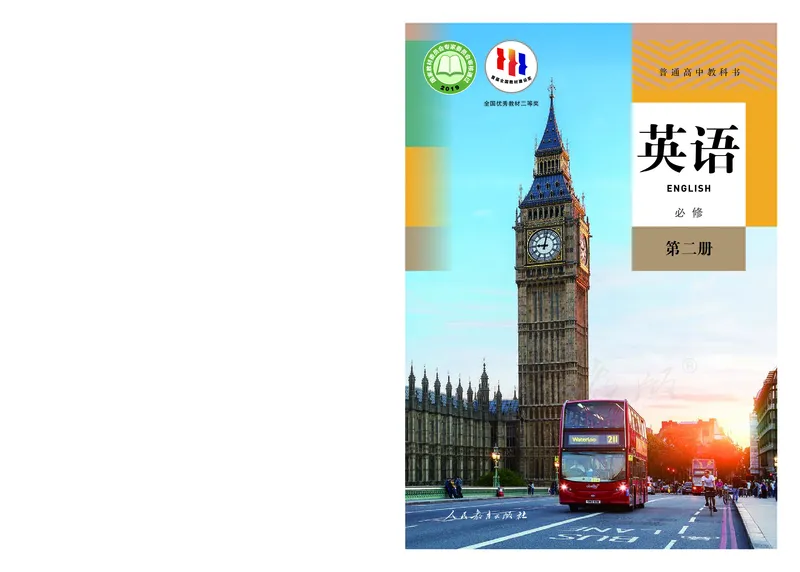
英语
英
语
必 修
PUTONG GAOZHONG JIAOKESHU
YINGYU 第二册
第
二
册
绿绿色色印印刷刷产产品品
定价: 元
人人教教教教材材封封面面 高高中中英英语语 必必修修二二 2200119900773300 11 22002222//44//11 1144::0011英语
普 通 高 中 教 科 书
ENGLISH
必 修
第二册
人民教育出版社 课程教材研究所
(中国)
英语课程教材研究开发中心 编著
(美国)圣 智 学 习 集 团
·北京·主 编:刘道义 郑旺全
副 主 编:吴 欣 张献臣
编写人员: Nils-Olov Fors Patrick Wallace Simon McCue
马晓蕾 王生军 徐 卓 赵钰莲 赵静宜
责任编辑:马晓蕾 王生军
美术编辑:胡白珂
封面设计:
版面设计:
插图绘制:
普通高中教科书 英语 必修 第二册
人民教育出版社 课程教材研究所
(中国)
英语课程教材研究开发中心 编著
(美国)圣 智 学 习 集 团
出 版
(北京市海淀区中关村南大街17号院1号楼 邮编:100081)
网 址 http://www.pep.com.cn
版权所有·未经许可不得采用任何方式擅自复制或使用本产品任何部分·违者必究
如发现内容质量问题,请登录中小学教材意见反馈平台:jcyjfk.pep.com.cn
如发现印、装质量问题,影响阅读,请与×××联系调换。电话:×××-××××××××前 言
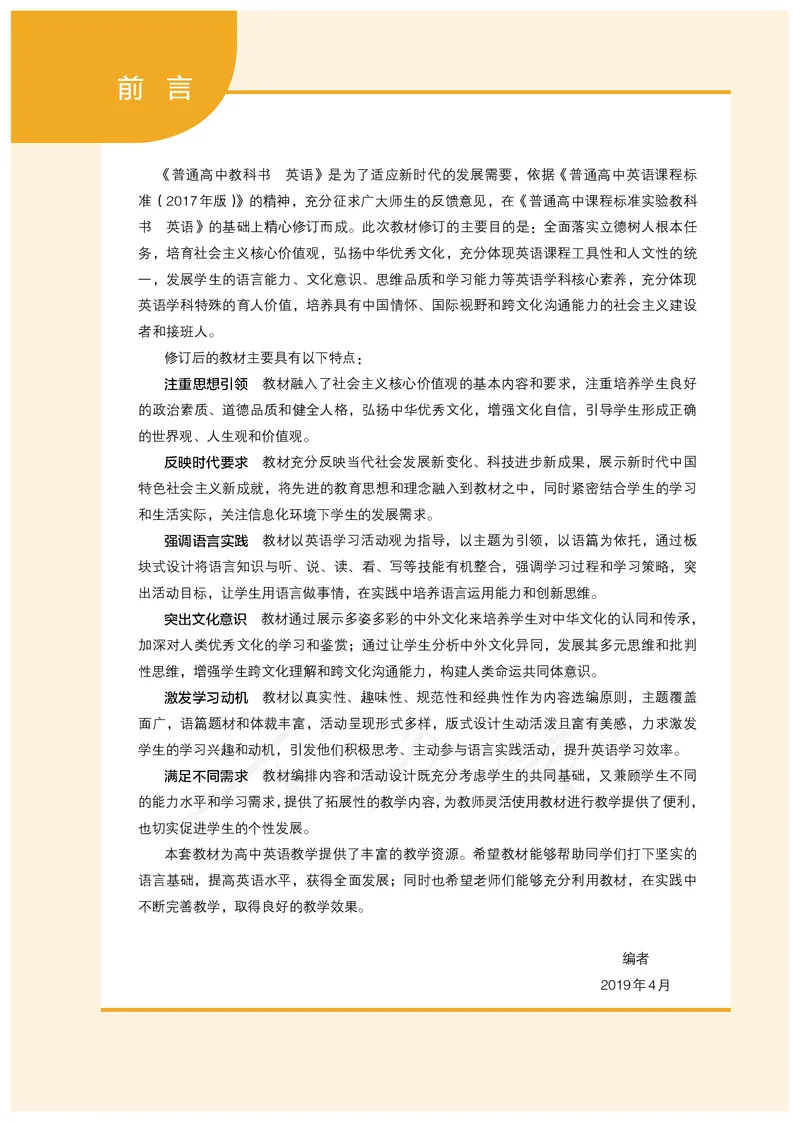
《普通高中教科书 英语》是为了适应新时代的发展需要,依据《普通高中英语课程标
准(2017年版)》的精神,充分征求广大师生的反馈意见,在《普通高中课程标准实验教科
书 英语》的基础上精心修订而成。此次教材修订的主要目的是:全面落实立德树人根本任
务,培育社会主义核心价值观,弘扬中华优秀文化,充分体现英语课程工具性和人文性的统
一,发展学生的语言能力、文化意识、思维品质和学习能力等英语学科核心素养,充分体现
英语学科特殊的育人价值,培养具有中国情怀、国际视野和跨文化沟通能力的社会主义建设
者和接班人。
修订后的教材主要具有以下特点:
注重思想引领 教材融入了社会主义核心价值观的基本内容和要求,注重培养学生良好
的政治素质、道德品质和健全人格,弘扬中华优秀文化,增强文化自信,引导学生形成正确
的世界观、人生观和价值观。
反映时代要求 教材充分反映当代社会发展新变化、科技进步新成果,展示新时代中国
特色社会主义新成就,将先进的教育思想和理念融入到教材之中,同时紧密结合学生的学习
和生活实际,关注信息化环境下学生的发展需求。
强调语言实践 教材以英语学习活动观为指导,以主题为引领,以语篇为依托,通过板
块式设计将语言知识与听、说、读、看、写等技能有机整合,强调学习过程和学习策略,突
出活动目标,让学生用语言做事情,在实践中培养语言运用能力和创新思维。
突出文化意识 教材通过展示多姿多彩的中外文化来培养学生对中华文化的认同和传承,
加深对人类优秀文化的学习和鉴赏;通过让学生分析中外文化异同,发展其多元思维和批判
性思维,增强学生跨文化理解和跨文化沟通能力,构建人类命运共同体意识。
激发学习动机 教材以真实性、趣味性、规范性和经典性作为内容选编原则,主题覆盖
面广,语篇题材和体裁丰富,活动呈现形式多样,版式设计生动活泼且富有美感,力求激发
学生的学习兴趣和动机,引发他们积极思考、主动参与语言实践活动,提升英语学习效率。
满足不同需求 教材编排内容和活动设计既充分考虑学生的共同基础,又兼顾学生不同
的能力水平和学习需求,提供了拓展性的教学内容,为教师灵活使用教材进行教学提供了便利,
也切实促进学生的个性发展。
本套教材为高中英语教学提供了丰富的教学资源。希望教材能够帮助同学们打下坚实的
语言基础,提高英语水平,获得全面发展;同时也希望老师们能够充分利用教材,在实践中
不断完善教学,取得良好的教学效果。
编者
2019年4月CONTENTS
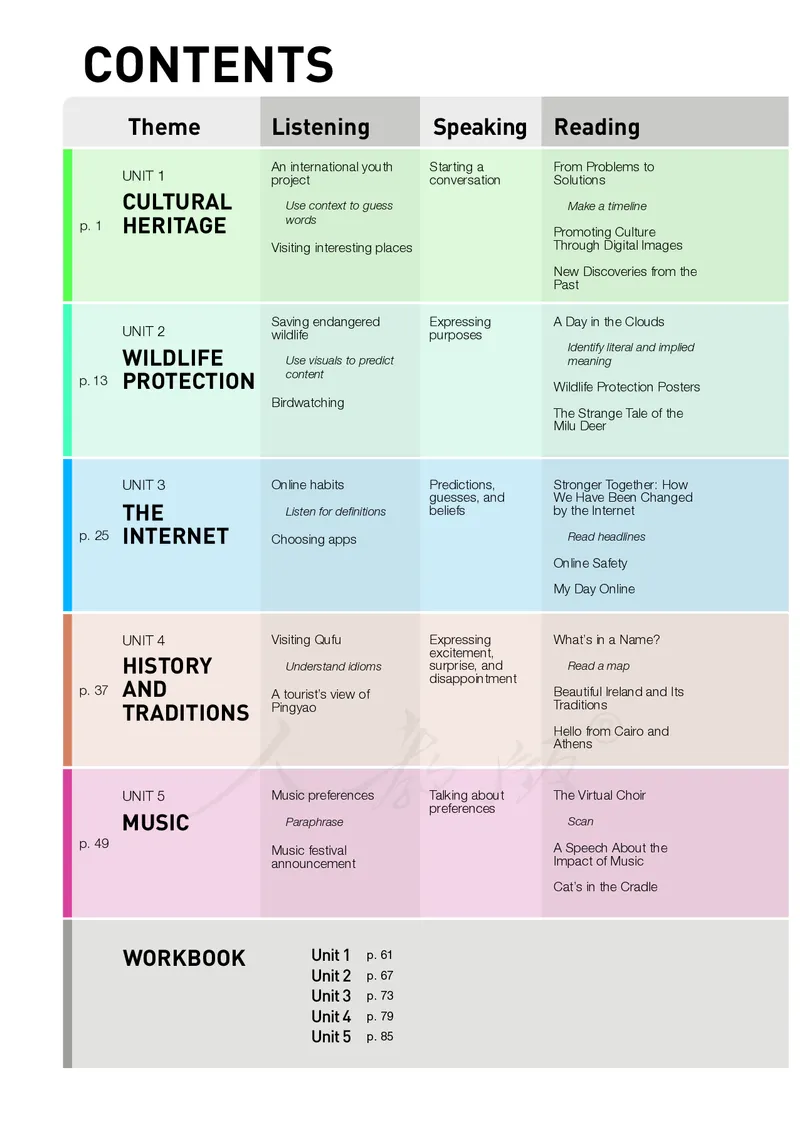
Theme Listening Speaking Reading
An international youth Starting a From Problems to
UNIT 1
project conversation Solutions
CULTURAL
Use context to guess Make a timeline
HERITAGE words
p. 1
Promoting Culture
Visiting interesting places Through Digital Images
New Discoveries from the
Past
Saving endangered Expressing A Day in the Clouds
UNIT 2 wildlife purposes
Identify literal and implied
WILDLIFE
Use visuals to predict meaning
PROTECTION content
p. 13
Wildlife Protection Posters
Birdwatching
The Strange Tale of the
Milu Deer
UNIT 3 Online habits Predictions, Stronger Together: How
guesses, and We Have Been Changed
THE
Listen for definitions beliefs by the Internet
INTERNET
p. 25 Choosing apps Read headlines
Online Safety
My Day Online
UNIT 4 Visiting Qufu Expressing What’s in a Name?
excitement,
HISTORy
Understand idioms surprise, and Read a map
disappointment
AND
p. 37 A tourist’s view of Beautiful lreland and Its
TRADITIONS Pingyao Traditions
Hello from Cairo and
Athens
UNIT 5 Music preferences Talking about The Virtual Choir
preferences
MUSIC
Paraphrase Scan
p. 49
Music festival A Speech About the
announcement Impact of Music
Cat’s in the Cradle
WORKBOOK Unit 1
p. 61
Unit 2
p. 67
Unit 3
p. 73
Unit 4
p. 79
Unit 5
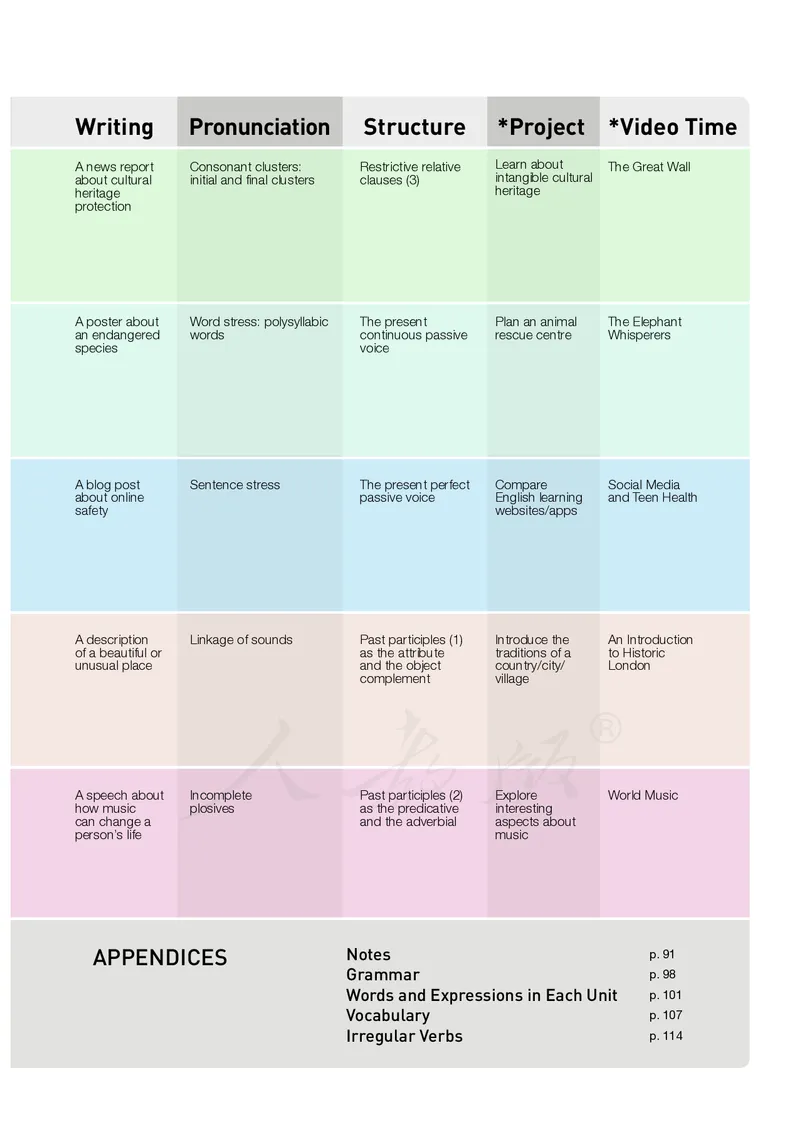
p. 85Writing Pronunciation Structure *Project *Video Time
A news report Consonant clusters: Restrictive relative Learn about The Great Wall
about cultural initial and final clusters clauses (3) intangible cultural
heritage heritage
protection
A poster about Word stress: polysyllabic The present Plan an animal The Elephant
an endangered words continuous passive rescue centre Whisperers
species voice
A blog post Sentence stress The present perfect Compare Social Media
about online passive voice English learning and Teen Health
safety websites/apps
A description Linkage of sounds Past participles (1) Introduce the An Introduction
of a beautiful or as the attribute traditions of a to Historic
unusual place and the object country/city/ London
complement village
A speech about Incomplete Past participles (2) Explore World Music
how music plosives as the predicative interesting
can change a and the adverbial aspects about
person’s life music
APPENDICES Notes
p. 91
Grammar
p. 98
Words and Expressions in Each Unit
p. 101
Vocabulary
p. 107
Irregular Verbs
p. 114UNIT 1
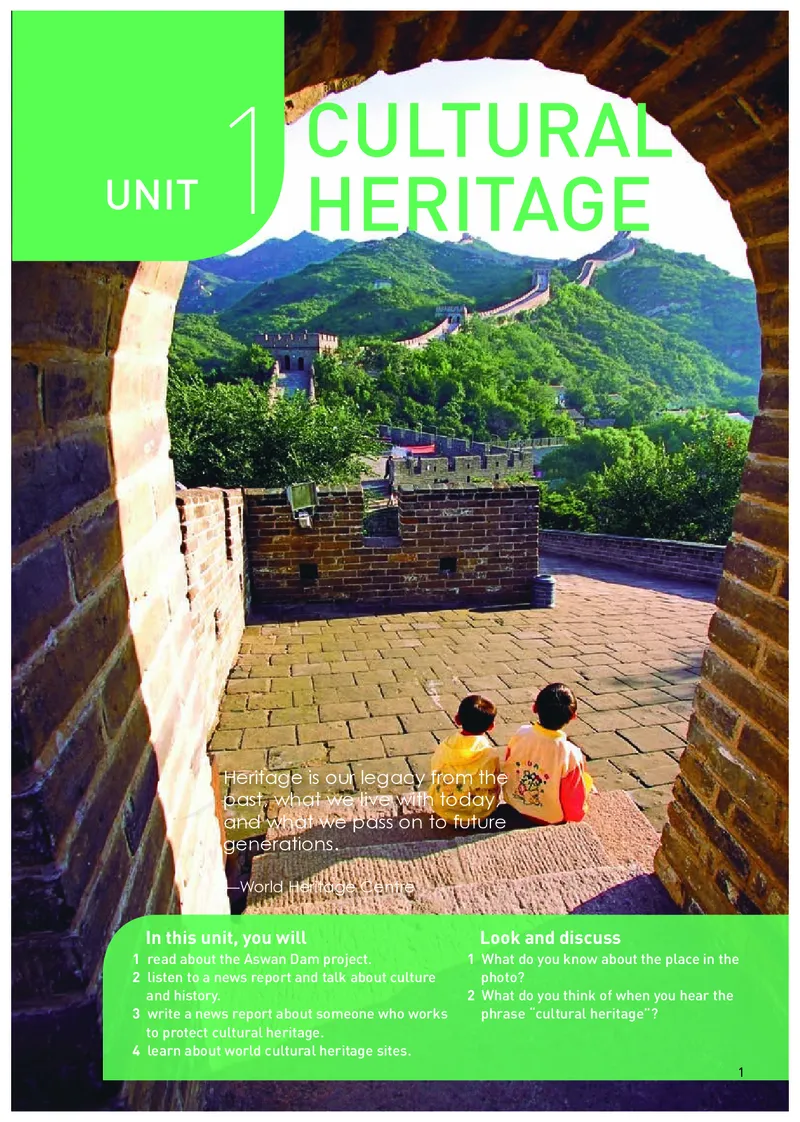
CULTURAL HERITAGE
1 CULTURAL
HERITAGE
UNIT
Heritage is our legacy from the
past, what we live with today,
and what we pass on to future
generations.
—World Heritage Centre
In this unit, you will Look and discuss
1 read about the Aswan Dam project. 1 What do you know about the place in the
2 listen to a news report and talk about culture photo?
and history. 2 What do you think of when you hear the
3 write a news report about someone who works phrase “cultural heritage”?
to protect cultural heritage.
4 learn about world cultural heritage sites.
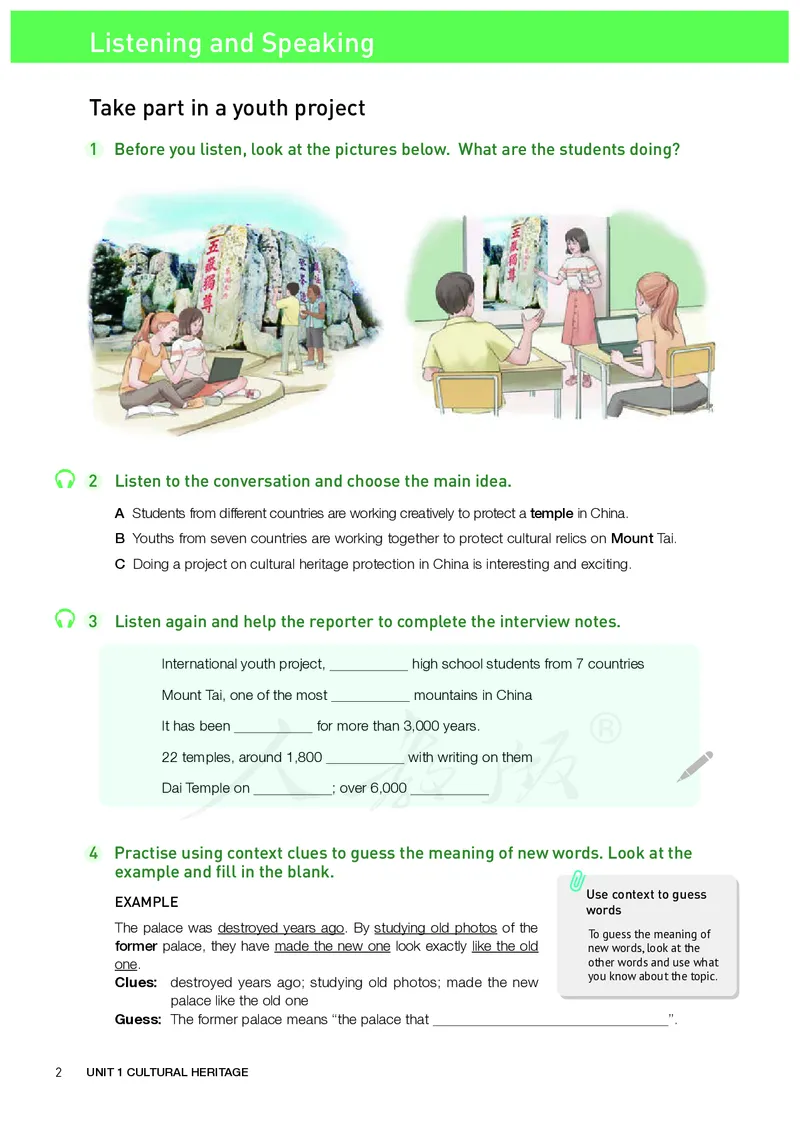
11Listening and Speaking
Take part in a youth project
1 Before you listen, look at the pictures below. What are the students doing?
2 Listen to the conversation and choose the main idea.
A Students from different countries are working creatively to protect a temple in China.
B Youths from seven countries are working together to protect cultural relics on Mount Tai.
C Doing a project on cultural heritage protection in China is interesting and exciting.
3 Listen again and help the reporter to complete the interview notes.
International youth project, high school students from 7 countries
Mount Tai, one of the most mountains in China
It has been for more than 3,000 years.
22 temples, around 1,800 with writing on them
Dai Temple on ; over 6,000
4 Practise using context clues to guess the meaning of new words. Look at the
example and fill in the blank.
Use context to guess
EXAMPLE
words
The palace was destroyed years ago. By studying old photos of the
To guess the meaning of
former palace, they have made the new one look exactly like the old new words, look at the
one. other words and use what
you know about the topic.
Clues: destroyed years ago; studying old photos; made the new
palace like the old one
Guess: The former palace means “the palace that ”.
2 UNIT 1 CULTURAL HERITAGE5 Listen to the conversation again and use the context to guess the meaning of the
words below. Tick the reason why you were able to guess the words.
Reason Preserve Promote Cypress
The word is an example of a group/type I know.
The word is explained by the speaker.
The word means the opposite of a word I know.
The word means the same as a word I know.
I know the general meaning of the word.
The speaker gives an example of the word.
6 Help the reporter to complete the news report based on what you hear and the
interview notes.
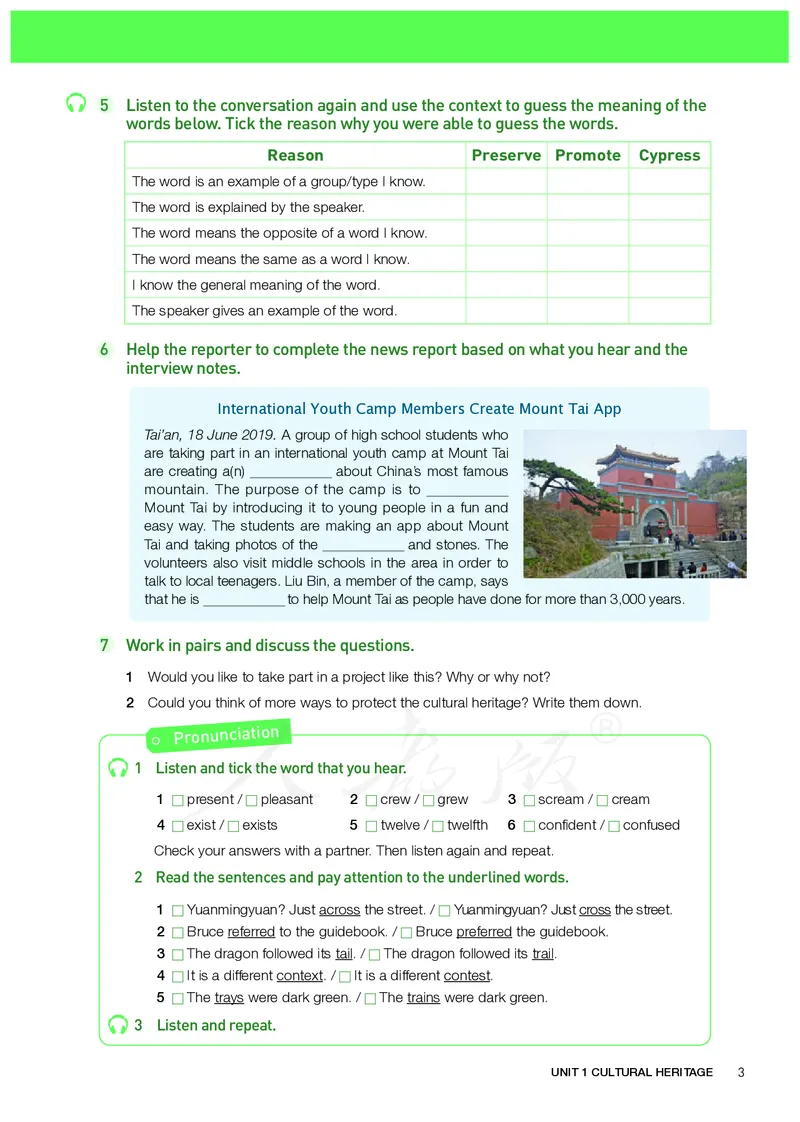
International Youth Camp Members Create Mount Tai App
Tai’an, 18 June 2019. A group of high school students who
are taking part in an international youth camp at Mount Tai
are creating a(n) about China’s most famous
mountain. The purpose of the camp is to
Mount Tai by introducing it to young people in a fun and
easy way. The students are making an app about Mount
Tai and taking photos of the and stones. The
volunteers also visit middle schools in the area in order to
talk to local teenagers. Liu Bin, a member of the camp, says
that he is to help Mount Tai as people have done for more than 3,000 years.
7 Work in pairs and discuss the questions.
1 Would you like to take part in a project like this? Why or why not?
2 Could you think of more ways to protect the cultural heritage? Write them down.
Pronunciation
1 Listen and tick the word that you hear.
1 present / pleasant 2 crew / grew 3 scream / cream
4 exist / exists 5 twelve / twelfth 6 confident / confused
Check your answers with a partner. Then listen again and repeat.
2 Read the sentences and pay attention to the underlined words.
1 Yuanmingyuan? Just across the street. / Yuanmingyuan? Just cross the street.
2 Bruce referred to the guidebook. / Bruce preferred the guidebook.
3 The dragon followed its tail. / The dragon followed its trail.
4 It is a different context. / It is a different contest.
5 The trays were dark green. / The trains were dark green.
3 Listen and repeat.
UNIT 1 CULTURAL HERITAGE 3Reading and Thinking
Understand how a problem was solved
1 Read the title and look at the photos. What do you think the text is about?
2 Scan the text for numbers. Circle the numbers and guess what they mean.
FROM PROBLEMS TO SOLUTIONS
Economic development is necessary if we want to improve society. There comes a time
when the old must give way to the new, and it is not possible to preserve everything from
our past as we move towards the future. Finding and keeping the right balance between
progress and the protection of cultural sites can be a big challenge.
Big challenges, however, can sometimes lead to great solutions. In the 1950s, the Egyptian
government wanted to build a new dam across the Nile in order to control floods, produce
electricity, and supply water to more farmers in the area. But the proposal led to protests.
Water from the dam would likely damage a number of temples and destroy cultural relics
that were an important part of Egypt’s cultural heritage. After listening to the scientists who
had studied the problem, and citizens who lived near the dam, the government turned to
the United Nations for help in 1959.
A committee was established to limit damage to the Egyptian buildings and prevent
the loss of cultural relics. The group asked for contributions from different departments
and raised funds within the international community. Experts investigated the issue,
conducted several tests, and then made a proposal for how the buildings could be saved.
Finally, a document was signed, and the work began in 1960.
The project brought together governments and environmentalists from around the world.
Temples and other cultural sites were taken down piece
by piece, and then moved and put back together again
in a place where they were safe from the water. In 1961,
German engineers moved the first temple. Over the next
20 years, thousands of engineers and workers rescued
22 temples and countless cultural relics. Fifty countries
donated nearly $80 million to the project.
When the project ended in 1980, it was considered a
great success. Not only had the countries found a path to
the future that did not run over the relics of the past, but
they had also learnt that it was possible for countries to
work together to build a better tomorrow.
The spirit of the Aswan Dam project is still alive today.
Perhaps the best example is shown by UNESCO,
which runs a programme that prevents world cultural
heritage sites around the world from disappearing. If a
problem seems too difficult for a single nation, the global
community can sometimes provide a solution.
4 UNIT 1 CULTURAL HERITAGE3 Read the text again and answer the questions.
Make a timeline
1 Why did the Egyptian government want to attempt
the building of the dam? Making a timeline that
shows when different events
2 How were the temples and other cultural sites saved? happened can help you
understand how the events
3 How long did it take to complete the project?
are connected to each other.
4 Complete the timeline with the information from the text.
The project starts. The temples and cultural relics are being rescued.
The project is completed. The first temple is moved. The government asks the UN for help.
1960
The project starts.
5 Complete the news report with the correct forms of the words in the box.
Then suggest a suitable title.
development progress proposal preserve
temple damage heritage establish prevent
Cairo, 16 March, 1956
In a speech today, a scientist gave her view on the new . She said that
is important and our area needs economic as well. But she added,
“We should not accept the project if it puts our cultural in danger. We must protect
the and make sure that no is done.” Before she ended her speech,
the scientist suggested that we need to a committee of experts to
the cultural heritage and it from being harmed.
6 Discuss one or more of the questions below in groups.
1 What were the solutions to the problem of building the Aswan Dam?
2 A lot of money was spent to protect the temples. Do you think it was worthwhile?
Why or why not?
3 Why do you think so many countries contributed funds and offered help to
the Egyptian project?
UNIT 1 CULTURAL HERITAGE 5Discovering Useful Structures
Describe people or things in greater detail
1 Look at the sentences below and underline the relative pronouns and adverbs.
After listening to the scientists who had studied the problem, and citizens who lived near the
dam, the government turned to the United Nations for help.
Temples and other cultural sites were taken down piece by piece, and then moved and put
back together again in a place where they were safe from the water.
Find more sentences containing relative clauses from the text on page 4, and
discuss briefly with a partner the major functions of them. Then make a short
summary in a table or mind map.
2 Rewrite the sentences using relative clauses.
EXAMPLE
I have downloaded that free app, but it doesn’t work well.→
The free app (which/that) I have downloaded doesn’t work well.
1 He showed me a photo in his room. It was a photo of a famous cultural relic in Egypt.→
The photo .
2 The project team helped protect the national parks in the United Republic of Tanzania. It was
formed by members from fifteen countries.→
The project team .
3 This temple was first built during the Qin Dynasty.→
The time .
4 We met a professional archaeologist at the entrance to the Great Pyramid. He
explained to us the process of building such a difficult structure.→
The professional archaeologist .
5 The documents about the cultural relics from overseas are under the desk. I found them
yesterday.→
The place .
6 Scientists worked together day and night to rescue the temple because they wanted to preserve it
for the next generation.→
The reason .
Discuss with a partner: Which relative pronouns can be deleted in your
sentences? When can you go without the relative pronouns like this?
3 Work in pairs and play a game of definitions. One asks the questions below and
the other answers them with relative clauses. Work out two more questions of
your own.
EXAMPLE
A: What is an exit?
B: An exit is the door where / through which you can leave a building.
1 What’s a library? (from/in which; where) 2 What’s a good friend? (to whom; who)
3 What’s a vacation? (during which; when) 4 What’s a football coach? (from whom; who)
6 UNIT 1 CULTURAL HERITAGEListening and Talking
Talk about history and culture
1 Listen to the conversation and choose the correct answers.
1 Where are the speakers? A On a street. B On a plane. C On a bus.
2 What are they doing? A Drawing a map. B Sightseeing. C Studying culture.
2 What do you know about the Kremlin and Red Square? Listen again and
complete the fact sheet.
World Cultural Heritage Site Fact Sheet
THE KREMLIN AND RED SQUARE, MOSCOW
• Built between the and centuries
• The palace where lives
• The Saint Basil’s Cathedral looks like .
• The part of Moscow
• Place for parades, concerts, and even
3 Work in groups. Choose a cultural site that you like and role-play a conversation
between some tourists and their tour guide. Take turns to play the different roles.
EXAMPLE
Tourist A: I beg your pardon, but is this the Xuanyuan Mirror?
Could you please tell me about it?
Tour guide: Yes, it is. It is said that it’s a mirror that can tell right from wrong!
… I see that you’re looking at that carving on the roof. Did you
know that it’s called chiwen—one of the nine sons of the
Chinese dragon?
Tourist B: No, I didn’t. That’s so interesting!
Starting a conversation
I beg your pardon, but …
Forgive me for asking, but …
Excuse me, but what is …?
Excuse me. Could you please tell me
about …?
Do/Did you know …?
I see that you are …
The Forbidden City
UNIT 1 CULTURAL HERITAGE 7Reading for Writing
Write a news report
1 Read the news report and answer the questions.
PROMOTING CULTURE
THROUGH DIGITAL IMAGES
Lanzhou, 9 August 2017. A group of researchers and scientists from China and other countries are
working together to help increase knowledge and appreciation of China’s ancient cultural heritage.
They are recording and collecting digital images of cultural relics from the Mogao Caves, which
were a key stop along the Silk Road throughout China’s ancient history. Nearly 500,000 high-
quality digital photographs have been produced since the international project started in 1994.
The Mogao Caves have long been a meeting point for different cultures and are part of the history
of many countries. Today, the caves are just as international as they were at the time when people
travelled the Silk Road. Tourists from all over the world visit Dunhuang to see the caves, and the
Getty Museum in Los Angeles has even reproduced a copy of the
caves and paintings for people to admire in America.
By sharing so many digital photos over the Internet, the group
hopes to promote even wider interest around the world in
China’s ancient history, culture, and traditions. They also hope
to further educate people about the importance of safeguarding
historic and cultural relics for future generations to understand
and appreciate. As one researcher who is working on the project
explains, “Appreciating one’s own cultural heritage is very
important for understanding oneself. Appreciating the cultural
heritage of other countries is very important for international
communication and understanding.”
1 What are the researchers and scientists trying to do?
What modern technology are they using?
2 Why are so many people interested in the Mogao Caves?
3 What do you think of the researcher’s opinion in the last paragraph?
2 Study the organisation and language features.
1 Read the news report again and find these parts.
A Lead sentence B Direct quote C Paraphrase
D Background information E Reporting verbs F Words to show comparison and/or contrast
2 Underline the relative clauses that the writer uses to identify the following.
A things B people C time
8 UNIT 1 CULTURAL HERITAGE3 Write a news report about a person or group who works to protect our
cultural heritage. You can use the interview notes below or write about a
person or group that you know of.
1 Read the interview notes.
Chen Lei, Wuhan Protectors of the Past, Wuhu
senior teacher protect old houses
takes photos of old buildings help repair buildings
wants to preserve cultural heritage look for cultural relics
interviews old people show cultural relics to the public
writes about the buildings raise money
visits schools to tell students about … repair temples and cultural relics
2 Draft a news report in which you explain what the person or group does.
A PICTURE IS WORTH A
Write a title to get the THOUSAND WORDS
Headline readers’ attention. Chen Lei is a senior
teacher who takes photos
Lead sentence Tell the readers who, what,
of old buildings in Wuhan
where, and why. in order to preserve the
city’s cultural heritage.
Explain what the
Body
person or group does.
Tell the reader Use relative clauses. Every day, Chen Lei takes
the facts, details, his camera and …
Use quotes and
examples, etc.
paraphrases.
End with a short
Neither people nor
Ending summary to help the buildings last forever, but
readers remember the Chen Lei’s photos can
help us remember them.
main idea.
3 Exchange drafts with a partner. Use the checklist to help each other revise the drafts.
Is there a title?
Does the lead sentence tell the reader about the situation?
Has the writer included details and explanations?
Are there quotes and paraphrases?
Does the writer use relative clauses to identify people, places, things, times, etc.?
Does the writer end with a short summary?
Are there any grammar or spelling mistakes?
4 Put up your news report in the classroom.
UNIT 1 CULTURAL HERITAGE 9Assessing Your Progress
1 How can you take part in cultural heritage protection? Read the passage.
Then complete the phrases below and use them to finish the passage.
in to from a balance sure
be proud keep prevent
donate sth lead take part
make turn
Getting young people to activities to protect their national heritage is a good way
to introduce them to their country’s history. As they learn more about where they come from,
they will hopefully tell others about their country and culture. Of course, teachers
must between teaching the good and bad parts of a country’s history. Learning only
the good parts can narrow thinking. Learning the bad parts may help
those kinds of things happening again. Students who know their history and
culture are more likely to that their cultural heritage is protected, and teachers can
motivate students by asking them to come up with their own ideas and make proposals for
ways to protect this. One possible idea is for students to raise or money
an organisation or group that protects their country’s cultural heritage. Teachers may also
their local museums or historical societies for help in getting students more
interested in this important field.
2 Read the conversation and learn about intangible cultural heritage (ICH).
Then complete it with the correct relative pronouns or adverbs.
A: My teacher just gave us a task I really don’t know how to do. I have to take part
in an organisation protects our cultural heritage.
B: Oh, that sounds interesting! Where are you planning to go? I’m sure there are all kinds of
historic sites cultural relics need to be protected.
A: Yes, but I’m not one of those people love museums. I think they’re kind of boring.
I like going on field trips I can experience and do things to protect cultural relics.
B: Cultural heritage is a lot more than just relics, you know. For example, our country has
many nationalities dances, crafts, and other traditions are also very important. If
we don’t protect those traditions, there may come a time they disappear.
REFLECTING
Did you find it easy or difficult to talk about culture and history? Why or why not?
.
What was the most interesting part of this unit and why?
.
How does learning about cultural heritage affect your opinion about your role in
protecting your culture? .
Overall, I thought this unit was good useful so-so difficult.
10 UNIT 1 CULTURAL HERITAGE*Project: Learn about intangible cultural heritage
A country’s cultural heritage includes not only temples, palaces, and other cultural relics,
but also its traditions, customs, and knowledge, such as dances, arts, and crafts. Learn
more about intangible cultural heritage and prepare a class presentation.
1 Work in pairs. Look at the examples of Chinese ICH and discuss the questions.
Are you familiar with any of these examples of Chinese ICH? Tell your partner what you
know about them.
Have you ever observed or taken part in any of them? If so, when and where? Share
your experiences with your partner.
What other kinds of ICH do you know about? Share what you know with your partner.
2 Work in groups. Choose something that represents ICH. Use the library or the
Internet to do research. You can refer to the questions below as a guide.
What is it? What are its characteristics?
What does it look like? How is it used/done/made?
Who uses/does it? Does it have any symbolic meaning?
Why should we protect it? How can we protect it?
3 Make a presentation to the class about the ICH that you have chosen.
UNIT 1 CULTURAL HERITAGE 11* Video Time
The Great Wall
The Great Wall of China is the largest structure ever
made and one of the great wonders of the world.
This makes it an important cultural heritage site not
just for China, but for all people around the world.
BEFORE yOU WATCH
Match the phrases below with the pictures from the video.
A surveyors and archaeologists studying the Great Wall B weeds speeding up its collapse
C volunteers taking care of the Great Wall D sections fallen into ruins
WHILE yOU WATCH
1 Read the statements and decide whether they are true (T) or false (F).
1 Every part of the Great Wall is easy to find and see. T F
2 The Great Wall took 2,300 years to build. T F
3 Some of the Great Wall has been lost. T F
4 The length of the Great Wall is the same as the distance between T F
the North and South Poles.
2 Complete the sentences below with the words you hear in the video.
1 We are and we usually come here once a month.
2 But when we are not busy with school, we come here .
3 We hope more people will protect our .
4 We need to protect the Great Wall, so we can present it to the future generations
and let our cultural imprint .
AFTER yOU WATCH
Discuss the questions in pairs.
1 Why is it important to protect cultural heritage sites like the Great Wall?
2 Are there any important cultural heritage sites in your area?
What can you do to help protect and take care of them?
12 UNIT 1 CULTURAL HERITAGEUNIT 2
WILDLIFE PROTECTION
2 WILDLIFE
PROTECTION
UNIT
When the buying stops,
the killing can too.
—WildAid
In this unit, you will Look and discuss
1 read about the protection of Tibetan antelopes. 1 What do you think of when you see this photo?
2 listen to and discuss facts and opinions about 2 Do you think that elephants are an endangered species?
endangered wildlife. 3 What other wild animals are in danger?
3 design a poster about an endangered species.
4 learn about ways to care for wildlife.
1133Listening and Speaking
Talk about saving endangered wildlife
Use visuals to
predict content
1 Before you listen, discuss these
questions in pairs. Before you listen, look at
pictures, charts, videos, and
other visuals to help you
1 What message do these posters share?
predict what you will hear.
2 Which one moves you the most? Why?
Up to 73 million
sharks end up
in shark fin soup
each year
Protect wildlife.
Say NO to
Shark fin soup.
2 Listen to the first part and fill in the blanks.
Our planet’s is dying out at an alarming
What
rate. Between 150 and 200 species are becoming
on Earth
extinct every day. This mass extinction is caused
by hunting, habitat , and pollution. We Are We Doing
must make people aware of the problem and help to Our Planet?
the endangered wildlife before it’s too late!
3 Listen to the second part and answer the questions.
1 How many elephants are killed on average every day?
2 What did Prince William say about China?
A China has made a lot of progress.
B China can become a global leader in wildlife protection.
C China preserves its natural habitats well.
4 Discuss the question in groups.
What does “Change begins with you” mean?
14 UNIT 2 WILDLIFE PROTECTION5 In pairs, discuss the questions, role-play the example, and then talk about one
of the animals in the photos below.
1 What do you know about the animals in the photos?
2 What is being done to help them?
EXAMPLE
A: I’m concerned about the African elephants. What do you know about them?
B: Well, I know that they’re being hunted and their habitat is getting smaller, so
they’re in danger of extinction. Elephants need large living spaces, so it’s difficult
for them to adapt to the changes.
A: That’s terrible. What measures are being taken to help them?
B: The authorities are under pressure to build elephant parks and tell people not to buy
elephant products.
blue whale panda African elephants
Pronunciation
1 Work in pairs. Read the words aloud to each other, and put them into the
correct groups. and stand for stressed syllables ( for primary stress,
and for secondary stress), and for unstressed syllable.
alarming announcement authority architecture civilisation
competition contribution electricity investigate literary
recommend responsibility vocabulary volunteer refrigerator
EXAMPLE habitat downstairs
2 Check your answers with another pair. Then listen and repeat.
3 Listen to the conversation in Activity 5, paying attention to the stress
patterns of the polysyllabic words and repeat them.
UNIT 2 WILDLIFE PROTECTION 15Reading and Thinking
Learn about protecting endangered animals
1 Before you read, discuss these questions in pairs.
1 Look at the pictures below. What do you think the text is about?
2 What do you know about the Tibetan antelope and the Changtang
National Nature Reserve?
A DAY IN THE CLOUDS
The air is thin and we have to rest several times on the short hike from
camp. To our left, snow-covered mountains disappear into
clouds that seem almost close enough to touch. On the plain
in front of us, we can just make out a herd of graceful animals.
This is why we’re here—to observe Tibetan antelopes.
Tibetan antelopes live on the plains of Tibet, Xinjiang, and Qinghai. Watching them move
slowly across the green grass, I’m struck by their beauty. I’m also reminded of the danger
they were in. They were hunted, illegally, for their valuable fur.
My guide is Zhaxi, a villager from Changtang. He works at the Changtang National
Nature Reserve. The reserve is a shelter for the animals and plants of northwestern
Tibet. To Zhaxi, the land is sacred and protecting the wildlife is a way of life. “We’re
not trying to save the animals,” he says. “Actually, we’re trying to save ourselves.”
The 1980s and 1990s were bad times for the Tibetan antelope. The population
dropped by more than 50 percent. Hunters were shooting antelopes to make profits.
Their habitats were becoming smaller as new roads and railways were built.
In order to save this species from extinction, the Chinese government placed it
under national protection. Zhaxi and other volunteers watched over the antelopes
day and night to keep them safe from attacks. Bridges and gates were added to let
the antelopes move easily and keep them safe from cars and trains.
The measures were effective. The antelope population has recovered and in June
2015, the Tibetan antelope was removed from the endangered species list. The
government, however, does not intend to stop the protection programmes, since
the threats to the Tibetan antelope have not yet disappeared.
In the evening, I drink a cup of tea and watch the stars. I think about the antelopes
and what Zhaxi told me. Much is being done to protect wildlife, but if we really want
to save the planet, we must change our way of life. Only when we learn to exist in
harmony with nature can we stop being a threat to wildlife and to our planet.
162 Read the text and answer the questions.
1 Why did the writer visit Tibet?
2 What happened to the Tibetan antelope in the 1980s and 1990s?
3 What did people do to help protect the Tibetan antelope?
4 What does “national protection” mean? Can you list more examples?
5 How does the writer feel about modern life? How do you know?
3 Read the sentences below, and decide if each idea is the literal meaning (L)
of the text or only implied (I) by the text.
EXAMPLE
Identify literal and implied
I The Tibetan antelope lives high above sea level. meaning
( This is implied by “The air is thin”.) Literal meaning is the usual,
basic meaning of the words,
When they first saw the antelopes, they were very far away.
i.e. exactly what the words say.
Implied meaning is suggested
We should not buy goods made from endangered animals.
but not directly expressed, i.e.
Human activities are threatening animals and plants. you guess the meaning based
on what you know.
The Tibetan antelope is not an endangered species now.
4 Learn about elephants by reading and completing the passage with the
correct forms of the words.
hunter illegally reserve attack
exist plain harmony threat
Herds of elephants used to live on the of Africa
and in the forests of Asia. But today, they face a serious
from . These large animals
are being killed for their body parts that are
considered valuable. In order to save them, some countries have
created where they can live in peace and safety.
However, the on them will continue as long as
interest in buying elephant products . To achieve
between humans and animals, the world must
protect these beautiful creatures.
5 Discuss the questions below in pairs.
The writer says that we must change our way of life and learn to live in harmony with nature in
order to save our planet. Do you agree? What do you think we should do or change?
UNIT 2 WILDLIFE PROTECTION 17UNIT 2
WILDLIFE PROTECTION
Discovering Useful Structures
Report an ongoing event
1 Underline the present continuous passive voice in the sentences and discuss its
function.
African elephants are being hunted.
What is being done to help them?
What measures are being taken to help them?
Find more sentences with the same verb form in this unit.
2 Choose the suitable verb forms to complete the sentences.
1 I’m (working / being worked) at home today because my office is (painted / being painted).
2 The alarming report is (written / being written). It will be finished soon.
3 What part of the city is (attacked / being attacked) now?
4 Right now, the deer are (watched / being watched) over by many volunteers.
5 Who is (hunting / being hunted) the kangaroos? Where are they (hunted / being hunted)?
6 It is reported that living spaces for wildlife are (reduced / being reduced) due to the cutting of
trees.
3 Liu Tao would like to express his concern over the wetland in his hometown. Help him
finish the passage with the present continuous passive voice of the verbs in brackets.
In the wetland of my hometown, there are many different kinds of animals, including wild
birds, fish, snakes, insects and so on. When I was in primary school, I often went there with
my friends to watch the birds and study them. That was an interesting place for all of us.
But things have begun to change in recent years. Small birds (catch) with
nets. Wild ducks (sell) at food markets. Fish and snakes (kill)
for food in restaurants. And even worse, the wetland (destroy). Some parts
(cover) with new houses. You can see rubbish everywhere. The wetland
(pollute) seriously every day. I am very worried about it. What can we do?
* 4 In groups, discuss the questions below. Prepare to give a presentation of your
ideas to the class.
What do you know is being done in your neighbourhood to protect animals and plants?
What suggestions do you have?
18Listening and Talking
Help the wildlife in your neighbourhood
1 Match the words with the pictures.
1 binoculars
2 bird feeder
3 bird field guide
A B C
2 Choose the right ending for each sentence.
1 Binoculars .
Expressing purposes
2 Build bird feeders .
3 Use a bird field guide . This is used for …
4 Put paper cut-outs on windows . I did it to / in order to /
so as to …
A in order to identify birds
B so that birds do not crash into them He has done it so that /
C to make sure that birds have enough food in order that …
D are used for watching birds from far away
3 Listen and answer the questions.
1 Who are the teenagers? 2 Where are they?
3 What are they doing? 4 Why are they doing it?
4 Listen again and use the phrases you hear to fill in the blanks.
1 They got up early search for wild birds.
2 I’ve brought a field guide we can look up the birds we see.
3 My dad gave me the binoculars we can see the birds better.
4 Birdwatching clubs clean up habitats, build bird feeders, and put paper cut-outs on
windows protect birds.
5 Think of other wildlife in your neighbourhood and their needs. What can you
do to care for them? Discuss their needs and solutions in groups.
EXAMPLE
A: I often see wild cats in our neighbourhood. Maybe we should do something to care for them.
B: Should we put out bowls of food for them?
C: Sure, and I think we could also put out boxes or other things for them, so that they can
find shelter when it’s cold or wet outside.
UNIT 2 WILDLIFE PROTECTION 19UNIT 2
WILDLIFE PROTECTION
Reading for Writing
Make an effective poster
1 Look at the posters below. Which emotions do the photos communicate?
funny surprising frightening sad ...
Opinion poster on the left poster on the right
I think it’s …
2 Read the posters and write a one-sentence summary for each.
Don’t
Make Paper
Give Ugly a
with My Home!
Chance!
When it comes to wildlife protection, all
Billions of trees are being cut
species—the good, the bad, and the ugly— down every year to make
should be treated equally. Pandas, dolphins, paper for humans. Every tree
and other cute wildlife are important, but we that is cut down is a part of the
habitat of animals such as these
must pay attention to less cute animals, too.
koalas. In this way a lot of animal
The world needs all kinds—without variety,
homes are being destroyed!
our planet cannot survive. So if you want the
Is it right to make animals
future to be beautiful, you have to give ugly
homeless so that humans can
a chance.
have more paper?
3 Look at the posters again. Discuss the questions in groups.
1 What does each poster use to stir up emotions?
2 Who do you think is the intended audience for each poster? Why do you think so?
3 What does each poster want people to do? How do you know?
4 In your opinion, which poster is more effective? Why?
20 UNIT 2 WILDLIFE PROTECTION4 Work in pairs. Make a poster about an endangered animal.
1 Choose one of the animals below or one of your own. Do some research to add to the
animal fact sheet.
South China Tiger
Why is it endangered? Habitat loss; hunted for its skin and fur
What is being done? A plan is being carried out to increase
the number of wild tigers.
What can we do? Do not buy fur or other tiger products!
Yangtze River Dolphin
Why is it endangered? Habitat loss
What is being done? Reserves are being built for them, and
they are being searched for in the wild.
What can we do? Clean up the rivers!
2 Follow these steps to organise your poster.
Write a title that is simple, interesting, and unusual,
1
and then collect the information you need.
2 Write the name of the species and why it is endangered.
Use a powerful image to attract the readers’ attention
3
to the facts and problems.
4 Tell the readers what you want them to think and do.
5 Exchange posters with another pair. Use this checklist to give them helpful
feedback.
Does the poster include key information about the animal?
Does the poster explain why it is endangered?
Does the poster support its information with facts?
Is the message of the poster clear, i.e. can you tell clearly what the designer
wants the reader to think or do?
Is the image on the poster effective?
6 Put up the poster in your classroom or in a public place.
UNIT 2 WILDLIFE PROTECTION 21Assessing Your Progress
1 Complete the phrases and use them to finish the passage.
about for of out to up
adapt die be concerned
search put be aware
The World Wide Fund For Nature (WWF) the many
species of plants and animals that around the
world. The WWF wants more people to the
problem, so they will stop hurting wildlife and
solutions. Very few people in modern society actually intend
to harm animals. Most people do not realise that many animal
species cannot the changes brought about by
modern civilisation. It is for this reason that the WWF constantly
information to stir up public interest in the welfare
of the planet.
Think about what the WWF does to protect wildlife.
2 Read and complete the passage with the present continuous passive voice of
the verbs in brackets.
It may seem that protecting wildlife is something far from the life of a high school
student, but in fact, a lot (do) by young people around the world. In
Washington State, USA, wolverines (貂熊) (study) by scientists in an effort
to learn how to preserve the population. However, during the winter, it is difficult to
attract the animals to cameras hidden in snowy forests. A group of students heard
about the problem and created a special device which (test) deep in a
snowy forest now. Their invention (use) to send out a certain smell near the
cameras. The shy animals are attracted by the smell and coming around the cameras.
They (observe) by a conservation researcher.
What do you think of the invention?
REFLECTING
In this unit, I was especially moved by
because .
I thought the most helpful part of the unit was
because .
I thought the most difficult part of the unit was
because .
Overall, I thought this unit was wonderful good so-so too hard.
22 UNIT 2 WILDLIFE PROTECTION*Project: Plan an animal rescue centre
Endangered animals are not the only animals that need help and protection. All animals need help
at times, such as pets that are left homeless when their owners move or wounded birds that fall to
the ground. They can be kept in an animal rescue centre for some time until they recover.
1 Here is part of a report about an animal rescue centre. Read the passage and
then tell your partner about it. The questions may help you.
SMALL FRIENDS PET SHELTER
The Small Friends Pet Shelter was started by a
group of high school students and their parents
when they started to see many pets that were
left behind after their families moved away.
Today, there are about 70 cats, 50 dogs,
three rabbits, and a few turtles living at the
shelter. The young people who run the shelter
work hard to keep the place clean, take care
of the animals, and advertise the animals so
that they can be adopted.
They have already helped to find homes for
nearly 200 animals. It is hard work, but the
young people working at the shelter think it is
worth it.
So if you find a pet that is lost, call the young
people at Small Friends Pet Shelter! And if you
1 What is the rescue centre called? want to help out, go and volunteer your time
2 Who started it? and love. That is what the animals really need
most.
3 What animals were rescued?
4 What help does the centre need?
2 Think about animals that need help. Plan an animal rescue centre for them.
Discuss the questions in groups.
What will it be called? What can we do to help the animals?
What skills or equipment do we need? Where should the centre be built?
What help could people offer?
3 Make a poster in which you describe your animal rescue centre and ask for
help. Put up the poster on the classroom wall.
UNIT 2 WILDLIFE PROTECTION 23* Video Time
The Elephant Whisperers
The elephant whisperers are the elephant
keepers who work for a programme in Kenya.
The organisation aims to rescue and raise orphan
elephants, and then return them to the wild. So far,
it has helped hundreds of baby elephants.
BEFORE yOU WATCH
Look at the title, introduction, and picture. Then guess whether the
statements are true (T) or false (F).
1 The elephants’ mothers left them alone. T F
2 The baby elephants all come from different areas of Kenya. T F
3 The native environment of the elephants is the forest. T F
4 The keepers have to feed the elephants every four hours, day and night. T F
5 The keepers have to sleep with the elephants. T F
WHILE yOU WATCH
1 Check your answers in Before You Watch.
2 Arrange the following items in the order you see them in the video. Write
the numbers 1–7 on the lines.
A Two elephants make friends.
B The elephant keepers lead the elephants into the forest.
C A keeper sings to the elephants.
D The elephants play football.
E An elephant keeper feeds an elephant some leaves.
F The keepers put the elephants to bed.
G The keepers feed the elephants milk using bottles.
3 Answer the questions using information from the video.
1 According to the elephant keeper, in what way are elephants like people?
2 What is the most important thing elephants must learn at the centre?
AFTER yOU WATCH
Discuss the questions in groups.
1 Why is this programme important for elephants and for the world?
2 Have you ever taken care of a baby animal? In what ways is it similar to or different from
taking care of a human baby?
24 UNIT 2 WILDLIFE PROTECTIONUNIT 3
THE INTERNET
3 THE
UNIT INTERNET
The Internet is becoming the town square
for the global village of tomorrow.
—Bill Gates
In this unit, you will Look and discuss
1 read about online communities. 1 What do you usually do online?
2 listen to people describe their online habits, 2 How can you use the Internet to learn English?
and talk about your own. 3 Have you ever helped others to use the Internet?
3 write a blog post about online safety. How?
4 learn about online education.
2255UNIT 3
THE INTERNET
Listening and Speaking
Ask about online habits
1 Look at the online activities in the box and match them with the pictures.
Then tick the pictures of the activities that you like to do when you are online.
write a blog post use a search engine
chat online stream movies and music
A B C D
2 Sam is doing a survey on online habits. He is now talking to his schoolmates Anna,
Paul, and Joe. Listen to the conversation and complete the table.
Time spent
Name Online activities Reasons for using the Internet
online every day
Anna
Paul
Joe
3 Listen again and fill in the blanks to complete the sentences.
1 A blog an online diary where you write about something you’re interested in.
, I like basketball, so I write a lot on my blog about my favourite team.
2 I stream videos and music. , I watch videos and listen to music online.
3 A search engine that helps you find what you’re looking for.
26 UNIT 3 THE INTERNET4 Look at Activity 3 again. How are the words in italics defined? Write them in the
correct brackets.
A Use simpler words. ( ) Listen for definitions
When you hear a word you don’t know,
pay attention to the next sentence
B Use an example. ( )
or two to see if there is a definition.
Definitions often begin with words
like “it’s like”, “that is”, or “for example”.
C Compare to something. ( )
5 Take turns to ask each other about your online habits.
EXAMPLE
A: How much time do you spend online every day?
B: Oh, it’s hard to say. Sometimes I’m too busy to go online. Sometimes I spend more than
four hours online. How about you?
A: It depends. I’d say from half an hour to three hours.
B: What do you usually do online?
A: I listen to music, stream videos, or look up information. And you?
B: Lots of things. I especially like to chat with my friends and family. By the way, what’s
your favourite app?
A: Well, …
Pronunciation
1 Most sentences have two basic types of words: content words and function
words. Content words are usually stressed. Read the sentence and notice
which words are stressed.
EXAMPLE
The Internet is becoming the town square for the global village of tomorrow.
2 Read the poem about online safety and mark the words that should be stressed.
Cyber Sense
I always keep things secret when I go online.
I never share the things that should be only mine.
My email and my home address, my phone number and name—
These are things only I should know on websites or in games.
And so I use a nonsense name for my net identity.
When folks online ask who I am, I say, “I’m Cyber Me.”
And if I ever think that someone online isn’t all that bad,
I never ever meet them without telling Mum or Dad.
3 Listen to the poem and see if you got the stressed words right.
UNIT 3 THE INTERNET 27Reading and Thinking
Start an online community
1 Before you read, look at the title and discuss these questions in pairs.
1 What do you think the text will say?
Read headlines
2 How do you think the writer feels about the topic?
Headlines usually include only
key ideas or information from
the text. They often do not
follow strict grammar rules,
STRONGER TOGETHER: because writers use as few
words as possible to catch the
HOW WE HAVE BEEN CHANGED attention of the readers.
BY THE INTERNET
Much has been written about the wonders of the World Wide Web. There are countless
articles telling us how the Internet has made our lives more convenient. We no longer have
to wait in line or carry cash around when we go shopping. We can get the most updated
information from large databases. We can download software, documents, and images
whenever we need them. But the Internet has done much more for people than simply
make life more convenient. People’s lives have been changed by online communities and
social networks.
Jan Tchamani, an English teacher in Birmingham, UK, suddenly developed a serious
illness and had to quit her job. At age 50, she found herself out of work and stuck at home
with only her computer to keep her company. After a while, she discovered that surfing the
Internet could help her feel less lonely and bored. She could listen to music, watch films,
play games, and explore the world. She also joined an online group where she could talk
about her problems and get support and advice from others. She realised that one of the
greatest benefits of the Internet was its ability to remove the distance that usually exists
between people.
She was so inspired by the people she met online that she decided to start an IT club
to teach older people how to use computers and the Internet. She and her friends now
organise events and collect money to pay for private teachers. Many people have been
helped by the club. A 59-year-old man learnt how to apply for work online and found
a great job. Now that he works and can take care of himself, his daughter has time to
study at university. A 61-year-old woman who was living alone has started a small online
company together with two friends. She no longer feels lonely, and her company has
become quite successful.
Jan has started taking online classes to learn more about how to use the Internet to make
society better. She believes that it is highly important to bridge the digital divide and make
sure that everyone has access to the Internet and knows how to use new technology. Her
next goal is to start a charity website to raise money for children in poor countries.
Jan’s life has been greatly improved by the Internet. “When you go through tough times,
you meet others who are facing similar challenges,” Jan says. “Thinking about other
people’s situations inspired
me to offer help.”
28 UNIT 3 THE INTERNET2 Read the text and answer the questions.
1 Why did Jan quit her job?
2 How did the people in the online community help her?
3 Why did she start the IT club?
4 What is the “digital divide”?
5 What’s Jan’s next goal?
6 What can we learn from her experiences?
3 List the ways in which the text says that the Internet has changed people’s
lives. Try to add more examples.
Examples from the text More examples you know
4 Complete the passage about Wuzhen with the correct forms of the words in
the box.
access convenient surf inspire distance
network download cash update benefit
The Internet has brought great to Wuzhen,
a small waterside town in Zhejiang Province. For the
past few years, Wuzhen has hosted the World Internet
Conference (WIC), which makes life in this ancient town
much more than it has been. Residents
here can online as easily as in large modern
cities. Plus they can movies and music at
high speeds. The Internet has even changed Wuzhen’s
transport! For short , both residents and tourists can use the public bike system.
Bikes can be rented by using online apps—no need for paperwork or payment.
In 2016, the parking system for Wuzhen’s WIC centre was to be fully Internet-based.
Wuzhen’s entering the world of the Internet should other small towns around the
world. No matter how small a town is, everyone should be able to join the global and
the world of the Internet!
5 Discuss the questions below in pairs.
1 Do you think your life has been changed by the Internet? If so, how?
2 The writer mentions many advantages of using the Internet. Do you think there are any
disadvantages? If so, what are they?
UNIT 3 THE INTERNET 29Discovering Useful Structures
Talk about something that has been done
1 Read the pairs of sentences. Underline and compare the different verb forms.
Jan’s life has been greatly improved by the The Internet has greatly improved
Internet. Jan’s life.
Much has been written about the wonders People have written much about the
of the World Wide Web. wonders of the World Wide Web.
How do we form the present perfect passive voice? Fill in the blank.
Active have/has + v-ed
Verb form
Passive
2 Change the sentences into the present perfect passive voice.
EXAMPLE
They’ve built a kind of new PC with more functions.→
A kind of new PC has been built with more functions.
1 I have downloaded the software to help my phone battery last longer.
2 Someone has lost an identity card.
3 Have you confirmed the Wi-Fi password?
4 Have you pressed the button yet to copy the file?
5 Has anyone made a comment about the online database?
Find out the differences in meaning and function between the active and
passive forms.
3 Read the poem. Then think of your own situation and write a similar poem.
Look at the way your face has been washed
Look at the way your teeth have been brushed
Look at the way your shoes have been cleaned
You’d better do them again.
Look at the way the flowers have been planted
Look at the way the grass has been cut
Look at the way the paths have been swept
I hope that you’ll come here again.
30 UNIT 3 THE INTERNETListening and Talking
Choose the best app
1 Laura and Xiao Bo are talking about apps. Listen to their conversation and
find out what apps they want.
Xiao Bo is looking for a(n) app to help him get in shape.
Laura would like an app for getting and another that will make her better.
2 Listen again. Are the sentences true (T) or false (F)?
1 Both of Xiao Bo’s apps keep track of the steps he takes.
2 Xiao Bo’s second app can help him make a fitness plan.
3 Laura needs an app that will help her get discounts.
4 Laura needs an app that will add money to her bank account.
3 Listen once more and tick the sentences you hear. Underline the words used to
express predictions, guesses, and beliefs.
Predictions, guesses, and beliefs
It might help me walk more.
My guess is that it wouldn’t work.
I imagine this app would help me get fit faster.
I suppose that would be good.
I guess you could save a little with this app.
I suppose there would be some problems, too.
I believe this app could help me get thinner.
4 Look at the descriptions of some apps. Then role-play the conversation. Which
app do you think would be more popular or useful?
Hear It First A: I imagine that TV Me would be
more popular. Everyone watches TV
and I think lots of people imagine
This app keeps you updated on all your themselves as actors in the TV
favourite topics. You can also choose to shows, so putting the two together
receive updates on the news or even lessons would be great. What do you think?
that you’re interested in. You get a message
whenever there has been an update. B: My guess would be Hear It First
because it’s both interesting and
useful. You could find out more
TV Me
TV ME
about the stories you like and make
sure that you don’t miss anything
important. I believe both the young
TV Me lets you stream your favourite TV
and old would like it.
programmes and see your face on the
screen together with the actors.
UNIT 3 THE INTERNET 31Reading for Writing
Write a blog post
1 Read the blog post and answer the questions.
Search this blog HOME PAGES CATEGORIES GALLERY CONTACT
Today I thought I’d blog about a question that has been asked many times—how do
you stay safe online and avoid bad experiences on the Internet? I’m not an expert, but
many years as a blogger have taught me a thing or two.
First of all, there’s the golden rule of the Internet: If you see or read something that
makes you feel uncomfortable, leave the site immediately. Don’t post comments or
click on anything. Second, protect your privacy. Don’t give out your address or phone
number. Someone might use the information to steal your identity. Identity theft is a
common and serious problem. Third, be polite. Being online is no excuse for being
rude, and you don’t want to become a target for a troll or cyberbully. A troll is a person
who posts comments or questions in order to stir up trouble online. Trolls often use
several false names so that they can stay on a site. A cyberbully uses the Internet to be
mean to others. Like a troll, a cyberbully will also write something mean but it is usually
directed at particular people. He or she may also post embarrassing photos and
information about those people. However, the more polite you are, the less likely it is you
will be attacked.
Have you had any bad experiences online, or do you have some good advice for staying
safe? Post your comments below!
Last year, we were having problems in our chat room. Mean comments
were being posted by someone we didn’t know. I think he or she was only
Boy579 trying to make trouble.
A girl at my school had a very bad experience online. A photo of her had
been posted online and she was being made fun of. It seemed like a joke
at first, but the girl was very upset.
Amy
1 What’s the main idea of the blog post? Write a title for it.
2 What guidelines does the author provide for staying safe online?
3 Who are the online troublemakers the blog post mentions?
4 Do you have any more tips for how to surf the Internet safely? Share your ideas with a partner.
2 Study the organisation and language features.
1 Tick what the writer tells the reader in Paragraph 1.
definition of online safety the writer’s knowledge
background information the topic of the post
32 UNIT 3 THE INTERNET2 What words and phrases does the writer use to organise the information in the second
paragraph?
3 What new words are explained in the text, and how?
4 How does the writer end the post?
3 Use what you have learnt to write a blog post about online safety.
1 Choose one of the topics below and use the notes to draft your blog post.
Online shopping sites Social networking apps Online chat rooms
• Use a website you • Don’t post personal • Don’t give out too
are familiar with. information. much information.
• Use strong passwords. • Don’t believe everything • Never meet someone
• Don’t use public you read. you met online alone.
computers.
• Be polite.
2 Organise your draft.
Tell the reader about
yourself and what
Introduction
you know about
the topic.
Tell the reader what
they should do or
keep in mind.
Body
Define new words
or key terms.
End by asking
Ending the readers to
write comments.
4 Exchange drafts with a partner. Use the checklist to help your partner revise
his/her draft.
Does the writer tell the reader what he/she knows about the topic?
Are the tips and suggestions well organised?
Has the writer defined the new words?
Does the author include examples, comparisons, or explanations?
Does the writer end by asking readers to leave comments and/or suggestions?
Can you find any grammar or spelling mistakes?
5 Put up your revised draft in the classroom or read it to your class.
UNIT 3 THE INTERNET 33Assessing Your Progress
1 The words in the box can be used as both nouns and verbs. Fill in the blanks
below with the correct forms of the words in the box.
function target blog comment click chat
1 I have a about environmental issues in my city.
I often about how my classmates and I help to clean up the environment in my city.
2 Grandma and I had a nice about the Internet just now.
Grandma and I often about the Internet.
3 Visit our site today! We’re just a away!
Visit our site today! Just on this link.
4 He made a positive on the design of our school website, so I think he really liked it!
He positively on the design of our school website, so I think he really liked it!
5 This case has two . It’s my wallet and my mobile phone case.
This both as my wallet and as my mobile phone case.
6 People who behave foolishly online often become of cyberbullies.
Cyberbullies often people who behave foolishly online.
2 The Internet is bringing great changes to modern life. Complete the text with
the correct forms of the words in brackets.
The world (turn upside down) since the invention of the Internet and the
introduction of personal computers into nearly every home. The twin inventions of the personal
computer and the Internet (consider) to be among the two most important
events of the last century. Shopping (completely change). Rather than going out
to stores weekly or even daily, more and more people order things from clothes to toys to foods
online and have them delivered directly to their homes. Social communication
(take over) by the Internet. In the past, letters, phone calls, and face-to-face meetings were
necessary to build up relationships, but now online communication is often the only social
interaction that some people have all day! Games, music, movies and so on
(heavily influence) by the Internet. New kinds of crimes are happening on the Internet, too, so
cyber security has to be constantly updated.
Do you agree with the writer? Give your reasons.
REFLECTING
In this unit, I thought the section about
was the most useful because .
I thought the part about
was not very useful because .
My favourite part of the unit was
because .
Overall, I thought this unit was very useful a bit helpful so-so difficult.
34 UNIT 3 THE INTERNET*Project: Compare English learning websites/apps
Work in pairs. Use what you have learnt in this unit to compare different English learning
websites/apps and present your findings to the class.
1 What English learning websites and/or apps do you use? Choose one that
you like best, and compare it with your partner’s. Use the questions below.
Question Mine My partner’s
Website/App name?
Who is it for?
What is it for?
Who made it? (i.e. a big,
famous company or a
small, not-so-famous one)
Is it easy to read and easy
to use?
Is it updated often?
Does it provide a list of
sources to show where its
information came from?
Is it full of ads?
Is the information clear
and easy to understand?
Does it teach you all that
you want to learn?
What do you like best
about it?
2 Use the results to do one of the tasks.
1 Prepare a short presentation to compare the websites or apps.
2 Write a blog post comparing the websites or apps.
UNIT 3 THE INTERNET 35* Video Time
Social Media and
Teen Health
Blackburn College is in the city of Blackburn in
the northwest of England. Some researchers are
worried that students in England are spending too
much time on social media.
BEFORE yOU WATCH
Complete the sentences below with the expressions in the box.
selfies social media profile 24/7
1 Jill is concerned about having a good , so she always posts things that
will make other people smile.
2 Everyone was excited to see photos from Andy’s trip, but they were disappointed when
they saw that he had only posted .
3 It seems that Nancy is online . She posts all the time, no matter what
hour it is in the day or the night.
WHILE yOU WATCH
1 Choose the best answers according to the video.
1 What is NOT a negative effect of using social media 24/7?
A It can hurt your confidence in yourself.
B It can hurt your ability to make friends in the real world.
C It causes a lack of sleep, and that can harm your health.
2 How is Blackburn College dealing with social media?
A They make students turn off social media at certain times.
B They have decided to forbid social media use.
C They try to encourage students to use it responsibly.
2 Complete the quotes below with words you hear in the video.
1 “… it’s very easy to become too invested in having to keep and
pictures, and to people online.”
2 “They want to be online . And as that need , then we also
saw that that had an impact on their .”
3 “What we try to do here is to develop some self-regulation skills in young people so they
understand when to , when to , …”
AFTER yOU WATCH
Discuss the questions in groups.
1 What are some of the benefits and dangers of social media use?
2 What steps can you take to control your social media use?
36 UNIT 3 THE INTERNETUNIT 4
HISTORY AND TRADITIONS
4 HISTORY AND
UNIT TRADITIONS
A people without the knowledge of their
past history, origin and culture is like a tree
without roots.
—Marcus Garvey
In this unit, you will Look and discuss
1 read about the history and traditions of the UK. 1 What do you know about the buildings in
2 listen to people talk about historic places and the photo above?
share your own experiences. 2 What traditions of that city/country do you
3 write about a place by describing different senses. know about?
4 learn more about different tea cultures. 3 Why is it important to protect historic
buildings and cultural traditions?
3377Listening and Speaking
Share views on historic sites
1 Before you listen, look at some photos of Qufu. What can you say about these
places?
Cemetery of Confucius
Kong Family Mansion
Temple of Confucius
2 Listen to a conversation between a British tourist and a Chinese student in
Qufu, and then write down what they say about Confucius.
Name Fact/Opinion about Confucius
1 Confucius is one of his favourite philosophers.
William
2
3
1
Xiao Kong
2
3
3 Listen again and decide whether these statements are true (T), false (F), or
not mentioned (NM). Then answer the question.
1 Confucius said that learning without understanding leads to confusion. T F NM
2 Xiao Kong is doing a research project on Confucius philosophy. T F NM
3 As one of Confucius’ descendants, Xiao Kong’s name is recorded T F NM
in the family tree.
4 Dacheng Hall is the tallest building in Qufu. T F NM
Why do you think William said his hometown was similar to Qufu?
A There are famous halls in his hometown.
B There are no tall buildings in his hometown.
C Both places have a famous person who was born there.
D His hometown doesn’t allow other buildings to be more noticeable than the historic
buildings.
38 UNIT 4 HISTORY AND TRADITIONSUnderstand idioms
An idiom is an expression which means something different from the meaning of the
individual words. Some idioms present an idea or paint a picture that gives a hint as to the
meaning. Other idioms can only be understood from the context in which they appear.
4 Write down the English idioms that are used in the conversation. Explain their
meanings and think about some Chinese equivalents.
English idiom Meaning Chinese equivalent
Achilles’ heel
pull one’s leg
fish out of water
5 Discuss the questions in groups.
1 What do you know about Confucius’ ideas on education? Think of two or three examples.
What else do you know about Confucius and his philosophy?
2 Think about a historic site that you have visited, and give an introduction to its history and
importance.
Pronunciation
1 Read this part of the poem “If–” written by British poet Rudyard Kipling.
Notice the linking sounds. Then mark the linking sounds after the model.
If you can make one heap of all your winnings
And risk it on one turn of pitch-and-toss,
And lose, and start again at your beginnings
And never breathe a word about your loss;
If you can force your heart and nerve and sinew
To serve your turn long after they are gone,
And so hold on when there is nothing in you
Except the Will which says to them: “Hold on!”
2 Repeat the poem after the recording.
UNIT 4 HISTORY AND TRADITIONS 39Reading and Thinking
Learn about a country through its history
1 Before you read, discuss the questions in pairs.
Look at the map below. What does it show? What is it used for?
2 Read the text and answer the questions.
Read a map
1 What are the four countries of the United Kingdom?
Which two were the first to be joined together?
When you look at a map, think first
about what the map shows and what
2 According to the text, what are two chief
the symbols mean.
advantages of studying the history of a country?
WHAT’S IN A NAME?
The United Kingdom, Great Britain, Britain,
England—many people are confused by what
these different names mean. So what is the
difference between them, if any? Getting to
know a little bit about British history will help
you solve this puzzle.
In the 16th century, the nearby country of Wales
was joined to the Kingdom of England. Later,
in the 18th century, the country Scotland was
joined to create the Kingdom of Great Britain.
In the 19th century, the Kingdom of Ireland was
added to create the United Kingdom of Great
Britain and Ireland. Finally, in the 20th century,
the southern part of Ireland broke away from
the UK, which resulted in the full name we
have today: the United Kingdom of Great Britain
and Northern Ireland. Most people just use the
shortened name: “the United Kingdom” or “the
UK”. People from the UK are called “British”,
which means the UK is also often referred to as
Britain or Great Britain.
The four countries that belong to the United Kingdom work together in some areas. They
use the same flag, known as the Union Jack, as well as share the same currency and
military defence. However, they also have some differences. For example, England, Wales,
Scotland, and Northern Ireland all have different education systems and legal systems.
They also have their own traditions, like their own national days and national dishes. And
they even have their own football teams for competitions like the World Cup!
The United Kingdom has a long and interesting history to explore, which can help you
understand much more about the country and its traditions. Almost everywhere you go in
the UK, you will be surrounded by evidence of four different groups of people who took
over at different times throughout history. The first group, the Romans, came in the first
century. Some of their great achievements included building towns and roads. Next, the
Anglo-Saxons arrived in the fifth century. They introduced the beginnings of the English
40 UNIT 4 HISTORY AND TRADITIONSlanguage, and changed the way people built houses. The Vikings came in the eighth
century, left behind lots of new vocabulary, and also the names of many locations across
the UK. The last group were the Normans. They conquered England after the well-known
Battle of Hastings in the 11th century. They had castles built all around England, and
made changes to the legal system. The Normans were French, so many French words
slowly entered into the English language.
There is so much more to learn about the interesting history and culture of the United
Kingdom. Studying the history of the country will make your visit much more enjoyable. The
capital city London is a great place to start, as it is an ancient port city that has a history
dating all the way back to Roman times. There are countless historic sites to explore, and
lots of museums with ancient relics from all over the UK. The UK is a fascinating mix of
history and modern culture, with both new and old traditions. If you keep your eyes open,
you will be surprised to find that you can see both its past and its present.
3 Read again and sort out the information according to the timeline.
When? What happened? What changed?
Romans arrived
Anglo-Saxons came
Vikings came
11th century
16th century
18th century
19th century
20th century
4 Complete the conversation about the UK using the phrases in their correct forms.
as well as belong to add to join to break away keep your eyes open
A: I can never remember what the UK means! There’s England, Britain, Great
Britain!
B: Well, it helps if you remember that there are four countries that the UK.
That’s why it’s called the United Kingdom.
A: Four countries? I must have been asleep in that part of our history class! So the first
country was England, and the others were that?
B: Yes, right. First England, then Wales, then Scotland. The last country was Ireland, but later
the southern half didn’t want to be the United Kingdom.
A: Oh, I remember now! The southern part from Northern Ireland, right?
B: Yes, you got it well remembered! But in history class next time!
5 Discuss the questions in groups.
1 Why is it important to study the history and culture of a country before visiting it?
2 What important things should visitors know about before they come to China?
UNIT 4 HISTORY AND TRADITIONS 41UNIT 4
HISTORY AND TRADITIONS
Discovering Useful Structures
Express feelings and describe situations
1 Look at the sentences and underline the past participles. In pairs, discuss their
functions. Then find more sentences with the -ed form in the text.
1 Most people just use the shortened name: “the United Kingdom” or “the UK”.
2 They use the same flag, known as the Union Jack, …
3 They had castles built all around England, …
When the past participle is used as the object complement, it is often formed
with the “have/get/feel/find/… + object + -ed form”.
2 Complete the phrases in the right column by using the past participles in
the left column. Compare the meaning of each pair of phrases. Then make
sentences with the phrases.
Past Participles as the Attribute (1) Past Participles as the Attribute (2)
tired visitors visitors of the long wait/…
a well-organised trip a trip well by my workplace/…
beautifully dressed stars
stars beautifully at the event/…
3 Read the sentences and underline the -ed form as the object complement.
1 Judy and I had our car parked in an underground car park near Trafalgar Square, where we
could get our car battery charged.
2 When we finally reached the service desk to ask for audio guides, we heard it announced
that there were no audio guides left.
3 We found ourselves very surprised by the large number of visitors and the amount of noise
at the entrance of the National Gallery.
4 Judy had her eyes fixed on Van Gogh’s Sunflowers. It was hard to approach the painting
as there were so many people around.
5 She had a copy of the painting boxed to ensure that it was delivered safely.
4 Rewrite the sentences with past participles as the attribute, and then see
whether you can write a little story with them.
1 Loch Ness was surrounded by beautiful natural landscape, which made it look amazing.
2 Carl and his friends stayed with a generous family who offered them bread with butter and
honey that was homemade.
3 The family’s ancestors once attended to soldiers who were wounded in the First World War.
4 The young people were attracted by the legend of Loch Ness. They watched over the lake
with their cameras and binoculars, which were positioned on the hill.
42UNIT 4
HISTORY AND TRADITIONS
Listening and Talking
Talk about a visit to a historic tourist destination
1 Backpacker Paul is talking to a receptionist at an international youth hostel
in Pingyao, China. Listen to the conversation and tick the places mentioned.
Ming-Qing Street Ancient Government Office Qiao Family Courtyard
Wang Family Courtyard Rishengchang Bank Mount Mian
the city wall Zhenguo Temple Shuanglin Temple
2 Listen once more. Complete the sentences to describe how the speakers felt.
I had expected something different. Paul sounded
It was like walking into history. Paul sounded
It wasn’t as big as I had expected. Paul sounded
Some of the snacks there are amazing. Xiao Yan sounded
I had no idea there would be so many tourists. Paul sounded
Wow, I can’t believe you didn’t see the wall. Xiao Yan sounded
3 Imagine one of you has just visited Pingyao. Work in pairs and role-play the
conversation below. Then continue the conversation using the expressions in
the box.
Expressing excitement, surprise, and disappointment
I had no idea … I didn’t know …
I was eager/surprised to see/learn/hear that …
It was so much fun! It was a little disappointing.
It wasn’t as good/interesting/fun as I’d expected.
EXAMPLE
A: Wow, I’ve just come back from Pingyao. It was amazing!
B: Oh, I loved Pingyao! So did you see the Ming-Qing Street?
A: Of course, but I didn’t expect to see so many tourists.
B: Yeah, I know what you mean, but there are some great snacks there. How about
the ...?
4 Take turns telling each other about a historic place that you have been to.
UUNNIITT 44 HHIISSTTOORRYY AANNDD TTRRAADDIITTIIOONNSS 43UNIT 4
HISTORY AND TRADITIONS
Reading for Writing
Describe a place that you like
1 Read the text and discuss the questions in pairs.
BEAUTIFUL IRELAND
AND ITS TRADITIONS
Ireland’s beautiful countryside has always had a great influence on its people and
traditions. The country has a long history of producing great writers and poets. Its
beautiful countryside excites and inspires all, offering something for each of the senses.
The peaceful landscape of the “Emerald Isle” and its many green counties is a true feast
for the eyes, with its rolling green hills dotted with sheep and cattle. And down by the sea,
the roar of the ocean waves and cries of the seabirds make up the music of the coast.
On a quiet morning in the mountains, feel the sun on your skin, and breathe in the sweet
scent of fresh flowers while birds greet the new day with their morning song. With all this
beauty, it is not surprising that Ireland has developed strong traditions that include music,
dancing, and dining. To have a chance of experiencing this, stop by a village pub and relax
with a glass of wine or a local beer. Better yet, enjoy a delicious traditional Irish Beef Stew.
If you’re lucky, you might be able to enjoy some traditional music and dancing, too. And
if you introduce yourself to a friendly face, you are more than likely to experience local
culture and customs first-hand.
1 What makes the Irish countryside exciting and inspiring?
2 What are the best ways to experience some Irish traditions and culture?
3 What is the meaning of “breathe in the sweet scent of fresh flowers while birds greet the
new day with their morning song”?
4 What are the best ways to experience Chinese traditions and customs?
2 Analyse the descriptive paragraph.
1 Identify and underline the paragraph’s introductory sentence(s) and the ending sentence(s).
2 The paragraph talks about different senses in different places. Write the senses and places
in the order that they appear.
Senses: 1 Places: 1
2 2
3 3
4 4
3 What words does the writer use to describe sensory details?
sight smell taste hearing touch
44 UNIT 4 HISTORY AND TRADITIONS3 Use what you have learnt in this unit to describe an interesting, exciting, or
surprising place.
1 Work in pairs. Choose one of your favourite places and tell a partner why you think it is
interesting, exciting, or surprising.
2 Use the questions below to describe the place you have chosen.
What can you see? What can you hear?
How does the place feel? What can you smell?
What can you taste there? What does the place make you think or feel?
3 Use your answers to draft a passage about the place.
Make the reader eager to read
your writing In my village, every day starts
with a “fire”! The houses turn
Introduction A striking image
red as the sun rises above the
Something surprising
mountains.
A quote or question
Transitions In the morning/afternoon/evening
Help the reader follow First, second, etc.
your ideas In the north … In the east …
Body
Details and examples What can you see, hear, smell, etc.?
Use sensory details I learnt a lot. → What did you learn?
Do not use general words There were many things… → What?
Give examples Some people… → Who?
At night, the stars come out to tell
Let the reader know that the us that all is well and my village
passage ends
Ending grows quiet. For now we’ll sleep,
Help the reader remember your and tomorrow the sun will set us
writing
on fire again for a new day!
4 Exchange drafts with a partner.
1 Use the checklist to help you evaluate his/her draft.
Does the writer start with an image, quote, or question?
Is the description well-organised and easy to read?
Has the writer included sensory details?
Does the writer use specific words and give examples?
Is the ending effective?
Can you find any grammar or spelling mistakes?
2 Give your comments to your partner and ask him/her to revise the draft.
5 Put up your passage in the classroom or make a class book about your
favourite places.
UNIT 4 HISTORY AND TRADITIONS 45Assessing Your Progress
1 Combine the words with the endings to form words that you learnt in this unit.
Then use them to complete the sentences below.
Words Endings
achieve locate king -ce -ive -ic
defend negate specify -dom -ment
describe refer -ence -tion
1 Professor Grange made several to the relationship between the two countries, and
gave a lot of background information to explain the situation they are facing.
2 For your homework this week, please do some research on the major of Isaac
Newton and give a full of one of these in class.
3 After the war, the was left in ruins, with all of its completely
destroyed.
4 That Shanghai restaurant has three different , so if you let me know where your
hotel is, I’ll give you directions to the closest one.
2 Combine each pair of sentences into one using the past participle of the verb
in the second sentence.
1 I heard the trip was to visit our sister school in Boston. That excited me.
2 I heard you had been chosen to join a cultural camp in Greece. That pleased me.
3 Dave could not find a seat in the room. It was very crowded.
4 The photo won the first prize in the competition. It was taken at Cardiff Castle.
5 On the lab table, he found a lot of bottles. They were marked “caution”.
REFLECTING
Do you think the idioms you learnt are useful to know? Why or why not?
How would you explain why there are many different names for the UK
to someone else?
Why is describing different senses useful when you write a text?
Overall, I thought this unit was interesting useful so-so difficult.
46 UNIT 4 HISTORY AND TRADITIONS*Project: Introduce the traditions of a country/city/village
1 Work in groups. Choose a country/city/village and prepare a presentation
using a poster. Consider these traditions:
• festivals
• food and drink
MEXICAN
• dances, music, or art
• clothing/items
TRADITIONS
• activities
• ...
You should include:
• a poster with photos or drawings
showing the traditions
MEXICAN HAT DANCE CELEBRATION PINATA
• a demonstration—like a dance,
song, object, or local food/drink
• ...
DAY OF THE DEAD MARIACHI GUITAR TRADITIONAL
FESTIVAL MUSICIANS CLOTHING
2 Divide the work among your group
members. Some of you should
research traditions, providing
photos and detailed descriptions.
The others can create the poster.
TACO—CORN
Decide on the roles each of you PANCAKE
will play in the presentation.
3 Present your poster to the class. Try to answer any questions asked. You may
take the poster about Mexican traditions as an example.
4 As a group, record and evaluate the other groups’ presentations by filling in
the form below.
Information Group 1 Group 2 Group 3 Group 4 Group ...
Place
Tradition 1
Tradition 2
Tradition 3
Demonstration
Rating (%)
5 Find out the winners and put up your posters in the classroom.
UNIT 4 HISTORY AND TRADITIONS 47* Video Time
An Introduction to
Historic London
London sits upon the River Thames in the
southeast of England. It is the capital of
the United Kingdom, and—with almost
nine million people—Europe’s largest city.
BEFORE yOU WATCH
Match the place names below with the photos from the video.
A Big Ben B Buckingham Palace C Houses of Parliament D Tower of London
E National Gallery F Trafalgar Square G Tower Bridge H Westminster Abbey
WHILE yOU WATCH
1 Complete the sentences below by writing 1–7 on the lines.
1 The Tower Bridge A is a symbol of the city of London.
2 Westminster Abbey B is also called the Palace of Westminster.
3 Buckingham Palace C is where the king or queen lives.
4 The National Gallery D is where all royal funerals and most coronations
take place.
5 Trafalgar Square E is in fact the name of the bell in the tower.
6 The Houses of Parliament F is a traditional place for public meetings.
7 Big Ben G contains a great art collection.
2 Answer the questions using information from the video.
What did Samuel Johnson say about London? What makes London a great city to walk in?
AFTER yOU WATCH
Discuss the questions in groups.
1 What historic places in London would you like to visit? Why?
2 What historic places in your local city would visitors probably like to see most? What could
you tell visitors about those places and the traditions of your local city?
48 UNIT 4 HISTORY AND TRADITIONSUNIT 5
MUSIC
5
MUSIC
UNIT
Music is the universal language
of mankind.
—Henry Wadsworth Longfellow
In this unit, you will Look and discuss
1 read about the virtual choir. 1 What do you think the performers are
2 listen to people talk about their music preferences, doing on the stage?
and share your own. 2 What can you say about the place where
3 write a speech about how music has helped you or they are giving the performance?
someone you know.
4 learn about musical scores in films.
4499LLiisstteenniinngg aanndd SSppeeaakkiinngg
Talk about music preferences
1 Before you listen, discuss the question in groups.
What are the people doing in the pictures below?
2 Match the pictures with the correct types of music.
A Chinese traditional B classical C country music D hip-hop
1 2
1
2
3 4
3
4
3 A reporter from the school newspaper is interviewing students about music.
Listen to the interviews. Draw lines between the words to make complete
sentences. Some words will not be used.
dance to Chinese traditional songs.
1 The first student likes to
listen to classical music.
2 The second student likes to
play hip-hop music.
3 The third student likes to
sing country music.
4 The reporter paraphrased some of the answers the students gave him. Listen
to the interviews again and complete the sentences with the words you hear.
1 A: Country music touches my heart.
B: So you like music that’s of ?
Paraphrase
2 A: When I listen to hip-hop, I just have to move! When you want to explain
something difficult to somebody, it
B: So it makes you want to ?
is helpful to use easier words with
3 A: Classical music makes me feel like I’m sitting beside a the same meaning. This will help
you make it easier to understand.
quiet stream and enjoying nature.
B: So to you, it’s and ?
50 UNIT 5 MUSIC5 Discuss these questions with your classmates.
1 Do these types of music make you feel the same as the students? Why or why not?
2 What type of music do you not like, and how does it make you feel?
6 Talk in pairs. Interview each other about music. Use the pictures below for
ideas.
EXAMPLE Reasons for liking music
A: What kind of music do you like? touches my heart/soul
makes me happy/want to dance
B: I like techno music.
gives me energy/hope
helps me exercise/study
A: What makes it so special to you?
sounds peaceful/beautiful
B: I like to listen to it when I exercise. reminds me of home/people I love
It gives me energy.
Bagpipes Pipa
wind instrument stringed instrument
Pronunciation
1 Read the lyrics below from “Blowin' in the Wind” by Bob Dylan. Notice how
the plosives are pronounced.
How many roads must a man wal(k) down Yes, and how many years can a mountain exist
Before you call him a man? Before it’s wash(ed) to the sea?
How many seas must a whi(te) dove sail Yes, and how many years can some people exist
Before she sleeps in the sand? Before they’re allow(ed) to be free?
Yes, and how many times mus(t) the cannon balls fly Yes, and how many times can a man turn his head
Before they’re forever banned? Pretending he jus(t) doesn’(t) see?
The answer, my friend, is blowin’ in the wind The answer, my friend, is blowin’ in the wind
The answer is blowin’ in the wind. The answer is blowin’ in the wind.
2 Repeat after the recording.
UNIT 5 MUSIC 51Reading and Thinking
Learn about experiencing music online
1 Before you read, discuss the question in groups.
How can computers and the Internet help us experience music differently?
2 Scan and circle the information in the text.
Scan
1 The man who came up with the idea for a virtual choir.
Scan a text to find important
2 The place where he studied musical composition. information such as dates,
numbers, and names.
3 The name of his song.
T H E V I R T U A L C H O I R
Imagine having the opportunity to sing together with hundreds of other people while you are at
home alone. You can do this in a virtual choir. Virtual choir members record themselves while
they perform alone on video. These videos are uploaded onto the Internet, and then they are put
together into one video that you can see online—a virtual choir. Anyone can take part in a virtual
choir from anywhere—all you need is a video camera and an Internet connection. You do not
even need a studio. A virtual choir helps connect ordinary people together. Many people do not
have close friends or contacts who have the same interest in music. Many others do not have the
chance to join a local choir. A virtual choir enables them to add their voices to those of other
individuals and become part of the global community. It has proved to be a positive influence
on the lives of many people. As one virtual choir member said, “Music helps me to … forget my
problems. With music, I become someone else.”
The virtual choir was the idea of award-winning composer and conductor Eric Whitacre. Born in
the USA on 2 January 1970, Whitacre began studying music at the University of Nevada in 1988.
He fell in love with Mozart’s classical music when he sang for the university choir. Moved by this
music, he said, “It was like seeing color for the first time.” He graduated from university in 1995,
and then received a master’s degree in musical composition from the Juilliard School in New York
in 1997. Over the next 10 years, Whitacre’s original compositions began to become quite popular
among choirs and singers. This led to the creation of the virtual choir.
In 2009, Whitacre received a video of a girl who was singing one of his works. Inspired, he asked
his fans to make videos, which he then joined together into one performance. His first virtual
choir, “Lux Aurumque”, had 185 singers from 12 different countries. It has received millions
of views on the Internet. Since then, the virtual choir has become a worldwide phenomenon.
Whitacre’s next effort was the Virtual Youth
Choir for UNICEF, which was first seen on
stage on 23 July 2014 in the UK. Altogether,
2,292 young people from 80 countries joined
in to sing Whitacre’s song “What If”.
The virtual choir is a wonderful way for people
around the world to sing with one voice and
thus make the world a better place.
52 UNIT 5 MUSIC3 Read the text again and answer the questions.
1 How is a virtual choir different from other choirs? Who can take part in it?
2 What caused Eric Whitacre to fall in love with classical music? What gave him the
inspiration to make his first virtual choir?
4 Find the numbers and dates to fill in the timeline.
2 January 19 Eric Whitacre was born.
19 –1995 Whitacre attended the University of Nevada, Las Vegas.
19 Whitacre got a master’s degree from the Juilliard School in New York.
2009 Whitacre first got the idea for the virtual choir. His first virtual choir used
singers from different countries; received
views on the Internet.
July 2014 Whitacre formed the Virtual Youth Choir for UNICEF. young
people from countries sang “What If”.
5 Learn more about music by completing the sentences with the correct forms of
the words and phrase. Then make a mind map about what music means to you.
ordinary remind perform award effort individual fall in love
enable stage studio original prove onto opportunity
1 Last night I went to see my friend’s new rock band on at a
small local music festival.
2 This new pop song me of an old song that was sung by Billy
White but later made popular by another singer.
3 I’m so happy! My favourite singer just won a music . This that
all the she put into her work was worth it.
4 I with rap music when I was a teenager. Listening to it me
to relax and forget about my problems.
5 Five years ago, he was finally given a(n) to record his song at a(n)
. Ever since, his success has shown the world that even
people can become famous.
6 Nowadays millions of musical performances are uploaded the Internet every
day by different who may or may not be professional musicians or singers.
6 Discuss the questions in groups.
1 What are the advantages and disadvantages of being a member of a virtual choir?
2 Does a virtual choir really bring people together? Why or why not?
UNIT 5 MUSIC 53Discovering Useful Structures
Express feelings and describe situations
1 Look at the following sentences and underline the past participles. Find more
of them in the text. In pairs, discuss their functions.
1 Born in the USA on 2 January 1970, Whitacre began studying music at the University of
Nevada in 1988.
2 Moved by this music, he said, “It was like seeing color for the first time.”
2 Rewrite the story using past participles as the adverbial.
EXAMPLE
The Silver Hall is usually used for singing performances and is full of cheers and energy.→
Usually used for singing performances, the Silver Hall is full of cheers and energy.
1 Henry was highly interested in music and began to write original compositions when he
was in high school.
2 They were pleased with his music and songs and finally invited him to perform in the Silver Hall.
3 Though he was affected by gradual blindness soon after the performance, Henry was still
capable of writing compositions and he found that creating music was a relief and cure
for his illness.
4 When he got absorbed in his world of music, he felt as if he could “see” the beauty of the
world around him, like he had in his previous life.
Find out the differences in meaning and function between the newly written
sentences and the original ones.
3 Match the sentence halves and rewrite each sentence beginning with a past
participle.
1 The room had been painted in dark colours A so he had time to consider what job
he really wanted.
2 Dave was unemployed
B so he felt nervous and excited.
3 The girl was moved by his romantic words
C so it was expected to be popular
4 He was corrected by his teacher from time with techno fans.
to time D so she accepted his gift.
5 The album was recorded in a new way E so it needed some bright lights.
6 He was invited to perform on the stage F so he lost interest in singing.
4 Complete the passage with the words in brackets in their correct forms.
Well known as a successful band, the Impact members show quite a few striking qualities. They
never ever give up. When (question) by the media, they are not
(discourage) and practise even harder. They are improving themselves by attending several
master training classes. They are united. (fill with) team spirit, they act as a
whole, always aiming for glory.
54 UNIT 5 MUSICListening and Talking
Plan a music festival
1 Listen to an announcement about a school music festival. Tick the kinds of
volunteers the festival needs.
people to give music lessons
choir members
people to run food stands
people to sell festival tickets
people to sell music CDs
people to set up equipment
musical performers
Talking about preferences
2 Listen to the announcement again and
answer the questions.
Would you prefer doing …?
1 What kind of songs will Grace Davis sing
What would you prefer to do?
at the festival?
Would you rather do … or …?
2 Who can try out as a performer?
What would you rather do?
3 What can those who think they do not I’d prefer … to …
have musical talent do?
I’d rather have … than …
4 How can students volunteer to take part?
3 Work in groups. Role-play the conversation or make a new one.
Debbie: Where have you been? You missed the announcement about the music festival.
John: I was at the doctor’s office. Music festival?
Frank: Yes, it’s going to be next month on the school sports field. John, you can play the
piano. How about playing it at the festival?
John: Well, I’d rather play the violin. I can play Liang Zhu.
Frank: Wow! Sounds good. What about you, Debbie?
Debbie: Actually, I don’t have much musical ability. I’d prefer just to help out with the crowds.
Frank: You can sell tickets or work at a food stand.
John: So can I assume that the aim of the festival is to raise money?
Debbie: Yes. All of the money will go to charity.
John: Well, if it’s for a good cause, everyone should take part!
4 In pairs, talk about what you would do at the music festival.
1 Would you like to sing or play a musical instrument? How else could you help in addition
to what has already been mentioned?
2 Whom would you invite? What other activities could you do at the music festival?
UNIT 5 MUSIC 55Reading for Writing
Write a speech
1 Read the speech below and answer the questions.
Good morning! My name is Sarah
Williams. It’s an honour to be here and
to share with you the story of how music
has had an impact on my life.
(A) Have you ever faced a time when
things looked dark and you had no
hope at all? Two years ago, I was told
I had a serious disease which was
difficult to cure. My body ached all the
time and thus I thought I didn’t have
much longer to live. I was very afraid and I felt so alone and discouraged. Then one
day, I had to go through a two-hour medical treatment. The doctor wanted me to relax,
so he had me listen to some music, and one of the songs was “Happy”. The song
made me feel so much better that from then on I began to listen to music all the time. (B)
John A. Logan said, “Music is the medicine of the mind.” And it’s true. Music helped me
recover.
(C) Music gave me happiness. When I listened to music, (D) it made my spirits fly like a
kite in the wind. (C) Music gave me strength and brought me relief. (E) It was the rock I
leant on to become strong and to get through those hard times. Moreover, (C) music
gave me hope and a sense of satisfaction. (F) It became my best friend. It spoke
words of encouragement to the deepest part of my being.
Of course, I hope none of you have to go through the same kind of suffering that I
did. At the same time, we all go through various periods when we feel sad or alone.
During those times, music can help you in the same way that it helped me. I hope all
of you will somehow begin to treasure music and make it a part of your life.
Thank you!
1 What was Sarah’s problem?
2 How did music help her during her difficult time?
3 What is her advice to others?
2 Study the language features.
1 Match the names of rhetorical devices to the lettered sentences in the speech.
metaphor personification
quote repetition
rhetorical question A simile
2 What expressions does Sarah use to talk about how music can make us feel? Circle
the phrases in the speech.
56 UNIT 5 MUSIC3 Use what you have learnt to write a speech about how music can change a
person’s life.
1 Work in groups. Think of ways that people experience music, and how music can help people.
Ways people experience music How music can help people
singing, give encouragement,
2 Now think about your experience with music and how it has changed your life, or think
about how the life of someone you know has been changed by his/her experience with
music.
3 Fill in the blanks below with some of the rhetorical devices you hope to use in your speech.
• Metaphor:
• Personification:
• Quote: said, “ ”
• Repetition: Music makes/gives/helps me/him/her …
1 2 3
• Rhetorical question: Have you ever ?
• Simile (verb + like):
Complete the outline and use it along with rhetorical devices to draft your speech.
• Introduce yourself. • Write about how music made you/him/her feel.
• Give the topic of your speech. • Relate your/his/her experience to the audience.
• Write about your experience with music, • Close the speech.
or the experience of someone you know.
Hello, my name is , and I’m here to talk about
. years ago, .
4 Exchange drafts with a partner.Use this checklist to help you revise the draft.
Does the writer explain how music has changed his/her/someone else’s life?
Are some of the rhetorical devices included and used properly?
Does the writer talk about how music makes him/her/someone feel?
Is the first word in each sentence capitalised?
Does the writer use correct punctuation?
5 Put up your speech in the classroom or deliver it to your class.
UNIT 5 MUSIC 57Assessing Your Progress
1 Complete each sentence with a word or phrase from the box.
aim impact peaceful phenomenon somehow souls trying out (for) various
1 Rachel is listening to music to help her concentrate on her studying.
2 Sad love songs often touch the of those who listen to them.
3 Tony is a band that is looking for a guitar player.
4 This new variety of music is a that is spreading around the world.
5 The of this music festival is to bring people of different cultures together.
6 The CD my dad gave me for my birthday contains styles of music.
7 Jazz music had a big on his life because it was the only thing he listened to
while growing up.
8 She learnt how to play the piano on her own when she was very young.
2 Read the story and underline the past participles.
I never thought I was very talented at anything agree. Given my inexperience, I chose a fairly
to do with music, but my parents wanted me simple composition. In order to perform well,
to learn to play the piano at the age of six. I practised the same composition for an hour
To be a good daughter, I agreed to learn a day for the next two months. On the day of
even though I wasn’t interested in it at all. the concert, I was so nervous that I woke up
Experienced in reading her students’ minds, with butterflies in my stomach. As it turned out,
my piano teacher could tell after a couple of there was no need to be nervous because all
lessons that my heart was not in it. However, my hard work paid off and I played perfectly.
after learning for about six months, I was Encouraged by this first performance and
asked to perform something at the year-end the positive reaction of the audience, I have
concert arranged by my teacher. Surprised continued to play the piano and enjoy it more
and terrified at the same time, I could only every day.
Work in pairs and reflect on the functions of the past participles. What do you think of
the girl’s experience in learning music?
REFLECTING
What new music types did you learn in this unit?
What useful vocabulary or structures did you learn in this unit?
Could you talk with your friends about music, musicians, and/or their influence on
your life after doing this unit?
What aspect of music would you like to learn more about, and why?
Overall, I thought this unit was interesting useful so-so difficult.
58 UNIT 5 MUSIC*Project: Explore interesting aspects about music
In this project, you are going to make a presentation using a poster or presentation file
about one of these topics:
a musical composition a musical play or film a musical instrument
a musical artist (singer, composer, etc.) a concert/a musical performance
1 In groups, discuss these questions.
1 What will be the topic of your presentation?
2 What information do you need to collect? Where can you find this information?
3 What tasks will need to be done so that you can complete this project?
(research, writing, making the poster, artwork, etc.)
4 Who in the group will do each of the tasks?
2 Now prepare your presentation, and the poster or presentation file to go with
it. Refer to the biography below for main points to include.
Ludwig van Beethoven
Ludwig van Beethoven (1770–1827) was born in Germany.
He started his musical training when he was five years old,
and his teachers worked him so hard that he often cried.
He started writing music when he was nineteen, and two
years later he moved to Vienna to study music and perform.
Beethoven first became famous as a pianist. However,
by 1800, his musical works were so popular that he was
thought of by many as the most important composer of
his generation. During this same period, he slowly became
deaf. Even though he could not hear with his ears, he could
still write music because he could hear music in his head.
Most of his greatest musical works were completed after he
became deaf. In the later part of his life, he had many health
and money issues. He was also lonely because the woman
he loved and wanted to marry had left him. His friends tried to
help him through his dark times, but his life became marked
by sadness. He died after a long illness in 1827.
Famous works
Symphony No. 3 (Eroica) 《英雄交响曲》 Violin Sonata No. 9 (Kreutzer) 《克莱采奏鸣曲》
Symphony No. 5 (Fate) 《命运交响曲》 Piano Sonata No. 14 (Moonlight) 《月光奏鸣曲》
Symphony No. 6 (Pastoral) 《田园交响曲》 Piano Sonata No. 8 (Pathétique) 《悲怆奏鸣曲》
Symphony No. 9 (The Choral, Ode to Joy) 《欢乐颂》 Bagatelle No. 25 (Für Elise) 《致爱丽丝》
3 Now give your presentation to the class. Each member should take turns to
explain or show one part of the presentation.
4 After listening to the presentations, decide on the best ones and give tips for
improving them.
UNIT 5 MUSIC 59* Video Time
World Music
WOMAD is an international festival that
celebrates world music, arts, and dance.
It is held in different places around the
world, including the UK.
BEFORE yOU WATCH
Complete the sentences with the words in the box.
bands performances folk rock co-founded stunning
1 A singer-songwriter WOMAD in the 1980s.
2 from all over the world come to perform at WOMAD.
3 All the different celebrate world music and cultures.
4 The band’s music is inspired by and the music of two kinds of
traditional Italian dances.
5 The band’s music was and people at the festival enjoyed it a lot.
WHILE yOU WATCH
1 Check your answers in Before You Watch.
2 Read the statements and decide whether they are true (T) or false (F).
1 WOMAD stands for “world of music, arts, and dance”. T F
2 Marcello Collasurdo is the co-founder of WOMAD. T F
3 Marcello is from Spaccanapoli. T F
4 There are eight different instruments used in Marcello’s band. T F
5 Marcello’s father taught him to dance the tamurriata when he was young. T F
6 The streets of Naples are like a stage to Marcello. T F
AFTER yOU WATCH
Discuss the questions in groups.
1 Would you like to go to the WOMAD festival? Why or why not?
2 Why is it important to celebrate music, arts, and world cultures?
60 UNIT 5 MUSICWORKBOOKUNIT 1 CULTURAL HERITAGE
UNIT 1 CULTURAL HERITAGE
Using Words and Expressions
1 Find seven words with p as the first
make establish keep raise
letter in the puzzle and circle them.
run investigate conduct sign
Check their meanings and complete
the sentences below with the correct
forms of the words from the puzzle.
1 a proposal
E R U P T P M C R A C K P
2 the issue
P R E S E R V E A P H X R
3 a programme
S S E N O E W A S A V D E 4 hundreds of tests
B N O I T C E T O R P I V 5 funds
S U I P R O T E S T S Y E 6 a document
K E E V A N H O F N V L N 7 a balance
8 a committee
F L A S O P O R P E C E T
H I P R O M O T E R K H T
(Words are hidden horizontally, 1 The purpose of the concert is to
vertically, or back to front.)
for cultural
heritage protection in Tongli.
1 The local government tries to find a balance
between economic development and 2 between
work and family can be a big challenge for
heritage .
many parents.
2 The issue whether they should
the old buildings in the 3 If the power company
, they will take on the
town gets a lot of attention these days.
responsibility to protect the Semmering
3 The new assistant impressed the boss with
Railway (塞默灵铁路).
his creative for solving
the company’s problems. 4 The scientists
and finally proved that the medicine helps
4 The department held a meeting to discuss
improve people’s health.
how to the new
product. 5 The museum
which helps visitors realise the importance
5 The organisers did their best to
of cultural heritage protection.
the situation from
getting worse. 6 UNESCO that
lists and protects world cultural heritage
6 Write down your answers and exchange
sites all over the world.
them with your .
7 The decision of pulling down the temple led 7 He that we each
donate 100 yuan to help preserve the town’s
to an immediate .
intangible cultural heritage.
2 Use the verbs in the box to make 8 The situation was once again becoming
phrases. Then complete the so serious that the officials were asked to
sentences with the correct forms of
immediately.
the phrases.
61WORKBOOK
3 Summarise the text on page 4 by * 5 For each sentence below, write a new
completing the passage. The first sentence as similar as possible in
letter of each word has been given. meaning using the phrases given.
How to balance economic development 1 Some people believe that compared to
economic development, cultural heritage
and cultural heritage p
protection is less important. (give way to)
can be a complex problem. In Egypt the
p of building the Aswan 2 He made a proposal at the meeting but
received a lot of different responses. (lead to)
Dam met with p for fear of
d the temples and cultural 3 People there are still suffering, though a lot
of supplies have been provided by the global
relics. The government t
community. (prevent…from…)
to the UN for help and e a
committee to prevent the l of 4 I trust him a lot and know he will always be
there for me if I am in trouble. (turn to)
cultural heritage and raise f
internationally. Thanks to the hard work of the 5 Volunteers did all they could to raise funds
to help the children go back to school.
g community, the project
(contribute…to…)
was completed successfully with the country’s
cultural heritage preserved.
Using Structures
4 Translate the sentences into English 1 Choose the correct words to fill in
using the words and phrases in the blanks.
brackets.
who whom whose that
1 每年泰山都会吸引世界各地的游客来观
which when where why
赏它的美景。(all over the world)
2 把钱花在买高质量的产品上是值得的。 1 That is the site they
(worthwhile, quality) discovered caves full of Buddha statues.
3 许多国家参与了这项工程,并为保护尼 2 Does anybody know the reason
罗河沿岸的文化遗产捐款。(take part in, he refused to sign the document?
donate…to…) 3 Sue is the person to I sent
4 这位父亲非常自豪地把儿子介绍给一位 the text message yesterday.
职 业 运 动 员。(be proud to, professional 4 My brother works in a café
athlete) top-quality Italian food is served.
5 你一定要在上下文当中去理解这些数字, 5 This is the archaeologist
否则它们就没有任何意义。(make sure, discovered the Inca ruins.
in context) 6 On the way home, he helped a young man
6 你知道从故宫入口到九龙壁有多远吗? car had broken down.
(Nine Dragon Wall, entrance) 7 Tasmania is the most unforgettable place
7 朱迪非常熟悉海外学习项目的申请过程。 I have ever been to.
(overseas study programme, application 8 In European countries, the weekend is
process) usually a time nobody
8 南非,正式名称为南非共和国,地处非 goes to work.
洲大陆的南端。(republic, the southern tip)
62UNIT 1 CULTURAL HERITAGE
9 This is the story in the 6 The Longmen Grottoes were the place in
valuable blue and white porcelain vase from which I met the famous artist who showed
the Ming Dynasty was finally returned to its me many of his paintings and digital photos.
owner. 7 I relied on my car until it broke down at the
place at which the three roads met.
2 Join the two sentences using relative
8 It is a time at which the sun begins to set
clauses. Then translate them into
and the moon begins to rise. He likes to take
Chinese.
photos from the roof of his house.
1 Last winter we saw the well-preserved
4 The large stone statues on Easter
temple for the first time. I will remember it
Island remain a mystery to us. Read
forever.
about their history and correct the
2 I met a German scientist at the party last
mistakes in the text.
week. He is likely to be working in our city.
3 This is the bookshop. I found a book about 1 No one knows for certain how the islanders
Liang Sicheng’s contribution to protecting transported the statues, they were extremely
China’s cultural heritage in it. large and heavy.
4 The boy’s proposal was helpful and practical. 2 People doubt that they were dragged (牵引)
Most of the students agreed with him. over the land, that is so rough.
5 He does not identify happiness with money. 3 Some people think that the islanders used
That is the reason. large tools that is made of strong wood.
6 The committee was established last year. It 4 The wood for making the tools probably
plays an important role in environmental came from big trees, it did not exist on the
protection. island.
5 Some people claim that unknown beings
3 Rewrite the sentences by replacing from space moved the statues, they are so
prep + which/whom with when/
heavy.
where/why.
6 According to the islanders, the finished
statues were moved by those had magic
1 This is the month during which we’d like to
powers.
travel around.
2 She gave a lecture in the hall in which we 7 It is said that the statues were carved during
the sixteenth and seventeenth centuries,
interviewed a famous Beijing opera actor
when the island was ruled by a mysterious
last week.
society then.
3 Lillian works in a government office in
which there are many different departments. 8 The Dutch visited the island in 1722 the
time the society that had made the statues
4 Finding a job as a history teacher in another
had disappeared.
school was the reason for which I moved.
5 Summer is the season in which it is best to 9 The Dutch wanted to get supplies on this
island where there were only four thousand
practise outside with your team.
people on it.
6633WORKBOOK
Reading and Writing
1 Discuss the questions in pairs. Then read the text.
1 Do you know of any famous archaeological discoveries?
2 What can we learn by studying cultural relics?
NEW DISCOVERIES FROM THE PAST
Few discoveries are as dramatic as finding the Titanic at the bottom of the Atlantic or
Machu Picchu in the mountains of Peru. But that does not mean that studying history and
cultural relics is boring or slow. In fact, exciting new discoveries from the past are made
every year. Read the news reports below to learn more about a few recent finds.
Relics from Ancient Greek Ship Rescued
Athens, 8 October 2014. Relics on a Greek ship that sank more than 2,000 years ago
have been rescued by an international team of archaeologists and divers. Several
artefacts, including a large bronze spear, were found. The ship, which rests 55 metres
below the surface, was first discovered in 1900 by local divers. Because the water is so
deep, it has been very difficult to examine the ship. Earlier this year, scientists were able
to use a robot to photograph and make a map of the wreck. The cultural relics which
were then rescued by the international team are among the most important to date and
will help answer some of the questions about the history of the ship. “A lot of work has
to be done at this site to uncover its secrets,” said the leader of the team.
Han Dynasty Treasures to Visit the Capital
Beijing, 25 February 2016. Beijing’s Capital
Museum will host some 400 rare cultural relics
from the Han Dynasty that have been found in
Jiangxi Province during the last five years. The
relics were chosen from more than 20,000 pieces
and include objects made of gold and other
metals. Visitors will have a chance to see beautiful
works of art as well as pottery and horse chariots.
The relics were found in the tomb of Haihunhou,
where experts have been digging since 2011.
According to one of the experts, the find is very
unusual, and special measures will be taken to
safeguard the objects: “We will make sure they
are not damaged.” The exhibition will open in
March and last for three months.
64UNIT 1 CULTURAL HERITAGE
2 Work in pairs. Use what you have learnt in this unit or from newspapers to
write a news report.
1 Complete the following with examples from the news reports in the text.
Headline—This should get the reader’s attention.
Example:
Lead sentence—This should tell the reader what the whole news report is about.
Example:
Reporting verbs—These let the reader know who said what.
Circle the reporting verbs in the news reports and write one example below.
Example:
2 Use the notes below to write a news report about the Nanhai No. 1.
Southern Song Nanhai No. 1 (NN1) built, 22 metres long, 10 metres wide
Dynasty
NN1 sailed along Maritime Silk Road
(1127–1279) NN1 sank in South China Sea
1987 British divers discovered NN1 when looking for another ship
2000 Chinese archaeologists mapped the site
2007 Chinese divers and scientists began rescuing cultural relics
NN1 placed at Guangdong Maritime Silk Road Museum
2008
in Yangjiang
Archaeologists completed examination of some
2016
50,000 cultural relics recovered from NN1
65WORKBOOK
* Expanding Your World
WORLD CULTURAL HERITAGE SITES
In 1972, UNESCO started a programme to protect the world’s cultural and natural heritage.
Since then, more than 800 cultural sites that are thought to be of special importance to
human history and culture have been added to the World Cultural Heritage Site List. The Taj
Mahal (泰姬陵) in India and the Imperial Tombs of the Ming and Qing Dynasties in China are
two of the best known examples.
The Taj Mahal, which was built between 1631 and 1648, is a masterpiece of architecture.
It took more than 20,000 workers and 1,000 elephants to complete the project, and the
stones came from as far away as China.
Building the Taj Mahal was a labour of love. In the early 17th century, India was ruled by an
emperor named Shah Jahan who was married to a woman named Mumtaz. The emperor
loved his wife so much that when she died, he built the Taj Mahal in her memory. The beautiful
mausoleum was designed to look like what the emperor hoped would be Mumtaz’s home in
the afterlife. The colour of the buildings appears to change with the light of day. Shah Jahan
was later buried next to Mumtaz, and the couple now rest together forever.
If the Taj Mahal is a celebration of the heart, then the Imperial Tombs of the Ming and Qing
Dynasties are a monument to the mind and spirit. Visitors who walk among the buildings
can feel both the weight of history and a wonderful sense of peace.
What makes the Ming and Qing Tombs unique even among amazing buildings such as the
Taj Mahal, Angkor Wat (吴哥窟) , and the Cologne Cathedral (科隆大教堂) is that they bring
together architecture and philosophy. Built by several emperors between 1368 and 1915
in Beijing, Hubei, Hebei, and Liaoning, the Imperial Tombs represent Chinese cultural and
historical values that have been handed down from generation to generation for thousands
of years.
Human life lasts only a short time but art and culture last forever. The UNESCO World
Cultural Heritage Sites programme attempts to protect and preserve the best of human
history. Masterpieces such as the Taj Mahal and the Imperial Tombs of the Ming and Qing
Dynasties remind us of what we can achieve at our finest, and inspire us to live up to our
great past in the future.
66UNIT 2 UNUINTI 2T W1 WILCIDLULDLILFTIEUF ERP ARPLOR THOETECERTCIITTOAINOGNE
Using Words and Expressions
1 Look at the underlined word(s) in 2 Rewrite each sentence with a phrase
each sentence and choose the most containing the word in brackets.
similar meaning.
EXAMPLE
1 Mass extinction is caused by hunting,
Some rare animals are dying out at an alarming
habitat loss, and pollution.
A huge speed. (rate)→
B most Some rare animals are dying out at an alarming
C common rate.
2 Our planet’s wildlife is dying out at an 1 The shepherds took care of their
alarming rate. sheep. (watch)→
A price
B speed
C interest 2 I couldn’t understand what he was
saying. (make)→
3 What measures are being taken to help them?
A efforts
B amounts
C signs 3 We are worried about endangered
animals. (concern)→
4 The authorities are under pressure to build
elephant parks ...
A organisations 4 This poster makes me realise the
B experts
importance of protecting
C government departments
wildlife. (remind)→
5 This is why we’re here—to observe Tibetan
antelopes.
A notice 5 Everyone understands the animals’
B follow serious situation. (aware)→
C carefully watch
6 The antelope population has recovered. 6 Several bird species are in danger of
A returned to its earlier level
extinction. (die)→
B become well again
C got back money
7 The government does not intend to stop the 7 The zoo provides shelter for a lot of
protection programmes. different animals. (variety)→
A pretend
B try
C plan 8 We are looking forward to living in
peace with all wildlife. (harmony)→
8 Without variety, our planet cannot survive.
A numbers
B differences
C shows
666777WORKBOOK
3 Complete the speech about wildlife Using Structures
protection by translating the
Chinese in brackets into English.
1 Complete the sentences with the
Then read it to a partner.
correct forms of the given verbs.
As we know, so many wild animals and plants 1 A new library (build) in
are dying out every day. Someone has to speak our school. It will open next year.
2 Conservation programmes for wild animals
up for
(discuss) in Australia now.
(濒危野生生物). I’d like to do that. Their lives
3 What (do) in your town
(正遭受威胁). Time to protect local wildlife?
is ticking away and more animals are dying out. 4 Don’t worry. Measures
(take) to stop such a thing from happening
Some (有效的措施)
again.
must therefore be taken immediately. The most
5 I (tell) that my ID and
important thing for the authorities is to password are not working. What should I
(建造更多的 do now?
6 Mum, my computer (fix).
自然保护区). Besides, it is high time to stop the
Can I use yours for a while?
people who
7 It is believed that many plant species
(非法捕猎). There are also other things we can do (threaten) with extinction.
to help. For example, here I
2 Rewrite the sentences using the
present continuous passive voice.
1 The zoo is opening a new area for the two
(设计了一个海报,
baby elephants.
让更多的人意识到保护野生生物的重要性). I will
2 The doctors are not examining the patient.
never wear fur clothes, eat shark fin soup, or buy 3 They are raising more funds for research
into wildlife protection.
other products made from wild animals in the
4 The city is setting up a new nature reserve
future. I hope you’ll agree with me and follow my
for endangered animals.
example.
5 Today we are completing our writing task
online.
4 Fill the boxes with as many words and phrases as you can think of.
Wildlife protection
South China tiger die out
Endangered
Situations
species
forest reserve
Habitats Protection
68UNIT 2 WILDLIFE PROTECTION
3 Read each sentence. If you find (produce) by humans, which are polluting
a mistake, underline it and write
animal habitats. Harmful chemicals
the correct form on the line. If the
(create) by human activities
sentence is right, put a tick on the
are being released into the air, water, and soil.
line.
The whole of nature (affect)
1 Nowadays more and more functions are by human beings.
adding to mobile phones. However, much has been done and
2 Don’t call Mary. She is interviewed right (still do) to save endangered
now. species. Many programmes
3 Are the right decisions being made? We (design) to preserve the populations of
have to wait and see. endangered species. In my opinion, there is still
4 Our speech is preparing. It will be ready hope that humans can live in harmony with all
in one or two hours. things on the earth.
5 Highway traffic is slowing down by the
accident. 5 Complete the speech with the
6 You can find online what new clothes correct sentences or clauses.
Then discuss possible solutions in
are selling.
groups.
7 The park which is rebuilt will be open
to tourists next month.
Hello, everyone! I’ve just come back from a
8 Where is the experiment being carried wonderful trip to Tibet. It was so beautiful there
out by the students?
that . The
scenery was so impressive and the air was so
4 Read and complete the passage
fresh and clean.
about wildlife protection with the
However, . Cans,
correct verb forms in brackets.
as they pass through
The balance of nature on our planet Tibet. I worry about the effect this will have on
(threaten) as a large number the local wildlife. We
of species (drive) to should all think about this.
extinction. Some scientists predict that half
of all our plants and animals will be extinct A Visitors are being told to pay more attention
by 2100. The question is why these species to protecting the environment.
(endanger). B this beautiful countryside is being spoiled by
One of the main reasons is loss of habitat. careless visitors
Animal habitats C paper and plastic bags are still being thrown
(destroy) as humans search for more natural away by many tour groups
resources to consume (消费). More land D How can we make visitors more aware
(also use) for growing of the damage that is being done to the
crops or keeping livestock (家畜). In addition, environment?
massive amounts of waste E I felt I was in a fairyland (仙境)
6699WORKBOOK
Reading and Writing
1 Tell a partner what you know about the milu deer. Then read the text.
THE STRANGE TALE OF THE MILU DEER
The milu deer, one of China’s most beloved animals, is
also one of its strangest. How else could you describe
a creature that has the face of a horse, the hoofs of a
cow, the antlers of a red deer, and the tail of a donkey?
The history of the species is nearly as strange as its
body. The milu deer used to be common in China long
ago. Like other deer, they lived together and ate grass
as well as the soft parts of trees, such as small branches.
However, milu deer were often hunted for food or sport in the past. The Ming and Qing
dynasties did not protect them and many were killed. In 1900, the milu deer disappeared from
China.
However, before all the deer were killed in China, some were taken to Europe. The Duke of
Bedford from Britain collected all the milu deer from Europe and put them in his deer park. The
deer liked the cool, wet weather in England, and their numbers increased year by year. In 1985,
20 milu deer were reintroduced from Britain to China and placed in the Beijing Nanhaizi Milu
Park in southern Beijing. The next year another herd of 39 arrived from the UK to the Dafeng
Milu Nature Reserve in Jiangsu Province.
The milu deer certainly seemed happy to be back in China because their numbers started
to grow steadily. There were soon so many of them that 64 milu deer were sent to a newly
opened reserve in Shishou, Hubei Province from Beijing in the 1990s. They can move freely in
the reserve, feed entirely on wild plants, and continue to safely thrive.
At the moment, the milu deer are still living in reserves where they are being protected and
cared for. As a result, their population is now recovering fast. Soon a new chapter will be added
to the strange tale of these special animals. The deer are being trained to survive outside the
park so that they can one day all return to the wild. The rescue of the milu deer is already a
success story. Now it is up to us to make sure that the deer live happily ever after.
70UNIT 2 WILDLIFE PROTECTION
2 Answer the questions.
1 Why do people think the milu deer looks strange?
2 Why did the milu deer become extinct in China?
3 How did the milu deer return to Beijing?
4 What do you think will happen to the milu deer in the future?
3 Write a letter to the WWF asking them for help to save one of the endangered
animals you are most concerned about.
Decide on an
endangered
wildlife species
Do some Is it being hunted and killed? Why?
research to
Is its food source in danger? Why?
find out why
the animal Is its habitat being threatened? Why?
is endangered Do people know that the animal is endangered? How?
Give your ideas
What are some ways to protect the animal?
on how to save
it and explain How could its habitat be preserved?
what the WWF
What could be done to let people know about the situation?
could do to help
Draft a letter
to the WWF Dear Sir/Madam,
Yours faithfully,
(signature)
71WORKBOOK
Expanding Your World
*
U R B A N W I L D L I F E
Cities are diverse ecosystems. In addition to visitors from the wild, such as coyotes (丛林狼)
in Los Angeles or boars (野猪) in Berlin, a large number of species share our urban areas.
As our cities spread, we need to think about what it is like for other species to have human
neighbours.
Because cities are built for humans, they do not always provide suitable habitats for wildlife.
For example, most city parks are kept neat and tidy so that humans will find them beautiful. But
when we cut grass or plant flowers, we destroy natural habitats.
Our actions sometimes help other species. When
a bridge in Austin, Texas was repaired, engineers
added small gaps running along the length of its
bottom. This made a good home for bats, and soon
the bridge was the home of thousands of bats. At
first, people were afraid of the bats and tried to
get rid of them. Now, they have come to value their
winged neighbours. The bats are a tourist attraction,
and they eat lots of bugs every night.
There are also structures built with the objective of
bringing wildlife into the city. The Beijing Olympic
Forest Park is a good example. The park used native
plants and created open, natural spaces for wildlife.
The result is a zone in Beijing with over 160 species of
birds. In many ways, the park is the opposite of a zoo.
Instead of being kept in cages, wildlife can move about
freely.
Another example is a 2011 proposal for a tall “Birdscraper” building in New York. The building
is intended to protect birds and fight pollution at the same time. It would be in the middle
of a lake, birds would sit on it, and their
droppings would fall into the water.
The droppings would feed water plants
which would then create oxygen through
photosynthesis (光合作用).
If we learn to share our space, we can
become better neighbours to the wildlife
around us. If we do not, more species will
become extinct and our own future will be
endangered.
72UNIT 3 UNIT 3 TTHHEE IINNTTEERRNNEETT
Using Words and Expressions
1 Learn more about the benefits and 2 Make collocations and then
drawbacks of the Internet. Complete complete the sentences with them.
the conversations with the correct
forms of the words below.
of with by on to
update false theft
A familiar
access upset account
benefit download database B comment
C keep track
Conversation 1
D inspired
A: What is your favourite way to get E get discounts
information?
B: Through the Internet, of course. 1 The Internet of Things (IoT) will make
A: But what about books? it possible for airplane engineers to
B: You’re kidding, right? The Internet is much the condition of airplane parts.
more . My studies have 2 They are famous musicians,
really a lot from it. and share their projects on a charity
A: But the information on the Internet may be website where artists find supporters and
. You should be careful. raise money.
3 An increasing number of people like
Conversation 2
shopping online because they can often
A: Why do you look so ? many goods.
B: All my money has been stolen from my 4 All the people invited to the meeting
bank . I never thought the new bus app.
online identity could 5 People are always more relaxed in places
happen to me. which are them.
A: Oh, I’m so sorry to hear that! Have you
reported it to the police and the bank?
3 Translate the sentences into
Maybe you can get all your money back if
English using the words and
you’re lucky enough. phrases in brackets.
B: Yes, I’ve done that already. Let’s hope it’s just a
bank error! 1 用网络和朋友保持联系是很方便的。
(convenient, keep in touch with)
Conversation 3 2 我想介绍两款你们两个都不熟悉的应用
程序。(app, be familiar with)
A: Do you have any bicycle rental apps?
3 没有人陪伴,她开始在网上聊天来打
B: No, though I’ve heard about them. How do
发时间。(keep somebody company, chat
you use them?
online)
A: Just an app on your
4 在别人哭泣的时候永远不要嘲笑,因为
smartphone. You can find the nearest bike
你可能永远不能充分了解他们经历过多
in the app. Just enter the bike number in
么艰难的时刻。(make fun of, go through,
the app and then you can ride it.
tough times)
B: That’s cool, isn’t it? They must have
to constantly their
.
73WORKBOOK
5 要记住,你的个人信息一定要保密。(keep Using Structures
in mind, keep ... private)
6 坚持锻炼三个月后,他的状态更好了。(in 1 Complete the sentences with the
good shape) present perfect passive voice of the
given verbs.
1 A: Why can’t I access my account?
4 Read and complete the passage
about online communication using B: your personal
the discourse markers in the box. information (update)?
2 Both learning sites
although for example however (visit) by over 10, 000 people since last year.
then to begin with such as
3 This keyboard
rather as long as
(not use) for a long time.
4 Can you tell me what
Connect Online to Meet Offline (do) to bridge the digital divide?
In our information technology society, we often 5 In the past year I
have more communications online than offline. (inspire) to buy e-books instead of paper
, just compare the number of books.
people to whom you have sent online messages 6 A: Where can I read those comments?
with that of the people you’ve actually met in the B: Online. They
past two weeks. (post) already.
7 It seems that more health problems
, there are now mobile apps (cause) by mobile
which allow you to connect with strangers online phones.
and then meet them in person, and I’m not 8 That app (delete)
talking about dating apps! , I’m from my smartphone already.
referring to apps which help to connect people
with similar interests who live in the same city.
2 Find and correct the mistake in
, get online and find a
each sentence.
group that interests you. , simply
join the group. you’re in a group EXAMPLE
with like-minded people, you will be able to enjoy
This app was used several times since I
doing the same activities together. You can do
h as been
this for free, some apps will ask you downloaded it.
to pay if you want to create an interest group.
1 How much money has spent on the
earthquake recovery?
There is a wide variety of interest groups out
2 The girl is really upset because her new
there, those for hiking, football,
bicycle has stolen.
photography, board games, poetry, or dog owners.
3 These old houses have been built in the
You name it, they’ve got it! This is really a great
18th century.
way to network, meet people if you’re new to a
4 It’s a pity that the letter has never sent to his
city, or simply to make new friends.
father.
5 Little had been seen of them since they
moved into the house down the street.
74UNIT 3 THE INTERNET
3 Read the newspaper headlines.
Change them into complete room (set up)
sentences as the example. in our school. We hope you will be happy
with this exciting new development in our
EXAMPLE
school.
E-library on School Website—for Students
→A n e-library for students has been set No. 8 Senior High School
up on the school website.
1 Boy’s Video Streamed over Two Million 5 Think about what you have done this
Times week. Write as many things as you
2 5 Records Broken Today can. Then share with a partner.
3 Intelligent Search Engine Designed for
EXAMPLES
Teenagers
4 Theft of Large Amount of Cash from Small
What has What has not
Bank
been finished been finished
5 STUDENTS: 30% Discount on
Smartphones
6 Government Done Much to Stop My room has My learning
Cyberbullies been cleaned. diary has not
been written.
The flowers in
4 Complete the notice with the correct my room have The plan for this
forms of the verbs in brackets. been watered. weekend has
not been made.
Notice to parents
6 The present perfect passive voice
Dear Parents,
is often used in formal situations
such as articles or speeches. Below,
We hope you will welcome this news.
a headmaster is making a speech.
Almost 100 computers
Help him complete it.
(give) to us by a local computer company
since the end of last year. A decision Name Prize for
(make) to begin a
Wang Xiaoding best in science
computer teaching experiment at our
Wu Lei top scores all year
school. Our plan (support) Li Li excellent class monitor
with technical equipment and advice Zhang Hong most well-behaved student
which (provide) by the in the class
City Information Technology Centre.
Hi, everyone!
Every teacher
The prizes this year have been awarded (奖励)
(provide) with a laptop since the
to four students for their outstanding work. It
beginning of this term.
(decide) that the Best in Science
prize will go to Wang Xiaoding. Wu Lei
More recently, most of our courses
(award) the prize for getting
(teach) using
the highest scores in the tests all year. She
computers. We (help)
deserves this prize for all her hard work. Li Li
in our teaching by a lot of information
(name) …
from the Internet. Also, a new computer
75WORKBOOK
Reading and Writing
1 Read the blog post and complete the tasks.
Search this blog HOME PAGES CATEGORIES GALLERY CONTACT
MY DAY ONLINE
Many people agree that our lives have been
changed by the Internet, but I have recently
realised that I live nearly my entire life online!
In the morning, I wake up and immediately check
my messages. I usually have messages from
friends or family, and I always reply right away.
Then I open my favourite online radio station and
listen to music while I get ready for school.
While I’m eating breakfast, I often read news
articles online. Sometimes I read news out loud for my mum while she cooks breakfast.
She doesn’t have much time to read, so she enjoys hearing me read aloud to her.
On my way to school, I usually wear my earphones so I can listen to an English podcast (播客)
with interesting talks about many different topics. It’s a good way to improve my English
listening, especially on days when English is the first lesson.
At lunch, I like to check some online forums (论坛) about topics I’m interested in, such as
pop music and TV shows. I read the updated posts from other forum members and post
my own thoughts when I think they will be helpful to other people. I think it’s a good way
to connect with others who share the same interests as me.
On the way home from school, I almost always play with one of the many learning apps
on my phone. I have an app that helps me practise maths, an app to practise English
grammar, and another one to help me memorise new vocabulary. It’s a fun way to keep
on learning even after all my classes are over.
After dinner, I start my homework, and that often means going online to do research.
My history teacher, my Chinese literature teacher, and my English teacher all often give
homework assignments that require me to go online and look up information. So I’m
nearly always online in the evening, reading online resources for my homework.
If I finish my homework before 9:00 p.m., my parents will let me play half an hour of video
games, which are almost always online games! I like online games because I can play with
my friends even when we’re not in the same place.
My final thing to do every day is to listen to an audio book online before I go to sleep!
Sometimes I like to read an online book, but I don’t like to look at a screen just before
bedtime, so audio books are the perfect thing for me. It’s a great way to drift off to sleep.
7766UNIT 3 THE INTERNET
1 Fill in the table with the online activities that the student does throughout the day.
Then mark each activity as entertainment (E), social use (S), or learning (L).
2 Ask yourself the following questions for each activity. Note down a few words in the table.
Do I do it, too?
Is it a good/bad activity? Why?
Is there anything better or just as good to recommend?
Activity I do Good
Time of day Online activity Why Recommendation
type or not or bad
check for messages S no not so a waste of time listen to English
and reply good radio programme
Morning
Noon
Afternoon
Evening
3 Do you think it is a good idea to spend so much time online? Why or why not?
2 Write a comment about the blog post.
1 There are a number of ways to organise your ideas. How would you like to organise your
ideas? Choose one way from the list below and explain why.
A By the time of day when the activities happen.
B By the type of activity (entertainment, social, learning).
C By opinion: good versus bad.
D By the ones I do versus the ones I don’t do.
2 Be sure to start with an introduction and end with a conclusion.
I think your daily online activities are very surprising/shocking/interesting/normal. …
…
To sum up, I think that your online activities are …
77WORKBOOK
* Expanding Your World
E-LEARNING
Courses that are taught via the Internet, or online courses, have become popular in many
countries. There are different kinds of online courses, but most show a video of a teacher
and students in a classroom. Students watch the video online and take part in online
activities. Some courses are free and open to anyone, giving students anywhere the
chance to study at any time. Of course, watching students and teachers on a computer
screen is not the same as taking part in a real class.
Other kinds of e-learning are being tested around the world. In Singapore, eight schools
have been chosen to try new ways of using technology in the classroom. The schools
have tablets and touchscreens instead of books and blackboards in the classrooms.
There are also social media platforms to help the students work together on projects,
and online “worlds” where the students can interact with each other and the digital
environment while completing different learning tasks.
In South Korea, some students have been taught English by teachers in the Philippines
and other countries since 2011. The teachers are in their home countries and are
connected to the Korean classrooms via the Internet. Instead of looking at a screen, the
students interact with a robot in the classroom. The robot is controlled by the teacher
and can move around the classroom and talk with the students. It is unlikely that robot
teachers will replace real teachers, but like online learning environments, they can be
useful tools.
These important examples show us that e-learning can be successful. Thanks to
technology, more and more ways of teaching and learning are being developed. Nobody
knows what the classroom of the future will look like, but one thing is for sure—there has
never been a more interesting time to be a student.
78UNIT 4 UNIT 4 HHIISsTTOoRrYy AaNNDd TTRrAaDdIITTIIOoNNSs
Using Words and Expressions
1 Study the words in bold. Circle the 3 A huge amount of government money
odd one out in each group.
is spent on .
4 The Normans ruled England after the
Group A
of Hastings.
5 It is important to know the differences
1 In 1801, the “United Kingdom of Great
between and informal English.
Britain and Ireland” was formed .
2 The United Kingdom consists of four 6 Each generation will reap (收获) what the
generation has sown (播种).
countries.
3 Ireland has 26 counties. 7 CEO means Executive Officer.
4 The ship spent four days in port. 8 Is DNA testing a dependable way to learn
more about one’s ?
Group B 9 While taking pictures,
that the camera is at the
1 Does the writer use specific words and eye level of the subject.
give examples?
10 Being without expecting
2 Try to adopt a positive attitude towards something in return is an important
life.
of being a good person.
3 Never hold a negative attitude towards
people.
4 I don’t mean to be rude, but I’d rather be 3 Add one word to make each sentence
alone. correct.
Group C 1 I need to go to the bookshop as well the
bank this afternoon.
1 Shall we go to the pub for a drink? 2 Far away our village the train whistles sounded.
2 No, thanks. I’m not old enough for beer. 3 The Irish countryside offers a feast our eyes.
3 I don’t drink wine, only spirits. 4 Keep eyes open for the unique landscape.
4 Bob hasn’t lost his strong Irish accent. 5 And above, keep your mind open as well
while travelling.
2 Complete each sentence with the
correct form of a word or phrase in
4 Read and complete an interview with
the box.
a detective novelist, using the correct
forms of the words in the box.
chief battle join to
ensure aspect former
legal greet gallery
formal position generous
ancestor belong to military defence
(J: Journalist A: Arthur)
1 The three airport terminals are J: Congratulations, Mr Rogers! I’ve been told
that loud cheers the
each other by a small train.
news that your new detective novel would
2 The four countries
come out soon.
the United Kingdom.
79WORKBOOK
A: Thank you. Using Structures
J: It was reported in the AnnualReview
1 Complete the sentences using the
that you did a lot of research into the
past participles of the verbs or
English Channel Tunnel and the National
phrase as the object complement.
before you started to
write. Why did you do that? notice please add
impress charge take care of
A: In order to avoid
complications, I wanted to collect some
1 His gaining admission to Peking University
truthful information. made his parents very .
J: Would you please tell us the structure of 2 Be confident. This bright-coloured dress will
get you .
your novel?
3 If you want to make the food
A: Sorry, it’s a secret.
tastier, you could have more spices
J: Oh, I see. Anyway, thank you for speaking to the dishes.
with us, Mr Rogers. And congratulations 4 She found herself by the
again on your new book. beauty of the landscape in Australia.
5 Getting back from her business trip,
Judy was happy to see her puppies well
5 Read and complete the passage with
by her friend.
the correct forms of the words below.
6 Remember to get your battery
before setting off
roll description deer
from the camping ground.
landscape surround
Behind a small cottage just outside the
2 Complete the sentences using the
village lies the beautiful Twinflower Pond, past participles of the verbs as the
attribute.
whose name is a reference to a special wild
reserve design pack
flower in Scotland. It’s a favourite with both
pollute drive complete
locals and visitors. The pond is part of a rich
natural which is home 1 The first engine by steam
was invented by James Watt, an inventor
to quite a few wild plants and animals. The
and engineer.
area provides an ideal habitat and plenty of
2 It is dangerous for the villagers to drink
food for , wildcats, and
from wells with poisonous
various species of birds, such as blackbirds chemicals.
and coots. Moreover, two miles away and 3 Rosemary shares her lunch
with two friends every day.
by
4 Westminster Abbey is a typical Gothic
hills, there is a lake where otters and kingfishers
church, in the 10th century.
(水獭和翠鸟) can often be seen. All in all,
5 These are English textbooks specially
the appeal of this small quiet village is beyond for primary school students.
. 6 In the car park of the National Museum
there are parking spaces
for people with disabilities.
80UNIT 4 HIsTory aNd TradITIoNs
3 Complete the sentences using the 5 A: What was the decision
past participles of the verbs as the by the committee based on?
attribute or the object complement.
B: There wasn’t enough money to start the
project.
repair cut excite raise open
6 A: Excuse me. Is there a problem?
position prepare style surround
B: Yes. I’m trying to use the Wi-Fi, but I can’t
get my computer .
1 They finally got that broken vase in the National
Museum Collection
by a team of relic restorers.
5 Read and complete the passage about
2 The director got the actors
Annie and the royal ball by translating
so that everyone could fit into the picture.
the words in brackets into English.
3 Do you know how long a(n)
jar of peanut butter can stay fresh? Annie was (兴奋的)
4 This is a well-written book which lists the to find her name on the list of people
things to do if one wants to get people (邀请)to the royal
about his research. ball at Windsor Castle. She took out a dress
5 Claire went to the hairdresser’s and had her (做) long ago for this
hair and special day. She turned around and around,
before the piano performance. enjoying her look in the mirror. The next
6 At the foot of the hill was a mysterious little day at the ball, she really found herself well
hut by tall pine trees.
(接待). She danced with
7 Mr Clark put the honey a few polite young men
for the picnic into his basket.
(介绍)to her. All in all, she found Windsor
8 These are the cattle Castle to be a place which would never leave
on a special diet which can produce high-
anyone (感到无聊).
quality milk.
4 Complete the conversations with 6 Read and complete the passage
the past participles of the verbs about travelling in Paris with the
as the attribute or the object past participles of the verbs as the
complement. attribute or the object complement.
make connect addict end advance preserve
hide write trap spend impress
1 A: What do you think of the weather? I still remember my time
B: It drives me crazy sometimes! The travelling in Paris. Almost everything there
continuous heavy rain had me left me . I was surprised
at home last week.
to find old buildings such as the Palace of
2 A: Do you like that new TV series? Versailles and the Louvre Museum quite well
B: Yes, it really has me . . At the same time, many
3 A: What’s your travel plan for this weekend?
futuristic buildings with
B: I’m so interested in the plays
high-tech facilities could be found all over. I felt
by Shakespeare that I’m going to
it a pity to have my trip so
Stratford-upon-Avon this weekend.
soon.
4 A: Why do you like this park so much?
B: We like to look for the birds
in the trees.
81WORKBOOK
Reading and Writing
1 Discuss the questions below in pairs. Then read the texts.
1 Would you prefer to visit a modern city or a historic city? Why?
2 Tell a partner about a historic city you have visited or would like to visit.
3 What are some similarities and differences between your local city and the cities shown in
the photos?
From:
To:
Hi Mum and Dad!
Well, here we are in Cairo at last. We managed to find a cheap hostel just a stone’s
throw away from the famous River Nile. The Egyptian Museum is nearby, too. We
saw lots of ancient mummies and also Tutankhamun’s mask-made of pure gold!
We took a tour to the Pyramids yesterday. They let us ride up to the pyramids on
camels—it felt just like a movie! This morning, we explored an old market area. It
was very atmospheric and filled with lots of interesting things. I bought a beautiful
necklace for you, Mum—it looks just like one that Queen Cleopatra would have
worn! Anyway, we’re going out to eat some more of Egypt’s national dish now. It’s
made with rice, so you’d really like it, Dad! Visiting Cairo has been an unforgettable
experience, even with the terrible heat! See ya!
Love, Cleo
Hi from Athens, John! There is just so much ancient history to explore here. My first stop
was the Acropolis. What a place—I never realised the columns would be so big! The old
quarter of Plaka (普拉卡) is just like a painting—little streets of houses on hills, all painted
white and blue. I go there every night and find a little restaurant to try some traditional
Greek food. After my meal, I always order a lovely Greek coffee and just soak up the
atmosphere. Tomorrow, I’m going to see the changing of the guard. I can’t wait to take
a selfie with them—and their funny shoes! Take care!
Sally
Greek guards
Cairo market
Tutankhamun’s mask
Old quarter of Plaka
82UNIT 4 HIsTory aNd TradITIoNs
2 Read the texts again and underline any words or phrases that relate to
history or tradition, and then answer the questions below.
1 What sort of writing is the text?
2 What things impressed Cleo about Cairo?
3 What was the Athens old quarter of Plaka like, and what did Sally do each night?
4 What do you think the two cities have in common? Which would you like to visit more, and
why? What cities in China do you think are similar to Cairo or Athens?
3 Your Australian friend Adam is coming to China next month for a short
visit. He really likes Chinese history and traditions. What city would you
recommend to him? Choose a historic city to write about, and draw a map of
the city to accompany your writing.
1 Consider which historic and traditional features you should include.
2 Draw a simple map of the city. Add icons and legends to the map to help others
understand it. Also include some reference photos, if possible.
N
W E
S
park street
underground station railway
U
4 Write one paragraph to describe the historic city and another paragraph to
say why you recommend Adam visit it.
Hi there, Adam!
83WORKBOOK
* Expanding Your World
A speech contest is being held at an international school. The topic is“ My family
treasure and traditions”. This speech is from a Russian student.
Samovar—the Special Teapot
Hello, my speech today is
about a very special teapot—
the samovar! It’s a traditional
Russian water boiler that can
also brew tea. It played a big
part in Russian history and was
a central part of Russian family
life for a very long time. I know
this because there is a very old
samovar in my home that we
treasure dearly. It belonged
to my great-grandmother’s great-grandmother, and the story of how she bought it has
been passed down from generation to generation along with the samovar. So let me tell
you how this samovar became part of our family.
Almost 200 years ago, my great-grandmother’s great-grandmother was trying to survive
yet another freezing Russian winter when she heard about a new invention called a
“samovar”, which means “self-boiler” in Russian. In her family, they could only boil water
on their big stove. The new samovar could make hot water much easier and could be
transported anywhere, not to mention that it required much less fuel. Although they were
poor, they decided to use their savings to invest in a samovar. So early one cold winter
morning, she set out to a distant town. After four hours of struggling through snow, she
found the town and quickly bundled her new samovar into her sack and hurried home.
The samovar was then proudly placed in her main room and has been in use by my family
ever since.
The samovar tea-making process is quite special and has two stages. First, a teapot
containing lots of tea leaves and a little water is placed on top of the samovar. As the
samovar heats up, the teapot begins to produce a strong tea concentrate. Next, the tea
concentrate is poured into cups, after which water from inside the samovar is added by
using the tap. In contrast to special tea ceremonies that can be found in countries like China,
the samovar is much less reserved and is traditionally enjoyed with a few sweet snacks.
This is a little similar to the British tradition of an informal cup of tea served with snacks.
However, with the samovar, tea is usually taken without milk, and sugar is not placed in the
cup but rather in the drinker’s mouth, to be slowly melted away by the warm tea.
In closing, in my opinion, regardless of how it is made, one thing is for sure: Tea makes
the world go round! Invented in China, it breaks through cultural barriers and provides
great relief after a hard day’s work. Every time we have a special occasion in my family,
out comes the family samovar. The samovar symbolises happiness, and that’s one thing
that I want to keep in my family forever!
84UNIT 5 UNIT 5 MMUUSSIICC
Using Words and Expressions
1 Fill in the blanks with words related 4 The poster has been produced with the
to music.
purpose of increasing sales of the singer’s
new album.
People Places 5 Classical music seems to have an important
influence on keeping one’s soul at peace.
6 Different kinds of people turned up at the
music festival.
7 Her gift for music showed at an early age.
8 The flute is a nice musical instrument;
moreover, it is not expensive.
3 Complete the sentences using the
correct forms of the verbs in the box.
Music
remind enable prove recover
go through set up fall in love with
previous romantic (be) capable of
Works Types 1 This peaceful music the
novelist to focus all her attention on the
writing.
2 The concert to be very
successful in the end.
3 This lively song me of
my years in Kenya.
4 Instead of helping out with the crowds, he
volunteered to equipment
for the music festival.
5 Music helped him from
the shock of this terrible accident.
2 Rewrite the sentences using
6 She hip-hop music the first
words and phrases from the box to
time she watched it performed on stage.
replace the parts in italics.
7 The musician bravely a one-
year medical treatment for the serious
aim from then on talent
ordinary opportunity various disease.
impact in addition
8 You should volunteer. You
performing at music festivals.
1 I put the letter intoa plain envelope. 9 Many styles of music start as a reaction
2 Thank you for giving me the chance to try to a one by changing it
out for the famous musical. somehow in one way or another.
3 The musician developed a serious disease in 10 Music in the Period is
2007 and has suffered stomachaches since usually considered to be more expressive
then. and emotional.
85WORKBOOK
4 Read and complete the interview with practising singing now. ,
a singer using the correct forms of it is highly recommended that you write your
the words below.
own compositions, which
will help develop your identity in music. First,
moreover award altogether
individual somehow being write a(n) of what the song
is about. Then use it and other linguistic devices
A: Congratulations on winning the Best (语言手段) to write something like a poem.
Singer ! After that, try singing the poem out loud using
B: Thank you. different melodies and note them down. Practise
A: Do you feel that your songs are popular with again and again. This is a great way to create your
people of all ages? own .
B: I’m not sure. Tastes in music depend on the
involved, you know.
Using Structures
A: Then who is your main target audience?
B: Teenagers, actually. 1 Join the sentences by using past
A: Until now, you have produced three albums participles.
, and they have all sold very
1 I am given the opportunity to perform
well. Do you have any effective marketing
alone on video. I will enjoy the experience.
strategies?
2 He was presented with the Player of the Year
B: No, I don’t. , I don’t think I
Award. Sam completed the final year of his
need one. I focus my attention on writing
career with great satisfaction.
and singing songs. I hope that fans will
3 Whitacre was inspired by his fans. He
find something in my
continued with his original compositions.
songs that touches a part of their
4 These videos were uploaded onto the
.
Internet. They soon became popular.
A: It’s said that you are making efforts to
5 They were invited to be volunteers at the
prepare for a classical music performance.
music festival. They are learning a lot from
Is it true?
this opportunity.
B: Shh ... It is a secret.
6 They are connected by virtual music.
They often perform and write musical
5 Are you interested in starting a
small band? Read and complete the compositions together online.
passage using the words below in
their correct forms.
2 Complete these sentences with the
correct forms of the verbs.
outline band opportunity studio
1 (give) some advice by
original in addition composition
a famous musician, the young singer was
not (worry) about his
Almost every teenager dreams of having the
performance any more.
to sing in public or even
2 Thousands of (excite)
becoming famous as a singer. Actually, you do
fans welcomed the
not have to sing in a . Nor
(respect) songwriter.
do you need a to make
3 The (alarm) passengers
records. You can just start with your friends.
rushed to help the
Get your musical instruments ready and begin
(injure) woman.
86UNIT 5 MUSIC
4 (move) by the 3 父母应该让孩子的内心平静而充实。
peaceful music, he decided to study (soul)
classical music in university. 4 信不信由你!伟大音乐家创作的美好音
5 (form) by some 乐,可以让一个人内心平静,从而更容
teenagers, the band soon became 易度过一段艰难时期。(get through)
popular among students
(interest) in hip-hop. 5 Read and complete the conversation
about a music festival with the correct
6 The top of the mountain is
forms of the verbs in brackets.
(cover) with snow for most of the year.
7 Those good old days are Linda: Hi George! How was the music
(go) forever! festival?
George: It was interesting. We were
3 Complete these sentences with the (amaze) to hear
correct forms of the words in italics.
so many types of music!
Linda: Did it take you long to get to the
1 It is important to speak English as much
festival?
as possible, but it frightens many
George: No, it was OK. We were
students.
(worry) about heavy traffic,
to speak in front of so
so we left a little earlier, and the roads
many people, they miss a lot of chances
were clear.
for improvement.
Linda: What did you enjoy most at the
2 Great people are stronglyi nfluential (有
festival?
影响力的).
George: Definitely the performance
by their beliefs and
(give)
qualities, we are trying to make a difference.
by my favourite hip-hop artist!
3 It was a long,t iring climb.
(attract) by the
Very , I slid into bed and
chance to see him perform live,
fell fast asleep that night.
I went to the music festival even
4 Thank you fors haring your new song
though it was still exam season!
with us.
Linda: He must be great.
Once with the public, it
George: Yes. He’s a very
proved to be wonderful.
(talent) musician.
5 They came from all over the world for one
(influence) by his grandmother who
performance.
was an opera singer, his music is
by so many top
really something different.
musicians, the song sounded different this
Linda: Cool, I should check out his music
time.
sometime!
4 Translate the sentences into English
using the words and phrases in
brackets.
1 这个现象令科学家吃惊,他们立即对其
展开调查研究。(phenomenon)
2 看到儿子的重病被医生治好了,这位妈妈
脸上露出了释然的微笑。(cure, relief)
87WORKBOOK
Reading and Writing
1 Read the song lyrics and music reviews. Then answer the questions.
Cat’s in the Cradle
by Harry and Sandy Chapin
Verse 1 He shook his head, and said with a smile,
My child arrived just the other day. “What I’d really like, Dad, is to borrow the car keys.
He came to the world in the usual way, See you later; can I have them please?”
But there were planes to catch and bills to pay.
He learned to walk while I was away, Chorus
And he was talking ’fore I knew it, and as he grew, And the cat’s in the cradle and the silver spoon,
He’d say, “I’m gonna be like you, Dad, Little boy blue and the man on the moon.
You know I’m gonna be like you.” “When you coming home, son?”
“I don’t know when, but we’ll get together then, Dad.
Chorus You know we’ll have a good time then.”
And the cat’s in the cradle and the silver spoon,
Little boy blue and the man on the moon. Verse 4
“When you coming home, Dad?” I’ve long since retired, my son’s moved away.
“I don’t know when, but we’ll get together then. I called him up just the other day.
You know we’ll have a good time then.” I said, “I’d like to see you, if you don’t mind.”
He said, “I’d love to, Dad, if I can find the time.
Verse 2 You see my new job’s a hassle and the kids have the flu,
My son turned ten just the other day. But it’s sure nice talking to you, Dad.
He said, “Thanks for the ball, Dad, come on let’s play. It’s been sure nice talking to you.”
Can you teach me to throw?” And as I hung up the phone, it occurred to me.
I said, “Not today, I got a lot to do.” He’d grown up just like me,
He said, “That’s okay.” My boy was just like me.
And he walked away but his smile never dimmed;
And said, “I’m gonna be like him, yeah. Chorus
You know I’m gonna be like him.” (Chorus) And the cat’s in the cradle and the silver spoon,
Little boy blue and the man on the moon.
Verse 3 “When you coming home, son?”
Well, he came from college just the other day, “I don’t know when, but we’ll get together then, Dad.
So much like a man, I just had to say. We’re gonna have a good time then.”
“Son, I’m proud of you. Can you sit for a while?”
88UNIT 5 MUSIC
“Cat’s in the Cradle” is about a father who is too busy to be with his son. Then after
his son grows up, his son is too busy to be with him. As the song notes: “My boy
was just like me.” The song made me think of my relationship with my own father.
He’s often busy with work because he wants to take care of me. I love my father
very much, but I wish we had more time together. The song made me want to work
harder to find chances to be with my father.
—Jill
“Cat’s in the Cradle” is about the idea that you get what you give. A father ignores
his son for years, and then when he is older his son ignores him. While I feel sad
for the man in the song, I had trouble relating to him, because I have a very good
relationship with my father. We often do things together and he works hard to be
with me. I’m sure that when I am older we will still be good friends.
—Dennis
1 In Verse 1, why is the father away so much?
2 In the chorus, do you think the father and son are talking face to face or over the phone?
Why?
3 In Verse 2, what is a possible reason why the father gives his son a ball?
4 In Verse 2, how does the son feel about his father?
5 In Verse 3, why do you think the son wants to borrow the car keys?
6 In Verse 4, do you think the son will have time for his father? Why?
7 Why do Jill and Dennis have different feelings about the song?
2 Arrange the items according to their order in the song reviews.
the title of the song
how the reviewer related the song to his/her life
a quote from the song
a summary of the song
how the song made the reviewer feel
3 Write your own comments on a song or a piece of music.
1 In pairs, decide which song or piece of music you want to write about.
2 Discuss how it makes you feel and why.
3 Discuss how you can relate it to your own life.
4 Here are some other things that you can consider including:
the background of the song or piece of music
a description of the song or music
whether the song or music is good or bad, and why
what musical instruments were used
who wrote it
for whom it was written
5 Write your comments. Remember to include the title and a short summary of the song
or a piece of music, and use complete sentences.
89WORKBOOK
* Expanding Your World
In today’s blog post, I’d like to look at the role of musical scores in films.
Most people recognise the music John Williams wrote for the film Jaws. As soon as you
hear it, you begin thinking that a shark will attack. And that is exactly what you are meant to
think. On the big screen, Jaws is a scary film. However, if you watch it without the music, it
becomes boring. The music tells you to be frightened about what you are seeing. Good film
scores always signal how to feel about what is happening on the screen. This is even clearer
with Williams’ next score, for Star Wars. When Luke Skywalker appears on the screen, the
music becomes heroic because he is the hero. Darth Vader is the bad guy, so his music
is quite dark. Would you think that Luke Skywalker was still a hero without the music?
Probably. However, the music makes him seem even more heroic.
No one can talk about film scores without talking about Hans Zimmer. He did the music for
many films, such as The Dark Knight, Inception, Pirates of the Caribbean, Gladiator, and The
Lion King. Zimmer and Williams have very different styles and ideas for film scores. There are
people who do not like Williams’ scores for the Harry Potter films because they stand out
too much, while some people do not like Zimmer’s scores because they sometimes do not
stand out enough. Of course, in many ways, that is not the point. When you leave a film, you
should not be saying, “Wow! Great music!” Instead, you should be saying, “Wow! Great film!”
A third, very different kind of film composer is Tan Dun, who has a classical music
background, unlike many film composers. Tan started out as a musician for the Peking
Opera. However, he fell in love with Western classical music, and started writing classical
Western operas that show a strong touch of Chinese music. Like his operas, the scores
for Crouching Tiger, Hidden Dragon, and Hero use Chinese musical instruments and styles
in a Western classical music score. The music follows all of the rules of most film scores—
the purpose is to tell you how to feel about the action in the film, and to help tell the story.
However, perhaps because of Tan’s background in classical music, his scores can stand
alone as works of art without needing a film to support them.
Film scores are almost always a form of classical music. However, unlike most classical music,
they have never been considered high art. Perhaps with Tan Dun, this will begin to change.
90Notes
Appendices 附录
Notes 注释
Unit 1
1 There comes a time when the old must give way to the new, and it is not possible to
preserve everything from our past as we move towards the future. 新旧更替的时代已
经到来,在走向未来的过程中,我们不可能将过去的一切都保存下来。
There comes a time when ... 这个句子中包含了由when引导的限制性定语从句,修饰的是先行词a
time。如:
This is a time when people can get a lot of information from the Internet. 这是一个可以从互联网上
获得大量信息的时代。
give way to sth 顺从;让步
The company finally gave way to the customer’s complaints. 面对顾客的投诉,公司最终还是让步
了。
【思考】动词give的常见搭配有很多,你还知道哪些并能用它们造句吗?
2 the Nile 尼罗河
又称Nile River, 是世界上最长的河流,自南向北穿过撒哈拉沙漠,流贯非洲东北部,注入地中海。
在第一瀑布处修建的阿斯旺大坝,有灌溉、防洪、发电、运输等作用。尼罗河对沿岸各国的经济生活具
有重要意义,其下游谷地和三角洲是世界古文明发祥地之一。
3 the United Nations 联合国
联合国是第二次世界大战之后为维护和平与安全而建立的国际组织,成立于1945年10月24日,总部
设在纽约。《联合国宪章》规定,联合国作为协调各国行动的中心,宗旨是维护国际和平与安全,发展各
国之间的友好关系,促进国际合作。联合国的主要机构有6个:联合国大会、安全理事会、联合国经济
及社会理事会、托管理事会、国际法院和秘书处。在国际事务中,联合国发挥着非常重要的作用。
4 Not only had the countries found a path to the future that did not run over the
relics of the past, but they had also learnt that it was possible for countries to work
together to build a better tomorrow. 这些国家不仅找到了一条不以牺牲古迹为代价的未来发展
之路,而且明白了多个国家合作创造美好未来的可能性。
这是一个由not only ... but also ... 所连接的复合句。not only ... but also ... 表示“不仅……而
且……”,既可以用来连接两个名词、代词或短语,也可以用来连接两个句子。本句中连接的就是两个
句子。第一个句子以词组not only 开始,助动词had被提到了主语the countries之前,形成了倒装句。
此句也可写成: The countries had not only found a path ..., but had also learnt that ...
短语动词run over 原本有“(车辆)撞倒并碾轧”之意。如:
It was so sad that the little puppy was run over and killed. 那只小狗被撞倒轧死了,这真让人难过。
run over 还有“翻阅;快速阅读”的意思。如:
The teacher ran over his teaching notes before giving his lesson. 老师上课前很快看了一遍教案。
这个短语动词在上述例句中形象地表示“损毁”“遗忘”(古迹)的意思。
5 UNESCO 联合国教科文组织
英文全称United Nations Educational, Scientific and Cultural Organization( 联合国教育、科学及文
化组织),是联合国系统的专门机构之一,成立于1945年,总部设在法国巴黎。中国是该组织的创始国
91Appendices
之一。其宗旨是推动各国在教育、科学和文化方面的交流与合作,促进各国人民之间的相互了解和维护
世界的和平与稳定。
6 the Kremlin and Red Square, Moscow 莫斯科的克里姆林宫和红场
Moscow 莫斯科,俄罗斯首都。俄罗斯政治、经济、交通和文化中心。莫斯科有800多年历史,是
俄罗斯最古老的城市之一。
the Kremlin 这里指克里姆林宫,英文全称 the Moscow Kremlin。始建于12世纪,至15世纪莫斯科
大公伊凡三世初具规模,以后逐渐扩大。16世纪中叶起成为沙皇的宫堡,17世纪逐渐失去城堡的性质
成为莫斯科的市中心建筑群。
Red Square 莫斯科红场,莫斯科市中心的广场,与克里姆林宫相毗连。17世纪中叶起称红场,俄
语意为“美丽的广场”。十月革命后,红场成为人民举行庆祝活动、集会和阅兵的广场。红场是莫斯科
最古老的广场,是莫斯科重大历史事件的见证场所。
克里姆林宫的钟塔群与红场周围的圣瓦西里大教堂及其他历史建筑,被视为莫斯科的标志和象征。
7 the Mogao Caves 莫高窟
莫高窟,又称“千佛洞”,中国佛教石窟,位于甘肃敦煌,与云冈石窟、龙门石窟并称为中国三大
石窟,开凿在鸣沙山东麓的断崖上。前秦建元二年(公元366年)创凿,持续至元代,前后延续约1,000
年,这在中国石窟中绝无仅有。壁画和雕塑作品反映了中国从公元5世纪到14世纪的部分社会生活及历
代造型艺术的发展情况。窟内大批敦煌遗书和文物先后被外国“探险队”捆载而去,壁画和塑像也遭掠
夺与破坏。1944年设立敦煌艺术研究所,对莫高窟进行修复、保管和研究工作,1961年被列为全国重点
文物保护单位,1987年被列入《世界遗产名录》。莫高窟曾是古代“丝绸之路”的重镇和必经之处。
8 By sharing so many digital photos over the Internet, the group hopes to promote
even wider interest around the world in China’s ancient history, culture, and
traditions.这些科学家和研究者在网络上分享了大量(有关莫高窟的)电子照片,希望在世界范围内
促使人们对中国古代历史和文化习俗产生更广泛的兴趣。
promote 促进;鼓励、提倡。如:
Enough sunlight and water can promote rapid growth in plants. 充足的阳光和水分能够促进植物的
快速生长。
Unit 2
1 Changtang National Nature Reserve 羌塘国家级自然保护区
羌塘国家级自然保护区位于西藏自治区北部,是藏羚羊的主要生活区之一。
2 On the plain in front of us, we can just make out a herd of graceful animals. 放眼平原,
我们隐约看到一群体形优美的动物。
make out( 勉强)看出;辨认出;听出。如:
They asked us to make out a shape on the page. 他们要求我们辨认出页面上的一个形状来。
Can you make out what they are saying? 你能听得清他们在说什么吗?
92Notes
3 The government, however, does not intend to stop the protection programmes,
since the threats to the Tibetan antelope have not yet disappeared. 然而,政府并没有
打算停止这些保护项目,因为对藏羚羊的威胁依然存在。
since 因为,既然。since引导原因状语从句,语气比because引导的从句要弱一些。如:
You should have a talk with Michael about how to learn English better since he is really an expert. 你
应该和麦克聊一聊如何把英语学得更好,因为他在这方面真的是专家。
Since I will be on holiday with my family next weekend, I shall not be able to go shopping with you.
因为下周末我要陪家人度假,也就无法陪你去购物了。
4 Much is being done to protect wildlife, ... 大量的工作正在进行中以保护野生动物,……
is being done为现在进行时的被动语态,表示“正在被做”。现在进行时的被动语态的结构为
am/is/are being done。如:
Air tickets are being booked for the tourists. 为旅客们准备的机票正在订购中。
New houses are being built for the poor in this city. 这座城市给穷人居住的新房正在建造中。
【思考】你能将以上两个句子改为主动语态吗?现在进行时的被动语态和主动语态在形式、结构和
意义上有什么不同?
5 Only when we learn to exist in harmony with nature can we stop being a threat to
wildlife and to our planet. 只有学会和大自然和谐共处,我们才不会成为野生生物和地球的威胁。
当only位于句首时,如果后面跟副词、介词短语或从句等状语,则要用部分倒装结构。如:
Only then did she realise her mistake. 只是在那时,她才意识到自己的错误。(如果谓语没有助动词
或情态动词,则需添加助动词do、does或did,并将其置于主语之前。)
Only by practising more can we learn English well. 只有多练习,我们才能学好英语。
Only when the project was completed was he able to get back home. 只有当工程完成时,他才能
回家。(主句部分倒装,was 置于主语he之前;句首的状语从句不倒装。)
6 Should we put out bowls of food for them? 我们该给它们(野猫)准备几碗食物吗?
put out在此处意思是“把……摆好;预备好(物品)”。
【思考】put out还可表达许多意思,你能说出来并造句吗?
7 WWF 世界自然基金会
世界自然基金会是一个独立性非政府环境保护组织。其前身是1961年创立的World Wildlife Fund
(世界野生动植物基金会,缩写为WWF),1986年改名为World Wide Fund For Nature(世界自然基金
会)。起初的缩写WWF仍然沿用。
WWF致力于保护世界生物多样性及生物的生存环境,减少人类对生物及其生存环境的影响,遏止
地球自然环境的恶化,创造人类与自然和谐相处的美好未来。
WWF于1980年在中国开展大熊猫及其栖息地的保护工作,并于1996年正式成立北京办事处。
Unit 3
1 At age 50, she found herself out of work and stuck at home with only her computer
to keep her company. 50岁时,她发觉自己失业了,困在家里,只有电脑相伴。
此句结构为“find + 宾语 + 宾补”,out of work和stuck at home是句子的宾语补足语,说明宾语
herself的处境。with only her computer to keep her company是“with + 名词 + to do”结构,在句中做
stuck的伴随状语。
93Appendices
find oneself ... 不知不觉间发现自己……。如:
I walked and walked along the street, and about 30 minutes later, I found myself at the school gate.
我在街上走啊走啊,大约半小时之后我发现自己来到了学校大门口。
When she woke up, she found herself lying in a hospital bed. 当她醒来的时候,她发现自己躺在一
家医院的病床上。
【思考】你能再举出几个“find + 宾语 + 宾补”的例句吗?
2 She realised that one of the greatest benefits of the Internet was its ability to
remove the distance that usually exists between people. 她意识到互联网的最大好处之一
就是能够消除通常存在于人和人之间的距离感。
这是一个复合句,realised之后由that引导了一个宾语从句,宾语从句中one of the greatest
benefits of the Internet是主语,its ability是表语,被动词不定式短语 to remove the distance that usually
exists between people所修饰,动词不定式短语中又包含了由that引起的定语从句,修饰the distance。
【思考】你能在本单元中找出更多从句中包含从句的例句吗?
3 She was so inspired by the people she met online that she decided to start an IT
club to teach older people how to use computers and the Internet. 她受到网友的启发,
决定成立一个IT俱乐部来教年长一些的人们学习使用电脑和互联网。
句中的she met online是一个省略了关系代词的定语从句,修饰前面的名词the people。
so ... that ... 如此……以至于……。如:
She was so worried about the safety of her son that she couldn’t fall asleep the whole night. 她如此
担心儿子安危以至于整宿没睡着觉。
4 She believes that it is highly important to bridge the digital divide and make sure
that everyone has access to the Internet and knows how to use new technology. 她认
为,消除数字鸿沟、确保每人都能使用互联网并且知晓如何运用新技术,是非常重要的。
本句中的bridge、divide和access既可以用作名词又可以用作动词。bridge一般用作名词,本句中
作动词,意思是“架起桥梁、消除(隔阂)”。如:
Cultural exchanges are building bridges between different areas and countries. 文化交流正在不同地
区和国家之间建立纽带。(用作名词)
She is trying her best to bridge the generation gap with her mother. 她在努力消除和妈妈之间的代
沟。(用作动词)
divide 多用作动词,此处用作名词,意思是“差异;分歧”。如:
There is clear divide between the two countries on that issue. 在那个问题上两个国家存在明显的分歧。
access 在句中作名词,意思是“(使用的)机会或权利”。如:
People in big cities usually have better access to good resources. 大城市的人们通常有更多机会使
用好的资源。
5 A cyberbully uses the Internet to be mean to others. 网络恶霸使用互联网来欺负别人。
mean 此处为形容词,意思是“刻薄的;吝啬小气的”。如:
Don’t be so mean to him! 不要对他那么刻薄!
It is mean of you not to invite her to your birthday party! 你真够小气的,生日聚会没邀请她!
94Notes
Unit 4
1 They use the same flag, known as the Union Jack, as well as share the same currency
and military defence. 像拥有同样的货币和国防一样,他们也使用同一面国旗。
the Union Jack 英国国旗,由英格兰、苏格兰和爱尔兰的旗帜组成。known as the Union Jack, 过去分
词短语作后置定语,修饰前面的名词flag,相当于非限制性定语从句which is known as the Union Jack。如:
Yang Liwei, known as the first Chinese astronaut to go into space, is regarded as an astronautic
hero. = Yang Liwei, who is known as the first Chinese astronaut to go into space, is regarded as an
astronautic hero. 作为第一个进入太空的中国宇航员, 杨利伟被称为航天英雄。
单个的过去分词一般用作前置定语。如:
He became one of the well-known actors of his day. 他成为那个时代著名的演员之一。
currency 货币。英国的货币是英镑(pound),符号是£。如:
You will need some local currency when going abroad, and of course you can also use your credit
card. 出国时你需要准备一些当地的货币,当然你也可以使用信用卡。
【思考】1. 你知道如何用英语表达我国的人民币和其他国家的货币单位吗?
2. 你能想出更多的过去分词作前置和后置定语的例子吗?
2 the Romans 古罗马人
公元前8世纪,古罗马人建立了强大的中央集权国家。公元前58年以后的几年间,罗马统帅恺撒
率领大军征服了外高卢(今法国、比利时等)后,又占领了不列颠岛南部。此后,古罗马的文明传入了
不列颠。
3 the Anglo-Saxons盎格鲁—撒克逊人
欧洲古代日耳曼人的一支。由盎格鲁和撒克逊人融合而成。公元9世纪,西撒克逊国打败诸国,建
立统一的英格兰王国。此后,不列颠岛上的部落逐渐发生融合,形成盎格鲁—撒克逊人,成为后来英格
兰人的主要部族。
4 the Vikings北欧海盗
维京人,斯堪的纳维亚人的一支。大约8世纪入侵不列颠,来自北欧的挪威和丹麦。
5 the Normans诺曼人
诺曼人来自欧洲西北部,1066年诺曼底公爵威廉入侵英国并实现了诺曼王朝对英国的统治。
6 The peaceful landscape of the “Emerald Isle” and its many green counties is a true
feast for the eyes, with its rolling green hills dotted with sheep and cattle.“ 绿宝石(爱
尔兰)岛”风光宁静秀美,郡县草木葱茏,青山连绵起伏,牛羊点缀其中,堪称一场名副其实的视觉盛宴。
a feast for the eyes 视觉盛宴,赏心悦目的事物。如:
We went to a painting exhibition yesterday, which was really a feast for the eyes. 我们昨天去看画展,
那真是一场视觉盛宴。
Unit 5
1 Henry Wadsworth Longfellow 亨利·沃兹沃斯·朗费罗(1807–1882)
亨利·沃兹沃斯·朗费罗是美国诗人。曾就读于博多因学院。1836年开始在哈佛大学任教,致力于
评介欧洲浪漫主义文学,成为新英格兰文化中心的重要人物。主要作品包括《伊凡吉林》《海华沙之歌》
和《迈尔斯·斯坦狄什的求婚》三首叙事长诗。
95Appendices
2 Different types of music 不同类型的音乐
根据体裁类型不同,常见的音乐可分为古典音乐(classical music)、流行乐(pop music)、摇滚
乐(rock music)等。
classical music 古典音乐,泛指过去时代具有典范意义或代表性的音乐(不包括民间音乐)。有时
专指欧洲19世纪初以前的专业音乐创作。
pop (popular) music流行音乐是相对于严肃音乐、古典音乐而言的一种结构短小、内容通俗、形
式活泼,并受大众喜爱的歌曲。其题材大多取自现实生活,表现手法自由,旋律易记易唱,节奏强烈
清晰。
country music 乡村音乐有时被称为(美国的)乡村与西部音乐,是一种美国流行音乐,常与美国
的乡村文化、南方地区联系在一起,兼具英国民间音乐、美国南方乡村的布鲁斯、19世纪晚期的流行音
乐和宗教音乐等元素。
jazz 爵士乐是一种流行音乐,19世纪后期起源于美国,融合了美国黑人音乐、布鲁斯、欧洲曲调及
传统和声等而逐步发展起来。即兴演奏是爵士乐的关键元素之一。
rock music摇滚乐是发源于20世纪50年代的美国通俗音乐形式,由美国黑人音乐、美国乡村音乐
和西方古典音乐发展而来。
hip-hop music 嘻哈乐是综合说唱乐、涂鸦、街舞等当今流行元素而创作的一种音乐。
3 Moved by this music, he said, “It was like seeing color for the first time.” 他被这段音
乐打动了,他说:“那种(兴奋的)感觉就如同是第一次看见色彩一样。”
moved by this music是过去分词短语,在句中作状语,用于说明原因,相当于As Eric was moved
by this music,它对主句动作起到修饰作用,表明主语是在被音乐打动后发出了感慨。
【思考】文中还有哪些句子使用了动词过去分词作状语?
4 He graduated from university in 1995, and then received a master’s degree in
musical composition from the Juilliard School in New York in 1997. 他1995年大学毕业,
随后于1997年获纽约茱莉亚音乐学院音乐创作硕士学位。
Juilliard School茱莉亚音乐学院,建于1905年,原名为音乐艺术学院,是美国一所培养音乐艺术人
才的高等学府。
5 Whitacre’s next effort was the Virtual Youth Choir for UNICEF, which was first seen
on stage on 23 July 2014 in the UK. 惠塔克的第二个壮举是打造联合国儿童基金会“虚拟青年合
唱团”,该团于2014年7月23日在英国首次登台演出。
UNICEF全称为United Nations International Children’s Emergency Fund(联合国儿童基金会),成
立于1946年12月,总部在纽约,旨在为二战中遭受严重破坏的国家儿童提供紧急的食物和医疗救援。
1950年其职责延伸至关注和解决发展中国家妇女和儿童面临的长期问题,1953年成为联合国常设机构
之一,并将名称中的international和emergency两个单词去掉,从而简化为United Nations Children’s
Fund, 但仍保留了原首字母缩写形式。
96Notes
6 Altogether, 2,292 young people from 80 countries joined in to sing Whitacre’s song
“What If”. 总共有来自80个国家的2,292名青年参与演唱惠塔克的歌曲《假如》。
altogether总共,共计。如:
Altogether there are 360 artists coming to the World Music Festival. 总共有360位艺术家来到了这届
世界音乐节。
join in (sth/doing sth) 或 join in (with sb/sth) 参加,加入(活动)。如:
He wanted his son to join in with the other children. 他希望儿子能和别的孩子一块儿玩。
7 It’s an honour to be here and to share with you the story of how music has had an
impact on my life. 非常荣幸来到这里与大家分享音乐是如何影响了我的人生的。
impact 作用,影响。一般与on 搭配。如:
The climate change is having a great impact on the environment. 气候变化正在给环境带来巨大影响。
8 It spoke words of encouragement to the deepest part of my being. 它(音乐)使我的内
心深受鼓舞。
being在这里指“身心,思想感情”。如:
The woman loved her dancing career with her whole being. 那个女子全身心地热爱着自己的舞蹈
事业。
The whole of his being had been taken over by fear. 他的身心充满恐惧。
9 rhetorical devices修辞手法
simile明喻:比喻的一种。用like或者as 将某物与另一物作比较。如:
Her eyes twinkled like stars. 她的眼睛像星星一样一眨一眨的。
metaphor隐喻:比喻的一种。其本体和喻体的关系,比明喻更为紧密。明喻在形式上只是相类关
系,隐喻在形式上却是相合的关系。如:
All the world’s a stage. —Shakespeare
整个世界就是一座舞台。——莎士比亚
quote引用:话语或文章中运用现成的语句或典故来表达意思,一般在所引用的原文部分用双引号
来标示。如:
As an old saying goes, “A friend in need is a friend indeed.” 正如一句俗语所言:“患难朋友才是真
朋友。”
personification 拟人:把事物进行人格化。如:
A lie can travel half way around the world while the truth is putting on his shoes. —Mark Twain
当真理刚刚穿上鞋子,谎言就已经走了半个世界。——马克·吐温
【思考】你能用明喻、隐喻和拟人各写一个英文句子吗?
97Appendices
Grammar 语法
I Restrictive Relative Clauses
限制性定语从句(3)
第一册介绍了定语从句的定义、功能、关系代词和关系副词的种类和用法以及“介词+关系代词”的用法。
根据定语从句与先行词的关系紧密程度不同,可将定语从句分为限制性定语从句和非限制性定语从句。
一般说来,限制性定语从句在意义上是先行词不可缺少的定语,如果省略,所修饰的先行词往往不明确,
这种定语从句前面一般不用逗号;而非限制性定语从句往往是对先行词的附加说明,为先行词提供补充信息,
即使去掉,也不会影响先行词的明确性,它与主句之间通常用逗号隔开。如:
We knew the scientist who had studied the problem. 我们了解那个研究过该问题的科学家。(若把从
句去掉,则不明白是哪位科学家)
We knew the physical scientist Hawkins, who had studied the problem. 我们了解物理科学家霍金斯,
他研究过该问题。(若把从句去掉,仍然知道是哪位科学家)
非限制性定语从句会在后面的册次详细介绍,本册进一步介绍有关限制性定语从句的知识。
1 在much或all后用that,不用which,作定语从句的宾语时可以省略。例如:
There was not much (that) we could do when it was raining.
That is all that works.
2 关系代词作动词的间接宾语时,用to或for。例如:
√ Who is the girl that he gave the flower to?
× Who is the girl that he gave the flower?
无关系代词时,也要用to或for。例如:
The lady I wrote the poem for was my sister.
3 正式英语中,介词可置于从句之首,whom或which之前。例如:
This is the great writer to whom our teacher was referring.
He asked a question to which there was no answer.
注意,介词不可置于who或that之前。
4 定语从句的谓语如果是以介词结尾的短语动词,则不可把介词移至从句之首。例如:
He received the email he was looking forward to.
II The Passive Voice
被动语态
大家在初中阶段已经学习了被动语态的构成和用法、一般现在时、一般过去时以及含有情态动词的被
动语态,本册继续学习有关被动语态的知识。
1 现在进行时的被动语态(the present continuous passive voice)的构成(以动词ask为例)
肯定式 否定式 疑问式
I am I am Am I
He/She/It is He/She/It is not Is he/she/it
being being
We are We are being Are we
asked ... asked ...?
You are You are asked ... Are you
They are They are Are they
98Grammar
2 现在完成时的被动语态(the present perfect passive voice)的构成(以动词ask为例)
肯定式 否定式 疑问式
I have
I have Have I
He/She/It has
He/She/It has not Has he/she/it
We have been been
We have been Have we
You have asked ... asked ...?
You have asked ... Have you
They have
They have Have they
3 短语动词的被动语态
短语动词是一种固定的词组,由“动词+副词/介词”或“动词+副词+介词”构成,其作用相当于一个
动词。
“及物动词+副词”“及物动词+介词”以及“及物动词+副词+介词”构成的短语动词可用于被动结构。
例如:
At last they put out the fire. → At last the fire was put out.
Have you sent for a doctor? → Has the doctor been sent for?
My classmates caught up with me in this exam. → I was caught up with by my classmates in this exam.
许多“不及物动词+介词”以及“不及物动词+副词+介词”构成的短语动词相当于及物动词,也可
以有宾语,也可用于被动结构。例如:
The boys laughed at him for the foolish mistake. → He was laughed at for the foolish mistake.
They looked down on peasants in the old days. → Peasants were looked down on in the old days.
注意:短语动词是一个不可分割的整体,在变为被动语态时,不可丢掉构成短语动词的介词或副词。
4 带有双宾语的句子在变为被动结构时,这两个宾语的任何一个都可作被动句的主语。例如:
The teacher gave the student a new book. →
The student was given a new book (by the teacher). 主动句的间接宾语成了被动句的主语,直接宾语仍
位于动词之后。
A new book was given to the student (by the teacher). 主动句的直接宾语成了被动句的主语,间接宾语
可位于to或for之后。
5 带有复合宾语的句子变为被动结构时,宾语补足语要相应变为主语补足语。例如:
Everybody called her Big Sister. → She was called Big Sister (by everybody).
People last saw the lost girl playing near the river. → The lost girl was last seen playing near the river.
要注意,主动语态中作宾语补足语的不带to的不定式,在变为被动语态时必须带to。例如:
The engineer made the robot clean the windows of the tall building. →
The robot was made to clean the windows of the tall building.
III Past Participles
过去分词(1)(2)
非谓语动词主要指动词不定式(Infinitives)、动词-ing形式(The -ing form)和过去分词(Past
participles)三种动词形式。初中阶段已介绍过动词不定式和-ing形式的部分用法。高中阶段除了继续介绍
这两种非谓语动词形式的用法,还要介绍动词的过去分词的用法。
规则动词的过去分词由动词原形加-ed构成。不规则动词的过去分词没有统一的构成规则。过去分词
一般表示完成的和被动的动作。过去分词在句子中一般可以用作定语(the attribute)、宾语补足语(the
object complement)、表语(the predicative)和状语(the adverbial),但不能单独构成谓语。
99Appendices
用法 例句
Before the show, hundreds of excited visitors waited in their seats
定语 eagerly.
The Normans ruled England after the well-known Battle of Hastings
过去分词如果单用,一般放在
in the 11th century.
名词的前面;如果是分词短
语,一般放在名词的后面。 … and the oldest castle built by the Norman rulers in Windsor nearby.
Come and read the poem written by an eight-year-old boy!
I felt myself often confused at first.
宾语补足语 She had her painting boxed so it was delivered safely.
We found ourselves shocked by the large number of visitors.
The audience were amazed by the beautiful music the six-year-old
表语 pianist played.
My cousin is very interested in painting.
Born in the USA on 2 January 1970, Whitacre began studying music
at the University of Nevada in 1988.
Moved by this music, he said, “It was like seeing color for the first
状语
time.”
Well known as a successful band, the Impact members show quite a
few striking abilities.
100Words and Expressions in Each Unit
Words and Expressions in Each Unit
各单元生词和习惯用语
注:黑体部分为课标词和短语;白体部分为非课标词;专有名词在每单元词表后面单独列出。
Unit 1 turn to 向……求助
committee /kmti/ n. 委员会
heritage /hertd/ n. 遗产(指国家或社会长期形成 establish /stbl/ vt. 建立;创立
的历史、传统和特色) limit /lmt/ n. 限度;限制
creatively /krietvli/ vt. 限制;限定
adv. 创造性地;有创造力地 prevent /prvent/ vt. 阻止;阻碍;阻挠
creative /krietv/ prevent … from … 阻止;不准
adj. 创造性的;有创造力的;有创意的 loss /ls/ n. 丧失;损失
temple /templ/ n.庙;寺 contribution /kntrbjun/
relic /relk/ n. 遗物;遗迹 n. 捐款;贡献;捐赠
mount /mant/ n. 山峰 contribute /kntrbjut/ vi. & vt. 捐献;捐助
vt. 爬上;骑上
department /dptmnt/ n. 部;司;科
vi. 爬;登上 fund /fnd/ n. 基金;专款
former /fm(r)/
within /wn/ prep. & adv.
adj. 以前的;(两者中)前者的
在(某段时间、距离或范围)之内
clue /klu/ n. 线索;提示
investigate /nvestet/ vi. & vt. 调查;研究
preserve /przv/ vt. 保存;保护;维持
issue /u; BrE also sju / n. 重要议题;争论的问题
n. 保护区
vt. 宣布;公布
promote /prmt/
conduct /kndkt/ n. 行为;举止;管理方法
vt. 促进;提升;推销;晋级
/kndkt/ vt. 组织;安排;带领
cypress /saprs/ n. 柏树
document /dkjumnt/
app /p/ n. 应用程序;应用软件
n. 文件;公文;(计算机)文档
(application的缩略形式)
vt. 记录;记载(详情)
application /plken/ n. 申请(表);用途;
donate /dnet/
运用;应用(程序)
take part in 参与(某事);参加(某活动) vt. (尤指向慈善机构)捐赠;赠送;献(血)
donate … to … 向……捐赠……
give way to 让步;屈服
balance /blns/ n. 平衡;均匀 disappear /dsp(r)/ vi. 消失;灭绝;消亡
vt. 使平衡 attempt /tempt/ n. & vt. 企图;试图;尝试
keep balance 保持平衡 make sure 确保;设法保证
lead to 导致 worthwhile /w(r)wal/
dam /dm/ n. 水坝;拦河坝 adj. 值得做的;值得花时间的
proposal /prpzl/ n. 提议;建议 download /danld/ vt. 下载
make a proposal 提出建议 n. 下载;已下载的数据资料
protest /prtest/ n. 抗议 republic /rpblk/ n. 共和国
/prtest/ vi. & vt. (公开)反对;抗议 professional /prfenl/
likely /lakli/ adj. 可能的 adj. 专业的;职业的
adv. 可能地 n. 专业人员;职业选手
101Appendices
archaeologist /:kildIst/ n. 考古学家 UNESCO /ju:nesk/ abbr. United Nations
entrance /entrns/ n. 入口;进入 Educational, Scientific and Cultural Organization
pyramid /pIrmId/ n. (古埃及的)金字塔;棱锥体 联合国教科文组织
process /prses/ n. 过程;进程;步骤 Cairo /kaIr/ 开罗(埃及首都)
vt. 处理;加工 Tanzania /tnzni:/ 坦桑尼亚(国家名)
overseas /v(r)si:z/ adj. 海外的 the Kremlin /kremlIn/ 克里姆林(宫)
adv. 在海外 Moscow /msk/ 莫斯科(俄罗斯首都)
exit /eksIt/ n. 出口;通道 Saint Basil’s Cathedral /snt bzlz ki:drl/
vi. & vt. 出去;离去 圣瓦西里大教堂
sheet /i:t/ n. 一张(纸);床单;被单 the Forbidden /fbIdn/ City紫禁城
parade /preId/ n. 游行;检阅 Los Angeles /ls ndli:z/ 洛杉矶(美国城市)
vi. 游行庆祝;游行示威
mirror /mIr/ n. 镜子 Unit 2
roof /ru:f/ n. 顶部;屋顶
poster /pst(r)/ n. 海报
chiwen /twn/ 鸱吻
illegal /Ili:l/ adj. 不合法的;非法的
dragon /drn/ n. 龙
illegally /Ili:li/ adv. 不合法地;非法地
forgive /fIv/
hunt /hnt/ vt. & vi. 打猎;搜寻;追捕
vt. & vi. (forgave, forgiven)原谅;宽恕
hunter /hnt/ n. 猎人
vt. 对不起;请原谅
immediately /Imi:ditli/ adv. 立刻
digital /dIdItl/ adj. 数码的;数字显示的
species /spi:i:z/ n. 物种
image /ImId/ n. 形象;印象
shark /:k/ n. 鲨鱼
cave /keIv/ n. 山洞;洞穴
fin /fIn/ n. (鱼的)鳍
throughout /ru:aut/ prep. 各处;遍及;自始至终 on earth (放在疑问词之后表示强调)究竟;到底
quality /kwlti/ die out 灭亡;逐渐消失
n. 质量;品质;素质;特征 alarming /l:mI/ adj. 惊人的;使人惊恐的
adj. 优质的;高质量的 alarm /l:m/ vt. 使惊恐;使害怕;使担心
all over the world 在世界各地
n. 恐慌;警报;警报器
tradition /trdIn/ rate /reIt/ n. 速度;(比)率
n. 传统;传统的信仰或风俗 vt. 划分等级
further /f:(r)/ adv. (far的比较级)更远;进一步 rating /reItI/ n. 等级;级别
historic /hIstrIk/ extinct /IkstIkt/ adj. 已灭绝的
adj. 历史上著名(或重要)的;有史时期的 extinction /IkstIkn/ n. 灭绝
opinion /pInjn/ n. 意见;想法;看法 mass /ms/ adj. 大量的;广泛的
quote /kwt/ vt. 引用 n. 大量;堆;群
paraphrase /prfreIz/ habitat /hbItt/ n. (动植物的)生活环境;栖息地
n., vi. & vt. (用更容易理解的文字)解释 aware /we(r)/ adj. 知道;发觉;有……意识的
comparison /kmprIsn/ n. 比较;相比 aware of 意识到;知道
contrast /kntr:st/ n. 对比;对照 endanger /IndeInd(r)/ vt. 使遭受危险;危害
/kntr:st/ vt. 对比;对照 average /vrId/ n. 平均数;平均水平
identify /aIdentIfaI/ vt. 确认;认出;找到 adj. 平均的;正常的;普通的
forever /frev(r)/ adv. 永远; 长久地 on average 平均
prince /prIns/ n. 王子;王孙;亲王
Aswan /:swn/ Dam 阿斯旺大坝 make progress 取得进步
the Nile /naIl/ 尼罗河 concern /kns:n/ vt. 涉及;让……担忧
Egypt /i:dIpt/ 埃及(国家名) concerned /kns:nd/ adj. 担心的;关切的
Egyptian /idIpn/ adj. 埃及的 concerned about 对……关切的;为……担忧的
102Words and Expressions in Each Unit
living adj. 居住的;活的;在用的 insect n. 昆虫
n. 生活;生计 net n. =Internet;网
adapt vi. 适应 adj. 净得的;纯的
vt. 使适应;使适合 neighbourhood
adapt to 适应 n. 临近的地方;街区
measure n. 措施;方法 binoculars j n. 双筒望远镜
vt. 测量;度量;估量 bird field guide 鸟类图鉴
authority n. 官方;当权;权威 search for 搜索;查找
pressure n. 压力;要求 dolphin n. 海豚
under pressure 在压力下;承受压力 Yangtze River Dolphin 白 豚
whale n. 鲸 koala n. 树袋熊;考拉
antelope n. 羚;羚类动物 stir vt. 激发;搅动
Tibetan antelope 藏羚羊 stir up 激起
reserve n. (动植物)保护区;储藏(量) emotion n. 感情;情感;情绪
vt. 预订;预留;保留 skin n. 皮;皮肤
plain n. 平原 unusual juu adj. 特别的;不寻常的
adj. 简单明了的;直率的;平凡的
make out 看清;听清;分清 Tibetan
herd n. 牧群;兽群 adj. 西藏的;藏语的;藏族(人)的
observe vt. 观察(到);注视;遵守 n. 西藏人;藏族人;藏语
beauty ju n. 美;美人;美好的东西 Tibet 西藏
remind vt. 提醒;使想起
remind sb of sb/sth Unit 3
使某人想起(类似的人或物)
fur n. 毛(皮);毛皮衣服 blog n. 博客
sacred adj. 神圣的;受尊敬的 vi. 写博客
shoot u blog post 博文;博客帖子
vt. & vi. (shot, shot)射杀;射伤;发射 blogger n. 博客作者;博主
profit n. 利润;利益 engine n. 引擎;发动机;火车头
watch over 保护;照管;监督 search engine(互联网上的)搜索引擎
day and night日日夜夜;夜以继日 chat vi. 聊天;闲聊
attack n., vi. & vt. 攻击;抨击 stream
effective adj. 有效的;生效的 vt. 流播(不用下载直接在互联网上播放音视频);流出
recover vi. 恢复;康复 vi. 流动
vt. 找回;寻回 n. 小河;溪流
remove u vt. 去除;移开;脱去 identity n. 身份;个性
intend vi. & vt. 打算;计划;想要 identity card 身份证
threat n. 威胁 convenient adj. 方便的;近便的
threaten vt. 威胁;危及 cash n. 现金;金钱
exist vi. 存在;生存 update vt. 更新;向……提供最新信息
harmony n. 和谐;融洽 n. 更新;最新消息
goods n. 商品;货物 database n. 数据库;资料库
creature n. 生物;动物 software n. 软件
deer n. 鹿 network
kangaroo u n. 袋鼠 n. (互联)网络;网状系统;人际网
reduce ju vt. 减少 vt. 将……连接成网络;联播
due ju adj. 由于;因为 vi. 建立工作关系
due to 由于;因为 stuck adj. 卡住;陷(入);困(于)
103Appendices
keep sb company陪伴某人 false adj. 假的;错误的
surf vt. & vi. 浏览;冲浪 particular j
benefit n. 益处 adj. 特定的;特别的;讲究的
vt. 使受益 embarrassing
vi. 得益于 adj. 让人难堪(尴尬;害羞)的
distance n. 距离 make fun of 取笑;戏弄
inspire vt. 鼓舞;激励;启发思考 upset
now that 既然;由于 adj. 心烦的;苦恼的;沮丧的
access vt. (upset, upset)使烦恼;使生气;搅乱
n. 通道;(使用、查阅、接近或面见的)机会 guideline n. 准则;指导原则
vt. 进入;使用;获取 author n. 作者;作家
charity n. 慈善;慈善机构(或组织) tip n. 忠告;诀窍;实用的提示
go through 经历;度过;通读 familiar adj. 熟悉;熟知
tough adj. 艰难的;严厉的 keep (…) in mind 牢记
province n. 省 define vt. 给……下定义;界定;解释
conference case n. 盒;箱;情况;案件
n. 会议;研讨会;正式会谈
resident n. 居民;(美国的)住院医生 the World Wide Web abbr. WWW
adj. (在某地)居住的 万维网;环球信息网
plus conj. 而且;此外 Jan Tchamani 简·夏曼尼
n. 加号;优势 Birmingham NAmE
prep. 加;另加 伯明翰(英国城市)
function n. 功能;作用;机能
vi. 起作用;正常工作;运转 Unit 4
battery n. 电池
confirm vt. 确认;使确信 Confucius ju 孔子
Wi-Fi n. 无线保真(用无线电波而非网线在 mansion n. 公馆;宅第
计算机网络传输数据的系统) cemetery n. 墓地;公墓
press vt. 按,压;敦促 philosophy n. 哲学
button n. 按钮;纽扣 descendant n. 后裔;后代;子孙
file n. 文件;文件夹;档案 individual u adj. 单独的;个别的
in shape 状况良好 n. 个人
keep track of 掌握……的最新消息; heel n. 足跟;(脚、袜子、鞋等的)后跟
了解……的动态 Achilles’ heel (喻)(希腊神话)
discount n. 折扣 阿喀琉斯的脚跟,致命的弱点
vt. 打折 kingdom n. 王国;领域
account n. 账户;描述 chief adj. 最重要的;最高级别的
click vt. & vi. 点击 n. (公司或机构的)首领;酋长
privacy NAmE - n. 隐私;私密 puzzle n. 谜;智力游戏;疑问
theft n. 偷(窃);盗窃罪 vt. 迷惑;使困惑
rude u adj. 粗鲁的;无礼的 nearby adj. 附近的;邻近的
target n. 目标;对象;靶子 adv. 在附近
vt. 把……作为攻击目标 join … to … 把……和……连接或联结起来
troll NAmE break away (from sb/sth)
n. 发挑衅帖子的人;恶意挑衅的帖子 脱离;背叛;逃脱
cyberbully n. 网霸 belong vi. 应在(某处);适应
vt. & vi. 网络欺凌 belong to 属于
104Words and Expressions in Each Unit
as well as 同(一样也);和;还 ocean n. 大海;海洋
currency n. 通货;货币 scent n. 气味;气息
military adj. 军事的;军用的 greet vt. 问候;迎接
defence n. 防御;保卫 pub n. 酒吧;酒馆
legal adj. 法律的;合法的 wine n. 葡萄酒;果酒
surround vt. 围绕;包围 beer n. (一杯)啤酒
evidence n. 证据;证明 stew ju n. 炖菜(有肉和蔬菜)
achievement vt. & vi. 炖;煨
n. 成就;成绩;达到 custom n. 风俗;习俗;习惯
location n. 地方;地点;位置 sensory adj. 感觉的;感官的
conquer vt. 占领;征服;控制 striking adj. 引人注目的;显著的
battle n. 战役;搏斗 transition -
vi. & vt. 搏斗;奋斗 n. 过渡;转变;变迁
port n. 港口(城市) crowd n. 人群;一群人;民众
fascinating adj. 极有吸引力的;迷人的
vt. 挤满;使……拥挤
keep your eyes open (for) 留心;留意
charge n. 收费;指控;主管
Wales 威尔士(英国)
vt. 收费;控告;充电
Scotland 苏格兰(英国)
announce vt. 宣布;通知;声称
Northern Ireland
amount n. 金额;数量
北爱尔兰(英国)
gallery
Anglo-Saxon 盎格鲁—撒克逊人
n. (艺术作品的)展览馆;画廊
Viking n. 维京人;北欧海盗
approach n. 方法;途径;接近
the Normans 诺曼人
vt. 接近;接洽;着手处理
Battle of Hastings 黑斯廷斯战役
vi. 靠近
Roman adj. 古罗马的;罗马的
ensure vt. 保证;确保;担保
n. 古罗马人;罗马市民
landscape
Van Gogh 梵高(荷兰画家)
n. (陆上,尤指乡村的)风景
generous the Emerald Isle
adj. 慷慨的;大方的;丰富的
绿宝石岛(爱尔兰的别称)
butter n. 黄油;奶油 Irish adj. 爱尔兰的;爱尔兰人(或语)的
n. 爱尔兰语
vt. 涂黄油于
honey n. 蜂蜜
ancestor n. 祖宗;祖先 Unit 5
position n. 位置;姿态;职位
vt. 安装;安置 classical adj. 古典的;经典的
courtyard j n. 庭院;院子 hip-hop n. 嘻哈音乐;嘻哈文化
snack n. 点心;小吃 techno
eager adj. 热切的;渴望的 n. 泰克诺音乐(一种节奏快、通常无歌声相伴的音乐)
poet n. 诗人 energy n. 能源;能量;精力
county soul n. 灵魂;心灵
n. (英国、爱尔兰的)郡;(美国的)县 bagpipes n. [pl.] 风笛
feast n. 盛宴;宴会;节日 stringed adj. 有弦的
roll vi. & vt. (使)翻滚;(使)滚动 stringed instrument 弦乐器
n. 卷(轴);翻滚 virtual u adj. 很接近的;事实上的;虚拟的
dot n. 点;小(圆)点 vt. 加点;遍布 virtual choir 虚拟合唱团
cattle n. 牛 composition
roar vi. & n. 吼叫;咆哮 n. 成分;(音乐、艺术、诗歌的)作品
105Appendices
opportunity ju n. 机会;时机 aim n. 目的;目标
perform vi. & vt. 表演;履行;执行 vi. & vt. 力求达到;力争做到;瞄准
performance n. 表演;演技;表现 vt. 目的是;旨在
performer n. 表演者;演员 set sth up 安装好(设备或机器)
onto prep. (朝)向 equipment n. 设备;装备
studio ju try out 参加……选拔(或试演)
n. 演播室;(音乐的)录音棚;工作室 talent n. 天才;天资;天赋
ordinary adj. 普通的;平凡的 piano n. 钢琴
enable vt. 使能够;使可能 assume ju vt. 以为;假设
prove u vt. 证明;展现 addition n. 添加;加法;增加物
award vt. 授予 in addition (to sb/sth) 除……以外(还)
n. 奖品 disease n. (疾)病
composer n. 作曲者;作曲家 ache vi. & n. 疼痛
conductor n. treatment n. 治疗;对待;处理
(乐队、合唱团等的)指挥;(公共汽车的)售票员 from (then) on 从(那)时起
fall in love with 爱上 lean
original adj. 原来的;独创的;原作的 vt. (leant/leaned, leant/leaned)依靠;倾斜
n. 原件;原作 get through (设法)处理;完成
phenomenon moreover adv. 而且;此外
(pl. phenomena -) n. 现象 satisfaction n. 满足;满意;欣慰
stage n. (发展或进展的)时期;阶段; being n. 身心;存在;生物
(多指剧场中的)舞台 various adj. 各种不同的;各种各样的
altogether somehow
adv.(用以强调)全部;总共 adv. 以某种方式(或方法);不知怎么地
thus adv. 如此;因此 rhetorical adj. 修辞的
band n. 乐队;带子 metaphor n. 暗喻;隐喻
rap n. 快速敲击;说唱音乐 personification
vi. & vt. 敲击;(说唱歌中的)念白 n. 拟人;人格化;化身
nowadays adv. 现在;目前 repetition n. 重复;重做
gradual u adj. 逐渐的;渐进的 simile n. 明喻
capable adj.有能力的;有才能的 outline n. & vt. 概述;概要
relief n. (焦虑、痛苦的)减轻或消除; reaction n. 反应;回应
(不快过后的)宽慰、轻松或解脱
cure j Eric Whitacre 埃里克·惠塔克
vt. 治愈;治好(疾病);解决(问题) Nevada 内华达州(美国)
n. 药物;治疗;(解决问题、改善糟糕情况的)措施 Mozart 莫扎特
absorbed in sth/sb Lux Aurumque
被……吸引住;专心致志
《金色光芒》(歌曲名)
previous adj. 先前的;以往的 UNICEF ju abbr. United Nations Children’s
unemployed adj. 失业的;待业的 Fund 联合国儿童基金会
romantic adj. 浪漫的 Las Vegas NAmE -
n. 浪漫的人
拉斯维加斯(美国城市)
album n. 相册;集邮簿;音乐专辑 John A. Logan 约翰·洛根
impact n. 巨大影响;强大作用;冲击力
106Vocabulary
Vocabulary
词汇表
注:黑体部分为课标词和短语;白体部分为非课标词;带△符号的词汇为专有名词。
A approach n. 方法;途径;接近
vt. 接近;接洽;着手处理
absorbed in sth/sb vi. 靠近 (4)
被……吸引住;专心致志 (5) archaeologist n. 考古学家 (1)
access as well as 同(一样也);和;还 (4)
n. 通道;(使用、查阅、接近或面见的)机会 assume ju vt. 以为;假设 (5)
vt. 进入;使用;获取 (3) △Aswan Dam 阿斯旺大坝 (1)
account n. 账户;描述 (3) attack n., vi. & vt. 攻击;抨击 (2)
ache vi. & n. 疼痛 (5) attempt n. & vt. 企图;试图;尝试 (1)
achievement author n. 作者;作家 (3)
n. 成就;成绩;达到 (4) authority n. 官方;当权;权威 (2)
adapt vi. 适应 average n. 平均数;平均水平
vt. 使适应;使适合 (2)
adj. 平均的;正常的;普通的 (2)
adapt to 适应 (2)
on average 平均 (2)
addition n. 添加;加法;增加物 (5)
award vt. 授予
in addition (to sb/sth) 除……以外(还) (5)
n. 奖品 (5)
aim n. 目的;目标
aware adj. 知道;发觉;有……意识的 (2)
vi. & vt. 力求达到;力争做到;瞄准
aware of 意识到;知道 (2)
vt. 目的是;旨在 (5)
alarm vt. 使惊恐;使害怕;使担心
B
n. 恐慌;警报;警报器 (2)
alarming adj. 惊人的;使人惊恐的 (2)
bagpipes n. [pl.] 风笛 (5)
album n. 相册;集邮簿;音乐专辑 (5)
balance n. 平衡;均匀
all over the world 在世界各地 (1)
vt. 使平衡 (1)
altogether
keep balance 保持平衡 (1)
adv.(用以强调)全部;总共 (5)
band n. 乐队;带子 (5)
amount n. 金额;数量 (4)
battery n. 电池 (3)
ancestor n. 祖宗;祖先 (4)
battle n. 战役;搏斗
△Anglo-Saxon
vi. & vt. 搏斗;奋斗 (4)
盎格鲁—撒克逊人 (4)
△Battle of Hastings
announce vt. 宣布;通知;声称 (4)
黑斯廷斯战役 (4)
antelope n. 羚;羚类动物 (2)
Tibetan antelope 藏羚羊 (2) beauty ju n. 美;美人;美好的东西 (2)
app n. 应用程序;应用软件 beer n. (一杯)啤酒 (4)
(application的缩略形式) (1) being n. 身心;存在;生物 (5)
application belong vi. 应在(某处);适应 (4)
n. 申请(表);用途;运用;应用(程序) (1) belong to 属于 (4)
107Appendices
benefit n. 益处 conduct n. 行为;举止;管理方法
vt. 使受益 vt. 组织;安排;带领 (1)
vi. 得益于 (3) conductor n.
binoculars j n. 双筒望远镜 (2) (乐队、合唱团等的)指挥;(公共汽车的)售票员 (5)
bird field guide 鸟类图鉴 (2) conference
△Birmingham NAmE n. 会议;研讨会;正式会谈 (3)
伯明翰(英国城市) (3)
confirm vt. 确认;使确信 (3)
Confucius ju 孔子 (4)
blog n. 博客
conquer vt. 占领;征服;控制 (4)
vi. 写博客 (3)
contrast n. 对比;对照
blog post 博文;博客帖子 (3)
vt. 对比;对照 (1)
blogger n. 博客作者;博主 (3)
contribute ju vi. & vt. 捐献;捐助 (1)
break away (from sb/sth)
contribution ju
脱离;背叛;逃脱 (4)
n. 捐款;贡献;捐赠 (1)
butter n. 黄油;奶油 convenient adj. 方便的;近便的 (3)
vt. 涂黄油于 (4)
county
button n. 按钮;纽扣 (3) n. (英国、爱尔兰的)郡;(美国的)县 (4)
courtyard j n. 庭院;院子 (4)
C creative //
adj. 创造性的;有创造力的;有创意的 (1)
△Cairo 开罗(埃及首都) (1) creatively
capable adj.有能力的;有才能的 (5) adv. 创造性地;有创造力地 (1)
case n. 盒;箱;情况;案件 (3) creature n. 生物;动物 (2)
cash n. 现金;金钱 (3) crowd n. 人群;一群人;民众
cattle n. 牛 (4) vt. 挤满;使……拥挤 (4)
cave n. 山洞;洞穴 (1) cure j
cemetery n. 墓地;公墓 (4) vt. 治愈;治好(疾病);解决(问题)
charge n. 收费;指控;主管 n. 药物;治疗;
vt. 收费;控告;充电 (4) (解决问题、改善糟糕情况的)措施 (5)
charity n. 慈善;慈善机构(或组织) (3) currency n. 通货;货币 (4)
chat vi. 聊天;闲聊 (3) custom n. 风俗;习俗;习惯 (4)
chief adj. 最重要的;最高级别的 cyberbully n. 网霸
vt. & vi. 网络欺凌 (3)
n. (公司或机构的)首领;酋长 (4)
cypress n. 柏树 (1)
chiwen 鸱吻 (1)
classical adj. 古典的;经典的 (5)
D
click vt. & vi. 点击 (3)
clue u n. 线索;提示 (1)
dam n. 水坝;拦河坝 (1)
committee n. 委员会 (1) △Aswan Dam 阿斯旺大坝 (1)
comparison n. 比较;相比 (1) database n. 数据库;资料库 (3)
composer n. 作曲者;作曲家 (5) day and night日日夜夜;夜以继日 (2)
composition
deer n. 鹿 (2)
n. 成分;(音乐、艺术、诗歌的)作品 (5) defence n. 防御;保卫 (4)
concern vt. 涉及;让……担忧 (2) define vt. 给……下定义;界定;解释 (3)
concerned adj. 担心的;关切的 (2) department n. 部;司;科 (1)
concerned about 对……关切的; descendant n. 后裔;后代;子孙 (4)
为……担忧的 (2) die out 灭亡;逐渐消失 (2)
108Vocabulary
digital adj. 数码的;数字显示的 (1) extinct adj. 已灭绝的 (2)
disappear vi. 消失;灭绝;消亡 (1) extinction n. 灭绝 (2)
discount n. 折扣
vt. 打折 (3) F
disease n. (疾)病 (5)
distance n. 距离 (3) fall in love with 爱上 (5)
document ju false adj. 假的;错误的 (3)
n. 文件;公文;(计算机)文档 familiar adj. 熟悉;熟知 (3)
vt. 记录;记载(详情) (1) fascinating
dolphin n. 海豚 (2) adj. 极有吸引力的;迷人的 (4)
Yangtze River Dolphin 白 豚 (2) feast n. 盛宴;宴会;节日 (4)
donate file n. 文件;文件夹;档案 (3)
vt. (尤指向慈善机构)捐赠;赠送;献(血) (1) fin n. (鱼的)鳍 (2)
donate … to … 向……捐赠…… (1) forever adv. 永远; 长久地 (1)
dot n. 点;小(圆)点 vt. 加点;遍布 (4) forgive
download vt. 下载 vt. & vi. (forgave, forgiven)原谅;宽恕
vt. 对不起;请原谅 (1)
n. 下载;已下载的数据资料 (1)
dragon n. 龙 (1) former adj. 以前的;(两者中)前者的 (1)
due ju adj. 由于;因为 (2) from (then) on 从(那)时起 (5)
function n. 功能;作用;机能
due to 由于;因为 (2)
vi. 起作用;正常工作;运转 (3)
fund n. 基金;专款 (1)
E
fur n. 毛(皮);毛皮衣服 (2)
eager adj. 热切的;渴望的 (4) further
effective adj. 有效的;生效的 (2) adv. (far的比较级)更远;进一步 (1)
△Egypt 埃及(国家名) (1)
Egyptian adj. 埃及的 (1)
G
embarrassing
gallery n. (艺术作品的)展览馆;画廊 (4)
adj. 让人难堪(尴尬;害羞)的 (3)
generous adj. 慷慨的;大方的;丰富的 (4)
emotion n. 感情;情感;情绪 (2)
get through (设法)处理;完成 (5)
enable vt. 使能够;使可能 (5)
give way to 让步;屈服 (1)
endanger vt. 使遭受危险;危害 (2)
go through 经历;度过;通读 (3)
energy n. 能源;能量;精力 (5)
goods n. 商品;货物 (2)
engine n. 引擎;发动机;火车头 (3)
gradual u adj. 逐渐的;渐进的 (5)
search engine(互联网上的)搜索引擎 (3)
greet vt. 问候;迎接 (4)
ensure vt. 保证;确保;担保 (4) guideline n. 准则;指导原则 (3)
entrance n. 入口;进入 (1)
△Eric Whitacre
H
埃里克·惠塔克 (5)
equipment n. 设备;装备 (5) habitat n. (动植物的)生活环境;栖息地 (2)
establish vt. 建立;创立 (1) harmony n. 和谐;融洽 (2)
evidence n. 证据;证明 (4) heel n. 足跟;(脚、袜子、鞋等的)后跟 (4)
exist vi. 存在;生存 (2) Achilles’ heel (喻)(希腊神话)
exit n. 出口;通道 阿喀琉斯的脚跟,致命的弱点 (4)
vi. & vt. 出去;离去 (1) herd n. 牧群;兽群 (2)
109Appendices
heritage n. 遗产(指国家或社会长期 L
形成的历史、传统和特色) (1)
hip-hop n. 嘻哈音乐;嘻哈文化 (5) landscape
historic n. (陆上,尤指乡村的)风景 (4)
adj. 历史上著名(或重要)的;有史时期的 (1) △Las Vegas NAmE -
honey n. 蜂蜜 (4) 拉斯维加斯(美国城市) (5)
hunt vt. & vi. 打猎;搜寻;追捕 (2) lead to 导致 (1)
hunter n. 猎人 (2) lean
vt. (leant/leaned, leant/leaned)依靠;倾斜 (5)
I legal adj. 法律的;合法的 (4)
likely adj. 可能的
identify vt. 确认;认出;找到 (1) adv. 可能地 (1)
identity n. 身份;个性 (3) limit n. 限度;限制
identity card 身份证 (3) vt. 限制;限定 (1)
illegal adj. 不合法的;非法的 (2) living adj. 居住的;活的;在用的
illegally adv. 不合法地;非法地 (2) n. 生活;生计 (2)
image n. 形象;印象 (1) location n. 地方;地点;位置 (4)
immediately adv. 立刻 (2)
△Los Angeles 洛杉矶(美国城市) (1)
impact n. 巨大影响;强大作用;冲击力 (5)
loss n. 丧失;损失 (1)
in shape 状况良好 (3)
△Lux Aurumque
individual u adj. 单独的;个别的
《金色光芒》(歌曲名) (5)
n. 个人 (4)
insect n. 昆虫 (2)
M
inspire vt. 鼓舞;激励;启发思考 (3)
intend vi. & vt. 打算;计划;想要 (2)
make fun of 取笑;戏弄 (3)
investigate vi. & vt. 调查;研究 (1)
make out 看清;听清;分清 (2)
△Irish adj. 爱尔兰的;爱尔兰人(或语)的
make progress 取得进步 (2)
n. 爱尔兰语 (4)
make sure 确保;设法保证 (1)
issue u BrE also ju
mansion n. 公馆;宅第 (4)
n. 重要议题;争论的问题
mass adj. 大量的;广泛的
vt. 宣布;公布 (1)
n. 大量;堆;群 (2)
measure n. 措施;方法
J
vt. 测量;度量;估量 (2)
△Jan Tchamani 简·夏曼尼 (3) metaphor n. 暗喻;隐喻 (5)
△John A. Logan 约翰·洛根 (5) military adj. 军事的;军用的 (4)
join … to … 把……和……连接或联结起来 (4) mirror n. 镜子 (1)
moreover adv. 而且;此外 (5)
K △Moscow 莫斯科(俄罗斯首都) (1)
mount n. 山峰
kangaroo u n. 袋鼠 (2) vt. 爬上;骑上
keep (…) in mind 牢记 (3) vi. 爬;登上 (1)
keep sb company陪伴某人 (3) △Mozart 莫扎特 (5)
keep track of 掌握……的最新消息;
了解……的动态 (3) N
keep your eyes open (for) 留心;留意 (4)
kingdom n. 王国;领域 (4) nearby adj. 附近的;邻近的
koala n. 树袋熊;考拉 (2) adv. 在附近 (4)
110Vocabulary
neighbourhood /neIbhd/ n. 临近的地方;街区 (2) piano /pin/ n. 钢琴 (5)
net /net/ n. =Internet;网 plain /pleIn/ n. 平原
adj. 净得的;纯的 (3) adj. 简单明了的;直率的;平凡的 (2)
network /netw:(r)k/ plus /pls/ conj. 而且;此外
n. (互联)网络;网状系统;人际网
n. 加号;优势
prep. 加;另加 (3)
vt. 将……连接成网络;联播
poet /pIt/ n. 诗人 (4)
vi. 建立工作关系 (3)
port /p:t/ n. 港口(城市) (4)
△Nevada /nv:d/ 内华达州(美国) (5)
position /pzIn/ n. 位置;姿态;职位
△Northern Ireland /n:n aIlnd/
vt. 安装;安置 (4)
北爱尔兰(英国) (4)
poster /pst(r)/ n. 海报 (2)
now that 既然;由于 (3) preserve /prIz:v/ vt. 保存;保护;维持
nowadays /nadeIz/ adv. 现在;目前 (5) n. 保护区 (1)
press /pres/ vt. 按,压;敦促 (3)
O pressure /pre(r)/ n. 压力;要求 (2)
under pressure 在压力下;承受压力 (2)
observe /bz:v/ vt. 观察(到);注视;遵守 (2) prevent /prIvent/ vt. 阻止;阻碍;阻挠 (1)
ocean /n/ n. 大海;海洋 (4) prevent … from … 阻止;不准 (1)
on earth (放在疑问词之后表示强调)究竟;到底 (2) previous /pri:vis/ adj. 先前的;以往的 (5)
onto /nt/ prep. (朝)向 (5) prince /prIns/ n. 王子;王孙;亲王 (2)
opinion /pInjn/ n. 意见;想法;看法 (1) privacy /prIvsi NAmE praIv-/ n. 隐私;私密 (3)
opportunity /ptju:nti/ n. 机会;时机 (5) process /prses/ n. 过程;进程;步骤
ordinary /:dnri/ adj. 普通的;平凡的 (5) vt. 处理;加工 (1)
original /rIdnl/ adj. 原来的;独创的;原作的 professional /prfenl/ adj. 专业的;职业的
n. 专业人员;职业选手 (1)
n. 原件;原作 (5)
profit /prfIt/ n. 利润;利益 (2)
outline /atlaIn/ n. & vt. 概述;概要 (5)
promote /prmt/ vt. 促进;提升;推销;晋级 (1)
overseas /v(r)si:z/ adj. 海外的
proposal /prpzl/ n. 提议;建议 (1)
adv. 在海外 (1)
make a proposal 提出建议 (1)
P protest /prtest/ n. 抗议
/prtest/ vi. & vt. (公开)反对;抗议 (1)
parade /preId/ n. 游行;检阅 prove /pru:v/ vt. 证明;展现 (5)
vi. 游行庆祝;游行示威 (1) province /prvIns/ n. 省 (3)
paraphrase /prfreIz/ pub /pb/ n. 酒吧;酒馆 (4)
n., vi. & vt. (用更容易理解的文字)解释 (1) puzzle /pzl/ n. 谜;智力游戏;疑问
particular /ptIkjl(r)/ vt. 迷惑;使困惑 (4)
adj. 特定的;特别的;讲究的 (3) pyramid /pIrmId/ n.(古埃及的)金字塔;棱锥体 (1)
perform /pf:(r)m/
vi. & vt. 表演;履行;执行 (5) Q
performance /pf:(r)mns/
n. 表演;演技;表现 (5) quality /kwlti/ n. 质量;品质;素质;特征
performer /pf:(r)m(r)/ n. 表演者;演员 (5) adj. 优质的;高质量的 (1)
quote /kwt/ vt. 引用 (1)
personification /psnIfIkeIn/
n. 拟人;人格化;化身 (5)
R
phenomenon/fnmInn/
(pl. phenomena /-In/)n. 现象 (5) rap /rp/ n. 快速敲击;说唱音乐
philosophy /flsfi/ n. 哲学 (4) vi. & vt. 敲击;(说唱歌中的)念白 (5)
111Appendices
rate n. 速度;(比)率 shoot u
vt. 划分等级 (2) vt. & vi. (shot, shot)射杀;射伤;发射 (2)
rating n. 等级;级别 (2) simile n. 明喻 (5)
reaction n. 反应;回应 (5) skin n. 皮;皮肤 (2)
recover vi. 恢复;康复 snack n. 点心;小吃 (4)
vt. 找回;寻回 (2) software n. 软件 (3)
reduce ju vt. 减少 (2) somehow
relic n. 遗物;遗迹 (1) adv. 以某种方式(或方法);不知怎么地 (5)
soul n. 灵魂;心灵 (5)
relief n. (焦虑、痛苦的)减轻或消除;
species n. 物种 (2)
(不快过后的)宽慰、轻松或解脱 (5)
stage n. (发展或进展的)时期;阶段;
remind vt. 提醒;使想起 (2)
(多指剧场中的)舞台 (5)
remind sb of sb/sth
stew ju n. 炖菜(有肉和蔬菜)
使某人想起(类似的人或物) (2) vt. & vi. 炖;煨 (4)
remove u vt. 去除;移开;脱去 (2) stir vt. 激发;搅动 (2)
repetition n. 重复;重做 (5) stir up 激起 (2)
republic n. 共和国 (1) stream
reserve n. (动植物)保护区;储藏(量) vt. 流播(不用下载直接在互联网上播放音视频);流出
vt. 预订;预留;保留 (2)
vi. 流动
n. 小河;溪流 (3)
resident n. 居民;(美国的)住院医生
striking adj. 引人注目的;显著的 (4)
adj. (在某地)居住的 (3)
stringed adj. 有弦的 (5)
rhetorical adj. 修辞的 (5)
stringed instrument 弦乐器 (5)
roar vi. & n. 吼叫;咆哮 (4) stuck adj. 卡住;陷(入);困(于) (3)
roll vi. & vt. (使)翻滚;(使)滚动 studio ju
n. 卷(轴);翻滚 (4) n. 演播室;(音乐的)录音棚;工作室 (5)
△Roman adj. 古罗马的;罗马的 surf vt. & vi. 浏览;冲浪 (3)
n. 古罗马人;罗马市民 (4) surround vt. 围绕;包围 (4)
romantic adj. 浪漫的
n. 浪漫的人 (5) T
roof u n. 顶部;屋顶 (1)
take part in 参与(某事);参加(某活动) (1)
rude u adj. 粗鲁的;无礼的 (3)
talent n. 天才;天资;天赋 (5)
△Tanzania // 坦桑尼亚(国家名) (1)
S target n. 目标;对象;靶子
vt. 把……作为攻击目标 (3)
sacred adj. 神圣的;受尊敬的 (2)
△techno n. 泰克诺音乐(一种节奏快、
△Saint Basil’s Cathedral
通常无歌声相伴的音乐) (5)
圣瓦西里大教堂 (1) temple n.庙;寺 (1)
satisfaction n. 满足;满意;欣慰 (5) △the Emerald Isle
scent n. 气味;气息 (4) 绿宝石岛(爱尔兰的别称) (4)
△Scotland 苏格兰(英国) (4) △the Forbidden // City紫禁城 (1)
search for 搜索;查找 (2) △the Kremlin // 克里姆林(宫) (1)
sensory adj. 感觉的;感官的 (4) △the Nile 尼罗河 (1)
set sth up 安装好(设备或机器) (5) △the Normans 诺曼人 (4)
shark n. 鲨鱼 (2) △the World Wide Web abbr. WWW
sheet n. 一张(纸);床单;被单 (1) 万维网;环球信息网 (3)
112Vocabulary
theft n.偷(窃);盗窃罪 (3) △UNICEF ju abbr. United Nations
threat n. 威胁 (2) Children’s Fund 联合国儿童基金会 (5)
threaten vt. 威胁;危及 (2) unusual juu adj. 特别的;不寻常的 (2)
throughout uu update vt. 更新;向……提供最新信息
prep. 各处;遍及;自始至终 (1) n. 更新;最新消息 (3)
thus adv. 如此;因此 (5) upset
△Tibet 西藏 (2) adj. 心烦的;苦恼的;沮丧的
Tibetan vt. (upset, upset)使烦恼;使生气;搅乱 (3)
adj. 西藏的;藏语的;藏族(人)的
n. 西藏人;藏族人;藏语 (2) V
tip n. 忠告;诀窍;实用的提示 (3)
tough adj. 艰难的;严厉的 (3) △Van Gogh 梵高(荷兰画家) (4)
tradition various adj. 各种不同的;各种各样的 (5)
n. 传统;传统的信仰或风俗 (1) △Viking n. 维京人;北欧海盗 (4)
transition - virtual u adj. 很接近的;事实上的;虚拟的 (5)
n. 过渡;转变;变迁 (4) virtual choir 虚拟合唱团 (5)
treatment n. 治疗;对待;处理 (5)
troll NAmE W
n. 发挑衅帖子的人;恶意挑衅的帖子 (3)
try out 参加……选拔(或试演) (5) △Wales 威尔士(英国) (4)
turn to … 向……求助 (1) watch over 保护;照管;监督 (2)
whale n. 鲸 (2)
Wi-Fi n. 无线保真(用无线电波而非网线
U
在计算机网络传输数据的系统) (3)
unemployed wine n. 葡萄酒;果酒 (4)
adj. 失业的;待业的 (5) within prep. & adv.
△UNESCO ju abbr. United Nations 在(某段时间、距离或范围)之内 (1)
Educational, Scientific and Cultural Organization worthwhile
联合国教科文组织 (1) adj. 值得做的;值得花时间的 (1)
113Appendices
Irregular Verbs 不规则动词
Verb Past tense Past participle Verb Past tense Past participle
be (am, is, are) was, were been get got got/gotten
bear bore born, borne give gave given
beat beat beaten go went gone
become became become grow grew grown
begin began begun hang hung hung
blow blew blown have (has) had had
break broke broken hear heard heard
bring brought brought hide hid hidden
build built built hit hit hit
burn burnt/burned burnt/burned hold held held
buy bought bought hurt hurt hurt
catch caught caught keep kept kept
choose chose chosen know knew known
come came come lay laid laid
cost cost cost lead led led
cut cut cut lean leant/leaned leant/leaned
deal dealt dealt learn learnt/learned learnt/learned
dig dug dug leave left left
do (does) did done lend lent lent
draw drew drawn let let let
dream dreamt/dreamed dreamt/dreamed lie (躺) lay lain
drink drank drunk light lit/lighted lit/lighted
drive drove driven lose lost lost
eat ate eaten make made made
fall fell fallen mean meant meant
feed fed fed meet met met
feel felt felt mistake mistook mistaken
fight fought fought overcome overcame overcome
find found found oversleep overslept overslept
fly flew flown pay paid paid
forget forgot forgotten put put put
forgive forgave forgiven quit quit quit
114Irregular Verbs
Verb Past tense Past participle Verb Past tense Past participle
read /ri:d/ read /red/ read /red/ speed sped/speeded sped/speeded
ride rode ridden spell spelt/spelled spelt/spelled
ring rang rung spend spent spent
rise rose risen spread spread spread
run ran run stand stood stood
say said said steal stole stolen
see saw seen stick stuck stuck
sell sold sold strike struck struck/stricken
send sent sent sweep swept swept
set set set swim swam swum
shake shook shaken take took taken
shine shone shone teach taught taught
shoot shot shot tell told told
show showed shown think thought thought
shut shut shut throw threw thrown
sing sang sung understand understood understood
sit sat sat upset upset upset
sleep slept slept wake woke woken
slide slid slid wear wore worn
smell smelt/smelled smelt/smelled win won won
speak spoke spoken write wrote written
115后 记
本册教科书是人民教育出版社课程教材研究所英语课程教材研究开发中心与美国圣智
学习集团合作,依据教育部《普通高中英语课程标准(2017 年版)》编写的,经国家教材
委员会2019年审查通过。
本册教科书的编写,集中反映了我国十余年来普通高中课程改革的成果,吸取了
2004年版《普通高中课程标准实验教科书 英语》的编写经验,凝聚了参与课改实验的
教育专家、学科专家、教材编写专家、教研人员和一线教师,以及教材设计装帧专家的集
体智慧。本册教科书的执笔者还有Sarah H. Miller、Jacqueline Eu、Edward Yoshioka、熊
金霞、郭砚冰、贵丽萍。为本册书绘制插图的是怡彩艺术设计。
我们感谢 2004 年版《普通高中课程标准实验教科书 英语》的副主编龚亚夫和编写
人员 Rick Sjoquist、Dodie Brooks、辜翔宇等。我们感谢所有对教科书的编写、出版、试
教等提供过帮助与支持的同仁和社会各界朋友。
本册教科书出版之前,我们通过多种渠道与教科书选用作品(包括照片、画作)的作
者进行了联系,得到了他们的大力支持。对此,我们表示衷心的感谢!
我们真诚地希望广大教师、学生及家长在使用本册教科书的过程中提出宝贵意见。我
们将集思广益,不断修订,使教科书趋于完善。
联系方式
电话:010-58758866
电子邮箱:jcfk@pep.com.cn
人民教育出版社 课程教材研究所
英 语 课 程 教 材 研 究 开 发 中 心
2019年4月谨向为本书提供照片的单位和人士致谢
东方IC图片网(P4 一张图,P7两张图,P25一张图, P29一
张图,P42一张图,P50 两张图,P72一张图,P78一张图,P87一
张图);
全景网(P7两张图,P11 两张图,P16一张图,P26一张图,
P38 一张图,P65 两张图);
摄图网(P55 一张图,P76一张图);
野生救援北京代表处(P14一张图);
武汉白鱀豚保护基金会、中国科学院水生生物研究所(P21一
张图);
WWF世界自然基金会(瑞士)北京代表处(P22一张图,
P71一张图);
新华通讯社(P70两张图);
奥林匹克森林公园(P72一张图);
黄忠任(P72一张图);
National Geographic Creative(P1 一张图,P51 一张图);
Getty Images(P37 一张图,P52 一张图,P90 一张图 )。普
®
通 普 通 高 中 教 科 书
高
中
教 全国优秀教材二等奖
科
书
英语
英
语
必 修
PUTONG GAOZHONG JIAOKESHU
YINGYU 第二册
第
二
册
绿绿色色印印刷刷产产品品
定价: 元
人人教教教教材材封封面面 高高中中英英语语 必必修修二二 2200119900773300 11 22002222//44//11 1144::0011