人教版(新标准)初中英语知识点精析
八年级下册 UNIT 1
What's the matter? 怎么了?
重点
● 熟练运用询问某人的健康问题及遇到麻烦的表达方式
● 重要词汇的意义辨析
难点
● 情态动词 should 的用法
语法
● 有关某人的健康问题及遇到麻烦的表达方法
● 情态动词 should 的用法
Section A
重点单词
matter 问题;事情 stomachache 胃痛;腹痛
foot脚;足 neck 颈;脖子
stomach 胃;腹部 throat咽喉;喉咙
fever发烧 lie 躺;平躺
rest放松;休息 cough 咳嗽
X-ray X射线; X 光 toothache 牙痛
headache 头痛 break 间歇;休息
hurt (使)疼痛;受伤 passenger 乘客;旅客
off离开(某处);不工作;从 ……去掉 onto 向;朝hit (用手或器具)击;打
trouble 问题;苦恼
herself(she 的反身代词)她自己
重点短语
have a cold感冒
have a stomachache 胃痛
lie down躺下
take one's temperature量体温
have a fever发烧
take a break/breaks休息
get off下车
to one's surprise使………惊讶的是;出乎的意料
right away立即;马上
get into 陷入;参与
重点句型
1.What's the matter? 怎么了?
2.I have a cold.我感冒了。
3. If your head and neck still hurt tomorrow, then go to a doctor.
如果明天你的头和脖子还痛的话,就去看医生。
4. … bus NO.26 was going along Zhonghua Road when the driver saw an old
man lying on the side of the road.
26 路公交车正行驶在中华路上,这时司机看到一位老人躺在路边。
Section B
重点单词
2sick生病的;有病的 knee 膝;膝盖
ourselves(we 的反身代词)我们自己 climber 登山者;攀登者
risk 危险;风险;冒险 situation 情况;状况
kilo千克;公斤 rock 岩石
knife 刀 blood 血
mean 意思是;打算;意欲 importance 重要性;重要
decision决定;抉择 control限制;约束;管
理
spirit勇气;意志 death 死;死亡
nurse 护士
重点短语
be used to 习惯于…… ;适应于……
take a risk/risks 冒险
run out(of) 用尽;耗尽
cut off切除
get out of 离开;从……出来
be in control of 掌管;管理
give up放弃
重点句型
1. There were many times when Aron almost lost his life because of accidents.
阿伦有很多次都差点儿因为意外丧命。
2. This means being in a difficult situation that you cannot seem to get out of.
它的意思是"处于一个你似乎无法摆脱的困境之中"。
s.
3. Aron loves mountain climbing and doesn't mind taking risk
阿伦热爱登山,不介意冒险。
34. Aron did not give up after the accident and keeps on climbing
mountains today.阿伦在意外之后没有放弃,现在仍继续登山。
Section A知识点精析
1.What's the matter? 怎么了?
要点精析
句型 What's the matter(with sb.)? “ (某人)怎么了?”常用来询问某人患了
何种疾病或遇到了何种麻烦,还可以用句型What's wrong (with sb.)? 或 What
happened(to sb.)? 替换。
例:-What's the matter with Ben? 本怎么了?
-He has a fever.他发烧了。
-What's the matter/wrong with Bob? 鲍勃怎么了?
-He has a sore back.他背痛。
小贴士
在句型 What's the matter with sb.中 matter 前要加定冠词the。
2.I have a cold.我感冒了。
要点精析
have a cold意为“患感冒”,其中cold 是可数名词,意为“感冒;伤风”。
例:Judy had a bad cold last week.朱迪上个星期患了重感冒。
知识拓展
表示有某种“病症;症状”,常用 “have +a(n)+疾病名称”结构, have 在此类
短语中有“患上”的意思。
例:have a headache头痛
have a stomachache胃痛
have a toothache牙痛
4have a sore back 背痛
have a sore throat 喉咙痛
have a fever 发烧
have a cough 咳嗽
3. She talked too much yesterday and didn't drink enough water.
她昨天说话太多,并且没有喝足够的水。
要点精析 1
too much 意为“太多”,有以下三种常见用法:
①用作副词词组,修饰不及物动词。
例:My deskmate talks too much.我的同桌说话太多。
②用作名词词组。
例:You have given me too much.你已经给我太多了。
③用作形容词词组,修饰不可数名词。
例:I drank too much beer last night.昨天晚上我喝了太多啤酒。
知识拓展
much too 意为“太,非常”,用作副词词组,修饰形容词或副词,但不可修饰动词。
【歌诀巧记】
too much 与 much too
too much,much too, 去掉前词看后头;
too much 可接不可数 (n.), 也可用作名或副;
much too 则修饰形或副,以上规则请记住。
要点精析 2
enough 在此处作限定词,意为“足够的;充足的”,修饰名词时,常放在名词之前,
也可放在名词之后。
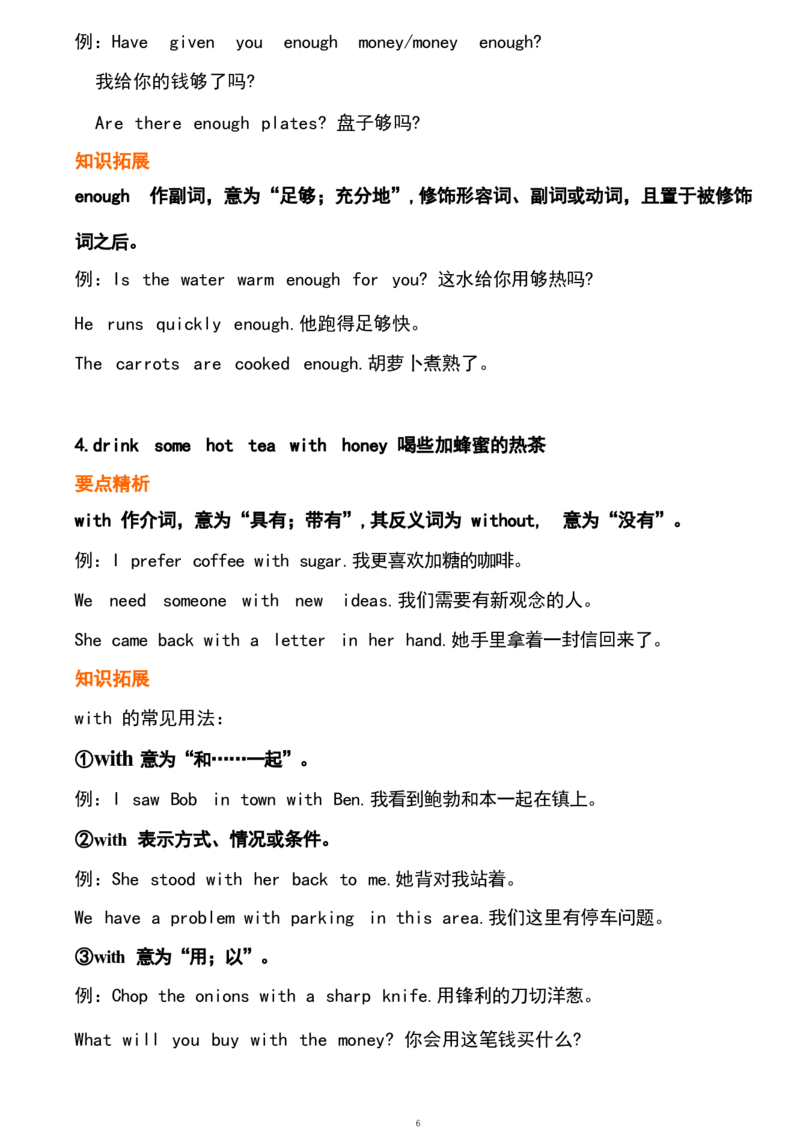
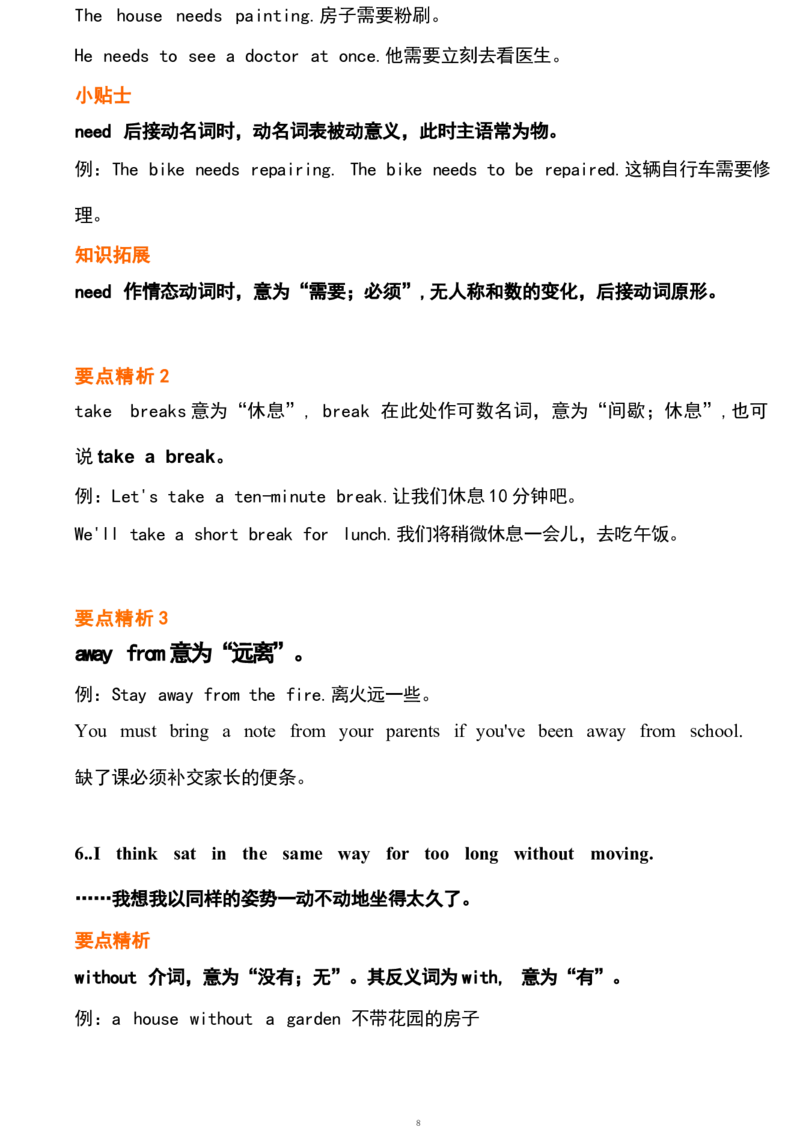
5辨析: with 与 in
with 多指用工具、手段
in 指使用某种语言、材料等
【助记】
write with pen 用钢笔写 write in ink 用墨水写
链接中考
(四川达州中考)-I'm thirsty.I'd like a glass of orange juice. What about you,
Andy?
-I prefer a cup of tea nothing in it.
A. with B. for C. to D. without
解析: with 常表示伴随,意为“具有;带有”; for 表示目的,意为“为了”;to
表 示程度、范围,意为“到;达"; without 为 with 的反义词,意为“不具有;
不带 有”。由上文句意“我渴了。我想喝一杯橙汁。安迪,你呢?”可推知,空格
所在句
句意为“我更喜欢喝一杯清茶”,故选 A。
5.You need to take breaks away from the computer.你需要离开电脑休息。
要点精析 1
need 在此处作实义动词,意为“需要”,后可接名词、代词、动名词或带to 的动词
不定式作宾语。
例:Plants need light in order to grow.植物生长需要光照。
7例:Have given you enough money/money enough?
我给你的钱够了吗?
Are there enough plates? 盘子够吗?
知识拓展
enough 作副词,意为“足够;充分地”,修饰形容词、副词或动词,且置于被修饰
词之后。
例:Is the water warm enough for you? 这水给你用够热吗?
He runs quickly enough.他跑得足够快。
The carrots are cooked enough.胡萝卜煮熟了。
4.drink some hot tea with honey 喝些加蜂蜜的热茶
要点精析
with 作介词,意为“具有;带有”,其反义词为 without, 意为“没有”。
例:I prefer coffee with sugar.我更喜欢加糖的咖啡。
We need someone with new ideas.我们需要有新观念的人。
She came back with a letter in her hand.她手里拿着一封信回来了。
知识拓展
with 的常见用法:
①with 意为“和……一起”。
例:I saw Bob in town with Ben.我看到鲍勃和本一起在镇上。
②with 表示方式、情况或条件。
例:She stood with her back to me.她背对我站着。
We have a problem with parking in this area.我们这里有停车问题。
③with 意为“用;以”。
例:Chop the onions with a sharp knife.用锋利的刀切洋葱。
What will you buy with the money? 你会用这笔钱买什么?
6The house needs painting.房子需要粉刷。
He needs to see a doctor at once.他需要立刻去看医生。
小贴士
need 后接动名词时,动名词表被动意义,此时主语常为物。
例:The bike needs repairing. The bike needs to be repaired.这辆自行车需要修
理。
知识拓展
need 作情态动词时,意为“需要;必须”,无人称和数的变化,后接动词原形。
要点精析 2
take breaks意为“休息”, break 在此处作可数名词,意为“间歇;休息”,也可
说take a break。
例:Let's take a ten-minute break.让我们休息10分钟吧。
We'll take a short break for lunch.我们将稍微休息一会儿,去吃午饭。
要点精析 3
away from 意为“远离”。
例:Stay away from the fire.离火远一些。
You must bring a note from your parents if you've been away from school.
缺了课必须补交家长的便条。
6..I think sat in the same way for too long without moving.
……我想我以同样的姿势一动不动地坐得太久了。
要点精析
without 介词,意为“没有;无”。其反义词为with, 意为“有”。
例:a house without a garden 不带花园的房子
8I don't know what I'd do without you.我不知道没有你我该怎么办。
链接中考
(福建福州中考) Don't go to school breakfast. It's a bad habit.
A.after B. with C. without
解析: after"在……之后"; with “具有;带有”; without “没有"。由后句“这是个
坏习惯”可推知前句句意为“别不吃早饭就去上学”。故选C。
7.I think you should lie down and rest.我认为你应该躺下休息。
要点精析 1
lie此处为不及物动词,意为“躺;卧”。
例:He was lying on the bed.他正躺在床上。
Don't lie in the sun too long.不要在阳光下躺太长时间。
for
【助记】
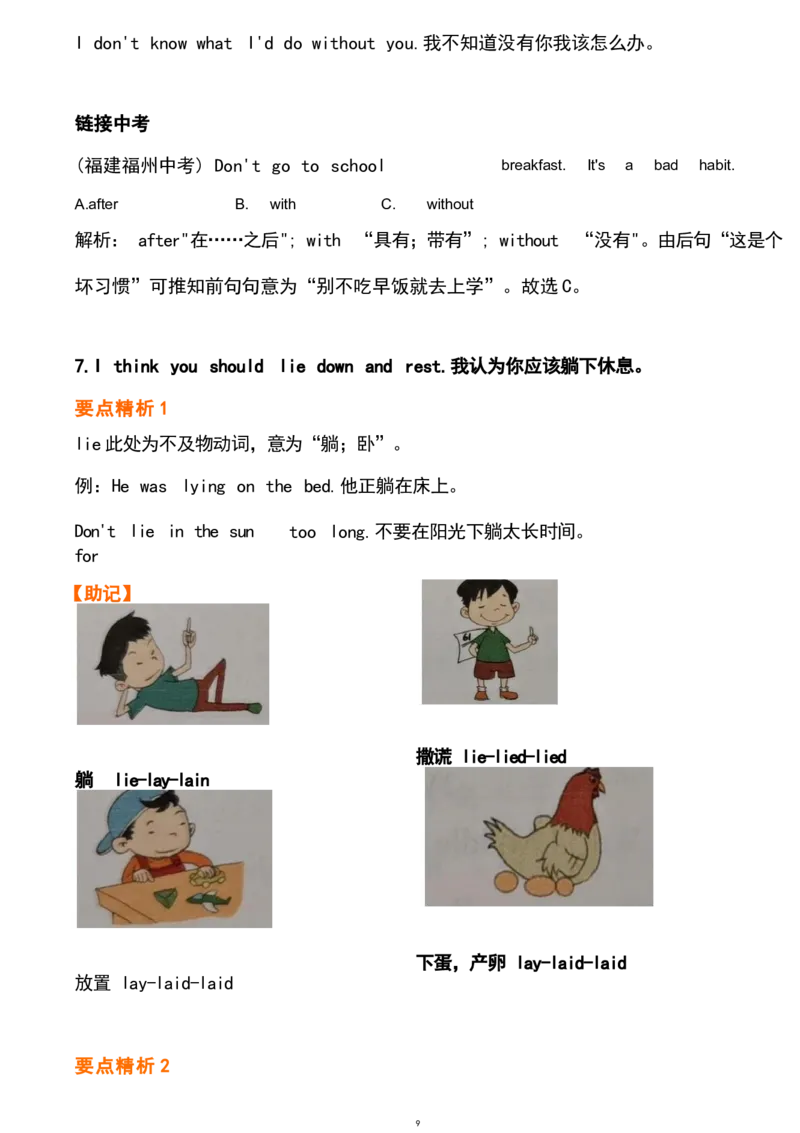
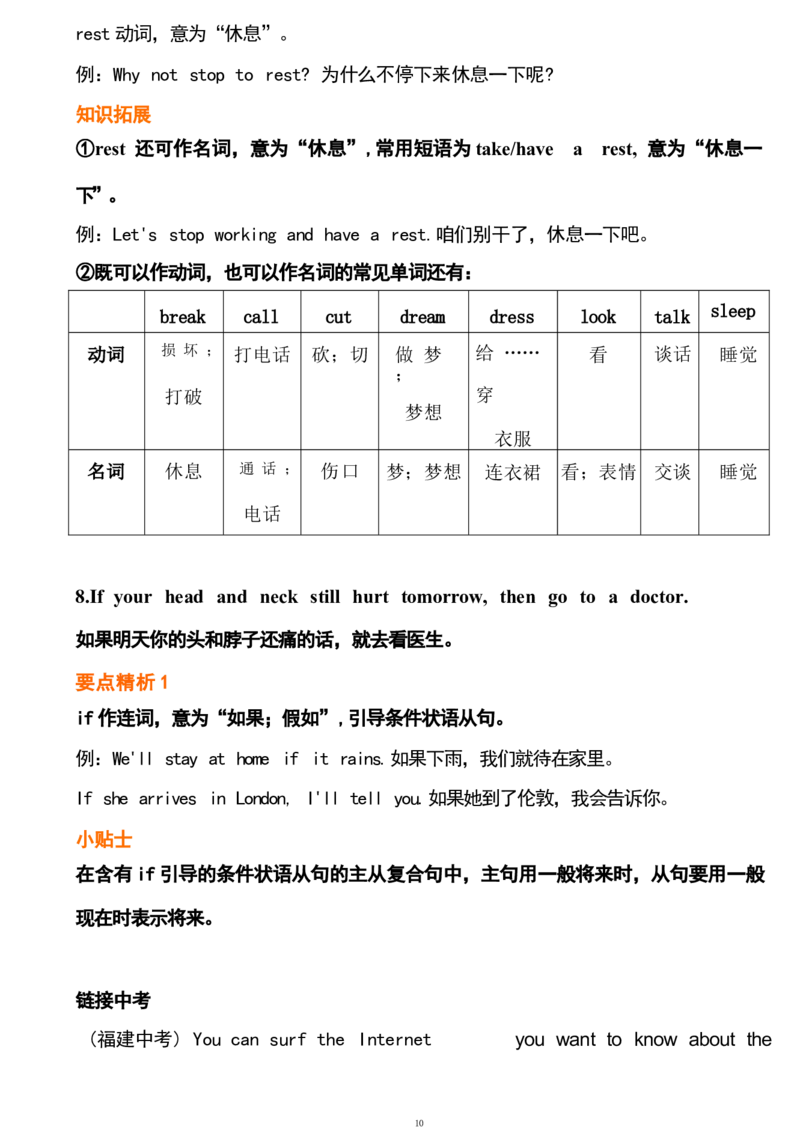
撒谎 lie-lied-lied
躺 lie-lay-lain
下蛋,产卵 lay-laid-laid
放置 lay-laid-laid
要点精析 2
9rest 动词,意为“休息”。
例:Why not stop to rest? 为什么不停下来休息一下呢?
知识拓展
①rest 还可作名词,意为“休息”,常用短语为 take/have a rest, 意为“休息一
下”。
例:Let's stop working and have a rest.咱们别干了,休息一下吧。
②既可以作动词,也可以作名词的常见单词还有:
sleep
break call cut dream dress look talk
动词 损 坏 ; 打电话 砍;切 做 梦 给 …… 看 谈话 睡觉
;
打破 穿
梦想
衣服
名词 休息 通 话 ; 伤口 梦;梦想 连衣裙 看;表情 交谈 睡觉
电话
8.If your head and neck still hurt tomorrow, then go to a doctor.
如果明天你的头和脖子还痛的话,就去看医生。
要点精析 1
if 作连词,意为“如果;假如”,引导条件状语从句。
例:We'll stay at home if it rains.如果下雨,我们就待在家里。
If she arrives in London, I'll tell you.如果她到了伦敦,我会告诉你。
小贴士
在含有 if 引导的条件状语从句的主从复合句中,主句用一般将来时,从句要用一般
现在时表示将来。
链接中考
(福建中考) You can surf the Internet you want to know about the
102020 World Middle School Games.
A. until C. if
B.
解析: until 意为“直到……为止”; after 意为“在……之后”; if 意为“如果”。
由前 半句句意“你可以上网”以及后半句句意“你想要了解 2020 年世界中学生运
动会“
可知 C 项符合题意。选 C。
要点精析 2
hurt 动词,意为“疼痛”。
例:John's left arm still hurts.约翰的左胳膊还是疼。
小贴士
hurt 既可以用作及物动词,也可以用作不及物动词。用作及物动词时,意为“使疼
痛”;用作不及物动词时,意为“疼痛”,常用疼痛的具体部位作主语。
要点精析 3
go to a doctor意为“看医生”,相当于go to see a doctor。
例:You should go to a doctor for help.你应该向医生寻求帮助。
Bob and Ben went to a doctor yesterday.鲍勃和本昨天看医生了。
9. … bus No, 26 was going along Zhonghua Road when the driver saw an
old man lying on the side of the road.
……26 路公交车正行驶在中华路上,这时司机看到一位老人躺在路边。
要点精析 1
when 引导时间状语从句,放在过去进行时构成的主句之后,表示“某事正在进行
时,另一件事情发生了”。
例:He was just getting into the shower when the doorbell rang.
他正要冲澡,这时门铃响了起来。
11要点精析 2
see sb.doing sth.表示“看到某人正在做某事/正处于某种状态”。
例:We saw him standing there alone, not knowing what to do.
我们看见他独自站在那里,不知所措。
知识拓展
在英语中,还有 hear,watch,find,feel,notice 等动词后面可接现在分词短语
作宾语补足语。
例:I heard the girls singing English songs in the classroom.
我听见女生们正在教室里唱英文歌曲。
We are watching the players playing basketball.我们正在观看运动员们打篮球。
He felt his heart beating faster and faster.他感觉到他的心脏跳得越来越快。
辨析: see sb. doing sth.与 see sb. do sth.
see sb. doing sth. “看见某人正在做某事”,强调动作正在进行
“看见某人做某事“,强调动作的整个过程
see sb. do sth.
例:We saw him crossing the road.我们看见他正在过马路。
We saw him cross the road.我们看见他过马路了
10.The bus driver, 24-year-old Wang Ping, stopped the bus without
thinking twice.这位公交车司机,24 岁的王平,毫不犹豫地停下了车。
要点精析
think twice 是英语中的一种固定表达,意为“认真思考”。
例:We must think twice before we make decisions.
在我们做决定之前,必须认真思考。
Think twice about it. Maybe you'll change your mind.
好好想想,也许你会改变主意。
知识拓展
12think 的其他常见短语:
think of想出;认为
think up想出;构思出
11.He got off and asked the woman what happened.
他下了车,询问那位妇女发生了什么事。
要点精析 1
get off意为“下车”,为动副型短语,其反义短语为 get on,意为“上车”。
例:Never get off while the bus is moving.车在行驶时,切勿下车。
小贴士
“搭乘”或“下”公共汽车或列车时分别使用 get on,get off; 但对于出租车或小
汽车, get into是“上”, get out of是“下”。
【助记】
get off
get on
下车(公共汽车、列车) 上车(公共汽车、列
get out of
get into
从出租车、小汽车里出来
进入车(出租车、小汽
链接中考
(湖北武汉中考) I took the subway and at the downtown station.
A.got through B. got over C. got on D.got off
解析: get through 意为“通过”; get over 意为“克服”; get on 意为“上车”;
13get off意为“下车”。由关键信息 took the subway (乘地铁)和地点状语
at the downtown station (在市中心车站)可知选 D。
要点精析 2
happen 为不及物动词,意为“发生;碰巧”,不用于被动语态。
①表示“某地/某时发生了某事”,用 sth.happened+ 介词+地点/时间.
例:A car accident happened on that street.那条街上发生了一起车祸。
②表示“某人出了某事”,用sth.happened to sb.
例:What has happened to Nancy? 南希发生了什么事?
③表示“某人碰巧………”用sb. happened to do sth. 和 It happened +that 从
句.
例: We happened to meet her on the bus.我们碰巧在公共汽车上遇到了她。
It happened that I had no money with me.碰巧我身上没带钱。
辨辨析:happen 与 take place
happen 发生,碰巧指偶然发生
take place 发生指经过安排
12.Mr. Wang knew he had to act quickly.王先生知道他必须快点儿行动。
要点精析
have to 意为“不得不;必须”,后接动词原形。
例:It's raining hard, so I have to stay at home.
雨下得很大,所以我不得不待在家里。
辨析: have to 与 must
强调客观上 “必须”,有人称、数和时态的变化,可用于一般现在
have to
时、 一般过去时和一般将来时等。don't have to 表示“不必
要,
14不需要”,常用来构成以 must(必须)开头的一般疑问句的否定
回答
强调主观上 “必须”,无人称、数和时态 must 的变化,主要用
must
于
一般现在时。mustn't 表示“禁止,不应该
例:I had to call the doctor at midnight, because my younger brother was ill.
因为我弟弟病了,我只得半夜里去请医生。(客观需要)
They must work hard.他们必须努力工作。(主观想法)
13. He expected most or all of the passengers to get off and wait for the
next bus. 他希望大部分或全部乘客下车去等下一辆公交车。
要点精析 1
expect 动词,意为“盼望;期望”,其后常接动词不定式作宾语或宾补。
例:I expect to see you again.我盼望再次与你见面。
知识拓展
expect 的常用结构:
expect to do sth.盼望做某事
expect sb.to do sth.盼望某人做某事
expect +that从句盼望
例:Millie expects to win the prize.米莉期望获奖。
I don't expect him to buy me a present.我并不指望他为我买礼物。
Mr. Wang expects(that) the plane can take off on time.
王先生盼望飞机能够按时起飞。
辨析:expect,wish 与 hope
expect 意为“盼望;期盼,侧重于相信或认为有可能实现的愿望
意为“希望;但愿”,常用来描述未完成或不能完成的愿望。其常用
wish
15结构: to do sth.
wish + sb. to do sth.
hope
that从句(虚拟语
气)
主要用来描述主观上的愿望并对其实现抱有信心。其常用结构:
for sth.
hope+ to do sth.
that从
要点精析 2
wait for意为“等待;等候”。
例:Jack is waiting for you at the school gate.杰克正在学校门口等你。
I'm waiting for him to realize how stupid he's been.
我在等着他意识到自己有多么笨。
14. But to his surprise, they all agreed to go with him.
但令他惊讶的是,他们都同意和他一起去医院。
要点精析 1
to one's surprise 意为“使……惊讶的是;出乎……的意料”。
例:To his surprise, Mary won first prize.令他惊讶的是,玛丽获得了一等奖。
知识拓展
to one's joy令某人高兴的是
to one's disappointment令某人失望的是
to ones' satisfaction 令某人满意的是
16要点精析 2
agree 作动词,意为“同意”,常见用法如下:
①agree with 后接“某人”或“意见”。
例:l agree with you.我同意你的看法。
②agree to (介词)后接“计划”或“建议”。
例:He agreed to our suggestions.他同意了我们的建议。
③agree on 后接“日期”或“条款”。
例:They agreed on these terms.他们同意了这些条款。
④agree to do sth. 意为“同意做某事”。
例:He agreed to marry her.他同意娶她了。
15. Thanks to Mr. Wang and the passengers, the man was saved by the
doctors in time.多亏了王先生和乘客们,老人得到了医生们的及时救治。
要点精析 1
thanks to意为“由于;多亏;因为”,通常表示由于某种原因才有了某种好的结果。
在句中作状语,常位于句首,有时可与because of或 with the help of进行转换。
例:Thanks to my teacher, I can finish the homework on time.
=With the help of my teacher, I can finish the homework on time.
多亏了老师的帮助,我才能按时完成家庭作业。
Thanks to(= Because of) the good weather, we went on our trip.
由于天气好,我们去旅行了。
链接中考
(四川巴中中考) Thanks Mr. Hu, we have learnt many English songs.
A.for B.at C.to
解析: thanks for“因 ……而感谢”; thanks to “多亏,由于”; thanks 不 与at 搭
配,
17排除 B 项。由句意“多亏胡老师,我们学会了许多英文歌曲”可知C 项符合题
意,故选 C。
要点精析 2
in time 意为“及时”,为固定短语。
例:We got to the bus station in time.我们及时赶到了汽车站。
知识拓展
time 的常用短语:
on time准时;按时
once upon time从前
all the time直;始终
in no time 立即
from time to time 有时;不时
have good time 玩得愉快
at the same time 同时
16. Do you agree that people often do not help others because they
do not want to get into trouble? 你赞同人们常常因为不想惹麻烦而不帮助
别人
吗?
要点精析 1
本句是复合句。 that 引导的宾语从句作 agree 的宾语;在从句中, because 引 导
了一个原因状语从句。
要点精析 2
get into trouble 意为“陷入困境;遇到困难”。
例:She got into trouble at that time.那时她遇到了困难。
18知识拓展
1 get into trouble with sb. 与某人发生不快(冲突)
例:He got into trouble with the police.他和警察发生了冲突。
②be in trouble 处于困难或麻烦中;有困难
例:He never came except when he was in trouble.他从来不来,除非遇到麻烦。
③have trouble (in)doing sth. 做某事有困难
例:Do you have trouble (in)finding the house? 你找房子有困难吗?
17. Did you hurt yourself playing soccer? 你踢足球时弄伤了自己吗?
要点精析
yourself 为反身代词,意为“你自己”。其复数形式为 yourselves, 意为“你们自
己”。
例:Help yourself to some food.请随便吃点儿东西。
知识拓展
1.反身代词的构成:
数 单数 复数
人称
第一人称 myself
ourselves
第二人称 yourself yourselves
第三人称
himself
herself themselves
itself
②反身代词常用于以下短语中:
例:enjoy oneself 玩得开心
learn sth. by oneself 自学
19help oneself to… 随便吃(喝)
by oneself独 自
链接中考
(湖北随州中考)-I'll have tennis game tomorrow. I'm a little bit
nervous.
-Believe in .You're the best in our club.
A.yourself B.myself C. herself D.himself
解析: yourself “你自己";myself “我自己"; herself “她自己";himself “他
自 己”。由上文句意“明天我有一场网球比赛。我有点儿紧张”和答语后句句意
“你在
我们俱乐部里是最优秀的”可知,答语前句句意为“相信你自己”。故选 A。
18.Did you fall down? 你摔倒了吗?
要点精析
fall down意为“跌倒;摔倒”,为不及物动词短语,其后跟宾语时须加介词 from。
此时 fall down from 相当于 fall off, 意为“从……掉/摔下来”。
例:When the little girl ran across the street, she fell down.
当那个小女孩儿跑过街道时,她摔倒了。
He fell down from his bike yesterday.=He fell off his bike yesterday.
昨天他从自行车上摔了下来。
知识拓展
fall的其他常见短语:
fall behind落后,跟不上 fall into落入
fall over跌倒 fall in love with爱上
fall asleep入睡
20Section A即学即试
单项选择
1 . (山东泰安中考)-Would you like some coffee.please?
-Yes, and please get some sugar.I prefer coffee sugar.
A.to B. for C. with D. from
2. I couldn't do it your great help. Thanks a
lot. A. with B. without C. for
D.to
3.-I wonder if the psychologist will come to our school this weekend.
-If he , we will be very excited.
A. come B. comes C. will come D. came
4. Don't the bus until it stops.
A.turn off B. put on C. get off D.set up
5.-What do you want to eat for lunch? I will prepare earlier today.
-Honey, you . Let's go out to have something different.
A. mustn't B. can't C. shouldn't D.don't have to
Section B
知识点精析
1.Put bandage on it.在上面绑上绷带。
要点精析
put sth.on sth.意为“在 ……上面放上 …… ”。
put on 为“动词+副词”类短语,意为“穿上;戴上”,代词作其宾语时,须放在
put 与 on 的中间。
例 :He put on a coat and went out.他穿上一件外套就出去了。
She put on her glasses and started to read.她戴上眼镜开始看书了。
21on,wear,dress,(be)in与 try on
辨析:put
22put on "穿(衣);戴(帽)",表动作
“穿(衣物)”,及物动词,表状态
wear
“给 ……穿衣服“,作及物动词,宾语只能为人,即 dress sb.
dress
(be)in 介词,“穿着”,后面接衣服或表示颜色的词,表状态。be in 同 be
dressed
in
try on “试穿”,代词作宾语时应放在中间
链接中考
(山东潍坊中考)It's too cold outside today.You'd better your jacket.
A. put on B. put up C. take off D. take after
解析: put on “穿上"; put up “举起;张贴;搭建"; take off “脱下(衣服);
(飞 机)起飞”;take after“(在相貌、性格等方面)像(父母等)"。由句意“今
天外面
太冷了。你最好穿上你的夹克”知应选 A。
2.Someone got hit on the head.有人磕到了头。
要点精析
hit动词,意为“(用手或器具)击;打”。
例:He hit the snake with a stick.用木棍打了那条蛇。
知识拓展
表示“打某人的某个部位”时,用 “hit sb.+介词+the+ 部位”结构。若所打部位
较硬,用介词 on; 若所打部位较软,则用介词 in。 值得注意的是,定冠词 the 不能
用 his,my 等词替换。
例:hit sb.on the head/nose/back 打某人的头/鼻子/背
hit sb. in the face/eye/stomach打某人的脸/眼睛/肚子
【助记】
23hit sb.on the head 打某人的头 hit sb.in the face 打某人的脸
3. have problems breathing 呼吸困难
要点精析 1
have problems(in)doing sth.为固定短语,意为“做某事有问题或困难”,同义
短语 have trouble/difficulty (in)doing sth.。
例:He had problems (in)learning English grammar.
他在学习英语语法上有困难。
She has no problem (in) singing the song.她唱这首歌没问题。
要点精析 2
breathe 常作不及物动词,也可作及物动词,意为“呼吸”。
例:People breathe more slowly when they are asleep.人睡觉时呼吸比较缓慢。
Relax and breathe deeply.放松,深呼吸。
It's good to breathe fresh air.呼吸新鲜空气有好处。
知识拓展
breath 的常用短语:
out of breath 上气不接下气
take deep breath 深呼吸
234. Aron Ralston is an American man who is interested in mountain
climbing. 阿伦 · 罗尔斯顿是一个对登山感兴趣的美国人。
要点精析 1
此处 who is interested in mountain climbing 为定语从句,修饰先行词 an
American man,who 为关系代词。当先行词为人时,常用关系代词 who 或 that
引导定语从句。
例:Do you know the girls who/that are dancing?
你认识那些正在跳舞的女孩儿吗?
The man that/who you are waiting for won't come.你正在等的那个人不会来了。
要点精析 2
be interested in 为固定短语,意为“对……感兴趣”,相当于 take an interest in。
例:I'm interested in music.我对音乐感兴趣。
She began to take an interest in stamp collecting.她开始对集邮感兴趣。
辨析:interested 与 interesting
interested “感兴趣的”,只作表语,主语通常是人
interesting “引起兴趣的;有趣的”,作表语或定语, 一般修饰物
例:He became interested in a second-hand car.他对二手车变得有兴趣。
The cartoon is very interesting.这部卡通片很有意思。
That's an interesting question.那是一个有趣的问题。
【助记】
人 is interested in 物品
物品 is interesting
5.As a mountain climber, Aron is used to taking risks.
作为一名登山者,阿伦习惯于冒险。
24要点精析 1
be used to意为“习惯于…… ;适应于……”,强调状态。 to 在此为介词,后
跟名词、代词或动名词。
例:My grandpa is used to the life in the country.我爷爷习惯了乡下的生活。
I do the dishes every day, so I'm used to it.我每天洗盘子,所以习惯了。
Mary is used to getting up early in the morning.玛丽习惯于早起。
辨析:be used to sth./doing sth.与 be used to do sth.
be used to sth./doing sth.
意为“习惯于某事/做某事,表示一种状态,可用于
现在、过去、将来等多种时态。其中 to 为介词,后
面接名词、代词或动名词; be 动词可用 get 或
become来代替,指的是从不习惯到习惯这一过程
的转变
意为“过去常…… ”,表示过去经常发生的动作
be used to do sth.
例:You will get used to the weather here.你会习惯这里的天气。
I become used to doing hard work now.现在我习惯了做艰苦的工作。
l used to draw pictures badly.我过去画画常常很糟糕。
l used to go to the park when l was young.当我小的时候,我经常去那个公园。
链接中考
(四川南充中考) She used to a bus to school, but now she is used to
to school
A. taking; walk B. take; walk C.taking; walking D.take; walking
解析: used to do sth.“过去常常做某事”; be used to doing sth.“习惯于做某事”。
句意:她过去常常坐公共汽车去上学,但是现在她习惯于步行去上学。选 D。
要点精析 2
25take risks= take a risk, 意为“冒险”。
例:Bob likes taking risks.鲍勃喜欢冒险。
知识拓展
risk 作可数名词,意为“危险;风险”;作动词,意为“冒险”。
6. There were many times when Aron almost lost his life because of
accidents. 阿伦有很多次都差点儿因为意外丧命。
要点精析 1
almost 副词,意为“几乎,差不多”。
例:Almost all the guests are here.几乎所有的客人都来了。
He has almost finished his work.他差不多完成了他的工作。
知识拓展
nearly 意为“差不多,几乎,将近”,所指差距一般比almost 大。
例:It's nearly five o'clock.差不多5点了。
要点精析 2
because of意为“因为;由于”。
例:Betty was late because of the heavy rain.因为大雨,贝蒂迟到了。
辨析: because of与 because
“因为”,介词短语,后面接名词、代词动词-ing 形式
because of
“因为”,连词,引导原因状语从句
because
链接中考
(湖北襄阳中考)-Did you have a sports meeting yesterday?
-No, we didn't. It was put off the heavy rain.
A. because of B.instead of C. as for D.across from
26解析:句意:“昨天你们开运动会了吗?”“不,我们没有。因为大雨它被推迟
了。” because of “因为"; instead of “代替”; as for “至于”;across from
“在……对面”。根据句意可知选A。
d
7.Because he could not free his arm, he stayed there for five days an
hoped that someone would find him.
因为无法把手臂解脱出来,他在那里待了 5 天,希望有人找到他。
要点精析
free 此处用作及物动词,意为“使自由;释放;解放”。
例:I have freed the birds from their cages.我已经把笼子里的鸟儿放飞了。
He expects to be freed quite soon.他预计很快就能获释。
She struggled to free herself, but the ropes were too tight.
她挣扎着想脱身,但是绳子太紧了。
知识拓展
free作形容词,意为“空闲的;免费的;自由的”。
例:I'm not free on Monday.星期一我没空。
Can you get a free ticket for the concert? 你能弄到一张免费的音乐会门票吗?
This is a free country.这是一个自由的国家。
o
8.But when his water ran out, he knew that he would have to d
something to save his own life.
但是当他的水耗尽的时候,他知道他得做些什么来挽救自己的生命。
要点精析 1
本句是复合句,含有when 引导的时间状语从句。在主句中, that 引导了一个宾语
从句。
27要点精析 2
run out 意为“用尽;耗尽”。其主语通常是时间、食物、金钱等名词。
例:My money ran out.我的钱花光了。
要点精析 3
动词不定式短语 to save his own life 表示目的,在句中作目的状语。短语 save
one's life 意为“挽救某人的生命”。
例:He saved the girl's life yesterday.昨天他救了那个女孩儿的命。
9.He was not ready to die that day. 他不愿意那天就死去。
要点精析
be ready to do sth.意为“愿意做某事;准备好做某事”。
例:Are you ready to go with me? 你愿意和我一起去吗?
Sandy is always ready to help her classmates.桑迪总是乐于帮助同班同学。
知识拓展
be/get ready for 为 ……做准备。
例:He was/got ready for death.他对死亡已有了心理准备。
10.So he used his knife to cut off half his right arm.
因此,他用刀割掉了他的半条右臂。
要点精析 1
use sth.to do sth.意为“用某物做某事”。
例:l use my pen to write a letter.我用我的钢笔写一封信。
l use knife to cut apples.= l use a knife for cutting apples.我用刀切苹果。
小贴士
use sth. to do sth.与 use sth.for doing sth.可互换。
28要点精析 2
knife 可数名词,意为“刀”,其复数形式为 knives。
例:There are three knives on the table.桌子上有三把刀。
【歌诀巧记】
树叶半数自己黄,妻子拿刀去割粮,
架后窜出一只狼,就像小偷逃命忙。
说明: leaf (树叶), half (一半), self (自己), wife (妻子),knife (刀),
shelf (架子), wolf (狼),thief (小偷), life (生命)这 9 个名词变复数时,
都要变-f
(e) 为-ves。
要点精析 3
cut off 为固定短语,意为“切除;切断”。
例:When was the telephone cut off? 电话什么时候被切断了?
How much do you want me to cut off your hair? 你的头发要剪掉多少?
11. Then, with his left arm, he bandaged himself so that he would not
lose too much blood.然后,他用左臂给自己绑上绷带,以免失血过多。
要点精析
so that 意为“以便;为了”,在此引导目的状语从句。
例:I put on red coat so that he could see me easily.
我穿上一件红外套,以便他能很容易地看见我。
知识拓展
so that 的不同用法:
词语 含义 用法
以便;为了 引导目的状语从句,从句谓语中常用情态动词 may,
so that
29might,can,could 等;主从句间连接紧凑,没有
逗号相隔
因此;所以 引导结果状语从句,从句中一般没有情态动词,主
从句间可有逗号相隔
12. This means being in a difficult situation that you cannot seem to get
out of.它的意思是“处于一个你似乎无法摆脱的困境之中”。
要点精析 1
mean 及物动词,意为“意思是”,其后常接名词、 v.-ing 形式或宾语从句。其名词
形式为 meaning, 意为“含义;意思”。
例:A dictionary tells you what words mean.词典告诉你词语的含义。
You mean that you can't' come tomorrow? 你的意思是你明天不能来了?
知识拓展
①mean 还可意为“打算;意欲”。 mean to do sth. 意为“打算做某事”。
例:I mean to talk with him about it.我打算和他谈谈这件事。
② What do you mean by.?=What do/ does. mean?=What's
the meaning of…? 意为“ ……是什么意思?”,其中 by 后跟名词、代词或 v.-
ing 形
式。
例:What do you mean by this word?
= What does this word mean?
= What's the meaning of this word?
这个单词是什么意思?
要点精析 2
get out of 意为“离开;从……出来”。
例:He wants to get out of bed.他想下床。
30Walk to the west after you get out of the car.下车后你向西走。
13.In this book, Aron tells of the importance of making good decisions,
and of being in control of one's life.
在这本书中,阿伦讲述了做出正确决定以及掌控自己生命的重要性。
要点精析 1
make decisions/a decision 意为“做决定”,其中 decision 为可数名词,意为“抉
择,决定”。
例:Let me make decisions myself.让我自己做决定。
要点精析 2
be in control of意为“掌管;管理”。
例:You should be in control of your own life and business.
你应该掌管自己的生活和事业。
知识拓展
be in the control of意为“受……控制;受……管理”; be out of control意为
“失去……的控制”。
14. His love for mountain climbing is so great that he kept on climbing
mountains even after this experience.
他对登山是如此热爱,甚至在这次经历之后他仍继续登山。
要点精析
keep on doing sth.意为“继续做某事”。
例:You just have to keep on trying.你可得继续努力。
She kept on working although she was tired.尽管累了,她还继续工作。
知识拓展
31①keep doing sth. 意为“继续不停地做某事”。
例:Keep going until you reach the end of the road.继续走,直到你到达
路的尽头。
②keep sb.doing sth.意为“使某人一直做某事”。
例:Don't keep your mother waiting.不要让你妈妈一直等着。
③keep sb.from doing sth. 意为“阻止某人做某事”。
例:You shouldn't keep him from watching cartoons.你不该阻止他看动画片。
15. Aron loves mountain climbing and doesn't mind taking risks.
阿伦热爱登山,不介意冒险。
要点精析
mind 在此作及物动词,意为“介意;在乎”,后常跟名词、代词或 v.-ing 形式。
mind 也可用作不及物动词,常用于疑问句、否定句或条件句中。
例:Would you mind opening the window? 你介意打开窗户吗?
知识拓展
Would/Do
you mind(one's)doing? 你介意(某人)做 ……吗?
Would/Do you mind if…? 如果……你介意吗?
例:Would/Do you mind my sitting here? 你介意我坐在这里吗?
-Would/Do you mind if I open the window? 如果我打开窗户,你介意吗?
-No,not at all.不, 一点儿也不介意。
小贴士
对以上两个句型进行回答时,表示“不介意”,习惯上说 Not at all./Certainly not.
/Of course not.等;表示“介意”时,习惯用 I'm sorry,butI do… 等。
链接中考
(黑龙江绥化中考) Would you mind down the music? It's too noisy.
32B.turning
A. to turn C. turn
解析: mind doing sth.意为“介意做某事”。句意:你介意把音乐关小吗?它
太吵了。选 B。
g
16.Aron did not give up after the accident and keeps on climbin
mountains today.阿伦在意外之后没有放弃,现在仍继续登山。
要点精析
give up 意为“放弃”,既可单独使用,也可后接名词、代词或 v.- ing 形式。
例:Don't give up easily.不要轻易放弃。
When did you give up playing computer games? 你是何时放弃玩电脑游戏的?
链接中考
(黑龙江绥化中考) The doctor advised my father to give up .
A. smoke B.smoking C. smokes
解析: give up doing sth.意为“放弃做某事”是固定搭配,故选B。
Section B 即学即试
单项选择
1. His father with his glasses on.
A.used to reading B.used for reading
C.is used to reading D.is used to read
2.-It's time for sports! your sports shoes, please.
-OK. I'm coming.
A.Put on B. Dress C. Wear D. Have on
3. This animal's tail will grow again if it's
B. cut in C. get down D. get off
A.cut off
33I
wouldn't get wet in the rain.
lent me an umbrella
4.S
A. for B. so that C. in order to D.such that
5.If she keeps on l ike this, losing weight is out of the question.
B.eating
A. eat C. to eat D.eats即学即试参考答案与解析
Section A
1.C 句意:“请问您要喝点儿咖啡吗?”“是的,请放些糖。我更喜欢加糖的咖啡“。
coffee with sugar “加糖的咖啡”,故选C。
2.B with “具有,带有”; without" 没有"; for “为了";to “对于”由Thanks a
lot.
可知,第一句句意应为“没有你的力相助,我不能做这件事”。故选B。
3.B 句意:“我想知道那位心理学家这个周末是否来我们学校。”“如果他来,我们
会 感到很兴奋。”由句意可知,第二句是含有if引导的条件状语从句的主从复合句,
主 句用一般将来时,从句应用一般现在时表将来,又因 he 为第三人称单数,故选
B。 4.C turn off"关闭";put on “穿上"; get off “下车”;set up “建立”。
根据句意
“直到车停了才能下车”可知应选 C。
5.D mustn't “禁止”;can't“不能”; shouldn't “不应该"; don't have to “不必"。
由“咱们出去吃点儿不同的东西”可知,此处表示“不必”准备午饭了,故选 D。
Section B
1.C 句意:他的父亲习习惯于戴着眼镜阅读。 be used to doing sth.习惯于做某事;
used to do sth.过去常常做某事。故选 C。
2.A 句意:“是运动的时候了!请穿上你的运动。”“好,我就来。”put on 强调穿的
动作; dress 不能接衣物; wear 和 have on 强调穿着的状态。故选 A。
3.A 句意:这种动物如果尾巴断了还会再长出来。 cut off切断"; cut in “插话";
get down “写下,记下” ; get off “下车”。故选A。
4.B 句意:她借给我一把伞,以便我不会被雨淋温。 so that”以便”,引导目的状语
从句。故选 B。
5.B句意:如果她继续像这样吃下去,减肥是不可能的。 keep on doing sth.“继续
做某事”。故选 B。
35