Unit 1
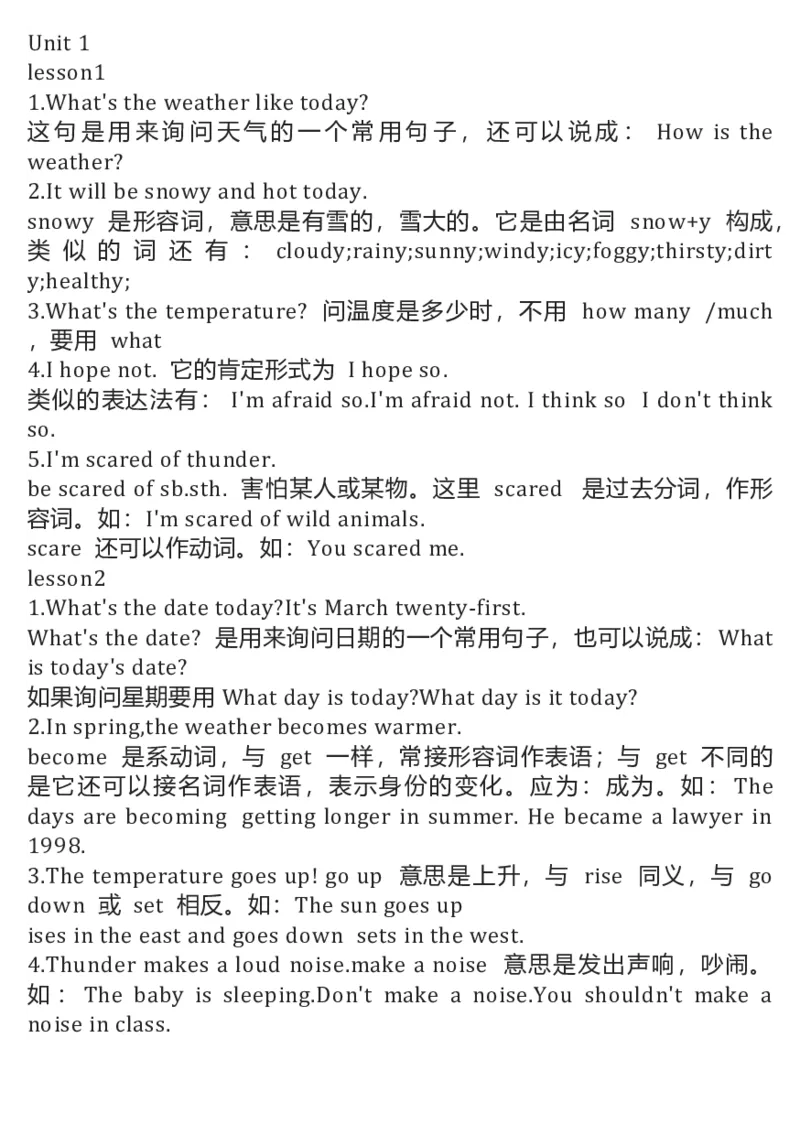
lesson1
1.What's the weather like today?
这句是用来询问天气的一个常用句子,还可以说成: How is the
weather?
2.It will be snowy and hot today.
snowy 是形容词,意思是有雪的,雪大的。它是由名词 snow+y 构成,
类 似 的 词 还 有 : cloudy;rainy;sunny;windy;icy;foggy;thirsty;dirt
y;healthy;
3.What's the temperature? 问温度是多少时,不用 how many /much
,要用 what
4.I hope not. 它的肯定形式为 I hope so.
类似的表达法有: I'm afraid so.I'm afraid not. I think so I don't think
so.
5.I'm scared of thunder.
be scared of sb.sth. 害怕某人或某物。这里 scared 是过去分词,作形
容词。如:I'm scared of wild animals.
scare 还可以作动词。如:You scared me.
lesson2
1.What's the date today?It's March twenty-first.
What's the date? 是用来询问日期的一个常用句子,也可以说成:What
is today's date?
如果询问星期要用 What day is today?What day is it today?
2.In spring,the weather becomes warmer.
become 是系动词,与 get 一样,常接形容词作表语;与 get 不同的
是它还可以接名词作表语,表示身份的变化。应为:成为。如:The
days are becoming getting longer in summer. He became a lawyer in
1998.
3.The temperature goes up! go up 意思是上升,与 rise 同义,与 go
down 或 set 相反。如:The sun goes up
ises in the east and goes down sets in the west.
4.Thunder makes a loud noise.make a noise 意思是发出声响,吵闹。
如:The baby is sleeping.Don't make a noise.You shouldn't make a
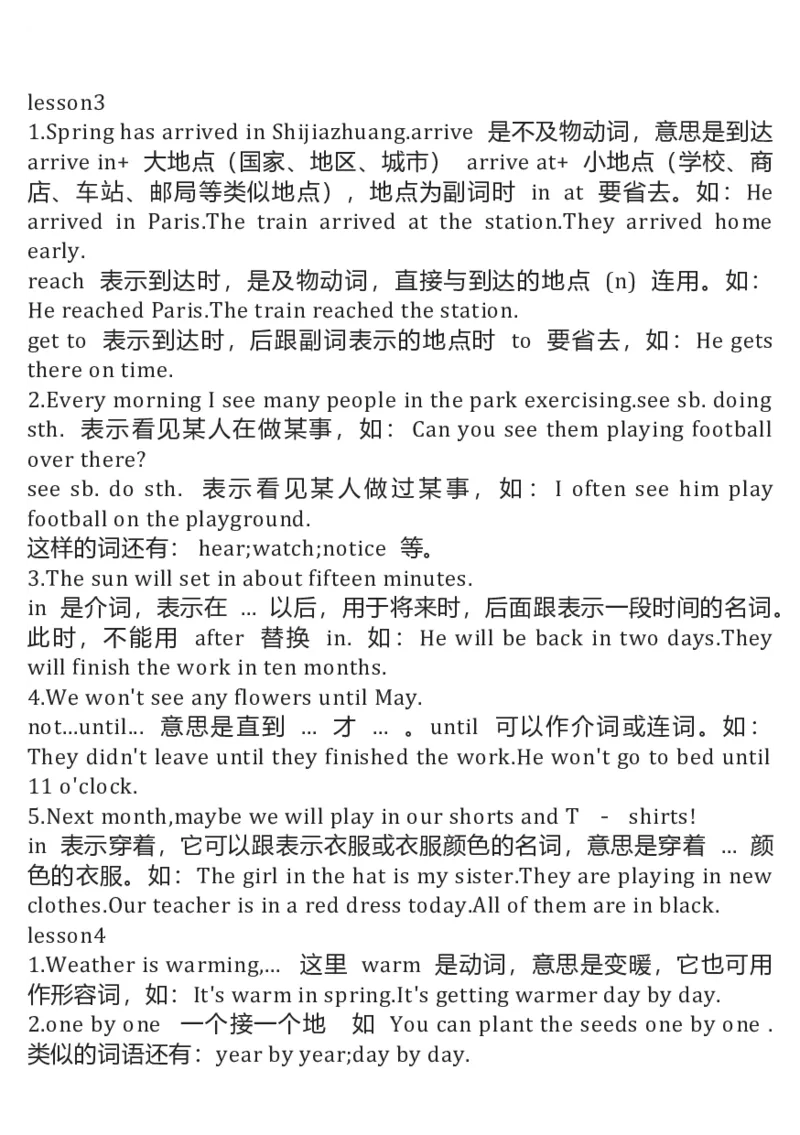
noise in class.lesson3
1.Spring has arrived in Shijiazhuang.arrive 是不及物动词,意思是到达
arrive in+ 大地点(国家、地区、城市) arrive at+ 小地点(学校、商
店、车站、邮局等类似地点),地点为副词时 in at 要省去。如:He
arrived in Paris.The train arrived at the station.They arrived home
early.
reach 表示到达时,是及物动词,直接与到达的地点 (n) 连用。如:
He reached Paris.The train reached the station.
get to 表示到达时,后跟副词表示的地点时 to 要省去,如:He gets
there on time.
2.Every morning I see many people in the park exercising.see sb. doing
sth. 表示看见某人在做某事,如:Can you see them playing football
over there?
see sb. do sth. 表示看见某人做过某事,如:I often see him play
football on the playground.
这样的词还有: hear;watch;notice 等。
3.The sun will set in about fifteen minutes.
in 是介词,表示在 ... 以后,用于将来时,后面跟表示一段时间的名词。
此时,不能用 after 替换 in. 如:He will be back in two days.They
will finish the work in ten months.
4.We won't see any flowers until May.
not...until... 意思是直到 ... 才 ... 。until 可以作介词或连词。如:
They didn't leave until they finished the work.He won't go to bed until
11 o'clock.
5.Next month,maybe we will play in our shorts and T - shirts!
in 表示穿着,它可以跟表示衣服或衣服颜色的名词,意思是穿着 ... 颜
色的衣服。如:The girl in the hat is my sister.They are playing in new
clothes.Our teacher is in a red dress today.All of them are in black.
lesson4
1.Weather is warming,... 这里 warm 是动词,意思是变暖,它也可用
作形容词,如:It's warm in spring.It's getting warmer day by day.
2.one by one 一个接一个地 如 You can plant the seeds one by one .
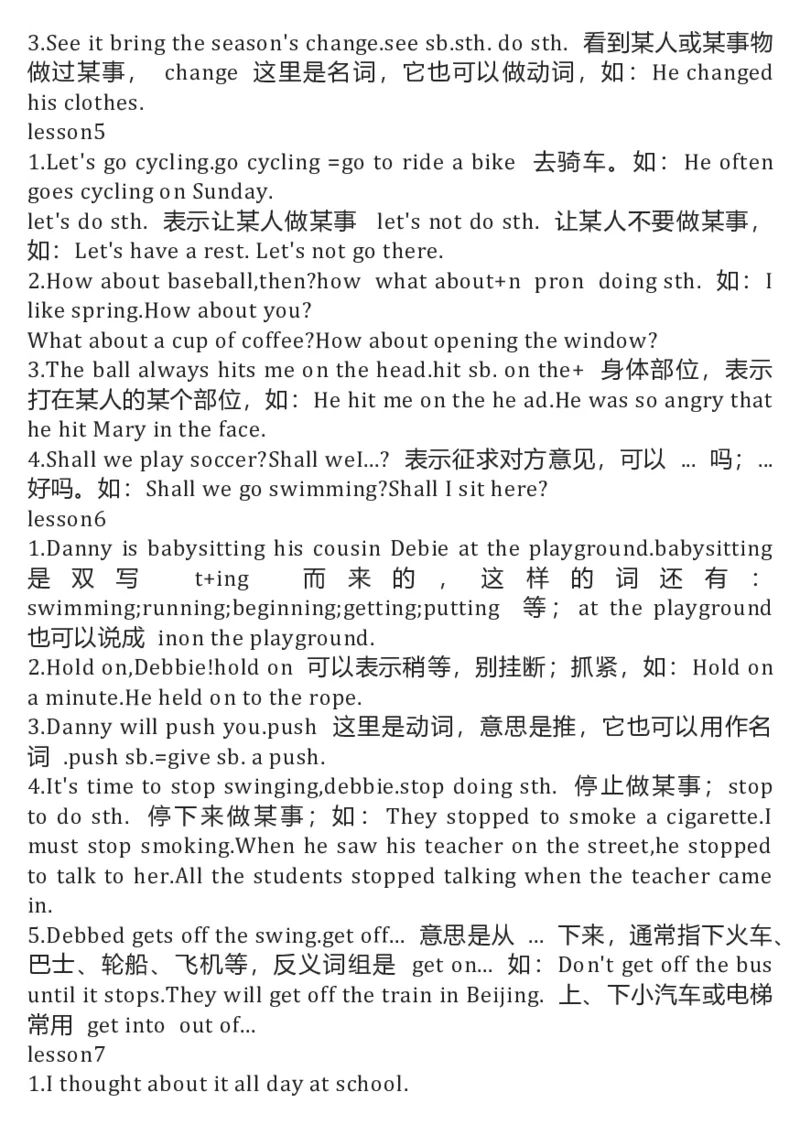
类似的词语还有:year by year;day by day.3.See it bring the season's change.see sb.sth. do sth. 看到某人或某事物
做过某事, change 这里是名词,它也可以做动词,如:He changed
his clothes.
lesson5
1.Let's go cycling.go cycling =go to ride a bike 去骑车。如:He often
goes cycling on Sunday.
let's do sth. 表示让某人做某事 let's not do sth. 让某人不要做某事,
如:Let's have a rest. Let's not go there.
2.How about baseball,then?how what about+n pron doing sth. 如:I
like spring.How about you?
What about a cup of coffee?How about opening the window?
3.The ball always hits me on the head.hit sb. on the+ 身体部位,表示
打在某人的某个部位,如:He hit me on the he ad.He was so angry that
he hit Mary in the face.
4.Shall we play soccer?Shall weI...? 表示征求对方意见,可以 ... 吗;...
好吗。如:Shall we go swimming?Shall I sit here?
lesson6
1.Danny is babysitting his cousin Debie at the playground.babysitting
是 双 写 t+ing 而 来 的 , 这 样 的 词 还 有 :
swimming;running;beginning;getting;putting 等;at the playground
也可以说成 inon the playground.
2.Hold on,Debbie!hold on 可以表示稍等,别挂断;抓紧,如:Hold on
a minute.He held on to the rope.
3.Danny will push you.push 这里是动词,意思是推,它也可以用作名
词 .push sb.=give sb. a push.
4.It's time to stop swinging,debbie.stop doing sth. 停止做某事;stop
to do sth. 停下来做某事;如:They stopped to smoke a cigarette.I
must stop smoking.When he saw his teacher on the street,he stopped
to talk to her.All the students stopped talking when the teacher came
in.
5.Debbed gets off the swing.get off... 意思是从 ... 下来,通常指下火车、
巴士、轮船、飞机等,反义词组是 get on... 如:Don't get off the bus
until it stops.They will get off the train in Beijing. 上、下小汽车或电梯
常用 get into out of...
lesson7
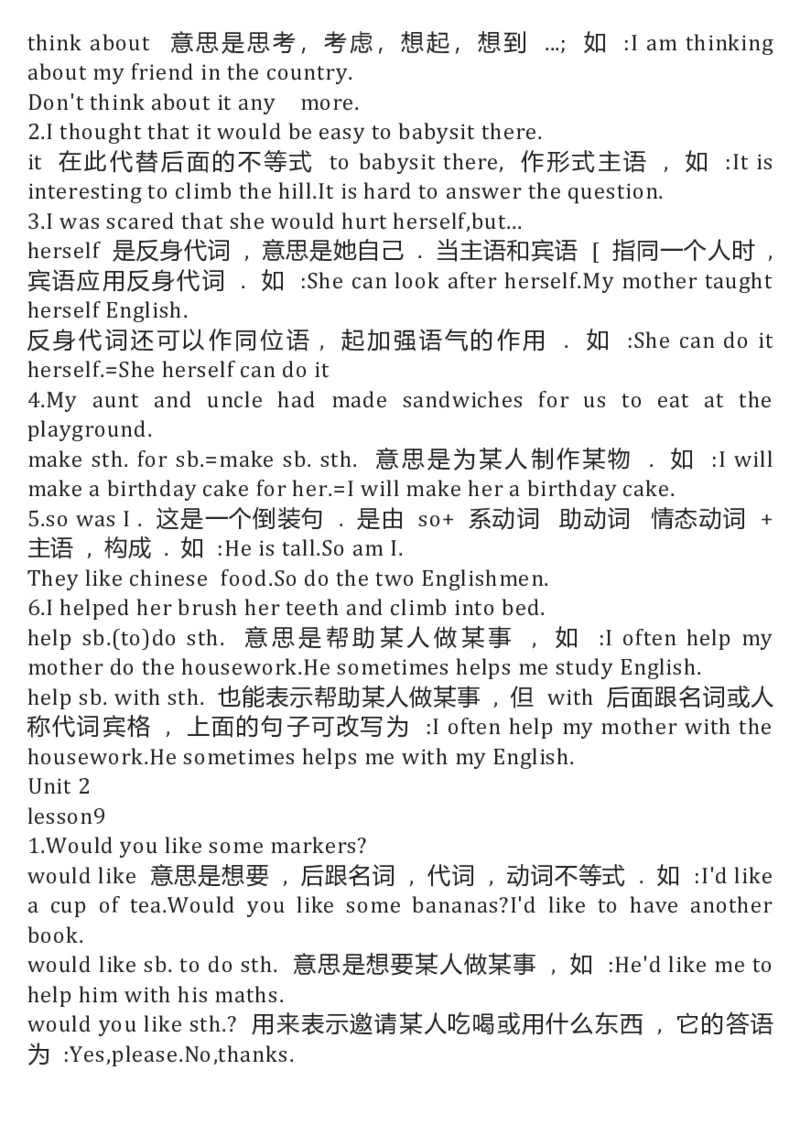
1.I thought about it all day at school.think about 意思是思考,考虑,想起,想到 ...; 如 :I am thinking
about my friend in the country.
Don't think about it any more.
2.I thought that it would be easy to babysit there.
it 在此代替后面的不等式 to babysit there, 作形式主语 , 如 :It is
interesting to climb the hill.It is hard to answer the question.
3.I was scared that she would hurt herself,but...
herself 是反身代词 , 意思是她自己 . 当主语和宾语 [ 指同一个人时 ,
宾语应用反身代词 . 如 :She can look after herself.My mother taught
herself English.
反身代词还可以作同位语 , 起加强语气的作用 . 如 :She can do it
herself.=She herself can do it
4.My aunt and uncle had made sandwiches for us to eat at the
playground.
make sth. for sb.=make sb. sth. 意思是为某人制作某物 . 如 :I will
make a birthday cake for her.=I will make her a birthday cake.
5.so was I . 这是一个倒装句 . 是由 so+ 系动词 助动词 情态动词 +
主语 , 构成 . 如 :He is tall.So am I.
They like chinese food.So do the two Englishmen.
6.I helped her brush her teeth and climb into bed.
help sb.(to)do sth. 意思是帮助某人做某事 , 如 :I often help my
mother do the housework.He sometimes helps me study English.
help sb. with sth. 也能表示帮助某人做某事 , 但 with 后面跟名词或人
称代词宾格 , 上面的句子可改写为 :I often help my mother with the
housework.He sometimes helps me with my English.
Unit 2
lesson9
1.Would you like some markers?
would like 意思是想要 , 后跟名词 , 代词 , 动词不等式 . 如 :I'd like
a cup of tea.Would you like some bananas?I'd like to have another
book.
would like sb. to do sth. 意思是想要某人做某事 , 如 :He'd like me to
help him with his maths.
would you like sth.? 用来表示邀请某人吃喝或用什么东西 , 它的答语
为 :Yes,please.No,thanks.would you like to do sth.? 用来表示邀请某人做某事 , 它的答语为 :
(yes),'d like love to.I'm afraid not...I'd love to ,but... 等 .
2.Would you please lend me your green marker?
would you please+ 动词原形 ? 表示请你 ... 好吗 ?
lend 是借进 , 常用 lend sth. to sb. 其反义词为 borrow, 常用 borrow
sth. from sb., 如 He borrowed a car from his friend.He lent his bike to
his neighbour.
3.Don't forget to draw the sun.
forget to do sth. 意思是忘记去做某事 ,forget doing sth. 意思是忘了做
过某事 , 如 :Don't forget to close the window before you beave. He
forgot closing the window,so he went back to close it again. He forgot
to turn off the light,so it was on the whole night.
4.After you plant a plant in a pot,what do you do next?
plant 是一个兼类词 , 既可以作动词 , 也可以作名词 .plant a plant 表
示种植物 . 类似的兼类词还有 :
work;water;push 等 .
lesson10
1.Flowers,leaves and stems grow above ground.Roots grow below
ground.
above 是介词 , 表示在 ... 上方 , 比 ... 还高 . 与 below 相反 . 如
:The plane is flying above the clouds. Today's temperature is 10
degrees below zero.
over 是在 ... 正上方 , 或覆盖在 ... 上面 , 如 :There is a lamp above
the desk. There is a bridge over the river.
2.Plants have flowers beause the flowers make seeds.
because 是连词 , 表示因为 , 引导原因状语从句 . 它不能和 so 连用 ,
如 :She didn't come to school because she was sick.=She was sick so
she didn't come to school.
3.The seeds of the rice plant feed billions of people.
hundred,thousand,million,billion 等词前有具体数字时 , 用单数形式 ,
直接修饰名词 ; 表示一个笼统的概念时 , 用复数形式 , 后面要与介词
of 连用再接名词 . 如 :He has three hundred books. He has read
hundreds of books.
lesson11
1.You need to look after it.look after=take care of 意思是照顾 , 如 :I have to look after the baby.
Can you look after yourself?
2.Plants use sunlight to make food.
to make food 是不定式 , 表示目的 , 如 :Li Ming went to B eijing to
see his uncle.
3.Gardens are full of plants.
be full of... 表示盛满 ..., 装满 .... 如 :The room is full of people. These
bottles are full of water.
4.In spring,people put covers over plants to keep them warm at night.
cover 用作动词意思是覆盖 , 遮盖 ,cover...with... 表示用 .. 把 ... 覆盖
上 , 如 :He covered his face with a scarf. be covered with... 被 ... 覆盖
着 . 如 :The road is usually covered with snow.
cover 还可以用作名词 , 表示覆盖物 , 封面 . 如 :The book needs a
new cover.
keep sb.sth.+adj. 表示使某人或某物处于某种状态 . 如 :We should
keep our classroom clean. He likes doing things to keep himself busy.
Let's keep the windows open.
5.Windows are made of glass.
be made of ... 意思是由 ... 制成 , 在制成的过程中原材料没有发生质的
变化 .
be made from... 意思是由 ... 制成 , 在制成的过程中原材料发生了质的
变化 . 如 :My desk is made of wood. Books are made of paper.
Paper is made from wood. Wine is made from wheat.
lesson12
1.One group sings the purple words ,and the other group sings the
black words.
one...,the other... 意思是一个 ... 另一个 ..., 如 :She has two cats.One is
white,the other is black.
2.The prettiest plant...prettiest 是 pretty 的最高级 , 如 :He is the tallest boy and she is the
prettiest girl.
3.That you ever did see.
did see 在此相当于 saw,did 放在动词原形前起加强语气的作用 , 如
:She does study hard. I do like computer games. They did go to have a
picnic yesterday.
4.As the stem grows,it makes leaves.
as 在本句中表示当 ... 时候 , 引导时间状语从句 . 如 :He went out as
I came in.
lesson13
1.Trees help clean the air.It's pleasant to walk among the trees.
pleasant,pleased 都是形容词 , 表示高兴的 , 快乐的 .pleasant 常用来
形容事物 , 而 pleased 常用来形容人 , 如 :I am very pleased you've
decided to come.
among 介词 , 表示在 ...( 三者以上 ) 之间 ,between 介词 , 表示在
两者之间 .
2.Donuts don't grow on trees.
on trees=on the tree 表示树本身所有物在树上 ;in the tree 表示外来物
在树上 ; 如 :There are some birds in the tree. There are many apples
on the tree.
3.Then we can sit under a tree in the shade.
in the shade 是介词短语 , 意思是在阴凉处 . 类似的短语有 in the
sun;in the light;
4.All plants take energy from the sun and make it into food.
make...into... 意思是把 ... 制成 ..., 如 :We can make the tree into
paper. We can make cotton into cloth.
make 还可以构成如下短语 be made ofromyin 等
5.Without food,they would have nothing to eat and they would die.
without 是介词 , 意思是没有 , 不 , 如 He went to school without
breakfast. He left without saying goodbye. Fish can't live without
water.
lesson14
1.There are about eighty thousand different plants in the world that
people can eat.
that people can eat 是定语从句 , 修饰 plants,that 是关系代词 , 引导
定语从句 , 并代指 plants, 也可以用 which 来引导 . 当被修饰的名词是人时 , 可以用 who,that, 如 I like the present that you gave me.
This is the most interesting book that I've ever read. The woman who
is babysitting the baby is my aunt.
2.But half of the world's food comes from only three plants:race,corn
and wheat.
half of... 意思是 ... 中的一半 , 当它所指代的是不可数名词时 , 代表单
数 . 如果后面所接的是可数名词的复数 , 那么它所代表的也是复数概念
. 如 Half of his money was spent on books. Half of the books here are
in English. Half of the students in our class like math.
all of...;a quarter of... 和它类似 .
3.Doctors use medicine to help sick people.
use...to do sth. 意思是用 ... 来做 ..., 如 We use our feet and legs to
walk.
sick 是形容词 , 意思是有病的 , 患病的 , 可作定语和表语 ;ill 也是形
容词 , 意思相同 , 但只能作表语 ; 如 His mother was sickill in bed.
There are many sick people in the doctor's waiting room.
4.Do you have a hat made of straw?
made of straw 是过去分词短语作后置定语 , 表示被动 ; 如 Do you
know the boy named peter? This is the camera bought in japan.
lesson15
1.I have a lot to write about today.
to write 作后置定语 , 修饰 a lot, 表示没有做 , 要去做的动作 . 如 I
have nothing to say. They found a room to live in. She has no pen to
write with.
2.Now sth.new is growing at the top of the stem.
sth. 是不定代词 , 应看作第三人称单数 . 形容词修饰它时应作后置定
语 . 如 Sth.is wrong with his computer. There is sth. important in
today\\\\\\\\\\\\\'s newspaper.
3.Later,the head will turn into wheat seeds.
turn into... 意思是变成 ... 如 Water can turn into ice.
turn...into... 意思是把 ... 变成 ..., 如 Heat turns water into vapor 蒸
汽 .
相关的短语有 change into...,change....into....
Unit 3
lesson17
1.She plays with me when I come home from school.play with... 意思是与 ... 玩 , 玩弄 ... 如 Don't play with fire ,it's
dangerous.
2.I will keep him under my desk.
keep 的意思是使某人 某物保持某种状态或某地位 . 如 If your hands
are cold,keep them in your pockets. These gloves will keep your hands
warm. I'm sorry to keep you waiting. You can't keep ducks in the
classroom.
keep 还有饲养 ... 的意思 , 如 He keeps bees ,goats and hens on his
farm.
3.I will need to plant a tree in my bedroom.
在肯定句中动词 need 通常用作行为动词 , 如 They need to finish the
project on time. You need to take an umbrella with you.
在否定句和疑问句中 ,need 即可用作行为动词 , 也可以用作情态动词 ,
如 You needn't finish that work today.=You don't need to finish that
work today. Do you need to go out?=Need you go out?
need 还可以用作名词 , 如 There is a great need for a new book on
this subject. There is no deed for you to start yet.
lesson18
1.He was talking to my mum.
Was/were+doing 是过去进行时 , 表示在过去某一时刻正在进行的动作
. 如 He wasn't watching the hamburgers at that time. He was cooking
supper when I got home.
lesson19
1.The zoo is open.
open 是形容词 , 意思是开放的 , 可进入的 . 如 This garden is open
to the public.
open 还可以表示开着的 , 营业的 , 等 . 如 He slept in the room with
the window open last night. The shop isn't open on sundays. His coat
was open. The cages are big and open.
2.It has all kinds of animals.
all kinds of 意 思 是 各 种 各 样 的 , 如 All kinds of plants were
displayed.
different kinds of... 不同种类的 ...;a kind of ... 一种 ....;
3.We'll need our caps to protect us from the sun.protect sb.sth. againstrom sth. 意思是保护 保卫某人或某物不受 ... 的
侵害 . 如 I was wearing a fur coat to protect myself from the cold.
Winter wheat lying under snow is protected against the cold.
4.Zoos can help people to stop animals from going extinct.
stop sb. from doing sth. 意思是阻止某人做某事 , 在主动语态中 from
可以省去 , 在被动语态中 from 不可省去 . 如 Please don't stop
him(from) playing basketball. He was stopped from playing basketball.
We all tried to stop him(from) smoking in bed.
lesson20
1.I am at the zoo watching all the animals,I want to make friends with
one today.
at the zoo 在动物园 , 也可用作 in the zoo.
make friends with... 表示与 ... 交朋友 .
2.Throw some food to the ducks by the water.
Stand so still while they waddle my way.
by 是介词 , 意思是在 ... 旁边 , 在 ... 附近 . 如 :My house is by the
river.
still 可以作形容词 , 意思是静止的 , 不动的 ; 如 :Keep still while I
comb your hair.Please stand still while I take your photograph.
still 还可以作副词 , 意思是还 , 仍然 , 仍旧 ; 如 :He is still
sleeping.The fist is still alive.
while 是连词 , 意思是当 ... 的时候 ; 如 :I met a friend while I was
walking down the street.
3.I want an animal friend that likes to jump and run,too.
that likes to jump and run 是定语从句 , 修饰先行词 an animal friend.
被定语从句修饰的词叫先行词 , 引导定语从句的词叫关系词 . 先行词是
人时 , 关系词通常用 that 或 whowhom; 先行词是事物时 , 关系词通
常用 that 或 which; 关系词在从句中除作状语外 , 可以省去 . 如 :
Edison was a man who never gave up. She is the girl whom I met at
the party.This is the house where(=in which) I lived last year. I know
the boy whose father is a teacher. The house which stands on the hill is
mine.
lesson21
1.They go through the entrance.through 介词 , 意思是 ( 从 ... 内部 ) 穿过 .across 指 ( 从 ... 表面
上 ) 横过 . 如 :I walked across the square to the museum. We walked
through the forest.
2.Maybe photos would surprise the animals.
maybe 意思是大概 , 或许 . 如 :Maybe he doesn't know it's spring.
Maybe you put the letter in your pocket.
情态动词 may 和系动词 be 一起也可以表示 可能是 ... 的意思 . 如
:You may be right. I can't find my watch.It may be in your pocket.
3.Then don't take photos of me.
take photos of sb. 意思是 给某人照相 .
4.It's nearly noon,and he's still sleeping.
nearly 是副词 , 意思是 几乎 , 差不多 . 如 :Hurry up--it's nrarly
time for school.
nearly 和 almost 都表示 几乎 , 差不多 . 在多数情况下 , 两者之间
没有什么差别 . 一般来说 almost 所表达的程度比 nearly 更接近一些
. 另外 ,nearly 不能用于修饰否定词 , 但可被 not 修饰 ; 而 almost
可以和否定词连用 .
5.That's where we go out.
where we go out. 是表语从句 ,where 是引导词 . 这样的词还有
:wh-,that,because 等 . 如 :That's what he said.
That's why I am so worried. The question is whether our parents will
agree. The problem is which is heavier. She looked as if she were a
doctor.
lesson22
1.Let's play a joke on someone today.
play a joke on sb. 意思是 开某人的玩笑 , 戏弄某人 . 如 :We all play
a joke on him.
have a joke with sb. 意思是 与某人一起开某人的玩笑 . 如 :I stopped
to have a joke with him.
make a joke about of sb.sth. 意思是 拿某人 ( 事 ) 开玩笑 . 如
:Don't make a joke about himhis shortcomings.
2.Let's tell Danny that the bear got out of the zoo.
get out (of sth.) 意思是 从 ... 里出来 .
另外 , 这个短语还可以表示 出外走走 . 如 We love to get out into
the countryside at weekends.
You ought to get out of your house more.get out of sth.doing sth. 意思是 逃避责任或义务 , 不做份内的事 ,
(使某人)放弃、停止或戒除(习惯等)。如 I wish I could get out of
going to that meeting. I can't get out of the habit of waking at six in the
morning.
3.We heard it on the radio.
onover the radio 意思是 通过无线电广播。类似的短语有 on the
telephone;on TV.
4.There's a fierce bear coming.
coming 为现在分词,作 bear 的定语,有正在到来的意思,相当于定
语从句 that is coming. 如 There is a bag lying on the ground.There
are some boys playing football over there.
5.You are joking,aren't you?
该句是反意疑问句。反意疑问句由两部分组成。前一部分是陈述句,后
一部分是简短问句,中间用逗号隔开。前后两部分遵循 两个一致,一
个相反 原则。如 The pen is yours,isn't it? He isn't a doctor,is he?
Your brother can swim,cant he? You don't study Chinese,do you? He
never watches TV,does he?
There won't be any meetings next week,will there?
6.We tricked out you,Danny!
trick 是动词,意思是欺骗,欺诈。如 The young man tricked me out
of 50 yuan.
trick sb. out of + 钱数。表示骗取某人多少钱。
lesson23
1.One of the world's first zoos was in Egypt ,about 3500 years ago.
ago 作副词表示从现在算起的以前;before 作副词可表示从过去某一刻
算起的以前。如 I met him three days ago. I said I had met him three
days before.
before 后接 时间点,可用于任何时态。如 She got to the office
before five o'clock. We hope to get home before six o'clock.
2.No other people could go.
no other people 可以说成 nobody else. 如 Nobody else could go
there except kings,queens and important people.
3. Egypt is famous for its pyramids.
be famouswell-known for 意思是 以 ... 著名 ; 以 ... 闻名 . 如
France is famous for its food and wine.
The place is fomous for its hot springs .be famous as... 意思是 作为 ... 职业 身份而著名 . 如 He is famous
as a writer.
4.People went to the zoo to learn about animals.
to learn about animals 是动词不定式作目的状语 . 如 He came to give
us a talk yesterday. I went to the park to breathe the fresh air.
5.Zoos are the only places that some kinds of animals live in.
that some kinds of animals live in 是定语从句 , 修饰先行词 the only
places. 由于先行词前有 only, 所以关系词只能用 that.
Unit 4
lesson25
1.I fill a jar with water.
fill...with... 意思是 用 ... 装满 ...
be filled with...=be full of... 意思是 充满 ... 如 On hearing the
news,her eyes are filled with tears. They filled the hole with water.
fill in... 意思是 填上 ...; 填充 ...; 如 Fill in the blanks.
2.Then,I turn the jar upside down.
upside down 意思是 向下翻转过来 如 That picture is upside
down.You hold the book upside down.
right side up 意思是 正面朝上 .
3.I think the floor will get wet.
get 作系动词 , 意思是 变得 , 后跟形容词作表语 . 如 The day gets
longer in spring.
与 get 相关的词组有 :
get alongon(well) with... 与 ...( 和睦 ) 相处 . 如 I am getting
alongon well with my classmates.
get away from... 意思是 逃跑 . 如 The thief got away from the
police.
get back 意思是 返回 ; 要回或拿回 . 如 After a long holiday,he had
to get back to work.Please get the book back for me.
get into... 意思是 上车 . 如 He got into the car.
get off... 意思是 下车 ; 从 ... 下来 . 如 He got off the train.
get up 意思是 起床 ; 起身 ; 站起 . 如 He suddenly got up from the
chair.I usually get up at six in the morning.
get together 意思是 集合 ; 团聚 . 如 We will get t ogether at the
school gate and g o to the park.get through 意思是 用电话联系上 ... 如 I often get through to my
friends.
get to... 意思是 到达 ... 如 We will get to Beijing tomorrow.He will
get home by four o'clock this afternoon.
4.I'm sure the floor won't get wet.
sb.be sure+that 从句 , 意思是 认为 ... 一定 .... 否定形式是 sb. be
sure+ 疑问词引导的从句 . 如 Tom is sure that he will win the
game.Tom is not sure whether he can win the game.I'm not sure when
he'll come here.
5.We can prove who's right.
prove 是及物动词 , 意思是 证明 , 证实 . 常用于以下结构 :prove
sth.(to sb.);prove(to sb.)that...;prove...(to be)+adj
. 如 The fact has proved the man's honesty to us all.=The fact has
proved to us all that the man is honest.=The fact has proved the man
(to be) honest.
prove 也可以作不及物动词 , 意思是 证明 表明 ( 自己 ) 是 ..., 后
跟形容词或名词 . 如 My theory will prove right some day.During the
trip,he proved a man with a strong will.
6.We'll do the experiment and observe what will happen.
observe 是动词 , 意思是 观察 .observe sb. dodoing sth. 如 I
observed her dance.When I passed by the grass,I observed him
walking.
lesson26
1.I will ask the class to make observations and guess what will happen.
make observations 意思是 观察 . 如 While doing experiments,you
must make careful observations.
这个短语还有 做观察报告 , 评述 , 评论的意思 . 如 Our geography
teacher has just made some interesting observations on Africa.
observation 也可以用作不可数名词 . 如 She is in hospital under
observation.
lesson27
1.Next,Brian will take his hand off the cardboard.
take sth. off sth. 意思是使某物离开或脱离 ... 如 Would you mind
taking your foot off my hand?
take off 意思是 起飞 ; 脱下 ; 匆忙离去 . 如 The plane took off at
7 a .m. Take off your shoes,please.He took off for the station in a hurry.
2.The force is strong enough to hold the water.
adjadv+enough to do sth. 意思是 足够 ... 以至于能做某事 . 如 The
boy is old enough to go to school.=The boy is so old that he can go to
school.=He is such an old boy that he can go to school.
enough 作副词 , 要放在被修饰的形容词和副词之后 ; 作形容词 , 通
常放在被修饰的名词之前 . 如 This hall is large enough to hold two
thousand people.He walks fast enough to be here in time.He does't
have enough money to go for traveling.I'm soory,but I haven't enough
time to do the job.
3.Air is stronger than I thought!
than 可作连词或介词 , 用于引入比较级的后半部分 , 表示 比 ...; 如
She is a better player than she was last year.He is taller than me.He
gets up earlier than I(do).
rather than 意思是 宁愿 ..., 不愿 ...; 与其 ... 不如 ... 如 I would
rather stay at home than go out.
4.Put eight spoonfuls of cornstarch into the bowl.
spoonful 是可数名词 , 意思是 一勺的量 . 如 a spoonful of sugar.
类似的还有 two cupfuls of milk; a few mouthfuls of tea; a handful of
flowers.
lesson28
1.That tastes so great.
taste 作系动词 , 后接形容词作表语 , 意思是 尝起来 ... 如 The
meat tastes good.It tastes better than looks.
2.And I will eat until my plate is empty.
延续性动词 +until ill... 表示 一直 ... 直到 ... 为止 . 如 You'd better
wait until he comes back. I will watch TV until my father comes back.
我一直看电视直到我爸爸回来为止 .
瞬间性动词 延续性动词 +not+until ill... 表示 直到 ... 才 ... 如 I
won't watch TV until my father comes back. 我直到爸爸回来才看电电
视 .I didn't go to bed until my father came back. 我直到爸爸回来才睡
觉 .He didn't go out until he finished his homework. 他直到完成作业
才出去 .
另 ,until ill 作连词时 , 引导时间状语从句 , 当主句是一般将来时时 ,
从句要用一般现在时来代替 . 如 I shall wait here until he arrives.I
will wait until he returns.lesson29
1.Danny is at the park.
at the park=in the park
2.Debbie will have fun looking for them.
have fun 相当于 enjoy oneself 意思是 玩得高兴 , 过得愉快 . 如
We had lots of fun on the sportsground today.=We enjoyed ourselves
very much on the sportsground today.
have fun doing sth. 表示 做某事有乐趣 .
It is(not) fun to dodoing sth.=There is much
o fun in doing sth. 意思是 做 ... 有 ( 无 ) 乐趣 . 如 It is fun to
cook a meal myself.=There\\\\\\\\\\\\\'s much fun in cooking a meal
myself.There is not much fun in going to a party alone.=It's not fun to
go to a party along.
3.I can't make eggs.
make eggs 意思是 产卵 , 下蛋 . 还可以说成 lay eggs.
4.Can you find them?
辨析 :find,look for,find out,hunt for
find 强调找的结果 , 意思是 找到 . 如 He found his lost pen.
look for 强调动作的过程 , 意思是 寻找 . 如 He is looking for his
lost pen.
find out 强调 ( 经过一番努力之后 ) 找到 ...; 查明 ....At last,they
found out who stole the bike.
hunt for sb.sth. 意思是 寻找某人或某物 . 与 look for 同义 . 如
The police are hunting for the thief.
5.Now my basket is full of eggs.
be full of... 意思是 充满 ...=be filled with... 如 The bus is full of
people.=The bus is filled with people.
lesson30
1.Fill the dish half full of water.
half 是副词 , 意思是 部分地 , 一半地 , 差不多 . 如 The bottle is
only half full.
half 也可作形容词 , 名词 , 意思是 半个的 , 一半的 , 一半 . 如
half a year=a half year;half an hour=a half hour;Half of them are
already here. Two halves make a whole.
2.To make a candle burn,you "light" it.makelethave sth.sb. do sth. 意思是 使某物或某人做某事 . 如 Let the
candle burn for two or three minutes.
3.As the candle burns,it uses up oxygen in the air.
1)as 作连词的各种用法
as...as... 结构中第二个 as 是连词 , 它往往连接一个不完整的句子 , 表
示比较 , 意思是 和 ... 一样 ...; 像 ... 一样 .... 如 John is as healthy
as his sister.
表示方式 , 意思是 像 , 按照 , 如同 . 如 Run as I do.Leave it as it is.
表示时间 , 意思是 当 ... 的时候 , 一边 ... 一边 ..., 随着 . 如 She
sang as she worked.I saw him as he was getting off the bus.You will
grow wiser as you grow older.
表示原因 , 意思是 因为 . 如 As you are tired,you bad better rest.
表示让步 , 意思是 虽然 , 尽管 . 如 Rich as he is ,he is not
happy.Much as I like it,I will not buy it.
2)use sth. up 意思是 用尽 ..., 利用 ...; 如 She used up the chicken
bones to make soup.When the candle stops burning,it has used up all
the oxygen in the air.
4.There is about one-fifth oxygen in the air,so the water rises and fills
about one-fifth of the jar. 分数的表达形式 : 分子用基数词 , 分母用序
数词 , 分子大于 1, 分母加 s. 概括为口诀 : 分子基 , 分母序 . 分子
>1, 分母加 s. 如 1/2=one/a half=one second=one-second;1/3=one
third=one-third;2/3=two thirds=two-thirds;
1/4=one/a quarter=one-quarter;3/4=three quarters=three-
quarters;3/5=three fifths=three-fifths;
5.The candleholder is "holding" the candle.
hold 为动词 , 意思是 拿 , 抓 , 握 , 抱 , 保持 , 容纳 . 如 Shall I
hold your bag?He held a book in his hand.
He held his head up.I don't think the car will hold you all.
lesson31
1.Do you want to surprise your friends?
surprise 是动词 , 意思是 使惊奇 , 使感到意外 . 如 It surprised me
to see so many people here.
它还可以作名词 , 意思是 惊奇 , 惊讶 , 诧异 , 意外之事 . 常用的有
两个短语 :to one's surprise;in surprise. 如 To my surprise the plan
succeeded.She looked up in surprise when I entered.
surprise 对应的形容词有两个 :surprised 和 surprising.surprised 意思是 感到惊奇的 . 如 We are surprised at the news.Are
you surprised,class?We were surprised to learn that he was French.
surprising 意思是 使人惊讶的 , 出人意料的 , 惊人的 . 如 We
knew the surprising fact.We are surprised at the surprising news.
2.The cardboard will hold the water up.
hold the water up=keep the water in the jar.
3.It pushes down on us from above.It also pushes up on us from
below.In the experiment,air pushes up on the cardboard.
pushes up/down on sb./sth. 意思的 向上或下推在 ... 上 ; 给 ... 一
个向上或下的推动力 .
3.Science is interesting.
interesting 形容词 , 意思是 有趣的 . 常用来形容事物 . 如 It's an
interesting story.
interested 形容词 , 意思是 对 ... 感兴趣 . 常用来形容人 . 如 Are
you interested in history?
be/become interested in sth./doing sth. 对 ( 做 )... 感兴趣 . 如 We
became interested in the interesting story.
Unit 5
lesson33
1.I can go almost any where on foot.
anywhere 在否定句中表示 什么地方 , 某地 . 相当于由 somewhere
变化而来 . 如 Did you go anywhere yesterday?
anywhere 在肯定句中表示 任何地方 . 如 You can go anywhere you
like.
2.But that would take a long time.
这里 would 表示 假想 , 猜测 , 推断 . 如 I know you wouldn't get
lost.
take 表示 花费 , 常用于句型 :It takes/took sb.+ 时间或钱 +to do
sth. 如 It takes us three hours to fly to Guangzhou .
take 还可以表示 乘坐 .... 如 I would take a train. Shall I take a
plane to the bakery?
3.I seldom take a ship.I would like a more rapid type of transportation.
seldom 意思是 很少 , 不常 , 难得 . 一般不用比较级和最高级 , 可
用 very 修饰 . 在句首时 , 句子要倒装 . 如 Seldom did I hear of her
last year=I seldom heard of her last year.
more rapid=rapider 是 rapid 的比较级 , 意思是 更快的 .type=kind, 意思是 类型 , 种类 , 样式 . 如 Cotton is a type of
material.I don't enjoy that type of show.
lesson34
1.In the 1760s,a scientist in England invented a way to put steam
engines and wheels together.
in the 1760s 意思是 在 18 世纪 60 年代 , 也就是 1760 年 -1769
年 . 如 the 1990s 其前要用介词 in
invent 是动词 , 意思是 发明 . 其对应的名词是 invention 和
inventor. 如 The inventor invented two new inventions last year.
put...together 意思是 装配 , 组成 , 凑成 , 把 ... 组装起来 . 如
Let's put a team together.
put two and two together 意思是 ( 根据所见或所闻等 ) 推测出真相 .
put our/your/their heads together 意思是 交流思想 , 交换意见 , 合
议 .
2.Many train stations were built to make it easier for passengers to get
on and off the trains.
get on/off... 意思是上下 ( 公共汽车 , 火车 , 轮船 , 飞机等 );
get in(to)/out of... 意思是上 / 下小汽车 , 电梯等
3.Early trains,like the Rocket,had a top speed of 50 kilometres per
hour.
top 在这里是名词作定语 , 意思是 顶部的 , 最高的 , 最上面的 . 如
Put it in the top drawer.
top speed 意思是 最高速度 . 如 The train is running at top speed.
per 意思是 每 , 每一 . 如 one apple per child.The fruit costs 3
yuan per kilo.
lesson35
1.In 1900,planes hadn't been invented.
had been invented 是过去完成时的被动语态 , 意思是 在 ... 时以前 ,
已经被发明 . 否定形式在 had 后加 not, 可缩写为 hadn't. 过去完成
时的被动语态的结构是 :had+been+ 动词的过去分词 . 如 The
classroom had been cleaned before we got to the school./the meal had
been cooked when we reached home.
2.How will people travel 100 years from now?
100 years from now=in 100 years 意思是 在 100 年后 , 用于一般将
来时 . 如 How many people will there be on the earth 50 years
from now?=How many people will there be on the earth in 50 years?3.You'd better not invent that,Danny!
you'd 是 you had 的缩写形式 ,had better (not) do sth. 意思是 最好
( 不 ) 做某事 . 如 You'd better not smoke here.They'd better finish
the work at once.
4.Henryford liked to be humorous and say,"You can have it in any
colour you want,as long as it's black."
as long as 意思是 只要 . 相当于 if, 引导条件状语从句 . 如 We will
go fishing as long as it doesn't rain tomorrow.I will do it at once as
long as you agree.
lesson36
1.Let's take a drive.
take a drive=drive 意思是 驾驶 ...
take a+n=v. 类似的还有 :take a walk=walk;take a look=look;take a
rest;take a swim=swim 等 .
2.get out of the car...
get out of... 意思是 从 ... 出来 , 其反义短语为 get into...
另外 ,get out of... 还有 使逃避 , 避免 , 摆脱 , 放弃等意思 . 如 She
tried to get out of helping her mother.
The teacher asked the boy to get out of a bad habit.
lesson37
1.Danny has thought of a new kind of transportation.
think of 意思是 思考 , 考虑 , 想起 , 想出 . 如 What do you think
of my singing?I can't think of his name at the moment.
2.Will Danny's invention r e ally work?
work 在这里的意思是 ( 计划 ) 行得通 ,( 机器等 ) 能运转 ,( 方法
) 奏效 . 如 The plan won't work.Your idea won't work in practice.
lesson38
1.It would go really fast and the ride would be so smooth.
ride 是名词 , 意思是 骑马 / 乘车旅行 . 如 He went for a ride in
his car.
smooth 是形容词 , 意思是 平稳的 , 不颠簸的 , 无摇晃的 . 如 a
smooth ride in a good car.
smooth 还有 光滑的 , 平坦的 , 平静的 , 顺利的 , 无困难的 , 流畅
的等意思 .
2.Well,I think a transporter would make you into energy.make...into... 意思是 把 ... 变成 ... 如 The child made a piece of
paper into a model plane.
3.In these shows,people use transporters all the time.
all the time 意思是 总是 , 一直 .
关于 time 的短语还有 :at the time 在那时 ;at the same time 同时 ;at
times=sometimes 有时 ;in time 及时 ;on time 按时 ;in no time=at
once 立刻 ;It's time for sth./to do sth. 是 ( 做 ) 某事的时间了 .
lesson39
1.We had to think of an invention,and present it to the class.
这里 present 是动词 , 意思是 介绍 , 展现 , 表现 . 如 May I
present Mr.Robinson to you?He always presents a calm smiling face.
Money presents no fifficulty to them. 金钱对他们来说不是问题 .
2.That sounds like a fun project.
sound 用作系动词 , 表示 听起来 , 似乎 , 后接形容词 , 名词或介词
like 等 . 如 The answer sounds right.Your id ea sounds a good
one.He sounds just the person we want to see.It sounds like the singing
of birds.
sound 作名词指各种声音 . 如 the sound of music
3.I hope your presentation goes well.
go 在这里的意思是 进展 , 进行 . 如 The hours went slowly.I hope
everything goes well.
Unit 6
lesson41
1.Now you can connect to the Internet.
connect to... 意思是 连接到 ... 如 It's easy to connect to the two
islands.
be connected with... 和 ... 有关 如 Are you connected with the
matter?
connect...to/with... 意思是 把 ... 和 ... 连接起来 . 相当于 join...to...
如 Connect the fridge to the electricity supply. 接通冰箱的电源 .The
bridge connects the city to the town.
2.Let's turn on the computer.
turn on 意思是打开 ( 电源 ), 拧开 ( 开关 ). 如 Turn on the
light,please.It's dark here.
其反义词组是 turn off. 如 Turn off the radio,It's too noisy.由 turn 构成的句型和短语还有 :turn up/down;turn right/left;turn
over;turn to;I's one's turn to do sth. 等 .
3.The computer makes a noise.
make a noise 意思是 吵闹 , 发出噪声 . 如 Don\'t make a noise.The
baby is sleeping.
noise,sound,voice 的区别 :noise 指巨大的声音 , 噪声 .sound 可以指
任何声音 .voice 指人的嗓音 .
4.Then the screen says,"Connect failed.Try again."
fail 意思是 失败 , 不及格 .fail (in) sth. 某事失败了 . 如 He failed
(in) his driving test.
fail to do sth.=fail in doing sth. 表示做某事失败 , 没能做成某事 . 如
He failed in passing/to pass the exam.
fail 的名词形式是 failure, 它们对应的反义词分别是 succeed 和
success. 如 Failure is the mother of success.
lesson42
1.Open your e-mail program.
这句为祈使句 , 以动词原形开头 , 表示 请求 , 建议 , 命令等口气 .
其否定形式在动词原形前面加 don't. 如 Stop talking,please!Don't
smoke here.
2.Click on that.
click on... 意思是 点击 ... 如 We use a mouse to click on the things
that we want to have a look at .
3.Your message will be sent to the person you address.
这句话包含定语从句 , 而且引导词 who/that 在从句中作宾语 , 所以省
去了 .
4.When you have finished reading a message,click on"close".
finish doing sth. 意思是完成做某事 . 像 finish 这样 , 只能跟 v+ing
作 宾 语 的 动 词 和 短 语 有 :enjoy;keep;practise;mind;be
busy;can't/couldn't help;have fun 等 .
5.The box with the message will close--you won't see it anymore.
not...anymore/any more 意思是 不再 ... 如 He doesn't smoke
anymore.
6.It's always nice to hear from Wu Hong.
It's nice to do sth. 意思是 做某事很好 . 如 It's very nice to meet
you here.hear from sb.=receive a letter/an e-mail/a phone/...from sb. 意思是
收到某人的 ... 如 How often do you hear from your parents?
hear of/about... 意思是 听说 ... 如 He heard of it not long ago.
lesson43
1.The printing press is a machine that can make lots of books in a short
time.
that can make lots of books in a short time 是定语从句 , 先行词
machine 在定语从句中作状语 , 所以引导词 that 不能省去 . 如 He is
the person who can give us great help.Everyone likes things that are
good and cheap.
2.Before the printing press,books were written by hand.
by hand 意思是 靠手 , 用手 .by 在这里是 以 ... 的方式 的意思 .
如 The room is heated by gas.He earns a living by writing.
3.Information began to travel much faster and much farther.
1)much 可用来修饰比较级 . 这样的词还有 a little;a bit;a lot;even;far
等 . 注意 so,very,quite,too 不能修饰比较级 . 如 It's a little hotter
today.
2)begin to do sth. 和 begin doing sth. 都表示 开始做某事 . 如 I
began to pack my things three hours before I left.
下列情况下必须用不定式作宾语 :
a. 当状语是物时 . 如 The ice begins to melt.
b. 当 begin 在句中是 beginning 形式时 . 如 He was beginning to
set off.
c. 当 begin 后 面 的 动 词 是 表 示 心 理 活 动 的 词 时 , 如
realize,know,think,understand 等时 . 如 He began to realize how his
parents loved him.
4.If you forget something,you could look it up.
look up 意思是 ( 在词典或参考书中 ) 查阅 ( 词或资料 ). 如 Look
up the words in the dictionary.
lesson44
1.Here ’ s a lesson you won't want to miss.
miss 意思是 错过 , 未赶上 . 如 He missed the 9:30 train.
miss 还有 思念 的意思 . 如 "I miss you very much,my son,"said
Moth e r.
另外 ,miss 还有 未看见 , 未听见 , 未明白 的意思 . 如 The house
is on the corner;you can't miss it.2.When you search the Internet.You can search around the world.
search 意思是 搜索 . 后面跟搜索的范围 . 如 They searched the
cave.
如果表示要找的对象 , 在搜索范围后加 for, 再加搜索对象 . 即
:search+ 范 围 +for+ 对 象 . 如 He searched his pockets for
money.=He searched for money in his pockets.
lesson45
1.I'm sorry,but he is not here right now.
I'm sorry,but... 意思是 对不起 ,... 此处 but 一般不翻译出来 . 如
I'm sorry,but I can't go with you.
right now 在这里表示 就在此刻 .right 是副词 , 意思是 恰恰 , 正
好 . 相当于 at this/the moment.
另 外 ,right now 还 有 立 刻 , 马 上 的 意 思 . 相 当 于 at
once,immediately.
2.Please wait a moment.
本句中 wait 后面省去了 for.
持续时间若直接置于某些持续动词之后时 ,for 可以省去 . 如 The
meeting lasted (for) two hours.We stayed there (for) a week.
3.I need to get a pen and paper.
need 在这里作实义动词 ( 行为动词 ), 后跟名词 , 代词 , 不定式或
doing. 如 He needs a new book.We need to put the water into the
jar.My bike needs mending(to be mended).
need 还可作情态动词 , 一般只在否定句和疑问句中出现 . 如 We
needn't go to school tomorrow.
lesson46
1.They also try to help their mother all day,so their mother can rest.
try to do sth. 意思是 努力或尽力做 ... 如 He tried to climb the
tree,but he could not.
try doing sth. 意思是 试着做 ... 如 She tried cooking the meat in
wine instead of water.
rest 这里是动词 , 意思是 休息 . 等于 have a rest(n). 如 Class is
over and let's have a rest/rest.
2.She asked the president of the United States to make it a special
day.
make 后可跟复合宾语结构 , 即 ,make+ 宾语 + 宾补 . 宾补可以是形
容词 , 略 to 不定式 , 名词等 . 如 His words make everybody in theroom happy.The teacher made us memorize a lot of English words
every day.
注意 make sb do sth. 如果变成被动语态时 , 应该在 do 前加上 to. 如
上面的句子若改成被动句则应为 :We are made to memorize a lot of
English words every day (by the teacher).
另外 ,make+ 宾语 +n 做宾补 , 而 n 是表示 职位或官衔的词时 , 其
前不加任何冠词 . 如 We made him monitor of our class.
3.She wanted children to say "thank you" to their mothers,while their
mothers were still alive.
while 意思是 当 ... 时候 , 引导时间状语从句 , 表示持续的时间段 .
如 While she was asleep,thieves broke in and stole her handbag.They
arrived while we were having dinner.
alive 是形容词 , 意思的 活着的 . 不能放在名词前作定语 .
4.Many countries of the world celebrate Mother's Day,but not all of
them celebrate it in May.
not all of them 意思是 并非所有都 ... 否定词加 all 或 both 表示部
分否定 . 其全部否定为 none 或 neither. 如 Not all the birds can
fly.=All the birds can't fly. 并不是所有的鸟儿都会飞 .My parents are
not both teachers.=Both of my parents are not teachers. 我的父母并不
都是老师 .None of them agreed with me. 他们谁也不同意我的观点
.Neither of the books is mine. 这两本书都不是我的 .
5.On Father's Day, fathers can do whatever they want.
whatever 意思是 无论什么 , 不管什么 . 相当于 anything that, 做宾
语 .
whatever 还可以作主语和引导状语从句 , 相当于 no matter what. 如
Whatever the parents do is for their children.Whatever I do,I do it for
you.
6.Since his wife had died young,he alone had taken care of his five
children.
1)since 是介词或连词 , 意思是 自 ... 以来 . 主句常用现在完成时 ,
从句用一般过去时 . 如 I have been there many times since the
war.What have you been doing since I last saw you?
2)alone 意思是 独自地 , 单独地 .lonely 意思是 孤独的 , 寂寞的 .
如 The old man lives alone in a lonely house,but he never feels lonely.3)take (good) care of...=look after...(well) 意思是 ( 好好 ) 照看 ...
如 You must take good care of your things=You must look after your
things well.
lesson47
1.Li ming said that you would be happy if you heard from me.Then,I
waited to see if he would write back.
两句中的 if 意思不一样 , 第一句中的 if 意思是 如果 , 引导条件状语
从句 ; 第二句中的 if 是 是否 , 引导宾语从句 . 如 I don't know if
it will rain.If it doesn\'t rain,I will stay at home.
2.I feel like I'm connected to everybody in the world.
feel like 在这里的意思是 感觉好像 ..., 后跟句子或名词 . 如 When I
knew I had made a stupid mistake,I felt like a fool.
feel like doing sth.=would like to do sth. 意思是 想要做某事 . 如 I
didn't feel like eating anything this morning=I wouldn't like to eat
anything t his morning.
be connected to 意思是 连接 ..., 联系 ...;connect...to... 意思是 把 ...
和 ... 连接起来 .
3.I hope it won't be long till I hear from you.
It won't be long till/until/before... 意思是 用不了多久就 ... 了 . 如
It won't be long before I catch up with him.
Unit 7
lesson49
1.Geography is the study of the world's places and population.
population 的用法有以下几点 :
1) 表示某国 , 某城市有多少人口时 , 一般说 has a population of... 或
the population of...is... 如 Our city has a population of two million.The
population of Australia is 19,500,000.
2) 指人口 多 或 少时 , 一般要用 large 或 small 来表示 . 不用
many 或 few. 如 China is a country with a large population.The
population of China is much larger than that of Japan .
3) 提问 有多少人口 , 用 what, 不用 how many 或 how much. 如
What's the population of Beijing?
2.Have you ever been abroad,Danny?
1)ever 意思是 曾经 , 常用于疑问句或否定句 . 如 Have you ever
seen a tiger?2)abroad 是副词 , 表示 在国外 , 到国外 , 出国 . 如 Do you like
traveling abroad?My aunt has already gone abroad.
3.Have you ever been to other countries in Asia ?
1)have been to 意思是 去过 ...( 已经回来了 );have gone to 意思是
去了 ...( 还没回来 ). 如 Jim has been to France.His father isn't at
home.He has gone to Australia .
2)other 形容词或代词 , 意思是 别的 , 其他的 . 作形容词 , 则后面
加名词 . 当它和表示数量的词连用时 , 数量词要放在前面 . 如 two
other books;Some/Many other boys are swimming in that river.
作代词 , 常与 one 搭配使用 , 表示 一个 ... 另一个 .... 如 I have
two brothers.One is a doctor;the other is a teacher.
any other 可修饰单数可数名词 , 表示 任何其他的一个 . 用于肯定句
. 如 I don't want to borrow any other books.
4.I would love to go to Japan .
would love 和 would like 的意思和用法基本一样 .would like sth./to
do sth./sb. to do sth. 如 Would you love to drink some juice?
5.They speak Japanese in Japan .
Japanese 可作名词 ( 日语 , 日本人 ) 或形容词 ( 日本的 , 日本人的
). 作 日本人讲时 , 单复数形式一样 . 如 There are two Japanese
talking with our teacher.
6.My m other hopes to visit her some day.
some day=some day 意思是 某一天 , 指将来的时间 . 如 I hope you
can come to China again some day.
7.It's fun to travel around the world.Do you want to tour with me?
1)It's+n/adj+to do sth. 意思是 做某事是 ... 的 . 如 It's hard to
learn English well,I think.
2)travel around the world 意思是 周游世界 ; 到世界各地旅行 .
3)tour 作名词 , 意思是 旅行 ; 观光 ; 参观 . 如 He made a tour of
China last year.
tour 也可作动词 , 意思是 在 ... 旅行 , 参观 . 如 We toured a farm
last summer.
lesson50
1.The populationof the world is increasing very quickly.By
2025,scientists predict the world will have 7.8 billion people.
increase 意思是 增加 ; 增大 ; 增长 ; 增强 ; 繁殖 .increase by... 意思是 增加了 ...,increase to... 意思是 增加到 ... 如
The population has increased by 300,000 to 70,000,000.
by+ 时间 , 表示 到 ... 为止 .
2.Oceans cover about three-quarters of the earth's surface.
three-quarters 意思是 四分之三 . 相当于 three-fourths
3.Not all land is good for children.
be good for... 意思是 对 ... 有好处 . 如 Reading is good for
children.
be good at... 意思是 擅长 ... 如 Are you good at English?
be good to... 意思是 对 ... 友好 . 如 The teacher is good to his
students.
lesson51
1.How big is Asia ?
how 经常和不同的词构成特殊疑问词组提问不同的内容 . 如 how
many/much/long/far/tall/deep/wide/heavy/often/soon 等 . 如
How long is your classroom?
2.The Yangtze River in China is the third-longest river in the world.
the+ 序数词 + 形容词最高级 + 名词 , 表示 第 ... 最 ..., 若表示
第一最 ..., 则一般省去序数词 first. 如 The Changjiang River is the
longest river in China .
lesson52
1.Cross the ocean,to Japan .
cross 是动词 , 意思是 横穿 ..., 相当于 go/walk/run across. 如
Don't cross the street without looking around.
lesson53
1.Maybe I'll ring him up.
ring up 为固定短语 , 表示 给 ... 打电话 . 后跟人或地点 , 若是名词
时 , 放在 up 前后都可以 , 但如果是代词时 , 则必须放在 ring 和 up
之间 . 表示 给 ... 打电话 . 的短语还有 :call sb.(up)/ring sb./give
sb.a ring(call)/make a telephone call to sb. 等 . 如 I'll call you as
soon as I get home.
2.He says some things a little differently from us.
different(ly) from... 为常用搭配 . 如 The weather here is different
from that in America.
3.Li Ming's mother answers.
answer(the telephone) 意思是 接电话 .4.Hold on,please.
hold on 意思是 稍等 , 别挂断 .
5.Hello,this is Li Ming speaking.
这是打电话的固定用语 , 通常打电话时表示 我是 ..., 不说 I\'m... 而
是 This/It is...(speaking/here). 问对方是谁时说 Who is that/this/it
(speaking)? 问对方 你是 ... 吗 ? 应说 Is that/it...(speaking)?
6.I'm writing a report on Asia for geography class.
on 是介词 , 意思是 关于 . 表示的内容比较专业或深奥 .
about 也可以表示 关于 的意思 , 它表示内容是不专业或浅显的 . 如
He wrote many books on animals.
lesson54
1.The major countries are England , France , Germany , Italy , Spain ,
Greece and Russia .
Germany 是名词 , 意思是 德国 .German 当名词时 , 意思是 德语
( 不可数 ), 德国人 ( 可数 , 复数形式是 germans); 做形容词时 , 意
思是 德国 ( 人 ) 的 . 如 There are some German students in our
school.Can you see any Germans in the photo?
lesson55
1.How did it go?
go 意思是 进展 . 如 How is everything going?It didn't go well.
2.I kept thinking about your report.
keep doing sth. 意思是 一直做某事 , 不断做某事 . 如 She kept
talking for an hour.
3.Our teacher said talking to pe ople from other parts of the world is a
good way to learn geogeaphy.
talking to people from other parts of the world 是动名词短语作主语 ,
应 用 作 第 三 人 称 单 数 . 如 Reading in the sun is bad for your
eyes.Shopping makes mum very tired but happy.
4.I like e-mail,but it was fine talking to Li Ming on the phone this week.
1)it is/was fine to do sth.=it is/was fine doing sth.
2)talk to/with sb. 表示 和 ... 谈话 . 如 My mother is talking with
my teacher.
3)on the phone 意思是 通过电话 . 也可以说成 over the phone.
Unit 8
lesson57
1.But look at all this rubbish.rubbish 是 不 可 数 名 词 , 意 思 是 垃 圾 . 和 它 同 义 的 词 有
garbage,litter. 它们都是不可数名词 .
2.Somebody should pick up that garbage.
pick up 意思是 捡起 , 拾起 . 如果宾语是代词 , 应该放在中间 . 如
He picked up a piece of paper and put it into the dustbin.
另外 , 它还有 搭便车 , 顺便来接 . 的意思 . 如 I'll pick you up at
five this afternoon.
3.It would take too long.
take 意思是 花费 . 常用于句型 It takes/took sb. s.t./s.m. to do sth.
如 It took them half an hour to clean the classroom.
4.Each student could clean up a bit of the schoolyard.
1)clean up 意思是清理 , 打扫 . 如 We'd better clean up the dirty
parts of the glass before our mum comes back.
2)a bit of 意思是 一点儿 , 一些 . 后接 不可数名词 .a bit 修饰形容
词或副词 , 表示程度很低 , 意思是 有点儿 . 如 It's a bit cold
today.Could you pass me a bit of salt?
5.We would finish cleaning in an hour.
finish 是动词 , 意思是 完成 . 后面可以跟名词 , 代词 ,v-ing 做宾语
. 如 Can you finish building the house before summer?
lesson58
1.In North America , many students help their schools make less
pollution.
make pollution 意思是 产生 / 造成污染 . 如 Be careful,Don't make
any pollution around you.
2.How much do you throw away after lunch?
throw away 意思是 扔掉 ; 抛弃 ; 浪费 . 如 He threw away a lot of
waste things.Your advice was thrown away on him.
3.They give prizes to the classes that make the least garbage.
that makes the least garbage 是定语从句 , 修饰 class.that 在从句中
作主语,不可省去.
least 和 less 是 little 的最高级和比较级 , 意思是 最少的 , 较少的 .
用来修饰不可数名词 . 如 She has less money than me.At last the
young man got the least gold.
4.Danny,would you please take out the garbage?
take out 意思是 带出去。如 I'll take out the frozen food as soon as I
ge home5.Did you know that a leaking toilet can waste twenty to forty litres of
water an hour?
leaking 是现在分词,作定语,修饰名词 toilet, 表示动作正在进行。
leaky 是形容词,修饰名词表示状态,如 leaky toilet 表示 漏水的马
桶。
lesson59
1.Jenny has emptied two bags of garbage onto the floor.
empty 可作形容词或动词,意思是 空的,倒空。如 There is an
empty bottle on the table.Can you empty the plates for me?
2.Can I help you sort it?
sort 可作名词或动词,意思是 类;分类。如 What sort of people are
they?We must sort out the bad apples from the good.
3.That's the same weight as a small car.
the same...as... 意思是 和 ... 一样 ....same 前必须加 the. 如 They
have the same population as we do. 反义词组为 be different from 意
思是 与 ... 不同 .
lesson60
1.My bike wheel just broke.
break 是动词 , 意思是 打破 , 弄坏 .broke 是它的过去式 ,broken
是它的过去分词 , 可以当形容词用 . 如 Look at the broken vase( 花
瓶 ).Who broke it? My bike is broken.
2.My old pants have a tear.
tear 可作动词 , 名词 , 表示 撕碎 ; 裂缝 . 如 Don't tear the
packaging.
3.I need something new for my hair.
形容词 new 修饰不定代词 something 要放在不定代词的后面 . 如 I
have something important to tell you.
4.My backpack doesn't fit.Or I might have a fit.
第一句中 fit 是动词 , 意思是 适合 , 合身 . 如 This dress doesn't
fit (me).
第二句中 fit 是名词 ,have a fit 相当于 be very surprised 或 be very
angry. 意思是 大惊 , 大怒 . 常用于口语中 . 如 Father will have a
fit when he hears what you have done.When I saw him again,I had a
great fit.
此外 ,fit 还可以用作形容词 , 意思是 健康的 , 合适的 . 如 Doing
exercise can make you fit.5.To fix and mend and reuse again.
mend,fix,repair 都有 修理 的意思 .fix 具有 mend 和 repair 这两
个动词的一般含义 , 但 fix 是个非正式用语 .mend 可以表示对衣服等
进行修理或修补 . 如 She often helps me mend my clothes.
lesson61
1.Almost all of it can be reused or recycled!
be reused or recycled 是被动语态 .
re- 是一个前缀 , 意思是 再 , 重新 . 如 rewrite,replay,reappear 等
.
2.People throw too much away!
too much 后省去了名词 rubbish. 它有两点作用 :1) 用来修饰不可数
名词 , 意思是 太多 . 如 There was too much rain last year.2) 用来
修饰形容词或副词的比较级 , 意思是 过分 , 难以接受 . 如 This one
is too much bigger than that one.
too many 意思是 太多 , 用来修饰可数名词复数 . 如 There are too
many cars in the street.
much too 太 ..., 用来修饰形容词 , 副词的原级 . 如 The radio is
much too noisy.Please turn it off!
3.It's only a little bit broken.
a little bit 中 little 修饰 bit, 用来强调程度之轻 . 后跟形容词 , 副词 .
如 Unit 1 is a little bit hard.
4.It can all be recycled,and made into new glass.
be made into 意思是 被制成 .... 如 The wood is made into new
funiture in the factory.
lesson62
1.I don't worry about it too much.
worry about... 意思是 担心 / 忧虑 ...,too much 用来修饰动词
worry.
2.What do we waste the most?
3.I take short showers.
take/have a shower 意思是 洗淋浴 . 洗澡可以说成 have/take a
bath.
lesson63
1.The next day,Danny,Brian and I took a walk through our
neighbourhood.take a walk 意思是 散步 . 如 It's good for you to take a walk after
supper.
2.Danny found a toy car with one broken wheel.
with one broken wheel 是介词短语作后置定语 , 修饰 car. 相当于从
句 that/which has one broken wheel. 又如 Please pass me the bottle
with some oil.
可见 “ 体验化消费 ” 广受大学生的欢迎、喜欢,这是我们创业项目是
否 成 功 的 关 键 , 必 须 引 起 足 够 的 注 意 。 3.We sort all of it into
paper,plastic,metal,glass and others.
sort.. .into... 意思是 将事物分类 , 整理 .sort 为动词 . 如 He is
sorting his stamps into piles.
(六) DIY 手工艺品的“创作交流性” sort 还可以用作名词 , 表示 种
类 , 类型 , 相当于 type,kind. 如 What sort of book are you reading?
是 □ 否 □ 4.Our teacher also taught us about how garbage is
recycled.
5.Today,Danny made a car out of garbage.
make...out of... 意思是 用 ... 制成 .... 如 We made some hats out of
the waste materials.They will make some bread out of the flour.
6.He used a bit of glue to put on the wheels.
a bit of... 意思是 一点 ... 后跟不可数名词 , 相当于 a little.
7.When you write something,don't forget to use both sides of the
paper.
forget to do sth. 意思是 忘记去做某事 .forget doing sth. 意思是 忘
了做过某事 .
both sides 也可以说成 either side 或 each side. 如 There are some
trees on both sides/either side/each side of the road.