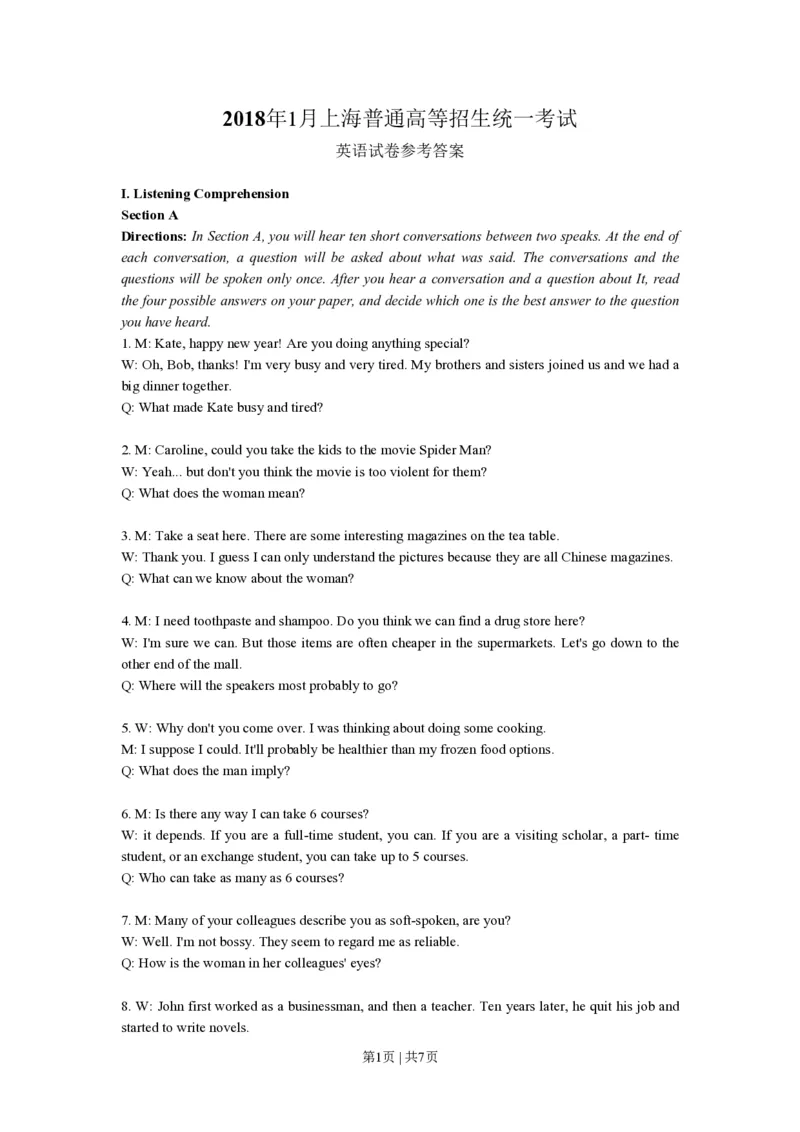
2018年1月上海普通高等招生统一考试
英语试卷参考答案
I. Listening Comprehension
Section A
Directions: In Section A, you will hear ten short conversations between two speaks. At the end of
each conversation, a question will be asked about what was said. The conversations and the
questions will be spoken only once. After you hear a conversation and a question about It, read
the four possible answers on your paper, and decide which one is the best answer to the question
you have heard.
1. M: Kate, happy new year! Are you doing anything special?
W: Oh, Bob, thanks! I'm very busy and very tired. My brothers and sisters joined us and we had a
big dinner together.
Q: What made Kate busy and tired?
2. M: Caroline, could you take the kids to the movie Spider Man?
W: Yeah... but don't you think the movie is too violent for them?
Q: What does the woman mean?
3. M: Take a seat here. There are some interesting magazines on the tea table.
W: Thank you. I guess I can only understand the pictures because they are all Chinese magazines.
Q: What can we know about the woman?
4. M: I need toothpaste and shampoo. Do you think we can find a drug store here?
W: I'm sure we can. But those items are often cheaper in the supermarkets. Let's go down to the
other end of the mall.
Q: Where will the speakers most probably to go?
5. W: Why don't you come over. I was thinking about doing some cooking.
M: I suppose I could. It'll probably be healthier than my frozen food options.
Q: What does the man imply?
6. M: Is there any way I can take 6 courses?
W: it depends. If you are a full-time student, you can. If you are a visiting scholar, a part- time
student, or an exchange student, you can take up to 5 courses.
Q: Who can take as many as 6 courses?
7. M: Many of your colleagues describe you as soft-spoken, are you?
W: Well. I'm not bossy. They seem to regard me as reliable.
Q: How is the woman in her colleagues' eyes?
8. W: John first worked as a businessman, and then a teacher. Ten years later, he quit his job and
started to write novels.
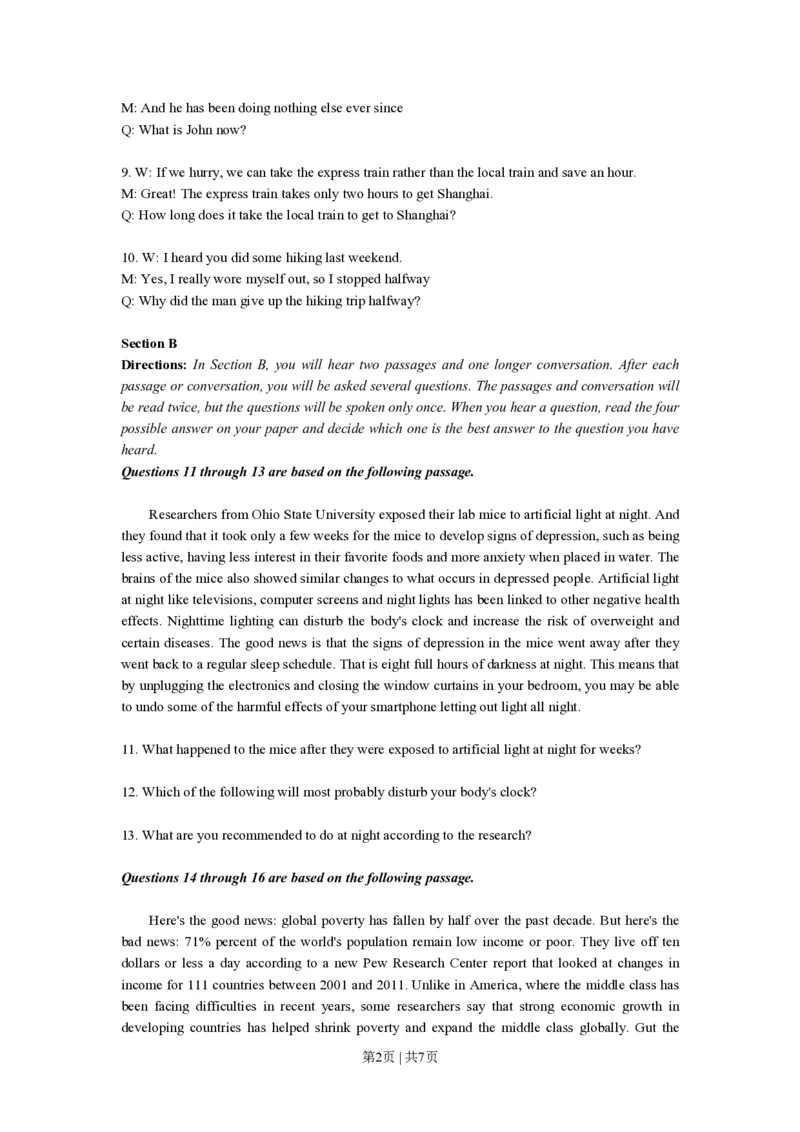
第1页 | 共7页M: And he has been doing nothing else ever since
Q: What is John now?
9. W: If we hurry, we can take the express train rather than the local train and save an hour.
M: Great! The express train takes only two hours to get Shanghai.
Q: How long does it take the local train to get to Shanghai?
10. W: I heard you did some hiking last weekend.
M: Yes, I really wore myself out, so I stopped halfway
Q: Why did the man give up the hiking trip halfway?
Section B
Directions: In Section B, you will hear two passages and one longer conversation. After each
passage or conversation, you will be asked several questions. The passages and conversation will
be read twice, but the questions will be spoken only once. When you hear a question, read the four
possible answer on your paper and decide which one is the best answer to the question you have
heard.
Questions 11 through 13 are based on the following passage.
Researchers from Ohio State University exposed their lab mice to artificial light at night. And
they found that it took only a few weeks for the mice to develop signs of depression, such as being
less active, having less interest in their favorite foods and more anxiety when placed in water. The
brains of the mice also showed similar changes to what occurs in depressed people. Artificial light
at night like televisions, computer screens and night lights has been linked to other negative health
effects. Nighttime lighting can disturb the body's clock and increase the risk of overweight and
certain diseases. The good news is that the signs of depression in the mice went away after they
went back to a regular sleep schedule. That is eight full hours of darkness at night. This means that
by unplugging the electronics and closing the window curtains in your bedroom, you may be able
to undo some of the harmful effects of your smartphone letting out light all night.
11. What happened to the mice after they were exposed to artificial light at night for weeks?
12. Which of the following will most probably disturb your body's clock?
13. What are you recommended to do at night according to the research?
Questions 14 through 16 are based on the following passage.
Here's the good news: global poverty has fallen by half over the past decade. But here's the
bad news: 71% percent of the world's population remain low income or poor. They live off ten
dollars or less a day according to a new Pew Research Center report that looked at changes in
income for 111 countries between 2001 and 2011. Unlike in America, where the middle class has
been facing difficulties in recent years, some researchers say that strong economic growth in
developing countries has helped shrink poverty and expand the middle class globally. Gut the
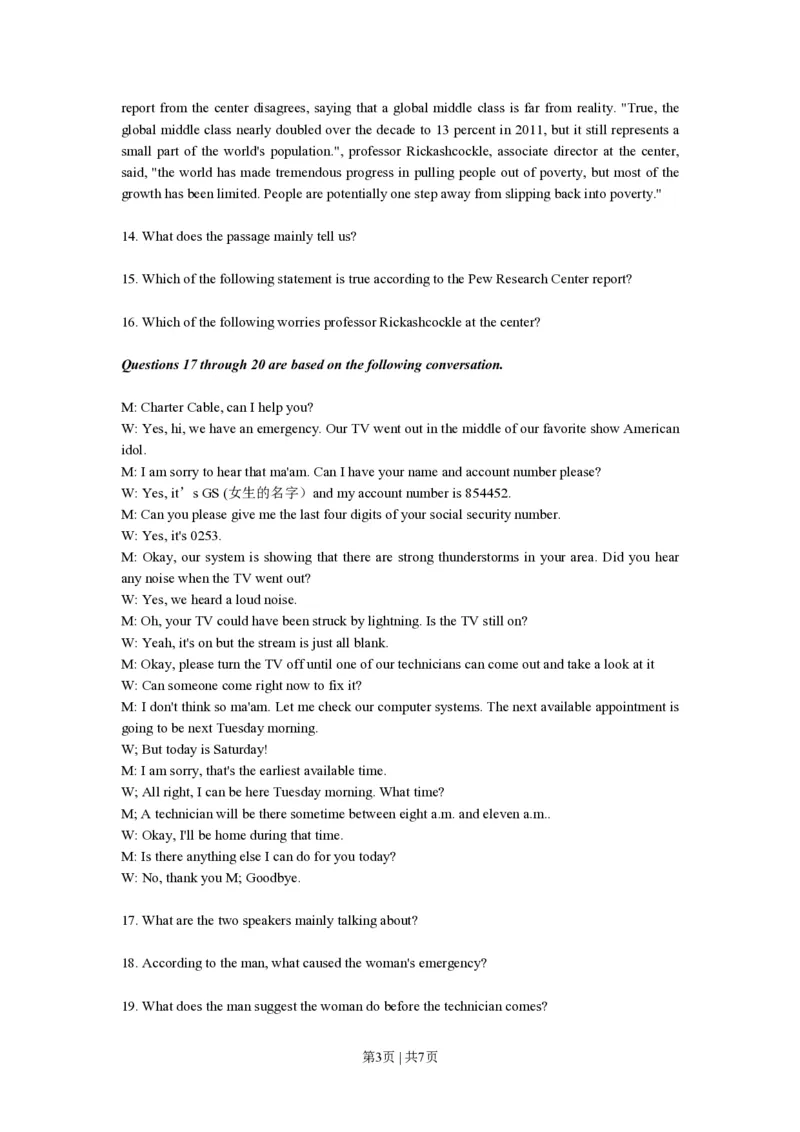
第2页 | 共7页report from the center disagrees, saying that a global middle class is far from reality. "True, the
global middle class nearly doubled over the decade to 13 percent in 2011, but it still represents a
small part of the world's population.", professor Rickashcockle, associate director at the center,
said, "the world has made tremendous progress in pulling people out of poverty, but most of the
growth has been limited. People are potentially one step away from slipping back into poverty."
14. What does the passage mainly tell us?
15. Which of the following statement is true according to the Pew Research Center report?
16. Which of the following worries professor Rickashcockle at the center?
Questions 17 through 20 are based on the following conversation.
M: Charter Cable, can I help you?
W: Yes, hi, we have an emergency. Our TV went out in the middle of our favorite show American
idol.
M: I am sorry to hear that ma'am. Can I have your name and account number please?
W: Yes, it’s GS (女生的名字)and my account number is 854452.
M: Can you please give me the last four digits of your social security number.
W: Yes, it's 0253.
M: Okay, our system is showing that there are strong thunderstorms in your area. Did you hear
any noise when the TV went out?
W: Yes, we heard a loud noise.
M: Oh, your TV could have been struck by lightning. Is the TV still on?
W: Yeah, it's on but the stream is just all blank.
M: Okay, please turn the TV off until one of our technicians can come out and take a look at it
W: Can someone come right now to fix it?
M: I don't think so ma'am. Let me check our computer systems. The next available appointment is
going to be next Tuesday morning.
W; But today is Saturday!
M: I am sorry, that's the earliest available time.
W; All right, I can be here Tuesday morning. What time?
M; A technician will be there sometime between eight a.m. and eleven a.m..
W: Okay, I'll be home during that time.
M: Is there anything else I can do for you today?
W: No, thank you M; Goodbye.
17. What are the two speakers mainly talking about?
18. According to the man, what caused the woman's emergency?
19. What does the man suggest the woman do before the technician comes?
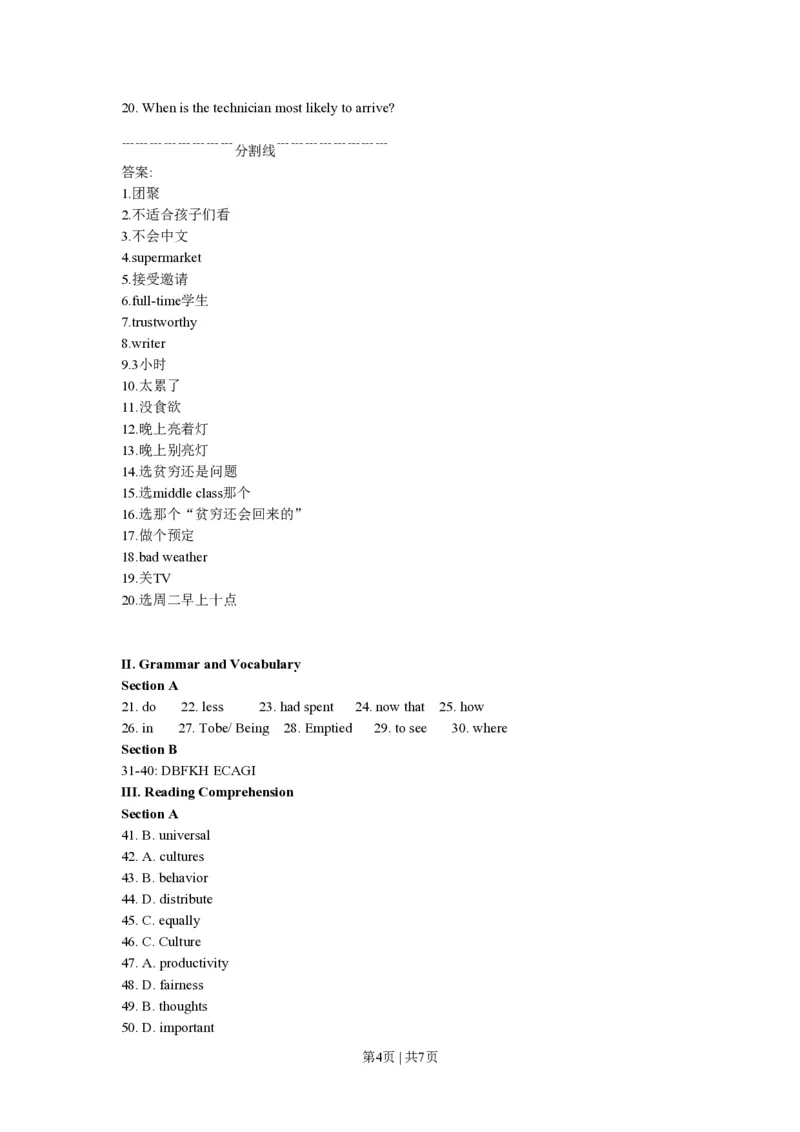
第3页 | 共7页20. When is the technician most likely to arrive?
﹉﹉﹉﹉﹉﹉﹉﹉分割线﹉﹉﹉﹉﹉﹉﹉﹉
答案:
1.团聚
2.不适合孩子们看
3.不会中文
4.supermarket
5.接受邀请
6.full-time学生
7.trustworthy
8.writer
9.3小时
10.太累了
11.没食欲
12.晚上亮着灯
13.晚上别亮灯
14.选贫穷还是问题
15.选middle class那个
16.选那个“贫穷还会回来的”
17.做个预定
18.bad weather
19.关TV
20.选周二早上十点
II. Grammar and Vocabulary
Section A
21. do 22. less 23. had spent 24. now that 25. how
26. in 27. Tobe/ Being 28. Emptied 29. to see 30. where
Section B
31-40: DBFKH ECAGI
III. Reading Comprehension
Section A
41. B. universal
42. A. cultures
43. B. behavior
44. D. distribute
45. C. equally
46. C. Culture
47. A. productivity
48. D. fairness
49. B. thoughts
50. D. important
第4页 | 共7页51. C. by contrast
52. A. familiar
53. D. sharing
54. C. balancing
55. B. imaginary
Section B
56-59:CBBA 60-62:CAD 63-66:CCBC
Section C
66. B. If you answered no, you’re not alone.
67. D. Your values and needs may also vary from one appointment to the next.
68. A. We weigh benefits of medications versus the complexity of adding one more drug to her
crowded pill box
69. F. A year from now after graduation, we’ll revisit the conversation, as his goals and needs may
be different
IV. Summary Writing
参考答案:
Scientists think humans are born with the ability to laugh, but why do we laugh? We laugh to feel
closer to one another. Laughter helps us to be recognized so we laugh more in groups than when
alone. Laughter also evolved from a more basic need to survive as it promoted cooperation,
enabling humans to survive better. (59w)
(be born with= be inborn/ accepted= recognized= identified/ be born out of= evolve from=come
from =originate from)
Laughter is unconscious, infectious and basic. It brings us a trustworthy, comfortable and honest
feeling, thus better maintaining friendships. Chances are that we laugh more with others around,
contributing to prompting recognition and feeling more connected with one another. Scientists
assure that laughter resulted in greater cooperation between individuals in ancient times, as better
cooperation leads to survival. (58w)
We were born with the ability of helping and scientists think the reason why we laugh is that we
feel connected with others and we want to be recognized by others. Besides, laughter helps people
to cooperate to survive with. (40w)
内容评分细则
5分 1. 在包含三个要点的基础上,提及第(2)和第(3)个要点中的主要信息(下划线部分)
We laugh to feel closer to one another.
Laughter helps us to be recognized so we laugh more in groups than when alone.
Laughter also evolved from a more basic need to survive as it promoted cooperation, enabling
humans to survive better.
2.在包含三个要点的基础上,同时提及“humans are born with the ability to
laugh”这一信息及第(2)或第(3)个要点中的主要信息(下划线部分)
4分 在包含三个要点的基础上,提及第(2)或第(3)个要点中的主要信息(下划线部分)
We laugh to feel closer to one another.
第5页 | 共7页Laughter helps us to be recognized so we laugh more in groups than when alone.
Laughter also evolved from a more basic need to survive as it promoted cooperation, enabling
humans to survive better.
3分 包含以下三个要点
(1) We laugh to feel closer to one another
(2) Laughter helps us to be recognized.
(3) Laughter also evolved from a more basic and survive.
补充细则:
1)语言全部沿用原文,语言分为0;内容分不超过4分
2)连续沿用原文5个字以上,语言分扣1分
3)laugh/ laughter/cooperation/ survive/ survival 允许出现在答案中,不必paraphrase
4) 在通篇准确流畅的基础上,文笔优美的语言可适当加分
5) 62个字以上酌情扣分
V. Translation
1.Don’t think too much sugary drinks/ sugared beverages, or it is easy for you to gain weight.
2.He insisted that he wasn’t guilty of robbing / robbery in court.
3.Do you agree creativity always occurs when you are in a good mood?
4.When it comes to office conflicts, experts suggest one should reflect more on herself or himself,
always put themselves in others’ shoes, and communicate with workmates in time.
VI. Guided Writing
Dear headmaster,
So appealing(倒装句)is your plan to introduce a robot to our school that I decide to respond
to your asking for proposals. From my perspective, a robot is more suitable for the position of
librarian.
With regard to the range of service, a librarian needs not only to classify different kinds of
books, put and find them in the right order on the right shelf but also keep a record of what books
are borrowed and returned, while being a waiter in a restaurant involves serving the right dishes to
the right table, do some cleaning and communicating with the diners. A robot can accomplish
three or four librarians’ work of sorting and labeling books at the same time, whereas it is pale
before a man in communicating and tackling the unexpected (unpredictable) occasions.
In terms of working efficiency, a robot may be more efficient in doing the programmed,
mechanical and repetitive kind of work. Therefore, it is more advisable for the robot to undertake
the duties of a librarian grouping countless books repeatedly, thus considerably improving the
efficiency of a human librarian. However, when it comes to the work of a waiter, who needn’t
work so heavily and fast as a librarian but do need react flexibly to the diners’ requirements, a
robot won’t make a remarkable difference and even may not be more qualified than a man.
In a nutshell, it is the mechanical work of a librarian that the robot is more competent
at. Hope that my advice will be of great help to your decision.
第6页 | 共7页Wang lei
第7页 | 共7页