Unit 5 What a Delicious Meal!
授课时
科目 英语 年级 八年级 班级
间
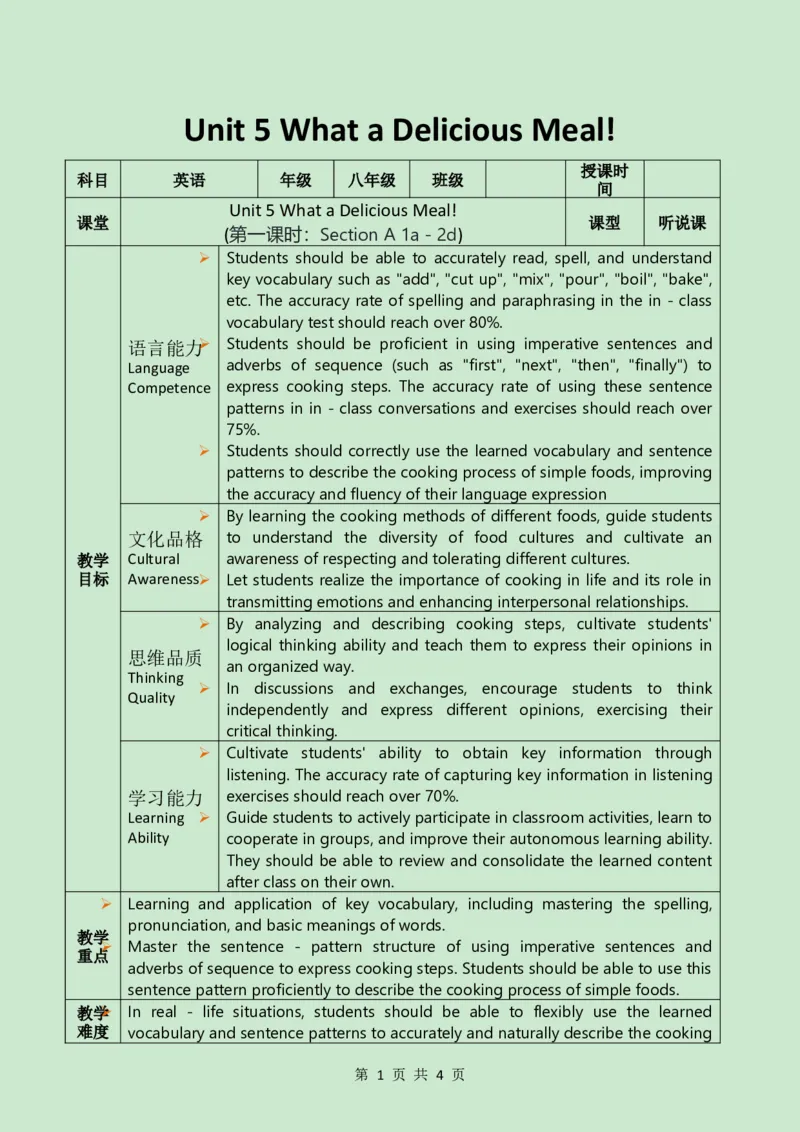
Unit 5 What a Delicious Meal!
课堂 课型 听说课
(第一课时:Section A 1a - 2d)
Students should be able to accurately read, spell, and understand
key vocabulary such as "add", "cut up", "mix", "pour", "boil", "bake",
etc. The accuracy rate of spelling and paraphrasing in the in - class
vocabulary test should reach over 80%.
语言能力 Students should be proficient in using imperative sentences and
Language adverbs of sequence (such as "first", "next", "then", "finally") to
Competence express cooking steps. The accuracy rate of using these sentence
patterns in in - class conversations and exercises should reach over
75%.
Students should correctly use the learned vocabulary and sentence
patterns to describe the cooking process of simple foods, improving
the accuracy and fluency of their language expression
By learning the cooking methods of different foods, guide students
文化品格 to understand the diversity of food cultures and cultivate an
教学 Cultural awareness of respecting and tolerating different cultures.
目标 Awareness Let students realize the importance of cooking in life and its role in
transmitting emotions and enhancing interpersonal relationships.
By analyzing and describing cooking steps, cultivate students'
logical thinking ability and teach them to express their opinions in
思维品质
an organized way.
Thinking
In discussions and exchanges, encourage students to think
Quality
independently and express different opinions, exercising their
critical thinking.
Cultivate students' ability to obtain key information through
listening. The accuracy rate of capturing key information in listening
学习能力 exercises should reach over 70%.
Learning Guide students to actively participate in classroom activities, learn to
Ability cooperate in groups, and improve their autonomous learning ability.
They should be able to review and consolidate the learned content
after class on their own.
Learning and application of key vocabulary, including mastering the spelling,
pronunciation, and basic meanings of words.
教学
Master the sentence - pattern structure of using imperative sentences and
重点
adverbs of sequence to express cooking steps. Students should be able to use this
sentence pattern proficiently to describe the cooking process of simple foods.
教学 In real - life situations, students should be able to flexibly use the learned
难度 vocabulary and sentence patterns to accurately and naturally describe the cooking
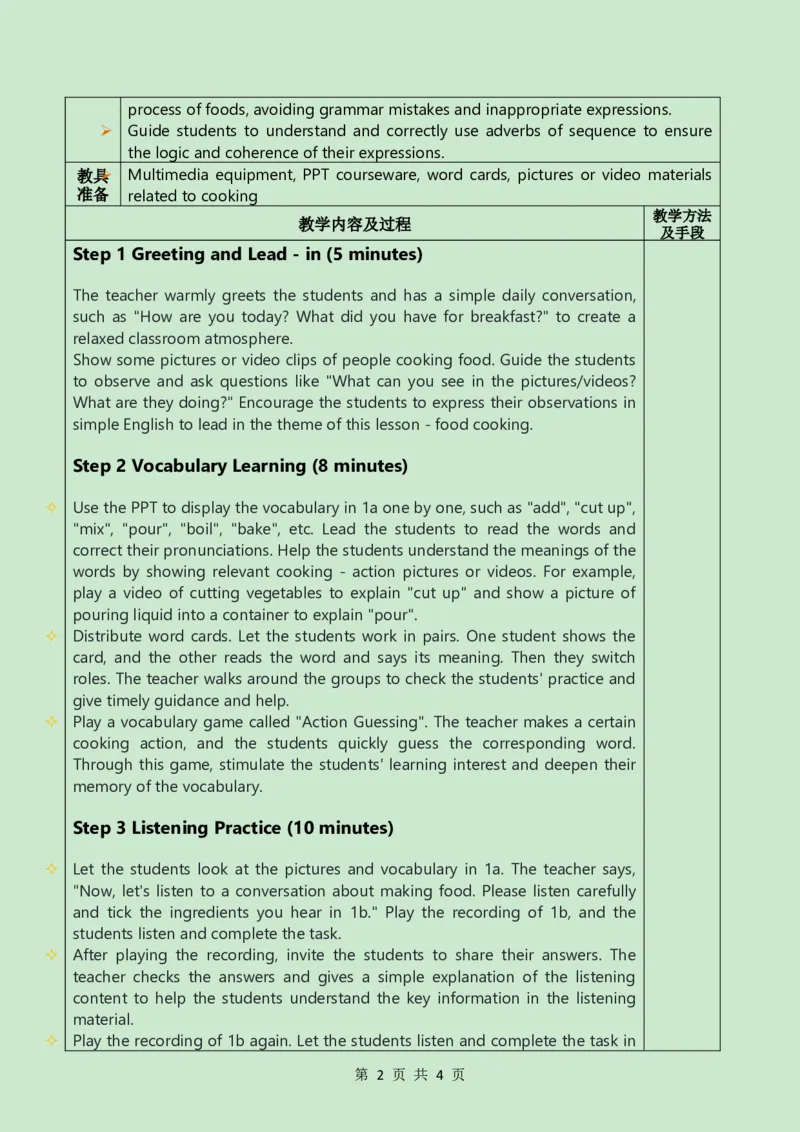
第 1 页 共 4 页process of foods, avoiding grammar mistakes and inappropriate expressions.
Guide students to understand and correctly use adverbs of sequence to ensure
the logic and coherence of their expressions.
教具 Multimedia equipment, PPT courseware, word cards, pictures or video materials
准备 related to cooking
教学方法
教学内容及过程
及手段
Step 1 Greeting and Lead - in (5 minutes)
The teacher warmly greets the students and has a simple daily conversation,
such as "How are you today? What did you have for breakfast?" to create a
relaxed classroom atmosphere.
Show some pictures or video clips of people cooking food. Guide the students
to observe and ask questions like "What can you see in the pictures/videos?
What are they doing?" Encourage the students to express their observations in
simple English to lead in the theme of this lesson - food cooking.
Step 2 Vocabulary Learning (8 minutes)
Use the PPT to display the vocabulary in 1a one by one, such as "add", "cut up",
"mix", "pour", "boil", "bake", etc. Lead the students to read the words and
correct their pronunciations. Help the students understand the meanings of the
words by showing relevant cooking - action pictures or videos. For example,
play a video of cutting vegetables to explain "cut up" and show a picture of
pouring liquid into a container to explain "pour".
Distribute word cards. Let the students work in pairs. One student shows the
card, and the other reads the word and says its meaning. Then they switch
roles. The teacher walks around the groups to check the students' practice and
give timely guidance and help.
Play a vocabulary game called "Action Guessing". The teacher makes a certain
cooking action, and the students quickly guess the corresponding word.
Through this game, stimulate the students' learning interest and deepen their
memory of the vocabulary.
Step 3 Listening Practice (10 minutes)
Let the students look at the pictures and vocabulary in 1a. The teacher says,
"Now, let's listen to a conversation about making food. Please listen carefully
and tick the ingredients you hear in 1b." Play the recording of 1b, and the
students listen and complete the task.
After playing the recording, invite the students to share their answers. The
teacher checks the answers and gives a simple explanation of the listening
content to help the students understand the key information in the listening
material.
Play the recording of 1b again. Let the students listen and complete the task in
第 2 页 共 4 页1c, numbering the instructions. After playing, invite the students to share their
answers, check and explain the answers to help the students understand the
listening content. When explaining the answers, the listening text can be
combined to help the students better understand the sentence structures and
key information.
Step 4 Oral Practice (7 minutes)
The teacher makes a demonstration: "Let's talk about how to make mashed
potatoes. First, wash the potatoes. Next, cut them into pieces. Then, put the
potatoes in a pot and boil them until they are soft. After that, add salt and
pepper. Finally, mash the potatoes." Guide the students to observe the pictures
and use the learned vocabulary and adverbs of sequence to describe the
process of making mashed potatoes.
Let the students work in pairs. According to the pictures and vocabulary in 1a,
they choose a food and have a conversation practice, describing its cooking
process to each other. The teacher walks around the groups, encourages the
students to speak actively, and corrects their grammar mistakes and
pronunciation problems in time.
Invite several pairs of students to show their conversations. The other students
listen carefully and give evaluations. The evaluation content includes the
accuracy of vocabulary usage, the correctness of sentence patterns, and the
fluency of expression. The teacher summarizes and gives feedback on the
students' performance, gives affirmation and encouragement, and also puts
forward suggestions for improvement.
Step 5 Pronunciation Practice (5 minutes)
Play the pronunciation - practice audio and display the classification of
phonetic symbols, such as /əʊ/ (potato, coat, etc.), /aʊ/ (house, how, etc.). Let
the students follow and imitate, paying attention to the mouth - shape and
tongue - position of pronunciation.
Play the audio again. The students follow the audio, and the teacher
emphasizes the rhythm and intonation of the sentences. Invite individual
students to imitate and read aloud. The teacher corrects and guides them to
help the students master the correct pronunciation skills.
Step 6 Listening and Oral Expansion (10 minutes)
Play the recording of the conversation in 2a. Let the students listen and think
about the questions: "What dish are they talking about? What are the steps to
make it?" After playing the recording, invite the students to answer the
questions.
Play the recording again. The students follow the recording and imitate the
pronunciation and intonation. Then let the students work in pairs and read the
第 3 页 共 4 页conversation in roles, paying attention to the pronunciation, intonation, and
emotional expression.
Invite several pairs of students to show their performance. The other students
listen carefully and give evaluations. The teacher finally summarizes and gives
feedback. Guide the students to pay attention to the vocabulary and sentence
patterns describing the cooking process in the conversation and encourage
them to use them flexibly in real - life communication.
Recite the key vocabulary learned in this lesson. Get the signature of parents to
confirm. There will be a vocabulary quiz the next day.
布置 Use the learned vocabulary and sentence patterns to describe the cooking
作业 process of a simple food you like, with no less than 5 sentences.
Preview the content of Section A's Grammar Focus - 3c and try to understand the
grammar knowledge.
1. Key Vocabulary and Phrases:
add; cut up; mix; pour; boil; bake
2. Sentence Patterns for Describing Cooking Steps:
板书
设计 First,... Next,... Then,... Finally,...
3. Pronunciation Practice:
/əʊ/ potato coat;
/aʊ/ house how
第 4 页 共 4 页