2010 年 12 月英语四级考试阅读真题
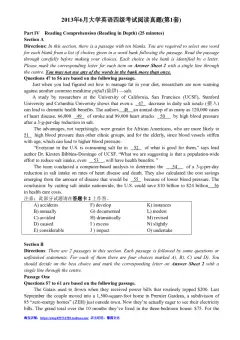
Part ⅣReading Comprehension(Reading inDepth) (25minutes)
SectionA
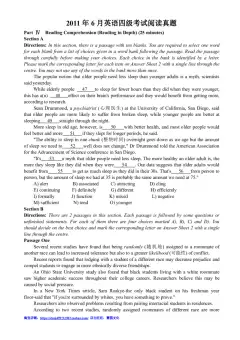
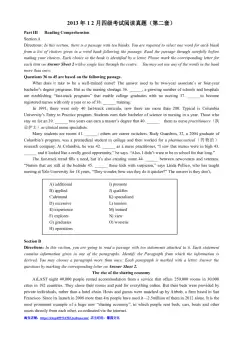
Directions: In this section, there is a passage with ten blanks. You are required to select one
word for each blank from a list of choices given in a word bank following the passage. Read the
passage through carefully before making your choices. Each choice in the bank is identified by a
letter. Please mark the corresponding letter for each item on Answer Sheet 2 with a single line
through thecentre. Youmay not useanyof thewords in thebankmorethan once.
Questions 47to56arebasedon thefollowing passage.
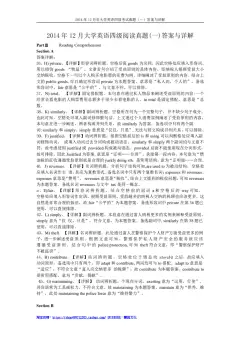
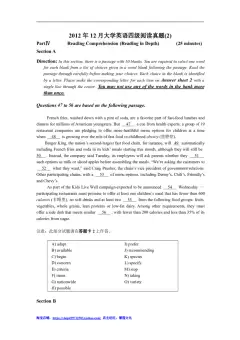
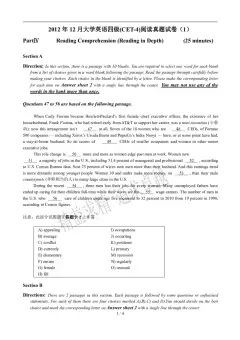
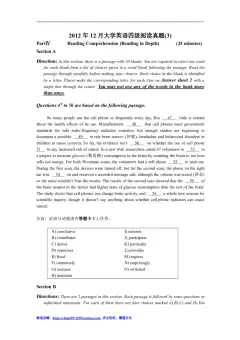
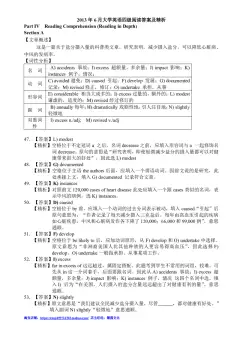
What determines the kind of person you are? What factors make you more or less bold,
intelligent, or able to read a map? All of these are influenced by the interaction of your genes and
the environment in which you were 47 . The study of how genes and environment interact to
influence 48 activity is known as behavioral genetics. Behavioral genetics has made important 49 to
the biological revolution, providing information about the extent to which biology influences mind,
brain and behavior.
Any research that suggests that 50 to perform certain behaviors are based in biology is
controversial. Who wants to be told that there are limitations to what you can 51 based on
something that is beyond your control, such as your genes? It is easy to accept that genes control
physical characteristics such as sex, race and eye color. But can genes also determine whether
people will get divorced, how 52 they are, or what career they are likely to choose? A concern of
psychological scientists is the 53 to which all of these characteristics are influenced by nature and
nurture(养育), by genetic makeup and the environment. Increasingly, science 54 that genes lay the
groundwork for many human traits. From this perspective, people are born 55 like undeveloped
photographs: The image is already captured, but the way it 56 appears can vary based on the
development process. However,thebasic picture isthere from thebeginning.
注意:此部分试题请在答题卡2上作答。
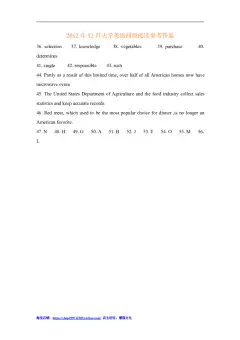
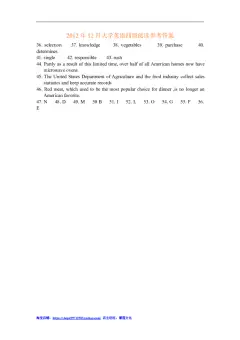
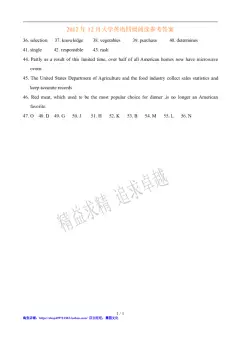
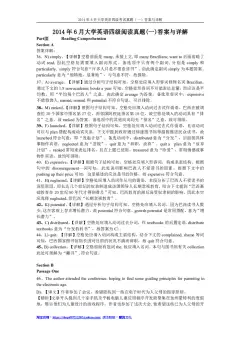
[A]abilities [I] extent
[B] achieve [J]indicates
[C]appeal [K]proceeds
[D]complaints [L] psychological
[E]contributions [M]raised
[F] displayed [N]smart
[G]essentially [O]standard
[H]eventually
SectionB
Directions: There are 2 passages in this section. Each passage is followed by some questions
or unfinished statements. For each of them there are four choices marked [A], [B], [C] and [D].
You should decide on the best choice and mark the corresponding letter on Answer Sheet 2 with a
singlelinethrough thecentre.
PassageOne
Questions 57to61arebasedon thefollowing passage.
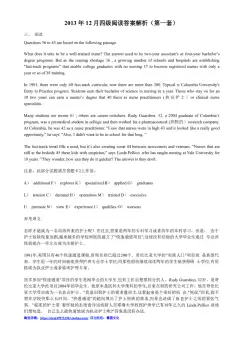
It is pretty much a one-way street. While it may be common for university researchers to try
their luck in the commercial world, there is very little traffic in the opposite direction. Pay has
always been the biggest deterrent, as people with families often feel they cannot afford the drop in
salary when moving to a university job. For some industrial scientists, however, the attractions of
academia (学术界) outweigh anyfinancial considerations.
淘宝店铺:https://shop499712503.taobao.com/ 店主旺旺:慧园文化Helen Lee took a 70% cut in salary when she moved from a senior post inAbbott Laboratories
to a medical department at the University of Cambridge. Her main reason for returning to academia
mid-career was to take advantage of the greater freedom to choose research questions. Some areas
ofinquiry havefew prospects ofacommercial return, and Lee’s is oneof them.
The impact of a salary cut is probably less severe for a scientist in the early stages of a career.
Guy Grant, now a research associate at the Unilever Centre for Molecular Informatics at the
University of Cambridge, spent two years working for a pharmaceutical (制药的) company before
returning to university as a post-doctoral researcher. He took a 30% salary cut but felt it worthwhile
forthegreater intellectual opportunities.
Higher up the ladder, where a pay cut is usually more significant, the demand for scientists
with a wealth of experience in industry is forcing universities to make the transition (转换) to
academia more attractive, according to Lee. Industrial scientists tend to receive training that
academics do not, such as how to build a multidisciplinary team, manage budgets and negotiate
contracts. They are also well placed to bring something extra to the teaching side of an academic
role that will help students get a job when they graduate, says Lee, perhaps experience in
manufacturing practice or product development. “Only a small number of undergraduates will
continue in an academic career. So someone leaving university who already has the skills needed to
work in an industrial lab has far more potential in the job market than someone who has spent all
theirtimeona narrow research project.”
注意: 此部分试题请在答题卡2 上作答。
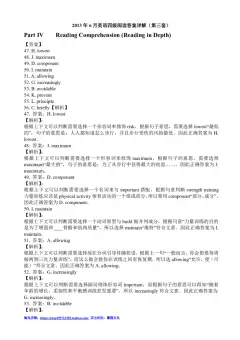
57.By“a one-way street”(Line 1,Para. 1), theauthormeans ________.
[A]university researchers knowlittleabout the commercial world
[B] there islittle exchange between industry and academia
[C]few industrialscientists would quit towork in auniversity
[D]few university professors are willing todoindustrial research
58.Theword “deterrent” (Line 2,Para. 1)most probably refers tosomething that ________.
[A]keeps someonefrom taking action [C]attracts people’s attention
[B] helps to movethetraffic [D]brings someone afinancial burden
59. What was Helen Lee’s major consideration when she changed her job in the middle of her
career?
[A]Flexiblework hours. [C]Her preference forthe lifestyle oncampus.
[B] Her research interests. [D]Prospects ofacademic accomplishments.
60.Guy Grant chose to work as aresearcher at Cambridge in order to ________.
[A]dofinancially morerewarding work
[B] raisehis status in theacademicworld
[C]enrich hisexperience in medical research
[D]exploit better intellectual opportunities
61.What contribution can industrial scientistsmake when theycome toteach in auniversity?
[A]Increase its graduates’competitiveness in thejob market.
[B] Develop its students’potential inresearch.
[C]Help it toobtain financial support from industry.
[D]Gear itsresearch towards practical applications.
PassageTwo
Questions 62to66arebasedon thefollowing passage.
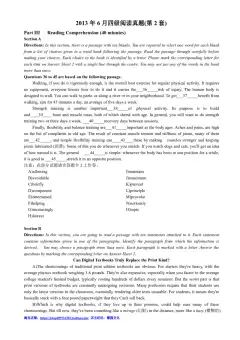
Being sociable looks like a good way to add years to your life. Relationships with family,
friends, neighbours, even pets, will all do the trick, but the biggest longevity (长寿) boost seems to
come from marriage or an equivalent relationship. The effect was first noted in 1858 by William
淘宝店铺:https://shop499712503.taobao.com/ 店主旺旺:慧园文化Farr, who wrote that widows and widowers (鳏夫) were at a much higher risk of dying than their
married peers. Studies since then suggest that marriage could add as much as seven years to a man’s
life and two to a woman’s. The effect holds for all causes of death, whether illness, accident or
self-harm.
Even if the odds are stacked against you, marriage can more than compensate. Linda Waite of
the University of Chicago has found that a married older man with heart disease can expect to live
nearly four years longer than an unmarried man with a healthy heart. Likewise, a married man who
smokes more than a pack a day is likely to live as long as a divorced man who doesn’t smoke.
There’s a flip side, however, as partners are more likely to become ill or die in the couple of years
following their spouse’s death, and caring for a spouse with mental disorder can leave you with
some of the same severe problems. Even so, the odds favour marriage. In a 30-year study of more
than 10,000 people, Nicholas Christakis of Harvard Medical School describes how all kinds of
social networks have similareffects.
So how does it work? The effects are complex, affected by socio-economic factors,
health-service provision, emotional support and other more physiological (生理的) mechanisms.
For example, social contact can boost development of the brain and immune system, leading to
better health and less chance of depression later in life. People in supportive relationships may
handlestress better.Then there are thepsychological benefits ofa supportivepartner.
A life partner, children and good friends are all recommended if you aim to live to 100. The
ultimate social network is still being mapped out, but Christakis says: “People are interconnected, so
theirhealth is interconnected.”
注意: 此部分试题请在答题卡2 上作答。
62.WilliamFarr’s study and other studies showthat _________.
[A]social life provides an effective cure for illness
[B] being sociable helps improveone’s quality oflife
[C]women benefit morethan men from marriage
[D]marriage contributes agreat deal tolongevity
63.LindaWaite’s studies support theidea that _________.
[A]older menshould quitsmoking tostay healthy
[B] marriage can help makeupfor illhealth
[C]themarried are happier than theunmarried
[D]unmarried people are likelyto suffer in laterlife
64.It can be inferred from thecontextthat the“flipside”(Line 4,Para. 2)refers to _________.
[A]thedisadvantages of being married
[B] theemotional problems arising from marriage
[C]theresponsibilityof taking care ofone’sfamily
[D]theconsequence of abroken marriage
65.What does theauthorsay about social networks?
[A]They have effects similartothoseofa marriage.
[B]They help develop people’scommunity spirit.
[C]They provide timely support forthosein need.
[D]They help relieve people oftheirlife’s burdens.
66.What can beinferred from thelast paragraph?
[A]It’s important that wedevelop asocial network when young.
[B]Tostay healthy,oneshould have aproper social network.
[C]Getting adivorce means riskinga reduced lifespan.
[D]Weshould share oursocial networks with each other.
淘宝店铺:https://shop499712503.taobao.com/ 店主旺旺:慧园文化