更多精品课程加微信:M920853
更多精品课程加微信:M920853
更多精品课程加微信:M920853
前言
希望学教研团队
亲爱的同学:
当你翻开这本书的时候,你又开始了一段新的学习之旅。
本书由希望学教研团队编写而成。团队有多年的教研沉淀,致力于为同学们
提供小学、初中和高中全学科的课外有益补充,培养学生分析问题和自主解决问
题的能力。锻炼思维,开拓视野,由“知识型”向“能力型”转化。
下面我们将向你介绍本书的诞生过程:
1、对标教材和课程标准建立课程大纲
希望学教研团队根据教育部审定的最新中学教材,选取重难点模块,收集各
地区题目,精心敲定教学大纲。
2、依据大数据、编撰高标准
①依托多年教研沉淀,精品题库、讲义素材、课件切片等四大库教研基建,
为讲义编撰提供优质素材;
②希望学大数据核心算法定位学习中的薄弱环节;
③百人教研团队,历经1000+小时,严格按照大纲目录进行编写,三轮审核
三轮校对。
3、三审三校
初稿经由希望学教研中心内部一审,学科产品、教学中心、主讲老师集中二
审,外部专家专业三审后进入校对环节。
由编者一次精校;教研中心资深教研员二次精校;排版团队三次精校。只有
经过全面的三审三校,这本书才能发送给我们的用户!
4、排版
编撰与审校结束后,会安排专业团队进行排版印刷。模板和风格由专业设计
师进行设计,并不断更新迭代,紧跟审美风向标,提升可读性。由供应部门统一
调配和发货,这本书就会到达你的手中啦!
路漫漫其修远兮,吾将上下而求索!接下来的每一天,我们都会在你的见证
下不断精进,不断成长。
未来,希望学也会继续承担起用科技推动教育进步的重任,不断致力于教育
资源的均衡发展。伴随着你的成长,见证着你的成功,每天进步一点点,一起做
更好的自己!
更多精品课程加微信:M920853
更多精品课程加微信:M920853
更多精品课程加微信:M920853
更多精品课程加微信:M920853
更多精品课程加微信:M920853
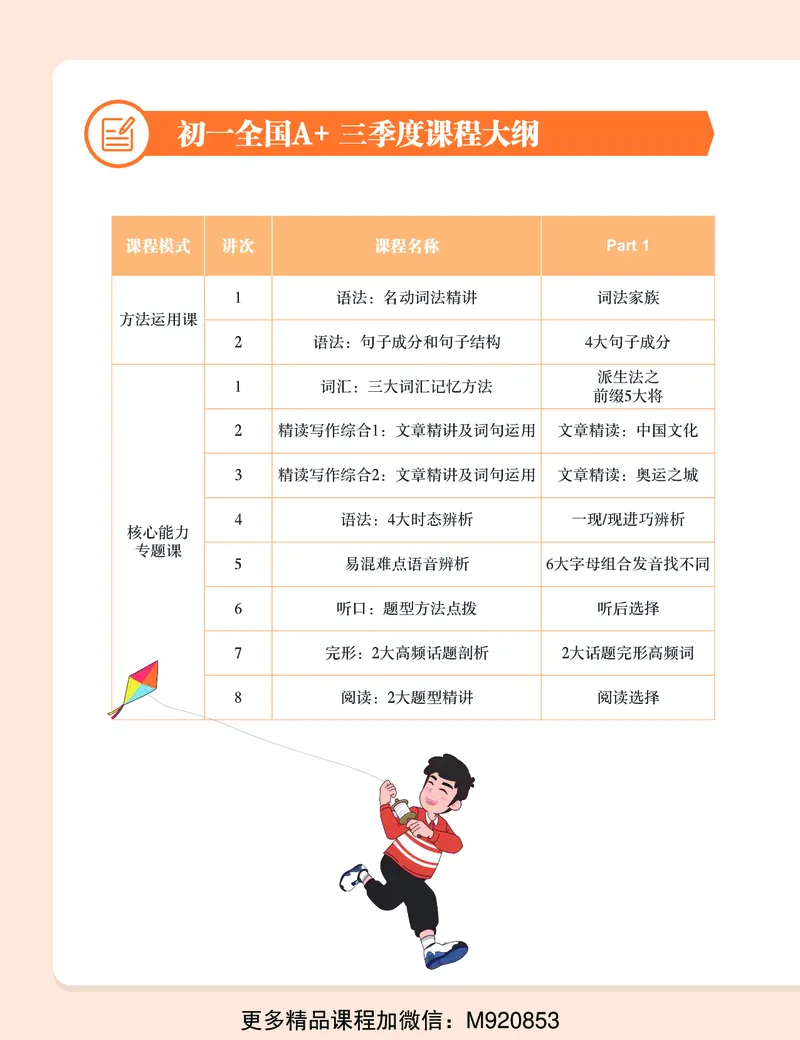
初一全国A+ 三季度课程大纲
方法运用课
词法家族
4大句子成分
派生法之
前缀5大将
文章精读:中国文化
文章精读:奥运之城
一现/现进巧辨析
6大字母组合发音找不同
听后选择
2大话题完形高频词
阅读选择
语法:名动词法精讲
语法:句子成分和句子结构
词汇:三大词汇记忆方法
精读写作综合1:文章精讲及词句运用
精读写作综合2:文章精讲及词句运用
语法:4大时态辨析
易混难点语音辨析
听口:题型方法点拨
完形:2大高频话题剖析
阅读:2大题型精讲
1
2
1
2
3
4
5
6
7
8
核心能力
专题课
课程模式
讲次
课程名称
Part 1
更多精品课程加微信:M920853
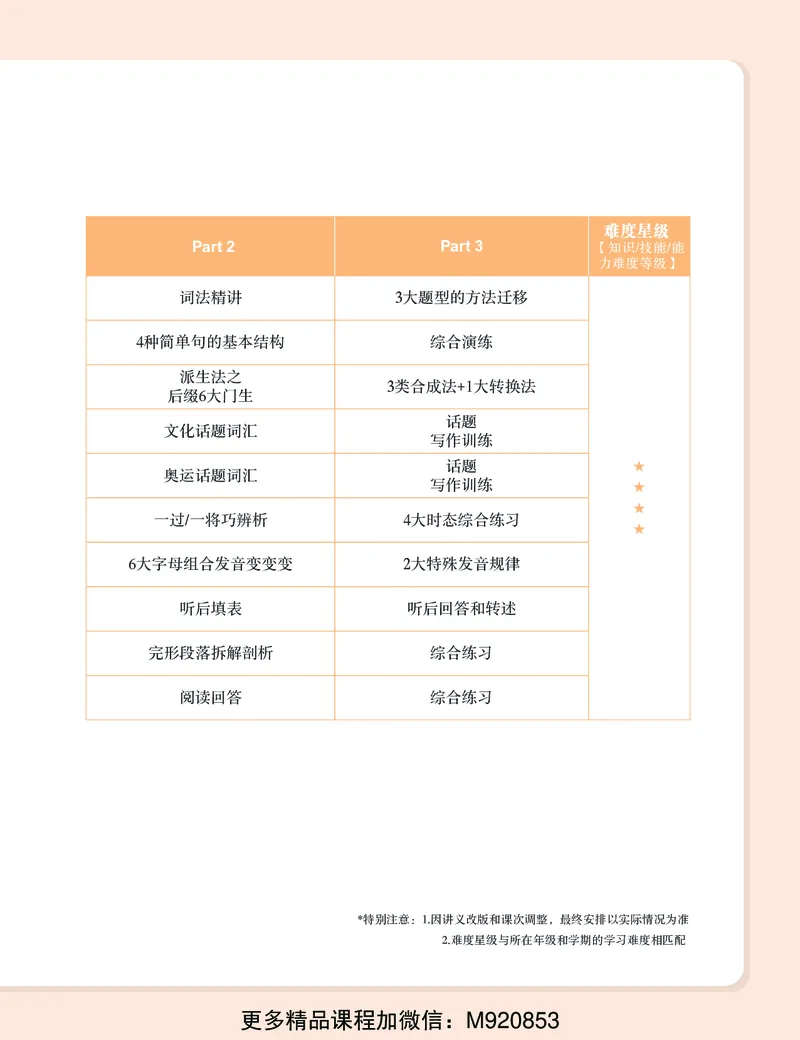
*特别注意:1.因讲义改版和课次调整,最终安排以实际情况为准
                      2.难度星级与所在年级和学期的学习难度相匹配
词法精讲
4种简单句的基本结构
派生法之
后缀6大门生
文化话题词汇
奥运话题词汇
一过/一将巧辨析
6大字母组合发音变变变
听后填表
完形段落拆解剖析
阅读回答
3大题型的方法迁移
综合演练
3类合成法+1大转换法
话题
写作训练
话题
写作训练
4大时态综合练习
2大特殊发音规律
听后回答和转述
综合练习
综合练习
Part 2
Part 3
难度星级
【知识/技能/能
力难度等级】
★
★
★
★
更多精品课程加微信:M920853
Contents
方法运用课
Lecture 1
Part One
词法家族
2
Part Two
词法精讲
3
Part Three
3 大题型的方法迁移
7
Part Four
随堂练习
11
Lecture 2
Part One
4 大句子成分
14
Part Two
4 种简单句的基本结构
16
Part Three
综合演练
20
Part Four
随堂练习
22
核心能力专项课
Lecture 1
Part One
派生法之前缀5 大将
24
Part Two
派生法之后缀6 大门生
26
Part Three
3 类合成法+1 大转换法
28
Part Four
随堂练习
31
Lecture 2
Part One
文章精读: 中国文化
34
Part Two
文化话题词汇
37
Part Three
话题写作训练
40
Part Four
随堂练习
42
更多精品课程加微信:M920853
Lecture 3
Part One
文章精读:奥运之城
46
Part Two
奥运话题词汇
49
Part Three
话题写作训练
53
Part Four
随堂练习
55
Lecture 4
Part One
一现/现进巧辨析
60
Part Two
一过/一将巧辨析
62
Part Three
4 大时态综合练习
64
Part Four
随堂练习
67
Lecture 5
Part One
6 大字母组合发音找不同
70
Part Two
6 大字母组合发音变变变
73
Part Three
2 大特殊发音规律
76
Part Four
随堂练习
78
Lecture 6
Part One
听后选择
80
Part Two
听后填表
84
Part Three
听后回答和转述
89
Part Four
随堂练习
94
Lecture 7
Part One
2 大话题完形高频词
98
Part Two
完形段落拆解剖析
102
Part Three
综合练习
106
Part Four
随堂练习
108
Lecture 8
Part One
阅读选择
110
Part Two
阅读回答
114
Part Three
综合练习
118
Part Four
随堂练习
122
更多精品课程加微信:M920853
更多精品课程加微信:M920853
LECTURE 1
Lecture1
Part One
词法家族
分析词法常考题型错因
学习2 大词性的含义及缩写
Part Two
词法精讲
学习名词的常见位置及3 大考法
学习动词的常见位置及2 大考法
Part Three
3 大题型的方法迁移
运用所学方法解决词法3 大易
错题型
Part Four
随堂练习
更多精品课程加微信:M920853
初一| 英语| 目标A+ 班
2
模块1
Part One
词法家族
为什么要学习词法?
考试题型
错误原因
真实原因
客观题
单项选择、完形填空
①不认识单词
②单词辨析易混淆
①不知道词义
②不了解词性及其转换
③搞不懂词汇的语法形式
主观题
首字母填空、方框选词、
用括号中所给词的适当形式
填空、根据汉语提示填空
①词性填错
②词形变错(a.语法b.转换)
常考词性介绍
词性
说明
英语缩写
名词
表示人、事物或地点的词,如Jason, apple, museum…
n.
动词
表示动作的词,如like, begin, have…
v.
更多精品课程加微信:M920853
初一| 英语| 目标A+ 班
3
模块2
Part Two
词法精讲
名词的灵活运用
1. 名词的位置
速记:___________________
Dogs are cute.
I have a new bag.
He is a teacher.
This is my book.
2. 名词的考法
考法1:变复数(条件:可数名词前有数量修饰词)常加 -s/-es 【见知识回顾1】
例题:Mrs. Bird would like some ______ (cherry). They are very nice.
【答案】cherries
考法2:变词性
1)v. 变n.
write → writer         teach → teacher
visit → _______     play → player
2)adj. 变n.
healthy → health       rainy → rain
dangerous → __________
更多精品课程加微信:M920853
初一| 英语| 目标A+ 班
4
例题:
1. Lu Xun is a great ________ (write) in China.
【答案】writer
2. Fish is good for our ________ (healthy).
【答案】health
考法 3:知词义(分析语境来判断)【见知识回顾 2】
例题:— What do you want to drink?
          —________, please.
           A. A hot dog        B. Milk       C. Some bananas
【答案】B
Practice I 方框选词
解题大招:看位置判词性,想考法来变形
A. tells
B. likes
C. subjects
1. I'm studying some new
, such as science, IT, and art. IT is very interesting.
A. meet
B. scarves
C. favorite
2. It is cold and windy today. Many people wear
to keep themselves warm.
Practice II 根据提示完成句子
解题大招:看位置判词性,想考法来变形
1. I have some new f
(朋友).
2. We should brush our t
twice a day.
3. I have two English d
. They help me know about English words (单词).
4. There are many
(visit) in the museum.
更多精品课程加微信:M920853
初一| 英语| 目标A+ 班
5
动词的灵活运用
1. 动词的位置
速记:_____________
We have lunch in the dining hall.
Paul likes art and history.
Li Mei can ride a bike.
2. 动词的考法
考法1:变时态( 三单/ 现在分词) 【见知识回顾3 和4】
例题:
【答案】
2. Look! The cat __________ (lie) under the desk. How lovely it is!
【答案】 is lying
考法2:后接to do/doing
1)后接to do: want, hope, plan, would like
2)后接doing: _______________________
例题:
1. I hope __________ (see) you soon.
【答案】to see
2. Do you enjoy ________(购物)with me?
【答案】 shopping
更多精品课程加微信:M920853
初一| 英语| 目标A+ 班
6
Practice I 方框选词
解题大招:看位置判词性,想考法来变形。
A. cool
B. right
C. wish
1. I
to have his mom's delicious zongzi.
A. different
B. likes
C. subjects
2. He
playing football very much.
Practice II 单项选择
解题大招:看位置判词性,想考法来变形
(  ) 1. Jim's grandpa    TV news and reads newspapers in the evening.
A. to watch
B. watching
C. watch
D. watches
(  ) 2. — Where can I find Roy?
— He    in bed at home because of chickenpox (水痘).
A. lies
B. lie
C. is lying
D. will lie
Practice III 用括号中所给词的适当形式填空
解题大招:看位置判词性,想考法来变形
1. He can finish
(read) the story in ten minutes.
2. Would you like
(go) to have supper outside?
3. Mike likes p
table tennis after school.
更多精品课程加微信:M920853
初一| 英语| 目标A+ 班
7
模块3
Part Three
3 大题型的方法迁移
一招解决三大易错题型
Step 1 判断_______
根据空格前后语境判断所需填的单词
Step 2 判断_______
根据空格所处位置判断词性
①名词的位置:动词前;形冠代后
②动词的位置:代名情后
Step 3 判断_______
根据语法知识考虑是否变形
①名词:单复数、v./adj. 变n.
②动词:时态、+to do/+doing
Exercise 关卡I----青铜关(填空)
1. Liu Cixin is the
(作者) who wrote the science fiction novel The Three Body
Problem.
2. Look, there are some small
(西红柿) and potatoes on the table.
3. My friend Bob
(finish) his breakfast at 7:00 every day.
4. Tom and Jim
(clean) the classroom now.
5. Some tigers are in great
(dangerous).
更多精品课程加微信:M920853
初一| 英语| 目标A+ 班
8
Exercise 关卡II----白银关(方框选词)
minute
speak
go
like
healthy
strawberry
tell
1. Would you like to have some
?
2. It takes them half an hour to practice
English every morning.
3. It's important for us to have healthy food. It's good for our
.
4. The library is not far from my house, so I plan
there on foot.
5. It takes me ten
to go to school on foot every day.
6. My mum
me to pay attention to (注意) the traffic lights.
Exercise 关卡III----王者关(首字母填空)
Zhang Hua is a very good football p
.
He is thirteen years old.
He was
born on 12th September. Now he l
with his parents in Shanghai and he is in
good h
. He is a member of our school football t
. Zhang Hua likes
p
computer games and listening to pop music. Many students in our school like
him.
更多精品课程加微信:M920853
初一| 英语| 目标A+ 班
9
【知识回顾1】名词变复数
情况
构成方法
例词
一般情况
直接加s
map-maps; bag-bags
以s, sh, ch, x 结尾
加es
bus-buses; box-boxes;
brush-brushes; watch-watches
辅音字母+y 结尾
变y 为i,再加es
cherry-cherries; dictionary-dictionaries
strawberry-strawberries
以f 或fe 结尾
变f 或fe 为v,再加es
thief-thieves; shelf-shelves
以o 结尾
+s( 无生命)
+es( 有生命)
piano-pianos; photo-photos
tomato-tomatoes; potato-potatoes
特殊变化
man-men, woman-women, foot-feet, tooth-teeth, goose-geese
【知识回顾2】常见名词词义
Places
dining room, kitchen, living room
School Life
dictionary, notebook, schoolbag, eraser, class, student, teacher,
pencil, exercise, friend, writer
Food
breakfast, lunch, dinner, strawberry, banana, bread, milk, dumplings,
hamburger, potato, tomato
更多精品课程加微信:M920853
初一| 英语| 目标A+ 班
10
【知识回顾3】动词三单变化
规则变化
①+s
like—likes    ask—asks
②+es(-s, -sh, -ch, -x, -o)
watch—watches      do—does       miss—misses
③ 辅+y → 改y 为ies
try—tries     study—studies
不规则变化
have—has
【知识回顾4】动词现在分词变化
直
直接 + ing
work – working, play – playing
去
去e + ing
write – writing, have – having
双
重读闭音节,双写尾字母 + ing
run – running, swim-swimming
改
改ie 为y + ing
lie – lying
更多精品课程加微信:M920853
初一| 英语| 目标A+ 班
11
模块4
Part Four
随堂练习
FULL MARKS:100
TEST RESULT:
I. 单项选择(10'×5=50')
(  ) 1. Mike usually    basketball with his friends after school.
A. play
B. plays
C. is playing
(  ) 2. — What are the students doing now?
— They    the classroom.
A. clean
B. cleans
C. are cleaning
(  ) 3. She wants    some new books for her lovely son.
A. buy
B. sell
C. to buy
D. to sell
(  ) 4. Look! There are many    in the    .
A. potatos; photos
B. potatoes; photoes
C. potatos; photoes
D. potatoes; photos
(  ) 5. Eating healthy food is good for your    .
A. health
B. healthy
C. subject
D. subjects
II. 填空(10'×5 = 50')
1. We want a lot of v
and fruit for dinner today.
2. My last lesson f
at 5:30 in the afternoon. I usually get home at 6:00.
3. She
(have) a dictionary.
4. I plan
(study) hard from now on.
5. The v
are visiting the Space Museum.
更多精品课程加微信:M920853
更多精品课程加微信:M920853
LECTURE 2
Lecture2
Part One
4 大句子成分
常见句法问题诊断
学习4 大句子基本成分
Part Two
4 种简单句的基本结构
学习常见4 大简单句基本结构
Part Three
综合演练
运用句法知识及技能解决校内
各大题型
Part Four
随堂练习
更多精品课程加微信:M920853
初一| 英语| 目标A+ 班
14
模块1
Part One
4 大句子成分
常见句法问题诊断
考试题型
错误原因
    真实原因
连词成句
不知道句子正确顺序
不知道句子成分
不懂句子结构
翻译
靠“ 语感” 翻译
写作
写出错误语序的句子
4 大常见句子成分
具体成分
含义
例句
主语
(subject)
动作的发出者;常为名词代词
       Mary teaches English.
   (主)(谓)  (宾)
__________
(predicate)
动作或状态;常为动词
宾语
(object)
动作承受者;常为名词代词
__________
(predicative)
说明主语的性质和状态等;
常在be 动词或感官系动词后
They are teachers.
beautiful.
更多精品课程加微信:M920853
初一| 英语| 目标A+ 班
15
Practice I 判断下列说法是正确(T) 还是错误(F)
1. My parrot has a big mouth and two wings.
划线部分为谓语

2. The birds' wings are yellow and green.
划线部分为表语

3. That idea sounds great.
划线部分为表语

4. I visited that museum last night.
划线部分为主语

5. I visited that museum last night.
划线部分为宾语

Practice II 判断下列划线部分在句子中的成分
(  ) 1. Nancy reads books.
A. 主语
B. 谓语
C. 宾语
(  ) 2. Nancy visited Beijing last week.
A. 主语
B. 谓语
C. 宾语
(  ) 3. Tom likes English.
A. 主语
B. 谓语
C. 宾语
(  ) 4. She is watching her favourite TV show.
A. 主语
B. 谓语
C. 表语
(  ) 5. She is Mary. She is my best friend.
A. 主语
B. 谓语
C. 表语
(  ) 6. The dress is long and beautiful.
A. 宾语
B. 谓语
C. 表语
(  ) 7. They both look pretty, but they don't look like each other.
A. 主语
B. 谓语
C. 表语
(  ) 8. These oranges look nice, but they taste sour.
A. 主语
B. 谓语
C. 表语
更多精品课程加微信:M920853
初一| 英语| 目标A+ 班
16
模块2
Part Two
4 种简单句的基本结构
简单句四大基本句型
I. 主+ 谓(S + V)
主语
谓语(不及物动词/ 词组)
The sun
rises.
Class
begins.
II. 主+ 谓+ 宾(S + V + O)
主语
谓语(及物动词/ 词组)
宾语
I
love
you.
He
has
many books.
III. 主+ 谓+(间)宾+(直)宾(S + V + IO + DO)
主语
谓语
间接宾语
直接宾语
She
gives
me
her telephone number.
The teacher
shows
her students
some pictures.
更多精品课程加微信:M920853
初一| 英语| 目标A+ 班
17
IV. 主+ 系+ 表(S + LV + P)
主语
系动词
表语
He
is
clever.
The girl
looks
beautiful.
The air
smells
fresh.
It
tastes
sweet.
The song
sounds
beautiful.
Practice I 判断句型
(  ) 1. He comes.
A. 主谓.
B. 主谓宾.
C. 主系表.
(  ) 2. Suzhou and Hangzhou are good places.
A. 主谓.
B. 主谓宾.
C. 主系表.
(  ) 3. Mimi opens a book.
A. 主谓宾宾.
B. 主谓宾.
C. 主系表.
(  ) 4. Mimi gives me the book.
A. 主谓宾宾.
B. 主谓宾.
C. 主系表.
Practice II 连词成句
解题大招:1. 判成分(先定动词) 2. 定句型3. 做检查
1. very,
are,
polite,
They
(.)
2.
ID,
I,
my,
card,
found
(.)
更多精品课程加微信:M920853
初一| 英语| 目标A+ 班
18
3. doing,
boy,
his,
The,
is
homework
(.)
4. Lucy,
school,
Mondays,
goes,
on,
to
(.)
5. big,
The,
eyes,
has,
long,
hair,
and,
girl
(.)
6. my,
is,
Her,
classmate,
name,
is,
This,
new,
Jill
(.),
(.)
Practice III 看图片及提示写句子
解题大招:1. 判成分(先定动词) 2. 定句型3. 做检查
例:She gives her some flowers.
1.
(buy)
2.
(send)
3.
(show)
4.
(tell)
更多精品课程加微信:M920853
初一| 英语| 目标A+ 班
19
Practice IV 翻译
解题大招:1. 判成分(先定动词) 2. 定句型3. 做检查
1. 我们说中文。
2. 公交车到了。
3. 那个女孩给她妈妈展示了她的图画。
4. 我每天会读一个故事。
5. 他是个商人。
初一| 英语| 目标A+ 班
19
更多精品课程加微信:M920853
初一| 英语| 目标A+ 班
20
模块3
Part Three
综合演练
一招解决三大易错题型
考试题型
解题方法
连词成句
1. 判:_________________
2. 定:句型
3. 查:做检查
翻译
写作
Exercise 关卡I----青铜关(连词成句)
1. is,
cat,
This,
cute
(.)
2. Qiqi,
Feifei gave,
a,
cap
(.)
3. My,
live,
UK,
grandparents,
the,
in
(.)
4. have,
and,
fish,
We,
tomatoes
(.)
5. ten,
is,
my,
He,
is,
brother,
This
(.),
(.)
更多精品课程加微信:M920853
初一| 英语| 目标A+ 班
21
6. is,
beautiful,
Chengdu,
city,
an,
old,
and
(.)
Exercise 关卡II----白银关(翻译)
1. 我的叔叔是一名厨师。
2. 我喜欢汉堡。
3. 狮子住在非洲。
4. 这是我的小猫。她最喜欢吃鱼。
5. 他戴眼镜。他的书包是蓝色的。
6. 早上太阳升起来了。亨利出去散步。
Exercise 关卡III----王者关(写作填空)
我爸妈去年给我买了(bought) 一台电脑作为生日礼物。这台电脑是蓝色的。键盘是黑色
的。我经常在上面做家庭作业。我非常喜欢音乐,所以我也在上面听音乐。有的时候我在上面
玩游戏或者看电影。我有一个美国朋友。我每周五晚上都会和他聊天。这非常有趣。我很喜欢。
  My parents
as a birthday gift.
.
The keyboard is black.
on it. I like music very much, so I also
listen to music on it. Sometimes
or
. I
have an American friend. I chat with him every Friday evening.
and
I like it very much.
更多精品课程加微信:M920853
初一| 英语| 目标A+ 班
22
模块4
Part Four
随堂练习
FULL MARKS:100
TEST RESULT:
I. 给划线部分选择合适的成分(12'×5=60')
A. 主语
B. 谓语
C. 宾语
D. 表语
(  ) 1. This bed feels soft and comfortable.
(  ) 2. These grapes taste sour.
(  ) 3. She showed us many of her pictures.
(  ) 4. She showed us many of her pictures.
(  ) 5. I watched a film yesterday.
II. 连词成句(10'×4=40')
1. died,
grandfather,
His
(.)
2. Ice,
cream,
nice,
tastes
(.)
3. short,
has,
hair,
She,
blond
(.)
4. The,
short,
is,
snowman,
and,
fat
(.)
更多精品课程加微信:M920853
LECTURE 1
Lecture1
Part One
派生法之前缀5 大将
学习派生法的5 个常见前缀
Part Two
派生法之后缀6 大门生
学习派生法的6 个常见后缀
Part Three
3 类合成法+1 大转换法
学习合成法中的3 类构词方式
学习1 大转换法
Part Four
随堂练习
更多精品课程加微信:M920853
初一| 英语| 目标A+ 班
24
模块1
Part One
派生法之前缀5 大将
派生法介绍
在词根前面加前缀或在词根后面加后缀构成一个与原单词意义相近或截然相反的新词叫做派
生法。
前缀定义
一般情况,加前缀只改变
,不改变词性。
例:happy adj. 高兴的→unhappy adj. 不高兴的
前缀五“大将”
否定前缀
例子
un-
unlucky 不幸的  unimportant 不重要的  unhappy 不高兴的
_________ 不寻常的  untidy 不整洁的  uncomfortable 不舒服的
dis-
_________ 不同意  dishonest 不诚实的  disappear 消失
in-
incorrect 不正确的  inexpensive 便宜的
im-
impossible 不可能的  impolite 不礼貌的
其他前缀
例子
re- ( 又;再;重复)
retell 复述  reuse 重复使用  rebuild 重建  return 返回
更多精品课程加微信:M920853
初一| 英语| 目标A+ 班
25
Practice I 否定形式归归类
Practice II 单项选择
(  ) 1. People sometimes argue (争吵) when they    about something.
A. agree
B. disagree
(  ) 2. Nothing is    if you try your best.
A. possible
B. impossible
(  ) 3. That clock is wrong - it's 12.30, not 12.15. 下划线部分可以替换为   。
A. inexpensive
B. incorrect
C. important
(  ) 4. — How long can I keep this dictionary?
— Two weeks. You must    it on time.
A. collect
B. call
C. return
(  ) 5. It's    of you to speak with your mouth full of food.
A. kind
B. polite
C. impolite
D. active
Practice III 用所给词的适当形式填空
1. We can
the old cans, bottles and books. (use)
2. Nancy looks
because she didn't pass the English exam. (happy)
3. Alice was very
to be hit by the car. (luck)
更多精品课程加微信:M920853
初一| 英语| 目标A+ 班
26
模块2
Part Two
派生法之后缀6 大门生
后缀定义
一般情况,加后缀只改变
,不改变词义。
例:write v. 写→writer n. 作家
后缀六大“门生”
“ 指人的” 后缀
例子
-er
farmer 农民  teacher 教师  singer 歌手
player 运动员  manager 经理  ________ 作家
-or
doctor 医生  visitor 游客  actor 演员
-ist
artist 艺术家  _________ 科学家  pianist 钢琴家
-ian
musician 音乐家  magician 魔术师
其他名词后缀
例子
-ion
education 教育  pollution 污染
suggestion 建议  __________ 决定
-ce
difference 差异  importance 重要
更多精品课程加微信:M920853
初一| 英语| 目标A+ 班
27
Practice I 根据汉语意思选择适当的后缀加在单词后
A. -er
B. -or
C. -ist
D. -ian
E. -ion
F. -ce
1. 演员
2. 魔术师
3. 科学家
4. 建议
5. 老师
6. 差异
act
magic
scient
suggest
teach
differen
Practice II 单项选择
(  ) 1. I am crazy about music and I want to be a    in the future.
A. singer
B. farmer
C. cleaner
D. worker
(  ) 2. — I have a bad cold.
— Sorry to hear that. You'd better go to see a    at once.
A. doctor
B. cook
C. writer
D. farmer
(  ) 3. My cousin wants to be a    like Lang Lang. Because he likes playing the
piano too.
A. musician
B. player
C. waiter
D. teacher
(  ) 4. Peng Shuai did a good job in the tennis match yesterday. She is my favourite
   .
A. worker
B. teacher
C. dancer
D. player
(  ) 5. Let's talk about the    between Chinese and English.
A. different
B. differently
C. difference
D. differences
Practice III 用所给词的适当形式填空
1. He is the
(manage) of that company.
2. Nowadays, we can see different kinds of
somewhere. (pollute)
3. Because of the COVID-19 (新冠病毒), there were not many
from other countries
these two years. (visit)
更多精品课程加微信:M920853
初一| 英语| 目标A+ 班
28
模块3
Part Three
3 类合成法+1 大转换法
合成法
合成法定义
在英语中将两个(或两个以上) 的单词连在一起合成一个新词的构词方法叫做合成法。
合成词的构成方式有3 种:
1⃝词与词之间加连字符“- ”,如:hard-working
2⃝词与词合成一个词,如:afternoon
3⃝词与词之间分开,如:washing machine
合成法三大类
合成词分类
例子
名词+ 名词
policeman 警察  bookstore 书店  seafood 海鲜  __________ 家务
形容词+ 名词
__________ 黑板  pop song 流行歌曲
doing + 名词
dining room 餐厅  washing machine 洗衣机
更多精品课程加微信:M920853
初一| 英语| 目标A+ 班
29
Practice 单项选择
(  ) 1. The    is the best place to chat and watch TV.
A. bedroom
B. dining room
C. living room
D. bathroom
(  ) 2. — What's your father's job?
— He is a    . He catches thieves and makes our city a safe place.
A. bank clerk
B. cook
C. policeman
D. fireman
(  ) 3. Which of the following words has the same word formation as the word
"snowstorm"?
A. helpless
B. incorrect
C. government
D. blackboard
转换法
转换法定义
把一种词性用作另一种词性而
不变的构词方法叫做转换法。
Tom hands me an English dictionary. 汤姆递给我一本英语字典。
Tom puts his hands up. 汤姆举起他的手。
名词转动词
词类转化
词汇
名词含义
动词含义
名词与动词相互转化
_________
展览
展示
water
水
浇水
_________
步行;散步
散步
look
看
看
exercise
锻炼
锻炼
hand
手
递
更多精品课程加微信:M920853
初一| 英语| 目标A+ 班
30
Practice 判断下列句子中划线单词的词性,并将答案填在后面括号内
A. 名词
B. 动词
1. She handed the letter to me.
(
)
2. Take a look at the man over there.
(
)
3. We do morning exercises every day.
(
)
4. She often waters the flowers in her garden. (
)
5. Thanks for watching our fashion show.
(
)
6. What about going out for a walk?
(
)
更多精品课程加微信:M920853
初一| 英语| 目标A+ 班
31
模块4
Part Four
随堂练习
FULL MARKS:100
TEST RESULT:
I. 单项选择(10'×5=50')
(  ) 1. When you    something, you use it again instead of throwing it away.
A. reuse
B. use
(  ) 2. My uncle works in a hospital, and he is a    .
A. doctors
B. nurses
C. doctor
(  ) 3. Linda's aunt is a    . Her job is to do research in science.
A. pilot
B. scientist
C. cook
D. pianist
(  ) 4. — Where are your classmates?
— They are in the    . It's lunchtime.
A. library
B. hallways
C. music room
D. dining hall
(  ) 5. — Could you give me a few    on how to spend the coming summer
holiday?
— OK. Let me see.
A. hobbies
B. knowledge
C. suggestions
D. information
更多精品课程加微信:M920853
初一| 英语| 目标A+ 班
32
II. 完成句子(10'×5=50')
1. You should do enough e
to keep healthy.
2. Mr. Green used to be a
in the countryside. (farm)
3. A lot of
(visit) come to our country every year.
4. My brother is the
(经理) of a theatre.
5. They are talking about how to stop the
(pollute).
更多精品课程加微信:M920853
LECTURE 2
Lecture2
Part One
文章精读: 中国文化
学会应用scanning 的阅读方
法理解文章
学习端午节的文化背景知识
Part Two
文化话题词汇
学习并积累10 大端午节话题
相关认知词汇
学习6 个节日高频词及10+ 拓
展用法
Part Three
话题写作训练
在写作题型中运用已学的词汇
和句式
积累4 大写作话题高频短语
Part Four
随堂练习
更多精品课程加微信:M920853
初一| 英语| 目标A+ 班
34
模块1
Part One
文章精读: 中国文化
  Chinese Dragon Boat Festival is also known as Duanwu Festival. It is one of the
three most important lunar (阴历的) festivals in China, along with Spring Festival and
Mid-Autumn Festival.
  The date of the festival is said to be the date when Qu Yuan died--the fifth day of the
fifth lunar month, so the date varies from year to year, such as it is June 20 in 2015, June
9 in 2016, May 30 in 2017, June 18 in 2018, June 7 in 2019, June 25 in 2020 and June
14 in 2021.
  Although the date is different, the custom is the same. With a history of over 2000
years, people celebrate it with all kinds of activities on the day. They hold dragon boat
racing, eat zongzi, drink realgar wine (雄黄酒), wear sachets (香囊) and so on. But dragon
boat racing is the most popular activity during the Dragon Boat Festival.

更多精品课程加微信:M920853
初一| 英语| 目标A+ 班
35
Activity I Fill in the blanks.
P1 段意:Lead in: the introduction of _______________.
P2 段意:The _______ of Duanwu Festival.
P3 段意:The _______ of Duanwu Festival.
Activity II Scan the text and judge whether the following sentences
are true (T) or false (F).
1. The Dragon Boat Festival is Duanwu Festival. (
)
2. The date of the Dragon Boat Festival is on the fifth day of each month. (
)
3. People hold dragon boat racing, eat zongzi and moon cakes during the Dragon Boat
Festival. (
)
Activity III Choose the best answer.
(  ) 1. Which of the following is NOT the most important lunar festival in China?
A. May Day
B. Dragon Boat Festival
C. Spring Festival
D. Mid-Autumn Festival
(  ) 2. The underlined word "varies" in the passage means "    " in Chinese.
A. 推迟
B. 变化
C. 提前
D. 递进
(  ) 3. Dragon Boat Festival is on    in 2020.
A. June 20
B. May 30
C. June 25
D. June 7
(  ) 4.    is the most popular with people during the Dragon Boat Festival.
A. Eating zongzi
B. Wearing sachets
C. Drinking realgar wine
D. Dragon boat racing
更多精品课程加微信:M920853
初一| 英语| 目标A+ 班
36
Words and Phrases
端午节话题词汇
NO.
Words
Pronunciation
1
lunar
/'lu:nə(r)/
adj. 月球的;月亮的;阴历的
2
date
/deɪt/
n. 日期;日子
3
custom
/'kʌstəm/
n. 风俗;习俗
4
sachet
/'sæʃeɪ/
n. 香囊
5
zongzi
粽子
6
(Chinese) Dragon Boat Festival= Duanwu Festival
端午节
7
Spring Festival
春节
8
Mid-Autumn Festival
中秋节
9
dragon boat racing
赛龙舟
10
realgar wine
雄黄酒
更多精品课程加微信:M920853
初一| 英语| 目标A+ 班
37
模块2
Part Two
文化话题词汇
节日高频词汇
NO.
Words
Pronunciation
1
be known as
作为……而出名;被称为
2
important
/ɪm'pɔ:tnt/
adj. 重要的
3
different
/'dɪfrənt/
adj. 不同的
4
celebrate
/'selɪbreɪt/
v. 庆祝
5
many kinds of
许多种
6
hold
/həʊld/
v. 举办
Words, Phrases and Use
1. be known as = be famous as
作为……而出名;被称为
常考搭配
be known for = ____________
因……而出名
Paris is known as "the City of Lights".
China is known for the Great Wall.
更多精品课程加微信:M920853
初一| 英语| 目标A+ 班
38
2. important
adj. 重要的
常考搭配
… be important to sb
……对某人来说是很重要的
My friends are important to me.
3. different
adj. 不同的
常考词性转换
difference
n. 差异;不同
常考搭配
__________________
与……不同
反义词
same
adj. 相同的
常考搭配
__________________
……和……一样
Your book is different from mine.
I have two cousins. They are the same age as you and Ben.
4. celebrate
v. 庆祝
常考词性转换
celebration
n. 庆祝
I always celebrate my birthday with my parents.
5. many kinds of
许多种类的
常考搭配
__________________
不同种类的
We have many kinds of fruits.
6. hold
v. 举办
常考搭配
hold a meeting
举办会议
hold a party
举办聚会
We always hold birthday parties.
更多精品课程加微信:M920853
初一| 英语| 目标A+ 班
39
Practice I 单项选择
(  ) 1. China is    the Great Wall.
A. known as
B. know for
C. know as
D. known for
(  ) 2. Hangzhou is    a beautiful city in China. It is    the West Lake.
A. famous as; famous for
B. famous for; famous for
C. famous as; famous as
D. famous for; famous as
(  ) 3. As we know, water is very important    us.
A. of
B. to
C. on
D. with
(  ) 4. The book is    from that one, and there are many    .
A. different; difference
B. different; differences
C. differences; different
D. difference; different
(  ) 5. Your sweater is    colour    his sweater.
A. same; like
B. the same; like
C. the same; as
D. same; as
Practice II 单项选择
(  ) 1. I have    subjects to learn this term.
A. a kind of
B. many kinds of
C. many kind of
D. many kinds
(  ) 2. Not many people in China    Christmas.
A. celebrate
B. celebration
(  ) 3. They will    a meeting to discuss this problem tomorrow.
A. notice
B. take
C. hold
D. gain
Exercise 完成句子
1. Tomorrow is the Dragon Boat Festival. There will be a
(celebrate) for it.
2. 潍坊是山东的一个城市。它以风筝而闻名。
Weifang is a city in Shandong. It
kites.
3. Norman Bethune is known for helping Chinese people. (改为同义句)
Norman Bethune
helping Chinese people.
4. The life in China is not the same as the life in the UK. (改写句子,句意不变)
The life in China is
the life in the UK.
更多精品课程加微信:M920853
初一| 英语| 目标A+ 班
40
模块3
Part Three
话题写作训练
写作话题
高频表达
释义
介绍城市/ 旅游景点
be famous / known for
因为……而出名
be famous / known as
作为……而出名
身体健康
be important to
对……重要
学校生活/ 介绍人物
be different from
与……不同
many kinds of
许多种类的
庆祝节日
celebrate sth. with sb.
和某人一起庆祝某事
hold a...party
举办……聚会
介绍城市/旅游景点
1. 剑桥因剑桥大学而出名。
Cambridge
Cambridge University.
2. 庐山因它美丽的景色和宜人的天气而出名。
Mount Lu
its beautiful scenery and pleasant weather.
身体健康
1. 吃早饭对我们来说很重要。
Eating breakfast
us.
2. 每个人都知道健康对我们来说是很重要的。
Everyone knows
is very
us.
更多精品课程加微信:M920853
初一| 英语| 目标A+ 班
41
学校生活/介绍人物
1. 初中生活和小学生活是非常不同的。
Middle school life
quite
primary school life.
2. 我妹妹喜欢辣的食物,我和她不同,我喜欢清淡的食物。
My sister likes spicy food. I
her. I like bland food.
3. 我的学校生活是多姿多彩的,学校里有许多种类的社团。
My school life is colorful.
There are
clubs in my
school.
庆祝节日
1. 欢迎你明年来中国和我一起庆祝春节。
You're welcome to China and
Spring Festival
me next year!
2. 我家每年都会举办新年派对。
In my family, we
a New Year
every year.
更多精品课程加微信:M920853
初一| 英语| 目标A+ 班
42
模块4
Part Four
随堂练习
FULL MARKS:100
TEST RESULT:
I. 单项选择(10'×4=40')
(  ) 1. The twins are    from each other. Tell me the    between them.
A. different; different
B. different; differences
C. difference; difference
D. difference; different
(  ) 2. Jake's passed his exams. We're going out to    .
A. introduce
B. communicate
C. celebrate
(  ) 3. Let's have a class meeting. "Have" here means    .
A. get
B. hold
C. hope
D. happen
(  ) 4. Lanzhou is    beef noodles.
A. be famous for
B. be famous as
C. famous for
D. famous as
更多精品课程加微信:M920853
初一| 英语| 目标A+ 班
43
II. 阅读选择(12'×5=60')
  There is an interesting festival in China. On that special day, people in Hunan always
have a dragon boat match. The dragon boat is quite long. There are pictures of dragons
on each side. The front of the boat is like the head of a dragon. Each team of the match
has twenty members. Besides them there is a man on the boat. He beats a drum (敲鼓).
It's an exciting match, especially (特别是) when they are reaching the end. The audience
(观众) beside the lake shout for their favourite teams. From this match, we have the name
of the festival—the Dragon Boat Festival. This special day has another (另一个) name—
Duanwu Festival. It has a story. The story is about a poet called Qu Yuan. On that day,
people usually eat rice dumplings.
(  ) 1. What's the name of this special festival? It's called    .
A. Chinese New Year
B. the Mid-Autumn Festival
C. the Dragon Boat Festival
D. Halloween
(  ) 2. The name of the Dragon Boat Festival comes from    .
A. the dragon match in Hunan
B. the dragon boat match in Hunan
C. the boat like a dragon in Sichuan
D. the dragon flying in the sky
(  ) 3. In the match, there is always a man on the boat to    .
A. shout for them
B. help them boat
C. carry a dragon for them
D. beat a drum for them
(  ) 4. The story of Duanwu Festival is about    .
A. a poet called Qu Yuan
B. a poet called Li Bai
C. a poet called Du Fu
D. a poet called Bai Juyi
(  ) 5. On that day, people eat    .
A. pumpkins
B. moon cakes
C. rice dumplings
D. candies
更多精品课程加微信:M920853
更多精品课程加微信:M920853
LECTURE 3
Lecture3
Part One
文章精读:奥运之城
学会应用skimming 的阅读
方法,分析文章结构
学习奥运的文化背景知识
Part Two
奥运话题词汇
学习并积累奥运话题7 大认知
词汇
学习6 个高频词及11+ 拓展用
法
Part Three
话题写作训练
在写作题型中运用已学的词汇
和句式
积累4 大写作话题高频短语
Part Four
随堂练习
更多精品课程加微信:M920853
初一| 英语| 目标A+ 班
46
模块1
Part One
文章精读:奥运之城
  Do you know the two lovely mascots (吉祥物)? You may know the five "Fuwa" dolls
from the 2008 Beijing Olympic Games (奥运会). On September 17 of this year, the two
lovely mascots first showed on TV. Now, let's see who they are.
  Look at the panda! It looks like an astronaut (宇航员). It wears an ice shell (冰壳)
and looks fat, so we call it "Bing Dwen Dwen". White is the colour of ice and snow. "Bing
Dwen Dwen" likes ice sports very much and is good at them. That's why it is the mascot
of 2022 Beijing Winter Olympic Games.
  Do you think the red mascot looks like a lantern? The lantern's name is "Shuey
Rhon Rhon".
When the Chinese New Year comes, people always make or buy red
lanterns. Red is the colour of hope and good luck, so people think their dreams will come
true in the new year. "Shuey Rhon Rhon" can give players hope and help them to do
well in the 2022 Beijing Winter Paralympic Games (残奥会).
  Many people in different countries like the two mascots very much, and they show
their love for them on the Internet.


更多精品课程加微信:M920853
初一| 英语| 目标A+ 班
47
Activity I Skim the text and fill in the blanks.
P1 段意:A topic about the two lovely _______________.
P2 段意:The introduction of _______________.
P3 段意:The introduction of _______________.
P4 段意:____________: people _______________ them very much.
Activity II Choose the best answer.
(  ) 1.    is the mascot of 2022 Beijing Winter Olympic Games.
A. "Fuwa" dolls
B. Bing Dwen Dwen
C. An astronaut
D. Shuey Rhon Rhon
(  ) 2. Why do people make or buy red lanterns when the Chinese New Year comes?
A. Because it is easy to make red lanterns.
B. Because "Shuey Rhon Rhon" is a mascot.
C. Because people think red lanterns are very lovely.
D. Because people think red lanterns can bring good luck.
(  ) 3. From the passage, we can learn    .
A. "Bing Dwen Dwen" can skate very well.
B. "Shuey Rhon Rhon" likes ice sports and is good at them.
C. The two lovely mascots first showed on TV on September 16.
D. Everybody likes the two mascots and shows their love on the Internet.
(  ) 4. What's the best title (标题) of the passage?
A. The sports in Olympic Games
B. The two lovely Olympic mascots
C. 2022 Beijing Winter Olympic Games
D. 2022 Beijing Winter Paralympic Games
更多精品课程加微信:M920853
初一| 英语| 目标A+ 班
48
Words and Phrases
奥运话题词汇
NO.
Words
Pronunciation
1
mascot
/'mæskət/
n. 吉祥物
2
lantern
/'læntən/
n. 灯笼
3
Fuwa
福娃(2008 年北京奥运会吉祥物)
4
Bing Dwen Dwen
冰墩墩
5
Shuey Rhon Rhon
雪容融
6
2022 Beijing Winter
Olympic Games
2022 年北京冬奥会
7
2022 Beijing Winter
Paralympic Games
2022 年北京冬残奥会
更多精品课程加微信:M920853
初一| 英语| 目标A+ 班
49
模块2
Part Two
奥运话题词汇
奥运高频词汇
NO.
Words
Pronunciation
1
look
/lʊk/
v. & n. 看
2
wear
/weə(r)/
v. 穿;戴
3
good
/ɡʊd/
adj. 好的
4
luck
/lʌk/
n. 幸运,好运
5
help
/help/
v. 帮助,援助
6
That's why…
这就是为什么……
更多精品课程加微信:M920853
初一| 英语| 目标A+ 班
50
Words, Phrases and Sentences
1. look
v. 看
常考搭配
look at
看( 强调动作)
近义词辨析
see
看(___________)
— Look at the monkey!
— A monkey? Where is it? I can't see a monkey.
2. wear
v. 穿;戴( 强调状态)
近义词辨析
put on
穿(___________)
dress sb.
打扮某人
Do you have to wear uniform?
Bob, put on your coat quickly, and help me dress your little brother, please.
3. good
adj. 好的
常考搭配
be good at
擅长
_______________
有益于
be good with
和……相处得好
Our music teacher is good at singing and she is good with students.
4. luck
n. 幸运,好运
常考搭配
wish sb. good luck
祝某人好运
词性转换
_________
adj. 幸运的
— We will have an important test this week.
— Wish you good luck.
更多精品课程加微信:M920853
初一| 英语| 目标A+ 班
51
5. help
v. 帮助,援助
常考搭配
help sb. ________ sth.
帮某人做某事
help sb. with sth.
在某方面帮某人
Would you like to help me with my English?
6. That's why…
这就是为什么……
People want to keep warm. That's why they wear clothes.
Practice I 单项选择
(  ) 1.    the words on the blackboard! Can you    them?
A. Look; see
B. See; look
C. Look at; see
D. See; look at
(  ) 2. It's important for students to    uniforms at school.
A. put on
B. have on
C. wear
D. dress
(  ) 3. — The little girl can    her shoes and take them off.
— Yes, she can    herself.
A. put on; wear
B. put on; dress
C. wear; put on
D. dress; get dressed
Practice II 单项选择
(  ) 1. — We should change the habit of sharing dishes together at the dinner table.
— I think so. It will    health.
A. be good at
B. be good for
C. be good with
(  ) 2. — Excuse me, can I join the "Help For Kids" club?
— Welcome, but are you    kids and    English?
A. good with; good with
B. good at; good at
C. good for; good at
D. good with; good at
更多精品课程加微信:M920853
初一| 英语| 目标A+ 班
52
(  ) 3. — Good    to you, Peter!
— Thank you! I'm always a    boy.
A. lucky; luck
B. luck; lucky
C. lucky; lucky
D. luck; luck
(  ) 4. — Do you often    your mother    housework?
— Of course.
A. help; for
B. help; with
C. ask; for
D. ask; with
Exercise 填空
1. In China, hongbao means
(luck) money.
2. Can you help me
(find) my glasses?
3. 看这头大象。它非常高。
this elephant. It's very tall.
4. The twin sisters do well in dancing. (改写同义句)
The twin sisters are
dancing.
5. 她擅长做饭。
更多精品课程加微信:M920853
初一| 英语| 目标A+ 班
53
模块3
Part Three
话题写作训练
写作话题
高频表达
释义
志愿者
be good at
擅长……
be good with
和……相处得好
介绍朋友
That's why...
这就是为什么……
课余活动
help sb. (to) do sth.
帮某人做某事
help sb. with sth.
在某方面帮某人
健康生活
be good for
对……有好处
志愿者
1. 我擅长英语口语。
I
oral English.
2. 我和其他人相处得很好。
I
others.
介绍朋友
她对其他同学很友好,并且我们有相同的爱好。这就是为什么我们能成为最好的朋友。
She is friendly to other classmates. Besides, we have the same hobbies.
we are the best friends.
更多精品课程加微信:M920853
初一| 英语| 目标A+ 班
54
课余活动
1. 我经常帮助父母做家务。
I often
the housework.
2. 他经常帮助我学习数学。
He often
Math.
健康生活
1. 做锻炼对你的身体有好处。
Doing exercise
your health.
2. 每天吃蔬菜水果对我们身体有好处。
It's
our health to eat fruit and vegetables every day.
更多精品课程加微信:M920853
初一| 英语| 目标A+ 班
55
模块4
Part Four
随堂练习
FULL MARKS:100
TEST RESULT:
I. 单项选择(12'×5=60')
(  ) 1. —    ! What can you    on the blackboard?
— Some trees.
A. Look; look
B. Look; see
C. See; look
D. See; see
(  ) 2. — Jimmy,    your trainers. You should get ready for your P.E. class
today.
— Don't worry, dad. I always    my trainers to school.
A. wear; wear
B. put on; wear
C. wear; put on
D. put on; put on
(  ) 3. She is a great swimmer and she is    swimming.
A. good to
B. good with
C. good at
D. good for
(  ) 4. I want you    me    my English.
A. help; with
B. to help; for
C. to help; with
D. help; for
(  ) 5. — I have an English test this afternoon.
— Good    to you.
A. morning
B. luck
C. dream
D. number
更多精品课程加微信:M920853
初一| 英语| 目标A+ 班
56
II. 阅读选择(10'×4=40')
  Are you interested in sports games? Here are some big and exciting games in China.
Read on to learn more about them.
  The 11th Asian Games
  The mascot (吉祥物) of the 1990 Beijing Asian Games is called Pan-Pan and it
comes from a real-life panda in China, Basi. Pan-Pan means hope for friendship, peace
and good grades in the Asian Games.
  The 29th Olympic Games
  The mascots of the 2008 Beijing Olympics are called Fuwa in Chinese, or Friendlies
in English. The five mascots are Beibei, Jingjing, Huanhuan, Yingying, and Nini. Together
they mean "Beijing welcomes you".
  The 16th Asian Games
  The mascots of the 2010 Guangzhou Asian Games are A Xiang, A He, A Ru, A Yi
and Le Yangyang. When put together (Xiang He Ru Yi Le Yangyang), they mean peace,
great happiness, and everything going as you wish.
更多精品课程加微信:M920853
初一| 英语| 目标A+ 班
57
  The 24th Olympic Winter Games
  The mascot of the 2022 Beijing Winter Olympic Games is called Bing Dwen Dwen.
People call it Bing Dwen Dwen because it shows the features (特点) and the spirit of the
Winter Games. You can watch the exciting games in Beijing and Zhangjiakou.
(  ) 1. When are the 11th Asian Games?
A. In 1990.
B. In 2008.
C. In 2010.
D. In 2022.
(  ) 2. Where are the 16th Asian Games?
A. In Beijing.
B. In Guangzhou.
C. In Zhangjiakou.
D. In Zhangjiakou and Beijing.
(  ) 3. What is the mascot of the 2008 Beijing Olympics?
A. Pan-Pan.
B. Fuwa.
C. Yangyang.
D. Basi.
(  ) 4. People call the mascot of the 2022 Beijing Winter Olympic Games Bing Dwen
Dwen, because    .
A. it means Beijing welcomes you
B. it means peace and great happiness
C. it means hope for friendship and good grades
D. it shows the features and the spirit of the games

更多精品课程加微信:M920853
更多精品课程加微信:M920853
LECTURE 4
Lecture4
Part One
一现/现进巧辨析
学习2 大时态的定义、结构和
标志词
学习2 大时态的4 大易错点
Part Two
一过/一将巧辨析
学习2 大时态的定义、结构和
标志词
学习一般过去时的2 大易错点
Part Three
4 大时态综合练习
能够在时态的3 大题型中灵活
应用解题技能
Part Four
随堂练习
更多精品课程加微信:M920853
初一| 英语| 目标A+ 班
60
模块1
Part One
一现/现进巧辨析
知识概览
时态
定义
结构
标志词
易错提示
一般现在时
① _____、
习惯性的
动作
② 现在的
状态
am/is/are
do/does
① every 系列:
every day,
every weekends...
② 频度系列:
always, often,
usually, once/
twice...a week...
① am/is/are 的判断:
我用am, 你用are,is 跟
着他她它;单数is,复数are
② 三单变化:
以-s/-ch/-sh/-o/-x 结尾:___
( 例:watch-watches)
have: has
现在进行时
________,
现阶段正
在进行的
动作
am/is/are
+ doing
① 时间系列:
(right) now,
at the moment,
these days...
② 其它系列:
Look, Listen,
Be quiet...
-ing 形式的变化:
①辅元辅:双写结尾的辅音
字母+ing ( 例:run-running)
②lie:________________
更多精品课程加微信:M920853
初一| 英语| 目标A+ 班
61
Practice I 单项选择
解题大招:1⃝找标志词2⃝判时态及结构
(  ) 1. My father and I    TV every Saturday afternoon.
A. watch
B. watches
C. is watching
D. are watches
(  ) 2. Sam often    stories to his younger sister on weekends.
A. read
B. reads
C. is reading
(  ) 3. Listen! Someone    the violin in the music classroom.
A. plays
B. played
C. is playing
D. was playing
(  ) 4. Don't turn on the TV. The baby    now.
A. is sleeping
B. will sleep
C. slept
D. sleeps
Practice II 词的适当形式填空
解题大招:1⃝找标志词2⃝判时态及结构
1. My grandpa
(watch) TV every day.
2. Li Ming usually
(do) his homework after supper.
3. Look! One of the children
(swim) in the lake.
4. At the moment, Lily is
(lie) in the sun and enjoying her holiday.
更多精品课程加微信:M920853
初一| 英语| 目标A+ 班
62
模块2
Part Two
一过/一将巧辨析
知识概览
时态
定义
结构
标志词
易错提示
一般过去时
______ 发生
的动作或存
在的状态
was/were
did
① 过去时间系列:
yesterday,
just now...
② last 系列:
last month,
last year...
③ ______ 系列:
three weeks ago,
two days ago...
一般过去时的规则
变化 :
辅音字母+y:
_______________
( 例:study-studied)
一般过去时的不规
则变化:
write-wrote
lose-lost
buy-bought
go-went
see-saw
一般将来时
______ 某个
时间发生的
动作或存在
的状态
will do/
be going to do
①将来时间系列:
tomorrow, soon,
in the future,
in+ 时间段...
②next 系列:
next week/month...
更多精品课程加微信:M920853
初一| 英语| 目标A+ 班
63
Practice I 单项选择
解题大招:1⃝找标志词2⃝判时态及结构
(  ) 1. The train from Tianjinnan    an hour ago.
A. arrived
B. has arrived
C. was arriving
D. arrived at
(  ) 2. We    a dolphin show in the Ocean Park last Saturday.
A. watched
B. will watch
C. watch
D. are watching
(  ) 3. — How many children do most post-80s' families have?
— One. They    two in the future, I guess.
A. will have
B. had
C. have
D. have had
(  ) 4. Don't leave now. We    a meeting soon.
A. are having
B. have
C. had
D. are going to have
(  ) 5. — What is your plan for next weekend, Lingling?
— I    volunteer work in the museum.
A. was doing
B. is going to do
C. have done
D. am going to do
Practice II 词的适当形式填空
解题大招:1⃝找标志词2⃝判时态及结构
1. Little Bill went home late last night. His mother
(worry) about him a lot.
2. Last night, I
an e-mail to my history teacher to ask some questions.(write)
3. My sister
(lose) her keys in the library yesterday.
4. Last Sunday, I
a pair of shoes. (buy)
5. They
(go) to the club fair two weeks ago.
更多精品课程加微信:M920853
初一| 英语| 目标A+ 班
64
模块3
Part Three
4 大时态综合练习
解题大招
题型
做题指南
单选
黄金法则:
① 找时间标志词
 ( 如:一现 usually  现进now  一过ago  一将next)
② 判时态及结构
词的适当形式填空
句型转换
解题策略:
① 根据要求判断时态 ② 确定动词结构
例:The students are having a summer camp in the country.
       ( 用 tomorrow 改写句子)
       The students ________ ________ a summer camp in the
       country tomorrow.
【解题思路】
① 根据要求判断时态:tomorrow- 一般将来时
② 确定动词结构:will have
更多精品课程加微信:M920853
初一| 英语| 目标A+ 班
65
Exercise 关卡I----青铜关(单项选择)
(  ) 1. — Sam, let's go to the cinema. There is a new movie called Star Wars.
— Not now. I    my brother David with his English.
A. help
B. helped
C. am helping
D. was helping
(  ) 2. — Where    you just now?
— I    in the playground.
A. are; were
B. did; was
C. were; was
(  ) 3. Look at the clouds in the sky. I think it    soon.
A. is going to rain
B. rains
C. is raining
D. rained
(  ) 4. — Tracy, what do you usually do after dinner every day?
— I usually    the dog in the park.
A. walk
B. walks
C. am walking
(  ) 5. Alice and her friends    their 14th birthday party together next year.
A. have
B. is going to have
C. are having
D. are going to have
(  ) 6. — Did you enjoy yourself in the countryside last Sunday?
— Yes, we    the mountains and    some great places.
A. climb; visit
B. climbed; visit
C. climbed; visited
D. climb; visited
(  ) 7. Listen! The girl    in the room. She often    English songs.
A. sings; is singing
B. is singing; sings
C. sings; sings
D. singing; sings
更多精品课程加微信:M920853
初一| 英语| 目标A+ 班
66
Exercise 关卡II----白银关(用所给词的适当形式填空)
1. After I heard the news, I
(hurry) to see him last week.
2. Look! The boy
(lie) under the tree.
3. My father always
(watch) movies with me at weekends.
4. Lily
(lose) her way at Xinjiekou Station when she tried to find the exit yesterday.
5. His family
(plan) the trip to Australia at the moment.
Exercise 关卡III----王者关(句型转换)
1. My sister had lunch at school yesterday. (用always 改写句子)
My sister
lunch at school.
2. Eric often swims with his classmates on Friday afternoon. (用now 改写句子)
Eric
with his classmates now.
3. My parents and I often do some shopping at weekends. (改为一般将来时)
This weekend, my parents and I
some
shopping.
4. I'm going to see a film and buy a storybook this weekend. (用一般过去时改写句子)
I
a film and
a storybook last weekend.
更多精品课程加微信:M920853
初一| 英语| 目标A+ 班
67
模块4
Part Four
随堂练习
FULL MARKS:100
TEST RESULT:
I. 单项选择(10'×5=50')
(  ) 1. Laura    a book in the library yesterday. Now she is    it.
A. borrows; read
B. borrowed; reading
C. borrowed; reads
(  ) 2. Mr. Wang has left for Guangzhou. He    a speech there in two days.
A. gives
B. gave
C. will give
D. has given
(  ) 3. Tom often    TV on Sundays. It's Sunday today, and he    TV now.
A. watches; is watching
B. is watching; is watching
C. watches; watches
D. is watching; watches
(  ) 4. Lucy usually    on vacation in Shanghai. But last year she    to
Guangzhou.
A. goes; went
B. goes; goes
C. went; goes
D. went; went
(  ) 5. Dad usually    some reading after supper. Look, he    a newspaper
now.
A. does; is reading
B. is doing; is reading
C. is doing; reads
D. does; reads
更多精品课程加微信:M920853
初一| 英语| 目标A+ 班
68
II. 词的适当形式填空(10'×5=50')
1. The small pool
(dry) up quickly in the burning sun last summer.
2. My friends
(see) our favourite team tomorrow morning.
3. He usually
(get) up at 6:30 am, and then washes his face.
4. Look! A kite is
(fly) in the sky.
5. The girl seldom
(study) in her free time. She always plays games.
更多精品课程加微信:M920853
LECTURE 5
Lecture5
Part One
6 大字母组合发音找不同
学习6 组多个字母或字母组合
对应一个发音
Part Two
6 大字母组合发音变变变
学习6 组一个字母或字母组合
对应多个发音
Part Three
2 大特殊发音规律
学习2 大特殊发音规律
---连读和失去爆破
Part Four
随堂练习
更多精品课程加微信:M920853
初一| 英语| 目标A+ 班
70
模块1
Part One
6 大字母组合发音找不同
多个字母或字母组合对应一个发音
组别
字母或字母组合
对应的发音
例子
1
ea
[i:]
sea          meat
ee
bee          meet
ie
piece        thief
2
i
[ɪ]
sit             mix
y
twenty      happy
e
delicious  decide
3
ir
[ɜ:]
girl            shirt
ur
turn          nurse
er
her           term
or
work         world
ear
learn         earth
4
o
[ə]
today        tomorrow
a
ago           about
er
teacher     leader
or
actor         doctor
ar
dollar        collar
更多精品课程加微信:M920853
初一| 英语| 目标A+ 班
71
5
al
[ɔ:]
talk           small
ar
warm        quarter
au
autumn     author
or
horse        short
our
four           court
6
a
[eɪ]
plane         late
ai
rain           paint
ay
way           play
ea
great         break
ey
they          grey
Practice I 选出下列单词中划线部分与其他三项读音不同的一项
(  ) 1. A. keep
B. heat
C. feet
D. head
(  ) 2. A. tree
B. cheek
C. dream
D. sit
(  ) 3. A. hit
B. meet
C. miss
D. zip
Practice II 选出下列单词中划线部分与其他三项读音不同的一项
(  ) 1. A. ruler
B. doctor
C. about
D. work
(  ) 2. A. forget
B. girl
C. work
D. nurse
Practice III 选出下列单词中划线部分与其他三项读音不同的一项
(  ) 1. A. ball
B. four
C. port
D. close
(  ) 2. A. day
B. play
C. holiday
D. monkey
更多精品课程加微信:M920853
初一| 英语| 目标A+ 班
72
Exercise 根据划线字母找出所对应的音标
easy
shirt
player
cake
delicious
work
actor
leave
short
small
great
meet
1. [i:]
2. [ɪ]
3. [ɜ:]
4. [ə]
5. [ɔ:]
6. [eɪ]
初一| 英语| 目标A+ 班
72
更多精品课程加微信:M920853
初一| 英语| 目标A+ 班
73
模块2
Part Two
6 大字母组合发音变变变
一个字母或字母组合对应多个发音
组别
字母或字母组合
对应的发音
例子
1
a
[æ]
bag             map
[ə]
banana       China
[e]
any             many
[ɒ]
watch          want
[ɑ:]
fast             class
[eɪ]
name          cake
2
e
[i:]
she             he
[ɪ]
pretty          decide
[e]
letter           message
[ə]
hundred      problem
不发音
wife             late
更多精品课程加微信:M920853
初一| 英语| 目标A+ 班
74
3
o
[ə]
today         tomorrow
[ʌ]
love           some
[ɒ]
hot             soft
[u:]
do              lose
[əʊ]
old             home
4
u
[ʌ]
but             duck
[ə]
support      suggest
[ʊ]
put             bull
[ju:]
huge          university
5
ea
[i:]
speak        meat
[e]
head          bread
[eɪ]
great          break
[ɪə]
idea           realize
6
oo
[ʌ]
bloo
ood
[ʊ]
look           foot
[u:]
room         food
Practice I 选出下列单词中划线部分与其他三项读音不同的一项
(  ) 1. A. apple
B. lamp
C. want
D. hat
(  ) 2. A. cake
B. take
C. nap
D. wave
(  ) 3. A. several
B. hotel
C. however
D. repeat
更多精品课程加微信:M920853
初一| 英语| 目标A+ 班
75
Practice II 选出下列单词中划线部分与其他三项读音不同的一项
(  ) 1. A. those
B. box
C. go
D. home
(  ) 2. A. front
B. dog
C. clock
D. shop
(  ) 3. A. ruler
B. uncle
C. under
D. must
Practice III 选出下列单词中划线部分与其他三项读音不同的一项
(  ) 1. A. book
B. good
C. wood
D. food
(  ) 2. A. meat
B. weather
C. speak
D. bean
Exercise 选出单词中划线部分所对应的音标
(  ) 1. become
A. [ʊ]
B. [ɪ]
C. [əʊ]
D. [ʌ]
(  ) 2. watch
A. [æ]
B. [ɒ]
C. [ə]
D. [ɔ:]
(  ) 3. good
A. [u:]
B. [ʌ]
C. [ɒ]
D. [ʊ]
(  ) 4. weather
A. [i:]
B. [e]
C. [eɪ]
D. [æ]
(  ) 5. push
A. [ʊ]
B. [u:]
C. [ju:]
D. [ʌ]
更多精品课程加微信:M920853
初一| 英语| 目标A+ 班
76
模块3
Part Three
2 大特殊发音规律
连读
1⃝定义:
将前一个单词的末尾和后一个单词的开头连起来读。
2⃝分类:
1.“ 辅元型”
辅音+ 元音
前词结尾发辅音,后词元音开头,朗读时会将他们连起来
Good idea!      Not at all.
2. “__________”
_____________
前词结尾发辅音,后词第一个音发[h] 并且不重读时,弱化[h],h 此时不发音
old house     told him
3. “__________”
_____________
前词结尾字母是r/re,后词元音开头时将他们拼起来连读
take care of     a football under it
4. 特殊的音变
① [d] + [j] = [dʒ]   I need you.
② [t] + [j]
t you well
③ [s] + [j] = [ʃ]    God bless you.
更多精品课程加微信:M920853
初一| 英语| 目标A+ 班
77
失去爆破
1⃝定义:
一个爆破音后紧接另一个爆破音,摩擦音,破擦音,鼻音时,前一个音只按照发音位置做好发音
姿势形成阻碍,不需要发出音,稍微停顿则发出下一个音。
爆破音
[p] [b]       [t] [d]       [k] [g]
摩擦音
[f] [v]         [s] [z]       [θ] [ð]      [ʃ] [ʒ]      [h] [r]
破擦音
[tʃ] [dʒ]      [ts] [dz]    [tr] [dr]
鼻音
[m]
      [n]            [ŋ]
2⃝分类
1. 爆破音+ __________
a good day   a great deal    good time
2. 爆破音+ 摩擦音或破擦音
big shoes     big change     fast train
3. _________________
good night     a bit more     at night
Exercise I 判断下面的句子是否含有连读,含有填T,不含有填F
(  ) 1. There are two cats on the table.
(  ) 2. For example, you can clean the room.
(  ) 3. I don't want to see Tom.
(  ) 4. Nice to meet you.
(  ) 5. The old house belongs to me.
Exercise II 画出下列句子中失去爆破的部分
1. I am a big girl.
2. Have a good night.
3. There is a great deal of pollution in this city.
4. My father has a pair of big shoes.
5. Great changes have taken place in my hometown.
更多精品课程加微信:M920853
初一| 英语| 目标A+ 班
78
模块4
Part Four
随堂练习
FULL MARKS:100
TEST RESULT:
I. 找出下列单词中画线部分与其他三项读音不同的一项(10'×5 = 50')
(  ) 1. A. map
B. grade
C. hamburger
D. packet
(  ) 2. A. go
B. no
C. to
D. nose
(  ) 3. A. cut
B. busy
C. bus
D. must
(  ) 4. A. bread
B. desk
C. bed
D. rabbit
(  ) 5. A. food
B. foot
C. moon
D. cool
II. 判断下列短语或句子中存在连读还是失去爆破的现象,连读填写A,失去爆破
填写B (10'×5 = 50')
(  ) 1. Fast food.
(  ) 2. Put on the coat.
(  ) 3. A truck stop.
(  ) 4. Please pick up the rubbish.
(  ) 5. How long is it?
更多精品课程加微信:M920853
LECTURE 6
Lecture6
Part One
听后选择
学习听后选择的易错点和做题
方法
Part Two
听后填表
学习听后填表题的坑点设置和
做题方法
Part Three
听后回答和转述
理解听后回答和转述的记答题
要点和做题方法
Part Four
随堂练习
更多精品课程加微信:M920853
初一| 英语| 目标A+ 班
80
模块1
Part One
听后选择
知识概览
听后选择
基础
考查点
对于事物、动作、时间、原因、地点、方式的基本识别能力
常见问法
What is Lisa doing now?
When does the girl have the writing class?
Why does the boy go to the park by bus today?
Where is Tony at 8:00 every evening?
How are Tony's evenings?
解题策略
注意提问方向,重点关注相关信息关键词
如:no,not,but,however..., 答案一般在后半部分
易错
考查点
对于听到内容的进一步计算和地点推断能力
常见问法
How many girls are there in Lily's class?
How long does the class take?
What time will the class end?
Where does the conversation probably take place?
更多精品课程加微信:M920853
初一| 英语| 目标A+ 班
81
解题策略
计算类:关注听到的时间,做好记录,进行计算
地点推断类:关注听到的地点关键词,进行进一步推断
例: School:lecture, paper, exam, grades, playground, teacher
        Restaurant:order, menu, soup, drink, bill
        Airport/Station :
        Supermarket:sandwich, bread, fruit, vegetables, checkout
        Bar:drink, beer, wine
做题步骤
审
审题干/ 选项关键词,关注选项差异
预
预测可能听到的内容或答案
听
听听力,做好笔记,分清人物
答
选择最佳答案
Example I 听力对话基础题
听短对话
(  ) 1. How does Amy go to school?
A. By bus.
B. By bike.
C. By car.
(  ) 2. Who is that man?
A. Jim's uncle.
B. Jim's father.
C. Jim's teacher.
扫码听音频
Example II 听力对话难题升级
听短对话
(  ) 1. Where is the conversation likely to take place?
A. At the supermarket.
B. At home.
C. At a canteen.
更多精品课程加微信:M920853
初一| 英语| 目标A+ 班
82
(  ) 2. What time will they have lunch?
A. 11:15
B. 11:25
C. 11:50
(  ) 3. How long does it take the woman to go to Shenzhen by train?
A. 4 hours.
B. 7 hours.
C. 9 hours.
扫码听音频
Practice I 听力对话基础题
听长对话
(  ) 1. Where will they have the party?
A. In the school.
B. In the man's house.
C. In Jenny's house.
(  ) 2. Is there a big garden in Jenny's house?
A. Yes, there is.
B. No, there isn't.
C. We don't know.
(  ) 3. When will they have the party?
A. On the 20th.
B. On the 21st.
C. On the 22nd.
(  ) 4. Who can come to the party?
A. Only their classmates.
B. All the children in the neighborhood.
C. Only the children born in this month.
扫码听音频
更多精品课程加微信:M920853
初一| 英语| 目标A+ 班
83
Practice II 听力对话难题升级
听短对话
(  ) 1. Where is this conversation likely to take place?
A. At home.
B. At a restaurant.
C. At a grocery store.
(  ) 2. Where is this conversation likely to take place?
A. At a bar.
B. At home.
C. At the supermarket.
扫码听音频
听长对话
(  ) 1. What language does Andy want to learn?
A. Arabic
B. Spanish
C. Hindi
(  ) 2. How many classes does Andy want each week?
A. Two
B. Three
C. Six
(  ) 3. How much will it cost Andy for a two-hour class?
A. $40
B. $80
C. $100
扫码听音频
更多精品课程加微信:M920853
初一| 英语| 目标A+ 班
84
模块2
Part Two
听后填表
知识概览
听后填表
考查能力
根据听到的内容和提示词,将所缺的信息填写出来
解题策略
① 审表格:了解听力主题,结合表格做预判
② 听录音,记录关键信息:重点听空前后内容
③ 填信息,查内容:重点关注时态、名词单复数、字母大小写:
    时态:一般现在时:___________________________
              现在进行时:______________
               一般过去时:was/were/did
     名词单复数:当前面有复数修饰词(如数词或many 等时)
                          当同行/ 列的名词为复数时
     大小写:_________________________、学科、句首或表头等
更多精品课程加微信:M920853
初一| 英语| 目标A+ 班
85
Example I
The West Park Zoo
No. 1 House
from _____2_____
No. 2 House
four _____3_____ and twelve tigers
No. 3 House
two _____4_____
They are _____5_____ now.
In the pool
1.
2.
3.
4.
5.
扫码听音频
更多精品课程加微信:M920853
初一| 英语| 目标A+ 班
86
Example II
Personal Information
Name
Cassie
Age
_____1_____ years old
Nationality
_____2_____
Physical condition ( 身体状况)
_____3_____
Language ability
Chinese and _____4_____
Hobbies
Painting and _____5_____
1.
2.
3.
4.
5.
扫码听音频
更多精品课程加微信:M920853
初一| 英语| 目标A+ 班
87
Practice I
Star Zoo
Animals
Food
Number
pandas
bamboo
_____1_____
_____2_____
meat
3
monkeys
_____3_____
14
_____4_____
grass
5
koalas
_____5_____
4
1.
2.
3.
4.
5.
扫码听音频
更多精品课程加微信:M920853
初一| 英语| 目标A+ 班
88
Practice II
Jim's new house
How is it?
Beautiful and _____1_____.
Where is it?
On a _____2_____ street.
What is across from it?
A big and new _____3_____.
What is behind it?
A big _____4_____.
Where is the school?
_____5_____ his home.
1.
2.
3.
4.
5.
扫码听音频
更多精品课程加微信:M920853
初一| 英语| 目标A+ 班
89
模块3
Part Three
听后回答和转述
知识概览
听后回答
考查能力
考查学生根据问题关键词寻找有用解题信息的能力。
解题策略
划
划题干关键词( 疑问词、核心名动形)
定
根据关键词定位听力位置
答
简答或回答完整句子
回答方式
What/Which
事物( 如 A bag.)
________
介词+ 时间 ( 如 In 2021.)
Where
介词+ 地点 ( 如 At school.)
________
Because (of)... ( 如 Because of the weather.)
How
形容词/ By+ 交通工具或动词ing 形式 ( 如 By bus.)
更多精品课程加微信:M920853
初一| 英语| 目标A+ 班
90
Example I 听后回答
1. Who can play erhu?
2. Why does Jane want to leave now?
3. Where does Martin work now?
4. How was the boy's weekend?
扫码听音频
听后转述
考查能力
考查学生根据提示词/ 提示信息,结合听力进行要点记录,对原听力内容
进行转述的能力。
解题策略
1. 主动记动、名、形容词
动词:实义动词( 如study)
名词:人名、地名、事物名( 如Mike、Beijing、school)
形容词:表达事件的状态、人物情感等( 如busy)
2. 笔记两步走
① 听第一遍录音,做好笔记记录,按要点分区域写
  清楚
② 听第二遍录音,补充漏掉细节
注意事项
① 尽可能详实,不要遗漏关键信息
② 注意人称转换、时态、单复数等
更多精品课程加微信:M920853
初一| 英语| 目标A+ 班
91
Example II 听短文并转述
你将听到一段关于Tom's day 的短文。
下面你有50 秒的准备时间。你的介绍可以这样开始:
Tom is a Grade 7 student.
扫码听音频
更多精品课程加微信:M920853
初一| 英语| 目标A+ 班
92
Practice I 听后回答
1. What does Millie want to be in the future?
2. Where are the keys?
3. Who had an accident?
4. When does Martin have to hand in his paper?
5. How could the man relax?
扫码听音频
更多精品课程加微信:M920853
初一| 英语| 目标A+ 班
93
Practice II 听短文并转述
你将听到一段独白。请根据所听到的内容和要点提示,在50 秒钟内说一段话,包含全部要
点。
  现在你有15 秒钟的时间阅读要点提示。
·How's the weather?
·What does he like doing best in winter?
·What's his favourite holiday?
·How does he feel about the winter in his hometown?
扫码听音频
更多精品课程加微信:M920853
初一| 英语| 目标A+ 班
94
模块4
Part Four
随堂练习
FULL MARKS:100
TEST RESULT:
I. 听短对话选择最佳答案(10'×5=50')
(  ) 1. Which floor is the classroom on?
A. The first floor.
B. The second floor.
C. The third floor.
(  ) 2. Where is this conversation likely to take place?
A. A supermarket.
B. A library.
C. A museum.
(  ) 3. Where is the language school?
A. Next to the theatre.
B. Opposite the library.
C. Next to the library.
(  ) 4. Where is the grammar book?
A. In the girl's bag.
B. On the bookshelf.
C. On the desk.
(  ) 5. Which two things are on the speaker's desk?
A. Cups, paper.
B. Books, pens.
C. Pencils, pens.
扫码听音频
更多精品课程加微信:M920853
初一| 英语| 目标A+ 班
95
II. 听后填表(10'×5=50')
Time
Place
What to do
From _____1_____ p.m.
on Friday
Sam's Disco
Enjoy a big crazy
_____2_____
Saturday afternoon
In the _____3_____
Have a(n) _____4_____
match at 2:00 p.m.
Sunday
Thornton Forest
Have a(n) _____5_____
1.
2.
3.
4.
5.
扫码听音频
更多精品课程加微信:M920853
更多精品课程加微信:M920853
LECTURE 7
Lecture7
Part One
2 大话题完形高频词
学习学校生活和个人情况2 大
话题完形高频词及用法
Part Two
完形段落拆解剖析
剖析完形段落,学习难词、相关
搭配和句型
Part Three
综合练习
练习“学校生活+ 个人情况”话
题完形
Part Four
随堂练习
更多精品课程加微信:M920853
初一| 英语| 目标A+ 班
98
模块1
Part One
2 大话题完形高频词
话题1 学校生活
高频名词
mistake
n. 错误
discussion
n. 讨论
homework
n. 作业
question
n. 问题
study
n. 学习
success
n. 成功
高频动词
enjoy
v. 享受……的乐趣
accept
v. 接受
v. 打架;战斗
agree
v. 同意
get
v. 获得
take
v. 拍照;拿
support
v. 支持
make
v. 制造
高频形容词& 副词
proud
adj. 骄傲的
bored
adj. 厌倦的
healthy
adj. 健康的
necessary
adj. 必须的
carefully
adv. 小心地
adv. 终于;最终
更多精品课程加微信:M920853
初一| 英语| 目标A+ 班
99
话题2 个人情况
高频名词
experience
n. 经历;经验
sport
n. 体育运动
choice
n. 选择
family
n. 家庭
lesson
n. 课程;教训
friend
n. 朋友
高频动词
live
v. 居住
remember
v. 记得
like
v. 喜欢
run
v. 跑
want
v. 想要
play
v. 玩耍;弹奏
高频形容词& 副词
favorite
adj. 最喜欢的
always
adv. 总是
outgoing
adj. 爱交际的;外向的
pleased
adj. 高兴的
same
adj. 同样的
interesting
adj. 有趣的
核心词汇讲解
一、一词多义
lesson
n. 课程
We have three lessons in
the afternoon.
head
n. 头;头脑
He shook his head.
n. _________
She decided to teach the
boy a lesson.
n. 负责人;校长
Do you know where the head
更多精品课程加微信:M920853
初一| 英语| 目标A+ 班
100
二、固定搭配
______________
为……感到骄傲
get bored
感到厌倦
get along well with… = get on well with…
与……友好相处
enjoy_______
享受做……的乐趣
like doing / to do…
喜欢做……
三、语境搭配
question
ask a question
问问题
answer the question
回答问题
play
play basketball
打篮球
play games
玩游戏
play baseball
打棒球
play tennis
打网球
______________
踢足球
play volleyball
打排球
play… with sb.
和某人一起玩……
take
take a trip
去旅行
______________
照相
take exercise
锻炼
take a seat
就坐
更多精品课程加微信:M920853
初一| 英语| 目标A+ 班
101
Practice I 单项选择
(  ) 1. Watching The Legend of Luo Xiaohei is a good    to relax when you're
tired.
A. rule
B. choice
C. question
D. skill
(  ) 2. I like football! And I do well in it! I    Manchester City. Its footballers are
so great!
A. dislike
B. meet
C. choose
D. support
(  ) 3. — What is your friend Jane like?
— She is    and never stops talking.
A. quiet
B. outgoing
C. shy
Practice II 单项选择
(  ) 1. The head teacher usually teaches us French.
A. 头部
B. 校长
(  ) 2. The family enjoy    cards together in their free time.
A. play
B. playing
(  ) 3. — What do you usually do when you want to relax yourself?
— I usually    with my friends. We can fly kites or take photos.
A. take a trip
B. take a seat
更多精品课程加微信:M920853
初一| 英语| 目标A+ 班
102
模块2
Part Two
完形段落拆解剖析
话题1 学校生活
  Maria Smith, the head teacher of the primary school, started the Book Club six years
ago. It is for parents who have moved to the USA. "There is a change happening," said
Mrs Smith. "They now enjoy   1   and it is something important for the kids."
  The members of the Book Club   2   twice a month. It takes Onate more than
an hour   3   to the meetings by bus,   4   she doesn't mind it at all. "The
club is the   5   part of my week. I've read many books and all of them have taught
me different lessons." Onate said.
(  ) 1. A. read
B. reading
C. to read
D. reads
(  ) 2. A. change
B. meet
C. like
D. laugh
(  ) 3. A. get
B. gets
C. getting
D. to get
(  ) 4. A. so
B. and
C. but
D. because
(  ) 5. A. best
B. only
C. last
D. late
更多精品课程加微信:M920853
初一| 英语| 目标A+ 班
103
段落剖析
剖析点1:搞定难词
primary
/'praɪməri/
adj. 主要的;基本的
__________
/'hæpən/
v. 发生
mind
/maɪnd/
v. 介意
剖析点2:搞定固定搭配
_________________
每月两次
teach sb. a lesson
给某人一个教训
剖析点3:搞定句型
1. ...( 人) who be/v. ...
……是……的人/ 做……的人
It is for parents who have moved to the USA.
2. There be…
有……
There is a change happening.
3. It takes sb. 时间 to do sth.
花费某人多长时间做某事
4. …but…
……但是……
It takes Onate more than an hour to get to the meetings by bus, but she doesn't mind it
at all.
更多精品课程加微信:M920853
初一| 英语| 目标A+ 班
104
话题2 个人情况
  Liu Mei is a student in No.2 Junior High School. Her school is very   1   and
modern. You can see lots of good views in her school. There're many tall buildings there.
She likes   2   there. She gets on well with the teachers and classmates.
  Liu Mei has a   3   family. She lives with her grandparents in a big house.
Her father is a   4   in the People's Hospital. The hospital is close to their home,
so her father   5   to work every day. Her mother is a dancing teacher. She goes
to work by car. Liu Mei's grandparents stay at home. In the morning, they go to the park.
In the afternoon, they drink tea with their friends.
(  ) 1. A. beautiful
B. interesting
C. bright
D. big
(  ) 2. A. playing
B. studying
C. reading
D. staying
(  ) 3. A. poor
B. big
C. small
D. sad
(  ) 4. A. scientist
B. patient
C. doctor
D. engineer
(  ) 5. A. moves
B. walks
C. climbs
D. drives
更多精品课程加微信:M920853
初一| 英语| 目标A+ 班
105
段落剖析
剖析点1:搞定难词
1. bright
/braɪt/
adj. 明亮的
2. modern
/'mɒdn/
adj. 现代的;当代的
3. view
/vju:/
n. 风景
4. patient
/'peɪʃ(ə)nt/
n. 病人
5. engineer
/ˌendʒɪ'nɪə(r)/
n. 工程师
6. move
/mu:v/
v. 移动
7. climb
/klaɪm/
v. 攀登;爬
剖析点2:搞定固定搭配
1. ______________
许多;大量
2. live with…
和……一起居住
3. ______________
靠近……
4. stay at home
待在家里
剖析点3:搞定句型
…so…
……所以……
The hospital is close to their home, so her father walks to work every day.
更多精品课程加微信:M920853
初一| 英语| 目标A+ 班
106
模块3
Part Three
综合练习
话题1 个人情况
  My friend Tony is an American   1   .
He is ten years old.
He lives
  2   his family in China now. There are   3   people in his family: his
mother Mrs. Green, his father Mr. Green and his little sister Amy. He has a white cat.
  4   name is Betty. Look! Amy is playing   5   Betty. His father, Mr. Green,
is watching TV. His mother is doing housework. What about Tony? He is doing   6
Chinese homework. He cannot   7   Chinese well, but he likes Chinese very much.
Tony's   8   works in a TV station. His father works in a school as an   9
teacher. Tony and his sister   10   to the same school.
(  ) 1. A. girl
B. boy
C. cat
D. dog
(  ) 2. A. on
B. after
C. with
D. in
(  ) 3. A. two
B. three
C. four
D. five
(  ) 4. A. His
B. She
C. It's
D. Its
(  ) 5. A. to
B. with
C. from
D. at
(  ) 6. A. her
B. it's
C. a
D. his
(  ) 7. A. say
B. tell
C. speak
D. talk
(  ) 8. A. father
B. mother
C. sister
D. brother
(  ) 9. A. Chinese
B. Japanese
C. English
D. Australian
(  ) 10. A. go
B. goes
C. going
D. to go
更多精品课程加微信:M920853
初一| 英语| 目标A+ 班
107
话题2 学校生活
  One day, Miss Ellie gave her students unusual homework:
homework about
  1   . The students would be "happiness collectors".
  One of her students, Carol, liked taking   2   . A few days later, she came
back with a big bag. "I   3   all the happiness and put in this bag." She said with a
smile. After hearing this, everyone was   4   .
  She took a small box out of the box and gave it to her   5   .
  "Please open it, Miss Ellie."
  The teacher carefully   6   the box and looked inside. She saw a photo of a
big smile there. She smiled, too. At that moment, Carol took a photo of her teacher
  7   . The photo came out of the   8   , and she gave it to Miss Ellie.
  Then Carol opened the bag again, out came hundreds of photos. They were all
different smiles, and each of them was   9   . When all her classmates saw the
photos, they felt very happy. Miss Ellie said, "Every time you smile, you are sending a
  10   to the world. So please always smile like this."
(  ) 1. A. happiness
B. sadness
C. hopefulness
D. carefulness
(  ) 2. A. trips
B. photos
C. exercise
D. bags
(  ) 3. A. made
B. borrowed
C. collected
D. enjoyed
(  ) 4. A. sad
B. happy
C. angry
D. surprised
(  ) 5. A. teacher
B. classmates
C. collectors
D. students
(  ) 6. A. closed
B. opened
C. pushed
D. pulled
(  ) 7. A. sadly
B. slowly
C. angrily
D. quickly
(  ) 8. A. box
B. bag
C. camera
D. pencil-case
(  ) 9. A. ugly
B. shy
C. beautiful
D. terrible
(  ) 10. A. gift
B. letter
C. postcard
D. message
更多精品课程加微信:M920853
初一| 英语| 目标A+ 班
108
模块4
Part Four
随堂练习
FULL MARKS:100
TEST RESULT:
Cloze. (10' × 10 = 100')
  My name is Ed Smith. I'm 12. I'm   1   Class One. I like (喜欢) ball games.
They are   2   . I play ball games every day. I can   3   baseball, tennis,
and volleyball. But I can not play   4   . Ping-pong is difficult for me.
  I   5   a good friend at school.   6   name is Linda Brown. Linda
Brown is an English   7   . She is 11. She also (也) likes   8   . She can play
tennis, volleyball, and ping-pong. But she   9   not play baseball.
  So Linda and   10   often (常常) play tennis and volleyball together (一起).
(  ) 1. A. in
B. on
C. of
D. to
(  ) 2. A. difficult
B. relaxing
C. boring
D. dear
(  ) 3. A. spell
B. play
C. meet
D. found
(  ) 4. A. baseball
B. tennis
C. volleyball
D. ping-pong
(  ) 5. A. lost
B. thank
C. have
D. call
(  ) 6. A. My
B. Your
C. His
D. Her
(  ) 7. A. boy
B. girl
C. father
D. mother
(  ) 8. A. ball games
B. computer games
C. phone numbers
D. ID card numbers
(  ) 9. A. is
B. are
C. do
D. can
(  ) 10. A. I
B. you
C. she
D. he
更多精品课程加微信:M920853
LECTURE 8
Lecture8
Part One
阅读选择
学习阅读细节题3 大解题步骤
学习8 个认知词汇和2 个核心
词汇
Part Two
阅读回答
学习阅读回答题4 大解题步骤
学习8 个认知词汇和2 个核心
词汇
Part Three
综合练习
能够灵活应用2 大题型的解题
步骤去做题
Part Four
随堂练习
更多精品课程加微信:M920853
初一| 英语| 目标A+ 班
110
模块1
Part One
阅读选择
知识概览
阅读选择之细节题
考察能力
主要考查学生提取关键词和在文章中寻找有用解题信息的能力
常见提问方式
How does the sound travel?
What can you eat for breakfast in the restaurant?
解题思路
划
划出题干 & 选项关键词。如核心名词(food, Mr. King),特殊疑
问词(where, who) 等
定
利用关键词定位原文
选
定位点前后选出答案
Example
  Being healthy is very important. What should you do if you want to be healthy?
Eat different food. You may have favourite food,
2⃝定but you'd better eat something
different, especially fruit and vegetables. If you eat different food, you will probably get
more nutrients (营养物) your body needs.
(  ) 1. You should eat 1⃝划different food, especially    .
A. meat
B. hamburgers
C. sweets
3⃝选D. fruit and vegetables
更多精品课程加微信:M920853
初一| 英语| 目标A+ 班
111
Practice
  Mr. King likes singing very much, but he isn't good at singing. He went to a party at
a friend's house last week and there were many other guests (客人), too.
  At the party, the hostess (女主人) went to Mr. King and said, "We all know that you
like singing very much, Peter. Would you please sing a song for us?"
  Mr. King was very happy, and he began to sing an old song about the rivers of
Canada. The guests listened for a few minutes and one of the guests began to cry. She
was a short woman with black hair and blue eyes.
  A young woman went to her, put her hand on the short woman's back and said,
"Please don't cry. Are you from Canada?"
  One of the other guests asked, "Do you miss your family?"
  "No," the short woman answered. "I am not from Canada. I never went there before.
I am a singer, and I love music. But this is not music!"
(  ) 1. Where did the story happen (发生)?
A. In a restaurant.
B. At Mr. King's home.
C. At a party.
D. In a cinema.
(  ) 2. Who asked Mr. King to sing?
A. The short woman.
B. A young woman.
C. The hostess.
D. We don't know.
(  ) 3. How long did Mr. King sing before the woman began to cry?
A. For one minute.
B. For a few minutes.
C. For an hour.
D. For a few hours.
(  ) 4. The young woman thought the short woman was    .
A. from Canada
B. happy
C. a singer
D. tired
(  ) 5. Why did the woman cry?
A. Because she was from Canada.
B. Because she missed her family.
C. Because she knew Mr. King.
D. Because Mr. King sang too badly.
更多精品课程加微信:M920853
初一| 英语| 目标A+ 班
112
Words,Phrases and Sentences
认知词汇
词汇
音标
词义
词汇
音标
词义
other
 /'ʌðə(r)/
adj. 其它的
begin
( 过去式began)
 /bɪ'ɡɪn/
v. 开始
guest
  /ɡest/
n. 客人
short
 /ʃɔ:t/
adj.

;
的
矮
短的
hostess
 /'həʊstəs/
n. 女主人
family
/'fæməli/
n. 家庭;
家人
know
 /nəʊ/
v. 知道
answer
 /'ɑ:nsə(r)/
v. 回答
核心词汇
词汇
音标
词义
用法
like
/laɪk/
v. 喜欢 prep. 像
like __________ sth.  喜欢做某事
listen
/'lɪsn/
v. 听( 动作)
hear v. 听见(_______)
listen to 听
长难句分析
1. He
 went to a party at a friend's house last week      and         there
 were many other
  并列句1( 主+ 谓+ 宾+ 其它)                              并列连词    并列句2 (there be 句型)
guests, too.
2.  A young woman went to her, put her hand on the short woman's back and said,
                                    谓语1           谓语2                                                       谓语3
"Please don't cry. Are you from Canada?"
更多精品课程加微信:M920853
初一| 英语| 目标A+ 班
113
Exercise
(  ) 1. — How does Peter exercise every day?
—    his father, he    jogging in the park in the morning.
A. Likes; like
B. Like; likes
C. Likes; likes
D. Like; like
(  ) 2.    carefully. Can you    anything?
A. Listen; listen
B. Listen to; hear
C. Listen; hear
D. Hear; listen
更多精品课程加微信:M920853
初一| 英语| 目标A+ 班
114
模块2
Part Two
阅读回答
知识概览
阅读回答
考情概览
问题形式:多数考查闭合型问题
解题步骤
划
划题干关键词
定
定原文答题区间
答
回答问题:简答或答完整句子(注意检查人称& 时态等)
问答方式
一般疑问句:
— Do/Does/Is/Are...
— Yes,.../No,...
特殊疑问句:
— Who/What/Which/When/Where/Why/How...?
— 人物/ 事物/ 时间/ 地点/ 原因/ 方式
更多精品课程加微信:M920853
初一| 英语| 目标A+ 班
115
Practice
  My name is Eric, and I'm a 14-year-old student. I live in a small town near the sea in
the west of America. It has great beaches and is the best place to surf (冲浪) in the US.
There are lots of surf schools for people to learn how to surf. I go surfing with my friends
every weekend.
  I love my town because there are lots of other things to do as well as surfing. If you
like water sports, you can go kayaking (皮划艇), water-skiing or coasteering (海岸运动).
Coasteering is different because it has rock climbing, jumping into the sea and swimming
in the same activity, but you should always go with a special teacher.
  If you like animals, you can also visit the aquarium (水族馆) and see lots of different
fish and even sharks. You can also visit the zoo. There are also lots of other activities
you can do as well, like American football, bowling and horse riding. Come and see for
yourself!
1. How old is Eric?
2. What does he do every weekend?
3. Why is coasteering different from other activities?
4. Does Eric like his town?
5. If you like animals, where can you go in Eric's town?
更多精品课程加微信:M920853
初一| 英语| 目标A+ 班
116
Words,Phrases and Sentences
认知词汇
词汇
音标
词义
词汇
音标
词义
live
 /lɪv/
v. 住
learn
/lɜ:n/
v. 学
near
/nɪə(r)/
adj./prep.
离……近
activity
/æk'tɪvəti/
n. 活动
beach
 /bi:tʃ/
n. 沙滩
special
/'speʃl/
adj. 特殊的
surf
/sɜ:f/
v. 冲浪
aquarium
/ə'kweəriəm/
n. 水族馆
核心词汇
词汇
音标
词义
用法
name
/neɪm/
n. 名字
名
________ name (last name) 姓
friend
/frend/
n. 朋友
make friends with 和……交朋友
长难句分析
1. It has great beaches         and         is the best place to surf in the US.
  并列句1 ( 主+ 谓+ 宾)  并列连词  并列句2 (It is + adj./n. to do sth. 句型)
2. If you like animals,
            if 从句                                                    主句
    even sharks.
更多精品课程加微信:M920853
初一| 英语| 目标A+ 班
117
Exercise
(  ) 1. I'm Cindy Jones. Jones is my    .
A. first name
B. last name
C. name
2. 没人想和他交朋友。
Nobody wants to
with him.
更多精品课程加微信:M920853
初一| 英语| 目标A+ 班
118
模块3
Part Three
综合练习
解题大招
解题
思路
阅读选择之细节题
阅读回答
划
划出题干/ 选项关键词
如核心名词(food, Mr. King),特殊疑问词(where, who) 等
定
利用关键词定位原文
选
定位点前后选出答案
答
回答问题:简答或答完整句子
(注意检查人称& 时态等)
初一| 英语| 目标A+ 班
118
更多精品课程加微信:M920853
初一| 英语| 目标A+ 班
119
Exercise I 阅读选择
  Do you like animals? So come to our zoo to see the Australian koalas and the
lions from South Africa. The American tigers are waiting for you. Do you want to see
penguins? They are kind of interesting. We also have very cute pandas, but they are a
little shy, so please be very quiet. You can play with the dolphins. They are smart and
cute. Do you like the giraffes? They are funny. And there are many other animals, too.
It's really exciting!
(  ) 1. Where are the tigers from?
A. Australia.
B. The US.
C. Africa.
D. The UK.
(  ) 2. The dolphins are    .
A. smart and cute
B. cute and shy
C. interesting and lazy
D. funny and exciting
(  ) 3. We must be very quiet when we see    .
A. lions
B. giraffes
C. pandas
D. koalas
(  ) 4. Today is Wednesday. It's 5:00 p.m. now. Can we see the animals now?
A. Yes, we can.
B. Yes, we do.
C. No, we can't.
D. No, we don't.
(  ) 5. If Tom is 10 years old, he goes to the zoo with his parents. How much do
they need to pay for the tickets?
A. ¥30.
B. ¥60.
C. ¥90.
D. ¥150.
更多精品课程加微信:M920853
初一| 英语| 目标A+ 班
120
Exercise II 阅读回答
  "Please don't go to Wuhan if it isn't really necessary," Zhong Nanshan, a famous
doctor, said to the public when the 2019-nCoV hit (袭击) Wuhan. But Zhong, 84, took an
overnight train to Wuhan to fight against it.
  Many Chinese know Zhong as a hero in SARS in 2003. People share his photos
and words online, saying they "follow every word of Zhong". He gives Chinese people
hope to win this battle (战役).
  A great doctor
  Zhong comes from a family of doctors. He wants to save as many lives as possible.
In 2003, when SARS hit China, he went to treat the sickest patients. After months, his
treatment plan for SARS was adopted (采纳) by China and then the whole world. And it
saved thousands of lives.
  Back to the frontlines
  Seventeen years later, Zhong is once again leading a team to fight the 2019-nCoV.
Although this new virus may be more dangerous to old people, Zhong worries little about
his own safety.
  He takes a high-speed train from Guangzhou to Wuhan. Then he becomes the first
expert to tell people that the virus can be spread (传播) between humans. Then his team
developed a rapid test kit (快速检测试剂盒) for the disease that can show results within
15 minutes.
  As People's Daily writes, "the 84-year-old Zhong Nanshan shows what the backbone
(脊梁) of our nation is like."

更多精品课程加微信:M920853
初一| 英语| 目标A+ 班
121
1. How does Zhong Nanshan get to Wuhan?
2. When does Zhong Nanshan become very famous?
3. Are there other doctors in Zhong's family?
4. As a doctor, what is Zhong Nanshan's dream?
5. According to the passage, what does the writer think of Zhong Nanshan?
更多精品课程加微信:M920853
初一| 英语| 目标A+ 班
122
模块4
Part Four
随堂练习
FULL MARKS:100
TEST RESULT:
I. 阅读理解(12'×4=48')
  Hi, my name's Alan. I'm fourteen years old. I go to Canyun Middle School in America.
I go to school on weekdays, but not on Saturday or Sunday. I usually have breakfast at
eight o'clock. I enjoy some bread and milk for breakfast. My class starts at ten to nine. My
friend Lisa sits in front of me, and my friend Peter sits next to me. We have three lessons
in the morning, and we usually have English, maths in the morning. In the afternoon,
we usually have a PE lesson and we often play basketball. That's my favourite. I don't
like Chinese or history because they are difficult. After school, I usually go back home at
once. In the evening, I enjoy watching TV.
(  ) 1. What does Alan like for breakfast?
A. Bread and cola. B. Eggs and milk.
C. Bread and milk. D. Tea and bread.
(  ) 2. Alan's class starts at    .
A. 8:00
B. 8:30
C. 8:50
D. 9:10
(  ) 3. What lessons does Alan usually have in the morning?
A. English and maths.
B. English and history.
C. Geography and maths.
D. English and Chinese.
(  ) 4. Why doesn't Alan like history?
A. Because it's very long.
B. Because it's too easy.
C. Because it's not funny.
D. Because it's hard.
更多精品课程加微信:M920853
初一| 英语| 目标A+ 班
123
II. 阅读回答(13'×4=52')
My Pet Dog
  My name is David and this is my pet dog! I love it. His name is Jack.
  Jack is a brown dog. I take care of (照顾) him. Every morning, I make breakfast for
him. He always eats dog food.
  Then I have my breakfast and go to school. Jack stays (待在) at home. I come back
home at five thirty. Jack jumps happily when he sees me. Then Jack and I go for a walk
(散步) in the park near our home. I throw (扔) a stick (棍子) and he runs to get it. It is a
great time for us. In the evening, Jack watches TV with us. He likes sitting in front of the
TV and sometimes we can't see it. At night, Jack sleeps in my bedroom. That is really
nice.
1. What color is Jack?
2. When does David come back home?
3. What do David and Jack do in the park?
4. Where does Jack sleep at night?
更多精品课程加微信:M920853
11220323470131
更多精品课程加微信:M920853