第1 页(共5 页)
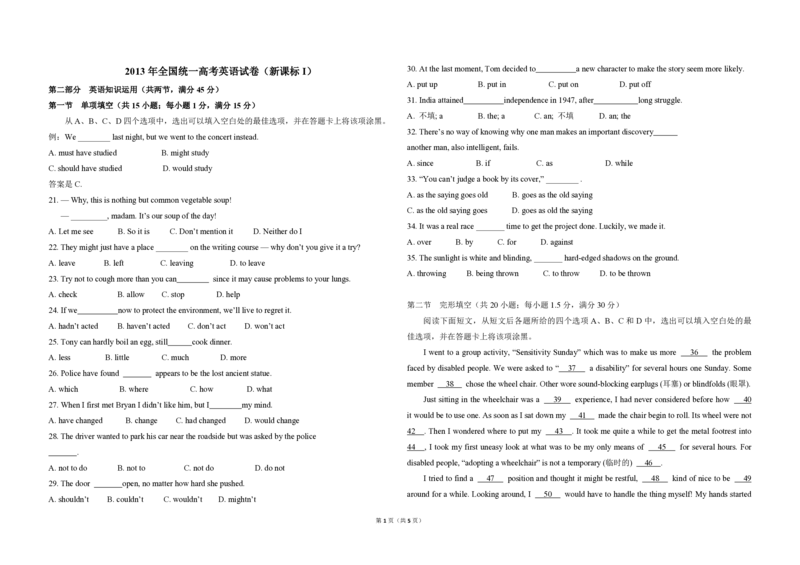
2013 年全国统一高考英语试卷(新课标I)
第二部分  英语知识运用(共两节,满分45 分)
第一节  单项填空(共15 小题;每小题1 分,满分15 分)
从A、B、C、D 四个选项中,选出可以填入空白处的最佳选项,并在答题卡上将该项涂黑。
例:We ________ last night, but we went to the concert instead.
A. must have studied
B. might study
C. should have studied
D. would study
答案是C.
21. — Why, this is nothing but common vegetable soup!
— _________, madam. It’s our soup of the day!
A. Let me see
B. So it is
C. Don’t mention it
D. Neither do I
22. They might just have a place ________ on the writing course — why don’t you give it a try?
A. leave
  B. left

C. leaving
   D. to leave
23. Try not to cough more than you can
 since it may cause problems to your lungs.
A. check
   B. allow
C. stop
   D. help
24. If we
now to protect the environment, we’ll live to regret it.
A. hadn’t acted    B. haven’t acted    C. don’t act    D. won’t act
25. Tony can hardly boil an egg, still
cook dinner.
A. less

B. little

C. much

D. more
26. Police have found
 appears to be the lost ancient statue.
A. which


B. where


C. how

D. what
27. When I first met Bryan I didn’t like him, but I
my mind.
A. have changed
B. change
C. had changed    D. would change
28. The driver wanted to park his car near the roadside but was asked by the police

.
A. not to do
   B. not to

  C. not do

  D. do not
29. The door
open, no matter how hard she pushed.
A. shouldn’t
 B. couldn’t
 C. wouldn’t
D. mightn’t
30. At the last moment, Tom decided to
a new character to make the story seem more likely.
A. put up


B. put in


C. put on


D. put off
31. India attained
independence in 1947, after
long struggle.
A. 不填; a

B. the; a

C. an; 不填
  D. an; the
32. There’s no way of knowing why one man makes an important discovery

another man, also intelligent, fails.
A. since

   B. if


 C. as


D. while
33. “You can’t judge a book by its cover,” ________ .
A. as the saying goes old
B. goes as the old saying
C. as the old saying goes
D. goes as old the saying
34. It was a real race _______ time to get the project done. Luckily, we made it.
A. over
B. by
C. for
D. against
35. The sunlight is white and blinding, _______ hard-edged shadows on the ground.
A. throwing
B. being thrown
C. to throw
D. to be thrown

第二节  完形填空(共20 小题;每小题1.5 分,满分30 分)
阅读下面短文,从短文后各题所给的四个选项A、B、C 和D 中,选出可以填入空白处的最
佳选项,并在答题卡上将该项涂黑。
I went to a group activity, “Sensitivity Sunday” which was to make us more   36   the problem
faced by disabled people. We were asked to “  37   a disability” for several hours one Sunday. Some
member   38   chose the wheel chair. Other wore sound-blocking earplugs (耳塞) or blindfolds (眼罩).
Just sitting in the wheelchair was a   39   experience, I had never considered before how   40
it would be to use one. As soon as I sat down my   41   made the chair begin to roll. Its wheel were not
42  . Then I wondered where to put my   43  . It took me quite a while to get the metal footrest into
44  , I took my first uneasy look at what was to be my only means of   45   for several hours. For
disabled people, “adopting a wheelchair” is not a temporary (临时的)   46  .
I tried to find a   47   position and thought it might be restful,   48   kind of nice to be   49
around for a while. Looking around, I   50   would have to handle the thing myself! My hands started
第2 页(共5 页)
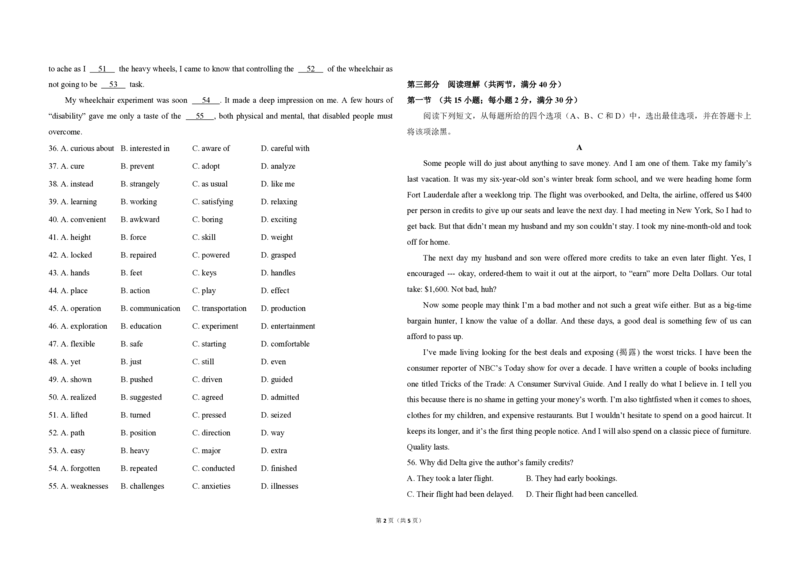
to ache as I   51   the heavy wheels, I came to know that controlling the   52   of the wheelchair as
not going to be   53   task.
My wheelchair experiment was soon   54  . It made a deep impression on me. A few hours of
“disability” gave me only a taste of the   55  , both physical and mental, that disabled people must
overcome.
36. A. curious about B. interested in
C. aware of
D. careful with
37. A. cure
B. prevent
C. adopt
D. analyze
38. A. instead
B. strangely
C. as usual
D. like me
39. A. learning
B. working
C. satisfying
D. relaxing
40. A. convenient
B. awkward
C. boring
D. exciting
41. A. height
B. force
C. skill
D. weight
42. A. locked
B. repaired
C. powered
D. grasped
43. A. hands
B. feet
C. keys
D. handles
44. A. place
B. action
C. play
D. effect
45. A. operation
B. communication
C. transportation
D. production
46. A. exploration
B. education
C. experiment
D. entertainment
47. A. flexible
B. safe
C. starting
D. comfortable
48. A. yet
B. just
C. still
D. even
49. A. shown
B. pushed
C. driven
D. guided
50. A. realized
B. suggested
C. agreed
D. admitted
51. A. lifted
B. turned
C. pressed
D. seized
52. A. path
B. position
C. direction
D. way
53. A. easy
B. heavy
C. major
D. extra
54. A. forgotten
B. repeated
C. conducted
D. finished
55. A. weaknesses
B. challenges
C. anxieties
D. illnesses

第三部分  阅读理解(共两节,满分40 分)
第一节 (共15 小题;每小题2 分,满分30 分)
阅读下列短文,从每题所给的四个选项(A、B、C 和D)中,选出最佳选项,并在答题卡上
将该项涂黑。
A
Some people will do just about anything to save money. And I am one of them. Take my family’s
last vacation. It was my six-year-old son’s winter break form school, and we were heading home form
Fort Lauderdale after a weeklong trip. The flight was overbooked, and Delta, the airline, offered us $400
per person in credits to give up our seats and leave the next day. I had meeting in New York, So I had to
get back. But that didn’t mean my husband and my son couldn’t stay. I took my nine-month-old and took
off for home.
The next day my husband and son were offered more credits to take an even later flight. Yes, I
encouraged --- okay, ordered-them to wait it out at the airport, to “earn” more Delta Dollars. Our total
take: $1,600. Not bad, huh?
Now some people may think I’m a bad mother and not such a great wife either. But as a big-time
bargain hunter, I know the value of a dollar. And these days, a good deal is something few of us can
afford to pass up.
I’ve made living looking for the best deals and exposing (揭露) the worst tricks. I have been the
consumer reporter of NBC’s Today show for over a decade. I have written a couple of books including
one titled Tricks of the Trade: A Consumer Survival Guide. And I really do what I believe in. I tell you
this because there is no shame in getting your money’s worth. I’m also tightfisted when it comes to shoes,
clothes for my children, and expensive restaurants. But I wouldn’t hesitate to spend on a good haircut. It
keeps its longer, and it’s the first thing people notice. And I will also spend on a classic piece of furniture.
Quality lasts.
56. Why did Delta give the author’s family credits?
A. They took a later flight.
  B. They had early bookings.
C. Their flight had been delayed.   D. Their flight had been cancelled.
第3 页(共5 页)
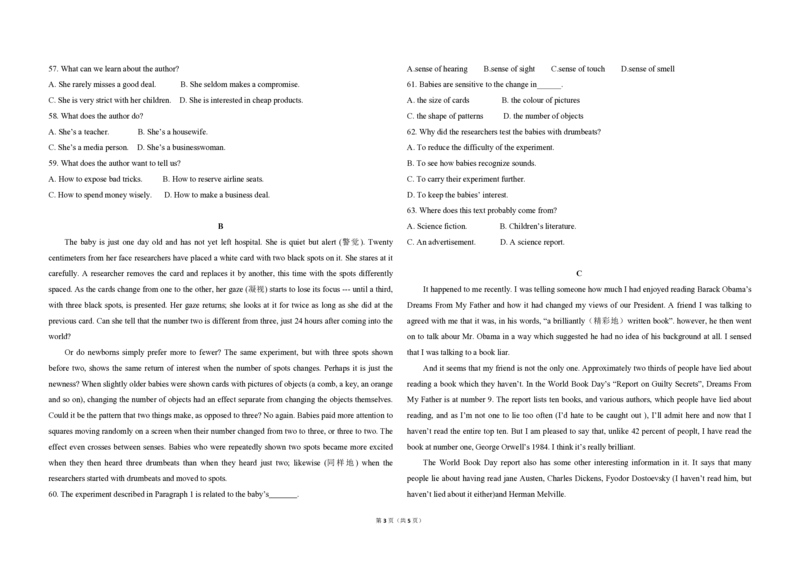
57. What can we learn about the author?
A. She rarely misses a good deal.
 B. She seldom makes a compromise.
C. She is very strict with her children.  D. She is interested in cheap products.
58. What does the author do?
A. She’s a teacher.
B. She’s a housewife.
C. She’s a media person.  D. She’s a businesswoman.
59. What does the author want to tell us?
A. How to expose bad tricks.
B. How to reserve airline seats.
C. How to spend money wisely.   D. How to make a business deal.

B
The baby is just one day old and has not yet left hospital. She is quiet but alert (警觉). Twenty
centimeters from her face researchers have placed a white card with two black spots on it. She stares at it
carefully. A researcher removes the card and replaces it by another, this time with the spots differently
spaced. As the cards change from one to the other, her gaze (凝视) starts to lose its focus --- until a third,
with three black spots, is presented. Her gaze returns; she looks at it for twice as long as she did at the
previous card. Can she tell that the number two is different from three, just 24 hours after coming into the
world?
Or do newborns simply prefer more to fewer? The same experiment, but with three spots shown
before two, shows the same return of interest when the number of spots changes. Perhaps it is just the
newness? When slightly older babies were shown cards with pictures of objects (a comb, a key, an orange
and so on), changing the number of objects had an effect separate from changing the objects themselves.
Could it be the pattern that two things make, as opposed to three? No again. Babies paid more attention to
squares moving randomly on a screen when their number changed from two to three, or three to two. The
effect even crosses between senses. Babies who were repeatedly shown two spots became more excited
when they then heard three drumbeats than when they heard just two; likewise (同样地) when the
researchers started with drumbeats and moved to spots.
60. The experiment described in Paragraph 1 is related to the baby’s
.
A.sense of hearing    B.sense of sight    C.sense of touch    D.sense of smell
61. Babies are sensitive to the change in______.
A. the size of cards
B. the colour of pictures
C. the shape of patterns
D. the number of objects
62. Why did the researchers test the babies with drumbeats?
A. To reduce the difficulty of the experiment.
B. To see how babies recognize sounds.
C. To carry their experiment further.

D. To keep the babies’ interest.
63. Where does this text probably come from?
A. Science fiction.
B. Children’s literature.
C. An advertisement.
D. A science report.

C
It happened to me recently. I was telling someone how much I had enjoyed reading Barack Obama’s
Dreams From My Father and how it had changed my views of our President. A friend I was talking to
agreed with me that it was, in his words, “a brilliantly(精彩地)written book”. however, he then went
on to talk abour Mr. Obama in a way which suggested he had no idea of his background at all. I sensed
that I was talking to a book liar.
And it seems that my friend is not the only one. Approximately two thirds of people have lied about
reading a book which they haven’t. In the World Book Day’s “Report on Guilty Secrets”, Dreams From
My Father is at number 9. The report lists ten books, and various authors, which people have lied about
reading, and as I’m not one to lie too often (I’d hate to be caught out ), I’ll admit here and now that I
haven’t read the entire top ten. But I am pleased to say that, unlike 42 percent of peoplt, I have read the
book at number one, George Orwell’s 1984. I think it’s really brilliant.
The World Book Day report also has some other interesting information in it. It says that many
people lie about having read jane Austen, Charles Dickens, Fyodor Dostoevsky (I haven’t read him, but
haven’t lied about it either)and Herman Melville.
第4 页(共5 页)
Asked why they lied, the most common reason was to “impress” someone they were speaking to.
This coule be tricky if the conversation became more in – depth!
But when asked which authors they actually enjoy, people named J.k. Rowling, John Grisham,
Sophie Kinsella (ah, the big sellers, in other words). Forty-two percent of people asked admitted they
turned to the back of the book to read the end before finishing the story (I’ll come clean: I do this and am
astonished that 58 percent said they had never dome so).
64. How did the author find his friend a book liar?
A. By judging his manner of speaking.   B. By looking into his background.
C. By mentioning a famous name.
   D. By discussing the book it self.
65. Which of the following is a “guilty secret” according to the World Book Day
report?
A. Charles Dickens is very low on the top-ten list.
B. 42% of people pretended to have read 1984.
C. The author admitted having read 9 books.

D. Dreams From My Father is hardly read.
66. By lying about reading, a person hopes to
.
A. control the conversation
B. appear knowledgeable
C. learn about the book
D. make more friends
67. What is the author’s attitude to 58% of readers?
A. Favorable     B. Uncaring      C. Doubtful      D. Friendly

D
The National Gallery
Description:
The National Gallery is the British national art museum built on the north side of European art
ranging from 13th-century religious paintings to more modern ones by Renoir and Van Gogh. The older
collections of the gallery are reached through the main entrance while the more modern works in the East
Wing are most easily reached from Trafalgar Square by a ground floor entrance.
Layout:
The modern Sainsbury Wing on the western side of the buileing houses 13th-to 15th-century
paintings, and artists include Duccio, Uccello, Van Eyck, Lippi, Mantegna, Botticelli and Memling.
The main West Wing houses 16th-century paintings, and artists include Leonardo da Vinci, Cranach,
Michelangelo, Raphael, Bruegel, Bronzino, Titan and Veronest.
The North Wing houses 17th-century paintings, and artists include Caravaggio, Rubens, Poussin,
Van Dyck, Velazquez, Claude and Vermeer.
The East Wing houses 18th-to early 20th-century paintings, and artists include Canaletto, Goya,
Turner, Constable, Renoir and Van Gogh.
Opening Hours:
The Gallery is open every day from 10am to 6pm(Fridays 10am to 9pm)and is free, but charges
apply to some special exhibitions.
Getting There:
Nearest underground stations: Charing Cross(2-minute walk). Leicester Square(3-minute
walk), Embankment(7-minute walk), and Piccadilly Circus(8-minute walk).
68. In which century’s collection can you see religious paintings?
A. The 13th.     B. The 17th.     C. The 18th.     D. The 20th.
69. Where are Leonardo da Vinci’s works shown?
A. In the East Wing.
B. In the main West Wing.
C. In the Sainsbury Wing.
D. In the North Wing.
70. Which underground station is closest to the National Gallery?
A. Piccadilly Circus.  B. Leicester Square.  C. Embankment.  D. Charing Cross.

第二节(共5 小题:每小题2 分,满分10 分)
根据短文内容,从短文后的选项中选出能填入空白处的最佳选项。选项中有两项为多余选
项。
Business is the organized approach to providing customers with the goods and services they want.
The word business also refers to an organization that provides these goods and services. Most businesses
第5 页(共5 页)
seek to make a profit(利润)--- that is, they aim to achieve income that is more than the costs of
operating the business.  71
Commonly called nonprofits, these organizations are primarily nongovernmental service providers.  72
Business management is a term used to describe the techniques of planning, direction, and control of
the operations of a business.  73    One is the establishment(制定)of broad basic policies with
respect to production; sales; the purchase of equipment, materials and supplies; and accounting.  74
The third relates to the establishment of standards of work in all departments. Direction is concerned
primarily with supervision(监管)and guidance by the management in authority.   75
A. Control includes the use of records and reports to compare actual work with the set standards for work.
B. In this connection there is the difference between top management and operative management.
C. Examples of nonprofit business top management and operative management.
D. However, some businesses only seek to enough to cover their operating costs.
E. The second aspect relates to the application of these policies by departments.
F. In the theory of business management, organization has two main aspects.
G. Planning in business management has three main aspects.

第四部分  写作(共两节,满分35 分)
第一节  短文改错(共10 小题;每小题1 分,满分10 分)
假定英语课上老师要求同桌中间交换修改作文,请你修改你同桌写的以下作文。文中共有10
处语言错误,每句中最多有两处,每处错误仅涉及一个单词的增加、删除或修改。
增加:把缺词处加个漏字符号(∧),并在其下面写出该加的词。
删除:把多余的词用斜线(\)划掉。
修改:在错的词下划一横线,并在该词下面写出修改后的词。
注意:1. 每处错误及其修改均仅限一词;
2. 只允许修改10 处,多者(从第11 处起)不计分。
I hardly remember my grandmother. She used to holding me on her knees and sing old songs. I was
only four when she passes away. She is just a distant memory for me now.
I remember my grandfather very much. He was tall, with broad shoulder and a beard that turned
from black toward gray over the years. He had a deep voice, which set himself apart from others in our
small town, he was strong and powerful. In a fact, he even scared my classmates away during they came
over to play or do homework with me. However, he was the gentlest man I have never known.

第二节  书面表达(满分25 分)
假定你是李华.请你给笔友Peter 写封信,告诉他你叔叔李明将去他所在城市开会,带去他想
要的那幅中国画,同时询问他是否可以接机.信中还需说明:
李明:高个子,戴眼镜;航班号:CA985;到达:8 月6 日上午11:30.
注意:1.词数100 左右;
2.可以适当增加细节,以使行文连贯;
3.开头语和结束语已为你写好.