2025 年高考第三次模拟考试(新高考 II 卷)03
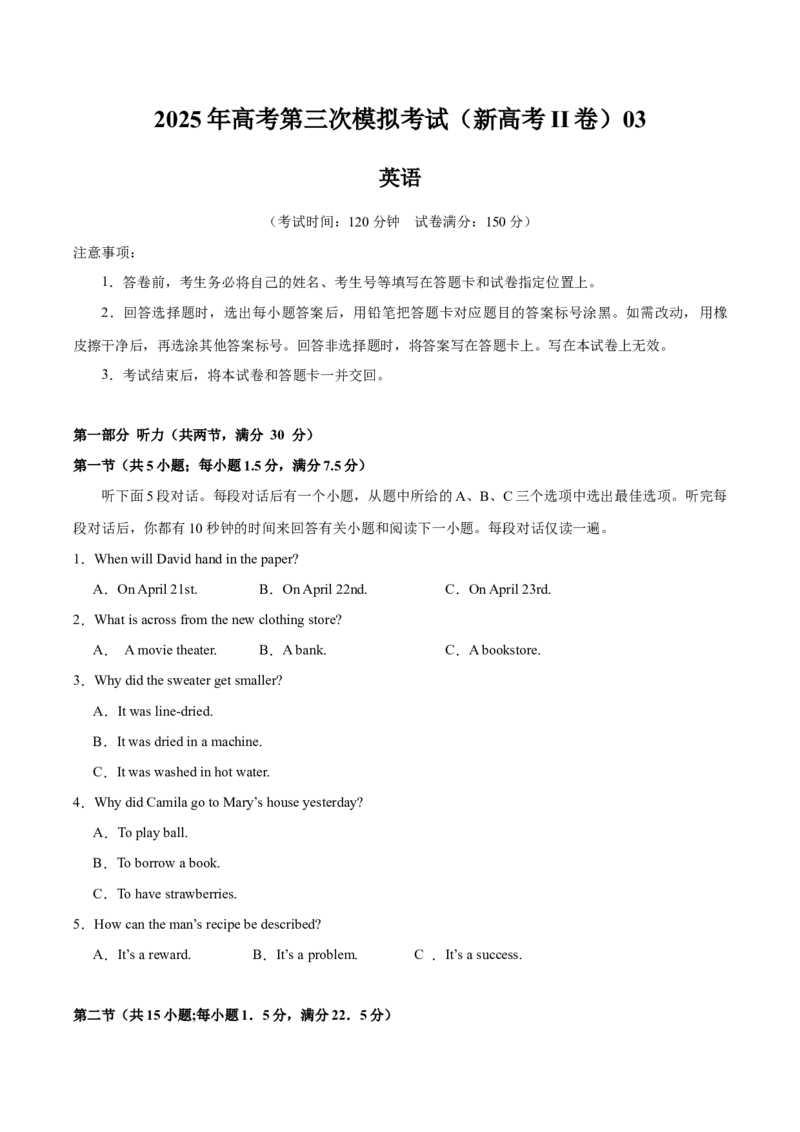
英语
(考试时间:120分钟 试卷满分:150分)
注意事项:
1.答卷前,考生务必将自己的姓名、考生号等填写在答题卡和试卷指定位置上。
2.回答选择题时,选出每小题答案后,用铅笔把答题卡对应题目的答案标号涂黑。如需改动,用橡
皮擦干净后,再选涂其他答案标号。回答非选择题时,将答案写在答题卡上。写在本试卷上无效。
3.考试结束后,将本试卷和答题卡一并交回。
第一部分 听力(共两节,满分 30 分)
第一节(共5小题;每小题1.5分,满分7.5分)
听下面5段对话。每段对话后有一个小题,从题中所给的A、B、C三个选项中选出最佳选项。听完每
段对话后,你都有10秒钟的时间来回答有关小题和阅读下一小题。每段对话仅读一遍。
1.When will David hand in the paper?
A.On April 21st. B.On April 22nd. C.On April 23rd.
2.What is across from the new clothing store?
A. A movie theater. B.A bank. C.A bookstore.
3.Why did the sweater get smaller?
A.It was line-dried.
B.It was dried in a machine.
C.It was washed in hot water.
4.Why did Camila go to Mary’s house yesterday?
A.To play ball.
B.To borrow a book.
C.To have strawberries.
5.How can the man’s recipe be described?
A.It’s a reward. B.It’s a problem. C .It’s a success.
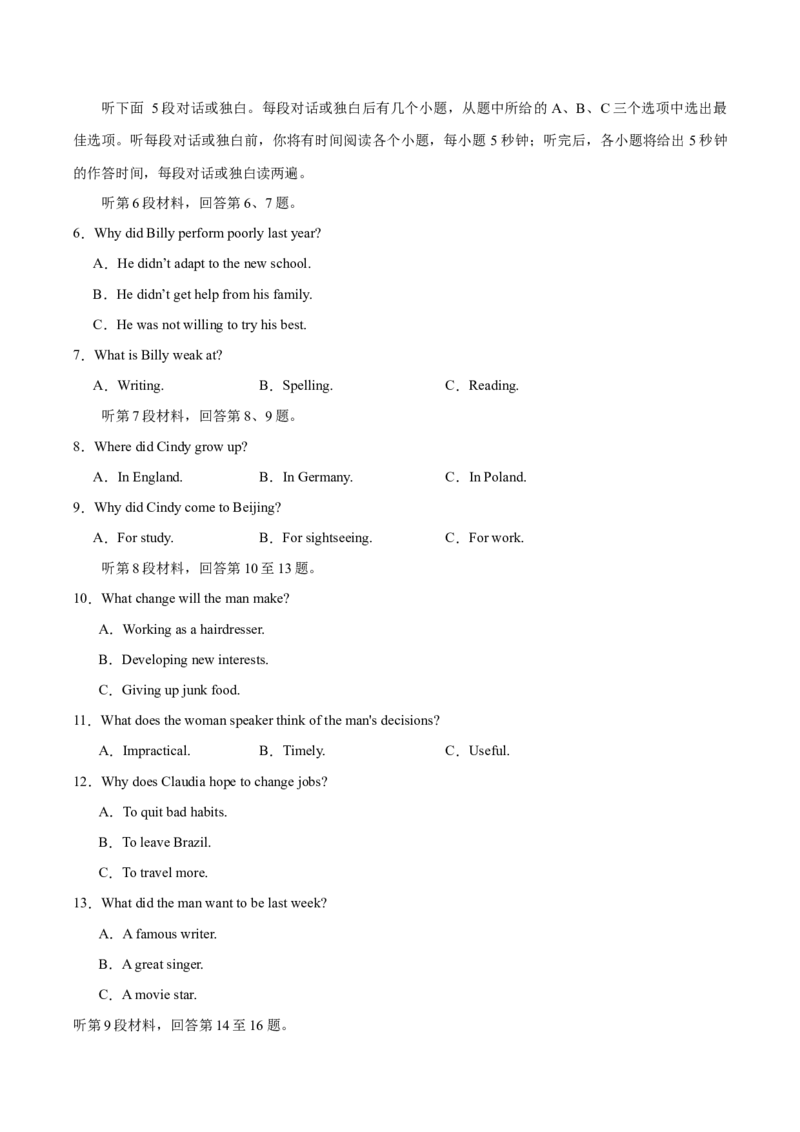
第二节(共15小题;每小题1.5分,满分22.5分)听下面 5段对话或独白。每段对话或独白后有几个小题,从题中所给的 A、B、C三个选项中选出最
佳选项。听每段对话或独白前,你将有时间阅读各个小题,每小题 5秒钟;听完后,各小题将给出5秒钟
的作答时间,每段对话或独白读两遍。
听第6段材料,回答第6、7题。
6.Why did Billy perform poorly last year?
A.He didn’t adapt to the new school.
B.He didn’t get help from his family.
C.He was not willing to try his best.
7.What is Billy weak at?
A.Writing. B.Spelling. C.Reading.
听第7段材料,回答第8、9题。
8.Where did Cindy grow up?
A.In England. B.In Germany. C.In Poland.
9.Why did Cindy come to Beijing?
A.For study. B.For sightseeing. C.For work.
听第8段材料,回答第10至13题。
10.What change will the man make?
A.Working as a hairdresser.
B.Developing new interests.
C.Giving up junk food.
11.What does the woman speaker think of the man's decisions?
A.Impractical. B.Timely. C.Useful.
12.Why does Claudia hope to change jobs?
A.To quit bad habits.
B.To leave Brazil.
C.To travel more.
13.What did the man want to be last week?
A.A famous writer.
B.A great singer.
C.A movie star.
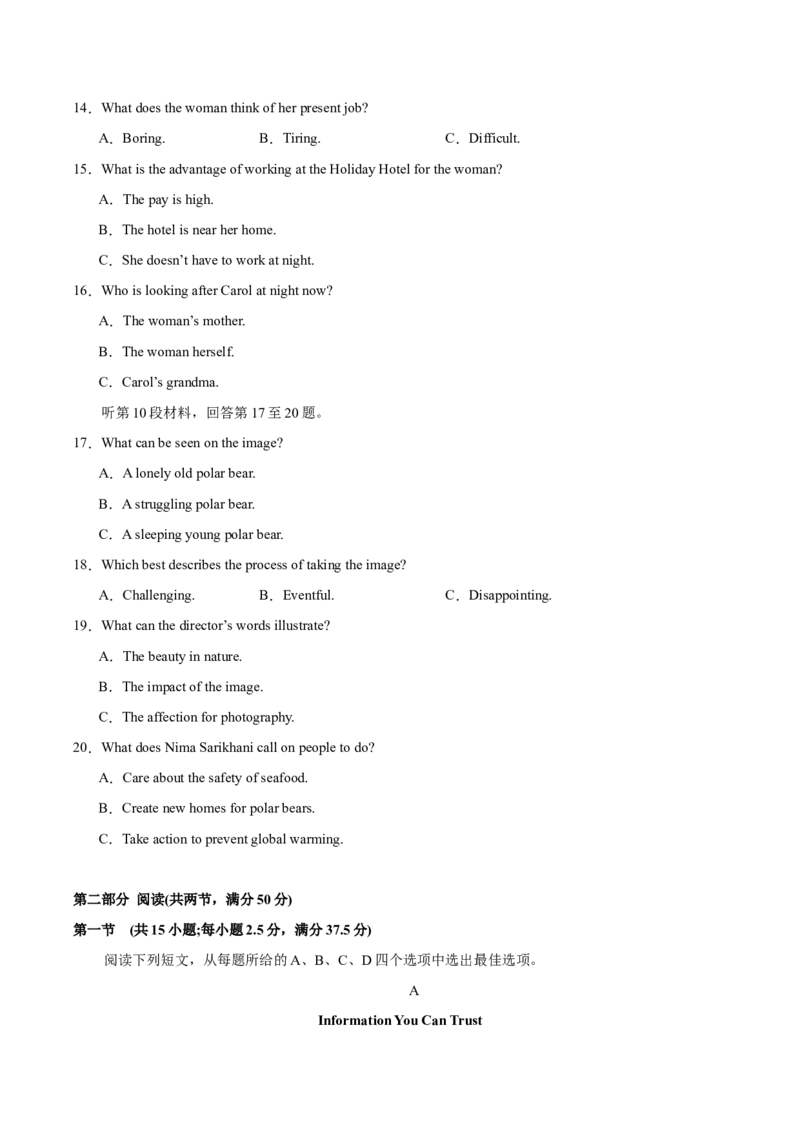
听第9段材料,回答第14至16题。14.What does the woman think of her present job?
A.Boring. B.Tiring. C.Difficult.
15.What is the advantage of working at the Holiday Hotel for the woman?
A.The pay is high.
B.The hotel is near her home.
C.She doesn’t have to work at night.
16.Who is looking after Carol at night now?
A.The woman’s mother.
B.The woman herself.
C.Carol’s grandma.
听第10段材料,回答第17至20题。
17.What can be seen on the image?
A.A lonely old polar bear.
B.A struggling polar bear.
C.A sleeping young polar bear.
18.Which best describes the process of taking the image?
A.Challenging. B.Eventful. C.Disappointing.
19.What can the director’s words illustrate?
A.The beauty in nature.
B.The impact of the image.
C.The affection for photography.
20.What does Nima Sarikhani call on people to do?
A.Care about the safety of seafood.
B.Create new homes for polar bears.
C.Take action to prevent global warming.
第二部分 阅读(共两节,满分50分)
第一节 (共15小题;每小题2.5分,满分37.5分)
阅读下列短文,从每题所给的A、B、C、D四个选项中选出最佳选项。
A
Information You Can Trust—A Guide to Our Editorial Process
Our goal at Wiki How is to deliver trustworthy articles that engage our readers and meet their informational
and emotional needs. For 18 years, we’ve committed to our step- by- step teaching model and continue to create the
best how- to experience on the Internet. We’ve helped millions of people solve problems, learn new skills, and feel
supported in the ordinary and complex moments of life.
Our Expert Team Wiki How partners with over 1,000 experts from a wide range of fields to ensure our content is
accurate and based on well- established research.
● MENTAL HEALTH, Chloe Carmichael, Licensed Clinical Psychologist
Licensed Clinical Psychologist. Specializes in relationship and stress.
● PETS, Brian Bourquin, Veterinarian (兽医) and Clinic Owner
Owner of Boston Veterinary Clinic, specializing in primary and emergency care.
● DIY, Joy Cho, Founder & Creative Director
Founder and Creative Director of lifestyle brand and design studio. Authored three books and consulted for creative
businesses around the world.
● PERSONAL STYLE, Dedra Allen, Cosmetologist (美容师)
CEO of Jdoah Beauty Salon. Over 30 years of experience as a licensed cosmetologist.
Meet more of Wiki How’s 1700+ experts >>
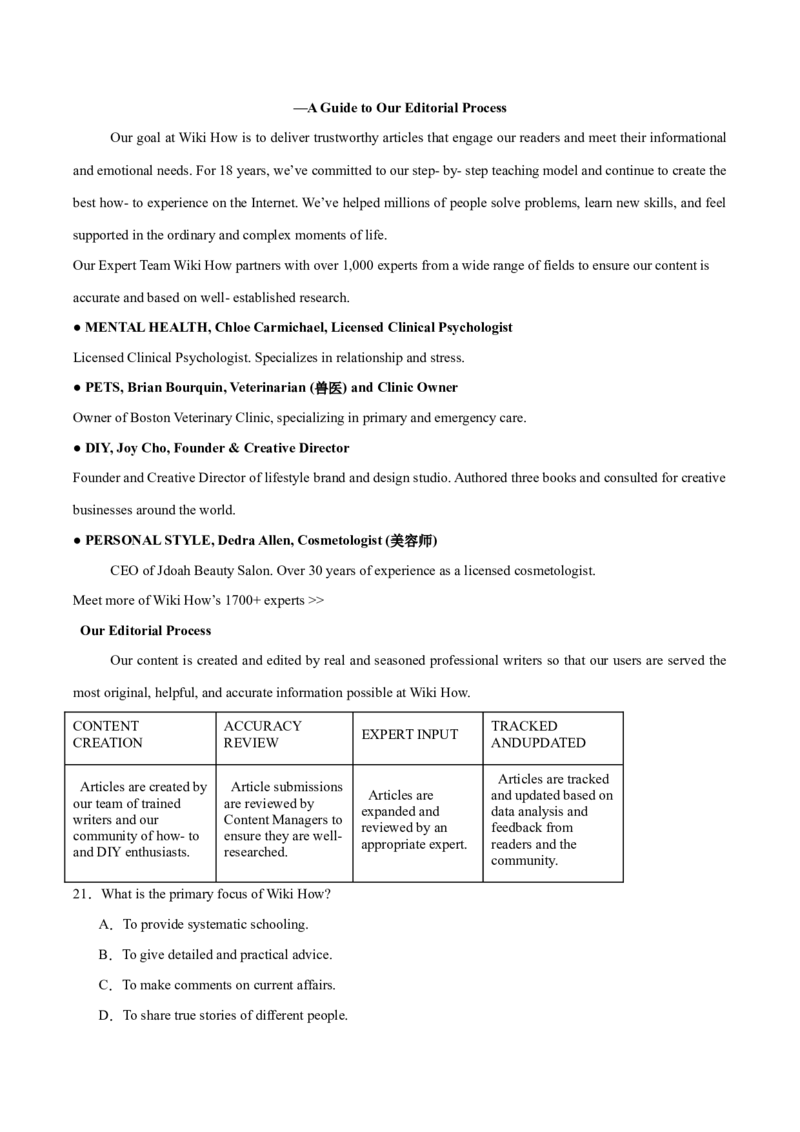
Our Editorial Process
Our content is created and edited by real and seasoned professional writers so that our users are served the
most original, helpful, and accurate information possible at Wiki How.
CONTENT ACCURACY TRACKED
EXPERT INPUT
CREATION REVIEW ANDUPDATED
Articles are tracked
Articles are created by Article submissions
Articles are and updated based on
our team of trained are reviewed by
expanded and data analysis and
writers and our Content Managers to
reviewed by an feedback from
community of how- to ensure they are well-
appropriate expert. readers and the
and DIY enthusiasts. researched.
community.
21.What is the primary focus of Wiki How?
A.To provide systematic schooling.
B.To give detailed and practical advice.
C.To make comments on current affairs.
D.To share true stories of different people.22.If you intend to open a souvenir store, which expert might be most helpful?
A.Chloe Carmichael. B.Brian Bourquin.
C.Joy Cho. D.Dedra Allen.
23.What is a shared responsibility of Content Managers and experts at Wiki How?
A.Writing articles for Wiki How.
B.Training writers for Wiki How.
C.Ensuring the credibility of articles.
D.Reviewing the originality of articles.
B
A surfer who lost his right leg to a shark attack months ago has amazed people by returning to the waves on
his one remaining leg. In a show of remarkable courage, the surfer Kai McKenzie paddled out to the same spot
where he had been attacked by a white shark four months earlier, which was quite a rare case.
After the initial shock, McKenzie kept his spirits uplifted by his mission to return to the water before the end
of the year. The 23-year-old had promised to get back into surfing as soon as he was able to. McKenzie took off his
artificial limb (肢) and got back to riding the waves and practicing new moves. He paddled out with focus, catching
several waves, jumping on his board with one leg and occasionally steering (控制) it with one hand when it was off
course. It’s far from effortless to surf with one leg which causes imbalance, and when he wiped out, he'd only got
one leg to swing back up.
Supported by family, McKenzie appeared at ease in the same water despite admitting he was a bit nervous
because the water looked “exactly like that day”. His bravery and skill while surfing on one foot touched everyone.
He later posted his return to the ocean online. “It’s one of the craziest feelings I’ve had! It’s the first time that I’d
paddled back in the water where I got bitten,” he wrote. “I sat out there by myself and took it in for a little bit then a
bunch of good people surfed with me.”
Mark, a surfing champion who lost his right leg due to cancer, mentioned McKenzie’s return to the ocean,
saying, “That fear of the shark would have been behind him as he was paddling out. Getting back out there is
extremely courageous. McKenzie might not at the top yet, but he’s young and he’ll adapt fast. He has taken his first
and biggest step by getting out there.”
24.Why are people amazed by McKenzie?
A.He has lost his right leg.
B.He rose right where he fell.C.He has a gift for surfing.
D.He was attacked by a shark.
25.How did McKenzie manage to surf with only one leg?
A.He relied on his artificial limb for support.
B.He got help from other surfers in the water.
C.He tried new moves and adjusted his techniques.
D.He used a special surfboard designed for balance.
26.What was McKenzie’s state of mind when returning to the water?
A.Basically relieved.
B.Extremely tense.
C.Rather unwilling.
D.Totally fearless.
27.What do Mark’s words imply about McKenzie’s future?
A.He will struggle to surf effectively.
B.He is likely to quit surfing due to fear.
C.He will live with the fear of the shark.
D.He is expected to be a promising surfer.
C
A tree laden with its fruit stands near the entrance of a yard. Close by, a broom leans casually against the
peeling.
The serene scene can generate nostalgic feelings — until a huge hand interrupts and places a fingernail-sized
stone well in the yard. Li Yizhong, an artisan of miniature (微型模型) items, is putting the final touches on the
scale model of a folk house.
“Miniature modeling began early in the West, but it primarily focuses on engineering structures and natural
landscapes,” said Li. Li’s works are mostly 1:30 scale models that replicate (复制) elements within a Chinese rural
courtyard, including the main house, plants, domestic animals, farm tools, and various other natural and man-made
surroundings.
Completing a model with all the accessories (附件) usually takes one to three months. The time depends on
the complexity of the work. Customers who come to Li with requests for miniatures usually provide photos of their
houses from different angles. Besides, the creation of accessories in the courtyard demands considerable patience.For example, to craft the branches of the palm-sized persimmon tree, Li used 521 pieces of 0.02-millimeter light
iron wires. One of his customers couldn’t hold back tears when she received her miniature. She said the artwork
reproduced cherished family memories buried deep within her heart.
In 2020, Li set up a center in Jinan, Shandong Province to impart his miniature-making skills. More than 300
apprentices (徒弟) , ranging in age from 16 to 79, have successfully learned the basics of the craft. People recreate
their own homes detail by detail and summon up sweet and bitter memories gradually.
“It’s a kind of inheritance. Family ties run deep in China, but now we’re gradually losing them. Some young
people even find it hard to understand why a poor house can arouse such deep emotions,” Li said. “That’s what I
am working for — to prevent the loss of our family culture.”
28.What are Li’s miniature models themed on?
A.Historical relics.
B.Traditional residences.
C.Natural landscapes.
D.Engineering structures.
29.Which of the following best describes Li’s job?
A.Efficient and flexible.
B.Innovative and inspiring.
C.Patient and respectable.
D.Collaborative and challenging.
30.What do the underlined words “summon up” mean in paragraph 6?
A.Redefine. B.Rewrite. C.Reawaken. D.Renew.
31.Why does Li devote himself to miniature modeling?
A.To maintain weakening family bonds.
B.To study traditional architecture.
C.To protect rural natural landscapes.
D.To bridge the generation gap.
D
According to current climate science, global temperatures will continue to rise until net carbon dioxide (CO )
2
emissions (排放) reach zero. Given current projected emissions, 2billion to 15 billion tonnes (Gt) of CO may need
2to be removed from the atmosphere annually to meet the goal of the 2015 Paris Agreement. However, a sustainable
technique to absorb and permanently store such large amounts of CO from the atmosphere is yet to be developed.
2
Van Roijen et al. report that replacing traditional building materials with CO -storing alternatives could cut
2
off carbon at the billion-tonne level. Considering the large human demands for infrastructure (基础设施) and
buildings and their long lifetimes, the proposed strategy could provide long-term CO removal.
2
They performed quantitative analyses of CO storage capacities of key building materials based on 2016
2
global consumption of each material. The authors assumed that all carbon in the materials was from the atmosphere
and that its storage was permanent. The combined CO storage potential of building materials was estimated to be
2
16.6 Gt, which equals to 50%of the total CO emissions in 2021. Van Roijen et al. show that replacing just
2
traditional concrete with CO -storing materials could remove 13.1 Gt of atmospheric CO annually.
2 2
A key challenge to creating building materials for CO storage is the quantity of available resources.
2
Carbonatable (可碳化的) materials obtained from the olivine (橄榄石) family of minerals can react with
atmospheric CO to form carbonates. Although it is most common, the distribution of olivine is uneven globally,
2
which could cause supply shortages in some regions. Limestone could be used additionally as an alternative.
However, limestone processing produces substantial amounts of CO gas.
2
To successfully use CO -storing building materials, financial bonuses and regulations are needed to
2
encourage market adoption. Additionally, to ensure that these activities permanently remove atmospheric CO , a
2
strong monitoring, reporting, and checking system is needed for tracking greenhouse gas emissions across the
supply chain. This could bring unexpected outcomes if these efforts are inadequate in CO emissions. Nonetheless,
2
with proper acts, the use of CO -storing building materials could provide a possible method for CO removal at a
2 2
reasonable cost.
32.What did Van Roijen et al. do to prove the result?
A.They analyzed building materials.
B.They did theory research.
C.They created computer models.
D.They quoted other studies.
33.Which is a challenge in creating building materials for CO storage?
2
A.The high cost of production.
B.The irregular spread of olivine.
C.The lack of alternative materials.D.The limited demand for buildings.
34.What is the author’s attitude to new building materials?
A.Indifferent. B.Doubtful. C.Supportive. D.Confident.
35.What would be the best title for the text?
A.Built to Remove Carbon B.Designed to Save Energy
C.Created to Reduce Emission D.Analyzed to Find New Materials
第二节 (共5小题;每小题2.5分,满分12.5分)
阅读下面短文,从短文后的选项中选出可以填入空白处的最佳选项。选项中有两项为多余选项。
A Century of Change
The last 100 years have seen major transformations in news reporting. Print newspapers dominated the early
1900s, but in November 1922, the dawn (曙光) of radio news arrived when the BBC launched its first daily radio
service. It marketed itself as news by and for social elites (精英). 36 In the 1950s, news shifted to
television broadcasting. A dramatic change came in 1980 with the creation of America’s Cable News Network
(CNN)—the world’s first 24-hour television news network.
37 The Internet has become a key site for sharing information, and news is more accessible than it
has ever been before. Crises can be reported from on the ground by people who closely understand them. Stories
can be shared with the click of a button. 38 In the time it takes for a story to move from a news site to
Facebook to your WhatsApp group chat, context is lost and facts go unchecked.
In 2016, we witnessed an important moment for the news landscape. Following a US election dogged by
dishonesty and misinformation spread largely on social media, Oxford Dictionaries announced “post-truth” as its
international word of the year. 39
With so much information at our fingertips, the considerable volume of news can be irresistible. Besides,
there is increasing uncertainty about what is true and what is not. So it is no wonder that recent years have seen the
birth of the “slow journalism” movement, which was first coined in 2007 by Susan Greenberg. 40
A.However, that can be dangerous.
B.Frequency of the word’s usage rose by 2,000 per cent that year.
C.Besides, it required broadcasters to use “received pronunciation”.
D.The creation of the World Wide Web in the 1990s changed things again.
E.So, the mark of a good story was how soon it was told after it happened.
F.It invites us to slow down and pay attention to what’s happening around us.G.People still mainly rely on newspapers for local information.
第三部分 语言运用(共两节,满分30分)
第一节 (共15小题;每小题1分,满分15分)
阅读下面短文,从每题所给的A、B、C、D四个选项中选出可以填入空白处的最佳选项。
For almost thirty years, I’ve been treated like the baby of the family, even though my sister is eight years
41 . And I’ve become accustomed to the specific role.
A week after my 30th birthday, my dad vomited (呕吐) blood and fainted at work. The next day, he was
42 . I was aimlessly shopping when I got the call that afternoon. “What are you doing?” my mom asked. “Just
43 before dinner with friend,” I answered. “Your father’s in hospital,” she said.
The doctor had 44 her the bleeding wasn’t too serious, but said someone should be with him. “I’ll
go,” I told her 45 . It made the most sense: she’d recently started a new job, and my sister was in college;
my only commitments were a dinner I could 46 and a freelance job. I booked a 47 for that
night.
I went straight from the airport to the hospital. The sight of him, weak and pale, made me 48 . For
the next few days, I dutifully 49 my father’s blood pressure, and got his medicines on time. I answered
phone calls from 50 family and friends.
When my dad was finally 51 , I stayed through the weekend, 52 his apartment,
and cooking enough food to last a few days. “Don’t forget about the follow-up 53 I’ve made for
you. I’ve 54 all the numbers and addresses in your phone,” I said.
“You are my angel, any. I don’t know what I would have done without you,” he said. At that very moment, I
knew I’d completed the 55 of my role in the family.
41.A.elder B.earlier C.junior D.later
42.A.operated B.rescued C.recovered D.hospitalized
43.A.booking tables B.killing time C.buying food D.making calls
44.A.warned B.suggested C.assured D.demanded
45.A.reluctantly B.instantly C.publicly D.impatiently
46.A.handle B.prepare C.reserve D.cancel
47.A.holiday B.breakfast C.flight D.seat
48.A.shrug B.tremble C.calm D.escape49.A.monitored B.predicted C.overlooked D.informed
50.A.thrilled B.concerned C.visiting D.annoying
51.A.discovered B.disposed C.discharged D.dismissed
52.A.cleaning B.renting C.decorating D.searching
53.A.appointments B.operations C.checks D.medications
54.A.installed B.downloaded C.dialed D.saved
55.A.shift B.journey C.choice D.balance
第二节 (共10小题;每小题1.5分,满分15分)
阅读下面短文,在空白处填入1个适当的单词或括号内单词的正确形式。
A red panda moves along the branch of an evergreen tree, placing one front paw (前爪) in front of 56
other like a gymnast on a balance beam (平衡木). Despite its name, the red panda is not 57 (close) related
to the giant panda but 58 (share) similar habitats and a diet primarily consisting of bamboo 59
(leaf) and shoots. While giant pandas spend most time walking around on the ground looking for food, red pandas
spend about 90 percent of their time in the trees. In fact, red pandas have adapted so well 60 life in the trees
that they’re famous for their incredible balancing skills. They even have a special wrist bone that helps when
climbing. Spending time in trees is 61 these animals avoid enemies, such as snow leopards. Their reddish
coats and white face markings provide cover in the red-brown and white trees where they live.
However, red pandas are endangered, as their forest homes are being cut down 62 their fur as well as
their adorableness might put them in more danger. China has taken significant steps 63 (protect) this rare
species, such as establishing nature reserves, and 64 (promote) sustainable land management practices.
Some organizations are using high-tech methods to track poachers (偷猎者), like taking a DNA sample from a red
panda 65 (rescue) from the illegal trade market.
第四部分 写作(共两节,满分40分)
第一节 (满分15分)
假定你是李华,你想设计一个网站来辅助你班同学学好英语。请你给擅长IT技能的外教Mr Robert写
一封邮件,内容包括:
1.介绍你的设想;
2.咨询相关建议。
注意:1.写作词数应为80个左右;
2.请按如下格式在答题卡的相应位置作答。
Dear Mr Robert,
____________________________________________________________________________________________
____________________________________________________________________________________________
____________________________________________________________________________________________
____________________________________________________________________________________________
____________________________________________________________________________________________
____________________________________________________________________________________________
Yours,
Li Hua
第二节 (满分25分)
阅读下面材料,根据其内容和所给段落开头语续写两段,使之构成一篇完整的短文。
Eight-year-old Lily was a curious little girl who loved exploring the world around her. One day, Lily’s
mother asked her to go to the store to buy some groceries. Excited by the thought of being responsible, Lily happily
walked along the streets, her small steps filled with purpose and enthusiasm. The sun was shining, and the air was
filled with the scent (香味) of freshly baked bread from the nearby bakery, adding to her excitement.
As Lily walked into the store, she noticed a beautiful container of pink candies on the cashier’s desk. The
candies were wrapped in sparking wrappers, and they seemed to call out to her. She really wanted to buy them.
However, there was one problem-she didn’t have enough money to pay.
Then, Lily came up with an idea. She told herself it was just a little white lie and that no one would ever
know. It seemed like a simple solution to her dilemma (困境). She quickly put the candies into her shopping bag
and paid for the groceries, hoping that her secret would be safe.
That evening, Lily couldn’t help but feel regretful in her heart. The excitement of the day had faded, replaced
by a heavy feeling of guilt. She knew that what she had done wasn’t right. Her conscience (良知) was eating away
at her, causing her to lose sleep and feel restless. The candies, once a source of joy, now sat heavily in her stomach,
a reminder of her actions.
The next morning, Lily’s mother noticed her daughter’s troubled expression and asked her what was wrong.
Lily hesitated for a moment, the weight of her secret almost too much to bear. But then, the truth poured out of her
mouth like a waterfall.“Mom, I have something to tell you,” Lily said, tears welling up in her eyes, “I took some candies from the
store without paying for them. I'm really sorry.” Her voice was small, but the sincerity in her words was clear.
Her mother’s face softened, and she pulled Lily into a warm hug. “Lily, I am proud of you for telling me the
truth,” her mother said gently. “But it’s important to understand that lying, even about something small, can hurt
others and ourselves. Let’s go back to the store and make things right.”
注意:
1. 续写词数应为150左右;
2. 请按如下格式在答题卡的相应位置作答。
Shortly, Lily and her mother were back at the store.
____________________________________________________________________________________________
____________________________________________________________________________________________
____________________________________________________________________________________________
____________________________________________________________________________________________
____________________________________________________________________________________________
____________________________________________________________________________________________
From that day on, Lily understood the importance of telling the truth.
____________________________________________________________________________________________
____________________________________________________________________________________________
____________________________________________________________________________________________
____________________________________________________________________________________________
____________________________________________________________________________________________
____________________________________________________________________________________________