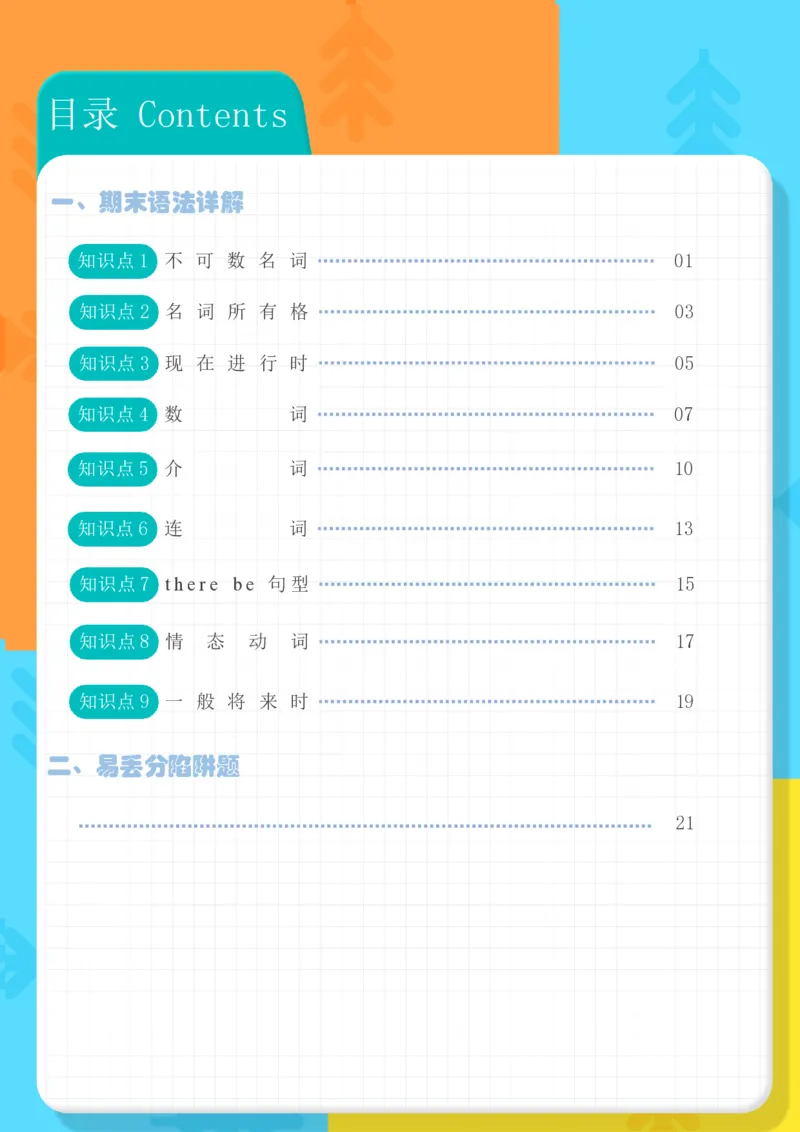
目录 Contents
一、期末语法详解
知识点 1 不 可 数 名 词 01
知识点 2 名 词 所 有 格 03
知识点 3 现 在 进 行 时 05
知识点 4 数 词 07
知识点 5 介 词 10
知识点 6 连 词 13
知识点 7 there be 句型 15
知识点 8 情 态 动 词 17
知识点 9 一 般 将 来 时 19
二、易丢 分陷阱题
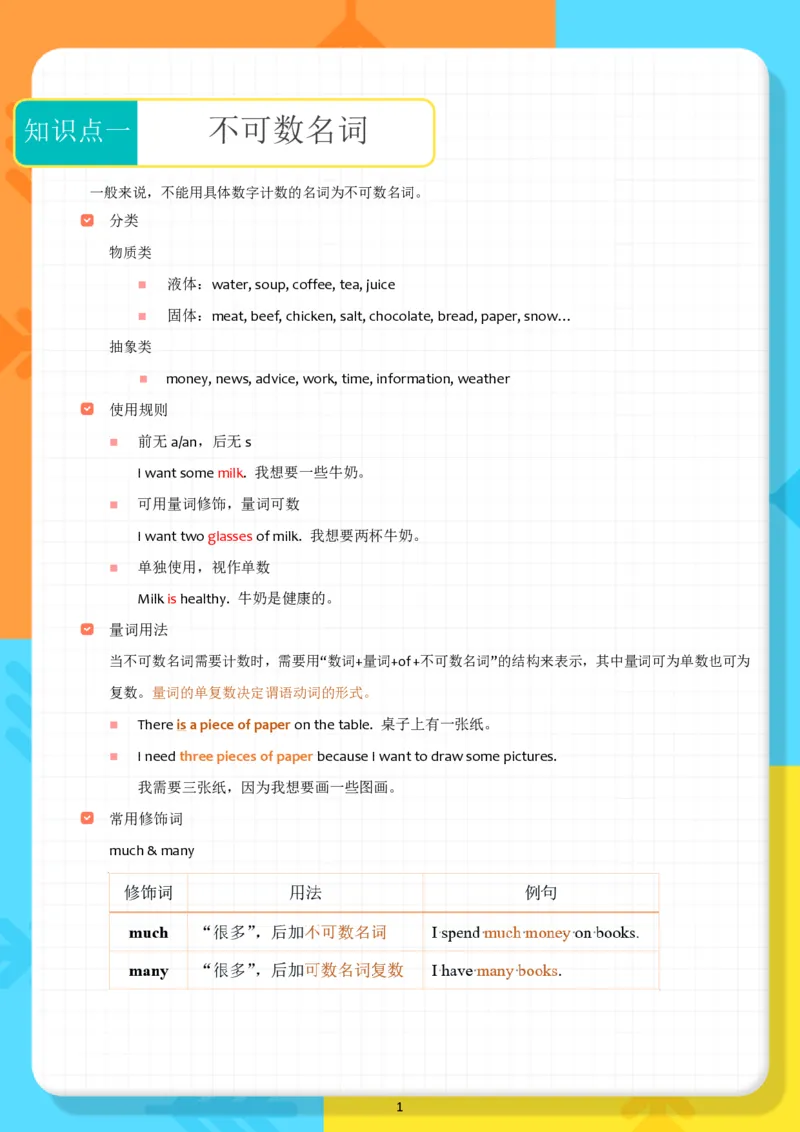
21知识点一 不可数名词
一般来 说,不能用具体数字计数的名词为不可数名词。
分类
物 质类
◼ 液体:water, soup, coffee, tea, juice
◼ 固体:meat, beef, chicken, salt, chocolate, bread, paper, snow…
抽象类
◼ money, news, advice, work, time, information, weather
使用规则
◼ 前无a/an,后无s
I want some milk. 我想要一些牛奶。
◼ 可用量词修饰,量词可数
I want two glasses of milk. 我想要两杯牛奶。
◼ 单独使用,视作单数
Milk is healthy. 牛奶是健康的。
量 词用法
当不可数名词需要计数时,需要用“数词+量词+of +不可数名词”的结构来表示,其中量词可为单数也可为
复 数。量词的单复数决定谓语动词的形式。
◼ There is a piece of paper on the table. 桌子上有一张纸。
◼ I need three pieces of paper because I want to draw some pictures.
我需要三张纸,因为我想要画一些图画。
常 用修饰词
much & many
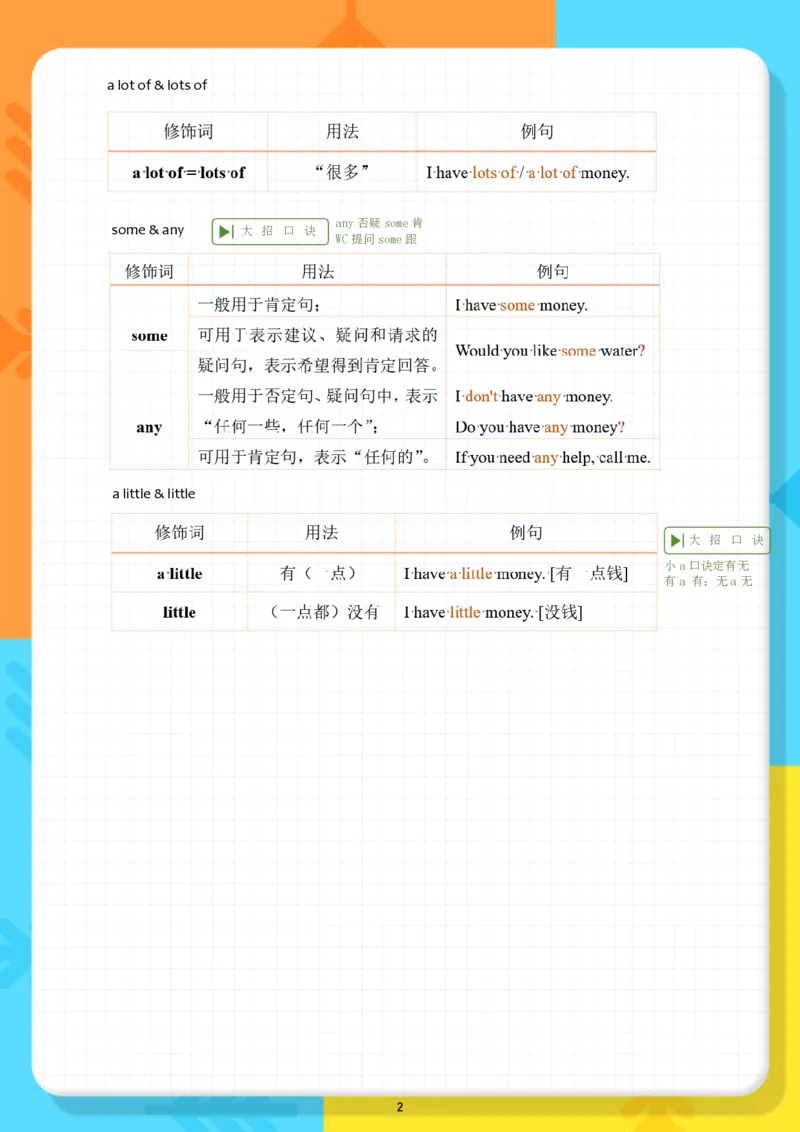
1a lot of & lots of
any否疑some肯
so me & any 大 招 口 诀
WC提问some跟
a little & little
大 招 口 诀
小a口诀定有无
有a 有;无a无
2知识点二 名 词 所 有 格
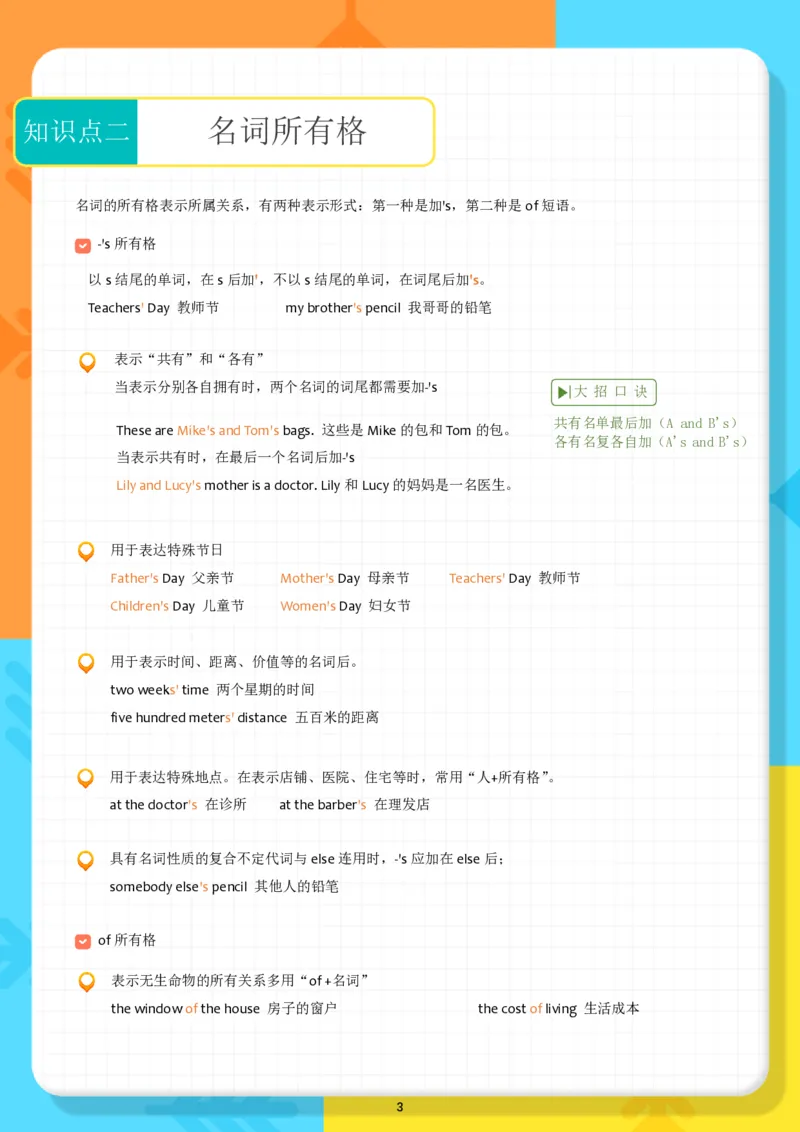
名词的所有格表示所属关系,有两种表示形式:第一种是加's,第二种是of短语。
-'s所有格
以s结 尾的单词,在s后加',不以s结尾的单词,在词尾后加's。
Teachers' Day 教师节 my brother's pencil 我哥哥的铅笔
表 示“共有”和“各有”
当表示分别各自拥有时,两个名词的词尾都需要加-'s
大 招 口 诀
共有名单最后加(A and B's)
These are Mike's and Tom's bags. 这些是Mike的包和Tom的包。
各有名复各自加(A's and B's)
当表示共有时,在最后一个名词后加-'s
L ily and Lucy's mother is a doctor. Lily和Lucy的妈妈是一名医生。
用 于表达特殊节日
Father's Day 父亲节 Mother's Day 母亲节 Teachers' Day 教师节
Children's Day 儿童节 Women's Day 妇女节
用于表示时间、距离、价值等的名词后。
two weeks' time 两个星期的时间
fiv e hundred meters' distance 五百米的距离
用 于表达特殊地点。在表示店铺、医院、住宅等时,常用“人+所有格”。
at the doctor's 在诊所 at the barber's 在理发店
具有名词性质的复合不定代词与else连用时,-'s应加在else后;
somebody else's pencil 其他人的铅笔
of所有格
表示无生命物的所有关系多用“of +名词”
the window of the house 房子的窗户 the cost of living 生活成本
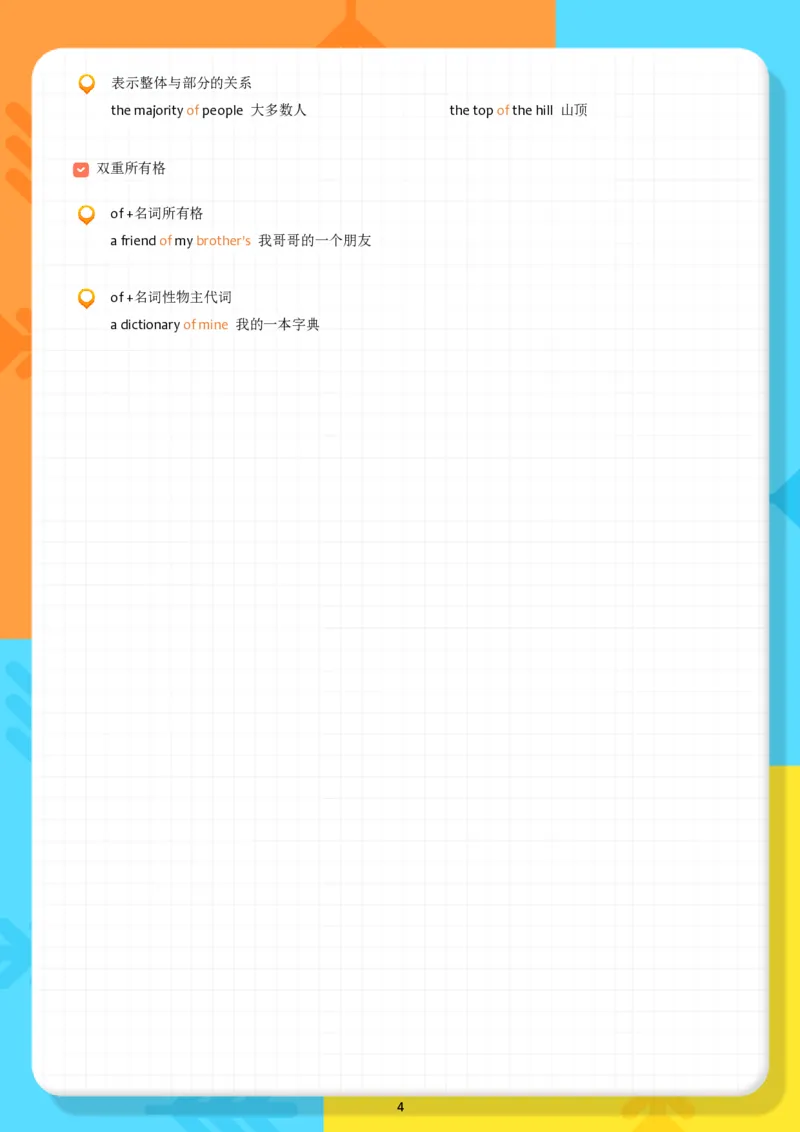
3表示整体与部分的关系
th e majority of people 大多数人 the top of the hill 山顶
双重 所有格
of +名词所有格
a friend of my brother's 我哥哥的一个朋友
of +名词性物主代词
a dictionary of mine 我的一本字典
4现在进行时
知识点三
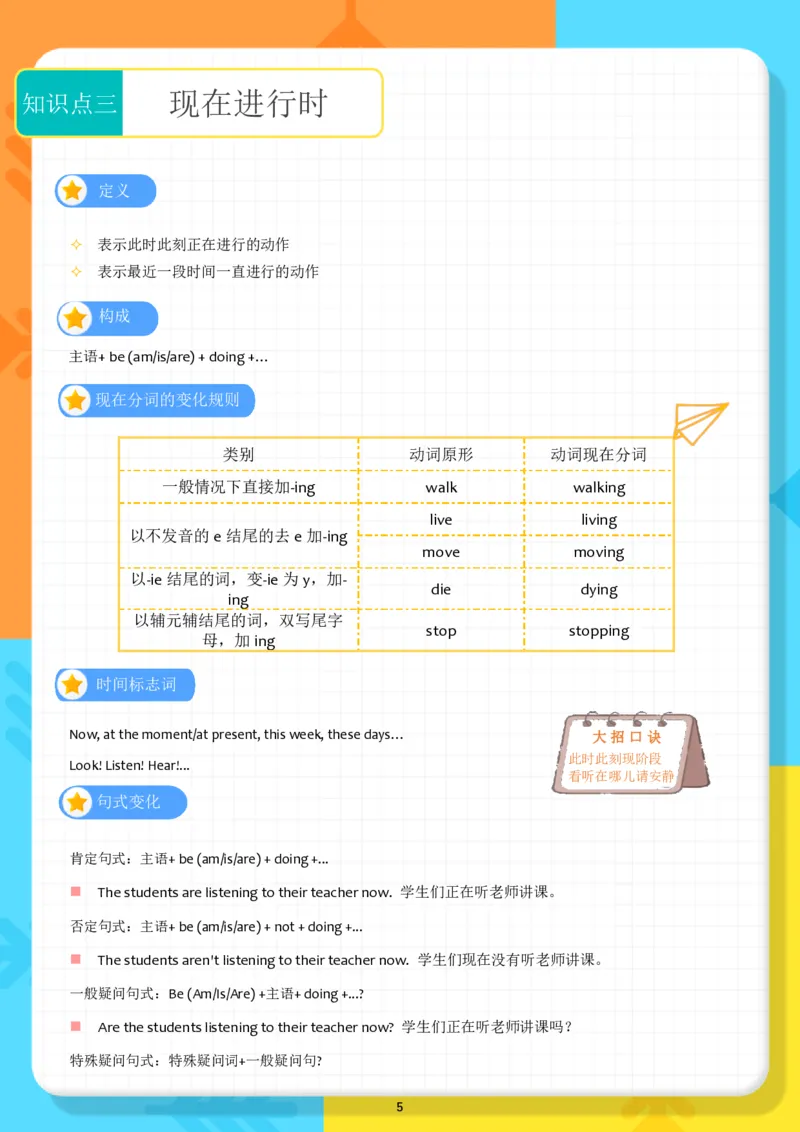
定义
表示此时此刻正在进行的动作
表示 最近一段时间一直进行的动作
构成
主语+ be (am/is/are) + doing +…
现在 分词的变化规则
类别 动词原形 动词现在分词
一般情况下直接加-ing walk walking
live living
以不发音的 e结尾的去 e加-ing
move moving
以-ie结尾的词,变-ie 为y,加-
die dying
ing
以辅元辅结尾的词,双写尾字
stop stopping
母,加 ing
时间标志词
Now, at t he moment/at present, this week, these days… 大招 口诀
此时此刻现阶段
Look! Listen! Hear!...
看听在哪儿请安静
句式 变化
肯定句式 :主语+ be (am/is/are) + doing +...
◼ The students are listening to their teacher now. 学生们正在听老师讲课。
否定句式 :主语+ be (am/is/are) + not + doing +...
◼ The students aren't listening to their teacher now. 学生们现在没有听老师讲课。
一般疑问句式:Be (Am/Is/Are) +主语+ doing +...?
◼ Are the students listening to their teacher now? 学生们正在听老师讲课吗?
特殊疑问句式:特殊疑问词+一般疑问句?
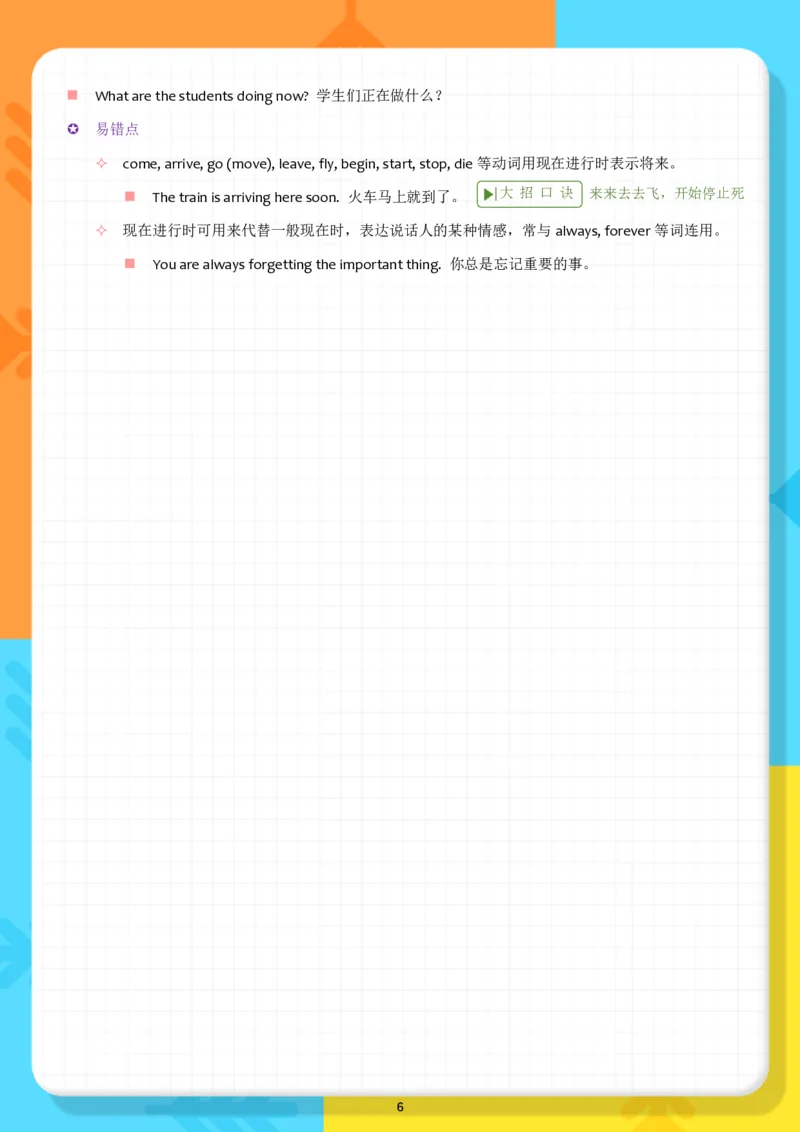
5◼ What are the students doing now? 学生们正在做什么?
易错 点
come, arrive, go (move), leave, fly, begin, start, stop, die等动词用现在进行时表示将来。
◼ The train is arriving here soon. 火车马上就到了。 大 招 口 诀 来来去去飞,开始停止死
现在进行时可用来代替一般现在时,表达说话人的某种情感,常与always, forever等词连用。
◼ You are always forgetting the important thing. 你总是忘记重要的事。
6知识点四 数词
基数 词
概述: 表示数量或数目多少的数词叫基数词。它可以在句中作主语、宾语、表语或定语。
基数词的构成
100以上的特殊数位读法如下:
12,345 读作:twelve thousand three hundred and forty-five
hundred, thousand, million被基数词修饰时,表示确切数目,其后不加-s,也不与of连用;
当表示 不确切的数目时,其后加-s,同时加of。
two million 两百万 three billion 三十亿 大 招 口 诀
hundreds of 成百上千的 thousands of 成千上万的
有无无,无有有
基数词 的主要用法
用 于名词前表示数量的多少;
I have three pens. 我有3支钢笔。
表 示年龄、年份;
M y mother is thirty-eight years old. 我母亲38岁。
I was born in 2005. 我2005年出生。
表示不确切岁数或年代(用几十的复数形式);
H e became a professor in his thirties. 他三十多岁时成为教授。
I t was in the 1960s. 那是在20世纪60年代。
表示价格;
The bike is two hundred and thirty-five yuan. 这辆自行车235元。
表示小数(小数点读作point)或百分数(百分号读作percent)
59.9 读作:fifty-nine point nine 27% 读作:twenty-seven percent
7 表示点钟时刻;
▪ 整点读法:小时+ o'clock
大 招 口 诀
顺读方法最常见,先读小时再分钟
seven o'clock 七点 nine o'clock 九点
逆读方法分两类,过半用to不到past
▪ 非整点读法:
表示时间、距离(用数词加名词所有格形式作定语);
five minutes' walk 步行5分钟
It's one hour's ride from my home to our university. 从我家到我们大学乘车是一小时的路程。
用于构成复合形容词。
由数词和其它名词构成的复合形容词作定语时,其中的名词用单数形式,各部分间要用连字符
“-”来连接。
She's a sixteen-year-old girl. 她是个16岁的 女孩。
序数词
概述:表示事物顺序的数词叫序数词。它的作用相当于 名词或形容词,可作主语、宾语、定语或表语。
序数词的构成
序数词前通常要加定冠词the;但当序数词前 有形容词性物主代词或名词所有格修饰时,不用定冠
词the。
Mr. Lin lives on the fifth floor. 林先生住在5楼。
Simon is his third child. 西蒙是他的第3个孩子。
8序数词的主要用法
表示分数:分子用基数词,写在前面;分母用序数词,写在后面。当分子大于1时,
分母要加s。 大 招 口 诀 子基母序,分子大于1,分母加s
1/3 one third 3/5 three fifths
表示日期
3月5日 the fifth of March 12月11日 the eleventh of December
9知识点五 介词
表 时间的介词 in/on/at
大 招 口 诀
in年in月in季节
at 多用于具体的钟点时刻前。也可用于中午、晚上、午夜等固定搭配中。 on天on 节on星期
at黎明午夜点钟前
【例】at seven 在7点;at a quarter past one 在一点一刻;
at noon 在中午; at night 在晚上;at midnight 在午夜
in表示一段时间,用于年、月、世纪、四季、泛指的一天的上午、下午、晚上等前。还可用于表示
“从 现在起,多长时间以后”的短语中。
【例】in the twenty-first century 在21世纪;in 1996 在1996年;in February 在二月
in autumn 在秋天;in the morning 在早上
on主要用在星期几、具体某一天;或某一天的早、中、晚或节日前。
【 例】on a cold morning在一个寒冷的早上;on Friday 在周五;on Spring Festival 在春节
表方位的介词
in, on, to
in表示在某一地区之内的某方位(属于该范围);
Fujian is in the southeast of China.
大 招 口 诀
福建省位于中国的东南部。
遇见东南西北方
to表示在某一地区之外的某方位(不属于该范围);
in里to外on接壤
China is to the west of Japan.
中国位于日本的西部。
on表示与某地的毗邻接壤关系;
Hubei is on the north of Hunan.
湖北在湖南的北部。
a t与in
at接较小的地方;
I will wait for you at the station.
我将在车站等你。
in接较大地方;
He lives in Shanghai.
他住在上海。
10ov er, above, on
over指在……的正上方,表示垂直在上方;
over
The bridge is over the river. 桥在河上。 above
on
above指在上方,不一定表示正上方;
We're flying above the clouds. 我们在云层之上飞行。
on指在上面,表示两物体有接触; beneath
below
There is a map on the wall. 墙上有一张地图。 under
below与under
below表示“在……下方”或“位置低于……”,不一定垂直在下;
The coat reaches below the knees. 这件外套到了膝盖下面。
under表示“在……正下方”;
There are many bikes under the trees. 树下有许多自行车。
易混淆 介词辨析
in front of, in the front of与behind, at the back of
in front of表示“在……的前面”(范围外);
There are some trees in front of the classroom.
教室前面有一些树。
in the front of表示“……的前面”(范围内);
There is a teacher's desk in the front of the classroom. 大 招 口 诀
前前后后
教室的前面有一张讲桌。
里the外不the
at the back of 表示“……的后面”(范围内)
There is a blackboard at the back of the classroom.
教室的后面有块黑板。
behind 表示“……的后面”(范围外)
There is a little garden behind the house.
房屋后面有个小花园。
王老师站在她的学生中间。
11between与among
between常指“在 两者之间”;among用于指“在三者或三者以上的人或物之间”。
◼ Maria sits between Lucy and Lily.
Maria坐在Lucy和Lily之间。
◼ Miss Wang stands among her students.
ac ross与through
across 和through 都表示“穿过”。across含有“从……表面穿过”之意,through 含有“从……中间
穿 过”之意。
【例】
大 招 口 诀
◼ He can swim across the river.
through内部穿,across表面过
他能游过这条河。 见森林、门、窗户选through
见河流、马路、田野选across
◼ The burglar got in through the window.
盗贼是从窗户进来的。
in/ on the tree与in/on the wall
on the tree表示枝、叶、果实等“长在树上”;in the tree表示人或其他东西“在树上”;
on the wall表示东西“粘贴或挂在墙上”;in the wall表示门、窗等“嵌在墙上”;
12知识点六 连 词
定义
并列连词主要用来连接属于同一层次并具有相同句法功能的词、短语或句子,主要用来表示并列
关系、转折关系、选择关系、因果推理关系等。
表示并列关系
并列关系主要表达“和”、“补充”、“增加”等意思,主要包括如下连词:
连词 意义 主谓一致
and 和 可单可复
both…and... 两者都...... 必复原则
neither…nor... 既不……也不...... 就近原则
not only…but (also)... 不但……而且...... 就近原则
as well as 和 就远原则
and的主谓一致原则(难点★)
当and所连接的两个词是指同一人或物时,谓语用单数;
The singer and dancer comes to the party. 唱跳歌手来参加了聚会。
当and所连接的两个词是指两个人或物时,谓语用复数。
The singer and the dancer come to the party. 歌手和舞蹈家都来参加了聚会。
表示转折关系
常用来表示转折关系的并列连词有如下几个:
连词 意义 连词 意义 连词 意义
but 但是 yet 然而 while 然而
but表示上下分句所述情况相反,用在句中,后不加逗号;
Life is limited but there is no limit to learning. 生命是有限的,但学习是无限的。
13yet用于引出颇令人惊讶的事实,意为“可是却,却又”;
He said he would be late, yet he arrived on time. 他说他会迟到,但他还是准时到了。
while表示前后对比性。
She is very diligent, while he is very lazy. 她很勤奋,而他很懒。
表示选择关系
常用来表示选择关系的并列连词有如下几个:
连词 意义 主谓一致
or 或者 就近原则
either…or… 要么……要么…… 就近原则
Either my sisters or my mother is coming. 不是我的姐妹们就是我的妈妈要来。
表示因果关系
常用来表示因果关系的并列连词有如下几个:
连词 意义
for 因为,理由是
so 因此,所以
for表示补充说明原因,一般用于句中;
We listened eagerly, for he brought news of our families. 我们急不可待地听着,因为他带来了我
们家人的消息。
so引出结果,不与because连用。
It was a lovely day so I walked home. 那天天气很好,所以我走路回家了。
14知识点七 there be 句型
语法概述:there be句型表示某地或某时有某物或者某人,强调存在。There是引导词,本身无实际意
义;be是 谓语动词,be后的名词是主语。
句式变化
肯定 句:There is/are+主语+其他.
There is a car in front of the house. 房子前面有一辆车。
否定 句:There is/are+not+主语+其他.
There isn’t any water here. 这儿没有水。
一般 疑问句及其答语:—Is/Are there+主语+其他?
—Yes, there is/are. || —No, there isn’t/aren’t.
—A re there any books in the bag? 书包里面有书吗?
—Yes, there are. 是的,有一些。|| —No, there aren’t. 不,没有。
特殊 疑问句结构:特殊疑问词(组)+be (+there)+其他? (there通常省略)
【例】
◼ —What's (there) in your bag? 你的书包里有什么?
—There is a pen and some books. 有一只钢笔和一些书。
◼ —How many students are there in your school? 你们学校有多少学生?
—There are 2,000. 有两千人。
易错点
there be句型与have/has
There be句型强调“存在关系”,而have/has强调“所属关系”。
There is a boat in the river. 河里有一条船。【存在关系】
I have a nice watch. 我有一块好看的表。【所属关系】
15 表示“有”时,there be 句型不能与实义动词have/has连用;在表示“复数某物/某地的东西时”,
there be 结构可以与have/has 进行同义句替换。
教室的墙上有四扇窗户。
大 招 口 诀
There are four windows in the wall of the classroom.
看见there就选be
= The classroom has four windows in the wall. 别把have/has掺进去
there be句型的一般将来时结构为:
There will be…或There is/are going to be…
There will be/is going to be a meeting tomorrow. 明天有一场会议。
当there be句型中出现多个主语时,be动词的形式要看离它最近的主语的单复数。[就近一致]
There are two boys and a teacher in the room. 房间里有两个男孩和一位老师。
16知识点八 情态动词
概念
用于表明说话者对某一行为的态度和观点。
情态动词的特征
① 有一定的词义,但不能单独作谓语,必须和其他动词连用构成谓语。
② 无人称和数的变化,情态动词 have to 除外(主语为第三人称单数时,have to 改为 has
to)。
大 招 口 诀
③ 后接动词原形,否定在情态动词后加not。
情态动词跟动原
④ 具有助动词的作用,可用来构成否定句、疑问句及用于简明答语。
人称变化情不变
否定情后n-o-t
情态动词can用法
1. 基本句式
❖ 肯定句:主语+can+动词原形+其他.
Ann can play chess. 安会下国际象棋。
❖ 否定句:主语+can’t+动词原形+其他.
Ann can’t play chess. 安不会下国际象棋。
❖ 一般疑问句:Can+主语+动词原形+其他?
肯定回答:Yes, 主语+can.
否定回答:No, 主语+can’t.
—Can Ann play chess? 安会下国际象棋吗?
—Yes, she can. 是的,她会。/—No, she can’t. 不,她不会。
❖ 特殊疑问句:特殊疑问词+can+主语+动词原形+其他?
What can Ann do? 安会做什么?
2. 拓展
(1)can还可以表示许可或请求,意为“可以”。
➢ Can I help you?
我可以帮助你吗?
17➢ Can you come to my birthday party?
你能来我的生日聚会吗?
(2)can还可以表示推测,意为“可能”,常用于否定或疑问句中。
➢ That man can’t be my English teacher.
那个人不可能是我的英语老师。
➢ Can that boy be Bill?
那个男孩可能是比尔吗?
18知识点九 一般将来时
定义
表示将要发生的动作或存在的状态及打算、计划或准备做某事。
构成
主语+ will+动词原形+其他.
主语+ be going to +动词原形+其他.
时间标志词
tomorrow morning/afternoon/evening
大招口诀
next week/month/year…
明天下个soon
2 years later in加段时future
in three days/weeks/months/years
句式变化
will 结构
一般表示将来势必会发生的事,或未经计划而临时做出的打算。
will可以用在任何人称。
肯定句式:主语+ will +动词原形+...
◼ She will call you this evening. 她今天晚上会给你打电话。
否定句式:主语+ will + not +动词原形+...
◼ The teachers won't write on the blackboard with chalk. 老师们将不再用粉笔在黑板
上写字。
疑问句式:Will +主语+动词原形+...?
◼ Will she come back in a week? 一周后她会回来吗?
be going to结构
按打算、决定、计划将要做的事,表示已经决定的,很可能发生的事,或某种迹象表明
19要发生的事。
肯定句式:主语+ be (am/is/are) + going to +动词原形+...
◼ He is going to travel around the world. 他计划周游世界。
否定句式:主语+ be (am/is/are) + not + going to +动词原形+...
◼ He isn't going to travel around the world. 他不打算周游世界。
疑问句式:Be (Am/Is/Are) +主语+ going to +动词原形+...?
◼ Is he going to travel around the world? 他计划周游世界么?
be going to与will的区别
be going to指已计划过或思考过的意图;will表示未事先思考或计划而临时做出的决定。
◼ I'm going to see him tomorrow. 我打算明天去看他。
◼ I will answer the door. 我会去开门。
be going to表示客观迹象表明马上要发生的事,而will表明说话者的主观意识。
◼ Look at the clouds. There's going to be a storm. 看看这些云,暴风雨要来了。
◼ I hope it will be warm tomorrow. 我希望明天会暖和起来。
201. John has two ________ and some ________ for dinner.
A. salad; chicken B. salads; chickens
C. salad; chickens D. salads; chicken
2. —What would you like to drink, girls?
— _______, please.
A. Two glass of water
B. Two glass of waters
C. Two glasses of water
D. Two glasses of waters
3. — What would you like for breakfast, Mr. Scott?
— Three pieces of _______ with ________ cup of black tea, please.
A. breads; a B. bread; a
C. breads; the D. bread; the
4. This is ________ bedroom. They both like it very much.
A. Mary and Helen B. Mary's and Helen's
C. Mary's and Helen D. Mary and Helen's
5. —Is this your room?
—No, it isn't. It's my ________ room. My mother and father live in it.
A. parents' B. parent's C. parent D. parent'
6. Tomorrow I'm going to my ________. It's ________.
A. aunt; five minutes' walk
B. aunt's; five minute's walk
C. aunt; five minute's walk
D. aunt's; five minutes' walk
7. It's about ________ walk from my home to our school.
A. 30 minutes B. 30 minute
C. 30 minute's D. 30 minutes'
8. —Where is my hat, mom?
—I think it's in your ________ room. Your grandpa and grandma like it very much.
21A. grandparent B. grandparents
C. grandparent's D. grandparents'
9. September 10th, 2024 is the 40th ________ Day in China. To thank all the teachers, our
school will have a big party then.
A. Women's B. Woman's C. Teachers' D. Teacher's
10. Mary likes reading and she ________ a book about animals now.
A. reads B. read
C. is reading D. will read
11. Look! Some students ________ Tai Ji over there. Let's go and join them.
A. play B. are playing
C. played D. plays
12. —Where is Mark?
—Look! He ________ a walk with his dad over there.
A. takes B. took C. is taking D. will take
13. — Where are you now, Betty?
— I'm in Lao She Teahouse and I ________ Beijing Opera.
A. watch B. watched
C. am watching D. have watched
14. —Hurry up! Mr. Li ________ for us in the library.
—OK. I am on my way.
A. waits B. waited
C. is waiting
15. —Sally, where's your brother?
—He ________ a model plane in his room now.
A. is making B. makes C. made
16. Please keep quiet. Your brother ________ a math class on the computer.
A. has B. had C. will have D. is having
17. —Can I speak to Jenny?
—Sorry, she ________badminton with her friend.
A. play B. played
22C. is playing D. plays
18. —Where is your father?
—In the garden. Look! He ________ tea at the table with my grandfather.
A. drink B. drinks
C. is drinking D. drank
19. February has ________ days in the year of 2024.
A. twenty-five B. twenty-nine
C. thirty-one D. thirty-two
20. There are ________ months in a year. The ________ month is August.
A. twelve, ninth B. twelfth, ninth
C. twelve, eighth D. twelve, eight
21. Look! There are ________ pictures on the wall. And the ________ picture is mine.
A. four; first B. four; one
C. fourth; first
22. Please turn to Page ________ and look at the ________ picture.
A. Three; three B. Third; three
C. Three; third D. Third; third
23. —Are you ________?
—Yes, and September 20th is my ________ birthday.
A. twelve; twelve B. twelve; twelfth
C. twelfth; twelfth D. twelfth; twelve
24. —I have ________ lessons today, and English is ________ one.
—Wow, you are so busy!
A. eight; the fifth B. eighth; five
C. eight; fifth D. eight; five
25. —How many friends will come to your ________ birthday party?
—About ________.
A. fifteen; fifteen B. fifteen; fifteenth
C. fifteenth; fifteen
26. —How old is your brother?
23—He is nine. We had a special party for his ________ birthday last Friday.
A. nine B. ninth C. the ninth
27. In the factory, ________ of the workers ________ women.
A. three fifths; are B. three fifth; are
C. third fives; is D. third five; is
28. There are five _________ students in my school.
A. hundreds of B. hundred of
C. hundred D. hundreds
29. The big tree in front of my house is ________ years old.
A. hundred B. hundreds of
C. hundreds D. one hundred of
30. We plan to visit Beijing ________ February and we're going to stay there for three days.
A. on B. in C. at D. of
31. My mother usually goes home ________ about 5: 30 a.m.
A. at B. to C. in D. on
32. Usually I make breakfast for my family ________ Saturdays.
A. at B. in C. on D. to
33. Chang'e-6 successfully landed on the moon ________ June 2nd, 2024.
A. at B. on C. in
34. _________ the morning of April 30th, many foreigners arrived _________ Shanghai.
A. In; at B. On; in C. On; to D. On; at
35. You can't see Lucy because she is ________ a tree.
A. under B. behind
C. near D. in front of
36. The moonlight is shining ________ the window. Everything in the room looks so nice.
A. in B. through C. over D. across
37. Turn right at the first crossing and the park is ________ your right.
A. at B. in C. on
38. Take a map with you, Jason. It can help you walk ________ the forest.
A. away B. across C. through D. over
2439. This song is very popular _________ many teenagers recently.
A. between B. among C. of D. at
40. —Where is Bob? Can you see him, Jim?
—He is sitting ________ his computer and playing games all the afternoon.
A. in front of B. across
C. behind D. near
41. My best friend is good at Chinese, ________ she often helps me with it.
A. but B. and C. because D. or
42. Remember to return the book on time, ________ other students can also read it next
time.
A. and B. or C. but
43. This sweater is nice, _________ it doesn't look good on me.
A. and B. but C. or D. so
44. —Which club would you like to join, Mary?
—I like music, ________ I'd like to join the Music Club.
A. because B. so C. but D. or
45. There ________ some rice and vegetables in his bowl, but he doesn't want to eat them.
A. have B. are C. is D. was
46. —Dad, ________ you do Chinese kung fu Tai Chi?
—Yes. I do it every morning.
A. must B. can C. may
47. —I don't take my ruler.
—Don't worry. You ________ use mine.
A. must B. need C. should D. can
48. —Could I watch TV now, mum?
—I'm afraid you ________. Finish your homework first.
A. could B. can C. can't D. couldn't
49. —I forget to bring my computer, may I use yours?
—Yes, you _________.
A. can B. could C. should
2550. —Dad! _________ I watch TV now?
—Of course. But you can't watch too long.
A. Must B. Can C. Need D. Will
51. Tomorrow is my grandma's birthday. We _________ a big birthday party for her.
A. held B. are holding
C. holds D. will hold
52. My sister is coming to my home today. She _________ with me for a week.
A. stay B. stayed
C. is staying D. will stay
53. —What is your plan for the weekend?
—I_________ my grandparents in the country.
A. am visiting B. visited
C. visit D. am going to visit
54. —Where's mum?
—She is trying on the new dress upstairs now. She _________ it to a party.
A. wears B. wore
C. will wear D. is wearing
55. —What is your plan for the coming Father's Day?
—I _________ a big dinner for my father.
A. am going to make B. makes
C. made D. make
56. I will give my mother a gift on _________(mother) Day.
57. Please look after the _________ (fireman) clothes. They will come back soon.
58. They can go there on _________ (child) Day.
59. There is too much _________(糖) in snacks like chocolate, ice cream and chips. Don't
eat them too often.
60. A supermarket is between our school and a post office. (改为同义句)
_________ _________ a supermarket between our school and a post office.
26