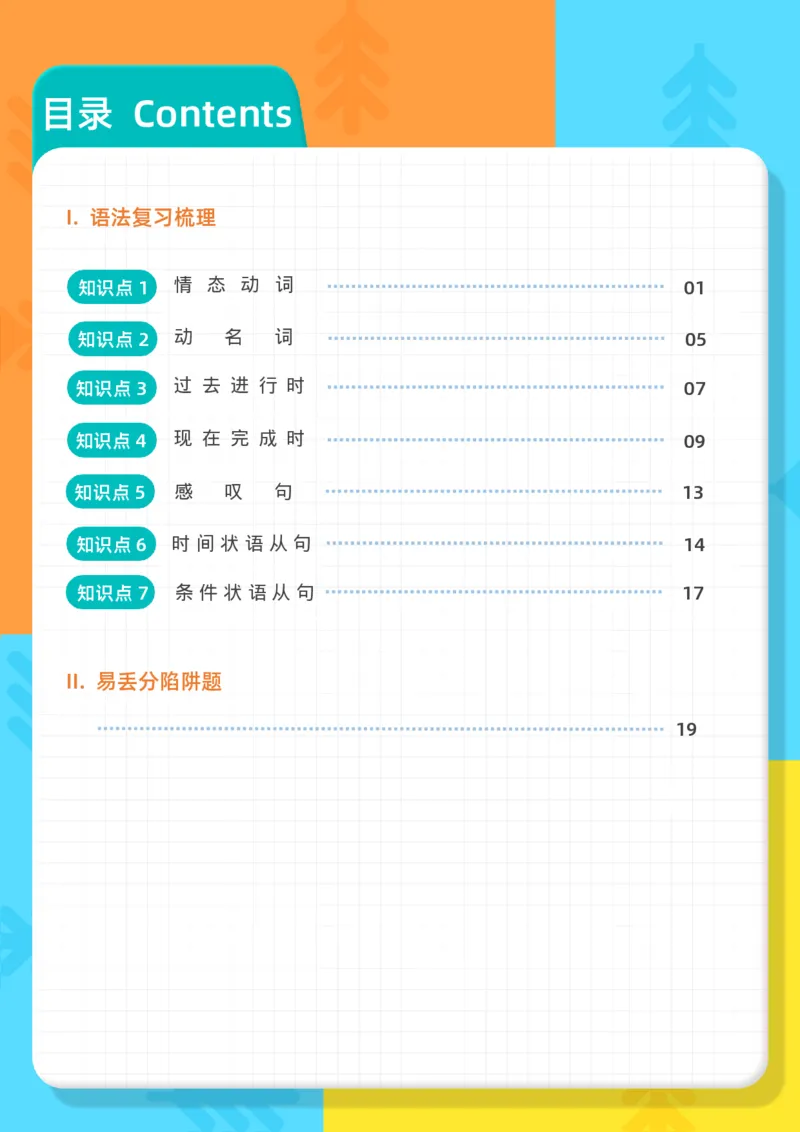
目录 Contents
I. 语法复习梳理
知识点 1 情 态 动 词 01
知识点 2 动 名 词 05
知识点 3 过 去 进 行 时 07
知识点 4 现 在 完 成 时 09
知识点 5 感 叹 句 13
知识点 6 时 间 状 语 从 句 14
知识点 7 条 件 状 语 从 句 17
II. 易丢分陷阱题
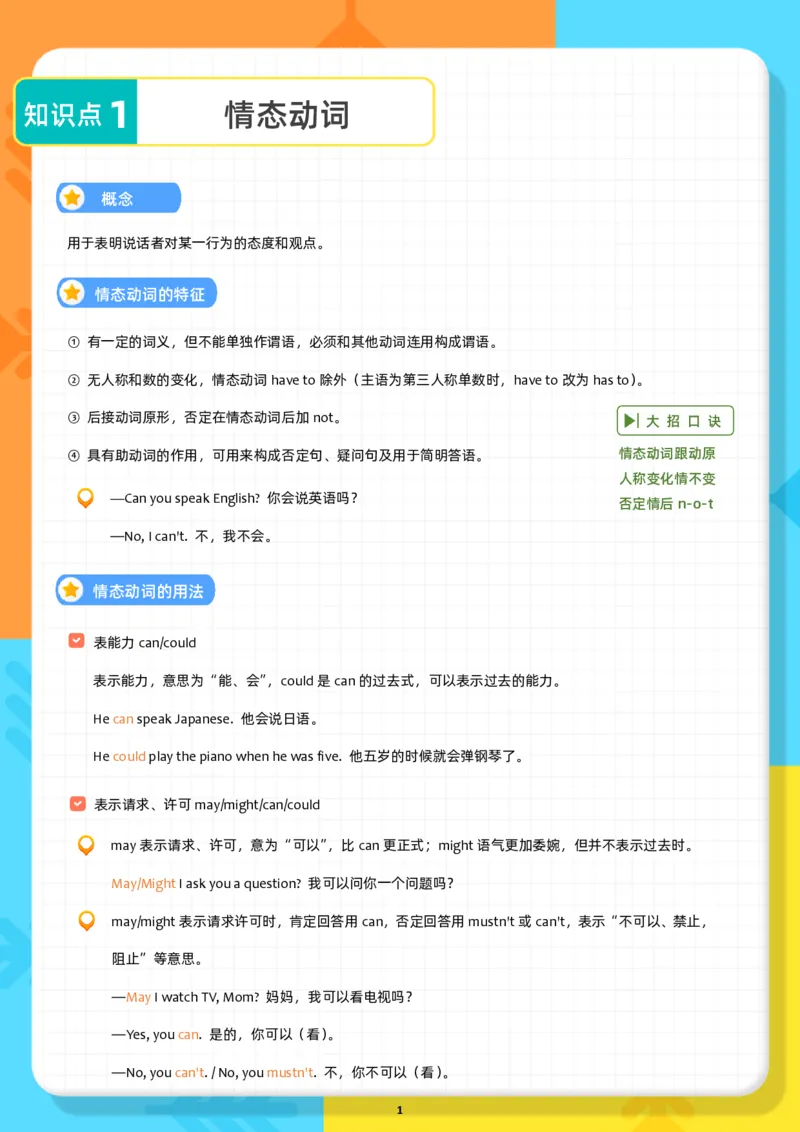
19知识点 1 情态动词
概念
用于表明说话者对某一行为的态度和观点。
情态动词的特征
① 有一定 的词义,但不能单独作谓语,必须和其他动词连用构成谓语。
② 无人称 和数的变化,情态动词have to除外(主语为第三人称单数时,have to改为has to)。
③ 后接动 词原形,否定在情态动词后加not。 大 招 口 诀
④ 具有助动词的作用,可用来构成否定句、疑问句及用于简明答语。 情态动词跟动原
人称变化情不变
— Can you speak English? 你会说英语吗? 否定情后n-o-t
—No, I can't. 不,我不会。
情态 动词的用法
表能力can/could
表示能力,意思为“能、会”,could是can的过去式,可以表示过去的能力。
He ca n speak Japanese. 他会说日语。
He co uld play the piano when he was five. 他五岁的时候就会弹钢琴了。
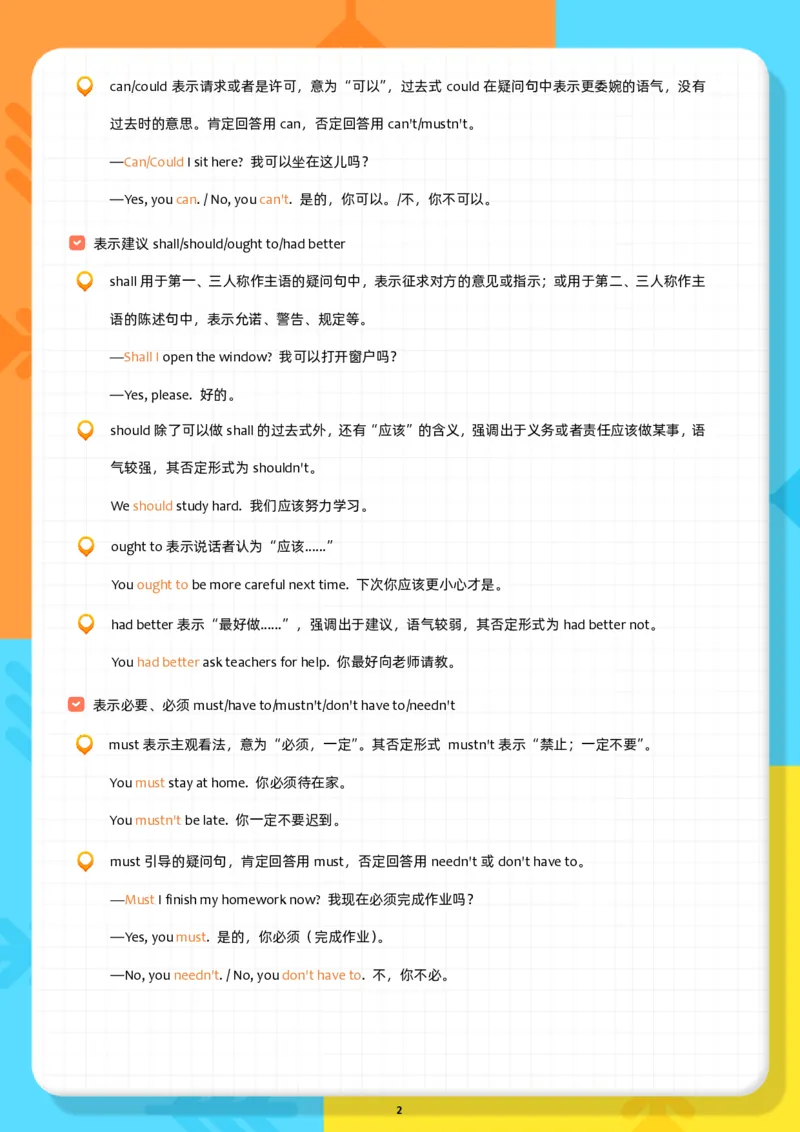
表示 请求、许可may/might/can/could
m ay表示请求、许可,意为“可以”,比can更正式;might语气更加委婉,但并不表示过去时。
M ay/Might I ask you a question? 我可以问你一个问题吗?
m ay/might表示请求许可时,肯定回答用can,否定回答用mustn't或can't,表示“不可以、禁止,
阻止”等意思。
—May I watch TV, Mom? 妈妈,我可以看电视吗?
—Yes, you can. 是的,你可以(看)。
—No, you can't. / No, you mustn't. 不,你不可以(看)。
1can/could表示请求或者是许可,意为“可以”,过去式 could在疑问句中表示更委婉的语气,没有
过去时的意思。肯定回答用can,否定回答用can't/mustn't。
—Can/Could I sit here? 我可以坐在这儿吗?
—Yes, you can. / No, you can't. 是的,你可以。/不,你不可以。
表示建议shall/should/ought to/had better
shall用于第一、三人称作主语的疑问句中,表示征求对方的意见或指示;或用于第二、三人称作主
语 的陈述句中,表示允诺、警告、规定等。
— Shall I open the window? 我可以打开窗户吗?
—Yes, please. 好的。
should除了可以做shall的过去式外,还有“应该”的含义,强调出于义务或者责任应该做某事,语
气 较强,其否定形式为shouldn't。
W e should study hard. 我们应该努力学习。
Wou eg shhto tuold表n示't l说au话gh者 at认 o为th“ers应. 该我 . 们 .... 不 .”应 该嘲笑他人。。
You ought to be more careful next time. 下次你应该更小心才是。
had better表示“最好做......”,强调出于建议,语气较弱,其否定形式为had better not。
You had better ask teachers for help. 你最好向老师请教。
表示必要、必须must/have to/mustn't/don't have to/needn't
must表示主观看法,意为“必须,一定”。其否定形式 mustn't表示“禁止;一定不要”。
Yo u must stay at home. 你必须待在家。
Yo u mustn't be late. 你一定不要迟到。
m ust引导的疑问句,肯定回答用must,否定回答用needn't或don't have to。
—Must I finish my homework now? 我现在必须完成作业吗?
—Yes, you must. 是的,你必须(完成作业)。
—No, you needn't. / No, you don't have to. 不,你不必。
2must表示主观上“必须”,无时态、人称和数的变化;have to表示客观上“不得不”,有时态、人
称 和数的变化。
We must protect our earth and stop polluting it. 我们必须保护地球,停止污染。
Nancy can't come to our party because she has to do her homework.
Nancy不能来我们的聚会了,因为她得做作业。
表示 推测can/can't/could/may/might/must
can表示推测,意思是“可能(是)”;could表示推测时,可能性低于can。否定句中的can't表示
完全否定,意思是“不可能”。
—Is this red shirt Mike's? 那件红色的衬衫是Mike的吗?
— No, it can't be his. He doesn't like red. 那不可能是他的。他不喜欢红色。
m ay 表示推测,常用于肯定句,意为“可能,也许”;might 是 may 的过去式,表推测时,可能性
低 于may。常与not sure连用。
—How nice the building is! What is it for? 多么漂亮的大楼啊!它是干什么用的?
—It may be a hotel, but I'm not sure. 它可能是个酒店,但我不确定。
must表示有把握的猜测,意为“一定是”。
Th e light is on. He must be at home now. 灯亮着,他现在一定在家。
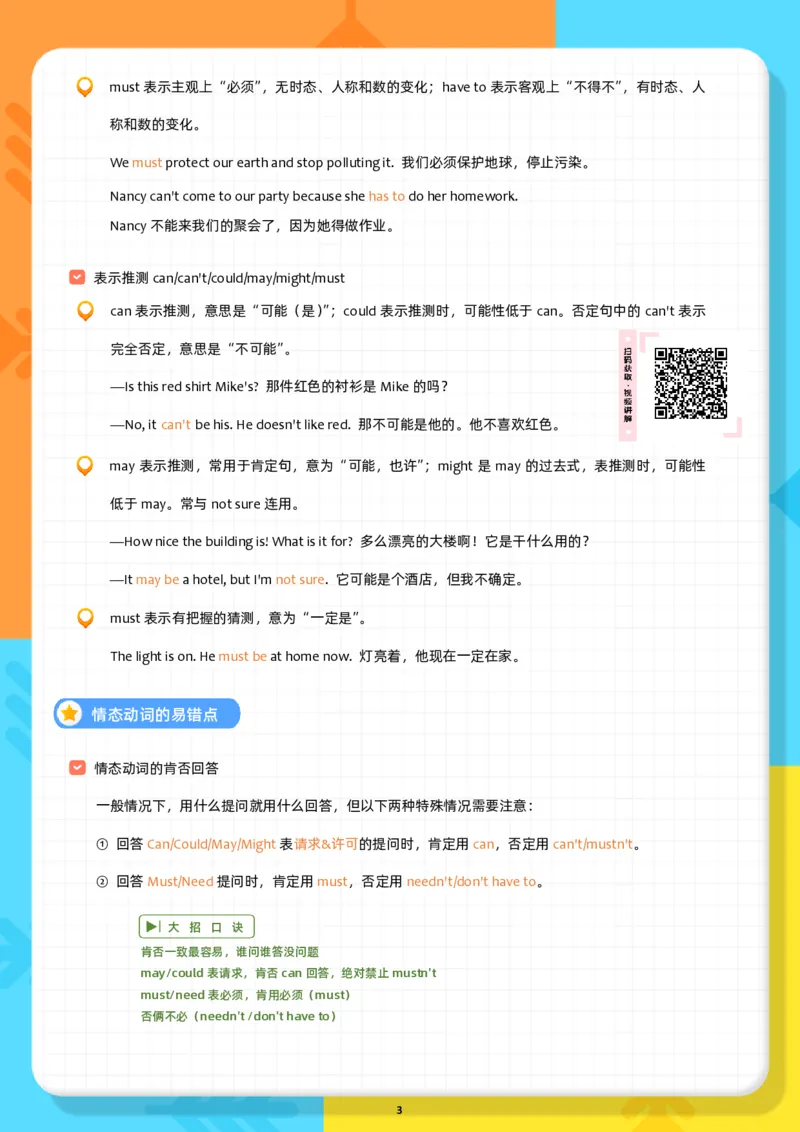
情态 动词的易错点
情态动词的肯否回答
一般情况下,用什么提问就用什么回答,但以下两种特殊情况需要注意:
① 回 答Can/Could/May/Might表请求&许可的提问时,肯定用can,否定用can't/mustn't。
② 回 答Must/Need提问时,肯定用must,否定用needn't/don't have to。
大 招 口 诀
肯否一致最容易,谁问谁答没问题
may/could表请求,肯否can回答,绝对禁止mustn't
must/need表必须,肯用必须(must)
否俩不必(needn't /don't have to)
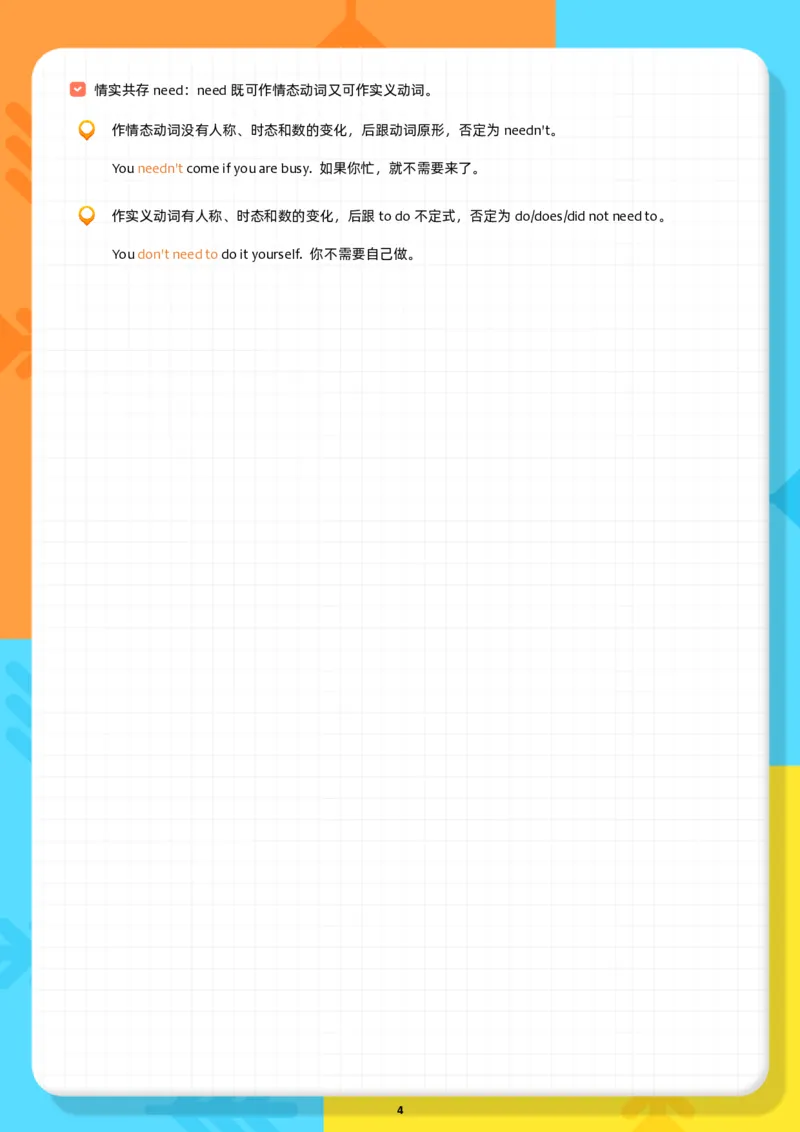
3情实共存need:need既可作情态动词又可作实义动词。
作 情态动词没有人称、时态和数的变化,后跟动词原形,否定为needn't。
Yo u needn't come if you are busy. 如果你忙,就不需要来了。
作 实义动词有人称、时态和数的变化,后跟to do不定式,否定为do/does/did not need to。
Yo u don't need to do it yourself. 你不需要自己做。
4知识点 2 动名词
定义
动名词是 非谓语的一种形式,动名词具有名词的性质,因此可在句中充当主语和宾语等。构成形式为“v-ing”。
作主语
动名词作 主语,谓语动词一般用第三人称单数形式。
Re ading is an art. 读书是一种艺术。
Cl imbing mountains is really fun. 爬山真是有趣。
作宾语
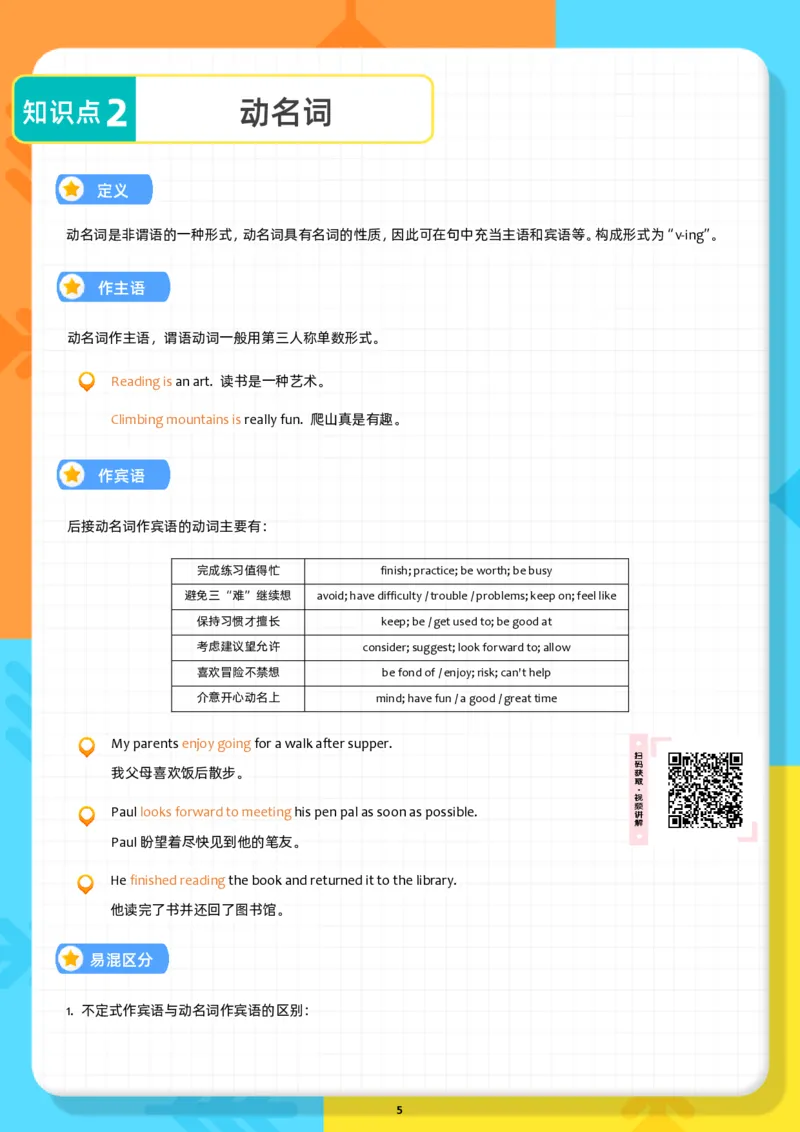
后接动名 词作宾语的动词主要有:
完成练习值得忙 finish; practice; be worth; be busy
避免三“难”继续想 avoid; have difficulty / trouble / problems; keep on; feel like
保持习惯才擅长 keep; be / get used to; be good at
考虑建议望允许 consider; suggest; look forward to; allow
喜欢冒险不禁想 be fond of / enjoy; risk; can't help
介意开心动名上 mind; have fun / a good / great time
M y parents enjoy going for a walk after supper.
我父母喜欢饭后散步。
Paul looks forward to meeting his pen pal as soon as possible.
Paul盼望着尽快见到他的笔友。
He finished reading the book and returned it to the library.
他 读完了书并还回了图书馆。
易混区分
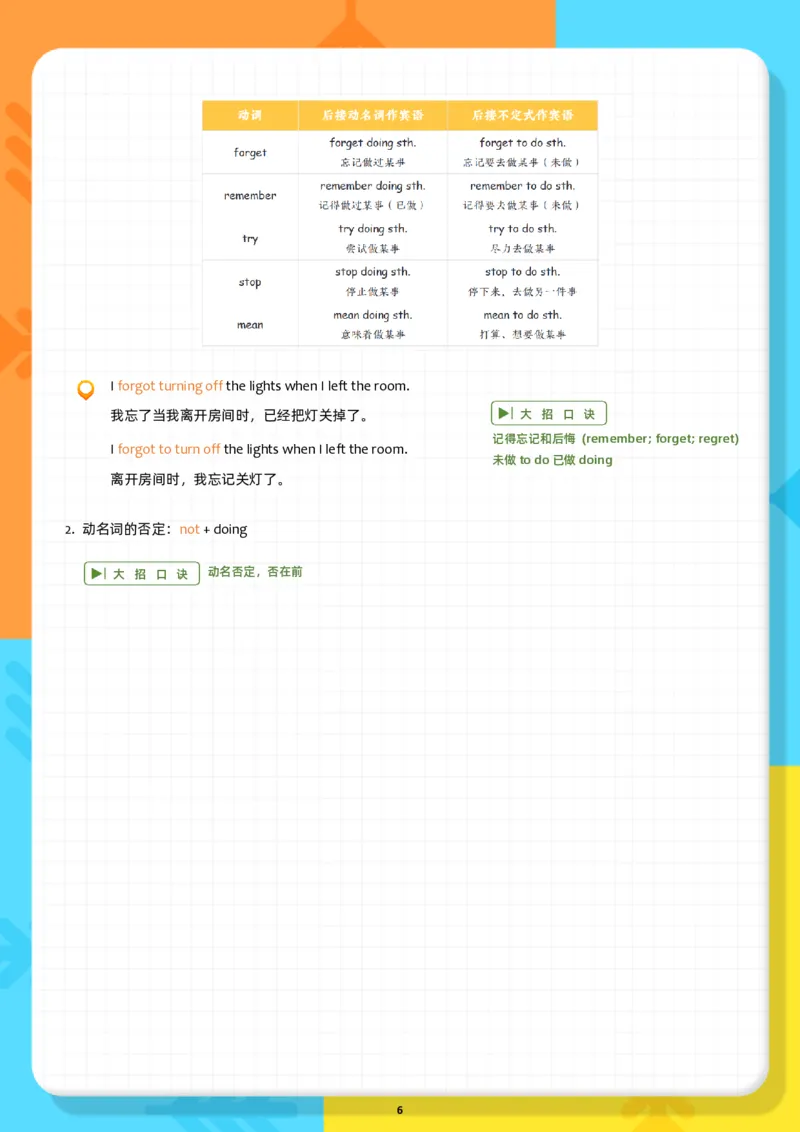
1. 不定式作宾语与动名词作宾语的区别:
5I forgot turning off the lights when I left the room.
我忘了当我离开房间时,已经把灯关掉了。 大 招 口 诀
记得忘记和后悔 (remember; forget; regret)
I forgot to turn off the lights when I left the room.
未做to do已做doing
离开房间时,我忘记关灯了。
2. 动名词 的否定:not + doing
大 招 口 诀 动名否定,否在前
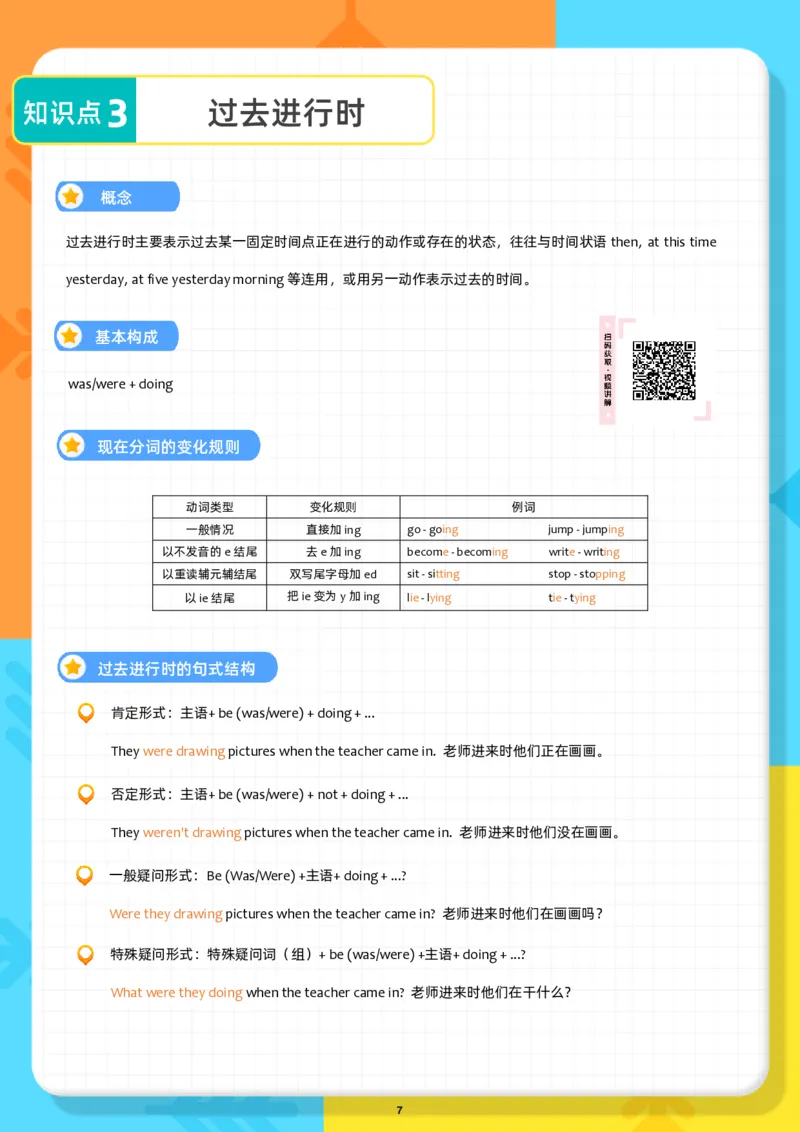
6知识点 3 过去进行时
概念
过去进行时主要表示过去某一固定时间点正在进行的动作或存在的状态,往往与时间状语then, at this time
yesterday , at five yesterday morning等连用,或用另一动作表示过去的时间。
基本 构成
was/were + doing
现在 分词的变化规则
动词类型 变化规则 例词
一般情况 直接加ing go - going jump - jumping
以不发音的e结尾 去e加ing become - becoming write - writing
以重读辅元辅结尾 双写尾字母加ed sit - sitting stop - stopping
以ie结尾 把ie变为y加ing lie - lying tie - tying
过去 进行时的句式结构
肯定形式:主语+ be (was/were) + doing + ...
Th ey were drawing pictures when the teacher came in. 老师进来时他们正在画画。
否 定形式:主语+ be (was/were) + not + doing + ...
Th ey weren't drawing pictures when the teacher came in. 老师进来时他们没在画画。
一 般疑问形式:Be (Was/Were) +主语+ doing + ...?
W ere they drawing pictures when the teacher came in? 老师进来时他们在画画吗?
特 殊疑问形式:特殊疑问词(组)+ be (was/were) +主语+ doing + ...?
What were they doing when the teacher came in? 老师进来时他们在干什么?
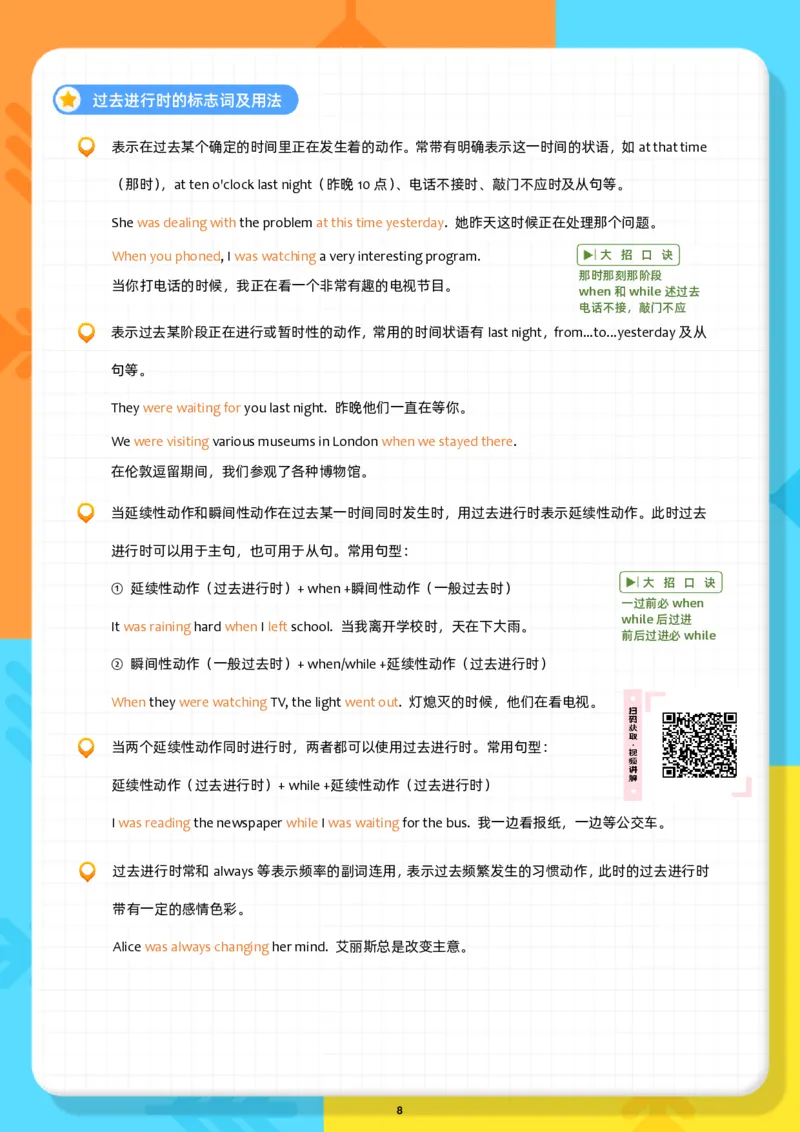
7过去进行时的标志词及用法
表 示在过去某个确定的时间里正在发生着的动作。常带有明确表示这一时间的状语,如at that time
(那时),at ten o'clock last night(昨晚10点)、电话不接时、敲门不应时及从句等。
She was dealing with the problem at this time yesterday. 她昨天这时候正在处理那个问题。
W hen you phoned, I was watching a very interesting program. 大 招 口 诀
那时那刻那阶段
当你打电话的时候,我正在看一个非常有趣的电视节目。
when和while述过去
电话不接,敲门不应
表示过去某阶段正在进行或暂时性的动作,常用的时间状语有last night,from...to...yesterday及从
句等。
They were waiting for you last night. 昨晚他们一直在等你。
W e were visiting various museums in London when we stayed there.
在伦敦逗留期间,我们参观了各种博物馆。
当延续性动作和瞬间性动作在过去某一时间同时发生时,用过去进行时表示延续性动作。此时过去
进 行时可以用于主句,也可用于从句。常用句型:
大 招 口 诀
① 延续性动作(过去进行时)+ when +瞬间性动作(一般过去时)
一过前必when
while后过进
It was raining hard when I left school. 当我离开学校时,天在下大雨。
前后过进必while
② 瞬间性动作(一般过去时)+ when/while +延续性动作(过去进行时)
When they were watching TV, the light went out. 灯熄灭的时候,他们在看电视。
当两个延续性动作同时进行时,两者都可以使用过去进行时。常用句型:
延续性动作(过去进行时)+ while +延续性动作(过去进行时)
I w as reading the newspaper while I was waiting for the bus. 我一边看报纸,一边等公交车。
过去进行时常和always等表示频率的副词连用,表示过去频繁发生的习惯动作,此时的过去进行时
带 有一定的感情色彩。
A lice was always changing her mind. 艾丽斯总是改变主意。
8Don’t let me go with her tomorrow.
特殊形式 No +名词/动名词
No photos. 禁止拍 照。
No smoking. 禁止吸烟。
9—Sorry, I won’t. 对不起,我不会了。
101112知识点 5 感叹句
概念
感叹句是表示喜、怒、哀、乐等感情色彩的句子。一般以how或what开头。how修饰形容词或副词;what
修饰名词 (名词前可有形容词或冠词)。
What引导的感叹句
W hat + a(n) +形容词+可数名词单数+主语+谓语!
W hat a clever kid he is! 多聪明的孩子啊!
W hat +形容词+可数名词复数+主语+谓语!
W hat funny boys they are! 多么有趣的男孩子们啊!
W hat +形容词+不可数名词+主语+谓语!
W hat nice weather it is! 多好的天气啊!
大 招 口 诀
How引导的感叹句
形名what,其他how;
名词可数单,what a 或 an
How +形容词/副词+主语+谓语!
How fast he is running! 他跑得真快!
How +形容词+ a(n) +可数名词单数+主语+谓语!
Ho w clever a kid he is! 他是个多聪明的孩子啊!
How +主语+谓语!
Ho w time flies! 时光飞逝啊!
13知识点 6 时间状语从句
概念
由时间连接词引导的表示时间的状语从句叫做时间状语从句。连接时间状语从句的连接词有:when, before,
after, whi le, as soon as, until, since......
引导词when
when意为“当……时”引导时间状语从句,表示主句的动作和从句的动作同时或先后发生;when引导的时
间状语从 句中的动词可以用延续性动词,也可以用非延续性动词。
W hen you are crossing the street, you must be careful. 你过马路时,一定要小心。
M y father was watching TV in the sitting room when I got home. 我到家的时候,我爸爸正在看电视。
引导词while
while引导 时间状语从句意为“与……同时,在……期间”。while引导的时间状语从句中常用延续性动词或表
示状态的动词。
They rushed in while we were discussing problems. 当我们正在讨论问题时,他们冲了进来。
You can go swimming while I am having lunch. 我吃午饭时你可以去游泳。
大 招 口 诀
易错点(when VS while)
一过前必when;while后过进;前后过进必while
M y mother came in when/while I was chatting with my friends online.
当我和朋友们在网上聊天的时候,我妈妈进来了。
He was working at the table when I went in. 当我进去时,他正在伏案工作。
He was writing an e-mail while I was reading a book. 他在写电子邮件,而我在看书。
14引导词as soon as
as soon as 引导的从句表 示从句的动作一发生,主句的动作随即发生,常译为“一......就......”。该从句经常用
一般现在 时表将来,遵循主将从现原则。
As soon as he arrives, I'll tell him. 他一到,我就告诉他。
引导词until/till
until/till都 表示“直到”,常可换用,但till不用于句首。
当 主句的谓语动词是延续性动词时,主句用肯定形式表示这一动作或状态一直延续到 until/till所表示
的时间为止。
You may stay here until the rain stops. 你可以在这里一直待到雨停。
当主句谓语动词是非延续性动词时,用否定形式表示主句的谓语所表示的动作直到 until 所表示的时
间 才发生。构成句式not…until…,有时不用not,而用其他如nothing, never等表示否定的词。
He didn't go to bed until he had finished his work. 他直到完成工作才去睡觉。
引导词since
since引导的时间状语从句表示“自……以来”,主句一般用现在完成时,从句用一般过去时。
I have worked in this company since I graduated. 从毕业到现在,我一直在这家公司上班。
“It is/has been +时间段+ since从句”表示“自……以来有(多久)”。since从句不可以用否定形式。
It is/has been 2 years since we last met. 自从我们上次见面以来已经有两年了。
引导词as
as引 导时间状语从句时,可以表达“正当,一边……一边,随着”等意思。
表示某事一发生,另一事随即发生。
As the sun rose, the fog disappeared. 太阳一出来雾就消散了。
表 示某事发生的过程中另一件事发生。(从句用进行时态)
As he was speaking, there was a loud explosion. 正当他在说话的时候,出现了一声巨响。
15表示两个动作同时发生。
As she sang, tears rolled down her cheeks. 她一边唱歌,眼泪沿着她的脸颊淌下来。
W e get wiser as we get older. 我们随着年龄的增长而变得聪明起来。(随着时间的变化而变化)
引导词before/after
before表 示“在……之前”,after表示“在……之后”。
I will always work hard before I enter Peking University.
在 我考上北京大学之前,我将一直努力学习。
She showed me many beautiful stamps after I got to her home.
我 到她家以后,她让我看了好多漂亮的邮票。
16知识点 7 条件状语从句
概念
条件状语从句是指从句中的动作实现之后,主句中的动作才能发生。通常用if(如果),as long as(只要),
unless(除 非)来引导。
条件状语从句的常用引导词
引导词if
if 是引导条件状语从句最常用的连词,意为“如果”,表示在某种条件下某事很可能发生。
If it snows tomorrow, we will build a snowman. 如果明天下雪,我们就堆雪人。
含 有if引导的条件状语从句的复合句可以改为:祈使句+ and/or +一般将来时的句子.
If you get up early, you will not be late for school.
= Get up early and you will not be late for school. 早点儿起床,你就不会上学迟到。
= Get up early or you will be late for school. 早点儿起床,否则你上学就会迟到。
引导词 unless
un less相当于if…not…,意为“除非,如果不”。
You will fail to arrive there in time unless you start earlier.
= You will fail to arrive there in time if you don't start earlier.
如 果你不早点动身,你就不能及时赶到那儿了。
引导 词as long as
as long as是引导条件状语从句的常见引导词之一,意为“只要”。
They'll respect you as long as you play fair. 只要为人正直,别人就会尊敬你。
17条件状语从句的时态原则
条件 状语从句一般遵循三个时态原则,分别是:主将从现原则、主情从现原则、主祈从现原则。具体如下:
主将从现原则:主句为一般将来时,从句用一般现在时。
I w ill go to the park with you if I have time tomorrow. 我如果明天有时间,将跟你一起去公园。
主 情从现原则:主句谓语含有情态动词,从句用一般现在时。
As long as you help us, we can finish the task on time. 只要你帮助我们,我们就能按时完成任务。
主 祈从现原则:主句为祈使句,从句用一般现在时。
Don't come unless I ask you. 我不叫你,你就别过来。
18习 题 专 练 易丢分陷阱题
1. —Must I get up early tomorrow morning?
—No, you ________. The meeting starts at 10:00.
A. mustn't B. needn't C. can't D. shouldn't
2. —Where is Susan?
—She ________ be in the bank, but I'm not quite sure.
A. might B. must C. need D. can
3. —Excuse me, __________ you please say it again? I didn't hear you clearly.
—Yes, of course.
A. could B. should C. need D. must
4. —I can't get on with my family.
—Why not talk with them? You ________ communicate (沟通) before things become worse.
A. should B. might C. would
5. —Look at the boy running on the playground. Is it David?
—It ________ be him. I saw him go to the teachers' office just now.
A. must B. can't C. could D. might
6. It is snowing heavily. For your safety, you ________ take the underground instead of riding
bicycles to school.
A. had better not B. needn't C. had better D. need
7. The river is too deep. You ________ swim in it.
A. can B. mustn't C. must D. may
8. You'd better ________ home too late, or your parents will be angry.
A. return B. to not return C. not to return D. not return
9. I practice ________ English every day.
A. to speak B. speaking C. speak D. spoke
10. My family went to Yunnan last summer. It's so beautiful that we're looking forward to
________ it again.
A. visit B. visiting C. visited D. visits
1911. —Anna, would you mind ________ so much noise in class?
—Sorry, Mr. Brown. I won't do that again.
A. to make B. not to make C. making D. not making
12. I improve my writing by ________ an English diary every day.
A. write B. wrote C. to write D. writing
13. ________ helps me to make more friends.
A. Playing basketball B. Play basketball
C. To play basketball D. Plays basketball
14. ________ living areas ________ tigers have no place to live.
A. Loss; make B. Lost; makes
C. Losing; makes D. Loss; makes
15. You look tired. You'd better ________ a good rest.
A. stop to have B. stop having
C. to stop to have D. to stop having
16. —I remember ________ him somewhere.
—Yeah. At Cindy's birthday party last month.
A. to meet B. meet C. meeting D. met
17. In the future, AI (人工智能) ________ the problem of taking care of the old people.
A. solved B. is solving C. solves D. will solve
18. What exciting news! Aunt Su ________ us to Hangzhou in two weeks.
A. took B. will take C. takes
19. —Why can't Tony play soccer with us the day after tomorrow?
—Because he ________ a music lesson.
A. took B. takes C. will take
20. —What are you saving money for?
—My mother's birthday is coming. I ________ a gift for her.
A. buy B. bought C. am going to buy D. am buying
21. —I ________ the baseball club next month. What about you?
—I'm thinking about joining the football club.
A. join B. will join C. joined D. was joining
2022. Next weekend we ________ some trees on the mountain.
A. are going to plant B. planted C. are planting
23. — Do you think ________ more pollution in a few years?
—Yes! So we must do something to save the earth.
A. there will be B. there will have C. there is D. there are
24. There ________ a wonderful English movie in the school hall next Sunday.
A. is going to have B. is going to be C. has
25. —I called you at 4:00 yesterday afternoon, but no one answered.
—Sorry, I ________ with my friends at that time.
A. swim B. swam C. will swim D. was swimming
26. —What were you doing at eight this morning? You didn't answer my phone.
—I'm sorry. I ________ my cat then.
A. was feeding B. fed C. feed D. will feed
27. —We ________ a picnic in the park when it began to rain.
—Sounds bad!
A. had B. will have C. are having D. were having
28. —Why didn't you come to our party yesterday?
—Sorry. I ________ a football match on TV from 7 p.m. to 8:30 p.m. and forgot the time.
A. was watching B. watched C. am watching D. will watch
29. —What ________ you ________ at nine o'clock last night?
—I was taking a shower.
A. were; doing B. are; doing C. did; do D. will; do
30. —When did your house have a power cut?
—This morning, while my mother ________ breakfast for us.
A. made B. was making C. is making D. makes
31. —Did you notice her come in?
—No. I ________ a football game then.
A. watched B. am watching C. watch D. was watching
32. My brother ________ a model plane while I was sweeping the floor.
A. makes B. will make C. made D. was making
2133. ________ buy your ticket from a ticket machine. There are lots of people there.
A. Not B. Not to C. Don't D. No
34. Kate, ________ your homework here tomorrow.
A. bring B. brings C. to bring D. bringing
35. ________ more time on your study and you will pass the exam easily.
A. Spending B. To spend C. Spend D. Spent
36. ________ swim on your way home. It's really dangerous.
A. Shouldn't B. Don't C. Doesn't
37. Please put the food in the fridge, ________ it may go bad.
A. or B. and C. so D. if
38. Be quick, ________ we will be late.
A. or B. and C. although D. but
39. ________ late for school again, Bill!
A. Don't to be B. Don't be C. Not be D. Be not
40. —There is an art festival in our school next week.
—________ news it is! I will play the violin in it.
A. How exciting B. What an exciting C. What exciting
41. —________ beautiful poem you are reading!
—Let's read it together.
A. How B. What C. What a
42. —With everybody's hard work, more Chinese people understand the importance of sorting
waste.
—And they are better at it now. ________ huge the progress is!
A. How B. What a C. What
43. 2023 Scientists Forum was held in Tengchong. ________ exciting it is!
A. What an B. How C. How an D. What
44. ________ fun it is to climb the mountains!
A. How B. What C. What a D. What an
45. ________ interesting it is to play with the kids in the kindergarten!
A. How B. What C. What a D. What an
2246. ________ useful information Henry gave us!
A. What a B. What C. How
47. The opening didn't start ________ everyone took their seats.
A. if B. until C. so
48. —Tom, what were your parents doing at 8:00 last night?
—My mother was reading ________ my father was playing computer games.
A. while B. when C. as D. as long as
49. The students were singing an English song ________ Mr. Xiang came into the classroom.
A. after B. when C. before D. as
50. ________ I was waiting for my friend in the park, I read an interesting story.
A. After B. While C. If
51. —Dad, I don't quite understand the novel.
—Dear, don't worry! ________ you grow older, you'll get to know it.
A. While B. Until C. As D. Since
52. My mother was cooking ________ I got home.
A. when B. before C. after D. since
53. Jenny is a very thoughtful girl. She had got everything ready ________ the class meeting
began.
A. before B. after C. when D. until
54. In summer, food will go bad quickly ________ we put it into fridge.
A. if B. as soon as C. unless
55. In fact, we will make our dream come true ________ we try our best to work hard.
A. as long as B. so C. unless D. though
56. We will have a picnic if it ________ tomorrow.
A. won't rain B. don't rain C. doesn't rain
57. —What do you plan for the coming winter vacation?
—If I ________ the exam, I ________ to Sanya to have a great time.
A. pass, fly B. will pass, fly C. pass, will fly D. will pass, will fly
58. ________ you work hard and never give up, you will learn Maths well.
A. After B. Although C. If D. Until
2359. You can use my room as you like ________ you keep it clean.
A. as well as B. as soon as C. as long as D. as far as
60. You can't improve yourself ________ you really work hard.
A. because B. unless C. after D. as long as
24