PAPER 2
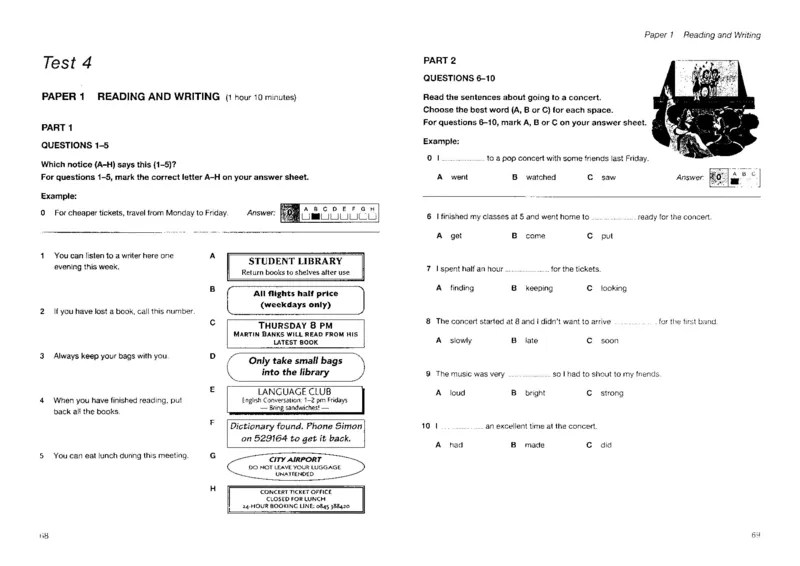
LISTENING (approximately 30 minutes including 8 minutes transfer time)
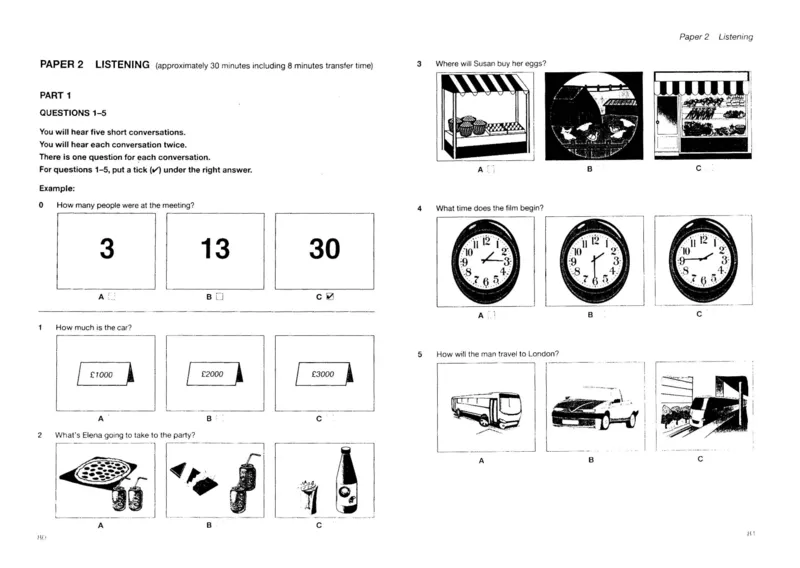
PART 1
QUESTIONS 1-5
You will hear five short conversations.
You will hear each conversation twice.
There is one question for each conversation.
For questions 1-5, put a tick (v) under the right answer.
Example:
0
How many people were at the meeting?
~----------------~
3
13
A :-::
B []
How much is the car?
;
£1000 l
L/_r_2_o_o_o_)
L ________________ ___
A .
s :
2
What's Elena going to take to the party?
~------------------
A
B
HI !
30
C 0
... / __
rJ_o_o_o__..l
c
. ·.~
.. ~
.lJ
c
Paper 2
Listening
3
Where will Susan buy her eggs?
B
c
4
What time does the film begin?
c
5
How will the man travel to London?
~ -------- --- -----·--
i .
I
1--------j
!
A
B
c
HI
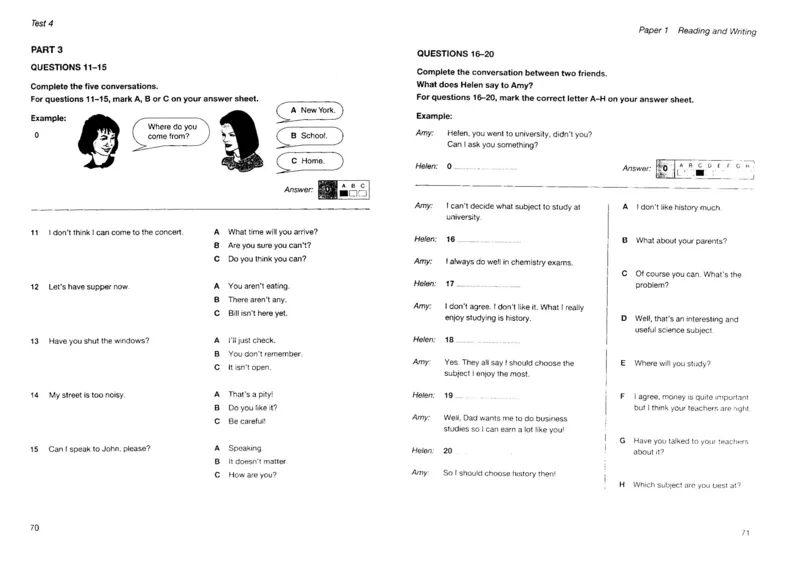
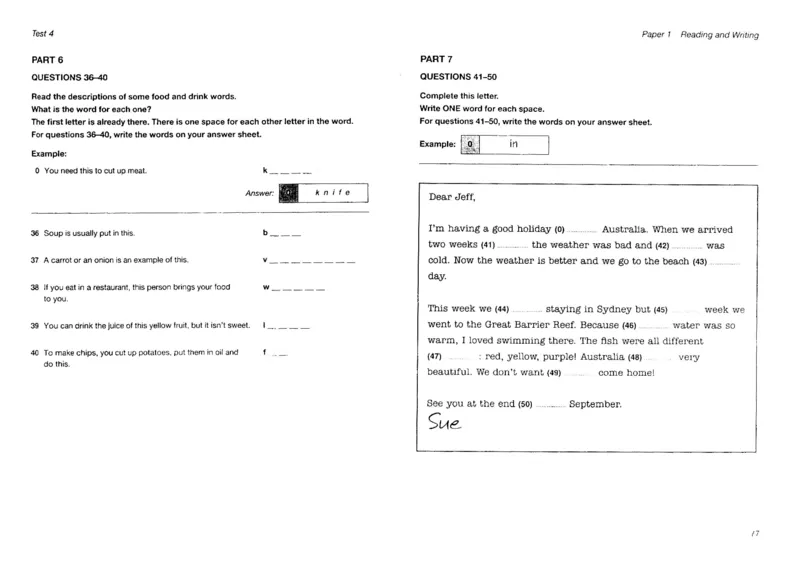
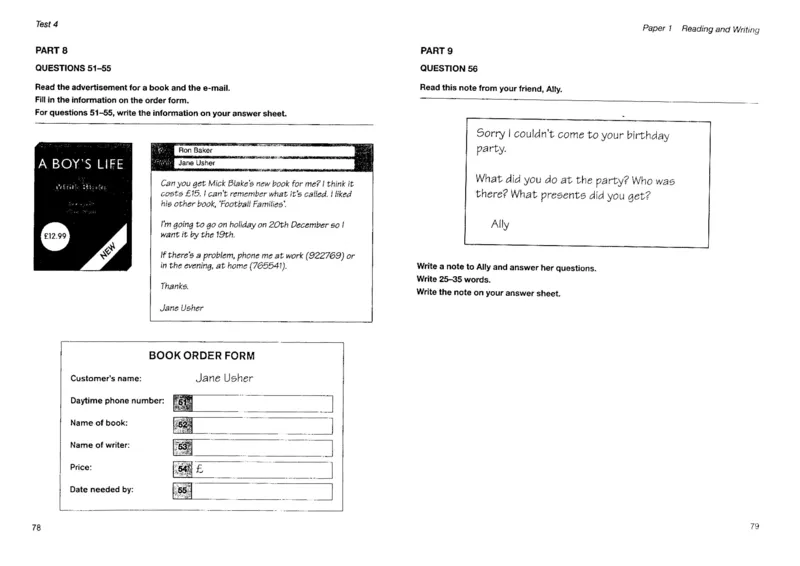
Test 4
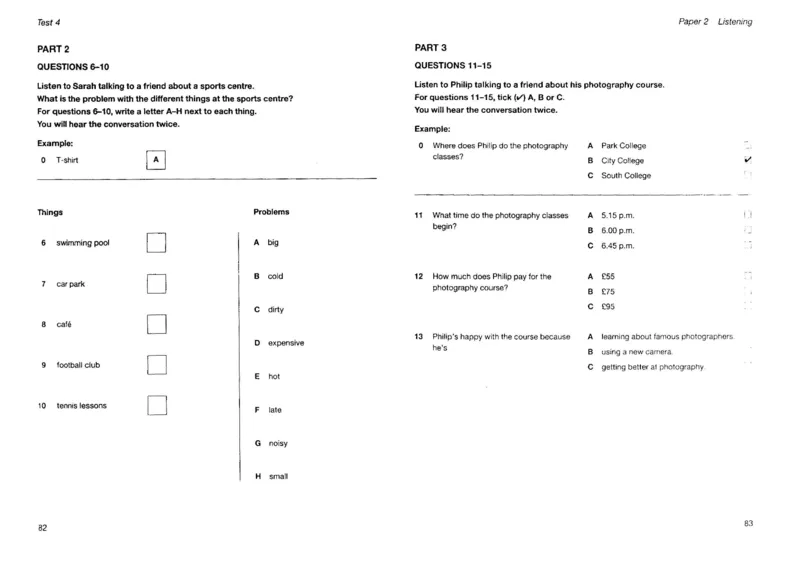
PART2
QUESTIONS 6-10
Listen to Sarah talking to a friend about a sports centre.
What is the problem with the different things at the sports centre?
For questions 6-10, write a letter A-H next to each thing.
You will hear the conversation twice.
Example:
0
T-shirt
Things
6
swimming pool
7
carpark
8
cafe
9
football club
10
tennis lessons
82
D
D
D
D
D
Problems
A
big
B
cold
c dirty
D expensive
E
hot
F
late
G noisy
H
small
Paper 2
Listening
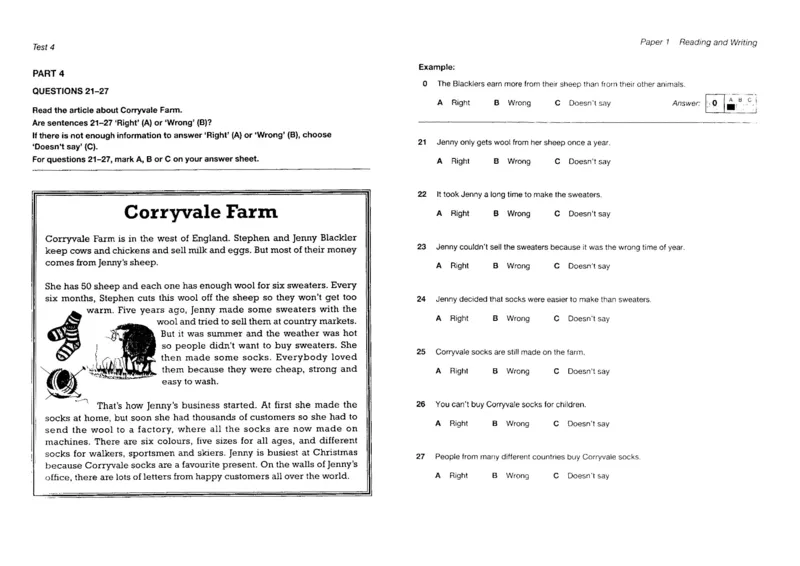
PART3
QUESTIONS 11-15
Listen to Philip talking to a friend about his photography course.
For questions 11-15, tick (v) A, B or C.
You will hear the conversation twice.
Example:
0
Where does Philip do the photography
classes?
11
What time do the photography classes
begin?
12
How much does Philip pay for the
photography course?
13
Philip's happy with the course because
he's
A
Park College
B
City College
C
South College
A 5.15 p.m.
B
6.00 p.m.
c 6.45 p.m.
A
£55
B
£75
c £95
A
learning about famous photographers.
B
using a new camera.
c getting better at photography
i I
' '
83
Test4
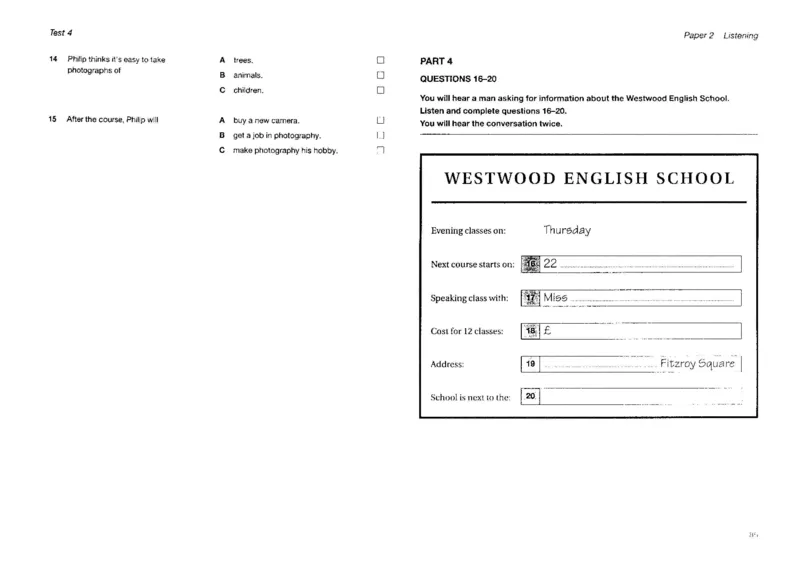
14
Philip thinks it's easy to take
photographs of
15
After the course, Philip will
A
8
c
A
8
c
trees.
0
animals.
0
children.
0
buy a new camera.
0
get a job in photography.
0
make photography his hobby.
0
Paper 2
Listening
PART4
QUESTIONS 16-20
You will hear a man asking for information about the Westwood English School.
Listen and complete questions 16-20.
You will hear the conversation twice.
WESTWOOD ENGLISH SCHOOL
Evening classes on:
Thursday
Next course starts on:
Speaking class with:
Miss.
Cost for 12 classes:
Address:
Ll _19_
.•
_l_I ___________
F_i_t_z_ro---'y'---S_q_._u_a_re
I
School is next to the:
Ll_2_o_.l _______________ _
-- _j
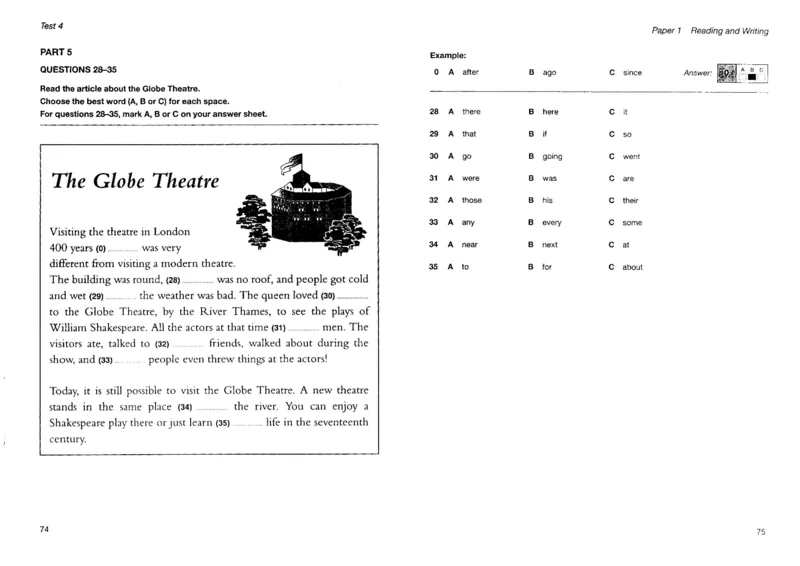
Test4
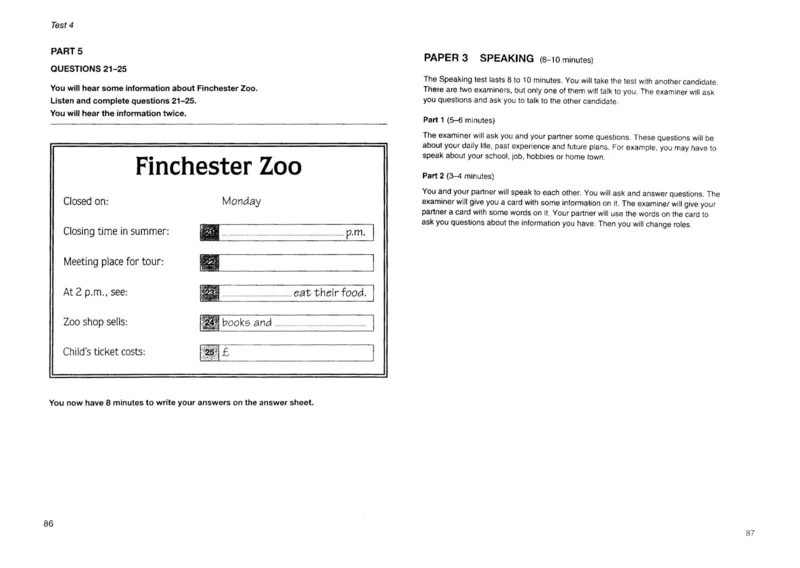
PARTS
QUESTIONS 21-25
You will hear some information about Finchester Zoo.
Listen and complete questions 21-25.
You will hear the information twice.
Finchester Zoo
Closed on:
Monday
Closing time in summer:
.
.............................................................
Meeting place for tour:
II
....... p.m.
At 2 p.m .. see:
............. eat their food.
Zoo shop sells:
books and ........ . . ............. ...... .
Child's ticket costs:
. £
You now have 8 minutes to write your answers on the answer sheet.
86
PAPER 3
SPEAKING (8-10 minutes)
The Speaking test lasts 8 to 10 minutes. You will take the test with another candidate.
There are two examiners, but only one of them will talk to you. The examiner will ask
you questions and ask you to talk to the other candidate.
Part 1 (5-6 minutes)
The examiner will ask you and your partner some questions. These questions will be
about your daily life, past experience and future plans. For example. you may have to
speak about your school, job, hobbies or home town.
Part 2 (3-4 minutes)
You and your partner will speak to each other. You will ask and answer questions. The
examiner will give you a card with some information on it. The examiner will give your
partner a card with some words on it. Your partner will use the words on the card to
ask you questions about the information you have. Then you will change roles .
87
lisual materials for Pa,.er 3
~
88
NEW WORLD
MUS~C SHOP
All COs £8
Buy the latest dance music here!
Monday to Saturday 9 am - 8 pm
Books and magazines
-
58 Walton Street -
CASTLE
• open I afternoon?
• student ticket? £?
• car park?
• buy I guidebook?
• telephone number?
Visual materials
ALISON'S
ANIMAL
HOSPITAL
Help for all an1mals
7 days a week -
8 am to 5 pm
• For appointments: 23456 7 •
Car park behind hospital
NEW TEACHER
• name?
• what I teach?
• where I from?
• when I start?
• play sport?
89
Visual materials
90
MUSIC SHOP
• name?
• price I COs? £?
• address?
• open I evenings?
• music magazines?
BOSTON
CASTLE
r·-
------- - ---- - - - -- -------~ -- -----1
i '*King Alfred hued here "'*
1
(-
---- --·- ··· ··------- - ---- -··-·· .•.
·--··· ··
___ , ___ __
.J
Adults: £3
Students: £2
Children: £1.50
Monday- Saturday, 10 am- 4 pm
Castle Shop - postcards, guidebooks, maps
Free Parking
For information tel: 543876
Visual materials
ANIMAL HOSPITAL
• name I animal hospital?
+ open I Sunday?
• for birds?
• address?
• car park?
I.C.C. College
From next Monday, our new
Eng lish and French teacher is
MR TOM COOPER
from Conodo
He wants to have a football club after school.
91
Visual materials
92
GUITAR LESSONS
~!~i\,"
·
-':;}~t,:t! Learn in your home T;•·:~.f~i':~~
~- ·-·-·--·- ·- ------- .I
I
I
l,
I
i_ .
-· ·-- ···-·--
-·--J
.
7 days a week - morning, afternoon or even1ng
All kinds of music
£90for101essons
Children from 8 years old
COMPUTER CAFE
• name I cafe?
Ill r---<::_
1
IE:!RI
•where? ~
·
• open I Sunday?
• cost?£?
• what I food?
Visual materials
HORSE-RIDING LESSONS
Bell Riding School
West Road
£15 per hour
Friendly, quiet horses
Classes every day
Everyone must wear a riding hat.
LIBRARY
• where?
• opening times?
• COs?
• free?
• computers?
93
Visual materials
GUITAR LESSONS
• cost?£?
• pop music?
• children's lessons?
• where?
• Saturday afternoon?
SMAll WORLD
~
COMP,UTER CAFE
Qd
--~:, 'f'
'
£1 for 30 minutes on computer
Tuesday- Sunday 8 am - 8 pm
cakes, cold drinks, coffee
23 GEORGE STREET
Visual materials
HORSE-RIDING LESSONS
• where?
• expensive?
• wear special clothes?
• lessons I Friday?
• nice horses?
CENTRAL LIBRARY
------... ------
books, videos, music CDs
Videos - £1 per week
Monday- Saturday 9.30 am- 5 pm
12 computers on 4th floor
Next to City Museum
9~
Paper 3 frames
Test 1
Note: The visual material for Paper 3 appears on pages 88-95.
Part 1 (5-6 minutes)
Greetings and introductions
At the beginning of Part 1, the interlocutor greets the candidates, asks for their names
and asks them to spell something.
Giving information about place of origin, occupation, studies
The interlocutor asks the candidates about where they come from/live, and for
information about their school/studies/work.
Giving general information about self
The interlocutor asks the candidates questions about their daily life, past experience or
future plans. They may be asked, for example, about their likes and dislikes or about
recent past experiences, or to describe and compare places.
Extended response
In I he final section of Part 1, candidates are expected to give an extended response to
a 'Tell me something about .. .' prompt. The topics are still of a personal and concrete
nature. Candidates should produce at least three utterances in their extended
response.
Paper 3 frames
Part 2 (3-4) minutes
The interlocutor introduces the activity as follows:
Interlocutor:
(Pablo) , here is some information about a music shop.
(Interlocutor shows answer card 1 A on page 88 to Pablo.)
(Laura), you don't know anything about the music shop, so ask (Pablo)
some questions about it.
(Interlocutor shows question card 18 on page 90 to Laura.)
Use these words to help you . (Interlocutor indicates prompt words.)
Do you understand?
Now, (Laura) , ask (Pablo) your questions about the music shop, and
(Pablo), you answer them.
NEW V\./O RLD ...6.Qa..
MUSIC SHOP.::.~
AIICDs£8
•
Buy the latest dance mus•c here!
Monday to Saturday 9 am - 8 pm
Books and magazines
-
58 Walton Street -
MUSIC SHOP
• name?
• price I CDs? 1:7
• address?
• open I evenings?
• music magazines?
~-----------------------
When the candidates have asked and answered their questions about the music shop,
they then exchange roles and talk about a different topic.
97
Paper 3 frames
The interlocutor introduces the activity as follows:
Interlocutor:
(Laura), here is some information about guitar lessons.
(Interlocutor shows answer card 1 Con page 92 to Laura.)
(Pablo), you don't know anything about the guitar lessons, so ask
(Laura) some questions about them.
(Interlocutor shows question card 10 on page 94 to Pablo.)
Use these words to help you. (Interlocutor indicates prompt words.)
Do you understand?
Now, (Pablo) , ask (Laura) your questions about the guitar lessons, and
(Laura), you answer them.
Note: Candidates are assessed on both their questions and answers in Part 2 of the
test.
GUITAR LESSONS
GUITAR LESSONS
--- Learn in your home ---
• cost?£? '"
ll!J
• pop music?
• children's lessons?
7 days a week - moming. afternoon or evening
AH kinds of music
• where?
£90 for 1 0 lessons
Children trom 8 years old
• Saturday afternoon?
98
Paper 3 frames
Test 2
Note: The visual material for Paper 3 appears on pages 88- 95.
Part 1 (5-6 minutes)
Greetings and introductions
At the beginning of Part 1, the interlocutor greets the candidates, asks for their names
and asks them to spell something.
Giving information about place of origin, occupation, studies
The interlocutor asks the candidates about where they come from/live, and for
information about their school/studies/work.
Giving general information about self
The interlocutor asks the candidates questions about their daily life, past experience or
future plans. They may be asked, for example, about their likes and dislikes or about
recent past experiences, or to describe and compare places.
Extended response
In the final section of Part 1, candidates are expected to give an extended response to
a 'Tell me something about .. .' prompt. The topics are still of a personal and concrete
nature. Candidates should produce at least three utterances in their extended
response.
99
Paper 3 frames
Part 2 (3-4) minutes
The interlocutor introduces the activity as follows:
Interlocutor:
(Pablo). here is some information about a castle.
(Interlocutor shows answer card 2A on page 90 to Pablo.)
[~
(Laura) , you don't know anything about the castle, so ask (Pablo} some
questions about it.
(Interlocutor shows question card 28 on page 88 to Laura.}
Use these words to help you. (Interlocutor indicates prompt words.)
Do you understand?
Now, (Laura), ask (Pablo) your questions about the castle, and (Pablo) ,
you answer them.
Adults: £3
Students: £2
Ch!ldn:n: £I. 50
Monday - Saturday, I 0 am - 4 pm
Castle .Yhop - po.\rcards .. ~uulehuok...;_ nWfJS
Free Par~
For 1nfo rn t H1 0ll tel: 54jH76
• open I afternoon?
• student ticket?£? a.
-·~.' ·.
' "
.
• car park?
, ·_,•:i?-J
• buy I guidebook?
• telephone number?
When the candidates have asked and answered their questions about the castle, they
then exchange roles and talk about a different topic.
1()0
Paper 3 frames
The interlocutor introduces the activ1ty as follows
Interlocutor:
(Laura), here 1s some information about a computer cafe
(Interlocutor shows answer card 2C on page 94 to Laura )
(Pablo). you don't know anything about the computer cafe, so ask
(Laura) some questions about it.
(Interlocutor shows question card 20 on page 92 to Pablo.)
Use these words to help you. (Interlocutor indicates prompt words.)
Do you understand?
Now, (Pablo). ask (Laura) your questions about the computer cafe, and
(Laura), you answer them.
Note: Candidates are assessed on both their questions and answers in Part 2 of the
test.
SMALL WORLD
COMPUTER CAFE
T
~~
£1 for 10 minulP<; on cumputer
Tuesday- Sunday 8 am- 8 pm
c.Jkcs. cold dnnks, coffee
23 GEORGE STREET
• name I cafe?
EfJ
t
~.
l~'1tk
t where?
~m _____ / • ··<...._ __ ~{ I
• open I Sunday?
• cost?£?
• what I food?
I() 1
Paper 3 frames
Test3
Note: The visual material tor Paper 3 appears on pages 88-95.
Part 1 (5--B minutes)
Greetings and introductions
At the beginning of Part 1, the interlocutor greets the candidates, asks for their names
and asks them to spell something.
Giving information about place of origin, occupation. studies
The interlocutor asks the candidates about where they come from/live, and for
information about their school/studies/work.
Giving general information about self
The interlocutor asks the candidates questions about their daily life, past experience or
future plans. They may be asked, for example, about their likes and dislikes or about
recent past experiences. or to describe and compare places.
Extended response
In the final section of Part 1, candidates are expected to give an extended response to
a 'Tell me something about ... ' prompt. The topics are still of a personal and concrete
nature. Candidates should produce at least three utterances in their extended
response.
102
1rt 2 (3-4) minutes
e interlocutor introduces the activity as follows:
erlocutor:
(Pablo) , here is some information about an animal hospital.
(Interlocutor shows answer card 3A on page 89 to Pablo.)
(Laura). you don't know anything about the animal hospital. so ask
(Pablo) some questions about it.
(Interlocutor shows question card 38 on page 91 to Laura )
Use these words to help you . (Interlocutor indicates prompt words)
Do you understand?
Now, (Laura), ask (Pablo) your questions about the animal hospital, and
(Pablo), you answer them.
ALISON'S
ANIMAL
;:~
. ;'''.
~~ r~~~p~.~~L
I\~
, '
~ lptcxdllanlrnd ls
7 days a week · -- 8 arn to 5 prn
• For appointments: 23456 7 •
ANIMAL HOSPITAL
• name I animal hospital?
• open I Sunday?
• for birds?
• address?
• car park?
When the candidates have asked and answered their questions about the animal
hospital, they then exchange roles and talk about a different top1c
Paper 3 frames
The interlocutor introduces the activity as follows:
Interlocutor:
(Laura), here is some information about some horse-riding lessons.
(Interlocutor shows answer card 3C on page 93 to Laura.)
(Pablo), you don't know anything about the horse-riding lessons, so ask
(Laura) some questions about them.
(Interlocutor shows question card 30 on page 95 to Pablo.)
Use these words to help you. (Interlocutor indicates prompt words.)
Do you understand?
Now, (Pablo) , ask (Laura) your questions about the horse-riding
lessons. and (Laura), you answer them.
Note: Candidates are assessed on both their questions and answers in Part 2 of the
test.
~ HORSE-RIDING LESSONS
104
Bell Riding School
West Road
£15 per hour
Fr1 e ndly, qu1et h o rses
Classe s eve ry doy
HORSE-RIDING LESSONS
• where?
• expensive?
• wear special clothes?
• lessons I Friday?
• nice horses?
Paper 3 frames
Test 4
Note: The visual material for Paper 3 appears on pages 88-95.
Part 1 (5-6 minutes)
Greetings and introductions
At the beginning of Part 1, the interlocutor greets the candidates. asks for their names
and asks them to spell something.
Giving information about place of origin, occupation, studies
The interlocutor asks the candidates about where they come from/live. and for
information about their school/studies/work.
Giving general information about self
The interlocutor asks the candidates questions about their daily life, past expenence or
future plans. They may be asked, for example, about their likes and dislikes or about
recent past experiences, or to describe and compare places.
Extended response
In the final section of Part 1, candidates are expected to give an extended response to
a 'Tell me something about .. .' prompt. The topics are still of a personal and concrete
nature. Candidates should produce at least three utterances in their extended
response.
105
Paper 3 frames
Part 2 (3-4} minutes
The interlocutor introduces the activity as follows:
Interlocutor:
(Pablo), here is some information about a new teacher.
(Interlocutor shows answer card 4A on page 91 to Pablo.)
(Laura), you don't know anything about the new teacher, so ask (Pablo)
some questions about him.
(Interlocutor shows question card 48 on page 89 to Laura.)
Use these words to help you. (Interlocutor indicates prompt words.)
Do you understand?
Now, (Laura), ask (Pablo) your questions about the new teacher, and
(Pablo), you answer them.
I.C.C. College
~ NEW TEACHER
• name?
from nex! Noodov. our new
• what I teach?
English and F u~nch !eocker t!l
MR TOM COOPER
• where /from?
• when I start?
H. wonts to hav. a football club after uhool.
• play sport?
When the candidates have asked and answered their questions about the new
teacher, they then exchange roles and talk about a different topic.
106
Paper 3 frames
The interlocutor introduces the activity as follows:
Interlocutor:
(Laura). here is some information about a library.
(Interlocutor shows answer card 4C on page 95 to Laura )
(Pablo), you don't know anything about the library, so ask (Laura) some
questions about it.
(Interlocutor shows question card 40 on page 93 to Pablo.)
Use these words to help you. (Interlocutor indicates prompt words.)
Do you understand?
Now, (Pablo), ask (Laura) your questions about the library, and (Laura).
you answer them.
Note: Candidates are assessed on both their questions and answers in Part 2 of the
test.
CENTRAL LIBRARY
--------···--------
r--~
.--
1
bool<s. rl<kos, musk CDs I .
. · :
. .:
.
I
Vtde:os - £1 ~r we:e:k
f
·
I
- --- :
Mondr(- Soturday 9.30 om - 5 pm
12 computers on 4th ftoor
Next to City Museum
~~
I LIBRARY -;l
1• where?
r· opening times?
,_._·
-~
! • COs?
~
~
'
i • tree?
I
~
compu_t_er_s __
? _____________ J
107
Marks and results
Paper 1
Reading and Writing
One mark IS g1ven for each correct answer in Parts 1-8. Correct spelling is required in
Parts 6, 7 and 8. There are five marks for Part 9 (see below for more details). The total
score of a possible 60 marks is then weighted to 50% of the marks available for the
whole test.
Mark scheme for Part 9
r Mark
Criteria
'
5
All three parts of message clearly communicated.
Only minor spelling errors or occasional grammatical errors.
4
All three parts of message communicated.
Some errors in spelling, grammar and/or punctuation.
I
3
All three parts of message attempted.
I
Expression may require interpretation by the reader.
or
Two parts of message are clearly communicated, but one part is
unattempted.
i Only minor spelling errors or occasional grammatical errors.
2 I Only two parts of message communicated.
I
Some errors in spelling and grammar. The errors in expression may
I require patience and interpretation by the reader.
-,---
-·--
1
I Only one part of message communicated .
0
!
Question unattempted, or totally incomprehensible response.
;
__
_____ _
_ _ _ _ ____j
Paper 2
Listening
'ne ma rk 1s g1ven for each correct answer. making a possible total of 25. or 25% of
.. - , ~ whole test.
Paper 3
Speaking
' ·oughout :.,e Speaking test. candidates are assessed on their language skills, not
···•r person2lity, intelligence or knowledge of the world. Candidates at this level are
·I expecte: to be fluent or accurate speakers. but they are expected to be able to
Marks and results
1teract and communicate appropriately according to the demands of the test. The
.anguage of the Speaking test is carefully controlled to be accessible to candidates at
this level. If candidates do not understand a question or an instruction. they should ask
for repetition or clarification and they will get credit for using this strategy. Similarly,
they will get credit for the use of paraphrase to supplement inadequate linguistic
resources. In some cases , a short response is all that IS required to a question. but
candidates will be given credit for extending their utterance to the phrase or sentence
level, where this is appropriate. Candidates are assessed on the1r own Individual
performance and not in relation to each other, according to established criteria. In Pa rt
2, where candidates are required to interact with each other. they will get cred1t for
cooperating to negotiate meaning, but one candidate will not be penal1sed for
another's shortcomings.
The marks given for the whole test are awarded on the basis of the follow1ng
criteria.
Grammar and vocabulary
This refers to the ability to use vocabulary, structure and paraphrase strategies to
convey meaning. Candidates at this level are only expected to have l1m1ted lingu1st1c
resources, and it is success in using these limited resources to commun1cate a
message which is being assessed, rather than range and accuracy.
Pronunciation
This refers to the intelligibility of the candidate's speech . First language mterlerence 1s
expected and not penalised if it does not affect communication .
Interactive communication
This refers to the ability to take part in interaction, with the examiner and the other
candidate, appropriately and with a reasonable degree of fluency. Hesitation while the
candidate searches for language is expected and not penalised as long as it does not
strain the pat1ence of the listener. Candidates should also d1splay the abil1ty to ask for
repetition or clanfication , if necessary.
The Speaking test is conducted by two examiners (an interlocutor and an assessor)
The assessor awards a mark out of five for each of the three cri terra, wh 1le the
interlocutor g1ves an impreSSIOn mark out of f1ve A total mark out of 20 IS we1ghted to
give a final total out of 25.
109
Test 4 Key
Sample answer D
Mark: 1
Dear Friend,
Doesn't matter you no come party. I made food for all people. Here came
people. I got different present. like fane and compute. Very good.
Your fa itfully
Abdullah
The only element which is covered is the present. The reference to people coming to
the party is not sufficient to cover this point and we do not know what they did at the party.
Sample answer E
Mark: 0
Dear my friend,
/like come with they to there. I must to work and ther is no taim for it. I
will to buy a computer for gifting and is verigood. My question is:
1. where is parti?
2. is who was there
3 . presents?
Thank you
Transcript
PART 1
This is the Cambndge Key English Test. Paper 2. Listening. Test number four.
There are five parts to the test. Parts One. Two. Three. Four and Five. We w11i
now stop for a moment before we start the test. Please ask any questions now
because you mustn't speak during the test.
[pause)
Now, look at the instructions for Part One.
[pause]
You will hear five short conversations. You will hear each conversat1on twice
There is one question for each conversation. For quest1ons 1 to 5. put a tick
under the right answer.
Here is an example:
How many people were at the meeting?
Woman:
Man:
Woman:
Man:
(pause]
Were there many people at the meeting?
About thirty.
That's not many.
No, but more than last time.
The answer is 30, so there is a tick in box C.
Now we are ready to start. Look at question one.
The writer has not understood the task and does not provide answers to the
(pause]
questions in this reply.
Paper 2
Listening
Part 1
1 c
2 A
3 B
4 c
5 A
Part 2
6 G
7 H
8 c
9 F
10 D
Part 3
11 c
12 B
13 c
14 A
15 c
Part 4
For questions 16-20. ignore capitals I absence of capitals. Spelling must be correct.
16 September
17 Jarvis
18 78 I seventy-eight (pounds)
19 223
20 bookshop I book shop
Part 5
For questions 21-25, ignore capitals I absence of capitals. Spelling must be correct.
except in questions 22 and 23. where recognisable spelling is acceptable.
21 9.30 I 21 .30 I nine thirty I half past nine
22 (the) entrance
23 (the) lions
24 games
25 4.65 I four (pounds) (and) sixty-live (plpence)
136
Question 1
One. How much is the car?
Question 2
Woman:
So which car are you buying?
Man:
The Monarch 2000. It's lovely but I have to gel a thousand pounds
more from the bank first because I don't have enough money.
Woman:
It's a lot of money ... three thousand pounds. I could live on that for a
year.
Man:
Well. cars are expensive.
[pause]
Now listen again.
[repeat]
[pause]
Two. What's Elena gomg to take to the party?
Man:
Elena:
Man:
Elena:
[pause]
Hi, Elena Are you taking some cans of cola to the party?
Of course. and a pizza.
I'm going to take a big bottle of orange JUice and some b1scu1ts
Chocolate ones. I hope.
Now listen again.
[repeat]
[pause]
Test 4 Key
13 7