人教新目标九年级英语Uni2 测试题
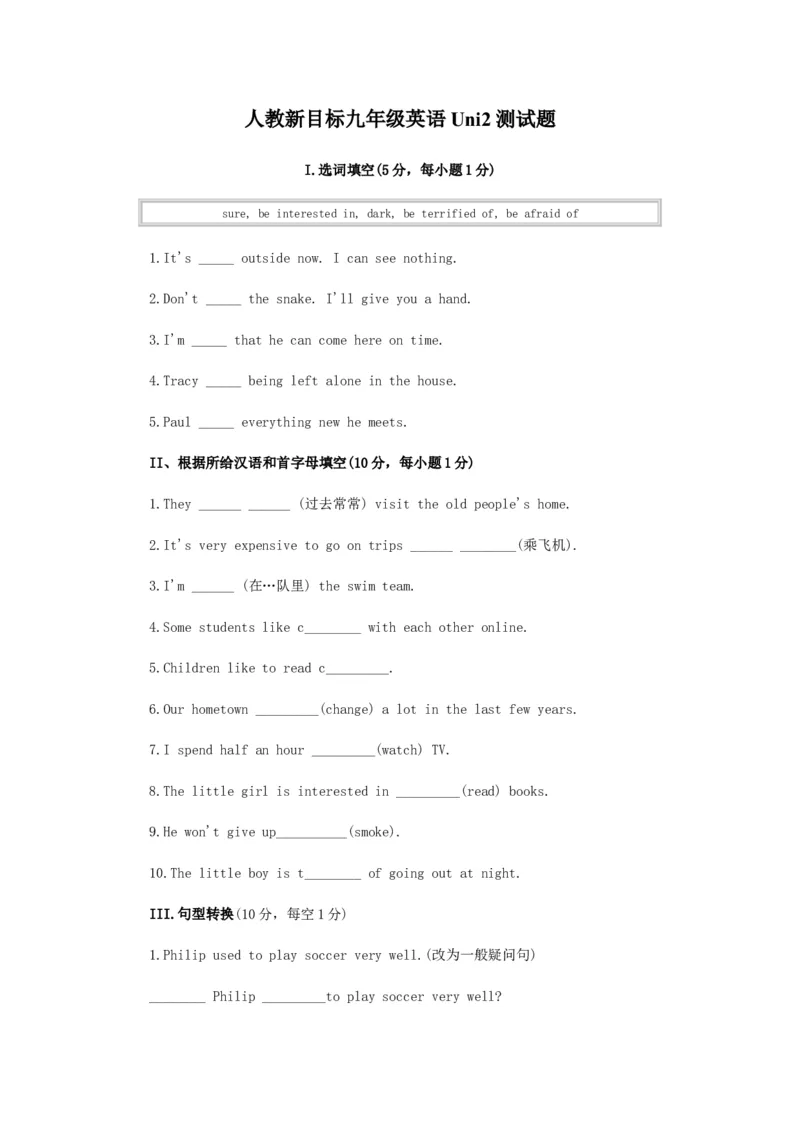
I.选词填空(5 分,每小题1 分)
sure, be interested in, dark, be terrified of, be afraid of
  1.It's _____ outside now. I can see nothing.
  2.Don't _____ the snake. I'll give you a hand.
  3.I'm _____ that he can come here on time.
  4.Tracy _____ being left alone in the house.
  5.Paul _____ everything new he meets.
  II、根据所给汉语和首字母填空(10 分,每小题1 分)
  1.They ______ ______ (过去常常) visit the old people's home.
  2.It's very expensive to go on trips ______ ________(乘飞机).
  3.I'm ______ (在…队里) the swim team.
  4.Some students like c________ with each other online.
  5.Children like to read c_________.
  6.Our hometown _________(change) a lot in the last few years.
  7.I spend half an hour _________(watch) TV.
  8.The little girl is interested in _________(read) books.
  9.He won't give up__________(smoke).
  10.The little boy is t________ of going out at night.
  III.句型转换(10 分,每空1 分)
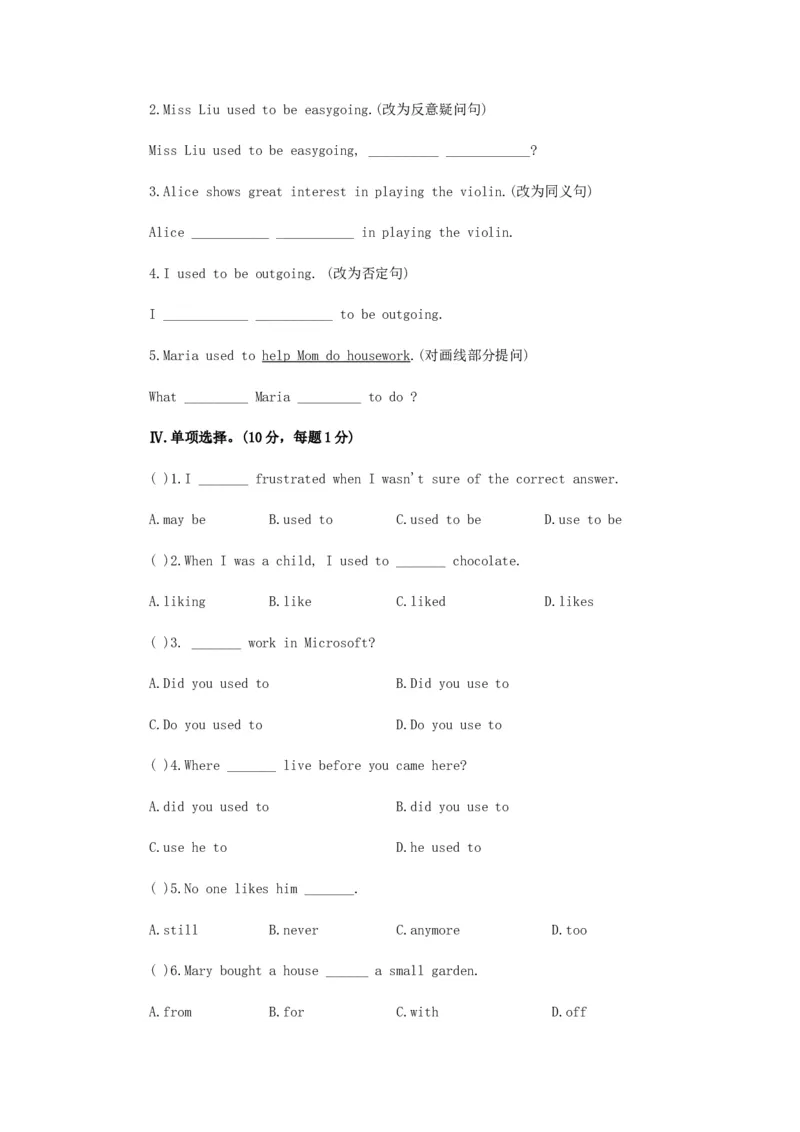
  1.Philip used to play soccer very well.(改为一般疑问句)
  ________ Philip _________to play soccer very well?
  2.Miss Liu used to be easygoing.(改为反意疑问句)
  Miss Liu used to be easygoing, __________ ____________?
  3.Alice shows great interest in playing the violin.(改为同义句)
  Alice ___________ ___________ in playing the violin.
  4.I used to be outgoing. (改为否定句)
  I ____________ ___________ to be outgoing.
  5.Maria used to help Mom do housework.(对画线部分提问)
  What _________ Maria _________ to do ?
  Ⅳ.单项选择。(10 分,每题1 分)
  ( )1.I _______ frustrated when I wasn't sure of the correct answer.
  A.may be     B.used to     C.used to be     D.use to be
  ( )2.When I was a child, I used to _______ chocolate.
  A.liking     B.like       C.liked        D.likes
  ( )3. _______ work in Microsoft?
  A.Did you used to          B.Did you use to
  C.Do you used to          D.Do you use to
  ( )4.Where _______ live before you came here?
  A.did you used to          B.did you use to
  C.use he to             D.he used to
  ( )5.No one likes him _______.
  A.still      B.never      C.anymore       D.too
  ( )6.Mary bought a house ______ a small garden.
  A.from      B.for       C.with         D.off
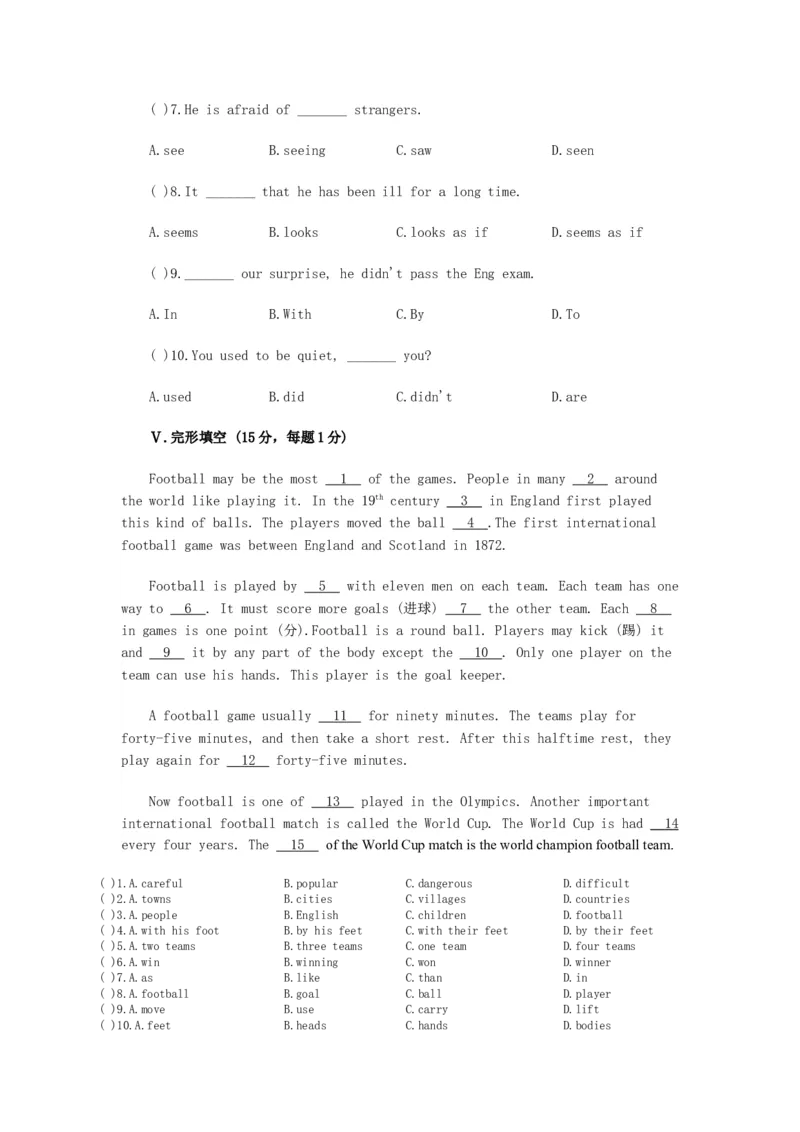
  ( )7.He is afraid of _______ strangers.
  A.see       B.seeing      C.saw         D.seen
  ( )8.It _______ that he has been ill for a long time.
  A.seems      B.looks      C.looks as if     D.seems as if
  ( )9._______ our surprise, he didn't pass the Eng exam.
  A.In       B.With       C.By          D.To
  ( )10.You used to be quiet, _______ you?
  A.used      B.did       C.didn't        D.are
  Ⅴ.完形填空 (15 分,每题1 分)
  Football may be the most
  1
   of the games. People in many
  2
   around
the world like playing it. In the 19th century
  3
   in England first played
this kind of balls. The players moved the ball
  4
  .The first international
football game was between England and Scotland in 1872.
  Football is played by
  5
   with eleven men on each team. Each team has one
way to
  6
  . It must score more goals (进球)
  7
   the other team. Each
  8

in games is one point (分).Football is a round ball. Players may kick (踢) it
and
  9
   it by any part of the body except the
  10

  . Only one player on the
team can use his hands. This player is the goal keeper.
  A football game usually
  11

   for ninety minutes. The teams play for
forty-five minutes, and then take a short rest. After this halftime rest, they
play again for
  12

   forty-five minutes.
  Now football is one of
  13

   played in the Olympics. Another important
international football match is called the World Cup. The World Cup is had
  14

every four years. The
  15

   of the World Cup match is the world champion football team.
( )1.A.careful
B.popular
C.dangerous
D.difficult
( )2.A.towns
B.cities
C.villages
D.countries
( )3.A.people
B.English
C.children
D.football
( )4.A.with his foot
B.by his feet
C.with their feet
D.by their feet
( )5.A.two teams
B.three teams
C.one team
D.four teams
( )6.A.win
B.winning
C.won
D.winner
( )7.A.as
B.like
C.than
D.in
( )8.A.football
B.goal
C.ball
D.player
( )9.A.move
B.use
C.carry
D.lift
( )10.A.feet
B.heads
C.hands
D.bodies
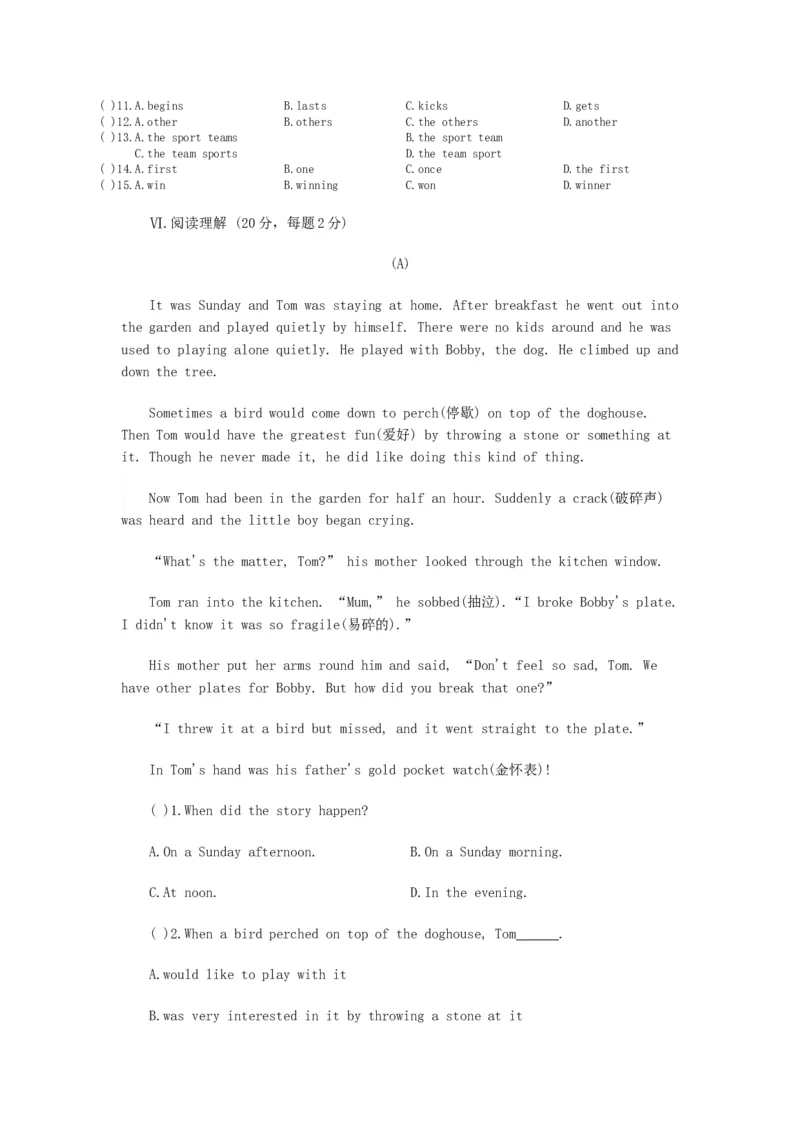
( )11.A.begins
B.lasts
C.kicks
D.gets
( )12.A.other
B.others
C.the others
D.another
( )13.A.the sport teams
B.the sport team
   C.the team sports
D.the team sport
( )14.A.first
B.one
C.once
D.the first
( )15.A.win
B.winning
C.won
D.winner
  Ⅵ.阅读理解 (20 分,每题2 分)
(A)
  It was Sunday and Tom was staying at home. After breakfast he went out into
the garden and played quietly by himself. There were no kids around and he was
used to playing alone quietly. He played with Bobby, the dog. He climbed up and
down the tree.
  Sometimes a bird would come down to perch(停歇) on top of the doghouse.
Then Tom would have the greatest fun(爱好) by throwing a stone or something at
it. Though he never made it, he did like doing this kind of thing.
  Now Tom had been in the garden for half an hour. Suddenly a crack(破碎声)
was heard and the little boy began crying.
  “What's the matter, Tom?” his mother looked through the kitchen window.
  Tom ran into the kitchen. “Mum,” he sobbed(抽泣).“I broke Bobby's plate.
I didn't know it was so fragile(易碎的).”
  His mother put her arms round him and said, “Don't feel so sad, Tom. We
have other plates for Bobby. But how did you break that one?”
  “I threw it at a bird but missed, and it went straight to the plate.”
  In Tom's hand was his father's gold pocket watch(金怀表)!
  ( )1.When did the story happen?
  A.On a Sunday afternoon.       B.On a Sunday morning.
  C.At noon.              D.In the evening.
  ( )2.When a bird perched on top of the doghouse, Tom   .
  A.would like to play with it
  B.was very interested in it by throwing a stone at it
  C.would like to give it something to eat
  D.would smile
  ( )3.There were no kids around and he was used to playing alone quietly.
Here “kids” means   .
  A.men       B.dogs       C.children       D.birds
  ( )4.How long had Tom been in the garden when his mother heard him cry?
  A.An hour.     B.A day.      C.Two hours.      D.Half an hour.
  ( )5.“Though he never made it” means“   ”.
  A.Though he couldn't hit a bird with a stone or something
  B.Though he couldn't catch the bird
  C.Though he couldn't have fun from the bird
  D.Though he couldn't eat the bird
(B)
  An important question about eating out is who pays for the meal. If a
friend of yours asks you to have lunch with him, you may say something like
this, “I'm afraid it'll have to be someplace cheap, as I have very little
money.” The other person may say, “OK, I'll meet you at McDonald's.”
  This means that the two agree to go Dutch, that is, each person pays for
himself. He may also say, “Oh, no. I want to take you to lunch at Smith's,”
or “I want you to try the Chinese dumplings there. They're great.” This means
the person wants to pay for both of you. If you feel friendly towards this
person, you can go with him and you needn't pay for the meal. You may just say,
“Thank you. That would be very nice.”
  American customs(风俗)about who pays for dates(约会)are much the same as in
other parts of the world. In the old days, American women wanted men to pay for
all the meals. But, today, a university girl or a woman in business world will
usually pay her way during the day. If a man asks her for a dance outside the
working hours, it means “Come, as my guest(客人).” So as you can see, it is a
polite thing to make the question clear at the very beginning.
  ( )1.The passage tells us    .
  A.how to eat out           B.where to eat out
  C.what to eat out           D.who pays for the meal
  ( )2.If you have little money,    .
  A.you'll have a cheap meal
  B.you'll borrow some from others
  C.you'll ask your friend to pay for your meal
  D.you won't want your friends to ask you to dinner
  ( )3.“Go Dutch” in this passage means    .
  A.去饭馆      B.就餐       C.订餐      D.各自付款
  ( )4.Sometimes your friend takes you to lunch. It means    .
  A.he's going to lend some money to you
  B.he's going to pay for your meal, too
  C.he'll be angry with you
  D.he can't understand you
  ( )5.In America, some girls and women ____ now.
  A.ask men to pay for their meals   B.try to pay for the men's meals
  C.try to pay for their own meals   D.never have anything outside
  Ⅶ.补全对话(共15 分,每空1 分)。
  在每段对话的空白处填入适当的话语(话语可以是句字、短语或词),使对话完整。
  A: Hello, Bob! Here! Don't you remember ma?
  B: Oh, sorry, you're Bill, 1_____ 2_____?
  A: That's 3______.
  B: You 4_____ 5_____ 6_____ quiet. But now you look 7________.
  A: Yes, I'm very outgoing now.
  B: By the 8________, did you 9_____ 10_____ 11_________ the piano?
  A: Yes, I did. But now I'm more interested 12_____ playing 13_____ . And
I'm 14__________ the basketball team in our school.
  B: Wow! People 15_______ change.
  Ⅷ.书面表达(15 分)
  根据提示,简要介绍你的朋友Lilian 的成长变化(字数)
  爱好:以前喜欢打乒乓球、看电视和聊天;现在喜欢弹钢琴、看书和散步。

  外貌:过去个子矮,短发;现在个子高多了,长发。

  性格:过去外向;现在有些内向。

  ______________________________________
参考答案
  I.1.dark 2.be afraid of 3.sure 4.is terrified of 5.is interested
  II.1.used to 2.by airplane 3.on 4.chatting 5.comics
  6.has changed 7.watching 8.reading 9.smoking 10.terrified
  III.1.Did use 2.didn't/usedn't she 3.is interested 4.didn't use 5.did use
do
  IV.CBBCB 6-10 CBADC
  V.1-5 BDACA 6-10 ACBAC 11-15 BDCCD
  VI.(A)1—5 BBCDA (B)1—5 DADBC
  VII.1.aren't 2.you 3.right 4.used 5.to 6.be 7.outgoing
  8.way 9.used 10.to 11.play 12.in 13.basketball 14.on 15.sure
  VIII.My friend Lilian is different from what she used to be. he used to
like playing table tennis, but now she enjoys playing the piano. She used to
watch TV or chat with others after supper, but now she usually reads books or
has a walk. She used to have short hair, but now she's much taller than before.
She used to.