2026 秋新人教PEP 版六年级上册英语语法精讲精练
Unit 1 Amazing landmarks 语法讲义
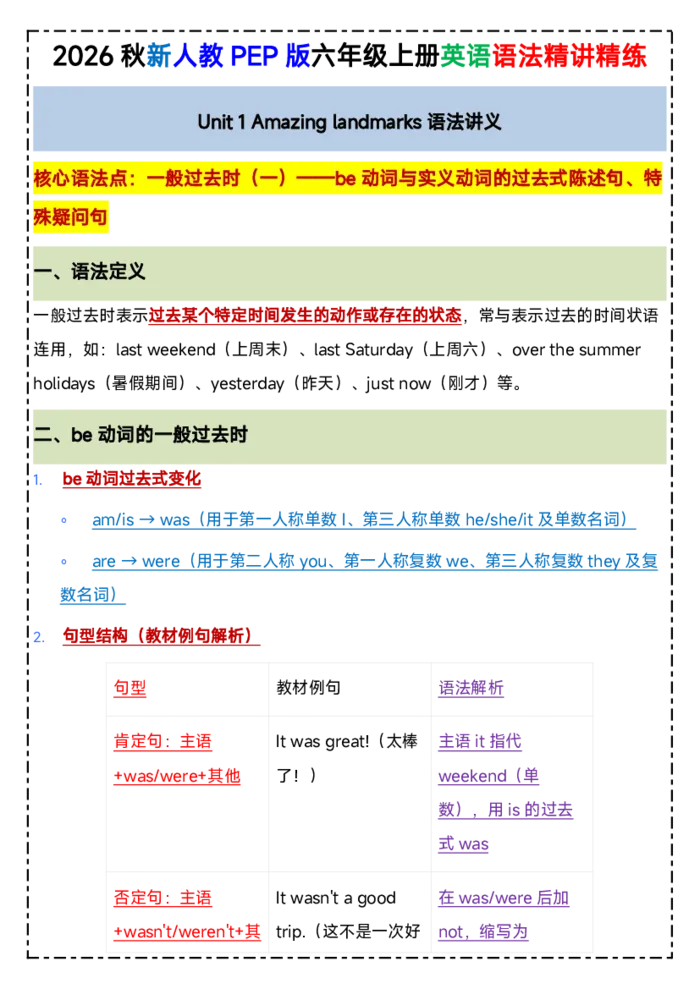
核心语法点:一般过去时(一)——be 动词与实义动词的过去式陈述句、特
殊疑问句
一、语法定义
一般过去时表示过去某个特定时间发生的动作或存在的状态,常与表示过去的时间状语
连用,如:last weekend(上周末)、last Saturday(上周六)、over the summer
holidays(暑假期间)、yesterday(昨天)、just now(刚才)等。
二、be 动词的一般过去时
1.
be 动词过去式变化
○
am/is →was(用于第一人称单数I、第三人称单数he/she/it 及单数名词)
○
are →were(用于第二人称you、第一人称复数we、第三人称复数they 及复
数名词)
2.
句型结构(教材例句解析)
句型
教材例句
语法解析
肯定句:主语
+was/were+其他
It was great!(太棒
了!)
主语it 指代
weekend(单
数),用is 的过去
式was
否定句:主语
+wasn't/weren't+其
It wasn't a good
trip.(这不是一次好
在was/were 后加
not,缩写为
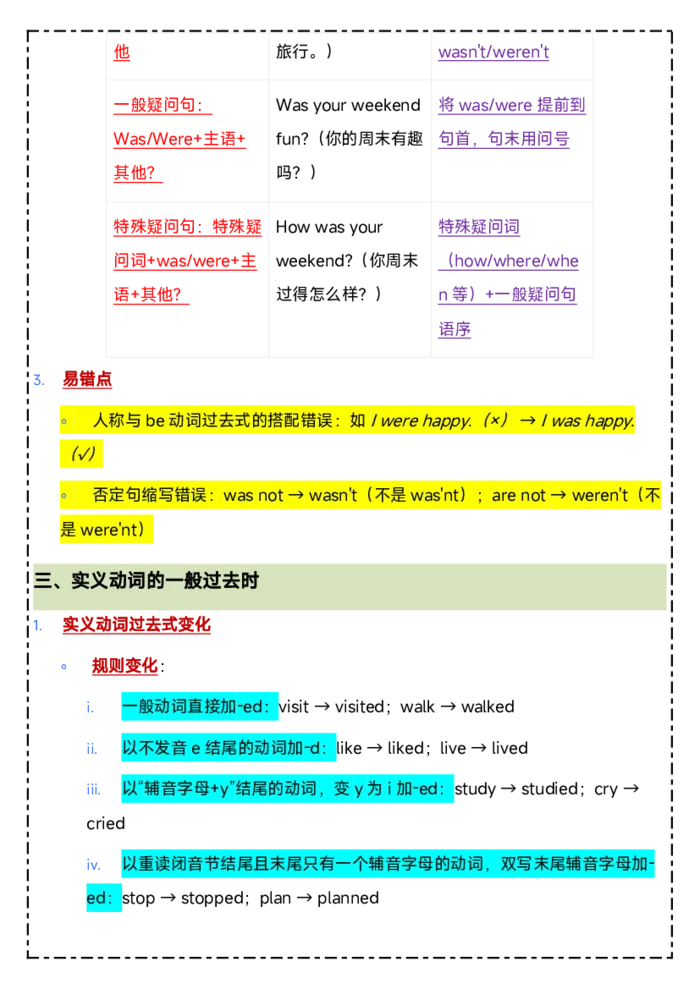
他
旅行。)
wasn't/weren't
一般疑问句:
Was/Were+主语+
其他?
Was your weekend
fun?(你的周末有趣
吗?)
将was/were 提前到
句首,句末用问号
特殊疑问句:特殊疑
问词+was/were+主
语+其他?
How was your
weekend?(你周末
过得怎么样?)
特殊疑问词
(how/where/whe
n 等)+一般疑问句
语序
3.
易错点
○
人称与be 动词过去式的搭配错误:如I were happy.(×)→I was happy.
(√)
○
否定句缩写错误:was not →wasn't(不是was'nt);are not →weren't(不
是were'nt)
三、实义动词的一般过去时
1.
实义动词过去式变化
○
规则变化:
i.
一般动词直接加-ed:visit →visited;walk →walked
ii.
以不发音e 结尾的动词加-d:like →liked;live →lived
iii.
以“辅音字母+y”结尾的动词,变y 为i 加-ed:study →studied;cry →
cried
iv.
以重读闭音节结尾且末尾只有一个辅音字母的动词,双写末尾辅音字母加-
ed:stop →stopped;plan →planned
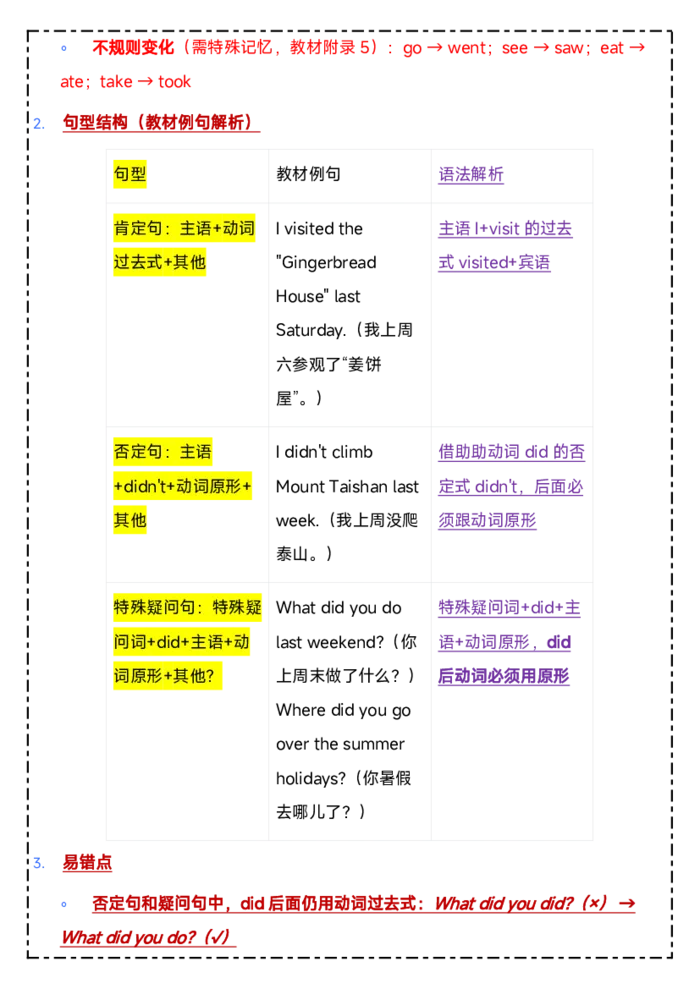
○
不规则变化(需特殊记忆,教材附录5):go →went;see →saw;eat →
ate;take →took
2.
句型结构(教材例句解析)
句型
教材例句
语法解析
肯定句:主语+动词
过去式+其他
I visited the
"Gingerbread
House" last
Saturday.(我上周
六参观了“姜饼
屋”。)
主语I+visit 的过去
式visited+宾语
否定句:主语
+didn't+动词原形+
其他
I didn't climb
Mount Taishan last
week.(我上周没爬
泰山。)
借助助动词did 的否
定式didn't,后面必
须跟动词原形
特殊疑问句:特殊疑
问词+did+主语+动
词原形+其他?
What did you do
last weekend?(你
上周末做了什么?)
Where did you go
over the summer
holidays?(你暑假
去哪儿了?)
特殊疑问词+did+主
语+动词原形,did
后动词必须用原形
3.
易错点
○
否定句和疑问句中,did 后面仍用动词过去式:What did you did?(×)→
What did you do?(√)
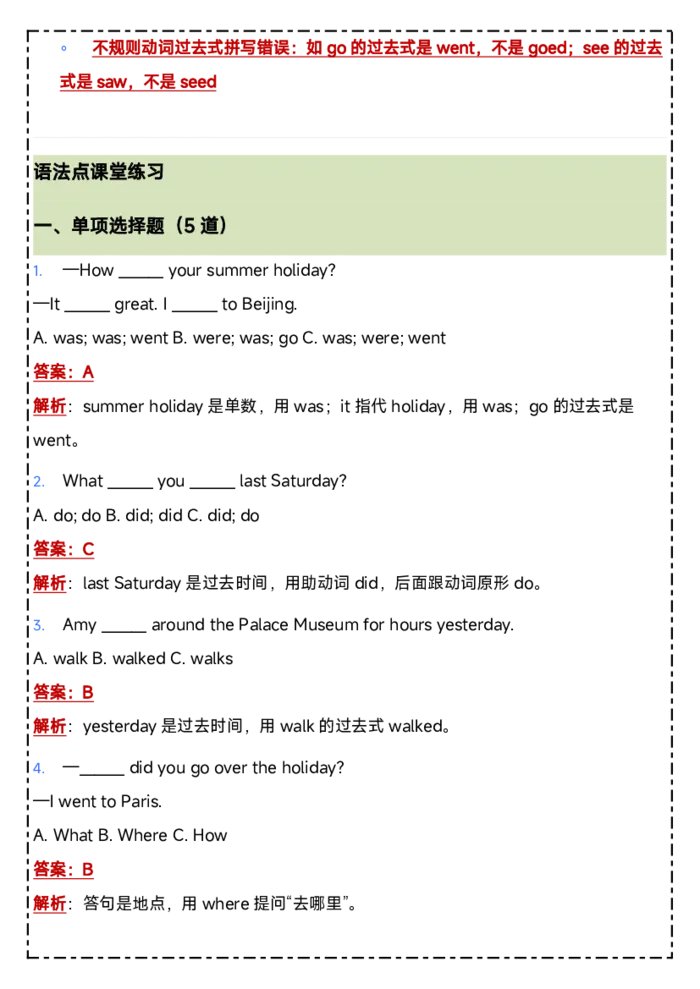
○
不规则动词过去式拼写错误:如go 的过去式是went,不是goed;see 的过去
式是saw,不是seed
语法点课堂练习
一、单项选择题(5 道)
1.
—How ______ your summer holiday?
—It ______ great. I ______ to Beijing.
A. was; was; went B. were; was; go C. was; were; went
答案:A
解析:summer holiday 是单数,用was;it 指代holiday,用was;go 的过去式是
went。
2.
What ______ you ______ last Saturday?
A. do; do B. did; did C. did; do
答案:C
解析:last Saturday 是过去时间,用助动词did,后面跟动词原形do。
3.
Amy ______ around the Palace Museum for hours yesterday.
A. walk B. walked C. walks
答案:B
解析:yesterday 是过去时间,用walk 的过去式walked。
4.
—______ did you go over the holiday?
—I went to Paris.
A. What B. Where C. How
答案:B
解析:答句是地点,用where 提问“去哪里”。
5.
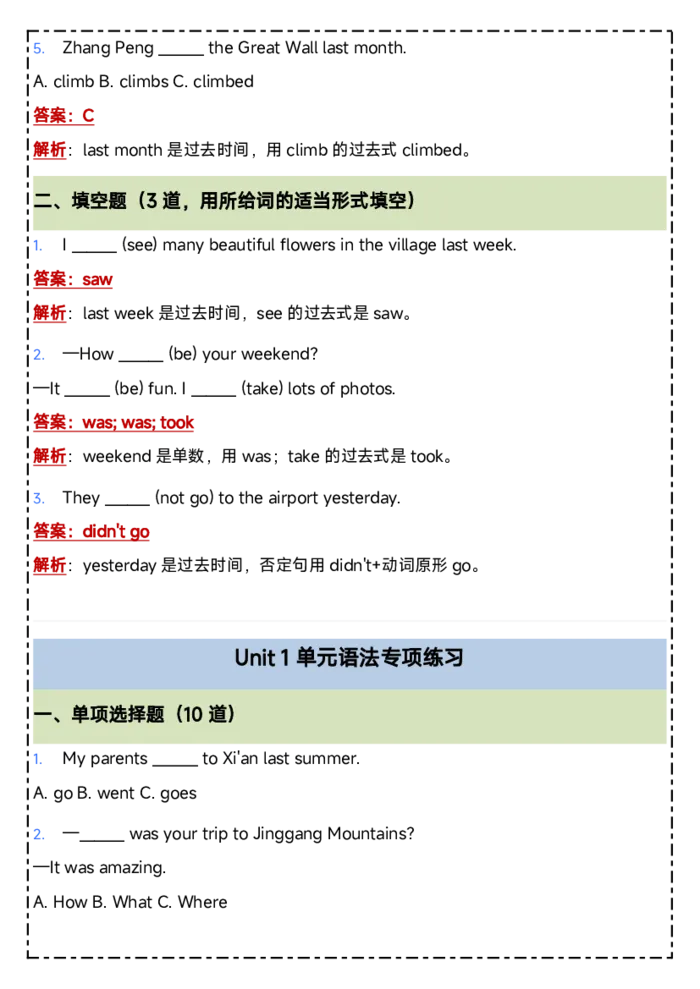
Zhang Peng ______ the Great Wall last month.
A. climb B. climbs C. climbed
答案:C
解析:last month 是过去时间,用climb 的过去式climbed。
二、填空题(3 道,用所给词的适当形式填空)
1.
I ______ (see) many beautiful flowers in the village last week.
答案:saw
解析:last week 是过去时间,see 的过去式是saw。
2.
—How ______ (be) your weekend?
—It ______ (be) fun. I ______ (take) lots of photos.
答案:was; was; took
解析:weekend 是单数,用was;take 的过去式是took。
3.
They ______ (not go) to the airport yesterday.
答案:didn't go
解析:yesterday 是过去时间,否定句用didn't+动词原形go。
Unit 1 单元语法专项练习
一、单项选择题(10 道)
1.
My parents ______ to Xi'an last summer.
A. go B. went C. goes
2.
—______ was your trip to Jinggang Mountains?
—It was amazing.
A. How B. What C. Where
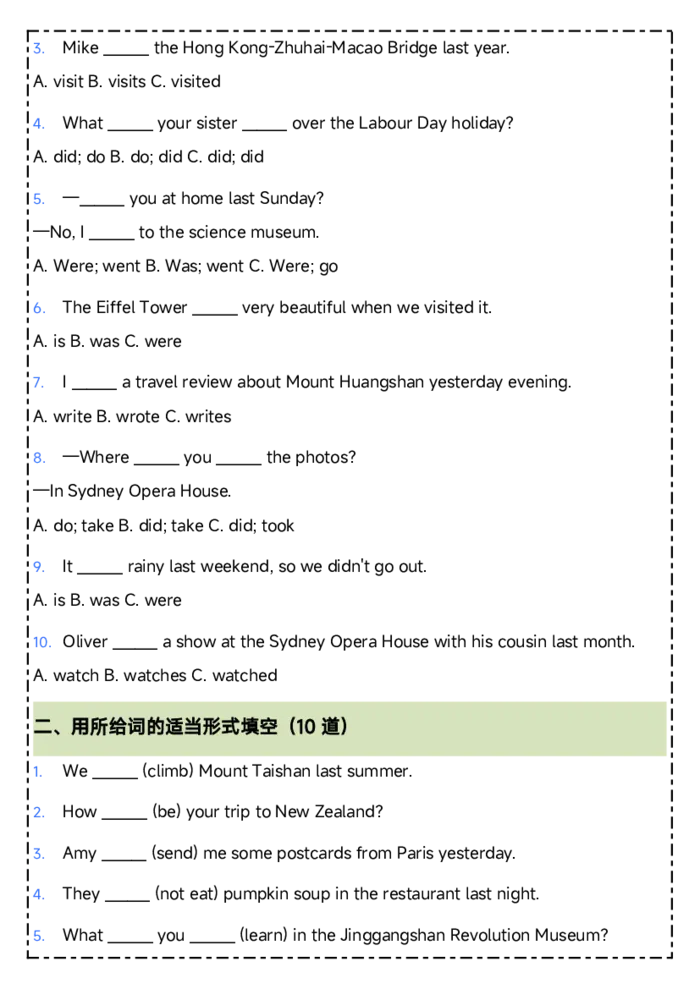
3.
Mike ______ the Hong Kong-Zhuhai-Macao Bridge last year.
A. visit B. visits C. visited
4.
What ______ your sister ______ over the Labour Day holiday?
A. did; do B. do; did C. did; did
5.
—______ you at home last Sunday?
—No, I ______ to the science museum.
A. Were; went B. Was; went C. Were; go
6.
The Eiffel Tower ______ very beautiful when we visited it.
A. is B. was C. were
7.
I ______ a travel review about Mount Huangshan yesterday evening.
A. write B. wrote C. writes
8.
—Where ______ you ______ the photos?
—In Sydney Opera House.
A. do; take B. did; take C. did; took
9.
It ______ rainy last weekend, so we didn't go out.
A. is B. was C. were
10. Oliver ______ a show at the Sydney Opera House with his cousin last month.
A. watch B. watches C. watched
二、用所给词的适当形式填空(10 道)
1.
We ______ (climb) Mount Taishan last summer.
2.
How ______ (be) your trip to New Zealand?
3.
Amy ______ (send) me some postcards from Paris yesterday.
4.
They ______ (not eat) pumpkin soup in the restaurant last night.
5.
What ______ you ______ (learn) in the Jinggangshan Revolution Museum?
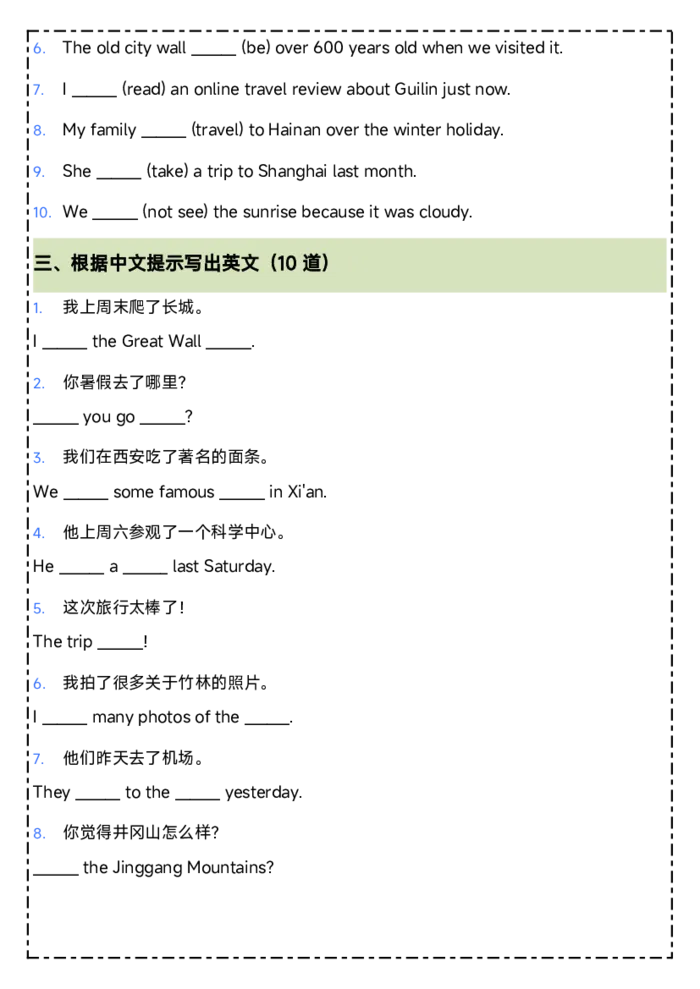
6.
The old city wall ______ (be) over 600 years old when we visited it.
7.
I ______ (read) an online travel review about Guilin just now.
8.
My family ______ (travel) to Hainan over the winter holiday.
9.
She ______ (take) a trip to Shanghai last month.
10. We ______ (not see) the sunrise because it was cloudy.
三、根据中文提示写出英文(10 道)
1.
我上周末爬了长城。
I ______ the Great Wall ______.
2.
你暑假去了哪里?
______ you go ______?
3.
我们在西安吃了著名的面条。
We ______ some famous ______ in Xi'an.
4.
他上周六参观了一个科学中心。
He ______ a ______ last Saturday.
5.
这次旅行太棒了!
The trip ______!
6.
我拍了很多关于竹林的照片。
I ______ many photos of the ______.
7.
他们昨天去了机场。
They ______ to the ______ yesterday.
8.
你觉得井冈山怎么样?
______ the Jinggang Mountains?
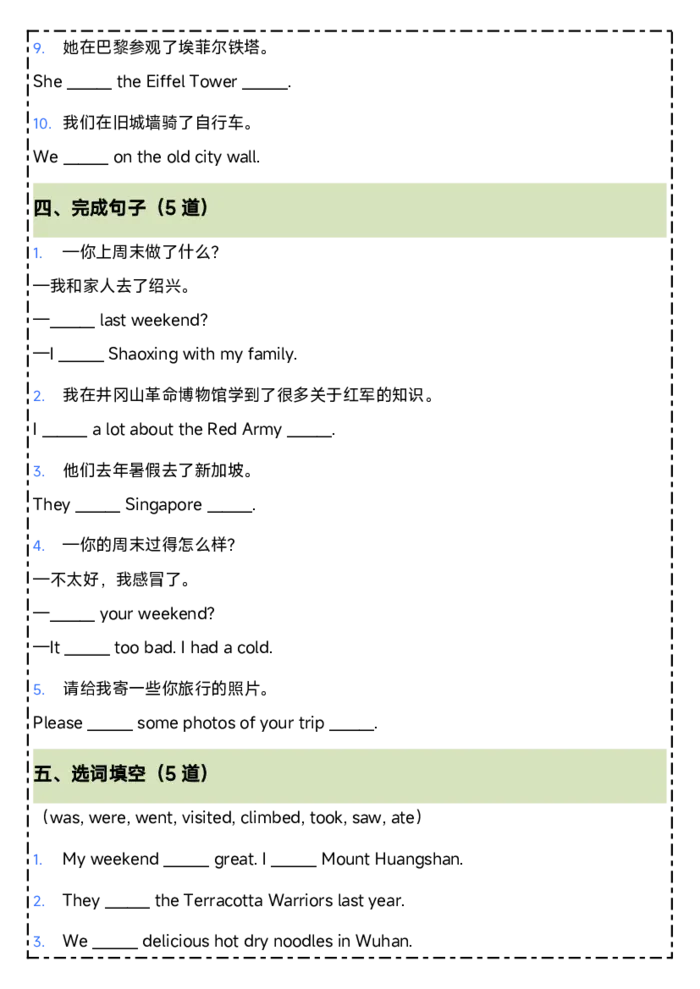
9.
她在巴黎参观了埃菲尔铁塔。
She ______ the Eiffel Tower ______.
10. 我们在旧城墙骑了自行车。
We ______ on the old city wall.
四、完成句子(5 道)
1.
—你上周末做了什么?
—我和家人去了绍兴。
—______ last weekend?
—I ______ Shaoxing with my family.
2.
我在井冈山革命博物馆学到了很多关于红军的知识。
I ______ a lot about the Red Army ______.
3.
他们去年暑假去了新加坡。
They ______ Singapore ______.
4.
—你的周末过得怎么样?
—不太好,我感冒了。
—______ your weekend?
—It ______ too bad. I had a cold.
5.
请给我寄一些你旅行的照片。
Please ______ some photos of your trip ______.
五、选词填空(5 道)
(was, were, went, visited, climbed, took, saw, ate)
1.
My weekend ______ great. I ______ Mount Huangshan.
2.
They ______ the Terracotta Warriors last year.
3.
We ______ delicious hot dry noodles in Wuhan.
4.
She ______ many beautiful photos in Singapore.
5.
______ you at the travel show last Sunday?
六、完形填空(10 道)
Last summer, I 1______ a trip to Jinggang Mountains with my parents. It 2______ a
three-day trip.
On the first day, we 3 ______to the mountains by bus. The air 4______ fresh and the
views 5 ______beautiful. We 6______ many bamboo forests and waterfalls.
On the second day, we visited the Jinggangshan Revolution Museum. We 7______
many old books and photos. The volunteers 8______ us great stories about the Red
Army. I 9______ a lot.
On the third day, we came back home. I 10______ a travel review about the trip. It
was the best trip ever!
1.
A. take B. took C. takes
2.
A. is B. was C. were
3.
A. go B. went C. goes
4.
A. was B. is C. were
5.
A. are B. was C. were
6.
A. see B. saw C. seen
7.
A. see B. saw C. seen
8.
A. tell B. told C. tells
9.
A. learn B. learned C. learns
10. A. write B. wrote C. writes
七、阅读理解(1 道,5 个选择题)
My name is Amy. Last summer, I went to Paris with my family. Paris is the capital of
France. It is a beautiful city.
We stayed there for five days. On the first day, we visited the Eiffel Tower. It is 324
metres tall. We climbed to the top and saw the whole city. The view was amazing!
On the second day, we went to the Louvre Museum. We saw many famous
paintings, like the Mona Lisa. On the third day, we walked along the Seine River.
We ate some delicious French food. On the fourth day, we went shopping. I bought
some gifts for my friends. On the fifth day, we came back home.
I loved Paris. It was a wonderful trip. I want to go there again.
1.
When did Amy go to Paris?
A. Last winter. B. Last summer. C. Last spring.
2.
How long did they stay in Paris?
A. For three days. B. For four days. C. For five days.
3.
What did they do on the first day?
A. They visited the Eiffel Tower.
B. They went to the Louvre Museum.
C. They walked along the Seine River.
4.
What did Amy buy?
A. Some French food. B. Some paintings. C. Some gifts.
5.
How did Amy feel about the trip?
A. It was boring. B. It was wonderful. C. It was tiring.
Unit 1 单元语法专项练习答案与详解
一、单项选择题
1.
答案:B 解析:last summer 是过去时间,go 的过去式是went。
2.
答案:A 解析:答句是感受,用how 提问“怎么样”。
3.
答案:C 解析:last year 是过去时间,visit 的过去式是visited。
4.
答案:A 解析:over the Labour Day holiday 是过去时间,用助动词did,后面跟
动词原形do。
5.
答案:A 解析:主语you 用were;last Sunday 是过去时间,go 的过去式是
went。
6.
答案:B 解析:when 引导的从句是过去时,主句也用过去时,Eiffel Tower 是单
数,用was。
7.
答案:B 解析:yesterday evening 是过去时间,write 的过去式是wrote。
8.
答案:B 解析:拍照是过去的动作,用助动词did,后面跟动词原形take。
9.
答案:B 解析:last weekend 是过去时间,it 是单数,用was。
10. 答案:C 解析:last month 是过去时间,watch 的过去式是watched。
二、用所给词的适当形式填空
1.
climbed 解析:last summer 是过去时间,climb 的过去式是climbed。
2.
was 解析:trip 是单数,用was。
3.
sent 解析:yesterday 是过去时间,send 的过去式是sent。
4.
didn't eat 解析:last night 是过去时间,否定句用didn't+动词原形eat。
5.
did; learn 解析:询问过去做的事,用助动词did,后面跟动词原形learn。
6.
was 解析:old city wall 是单数,用was。
7.
read 解析:just now 是过去时间,read 的过去式是read(发音不同)。
8.
travelled 解析:over the winter holiday 是过去时间,travel 的过去式是
travelled。
9.
took 解析:last month 是过去时间,take 的过去式是took。
10. didn't see 解析:because 引导的从句是过去时,主句也用过去时,否定句用
didn't+动词原形see。
三、根据中文提示写出英文
1.
climbed; last weekend
2.
Where did; over the summer holidays
3.
ate; Xi'an noodles
4.
visited; science centre
5.
was amazing
6.
took; bamboo forest
7.
went; airport
8.
How was
9.
visited; in Paris
10. rode bikes
四、完成句子
1.
What did you do; went to
2.
learned; in the Jinggangshan Revolution Museum
3.
went to; last summer holiday
4.
How was; wasn't
5.
send; to me
五、选词填空
1.
was; climbed
2.
visited
3.
ate
4.
took
5.
Were
六、完形填空
1.
B 解析:last summer 是过去时间,take 的过去式是took。
2.
B 解析:trip 是单数,用was。
3.
B 解析:go 的过去式是went。
4.
A 解析:air 是不可数名词,用was。
5.
C 解析:views 是复数,用were。
6.
B 解析:see 的过去式是saw。
7.
B 解析:see 的过去式是saw。
8.
B 解析:tell 的过去式是told。
9.
B 解析:learn 的过去式是learned。
10. B 解析:write 的过去式是wrote。
七、阅读理解
1.
B 解析:原文第一句“Last summer, I went to Paris with my family.”
2.
C 解析:原文第二段第一句“We stayed there for five days.”
3.
A 解析:原文第二段第二句“On the first day, we visited the Eiffel Tower.”
4.
C 解析:原文第二段倒数第二句“I bought some gifts for my friends.”
5.
B 解析:原文最后一段第二句“It was a wonderful trip.”
2026 秋新人教PEP 版六年级上册英语语法精讲精练
Unit 2 Getting together 语法讲义
核心语法点:一般过去时(二)——一般疑问句及回答
一、语法定义
本单元继续学习一般过去时,重点掌握实义动词和be 动词的一般过去时一般疑问句及
肯定/否定回答,用于询问过去是否发生了某件事。
二、be 动词的一般过去时一般疑问句
1.
句型结构
○
一般疑问句:Was/Were+主语+其他?
○
肯定回答:Yes, 主语+was/were.
○
否定回答:No, 主语+wasn't/weren't.
2.
教材例句解析
○
例句:—Were you at home last Mid-Autumn Festival?(你去年中秋节在家
吗?)
—Yes, I was.(是的,我在。)/ No, I wasn't.(不,我不在。)
○
解析:主语you 用were 提问,回答时主语变为I,用was。
三、实义动词的一般过去时一般疑问句
1.
句型结构
○
一般疑问句:Did+主语+动词原形+其他?
○
肯定回答:Yes, 主语+did.
○
否定回答:No, 主语+didn't.
2.
教材例句解析
○
例句1:—Did you take a trip?(你们去旅行了吗?)
—No, we didn't.(不,我们没有。)
○
例句2:—Did you eat mooncakes?(你们吃月饼了吗?)
—Yes, we did.(是的,我们吃了。)
○
解析:借助助动词did 提问,did 后面必须跟动词原形;回答时用did/didn't,
不能重复实义动词的过去式(如不能说Yes, I ate.)。
3.
易错点
○
疑问句中did 后面用动词过去式:Did you ate jiaozi?(×)→Did you eat
jiaozi?(√)
○
回答时用实义动词过去式:Yes, I ate.(×)→Yes, I did.(√)
○
主语是第三人称单数时,仍用did 提问,不用does:Did he go to the
marathon?(√)
语法点课堂练习
一、单项选择题(5 道)
1.
—______ you eat zongzi on Dragon Boat Festival?
—Yes, I ______.
A. Did; did B. Do; do C. Did; ate
答案:A
解析:询问过去的动作,用did 提问,回答也用did。
2.
—______ your brother at the Spring Festival Gala last night?
—No, he ______. He was ill.
A. Was; wasn't B. Were; weren't C. Did; didn't
答案:A
解析:主语your brother 是单数,用was 提问,否定回答用wasn't。
3.
—Did they ______ the dragon boat race?
—Yes, they did. They ______ very excited.
A. watch; were B. watched; were C. watch; are
答案:A
解析:did 后面跟动词原形watch;描述过去的状态,用were。
4.
—______ you paste fu on the door last Spring Festival?
—No, I ______. My sister did it.
A. Did; didn't B. Were; wasn't C. Do; don't
答案:A
解析:paste 是实义动词,用did 提问,否定回答用didn't。
5.
—Did Chen Jie join the online book fair?
—______
A. Yes, she did. B. Yes, she joined. C. No, she don't.
答案:A
解析:did 引导的一般疑问句,回答用did/didn't。
二、填空题(3 道,用所给词的适当形式填空)
1.
—______ (be) you at the marathon last Sunday?
—No, I ______ (be not). I ______ (go) to the book fair.
答案:Were; wasn't; went
解析:主语you 用were;回答用I wasn't;go 的过去式是went。
2.
—______ they ______ (count) down to the new year last night?
—Yes, they ______.
答案:Did; count; did
解析:询问过去的动作,用did+动词原形count,回答用did。
3.
Mike ______ (not watch) the Spring Festival Gala yesterday.
答案:didn't watch
解析:yesterday 是过去时间,否定句用didn't+动词原形watch。
Unit 2 单元语法专项练习
一、单项选择题(10 道)
1.
—______ you have a good time at the Lantern Festival?
—Yes, I did.
A. Do B. Did C. Were
2.
—______ your parents at the sports meet last week?
—No, they ______. They went to work.
A. Was; wasn't B. Were; weren't C. Did; didn't
3.
—Did they ______ the robot show at the art festival?
—Yes, they did. It ______ very interesting.
A. see; was B. saw; was C. see; is
4.
—______ Amy sing a song at the school party?
—No, she ______. She danced.
A. Did; didn't B. Does; doesn't C. Was; wasn't
5.
—Were you excited when you watched the race?
—______
A. Yes, I were. B. Yes, I was. C. Yes, I did.
6.
—Did you ______ jiaozi with your family last Spring Festival?
—Yes, we did.
A. eat B. ate C. eating
7.
—______ the writer read his book to the children?
—Yes, he did.
A. Is B. Does C. Did
8.
—Did your father win the dragon boat race?
—______ He was the first.
A. Yes, he did. B. No, he didn't. C. Yes, he was.
9.
—______ you clean the house before the Spring Festival?
—No, my mother ______ it.
A. Did; clean B. Did; cleaned C. Do; cleans
10. —Were the students happy on Children's Day?
—______ They sang and danced all day.
A. Yes, they were. B. Yes, they did. C. No, they weren't.
二、用所给词的适当形式填空(10 道)
1.
—______ you ______ (go) to the old people's home last Double Ninth Festival?
—Yes, I did.
2.
The students ______ (not have) a school trip last month.
3.
—______ (be) the dragon boat race exciting?
—Yes, it was.
4.
We ______ (wait) for the Spring Festival Gala last night.
5.
—______ they ______ (dress) in red on National Day?
—No, they didn't.
6.
My grandma ______ (tell) us a story about Nian yesterday.
7.
—______ you ______ (make) cards for your teachers last Teachers' Day?
—Yes, I did.
8.
The runners ______ (run) very fast in the marathon last Sunday.
9.
They ______ (not set) off fireworks last Spring Festival.
10. —______ (be) you tired after the big event?
—No, I wasn't.
三、根据中文提示写出英文(10 道)
1.
你去年中秋节吃月饼了吗?
______ you ______ last Mid-Autumn Festival?
2.
他们上周日去看马拉松了吗?
______ they ______ the marathon last Sunday?
3.
是的,他们去了。
Yes, ______.
4.
你春节贴福字了吗?
______ you ______ on the door last Spring Festival?
5.
不,我没有。我妹妹贴的。
No, ______. My sister did it.
6.
你们在艺术节唱歌了吗?
______ you ______ at the art festival?
7.
龙舟比赛很令人激动吗?
______ the dragon boat race ______?
8.
他参加线上书市了吗?
______ he ______ the online book fair?
9.
我们昨晚倒计时迎接新年了。
We ______ to the new year last night.
10. 他们在春节联欢晚会上看了精彩的节目。
They ______ wonderful shows at the Spring Festival Gala.
四、完成句子(5 道)
1.
—你上周参加运动会了吗?
—是的,我参加了。我跑了100 米。
—______ the sports meet last week?
—Yes, ______. I ran the 100-metre race.
2.
—你妈妈昨晚包饺子了吗?
—不,她没有。我们吃了面条。
—______ jiaozi last night?
—No, ______. We ate noodles.
3.
—孩子们在儿童节玩得开心吗?
—是的,他们很开心。他们又唱又跳。
—______ the children ______ on Children's Day?
—Yes, they were. They sang and danced.
4.
—你看了关于年的故事吗?
—是的,我看了。它很有趣。
—______ the story about Nian?
—Yes, I did. It was very interesting.
5.
—他们在重阳节去敬老院了吗?
—不,他们没有。他们邀请了爷爷奶奶来学校。
—______ to the old people's home last Double Ninth Festival?
—No, they didn't. They invited their grandparents to school.
五、选词填空(5 道)
(Did, Was, Were, did, was, were, ate, sang, watched, joined)
1.
—______ you at the party last night?
—Yes, I ______.
2.
—______ they ______ the book fair?
—No, they didn't.
3.
The dragon boat race ______ very exciting.
4.
We ______ delicious zongzi on Dragon Boat Festival.
5.
—______ you ______ the Spring Festival Gala?
—Yes, we did.
六、完形填空(10 道)
Last Spring Festival, I 1 ______a great time with my family.
Before the festival, we 2 ______the house and pasted fu on the door. My mother 3
______lots of delicious food. On New Year's Eve, we 4 ______the Spring Festival Gala
together. We 5______ down to 12 o'clock and set off fireworks.
On the first day of the new year, we 6______ our grandparents. They 7______ us red
envelopes. We 8______ jiaozi for breakfast. In the afternoon, we 9______ with our
friends. We 10______ and played games.
I love Spring Festival!
1.
A. have B. had C. has
2.
A. clean B. cleaned C. cleaning
3.
A. make B. made C. makes
4.
A. watch B. watched C. watches
5.
A. count B. counted C. counts
6.
A. visit B. visited C. visits
7.
A. give B. gave C. gives
8.
A. eat B. ate C. eating
9.
A. play B. played C. plays
10. A. sing B. sang C. sings
七、阅读理解(1 道,5 个选择题)
The Dragon Boat Festival is a traditional Chinese festival. It is on the 5th day of the
5th lunar month.
Last Dragon Boat Festival, I had a wonderful time. In the morning, I went to the
river with my father to watch the dragon boat race. There were many teams. The
race was very exciting. My father's team won the race! I cheered for them loudly.
In the afternoon, my family made zongzi together. My grandma taught me how to
make zongzi. It was difficult but fun. We ate zongzi for dinner. They were delicious.
I love the Dragon Boat Festival. It is my favourite festival.
1.
When is the Dragon Boat Festival?
A. On the 5th day of the 5th lunar month.
B. On the 15th day of the 8th lunar month.
C. On the 1st day of the 1st lunar month.
2.
What did the writer do in the morning?
A. He made zongzi.
B. He watched the dragon boat race.
C. He ate zongzi.
3.
Who won the dragon boat race?
A. The writer's team.
B. The writer's father's team.
C. The writer's grandpa's team.
4.
Who taught the writer to make zongzi?
A. His mother. B. His father. C. His grandma.
5.
How did the writer feel about the festival?
A. It was boring. B. It was wonderful. C. It was tiring.
Unit 2 单元语法专项练习答案与详解
一、单项选择题
1.
答案:B 解析:询问过去的动作,用did 提问。
2.
答案:B 解析:主语your parents 是复数,用were 提问,否定回答用weren't。
3.
答案:A 解析:did 后面跟动词原形see;描述过去的状态,用was。
4.
答案:A 解析:sing 是实义动词,用did 提问,否定回答用didn't。
5.
答案:B 解析:were 引导的一般疑问句,主语I 用was 回答。
6.
答案:A 解析:did 后面跟动词原形eat。
7.
答案:C 解析:询问过去的动作,用did 提问。
8.
答案:A 解析:根据答句“He was the first.”可知是肯定回答,用did。
9.
答案:B 解析:用did 提问,答句是过去时,clean 的过去式是cleaned。
10. 答案:A 解析:were 引导的一般疑问句,主语they 用were 回答。
二、用所给词的适当形式填空
1.
Did; go 解析:询问过去的动作,用did+动词原形go。
2.
didn't have 解析:last month 是过去时间,否定句用didn't+动词原形have。
3.
Was 解析:race 是单数,用was。
4.
waited 解析:last night 是过去时间,wait 的过去式是waited。
5.
Did; dress 解析:询问过去的动作,用did+动词原形dress。
6.
told 解析:yesterday 是过去时间,tell 的过去式是told。
7.
Did; make 解析:last Teachers' Day 是过去时间,用did+动词原形make。
8.
ran 解析:last Sunday 是过去时间,run 的过去式是ran。
9.
didn't set 解析:last Spring Festival 是过去时间,否定句用didn't+动词原形set。
10. Were 解析:主语you 用were。
三、根据中文提示写出英文
1.
Did; eat mooncakes
2.
Did; watch
3.
they did
4.
Did; paste fu
5.
I didn't
6.
Did; sing songs
7.
Was; exciting
8.
Did; join
9.
counted down
10. watched
四、完成句子
1.
Did you take part in; I did
2.
Did your mother make; she didn't
3.
Were; happy
4.
Did you read
5.
Did they go
五、选词填空
1.
Were; was
2.
Did; join
3.
was
4.
ate
5.
Did; watch
六、完形填空
1.
B 解析:have a great time 的过去式是had a great time。
2.
B 解析:clean 的过去式是cleaned。
3.
B 解析:make 的过去式是made。
4.
B 解析:watch 的过去式是watched。
5.
B 解析:count 的过去式是counted。
6.
B 解析:visit 的过去式是visited。
7.
B 解析:give 的过去式是gave。
8.
B 解析:eat 的过去式是ate。
9.
B 解析:play 的过去式是played。
10. B 解析:sing 的过去式是sang。
七、阅读理解
1.
A 解析:原文第一段第二句“It is on the 5th day of the 5th lunar month.”
2.
B 解析:原文第二段第二句“In the morning, I went to the river with my father to
watch the dragon boat race.”
3.
B 解析:原文第二段第四句“My father's team won the race!”
4.
C 解析:原文第三段第二句“My grandma taught me how to make zongzi.”
5.
B 解析:原文第二段第一句“Last Dragon Boat Festival, I had a wonderful time.”
2026 秋新人教PEP 版六年级上册英语语法精讲精练
Unit 3 Healthy life 语法讲义
核心语法点
1.
一般现在时(谈论身体状况)
2.
一般将来时(be going to 结构)
3.
情态动词should(提建议)
一、一般现在时(谈论身体状况)
1.
语法定义
一般现在时表示现在的状态、经常性或习惯性的动作,本单元用于描述当前的身体感受
和健康状况。
2.
句型结构(教材例句解析)
句型
教材例句
语法解析
肯定句:主语+动词
原形/第三人称单数
+其他
I feel ill.(我感觉不
舒服。)
My head hurts.(我
头疼。)
主语I 用动词原形
feel;主语my head
(单数)用hurt 的
第三人称单数hurts
否定句:主语
+don't/doesn't+动
词原形+其他
I don't feel well.
(我感觉不好。)
She doesn't have a
fever.(她不发
主语是第一/二人称/
复数用don't;第三
人称单数用
doesn't,后面跟动
烧。)
词原形
一般疑问句:
Do/Does+主语+动
词原形+其他?
Do you feel cold?
(你感觉冷吗?)
Does he have a
cough?(他咳嗽
吗?)
主语是第一/二人称/
复数用Do;第三人
称单数用Does
特殊疑问句:特殊疑
问词+do/does+主
语+动词原形+其
他?
How do you feel?
(你感觉怎么样?)
特殊疑问词+一般疑
问句语序
3.
易错点
○
第三人称单数作主语时,动词忘记加s/es:My head hurt.(×)→My head
hurts.(√)
○
否定句和疑问句中,第三人称单数后仍用动词第三人称单数形式:Does he has
a cold?(×)→Does he have a cold?(√)
二、一般将来时(be going to 结构)
1.
语法定义
表示计划、打算要做的事情,或根据现有迹象判断即将发生的动作,常与表示将来的时
间状语连用,如:this afternoon(今天下午)、tomorrow(明天)、next week(下
周)等。
2.
句型结构(教材例句解析)
句型
教材例句
语法解析
肯定句:主语
+am/is/are+going
to+动词原形+其他
My mum is going
to take me to
hospital this
afternoon.(我妈妈
今天下午要带我去医
院。)
主语my mum 是第
三人称单数,用is;
going to 后面跟动
词原形take
否定句:主语
+am/is/are+not+go
ing to+动词原形+其
他
I'm not going to
school tomorrow.
(我明天不去上
学。)
在am/is/are 后加
not
一般疑问句:
Am/Is/Are+主语
+going to+动词原
形+其他?
Is she going to see
a doctor?(她要去
看医生吗?)
将am/is/are 提前到
句首
特殊疑问句:特殊疑
问词+am/is/are+主
语+going to+动词
原形+其他?
What are you
going to do this
weekend?(你这周
末打算做什么?)
特殊疑问词+一般疑
问句语序
3.
易错点
○
be 动词与人称搭配错误:I is going to...(×)→I am going to...(√)
○
going to 后面跟动词ing 形式或名词:I'm going to swimming.(×)→I'm
going to swim.(√)
三、情态动词should(提建议)
1.
语法定义
should 是情态动词,表示“应该”,用于给别人提出建议或劝告,没有人称和数的变化,
后面必须跟动词原形。
2.
句型结构(教材例句解析)
句型
教材例句
语法解析
肯定句:主语
+should+动词原形+
其他
Maybe you should
see a doctor.(也许
你应该去看医生。)
should 后面跟动词
原形see
否定句:主语
+shouldn't+动词原
形+其他
You shouldn't stay
up late.(你不应该
熬夜。)
should 的否定形式
是shouldn't,后面
跟动词原形
一般疑问句:
Should+主语+动词
原形+其他?
Should I drink
more water?(我应
该多喝水吗?)
将should 提前到句
首
3.
易错点
○
should 后面跟动词ing 形式:You should seeing a doctor.(×)→You
should see a doctor.(√)
○
第三人称单数作主语时,should 加s:He shoulds exercise.(×)→He
should exercise.(√)
语法点课堂练习
一、一般现在时课堂练习
单项选择题(5 道)
1.
—How ______ you feel?
—I ______ ill. I have a runny nose.
A. do; feel B. does; feel C. do; feels
答案:A
解析:主语you 用do;主语I 用动词原形feel。
2.
My sister ______ a bad cold. She ______ a fever.
A. have; has B. has; has C. has; have
答案:B
解析:主语my sister 是第三人称单数,用has。
3.
—______ he have a cough?
—No, he ______.
A. Do; don't B. Does; doesn't C. Does; don't
答案:B
解析:主语he 是第三人称单数,用does 提问,否定回答用doesn't。
4.
His head ______ and he ______ a runny nose.
A. hurt; have B. hurts; has C. hurts; have
答案:B
解析:主语his head 和he 都是第三人称单数,动词用第三人称单数形式。
5.
—______ do you feel now?
—I feel much better.
A. What B. How C. Where
答案:B
解析:询问感受用how。
填空题(3 道)
1.
—How ______ (do) your brother feel?
—He ______ (feel) tired.
答案:does; feels
解析:主语your brother 是第三人称单数,用does;feel 的第三人称单数是feels。
2.
I ______ (not have) a fever. I just have a cough.
答案:don't have
解析:主语I 用don't,后面跟动词原形have。
3.
______ (do) she have a headache?
答案:Does
解析:主语she 是第三人称单数,用Does。
二、一般将来时(be going to)课堂练习
单项选择题(5 道)
1.
I ______ going to see a doctor this afternoon.
A. am B. is C. are
答案:A
解析:主语I 用am。
2.
My parents ______ going to take me to the park tomorrow.
A. am B. is C. are
答案:C
解析:主语my parents 是复数,用are。
3.
—______ she going to stay at home?
—Yes, she ______.
A. Is; is B. Are; are C. Does; does
答案:A
解析:主语she 是第三人称单数,用is 提问和回答。
4.
What ______ you ______ do this weekend?
A. are; going B. are; going to C. do; going to
答案:B
解析:be going to+动词原形,主语you 用are。
5.
He ______ going to ______ football after school.
A. is; play B. is; playing C. are; play
答案:A
解析:主语he 用is;going to 后面跟动词原形play。
填空题(3 道)
1.
They ______ (be) going to have a picnic tomorrow.
答案:are
解析:主语they 是复数,用are。
2.
______ (be) you going to exercise this afternoon?
答案:Are
解析:主语you 用are。
3.
She ______ (not be) going to watch TV tonight.
答案:isn't
解析:主语she 是第三人称单数,否定形式是isn't。
三、情态动词should 课堂练习
单项选择题(5 道)
1.
You ______ drink more water when you have a cold.
A. should B. shouldn't C. could
答案:A
解析:提建议“应该多喝水”,用should。
2.
You ______ stay up late. It's bad for your health.
A. should B. shouldn't C. can
答案:B
解析:“不应该熬夜”,用shouldn't。
3.
—______ I see a doctor?
—Yes, you should.
A. Do B. Should C. Am
答案:B
解析:根据答句可知用should 提问。
4.
Maybe you ______ have a rest.
A. should B. would C. need
答案:A
解析:提建议“应该休息一下”,用should。
5.
You ______ eat too much junk food.
A. should B. shouldn't C. must
答案:B
解析:“不应该吃太多垃圾食品”,用shouldn't。
填空题(3 道)
1.
You ______ (should) exercise every day to stay healthy.
答案:should
解析:should 后面跟动词原形exercise。
2.
She ______ (should) eat too much cake.
答案:shouldn't
解析:“不应该吃太多蛋糕”,用shouldn't。
3.
______ (should) I call my friend to cheer her up?
答案:Should
解析:一般疑问句将should 提前。
Unit 3 单元语法专项练习
一、单项选择题(10 道)
1.
—How ______ your mother feel?
—She ______ tired.
A. do; feel B. does; feels C. does; feel
2.
I ______ a bad cold. I ______ to see a doctor tomorrow.
A. have; am going B. has; am going C. have; is going
3.
You ______ stay in bed and have a rest.
A. should B. shouldn't C. could
4.
—______ they going to join the ping-pong club?
—No, they ______.
A. Are; aren't B. Is; isn't C. Do; don't
5.
My brother ______ a cough. He ______ drink more water.
A. have; should B. has; should C. has; shouldn't
6.
What ______ we ______ do to stay healthy?
A. do; should B. should; / C. are; going
7.
—______ you feel sad?
—Yes, I ______. My friend moved away.
A. Do; do B. Are; am C. Did; did
8.
She ______ going to ______ her friend an email this evening.
A. is; send B. is; sending C. are; send
9.
You ______ talk to your family when you feel unhappy.
A. should B. shouldn't C. mustn't
10. —______ does he feel now?
—He feels better.
A. What B. How C. Where
二、用所给词的适当形式填空(10 道)
1.
How ______ (do) you feel?
2.
My sister ______ (have) a fever. She ______ (be) going to see a doctor.
3.
You ______ (should) eat more vegetables.
4.
What ______ (be) you going to do this weekend?
5.
He ______ (not feel) well. He ______ (should) stay at home.
6.
They ______ (be) going to exercise every morning.
7.
______ (should) I take some medicine?
8.
She ______ (not be) going to stay up late tonight.
9.
My head ______ (hurt). I ______ (should) have a rest.
10. ______ (do) he have a runny nose?
三、根据中文提示写出英文(10 道)
1.
我感觉不舒服,我头疼。
I ______. I ______.
2.
你应该去看医生。
You ______ a doctor.
3.
我妈妈今天下午要带我去医院。
My mum ______ to hospital this afternoon.
4.
你不应该熬夜。
You ______ late.
5.
她打算明天给她的朋友发邮件。
She ______ her friend an email tomorrow.
6.
我们应该多锻炼。
We ______ more exercise.
7.
你感觉怎么样?
______ you feel?
8.
他们打算加入乒乓球俱乐部。
They ______ the ping-pong club.
9.
也许你应该给她打个电话。
Maybe you ______ her.
10. 他不发烧,只是咳嗽。
He ______ a fever. He just ______.
四、完成句子(5 道)
1.
—你怎么了?
—我感冒了,还流鼻涕。
—What's the matter?
—I ______. I ______.
2.
我们应该保持健康的饮食。
We ______ a healthy diet.
3.
她打算放学后做运动。
She ______ after school.
4.
当你难过的时候,你应该和朋友聊聊。
When you feel sad, you ______ your friends.
5.
他们明天打算去公园野餐。
They ______ a picnic in the park tomorrow.
五、选词填空(5 道)
(do, does, am, is, are, should, shouldn't, feel, feels, have, has)
1.
—How ______ you ______?
—I ______ happy.
2.
My brother ______ a bad cold. He ______ see a doctor.
3.
______ she going to join the club?
4.
You ______ eat too much junk food.
5.
What ______ we ______ do to stay healthy?
六、完形填空(10 道)
Liu Jia was sad because her good friend Lucy 1______ to another city. She 2______
down all day.
Miss White saw her and asked, "What's the matter, Liu Jia? You 3 ______sad."
Liu Jia said, "I'm feeling down. My good friend moved away."
Miss White said, "Don't worry. You 4 ______call her or send her emails. You 5______
also do some exercise. Exercise may cheer you up. And you 6______ join some
after-school clubs and make new friends."
Liu Jia 7______ Miss White's advice. Now she often 8 ______video calls with Lucy.
She 9______ a ping-pong club and 10 ______some new friends. She feels much
better now.
1.
A. move B. moved C. moves
2.
A. feel B. feels C. felt
3.
A. look B. looks C. looked
4.
A. should B. shouldn't C. could
5.
A. can B. should C. must
6.
A. should B. shouldn't C. can't
7.
A. take B. takes C. took
8.
A. make B. makes C. made
9.
A. join B. joins C. joined
10. A. make B. makes C. made
七、阅读理解(1 道,5 个选择题)
Health is very important for us. We should have a healthy lifestyle.
First, we should have a healthy diet. We should eat more vegetables and fruit. We
shouldn't eat too much junk food.
Second, we should exercise often. We can run, jump rope or play ball games.
Exercise can make us strong.
Third, we should sleep well. We shouldn't stay up late. We should sleep for 8-9
hours every night.
Fourth, we should be happy. When we feel sad, we can talk to our family or friends.
We can also do some fun things.
If we have a healthy lifestyle, we will be healthy and happy.
1.
What is the main idea of the passage?
A. We should have a healthy diet.
B. We should exercise often.
C. We should have a healthy lifestyle.
2.
What shouldn't we eat too much?
A. Vegetables. B. Fruit. C. Junk food.
3.
How long should we sleep every night?
A. 6-7 hours. B. 8-9 hours. C. 10-11 hours.
4.
What can we do when we feel sad?
A. Stay at home alone.
B. Talk to our family or friends.
C. Eat lots of junk food.
5.
Which of the following is NOT a healthy lifestyle?
A. Exercising often.
B. Staying up late.
C. Eating more vegetables.
Unit 3 单元语法专项练习答案与详解
一、单项选择题
1.
答案:B 解析:主语your mother 是第三人称单数,用does;feel 的第三人称单数
是feels。
2.
答案:A 解析:主语I 用have;be going to 结构中,主语I 用am。
3.
答案:A 解析:提建议“应该卧床休息”,用should。
4.
答案:A 解析:主语they 是复数,用are 提问,否定回答用aren't。
5.
答案:B 解析:主语my brother 是第三人称单数,用has;提建议用should。
6.
答案:B 解析:should 后面跟动词原形,不需要加to。
7.
答案:A 解析:询问现在的感受,用一般现在时,主语you 用do。
8.
答案:A 解析:主语she 用is;going to 后面跟动词原形send。
9.
答案:A 解析:提建议“应该和家人聊聊”,用should。
10. 答案:B 解析:询问感受用how。
二、用所给词的适当形式填空
1.
do 解析:主语you 用do。
2.
has; is 解析:主语my sister 是第三人称单数,用has;be going to 结构中用is。
3.
should 解析:should 后面跟动词原形eat。
4.
are 解析:主语you 用are。
5.
doesn't feel; should 解析:主语he 是第三人称单数,否定句用doesn't+动词原形
feel;提建议用should。
6.
are 解析:主语they 是复数,用are。
7.
Should 解析:一般疑问句将should 提前。
8.
isn't 解析:主语she 是第三人称单数,否定形式是isn't。
9.
hurts; should 解析:主语my head 是第三人称单数,用hurts;提建议用should。
10. Does 解析:主语he 是第三人称单数,用Does。
三、根据中文提示写出英文
1.
feel ill; have a headache
2.
should see
3.
is going to take me
4.
shouldn't stay up
5.
is going to send
6.
should do
7.
How do
8.
are going to join
9.
should call
10. doesn't have; has a cough
四、完成句子
1.
have a bad cold; have a runny nose
2.
should have
3.
is going to exercise
4.
should talk to
5.
are going to have
五、选词填空
1.
do; feel; feel
2.
has; should
3.
Is
4.
shouldn't
5.
should; /
六、完形填空
1.
B 解析:move 的过去式是moved。
2.
C 解析:描述过去的状态,用feel 的过去式felt。
3.
A 解析:直接引语用一般现在时,主语you 用look。
4.
A 解析:提建议用should。
5.
A 解析:表示“可以”用can。
6.
A 解析:提建议用should。
7.
C 解析:take 的过去式是took。
8.
B 解析:now 表示现在,主语she 用第三人称单数makes。
9.
B 解析:主语she 用第三人称单数joins。
10. B 解析:主语she 用第三人称单数makes。
七、阅读理解
1.
C 解析:原文第一段第二句“We should have a healthy lifestyle.”是全文主旨。
2.
C 解析:原文第二段第三句“We shouldn't eat too much junk food.”
3.
B 解析:原文第四段第三句“We should sleep for 8-9 hours every night.”
4.
B 解析:原文第五段第二句“When we feel sad, we can talk to our family or
friends.”
5.
B 解析:原文第四段第二句“We shouldn't stay up late.”可知熬夜不是健康的生活方
式。
2026 秋新人教PEP 版六年级上册英语语法精讲精练
Unit 4 Managing money well 语法讲义
核心语法点
1.
一般将来时(be going to 结构的进一步应用)
2.
want to 和need to 的用法
一、一般将来时(be going to 结构的进一步应用)
1.
语法定义
本单元继续学习be going to 结构,主要用于谈论花钱的计划和打算,与Unit3 的结构
一致,但更侧重表达个人的消费计划。
2.
句型结构(教材例句解析)
句型
教材例句
语法解析
肯定句:主语
+am/is/are+going
to+动词原形+其他
I'm going to buy a
schoolbag.(我打算
买一个书包。)
I'm going to buy a
pair of sunglasses
for Grandpa.(我打
算给爷爷买一副太阳
镜。)
主语I 用am;
going to 后面跟动
词原形buy
否定句:主语
I'm not going to
在am/is/are 后加
+am/is/are+not+go
ing to+动词原形+其
他
buy ice cream.(我
不打算买冰淇淋。)
not
一般疑问句:
Am/Is/Are+主语
+going to+动词原
形+其他?
Are you going to
spend your pocket
money on books?
(你打算把零花钱花
在书上吗?)
将am/is/are 提前到
句首
特殊疑问句:特殊疑
问词+am/is/are+主
语+going to+动词
原形+其他?
How are you going
to spend it?(你打
算怎么花它?)
What else are you
going to buy?(你
还打算买什么?)
特殊疑问词+一般疑
问句语序
3.
易错点
○
与Unit3 相同,注意be 动词的人称变化和going to 后面跟动词原形。
○
表示“打算给某人买某物”用buy sth. for sb.,不能说buy sb. sth.(虽然语法上
也对,但教材中用的是buy sth. for sb.,需统一)。
二、want to 和need to 的用法
1.
语法定义
○
want to 表示主观上“想要做某事”,是个人的愿望或想法。
○
need to 表示客观上“需要做某事”,是因为有必要而必须做的事情。
○
两者后面都必须跟动词原形,没有人称和数的变化(但want 和need 有人称变
化)。
2.
句型结构(教材例句解析)
结构
教材例句
语法解析
主语+want(s) to+动
词原形+其他
I also want to buy a
microscope.(我还
想买一个显微镜。)
主语I 用want;
want to 后面跟动词
原形buy
主语+need(s) to+动
词原形+其他
I need to save
more.(我需要多攒
点钱。)
主语I 用need;
need to 后面跟动词
原形save
否定句:主语
+don't/doesn't+wa
nt/need to+动词原
形+其他
I don't want to buy
toys.(我不想买玩
具。)
She doesn't need
to buy a new
schoolbag.(她不需
要买新书包。)
主语是第一/二人称/
复数用don't;第三
人称单数用doesn't
3.
易错点
○
want to/need to 后面跟动词ing 形式:I want to buying a book.(×)→I
want to buy a book.(√)
○
第三人称单数作主语时,want/need 忘记加s:He want to save money.(×)
→He wants to save money.(√)
○
混淆want to 和need to:want to 是主观愿望,need to 是客观需要。如:I
need to buy a schoolbag.(我的书包坏了,客观需要买);I want to buy a
microscope.(我对显微镜感兴趣,主观想要买)
语法点课堂练习
一、一般将来时(be going to)课堂练习
单项选择题(5 道)
1.
—How ______ you going to spend your pocket money?
—I ______ going to buy some books.
A. are; am B. is; am C. are; is
答案:A
解析:主语you 用are;主语I 用am。
2.
She ______ going to ______ a haircut this weekend.
A. is; have B. is; has C. are; have
答案:A
解析:主语she 用is;going to 后面跟动词原形have。
3.
—______ they going to save up for a computer?
—Yes, they ______.
A. Are; are B. Is; is C. Do; do
答案:A
解析:主语they 是复数,用are 提问和回答。
4.
What ______ he ______ buy with his lucky money?
A. is; going B. is; going to C. does; going to
答案:B
解析:be going to+动词原形,主语he 用is。
5.
We ______ going to ______ a spending plan for next month.
A. are; make B. are; making C. is; make
答案:A
解析:主语we 是复数,用are;going to 后面跟动词原形make。
填空题(3 道)
1.
He ______ (be) going to wait for a sale.
答案:is
解析:主语he 是第三人称单数,用is。
2.
______ (be) you going to buy a gift for your grandpa?
答案:Are
解析:主语you 用are。
3.
They ______ (not be) going to spend all their money.
答案:aren't
解析:主语they 是复数,否定形式是aren't。
二、want to 和need to 课堂练习
单项选择题(5 道)
1.
I ______ buy a new schoolbag. My old one is broken.
A. want to B. need to C. like to
答案:B
解析:书包坏了是客观需要,用need to。
2.
She ______ buy some animal books. She likes animals very much.
A. want to B. wants to C. needs to
答案:B
解析:喜欢动物是主观愿望,主语she 是第三人称单数,用wants to。
3.
—Do you ______ buy a microscope?
—Yes, I do. It's very interesting.
A. want to B. need to C. have to
答案:A
解析:觉得有趣是主观愿望,用want to。
4.
We ______ save more money. We don't have enough money for the trip.
A. want to B. needs to C. need to
答案:C
解析:钱不够是客观需要,主语we 用need to。
5.
He ______ want to buy ice cream. He is on a diet.
A. don't B. doesn't C. isn't
答案:B
解析:主语he 是第三人称单数,否定句用doesn't。
填空题(3 道)
1.
I ______ (want) to buy a robot show ticket.
答案:want
解析:主语I 用want。
2.
She ______ (need) to save up for a new computer.
答案:needs
解析:主语she 是第三人称单数,用needs。
3.
They ______ (not want) to spend all their pocket money.
答案:don't want
解析:主语they 是复数,否定句用don't+动词原形want。
Unit 4 单元语法专项练习
一、单项选择题(10 道)
1.
—What ______ you going to buy?
—I ______ going to buy a dictionary.
A. are; am B. is; am C. are; is
2.
My brother ______ save up for a new bike.
A. want to B. wants to C. need to
3.
—______ she going to have a haircut?
—No, she ______.
A. Is; isn't B. Are; aren't C. Does; doesn't
4.
I ______ buy a pair of sunglasses for my grandpa. He lost his old pair.
A. want to B. needs to C. am going to
5.
What else ______ you ______ buy with your lucky money?
A. are; going B. are; going to C. do; going to
6.
We ______ write a spending plan to use money wisely.
A. should B. want C. need
7.
—Do you ______ buy a new schoolbag?
—No, I don't. My old one is still good.
A. want to B. need to C. like to
8.
He ______ going to ______ some money for his birthday gift.
A. is; save B. is; saving C. are; save
9.
They ______ want to buy expensive things. They want to save money.
A. don't B. doesn't C. aren't
10. —______ are you going to spend your pocket money?
—I'm going to buy some books and a pencil case.
A. What B. How C. Where
二、用所给词的适当形式填空(10 道)
1.
How ______ (be) you going to spend your money?
2.
She ______ (want) to buy a microscope.
3.
______ (be) he going to wait for a sale?
4.
I ______ (need) to save more money for the trip.
5.
They ______ (be) going to make a spending plan.
6.
My sister ______ (not want) to buy toys. She wants to buy books.
7.
What ______ (be) you going to do with your lucky money?
8.
He ______ (need) to buy a new schoolbag. His old one is broken.
9.
______ (do) you want to go to the robot show?
10. We ______ (not be) going to spend all our money.
三、根据中文提示写出英文(10 道)
1.
你打算怎么花你的零花钱?
______ you going to ______ your pocket money?
2.
我打算买一个书包。
I ______ a schoolbag.
3.
我还想买一些书。
I ______ some books.
4.
她打算给爷爷买一副太阳镜。
She ______ a pair of sunglasses for Grandpa.
5.
我需要多攒点钱。
I ______ more money.
6.
我们应该写一个消费计划。
We ______ a spending plan.
7.
他打算等打折的时候再买。
He ______ for a sale.
8.
你想买什么?
What ______ you ______ buy?
9.
他们不打算把所有的钱都花掉。
They ______ all their money.
10. 她需要攒钱买一台电脑。
She ______ save up for a computer.
四、完成句子(5 道)
1.
—你打算用你的压岁钱买什么?
—我打算买一个显微镜和一些动物书。
—______ with your lucky money?
—I ______ a microscope and some animal books.
2.
我需要攒钱买一辆新自行车。
I ______ for a new bike.
3.
他们打算下个月做一个消费计划。
They ______ a spending plan next month.
4.
你想要买一张机器人展的票吗?
______ a ticket for the robot show?
5.
我们不应该花太多钱在零食上。
We ______ too much money on snacks.
五、选词填空(5 道)
(am, is, are, want, wants, need, needs, going to, want to, need to)
1.
I ______ buy a new pencil case.
2.
She ______ save up for a computer.
3.
______ you ______ buy a gift for your mum?
4.
They ______ make a spending plan.
5.
He ______ going to ______ wait for a sale.
六、完形填空(10 道)
Matt has 357 yuan in his piggy bank. He 1 how to spend it.
"I 2 buy a new schoolbag," Matt says. "My old one is broken."
"I 3 buy some books too," he says. "I like animal books."
"Should I buy some ice cream?" Matt thinks. "No, I 4 eat too much ice cream. It's
bad for my teeth."
Matt's friend Sarah has a spending plan. She 5 buy a pair of sunglasses for her
grandpa. He lost his old pair. She 6 buy a microscope too. But microscopes are
expensive. So she 7 save more money.
Matt thinks, "I 8 make a spending plan too. That way, I can use my money 9."
So Matt 10 a spending plan for the next month. He is going to use his money wisely.
1.
A. think about B. thinks about C. thought about
2.
A. am going to B. is going to C. are going to
3.
A. also want to B. also wants to C. also need to
4.
A. should B. shouldn't C. need to
5.
A. is going to B. am going to C. are going to
6.
A. also want to B. also wants to C. also needs to
7.
A. need to B. needs to C. wants to
8.
A. should B. shouldn't C. can
9.
A. good B. well C. bad
10. A. make B. makes C. made
七、阅读理解(1 道,5 个选择题)
Many children get pocket money from their parents. But do they know how to use
money well?
Here are some tips for using money wisely:
First, make a spending plan. Write down what you need to buy and what you want
to buy. Need is what you must have, like school things. Want is what you would like
to have, like toys.
Second, wait for a sale. If you want to buy something expensive, you can wait for a
sale. You can save a lot of money.
Third, save some money. You can put some money in your piggy bank. You can use
it to buy something big later.
If you follow these tips, you can use your money well.
1.
What is the first tip for using money wisely?
A. Wait for a sale.
B. Make a spending plan.
C. Save some money.
2.
What is "need" according to the passage?
A. What you would like to have.
B. What you must have.
C. What you don't need.
3.
Why should we wait for a sale?
A. Because we can save a lot of money.
B. Because things are better on sale.
C. Because we can buy more things.
4.
What can we do with the money we save?
A. Buy something big later.
B. Buy lots of toys.
C. Spend it all on snacks.
5.
What is the main idea of the passage?
A. How to get pocket money.
B. How to use money wisely.
C. How to save money.
Unit 4 单元语法专项练习答案与详解
一、单项选择题
1.
答案:A 解析:主语you 用are;主语I 用am。
2.
答案:B 解析:主语my brother 是第三人称单数,用wants to。
3.
答案:A 解析:主语she 是第三人称单数,用is 提问,否定回答用isn't。
4.
答案:C 解析:表示计划打算用be going to,主语I 用am。
5.
答案:B 解析:be going to+动词原形,主语you 用are。
6.
答案:A 解析:提建议用should,后面跟动词原形write。
7.
答案:B 解析:根据答句“我的旧书包还很好”可知是问“需要买新书包吗”,用need
to。
8.
答案:A 解析:主语he 用is;going to 后面跟动词原形save。
9.
答案:A 解析:主语they 是复数,否定句用don't。
10. 答案:B 解析:询问“怎么花”用how。
二、用所给词的适当形式填空
1.
are 解析:主语you 用are。
2.
wants 解析:主语she 是第三人称单数,用wants。
3.
Is 解析:主语he 是第三人称单数,用Is。
4.
need 解析:主语I 用need。
5.
are 解析:主语they 是复数,用are。
6.
doesn't want 解析:主语my sister 是第三人称单数,否定句用doesn't+动词原形
want。
7.
are 解析:主语you 用are。
8.
needs 解析:主语he 是第三人称单数,用needs。
9.
Do 解析:主语you 用Do。
10. aren't 解析:主语we 是复数,否定形式是aren't。
三、根据中文提示写出英文
1.
How are; spend
2.
am going to buy
3.
also want to buy
4.
is going to buy
5.
need to save
6.
should write
7.
is going to wait
8.
do; want to
9.
aren't going to spend
10. needs to
四、完成句子
1.
What are you going to buy; am going to buy
2.
need to save up
3.
are going to make
4.
Do you want to buy
5.
shouldn't spend
五、选词填空
1.
want to
2.
needs to
3.
Do; want to
4.
are going to
5.
is; /
六、完形填空
1.
B 解析:主语Matt 是第三人称单数,用thinks about。
2.
A 解析:主语I 用am going to。
3.
A 解析:主语I 用also want to。
4.
B 解析:“不应该吃太多冰淇淋”,用shouldn't。
5.
A 解析:主语she 用is going to。
6.
B 解析:主语she 用also wants to。
7.
B 解析:主语she 是第三人称单数,用needs to。
8.
A 解析:提建议“应该做消费计划”,用should。
9.
B 解析:修饰动词use 用副词well。
10. B 解析:主语Matt 是第三人称单数,用makes。
七、阅读理解
1.
B 解析:原文第二段第一句“First, make a spending plan.”
2.
B 解析:原文第二段第三句“Need is what you must have, like school things.”
3.
A 解析:原文第三段第三句“You can save a lot of money.”
4.
A 解析:原文第四段第三句“You can use it to buy something big later.”
5.
B 解析:全文主要讲如何明智地使用钱。