2026 秋新人教PEP 版六年级上册英语语法精讲精练
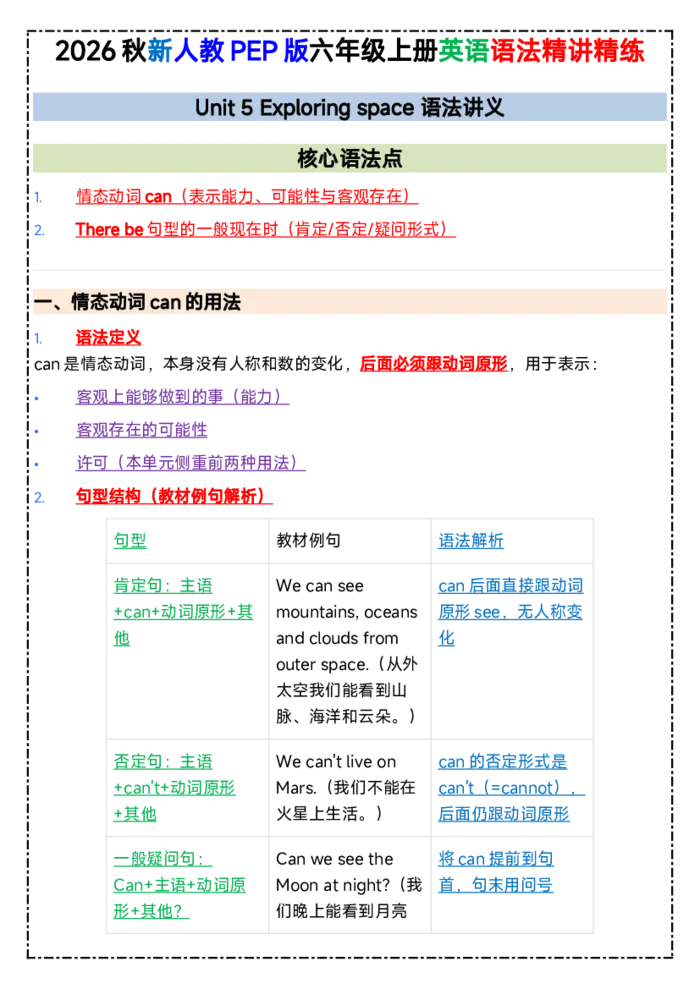
Unit 5 Exploring space 语法讲义
核心语法点
1.
情态动词

  can

 (表示能力、可能性与客观存在)


2.
There

  be
  句型的一般现在时(肯定

 /  否定

 /  疑问形式)


一、情态动词can 的用法
1.
语法定义


can 是情态动词,本身没有人称和数的变化,后面必须跟动词原形,用于表示:
•
客观上能够做到的事(能力)


•
客观存在的可能性


•
许可(本单元侧重前两种用法)


2.
句型结构(教材例句解析)


句型
教材例句
语法解析
肯定句:主语
+can+

 动词原形

 +  其

他
We can see
mountains, oceans
and clouds from
outer space.(从外
太空我们能看到山
脉、海洋和云朵。)
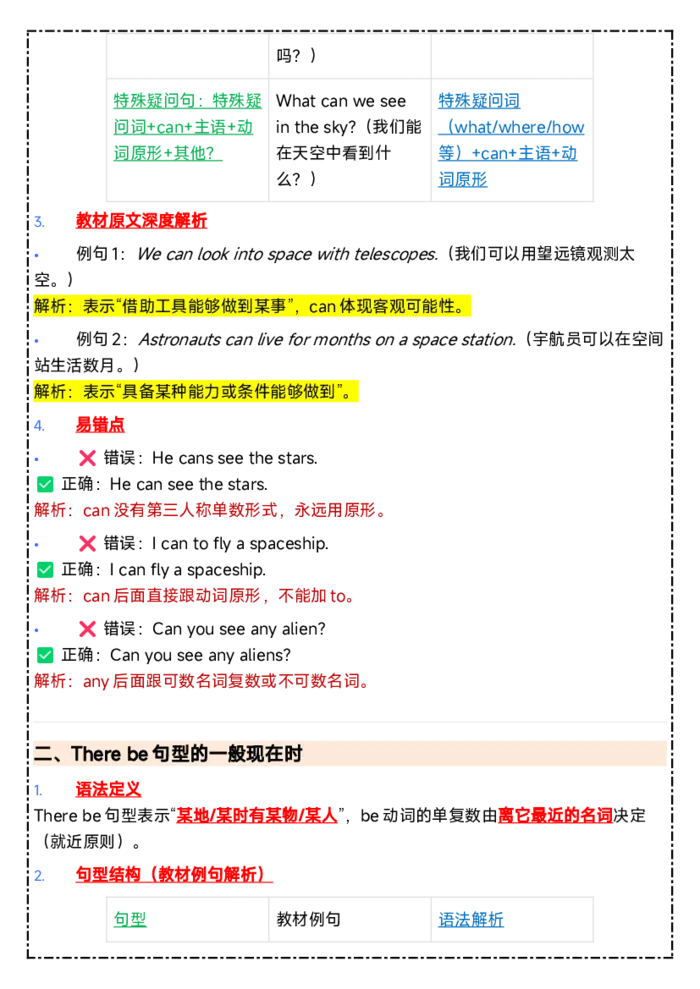
can

  后面直接跟动词


原形

  see

 ,无人称变


化
否定句:主语
+can't+

 动词原形


+  其他


We can't live on
Mars.(我们不能在
火星上生活。)
can

  的否定形式是


can't

 (
  =cannot

 ),


后面仍跟动词原形
一般疑问句:
Can+

 主语

 +  动词原


形
  +  其他?


Can we see the
Moon at night?(我
们晚上能看到月亮
将
   can

  提前到句


首,句末用问号
吗?)
特殊疑问句:特殊疑
问词

 +can+

 主语

 +  动

词原形

 +  其他?


What can we see
in the sky?(我们能
在天空中看到什
么?)
特殊疑问词
(
  what/where/how


等)

 +can+

 主语

 +  动

词原形
3.
教材原文深度解析


•
例句1:We can look into space with telescopes.(我们可以用望远镜观测太
空。)
解析:表示“借助工具能够做到某事”,can 体现客观可能性。
•
例句2:Astronauts can live for months on a space station.(宇航员可以在空间
站生活数月。)
解析:表示“具备某种能力或条件能够做到”。
4.
易错点


•
 错误:
❌
He cans see the stars.
 正确:
✅
He can see the stars.
解析:can 没有第三人称单数形式,永远用原形。
•
 错误:
❌
I can to fly a spaceship.
 正确:
✅
I can fly a spaceship.
解析:can 后面直接跟动词原形,不能加to。
•
 错误:
❌
Can you see any alien?
 正确:
✅
Can you see any aliens?
解析:any 后面跟可数名词复数或不可数名词。
二、There be 句型的一般现在时
1.
语法定义


There be 句型表示“某地

 /  某时有某物

 /  某人

 ”,be 动词的单复数由离它最近的名词决定
(就近原则)。
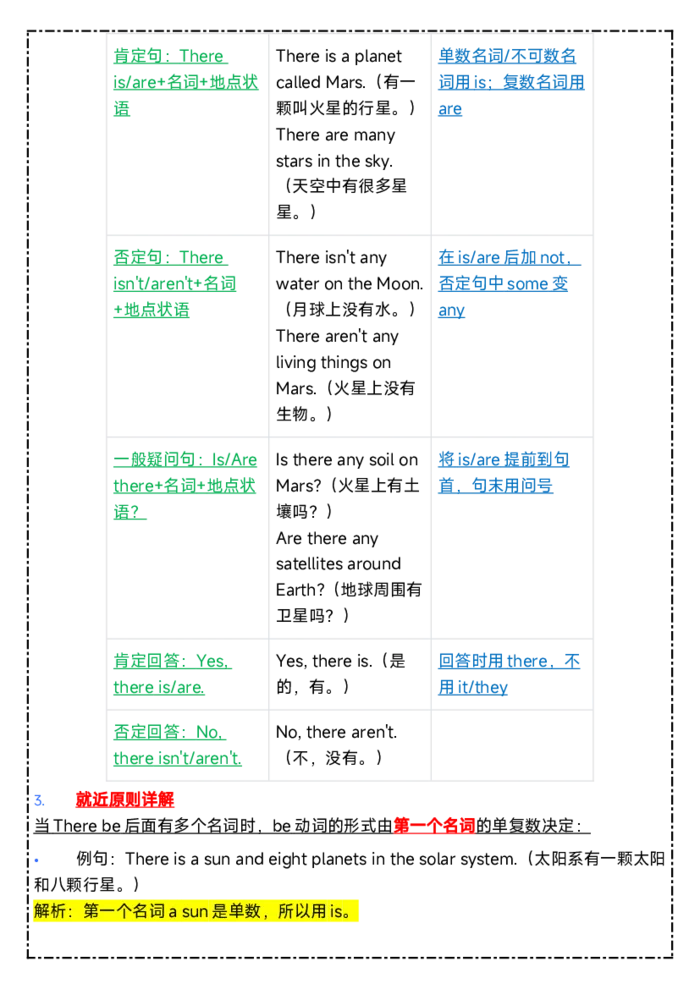
2.
句型结构(教材例句解析)


句型
教材例句
语法解析
肯定句:

 There


is/are+

 名词

 +  地点状


语
There is a planet
called Mars.(有一
颗叫火星的行星。)
There are many
stars in the sky.
(天空中有很多星
星。)
单数名词

 /  不可数名


词用

  is  ;复数名词用


are
否定句:

 There


isn't/aren't+

 名词


+  地点状语


There isn't any
water on the Moon.
(月球上没有水。)
There aren't any
living things on
Mars.(火星上没有
生物。)
在
   is/are

  后加

  not

 ,

否定句中

  some

 变

any
一般疑问句:

 Is/Are


there+

 名词

 +  地点状


语?
Is there any soil on
Mars?(火星上有土
壤吗?)
Are there any
satellites around
Earth?(地球周围有
卫星吗?)
将
   is/are

  提前到句


首,句末用问号
肯定回答:

 Yes,


there

  is/are.


Yes, there is.(是
的,有。)
回答时用

  there

 ,不


用
   it/they


否定回答:

 No,


there

  isn't/aren't.


No, there aren't.
(不,没有。)
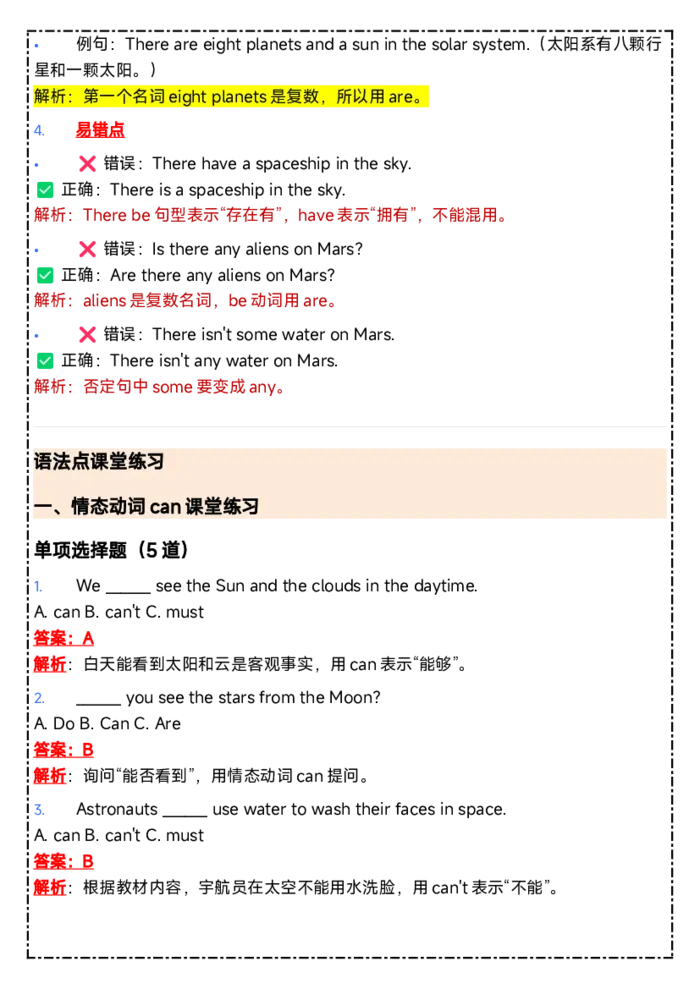
3.
就近原则详解


当
  There

  be
   后面有多个名词时,

 be
  动词的形式由

 第一个名词

 的单复数决定:


•
例句:There is a sun and eight planets in the solar system.(太阳系有一颗太阳
和八颗行星。)
解析:第一个名词a sun 是单数,所以用is。
•
例句:There are eight planets and a sun in the solar system.(太阳系有八颗行
星和一颗太阳。)
解析:第一个名词eight planets 是复数,所以用are。
4.
易错点


•
 错误:
❌
There have a spaceship in the sky.
 正确:
✅
There is a spaceship in the sky.
解析:There be 句型表示“存在有”,have 表示“拥有”,不能混用。
•
 错误:
❌
Is there any aliens on Mars?
 正确:
✅
Are there any aliens on Mars?
解析:aliens 是复数名词,be 动词用are。
•
 错误:
❌
There isn't some water on Mars.
 正确:
✅
There isn't any water on Mars.
解析:否定句中some 要变成any。
语法点课堂练习
一、情态动词can 课堂练习
单项选择题(5 道)
1.
We ______ see the Sun and the clouds in the daytime.
A. can B. can't C. must
答案:

 A
解析:白天能看到太阳和云是客观事实,用can 表示“能够”。
2.
______ you see the stars from the Moon?
A. Do B. Can C. Are
答案:

 B
解析:询问“能否看到”,用情态动词can 提问。
3.
Astronauts ______ use water to wash their faces in space.
A. can B. can't C. must
答案:

 B
解析:根据教材内容,宇航员在太空不能用水洗脸,用can't 表示“不能”。
4.
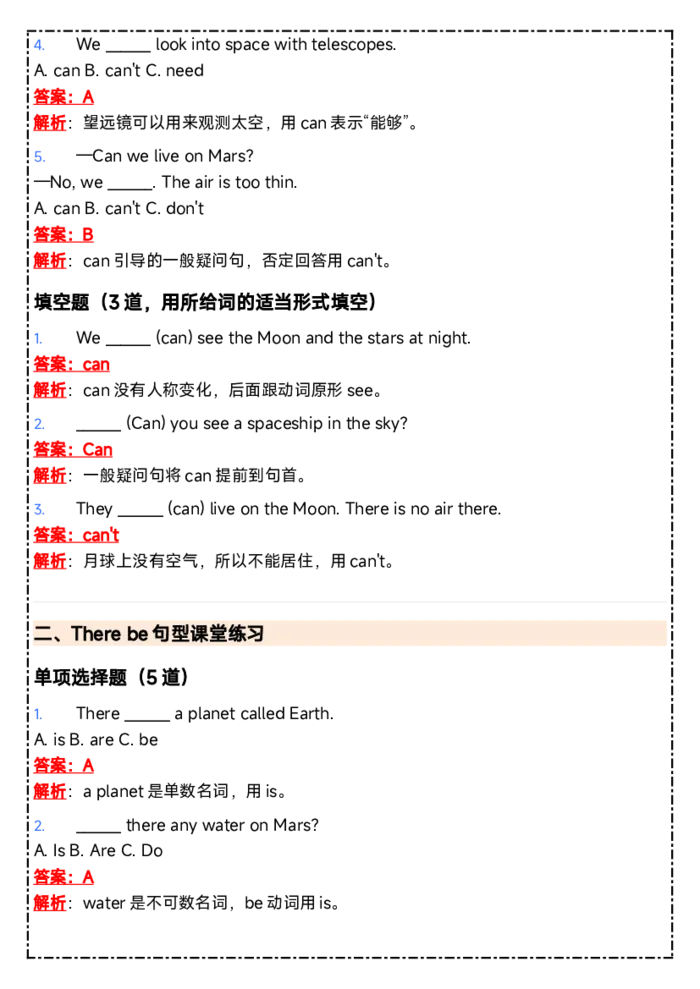
We ______ look into space with telescopes.
A. can B. can't C. need
答案:

 A
解析:望远镜可以用来观测太空,用can 表示“能够”。
5.
—Can we live on Mars?
—No, we ______. The air is too thin.
A. can B. can't C. don't
答案:

 B
解析:can 引导的一般疑问句,否定回答用can't。
填空题(3 道,用所给词的适当形式填空)
1.
We ______ (can) see the Moon and the stars at night.
答案:

 can


解析:can 没有人称变化,后面跟动词原形see。
2.
______ (Can) you see a spaceship in the sky?
答案:

 Can


解析:一般疑问句将can 提前到句首。
3.
They ______ (can) live on the Moon. There is no air there.
答案:

 can't


解析:月球上没有空气,所以不能居住,用can't。
二、There be 句型课堂练习
单项选择题(5 道)
1.
There ______ a planet called Earth.
A. is B. are C. be
答案:

 A
解析:a planet 是单数名词,用is。
2.
______ there any water on Mars?
A. Is B. Are C. Do
答案:

 A
解析:water 是不可数名词,be 动词用is。
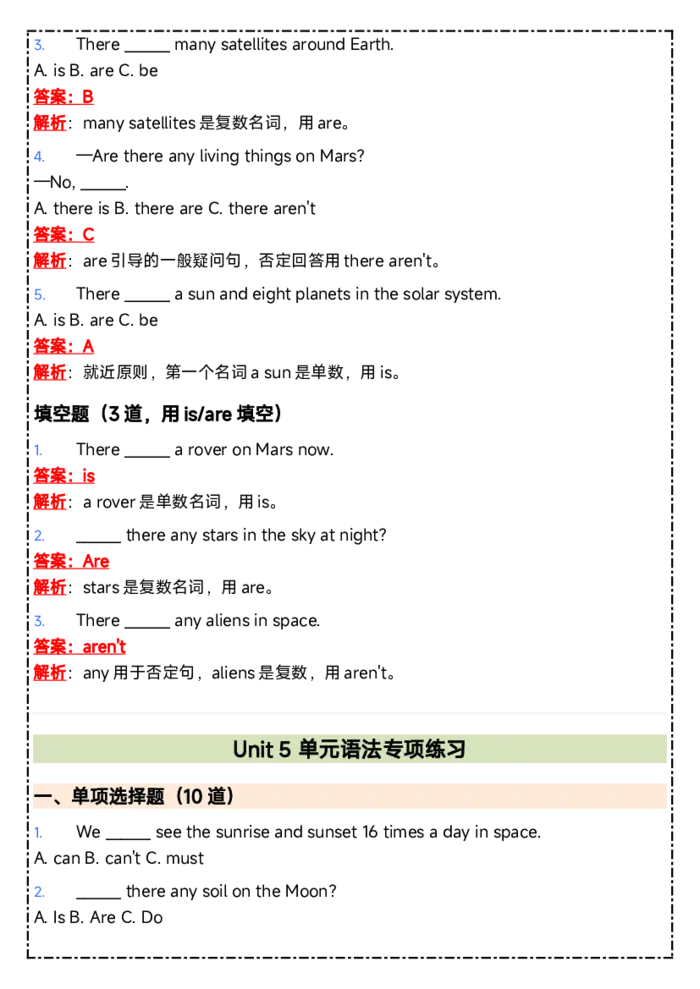
3.
There ______ many satellites around Earth.
A. is B. are C. be
答案:

 B
解析:many satellites 是复数名词,用are。
4.
—Are there any living things on Mars?
—No, ______.
A. there is B. there are C. there aren't
答案:

 C
解析:are 引导的一般疑问句,否定回答用there aren't。
5.
There ______ a sun and eight planets in the solar system.
A. is B. are C. be
答案:

 A
解析:就近原则,第一个名词a sun 是单数,用is。
填空题(3 道,用is/are 填空)
1.
There ______ a rover on Mars now.
答案:

 is
解析:a rover 是单数名词,用is。
2.
______ there any stars in the sky at night?
答案:

 Are


解析:stars 是复数名词,用are。
3.
There ______ any aliens in space.
答案:

 aren't


解析:any 用于否定句,aliens 是复数,用aren't。
Unit 5 单元语法专项练习
一、单项选择题(10 道)
1.
We ______ see the sunrise and sunset 16 times a day in space.
A. can B. can't C. must
2.
______ there any soil on the Moon?
A. Is B. Are C. Do
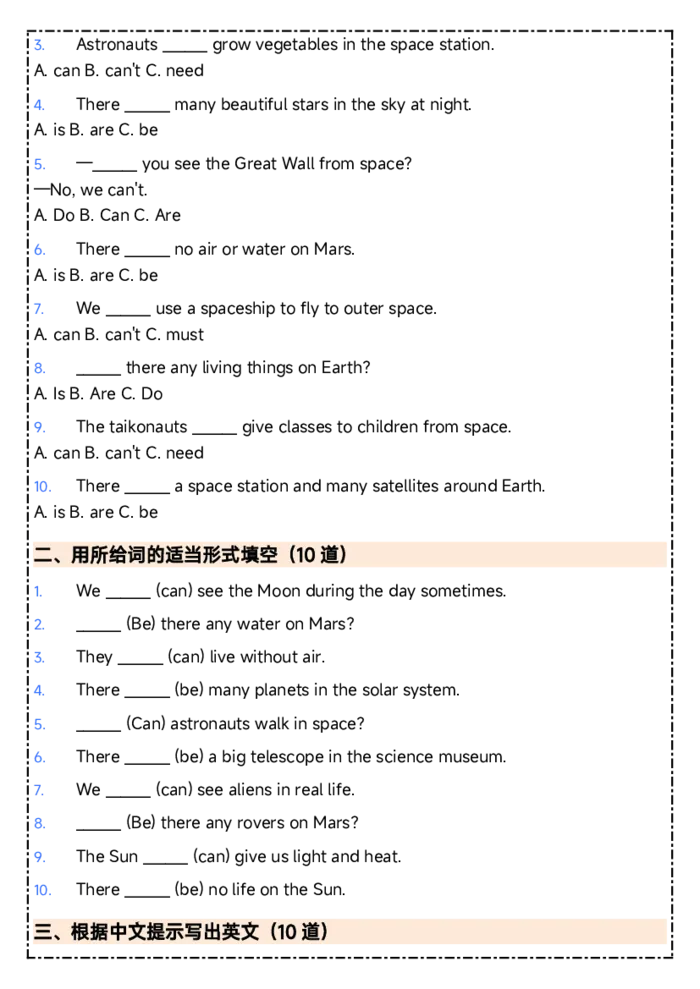
3.
Astronauts ______ grow vegetables in the space station.
A. can B. can't C. need
4.
There ______ many beautiful stars in the sky at night.
A. is B. are C. be
5.
—______ you see the Great Wall from space?
—No, we can't.
A. Do B. Can C. Are
6.
There ______ no air or water on Mars.
A. is B. are C. be
7.
We ______ use a spaceship to fly to outer space.
A. can B. can't C. must
8.
______ there any living things on Earth?
A. Is B. Are C. Do
9.
The taikonauts ______ give classes to children from space.
A. can B. can't C. need
10.
There ______ a space station and many satellites around Earth.
A. is B. are C. be
二、用所给词的适当形式填空(10 道)
1.
We ______ (can) see the Moon during the day sometimes.
2.
______ (Be) there any water on Mars?
3.
They ______ (can) live without air.
4.
There ______ (be) many planets in the solar system.
5.
______ (Can) astronauts walk in space?
6.
There ______ (be) a big telescope in the science museum.
7.
We ______ (can) see aliens in real life.
8.
______ (Be) there any rovers on Mars?
9.
The Sun ______ (can) give us light and heat.
10.
There ______ (be) no life on the Sun.
三、根据中文提示写出英文(10 道)
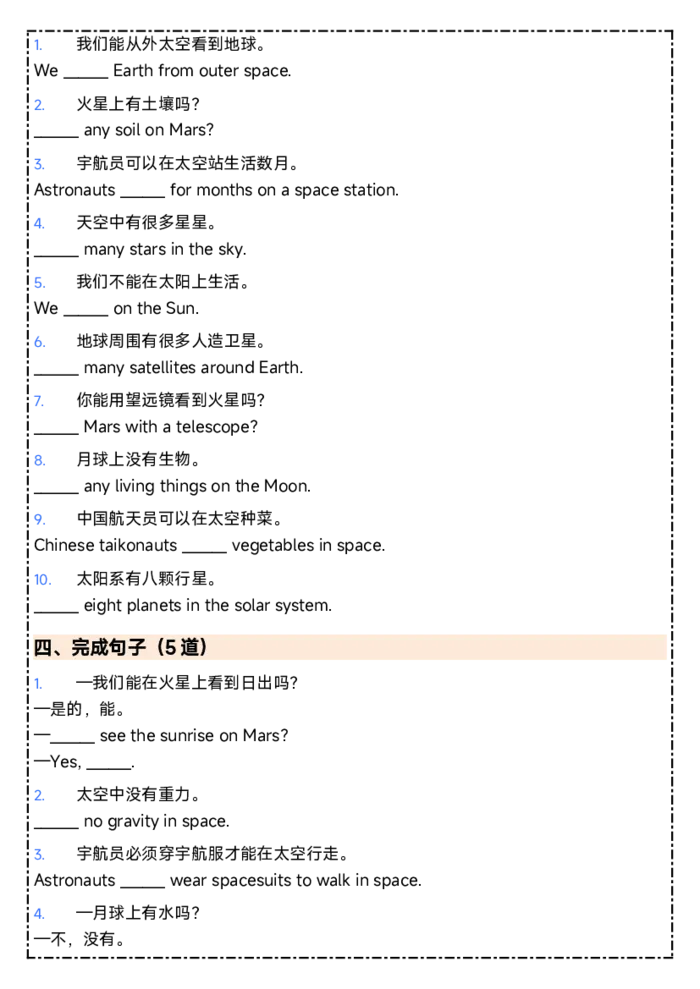
1.
我们能从外太空看到地球。
We ______ Earth from outer space.
2.
火星上有土壤吗?
______ any soil on Mars?
3.
宇航员可以在太空站生活数月。
Astronauts ______ for months on a space station.
4.
天空中有很多星星。
______ many stars in the sky.
5.
我们不能在太阳上生活。
We ______ on the Sun.
6.
地球周围有很多人造卫星。
______ many satellites around Earth.
7.
你能用望远镜看到火星吗?
______ Mars with a telescope?
8.
月球上没有生物。
______ any living things on the Moon.
9.
中国航天员可以在太空种菜。
Chinese taikonauts ______ vegetables in space.
10.
太阳系有八颗行星。
______ eight planets in the solar system.
四、完成句子(5 道)
1.
—我们能在火星上看到日出吗?
—是的,能。
—______ see the sunrise on Mars?
—Yes, ______.
2.
太空中没有重力。
______ no gravity in space.
3.
宇航员必须穿宇航服才能在太空行走。
Astronauts ______ wear spacesuits to walk in space.
4.
—月球上有水吗?
—不,没有。
—______ any water on the Moon?
—No, ______.
5.
我们可以通过电视观看天宫课堂。
We ______ the Tiangong Class on TV.
五、选词填空(5 道)
(can, can't, is, are, Is, Are)
1.
______ there a rover on Mars?
2.
We ______ see the Sun at night.
3.
There ______ many beautiful galaxies in the universe.
4.
______ you see the Moon tonight?
5.
There ______ no life on Mars.
六、完形填空(10 道)
The solar system is a very big place. There 1  ______ eight planets in it. The Sun is a
star. It 2  ______ give us light and heat.
Earth is our home. There 3 ______  air, water and land on Earth. So there 4 ______
many living things here. We 5 ______  live on Earth happily.
Mars is the "red planet". There 6 ______  some soil and water on Mars. But there 7
______  any air. So we 8  ______ live there now. But scientists are working hard.
Maybe one day we 9 ______  live on Mars.
There 10  ______ also many other stars and planets in the universe. We are still
learning about them.
1.
A. is B. are C. be
2.
A. can B. can't C. must
3.
A. is B. are C. be
4.
A. is B. are C. be
5.
A. can B. can't C. must
6.
A. is B. are C. be
7.
A. is B. isn't C. aren't
8.
A. can B. can't C. must
9.
A. can B. can't C. will can
10.
A. is B. are C. be
七、阅读理解(1 道,5 个选择题)
The Moon is our nearest neighbour in space. It is about 384,400 kilometres away
from Earth.
There is no air or water on the Moon. So there are no living things there. The Moon
is very quiet. You can't hear any sound there.
The Moon goes around Earth. It takes about 28 days to go around Earth once. We
can see different shapes of the Moon at different times.
Astronauts first walked on the Moon in 1969. They took many photos and brought
some rocks back to Earth. Now we know a lot about the Moon. But there are still
many secrets waiting for us to find out.
1.
How far is the Moon from Earth?
A. About 384,400 kilometres.
B. About 38,440 kilometres.
C. About 3,844,000 kilometres.
2.
Why are there no living things on the Moon?
A. Because it is too hot.
B. Because there is no air or water.
C. Because it is too quiet.
3.
How long does it take the Moon to go around Earth once?
A. About 7 days.
B. About 28 days.
C. About 365 days.
4.
When did astronauts first walk on the Moon?
A. In 1969.
B. In 1979.
C. In 1989.
5.
Which of the following is TRUE?
A. You can hear sound on the Moon.
B. Astronauts brought some rocks back from the Moon.
C. We know all the secrets of the Moon.
Unit 5 单元语法专项练习答案与详解
一、单项选择题
1.
答案:

 A   解析:在太空一天能看到16 次日出日落是客观事实,用can 表示“能够”。
2.
答案:

 A   解析:water 是不可数名词,be 动词用is。
3.
答案:

 A   解析:根据教材内容,宇航员可以在空间站种蔬菜,用can。
4.
答案:

 B   解析:many stars 是复数名词,用are。
5.
答案:

 B   解析:根据答句No, we can't 可知用can 提问。
6.
答案:

 A   解析:就近原则,air 是不可数名词,用is。
7.
答案:

 A   解析:我们可以用宇宙飞船飞往太空,用can 表示“能够”。
8.
答案:

 B   解析:living things 是复数名词,用are。
9.
答案:

 A   解析:中国航天员可以从太空给孩子们上课,用can。
10.
答案:

 A   解析:就近原则,a space station 是单数,用is。
二、用所给词的适当形式填空
1.
can

  解析:表示“有时白天能看到月亮”,用can。
2.
Is   解析:water 是不可数名词,用Is。
3.
can't

  解析:没有空气不能生存,用can't。
4.
are

  解析:many planets 是复数,用are。
5.
Can

  解析:一般疑问句将can 提前。
6.
is   解析:a big telescope 是单数,用is。
7.
can't

  解析:现实生活中看不到外星人,用can't。
8.
Are

  解析:rovers 是复数,用Are。
9.
can

  解析:太阳能给我们光和热,用can。
10.
is   解析:life 是不可数名词,用is。
三、根据中文提示写出英文
1.
can see
2.
Is there
3.
can live
4.
There are
5.
can't live
6.
There are
7.
Can you see
8.
There aren't
9.
can grow
10.
There are
四、完成句子
1.
Can we; we can
2.
There is
3.
must
4.
Is there; there isn't
5.
can watch
五、选词填空
1.
Is
2.
can't
3.
are
4.
Can
5.
is
六、完形填空
1.
B   解析:eight planets 是复数,用are。
2.
A   解析:太阳能给我们光和热,用can。
3.
A   解析:就近原则,air 是不可数名词,用is。
4.
B   解析:many living things 是复数,用are。
5.
A   解析:我们能在地球上快乐生活,用can。
6.
A   解析:soil 是不可数名词,用is。
7.
B   解析:火星上没有空气,用isn't。
8.
B   解析:所以我们现在不能在那里生活,用can't。
9.
A   解析:也许有一天我们能在火星上生活,用can。
10.
B   解析:many other stars 是复数,用are。
七、阅读理解
1.
A   解析:原文第一段第二句“It is about 384,400 kilometres away from Earth.”
2.
B   解析:原文第二段第一句“There is no air or water on the Moon. So there are
no living things there.”
3.
B   解析:原文第三段第二句“It takes about 28 days to go around Earth once.”
4.
A   解析:原文第四段第一句“Astronauts first walked on the Moon in 1969.”
5.
B   解析:原文第四段第二句“They took many photos and brought some rocks
back to Earth.”
2026 秋新人教PEP 版六年级上册英语语法精讲精练
Unit 6 Energy, nature and us 语法讲义
核心语法点
1.
一般现在时的特殊疑问句(第三人称单数)


2.
情态动词

  should

  与
  can

  的区分使用(环保建议)


一、一般现在时的特殊疑问句(第三人称单数)
1.
语法定义


一般现在时表示客观真理、经常性或习惯性的动作。当主语是第三人称单数(he/she/it
/单数名词/不可数名词)时,特殊疑问句的结构为:
特殊疑问词

 +does+

 主语

 +  动词原形

 +  其他?


其他人称(I/you/we/they/复数名词)用:
特殊疑问词

 +do+

 主语

 +  动词原形

 +  其他?


2.
句型结构(教材例句解析)


主语类型
句型
教材例句
语法解析
第三人称单数
特殊疑问词
+does+

 主语


+  动词原形

 +  其

他?
Where does
water come
from?(水来
自哪里?)
How does a
solar oven
work?(太阳
能烤箱是怎么
工作的?)
助动词用
does

 ,后面必


须跟动词原形
come/work
其他人称
特殊疑问词
+do+

 主语

 +  动

词原形

 +  其

他?
How do we
make power
from water?
(我们怎么用
水发电?)
What do we
use green
energy for?
(我们用绿色
能源做什
么?)
助动词用

  do
  ,

后面跟动词原
形
   make/use


3.
教材原文深度解析


•
例句1:Where does water come from?
解析:water 是不可数名词,属于第三人称单数,所以助动词用does,后面动词用原形
come(不能用comes)。
•
例句2:How do we save energy?
解析:主语we 是第一人称复数,助动词用do,后面跟动词原形save。
4.
易错点


•
 错误:
❌
Where does water comes from?
 正确:
✅
Where does water come from?
解析:助动词does 后面必须跟动词原形,不能用第三人称单数形式。
•
 错误:
❌
How we make power from water?
 正确:
✅
How do we make power from water?
解析:特殊疑问句必须有助动词do/does,不能直接说How we make...
•
 错误:
❌
What do your mother do?
 正确:
✅
What does your mother do?
解析:your mother 是第三人称单数,助动词用does。
二、情态动词should 与can 的区分使用
1.
语法定义


•
should

 :表示“应该”,用于提出建议或劝告,强调责任和义务。
•
can

 :表示“能够、可以”,用于表示能力或可能性,强调客观条件允许。
两者都是情态动词,后面都必须跟动词原形,没有人称和数的变化。
2.
用法对比(教材例句解析)


情态动词
含义
教材例句
语法解析
should
应该(提建
议)
We should
save energy.
(我们应该节
约能源。)
We should
use both
sides of
强调“有责任、
有义务做某
事”,是一种建
议
paper.(我们
应该用纸的两
面。)
can
能够、可以
(表能力

 /  可能


性)
We can take
quick
showers.(我
们可以快速淋
浴。)
We can use
old bottles
again.(我们
可以重复使用
旧瓶子。)
强调“客观上能
够做到某事”,
是一种可行的
方法
3.
教材原文深度解析


•
例句:We should save energy. We can take quick showers.
解析:第一句用should 提出“节约能源”的总体建议;第二句用can 给出“快速淋浴”这个
具体可行的方法。
4.
易错点


•
 错误:
❌
We should to save water.
 正确:
✅
We should save water.
解析:

 should

  后面直接跟动词原形,不能加

 to
  。

•
 错误:
❌
We can saving energy.
 正确:
✅
We can save energy.
解析:

 can

  后面直接跟动词原形,不能用

  ing

  形式。


•
 混淆:
❌
We can turn off the lights when we leave.(正确,表可行方法)
We should turn off the lights when we leave.(也正确,表建议)
解析:两者在提建议时有时可通用,但

 should

 语气更强,强调“应该做”;

 can

 语气更委


婉,强调“可以做”。
语法点课堂练习
一、一般现在时特殊疑问句课堂练习
单项选择题(5 道)
1.
______ does water come from?
A. What B. Where C. How
答案:

 B
解析:询问“来自哪里”用where。
2.
How ______ we make power from wind?
A. do B. does C. are
答案:

 A
解析:主语we 是第一人称复数,助动词用do。
3.
______ does a solar oven work?
A. What B. Where C. How
答案:

 C
解析:询问“如何工作”用how。
4.
Where ______ your father work?
A. do B. does C. is
答案:

 B
解析:your father 是第三人称单数,助动词用does。
5.
What ______ we use green energy for?
A. do B. does C. are
答案:

 A
解析:主语we 是第一人称复数,助动词用do。
填空题(3 道,用do/does 填空)
1.
______ you save energy at home?
答案:

 Do

解析:主语you 是第二人称,助动词用Do。
2.
How ______ electricity come to our homes?
答案:

 does


解析:electricity 是不可数名词,第三人称单数,助动词用does。
3.
What ______ they do to save water?
答案:

 do

解析:主语they 是第三人称复数,助动词用do。
二、should 与can 区分使用课堂练习
单项选择题(5 道)
1.
We ______ save water. It's important.
A. should B. can C. must
答案:

 A
解析:节约用水是我们应该做的事,用should 强调责任。
2.
We ______ use old bottles to make pen holders.
A. should B. can C. must
答案:

 B
解析:用旧瓶子做笔筒是一种可行的方法,用can 表示可能性。
3.
You ______ leave the lights on when you go out.
A. should B. shouldn't C. can't
答案:

 B
解析:离开时不应该开着灯,用shouldn't 表示“不应该”。
4.
We ______ walk or ride bikes to school to save energy.
A. should B. can C. must
答案:

 A
解析:步行或骑车上学是节约能源的好建议,用should。
5.
—______ I use both sides of paper?
—Yes, of course.
A. Should B. Can C. Must
答案:

 B
解析:询问“是否可以”用纸的两面,用can 表示许可。
填空题(3 道,用should/shouldn't/can/can't 填空)
1.
We ______ use LED lighting to save electricity.
答案:

 should/can


解析:用LED 灯节约用电既是应该做的,也是可行的。
2.
You ______ waste food.
答案:

 shouldn't


解析:不应该浪费食物,用shouldn't。
3.
We ______ make a solar oven at home. It's easy.
答案:

 can


解析:在家做太阳能烤箱是可行的,用can。
Unit 6 单元语法专项练习
一、单项选择题(10 道)
1.
______ does wind power come from?
A. What B. Where C. How
2.
How ______ we save energy at school?
A. do B. does C. are
3.
We ______ turn off the computers when we don't use them.
A. should B. can C. must
4.
Where ______ solar energy come from?
A. do B. does C. is
5.
We ______ reuse old clothes and books.
A. should B. can C. must
6.
______ do we use water for?
A. What B. Where C. How
7.
You ______ take long showers. It wastes water.
A. should B. shouldn't C. can't
8.
How ______ a wind turbine work?
A. do B. does C. is
9.
We ______ plant more trees to protect the Earth.
A. should B. can C. must
10.
______ you tell me some tips to save energy?
A. Should B. Can C. Must
二、用所给词的适当形式填空(10 道)
1.
Where ______ (do) coal come from?
2.
How ______ (do) you go to school every day?
3.
We ______ (should) save our natural resources.
4.
What ______ (do) they do to protect the environment?
5.
We ______ (can) use solar power to cook food.
6.
How ______ (do) electricity help us?
7.
You ______ (should) throw rubbish everywhere.
8.
Where ______ (do) you get your energy from?
9.
We ______ (can) recycle bottles and boxes.
10.
What ______ (do) green energy mean?
三、根据中文提示写出英文(10 道)
1.
我们应该节约能源。
We ______ energy.
2.
水来自哪里?
______ water come from?
3.
我们可以用风能发电。
We ______ electricity from wind power.
4.
你不应该浪费食物。
You ______ food.
5.
我们怎么用水发电?
______ we make power from water?
6.
我们应该重复使用旧瓶子。
We ______ old bottles.
7.
太阳能来自太阳。
Solar energy ______ the Sun.
8.
我们可以步行上学。
We ______ to school.
9.
我们应该用纸的两面。
We ______ both sides of paper.
10.
你能告诉我一些节约用水的方法吗?
______ tell me some tips to save water?
四、完成句子(5 道)
1.
—我们应该怎么帮助地球?
—我们可以节约能源和水。
—______ help the Earth?
—We ______ energy and water.
2.
电是怎么来到我们家的?
______ electricity come to our homes?
3.
你不应该开着空调睡觉。
You ______ with the air conditioner on.
4.
—我们能用太阳能做什么?
—我们可以用它来照明和加热。
—______ we use solar energy for?
—We ______ it to light and heat our homes.
5.
我们应该回收利用旧衣服和玩具。
We ______ old clothes and toys.
五、选词填空(5 道)
(do, does, should, can, shouldn't)
1.
______ you turn off the lights when you leave?
2.
We ______ protect our Mother Earth.
3.
How ______ a solar oven work?
4.
You ______ waste paper.
5.
We ______ make a poster about saving energy.
六、完形填空(10 道)
Mother Earth is our home. But now she is in trouble. Many resources 1 ______
running out. So we 2  ______do something to help her.
First, we 3 ______save energy. We 4 ______ turn off the lights when we leave a
room. We 5 ______ use LED lighting. We 6  ______walk or ride bikes to school.
Second, we 7  ______save water. We 8 ______ take quick showers. We 9  ______wash
all our clothes together.
Third, we 10 ______ follow the "3R" rules: Reduce, Reuse and Recycle. Small
changes can make a big difference.
1.
A. is B. are C. be
2.
A. should B. can C. must
3.
A. should B. can C. must
4.
A. should B. can C. must
5.
A. should B. can C. must
6.
A. should B. can C. must
7.
A. should B. can C. must
8.
A. should B. can C. must
9.
A. should B. can C. must
10.
A. should B. can C. must
七、阅读理解(1 道,5 个选择题)
Green energy is clean and good for the Earth. There are many types of green
energy, like wind power, solar power and water power.
Wind power comes from the wind. We use wind turbines to make electricity from
wind. Wind power is very clean. But it only works when there is wind.
Solar power comes from the Sun. We use solar panels to make electricity from
sunlight. Solar power is also clean. And it works on sunny days.
Water power comes from running water. We build dams to make electricity from
water. Water power is very powerful. But it can change the environment around
the river.
We should use more green energy. It can help save our Earth.
1.
What is green energy?
A. It is dirty and bad for the Earth.
B. It is clean and good for the Earth.
C. It is expensive.
2.
Which of the following is NOT a type of green energy?
A. Coal power.
B. Wind power.
C. Solar power.
3.
What do we use to make electricity from wind?
A. Solar panels.
B. Dams.
C. Wind turbines.
4.
When does solar power work?
A. On rainy days.
B. On sunny days.
C. At night.
5.
Which of the following is TRUE?
A. Wind power works all the time.
B. Water power can change the environment.
C. We shouldn't use green energy.
Unit 6 单元语法专项练习答案与详解
一、单项选择题
1.
答案:

 B   解析:询问“风能来自哪里”用where。
2.
答案:

 A   解析:主语we 是第一人称复数,助动词用do。
3.
答案:

 A   解析:不用电脑时应该关机,用should 强调责任。
4.
答案:

 B   解析:solar energy 是不可数名词,第三人称单数,助动词用does。
5.
答案:

 B   解析:重复使用旧衣服和书籍是可行的方法,用can。
6.
答案:

 A   解析:询问“用来做什么”用what...for。
7.
答案:

 B   解析:不应该长时间淋浴,用shouldn't。
8.
答案:

 B   解析:a wind turbine 是单数,助动词用does。
9.
答案:

 A   解析:种更多树保护地球是我们应该做的,用should。
10.
答案:

 B   解析:请求对方“能否”告诉一些方法,用can。
二、用所给词的适当形式填空
1.
does

  解析:coal 是不可数名词,第三人称单数,用does。
2.
do
   解析:主语you 是第二人称,用do。
3.
should

  解析:应该节约自然资源,用should。
4.
do
   解析:主语they 是第三人称复数,用do。
5.
can

  解析:可以用太阳能做饭,用can。
6.
does

  解析:electricity 是不可数名词,用does。
7.
shouldn't

  解析:不应该到处扔垃圾,用shouldn't。
8.
do
   解析:主语you 是第二人称,用do。
9.
can

  解析:可以回收瓶子和盒子,用can。
10.
does

  解析:green energy 是不可数名词,用does。
三、根据中文提示写出英文
1.
should save
2.
Where does
3.
can make
4.
shouldn't waste
5.
How do
6.
should reuse
7.
comes from
8.
can walk
9.
should use
10.
Can you
四、完成句子
1.
How should we; can save
2.
How does
3.
shouldn't sleep
4.
What can; can use
5.
should recycle
五、选词填空
1.
Do
2.
should
3.
does
4.
shouldn't
5.
can
六、完形填空
1.
B   解析:resources 是复数,用are。
2.
A   解析:我们应该做些事来帮助地球,用should。
3.
A   解析:首先我们应该节约能源,用should。
4.
A   解析:离开房间时应该关灯,用should。
5.
B   解析:我们可以用LED 灯,用can 表示可行方法。
6.
A   解析:我们应该步行或骑车上学,用should。
7.
A   解析:其次我们应该节约用水,用should。
8.
B   解析:我们可以快速淋浴,用can。
9.
B   解析:我们可以一起洗所有衣服,用can。
10.
A   解析:我们应该遵守3R 原则,用should。
七、阅读理解
1.
B   解析:原文第一段第一句“Green energy is clean and good for the Earth.”
2.
A   解析:原文第一段提到风能、太阳能、水能是绿色能源,煤炭不是。
3.
C   解析:原文第二段第二句“We use wind turbines to make electricity from
wind.”
4.
B   解析:原文第三段第四句“And it works on sunny days.”
5.
B   解析:原文第四段第四句“But it can change the environment around the
river.”
@小红书:苏苏老师精品资料_______原创制作,更多精品原创资料请关注小红书