FOREWORD
"Whatever your mind can conceive and believe it can achieve." - Napoleon Hill
    American born Napoleon Hill is considered to have influenced more people
into success than any other person in history. He has been perhaps the most
influential man in the area of personal success technique development, primarily
through his classic book Think and Grow Rich which has helped million of the
people and has been important in the life of many successful people such as W.
Clement Stone and Og Mandino.
    Napoleon Hill was born into poverty in 1883 in a one-room cabin on the Pound
River in Wise County, Virginia. At the age of 10 his mother died, and two years
later his father remarried. He became a very rebellious boy, but grew up to be an
incredible man. He began his writing career at age 13 as a "mountain reporter" for
small town newspapers and went on to become America's most beloved
motivational author. Fighting against all class of great disadvantages and
pressures, he dedicated more than 25 years of his life to define the reasons by
which so many people fail to achieve true financial success and happiness in their
life.
    During this time he achieved great success as an attorney and journalist. His
early career as a reporter helped finance his way through law school. He was
given an assignment to write a series of success stories of famous men, and his
big break came when he was asked to interview steel-magnate Andrew Carnegie.
Mr. Carnegie commissioned Hill to interview over 500 millionaires to find a
success formula that could be used by the average person. These included Thomas
Edison, Alexander Graham Bell, Henry Ford, Elmer Gates, Charles M. Schwab,
Theodore Roosevelt, William Wrigley Jr, John Wanamaker, WIlliam Jennings
Bryan, George Eastman, Woodrow Wilson, William H. Taft, John D. Rockefeller,
F. W. Woolworth, Jennings Randolph, among others.
    He became an advisor to Andrew Carnegie, and with Carnegie's help he
formulated a philosophy of success, drawing on the thoughts and experience of a
multitude of rags-to-riches tycoons. It took Hill over 20 years to produce his
book, a classic in the Personal Development field called Think and Grow Rich.
This book has sold over 7 million copies and has helped thousands achieve
success.

The secret to success is very simple but you'll have to read the book to find out
what it is!
    Napoleon Hill passed away in November 1970 after a long and successful
career writing, teaching, and lecturing about the principles of success. His work
stands as a monument to individual achievement and is the cornerstone of modern
motivation. His book, Think and Grow Rich, is the all time best-seller in the field.
    Perhaps no other success book has influenced more people than Napoleon
Hill’s Classic Think and Grow Rich. Since it’s introduction in 1937, millions of
copies have been sold around the world. It still remains one of the top selling
books of its kind.
    Several years ago I came across a biography of Hill on a PBS show and it was
an eye-opening adventure into the life of a man whose days were not the smooth
sailing I had always assumed they were.
    Napoleon struggled against a myriad of obstacles throughout his life many of
which were brought on by some of the earlier choices he had made. I can’t count
the number of times he became broke and penniless following a highly successful
venture gone sour. His personal life was as spotted as his financial life and a
recounting of that could easily consume a full book.
    I would have thought that my discovery of his many flaws would cause me to
lose respect for him, and thus doubt the veracity of his teachings that have
influenced me for more than twenty years. But it is quite the opposite. Having
listened to the struggles of this very human man has given me a whole new
perspective of respect, even awe, of the incredible resilience and persistence that
he displayed repeatedly against sometimes massive odds.
    I now understand that he didn’t write about some theory of how to think and
grow rich. He wrote from experience his numerous experiences and the
experiences of America’s most successful.
    While the casual observer would believe that this book is only about making
money, those of us who have studied it for years know otherwise. It’s about a
better way to live a rich life. And for that I am grateful that Napoleon gave so
much of himself in order that he might leave us with this incredible work.
OpportunityInformer.com


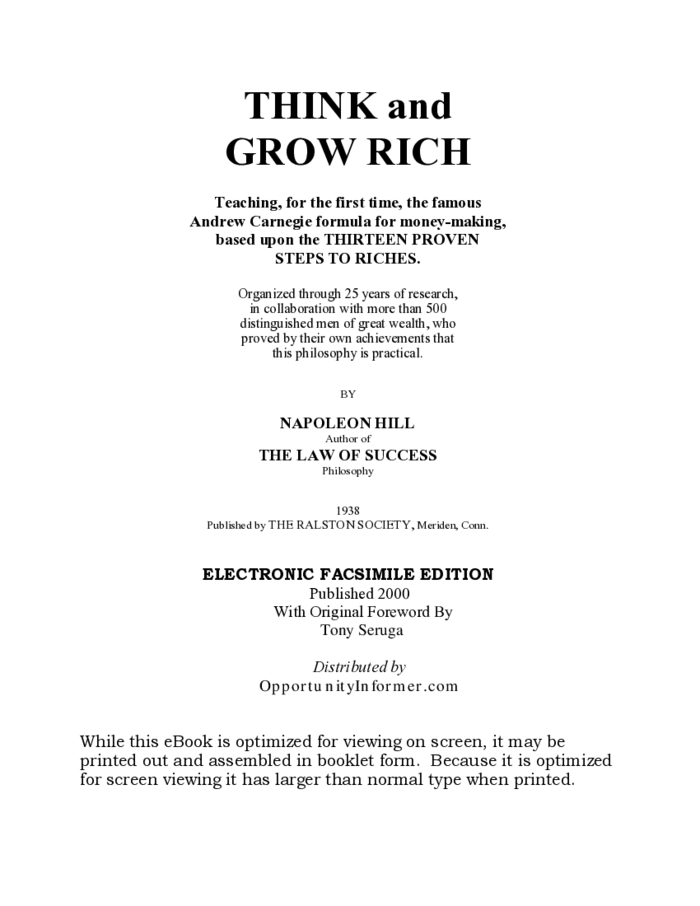
THINK and
GROW RICH

Teaching, for the first time, the famous
Andrew Carnegie formula for money-making,
based upon the THIRTEEN PROVEN
STEPS TO RICHES.

Organized through 25 years of research,
in collaboration with more than 500
distinguished men of great wealth, who
proved by their own achievements that
this philosophy is practical.


BY

NAPOLEON HILL
Author of
THE LAW OF SUCCESS
Philosophy


1938
Published by THE RALSTON SOCIETY, Meriden, Conn.


ELECTRONIC FACSIMILE EDITION
   Published 2000
With Original Foreword By
    Tony Seruga

   Distributed by
OpportunityInformer.com


While this eBook is optimized for viewing on screen, it may be
printed out and assembled in booklet form.  Because it is optimized
for screen viewing it has larger than normal type when printed.


COPYRIGHT, 1937, BY

NAPOLEON HILL


All Rights Reserved


Printings


 March, 1937
.
.5000 Copies
May, 1937
.
. 10,000 Copies
August, 1937
.
. 20,000 Copies
February, 1938
.
. 20,000 Copies

This book is an eBook reproduction of the complete and original 1937 version of Think and
Grow Rich by Napoleon Hill, originally published by The Ralston Society and now in the public
domain.  This eBook edition published with an original cover design and an original foreword by
Tony Seruga, is not sponsored or endorsed by, or otherwise affiliated with, Napoleon Hill or his
family and heirs, the Napoleon Hill Foundation, The Ralston Society, or any other person or
entity.

5

WHAT DO YOU WANT MOST?

Is It Money, Fame, Power,
Contentment, Personality,
Peace of Mind, Happiness?

The Thirteen Steps to Riches described in this book offer the
shortest dependable philosophy of individual achievement ever
presented for the benefit of the man or woman who is searching for
a definite goal in life.
Before beginning the book you will profit greatly if you
recognize the fact that the book was not written to entertain. You
cannot digest the contents properly in a week or a month.
After reading the book thoroughly, Dr. Miller Reese Hutchison,
nationally known Consulting Engineer and long-time associate of
Thomas A. Edison, said— “This is not a novel. It is a textbook on
individual achievement that came directly from the experiences of
hundreds of America’s most successful men. It should be studied,
digested, and meditated upon. No more than one chapter should be
read in a single night. The reader should underline the sentences
which impress him most. Later, he should go back to these marked
lines and read them again. A real student will not merely read this
book, he will absorb its contents and make them his own. This book
should be adopted by all high schools and no boy or girl should be
permitted to graduate without having satisfactorily passed an
examination on it. This philosophy will not take the place of the
subjects taught in schools, but it will enable one to organize and
apply the knowledge acquired, and convert it into useful service and
adequate compensation without waste of time.
Dr. John R. Turner, Dean of the College of The City of New
York, after having read the book, said— “The very best example of
the soundness of this philosophy is your own son, Blair, whose
dramatic story you have outlined in the chapter on Desire.”
Dr. Turner had reference to the author’s son, who, born
without normal hearing capacity, not only avoided becoming a deaf
mute, but actually converted his handicap into a priceless asset by
applying the philosophy here described. After reading the story
(starting on page 52), you will realize that you are about to come

6
into possession of a philosophy which can be transmuted into
material wealth, or serve as readily to bring you peace of mind,
understanding, spiritual harmony, and in some instances, as in the
case of the author’s son, it can. help you master physical affliction.
The author discovered, through personally analyzing hundreds
of successful men, that all of them followed the habit of exchanging
ideas, through what is commonly called conferences. When they had
problems to be solved they sat down together and talked freely until
they discovered, from their joint contribution of ideas, a plan that
would serve their purpose.
You, who read this book, will get most out of it by putting into
practice the Master Mind principle described in the book. This you
can do (as others are doing so successfully) by forming a study
club, consisting of any desired number of people who are friendly
and harmonious. The club should have a meeting at regular
periods, as often as once each week. The procedure should consist
of reading one chapter of the book at each meeting, after which the
contents of the chapter should be freely discussed by all members.
Each member should make notes, putting down ALL IDEAS OF HIS
OWN inspired by the discussion. Each member should carefully
read and analyze each chapter several days prior to its open reading
and joint discussion in the club. The reading at the club should be
done by someone who reads well and understands how to put color
and feeling into the lines.
By following this plan every reader will get from its pages, not
only the sum total of the best knowledge organized from the
experiences of hundreds of successful men, but more important by
far, he will tap new sources of knowledge in his own mind as well as
acquire knowledge of priceless value FROM EVERY OTHER PERSON
PRESENT.
If you follow this plan persistently you will be almost certain to
uncover and appropriate the secret formula by which Andrew
Carnegie acquired his huge fortune, as referred to in the author’s
introduction.

7
TRIBUTES TO THE AUTHOR
From Great American Leaders

“THINK AND GROW RICH” was 25 years in the making. It is
Napoleon Hill’s newest book, based upon his famous Law of
Success Philosophy. His work and writings have been praised by
great leaders in Finance, Education, Politics, Government.


Supreme Court of the United States
Washington, D.C.

Dear  Mr. Hill:—


I have now had an opportunity to finish reading your Law of
Success textbooks and I wish to express my appreciation of the
splendid work you have done in the organization of this philosophy.
It would be helpful if every politician in the country would
assimilate and apply the 17 principles upon which your lessons are
based. It contains some very fine material which every leader in
every walk of life should understand.
I am happy to have had the privilege of rendering you some
slight measure of help in the organization of this splendid course of
“common sense” philosophy.

Sincerely yours


(Former President and former Chief Justice of the United States)

KING OF THE 5 AND 10 CENT STORES

“By applying many of the 17 fundamentals of the Law of
Success philosophy we have built a great chain of successful stores.
I presume it would be no exaggeration of fact if I said that the
Woolworth Building might properly be called a monument to the
soundness of these principles.”
F. W. WOOLWORTH

8

A GREAT STEAMSHIP MAGNATE

“I feel greatly indebted for the privilege of reading your Law of
Success. If I had had this philosophy fifty years ago, I suppose I
could have accomplished all that I have done in less than half the
time. I sincerely hope the world will discover and reward you.”
ROBERT DOLLAR

FAMOUS AMERICAN LABOR LEADER

“Mastery of the Law of Success philosophy is the equivalent of
an insurance policy against failure.”
SAMUEL GOMPERS

A FORMER PRESIDENT OF THE UNITED STATES

“May I not congratulate you on your persistence. Any man who
devotes that much time . . . must of necessity make discoveries of
great value to others. 1 am deeply impressed by your interpretation
of the ‘Master Mind’ principles which you have so clearly described.”
WOODROW WILSON

A MERCHANT PRINCE

“I know that your 17 fundamentals of success are sound
because I have been applying them in my business for more than
30 years.”
JOHN WANAMAKER


WORLD’S LARGEST MAKER OF CAMERAS

“I know that you are doing a world of good with your Law of
Success. I would not care to set a monetary value on this training
because it brings to the student qualities which cannot be
measured by money, alone.”
GEORGE EASTMAN


9
A NATIONALLY KNOWN BUSINESS CHIEF

“Whatever success I may have attained I owe, entirely, to the
application of your 17 fundamental principles of the Law of
Success. I believe I have the honor of being your first student.”
WM. WRIGLEY, JR.

10

PUBLISHER’S PREFACE

THIS book conveys the experience of more than 500 men of
great wealth, who began at scratch, with nothing to give in return
for riches except THOUGHTS, IDEAS and ORGANIZED PLANS.
Here you have the entire philosophy of moneymaking, just as
it was organized from the actual achievements of the most
successful men known to the American people during the past fifty
years. It describes WHAT TO DO, also, HOW TO DO IT!
It presents complete instructions on HOW TO SELL YOUR
PERSONAL SERVICES.
It provides you with a perfect system of self-analysis that will
readily disclose what has been standing between you and “the big
money” in the past.
It describes the famous Andrew Carnegie formula of personal
achievement by which he accumulated hundreds of millions of
dollars for himself and made no fewer than a score of millionaires of
men to whom he taught his secret.
Perhaps you do not need all that is to be found in the book—
no one of the 500 men from whose experiences it was written did—
but you may need ONE IDEA, PLAN OR SUGGESTION to start you
toward your goal. Somewhere in the book you will find this needed
stimulus.
The book was inspired by Andrew Carnegie, after he had made
his millions and retired. It was written by the man to whom
Carnegie disclosed the astounding secret of his riches—the same
man to whom the 500 wealthy men revealed the source of their
riches.
In this volume will be found the thirteen principles of money-
making essential to every person who accumulates sufficient money
to guarantee financial independence. It is estimated that the
research which went into the preparation, before the book was
written, or could be written—research covering more than twenty-
five years of continuous effort—could not be duplicated at a cost of
less than $100,000.00.
Moreover, the knowledge contained in the book never can be
duplicated, at any cost, for the reason that more than half of the
500 men who supplied the information it brings have passed on.
Riches cannot always be measured in money!

11
Money and material things are essential for freedom of body
and mind, but there are some who will feel that the greatest of all
riches can be evaluated only in terms of lasting friendships,
harmonious family relationships, sympathy and understanding
between business associates, and introspective harmony which
brings one peace of mind measurable only in spiritual values!
All who read, understand and apply this philosophy will be
better prepared to attract and enjoy these higher estates which
always have been and always will be denied to all except those who
are ready for them.
Be prepared, therefore, when you expose yourself to the
influence of this philosophy, to experience a CHANGED LIFE which
may help you not only to negotiate your way through life with
harmony and understanding, but also to prepare you for the ac-
cumulation of material riches in abundance.


THE PUBLISHER.

12

AUTHOR’S PREFACE

IN EVERY chapter of this book, mention has been made of the
money-making secret which has made fortunes for more than five
hundred exceedingly wealthy men whom I have carefully analyzed
over a long period of years.
The secret was brought to my attention by Andrew Carnegie,
more than a quarter of a century ago. The canny, lovable old
Scotsman carelessly tossed it into my mind, when I was but a boy.
Then he sat back in his chair, with a merry twinkle in his eyes, and
watched carefully to see if I had brains enough to understand the
full significance of what he had said to me.
When he saw that I had grasped the idea, he asked if I would
be willing to spend twenty years or more, preparing myself to take it
to the world, to men and women who, without the secret, might go
through life as failures. I said I would, and with Mr. Carnegie’s
cooperation, I have kept my promise.
This book contains the secret, after having been put to a
practical test by thousands of people, in almost every walk of life. It
was Mr. Carnegie’s idea that the magic formula, which gave him a
stupendous fortune, ought to be placed within reach of people who
do not have time to investigate how men make money, and it was
his hope that I might test and demonstrate the soundness of the
formula through the experience of men and women in every calling.
He believed the formula should be taught in all public schools and
colleges, and expressed the opinion that if it were properly taught it
would so revolutionize the entire educational system that the time
spent in school could be reduced to less than half.
His experience with Charles M. Schwab, and other young men
of Mr. Schwab’s type, convinced Mr. Carnegie that much of that
which is taught in the schools is of no value whatsoever in
connection with the business of earning a living or accumulating
riches. He had arrived at this decision, because he had taken into
his business one young man after another, many of them with but
little schooling, and by coaching them in the use of this formula,
developed in them rare leadership. Moreover, his coaching made
fortunes for everyone of them who followed his instructions.
In the chapter on Faith, you will read the astounding story of
the organization of the giant United States Steel Corporation, as it

13
was conceived and carried out by one of the young men through
whom Mr. Carnegie proved that his formula will work for all who are
ready for it. This single application of the secret, by that young
man—Charles M. Schwab—made him a huge fortune in both money
and OPPORTUNITY. Roughly speaking, this particular application of
the formula was worth six hundred million dollars.
These facts-and they are facts well known to almost everyone
who knew Mr. Carnegie—give you a fair idea of what the reading of
this book may bring to you, provided you KNOW WHAT IT IS THAT
YOU WANT.
Even before it had undergone twenty years of practical testing,
the secret was passed on to more than one hundred thousand men
and women who have used it for their personal benefit, as Mr. Car-
negie planned that they should. Some have made fortunes with it.
Others have used it successfully in creating harmony in their
homes. A clergyman used it so effectively that it brought him an
income of upwards of $75,000.00 a year.
Arthur Nash, a Cincinnati tailor, used his near-bankrupt
business as a “guinea pig” on which to test the formula. The
business came to life and made a fortune for its owners. It is still
thriving, although Mr. Nash has gone. The experiment was so
unique that newspapers and magazines, gave it more than a million
dollars’ worth of laudatory publicity.
The secret was passed on to Stuart Austin Wier, of Dallas,
Texas. He was ready for it—so ready that he gave up his profession
and studied law. Did he succeed? That story is told too.
I gave the secret to Jennings Randolph, the day he graduated
from College, and he has used it so successfully that he is now
serving his third term as a Member of Congress, with an excellent
opportunity to keep on using it until it carries him to the White
House.
While serving as Advertising Manager of the La-Salle
Extension University, when it was little more than a name, I had
the privilege of seeing J. G. Chapline, President of the University,
use the formula so effectively that he has since made the LaSalle
one of the great extension schools of the country.
The secret to which I refer has been mentioned no fewer than
a hundred times, throughout this book. It has not been directly
named, for it seems to work more successfully when it is merely un-
covered and left in sight, where THOSE WHO ARE READY, and

14
SEARCHING FOR IT, may pick it up. That is why Mr. Carnegie
tossed it to me so quietly, without giving me its specific name.
If you are READY to put it to use, you will recognize this secret
at least once in every chapter. I wish I might feel privileged to tell
you how you will know if you are ready, but that would deprive you
of much of the benefit you will receive when you make the discovery
in your own way.
While this book was being written, my own son, who was then
finishing the last year of his college work, picked up the manuscript
of chapter two, read it, and discovered the secret for himself. He
used the information so effectively that he went directly into a
responsible position at a beginning salary greater than the average
man ever earns. His story has been briefly described in chapter two.
When you read it, perhaps you will dismiss any feeling you may
have had, at the beginning of the book, that it promised too much.
And, too, if you have ever been discouraged, if you have had
difficulties to surmount which took the very soul out of you, if you
have tried and failed, if you were ever handicapped by illness or
physical affliction, this story of my son’s discovery and use of the
Carnegie formula may prove to be the oasis in the Desert of Lost
Hope, for which you have been searching.
This secret was extensively used by President Woodrow
Wilson, during the World War. It was passed on to every soldier who
fought in the war, carefully wrapped in the training received before
going to the front. President Wilson told me it was a strong factor in
raising the funds needed for the war.
More than twenty years ago, Hon. Manuel L. Quezon (then
Resident Commissioner of the Philippine Islands), was inspired by
the secret to gain freedom for his people. He has gained freedom for
the Philippines, and is the first President of the free state.
A peculiar thing about this secret is that those who once
acquire it and use it, find themselves literally swept on to success,
with but little effort, and they never again submit to failure! If you
doubt this, study the names of those who have used it, wherever
they have been mentioned, check their records for yourself, and be
convinced.
There is no such thing as SOMETHING FOR NOTHING!
The secret to which I refer cannot be had without a price,
although the price is far less than its value. It cannot be had at any
price by those who are not intentionally searching for it. It cannot

15
be given away, it cannot be purchased for money, for the reason
that it comes in two parts. One part is already in possession of
those who are ready for it.
The secret serves equally well, all who are ready for it.
Education has nothing to do with it. Long before I was born, the
secret had found its way into the possession of Thomas A. Edison,
and he used it so intelligently that he became the world’s leading
inventor, although he had but three months of schooling.
The secret was passed on to a business associate of Mr.
Edison. He used it so effectively that, although he was then making
only $12,000 a year, he accumulated a great fortune, and retired
from active business while still a young man. You will find his story
at the beginning of the first chapter. It should convince you that
riches are not beyond your reach, that you can still be what you
wish to be, that money, fame, recognition and happiness can be
had by all who are ready and determined to have these blessings.
How do I know these things? You should have the answer
before you finish this book. You may find it in the very first chapter,
or on the last page.
While I was performing the twenty year task of research, which
I had undertaken at Mr. Carnegie’s request, I analyzed hundreds of
well known men, many of whom admitted that they had
accumulated their vast fortunes through the aid of the Carnegie
secret; among these men were: —

HENRY FORD
WILLIAM WRIGLEY JR.
JOHN WANAMAKER
JAMES J. HILL
GEORGE S. PARKER
E. M. STATLER
HENRY L. DOHERTY
CYRUS H. K. CURTIS
GEORGE EASTMAN
THEODORE ROOSEVELT
JOHN W. DAVIS
ELBERT HUBBARD
WILBUR WRIGHT
WILLIAM JENNINGS BRYAN
DR. DMTID STARR JORDAN

16
J. ODGEN ARMOUR
CHARLES M. SCHWAB
HARRIS F. WILLIAMS
DR. FRANK GUNSAULUS
DANIEL WILLARD
KING GILLETTE
RALPH A. WEEKS
JUDGE DANIEL T. WRIGHT
JOHN D. ROCKEFELLER
THOMAS A. EDISON
FRANK A. VANDERLIP
F. W. WOOLWORTH
COL. ROBERT A. DOLLAR
EDWARD A. FILENE
EDWIN C. BARNES
ARTHUR BRISBANE
WOODROW WILSON
WM. HOWARD TAFT
LUTHER BURBANK
EDWARD W. BOK
FRANK A. MUNSEY
ELBERT H. GARY
DR. ALEXANDER GRAHAM BELL
JOHN H. PATTERSON
JULIUS ROSENWALD
STUART AUSTIN WIER
DR. FRANK CRANE
GEORGE M.   ALEXANDER
J. G. CHAPPLINE
HON. JENNINGS RANDOLPH
ARTHUR NASH
CLARENCE DARROW

These names represent but a small fraction of the hundreds of
well known Americans whose achievements, financially and
otherwise, prove that those who understand and apply the Carnegie
secret, reach high stations in life. I have never known anyone who
was inspired to use the secret, who did not achieve noteworthy
success in his chosen calling. I have never known any person to
distinguish himself, or to accumulate riches of any consequence,

17
without possession of the secret. From these two facts I draw the
conclusion that the secret is more important, as a part of the
knowledge essential for self-determination, than any which one
receives through what is popularly known as “education.”
What is EDUCATION, anyway? This has been answered in full
detail.
As far as schooling is concerned, many of these men had very
little. John Wanamaker once told me that what little schooling he
had, he acquired in very much the same manner as a modern loco-
motive takes on water, by “scooping it up as it runs.” Henry Ford
never reached high school, let alone college. I am not attempting to
minimize the value of schooling, but I am trying to express my
earnest belief that those who master and apply the secret will reach
high stations, accumulate riches, and bargain with life on their own
terms, even if their schooling has been meager.
Somewhere, as you read, the secret to which I refer will jump
from the page and stand boldly before you, IF YOU ARE READY
FOR IT! When it appears, you will recognize it. Whether you receive
the sign in the first or the last chapter, stop for a moment when it
presents itself, and turn down a glass, for that occasion will mark
the most important turning-point of your life.
We pass now, to Chapter One, and to the story of my very dear
friend, who has generously acknowledged having seen the mystic
sign, and whose business achievements are evidence enough that
he turned down a glass. As you read his story, and the others,
remember that they deal with the important problems of life, such
as all men experience.
The problems arising from one’s endeavor to earn a living, to
find hope, courage, contentment and peace of mind; to accumulate
riches and to enjoy freedom of body and spirit.
Remember, too, as you go through the book, that it deals with
facts and not with fiction, its purpose being to convey a great
universal truth through which all who are READY may learn, not
only WHAT TO DO, BUT ALSO HOW TO DO IT! and receive, as well,
THE NEEDED STIMULUS TO MAKE A START.
As a final word of preparation, before you begin the first
chapter, may I offer one brief suggestion which may provide a clue
by which the Carnegie secret may be recognized? It is this—ALL
ACHIEVEMENT, ALL EARNED RICHES, HAVE THEIR BEGINNING IN
AN IDEA! If you are ready for the secret, you already possess one

18
half of it, therefore, you will readily recognize the other half the
moment it reaches your mind.


THE AUTHOR

19

CHAPTER 1

INTRODUCTION

THE MAN WHO “THOUGHT” HIS
WAY INTO PARTNERSHIP WITH
THOMAS A. EDISON

TRULY, “thoughts are things,” and powerful things at that,
when they are mixed with definiteness of purpose, persistence, and
a BURNING DESIRE for their translation into riches, or other
material objects.
A little more than thirty years ago, Edwin C. Barnes discovered
how true it is that men really do THINK AND GROW RICH. His
discovery did not come about at one sitting. It came little by little,
beginning with a BURNING DESIRE to become a business associate
of the great Edison.
One of the chief characteristics of Barnes’ Desire was that it
was definite. He wanted to work with Edison, not for him. Observe,
carefully, the description of how he went about translating his
DESIRE into reality, and you will have a better understanding of the
thirteen principles which lead to riches.
When this DESIRE, or impulse of thought, first flashed into
his mind he was in no position to act upon it. Two difficulties stood
in his way. He did not know Mr. Edison, and he did not have
enough money to pay his railroad fare to Orange, New Jersey.
These difficulties were sufficient to have discouraged the
majority of men from making any attempt to carry out the desire.
But his was no ordinary desire! He was so determined to find a way
to carry out his desire that he finally decided to travel by “blind
baggage,” rather than be defeated. (To the uninitiated, this means
that he went to East Orange on a freight train).
He presented himself at Mr. Edison’s laboratory, and
announced he had come to go into business with the inventor. In
speaking of the first meeting between Barnes and Edison, years
later, Mr. Edison said, “He stood there before me, looking like an
ordinary tramp, but there was something in the expression of his
face which conveyed the impression that he was determined to get
what he had come after. I had learned, from years of experience with

20
men, that when a man really DESIRES a thing so deeply that he is
willing to stake his entire future on a single turn of the wheel in
order to get it, he is sure to win. I gave him the opportunity he
asked for, because I saw he had made up his mind to stand by until
he succeeded. Subsequent events proved that no mistake was
made.”
Just what young Barnes said to Mr. Edison on that occasion
was far less important than that which he thought. Edison, himself,
said so! It could not have been the young man’s appearance which
got him his start in the Edison office, for that was definitely against
him. It was what he THOUGHT that counted.
If the significance of this statement could be conveyed to every
person who reads it, there would be no need for the remainder of
this book.
Barnes did not get his partnership with Edison on his first
interview. He did get a chance to work in the Edison offices, at a
very nominal wage, doing work that was unimportant to Edison,
but most important to Barnes, because it gave him an opportunity
to display his “merchandise” where his intended “partner” could see
it.
Months went by. Apparently nothing happened to bring the
coveted goal which Barnes had set up in his mind as his DEFINITE
MAJOR PURPOSE. But something important was happening in
Barnes’ mind. He was constantly intensifying his DESIRE to
become the business associate of Edison.
Psychologists have correctly said that “when one is truly ready
for a thing, it puts in its appearance.”
Barnes was ready for a business association with Edison,
moreover, he was DETERMINED TO REMAIN READY UNTIL HE
GOT THAT WHICH HE WAS SEEKING.
He did not say to himself, “Ah well, what’s the use? I guess I’ll
change my mind and try for a salesman’s job.” But, he did say, “I
came here to go into business with Edison, and I’ll accomplish this
end if it takes the remainder of my life.” He meant it! What a
different story men would have to tell if only they would adopt a
DEFINITE PURPOSE, and stand by that purpose until it had time to
become an all-consuming obsession!
Maybe young Barnes did not know it at the time, but his
bulldog determination, his persistence in standing back of a single
DESIRE, was destined to mow down all opposition, and bring him

21
the opportunity he was seeking.
When the opportunity came, it appeared in a different form,
and from a different direction than Barnes had expected. That is
one of the tricks of opportunity. It has a sly habit of slipping in by
the back door, and often it comes disguised in the form of
misfortune, or temporary defeat. Perhaps this is why so many fail to
recognize opportunity.
Mr. Edison had just perfected a new office device, known at
that time, as the Edison Dictating Machine (now the Ediphone). His
salesmen were not enthusiastic over the machine. They did not
believe it could be sold without great effort. Barnes saw his
opportunity. It had crawled in quietly, hidden in a queer looking
machine which interested no one but Barnes and the inventor.
Barnes knew he could sell the Edison Dictating Machine. He
suggested this to Edison, and promptly got his chance. He did sell
the machine. In fact, he sold it so successfully that Edison gave him
a contract to distribute and market it all over the nation. Out of
that business association grew the slogan, “Made by Edison and
installed by Barnes.”
The business alliance has been in operation for more than
thirty years. Out of it Barnes has made himself rich in money, but
he has done something infinitely greater, he has proved that one
really may “Think and Grow Rich.”
How much actual cash that original DESIRE of Barnes’ has
been worth to him, I have no way of knowing. Perhaps it has
brought him two or three million dollars, but the amount, whatever
it is, becomes insignificant when compared with the greater asset
he acquired in the form of definite knowledge that an intangible
impulse of thought can be transmuted into its physical counterpart by
the application of known principles.
Barnes literally thought himself into a partnership with the
great Edison! He thought himself into a fortune. He had nothing to
start with, except the capacity to KNOW WHAT HE WANTED, AND
THE DETERMINATION TO STAND BY THAT DESIRE UNTIL HE
REALIZED IT.
He had no money to begin with. He had but little education.
He had no influence. But he did have initiative, faith, and the will to
win. With these intangible forces he made himself number one man
with the greatest inventor who ever lived.
Now, let us look at a different situation, and study a man who

22
had plenty of tangible evidence of riches, but lost it, because he
stopped three feet short of the goal he was seeking.

THREE FEET FROM GOLD

One of the most common causes of failure is the habit of
quitting when one is overtaken by temporary defeat. Every person is
guilty of this mistake at one time or another.
An uncle of R. U. Darby was caught by the “gold fever” in the
gold-rush days, and went west to DIG AND GROW RICH. He had
never heard that more gold has been mined from the brains of men
than has ever been taken from the earth. He staked a claim and
went to work with pick and shovel. The going was hard, but his lust
for gold was definite.
After weeks of labor, he was rewarded by the discovery of the
shining ore. He needed machinery to bring the ore to the surface.
Quietly, he covered up the mine, retraced his footsteps to his home
in Williamsburg, Maryland, told his relatives and a few neighbors of
the “strike.” They got together money for the needed machinery, had
it shipped. The uncle and Darby went back to work the mine.
The first car of ore was mined, and shipped to a smelter. The
returns proved they had one of the richest mines in Colorado! A few
more cars of that ore would clear the debts. Then would come the
big killing in profits.
Down went the drills! Up went the hopes of Darby and Uncle!
Then something happened! The vein of gold ore disappeared! They
had come to the end of the rainbow, and the pot of gold was no
longer there! They drilled on, desperately trying to pick up the vein
again—all to no avail.
Finally, they decided to QUIT.
They sold the machinery to a junk man for a few hundred
dollars, and took the train back home. Some “junk” men are dumb,
but not this one! He called in a mining engineer to look at the mine
and do a little calculating. The engineer advised that the project had
failed, because the owners were not familiar with “fault lines.” His
calculations showed that the vein would be found JUST THREE
FEET FROM WHERE THE DARBYS HAD STOPPED DRILLING! That
is exactly where it was found!
The “Junk” man took millions of dollars in ore from the mine,
because he knew enough to seek expert counsel before giving up.

23
Most of the money which went into the machinery was
procured through the efforts of R. U. Darby, who was then a very
young man. The money came from his relatives and neighbors,
because of their faith in him. He paid back every dollar of it,
although he was years in doing so.
Long afterward, Mr. Darby recouped his loss many times over,
when he made the discovery that DESIRE can be transmuted into
gold. The discovery came after he went into the business of selling
life insurance.
Remembering that he lost a huge fortune, because he
STOPPED three feet from gold, Darby profited by the experience in
his chosen work, by the simple method of saying to himself, “I
stopped three feet from gold, but I will never stop because men say
‘no’ when I ask them to buy insurance.”
Darby is one of a small group of fewer than fifty men who sell
more than a million dollars in life insurance annually. He owes his
“stickability” to the lesson he learned from his “quitability” in the
gold mining business.
Before success comes in any man’s life, he is sure to meet with
much temporary defeat, and, perhaps, some failure. When defeat
overtakes a man, the easiest and most logical thing to do is to
QUIT. That is exactly what the majority of men do.
More than five hundred of the most successful men this
country has ever known, told the author their greatest success
came just one step beyond the point at which defeat had overtaken
them. Failure is a trickster with a keen sense of irony and cunning.
It takes great delight in tripping one when success is almost within
reach.

A FIFTY-CENT LESSON IN PERSISTENCE

Shortly after Mr. Darby received his degree from the
“University of Hard Knocks,” and had decided to profit by his
experience in the gold mining business, he had the good fortune to
be present on an occasion that proved to him that “No” does not
necessarily mean no.
One afternoon he was helping his uncle grind wheat in an old
fashioned mill. The uncle operated a large farm on which a number
of colored sharecrop farmers lived. Quietly, the door was opened,
and a small colored child, the daughter of a tenant, walked in and

24
took her place near the door.
The uncle looked up, saw the child, and barked at her roughly,
“what do you want?”
Meekly, the child replied, “My mammy say send her fifty
cents.”
“I’ll not do it,” the uncle retorted, “Now you run on home.”
“Yas sah,” the child replied. But she did not move.
The uncle went ahead with his work, so busily engaged that he
did not pay enough attention to the child to observe that she did
not leave. When he looked up and saw her still standing there, he
yelled at her, “I told you to go on home! Now go, or I’ll take a switch
to you.”
The little girl said “yas sah,” but she did not budge an inch.
The uncle dropped a sack of grain he was about to pour into
the mill hopper, picked up a barrel stave, and started toward the
child with an expression on his face that indicated trouble.
Darby held his breath. He was certain he was about to witness
a murder. He knew his uncle had a fierce temper. He knew that
colored children were not supposed to defy white people in that part
of the country.
When the uncle reached the spot where the child was
standing, she quickly stepped forward one step, looked up into his
eyes, and screamed at the top of her shrill voice, “MY MAMMY’S
GOTTA HAVE THAT FIFTY CENTS!”
The uncle stopped, looked at her for a minute, then slowly laid
the barrel stave on the floor, put his hand in his pocket, took out
half a dollar, and gave it to her.
The child took the money and slowly backed toward the door,
never taking her eyes off the man whom she had just conquered.
After she had gone, the uncle sat down on a box and looked out the
window into space for more than ten minutes. He was pondering,
with awe, over the whipping he had just taken.
Mr. Darby, too, was doing some thinking. That was the first
time in all his experience that he had seen a colored child
deliberately master an adult white person. How did she do it? What
happened to his uncle that caused him to lose his fierceness and
become as docile as a lamb? What strange power did this child use
that made her master over her superior? These and other similar
questions flashed into Darby’s mind, but he did not find the answer
until years later, when he told me the story.

25
Strangely, the story of this unusual experience was told to the
author in the old mill, on the very spot where the uncle took his
whipping. Strangely, too, I had devoted nearly a quarter of a
century to the study of the power which enabled an ignorant,
illiterate colored child to conquer an intelligent man.
As we stood there in that musty old mill, Mr. Darby repeated
the story of the unusual conquest, and finished by asking, “What
can you make of it? What strange power did that child use, that so
completely whipped my uncle?”
The answer to his question will be found in the principles
described in this book. The answer is full and complete. It contains
details and instructions sufficient to enable anyone to understand,
and apply the same force which the little child accidentally
stumbled upon.
Keep your mind alert, and you will observe exactly what
strange power came to the rescue of the child, you will catch a
glimpse of this power in the next chapter. Somewhere in the book
you will find an idea that will quicken your receptive powers, and
place at your command, for your own benefit, this same irresistible
power. The awareness of this power may come to you in the first
chapter, or it may flash into your mind in some subsequent chap-
ter. It may come in the form of a single idea. Or, it may come in the
nature of a plan, or a purpose. Again, it may cause you to go back
into your past experiences of failure or defeat, and bring to the
surface some lesson by which you can regain all that you lost
through defeat.
After I had described to Mr. Darby the power unwittingly used
by the little colored child, he quickly retraced his thirty years of
experience as a life insurance salesman, and frankly acknowledged
that his success in that field was due, in no small degree, to the
lesson he had learned from the child.
Mr. Darby pointed out: “every time a prospect tried to bow me
out, without buying, I saw that child standing there in the old mill,
her big eyes glaring in defiance, and I said to myself, ‘I’ve gotta
make this sale.’ The better portion of all sales I have made, were
made after people had said ‘NO’.”
He recalled, too, his mistake in having stopped only three feet
from gold, “but,” he said, “that experience was a blessing in
disguise. It taught me to keep on keeping on, no matter how hard
the going may be, a lesson I needed to learn before I could succeed

26
in anything.”
This story of Mr. Darby and his uncle, the colored child and
the gold mine, doubtless will be read by hundreds of men who make
their living by selling life insurance, and to all of these, the author
wishes to offer the suggestion that Darby owes to these two
experiences his ability to sell more than a million dollars of life
insurance every year.
Life is strange, and often imponderable! Both the successes
and the failures have their roots in simple experiences. Mr. Darby’s
experiences were commonplace and simple enough, yet they held
the answer to his destiny in life, therefore they were as important
(to him) as life itself. He profited by these two dramatic experiences,
because he analyzed them, and found the lesson they taught. But
what of the man who has neither the time, nor the inclination to
study failure in search of knowledge that may lead to success?
Where, and how is he to learn the art of converting defeat into
stepping stones to opportunity?
In answer to these questions, this book was written.
The answer called for a description of thirteen principles, but
remember, as you read, the answer you may be seeking, to the
questions which have caused you to ponder over the strangeness of
life, may be found in your own mind, through some idea, plan, or
purpose which may spring into your mind as you read.
One sound idea is all that one needs to achieve success. The
principles described in this book, contain the best, and the most
practical of all that is known, concerning ways and means of
creating useful ideas.
Before we go any further in our approach to the description of
these principles, we believe you are entitled to receive this
important suggestion….WHEN RICHES BEGIN TO COME THEY
COME SO QUICKLY, IN SUCH GREAT ABUNDANCE, THAT ONE
WONDERS WHERE THEY HAVE BEEN HIDING DURING ALL
THOSE LEAN YEARS. This is an astounding statement, and all the
more so, when we take into consideration the popular belief, that
riches come only to those who work hard and long.
When you begin to THINK AND GROW RICH, you will observe
that riches begin with a state of mind, with definiteness of purpose,
with little or no hard work. You, and every other person, ought to be
interested in knowing how to acquire that state of mind which will
attract riches. I spent twenty-five years in research, analyzing more

27
than 25,000 people, because I, too, wanted to know “how wealthy
men become that way.
Without that research, this book could not have been written.
Here take notice of a very significant truth, viz:
The business depression started in 1929, and continued on to
an all time record of destruction, until sometime after President
Roosevelt entered office. Then the depression began to fade into
nothingness. Just as an electrician in a theatre raises the lights so
gradually that darkness is transmuted into light before you realize
it, so did the spell of fear in the minds of the people gradually fade
away and become faith.
Observe very closely, as soon as you master the principles of
this philosophy, and begin to follow the instructions for applying
those principles, your financial status will begin to improve, and
everything you touch will begin to transmute itself into an asset for
your benefit. Impossible? Not at all!
One of the main weaknesses of mankind is the average man’s
familiarity with the word “impossible.” He knows all the rules which
will NOT work. He knows all the things which CANNOT be done.
This book was written for those who seek the rules which have
made others successful, and are willing to stake everything on those
rules.
A great many years ago I purchased a fine dictionary. The first
thing I did with it was to turn to the word “impossible,” and neatly
clip it out of the book. That would not be an unwise thing for you to
do.
Success comes to those who become SUCCESS CONSCIOUS.
Failure comes to those who indifferently allow themselves to
become FAILURE CONSCIOUS.
The object of this book is to help all who seek it, to learn the
art of changing their minds from FAILURE CONSCIOUSNESS to
SUCCESS CONSCIOUSNESS.
Another weakness found in altogether too many people, is the
habit of measuring everything, and everyone, by their own
impressions and beliefs. Some who will read this, will believe that
no one can THINK AND GROW RICH. They cannot think in terms of
riches, because their thought habits have been steeped in poverty,
want, misery, failure, and defeat.
These unfortunate people remind me of a prominent Chinese,
who came to America to be educated in American ways. He

28
attended the University of Chicago. One day President Harper met
this young Oriental on the campus, stopped to chat with him for a
few minutes, and asked what had impressed him as being the most
noticeable characteristic of the American people.
“Why,” the Chinaman exclaimed, “the queer slant of your eyes.
Your eyes are off slant!”
What do we say about the Chinese?
We refuse to believe that which we do not understand. We
foolishly believe that our own limitations are the proper measure of
limitations. Sure, the other fellow’s eyes are “off slant,” BECAUSE
THEY ARE NOT THE SAME AS OUR OWN.
Millions of people look at the achievements of Henry Ford,
after he has arrived, and envy him, because of his good fortune, or
luck, or genius, or whatever it is that they credit for Ford’s fortune.
Perhaps one person in every hundred thousand knows the secret of
Ford’s success, and those who do know are too modest, or too
reluctant, to speak of it, because of its simplicity. A single
transaction will illustrate the “secret” perfectly.
A few years back, Ford decided to produce his now famous V-8
motor. He chose to build an engine with the entire eight cylinders
cast in one block, and instructed his engineers to produce a design
for the engine. The design was placed on paper, but the engineers
agreed, to a man, that it was simply impossible to cast an eight-
cylinder gas engine block in one piece.
Ford said, “Produce it anyway.”
“But,” they replied, “it’s impossible!”
“Go ahead,” Ford commanded, “and stay on the job until you
succeed no matter how much time is required.”
The engineers went ahead. There was nothing else for them to
do, if they were to remain on the Ford staff. Six months went by,
nothing happened. Another six months passed, and still nothing
happened. The engineers tried every conceivable plan to carry out
the orders, but the thing seemed out of the question; “impossible!”
At the end of the year Ford checked with his engineers, and
again they informed him they had found no way to carry out his
orders.
“Go right ahead,” said Ford, “I want it, and I’ll have it.”
They went ahead, and then, as if by a stroke of magic, the
secret was discovered.
The Ford DETERMINATION had won once more!

29
This story may not be described with minute accuracy, but the
sum and substance of it is correct. Deduce from it, you who wish to
THINK AND GROW RICH, the secret of the Ford millions, if you can.
You’ll not have to look very far.
Henry Ford is a success, because he understands, and applies
the principles of success. One of these is DESIRE: knowing what
one wants. Remember this Ford story as you read, and pick out the
lines in which the secret of his stupendous achievement have been
described. If you can do this, if you can lay your finger on the
particular group of principles which made Henry Ford rich, you can
equal his achievements in almost any calling for which you are
suited.

YOU ARE “THE MASTER OF YOUR FATE, THE CAPTAIN OF YOUR
SOUL,” BECAUSE…

When Henley wrote the prophetic lines, “I am the Master of my
Fate, I am the Captain of my Soul,” he should have informed us
that we are the Masters of our Fate, the Captains of our Souls,
because we have the power to control our thoughts.
He should have told us that the ether in which this little earth
floats, in which we move and have our being, is a form of energy
moving at an inconceivably high rate of vibration, and that the ether
is filled with a form of universal power which ADAPTS itself to the
nature of the thoughts we hold in our minds; and INFLUENCES us,
in natural ways, to transmute our thoughts into their physical
equivalent.
If the poet had told us of this great truth, we would know WHY
IT IS that we are the Masters of our Fate, the Captains of our Souls.
He should have told us, with great emphasis, that this power makes
no attempt to discriminate between destructive thoughts and
constructive thoughts, that it will urge us to translate into physical
reality thoughts of poverty, just as quickly as it will influence us to
act upon thoughts of riches.
He should have told us, too, that our brains become
magnetized with the dominating thoughts which we hold in our
minds, and, by means with which no man is familiar, these
“magnets” attract to us the forces, the people, the circumstances of
life which harmonize with the nature of our dominating thoughts.
He should have told us, that before we can accumulate riches

30
in great abundance, we must magnetize our minds with intense
DESIRE for riches, that we must become “money conscious until
the DESIRE for money drives us to create definite plans for
acquiring it.
But, being a poet, and not a philosopher, Henley contented
himself by stating a great truth in poetic form, leaving those who
followed him to interpret the philosophical meaning of his lines.
Little by little, the truth has unfolded itself, until it now
appears certain that the principles described in this book, hold the
secret of mastery over our economic fate.
We are now ready to examine the first of these principles.
Maintain a spirit of open-mindedness, and remember as you read,
they are the invention of no one man. The principles were gathered
from the life experiences of more than 500 men who actually
accumulated riches in huge amounts; men who began in poverty,
with but little education, without influence. The principles worked
for these men. You can put them to work for your own enduring
benefit.
You will find it easy, not hard, to do.
Before you read the next chapter, I want you to know that it
conveys factual information which might easily change your entire
financial destiny, as it has so definitely brought changes of
stupendous proportions to two people described.
I want you to know, also, that the relationship between these
two men and myself, is such that I could have taken no liberties
with the facts, even if I had wished to do so. One of them has been
my closest personal friend for almost twenty-five years, the other is
my own son. The unusual success of these two men, success which
they generously accredit to the principle described in the next
chapter, more than justifies this personal reference as a means of
emphasizing the far-flung power of this principle.
Almost fifteen years ago, I delivered the Commencement
Address at Salem College, Salem, West Virginia. I emphasized the
principle described in the next chapter, with so much intensity that
one of the members of the graduating class definitely appropriated
it, and made it a part of his own philosophy. The young man is now
a Member of Congress, and an important factor in the present
administration. Just before this book went to the publisher, he
wrote me a letter in which he so clearly stated his opinion of the
principle outlined in the next chapter, that I have chosen to publish

31
his letter as an introduction to that chapter.
It gives you an idea of the rewards to come.

“My dear Napoleon:
  “My service as a Member of Congress having given me an insight
into the problems of men and women, I am writing to offer a
suggestion which may become helpful to thousands of worthy
people.
  “With apologies, I must state that the suggestion, if acted upon,
will mean several years of labor and responsibility for you, but I am
en-heartened to make the suggestion, because I know your great
love for rendering useful service.
  “In 1922, you delivered the Commencement address at Salem
College, when I was a member’ of the graduating class. In that
address, you planted in my mind an idea which has been
responsible for the opportunity I now have to serve the people of my
State, and will be responsible, in a very large measure, for whatever
success I may have in the future.

“The suggestion I have in mind is, that you put into a book the
sum and substance of the address you delivered at Salem College,
and in that way give the people of America an opportunity to profit
by your many years of experience and association with the men
who, by their greatness, have made America the richest nation on
earth.

“I recall, as though it were yesterday, the marvelous
description you gave of the method by which Henry Ford, with but
little schooling, without a dollar, with no influential friends, rose to
great heights. I made up my mind then, even before you had
finished your speech, that I would make a place for myself, no
matter how many difficulties I had to surmount.
“Thousands of young people will finish their schooling this
year, and within the next few years. Every one of them will be
seeking just such a message of practical encouragement as the one
I received from you. They will want to know where to turn, what to
do, to get started in life. You can tell them, because you have helped
to solve the problems of so many, many people.
“If there is any possible way that you can afford to render so
great a service, may I offer the suggestion that you include with
every book, one of your Personal Analysis Charts, in order that the
purchaser of the book may have the benefit of a complete self-

32
inventory, indicating, as you indicated to me years ago, exactly
what is standing in the way of success.
“Such a service as this, providing the readers of your book
with a complete, unbiased picture of their faults and their virtues,
would mean to them the difference between success and failure.
The service would be priceless.
“Millions of people are now facing the problem of staging a
come-back, because of the depression, and I speak from personal
experience when I say, I know these earnest people would welcome
the opportunity to tell you their problems, and to receive your
suggestions for the solution.
“You know the problems of those who face the necessity of
beginning all over again. There are thousands of people in America
today who would like to know how they can convert ideas into
money, people who must start at scratch, without finances, and
recoup their losses. If anyone can help them, you can.
“If you publish the book, I would like to own the first copy that
comes from the press, personally autographed by you.
“With best wishes, believe me,

“Cordially yours,

“JENNINGS RANDOLPH”


33
CHAPTER 2

DESIRE

THE STARTING POINT OF
ALL ACHIEVEMENT

The First Step toward Riches

WHEN Edwin C. Barnes climbed down from the freight train in
Orange, N. J., more than thirty years ago, he may have resembled a
tramp, but his thoughts were those of a king!
As he made his way from the railroad tracks to Thomas A.
Edison’s office, his mind was at work. He saw himself standing in
Edison’s presence. He heard himself asking Mr. Edison for an
opportunity to carry out the one CONSUMING OBSESSION OF HIS
LIFE, a BURNING DESIRE to become the business associate of the
great inventor.
Barnes’ desire was not a hope! It was not a wish! It was a
keen, pulsating DESIRE, which transcended everything else. It was
DEFINITE.
The desire was not new when he approached Edison. It had
been Barnes’ dominating desire for a long time. In the beginning,
when the desire first appeared in his mind, it may have been, prob-
ably was, only a wish, but it was no mere wish when he appeared
before Edison with it.
A few years later, Edwin C. Barnes again stood before Edison,
in the same office where he first met the inventor. This time his
DESIRE had been translated into reality. He was in business with
Edison. The dominating DREAM OF HIS LIFE had become a reality.
Today, people who know Barnes envy him, because of the “break”
life yielded him. They see him in the days of his triumph, without
taking the trouble to investigate the cause of his success.
Barnes succeeded because he chose a definite goal, placed all
his energy, all his will power, all his effort, everything back of that
goal. He did not become the partner of Edison the day he arrived.
He was content to start in the most menial work, as long as it
provided an opportunity to take even one step toward his cherished
goal.
Five years passed before the chance he had been seeking

34
made its appearance. During all those years not one ray of hope,
not one promise of attainment of his DESIRE had been held out to
him. To everyone, except himself, he appeared only another cog in
the Edison business wheel, but in his own mind, HE WAS THE
PARTNER OF EDISON EVERY MINUTE OF THE TIME, from the
very day that he first went to work there.
It is a remarkable illustration of the power of a DEFINITE
DESIRE. Barnes won his goal, because he wanted to be a business
associate of Mr. Edison, more than he wanted anything else. He
created a plan by which to attain that purpose. But
he BURNED ALL BRIDGES BEHIND HIM.
He stood by his DESIRE until it became the dominating
obsession of his life—and—finally, a fact.
When he went to Orange, he did not say to himself, “I will try
to induce Edison to give me a job of some soft.” He said, “I will see
Edison, and put him on notice that I have come to go into business
with him.
He did not say, “I will work there for a few months, and if I get
no encouragement, I will quit and get a job somewhere else.” He did
say, “I will start anywhere. I will do anything Edison tells me to do,
but before I am through, I will be his associate.”
He did not say, “I will keep my eyes open for another
opportunity, in case I fail to get what I want in the Edison
organization.” He said, “There is but ONE thing in this world that I
am determined to have, and that is a business association with
Thomas A. Edison. I will burn all bridges behind me, and stake my
ENTIRE FUTURE on my ability to get what I want.”
He left himself no possible way of retreat. He had to win or
perish!
That is all there is to the Barnes story of success! A long while
ago, a great warrior faced a situation which made it necessary for
him to make a decision which insured his success on the
battlefield. He was about to send his armies against a powerful foe,
whose men outnumbered his own. He loaded his soldiers into
boats, sailed to the enemy’s country, unloaded soldiers and
equipment, then gave the order to burn the ships that had carried
them. Addressing his men before the first battle, he said, “You see
the boats going up in smoke. That means that we cannot leave
these shores alive unless we win! We now have no choice-we win—
or we perish!  They won.

35
Every person who wins in any undertaking must be willing to
burn his ships and cut all sources of retreat. Only by so doing can
one be sure of maintaining that state of mind known as a BURNING
DESIRE TO WIN, essential to success.
The morning after the great Chicago fire, a group of merchants
stood on State Street, looking at the smoking remains of what had
been their stores. They went into a conference to decide if they
would try to rebuild, or leave Chicago and start over in a more
promising section of the country. They reached a decision—all
except one-to leave Chicago.
The merchant who decided to stay and rebuild pointed a finger
at the remains of his store, and said, “Gentlemen, on that very spot
I will build the world’s greatest store, no matter how many times it
may burn down.”
That was more than fifty years ago. The store was built. It
stands there today, a towering monument to the power of that state
of mind known as a BURNING DESIRE. The easy thing for Marshal
Field to have done, would have been exactly what his fellow
merchants did. When the going was hard, and the future looked
dismal, they pulled up and went where the going seemed easier.
Mark well this difference between Marshal Field and the other
merchants, because it is the same difference which distinguishes
Edwin C. Barnes from thousands of other young men who have
worked in the Edison organization. It is the same difference which
distinguishes practically all who succeed from those who fail.
Every human being who reaches the age of understanding of
the purpose of money, wishes for it. Wishing will not bring riches.
But desiring riches with a state of mind that becomes an obsession,
then planning definite ways and means to acquire riches, and
backing those plans with persistence which does not recognize
failure, will bring riches.
The method by which DESIRE for riches can be transmuted
into its financial equivalent, consists of six definite, practical steps,
viz:

First. Fix in your mind the exact amount of money you
desire. It is not sufficient merely to say “I want plenty of money.”
Be definite as to the amount. (There is a psychological reason for
definiteness which will be described in a subsequent chapter).


36
Second. Determine exactly what you intend to give in
return for the money you desire. (There is no such reality as
“something for nothing.)

Third. Establish a definite date when you intend to possess
the money you desire.

Fourth. Create a definite plan for carrying out your desire,
and begin at once, whether you are ready or not, to put this plan
into action.

Fifth. Write out a clear, concise statement of the amount of
money you intend to acquire, name the time limit for its
acquisition, state what you intend to give in return for the
money, and describe clearly the plan through which you intend
to accumulate it.

Sixth. Read your written statement aloud, twice daily, once
just before retiring at night, and once after arising in the
morning. AS YOU READ—SEE AND FEEL AND BELIEVE
YOURSELF ALREADY IN POSSESSION OF THE MONEY.

It is important that you follow the instructions described in
these six steps. It is especially important that you observe, and
follow the instructions in the sixth paragraph. You may complain
that it is impossible for you to “see yourself in possession of money”
before you actually have it. Here is where a BURNING DESIRE will
come to your aid. If you truly DESIRE money so keenly that your
desire is an obsession, you will have no difficulty in convincing
yourself that you will acquire it. The object is to want money, and to
become so determined to have it that you CONVINCE yourself you
will have it.
Only those who become “money conscious” ever accumulate
great riches. “Money consciousness” means that the mind has
become so thoroughly saturated with the DESIRE for money, that
one can see one’s self already in possession of it.
To the uninitiated, who has not been schooled in the working
principles of the human mind, these instructions may appear
impractical. It may be helpful, to all who fail to recognize the
soundness of the six steps, to know that the information they

37
convey, was received from Andrew Carnegie, who began as an
ordinary laborer in the steel mills, but managed, despite his humble
beginning, to make these principles yield him a fortune of
considerably more than one hundred million dollars.
It may be of further help to know that the six steps here
recommended were carefully scrutinized by the late Thomas A.
Edison, who placed his stamp of approval upon them as being, not
only the steps essential for the accumulation of money, but neces-
sary for the attainment of any definite goal.
The steps call for no “hard labor.” They call for no sacrifice.
They do not require one to become ridiculous, or credulous. To
apply them calls for no great amount of education. But the
successful application of these six steps does call for sufficient
imagination to enable one to see, and to understand, that
accumulation of money cannot be left to chance, good fortune, and
luck. One must realize that all who have accumulated great
fortunes, first did a certain amount of dreaming, hoping, wishing,
DESIRING, and PLANNING before they acquired money.
You may as well know, right here, that you can never have
riches in great quantities, UNLESS you can work yourself into a
white heat of DESIRE for money, and actually BELIEVE you will
possess it.
You may as well know, also that every great leader, from the
dawn of civilization down to the present, was a dreamer.
Christianity is the greatest potential power in the world today,
because its founder was an intense dreamer who had the vision and
the imagination to see realities in their mental and spiritual form
before they had been transmuted into physical form.
If you do not see great riches in your imagination, you will
never see them in your bank balance.
Never, in the history of America has there been so great an
opportunity for practical dreamers as now exists. The six year
economic collapse has reduced all men, substantially, to the same
level. A new race is about to be run. The stakes represent huge
fortunes which will be accumulated within the next ten years. The
rules of the race have changed, because we now live in a CHANGED
WORLD that definitely favors the masses, those who had but little
or no opportunity to win under the conditions existing during the
depression, when fear paralyzed growth and development.
We who are in this race for riches, should be encouraged to

38
know that this changed world in which we live is demanding new
ideas, new ways of doing things, new leaders, new inventions, new
methods of teaching, new methods of marketing, new books, new
literature, new features for the radio, new ideas for moving pictures.
Back of all this demand for new and better things, there is one
quality which one must possess to win, and that is DEFINITENESS
OF PURPOSE, the knowledge of what one wants, and a burning
DESIRE to possess it.
The business depression marked the death of one age, and the
birth of another. This changed world requires practical dreamers
who can, and will put their dreams into action. The practical
dreamers have always been, and always will be the pattern-makers
of civilization.
We who desire to accumulate riches, should remember the
real leaders of the world always have been men who harnessed, and
put into practical use, the intangible, unseen forces of unborn
opportunity, and have converted those forces, [or impulses of
thought], into sky-scrapers, cities, factories, airplanes, automobiles,
and every form of convenience that makes life more pleasant.
Tolerance, and an open mind are practical necessities of the
dreamer of today. Those who are afraid of new ideas are doomed
before they start. Never has there been a time more favorable to
pioneers than the present. True, there is no wild and woolly west to
be conquered, as in the days of the Covered Wagon; but there is a
vast business, financial, and industrial world to be remoulded and
redirected along new and better lines.
In planning to acquire your share of the riches, let no one
influence you to scorn the dreamer. To win the big stakes in this
changed world, you must catch the spirit of the great pioneers of
the past, whose dreams have given to civilization all that it has of
value, the spirit which serves as the life-blood of our own country—
your opportunity and mine, to develop and market our talents.
Let us not forget, Columbus dreamed of an Unknown world,
staked his life on the existence of such a world, and discovered it!
Copernicus, the great astronomer, dreamed of a multiplicity of
worlds, and revealed them! No one denounced him as “impractical”
after he had triumphed. Instead, the world worshipped at his
shrine, thus proving once more that “SUCCESS REQUIRES NO
APOLOGIES, FAILURE PERMITS NO ALIBIS.”
If the thing you wish to do is right, and you believe in it, go

39
ahead and do it! Put your dream across, and never mind what
“they” say if you meet with temporary defeat, for “they,” perhaps, do
not know that EVERY FAILURE BRINGS WITH IT THE SEED OF AN
EQUIVALENT SUCCESS.
Henry Ford, poor and uneducated, dreamed of a horseless
carriage, went to work with what tools he possessed, without
waiting for opportunity to favor him, and now evidence of his dream
belts the entire earth. He has put more wheels into operation than
any man who ever lived, because he was not afraid to back his
dreams.
Thomas Edison dreamed of a lamp that could be operated by
electricity, began where he stood to put his dream into action, and
despite more than ten thousand failures, he stood by that dream
until he made it a physical reality. Practical dreamers DO NOT
QUIT!
Whelan dreamed of a chain of cigar stores, transformed his
dream into action, and now the United Cigar Stores occupy the best
corners in America.
Lincoln dreamed of freedom for the black slaves, put his
dream into action, and barely missed living to see a united North
and South translate his dream into reality.
The Wright brothers dreamed of a machine that would fly
through the air. Now one may see evidence all over the world, that
they dreamed soundly.
Marconi dreamed of a system for harnessing the intangible
forces of the ether. Evidence that he did not dream in vain, may be
found in every wireless and radio in the world. Moreover, Marconi’s
dream brought the humblest cabin, and the most stately manor
house side by side. It made the people of every nation on earth
back-door neighbors. It gave the President of the United States a
medium by which he may talk to all the people of America at one
time, and on short notice. It may interest you to know that
Marconi’s “friends” had him taken into custody, and examined in a
psychopathic hospital, when he announced he had discovered a
principle through which he could send messages through the air,
without the aid of wires, or other direct physical means of
communication. The dreamers of today fare better.
The world has become accustomed to new discoveries. Nay, it
has shown a willingness to reward the dreamer who gives the world
a new idea.

40
“The greatest achievement was, at first, and for a time, but a
dream.”
“The oak sleeps in the acorn. The bird waits in the egg, and in
the highest vision of the soul, a waking angel stirs. DREAMS ARE
THE SEEDLINGS OF REALITY.”
Awake, arise, and assert yourself, you dreamers of the world.
Your star is now in the ascendency. The world depression brought
the opportunity you have been waiting for. It taught people
humility, tolerance, and open-mindedness.
The world is filled with an abundance of OPPORTUNITY which
the dreamers of the past never knew.
A BURNING DESIRE TO BE, AND TO DO is the starting point
from which the dreamer must take off. Dreams are not born of
indifference, laziness, or lack of ambition.
The world no longer scoffs at the dreamer, nor calls him
impractical. If you think it does, take a trip to Tennessee, and
witness what a dreamer President has done in the way of
harnessing, and using the great water power of America. A score of
years ago, such a dream would have seemed like madness.
You have been disappointed, you have undergone defeat
during the depression, you have felt the great heart within you
crushed until it bled. Take courage, for these experiences have
tempered the spiritual metal of which you are made-they are assets
of incomparable value.
Remember, too, that all who succeed in life get off to a bad
start, and pass through many heartbreaking struggles before they
“arrive.” The turning point in the lives of those who succeed,
usually comes at the moment of some crisis, through which they
are introduced to their “other selves.”
John Bunyan wrote the Pilgrim’s Progress, which is among the
finest of all English literature, after he had been confined in prison
and sorely punished, because of his views on the subject of religion.
0. Henry discovered the genius which slept within his brain,
after he had met with great misfortune, and was confined in a
prison
cell,
in
Columbus, Ohio. Being FORCED, through
misfortune, to become acquainted with his “other self,” and to use
his IMAGINATION, he discovered himself to be a great author
instead of a miserable criminal and outcast. Strange and varied are
the ways of life, and stranger still are the ways of Infinite
Intelligence, through which men are sometimes forced to undergo

41
all sorts of punishment before discovering their own brains, and
their own capacity to create useful ideas through imagination.
Edison, the world’s greatest inventor and scientist, was a
“tramp” telegraph operator, he failed innumerable times before he
was driven, finally, to the discovery of the genius which slept within
his brain.
Charles Dickens began by pasting labels on blacking pots. The
tragedy of his first love penetrated the depths of his soul, and
converted him into one of the world’s truly great authors. That
tragedy produced, first, David Copperfield, then a succession of
other works that made this a richer and better world for all who
read his books. Disappointment over love affairs, generally has the
effect of driving men to drink, and women to ruin; and this, because
most people never learn the art of transmuting their strongest
emotions into dreams of a constructive nature.
Helen Keller became deaf, dumb, and blind shortly after birth.
Despite her greatest misfortune, she has written her name indelibly
in the pages of the history of the great. Her entire life has served as
evidence that no one ever is defeated until defeat has been accepted
as a reality.
Robert Burns was an illiterate country lad, he was cursed by
poverty, and grew up to be a drunkard in the bargain. The world
was made better for his having lived, because he clothed beautiful
thoughts in poetry, and thereby plucked a thorn and planted a rose
in its place.
Booker T. Washington was born in slavery, handicapped by
race and color. Because he was tolerant, had an open mind at all
times, on all subjects, and was a DREAMER, he left his impress for
good on an entire race.
Beethoven was deaf, Milton was blind, but their names will
last as long as time endures, because they dreamed and translated
their dreams into organized thought.
Before passing to the next chapter, kindle anew in your mind
the fire of hope, faith, courage, and tolerance. If you have these
states of mind, and a working knowledge of the principles
described, all else that you need will come to you, when you are
READY for it. Let Emerson state the thought in these words, “Every
proverb, every book, every byword that belongs to thee for aid and
comfort shall surely come home through open or winding passages.
Every friend whom not thy fantastic will, but the great and tender

42
soul in thee craveth, shall lock thee in his embrace.”
There is a difference between WISHING for a thing and being
READY to receive it. No one is ready for a thing, until he believes he
can acquire it. The state of mind must be BELIEF, not mere hope or
wish. Open-mindedness is essential for belief. Closed minds do not
inspire faith, courage, and belief.
Remember, no more effort is required to aim high in life, to
demand abundance and prosperity, than is required to accept
misery and poverty. A great poet has correctly stated this universal
truth through these lines:

“I bargained with Life for a penny,
And Life would pay no more,
However I begged at evening
When I counted my scanty store.

“For Life is a just employer,
He gives you what you ask,
But once you have set the wages,
Why, you must bear the task.

“I worked for a menial’s hire,
Only to learn, dismayed,
That any wage I had asked of Life,
Life would have willingly paid.”

DESIRE OUTWITS MOTHER NATURE

As a fitting climax to this chapter, I wish to introduce one of
the most unusual persons I have ever known. I first saw him
twenty-four years ago, a few minutes after he was born. He came
into the world without any physical sign of ears, and the doctor
admitted, when pressed for an opinion, that the child might be deaf,
and mute for life.
I challenged the doctor’s opinion. I had the right to do so, I
was the child’s father. I, too, reached a decision, and rendered an
opinion, but I expressed the opinion silently, in the secrecy of my
own heart. I decided that my son would hear and speak. Nature
could send me a child without ears, but Nature could not induce me
to accept the reality of the affliction.

43
In my own mind I knew that my son would hear and speak.
How? I was sure there must be a way, and I knew I would find it. I
thought of the words of the immortal Emerson, “The whole course
of things goes to teach us faith. We need only obey.
There is guidance for each of us, and by lowly listening, we
shall hear the right word.”
The right word? DESIRE! More than anything else, I DESIRED
that my son should not be a deaf mute. From that desire I never
receded, not for a second.
Many years previously, I had written, “Our only limitations are
those we set up in our own minds.” For the first time, I wondered if
that statement were true. Lying on the bed in front of me was a
newly born child, without the natural equipment of hearing. Even
though he might hear and speak, he was obviously disfigured for
life. Surely, this was a limitation which that child had not set up in
his own mind.
What could I do about it? Somehow I would find a way to
transplant into that child’s mind my own BURNING DESIRE for
ways and means of conveying sound to his brain without the aid of
ears.
As soon as the child was old enough to cooperate, I would fill
his mind so completely with a BURNING DESIRE to hear, that
Nature would, by methods of her own, translate it into physical
reality.
All this thinking took place in my own mind, but I spoke of it
to no one. Every day I renewed the pledge I bad made to myself, not
to accept a deaf mute for a son.
As he grew older, and began to take notice of things around
him, we observed that he had a slight degree of hearing. When he
reached the age when children usually begin talking, he made no
attempt to speak, but we could tell by his actions that he could
hear certain sounds slightly. That was all I wanted to know! I was
convinced that if he could hear, even slightly, he might develop still
greater hearing capacity. Then something happened which gave me
hope. It came from an entirely unexpected source.
We bought a victrola. When the child heard the music for the
first time, he went into ecstasies, and promptly appropriated the
machine. He soon showed a preference for certain records, among
them, “It’s a Long Way to Tipperary.” On one occasion, he played
that piece over and over, for almost two hours, standing in front of

44
the victrola, with his teeth clamped on the edge of the case. The
significance of this self-formed habit of his did not become clear to
us until years afterward, for we had never heard of the principle of
“bone conduction” of sound at that time.
Shortly after he appropriated the victrola, I discovered that he
could hear me quite clearly when I spoke with my lips touching his
mastoid bone, or at the base of the brain. These discoveries placed
in my possession the necessary media by which I began to translate
into reality my Burning Desire to help my son develop hearing and
speech. By that time he was making stabs at speaking certain
words. The outlook was far from encouraging, but DESIRE BACKED
BY FAITH knows no such word as impossible.
Having determined that he could hear the sound of my voice
plainly, I began, immediately, to transfer to his mind the desire to
hear and speak. I soon discovered that the child enjoyed bedtime
stories, so I went to work, creating stories designed to develop in
him self-reliance, imagination, and a keen desire to hear and to be
normal.
There was one story in particular, which I emphasized by
giving it some new and dramatic coloring each time it was told. It
was designed to plant in his mind the thought that his affliction
was not a liability, but an asset of great value. Despite the fact that
all the philosophy I had examined clearly indicated that EVERY
ADVERSITY BRINGS WITH IT THE SEED OF AN EQUIVALENT
ADVANTAGE, I must confess that I had not the slightest idea how
this affliction could ever become an asset. However, I continued my
practice of wrapping that philosophy in bedtime stories, hoping the
time would come when he would find some plan by which his
handicap could be made to serve some useful purpose.
Reason told me plainly, that there was no adequate
compensation for the lack of ears and natural hearing equipment.
DESIRE backed by FAITH, pushed reason aside, and inspired me to
carry on.
As I analyze the experience in retrospect, I can see now, that
my son’s faith in me had much to do with the astounding results.
He did not question anything I told him. I sold him the idea that he
had a distinct advantage over his older brother, and that this
advantage would reflect itself in many ways. For example, the
teachers in school would observe that he had no ears, and, because
of this, they would show him special attention and treat him with

45
extraordinary kindness. They always did. His mother saw to that,
by visiting the teachers and arranging with them to give the child
the extra attention necessary. I sold him the idea, too, that when he
became old enough to sell newspapers, (his older brother had
already become a newspaper merchant), he would have a big
advantage over his brother, for the reason that people would pay
him extra money for his wares, because they could see that he was
a bright, industrious boy, despite the fact he had no ears.
We could notice that, gradually, the child’s hearing was
improving. Moreover, he had not the slightest tendency to be self-
conscious, because of his affliction. When he was about seven, he
showed the first evidence that our method of servicing his mind was
bearing fruit. For several months he begged for the privilege of
selling newspapers, but his mother would not give her consent. She
was afraid that his deafness made it unsafe for him to go on the
street alone.
Finally, he took matters in his own hands. One afternoon,
when he was left at home with the servants, he climbed through the
kitchen window, shinnied to the ground, and set out on his own. He
borrowed six cents in capital from the neighborhood shoemaker,
invested it in papers, sold out, reinvested, and kept repeating until
late in the evening. After balancing his accounts, and paying back
the six cents he had borrowed from his banker, he had a net profit
of forty-two cents. When we got home that night, we found him in
bed asleep, with the money tightly clenched in his hand.
His mother opened his hand, removed the coins, and cried. Of
all things! Crying over her son’s first victory seemed so
inappropriate. My reaction was the reverse. I laughed heartily, for I
knew that my endeavor to plant in the child’s mind an attitude of
faith in himself had been successful.
His mother saw, in his first business venture, a little deaf boy
who had gone out in the streets and risked his life to earn money. I
saw a brave, ambitious, self-reliant little business man whose stock
in himself had been increased a hundred percent, because he had
gone into business on his own initiative, and had won. The
transaction pleased me, because I knew that he had given evidence
of a trait of resourcefulness that would go with him all through life.
Later events proved this to be true. When his older brother wanted
something, he would lie down on the floor, kick his feet in the air,
cry for it—and get it. When the “little deaf boy” wanted something,

46
he would plan a way to earn the money, then buy it for himself.  He
still follows that plan!
Truly, my own son has taught me that handicaps can be
converted into stepping stones on which one may climb toward
some worthy goal, unless they are accepted as obstacles, and used
as alibis.
The little deaf boy went through the grades, high school, and
college without being able to hear his teachers, excepting when they
shouted loudly, at close range. He did not go to a school for the
deaf.
WE WOULD NOT PERMIT HIM TO LEARN THE SIGN
LANGUAGE. We were determined that he should live a normal life,
and associate with normal children, and we stood by that decision,
although it cost us many heated debates with school officials.
While he was in high school, he tried an electrical hearing aid,
but it was of no value to him; due, we believed, to a condition that
was disclosed when the child was six, by Dr. J. Gordon Wilson, of
Chicago, when he operated on one side of the boy’s head, and
discovered that there was no sign of natural hearing equipment.
During his last week in college, (eighteen years after the
operation), something happened which marked the most important
turning-point of his life. Through what seemed to be mere chance,
he came into possession of another electrical hearing device, which
was sent to him on trial. He was slow about testing it, due to his
disappointment with a similar device. Finally he picked the
instrument up, and more or less carelessly, placed it on his head,
hooked up the battery, and lo! as if by a stroke of magic, his lifelong
DESIRE FOR NORMAL HEARING BECAME A REALITY! For the first
time in his life he heard practically as well as any person with
normal hearing. “God moves in mysterious ways, His wonders to
perform.”
Overjoyed because of the Changed World which had been
brought to him through his hearing device, he rushed to the
telephone, called his mother, and heard her voice perfectly. The
next day he plainly heard the voices of his professors in class, for
the first time in his life! Previously he could hear them only when
they shouted, at short range. He heard the radio. He heard the
talking pictures. For the first time in his life, he could converse
freely with other people, without the necessity of their having to
speak loudly. Truly, he had come into possession of a Changed

47
World. We had refused to accept Nature’s error, and, by
PERSISTENT DESIRE, we had induced Nature to correct that error,
through the only practical means available.
DESIRE had commenced to pay dividends, but the victory was
not yet complete. The boy still had to find a definite and practical
way to convert his handicap into an equivalent asset.
Hardly realizing the significance of what had already been
accomplished, but intoxicated with the joy of his newly discovered
world of sound, he wrote a letter to the manufacturer of the
hearing-aid, enthusiastically describing his experience. Something
in his letter; something, perhaps which was not written on the
lines, but back of them; caused the company to invite him to New
York. When be arrived, he was escorted through the factory, and
while talking with the Chief Engineer, telling him about his changed
world, a hunch, an idea, or an inspiration—call it what you wish—
flashed into his mind. It was this impulse of thought which con-
verted his affliction into an asset, destined to pay dividends in both
money and happiness to thousands for all time to come.
The sum and substance of that impulse of thought was this: It
occurred to him that he might be of help to the millions of deafened
people who go through life without the benefit of hearing devices, if
he could find a way to tell them the story of his Changed World.
Then and there, he reached a decision to devote the remainder of
his life to rendering useful service to the hard of hearing.
For an entire month, he carried on an intensive research,
during which he analyzed the entire marketing system of the
manufacturer of the hearing device, and created ways and means of
communicating with the hard of hearing all over the world for the
purpose of sharing with them his newly discovered “Changed
World.” When this was done, he put in writing a two-year plan,
based upon his findings. When he presented the plan to the com-
pany, he was instantly given a position, for the purpose of carrying
out his ambition.
Little did he dream, when he went to work, that he was
destined to bring hope and practical relief to thousands of deafened
people who, without his help, would have been doomed forever to
deaf mutism.
Shortly after he became associated with the manufacturer of
his hearing aid, he invited me to attend a class conducted by his
company, for the purpose of teaching deaf mutes to hear, and to

48
speak. I had never heard of such a form of education, therefore I
visited the class, skeptical but hopeful that my time would not be
entirely wasted. Here I saw a demonstration which gave me a
greatly enlarged vision of what I had done to arouse and keep alive
in my son’s mind the DESIRE for normal hearing. I saw deaf mutes
actually being taught to hear and to speak, through application of
the self-same principle I had used, more than twenty years
previously, in saving my son from deaf mutism.
Thus, through some strange turn of the Wheel of Fate, my son,
Blair, and I have been destined to aid in correcting deaf mutism for
those as yet unborn, because we are the only living human beings,
as far as I know, who have established definitely the fact that deaf
mutism can be corrected to the extent of restoring to normal life
those who suffer with this affliction. It has been done for one; it will
be done for others.
There is no doubt in my mind that Blair would have been a
deaf mute all his life, if his mother and I had not managed to shape
his mind as we did. The doctor who attended at his birth told us,
confidentially, the child might never hear or speak. A few weeks
ago, Dr. Irving Voorhees, a noted specialist on such cases,
examined Blair very thoroughly. He was astounded when he learned
how well my son now hears, and speaks, and said his examination
indicated that “theoretically, the boy should not be able to hear at
all.” But the lad does hear, despite the fact that X-ray pictures show
there is no opening in the skull, whatsoever, from where his ears
should be to the brain.
When I planted in his mind the DESIRE to hear and talk, and
live as a normal person, there went with that impulse some strange
influence which caused Nature to become bridge-builder, and span
the gulf of silence between his brain and the outer world, by some
means which the keenest medical specialists have not been able to
interpret. It would be sacrilege for me to even conjecture as to how
Nature performed this miracle. It would be unforgivable if I
neglected to tell the world as much as I know of the humble part I
assumed in the strange experience. It is my duty, and a privilege to
say I believe, and not without reason, that nothing is impossible to
the person who backs DESIRE with enduring FAITH.
Verily, a BURNING DESIRE has devious ways of transmuting
itself into its physical equivalent. Blair DESIRED normal hearing;
now he has it! He was born with a handicap which might easily

49
have sent one with a less defined DESIRE to the street with a
bundle of pencils and a tin cup. That handicap now promises to
serve as the medium by which he will render useful service to many
millions of hard of hearing, also, to give him useful employment at
adequate financial compensation the remainder of his life.
The little “white lies” I planted in his mind when he was a
child, by leading him to BELIEVE his affliction would become a
great asset, which he could capitalize, has justified itself. Verily,
there is nothing, right or wrong, which BELIEF, plus BURNING
DESIRE, cannot make real. These qualities are free to everyone.
In all my experience in dealing with men and women who had
personal problems, I never handled a single case which more
definitely demonstrates the power of DESIRE. Authors sometimes
make the mistake of writing of subjects of which they have but
superficial, or very elementary knowledge. It has been my good
fortune to have had the privilege of testing the soundness of the
POWER OF DESIRE, through the affliction of my own son. Perhaps
it was providential that the experience came as it did, for surely no
one is better prepared than he, to serve as an example of what
happens when DESIRE is put to the test. If Mother Nature bends to
the will of desire, is it logical that mere men can defeat a burning
desire?
Strange and imponderable is the power of the human mind!
We do not understand the method by which it uses every
circumstance, every individual, every physical thing within its
reach, as a means of transmuting DESIRE into its physical
counterpart. Perhaps science will uncover this secret.
I planted in my son’s mind the DESIRE to hear and to speak
as any normal person hears and speaks. That DESIRE has now
become a reality. I planted in his mind the DESIRE to convert his
greatest handicap into his greatest asset. That DESIRE has been
realized. The modus operandi by which this astounding result was
achieved is not hard to describe. It consisted of three very definite
facts; first, I MIXED FAITH with the DESIRE for normal hearing,
which I passed on to my son. Second, I communicated my desire to
him in every conceivable way available, through persistent,
continuous effort, over a period of years. Third, HE BELIEVED ME!
As this chapter was being completed, news came of the death
of Mme. Schuman-Heink. One short paragraph in the news
dispatch gives the clue to this unusual woman’s stupendous

50
success as a singer. I quote the paragraph, because the clue it
contains is none other than DESIRE.
Early in her career, Mme. Schuman-Heink visited the director
of the Vienna Court Opera, to have him test her voice. But, he did
not test it. After taking one look at the awkward and poorly dressed
girl, he exclaimed, none too gently, “With such a face, and with no
personality at all, how can you ever expect to succeed in opera? My
good child, give up the idea. Buy a sewing machine, and go to work.
YOU CAN NEVER BE A SINGER.”
Never is a long time! The director of the Vienna Court Opera
knew much about the technique of singing. He knew little about the
power of desire, when it assumes the proportion of an obsession. If
he had known more of that power, he would not have made the
mistake of condemning genius without giving it an opportunity.
Several years ago, one of my business associates became ill.
He became worse as time went on, and finally was taken to the
hospital for an operation. Just before he was wheeled into the
operating room, I took a look at him, and wondered how anyone as
thin and emaciated as he, could possibly go through a major
operation successfully. The doctor warned me that there was little if
any chance of my ever seeing him alive again. But that was the
DOCTOR’S OPINION. It was not the opinion of the patient. Just
before he was wheeled away, he whispered feebly, “Do not be
disturbed, Chief, I will be out of here in a few days.” The attending
nurse looked at me with pity. But the patient did come through
safely. After it was all over, his physician said, “Nothing but his own
desire to live saved him. He never would have pulled through if he
had not refused to accept the possibility of death.”
I believe in the power of DESIRE backed by FAITH, because I
have seen this power lift men from lowly beginnings to places of
power and wealth; I have seen it rob the grave of its victims; I have
seen it serve as the medium by which men staged a comeback after
having been defeated in a hundred different ways; I have seen it
provide my own son with a normal, happy, successful life, despite
Nature’s having sent him into the world without ears.
How can one harness and use the power of DESIRE? This has
been answered through this, and the subsequent chapters of this
book. This message is going out to the world at the end of the
longest, and perhaps, the most devastating depression America has
ever known. It is reasonable to presume that the message may

51
come to the attention of many who have been wounded by the
depression, those who have lost their fortunes, others who have lost
their positions, and great numbers who must reorganize their plans
and stage a comeback. To all these I wish to convey the thought
that all achievement, no matter what may be its nature, or its pur-
pose, must begin with an intense, BURNING DESIRE for something
definite.
Through some strange and powerful principle of “mental
chemistry” which she has never divulged, Nature wraps up in the
impulse of STRONG DESIRE “that something” which recognizes no
such word as impossible, and accepts no such reality as failure.


52
CHAPTER 3

FAITH

VISUALIZATION OF, AND BELIEF
IN ATTAINMENT OF DESIRE

The Second Step toward Riches

FAITH is the head chemist of the mind. When FAITH is
blended with the vibration of thought, the subconscious mind
instantly picks up the vibration, translates it into its spiritual
equivalent, and transmits it to Infinite Intelligence, as in the case of
prayer.
The emotions of FAITH, LOVE, and SEX are the most powerful
of all the major positive emotions. When the three are blended, they
have the effect of “coloring” the vibration of thought in such a way
that it instantly reaches the subconscious mind, where it is
changed into its spiritual equivalent, the only form that induces a
response from Infinite Intelligence.
Love and faith are psychic; related to the spiritual side of man.
Sex is purely biological, and related only to the physical. The
mixing, or blending, of these three emotions has the effect of
opening a direct line of communication between the finite, thinking
mind of man, and Infinite Intelligence.

How To Develop Faith

There comes, now, a statement which will give a better
understanding of the importance the principle of auto-suggestion
assumes in the transmutation of desire into its physical, or
monetary equivalent; namely: FAITH is a state of mind which may
be induced, or created, by affirmation or repeated instructions to
the subconscious mind, through the principle of auto-suggestion.
As an illustration, consider the purpose for which you are,
presumably, reading this book. The object is, naturally, to acquire
the ability to transmute the intangible thought impulse of DESIRE
into its physical counterpart, money. By following the instructions
laid
down
in
the
chapters
on
auto-suggestion,
and
the
subconscious mind, as summarized in the chapter on auto-

53
suggestion, you may CONVINCE the subconscious mind that you
believe you will receive that for which you ask, and it will act upon
that belief, which your subconscious mind passes back to you in
the form of “FAITH,” followed by definite plans for procuring that
which you desire.
The method by which one develops FAITH, where it does not
already exist, is extremely difficult to describe, almost as difficult, in
fact, as it would be to describe the color of red to a blind man who
has never seen color, and has nothing with which to compare what
you describe to him. Faith is a state of mind which you may develop
at will, after you have mastered the thirteen principles, because it is
a state of mind which develops voluntarily, through application and
use of these principles.
Repetition of affirmation of orders to your subconscious mind i5
the only known method of voluntary development of the emotion of
faith.
Perhaps the meaning may be made clearer through the
following explanation as to the way men sometimes become
criminals. Stated in the words of a famous criminologist, “When
men first come into contact with crime, they abhor it. If they remain
in contact with crime for a time, they become accustomed to it, and
endure it. If they remain in contact with it long enough, they finally
embrace it, and become influenced by it.”
This is the equivalent of saying that any impulse of thought
which is repeatedly passed on to the subconscious mind is, finally,
accepted and acted upon by the subconscious mind, which
proceeds to translate that impulse into its physical equivalent, by
the most practical procedure available.
In connection with this, consider again the statement, ALL
THOUGHTS WHICH HAVE BEEN EMOTIONALIZED, (given feeling)
AND MIXED WITH FAITH, begin immediately to translate
themselves into their physical equivalent or counterpart.
The emotions, or the “feeling” portion of thoughts, are the
factors which give thoughts vitality, life, and action. The emotions of
Faith, Love, and Sex, when mixed with any thought impulse, give it
greater action than any of these emotions can do singly.
Not only thought impulses which have been mixed with
FAITH, but those which have been mixed with any of the positive
emotions, or any of the negative emotions, may reach, and influence
the subconscious mind.

54
From
this
statement,
you
will
understand
that
the
subconscious mind will translate into its physical equivalent, a
thought impulse of a negative or destructive nature, just as readily
as it will act upon thought impulses of a positive or constructive na-
ture. This accounts for the strange phenomenon which so many
millions of people experience, referred to as “misfortune,” or “bad
luck.”
There are millions of people who BELIEVE themselves
“doomed” to poverty and failure, because of some strange force over
which they BELIEVE they have no control. They are the creators of
their own “misfortunes,” because of this negative BELIEF, which is
picked up by the subconscious mind, and translated into its
physical equivalent.
This is an appropriate place at which to suggest again that you
may benefit, by passing on to your subconscious mind, any DESIRE
which you wish translated into its physical, or monetary equivalent,
in a state of expectancy or BELIEF that the transmutation will
actually take place. Your BELIEF, or FAITH, is the element which
determines the action of your subconscious mind. There is nothing
to hinder you from “deceiving” your subconscious mind when giving
it instructions through autosuggestion, as I deceived my son’s
subconscious mind.
To make this “deceit” more realistic, conduct yourself just as
you would, if you were ALREADY IN POSSESSION OF THE
MATERIAL THING WHICH YOU ARE DEMANDING, when you call
upon your subconscious mind.
The subconscious mind will transmute into its physical
equivalent, by the most direct and practical media available, any
order which is given to it in a state of BELIEF, or FAITH that the
order will be carried out.
Surely, enough has been stated to give a starting point from
which one may, through experiment and practice, acquire the
ability to mix FAITH with any order given to the subconscious mind.
Perfection will come through practice. It cannot come by merely
reading instructions.
If it be true that one may become a criminal by association
with crime, (and this is a known fact), it is equally true that one
may develop faith by voluntarily suggesting to the subconscious
mind that one has faith. The mind comes, finally, to take on the
nature of the influences which dominate it. Understand this truth,

55
and you will know why it is essential for you to encourage the
positive emotions as dominating forces of your mind, and discourage
— and eliminate negative emotions.
A mind dominated by positive emotions, becomes a favorable
abode for the state of mind known as faith. A mind so dominated
may, at will, give the subconscious mind instructions, which it will
accept and act upon immediately.

FAITH IS A STATE OF MIND WHICH MAY BE
INDUCED BY AUTO-SUGGESTION

All down the ages, the religionists have admonished struggling
humanity to “have faith” in this, that, and the other dogma or
creed, but they have failed to tell people HOW to have faith. They
have not stated that “faith is a state of mind, and that it may be
induced by self-suggestion.”
In language which any normal human being can understand,
we will describe all that is known about the principle through which
FAITH may be developed, where it does not already exist.
Have Faith in yourself; Faith in the Infinite.
Before we begin, you should be reminded again that:
FAITH is the “eternal elixir” which gives life, power, and action
to the impulse of thought!
The foregoing sentence is worth reading a second time, and a
third, and a fourth. It is worth reading aloud!
FAITH is the starting point of all accumulation of riches!
FAITH is the basis of all “miracles,” and all mysteries which
cannot be analyzed by the rules of science!
FAITH is the only known antidote for FAILURE!
FAITH is the element, the “chemical” which, when mixed with
prayer, gives one direct communication with Infinite Intelligence.
FAITH is the element which transforms the ordinary vibration
of thought, created by the finite mind of man, into the spiritual
equivalent.
FAITH is the only agency through which the cosmic force of
Infinite Intelligence can be harnessed and used by man.
EVERY ONE OF THE FOREGOING STATEMENTS IS CAPABLE
OF PROOF!
The proof is simple and easily demonstrated. It is wrapped up
in the principle of auto-suggestion. Let us center our attention,

56
therefore, upon the subject of self-suggestion, and find out what it
is, and what it is capable of achieving.
It is a well known fact that one comes, finally, to BELIEVE
whatever one repeats to one’s self, whether the statement be true or
false. If a man repeats a lie over and over, he will eventually accept
the lie as truth. Moreover, he will BELIEVE it to be the truth. Every
man is what he is, because of the DOMINATING THOUGHTS which
he permits to occupy his mind. Thoughts which a man deliberately
places in his own mind, and encourages with sympathy, and with
which he mixes any one or more of the emotions, constitute the
motivating forces, which direct and control his every movement, act,
and deed!
Comes, now, a very significant statement of truth:
THOUGHTS WHICH ARE MIXED WITH ANY OF THE
FEELINGS OF EMOTIONS, CONSTITUTE A “MAGNETIC” FORCE
WHICH ATTRACTS, FROM THE VIBRATIONS OF THE ETHER,
OTHER SIMILAR, OR RELATED THOUGHTS. A thought thus
“magnetized” with emotion may be compared to a seed which, when
planted in fertile soil, germinates, grows, and multiplies itself over
and over again, until that which was originally one small seed, be-
comes countless millions of seeds of the SAME BRAND!
The ether is a great cosmic mass of eternal forces of vibration.
It is made up of both destructive vibrations and constructive
vibrations. It carries, at all times, vibrations of fear, poverty,
disease, failure, misery; and vibrations of prosperity, health,
success, and happiness, just as surely as it carries the sound of
hundreds of orchestrations of music, and hundreds of human
voices, all of which maintain their own individuality, and means of
identification, through the medium of radio.
From the great storehouse of the ether, the human mind is
constantly attracting vibrations which harmonize with that which
DOMINATES the human mind. Any thought, idea, plan, or purpose
which one holds in one’s mind attracts, from the vibrations of the
ether, a host of its relatives, adds these “relatives” to its own force,
and grows until it becomes the dominating, MOTIVATING MASTER
of the individual in whose mind it has been housed.
Now, let us go back to the starting point, and become informed
as to how the original seed of an idea, plan, or purpose may be
planted in the mind. The information is easily conveyed: any idea,
plan, or purpose may be placed in the mind through repetition of

57
thought. This is why you are asked to write out a statement of your
major purpose, or Definite Chief Aim, commit it to memory, and
repeat it, in audible words, day after day, until these vibrations of
sound have reached your subconscious mind.
We are what we are, because of the vibrations of thought
which we pick up and register, through the stimuli of our daily
environment.
Resolve to throw off the influences of any unfortunate
environment, and to build your own life to ORDER. Taking
inventory of mental assets and liabilities, you will discover that your
greatest weakness is lack of self-confidence. This handicap can be
surmounted, and timidity translated into courage, through the aid
of the principle of autosuggestion. The application of this principle
may be made through a simple arrangement of positive thought
impulses stated in writing, memorized, and repeated, until they
become a part of the working equipment of the subconscious
faculty of your mind.

SELF-CONFIDENCE FORMULA

First. I know that I have the ability to achieve the object of
my Definite Purpose in life, therefore, I DEMAND of myself
persistent, continuous action toward its attainment, and I here
and now promise to render such action.

Second. I realize the dominating thoughts of my mind will
eventually reproduce themselves in outward, physical action,
and gradually transform themselves into physical reality, there-
fore, I will concentrate my thoughts for thirty minutes daily,
upon the task of thinking of the person I intend to become,
thereby creating in my mind a clear mental picture of that
person.

Third. I know through the principle of auto-suggestion, any
desire that I persistently hold in my mind will eventually seek
expression through some practical means of attaining the object
back of it, therefore, I will devote ten minutes daily to
demanding of myself the development of SELF-CONFIDENCE.

Fourth. I have clearly written down a description of my

58
DEFINITE CHIEF AIM in life, and I will never stop trying, until I
shall have developed sufficient self-confidence for its attainment.

Fifth. I fully realize that no wealth or position can long
endure, unless built upon truth and justice, therefore, I will
engage in no transaction which does not benefit all whom it
affects. I will succeed by attracting to myself the forces I wish to
use, and the cooperation of other people. I will induce others to
serve me, because of my willingness to serve others. I will
eliminate hatred, envy, jealousy, selfishness, and cynicism, by
developing love for all humanity, because I know that a negative
attitude toward others can never bring me success. I will cause
others to believe in me, because I will believe in them, and in
myself.
I will sign my name to this formula, commit it to memory,
and repeat it aloud once a day, with full FAITH that it will
gradually influence my THOUGHTS and ACTIONS so that I will
become a self-reliant, and successful person.

Back of this formula is a law of Nature which no man has yet
been able to explain. It has baffled the scientists of all ages. The
psychologists have named this law “auto-suggestion,” and let it go
at that.
The name by which one calls this law is of little importance.
The important fact about it is—it WORKS for the glory and success
of mankind, IF it is used constructively. On the other hand, if used
destructively, it will destroy just as readily. In this statement may
be found a very significant truth, namely; that those who go down
in defeat, and end their lives in poverty, misery, and distress, do so
because of negative application of the principle of auto-suggestion.
The cause may be found in the fact that ALL IMPULSES OF
THOUGHT HAVE A TENDENCY TO CLOTHE THEMSELVES IN
THEIR PHYSICAL EQUIVALENT.
The subconscious mind, (the chemical laboratory in which all
thought impulses are combined, and made ready for translation
into physical reality), makes no distinction between constructive
and destructive thought impulses. It works with the material we
feed it, through our thought impulses. The subconscious mind will
translate into reality a thought driven by FEAR just as readily as it
will translate into reality a thought driven by COURAGE, or FAITH.

59
The pages of medical history are rich with illustrations of
cases of “suggestive suicide.” A man may commit suicide through
negative suggestion, just as effectively as by any other means. In a
midwestern city, a man by the name of Joseph Grant, a bank
official, “borrowed” a large sum of the bank’s money, without the
consent of the directors. He lost the money through gambling. One
afternoon, the Bank Examiner came and began to check the
accounts. Grant left the bank, took a room in a local hotel, and
when they found him, three days later, he was lying in bed, wailing
and moaning, repeating over and over these words, “My God, this
will kill me! I cannot stand the disgrace.” In a short time he was
dead.  The doctors pronounced the case one of “mental suicide.”
Just as electricity will turn the wheels of industry, and render
useful service if used constructively; or snuff out life if wrongly
used, so will the law of auto-suggestion lead you to peace and
prosperity. or down into the valley of misery, failure, and death,
according to your degree of understanding and application of it.
If you fill your mind with FEAR, doubt and unbelief in your
ability to connect with, and use the forces of Infinite Intelligence,
the law of auto—suggestion will take this spirit of unbelief and use
it as a pattern by which your subconscious mind will translate it
into its physical equivalent.
THIS STATEMENT IS AS TRUE AS THE STATEMENT THAT
TWO AND TWO ARE FOUR!
Like the wind which carries one ship East, and another West,
the law of auto-suggestion will lift you up or pull you down,
according to the way you set your sails of THOUGHT.
The law of auto-suggestion, through which any person may
rise to altitudes of achievement which stagger the imagination, is
well described in the following verse:

“If you think you are beaten, you are,
If you think you dare not, you don’t
If you like to win, but you think you can’t,
It is almost certain you won’t.

“If you think you’ll lose, you’re lost
For out of the world we find,
Success begins with a fellow’s will—
It’s all in the state of mind.

60

“If you think you are outclassed, you are,
You’ve got to think high to rise,
You’ve got to be sure of yourself before
You can ever win a prize.

“Life’s battles don’t always go
To the stronger or faster man,
But soon or late the man who wins
Is the man WHO THINKS HE CAN!”

Observe the words which have been emphasized, and you will
catch the deep meaning which the poet had in mind.
Somewhere in your make-up (perhaps in the cells of your
brain) there lies sleeping, the seed of achievement which, if aroused
and put into action, would carry you to heights, such as you may
never have hoped to attain.
Just as a master musician may cause the most beautiful
strains of music to pour forth from the strings of a violin, so may
you arouse the genius which lies asleep in your brain, and cause it
to drive you upward to whatever goal you may wish to achieve.
Abraham Lincoln was a failure at everything he tried, until he
was well past the age of forty. He was a Mr. Nobody from Nowhere,
until a great experience came into his life, aroused the sleeping
genius within his heart and brain, and gave the world one of its
really great men. That “experience” was mixed with the emotions of
sorrow and LOVE. It came to him through Anne Rutledge, the only
woman whom he ever truly loved.
It is a known fact that the emotion of LOVE is closely akin to
the state of mind known as FAITH, and this for the reason that Love
comes very near to translating one’s thought impulses into their
spiritual equivalent. During his work of research, the author
discovered, from the analysis of the life-work and achievements of
hundreds of men of outstanding accomplishment, that there was
the influence of a woman’s love back of nearly EVERY ONE OF
THEM. The emotion of love, in the human heart and brain, creates
a favorable field of magnetic attraction, which causes an influx of
the higher and finer vibrations which are afloat in the ether.
If you wish evidence of the power of FAITH, study the
achievements of men and women who have employed it. At the head

61
of the list comes the Nazarene. Christianity is the greatest single
force which influences the minds of men. The basis of Christianity
is FAITH, no matter how many people may have perverted, or
misinterpreted the meaning of this great force, and no matter how
many dogmas and creeds have been created in its name, which do
not reflect its tenets.
The
sum
and
substance
of
the
teachings
and
the
achievements of Christ, which may have been interpreted as
“miracles,” were nothing more nor less than FAITH. If there are any
such phenomena as “miracles” they are produced only through the
state of mind known as FAITH! Some teachers of religion, and many
who call themselves Christians, neither understand nor practice
FAITH.
Let us consider the power of FAITH, as it is now being
demonstrated, by a man who is well known to all of civilization,
Mahatma Gandhi, of India. In this man the world has one of the
most astounding examples known to civilization, of the possibilities
of FAITH. Gandhi wields more potential power than any man living
at this time, and this, despite the fact that he has none of the ortho-
dox tools of power, such as money, battle ships, soldiers, and
materials of warfare. Gandhi has no money, he has no home, he
does not own a suit of clothes, but HE DOES HAVE POWER. How
does he come by that power?
HE CREATED IT OUT OF HIS UNDERSTANDING OF THE
PRINCIPLE OF FAITH, AND THROUGH HIS ABILITY TO TRANS-
PLANT THAT FAITH INTO THE MINDS OF TWO HUNDRED
MILLION PEOPLE.
Gandhi has accomplished, through the influence of FAITH,
that which the strongest military power on earth could not, and
never will accomplish through soldiers and military equipment. He
has accomplished the astounding feat of INFLUENCING two
hundred million minds to COALESCE AND MOVE IN UNISON, AS A
SINGLE MIND.
What other force on earth, except FAITH could do as much?
There will come a day when employees as well as employers
will discover the possibilities of FAITH. That day is dawning. The
whole world has had ample opportunity, during the recent business
depression, to witness what the LACK OF FAITH will do to business.
Surely, civilization has produced a sufficient number of
intelligent human beings to make use of this great lesson which the

62
depression has taught the world. During this depression, the world
had evidence in abundance that widespread FEAR will paralyze the
wheels of industry and business. Out of this experience will arise
leaders in business and industry who will profit by the example
which Gandhi has set for the world, and they will apply to business
the same tactics which he has used in building the greatest
following known in the history of the world. These leaders will come
from the rank and file of the unknown men, who now labor in the
steel plants, the coal mines, the automobile factories, and in the
small towns and cities of America.
Business is due for a reform, make no mistake about this! The
methods of the past, based upon economic combinations of FORCE
and FEAR, will be supplanted by the better principles of FAITH and
cooperation. Men who labor will receive more than daily wages; they
will receive dividends from the business, the same as those who
supply the capital for business; but, first they must GIVE MORE TO
THEIR EMPLOYERS, and stop this bickering and bargaining by
force, at the expense of the public. They must earn the right to
dividends!
Moreover, and this is the most important thing of all—THEY
WILL BE LED BY LEADERS WHO WILL UNDERSTAND AND APPLY
THE PRINCIPLES EMPLOYED BY MAHATMA GANDHI. Only in this
way may leaders get from their followers the spirit of FULL
cooperation which constitutes power in its highest and most
enduring form.
This stupendous machine age in which we live, and from
which we are just emerging, has taken the soul out of men. Its
leaders have driven men as though they were pieces of cold
machinery; they were forced to do so by the employees who have
bargained, at the expense of all concerned, to get and not to give.
The watchword of the future will be HUMAN HAPPINESS AND
CONTENTMENT, and when this state of mind shall have been
attained, the production will take care of itself, more effectively than
anything that has ever been accomplished where men did not, and
could not mix FAITH and individual interest with their labor.
Because of the need for faith and cooperation in operating
business and industry, it will be both interesting and profitable to
analyze an event which provides an excellent understanding of the
method by which industrialists and business men accumulate great
fortunes, by giving before they try to get.

63
The event chosen for this illustration dates back to 1900,
when the United States Steel Corporation was being formed. As you
read the story, keep in mind these fundamental facts and you will
understand how IDEAS have been converted into huge fortunes.
First, the huge United States Steel Corporation was born in
the mind of Charles M. Schwab, in the form of an IDEA he created
through his IMAGINATION! Second, he mixed FAITH with his IDEA.
Third, he formulated a PLAN for the transformation of his IDEA into
physical and financial reality. Fourth, he put his plan into action
with his famous speech at the University Club. Fifth, he applied,
and followed-through on his PLAN with PERSISTENCE, and backed
it with firm DECISION until it had been fully carried out. Sixth, he
prepared the way for success by a BURNING DESIRE for success.
If you are one of those who have often wondered how great
fortunes are accumulated, this story of the creation of the United
States Steel Corporation will be enlightening. If you have any doubt
that men can THINK AND GROW RICH, this story should dispel
that doubt, because you can plainly see in the story of the United
States Steel, the application of a major portion of the thirteen prin-
ciples described in this book.
This astounding description of the power of an IDEA was
dramatically told by John Lowell, in the New York World-Telegram,
with whose courtesy it is here reprinted.

“A PRETTY AFTER-DINNER SPEECH FOR A
BILLION DOLLARS

“When, on the evening of December 12, 1900, some eighty of
the nation’s financial nobility gathered in the banquet hail of the
University Club on Fifth Avenue to do honor to a young man from
out of the West, not half a dozen of the guests realized they were to
witness the most significant episode in American industrial history.
“J. Edward Simmons and Charles Stewart Smith, their hearts
full of gratitude for the lavish hospitality bestowed on them by
Charles M. Schwab during a recent visit to Pittsburgh, had
arranged the dinner to introduce the thirty-eight-year-old steel man
to eastern banking society. But they didn’t expect him to stampede
the convention. They warned him, in fact, that the bosoms within
New York’s stuffed shirts would not be responsive to oratory, and
that, if he didn’t want to bore the Stilhnans and Harrimans and

64
Vanderbilts, he had better limit himself to fifteen or twenty minutes
of polite vaporings and let it go at that.
“Even John Pierpont Morgan, sitting on the right hand of
Schwab as became his imperial dignity, intended to grace the
banquet table with his presence only briefly. And so far as the press
and public were concerned, the whole affair was of so little moment
that no mention of it found its way into print the next day.
“So the two hosts and their distinguished guests ate their way
through the usual seven or eight courses. There was little
conversation and what there was of it was restrained. Few of the
bankers and brokers had met Schwab, whose career had flowered
along the banks of the Monongahela, and none knew him well. But
before the evening was over, they—and with them Money Master
Morgan — were to be swept off their feet, and a billion dollar baby,
the United States Steel Corporation, was to be conceived.
“It is perhaps unfortunate, for the sake of history, that no
record of Charlie Schwab’s speech at the dinner ever was made. He
repeated some parts of it at a later date during a similar meeting of
Chicago bankers. And still later, when the Government brought suit
to dissolve the Steel Trust, he gave his own version, from the
witness stand, of the remarks that stimulated Morgan into a frenzy
of financial activity.
“It is probable, however, that it was a ‘homely’ speech,
somewhat ungrammatical (for the niceties of language never
bothered Schwab), full of epigram and threaded with wit. But aside
from that it had a galvanic force and effect upon the five billions of
estimated capital that was represented by the diners. After it was
over and the gathering was still under its spell, although Schwab
had talked for ninety minutes, Morgan led the orator to a recessed
window where, dangling their legs from the high, uncomfortable
seat, they talked for an hour more.
“The magic of the Schwab personality had been turned on, full
force, but what was more important and lasting was the full-
fledged, clear-cut program he laid down for the aggrandizement of
Steel. Many other men had tried to interest Morgan in slapping
together a steel trust after the pattern of the biscuit, wire and hoop,
sugar, rubber, whisky, oil or chewing gum combinations. John W.
Gates, the gambler, had urged it, but Morgan distrusted him. The
Moore boys, Bill and Jim, Chicago stock jobbers who had glued
together a match trust and a cracker corporation, had urged it and

65
failed. Elbert H. Gary, the sanctimonious country lawyer, wanted to
foster it, but he wasn’t big enough to be impressive. Until Schwab’s
eloquence took J. P. Morgan to the heights from which he could
visualize the solid results of the most daring financial undertaking
ever conceived, the project was regarded as a delirious dream of
easy-money crackpots.
“The financial magnetism that began, a generation ago, to
attract thousands of small and sometimes inefficiently managed
companies into large and competition-crushing combinations, had
become operative in the steel world through the devices of that
jovial business pirate, John W. Gates. Gates already had formed the
American Steel and Wire Company out of a chain of small concerns,
and together with Morgan had created the Federal Steel Company.
The National Tube and American Bridge companies were two more
Morgan concerns, and the Moore Brothers had forsaken the match
and cookie business to form the ‘American’ group— Tin Plate, Steel
Hoop, Sheet Steel—and the National Steel Company.
“But by the side of Andrew Carnegie’s gigantic vertical trust, a
trust owned and operated by fifty-three partners, those other
combinations were picayune. They might combine to their heart’s
content but the whole lot of them couldn’t make a dent in the
Carnegie organization, and Morgan knew it.
“The eccentric old Scot knew it, too. From the magnificent
heights of Skibo Castle he had viewed, first with amusement and
then with resentment, the attempts of Morgan’s smaller companies
to cut into his business. When the attempts became too bold,
Carnegie’s temper was translated into anger and retaliation. He
decided to duplicate every mill owned by his rivals. Hitherto, he
hadn’t been interested in wire, pipe, hoops, or sheet. Instead, he
was content to sell such companies the raw steel and let them work
it into whatever shape they wanted. Now, with Schwab as his chief
and able lieutenant, he planned to drive his enemies to the wall.
“So it was that in the speech of Charles M. Schwab, Morgan
saw the answer to his problem of combination. A trust without
Carnegie-giant of them all—would be no trust at all, a plum
pudding, as one writer said, without the plums.
“Schwab’s speech on the night of December 12, 1900,
undoubtedly carried the inference, though not the pledge, that the
vast Carnegie enterprise could be brought under the Morgan tent.
He talked of the world future for steel, of reorganization for

66
efficiency, of specialization, of the scrapping of unsuccessful mills
and concentration of effort on the flourishing properties, of
economies in the ore traffic, of economies in overhead and
administrative departments, of capturing foreign markets.
“More than that, he told the buccaneers among them wherein
lay the errors of their customary piracy. Their purposes, he inferred,
bad been to create monopolies, raise prices, and pay themselves fat
dividends out of privilege. Schwab condemned the system in his
heartiest manner. The shortsightedness of such a policy, he told his
hearers, lay in the fact that it restricted the market in an era when
everything cried for expansion. By cheapening the cost of steel, he
argued, an ever-expanding market would be created; more uses for
steel would be devised, and a goodly portion of the world trade
could be captured. Actually, though he did not know it, Schwab
was an apostle of modern mass production.
“So the dinner at the University Club came to an end. Morgan
went home, to think about Schwab’s rosy predictions. Schwab went
back to Pittsburgh to run the steel business for ‘Wee Andra
Carnegie,’ while Gary and the rest went back to their stock tickers,
to fiddle around in anticipation of the next move.
“It was not long coming. It took Morgan about one week to
digest the feast of reason Schwab had placed before him. When he
had assured himself that no financial indigestion was to result, he
sent for Schwab-and found that young man rather coy. Mr.
Carnegie, Schwab indicated, might not like it if he found his trusted
company president had been flirting with the Emperor of Wall
Street, the Street upon which Carnegie was resolved never to tread.
Then it was suggested by John W. Gates the go-between, that if
Schwab ‘happened’ to be in the Bellevue Hotel in Philadelphia, J. P.
Morgan might also ‘happen’ to be there. When Schwab arrived,
however, Morgan was inconveniently ill at his New York home, and
so, on the elder man’s pressing invitation, Schwab went to New
York and presented himself at the door of the financier’s library.
“Now certain economic historians have professed the belief
that from the beginning to the end of the drama, the stage was set
by Andrew Carnegie—that the dinner to Schwab, the famous
speech, the Sunday night conference between Schwab and the
Money King, were events arranged by the canny Scot. The truth is
exactly the opposite. When Schwab was called in to consummate
the deal, he didn’t even know whether ‘the little boss,’ as Andrew

67
was called, would so much as listen to an offer to sell, particularly
to a group of men whom Andrew regarded as being endowed with
something less than holiness. But Schwab did take into the
conference with him, in his own handwriting, six sheets of copper-
plate figures, representing to his mind the physical worth and the
potential earning capacity of every steel company he regarded as an
essential star in the new metal firmament.
“Four men pondered over these figures all night. The chief, of
course, was Morgan, steadfast in his belief in the Divine Right of
Money. With him was his aristocratic partner, Robert Bacon, a
scholar and a gentleman. The third was John W. Gates whom
Morgan scorned as a gambler and used as a tool. The fourth was
Schwab, who knew more about the processes of making and selling
steel than any whole group of men then living. Throughout that
conference, the Pittsburgher’s figures were never questioned. If he
said a company was worth so much, then it was worth that much
and no more. He was insistent, too, upon including in the com-
bination only those concerns he nominated. He had conceived a
corporation in which there would be no duplication, not even to
satisfy the greed of friends who wanted to unload their companies
upon the broad Morgan shoulders. Thus he left out, by design, a
number of the larger concerns upon which the Walruses and
Carpenters of Wall Street had cast hungry eyes.
 “When dawn came, Morgan rose and straightened his back.
Only one question remained.
“‘Do you think you can persuade Andrew Carnegie to sell?’ he
asked.
“‘I can try,’ said Schwab.
“‘If you can get him to sell, I will undertake the matter,’ said
Morgan.
“So far so good. But would Carnegie sell? How much would he
demand? (Schwab thought about $320,000,000). What would he
take payment in? Common or preferred stocks? Bonds? Cash? No-
body could raise a third of a billion dollars in cash.
“There was a golf game in January on the frost-cracking heath
of the St. Andrews links in Westchester, with Andrew bundled up in
sweaters against the cold, and Charlie talking volubly, as usual, to
keep his spirits up. But no word of business was mentioned until
the pair sat down in the cozy warmth of the Carnegie cottage hard
by. Then, with the same persuasiveness that had hypnotized eighty

68
millionaires at the University Club, Schwab poured out the
glittering promises of retirement in comfort, of untold millions to
satisfy the old man’s social caprices. Carnegie capitulated, wrote a
figure on a slip of paper, handed it to Schwab and said, ‘all right,
that’s what we’ll sell for.’
“The figure was approximately $400,000,000, and was reached
by taking the $320,000,000 mentioned by Schwab as a basic figure,
and adding to it $80,000,000 to represent the increased capital
value over the previous two years.
“Later, on the deck of a trans-Atlantic liner, the Scotsman said
ruefully to Morgan, ‘I wish I had asked you for $100,000,000 more.’
“‘If you had asked for it, you’d have gotten it,’ Morgan told him
cheerfully.

*
*
*
*
*
*
*

“There was an uproar, of course. A British correspondent
cabled that the foreign steel world was ‘appalled’ by the gigantic
combination. President Hadley, of Yale, declared that unless trusts
were regulated the country might expect ‘an emperor in Washington
within the next twenty-five years.’ But that able stock manipulator,
Keene, went at his work of shoving the new stock at the public so
vigorously that all the excess water—estimated by some at nearly
$600,000,000—was absorbed in a twinkling. So Carnegie had his
millions, and the Morgan syndicate had $62,000,000 for all its
‘trouble,’ and all the ‘boys,’ from Gates to Gary, had their millions.

*
*
*
*
*
*
*

“The thirty-eight-year-old Schwab had his reward. He was
made president of the new corporation and remained in control
until 1930.”
The dramatic story of “Big Business” which you have just
finished, was included in this book, because it is a perfect
illustration of the method by which DESIRE CAN BE TRANSMUTED
INTO ITS PHYSICAL EQUIVALENT!
I imagine some readers will question the statement that a
mere, intangible DESIRE can be converted into its physical
equivalent. Doubtless some will say, “You cannot convert NOTHING
into SOMETHING!” The answer is in the story of United States

69
Steel.
That giant organization was created in the mind of one man.
The plan by which the organization was provided with the steel
mills that gave it financial stability was created in the mind of the
same man. His FAITH, his DESIRE, his IMAGINATION, his
PERSISTENCE were the real ingredients that went into United
States Steel. The steel mills and mechanical equipment acquired by
the corporation, AFTER IT HAD BEEN BROUGHT INTO LEGAL
EXISTENCE, were incidental, but careful analysis will disclose the
fact that the appraised value of the properties acquired by the
corporation increased in value by an estimated SIX HUNDRED
MILLION DOLLARS, by the mere transaction which consolidated
them under one management.
In other words, Charles M. Schwab’s IDEA, plus the FAITH
with which he conveyed it to the minds of J. P. Morgan and the
others, was marketed for a profit of approximately $600,000,000.
Not an insignificant sum for a single IDEA!
What happened to some of the men who took their share of the
millions of dollars of profit made by this transaction, is a matter
with which we are not now concerned. The important feature of the
astounding achievement is that it serves as unquestionable
evidence of the soundness of the philosophy described in this book,
because this philosophy was the warp and the woof of the entire
transaction. Moreover, the practicability of the philosophy has been
established by the fact that the United States Steel Corporation
prospered, and became one of the richest and most powerful
corporations in America, employing thousands of people, developing
new uses for steel, and opening new markets; thus proving that the
$600,000,000 in profit which the Schwab IDEA produced was
earned.
RICHES begin in the form of THOUGHT!
The amount is limited only by the person in whose mind the
THOUGHT is put into motion. FAITH removes limitations!
Remember this when you are ready to bargain with Life for
whatever it is that you ask as your price for having passed this way.
Remember, also, that the man who created the United States
Steel Corporation was practically unknown at the time. He was
merely Andrew Carnegie’s “Man Friday” until he gave birth to his
famous IDEA. After that he quickly rose to a position of power,
fame, and riches.

70


THERE ARE NO LIMITATIONS

TO THE MIND EXCEPT THOSE

WE ACKNOWLEDGE


BOTH POVERTY AND RICHES ARE THE

OFFSPRING OF THOUGHT

71

CHAPTER 4

AUTO-SUGGESTION

THE MEDIUM FOR INFLUENCING
THE SUBCONSCIOUS MIND

The Third Step toward Riches

AUTO-SUGGESTION
is
a
term
which
applies
to
al1
suggestions and all self-administered stimuli which reach one’s
mind through the five senses. Stated in another way, auto-
suggestion is self-suggestion. It is the agency of communication
between that part of the mind where conscious thought takes place,
and that which serves as the seat of action for the subconscious
mind.
Through the dominating thoughts which one permits to remain
in the conscious mind, (whether these thoughts be negative or
positive, is immaterial), the principle of auto-suggestion voluntarily
reaches the subconscious mind and influences it with these
thoughts.
NO THOUGHT, whether it be negative or positive, CAN ENTER
THE SUBCONSCIOUS MIND WITHOUT THE AID OF THE
PRINCIPLE OF AUTO-SUGGESTION, with the exception of thoughts
picked up from the ether. Stated differently, all sense impressions
which are perceived through the five senses, are stopped by the
CONSCIOUS thinking mind, and may be either passed on to the
subconscious mind, or rejected, at will. The conscious faculty
serves, therefore, as an outer-guard to the approach of the
subconscious.
 Nature has so built man that he has ABSOLUTE CONTROL
over the material which reaches his subconscious mind, through
his five senses, although this is not meant to be construed as a
statement that man always EXERCISES this control. In the great
majority of instances, he does NOT exercise it, which explains why
so many people go through life in poverty.
Recall what has been said about the subconscious mind
resembling a fertile garden spot, in which weeds will grow in
abundance, if the seeds of more desirable crops are not sown

72
therein. AUTOSUGGESTION is the agency of control through which
an individual may voluntarily feed his subconscious mind on
thoughts of a creative nature, or, by neglect, permit thoughts of a
destructive nature to find their way into this rich garden of the
mind.
You were instructed, in the last of the six steps described in
the chapter on Desire, to read ALOUD twice daily the WRITTEN
statement of your DESIRE FOR MONEY, and to SEE AND FEEL
yourself ALREADY in possession of the money! By following these
instructions, you communicate the object of your DESIRE directly
to your SUBCONSCIOUS mind in a spirit of absolute FAITH.
Through repetition of this procedure, you voluntarily create thought
habits which are favorable to your efforts to transmute desire into
its monetary equivalent.
Go back to these six steps described in chapter two, and read
them again, very carefully, before you proceed further. Then (when
you come to it), read very carefully the four instructions for the
organization of your “Master Mind” group, described in the chapter
on Organized Planning. By comparing these two sets of instructions
with that which has been stated on auto-suggestion, you, of course,
will see that the instructions involve the application of the principle
of auto-suggestion.
Remember, therefore, when reading aloud the statement of
your desire (through which you are endeavoring to develop a
“money consciousness”), that the mere reading of the words is of
NO CONSEQUENCE—UNLESS you mix emotion, or feeling with
your words. If you repeat a million times the famous Emil Coué
formula, “Day by day, in every way, I am getting better and better,”
without mixing emotion and FAITH with your words, you will
experience no desirable results. Your subconscious mind recognizes
and acts upon ONLY thoughts which have been well-mixed with
emotion or feeling.
This is a fact of such importance as to warrant repetition in
practically every chapter, because the lack of understanding of this
is the main reason the majority of people who try to apply the prin-
ciple of auto-suggestion get no desirable results.
Plain, unemotional words do not influence the subconscious
mind. You will get no appreciable results until you learn to reach
your subconscious mind with thoughts, or spoken words which
have been well emotionalized with BELIEF.

73
Do not become discouraged, if you cannot control and direct
your emotions the first time you try to do so. Remember, there is no
such possibility as SOMETHING FOR NOTHING. Ability to reach,
and influence your subconscious mind has its price, and you MUST
PAY THAT PRICE. You cannot cheat, even if you desire to do so. The
price of ability to influence your subconscious mind is everlasting
PERSISTENCE in applying the principles described here. You
cannot develop the desired ability for a lower price. You, and YOU
ALONE, must decide whether or not the reward for which you are
striving (the “money consciousness”), is worth the price you must
pay for it in effort.
Wisdom and “cleverness” alone, will not attract and retain
money except in a few very rare instances, where the law of
averages favors the attraction of money through these sources. The
method of attracting money described here, does not depend upon
the law of averages. Moreover, the method plays no favorites. It will
work for one person as effectively as it will for another. Where
failure is experienced, it is the individual, not the method, which has
failed. If you try and fail, make another effort, and still another,
until you succeed.
Your ability to use the principle of auto-suggestion will
depend, very largely, upon your capacity to CONCENTRATE upon a
given DESIRE until that desire becomes a BURNING OBSESSION.
When you begin to carry out the instructions in connection
with the six steps described in the second chapter, it will be
necessary for you to make use of the principle of CONCENTRATION.
Let us here offer suggestions for the effective use of
concentration. When you begin to carry out the first of the six steps,
which instructs you to “fix in your own mind the EXACT amount of
money you desire,” hold your thoughts on that amount of money by
CONCENTRATION, or fixation of attention, with your eyes closed,
until you can ACTUALLY SEE the physical appearance of the
money. Do this at least once each day. As you go through these
exercises, follow the instructions given in the chapter on FAITH,
and see yourself actually IN POSSESSION OF THE MONEY!
Here is a most significant fact—the subconscious mind takes
any orders given it in a spirit of absolute FAITH, and acts upon
those orders, although the orders often have to be presented over
and over again, through repetition, before they are interpreted by
the subconscious mind. Following the preceding statement,

74
consider the possibility of playing a perfectly legitimate “trick” on
your subconscious mind, by making it believe, because you believe
it, that you must have the amount of money you are visualizing,
that this money is already awaiting your claim, that the
subconscious mind MUST hand over to you practical plans for
acquiring the money which is yours.
Hand over the thought suggested in the preceding paragraph
to your IMAGINATION, and see what your imagination can, or will
do, to create practical plans for the accumulation of money through
transmutation of your desire.
DO NOT WAIT for a definite plan, through which you intend to
exchange services or merchandise in return for the money you are
visualizing, but begin at once to see yourself in possession of the
money, DEMANDING and EXPECTING meanwhile, that your
subconscious mind will hand over the plan, or plans you need. Be
on the alert for these plans, and when they appear, put them into
ACTION IMMEDIATELY. When the plans appear, they will probably
“flash” into your mind through the sixth sense, in the form of an
“inspiration.” This inspiration may be considered a direct
“telegram,” or message from Infinite Intelligence. Treat it with
respect, and act upon it as soon as you receive it. Failure to do this
will be FATAL to your success.
In the fourth of the six steps, you were instructed to “Create a
definite plan for carrying out your desire, and begin at once to put
this plan into action.” You should follow this instruction in the
manner described in the preceding paragraph. Do not trust to your
“reason when creating your plan for accumulating money through
the transmutation of desire. Your reason is faulty. Moreover, your
reasoning faculty may be lazy, and, if you depend entirely upon it to
serve you, it may disappoint you.
When visualizing the money you intend to accumulate, (with
closed eyes), see yourself rendering the service, or delivering the
merchandise you intend to give in return for this money. This is
important!

SUMMARY OF INSTRUCTIONS

The fact that you are reading this book is an indication that
you earnestly seek knowledge. It is also an indication that you are a
student of this subject. If you are only a student, there is a chance

75
that you may learn much that you did not know, but you will learn
only by assuming an attitude of humility. If you choose to follow
some of the instructions but neglect, or refuse to follow others-you
will fail! To get satisfactory results, you must follow ALL
instructions in a spirit of FAITH.
The instructions given in connection with the six steps in the
second chapter will now be summarized, and blended with the
principles covered by this chapter, as follows:

First. Go into some quiet spot (preferably in bed at night)
where you will not be disturbed or interrupted, close your eyes,
and repeat aloud, (so you may hear your own words) the written
statement of the amount of money you intend to accumulate,
the time limit for its accumulation, and a description of the
service or merchandise you intend to give in return for the
money. As you carry out these instructions, SEE YOURSELF
ALREADY IN POSSESSION OF THE MONEY.
For example :—Suppose that you intend to accumulate
$50,000 by the first of January, five years hence, that you
intend to give personal services in return for the money, in the
Capacity of a salesman. Your written statement of your purpose
should be similar to the following:
“By the first day of January, 19.., I will have in my
possession $50,000, which will come to me in various amounts
from time to time during the interim.
“In return for this money I will give the most efficient
service of which I am capable, rendering the fullest possible
quantity, and the best possible quality of service in the capacity
of salesman of (describe the service or merchandise you intend
to sell).
“I believe that I will have this money in my possession. My
faith is so strong that I can now see this money before my eyes. I
can touch it with my hands. It is now awaiting transfer to me at
the time, and in the proportion that I deliver the service I intend
to render in return for it. I am awaiting a plan by which to
accumulate this money, and I will follow that plan, when it is
received.”

Second. Repeat this program night and morning until you
can see, (in your imagination) the money you intend to

76
accumulate.

Third. Place a written copy of your statement where you
can see it night and morning, and read it just before retiring,
and upon arising until it has been memorized.

Remember, as you carry out these instructions, that you are
applying the principle of auto-suggestion, for the purpose of giving
orders to your subconscious mind. Remember, also, that your
subconscious mind will act ONLY upon instructions which are
emotionalized, and handed over to it with “feeling.” FAITH is the
strongest, and most productive of the emotions. Follow the
instructions given in the chapter on FAITH.
These instructions may, at first, seem abstract. Do not let this
disturb you. Follow the instructions, no matter how abstract or
impractical they may, at first, appear to be. The time will soon
come, if you do as you have been instructed, in spirit as well as in
act, when a whole new universe of power will unfold to you.
Scepticism, in connection with ALL new ideas, is characteristic
of all human beings. But if you follow the instructions outlined,
your scepticism will soon be replaced by belief, and this, in turn,
will soon become crystallized into ABSOLUTE FAITH. Then you will
have arrived at the point where you may truly say, “I am the master
of my fate, I am the captain of my soul!”
Many philosophers have made the statement, that man is the
master of his own earthly destiny, but most of them have failed to
say why he is the master. The reason that man may be the master
of his own earthly status, and especially his financial status, is
thoroughly explained in this chapter. Man may become the master
of himself, and of his environment, because he has the POWER TO
INFLUENCE HIS OWN SUBCONSCIOUS MIND, and through it, gain
the cooperation of Infinite Intelligence.
You are now reading the chapter which represents the
keystone to the arch of this philosophy. The instructions contained
in this chapter must be understood and APPLIED WITH
PERSISTENCE, if you succeed in transmuting desire into money.
The actual performance of transmuting DESIRE into money,
involves the use of auto-suggestion as an agency by which one may
reach, and influence, the subconscious mind. The other principles
are simply tools with which to apply auto-suggestion. Keep this

77
thought in mind, and you will, at all times, be conscious of the
important part the principle of auto-suggestion is to play in your
efforts to accumulate money through the methods described in this
book.
Carry out these instructions as though you were a small child.
Inject into your efforts something of the FAITH of a child. The
author has been most careful, to see that no impractical
instructions were included, because of his sincere desire to be
helpful.
After you have read the entire book, come back to this
chapter, and follow in spirit, and in action, this instruction:
READ THE ENTIRE CHAPTER ALOUD ONCE EVERY NIGHT,
UNTIL YOU BECOME THOROUGHLY CONVINCED THAT THE
PRINCIPLE OF AUTO-SUGGESTION IS SOUND, THAT IT WILL
ACCOMPLISH FOR YOU ALL THAT HAS BEEN CLAIMED FOR IT.
AS YOU READ, UNDERSCORE WITH A PENCIL EVERY SENTENCE
WHICH IMPRESSES YOU FAVORABLY.
Follow the foregoing instruction to the letter, and it will open
the way for a complete understanding, and mastery of the
principles of success.


78
CHAPTER 5

SPECIALIZED KNOWLEDGE

PERSONAL EXPERIENCES OR
OBSERVATIONS

The Fourth Step toward Riches

THERE are two kinds of knowledge. One is general, the other
is specialized. General knowledge, no matter how great in quantity
or variety it may be, is of but little use in the accumulation of
money. The faculties of the great universities possess, in the
aggregate, practically every form of general knowledge known to
civilization. Most of the professors have but little or no money. They
specialize on teaching knowledge, but they do not specialize on the
organization, or the use of knowledge.
KNOWLEDGE will not attract money, unless it is organized,
and intelligently directed, through practical PLANS OF ACTION, to
the DEFINITE END of accumulation of money. Lack of under-
standing of this fact has been the source of confusion to millions of
people who falsely believe that “knowledge is power.” It is nothing of
the sort! Knowledge is only potential power. It becomes power only
when, and if, it is organized into definite plans of action, and
directed to a definite end.
This “missing link” in all systems of education known to
civilization today, may be found in the failure of educational
institutions to teach their students HOW TO ORGANIZE AND USE
KNOWLEDGE AFTER THEY ACQUIRE IT.
Many people make the mistake of assuming that, because
Henry Ford had but little “schooling,” he is not a man of
“education.” Those who make this mistake do not know Henry Ford,
nor do they understand the real meaning of the word “educate.”
That word is derived from the Latin word “educo,” meaning to
educe, to draw out, to DEVELOP FROM WITHIN.
An educated man is not, necessarily, one who has an
abundance of general or specialized knowledge. An educated man is
one who has so developed the faculties of his mind that he may
acquire anything he wants, or its equivalent, without violating the
rights of others. Henry Ford comes well within the meaning of this

79
definition.
During the world war, a Chicago newspaper published certain
editorials in which, among other statements, Henry Ford was called
“an ignorant pacifist.” Mr. Ford objected to the statements, and
brought suit against the paper for libeling him. When the suit was
tried in the Courts, the attorneys for the paper pleaded justification,
and placed Mr. Ford, himself, on the witness stand, for the purpose
of proving to the jury that he was ignorant. The attorneys asked Mr.
Ford a great variety of questions, all of them intended to prove, by
his own evidence, that, while he might possess considerable
specialized knowledge pertaining to the manufacture of auto-
mobiles, he was, in the main, ignorant.
Mr. Ford was plied with such questions as the following:
“Who was Benedict Arnold?” and “How many soldiers did the
British send over to America to put down the Rebellion of 1776?” In
answer to the last question, Mr. Ford replied, “I do not know the
exact number of soldiers the British sent over, but I have heard that
it was a considerably larger number than ever went back.”
Finally, Mr. Ford became tired of this line of questioning, and
in reply to a particularly offensive question, he leaned over, pointed
his finger at the lawyer who had asked the question, and said, “If I
should really WANT to answer the foolish question you have just
asked, or any of the other questions you have been asking me, let
me remind you that I have a row of electric push-buttons on my
desk, and by pushing the right button, I can summon to my aid
men who can answer ANY question I desire to ask concerning the
business to which I am devoting most of my efforts. Now, will you
kindly tell me, WHY I should clutter up my mind with general
knowledge, for the purpose of being able to answer questions, when
I have men around me who can supply any knowledge I require?”
There certainly was good logic to that reply.
That answer floored the lawyer. Every person in the courtroom
realized it was the answer, not of an ignorant man, but of a man of
EDUCATION. Any man is educated who knows where to get knowl-
edge when he needs it, and how to organize that knowledge into
definite plans of action. Through the assistance of his “Master
Mind” group, Henry Ford had at his command all the specialized
knowledge he needed to enable him to become one of the wealthiest
men in America. It was not essential that he have this knowledge in
his own mind. Surely no person who has sufficient inclination and

80
intelligence to read a book of this nature can possibly miss the
significance of this illustration.
Before you can be sure of your ability to transmute DESIRE
into its monetary equivalent, you will require SPECIALIZED
KNOWLEDGE of the service, merchandise, or profession which you
intend to offer in return for fortune. Perhaps you may need much
more specialized knowledge than you have the ability or the
inclination to acquire, and if this should be true, you may bridge
your weakness through the aid of your “Master Mind” group.
Andrew Carnegie stated that he, personally, knew nothing
about the technical end of the steel business; moreover, he did not
particularly care to know anything about it. The specialized
knowledge which he required for the manufacture and marketing of
steel, he found available through the individual units of his
MASTER MIND GROUP.
The accumulation of great fortunes calls for POWER, and
power is acquired through highly organized and intelligently
directed specialized knowledge, but that knowledge does not,
necessarily, have to be in the possession of the man who ac-
cumulates the fortune.
The preceding paragraph should give hope and encouragement
to the man with ambition to accumulate a fortune, who has not
possessed himself of the necessary “education” to supply such
specialized knowledge as he may require. Men sometimes go
through life suffering from “inferiority complexes,” because they are
not men of “education.” The man who can organize and direct a
“Master Mind” group of men who possess knowledge useful in the
accumulation of money, is just as much a man of education as any
man in the group. REMEMBER THIS, if you suffer from a feeling of
inferiority, because your schooling has been limited.
Thomas A. Edison had only three months of “schooling” during
his entire life. He did not lack education, neither did he die poor.
Henry Ford had less than a sixth grade “schooling” but he has
managed to do pretty well by himself, financially.
SPECIALIZED KNOWLEDGE is among the most plentiful, and
the cheapest forms of service which may be had! If you doubt this,
consult the payroll of any university.


81
IT PAYS TO KNOW HOW TO PURCHASE KNOWLEDGE

First of all, decide the sort of specialized knowledge you
require, and the purpose for which it is needed. To a large extent
your major purpose in life, the goal toward which you are working,
will help determine what knowledge you need. With this question
settled, your next move requires that you have accurate information
concerning dependable sources of knowledge. The more important
of these are:

(a)
One’s own experience and education
(b)
Experience
and
education
available
through
cooperation of others (Master Mind Alliance)
(c)
Colleges and Universities
(d)
Public Libraries (Through books and periodicals in
which may be found all the knowledge organized by
civilization)
(e)
Special Training Courses (Through night schools
and home study schools in particular.)

As knowledge is acquired it must be organized and put into
use, for a definite purpose, through practical plans. Knowledge has
no value except that which can be gained from its application to-
ward some worthy end. This is one reason why college degrees are
not valued more highly. They represent nothing but miscellaneous
knowledge.
If you contemplate taking additional schooling, first determine
the purpose for which you want the knowledge you are seeking,
then learn where this particular sort of knowledge can be obtained,
from reliable sources.
Successful men, in all callings, never stop acquiring
specialized knowledge related to their major purpose, business, or
profession. Those who are not successful usually make the mistake
of believing that the knowledge acquiring period ends when one
finishes school.  The truth is that schooling does but little more
than to put one in the way of learning how to acquire practical
knowledge.
With this Changed World which began at the end of the
economic collapse, came also astounding changes in educational
requirements. The order of the day is SPECIALIZATION! This truth

82
was emphasized by Robert P. Moore, secretary of appointments of
Columbia University.

“SPECIALISTS MOST SOUGHT

“Particularly sought after by employing companies are
candidates who have specialized in some field—business-school
graduates with training in accounting and statistics, engineers of all
varieties, journalists, architects, chemists, and also outstanding
leaders and activity men of the senior class.
“The man who has been active on the campus, whose
personality is such that he gets along with all kinds of people and
who has done an adequate job with his studies has a most decided
edge over the strictly academic student. Some of these, because of
their all-around qualifications, have received several offers of
positions, a few of them as many as six.
“In departing from the conception that the ‘straight A’ student
was invariably the one to get the choice of the better jobs, Mr.
Moore said that most companies look not only to academic records
but to activity records and personalities of the students.
“One of the largest industrial companies, the leader in its field,
in writing to Mr. Moore concerning prospective seniors at the
college, said:
“‘We are interested primarily in finding men who can make
exceptional progress in management work. For this reason we
emphasize qualities of character, intelligence and personality far
more than specific educational background.’

“APPRENTICESHIP’ PROPOSED

“Proposing a system of ‘apprenticing’ students in offices, stores
and industrial occupations during the summer vacation, Mr. Moore
asserts that after the first two or three years of college, every
student should be asked ‘to choose a definite future course and to
call a halt if he has been merely pleasantly drifting without purpose
through an unspecialized academic curriculum.’
“Colleges
and
universities
must
face
the
practical
consideration that all professions and occupations now demand
specialists,” he said, urging that educational institutions accept
more direct responsibility for vocational guidance.  One of the

83
most reliable and practical sources of knowledge available to
those who need specialized schooling, is the night schools
operated in most large cities. The correspondence schools give
specialized training anywhere the U. S. mails go, on all subjects
that can be taught by the extension method. One advantage of
home study training is the flexibility of the study programme
which permits one to study during spare time. Another
stupendous advantage of home study training (if the school is
carefully chosen), is the fact that most courses offered by home
study schools carry with them generous privileges of consultation
which can be of priceless value to those needing specialized
knowledge. No matter where you live, you can share the benefits.
Anything acquired without effort, and without cost is generally
unappreciated, often discredited; perhaps this is why we get so little
from our marvelous opportunity in public schools. The SELF-
DISCIPLINE one receives from a definite programme of specialized
study makes up to some extent, for the wasted opportunity when
knowledge was available without cost. Correspondence schools are
highly organized business institutions. Their tuition fees are so low
that they are forced to insist upon prompt payments. Being asked
to pay, whether the student makes good grades or poor, has the
effect of causing one to follow through with the course when he
would otherwise drop it. The correspondence schools have not
stressed this point sufficiently, for the truth is that their collection
departments constitute the very finest sort of training on
DECISION, PROMPTNESS, ACTION and THE HABIT OF FINISHING
THAT WHICH ONE BEGINS.
I learned this from experience, more than twenty-five years
ago. I enrolled for a home study course in Advertising. After
completing eight or ten lessons I stopped studying, but the school
did not stop sending me bills. Moreover, it insisted upon payment,
whether I kept up my studies or not. I decided that if I had to pay
for the course (which I had legally obligated myself to do), I should
complete the lessons and get my money’s worth. I felt, at the time,
that the collection system of the school was somewhat too well
organized, but I learned later in life that it was a valuable part of my
training for which no charge had been made. Being forced to pay, I
went ahead and completed the course. Later in life I discovered that
the efficient collection system of that school had been worth much
in the form of money earned, because of the training in advertising I

84
had so reluctantly taken.
We have in this country what is said to be the greatest public
school system in the world. We have invested fabulous sums for
fine buildings, we have provided convenient transportation for
children living in the rural districts, so they may attend the best
schools, but there is one astounding weakness to this marvelous
system—IT IS FREE! One of the strange things about human beings
is that they value only that which has a price. The free schools of
America, and the free public libraries, do not impress people
because they are free. This is the major reason why so many people
find it necessary to acquire additional training after they quit school
and go lo work. It is also one of the major reasons why EMPLOYERS
GIVE GREATER CONSIDERATION TO EMPLOYEES WHO TAKE
HOME STUDY COURSES. They have learned, from experience, that
any person who has the ambition to give up a part of his spare time
to studying at home has in him those qualities which make for
leadership. This recognition is not a charitable gesture, it is sound
business judgment upon the part of the employers.
There is one weakness in people for which there is no remedy.
It is the universal weakness of LACK OF AMBITION! Persons,
especially salaried people, who schedule their spare time, to provide
for home study, seldom remain at the bottom very long. Their action
opens the way for the upward climb, removes many obstacles from
their path, and gains the friendly interest of those who have the
power to put them in the way of OPPORTUNITY.
The home study method of training is especially suited to the
needs of employed people who find, after leaving school, that they
must acquire additional specialized knowledge, but cannot spare
the time to go back to school.
The changed economic conditions prevailing since the depression
have made it necessary for thousands of people to find additional,
or new sources of income. For the majority of these, the solution to
their problem may be found only by acquiring specialized
knowledge. Many will be forced to change their occupations entirely.
When a merchant finds that a certain line of merchandise is not
selling, he usually supplants it with another that is in demand. The
person whose business is that of marketing personal services must
also be an efficient merchant. If his services do not bring adequate
returns in one occupation, he must change to another, where
broader opportunities are available.

85
Stuart Austin Wier prepared himself as a Construction
Engineer and followed this line of work until the depression limited
his market to where it did not give him the income he required. He
took inventory of himself, decided to change his profession to law,
went back to school and took special courses by which he prepared
himself as a corporation lawyer. Despite the fact the depression had
not ended, he completed his training, passed the Bar Examination,
and quickly built a lucrative law practice, in Dallas, Texas; in fact
he is turning away clients.
Just to keep the record straight, and to anticipate the alibis of
those who will say, “I couldn’t go to school because I have a family
to support,” or “I’m too old,” I will add the information that Mr. Wier
was past forty, and married when he went back to school. Moreover,
by carefully selecting highly specialized courses, in colleges best
prepared to teach the subjects chosen, Mr. Wier completed in two
years the work for which the majority of law students require four
years. IT PAYS TO KNOW HOW TO PURCHASE KNOWLEDGE!
The person who stops studying merely because he has finished
school is forever hopelessly doomed to mediocrity, no matter what
may be his calling. The way of success is the way of continuous
pursuit of knowledge.
Let us consider a specific instance.
During the depression a salesman in a grocery store found
himself without a position. Having had some bookkeeping
experience, he took a special course in accounting, familiarized
himself with all the latest bookkeeping and office equipment, and
went into business for himself. Starting with the grocer for whom he
had formerly worked, he made contracts with more than 100 small
merchants to keep their books, at a very nominal monthly fee. His
idea was so practical that he soon found it necessary to set up a
portable office in a light delivery truck, which he equipped with
modern bookkeeping machinery. He now has a fleet of these
bookkeeping offices “on wheels” and employs a large staff of as-
sistants, thus providing small merchants with accounting service
equal to the best that money can buy, at very nominal cost.
Specialized knowledge, plus imagination, were the ingredients
that went into this unique and successful business. Last year the
owner of that business paid an income tax of almost ten times as
much as was paid by the merchant for whom he worked when the
depression forced upon him a temporary adversity which proved to

86
be a blessing in disguise.
 The beginning of this successful business was an IDEA!
Inasmuch as I had the privilege of supplying the unemployed
salesman with that idea, I now assume the further privilege of
suggesting another idea which has within it the possibility of even
greater income. Also the possibility of rendering useful service to
thousands of people who badly need that service.
The idea was suggested by the salesman who gave up selling
and went into the business of keeping books on a wholesale basis.
When the plan was suggested as a solution of his unemployment
problem, he quickly exclaimed, “I like the idea, but I would not
know how to turn it into cash.” In other words, he complained he
would not know how to market his bookkeeping knowledge after he
acquired it.
So, that brought up another problem which had to be solved.
With the aid of a young woman typist, clever at hand lettering, and
who could put the story together, a very attractive book was
prepared, describing the advantages of the new system of book-
keeping. The pages were neatly typed and pasted in an ordinary
scrapbook, which was used as a silent salesman with which the
story of this new business was so effectively told that its owner soon
had more accounts than he could handle.
There are thousands of people, all over the country, who need
the services of a merchandising specialist capable of preparing an
attractive brief for use in marketing personal services. The
aggregate annual income from such a service might easily exceed
that received by the largest employment agency, and the benefits of
the service might be made far greater to the purchaser than any to
be obtained from an employment agency.
The IDEA here described was born of necessity, to bridge an
emergency which had to be covered, but it did not stop by merely
serving one person. The woman who created the idea has a keen
IMAGINATION. She saw in her newly born brain-child the making of
a new profession, one that is destined to render valuable service to
thousands of people who need practical guidance in marketing
personal services.
Spurred to action by the instantaneous success of her first
“PREPARED PLAN TO MARKET PERSONAL SERVICES,” this
energetic woman turned next to the solution of a similar problem
for her son who had just finished college, but had been totally

87
unable to find a market for his services. The plan she originated for
his use was the finest specimen of merchandising of personal
services I have ever seen.
When the plan book had been completed, it contained nearly
fifty pages of beautifully typed, properly organized information,
telling the story of her son’s native ability, schooling, personal
experiences, and a great variety of other information too extensive
for description. The plan book also contained a complete description
of the position her son desired, together with a marvelous word
picture of the exact plan he would use in filling the position.
The preparation of the plan book required several week’s labor,
during which time its creator sent her son to the public library
almost daily, to procure data needed in selling his services to best
advantage. She sent him, also to all the competitors of his pro-
spective employer, and gathered from them vital information
concerning their business methods which was of great value in the
formation of the plan he intended to use in filling the position he
sought. When the plan had been finished, it contained more than
half a dozen very fine suggestions for the use and benefit of the
prospective employer. (The suggestions were put into use by the
company).
One may be inclined to ask, “Why go to all this trouble to
secure a job?” The answer is straight to the point, also it is
dramatic, because it deals with a subject which assumes the
proportion of a tragedy with millions of men and women whose sole
source of income is personal services.
The answer is, “DOING A THING WELL NEVER IS TROUBLE!
THE PLAN PREPARED BY THIS WOMAN FOR THE BENEFIT OF
HER SON, HELPED HIM GET THE JOB FOR WHICH HE APPLIED,
AT THE FIRST INTERVIEW, AT A SALARY FIXED BY HIMSELF.”
Moreover—and this, too, is important—THE POSITION DID
NOT REQUIRE THE YOUNG MAN TO START AT THE BOTTOM. HE
BEGAN AS A JUNIOR EXECUTIVE, AT AN EXECUTIVE’S SALARY.
“Why go to all this trouble?” do you ask?
Well, for one thing, the PLANNED PRESENTATION of this
young man’s application for a position clipped off no less than ten
years of time he would have required to get to where he began, had
he “started at the bottom and worked his way up.”
This idea of starting at the bottom and working one’s way up
may appear to be sound, but the major objection to it is this-too

88
many of those who begin at the bottom never manage to lift their
heads high enough to be seen by OPPORTUNITY, so they remain at
the bottom. It should be remembered, also, that the outlook from
the bottom is not so very bright or encouraging. It has a tendency to
kill off ambition. We call it “getting into a rut,” which means that we
accept our fate because we form the HABIT of daily routine, a habit
that finally becomes so strong we cease to try to throw it off. And
that is another reason why it pays to start one or two steps above
the bottom. By so doing one forms the HABIT of looking around, of
observing how others get ahead, of seeing OPPORTUNITY, and of
embracing it without hesitation.
Dan Halpin is a splendid example of what I mean. During his
college days, he was manager of the famous 1930 National
Championship Notre Dame football team, when it was under the
direction of the late Knute Rockne.
Perhaps he was inspired by the great football coach to aim
high, and NOT MISTAKE TEMPORARY DEFEAT FOR FAILURE, just
as Andrew Carnegie, the great industrial leader, inspired his young
business lieutenants to set high goals for themselves. At any rate,
young Halpin finished college at a mighty unfavorable time, when
the depression had made jobs scarce, so, after a fling at investment
banking and motion pictures, he took the first opening with a
potential future he could find—selling electrical hearing aids on a
commission basis. ANYONE COULD START IN THAT SORT OF JOB,
AND HALPIN KNEW IT, but it was enough to open the door of
opportunity to him.
For almost two years, he continued in a job not to his liking,
and he would never have risen above that job if he had not done
something about his dissatisfaction. He aimed, first, at the job of
Assistant Sales Manager of his company, and got the job. That one
step upward placed him high enough above the crowd to enable
him to see still greater opportunity, also, it placed him where
OPPORTUNITY COULD SEE HIM.
He made such a fine record selling hearing aids, that A. M.
Andrews, Chairman of the Board of the Dictograph Products
Company, a business competitor of the company for which Halpin
worked, wanted to know something about that man Dan Halpin
who was taking big sales away from the long established Dictograph
Company. He sent for Hal-pin. When the interview was over, Halpin
was the new Sales Manager, in charge of the Acousticon Division.

89
Then, to test young Halpin’s metal, Mr. Andrews went away to
Florida for three months, leaving him to sink or swim in his new
job. He did not sink! Knute Rockne’s spirit of “All the world loves a
winner, and has no time for a loser inspired him to put so much
into his job that he was recently elected Vice-President of the
company, and General Manager of the Acousticon and Silent Radio
Division, a job which most men would be proud to earn through ten
years of loyal effort. Halpin turned the trick in little more than six
months.
It is difficult to say whether Mr. Andrews or Mr. Halpin is more
deserving of eulogy, for the reason that both showed evidence of
having an abundance of that very rare quality known as
IMAGINATION. Mr. Andrews deserves credit for seeing, in young
Halpin, a “go-getter” of the highest order. Halpin deserves credit for
REFUSING TO COMPROMISE WITH LIFE BY ACCEPTING AND
KEEPING A JOB HE DID NOT WANT, and that is one of the major
points I am trying to emphasize through this entire philosophy—
that we rise to high positions or remain at the bottom BECAUSE OF
CONDITIONS WE CAN CONTROL IF WE DESIRE TO CONTROL
THEM.
I am also trying to emphasize another point, namely, that both
success and failure are largely the results of HABIT! I have not the
slightest doubt that Dan Halpin’s close association with the greatest
football coach America ever knew, planted in his mind the same
brand of DESIRE to excel which made the Notre Dame football team
world famous. Truly, there is something to the idea that hero-
worship is helpful, provided one worships a WINNER. Halpin tells
me that Rockne was one of the world’s greatest leaders of men in all
history.
My belief in the theory that business associations are vital
factors, both in failure and in success, was recently demonstrated,
when my son Blair was negotiating with Dan Halpin for a position.
Mr. Halpin offered him a beginning salary of about one half what he
could have gotten from a rival company. I brought parental
pressure to bear, and induced him to accept the place with Mr.
Halpin, because I BELIEVE THAT CLOSE ASSOCIATION WITH ONE
WHO REFUSES TO COMPROMISE WITH CIRCUMSTANCES HE
DOES NOT LIKE, IS AN ASSET THAT CAN NEVER BE MEASURED
IN TERMS OF MONEY.
The bottom is a monotonous, dreary, unprofitable place for

90
any person. That is why I have taken the time to describe how lowly
beginnings may be circumvented by proper planning. Also, that is
why so much space has been devoted to a description of this new
profession, created by a woman who was inspired to do a fine job of
PLANNING because she wanted her son to have a favorable “break.”
With the changed conditions ushered in by the world economic
collapse, came also the need for newer and better ways of marketing
PERSONAL SERVICES. It is hard to determine why someone had
not previously discovered this stupendous need, in view of the fact
that more money changes hands in return for personal services
than for any other purpose. The sum paid out monthly, to people
who work for wages and salaries, is so huge that it runs into
hundreds of millions, and the annual distribution amounts to
billions.
Perhaps some will find, in the IDEA here briefly described, the
nucleus of the riches they DESIRE! Ideas with much less merit have
been the seedlings from which great fortunes have grown.
Woolworth’s Five and Ten Cent Store idea, for example, had far less
merit, but it piled up a fortune for its creator.
Those seeing OPPORTUNITY lurking in this suggestion will
find valuable aid in the chapter on Organized Planning.
Incidentally, an efficient merchandiser of personal services would
find a growing demand for his services wherever there are men and
women who seek better markets for their services. By applying the
Master Mind principle, a few people with suitable talent, could form
an alliance, and have a paying business very quickly. One would
need to be a fair writer, with a flair for advertising and selling, one
handy at typing and hand lettering, and one should be a first class
business getter who would let the world know about the service. If
one person possessed all these abilities, he might carry on the
business alone, until it outgrew him.
The woman who prepared the “Personal Service Sales Plan” for
her son now receives requests from all parts of the country for her
cooperation in preparing similar plans for others who desire to
market their personal services for more money. She has a staff of
expert typists, artists, and writers who have the ability to dramatize
the case history so effectively that one’s personal services can be
marketed for much more money than the prevailing wages for
similar services. She is so confident of her ability that she accepts,
as the major portion of her fee, a percentage of the increased pay

91
she helps her clients to earn.
It must not be supposed that her plan merely consists of
clever salesmanship by which she helps men and women to
demand and receive more money for he same services they formerly
sold for less pay. She looks after the interests of the purchaser as
well as the seller of personal services, and so prepares her plans
that the employer receives full value for the additional money he
pays. The method by which she accomplishes this astonishing
result is a professional secret which she discloses to no one
excepting her own clients.
If you have the IMAGINATION, and seek a more profitable
outlet for your personal services, this suggestion may be the
stimulus for which you have been searching. The IDEA is capable of
yielding an income far greater than that of the “average” doctor,
lawyer, or engineer whose education required several years in
college. The idea is saleable to those seeking new positions, in
practically all positions calling for managerial or executive ability,
and those desiring re-arrangement of incomes in their present
positions.
There is no fixed price for sound IDEAS!
Back of all IDEAS is specialized knowledge. Unfortunately, for
those who do not find riches in abundance, specialized knowledge is
more abundant and more easily acquired than IDEAS. Because of
this very truth, there is a universal demand and an ever-increasing
opportunity for the person capable of helping men and women to
sell their personal services advantageously. Capability means
IMAGINATION, the one quality needed to combine specialized
knowledge with IDEAS, in the form of ORGANIZED PLANS designed
to yield riches.
If you have IMAGINATION this chapter may present you with
an idea sufficient to serve as the beginning of the riches you desire.
Remember, the IDEA is the main thing. Specialized knowledge may
be found just around the corner—any corner!

92
CHAPTER 6

IMAGINATION

THE WORKSHOP OF THE MIND

The Fifth Step toward Riches

The imagination is literally the workshop wherein are
fashioned all plans created by man. The impulse, the DESIRE, is
given shape, form, and ACTION through the aid of the imaginative
faculty of the mind.
It has been said that man can create anything which he can
imagine.
Of all the ages of civilization, this is the most favorable for the
development of the imagination, because it is an age of rapid
change. On every hand one may contact stimuli which develop the
imagination.
Through the aid of his imaginative faculty, man has
discovered, and harnessed, more of Nature’s forces during the past
fifty years than during the entire history of the human race,
previous to that time. He has conquered the air so completely, that
the birds are a poor match for him in flying. He has harnessed the
ether, and made it serve as a means of instantaneous
communication with any part of the world. He has analyzed, and
weighed the sun at a distance of millions of miles, and has de-
termined, through the aid of IMAGINATION, the elements of which
it consists. He has discovered that his own brain is both a
broadcasting, and a receiving station for the vibration of thought,
and he is beginning now to learn how to make practical use of this
discovery. He has increased the speed of locomotion, until he may
now travel at a speed of more than three hundred miles an hour.
The time will soon come when a man may breakfast in New York,
and lunch in San Francisco.
MAN’S ONLY LIMITATION, within reason, LIES IN HIS
DEVELOPMENT AND USE OF HIS IMAGINATION. He has not yet
reached the apex of development in the use of his imaginative
faculty. He has merely discovered that he has an imagination, and
has commenced to use it in a very elementary way.


93
TWO FORMS OF IMAGINATION

The imaginative faculty functions in two forms. One is known
as “synthetic imagination,” and the other as “creative imagination.”
SYNTHETIC IMAGINATION:—Through this faculty, one may
arrange old concepts, ideas, or plans into new combinations. This
faculty creates nothing. It merely works with the material of ex-
perience, education, and observation with which it is fed. It is the
faculty used most by the inventor, with the exception of the who
draws upon the creative imagination, when he cannot solve his
problem through synthetic imagination.
CREATIVE IMAGINATION:—Through the faculty of creative
imagination, the finite mind of man has direct communication with
Infinite Intelligence. It is the faculty through which “hunches” and
“inspirations” are received. It is by this faculty that all basic, or new
ideas are handed over to man.
It is through this faculty that thought vibrations from the
minds of others are received. It is through this faculty that one
individual may “tune in,” or communicate with the subconscious
minds of other men.
The creative imagination works automatically, in the manner
described in subsequent pages. This faculty functions ONLY when
the conscious mind is vibrating at an exceedingly rapid rate, as for
example, when the conscious mind is stimulated through the
emotion of a strong desire.
The creative faculty becomes more alert, more receptive to
vibrations from the sources mentioned, in proportion to its
development through USE. This statement is significant! Ponder
over it before passing on.
Keep in mind as you follow these principles, that the entire
story of how one may convert DESIRE into money cannot be told in
one statement. The story will be complete, only when one has MAS-
TERED, ASSIMILATED, and BEGUN TO MAKE USE of all the
principles.
The great leaders of business, industry, finance, and the great
artists, musicians, poets, and writers became great, because they
developed the faculty of creative imagination.
Both the synthetic and creative faculties of imagination
become more alert with use, just as any muscle or organ of the
body develops through use.

94
Desire is only a thought, an impulse. It is nebulous and
ephemeral. It is abstract, and of no value, until it has been
transformed into its physical counterpart. While the synthetic
imagination is the one which will be used most frequently, in the
process of transforming the impulse of DESIRE into money, you
must keep in mind the fact, that you may face circumstances and
situations which demand use of the creative imagination as well.
Your imaginative faculty may have become weak through
inaction. It can be revived and made alert through USE. This faculty
does not die, though it may become quiescent through lack of use.
Center your attention, for the time being, on the development
of the synthetic imagination, because this is the faculty which you
will use more often in the process of converting desire into money.
Transformation of the intangible impulse, of DESIRE, into the
tangible reality, of MONEY, calls for the use of a plan, or plans.
These plans must be formed with the aid of the imagination, and
mainly, with the synthetic faculty.
Read the entire book through, then come back to this chapter,
and begin at once to put your imagination to work on the building
of a plan, or plans, for the transformation of your DESIRE into
money. Detailed instructions for the building of plans have been
given in almost every chapter. Carry out the instructions best
suited to your needs, reduce your plan to writing, if you have not
already done so. The moment you complete this, you will have DEF-
INITELY given concrete form to the intangible DESIRE. Read the
preceding sentence once more. Read it aloud, very slowly, and as
you do so, remember that the moment you reduce the statement of
your desire, and a plan for its realization, to writing, you have
actually TAKEN THE FIRST of a series of steps, which will enable
you to convert the thought into its physical counterpart.
The earth on which you live, you, yourself, and every other
material thing are the result of evolutionary change, through which
microscopic bits of matter have been organized and arranged in an
orderly fashion.
Moreover—and this statement is of stupendous importance—
this earth, every one of the billions of individual cells of your body,
and every atom of matter, began as an intangible form of energy.
DESIRE is thought impulse! Thought impulses are forms of
energy. When you begin with the thought impulse, DESIRE, to
accumulate money, you are drafting into your service the same

95
“stuff” that Nature used in creating this earth, and every material
form in the universe, including the body and brain in which the
thought impulses function.
As far as science has been able to determine, the entire
universe consists of but two elements-matter and energy.
Through the combination of energy and matter, has been
created everything perceptible to man, from the largest star which
floats in the heavens, down to, and including man, himself.
You are now engaged in the task of trying to profit by Nature’s
method. You are (sincerely and earnestly, we hope), trying to adapt
yourself to Nature’s laws, by endeavoring to convert DESIRE into its
physical or monetary equivalent. YOU
CAN DO IT! IT HAS BEEN DONE BEFORE!
You can build a fortune through the aid of laws which are
immutable. But, first, you must become familiar with these laws,
and learn to USE them. Through repetition, and by approaching the
description of these principles from every conceivable angle, the
author hopes to reveal to you the secret through which every great
fortune has been accumulated. Strange and paradoxical as it may
seem, the “secret” is NOT A SECRET. Nature, herself, advertises it
in the earth on which we live, the stars, the planets suspended
within our view, in the elements above and around us, in every
blade of grass, and every form of life within our vision.
Nature advertises this “secret” in the terms of biology, in the
conversion of a tiny cell, so small that it may be lost on the point of
a pin, into the HUMAN BEING now reading this line. The conversion
of desire into its physical equivalent is, certainly, no more
miraculous!
Do not become discouraged if you do not fully comprehend all
that has been stated. Unless you have long been a student of the
mind, it is not to be expected that you will assimilate all that is in
this chapter upon a first reading.
But you will, in time, make good progress.
The
principles
which
follow
will
open
the
way
for
understanding
of
imagination.
Assimilate
that
which
you
understand, as you read this philosophy for the first time, then,
when you reread and study it, you will discover that something has
happened to clarify it, and give you a broader understanding of the
whole. Above all, DO NOT STOP, nor hesitate in your study of these
principles until you have read the book at least THREE times, for

96
then, you will not want to stop.

HOW TO MAKE PRACTICAL USE OF IMAGINATION

Ideas are the beginning points of all fortunes. Ideas are
products of the imagination. Let us examine a few well known ideas
which have yielded huge fortunes, with the hope that these
illustrations will convey definite information concerning the method
by which imagination may be used in accumulating riches.

THE ENCHANTED KETTLE

Fifty years ago, an old country doctor drove to town, hitched
his horse, quietly slipped into a drug store by the back door, and
began “dickering” with the young drug clerk.
His mission was destined to yield great wealth to many people.
It was destined to bring to the South the most far-flung benefit
since the Civil War.
For more than an hour, behind the prescription counter, the
old doctor and the clerk talked in low tones. Then the doctor left. He
went out to the buggy and brought back a large, old fashioned ket-
tle, a big wooden paddle (used for stirring the contents of the
kettle), and deposited them in the back of the store.
The clerk inspected the kettle, reached into his inside pocket,
took out a roll of bills, and handed it over to the doctor. The roll
contained exactly $500.00-the clerk’s entire savings!
The doctor handed over a small slip of paper on which was
written a secret formula. The words on that small slip of paper were
worth a King’s ransom! But not to the doctor! Those magic words
were needed to start the kettle to boiling, but neither the doctor nor
the young clerk knew what fabulous fortunes were destined to flow
from that kettle.
The old doctor was glad to sell the outfit for five hundred
dollars. The money would pay off his debts, and give him freedom of
mind. The clerk was taking a big chance by staking his entire life’s
savings on a mere scrap of paper and an old kettle! He never
dreamed his investment would start a kettle to overflowing with
gold that would surpass the miraculous performance of Aladdin’s
lamp.
What the clerk really purchased was an IDEA! The old kettle

97
and the wooden paddle, and the secret message on a slip of paper
were incidental. The strange performance of that kettle began to
take place after the new owner mixed with the secret instructions
an ingredient of which the doctor knew nothing.
Read this story carefully, give your imagination a test! See if
you can discover what it was that the young man added to the
secret message, which caused the kettle to overflow with gold.
Remember, as you read, that this is not a story from Arabian
Nights. Here you have a story of facts, stranger than fiction, facts
which began in the form of an IDEA.
Let us take a look at the vast fortunes of gold this idea has
produced. It has paid, and still pays huge fortunes to men and
women all over the world, who distribute the contents of the kettle
to millions of people.
The Old Kettle is now one of the world’s largest consumers of
sugar, thus providing jobs of a permanent nature to thousands of
men and women engaged in growing sugar cane, and in refining
and marketing sugar.
The Old Kettle consumes, annually, millions of glass bottles,
providing jobs to huge numbers of glass workers.
The Old Kettle gives employment to an army of clerks,
stenographers, copy writers, and advertising experts throughout the
nation. It has brought fame and fortune to scores of artists who
have created magnificent pictures describing the product.
The Old Kettle has converted a small Southern city into the
business capital of the South, where it now benefits, directly, or
indirectly, every business and practically every resident of the city.
The influence of this idea now benefits every civilized country
in the world, pouring out a continuous stream of gold to all who
touch it.
Gold from the kettle built and maintains one of the most
prominent colleges of the South, where thousands of young people
receive the training essential for success.
The Old Kettle has done other marvelous things. All through
the world depression, when factories, banks and business houses
were folding up and quitting by the thousands, the owner of this
Enchanted Kettle went marching on, giving continuous employment
to an army of men and women all over the world, and paying out
extra portions of gold to those who, long ago, had faith in the idea.
If the product of that old brass kettle could talk, it would tell

98
thrilling tales of romance in every language. Romances of love,
romances of business, romances of professional men and women
who are daily being stimulated by it.
The author is sure of at least one such romance, for he was a
part of it, and it all began not far from the very spot on which the
drug clerk purchased the old kettle. It was here that the author met
his wife, and it was she who first told him of the Enchanted Kettle.
It was the product of that Kettle they were drinking when he asked
her to accept him “for better or worse.”
Now that you know the content of the Enchanted Kettle is a
world famous drink, it is fitting that the author confess that the
home city of the drink supplied him with a wife, also that the drink
itself provides him with stimulation of thought without intoxication,
and thereby it serves to give the refreshment of mind which an
author must have to do his best work.
Whoever you are, wherever you may live, whatever occupation
you may be engaged in, just remember in the future, every time you
see the words “Coca-Cola,” that its vast empire of wealth and
influence grew out of a single IDEA, and that the mysterious
ingredient the drug clerk—Asa Candler—mixed with the secret
formula was. . . IMAGINATION!
Stop and think of that, for a moment.
Remember, also, that the thirteen steps to riches, described in
this book, were the media through which the influence of Coca-Cola
has been extended to every city, town, village, and cross-roads of
the world, and that ANY IDEA you may create, as 8OUfld and
meritorious as Coca-Cola, has the possibility of duplicating the
stupendous record of this world-wide thirst-killer.
Truly, thoughts are things, and their scope of operation is the
world, itself.

WHAT I WOULD DO IF I HAD A MILLION DOLLARS

This story proves the truth of that old saying, “where there’s a
will, there’s a way.” It was told to me by that beloved educator and
clergyman, the late Frank W. Gunsaulus, who began his preaching
career in the stockyards region of South Chicago.
While Dr. Gunsaulus was going through college, he observed
many defects in our educational system, defects which he believed
he could correct, if he were the head of a college. His deepest desire

99
was to become the directing head of an educational institution in
which young men and women would be taught to “learn by doing.”
He made up his mind to organize a new college in which he
could carry out his ideas, without being handicapped by orthodox
methods of education.
He needed a million dollars to put the project across! Where
was he to lay his hands on so large a sum of money? That was the
question that absorbed most of this ambitious young preacher’s
thought.
But he couldn’t seem to make any progress.
Every night he took that thought to bed with him. He got up
with it in the morning. He took it with him everywhere he went. He
turned it over and over in his mind until it became a consuming
obsession with him. A million dollars is a lot of money. He
recognized that fact, but he also recognized the truth that the only
limitation is that which one sets up in one’s own mind.
Being a philosopher as well as a preacher, Dr. Gunsaulus
recognized, as do all who succeed in life, that DEFINITENESS OF
PURPOSE is the starting point from which one must begin. He
recognized, too, that definiteness of purpose takes on animation,
life, and power when backed by a BURNING DESIRE to translate
that purpose into its material equivalent.
He knew all these great truths, yet he did not know where, or
how to lay his hands on a million dollars. The natural procedure
would have been to give up and quit, by saying, “Ah well, my idea is
a good one, but I cannot do anything with it, because I never can
procure the necessary million dollars.” That is exactly what the
majority of people would have said, but it is not what Dr.
Gunsaulus said. What he said, and what he did are so important
that I now introduce him, and let him speak for himself.
“One Saturday afternoon I sat in my room thinking of ways
and means of raising the money to carry out my plans. For nearly
two years, I had been thinking, but I had done nothing but think!
“The time had come for ACTION!
“I made up my mind, then and there, that I would get the
necessary million dollars within a week. How? I was not concerned
about that. The main thing of importance was the decision to get
the money within a specified time, and I want to tell you that the
moment I reached a definite decision to get the money within a
specified time, a strange feeling of assurance came over me, such as

100
I had never before experienced. Something inside me seemed to say,
‘Why didn’t you reach that decision a long time ago? The money was
waiting for you all the time!’
“Things began to happen in a hurry. I called the newspapers
and announced I would preach a sermon the following morning,
entitled, ‘What I would do if I had a Million Dollars.’
“I went to work on the sermon immediately, but I must tell
you, frankly, the task was not difficult, because I had been
preparing that sermon for almost two years. The spirit back of it
was a part of me!
“Long before midnight I had finished writing the sermon. I
went to bed and slept with a feeling of confidence, for I could see
myself already in. possession of the million dollars.
“Next morning I arose early, went into the bathroom, read the
sermon, then knelt on my knees and asked that my sermon might
come to the attention of someone who would supply the needed
money.
“While I was praying I again had that feeling of assurance that
the money would be forthcoming. In my excitement, I walked out
without my sermon, and did not discover the oversight until I was
in my pulpit and about ready to begin delivering it.
“It was too late to go back for my notes, and what a blessing
that I couldn’t go back! Instead, my own subconscious mind yielded
the material I needed. When I arose to begin my sermon, I closed
my eyes, and spoke with all my heart and soul of my dreams. I not
only talked to my audience, but I fancy I talked also to God. I told
what I would do with a million dollars if that amount were placed in
my hands. I described the plan I had in mind for organizing a great
educational institution, where young people would learn to do
practical things, and at the same time develop their minds.
“When I had finished and sat down, a man slowly arose from
his seat, about three rows from the rear, and made his way toward
the pulpit. I wondered what he was going to do. He came into the
pulpit, extended his hand, and said, ‘Reverend, I liked your sermon.
I believe you can do everything you said you would, if you had a
million dollars. To prove that I believe in you and your sermon, if
you will come to my office tomorrow morning, I will give you the
million dollars. My name is Phillip D. Armour.”’
Young Gunsaulus went to Mr. Armour’s office and the million
dollars was presented to him. With the money, he founded the

101
Armour Institute of Technology.
That is more money than the majority of preachers ever see in
an entire lifetime, yet the thought impulse back of the money was
created m the young preacher’s mind in a fraction of a minute. The
necessary million dollars came as a result of an idea. Back of the
idea was a DESIRE which young Gunsaulus had been nursing in
his mind for almost two y ears.
Observe this important fact... HE GOT THE MONEY WITHIN
THIRTY-SIX HOURS AFTER HE REACHED A DEFINITE DECISION
IN HIS OWN MIND TO GET IT, AND DECIDED UPON A DEFINITE
PLAN FOR GETTING IT!
There was nothing new or unique about young Gunsaulus’
vague thinking about a million dollars, and weakly hoping for it.
Others before him, and many since his time, have had similar
thoughts. But there was something very unique and different about
the decision he reached on that memorable Saturday, when he put
vagueness into the background, and definitely said, “I WILL get that
money within a week!”
God seems to throw Himself on the side of the man who knows
exactly what he wants, if he is determined to get JUST THAT!
Moreover, the principle through which Dr. Gunsaulus got his
million dollars is still alive! It is available to you! This universal law
is as workable today as it was when the young preacher made use
of it so successfully. This book describes, step by step, the thirteen
elements of this great law, and suggests how they may be put to
use.
Observe that Asa Candler and Dr. Frank Gunsaulus had one
characteristic in common. Both knew the astounding truth that
IDEAS CAN BE TRANSMUTED INTO CASH THROUGH THE POWER
OF DEFINITE PURPOSE, PLUS DEFINITE PLANS.
If you are one of those who believe that hard work and
honesty, alone, will bring riches, perish the thought! It is not true!
Riches, when they come in huge quantities, are never the result of
HARD work! Riches come, if they come at all, in response to definite
demands, based upon the application of definite principles, and not
by chance or luck. Generally speaking, an idea is an impulse of
thought that impels action, by an appeal to the imagination. All
master salesmen know that ideas can be sold where merchandise
cannot. Ordinary salesmen do not know this-that is why they are
“ordinary.

102
A publisher of books, which sell for a nickel, made a discovery
that should be worth much to publishers generally. He learned that
many people buy titles, and not contents of books. By merely
changing the name of one book that was not moving, his sales on
that book jumped upward more than a million copies. The inside of
the book was not changed in any way. He merely ripped off the
cover bearing the title that did not sell, and put on a new cover with
a title that had “box-office” value.
That, as simple as it may seem, was an IDEA! It was
IMAGINATION.
There is no standard price on ideas. The creator of ideas
makes his own price, and, if he is smart, gets it.
The moving picture industry created a whole flock of
millionaires. Most of them were men who couldn’t create ideas—
BUT—they had the imagination to recognize ideas when they saw
them.
The next flock of millionaires will grow out of the radio
business, which is new and not overburdened with men of keen
imagination. The money will be made by those who discover or
create new and more meritorious radio programmes and have the
imagination to recognize merit, and to give the radio listeners a
chance to profit by it.
The sponsor! That unfortunate victim who now pays the cost
of all radio “entertainment,” soon will become idea conscious, and
demand something for his money. The man who beats the sponsor
to the draw, and supplies programmes that render useful service, is
the man who will become rich in this new industry.
Crooners and light chatter artists who now pollute the air with
wisecracks and silly giggles, will go the way of all light timbers, and
their places will be taken by real artists who interpret carefully
planned programmes which have been designed to service the
minds of men, as well as provide entertainment.
Here is a wide open field of opportunity screaming its protest
at the way it is being butchered, because of lack of imagination, and
begging for rescue at any price. Above all, the thing that radio needs
is new IDEAS!
If this new field of opportunity intrigues you, perhaps you
might profit by the suggestion that the successful radio
programmes of the future will give more attention to creating
“buyer” audiences, and less attention to “listener” audiences. Stated

103
more plainly, the builder of radio programmes who succeeds in the
future, must find practical ways to convert “listeners” into “buyers.”
Moreover, the successful producer of radio programmes in the
future must key his features so that he can definitely show its effect
upon the audience.
Sponsors are becoming a bit weary of buying glib selling talks,
based upon statements grabbed out of thin air. They want, and in
the future will demand, indisputable proof that the Whoosit
programme not only gives millions of people the silliest giggle ever,
but that the silly giggler can sell merchandise!
Another thing that might as well be understood by those who
contemplate entering this new field of opportunity, radio advertising
is going to be handled by an entirely new group of advertising
experts, separate and distinct from the old time newspaper and
magazine advertising agency men. The old timers in the advertising
game cannot read the modern radio scripts, because they have been
schooled to SEE ideas. The new radio technique demands men who
can interpret ideas from a written manuscript in terms of SOUND! It
cost the author a year of hard labor, and many thousands of dollars
to learn this.
Radio, right now, is about where the moving pictures were,
when Mary Pickford and her curls first appeared on the screen.
There is plenty of room in radio for those who can produce or
recognize IDEAS.
If the foregoing comment on the opportunities of radio has not
started your idea factory to work, you had better forget it. Your
opportunity is in some other field. If the comment intrigued you in
the slightest degree, then go further into it, and you may find the
one IDEA you need to round out your career.
Never let it discourage you if you have no experience in radio.
Andrew Carnegie knew very little about making steel—I have
Carnegie’s own word for this-but he made practical use of two of the
principles described in this book, and made the steel business yield
him a fortune.
 The story of practically every great fortune starts with the day
when a creator of ideas and a seller of ideas got together and
worked in harmony. Carnegie surrounded himself with men who
could do all that he could not do. Men who created ideas, and men
who put ideas into operation, and made himself and the others
fabulously rich.

104
Millions of people go through life hoping for favorable “breaks.”
Perhaps a favorable break can get one an opportunity, but the
safest plan is not to depend upon luck. It was a favorable “break”
that gave me the biggest opportunity of my life— but—twenty-five
years of determined effort had to be devoted to that opportunity
before it became an asset.
The “break” consisted of my good fortune in meeting and
gaining the cooperation of Andrew Carnegie. On that occasion
Carnegie planted in my mind the idea of organizing the principles of
achievement into a philosophy of success. Thousands of people
have profited by the discoveries made in the twenty-five years of
research, and several fortunes have been accumulated through the
application of the philosophy. The beginning was simple. It was an
IDEA which anyone might have developed.
The favorable break came through Carnegie, but what about
the DETERMINATION, DEFINITENESS OF PURPOSE, and the
DESIRE TO ATTAIN THE GOAL, and the PERSISTENT EFFORT OF
TWENTY-FIVE YEARS? It was no ordinary DESIRE that survived
disappointment, discouragement, temporary defeat, criticism, and
the constant reminding of “waste of time.” It was a BURNING
DESIRE! AN OBSESSION!
When the idea was first planted in my mind by Mr. Carnegie, it
was coaxed, nursed, and enticed to remain alive. Gradually, the
idea became a giant under its own power, and it coaxed, nursed,
and drove me. Ideas are like that. First you give life and action and
guidance to ideas, then they take on power of their own and sweep
aside all opposition.
Ideas are intangible forces, but they have more power than the
physical brains that give birth to them. They have the power to live
on, after the brain that creates them has returned to dust. For
example, take the power of Christianity. That began with a simple
idea, born in the brain of Christ. Its chief tenet was, “do unto others
as you would have others do unto you.” Christ has gone back to the
source from whence He came, but His IDEA goes marching on.
Some day, it may grow up, and come into its own, then it will have
fulfilled Christ’s deepest DESIRE. The IDEA has been developing
only two thousand years. Give it time!


105


SUCCESS  REQUIRES NO EXPLANATIONS


FAILURE PERMITS NO ALIBIS

106
CHAPTER 7

ORGANIZED PLANNING

THE CRYSTALLIZATION OF DESIRE
INTO ACTION

The Sixth Step toward Riches

 You have learned that everything man creates or acquires,
begins in the form of DESIRE, that desire is taken on the first lap of
its journey, from the abstract to the concrete, into the workshop of
the IMAGINATION, where PLANS for its transition are created and
organized.
In Chapter two, you were instructed to take six definite,
practical steps, as your first move in translating the desire for
money into its monetary equivalent. One of these steps is the
formation of a DEFINITE, practical plan, or plans, through which
this transformation may be made.
You will now be instructed how to build plans which will be
practical, viz:—

(a)
Ally yourself with a group of as many people as you
may need for the creation, and carrying out of your plan, or
plans for the accumulation of money—making use of the “Master
Mind” principle described in a later chapter. (Compliance with
this instruction is absolutely essential. Do not neglect it.)

(b)
Before forming your “Master Mind” alliance, decide
what advantages, and benefits, you may offer the individual
members of your group, in return for their cooperation. No one
will work indefinitely without some form of compensation. No
intelligent person will either request or expect another to work
without adequate compensation, although this may not always
be in the form of money.

(c)
Arrange to meet with the members of your “Master
Mind” group at least twice a week, and more often if possible,
until you have jointly perfected the necessary plan, or plans for
the accumulation of money.

107

(d)
Maintain PERFECT HARMONY between yourself
and every member of your “Master Mind” group. If you fail to
carry out this instruction to the letter, you may expect to meet
with failure. The “Master Mind” principle cannot obtain where
PERFECT HARMONY does not prevail.

Keep in mind these facts:—

First. You are engaged in an undertaking of major importance to
you. To be sure of success, you must have plans which are
faultless.

Second. You must have the advantage of the experience, education,
native ability and imagination of other minds. This is in harmony
with the methods followed by every person who has accumulated a
great fortune.

No individual has sufficient experience, education, native
ability, and knowledge to insure the accumulation of a great
fortune, without the cooperation of other people. Every plan you
adopt, in your endeavor to accumulate wealth, should be the joint
creation of yourself and every other member of your “Master Mind”
group. You may originate your own plans, either in whole or in part,
but SEE THAT THOSE PLANS ARE CHECKED, AND APPROVED BY
THE MEMBERS OF YOUR “MASTER MIND” ALLIANCE.
If the first plan which you adopt does not work successfully,
replace it with a new plan, if this new plan fails to work, replace it,
in turn with still another, and so on, until you find a plan which
DOES WORK. Right here is the point at which the majority of men
meet with failure, because of their lack of PERSISTENCE in creating
new plans to take the place of those which fail.
The
most
intelligent
man
living
cannot
succeed
in
accumulating money—nor in any other undertaking—without plans
which are practical and workable. Just keep this fact in mind, and
remember when your plans fail, that temporary defeat is not
permanent failure. It may only mean that your plans have not been
sound. Build other plans. Start all over again.
Thomas A. Edison “failed” ten thousand times before he
perfected the incandescent electric light bulb. That is—he met with

108
temporary defeat ten thousand times, before his efforts were
crowned with success.
Temporary defeat should mean only one thing, the certain
knowledge that there is something wrong with your plan. Millions of
men go through life in misery and poverty, because they lack a
sound plan through which to accumulate a fortune.
Henry Ford accumulated a fortune, not because of his
superior mind, but because he adopted and followed a PLAN which
proved to be sound. A thousand men could be pointed out, each
with a better education than Ford’s, yet each of whom lives in
poverty, because he does not possess the RIGHT plan for the
accumulation of money.
Your achievement can be no greater than your PLANS are
sound. That may seem to be an axiomatic statement, but it is true.
Samuel Insull lost his fortune of over one hundred million dollars.
The Insull fortune was built on plans which were sound. The
business depression forced Mr. Insull to CHANGE HIS PLANS; and
the CHANGE brought “temporary defeat,” because his new plans
were NOT SOUND. Mr. Insull is now an old man, he may,
consequently, accept “failure” instead of “temporary defeat,” but if
his experience turns out to be FAILURE, it will be for the reason
that he lacks the fire of PERSISTENCE to rebuild his plans.
No man is ever whipped, until he QUITS—in his own mind.
This fact will be repeated many times, because it is so easy to
“take the count” at the first sign of defeat.
James J. Hill met with temporary defeat when he first
endeavored to raise the necessary capital to build a railroad from
the East to the West, but he, too turned defeat into victory through
new plans.
Henry Ford met with temporary defeat, not only at the
beginning of his automobile career, but after he had gone far toward
the top. He created new plans, and went marching on to financial
victory.
We see men who have accumulated great fortunes, but we
often recognize only their triumph, overlooking the temporary
defeats which they had to surmount before “arriving.
NO FOLLOWER OF THIS PHILOSOPHY CAN REASONABLY
EXPECT TO ACCUMULATE A FORTUNE WITHOUT EXPERIENCING
“TEMPORARY DEFEAT.” When defeat comes, accept it as a signal
that your plans are not sound, rebuild those plans, and set sail

109
once more toward your coveted goal. If you give up before your goal
has been reached, you are a “quitter.”
A QUITTER NEVER WINS-AND—A WINNER NEVER QUITS.
Lift this sentence out, write it on a piece of paper in letters an inch
high, and place it where you will see it every night before you go to
sleep, and every morning before you go to work.
When you begin to select members for your “Master Mind”
group, endeavor to select those who do not take defeat seriously.
Some people foolishly believe that only MONEY can make
money. This is not true! DESIRE, transmuted into its monetary
equivalent, through the principles laid down here, is the agency
through which money is “made.” Money, of itself, is nothing but
inert matter. It cannot move, think, or talk, but it can “hear” when a
man who DESIRES it, calls it to come!

PLANNING THE SALE OF SERVICES

The remainder of this chapter has been given over to a
description of ways and means of marketing  personal services. The
information here conveyed will be of practical help to any person
having any form of personal services to market, but it will be of
priceless benefit to those who aspire to leadership in their chosen
occupations.
Intelligent planning is essential for success in any undertaking
designed to accumulate riches. Here will be found detailed
instructions to those who must begin the accumulation of riches by
selling personal services.
It should be encouraging to know that practically all the great
fortunes began in the form of compensation for personal services, or
from the sale of IDEAS. What else, except ideas and personal serv-
ices, would one not possessed of property have to give in return for
riches?
Broadly speaking, there are two types of people in the world.
One type is known as LEADERS, and the other as FOLLOWERS.
Decide at the outset whether you intend to become a leader in your
chosen calling, or remain a follower. The difference in compensation
is vast. The follower cannot reasonably expect the compensation to
which a leader is entitled, although many followers make the mis-
take of expecting such pay.
It is no disgrace to be a follower. On the other hand, it is no

110
credit to remain a follower. Most great leaders began in the capacity
of followers. They became great leaders because they were IN-
TELLIGENT FOLLOWERS. With few exceptions, the man who
cannot follow a leader intelligently, cannot become an efficient
leader. The man who can follow a leader most efficiently, is usually
the man who develops into leadership most rapidly. An intelligent
follower has many advantages, among them the OPPORTUNITY TO
ACQUIRE KNOWLEDGE FROM HIS LEADER.

THE MAJOR ATTRIBUTES OF LEADERSHIP

The following are important factors of leadership:—

1. UNWAVERING COURAGE based upon knowledge of self,
and of one’s occupation. No follower wishes to be dominated by a
leader who lacks self-confidence and courage. No intelligent
follower will be dominated by such a leader very long.

2. SELF-CONTROL. The man who cannot control himself,
can never control others. Self-control sets a mighty example for
one’s followers, which the more intelligent will emulate.

3. A KEEN SENSE OF JUSTICE. Without a sense of
fairness and justice, no leader can command and retain the
respect of his followers.

4. DEFINITENESS OF DECISION. The man who wavers in
his decisions, shows that he is not sure of himself. He cannot
lead others successfully.

5. DEFINITENESS OF PLANS. The successful leader must
plan his work, and work his plan. A leader who moves by
guesswork, without practical, definite plans, is comparable to a
ship without a rudder. Sooner or later he will land on the rocks.

6. THE HABIT OF DOING MORE THAN PAID FOR. One of
the penalties of leadership is the necessity of willingness, upon
the part of the leader, to do more than he requires of his
followers.


111
7. A PLEASING PERSONALITY. No slovenly, careless
person can become a successful leader. Leadership calls for
respect. Followers will not respect a leader who does not grade
high on all of the factors of a Pleasing Personality.

8. SYMPATHY AND UNDERSTANDING. The successful
leader must be in sympathy with his followers. Moreover, he
must understand them and their problems.

9. MASTERY OF DETAIL. Successful leadership calls for
mastery of details of the leader’s position.

10.
WILLINGNESS
TO
ASSUME
FULL
RE-
SPONSIBILITY. The successful leader must be willing to assume
responsibility for the mistakes and the shortcomings of his
followers. If he tries to shift this responsibility, he will not
remain the leader. If one of his followers makes a mistake, and
shows himself incompetent, the leader must consider that it is
he who failed.

11.
COOPERATION.
The
successful
leader
must
understand, and apply the principle of cooperative effort and be
able to induce his followers to do the same. Leadership calls for
POWER, and power calls for COOPERATION.

There are two forms of Leadership. The first, and by far the
most effective, is LEADERSHIP BY CONSENT of, and with the
sympathy of the followers. The second is LEADERSHIP BY FORCE,
without the consent and sympathy of the followers.
History is filled with evidences that Leadership by Force
cannot endure. The downfall and disappearance of “Dictators” and
kings is significant. It means that people will not follow forced
leadership indefinitely.
The world has just entered a new era of relationship between
leaders and followers, which very clearly calls for new leaders, and a
new brand of leadership in business and industry. Those who
belong to the old school of leadership-by-force, must acquire an
understanding of the new brand of leadership (cooperation) or be
relegated to the rank and file of the followers. There is no other way
out for them.

112
The relationship of employer and employee, or of leader and
follower, in the future, will be one of mutual cooperation, based
upon an equitable division of the profits of business. In the future,
the relationship of employer and employee will be more like a
partnership than it has been in the past.
Napoleon, Kaiser Wilhelm of Germany, the Czar of Russia, and
the King of Spain were examples of leadership by force. Their
leadership passed. Without much difficulty, one might point to the
prototypes of these ex-leaders, among the business, financial, and
labor leaders of America who have been dethroned or slated to go.
Leadership-by-consent of the followers is the only brand which can
endure!
Men may follow the forced leadership temporarily, but they
will not do so willingly.
The new brand of LEADERSHIP will embrace the eleven factors
of leadership, described in this chapter, as well as some other
factors. The man who makes these the basis of his leadership, will
find abundant opportunity to lead in any walk of life. The
depression was prolonged, largely, because the world lacked
LEADERSHIP of the new brand. At the end of the depression, the
demand for leaders who are competent to apply the new methods of
leadership has greatly exceeded the supply. Some of the old type of
leaders will reform and adapt themselves to the new brand of
leadership, but generally speaking, the world will have to look for
new timber for its leadership. This necessity may be your
OPPORTUNITY!

THE 10 MAJOR CAUSES OF FAILURE IN LEADERSHIP

We come now to the major faults of leaders who fail, because it
is just as essential to know WHAT NOT TO DO as it is to know what
to do.

1.
INABILITY
TO
ORGANIZE
DETAILS.
Efficient
leadership calls for ability to organize and to master details. No
genuine leader is ever “too busy” to do anything which may be
required of him in his capacity as leader. When a man, whether
he is a leader or follower, admits that he is “too busy” to change
his plans, or to give attention to any emergency, he admits his
inefficiency. The successful leader must be the master of all

113
details connected with his position. That means, of course, that
he must acquire the habit of relegating details to capable lieu-
tenants.

2.  UNWILLINGNESS TO RENDER HUMBLE SERVICE.
Truly great leaders are willing, when occasion demands, to
perform any sort of labor which they would ask another to
perform. “The greatest among ye shall be the servant of all” is a
truth which all able leaders observe and respect.

3.
EXPECTATION OF PAY FOR WHAT THEY “KNOW”
INSTEAD OF WHAT THEY DO WITH THAT WHICH THEY KNOW.
The world does not pay men for that which they “know.” It pays
them
for
what
they
DO,
or
induce
others
to
do.

4. FEAR OF COMPETITION FROM FOLLOWERS. The
leader who fears that one of his followers may take his position
is practically sure to realize that fear sooner or later. The able
leader trains understudies to whom he may delegate, at will, any
of the details of his position. Only in this way may a leader
multiply himself and prepare himself to be at many places, and
give attention to many things at one time. It is an eternal truth
that men receive more pay for their ABILITY TO GET OTHERS
TO PERFORM, than they could possibly earn by their own
efforts. An efficient leader may, through his knowledge of his job
and the magnetism of his personality, greatly increase the
efficiency of others, and induce them to render more service and
better service than they could render without his aid.

5. LACK OF IMAGINATION. Without imagination, the leader
is incapable of meeting emergencies, and of creating plans by
which to guide his followers efficiently.

6. SELFISHNESS. The leader who claims all the honor for
the work of his followers, is sure to be met by resentment. The
really great leader CLAIMS NONE OF THE HONORS. He is
contented to see the honors, when there are any, go to his
followers, because he knows that most men will work harder for
commendation and recognition than they will for money alone.


114
7. INTEMPERANCE.
Followers
do
not
respect
an
intemperate leader. Moreover, intemperance in any of its various
forms, destroys the endurance and the vitality of all who indulge
in it.

8. DISLOYALTY. Perhaps this should have come at the head
of the list. The leader who is not loyal to his trust, and to his
associates, those above him, and those below him, cannot long
maintain his leadership. Disloyalty marks one as being less than
the dust of the earth, and brings down on one’s head the
contempt he deserves. Lack of loyalty is one of the major causes
of failure in every walk of life.

9. EMPHASIS OF THE “AUTHORITY” OF LEADERSHIP. The
efficient leader leads by encouraging, and not by trying to instil
fear in the hearts of his followers. The leader who tries to impress
his followers with his “authority” comes within the category of
leadership through FORCE. If a leader is a REAL LEADER, he will
have no need to advertise that fact except by his conduct—his
sympathy, understanding, fairness, and a demonstration that he
knows his job.

10.
EMPHASIS OF TITLE. The competent leader
requires no “title” to give him the respect of his followers. The
man who makes too much over his title generally has little else to
emphasize. The doors to the office of the real leader are open to
all who wish to enter, and his working quarters are free from
formality or ostentation.

These are among the more common of the causes of failure in
leadership. Any one of these faults is sufficient to induce failure.
Study the list carefully if you aspire to leadership, and make sure
that you are free of these faults.

SOME FERTILE FIELDS IN WHICH “NEW LEADERSHIP”
WILL BE REQUIRED

Before leaving this chapter, your attention is called to a few of
the fertile fields in which there has been a decline of leadership, and
in which the new type of leader may find an abundance of

115
OPPORTUNITY.

First. In the field of politics there is a most insistent
demand for new leaders; a demand which indicates nothing less
than an emergency. The majority of politicians have, seemingly,
become high-grade, legalized racketeers. They have increased
taxes and debauched the machinery of industry and business
until the people can no longer stand the burden.

Second. The banking business is undergoing a reform. The
leaders in this field have almost entirely lost the confidence of
the public. Already the bankers have sensed the need of reform,
and they have begun it.

Third. Industry calls for new leaders. The old type of leaders
thought and moved in terms of dividends instead of thinking and
moving in terms of human equations! The future leader in
industry, to endure, must regard himself as a quasi-public
official whose duty it is to manage his trust in such a way that it
will work hardship on no individual, or group of individuals.
Exploitation of working men is a thing of the past. Let the man
who aspires to leadership in the field of business, industry, and
labor remember this.

Fourth. The religious leader of the future will be forced to
give more attention to the temporal needs of his followers, in the
solution of their economic and personal problems of the present,
and less attention to the dead past, and the yet unborn future.

Fifth. In the professions of law, medicine, and education, a
new brand of leadership, and to some extent, new leaders will
become a necessity. This is especially true in the field of
education. The leader in that field must, in the future, find ways
and means of teaching people HOW TO APPLY the knowledge
they receive in school. He must deal more with PRACTICE and
less with THEORY.

Sixth. New leaders will be required in the field of
Journalism. Newspapers of the future, to be conducted
successfully, must be divorced from “special privilege” and

116
relieved from the subsidy of advertising. They must cease to be
organs of propaganda for the interests which patronize their
advertising columns. The type of newspaper which publishes
scandal and lewd pictures will eventually go the way of all forces
which debauch the human mind.

These are but a few of the fields in which opportunities for new
leaders and a new brand of leadership are now available. The world
is undergoing a rapid change. This means that the media through
which the changes in human habits are promoted, must be adapted
to the changes. The media here described, are the ones which, more
than any others, determine the trend of civilization.

WHEN AND HOW TO APPLY FOR A POSITION

The information described here is the net result of many years
of experience during which thousands of men and women were
helped to market their services effectively. It can, therefore, be relied
upon as sound and practical.

MEDIA THROUGH WHICH SERVICES MAY BE
MARKETED

Experience has proved that the following media offer the most
direct and effective methods of bringing the buyer and seller of
personal services together.

1. EMPLOYMENT BUREAUS. Care must be taken to select
only reputable bureaus, the management of which can show
adequate records of achievement of satisfactory results. There are
comparatively few such bureaus.

2. ADVERTISING in newspapers, trade journals, magazines,
and radio. Classified advertising may usually be relied upon to
produce satisfactory results in the case of those who apply for
clerical or ordinary salaried positions. Display advertising is more
desirable in the case of those who seek executive connections, the
copy to appear in the section of the paper which is most apt to
come to the attention of the class of employer being sought. The
copy should be prepared by an expert, who understands how to

117
inject sufficient selling qualities to produce replies.

3. PERSONAL LETTERS OF APPLICATION, directed to
particular firms or individuals most apt to need such services as
are being offered. Letters should be neatly typed, ALWAYS, and
signed by hand. With the letter, should be sent a complete “brief”
or outline of the applicant’s qualifications. Both the letter of
application and the brief of experience or qualifications should be
prepared by an expert. (See instructions as to information to be
supplied).

4. APPLICATION THROUGH PERSONAL ACQUAINTANCES.
When possible, the applicant should endeavor to approach
prospective employers through some mutual acquaintance. This
method of approach is particularly advantageous in the case of
those who seek executive connections and do not wish to appear
to be “peddling” themselves.

5. APPLICATION IN PERSON. In some in-stances, it may be
more effective if the applicant offers personally, his services to
prospective employers, in which event a complete written state-
ment of qualifications for the position should be presented, for
the reason that prospective employers often wish to discuss with
associates, one’s record.

INFORMATION TO BE SUPPLIED IN A WRITFEN “BRIEF”

This brief should be prepared as carefully as a lawyer would
prepare the brief of a case to be tried m court. Unless the applicant
is experienced in the preparation of such briefs, an expert should be
consulted, and his services enlisted for this purpose. Successful
merchants employ men and women who understand the art and the
psychology
of
advertising
to
present
the
merits
of
their
merchandise. One who has personal services for sale should do the
same. The following information should appear in the brief:

1. Education. State briefly, but definitely, what schooling
you have had, and in what subjects you specialized in school,
giving the reasons for that specialization.


118
2. Experience. If you have had experience in connection with
positions similar to the one you seek, describe it fully, state
names and addresses of former employers. Be sure to bring out
clearly any special experience you may have had which would
equip you to fill the position you seek.

3. References. Practically every business firm desires to
know all about the previous records, antecedents, etc., of
prospective employees who seek positions of responsibility.
Attach to your brief photostatic copies of letters from:

a.
Former employers
b. Teachers under whom you studied
c.
Prominent people whose judgement may be relied
upon.

4. Photograph of self. Attach to your brief a recent,
unmounted photograph of yourself.

5. Apply for a specific position. Avoid application for a
position without describing EXACTLY what particular position
you seek. Never apply for “just a position.” That indicates you
lack specialized qualifications.

6. State your qualifications for the particular position for
which you apply. Give full details as to the reason you believe you
are qualified for the particular position you seek. This is THE
APPLICATION. It will determine, more than anything else, what
consideration you receive.

7. Offer to go to work on probation. In the majority of
instances if you are determined to have the position for which you
apply, it will be most effective if you offer to work for a week, or a
month, or for a sufficient length of time to enable your
prospective employer to judge your value WITHOUT PAY. This
may appear to be a radical suggestion, but experience has proved
that it seldom fails to win at least a trial. If you are SURE OF
YOUR QUALIFICATIONS, a trial is all you need. Incidentally, such
an offer indicates that you have confidence in your ability to fill
the position you seek. It is most convincing. If your offer is

119
accepted, and you make good, more than likely you will be paid
for your “probation” period. Make clear the fact that your offer is
based upon:
a. Your confidence in your ability to fill the position.
 b. Your confidence in your prospective employer’s
decision to employ you after trial.
 c. Your DETERMINATION to have the position you
seek.

8. Knowledge of your prospective employer’s business. Before
applying for a position, do sufficient research in connection with the
business to familiarize yourself thoroughly with that business, and
indicate in your brief the knowledge you have acquired in this field.
This will be impressive, as it will indicate that you have im-
agination, and a real interest in the position you seek.
Remember that it is not the lawyer who knows the most law,
but the one who best prepares his case, who wins. If your “case” is
properly prepared and presented, your victory will have been more
than half won at the outset.
Do not be afraid of making your brief too long. Employers are
just as much interested in purchasing the services of well-qualified
applicants as you are in securing employment. In fact, the success
of most successful employers is due, in the main, to their ability to
select well-qualified lieutenants. They want all the information
available.
Remember another thing; neatness in the preparation of your
brief will indicate that you are a painstaking person. I have helped
to prepare briefs for clients which were so striking and out of the
ordinary that they resulted in the employment of the applicant
without a personal interview.
When your brief has been completed, have it neatly bound by
an experienced binder, and lettered by an artist, or printer similar
to the following:

BRIEF OF THE QUALIFICATIONS OF
Robert K. Smith
APPLYING FOR THE POSITION OF
Private Secretary to
The President of
THE BLANK COMPANY, Inc.

120


Change names each time brief is shown.
This personal touch is sure to command attention. Have your
brief neatly typed or mimeographed on the finest paper you can
obtain, and bound with a heavy paper of the book-cover variety, the
binder to be changed, and the proper firm name to be inserted if it
is to be shown to more than one company. Your photograph should
be pasted on one of the pages of your brief. Follow these
instructions to the letter, improving upon them wherever your
imagination suggests.
Successful salesmen groom themselves with care. They
understand that first impressions are lasting. Your brief is your
salesman. Give it a good suit of clothes, so it will stand out in bold
contrast to anything your prospective employer ever saw, in the way
of an application for a position. If the position you seek is worth
having, it is worth going after with care. Moreover, if you sell
yourself to an employer in a manner that impresses him with your
individuality, you probably will receive more money for your
services from the very start, than you would if you applied for
employment in the usual conventional way.
If you seek employment through an advertising agency, or an
employment agency, have the agent use copies of your brief in
marketing your services. This will help to gain preference for you,
both with the agent, and the prospective employers.

HOW TO GET THE EXACT POSITION YOU DESIRE

Everyone enjoys doing the kind of work for which he is best
suited. An artist loves to work with paints, a craftsman with his
hands, a writer loves to write. Those with less definite talents have
their preferences for certain fields of business and industry. If
America does anything well, it offers a full range of occupations,
tilling the soil, manufacturing, marketing, and the professions.

First. Decide EXACTLY what kind of a job you want. If the
job doesn’t already exist, perhaps you can create it.

Second. Choose the company, or individual for whom you
wish to work.


121
Third. Study your prospective employer, as to policies,
personnel, and chances of advancement.

Fourth. By analysis of yourself, your talents and
capabilities, figure WHAT YOU CAN OFFER, and plan ways and
means of giving advantages, services, developments, ideas that
you believe you can successfully deliver.

Fifth. Forget about “a job.” Forget whether or not there is
an opening. Forget the usual routine of “have you got a job for
me?” Concentrate on what you can give.

Sixth. Once you have your plan in mind, arrange with an
experienced writer to put it on paper in neat form, and in full
detail.

Seventh. Present it to the proper person with authority and
he will do the rest. Every company is looking for men who can
give something of value, whether it be ideas, services, or “con-
nections.” Every company has room for the man who has a
definite plan of action which is to the advantage of that
company.

This line of procedure may take a few days or weeks of extra
time, but the difference in income, in advancement, and in gaining
recognition will save years of hard work at small pay. It has many
advantages, the main one being that it will often save from one to
five years of time in reaching a chosen goal.
Every person who starts, or “gets in” half way up the ladder,
does so by deliberate and careful planning, (excepting, of course,
the Boss’ son).

THE NEW WAY OF MARKETING SERVICES
“JOBS” ARE NOW “PARTNERSHIPS”

Men and women who market their services to best advantage
in the future, must recognize the stupendous change which has
taken place in connection with the relationship between employer
and employee.
In the future, the “Golden Rule,” and not the “Rule of Gold”

122
will be the dominating factor in the marketing of merchandise as
well as personal services. The future relationship between
employers and their employees will be more in the nature of a
partnership consisting of:
a. The employer
b. The employee
c. The public they serve
This new way of marketing personal services is called new for
many reasons, first, both the employer and the employee of the
future will be considered as fellow-employees whose business it will
be to SERVE THE PUBLIC EFFICIENTLY. In times past, employers,
and employees have bartered among themselves, driving the best
bargains they could with one another, not considering that in the
final analysis they were, in reality, BARGAINING AT THE EXPENSE
OF THE THIRD PARTY, THE PUBLIC THEY SERVED.
The depression served as a mighty protest from an injured
public, whose rights had been trampled upon in every direction by
those who were clamoring for individual advantages and profits.
When the debris of the depression shall have been cleared away,
and business shall have been once again restored to balance, both
employers and employees will recognize that they are NO LONGER
PRIVILEGED TO DRIVE BARGAINS AT THE EXPENSE OF THOSE
WHOM THEY SERVE. The real employer of the future will be the
public. This should be kept uppermost in mind by every person
seeking to market personal services effectively.
Nearly every railroad in America is in financial difficulty. Who
does not remember the day when, if a citizen enquired at the ticket
office, the time of departure of a train, he was abruptly referred to
the bulletin board instead of being politely given the information?
The street car companies have experienced a “change of times”
also. There was a time not so very long ago when street car
conductors took pride in giving argument to passengers. Many of
the street car tracks have been removed and passengers ride on a
bus, whose driver is “the last word in politeness.”
All over the country street car tracks are rusting from
abandonment, or have been taken up. Where-ever street cars are
still in operation, passengers may now ride without argument, and
one may even hail the car in the middle of the block, and the
motorman will OBLIGINGLY pick him up.
HOW TIMES HAVE CHANGED! That is just the point I am

123
trying to emphasize. TIMES HAVE CHANGED! Moreover, the change
is reflected not merely in railroad offices and on street cars, but in
other walks of life as well. The “public-be-damned” policy is now
passé. It has been supplanted by the “we-are-obligingly-at-your-
service, sir,” policy.
The bankers have learned a thing or two during this rapid
change which has taken place during the past few years.
Impoliteness on the part of a bank official, or bank employee today
is as rare as it was conspicuous a dozen years ago. In the years
past, some bankers (not all of them, of course), carried an
atmosphere of austerity which gave every would-be borrower a chill
when he even thought of approaching his banker for a loan.
The thousands of bank failures during the depression had the
effect of removing the mahogany doors behind which bankers
formerly barricaded themselves. They now sit at desks in the open,
where they may be seen and approached at will by any depositor, or
by anyone who wishes to see them, and the whole atmosphere of
the bank is one of courtesy and understanding.
It used to be customary for customers to have to stand and
wait at the corner grocery until the clerks were through passing the
time of day with friends, and the proprietor had finished making up
his bank deposit, before being waited upon. Chain stores, managed
by COURTEOUS MEN who do everything in the way of service,
short of shining the customer’s shoes, have PUSHED THE OLD-
TIME MERCHANTS INTO THE BACKGROUND. TIME MARCHES
ON!
“Courtesy”
and
“Service”
are
the
watch-words
of
merchandising today, and apply to the person who is marketing
personal services even more directly than to the employer whom he
serves, because, in the final analysis, both the employer and his
employee are EMPLOYED BY THE PUBLIC THEY SERVE. If they fail
to serve well, they pay by the loss of their privilege of serving.
We can all remember the time when the gas-meter reader
pounded on the door hard enough to break the panels. When the
door was opened, he pushed his way in, uninvited, with a scowl on
his face which plainly said, “what-the-hell-did-you-keep-me-
waiting-for?” All that has undergone a change. The meter-man now
conducts himself as a gentleman who is “delighted-to-be-at-your-
service-sir.” Before the gas companies learned that their scowling
meter-men were accumulating liabilities never to be cleared away,

124
the polite salesmen of oil burners came along and did a land office
business.
During the depression, I spent several months in the
anthracite coal region of Pennsylvania, studying conditions which
all but destroyed the coal industry. Among several very significant
discoveries, was the fact that greed on the part of operators and
their employees was the chief cause of the loss of business for the
operators, and loss of jobs for the miners.
Through the pressure of a group of overzealous labor leaders,
representing the employees, and the greed for profits on the part of
the operators, the anthracite business suddenly dwindled. The coal
operators and their employees drove sharp bargains with one
another, adding the cost of the “bargaining” to the price of the coal,
until, finally, they discovered they had BUILT UP A WONDERFUL
BUSINESS FOR THE MANUFACTURERS OF OIL BURNING
OUTFITS AND THE PRODUCERS OF CRUDE OIL.
“The wages of sin is death!” Many have read this in the Bible,
but few have discovered its meaning. Now, and for several years, the
entire world has been listening BY FORCE, to a sermon which
might well be called “WHATSOEVER A MAN SOWETH, THAT SHALL
HE ALSO REAP.”
Nothing as widespread and effective as the depression could
possibly be “just a coincidence.” Behind the depression was a
CAUSE. Nothing ever happens without a CAUSE. In the main, the
cause of the depression is traceable directly to the worldwide habit
of trying to REAP without SOWING.
This should not be mistaken to mean that the depression
represents a crop which the world is being FORCED to reap without
having SOWN. The trouble is that the world sowed the wrong sort of
seed. Any farmer knows he cannot sow the seed of thistles, and
reap a harvest of grain. Beginning at the outbreak of the world war,
the people of the world began to sow the seed of service inadequate
in both quality and quantity. Nearly everyone was engaged in the
pastime of trying to GET WITHOUT GIVING.
These illustrations are brought to the attention of those who
have personal services to market, to show that we are where we are,
and what we are, because of our own conduct! If there is a principle
of cause and effect, which controls business, finance, and
transportation, this same principle controls individuals and
determines their economic status.

125

WHAT IS YOUR “QQS” RATING?

The causes of success in marketing services EFFECTIVELY
and permanently, have been clearly described. Unless those causes
are studied, analyzed, understood and APPLIED, no man can
market his services effectively and permanently. Every person must
be his own salesman of personal services. The QUALITY and the
QUANTITY of service rendered, and the SPIRIT in which it is
rendered, determine to a large extent, the price, and the duration of
employment. To market Personal services effectively, (which means
a permanent market, at a satisfactory price, under pleasant con-
ditions), one must adopt and follow the “QQS” formula which
means that QUALITY, plus QUANTITY, plus the proper SPIRIT of
cooperation, equals perfect salesmanship of service. Remember the
“QQS” formula, but do more-APPLY IT AS A HABIT!
Let us analyze the formula to make sure we understand
exactly what it means.

1. QUALITY of service shall be construed to mean the
performance of every detail, in connection with your position, in
the most efficient manner possible, with the object of greater
efficiency always in mind.
2. QUANTITY of service shall be understood to mean the
HABIT of rendering all the service of which you are capable, at all
times, with the purpose of increasing the amount of service ren-
dered as greater skill is developed through practice and
experience. Emphasis is again placed on the word HABIT.
3. SPIRIT of service shall be construed to mean the HABIT of
agreeable, harmonious conduct which will induce cooperation
from associates and fellow employees.

Adequacy of QUALITY and QUANTITY of service is not
sufficient to maintain a permanent market for your services. The
conduct, or the SPIRIT in which you deliver service, is a strong
determining factor in connection with both the price you receive,
and the duration of employment.
Andrew Carnegie stressed this point more than others in
connection with his description of the factors which lead to success
in the marketing of personal services. He emphasized again, and

126
again, the necessity for HARMONIOUS CONDUCT. He stressed the
fact that he would not retain any man, no matter how great a
QUANTITY, or how efficient the QUALITY of his work, unless he
worked in a spirit of HARMONY. Mr. Carnegie insisted upon men
being AGREEABLE.
To prove that he placed a high value upon this quality, he
permitted many men who conformed to his standards to become
very wealthy. Those who did not conform, had to make room for
others.
The importance of a pleasing personality has been stressed,
because it is a factor which enables one to render service in the
proper SPIRIT. If one has a personality which PLEASES, and
renders service in a spirit of HARMONY, these assets often make up
for deficiencies in both the QUALITY, and the QUANTITY of service
one
renders.
Nothing,
however,
can
be
SUCCESSFULLY
SUBSTITUTED FOR PLEASING CONDUCT.

THE CAPITAL VALUE OF YOUR SERVICES

The person whose income is derived entirely from the sale of
personal services is no less a merchant than the man who sells
commodities, and it might well be added, such a person is subject
to EXACTLY THE SAME RULES of conduct as the merchant who
sells merchandise.
This has been emphasized, because the majority of people who
live by the sale of personal services make the mistake of considering
themselves free from the rules of conduct, and the responsibilities
attached to those who are engaged in marketing commodities.
The new way of marketing services has practically forced both
employer and. employee into partnership alliances, through which
both take into consideration the rights of the third party, THE
PUBLIC THEY SERVE.
The day of the “go-getter” has passed. He has been supplanted
by the “go-giver.” High-pressure methods in business finally blew
the lid off. There will never be the need to put the lid back on, be-
cause, in the future, business will be conducted by methods that
will require no pressure.
The actual capital value of your brains may be determined by
the amount of income you can produce (by marketing your
services). A fair estimate of the capital value of your services may be

127
made by multiplying your annual income by sixteen and two-thirds,
as it is reasonable to estimate that your annual income represents
six percent of your capital value. Money rents for 6% per annum.
Money is worth no more than brains. It is often worth much less.
Competent “brains,” if effectively marketed, represent a much
more desirable form of capital than that which is required to
conduct a business dealing in commodities, because “brains” are a
form of capital which cannot be permanently depreciated through
depressions, nor can this form of capital be stolen or spent.
Moreover, the money which is essential for the conduct of business
is as worthless as a sand dune, until it has been mixed with effi-
cient “brains.”

THE THIRTY MAJOR CAUSES OF FAILURE
HOW MANY OF THESE ARE HOLDING YOU BACK?

Life’s greatest tragedy consists of men and women who
earnestly try, and fail! The tragedy lies in the overwhelmingly large
majority of people who fail, as compared to the few who succeed.
I have had the privilege of analyzing several thousand men
and women, 98% of whom were classed as “failures.” There is
something radically wrong with a civilization, and a system of
education, which permit 98% of the people to go through life as
failures. But I did not write this book for the purpose of moralizing
on the rights and wrongs of the world; that would require a book a
hundred times the size of this one.
My analysis work proved that there are thirty major reasons
for failure, and thirteen major principles through which people
accumulate fortunes. In this chapter, a description of the thirty
major causes of failure will be given. As you go over the list, check
yourself by it, point by point, for the purpose of discovering how
many of these causes-of-failure stand between you and success.

1. UNFAVORABLE HEREDITARY BACKGROUND. There is
but little, if anything, which can be done for people who are born
with a deficiency in brain power. This philosophy offers but one
method of bridging this weakness—through the aid of the Master
Mind. Observe with profit, however, that this is the ONLY one of
the thirty causes of failure which may not be easily corrected by
any individual.

128
2. LACK OF A WELL-DEFINED PURPOSE IN LIFE. There is
no hope of success for the person who does not have a central
purpose, or definite goal at which to aim. Ninety-eight out of
every hundred of those whom I have analyzed, had no such aim.
Perhaps this was the
3. LACK OF AMBITION TO AIM ABOVE MEDIOCRITY. We
offer no hope for the person who is so indifferent as not to want
to get ahead in life, and who is not willing to pay the price.
4. INSUFFICIENT EDUCATION. This is a handicap which
may be overcome with comparative ease. Experience has proven
that the best-educated people are often those who are known as
“self-made,” or self-educated. It takes more than a college degree
to make one a person of education. Any person who is educated
is one who has learned to get whatever he wants in life without
violating the rights of others. Education consists, not so much of
knowledge, but of knowledge effectively and persistently
APPLIED. Men are paid, not merely for what they know, but more
particularly for WHAT THEY DO WITH THAT WHICH THEY
KNOW.
5. LACK OF SELF-DISCIPLINE. Discipline comes through
self-control. This means that one must control all negative
qualities. Before you can control conditions, you must first con-
trol yourself. Self-mastery is the hardest job you will ever tackle.
If you do not conquer self, you will be conquered by self. You may
see at one and the same time both your best friend and your
greatest enemy, by stepping in front of a mirror.
6. ILL HEALTH. No person may enjoy outstanding success
without good health. Many of the causes of ill health are subject
to mastery and control. These, in the main are:
a. Overeating of foods not conducive to health
b. Wrong habits of thought; giving expression to
negatives.
c.
Wrong use of, and over indulgence in sex.
d. Lack of proper physical exercise
e.
An inadequate supply of fresh air, due to improper
breathing.
7. UNFAVORABLE
ENVIRONMENTAL
INFLUENCES
DURING CHILDHOOD. “As the twig is bent, so shall the tree
grow.” Most people who have criminal tendencies acquire them
as the result of bad environment, and improper associates during

129
childhood.
8. PROCRASTINATION. This is one of the most common
causes of failure. “Old Man Procrastination” stands within the
shadow of every human being, waiting his opportunity to spoil
one’s chances of success. Most of us go through life as failures,
because we are waiting for the “time to be right” to start doing
something worthwhile. Do not wait. The time will never be “just
right.” Start where you stand, and work with whatever tools you
may have at your command, and better tools will be found as you
go along.
9. LACK OF PERSISTENCE. Most of us are good “starters”
but poor “finishers” of everything we begin. Moreover, people are
prone to give up at the first signs of defeat. There is no substitute
for PERSISTENCE. The person who makes PERSISTENCE his
watch-word, discovers that “Old Man Failure” finally becomes
tired, and makes his departure. Failure cannot cope with
PERSISTENCE.
10. NEGATIVE PERSONALITY. There is no hope of success
for the person who repels people through a negative personality.
Success comes through the application of POWER, and power is
attained through the cooperative efforts of other people. A
negative personality will not induce cooperation.
11. LACK OF CONTROLLED SEXUAL URGE.  Sex energy is
the most powerful of all the stimuli which move people into
ACTION. Because it is the most powerful of the emotions, it must
be controlled, through transmutation, and converted into other
channels.
12. UNCONTROLLED DESIRE FOR “SOMETHING FOR
NOTHING.” The gambling instinct drives millions of people to
failure. Evidence of this may be found in a study of the Wall
Street crash of ‘29, during which millions of people tried to make
money by gambling on stock margins.
13. LACK OF A WELL DEFINED POWER OF DECISION.
Men who succeed reach decisions promptly, and change them, if
at all, very slowly. Men who fail, reach decisions, if at all, very
slowly, and change them frequently, and quickly. Indecision and
procrastination are twin brothers. Where one is found, the other
may usually be found also. Kill off this pair before they
completely “hog-tie” you to the treadmill of FAILURE.
14.  ONE OR MORE OF THE SIX BASIC FEARS. These fears

130
have been analyzed for you in a later chapter. They must be
mastered before you can market your services effectively.
15.
WRONG SELECTION OF A MATE IN MARRIAGE.
This a most common cause of failure. The relationship of
marriage brings people intimately into contact. Unless this re-
lationship is harmonious, failure is likely to follow. Moreover, it
will be a form of failure that is marked by misery and
unhappiness, destroying all signs of AMBITION.
16.
OVER-CAUTION. The person who takes no chances,
generally has to take whatever is left when others are through
choosing. Over-caution is as bad as under-caution. Both are
extremes to be guarded against. Life itself is filled with the
element of chance.
17.
WRONG
SELECTION
OF
ASSOCIATES
IN
BUSINESS. This is one of the most common causes of failure in
business. In marketing personal services, one should use great
care to select an employer who will be an inspiration, and who is,
himself, intelligent and successful. We emulate those with whom
we associate most closely. Pick an employer who is worth emu-
lating.
18. SUPERSTITION AND PREJUDICE. Superstition is a
form of fear. It is also a sign of ignorance. Men who succeed keep
open minds and are afraid of nothing.
19.  WRONG SELECTION OF A VOCATION.
No man can succeed in a line of endeavor which he does
not like. The most essential step in the marketing of personal
services is that of selecting an occupation into which you can
throw yourself wholeheartedly.

      20. LACK OF CONCENTRATION OF EFFORT.
The “jack-of-all-trades” seldom is good at any.
Concentrate all of your efforts on one DEFINITE CHIEF
AIM.
21. THE HABIT OF INDISCRIMINATE SPENDING. The
spend-thrift cannot succeed, mainly because he stands eternally
in FEAR OF POVERTY. Form the habit of systematic saving by
putting aside a definite percentage of your income. Money in the
bank gives one a very safe foundation of COURAGE when bar-
gaining for the sale of personal services. Without money, one
must take what one is offered, and be glad to get it.
22. LACK OF ENTHUSIASM. Without enthusiasm one

131
cannot be convincing. Moreover, enthusiasm is contagious, and
the person who has it, under control, is generally welcome in any
group of people.
23.  INTOLERANCE. The person with a “closed” mmd on
any subject seldom gets ahead. Intolerance means that one has
stopped acquiring knowledge. The most damaging forms of
intolerance are those connected with religious, racial, and
political differences of opinion.
24. INTEMPERANCE. The most damaging forms of
intemperance are connected with eating, strong drink, and
sexual activities. Overindulgence in any of these is fatal to
success.
25. INABILITY TO COOPERATE WITH OTHERS. More
people lose their positions and their big opportunities in life,
because of this fault, than for all other reasons combined. It is a
fault which no well-informed business man, or leader will
tolerate.
26. POSSESSION OF POWER THAT WAS NOT ACQUIRED
THROUGH SELF EFFORT.
(Sons and daughters of wealthy men, and others who
inherit money which they did not earn). Power in the hands of
one who did not acquire it gradually, is often fatal to success.
QUICK RICHES are more dangerous than poverty.
27. INTENTIONAL DISHONESTY. There is no substitute for
honesty. One may be temporarily dishonest by force of
circumstances over which one has no control, without permanent
damage. But, there is NO HOPE for the person who is dishonest
by choice. Sooner or later, his deeds will catch up with him, and
he will pay by loss of reputation, and perhaps even loss of liberty.
28. EGOTISM AND VANITY. These qualities serve as red
lights which warn others to keep away. THEY ARE FATAL TO
SUCCESS.
29. GUESSING INSTEAD OF THINKING.
Most people are too indifferent or lazy to acquire FACTS
with which to THINK ACCURATELY. They prefer to act on
“opinions” created by guesswork or snap-judgments.
30. LACK OF CAPITAL. This is a common cause of failure
among those who start out in business for the first time, without
sufficient reserve of capital to absorb the shock of their mistakes,
and to carry them over until they have established a

132
REPUTATION.
31. Under this, name any particular cause of failure from
which you have suffered that has not been included in the
foregoing list.

In these thirty major causes of failure is found a description of
the tragedy of life, which obtains for practically every person who
tries and fails. It will be helpful if you can induce someone who
knows you well to go over this list with you, and help to analyze you
by the thirty causes of failure. It may be beneficial if you try this
alone. Most people cannot see themselves as others see them. You
may be one who cannot.
The oldest of admonitions is “Man, know thyself!” If you
market merchandise successfully, you must know the merchandise.
The same is true in marketing personal services. You should know
all of your weaknesses in order that you may either bridge them or
eliminate them entirely. You should know your strength in order
that you may call attention to it when selling your services. You can
know yourself only through accurate analysis.
The folly of ignorance in connection with self was displayed by
a young man who applied to the manager of a well known business
for a position. He made a very good impression until the manager
asked him what salary he expected. He replied that he had no fixed
sum in mind (lack of a definite aim). The manager then said, “We
will pay you all you are worth, alter we try you out for a week.”
“I will not accept it,” the applicant replied, “because I AM
GETTING MORE THAN THAT WHERE I AM NOW EMPLOYED.”
Before you even start to negotiate for a readjustment of your
salary in your present position, or to seek employment elsewhere,
BE SURE THAT YOU ARE WORTH MORE THAN YOU NOW
RECEIVE.
It is one thing to WANT money—everyone wants more-but it is
something entirely different to be WORTH MORE! Many people
mistake their WANTS for their JUST DUES. Your financial
requirements or wants have nothing whatever to do with your
WORTH. Your value is established entirely by your ability to render
useful service or your capacity to induce others to render such
service.


133

TAKE INVENTORY OF YOURSELF
28 QUESTIONS YOU SHOULD ANSWER

Annual self-analysis is an essential in the effective marketing
of personal services, as is annual inventory in merchandising.
Moreover, the yearly analysis should disclose a DECREASE IN
FAULTS, and an increase in VIRTUES. One goes ahead, stands still,
or goes backward in life. One’s object should be, of course, to go
ahead. Annual self-analysis will disclose whether advancement has
been, made, and if so, how much. It will also disclose any backward
steps one may have made. The effective marketing of personal
services requires one to move forward even if the progress is slow.
Your annual self-analysis should be made at the end of each
year, so you can include in your New Year’s Resolutions any
improvements which the analysis indicates should be made. Take
this inventory by asking yourself the following questions, and by
checking your answers with the aid of someone who will not permit
you to deceive yourself as to their accuracy.

SELF-ANALYSIS QUESTIONNAIRE FOR
PERSONAL INVENTORY

1.
Have I attained the goal which I established as my
objective for this year? (You should work with a
definite yearly objective to be attained as a part of
your major life objective).
2.
Have I delivered service of the best possible
QUALITY of which I was capable, or could I have
improved any part of this service?
3.
Have I delivered service in the greatest possible
QUANTITY of which I was capable?
4.
Has the spirit of my conduct been harmonious,
and cooperative at all times?
5.
Have I permitted the habit of PROCRASTINATION
to decrease my efficiency, and if so, to what
extent?
6.
Have I improved my PERSONALITY, and if so, in
what ways?
7.
Have I been PERSISTENT in following my plans

134
through to completion?
8.
Have I reached DECISIONS PROMPTLY AND
DEFINITELY on all occasions?
9.
Have I permitted any one or more of the six basic
fears to decrease my efficiency?
10.
Have I been either “over-cautious,” or “under-
cautious?”
11.
Has my relationship with my associates in work
been pleasant, or unpleasant? If it has been
unpleasant, has the fault been partly, or wholly
mine?
12.
Have I dissipated any of my energy through lack of
CONCENTRATION of effort?
13.
Have I been open minded and tolerant in con-
nection with all subjects?
14.
In what way have I improved my ability to render
service?
15.
Have I been intemperate in any of my habits?
16.
Have I expressed, either openly or secretly, any
form of EGOTISM?
17.
Has my conduct toward my associates been such
that it has induced them to RESPECT me?
18.
Have my opinions and DECISIONS been based
upon guesswork, or accuracy of analysis and
THOUGHT?
19.
Have I followed the habit of budgeting my time, my
expenses, and my income, and have I been
conservative in these budgets?
20.
How much time have I devoted to UNPROFITABLE
effort which I might have used to better
advantage?
21.
How may I RE-BUDGET my time, and change my
habits so I will be more efficient during the coming
year?
22.
Have I been guilty of any conduct which was not
approved by my conscience?
23.
In what ways have I rendered MORE SERVICE
AND BETTER SERVICE than I was paid to render?
24.
Have I been unfair to anyone, and if so, in what
way?

135
25.
If I had been the purchaser of my own services for
the year, would I be satisfied with my purchase?
26.
Am I in the right vocation, and if not, why not?
27.
Has the purchaser of my services been satisfied
with the service I have rendered, and if not, why
not?
28.
What is my present rating on the fundamental
principles of success? (Make this rating fairly, and
frankly, and have it checked by someone who is
courageous enough to do it accurately).

Having read and assimilated the information conveyed
through this chapter, you are now ready to create a practical plan
for marketing your personal services. In this chapter will be found
an adequate description of every principle essential in planning the
sale of personal services, including the major attributes of
leadership; the most common causes of failure in leadership; a
description of the fields of opportunity for leadership; the main
causes of failure in all walks of life, and the important questions
which should be used in self-analysis. This extensive and detailed
presentation of accurate information has been included, because it
will be needed by all who must begin the accumulation of riches by
marketing personal services. Those who have lost their fortunes,
and those who are just beginning to earn money, have nothing but
personal services to offer in return for riches, therefore it is
essential that they have available the practical information needed
to market services to best advantage.
The information contained in this chapter will be of great value
to all who aspire to attain leadership in any calling. It will be
particularly helpful to those aiming to market their services as
business or industrial executives.
Complete assimilation and understanding of the information
here conveyed will be helpful in marketing one’s own services, and
it will also help one to become more analytical and capable of
judging people. The information will be priceless to personnel
directors, employment managers, and other executives charged with
the selection of employees, and the maintenance of efficient
organizations. If you doubt this statement, test its soundness by
answering in writing the twenty-eight self-analysis questions. That
might be both interesting and profitable, even though you do not

136
doubt the sound -ness of the statement.

WHERE AND HOW ONE MAY FIND OPPORTUNITIES
TO ACCUMULATE RICHES

Now that we have analyzed the principles by which riches may
be accumulated, we naturally ask, “where may one find favorable
opportunities to apply these principles?” Very well, let us take
inventory and see what the United States of America offer the
person seeking riches, great or small.
To begin with, let us remember, all of us, that we live in a
country where every law-abiding citizen enjoys freedom of thought
and freedom of deed unequaled anywhere in the world. Most of us
have never taken inventory of the advantages of this freedom. We
have never compared our unlimited freedom with the curtailed
freedom in other countries.
Here we have freedom of thought, freedom in the choice and
enjoyment of education, freedom in religion, freedom in politics,
freedom in the choice of a business, profession or occupation,
freedom to accumulate and own without molestation, ALL
THE PROPERTY WE CAN ACCUMULATE, freedom to choose our
place of residence, freedom in marriage, freedom through equal
opportunity to all races, freedom of travel from one state to another,
freedom in our choice of foods, and freedom
to AIM FOR ANY STATION IN LIFE FOR WHICH WE HAVE
PREPARED OURSELVES, even for the presidency of the United
States.
We have other forms of freedom, but this list will give a bird’s
eye view of the most important, which constitute OPPORTUNITY of
the highest order. This advantage of freedom is all the more
conspicuous because the United States is the only country
guaranteeing to every citizen, whether native born or naturalized, so
broad and varied a list of freedom.
Next, let us recount some of the blessings which our
widespread freedom has placed within our hands. Take the average
American family for example (meaning, the family of average
income) and sum up the benefits available to every member of the
family, in this land of OPPORTUNITY and plenty!

a. FOOD. Next to freedom of thought and deed comes

137
FOOD, CLOTHING, and SHELTER, the three basic necessities of
life.
Because of our universal freedom the average American
family has available, at its very door, the choicest selection of
food to be found anywhere in the world, and at prices within its
financial range.
A family of two, living in the heart of Times Square district
of New York City, far removed from the source of production of
foods, took careful inventory of the cost of a simple breakfast,
with this astonishing result:

Articles of food;


Cost at the  breakfast table:
Grape Fruit Juice, (From Florida)
. . . . . . . . . . . . 02

   Rippled Wheat Breakfast food (Kansas Farm). . . . . . 02

   Tea (From China). . . . . . . . . . . . . . . . . . . . . . . . . . . 02
Bananas (From South America) . . . . . . . . . . . . . . . . 02½

   Toasted Bread (From Kansas Farm) . . . . . . . . . . . . . 01

   Fresh Country Eggs (From Utah)  . . . . . . . . . . . . . . .07

   Sugar (From Cuba, or Utah) . . . . . . . . . . . . . . . . . . .00½

   Butter and Cream (From New England) . . . . . . . . . . .03

                             Grand total . . . .20

It is not very difficult to obtain FOOD in a country where two
people can have breakfast consisting of all they want or need for a
dime apiece! Observe that this simple breakfast was gathered, by
some strange form of magic (?) from China, South America, Utah,
Kansas and the New England States, and delivered on the breakfast
table, ready for consumption, in the very heart of the most crowded
city in America, at a cost well within the means of the most humble
laborer.
The cost included all federal, state and city taxes! (Here is a
fact the politicians did not mention when they were crying out to
the voters to throw their opponents out of office because the people
were being taxed to death).

b.
SHELTER. This family lives in a comfortable
apartment, heated by steam, lighted with electricity, with gas for
cooking, all for $65.00 a month. In a smaller city, or a more
sparsely settled part of New York city, the same apartment could

138
be had for as low as $20.00 a month.
The toast they had for breakfast in the food estimate was
toasted on an electric toaster, which cost but a few dollars, the
apartment is cleaned with a vacuum sweeper that is run by
electricity. Hot &nd cold water is available, at all times, in the
kitchen and the bathroom. The food is kept cool in a refrigerator
that is run by electricity. The wife curls her hair, washes her
clothes and irons them with easily operated electrical
equipment, on power obtained by sticking a plug in the wall.
The husband shaves with an electric shaver, and they receive
entertainment from all over the world, twenty four hours a day,
if they want it, without cost, by merely turning the dial of their
radio.
There are other conveniences in this apartment, but the
foregoing list will give a fair idea of some of the concrete
evidences of the freedom we, of America, enjoy. (And this is
neither political nor economic propaganda).

c.
CLOTHING. Anywhere in the United States, the
woman of average clothing requirements can dress very
comfortably and neatly for less than $200.00 a year, and the
average man can dress for the same, or less.

Only the three basic necessities of food, clothing, and shelter
have been mentioned. The average American citizen has other
privileges and advantages available in return for modest effort, not
exceeding eight hours per day of labor. Among these is the privilege
of automobile transportation, with which one can go and come at
will, at very small cost.
The average American has security of property rights not
found in any other country in the world. He can place his surplus
money in a bank with the assurance that his government will
protect it, and make good to him if the bank fails. If an American
citizen wants to travel from one state to another he needs no
passport, no one’s permission. He may go when he pleases, and
return at will. Moreover, he may travel by train, private automobile,
bus, airplane, or ship, as his pocketbook permits. In Germany,
Russia, Italy, and most of the other European and Oriental
countries, the people cannot travel with so much freedom, and at so
little cost.

139

THE “MIRACLE” THAT HAS PROVIDED
THESE BLESSINGS

We often hear politicians proclaiming the freedom of America,
when they solicit votes, but seldom do they take the time or devote
sufficient effort to the analysis of the source or nature of this
“freedom.” Having no axe to grind, no grudge to express, no ulterior
motives to be carried out, I have the privilege of going into a frank
analysis of that mysterious, abstract, greatly misunderstood
“SOMETHING” which gives to every citizen of America more
blessings, more opportunities to accumulate wealth, more freedom
of every nature, than may be found in any other country.
I have the right to analyze the source and nature of this
UNSEEN POWER, because I know, and have known for more than a
quarter of a century, many of the men who organized that power,
and many who are now responsible for its maintenance.
The name of this mysterious benefactor of mankind is
CAPITAL!
CAPITAL consists not alone of money, but more particularly of
highly organized, intelligent groups of men who plan ways and
means of using money efficiently for the good of the public, and
profitably to themselves.
These groups consist of scientists, educators, chemists,
inventors, business analysts, publicity men, transportation experts,
accountants, lawyers, doctors, and both men and women who have
highly specialized knowledge in all fields of industry and business.
They pioneer, experiment, and blaze trails in new fields of endeavor.
They support colleges, hospitals, public schools, build good roads,
publish newspapers, pay most of the cost of government, and take
care of the multitudinous detail essential to human progress.
Stated briefly, the capitalists are the brains of civilization, because
they supply the entire fabric of which all education, enlightenment
and human progress consists.
Money, without brains, always is dangerous. Properly used, it
is the most important essential of civilization. The simple breakfast
here described could not have been delivered to the New York family
at a dime each, or at any other price, if organized capital had not
provided the machinery, the ships, the railroads, and the huge
armies of trained men to operate them.

140
Some slight idea of the importance of ORGANIZED CAPITAL
may be had by trying to imagine yourself burdened with the
responsibility of collecting, without the aid of capital, and delivering
to the New York City family, the simple breakfast described.
To supply the tea, you would have to make a trip to China or
India, both a very long way from America. Unless you are an
excellent swimmer, you would become rather tired before making
the round trip. Then, too, another problem would confront you.
What would you use for money, even if you had the physical
endurance to swim the ocean?
To supply the sugar, you would have to take another long
swim to Cuba, or a long walk to the sugar beet section of Utah. But
even then, you might come back without the sugar, because or-
ganized effort and money are necessary to produce sugar, to say
nothing of what is required to refine, transport, and deliver it to the
breakfast table anywhere in the United States.
The eggs, you could deliver easily enough from the barn yards
near New York City, but you would have a very long walk to Florida
and return, before you could serve the two glasses of grapefruit
juice.
You would have another long walk, to Kansas, or one of the
other wheat growing states, when you went after the four slices of
wheat bread.
The Rippled Wheat Biscuits would have to be omitted from the
menu, because they would not be available except through the
labor of a trained organization of men and suitable machinery, ALL
OF WHICH CALL FOR CAPITAL.
While resting, you could take off for another little swim down
to South America, where you would pick up a couple of bananas,
and on your return, you could take a short walk to the nearest farm
having a dairy and pick up some butter and cream. Then your New
York City family would be ready to sit down and enjoy breakfast,
and you could collect your two dimes for your labor!
Seems absurd, doesn’t it? Well, the procedure described would
be the only possible way these simple items of food could be
delivered to the heart of New York City, if we had no capitalistic
system.
The sum of money required for the building and maintenance
of the railroads and steam ships used in the delivery of that simple
breakfast is so huge that it staggers one’s imagination. It runs into

141
hundreds of millions of dollars, not to mention the armies of trained
employees
required
to
man
the
ships
and
trains.
But,
transportation is only a part of the requirements of modern
civilization in capitalistic America. Before there can be anything to
haul, something must be grown from the ground, or manufactured
and prepared for market. This calls for more millions of dollars for
equipment, machinery, boxing, marketing, and for the wages of
millions of men and women.
Steam ships and railroads do not spring up from the earth and
function automatically. They come in response to the call of
civilization, through the labor and ingenuity and organizing ability
of men who have IMAGINATION, FAITH, ENTHUSIASM, DECISION,
PERSISTENCE! These men are known as capitalists. They are
motivated by the desire to build, construct, achieve, render useful
service, earn profits and accumulate riches. And, because they
RENDER SERVICE WITHOUT WHICH THERE WOULD BE NO
CIVILIZATION, they put themselves in the way of great riches.
Just to keep the record simple and understandable, I will add
that these capitalists are the self-same men of whom most of us
have heard soap-box orators speak. They are the same men to
whom radicals, racketeers, dishonest politicians and grafting labor
leaders refer as “the predatory interests,” or “Wall Street.”
I am not attempting to present a brief for or against any group
of men or any system of economics. I am not attempting to
condemn collective bargaining when I refer to “grafting labor
leaders,” nor do I aim to give a clean bill of health to all individuals
known as capitalists.
The purpose of this book—A purpose to which I have faithfully
devoted over a quarter of a century—is to present to all who want
the knowledge, the most dependable philosophy through which
individuals may accumulate riches in whatever amounts they
desire.
I have here analyzed the economic advantages of the
capitalistic system for the two-fold purpose of showing:

1.
that all who seek riches must recognize and adapt themselves
to the system that controls all approaches to fortunes, large or
small, and
2.   to present the side of the picture opposite to that being shown
by politicians and demagogues who deliberately becloud the issues

142
they bring up, by referring to organized capital as if it were
something poisonous.

This is a capitalistic country, it was developed through the use
of capital, and we who claim the right to partake of the blessings of
freedom and opportunity, we who seek to accumulate riches here,
may as well know that neither riches nor opportunity would be
available to us if ORGANIZED CAPITAL had not provided these
benefits.
For more than twenty years it has been a somewhat popular
and
growing
pastime
for
radicals,
self-seeking
politicians,
racketeers, crooked labor leaders, and on occasion religious leaders,
to take pot-shots at “WALL STREET, THE MONEY CHANGERS, and
BIG BUSINESS.”
The practice became so general that we witnessed during the
business depression, the unbelievable sight of high government
officials lining up with the cheap politicians, and labor leaders, with
the openly avowed purpose of throttling the system which has made
Industrial America the richest country on earth. The line-up was so
general and so well organized that it prolonged the worst depression
America has ever known. It cost millions of men their jobs, because
those jobs were inseparably a part of the industrial and capitalistic
system which form the very backbone of the nation.
During this unusual alliance of government officials and self-
seeking individuals who were endeavoring to profit by declaring
“open season” on the American system of industry, a certain type of
labor leader joined forces with the politicians and offered to deliver
voters in return for legislation designed to permit men to TAKE
RICHES AWAY FROM INDUSTRY BY ORGANIZED FORCE OF
NUMBERS, INSTEAD OF THE BETTER METHOD OF GIVING A
FAIR DAY’S WORK FOR A FAIR DAY’S PAY.
Millions of men and women throughout the nation are still
engaged in this popular pastime of trying to GET without GIVING.
Some of them are lined up with labor unions, where they demand
SHORTER HOURS AND MORE PAY! Others do not take the trouble
to work at all. THEY DEMAND GOVERNMENT RELIEF AND ARE
GETTING IT. Their idea of their rights of freedom was demonstrated
in New York City, where violent complaint was registered with the
Postmaster, by a group of “relief beneficiaries,” because the
Postmen awakened them at 7:30 A.M. to deliver Government relief

143
checks. They DEMANDED that the time of delivery be set up to
10:00 o’clock.
If you are one of those who believe that riches can be
accumulated by the mere act of men who organize themselves into
groups and demand MORE PAY for LESS SERVICE, if you are one
of those who DEMAND Government relief without early morning
disturbance when the money is delivered to you, if you are one of
those who believe in trading their votes to politicians in return for
the passing of laws which permit the raiding of the public treasury,
you may rest securely on your belief, with certain knowledge that
no one will disturb you, because THIS IS A FREE COUNTRY
WHERE EVERY MAN MAY THINK AS HE PLEASES, where nearly
everybody can live with but little effort, where many may live well
without doing any work whatsoever.
However, you should know the full truth concerning this
FREEDOM of which so many people boast, and so few understand.
As great as it is, as far as it reaches, as many privileges as it
provides, IT DOES NOT, AND CANNOT BRING RICHES WITHOUT
EFFORT.
There is but one dependable method of accumulating, and
legally holding riches, and that is by rendering useful service. No
system has ever been created by which men can legally acquire
riches through mere force of numbers, or without giving in return
an equivalent value of one form or another.
There is a principle known as the law of ECONOMICS! This is
more than a theory. It is a law no man can beat.
Mark well the name of the principle, and remember it, because
it is far more powerful than all the politicians and political
machines. It is above and beyond the control of all the labor unions.
It cannot be swayed, nor influenced nor bribed by racketeers or
self-appointed leaders in any calling. Moreover, IT HAS AN ALL-
SEEING EYE, AND A PERFECT SYSTEM OF BOOKKEEPING, in
which it keeps an accurate account of the transactions of every
human being engaged in the business of trying to get without
giving. Sooner or later its auditors come around, look over the
records of individuals both great and small, and demand an
accounting.
“Wall Street, Big Business, Capital Predatory Interests,” or
whatever name you choose to give the system which has given us
AMERICAN FREEDOM, represents a group of men who understand,

144
respect, and adapt themselves to this powerful LAW OF
ECONOMICS! Their financial continuation depends upon their
respecting the law.
Most people living in America like this country, its capitalistic
system and all. I must confess I know of no better country, where
one may find greater opportunities to accumulate riches. Judging
by their acts and deeds, there are some in this country who do not
like it. That, of course is their privilege; if they do not like this
country, its capitalistic system, its boundless opportunities, THEY
HAVE THE PRIVILEGE OF CLEARING OUT!  Always there are other
countries, such as Germany, Russia, and Italy, where one may try
one’s hand at enjoying freedom, and accumulating riches providing
one is not too particular.
America provides all the freedom and all the opportunity to
accumulate riches that any honest person may require. When one
goes hunting for game, one selects hunting grounds where game is
plentiful. When seeking riches, the same rule would naturally
obtain.
If it is riches you are seeking, do not overlook the possibilities
of a country whose citizens are so rich that women, alone, spend
over two hundred million dollars annually for lip-sticks, rouge and
cosmetics. Think twice, you who are seeking riches, before trying to
destroy the Capitalistic System of a country whose citizens spend
over fifty million dollars a year for GREETING CARDS, with which
to express their appreciation of their FREEDOM!
If it is money you are seeking, consider carefully a country
that spends hundreds of millions of dollars annually for cigarettes,
the bulk of the income from which goes to only four major
companies engaged in supplying this national builder of “non-
chalance” and “quiet nerves.”
By all means give plenty of consideration to a country whose
people spend annually more than fifteen million dollars for the
privilege of seeing moving pictures, and toss in a few additional mil-
lions for liquor, narcotics, and other less potent soft drinks and
giggle-waters.
Do not be in too big a hurry to get away from a country whose
people willingly, even eagerly, hand over millions of dollars annually
for football, baseball, and prize fights.
And, by all means, STICK by a country whose inhabitants give
up more than a million dollars a year for chewing gum, and another

145
million for safety razor blades.
Remember, also, that this is but the beginning of the available
sources for the accumulation of wealth. Only a few of the luxuries
and non-essentials have been mentioned. But, remember that the
business of producing, transporting, and marketing these few items
of merchandise gives regular employment to MANY MILLIONS OF
MEN AND WOMEN, who receive for their services MANY MILLIONS
OF DOLLARS MONTHLY, and spend it freely for both the luxuries
and the necessities.
Especially remember, that back of all this exchange of
merchandise and personal services may be found an abundance of
OPPORTUNITY to accumulate riches. Here our AMERICAN FREE-
DOM comes to one’s aid. There is nothing to stop you, or anyone
from engaging in any portion of the effort necessary to carry on
these businesses. If one has superior talent, training, experience,
one may accumulate riches in large amounts. Those not so
fortunate may accumulate smaller amounts. Anyone may earn a
living in return for a very nominal amount of labor.
So—there you are!
OPPORTUNITY has spread its wares before you. Step up to the
front, select what you want, create your plan, put the plan into
action, and follow through with PERSISTENCE. “Capitalistic”
America will do the rest. You can depend upon this much—
CAPITALISTIC
AMERICA
INSURES
EVERY
PERSON
THE
OPPORTUNITY TO RENDER USEFUL SERVICE, AND TO COLLECT
RICHES IN PROPORTION TO THE VALUE OF THE SERVICE.
The “System” denies no one this right, but it does not, and
cannot promise SOMETHING FOR NOTHING, because the system,
itself, is irrevocably controlled by the LAW OF ECONOMICS which
neither recognizes nor tolerates for long, GETTING WITHOUT
GIVING.
The LAW OF ECONOMICS was passed by Nature! There is no
Supreme Court to which violators of this law may appeal. The law
hands out both penalties for its violation, and appropriate rewards
for its observance, without interference or the possibility of
interference by any human being. The law cannot be repealed. It is
as fixed as the stars in the heavens, and subject to, and a part of
the same system that controls the stars.
May one refuse to adapt one’s self to the LAW OF
ECONOMICS?

146
Certainly! This is a free country, where all men are born with
equal rights, including the privilege of ignoring the LAW OF
ECONOMICS.
What happens then?
Well, nothing happens until large numbers of men join forces
for the avowed purpose of ignoring the law, and taking what they
want by force.
THEN COMES THE DICTATOR, WITH WELL ORGANIZED
FIRING SQUADS AND MACHINE GUNS!
We have not yet reached that stage in America! But we have
heard all we want to know about how the system works. Perhaps we
hal1 be fortunate enough not to demand personal knowledge of so
gruesome a reality. Doubtless we shall prefer to continue with our
FREEDOM OF SPEECH, FREEDOM OF DEED, and FREEDOM TO
RENDER USEFUL SERVICE IN RETURN FOR RICHES.
The practice, by Government officials of extending to men and
women the privilege of raiding the public treasury in return for
votes, sometimes results in election, but as night follows day, the
final payoff comes; when every penny wrongfully used, must be
repaid with compound interest on compound interest. If those who
make the grab are not forced to repay, the burden falls on their
children, and their children’s children, “even unto the third and
fourth generations.” There is no way to avoid the debt.
Men can, and sometimes do, form themselves into groups for
the purpose of crowding wages up, and working hours down. There
is a point beyond which they cannot go. It is the point at which the
LAW OF ECONOMICS steps in, and the sheriff gets both the
employer and the employees.
For six years, from 1929, to 1935, the people of America, both
rich and poor, barely missed seeing the Old Man Economics hand
over to the sheriff all the businesses, and industries and banks. It
was not a pretty sight! It did not increase our respect for mob
psychology through which men cast reason to the winds and start
trying to GET without GIVING.
We who went through those six discouraging years, when
FEAR WAS IN THE SADDLE, AND FAITH WAS ON THE GROUND,
cannot forget how ruthlessly the LAW OF ECONOMICS exacted its
toll from both rich and poor, weak and strong, old and young. We
shall not wish to go through another such experience.
These
observations
are
not
founded
upon
short-time

147
experience. They are the result of twenty-five years of careful
analysis of the methods of both the most successful and the most
unsuccessful men America has known.

148
CHAPTER 8

DECISION

THE MASTERY OF PROCRASTINATION

The Seventh Step toward Riches

ACCURATE analysis of over 25,000 men and women who had
experienced failure, disclosed the fact that LACK OF DECISION was
near the head of the list of the 30 major causes of FAILURE. This is
no mere statement of a theory—it is a fact.
PROCRASTINATION, the opposite of DECISION, is a common
enemy which practically every man must conquer.
You will have an opportunity to test your capacity to reach
quick and definite DECISIONS when you finish reading this book,
and are ready to begin putting into ACTION the principles which it
describes.
Analysis of several hundred people who had accumulated
fortunes well beyond the million dollar mark, disclosed the fact that
every one of them had the habit of REACHING DECISIONS
PROMPTLY, and of changing these decisions SLOWLY, if, and when
they were changed. People who fail to accumulate money, without
exception, have the habit of reaching decisions, IF AT ALL, very
slowly, and of changing these decisions quickly and often.
One of Henry Ford’s most outstanding qualities is his habit of
reaching decisions quickly and definitely, and changing them
slowly. This quality is so pronounced in Mr. Ford, that it has given
him the reputation of being obstinate. It was this quality which
prompted Mr. Ford to continue to manufacture his famous Model
“T” (the world’s ugliest car), when all of his advisors, and many of
the purchasers of the car, were urging him to change it.
Perhaps, Mr. Ford delayed too long in making the change, but
the other side of the story is, that Mr. Ford’s firmness of decision
yielded a huge fortune, before the change in model became
necessary. There is but little doubt that Mr. Ford’s habit of
definiteness of decision assumes the proportion of obstinacy, but
this quality is preferable to slowness in reaching decisions and
quickness in changing them.
The majority of people who fail to accumulate money sufficient

149
for their needs, are, generally, easily influenced by the “opinions” of
others. They permit the newspapers and the “gossiping” neighbors
to do their “thinking” for them. “Opinions are the cheapest
commodities on earth. Everyone has a flock of opinions ready to be
wished upon anyone who will accept them. If you are influenced by
“opinions” when you reach DECISIONS, you will not succeed in any
undertaking, much less in that of transmuting YOUR OWN DESIRE
into money.
If you are influenced by the opinions of others, you will have
no DESIRE of your own.
Keep your own counsel, when you begin to put into practice
the principles described here, by reaching your own decisions and
following them. Take no one into your confidence, EXCEPT the
members of your “Master Mind” group, and be very sure in your
selection of this group, that you choose ONLY those who will be in
COMPLETE SYMPATHY AND HARMONY WITH YOUR PURPOSE.
Close friends and relatives, while not meaning to do so, often
handicap one through “opinions” and sometimes through ridicule,
which is meant to be humorous. Thousands of men and women
carry inferiority complexes with them all through life, because some
well-meaning, but ignorant person destroyed their confidence
through “opinions” or ridicule.
You have a brain and mind of your own. USE IT, and reach
your own decisions. If you need facts or information from other
people, to enable you to reach decisions, as you probably will in
many instances; acquire these facts or secure the information you
need quietly, without disclosing your purpose.
It is characteristic of people who have but a smattering or a
veneer of knowledge to try to give the impression that they have
much knowledge. Such people generally do TOO MUCH talking, and
TOO LITTLE listening. Keep your eyes and ears wide open—and
your mouth CLOSED, if you wish to acquire the habit of prompt
DECISION. Those who talk too much do little else. If you talk more
than you listen, you not only deprive yourself of many opportunities
to accumulate useful knowledge, but you also disclose your PLANS
and PURPOSES to people who will take great delight in defeating
you, because they envy you.
Remember, also, that every time you open your mouth in the
presence of a person who has an abundance of knowledge, you
display to that person, your exact stock of knowledge, or your LACK

150
of it! Genuine wisdom is usually conspicuous through modesty and
silence.
Keep in mind the fact that every person with whom you
associate is, like yourself, seeking the opportunity to accumulate
money. If you talk about your plans too freely, you may be
surprised when you learn that some other person has beaten you to
your goal by PUTTING INTO ACTION AHEAD OF YOU, the plans of
which you talked unwisely.
Let one of your first decisions be to KEEP A CLOSED MOUTH
AND OPEN EARS AND EYES.
As a reminder to yourself to follow this advice, it will be helpful
if you copy the following epigram in large letters and place it where
you will see it daily.
“TELL THE WORLD WHAT YOU INTEND TO DO, BUT FIRST
SHOW IT.”
This is the equivalent of saying that “deeds, and not words, are
what count most.”

FREEDOM OR DEATH ON A DECISION

The value of decisions depends upon the courage required to
render them. The great decisions, which served as the foundation of
civilization, were reached by assuming great risks, which often
meant the possibility of death.
Lincoln’s decision to issue
his
famous
Proclamation
of
Emancipation, which gave freedom to the colored people of America,
was rendered with full understanding that his act would turn
thousands of friends and political supporters against him. He knew,
too, that the carrying out of that proclamation would mean death to
thousands of men on the battlefield. In the end, it cost Lincoln his
life. That required courage.
Socrates’ decision to drink the cup of poison, rather than
compromise in his personal belief, was a decision of courage. It
turned Time ahead a thousand years, and gave to people then
unborn, the right to freedom of thought and of speech.
The decision of Gen. Robert E. Lee, when he came to the
parting of the way with the Union, and took up the cause of the
South, was a decision of courage, for he well knew that it might cost
him his own life, that it would surely cost the lives of others.
But, the greatest decision of all time, as far as any American

151
citizen is concerned, was reached in Philadelphia, July 4, 1776,
when fifty-six men signed their names to a document, which they
well knew would bring freedom to all Americans, or leave every one
of the fifty-six hanging from a gallows!
You have heard of this famous document, but you may not
have drawn from it the great lesson in personal achievement it so
plainly taught.
We all remember the date of this momentous decision, but few
of us realize what courage that decision required. We remember our
history, as it was taught; we remember dates, and the names of the
men who fought; we remember Valley Forge, and Yorktown; we
remember George Washington, and Lord Cornwallis. But we know
little of the real forces back of these names, dates, and places. We
know still less of that intangible POWER, which insured us freedom
long before Washington’s armies reached Yorktown.
We read the history of the Revolution, and falsely imagine that
George Washington was the Father of our Country, that it was he
who won our freedom, while the truth is—Washington was only an
accessory after the fact, because victory for his armies had been
insured long before Lord Cornwallis surrendered. This is not
intended to rob Washington of any of the glory he so richly merited.
Its purpose, rather, is to give greater attention to the astounding
POWER that was the real cause of his victory.
It is nothing short of tragedy that the writers of history have
missed, entirely, even the slightest reference to the irresistible
POWER, which gave birth and freedom to the nation destined to set
up new standards of independence for all the peoples of the earth. I
say it is a tragedy, because it is the self-same POWER which must
be used by every individual who surmounts the difficulties of Life,
and forces Life to pay the price asked.
Let us briefly review the events which gave birth to this
POWER. The story begins with an incident in Boston, March 5,
1770. British soldiers were patroling the streets, by their presence,
openly threatening the citizens. The colonists resented armed men
marching in their midst. They began to express their resentment
openly, hurling stones as well as epithets, at the marching soldiers,
until the commanding officer gave orders, “Fix bayonets. . . .
Charge!”
The battle was on. It resulted in the death and injury of many.
The incident aroused such resentment that the Provincial

152
Assembly, (made up of prominent colonists), called a meeting for
the purpose of taking definite action. Two of the members of that
Assembly were, John Hancock, and Samuel Adams-LONG LIVE
THEIR NAMES! They spoke up courageously, and declared that a
move must be made to eject all British soldiers from Boston.
Remember this-a DECISION, in the minds of two men, might
properly be called the beginning of the freedom which we, of the
United States now enjoy. Remember, too, that the DECISION of
these two men called for FAITH, and COURAGE, because it was
dangerous.
Before the Assembly adjourned, Samuel Adams was appointed
to call on the Governor of the Province, Hutchinson, and demand
the withdrawal of the British troops.
The request was granted, the troops were removed from
Boston, but the incident was not closed. It had caused a situation
destined to change the entire trend of civilization. Strange, is it not,
how the great changes, such as the American Revolution, and the
World War, often have their beginnings in circumstances which
seem unimportant? It is interesting, also, to observe that these im-
portant changes usually begin in the form of a DEFINITE DECISION
in the minds of a relatively small number of people. Few of us know
the history of our country well enough to realize that John
Hancock, Samuel Adams, and Richard Henry Lee (of the Province of
Virginia) were the real Fathers of our Country.
Richard Henry Lee became an important factor in this story by
reason of the fact that he and Samuel Adams communicated
frequently (by correspondence), sharing freely their fears and their
hopes concerning the welfare of the people of their Provinces. From
this practice, Adams conceived the idea that a mutual exchange of
letters between the thirteen Colonies might help to bring about the
coordination of effort so badly needed in connection with the
solution of their problems. Two years after the clash with the
soldiers in Boston (March ‘72), Adams presented this idea to the
Assembly, in the form of a motion that a Correspondence
Committee be established among the Colonies, with definitely
appointed correspondents in each Colony, “for the purpose of
friendly cooperation for the betterment of the Colonies of British
America.”
Mark well this incident! It was the beginning of the
organization of the far-flung POWER destined to give freedom to

153
you, and to me. The Master Mind had already been organized. It
consisted of Adams, Lee, and Hancock. “I tell you further, that if
two of you agree upon the earth concerning anything for which you
ask, it will come to you from My Father, who is in Heaven.”
The Committee of Correspondence was organized. Observe
that this move provided the way for increasing the power of the
Master Mind by adding to it men from all the Colonies. Take notice
that this procedure constituted the first ORGANIZED PLANNING of
the disgruntled Colonists.
In union there is strength! The citizens of the Colonies had
been waging disorganized warfare against the British soldiers,
through incidents similar to the Boston riot, but nothing of benefit
had been accomplished. Their individual grievances had not been
consolidated under one Master Mind. No group of individuals had
put their hearts, minds, souls, and bodies together in one definite
DECISION to settle their difficulty with the British once and for all,
until Adams, Hancock, and Lee got together.
Meanwhile, the British were not idle. They, too, were doing
some PLANNING and “Master-Minding” on their own account, with
the advantage of having back of them money, and organized sol-
diery.
The Crown appointed Gage to supplant Hutchinson as the
Governor of Massachusetts. One of the new Governor’s first acts
was to send a messenger to call on Samuel Adams, for the purpose
of endeavoring to stop his opposition—by FEAR.
We can best understand the spirit of what happened by
quoting the conversation between Col. Fenton, (the messenger sent
by Gage), and Adams.
Col. Fenton: “I have been authorized by Governor Gage, to
assure you, Mr. Adams, that the Governor has been empowered to
confer upon you such benefits as would be satisfactory, [endeavor
to win Adams by promise of bribes], upon the condition that you
engage to cease in your opposition to the measures of the
government. It is the Governor’s advice to you, Sir, not to incur the
further displeasure of his majesty. Your conduct has been such as
makes you liable to penalties of an Mt of Henry VIII, by which
persons can be sent to England for trial for treason, or misprision of
treason, at the discretion of a governor of a province. But, BY
CHANGING YOUR POLITICAL COURSE, you will not only receive
great personal advantages, but you will make your peace with the

154
King.”
Samuel Adams had the choice of two DECISIONS. He could
cease his opposition, and receive personal bribes, or he could
CONTINUE, AND RUN THE RISK OF BEING HANGED!
Clearly, the time had come when Adams was forced to reach
instantly, a DECISION which could have cost his life. The majority
of men would have found it difficult to reach such a decision. The
majority would have sent back an evasive reply, but not Adams! He
insisted upon Col. Fenton’s word of honor, that the Colonel would
deliver to the Governor the answer exactly as Adams would give it to
him.
Adams’ answer, “Then you may tell Governor Gage that I trust
I have long since made my peace with the King of Kings. No
personal consideration shall induce me to abandon the righteous
cause of my Country. And, TELL GOVERNOR GAGE IT IS THE
ADVICE OF SAMUEL ADAMS TO HIM, no longer to insult the
feelings of an exasperated people.”
Comment as to the character of this man seems unnecessary.
It must be obvious to all who read this astounding message that its
sender possessed loyalty of the highest order. This is important.
(Racketeers and dishonest politicians have prostituted the honor for
which such men as Adams died).
When Governor Gage received Adams’ caustic reply, he flew
into a rage, and issued a proclamation which read, “I do, hereby, in
his majesty’s name, offer and promise his most gracious pardon to
all persons who shall forthwith lay down their arms, and return to
the duties of peaceable subjects, excepting only from the benefit of
such pardon, SAMUEL ADAMS AND JOHN HANCOCK, whose
offences are of too flagitious a nature to admit of any other
consideration but that of condign punishment.”
As one might say, in modern slang, Adams and Hancock were
“on the spot!” The threat of the irate Governor forced the two men to
reach another DECISION, equally as dangerous. They hurriedly
called a secret meeting of their staunchest followers. (Here the
Master Mind began to take on momentum). After the meeting had
been called to order, Adams locked the door, placed the key in his
pocket, and informed all present that it was imperative that a
Congress of the Colonists be organized, and that NO MAN SHOULD
LEAVE THE ROOM UNTIL THE DECISION FOR SUCH A
CONGRESS HAD BEEN REACHED.

155
Great excitement followed. Some weighed the possible
consequences of such radicalism. (Old Man Fear). Some expressed
grave doubt as to the wisdom of so definite a decision in defiance of
the Crown. Locked in that room were TWO MEN immune to Fear,
blind to the possibility of Failure. Hancock and Adams. Through the
influence of their minds, the others were induced to agree that,
through the Correspondence Committee, arrangements should be
made for a meeting of the First Continental Congress, to be held in
Philadelphia, September 5, 1774.
Remember this date. It is more important than July 4, 1776. If
there had been no DECISION to hold a Continental Congress, there
could have been no signing of the Declaration of Independence.
Before the first meeting of the new Congress, another leader,
in a different section of the country was deep in the throes of
publishing a “Summary View of the Rights of British America.” He
was Thomas Jefferson, of the Province of Virginia, whose
relationship to Lord Dunmore, (representative of the Crown in
Virginia), was as strained as that of Hancock and Adams with their
Governor.
Shortly after his famous Summary of Rights was published,
Jefferson was informed that he was subject to prosecution for high
treason against his majesty’s government. Inspired by the threat,
one of Jefferson’s colleagues, Patrick Henry, boldly spoke his mind,
concluding his remarks with a sentence which shall remain forever
a classic, “If this be treason, then make the most of it.”
It was such men as these who, without power, without
authority, without military strength, without money, sat in solemn
consideration of the destiny of the colonies, beginning at the
opening of the First Continental Congress, and continuing at
intervals for two years—until on June 7, 1776, Richard Henry Lee
arose, addressed the Chair, and to the startled Assembly made this
motion:
“Gentlemen, I make the motion that these United Colonies are,
and of right ought to be free and independent states, that they be
absolved from all allegiance to the British Crown, and that all politi-
cal connection between them and the state of Great Britain is, and
ought to be totally dissolved.”
Lee’s astounding motion was discussed fervently, and at such
length that he began to lose patience. Finally, after days of
argument, he again took the floor, and declared, in a clear, firm

156
voice, “Mr. President, we have discussed this issue for days. It is the
only course for us to follow. Why, then Sir, do we longer delay? Why
still deliberate? Let this happy day give birth to an American
Republic. Let her arise, not to devastate and to conquer, but to re-
establish the reign of peace, and of law. The eyes of Europe are
fixed upon us. She demands of us a living example of freedom, that
may exhibit a contrast, in the felicity of the citizen, to the ever in-
creasing tyranny.”
Before his motion was finally voted upon, Lee was called back
to Virginia, because of serious family illness, but before leaving, he
placed his cause in the hands of his friend, Thomas Jefferson, who
promised to fight until favorable action was taken. Shortly
thereafter the President of the Congress (Hancock), appointed
Jefferson as Chairman of a Committee to draw up a Declaration of
Independence.
Long and hard the Committee labored, on a document which
would mean, when accepted by the Congress, that EVERY MAN
WHO SIGNED IT, WOULD BE SIGNING HIS OWN DEATH WAR-
RANT, should the Colonies lose in the fight with Great Britain,
which was sure to follow.
The document was drawn, and on June 28, the original draft
was read before the Congress. For several days it was discussed,
altered, and made ready. On July 4, 1776, Thomas Jefferson stood
before the Assembly, and fearlessly read the most momentus
DECISION ever placed upon paper.
“When in the course of human events it is necessary for one
people to dissolve the political bands which have connected them
with another, and to assume, among the powers of the earth, the
separate and equal station to which the laws of Nature, and of
Nature’s God entitle them, a decent respect to the opinions of
mankind requires that they should declare the causes which impel
them to the separation. . .
When Jefferson finished, the document was voted upon,
accepted, and signed by the fifty-six men, every one staking his own
life upon his DECISION to write his name. By that DECISION came
into existence a nation destined to bring to mankind forever, the
privilege of making DECISIONS.
By decisions made in a similar spirit of Faith, and only by
such decisions, can men solve their personal problems, and win for
themselves high estates of material and spiritual wealth. Let us not

157
forget this!
Analyze the events which led to the Declaration of
Independence, and be convinced that this nation, which now holds
a position of commanding respect and power among all nations of
the world, was born of a DECISION created by a Master Mind,
consisting of fifty-six men. Note well, the fact that it was their
DECISION which insured the success of Washington’s armies,
because the spirit of that decision was in the heart of every soldier
who fought with him, and served as a spiritual power which
recognizes no such thing as FAILURE.
Note, also, (with great personal benefit), that the POWER
which gave this nation its freedom, is the self-same power that
must be used by every individual who becomes self-determining.
This POWER is made up of the principles described in this book. It
will not be difficult to detect, in the story of the Declaration of
Independence, at least six of these principles; DESIRE, DECISION,
FAITH, PERSISTENCE, THE MASTER MIND, and ORGANIZED
PLANNING.
Throughout this philosophy will be found the suggestion that
thought, backed by strong DESIRE, has a tendency to transmute
itself into its physical equivalent. Before passing on, I wish to leave
with you the suggestion that one may find in this story, and in the
story of the organization of the United States Steel Corporation, a
perfect description of the method by which thought makes this
astounding transformation.
In your search for the secret of the method, do not look for a
miracle, because you will not find it. You will find only the eternal
laws of Nature. These laws are available to every person who has
the FAITH and the COURAGE to use them. They may be used to
bring freedom to a nation, or to accumulate riches. There is no
charge save the time necessary to understand and appropriate
them.
Those who reach DECISIONS promptly and definitely, know
what they want, and generally get it. The leaders in every walk of
life DECIDE quickly, and firmly. That is the major reason why they
are leaders. The world has the habit of making room for the man
whose words and actions show that he knows where he is going.
INDECISION is a habit which usually begins in youth. The
habit takes on permanency as the youth goes through graded
school,
high
school,
and
even
through
college,
without

158
DEFINITENESS OF PURPOSE. The major weakness of all
educational systems is that they neither teach nor encourage the
habit of DEFINITE DECISION.
It would be beneficial if no college would permit the enrollment
of any student, unless and until the student declared his major
purpose in matriculating. It would be of still greater benefit, if every
student who enters the graded schools were compelled to accept
training in the HABIT OF DECISION, and forced to pass a
satisfactory examination on this subject before being permitted to
advance in the grades.
The habit of INDECISION acquired because of the deficiencies
of our school systems, goes with the student into the occupation he
chooses . . . IF . . in fact, he chooses his occupation. Generally, the
youth just out of school seeks any job that can be found. He takes
the first place he finds, because he has fallen into the habit of
INDECISION. Ninety-eight out of every hundred people working for
wages today, are in the positions they hold, because they lacked the
DEFINITENESS OF DECISION to PLAN A DEFINITE POSITION, and
the knowledge of how to choose an employer.
DEFINITENESS OF DECISION always requires courage,
sometimes very great courage. The fifty-six men who signed the
Declaration of Independence staked their lives on the DECISION to
affix their signatures to that document. The person who reaches a
DEFINITE DECISION to procure the particular job, and make life
pay the price he asks, does not stake his life on that decision; he
stakes his ECONOMIC FREEDOM. Financial independence, riches,
desirable business and professional positions are not within reach
of the person who neglects or refuses to EXPECT, PLAN, and
DEMAND these things. The person who desires riches in the same
spirit that Samuel Adams desired freedom for the Colonies, is sure
to accumulate wealth.
In the chapter on Organized Planning, you will find complete
instructions for marketing every type of personal services. You will
find also detailed information on how to choose the employer you
prefer, and the particular job you desire. These instructions will be
of no value to you UNLESS YOU DEFINITELY DECIDE to organize
them into a plan of action.


159
CHAPTER 9

PERSISTENCE

THE SUSTAINED EFFORT NECESSARY
TO INDUCE FAITH

The Eighth Step toward Riches

PERSISTENCE is an essential factor in the procedure of
transmuting DESIRE into its monetary equivalent. The basis of
persistence is the POWER OF WILL.
Will-power and desire, when properly combined, make an
irresistible pair. Men who accumulate great fortunes are generally
known as cold-blooded, and sometimes ruthless. Often they are
misunderstood. What they have is will-power, which they mix with
persistence, and place back of their desires to insure the attainment
of their objectives.
Henry Ford has been generally misunderstood to be ruthless
and cold-blooded. This misconception grew out of Ford’s habit of
following through in all of his plans with PERSISTENCE.
The majority of people are ready to throw their aims and
purposes overboard, and give up at the first sign of opposition or
misfortune. A few carry on DESPITE all opposition, until they attain
their goal. These few are the Fords, Carnegies, Rockefellers, and
Edisons.
There may be no heroic connotation to the word “persistence,”
but the quality is to the character of man what carbon is to steel.
The building of a fortune, generally, involves the application of
the entire thirteen factors of this philosophy. These principles must
be understood, they must be applied with PERSISTENCE by all who
accumulate money.
If you are following this book with the intention of applying the
knowledge it conveys, your first test as to your PERSISTENCE will
come when you begin to follow the six steps described in the second
chapter. Unless you are one of the two out of every hundred who
already have a DEFINITE GOAL at which you are aiming, and a
DEFINITE PLAN for its attainment, you may read the instructions,
and then pass on with your daily routine, and never comply with
those instructions.

160
The author is checking you up at this point, because lack of
persistence is one of the major causes of failure. Moreover,
experience with thousands of people has proved that lack of
persistence is a weakness common to the majority of men. It is a
weakness which may be overcome by effort. The ease with which
lack of persistence may be conquered will depend entirely upon the
INTENSITY OF ONE’S DESIRE.
The starting point of all achievement is DESIRE. Keep this
constantly in mind. Weak desires bring weak results, just as a
small amount of fire makes a small amount of heat. If you find
yourself lacking in persistence, this weakness may be remedied by
building a stronger fire under your desires.
Continue to read through to the end, then go back to Chapter
two, and start immediately to carry out the instructions given in
connection with the six steps. The eagerness with which you follow
these instructions will indicate clearly, how much, or how little you
really DESIRE to accumulate money. If you find that you are
indifferent, you may be sure that you have not yet acquired the
“money consciousness” which you must possess, before you can be
sure of accumulating a fortune.
Fortunes gravitate to men whose minds have been prepared to
“attract” them, just as surely as water gravitates to the ocean. In
this book may be found all the stimuli necessary to “attune” any
normal mind to the vibrations which will attract the object of one’s
desires.
If you find you are weak in PERSISTENCE, center your
attention upon the instructions contained in the chapter on
“Power”; surround yourself with a “MASTER MIND” group, and
through the cooperative efforts of the members of this group, you
can develop persistence. You will find additional instructions for the
development of persistence in the chapters on auto-suggestion, and
the subconscious mind. Follow the instructions outlined in these
chapters until your habit nature hands over to your subconscious
mind, a clear picture of the object of your DESIRE. From that point
on, you will not be handicapped by lack of persistence.
Your subconscious mind works continuously, while you are
awake, and while you are asleep.
Spasmodic, or occasional effort to apply the rules will be of no
value to you. To get RESULTS, you must apply all of the rules until
their application becomes a fixed habit with you. In no other way

161
can you develop the necessary “money consciousness.”
POVERTY is attracted to the one whose mind is favorable to it,
as money is attracted to him whose mind has been deliberately
prepared to attract it, and through the same laws. POVERTY
CONSCIOUSNESS WILL VOLUNTARILY SEIZE THE MIND WHICH
IS NOT OCCUPIED WITH THE MONEY CONSCIOUSNESS. A
poverty consciousness develops without conscious application of
habits favorable to it. The money consciousness must be created to
order, unless one is born with such a consciousness.
Catch the full significance of the statements in the preceding
paragraph,
and
you
will
understand
the
importance
of
PERSISTENCE in the accumulation of a fortune. Without
PERSISTENCE, you will be defeated, even before you start. With
PERSISTENCE you will win.
If you have ever experienced a nightmare, you will realize the
value of persistence. You are lying in bed, half awake, with a feeling
that you are about to smother. You are unable to turn over, or to
move a muscle. You realize that you MUST BEGIN to regain control
over your muscles. Through persistent effort of will-power, you
finally manage to move the fingers of one hand. By continuing to
move your fingers, you extend your control to the muscles of one
arm, until you can lift it. Then you gain control of the other arm in
the same manner. You finally gain control over the muscles of one
leg, and then extend it to the other leg. THEN—WITH ONE
SUPREME EFFORT OF WILL— you regain complete control over
your muscular system, and “snap” out of your nightmare. The trick
has been turned step by step.
 You may find it necessary to “snap” out of your mental inertia,
through a similar procedure, moving slowly at first, then increasing
your speed, until you gain complete control over your will. Be
PERSISTENT no matter how slowly you may, at first, have to move.
WITH PERSISTENCE WILL COME SUCCESS.
If you select your “Master Mind” group with care, you will have
in it, at least one person who will aid you in the development of
PERSISTENCE. Some men who have accumulated great fortunes,
did so because of NECESSITY. They developed the habit of
PERSISTENCE,
because
they
were
so
closely
driven
by
circumstances, that they had to become persistent.
THERE IS NO SUBSTITUTE FOR PERSISTENCE! It cannot be
supplanted by any other quality! Remember this, and it will hearten

162
you, in the beginning, when the going may seem difficult and slow.
Those who have cultivated the HABIT of persistence seem to
enjoy insurance against failure. No matter how many times they are
defeated, they finally arrive up toward the top of the ladder.
Sometimes it appears that there is a hidden Guide whose duty is to
test men through all sorts of discouraging experiences. Those who
pick themselves up after defeat and keep on trying, arrive; and the
world cries, “Bravo! I knew you could do it!” The hidden Guide lets
no one enjoy great achievement without passing the PERSISTENCE
TEST. Those who can’t take it, simply do not make the grade.
Those who can “take it” are bountifully rewarded for their
PERSISTENCE. They receive, as their compensation, whatever goal
they are pursuing. That is not all! They receive something infinitely
more important than material compensation—the knowledge that
“EVERY
FAILURE
BRINGS
WITH
IT
THE
SEED
OF
AN
EQUIVALENT ADVANTAGE.”
There are exceptions to this rule; a few people know from
experience the soundness of persistence. They are the ones who
have not accepted defeat as being anything more than temporary.
They are the ones whose DESIRES are so PERSISTENTLY APPLIED
that defeat is finally changed into victory. We who stand on the
side-lines of Life see the overwhelmingly large number who go down
in defeat, never to rise again. We see the few who take the
punishment of defeat as an urge to greater effort. These, fortunately,
never learn to accept Life’s reverse gear. But what we DO NOT SEE,
what most of us never suspect of existing, is the silent but
irresistible POWER which comes to the rescue of those who fight on
in the face of discouragement. If we speak of this power at all we
call it PERSISTENCE, and let it go at that. One thing we all know, if
one does not possess PERSISTENCE, one does not achieve
noteworthy success in any calling.
As these lines are being written, I look up from my work, and
see before me, less than a block away, the great mysterious
“Broadway,” the “Graveyard of Dead Hopes,” and the “Front Porch
of Opportunity.” From all over the world people have come to
Broadway, seeking fame, fortune, power, love, or whatever it is that
human beings call success. Once in a great while someone steps
out from the long procession of seekers, and the world hears that
another person has mastered Broadway. But Broadway is not easily
nor quickly conquered. She acknowledges talent, recognizes genius,

163
pays off in money, only after one has refused to QUIT.
Then we know he has discovered the secret of how to conquer
Broadway. The secret is always inseparably attached to one word,
PERSISTENCE!
The secret is told in the struggle of Fannie Hurst, whose
PERSISTENCE conquered the Great White Way. She came to New
York in 1915, to convert writing into riches. The conversion did not
come quickly, BUT IT CAME. For four years Miss Hurst learned
about “The Sidewalks of New York” from first hand experience. She
spent her days laboring, and her nights HOPING. When hope grew
dim, she did not say, “Alright Broadway, you win!” She said, “Very
well, Broadway, you may whip some, but not me. I’m going to force
you to give up.”
One publisher (The Saturday Evening Post) sent her thirty six
rejection slips, before she “broke the ice and got a story across. The
average writer, like the “average” in other walks of life, would have
given up the job when the first rejection slip came. She pounded the
pavements for four years to the tune of the publisher’s “NO,”
because she was determined to win.
Then came the “payoff.” The spell had been broken, the unseen
Guide had tested Fannie Hurst, and she could take it. From that
time on publishers made a beaten path to her door. Money came so
fast she hardly had time to count it. Then the moving picture men
discovered her, and money came not in small change, but in floods.
The moving picture rights to her latest novel, “Great Laughter,”
brought $100,000.00, said to be the highest price ever paid for a
story before publication. Her royalties from the sale of the book
probably will run much more.
Briefly, you have a description of what PERSISTENCE is
capable of achieving. Fannie Hurst is no exception. Wherever men
and women accumulate great riches, you may be sure they first
acquired PERSISTENCE. Broadway will give any beggar a cup of
coffee and a sandwich, but it demands PERSISTENCE of those who
go after the big stakes.
Kate Smith will say “amen” when she reads this. For years she
sang, without money, and without price, before any microphone she
could reach. Broadway said to her, “Come and get it, if you can take
it.” She did take it until one happy day Broadway got tired and said,
“Aw, what’s the use? You don’t know when you’re whipped, so name
your price, and go to work in earnest.” Miss Smith named her price!

164
It was plenty. Away up in figures so high that one week’s salary is
far more than most people make in a whole year.
Verily it pays to be PERSISTENT!
And here is an encouraging statement which carries with it a
suggestion of great significance— THOUSANDS OF SINGERS WHO
EXCEL KATE SMITH ARE WALKING UP AND DOWN BROADWAY
LOOKING FOR A “BREAK”— WITHOUT SUCCESS. Countless others
have come and gone, many of them sang well enough, but they
failed to make the grade because they lacked the courage to keep on
keeping on, until Broadway became tired of turning them away.
Persistence is a state of mind, therefore it can be cultivated.
Like all states of mind, persistence is based upon definite causes,
among them these:—

a. DEFINITENESS OF PURPOSE. Knowing what one wants
is the first and, perhaps, the most important step toward the
development of persistence. A strong motive forces one to
surmount many difficulties.

b. DESIRE. It is comparatively easy to acquire and to
maintain persistence in pursuing the object of intense desire.

c. SELF-RELIANCE. Belief in one’s ability to carry out a
plan encourages one to follow the plan through with persistence.
(Self-reliance can be developed through the principle described in
the chapter on auto-suggestion).

d. DEFINITENESS OF PLANS. Organized plans, even
though they may be weak and entirely impractical, encourage
persistence.

e. ACCURATE KNOWLEDGE. Knowing that one’s plans are
sound, based upon experience or observation, encourages
persistence; “guessing” instead of “knowing” destroys persistence.

f.
CO-OPERATION.
Sympathy,
understanding,
and
harmonious cooperation with others tend to develop persistence.

g. WILL-POWER. The habit of concentrating one’s thoughts
upon the building of plans for the attainment of a definite

165
purpose, leads to persistence.

h. HABIT. Persistence is the direct result of habit. The mind
absorbs and becomes a part of the daily experiences upon which
it feeds. Fear, the worst of all enemies, can be effectively cured by
forced repetition of cwt8 of courage. Everyone who has seen active
service in war knows this.

Before leaving the subject of PERSISTENCE, take inventory of
yourself, and determine in what particular, if any, you are lacking
in this essential quality. Measure yourself courageously, point by
point, and see how many of the eight factors of persistence you
lack. The analysis may lead to discoveries that will give you a new
grip on yourself.

SYMPTOMS OF LACK OF PERSISTENCE

Here you will find the real enemies which stand between you
and noteworthy achievement. Here you will find not only the
“symptoms” indicating weakness of PERSISTENCE, but also the
deeply seated subconscious causes of this weakness. Study the list
carefully, and face yourself squarely IF YOU REALLY WISH TO
KNOW WHO YOU ARE, AND WHAT YOU ARE CAPABLE OF DOING.
These are the weaknesses which must be mastered by all who
accumulate riches.

1. Failure to recognize and to clearly define exactly what
one wants.
2. Procrastination, with or without cause. (Usually backed
up with a formidable array of alibis and excuses).
3. Lack of interest in acquiring specialized knowledge.
4. Indecision, the habit of “passing the buck” on all
occasions, instead of facing issues squarely. (Also backed by
alibis).
5. The habit of relying upon alibis instead of creating
definite plans for the solution of problems.
6. Self-satisfaction. There is but little remedy for this
affliction, and no hope for those who suffer from it.
7. Indifference, usually reflected in one’s readiness to
compromise on all occasions, rather than meet opposition and

166
fight it.
8. The habit of blaming others for one’s mistakes, and
accepting unfavorable circumstances as being unavoidable.
9. WEAKNESS OF DESIRE, due to neglect in the choice of
MOTIVES that impel action.
10. Willingness, even eagerness, to quit at the first sign of
defeat. (Based upon one or more of the 6 basic fears).
11. Lack of ORGANIZED PLANS, placed in writing where they
may be analyzed.
12. The habit of neglecting to move on ideas, or to grasp
opportunity when it presents itself.
13. WISHING instead of WILLING.
14. The habit of compromising with POVERTY instead of
aiming at riches. General absence of ambition to be, to do, and to
own.
15. Searching for all the short-cuts to riches, trying to GET
without GIVING a fair equivalent, usually reflected in the habit of
gambling, endeavoring to drive “sharp” bargains.
16. FEAR OF CRITICISM, failure to create plans and to put
them into action, because of what other people will think, do, or
say. This enemy belongs at the head of the list, because it gen-
erally exists in one’s subconscious mind, where its presence is
not recognized. (See the Six Basic Fears in a later chapter).

Let us examine some of the symptoms of the Fear of Criticism.
The majority of people permit relatives, friends, and the public at
large to so influence them that they cannot live their own lives,
because they fear criticism.
Huge numbers of people make mistakes in marriage, stand by
the bargain, and go through life miserable and unhappy, because
they fear criticism which may follow if they correct the mistake.
(Anyone who has submitted to this form of fear knows the
irreparable damage it does, by destroying ambition, self-reliance,
and the desire to achieve).
Millions of people neglect to acquire belated educations, after
having left school, because they fear criticism.
Countless numbers of men and women, both young and old,
permit relatives to wreck their lives in the name of DUTY, because
they fear criticism. (Duty does not require any person to submit to
the destruction of his personal ambitions and the right to live his

167
own life in his own way).
People refuse to take chances in business, because they fear
the criticism which may follow if they fail. The fear of criticism, in
such cases is stronger than the DESIRE for success.
Too many people refuse to set high goals for themselves, or
even neglect selecting a career, because they fear the criticism of
relatives and “friends” who may say “Don’t aim so high, people will
think you are crazy.
When Andrew Carnegie suggested that I devote twenty years to
the organization of a philosophy of individual achievement my first
impulse of thought was fear of what people might say. The
suggestion set up a goal for me, far out of proportion to any I had
ever conceived. As quick as a flash, my mind began to create alibis
and excuses, all of them traceable to the inherent FEAR OF
CRITICISM. Something inside of me said, “You can’t do it—the job
is too big, and requires too much time-what will your relatives think
of you ?—how will you earn a living?—no one has ever organized a
philosophy of success, what right have you to believe you can do
it?—who are you, anyway, to aim so high?— remember your
humble birth—what do you know about philosophy—people will
think you are crazy—(and they did)—why hasn’t some other person
done this before now?”
These, and many other questions flashed into my mind, and
demanded attention. It seemed as if the whole world had suddenly
turned its attention to me with the purpose of ridiculing me into
giving up all desire to carry out Mr. Carnegie’s suggestion.
I had a fine opportunity, then and there, to kill off ambition
before it gained control of me. Later in life, after having analyzed
thousands of people, I discovered that MOST IDEAS ARE STILL-
BORN, AND NEED THE BREATH OF LIFE INJECTED INTO THEM
THROUGH DEFINITE PLANS OF IMMEDIATE ACTION. The time to
nurse an idea is at the time of its birth. Every minute it lives, gives
it a better chance of surviving. The FEAR OF CRITICISM is at the
bottom of the destruction of most ideas which never reach the
PLANNING and ACTION stage.
Many people believe that material success is the result of
favorable “breaks.” There is an element of ground for the belief, but
those depending entirely upon luck, are nearly always disappointed,
because they overlook another important factor which must be
present before one can be sure of success. It is the knowledge with

168
which favorable “breaks” can be made to order.
During the depression, W. C. Fields, the comedian, lost all his
money, and found himself without income, without a job, and his
means of earning a living (vaudeville) no longer existed. Moreover,
he was past sixty, when many men consider themselves “old.” He
was so eager to stage a comeback that he offered to work without
pay, in a new field (movies). In addition to his other troubles, he fell
and injured his neck. To many that would have been the place to
give up and QUIT. But Fields was PERSISTENT. He knew that if he
carried on he would get the “breaks” sooner or later, and he did get
them, but not by chance.
Marie Dressler found herself down and out, with her money
gone, with no job, when she was about sixty. She, too, went after
the “breaks,” and got them. Her PERSISTENCE brought an
astounding triumph late in life, long beyond the age when most
men and women are done with ambition to achieve.
Eddie Cantor lost his money in the 1929 stock crash, but he
still had his PERSISTENCE and his courage. With these, plus two
prominent eyes, he exploited himself back into an income of
$10,000 a week! Verily, if one has PERSISTENCE, one can get along
very well without many other qualities.
The only “break” anyone can afford to rely upon is a self-made
“break.” These come through the application of PERSISTENCE. The
starting point is DEFINITENESS OF PURPOSE.
Examine the first hundred people you meet, ask them what
they want most in life, and ninety eight of them will not be able to
tell you. If you press them for an answer, some will say—
SECURITY, many will say—MONEY, a few will say—HAPPINESS,
others will say—FAME AND POWER, and still others will say—
SOCIAL RECOGNITION, EASE IN LIVING, ABILITY TO SING,
DANCE, or WRITE, but none of them will be able to define these
terms, or give the slightest indication of a PLAN by which they hope
to attain these vaguely expressed wishes. Riches do not respond to
wishes. They respond only to definite plans, backed by definite
desires, through constant PERSISTENCE.

HOW TO DEVELOP PERSISTENCE

There are four simple steps which lead to the habit of
PERSISTENCE. They call for no great amount of intelligence, no

169
particular amount of education, and but little time or effort. The
necessary steps are:—

1. A DEFINITE PURPOSE BACKED BY BURNING DESIRE FOR
ITS FULFILLMENT.
2. A DEFINITE PLAN, EXPRESSED IN CONTINUOUS ACTION.
3. A MIND CLOSED TIGHTLY AGAINST ALL NEGATIVE AND
DISCOURAGING
INFLUENCES,
including
negative
suggestions of relatives, friends and acquaintances.
4. A FRIENDLY ALLIANCE WITH ONE OR MORE PERSONS WHO
WILL ENCOURAGE ONE TO FOLLOW THROUGH WITH BOTH
PLAN AND PURPOSE.

These four steps are essential for success in all walks of life.
The entire purpose of the thirteen principles of this philosophy is to
enable one to take these four steps as a matter of habit.

 These are the steps by which one may control one’s economic
destiny.
 They are the steps that lead to freedom and independence of
thought.
 They are the steps that lead to riches, in small or great
quantities.
 They lead the way to power, fame, and worldly recognition.
 They are the four steps which guarantee favorable “breaks.”
 They are the steps that convert dreams into physical realities.
 They lead, also, to the mastery of FEAR, DISCOURAGEMENT,
INDIFFERENCE.

There is a magnificent reward for all who learn to take these
four steps. It is the privilege of writing one’s own ticket, and of
making Life yield whatever price is asked.
I have no way of knowing the facts, but I venture to conjecture
that Mrs. Wallis Simpson’s great love for a man was not accidental,
nor the result of favorable “breaks” alone. There was a burning de-
sire, and careful searching at every step of the way. Her first duty
was to love. What is the greatest thing on earth? The Master called
it love-not man made rules, criticism, bitterness, slander, or
political “marriages,” but love.
She knew what she wanted, not after she met the Prince of

170
Wales, but long before that. Twice when she had failed to find it,
she had the courage to continue her search. “To thine own self be
true, and it must follow, as the night the day, thou canst not then
be false to any man.”
Her rise from obscurity was of the slow, progressive,
PERSISTENT order, but it was SURE! She triumphed over
unbelievably long odds; and, no matter who you are, or what you
may think of Wallis Simpson, or the king who gave up his Crown for
her love, she is an astounding example of applied PERSISTENCE,
an instructor on the rules of self-determination, from whom the
entire world might profitably take lessons.
When you think of Wallis Simpson, think of one who knew
what she wanted, and shook the greatest empire on earth to get it.
Women who complain that this is a man’s world, that women do not
have an equal chance to win, owe it to themselves to study carefully
the life of this unusual woman, who, at an age which most women
consider “old,” captured the affections of the most desirable
bachelor in the entire world.
And what of King Edward? What lesson may we learn from his
part in the world’s greatest drama of recent times? Did he pay too
high a price for the affections of the woman of his choice?
Surely no one but he can give the correct answer. The rest of us
can only conjecture. This much we know, the king came into the
world without his own consent. He was born to great riches,
without requesting them. He was persistently sought in marriage;
politicians and statesmen throughout Europe tossed dowagers and
princesses at his feet. Because he was the first born of his parents,
he inherited a crown, which he did not seek, and perhaps did not
desire. For more than forty years he was not a free agent, could not
live his life in his own way, had but little privacy, and finally
assumed duties inflicted upon him when he ascended the throne.
Some will say, “With all these blessings, King Edward should
have found peace of mind, contentment, and joy of living.”
The truth is that back of all the privileges of a crown, all the
money, the fame, and the power inherited by King Edward, there
was an emptiness which could be filled only by love.
His greatest DESIRE was for love. Long before he met Wallis
Simpson, he doubtless felt this great universal emotion tugging at
the strings of his heart, beating upon the door of his soul, and
crying out for expression.

171
And when he met a kindred spirit, crying out for this same Holy
privilege of expression, he recognized it, and without fear or
apology, opened his heart and bade it enter. All the scandal-
mongers in the world cannot destroy the beauty of this inter-
national drama, through which two people found love, and had the
courage to face open criticism, renounce ALL ELSE to give it holy
expression.
King Edward’s DECISION to give up the crown of the world’s
most powerful empire, for the privilege of going the remainder of the
way through life with the woman of his choice, was a decision that
required courage. The decision also had a price, but who has the
right to say the price was too great? Surely not He who said, “He
among you who is without sin, let him cast the first stone.”
As a suggestion to any evil-minded person who chooses to find
fault with the Duke of Windsor, because his DESIRE was for LOVE,
and for openly declaring his love for Wallis Simpson, and giving up
his throne for her, let it be remembered that the OPEN
DECLARATION was not essential. He could have followed the
custom of clandestine liaison which has prevailed in Europe for
centuries, without giving up either his throne, or the woman of his
choice, and there would have been NO COMPLAINT FROM EITHER
CHURCH OR LAITY.  But this unusual man was built of sterner
stuff. His love was clean. It was deep and sincere. It represented the
one thing which, above ALL ELSE he truly DESIRED, therefore, he
took what he wanted, and paid the price demanded.
If Europe had been blessed with more rulers with the human
heart and the traits of honesty of ex-king Edward, for the past
century, that unfortunate hemisphere now seething with greed,
hate, lust, political connivance, and threats of war, would have a
DIFFERENT AND A BETTER STORY TO TELL. A story in which Love
and not Hate would rule.
In the words of Stuart Austin Wier we raise our cup and drink
this toast to ex-king Edward and Wallis Simpson:

“Blessed is the man who has come to know that our muted
thoughts are our sweetest thoughts.
“Blessed is the man who, from the blackest depths, can see
the luminous figure of LOVE, and seeing, sing; and singing, say:
‘Sweeter far than uttered lays are the thoughts I have of you.’”


172
In these words would we pay tribute to the two people who,
more than all others of modern times, have been the victims of
criticism and the recipients of abuse, because they found Life’s
greatest treasure, and claimed it. *Mrs. Simpson read and
approved this analysis.
Most of the world will applaud the Duke of Windsor and Wallis
Simpson, because of their PERSISTENCE in searching until they
found life’s greatest reward. ALL OF US CAN PROFIT by following
their example in our own search for that which we demand of life.
What mystical power gives to men of PERSISTENCE the
capacity to master difficulties? Does the quality of PERSISTENCE
set up in one’s mind some form of spiritual, mental or chemical
activity which gives one access to supernatural forces? Does Infinite
Intelligence throw itself on the side of the person who still fights on,
after the battle has been lost, with the whole world on the opposing
side?
These and many other similar questions have arisen in my
mind as I have observed men like Henry Ford, who started at
scratch, and built an Industrial Empire of huge proportions, with
little else in the way of a beginning but PERSISTENCE. Or, Thomas
A. Edison, who, with less than three months of schooling, became
the world’s leading inventor and converted PERSISTENCE into the
talking machine, the moving picture machine, and the incandescent
light, to say nothing of half a hundred other useful inventions.
I had the happy privilege of analyzing both Mr. Edison and Mr.
Ford, year by year, over a long period of years, and therefore, the
opportunity to study them at close range, so I speak from actual
knowledge when I say that I found no quality save PERSISTENCE,
in either of them, that even remotely suggested the major source of
their stupendous achievements.
As one makes an impartial study of the prophets, philosophers,
“miracle” men, and religious leaders of the past, one is drawn to the
inevitable conclusion that PERSISTENCE, concentration of effort,
and DEFINITENESS OF PURPOSE, were the major sources of their
achievements.
Consider, for example, the strange and fascinating story of
Mohammed; analyze his life, compare him with men of achievement
in this modern age of industry and finance, and observe how they
have one outstanding trait in common, PERSISTENCE!
If you are keenly interested in studying the strange power

173
which gives potency to PERSISTENCE, read a biography of
Mohammed, especially the one by Essad Bey. This brief review of
that book, by Thomas Sugrue, in the Herald-Tribune, will provide a
preview of the rare treat in store for those who take the time to read
the entire story of one of the most astounding examples of the
power of PERSISTENCE known to civilization.

THE LAST GREAT PROPHET

Reviewed by Thomas Sugrue

“Mohammed was a prophet, but he never performed a miracle.
He was not a mystic; he had no formal schooling; he did not begin
his mission until he was forty. When he announced that he was the
Messenger of God, bringing word of the true religion, he was
ridiculed and labeled a lunatic. Children tripped him and women
threw filth upon him. He was banished from his native city, Mecca,
and his followers were stripped of their worldly goods and sent into
the desert after him. When he had been preaching ten years he had
nothing to show for it but banishment, poverty and ridicule. Yet
before another ten years had passed, he was dictator of all Arabia,
ruler of Mecca, and the head of a New World religion which was to
sweep to the Danube and the Pyrenees before exhausting the
impetus he gave it. That impetus was three-fold: the power of
words, the efficacy of prayer and man’s kinship with God.
“His career never made sense. Mohammed was born to
impoverished members of a leading family of Mecca. Because
Mecca, the crossroads of the world, home of the magic stone called
the Caaba, great city of trade and the center of trade routes, was
unsanitary, its children were sent to be raised in the desert by
Bedouins. Mohammed was thus nurtured, drawing strength and
health from the milk of nomad, vicarious mothers. He tended sheep
and soon hired out to a rich widow as leader of her caravans. He
traveled to all parts of the Eastern World, talked with many men of
diverse beliefs and observed the decline of Christianity into warring
sects. When he was twenty-eight, Khadija, the widow, looked upon
him with favor, and married him. Her father would have objected to
such a marriage, so she got him drunk and held him up while he
gave the paternal blessing. For the next twelve years Mohammed
lived as a rich and respected and very shrewd trader. Then he took

174
to wandering in the desert, and one day he returned with the first
verse of the Koran and told Khadija that the archangel Gabriel had
appeared to him and said that he was to be the Messenger of God.
“The Koran, the revealed word of God, was the closest thing to
a miracle in Mohammed’s life. He had not been a poet; he had no
gift of words. Yet the verses of the Koran, as he received them and
recited them to the faithful, were better than any verses which the
professional poets of the tribes could produce. This, to the Arabs,
was a miracle. To them the gift of words was the greatest gift, the
poet was all-powerful. In addition the Koran said that all men were
equal before God, that the world should be a democratic state—
Islam. It was this political heresy, plus Mohammed’s desire to
destroy all the 360 idols in the courtyard of the Caaba, which
brought about his banishment. The idols brought the desert tribes
to Mecca, and that meant trade. So the business men of Mecca, the
capitalists, of which he had been one, set upon Mohammed. Then
he retreated to the desert and demanded sovereignty over the world.
“The rise of Islam began. Out of the desert came a flame which
would not be extinguished—a democratic army fighting as a unit
and prepared to die without wincing. Mohammed had invited the
Jews and Christians to join him; for he was not building a new
religion. He was calling all who believed in one God to join in a
single faith. If the Jews and Christians had accepted his invitation
Islam would have conquered the world. They didn’t. They would not
even accept Mohammed’s innovation of humane warfare. When the
armies of the prophet entered Jerusalem not a single person was
killed because of his faith. When the crusaders entered the city,
centuries later, not a Moslem man, woman, or child was spared.
But the Christians did accept one Moslem idea—the place of
learning, the university.”

175
CHAPTER 10

POWER OF THE MASTER MIND

THE DRIVING FORCE

The Ninth Step toward Riches

POWER is essential for success in the accumulation of money.
PLANS are inert and useless, without sufficient POWER to
translate them into ACTION. This chapter will describe the method
by which an individual may attain and apply POWER.
POWER may be defined as “organized and intelligently directed
KNOWLEDGE.” Power, as the term is here used, refers to
ORGANIZED effort, sufficient to enable an individual to transmute
DESIRE into its monetary equivalent. ORGANIZED effort is
produced through the coordination of effort of two or more people,
who work toward a DEFINITE end, in a spirit of harmony.
POWER IS REQUIRED FOR THE ACCUMULATION OF MONEY!
POWER IS NECESSARY FOR THE RETENTION OF MONEY AFTER
IT HAS BEEN ACCUMULATED!
Let us ascertain how power may be acquired. If power is
“organized knowledge,” let us examine the sources of knowledge:

a. INFINITE INTELLIGENCE. This source of knowledge may
be contacted through the procedure described in another
chapter, with the aid of Creative Imagination.
b. ACCUMULATED
EXPERIENCE.
The
accumulated
experience of man, (or that portion of it which has been
organized and recorded), may be found in any well-equipped
public library. An important part of this accumulated experience
is taught in public schools and colleges, where it has been
classified and organized.
c.
EXPERIMENT AND RESEARCH. In the field of science,
and in practically every other walk of life, men are gathering,
classifying, and organizing new facts daily. This is the source to
which one must turn when knowledge is not available through
“accumulated experience.” Here, too, the Creative Imagination
must often be used.


176
Knowledge may be acquired from any of the foregoing sources.
It may be converted into POWER by organizing it into definite
PLANS and by expressing those plans in terms of ACTION.
Examination of the three major sources of knowledge will
readily disclose the difficulty an individual would have, if he
depended upon his efforts alone, in assembling knowledge and
expressing it through definite plans in terms of ACTION. If his plans
are comprehensive, and if they contemplate large proportions, he
must, generally, induce others to cooperate with him, before he can
inject into them the necessary element of POWER.

GAINING POWER THROUGH THE ‘‘MASTER MIND”

The “Master Mind” may be defined as: “Coordination of
knowledge and effort, in a spirit of harmony, between two or more
people, for the attainment of a definite purpose.”
No individual may have great power without availing himself of
the “Master Mind.” In a preceding chapter, instructions were given
for the creation of PLANS for the purpose of translating DESIRE
into its monetary equivalent. If you carry out these instructions
with PERSISTENCE and intelligence, and use discrimination in the
selection of your “Master Mind” group, your objective will have been
half-way reached, even before you begin to recognize it.
So you may better understand the “intangible” potentialities of
power available to you, through a properly chosen “Master Mind”
group, we will here explain the two characteristics of the Master
Mind principle, one of which is economic in nature, and the other
psychic. The economic feature is obvious. Economic advantages
may be created by any person who surrounds himself with the
advice, counsel, and personal cooperation of a group of men who
are willing to lend him wholehearted aid, in a spirit of PERFECT
HARMONY. This form of cooperative alliance has been the basis of
nearly every great fortune. Your understanding of this great truth
may definitely determine your financial status.
The psychic phase of the Master Mind principle is much more
abstract, much more difficult to comprehend, because it has
reference to the spiritual forces with which the human race, as a
whole, is not well acquainted. You may catch a significant sug-
gestion from this statement: “No two minds ever come together
without, thereby, creating a third, invisible, intangible force which

177
may be likened to a third mind.”
Keep in mind the fact that there are only two known elements
in the whole universe, energy and matter. It is a well known fact
that matter may be broken down into units of molecules, atoms,
and electrons. There are units of matter which may be isolated,
separated, and analyzed.
Likewise, there are units of energy.
The human mind is a form of energy, a part of it being spiritual
in nature. When the minds of two people are coordinated in a
SPIRIT OF HARMONY, the spiritual units of energy of each mind
form an affinity, which constitutes the “psychic” phase of the
Master Mind.
The Master Mind principle, or rather the economic feature of it,
was first called to my attention by Andrew Carnegie, over twenty-
five years ago. Discovery of this principle was responsible for the
choice of my life’s work.
Mr. Carnegie’s Master Mind group consisted of a staff of
approximately fifty men, with whom he surrounded himself, for the
DEFINITE PURPOSE of manufacturing and marketing steel. He
attributed his entire fortune to the POWER he accumulated through
this “Master Mind.”
Analyze the record of any man who has accumulated a great
fortune, and many of those who have accumulated modest fortunes,
and you will find that they have either consciously, or
unconsciously employed the “Master Mind” principle.
GREAT POWER CAN BE ACCUMULATED THROUGH NO
OTHER PRINCIPLE!
ENERGY is Nature’s universal set of building blocks, out of
which she constructs every material thing in the universe, including
man, and every form of animal and vegetable life. Through a
process which only Nature completely understands, she translates
energy into matter.
Nature’s building blocks are available to man, in the energy
involved in THINKING! Man’s brain may be compared to an electric
battery. It absorbs energy from the ether, which permeates every
atom of matter, and fills the entire universe.
It is a well known fact that a group of electric batteries will
provide more energy than a single battery. It is also a well known
fact that an individual battery will provide energy in proportion to
the number and capacity of the cells it contains.

178
The brain functions in a similar fashion. This accounts for the
fact that some brains are more efficient than others, and leads to
this significant statement—a group of brains coordinated (or con-
nected) in a spirit of harmony, will provide more thought-energy
than a single brain, just as a group of electric batteries will provide
more energy than a single battery.
Through this metaphor it becomes immediately obvious that
the Master Mind principle holds the secret of the POWER wielded by
men who surround themselves with other men of brains.
There follows, now, another statement which will lead still
nearer to an understanding of the psychic phase of the Master Mind
principle: When a group of individual brains are coordinated and
function in Harmony, the increased energy created through that
alliance, becomes available to every individual brain in the group.
It is a well known fact that Henry Ford began his business
career under the handicap of poverty, illiteracy, and ignorance. It is
an equally well known fact that, within the inconceivably short
period of ten years, Mr. Ford mastered these three handicaps, and
that within twenty-five years he made himself one of the richest
men in America. Connect with this fact, the additional knowledge
that Mr. Ford’s most rapid strides became noticeable, from the time
he became a personal friend of Thomas A. Edison, and you will
begin to understand what the influence of one mind upon another
can accomplish. Go a step farther, and consider the fact that Mr.
Ford’s most outstanding achievements began from the time that he
formed the acquaintances of Harvey Firestone, John Burroughs,
and Luther Burbank, (each a man of great brain capacity), and you
will have further evidence that POWER may be produced through
friendly alliance of minds.
There is little if any doubt that Henry Ford is one of the best
informed men in the business and industrial world. The question of
his wealth needs no discussion. Analyze Mr. Ford’s intimate per-
sonal friends, some of whom have already been mentioned, and you
will be prepared to understand the following statement:— “Men take
on the nature and the habits and the POWER OF THOUGHT of
those with whom they associate in a spirit of sympathy and
harmony.”
Henry Ford whipped poverty, illiteracy, and ignorance by
allying himself with great minds, whose vibrations of thought he
absorbed into his own mind. Through his association with Edison,

179
Burbank, Burroughs, and Firestone, Mr. Ford added to his own
brain power, the sum and substance of the intelligence, experience,
knowledge, and spiritual forces of these four men. Moreover, he ap-
propriated, and made use of the Master Mind principle through the
methods of procedure described in this book.
This principle is available to you!
We have already mentioned Mahatma Gandhi. Perhaps the
majority of those who have heard of Gandhi, look upon him as
merely an eccentric little man, who goes around without formal
wearing apparel, and makes trouble for the British Government.
In reality, Gandhi is not eccentric, but HE IS THE MOST
POWERFUL MAN NOW LIVING.
(Estimated by the number of his followers and their faith in
their leader.) Moreover, he is probably the most powerful man who
has ever lived. His power is passive, but it is real.
Let us study the method by which he attained his stupendous
POWER. It may be explained in a few words. He came by POWER
through inducing over two hundred million people to coordinate,
with mind and body, in a spirit of HARMONY, for a DEFINITE
PURPOSE.
In brief, Gandhi has accomplished a MIRACLE, for it is a
miracle when two hundred million people can be induced—not
forced—to cooperate in a spirit of HARMONY, for a limitless time. If
you doubt that this is a miracle, try to induce ANY TWO PEOPLE to
cooperate in a spirit of harmony for any length of time.
Every man who manages a business knows what a difficult
matter it is to get employees to work together in a spirit even
remotely resembling HARMONY.
The list of the chief sources from which POWER may be
attained is, as you have seen, headed by INFINITE INTELLIGENCE.
When two or more people coordinate in a spirit of HARMONY, and
work toward a definite objective, they place themselves in position,
through that alliance, to absorb power directly from the great
universal storehouse of Infinite Intelligence. This is the greatest of
all sources of POWER. It is the source to which the genius turns. It
is the source to which every great leader turns, (whether he may be
conscious of the fact or not).
The other two major sources from which the knowledge,
necessary for the accumulation of POWER, may be obtained are no
more reliable than the five senses of man. The senses are not

180
always reliable. Infinite Intelligence DOES NOT ERR.
In subsequent chapters, the methods by which Infinite
Intelligence may be most readily contacted will be adequately
described.
This is not a course on religion. No fundamental principle
described in this book should be interpreted as being intended to
interfere either directly, or indirectly, with any man’s religious
habits. This book has been confined, exclusively, to instructing the
reader how to transmute the DEFINITE PURPOSE OF DESIRE FOR
MONEY, into its monetary equivalent.
Read, THINK, and meditate as you read. Soon, the entire
subject will unfold, and you will see it in perspective. You are now
seeing the detail of the individual chapters.
Money is as shy and elusive as the “old time” maiden. It must
be wooed and won by methods not unlike those used by a
determined lover, in pursuit of the girl of his choice. And,
coincidental as it is, the POWER used in the “wooing” of money is
not greatly different from that used in wooing a maiden. That
power, when successfully used in the pursuit of money must be
mixed with FAITH. It must be mixed with DESIRE. It must be mixed
with PERSISTENCE. It must be applied through a plan, and that
plan must be set into ACTION.
When money comes in quantities known as “the big money,” it
flows to the one who accumulates it, as easily as water flows down
hill. There exists a great unseen stream of POWER, which may be
compared to a river; except that one side flows in one direction,
carrying all who get into that side of the stream, onward and
upward to WEALTH—and the other side flows in the opposite
direction, carrying all who are unfortunate enough to get into it
(and not able to extricate themselves from it), downward to misery
and POVERTY.
Every man who has accumulated a great fortune, has
recognized the existence of this stream of life. It consists of one’s
THINKING PROCESS. The positive emotions of thought form the
side of the stream which carries one to fortune. The negative
emotions form the side which carries one down to poverty.
This carries a thought of stupendous importance to the person
who is following this book with the object of accumulating a
fortune.
If you are in the side of the stream of POWER which leads to

181
poverty, this may serve as an oar, by which you may propel yourself
over into the other side of the stream. It can serve you ONLY
through application and use. Merely reading, and passing judgment
on it, either one way or another, will in no way benefit you.
Some people undergo the experience of alternating between the
positive and negative sides of the stream, being at times on the
positive side, and at times on the negative side. The Wall Street
crash of ‘29 swept millions of people from the positive to the
negative side of the stream. These millions are struggling, some of
them in desperation and fear, to get back to the positive side of the
stream. This book was written especially for those millions.
Poverty and riches often change places. The Crash taught the
world this truth, although the world will not long remember the
lesson. Poverty may, and generally does, voluntarily take the place
of riches. When riches take the place of poverty, the change is
usually brought about through well conceived and carefully
executed PLANS. Poverty needs no plan. It needs no one to aid it,
because it is bold and ruthless. Riches are shy and timid. They
have to be “attracted.”


ANYBODY can WISH
for riches, and most
people do, but only a few
know that a definite plan,
plus a BURNING DESIRE
for wealth, are the only
dependable means of
accumulating wealth.

182
CHAPTER 11

THE MYSTERY OF SEX
TRANSMUTATION

The Tenth Step toward Riches

    The meaning of the word “transmute” is, in simple language,
“the changing, or transferring of one element, or form of energy, into
another.”
    The  emotion of sex brings into being a state of mind.
Because of ignorance on the subject, this state of mind is
generally associated with the physical, and because of improper
influences, to which most people have been subjected, in acquiring
knowledge of sex, things essentially physical have highly biased the
mind.
The emotion of sex has back of it the possibility of three
constructive potentialities, they are:—

1. The perpetuation of mankind.
2. The maintenance of health, (as a therapeutic agency, it
has no equal).
3. The transformation of mediocrity into genius through
transmutation.

Sex transmutation is simple and easily explained. It means the
switching of the mind from thoughts of physical expression, to
thoughts of some other nature.
Sex desire is the most powerful of human desires.  When driven
by this desire, men develop keenness of imagination, courage, will-
power, persistence, and creative ability unknown to them at other
times. So strong and impelling is the desire for sexual contact that
men freely run the risk of life and reputation to indulge it. When
harnessed, and redirected along other lines, this motivating force
maintains all of its attributes of keenness of imagination, courage,
etc., which may be used as powerful creative forces in literature,
art, or in any other profession or calling, including, of course, the
accumulation of riches.
The transmutation of sex energy calls for the exercise of will-
power, to be sure, but the reward is worth the effort. The desire for

183
sexual expression is inborn and natural. The desire cannot, and
should not be submerged or eliminated. But it should be given an
outlet through forms of expression which enrich the body, mind,
and spirit of man. If not given this form of outlet, through
transmutation, it will seek outlets through purely physical
channels.
A river may be dammed, and its water controlled for a time, but
eventually, it will force an outlet. The same is true of the emotion of
sex. It may be submerged and controlled for a time, but its very
nature causes it to be ever seeking means of expression. If it is not
transmuted into some creative effort it will find a less worthy outlet.
Fortunate, indeed, is the person who has discovered how to
give sex emotion an outlet through some form of creative effort, for
he has, by that discovery, lifted himself to the status of a genius.
Scientific research has disclosed these significant facts:
1.
The men of greatest achievement are men with highly
developed sex natures; men who have learned the art of sex
transmutation.
2.
The men who have accumulated great fortunes and
achieved outstanding recognition in literature, art, industry,
architecture, and the professions, were motivated by the influence
of a woman.

The research from which these astounding discoveries were
made, went back through the pages of biography and history for
more than two thousand years. Wherever there was evidence
available in connection with the lives of men and women of great
achievement, it indicated most convincingly that they possessed
highly developed sex natures.
The emotion of sex is an “irresistible force,” against which there
can be no such opposition as an “immovable body.” When driven by
this emotion, men become gifted with a super power for action.
Understand this truth, and you will catch the significance of the
statement that sex transmutation will lift one to the status of a
genius.
The emotion of sex contains the secret of creative ability.
Destroy the sex glands, whether in man or beast, and you have
removed the major source of action. For proof of this, observe what
happens to any animal after it has been castrated. A bull becomes
as docile as a cow after it has been altered sexually. Sex alteration

184
takes out of the male, whether man or beast, all the FIGHT that was
in him. Sex alteration of the female has the same effect.

THE TEN MIND STIMULI

The human mind responds to stimuli, through which it may be
“keyed up” to high rates of vibration, known as enthusiasm,
creative imagination, intense desire, etc. The stimuli to which the
mind responds most freely are:—

1. The desire for sex expression
2. Love
3. A burning desire for fame, power, or financial gain, MONEY
4. Music
5. Friendship between either those of the same sex, or those of
the opposite sex.
6. A Master Mind alliance based upon the harmony of two or
more people who ally themselves for spiritual or temporal
advancement.
7. Mutual suffering, such as that experienced by people who are
persecuted.
8. Auto-suggestion
9. Fear
10. Narcotics and alcohol.

The desire for sex expression comes at the head of the list of
stimuli, which most effectively “stepup” the vibrations of the mind
and start the “wheels” of physical action. Eight of these stimuli are
natural and constructive. Two are destructive. The list is here
presented for the purpose of enabling you to make a comparative
study of the major sources of mind stimulation. From this study, it
will be readily seen that the emotion of sex is, by great odds, the
most intense and powerful of all mind stimuli.
This comparison is necessary as a foundation for proof of the
statement that transmutation of sex energy may lift one to the
status of a genius. Let us find out what constitutes a genius.
Some wiseacre has said that a genius is a man who “wears long
hair, eats queer food, lives alone, and serves as a target for the joke
makers.” A better definition of a genius is, “a man who has dis-
covered how to increase the vibrations of thought to the point where

185
he can freely communicate with sources of knowledge not available
through the ordinary rate of vibration of thought.”
The person who thinks will want to ask some questions
concerning this definition of genius. The first question will be, “How
may one communicate with sources of knowledge which are not
available through the ORDINARY rate of vibration of thought?”
The next question will be, “Are there known sources of
knowledge which are available only to genii, and if so, WHAT ARE
THESE SOURCES, and exactly how may they be reached?”
We shall offer proof of the soundness of some of the more
important statements made in this book—or at least we shall offer
evidence through which you may secure your own proof through
experimentation, and in doing so, we shall answer both of these
questions.

“GENIUS” IS DEVELOPED THROUGH
THE SIXTH SENSE

The reality of a “sixth sense” has been fairly well established.
This sixth sense is “Creative Imagination.” The faculty of creative
imagination is one which the majority of people never use during an
entire lifetime, and if used at all, it usually happens by mere
accident. A relatively small number of people use, WITH
DELIBERATION AND PURPOSE AFORETHOUGHT, the faculty of
creative imagination. Those who use this faculty voluntarily, and
with understanding of its functions, are GENII.
The faculty of creative imagination is the direct link between
the finite mind of man and Infinite Intelligence. All so-called
revelations, referred to in the realm of religion, and all discoveries of
basic or new principles in the field of invention, take place through
the faculty of creative imagination.
When ideas or concepts flash into one’s mind, through what is
popularly called a “hunch,” they come from one or more of the
following sources:—

1. Infinite Intelligence
2. One’s subconscious mind, wherein is stored every sense
impression and thought impulse which ever reached the
brain through any of the five senses
3. From the mind of some other person who has just released

186
the thought, or picture of the idea or concept, through
conscious thought, or
4. From the other person’s subconscious storehouse.

There are no other KNOWN sources from which “inspired” ideas
or “hunches” may be received.
The creative imagination functions best when the mind is
vibrating (due to some form of mind stimulation) at an exceedingly
high rate. That is, when the mind is functioning at a rate of
vibration higher than that of ordinary, normal thought.
When brain action has been stimulated, through one or more of
the ten mind stimulants, it has the effect of lifting the individual far
above the horizon of ordinary thought, and permits him to envision
distance, scope, and quality of THOUGHTS not available on the
lower plane, such as that occupied while one is engaged in the
solution of the problems of business and professional routine.
When lifted to this higher level of thought, through any form of
mind stimulation, an individual occupies, relatively, the same
position as one who has ascended in an airplane to a height from
which he may see over and beyond the horizon line which limits his
vision, while on the ground. Moreover, while on this higher level of
thought, the individual is not hampered or bound by any of the
stimuli which circumscribe and limit his vision while wrestling with
the problems of gaining the three basic necessities of food, clothing,
and shelter. He is in a world of thought in which the ORDINARY,
work-a-day thoughts have been as effectively removed as are the
hills and valleys and other limitations of physical vision, when he
rises in an airplane.
While on this exalted plane of THOUGHT, the creative faculty of
the mind is given freedom for action. The way has been cleared for
the sixth sense to function, it becomes receptive to ideas which
could not reach the individual under any other circumstances. The
“sixth sense” is the faculty which marks the difference between a
genius and an ordinary individual.
The creative faculty becomes more alert and receptive to
vibrations, originating outside the individual’s subconscious mind,
the more this faculty is used, and the more the individual relies
upon it, and makes demands upon it for thought impulses. This
faculty can be cultivated and developed only through use.
That which is known as ones ‘conscience operates entirely

187
through the faculty of the sixth sense.
The great artists, writers, musicians, and poets become great,
because they acquire the habit of relying upon the “still small voice”
which speaks from within, through the faculty of creative imagi-
nation. It is a fact well known to people who have “keen”
imaginations that their best ideas come through so-called
“hunches.”
There is a great orator who does not attain to greatness, until
he closes his eyes and begins to rely entirely upon the faculty of
Creative Imagination. When asked why he closed his eyes just be-
fore the climaxes of his oratory, he replied, “I do it, because, then I
speak through ideas which come to me from within.”
One of America’s most successful and best known financiers
followed the habit of closing his eyes for two or three minutes before
making a decision.
When asked why he did this, he replied, “With my eyes closed, I
am able to draw upon a source of superior intelligence.”
The late Dr. Elmer R. Gates, of Chevy Chase, Maryland, created
more than 200 useful patents, many of them basic, through the
process of cultivating and using the creative faculty. His method is
both significant and interesting to one interested in attaining to the
status of genius, in which category Dr. Gates, unquestionably
belonged. Dr. Gates was one of the really great, though less
publicized scientists of the world.
In his laboratory, he had what he called his “personal
communication room.” It was practically sound proof, and so
arranged that all light could be shut out. It was equipped with a
small table, on which he kept a pad of writing paper. In front of the
table, on the wall, was an electric pushbutton, which controlled the
lights. When Dr. Gates desired to draw upon the forces available to
him through his Creative Imagination, he would go into this room,
seat himself at the table, shut off the lights, and CONCENTRATE
upon the KNOWN factors of the invention on which he was working,
remaining in that position until ideas began to “flash” into his mind
in connection with the UNKNOWN factors of the invention.
On one occasion, ideas came through so fast that he was forced
to write for almost three hours. When the thoughts stopped flowing,
and he examined his notes, he found they contained a minute
description of principles which bad not a parallel among the known
data of the scientific world.

188
Moreover, the answer to his problem was intelligently presented
in those notes. In this manner Dr. Gates completed over 200
patents, which had been begun, but not completed, by “half-baked”
brains. Evidence of the truth of this statement is in the United
States Patent Office.
Dr. Gates earned his living by “sitting for ideas” for individuals
and corporations. Some of the largest corporations in America paid
him substantial fees, by the hour, for “sitting for ideas.”
The reasoning faculty is often faulty, because it is largely
guided by one’s accumulated experience. Not all knowledge, which
one accumulates through “experience,” is accurate. Ideas received
through the creative faculty are much more reliable, for the reason
that they come from sources more reliable than any which are
available to the reasoning faculty of the mind.
The major difference between the genius and the ordinary
“crank” inventor, may be found in the fact that the genius works
through his faculty of creative imagination, while the “crank” knows
nothing of this faculty. The scientific inventor (such as Mr. Edison,
and Dr. Gates), makes use of both the synthetic and the creative
faculties of imagination.
For example, the scientific inventor, or “genius, begins an
invention by organizing and combining the known ideas, or
principles accumulated through experience, through the synthetic
faculty (the reasoning faculty). If he finds this accumulated
knowledge to be insufficient for the completion of his invention, he
then draws upon the sources of knowledge available to him through
his creative faculty. The method by which he does this varies with
the individual, but this is the sum and substance of his procedure:

1.
HE STIMULATES HIS MIND SO THAT IT VIBRATES ON A
HIGHER-THAN-AVERAGE PLANE, using one or more of the ten
mind stimulants or some other stimulant of his choice.
2.
HE CONCENTRATES upon the known factors (the finished
part) of his invention, and creates in his mind a perfect picture of
unknown factors (the unfinished part), of his invention. He holds
this picture in mind until it has been taken over by the
subconscious mind, then relaxes by clearing his mind of ALL
thought, and waits for his answer to “flash” into his mind.

Sometimes the results are both definite and immediate. At

189
other times, the results are negative, depending upon the state of
development of the “sixth sense,” or creative faculty.
Mr. Edison tried out more than 10,000 different combinations
of ideas through the synthetic faculty of his imagination before he
“tuned in” through the creative faculty, and got the answer which
perfected the incandescent light. His experience was similar when
he produced the talking machine.
There is plenty of reliable evidence that the faculty of creative
imagination exists. This evidence is available through accurate
analysis of men who have become leaders in their respective call-
ings, without having had extensive educations. Lincoln was a
notable example of a great leader who achieved greatness, through
the discovery, and use of his faculty of creative imagination. He dis-
covered, and began to use this faculty as the result of the
stimulation of love which he experienced after he met Anne
Rutledge, a statement of the highest significance, in connection
with the study of the source of genius.
The pages of history are filled with the records of great leaders
whose achievements may be traced directly to the influence of
women who aroused the creative faculties of their minds, through
the stimulation of sex desire. Napoleon Bonaparte was one of these.
When inspired by his first wife, Josephine, he was irresistible and
invincible. When his “better judgment” or reasoning faculty
prompted him to put Josephine aside, he began to decline. His de-
feat and St. Helena were not far distant.
If good taste would permit, we might easily mention scores of
men, well known to the American people, who climbed to great
heights of achievement under the stimulating influence of their
wives, only to drop back to destruction AFTER money and power
went to their heads, and they put aside the old wife for a new one.
Napoleon was not the only man to discover that sex influence, from
the right source, is more powerful than any substitute of expediency,
which may be created by mere reason.
The human mind responds to stimulation!
Among the greatest, and most powerful of these stimuli is the
urge of sex. When harnessed and transmuted, this driving force is
capable of lifting men into that higher sphere of thought which
enables them to master the sources of worry and petty annoyance
which beset their pathway on the lower plane.
Unfortunately, only the genii have made the discovery. Others

190
have accepted the experience of sex urge, without discovering one of
its major potentialities—a fact which accounts for the great number
of “others” as compared to the limited number of genii.
For the purpose of refreshing the memory, in connection with
the facts available from the biographies of certain men, we here
present the names of a few men of outstanding achievement, each
of whom was known to have been of a highly sexed nature. The
genius which was their’s, undoubtedly found its source of power in
transmuted sex energy:

GEORGE WASHINGTON
NAPOLEON BONAPARTE
WILLIAM SHAKESPEARE
ABRAHAM LINCOLN
RALPH WALDO EMERSON
ROBERT BURNS
THOMAS JEFFERSON
ELBERT HUBBARD
ELBERT H. GARY
OSCAR WILDE
WOODROW WILSON
JOHN H. PATTERSON
ANDREW JACKSON
ENRICO CARUSO

Your own knowledge of biography will enable you to add to this
list.  Find, if you can, a single man, in all history of civilization, who
achieved outstanding success in any calling, who was not driven by
a well developed sex nature.
If you do not wish to rely upon biographies of men not now
living, take inventory of those whom you know to be men of great
achievement, and see if you can find one among them who is not
highly sexed.
Sex energy is the creative energy of all genii. There never has
been, and never will be a great leader, builder, or artist lacking in
this driving force of sex.
Surely no one will misunderstand these statements to mean
that ALL who are highly sexed are genii! Man attains to the status
of a genius ONLY when, and IF, he stimulates his mind so that it
draws upon the forces available, through the creative faculty of the

191
imagination. Chief among the stimuli with which this “stepping up”
of the vibrations may be produced is sex energy. The mere
possession of this energy is not sufficient to produce a genius. The
energy must be transmuted from desire for physical contact, into
some other form of desire and action, before it will lift one to the
status of a genius.
Far from becoming genii, because of great sex desires, the
majority of men lower themselves, through misunderstanding and
misuse of this great force, to the status of the lower animals.

WHY MEN SELDOM SUCCEED BEFORE FORTY

I discovered, from the analysis of over 25,000 people, that men
who succeed in an outstanding way, seldom do so before the age of
forty, and more often they do not strike their real pace until they
are well beyond the age of fifty. This fact was so astounding that it
prompted me to go into the study of its cause most carefully,
carrying the investigation over a period of more than twelve years.
This study disclosed the fact that the major reason why the
majority of men who succeed do not begin to do so before the age of
forty to fifty, is their tendency to DISSIPATE their energies through
over indulgence in physical expression of the emotion of sex. The
majority of men never learn that the urge of sex has other
possibilities, which far transcend in importance, that of mere
physical expression. The majority of those who make this discovery,
do so after having wasted many years at a period when the sex
energy is at its height, prior to the age of forty-five to fifty. This
usually is followed by noteworthy achievement.
The lives of many men up to, and sometimes well past the age
of forty, reflect a continued dissipation of energies, which could
have been more profitably turned into better channels. Their finer
and more powerful emotions are sown wildly to the four winds. Out
of this habit of the male, grew the term, “sowing his wild oats.”
The desire for sexual expression is by far the strongest and
most impelling of all the human emotions, and for this very reason
this desire, when harnessed and transmuted into action, other than
that of physical expression, may raise one to the status of a genius.
One of America’s most able business men frankly admitted that
his attractive secretary was responsible for most of the plans he
created. He admitted that her presence lifted him to heights of

192
creative imagination, such as he could experience under no other
stimulus.
One of the most successful men in America owes most of his
success to the influence of a very charming young woman, who has
served as his source of inspiration for more than twelve years.
Everyone knows the man to whom this reference is made, but not
everyone knows the REAL SOURCE of his achievements.
History is not lacking in examples of men who attained to the
status of genii, as the result of the use of artificial mind stimulants
in the form of alcohol and narcotics. Edgar Allen Poe wrote the
“Raven” while under the influence of liquor, “dreaming dreams that
mortal never dared to dream before.” James Whitcomb Riley did his
best writing while under the influence of alcohol. Perhaps it was
thus he saw “the ordered intermingling of the real and the dream,
the mill above the river, and the mist above the stream.” Robert
Burns wrote best when intoxicated, “For Auld Lang Syne, my dear,
we’ll take a cup of kindness yet, for Auld Lang Syne.”
But let it be remembered that many such men have destroyed
themselves in the end. Nature has prepared her own potions with
which men may safely stimulate their minds so they vibrate on a
plane that enables them to tune in to fine and rare thoughts which
come from—no man knows where! No satisfactory substitute for
Nature’s stimulants has ever been found.
It is a fact well known to psychologists that there is a very close
relationship between sex desires and spiritual urges—a fact which
accounts for the peculiar behavior of people who participate in the
orgies known as religious “revivals,” common among the primitive
types.
The world is ruled, and the destiny of civilization is established,
by the human emotions. People are influenced in their actions, not
by reason so much as by “feelings.” The creative faculty of the mind
is set into action entirely by emotions, and not by cold reason. The
most powerful of all human emotions is that of sex. There are other
mind stimulants, some of which have been listed, but no one of
them, nor all of them combined, can equal the driving power of sex.
A mind stimulant is any influence which will either temporarily,
or permanently, increase the vibrations of thought. The ten major
stimulants, described, are those most commonly resorted to.
Through these sources one may commune with In.-finite
Intelligence, or enter, at will, the storehouse of the subconscious

193
mind, either one’s own, or that of another person, a procedure
which is all there is of genius.
A teacher, who has trained and directed the efforts of more
than 30,000 sales people, made the astounding discovery that
highly sexed men are the most efficient salesmen. The explanation
is, that the factor of personality known as “personal magnetism” is
nothing more nor less than sex energy. Highly sexed people always
have a plentiful supply of magnetism. Through cultivation and un-
derstanding, this vital force may be drawn upon and used to great
advantage in the relationships between people. This energy may be
communicated to others through the following media:

1.  The hand-shake. The touch of the hand indicates, instantly, the
presence of magnetism, or the lack of it.
2.  The tone of voice. Magnetism, or sex energy, is the factor with
which the voice may be colored, or made musical and charming.
3. Posture and carriage of the body. Highly sexed people move
briskly, and with grace and ease.
4.  The vibrations of thought. Highly sexed people mix the emotion
of sex with their thoughts, or may do so at will, and in that way,
may influence those around them.
5.  Body adornment. People who are highly sexed are usually very
careful about their personal appearance. They usually select
clothing of a style becoming to their personality, physique, com-
plexion, etc.

When employing salesmen, the more capable sales manager
looks for the quality of personal magnetism as the first requirement
of a salesman. People who lack sex energy will never become
enthusiastic nor inspire others with enthusiasm, and enthusiasm is
one of the most important requisites in salesmanship, no matter
what one is selling.
The public speaker, orator, preacher, lawyer, or salesman who
is lacking in sex energy is a “flop,” as far as being able to influence
others is concerned. Couple with this the fact, that most people can
be influenced only through an appeal to their emotions, and you
will understand the importance of sex energy as a part of the
salesman’s native ability. Master salesmen attain the status of
mastery in selling, because they, either consciously, or uncon-
sciously, transmute the energy of sex into SALES ENTHUSIASM! In

194
this statement may be found a very practical suggestion as to the
actual meaning of sex transmutation.
The salesman who knows how to take his mind off the subject
of sex, and direct it in sales effort with as much enthusiasm and
determination as he would apply to its original purpose, has
acquired the art of sex transmutation, whether he knows it or not.
The majority of salesmen who transmute their sex energy do so
without being in the least aware of what they are doing, or how they
are doing it.
Transmutation of sex energy calls for more will power than the
average person cares to use for this purpose. Those who find it
difficult to summon will-power sufficient for transmutation, may
gradually acquire this ability. Though this requires will-power, the
reward for the practice is more than worth the effort.
The entire subject of sex is one with which the majority of
people appear to be unpardonably ignorant. The urge of sex has
been grossly misunderstood, slandered, and burlesqued by the
ignorant and the evil minded, for so long that the very word sex is
seldom used in polite society. Men and women who are known to be
blessed—yes, BLESSED—with highly sexed natures, are usually
looked upon as being people who will bear watching. Instead of
being called blessed, they are usually called cursed.
Millions of people, even in this age of enlightenment, have
inferiority complexes which they developed because of this false
belief that a highly sexed nature is a curse. These statements, of the
virtue of sex energy, should not be construed as justification for the
libertine. The emotion of sex is a virtue ONLY when used
intelligently, and with discrimination. It may be misused, and often
is, to such an extent that it debases, instead of enriches, both body
and mind. The better use of this power is the burden of this
chapter.
It seemed quite significant to the author, when he made the
discovery that practically every great leader, whom he had the
privilege of analyzing, was a man whose achievements were largely
inspired by a woman. In many instances, the “woman in the case”
was a modest, self-denying wife, of whom the public had heard but
little or nothing. In a few instances, the source of inspiration has
been traced to the “other woman.” Perhaps such cases may not be
entirely unknown to you.
Intemperance in sex habits is just as detrimental as

195
intemperance in habits of drinking and eating. In this age in which
we live, an age which began with the world war, intemperance in
habits of sex is common. This orgy of indulgence may account for
the shortage of great leaders. No man can avail himself of the forces
of his creative imagination, while dissipating them. Man is the only
creature on earth which violates Nature’s purpose in this
connection. Every other animal indulges its sex nature in
moderation, and with purpose which harmonizes with the laws of
nature. Every other animal responds to the call of sex only in
“season.” Man’s inclination is to declare “open season.”
Every intelligent person knows that stimulation in excess,
through alcoholic drink and narcotics, is a form of intemperance
which destroys the vital organs of the body, including the brain. Not
every person knows, however, that over indulgence in sex
expression may become a habit as destructive and as detrimental to
creative effort as narcotics or liquor.
A sex-mad man is not essentially different than a dope-mad
man! Both have lost control over their faculties of reason and will-
power. Sexual overindulgence may not only destroy reason and will-
power, but it may also lead to either temporary, or permanent
insanity. Many cases of hypochondria (imaginary illness) grow out
of habits developed in ignorance of the true function of sex.
From these brief references to the subject, it may be readily
seen that ignorance on the subject of sex transmutation, forces
stupendous penalties upon the ignorant on the one hand, and
withholds from them equally stupendous benefits, on the other.
Widespread ignorance on the subject of sex is due to the fact
that the subject has been surrounded with mystery and beclouded
by dark silence. The conspiracy of mystery and silence has had the
same effect upon the minds of young people that the psychology of
prohibition had. The result has been increased curiosity, and desire
to acquire more knowledge on this “verboten” subject; and to the
shame of all lawmakers, and most physicians—by training best
qualified to educate youth on that subject-information has not been
easily available.
Seldom does an individual enter upon highly creative effort in
any field of endeavor before the age of forty. The average man
reaches the period of his greatest capacity to create between forty
and sixty. These statements are based upon analysis of thousands
of men and women who have been carefully observed. They should

196
be encouraging to those who fail to arrive before the age of forty,
and to those who become frightened at the approach of “old age,”
around the forty-year mark. The years between forty and fifty are,
as a rule, the most fruitful. Man should approach this age, not with
fear and trembling, but with hope and eager anticipation.
If you want evidence that most men do not begin to do their
best work before the age of forty, study the records of the most
successful men known to the American people, and you will find it.
Henry Ford had not “hit his pace” of achievement until he had
passed the age of forty. Andrew Carnegie was well past forty before
he began to reap the reward of his efforts. James J. Hill was still
running a telegraph key at the age of forty. His stupendous
achievements took place after that age. Biographies of American
industrialists and financiers are filled with evidence that the period
from forty to sixty is the most productive age of man.
Between the ages of thirty and forty, man begins to learn (if he
ever learns), the art of sex transmutation. This discovery is
generally accidental, and more often than otherwise, the man who
makes it is totally unconscious of his discovery. He may observe
that his powers of achievement have increased around the age of
thirty-five to forty, but in most cases, he is not familiar with the
cause of this change; that Nature begins to harmonize the emotions
of love and sex in the individual, between the ages of thirty and
forty, so that he may draw upon these great forces, and apply them
jointly as stimuli to action.
Sex, alone, is a mighty urge to action, but its forces are like a
cyclone-they are often uncontrollable. When the emotion of love
begins to mix itself with the emotion of sex, the result is calmness
of purpose, poise, accuracy of judgment, and balance. What person,
who has attained to the age of forty, is so unfortunate as to be
unable to analyze these statements, and to corroborate them by his
own experience?
When driven by his desire to please a woman, based solely
upon the emotion of sex, a man may be, and usually is, capable of
great achievement, but his actions may be disorganized, distorted,
and totally destructive. When driven by his desire to please a
woman, based upon the motive of sex alone, a man may steal,
cheat, and even commit murder. But when the emotion of LOVE is
mixed with the emotion of sex, that same man will guide his actions
with more sanity, balance, and reason.

197
Criminologists have discovered that the most hardened
criminals can be reformed through the influence of a woman’s love.
There is no record of a criminal having been reformed solely
through the sex influence. These facts are well known, but their
cause is not. Reformation comes, if at all, through the heart, or the
emotional side of man, not through his head, or reasoning side.
Reformation means, “a change of heart.” It does not mean a “change
of head.” A man may, because of reason, make certain changes in
his personal conduct to avoid the consequences of undesirable
effects, but GENUINE REFORMATION comes only through a change
of heart-through a DESIRE to change.
Love, Romance, and Sex are all emotions capable of driving
men to heights of super achievement. Love is the emotion which
serves as a safety valve, and insures balance, poise, and
constructive effort. When combined, these three emotions may lift
one to an altitude of a genius. There are genii, however, who know
but little of the emotion of love. Most of them may be found engaged
in some form of action which is destructive, or at least, not based
upon justice and fairness toward others. If good taste would permit,
a dozen genii could be named in the field of industry and finance,
who ride ruthlessly over the rights of their fellow men. They seem
totally lacking in conscience. The reader can easily supply his own
list of such men.
The emotions are states of mind. Nature has provided man with
a “chemistry of the mind” which operates in a manner similar to the
principles of chemistry of matter. It is a well known fact that,
through the aid of chemistry of matter, a chemist may create a
deadly poison by mixing certain elements, none of which are—in
themselves—harmful in the right proportions. The emotions may,
likewise, be combined so as to create a deadly poison. The emotions
of sex and jealousy, when mixed, may turn a person into an insane
beast.
The presence of any one or more of the destructive emotions in
the human mind, through the chemistry of the mind, sets up a
poison which may destroy one’s sense of justice and fairness. In ex-
treme cases, the presence of any combination of these emotions in
the mind may destroy one’s reason.
The road to genius consists of the development, control, and
use of sex, love, and romance. Briefly, the process may be stated as
follows:

198
Encourage the presence of these emotions as the dominating
thoughts in one’s mind, and discourage the presence of all the
destructive emotions. The mind is a creature of habit. It thrives
upon the dominating thoughts fed it. Through the faculty of will-
power, one may discourage the presence of any emotion, and
encourage the presence of any other. Control of the mind, through
the power of will, is not difficult. Control comes from persistence,
and habit. The secret of control lies in understanding the process of
transmutation. When any negative emotion presents itself in one’s
mind, it can be transmuted into a positive, or constructive emotion,
by the simple procedure of changing one’s thoughts.
THERE IS NO OTHER ROAD TO GENIUS THAN THROUGH
VOLUNTARY SELF EFFORT! A man may attain to great heights of
financial or business achievement, solely by the driving force of sex
energy, but history is filled with evidence that he may, and usually
does, carry with him certain traits of character which rob him of the
ability to either hold, or enjoy his fortune. This is worthy of
analysis, thought, and meditation, for it states a truth, the
knowledge of which may be helpful to women as well as men.
Ignorance of this has cost thousands of people their privilege of
HAPPINESS, even though they possessed riches.
The emotions of love and sex leave their unmistakable marks
upon the features. Moreover, these signs are so visible, that all who
wish may read them. The man who is driven by the storm of
passion, based upon sex desires alone, plainly advertises that fact
to the entire world, by the expression of his eyes, and the lines of
his face. The emotion of love, when mixed with the emotion of sex,
softens, modifies, and beautifies the facial expression. No character
analyst is needed to tell you this— you may observe it for yourself.
The emotion of love brings out, and develops, the artistic and
the aesthetic nature of man. It leaves its impress upon one’s very
soul, even after the fire has been subdued by time and circum-
stance.
Memories of love never pass. They linger, guide, and influence
long after the source of stimulation has faded. There is nothing new
in this. Every person, who has been moved by GENUINE LOVE,
knows that it leaves enduring traces upon the human heart. The
effect of love endures, because love is spiritual in nature. The man
who cannot be stimulated to great heights of achievement by love, is
hopeless-he is dead, though he may seem to live.

199
Even the memories of love are sufficient to lift one to a higher
plane of creative effort. The major force of love may spend itself and
pass away, like a fire which has burned itself out, but it leaves be-
hind indelible marks as evidence that it passed that way. Its
departure often prepares the human heart for a still greater love.
Go back into your yesterdays, at times, and bathe your mind in
the beautiful memories of past love. It will soften the influence of
the present worries and annoyances. It will give you a source of
escape from the unpleasant realities of life, and maybe—who
knows?—your mind will yield to you, during this temporary retreat
into the world of fantasy, ideas, or plans which may change the
entire financial or spiritual status of your life.
If you believe yourself unfortunate, because you have “loved
and lost,” perish the thought. One who has loved truly, can never
lose entirely. Love is whimsical and temperamental. Its nature is
ephemeral, and transitory. It comes when it pleases, and goes away
without warning. Accept and enjoy it while it remains, but spend no
time worrying about its departure. Worry will never bring it back.
Dismiss, also, the thought that love never comes but once. Love
may come and go, times without number, but there are no two love
experiences which affect one in just the same way. There may be,
and there usually is, one love experience which leaves a deeper
imprint on the heart than all the others, but all love experiences are
beneficial, except to the person who becomes resentful and cynical
when love makes its departure.
There should be no disappointment over love, and there would
be none if people understood the difference between the emotions of
love and sex. The major difference is that love is spiritual, while sex
is biological. No experience, which touches the human heart with a
spiritual force, can possibly be harmful, except through ignorance,
or jealousy.
Love is, without question, life’s greatest experience. It brings
one into communion with Infinite Intelligence. When mixed with the
emotions of romance and sex, it may lead one far up the ladder of
creative effort. The emotions of love, sex, and romance, are sides of
the eternal triangle of achievement-building genius. Nature creates
genii through no other force.
Love is an emotion with many sides, shades, and colors. The
love which one feels for parents, or children is quite different from
that which one feels for one’s sweetheart. The one is mixed with the

200
emotion of sex, while the other is not.
The love which one feels in true friendship is not the same as
that felt for one’s sweetheart, parents, or children, but it, too, is a
form of love.
Then, there is the emotion of love for things inanimate, such as
the love of Nature’s handiwork. But the most intense and burning
of all these various kinds of love, is that experienced in the blending
of the emotions of love and sex. Marriages, not blessed with the
eternal affinity of love, properly balanced and proportioned, with
sex, cannot be happy ones—and seldom endure. Love, alone, will
not bring happiness in marriage, nor will sex alone. When these two
beautiful emotions are blended, marriage may bring about a state of
mind, closest to the spiritual that one may ever know on this
earthly plane.
When the emotion of romance is added to those of love and sex,
the obstructions between the finite mind of man and Infinite
Intelligence are removed.
Then a genius has been born!
What a different story is this, than those usually associated
with the emotion of sex. Here is an interpretation of the emotion
which lifts it out of the commonplace, and makes of it potter’s clay
in the hands of God, from which He fashions all that is beautiful
and inspiring. It is an interpretation which would, when properly
understood, bring harmony out of the chaos which exists in too
many marriages. The disharmonies often expressed in the form of
nagging, may usually be traced to lack of knowledge on the subject
of sex. Where love, romance and the proper understanding of the
emotion and function of sex abide, there is no disharmony between
married people.
Fortunate is the husband whose wife understands the true
relationship between the emotions of love, sex, and romance. When
motivated by this holy triumvirate, no form of labor is burdensome,
because even the most lowly form of effort takes on the nature of a
labor of love.
It is a very old saying that “a man’s wife may either make him
or break him,” but the reason is not always understood. The
“making” and “breaking” is the result of the wife’s understanding, or
lack of understanding of the emotions of love, sex, and romance.
Despite the fact that men are polygamous, by the very nature of
their biological inheritance, it is true that no woman has as great an

201
influence on a man as his wife, unless he is married to a woman
totally unsuited to his nature. If a woman permits her husband to
lose interest in her, and become more interested in other women, it
is usually because of her ignorance, or indifference toward the
subjects of sex, love, and romance. This statement presupposes, of
course, that genuine love once existed between a man and his wife.
The facts are equally applicable to a man who permits his wife’s
interest in him to die.
Married people often bicker over a multitude of trivialities. If
these are analyzed accurately, the real cause of the trouble will
often be found to be indifference, or ignorance on these subjects.
Man’s greatest motivating force is his desire to please woman!
The hunter who excelled during prehistoric days, before the dawn of
civilization, did so, because of his desire to appear great in the eyes
of woman. Man’s nature has not changed in this respect. The
“hunter” of today brings home no skins of wild animals, but he
indicates his desire for her favor by supplying fine clothes, motor
cars, and wealth. Man has the same desire to please woman that he
had before the dawn of civilization. The only thing that has
changed, is his method of pleasing. Men who accumulate large
fortunes, and attain to great heights of power and fame, do so,
mainly, to satisfy their desire to please women.
Take women out of their lives, and great wealth would be
useless to most men. It is this inherent desire of man to please
woman, which gives woman the power to make or break a man.
The woman who understands man’s nature and tactfully caters
to it, need have no fear of competition from other women. Men may
be “giants” with indomitable will-power when dealing with other
men, but they are easily managed by the women of their choice.
Most men will not admit that they are easily influenced by the
women they prefer, because it is in the nature of the male to want
to be recognized as the stronger of the species. Moreover, the
intelligent woman recognizes this “manly trait” and very wisely
makes no issue of it.
Some men know that they are being influenced by the women
of their choice—their wives, sweethearts, mothers or sisters—but
they tactfully refrain from rebelling against the influence because
they are intelligent enough to know that NO MAN IS HAPPY OR
COMPLETE WITHOUT THE MODIFYING INFLUENCE OF THE
RIGHT WOMAN. The man who does not recognize this important

202
truth deprives himself of the power which has done more to help
men achieve success than all other forces combined.

203
CHAPTER 12

THE SUBCONSCIOUS
MIND

THE CONNECTING LINK

The Eleventh Step toward Riches

THE
SUBCONSCIOUS
MIND
consists
of
a
field
of
consciousness, in which every impulse of thought that reaches the
objective mind through any of the five senses, is classified and
recorded, and from which thoughts may be recalled or withdrawn
as letters may be taken from a filing cabinet.
It receives, and files, sense impressions or thoughts, regardless
of their nature. You may VOLUNTARILY plant in your subconscious
mind any plan, thought, or purpose which you desire to translate
into its physical or monetary equivalent. The subconscious acts first
on the dominating desires which have been mixed with emotional
feeling, such as faith.
Consider this in connection with the instructions given in the
chapter on DESIRE, for taking the six steps there outlined, and the
instructions given in the chapter on the building and execution of
plans, and you will understand the importance of the thought
conveyed.
THE SUBCONSCIOUS MIND WORKS DAY AND NIGHT.
Through
a
method
of
procedure,
unknown
to
man,
the
subconscious mind draws upon the forces of Infinite Intelligence for
the power with which it voluntarily transmutes one’s desires into
their physical equivalent, making use, always of the most practical
media by which this end may be accomplished.
You cannot entirely control your subconscious mind, but you
can voluntarily hand over to it any plan, desire, or purpose which
you wish transformed into concrete form. Read, again, instructions
for using the subconscious mind, in the chapter on autosuggestion.
There is plenty of evidence to support the belief that the
subconscious mind is the connecting link between the finite mind of
man and Infinite Intelligence. It is the intermediary through which
one may draw upon the forces of Infinite Intelligence at will. It,
alone, contains the secret process by which mental impulses are

204
modified and changed into their spiritual equivalent. It, alone, is the
medium through which prayer may be transmitted to the source
capable of answering prayer.
The possibilities of creative effort connected with the
subconscious mind are stupendous and imponderable. They inspire
one with awe.
I never approach the discussion of the subconscious mind
without a feeling of littleness and inferiority due, perhaps, to the
fact that man’s entire stock of knowledge on this subject is so
pitifully limited. The very fact that the subconscious mind is the
medium of communication between the thinking mind of man and
Infinite Intelligence is, of itself, a thought which almost paralyzes
one’s reason.
After you have accepted, as a reality, the existence of the
subconscious mind, and understand its possibilities, as a medium
for transmuting your DESIRES into their physical or monetary
equivalent, you will comprehend the full significance of the
instructions given in the chapter on DESIRE. You will also
understand why you have been repeatedly admonished to MAKE
YOUR DESIRES CLEAR, AND TO REDUCE THEM TO WRITING.
You will also understand the necessity of PERSISTENCE in carrying
out instructions.
The thirteen principles are the stimuli with which you acquire
the ability to reach, and to influence your subconscious mind. Do
not become discouraged, if you cannot do this upon the first at-
tempt. Remember that the subconscious mind may be voluntarily
directed only through habit, under the directions given in the
chapter on FAITH. You have not yet had time to master faith. Be
patient. Be persistent.
A good many statements in the chapters on faith and auto-
suggestion will be repeated here, for the benefit of YOUR
subconscious mind. Remember, your subconscious mind functions
voluntarily, whether you make any effort to influence it or not. This,
naturally, suggests to you that thoughts of fear and poverty, and all
negative thoughts serve as stimuli to your subconscious mind,
unless, you master these impulses and give it more desirable food
upon which it may feed.
The subconscious mind will not remain idle! If you fail to plant
DESIRES in your subconscious mind, it will feed upon the thoughts
which reach it as the result of your neglect. We have already

205
explained that thought impulses, both negative and positive are
reaching the subconscious mind continuously, from the four
sources
which
were
mentioned
in
the
chapter
on
Sex
Transmutation.
For the present, it is sufficient if you remember that you are
living daily, in the midst of all manner of thought impulses which
are reaching your subconscious mind, without your knowledge.
Some of these impulses are negative, some are positive. You are
now engaged in trying to help shut oil the flow of negative impulses,
and to aid in voluntarily influencing your subconscious mind,
through positive impulses of DESIRE.
When you achieve this, you will possess the key which unlocks
the door to your subconscious mind. Moreover, you will control that
door so completely, that no undesirable thought may influence your
subconscious mind.
Everything which man creates, BEGINS in the form of a
thought impulse. Man can create nothing which he does not first
conceive in THOUGHT. Through the aid of the imagination, thought
impulses may be assembled into plans. The imagination, when
under control, may be used for the creation of plans or purposes
that lead to success in one’s chosen occupation.
All thought impulses, intended for transmutation into their
physical equivalent, voluntarily planted in the subconscious mind,
must pass through the imagination, and be mixed with faith. The
“mixing” of faith with a plan, or purpose, intended for submission to
the subconscious mind, may be done ONLY through the
imagination.
From these statements, you will readily observe that voluntary
use of the subconscious mind calls for coordination and application
of all the principles.
Ella Wheeler Wilcox gave evidence of her understanding of the
power of the subconscious mind when she wrote:

“You never can tell what a thought will do
In bringing you hate or love—
For thoughts are things, and their airy wings
Are swifter than carrier doves.
They follow the law of the universe—
Each thing creates its kind,
And they speed O’er the track to bring you back

206
Whatever went out from your mind.”

Mrs. Wilcox understood the truth, that thoughts which go out
from one’s mind, also imbed themselves deeply in one’s
subconscious mind, where they serve as a magnet, pattern, or
blueprint by which the subconscious mind is influenced while
translating them into their physical equivalent. Thoughts are truly
things, for the reason that every material thing begins in the form of
thought-energy.
The subconscious mind is more susceptible to influence by
impulses of thought mixed with “feeling” or emotion, than by those
originating solely in the reasoning portion of the mind. In fact, there
is much evidence to support the theory, that ONLY emotionalized
thoughts have any ACTION influence upon the subconscious mind.
It is a well known fact that emotion or feeling, rules the majority of
people. If it is true that the subconscious mind responds more
quickly to, and is influenced more readily by thought impulses
which are well mixed with emotion, it is essential to become familiar
with the more important of the emotions. There are seven major
positive emotions, and seven major negative emotions. The
negatives voluntarily inject themselves into the thought impulses,
which insure passage into the subconscious mind. The positives
must be injected, through the principle of auto-suggestion, into the
thought impulses which an individual wishes to pass on to his
subconscious mind. (Instructions have been given in the chapter on
auto-suggestion.)
These emotions, or feeling impulses, may be likened to yeast in
a loaf of bread, because they constitute the ACTION element, which
transforms thought impulses from the passive to the active state.
Thus may one understand why thought impulses, which have been
well mixed with emotion, are acted upon more readily than thought
impulses originating in “cold reason.”
You are preparing yourself to influence and control the “inner
audience” of your subconscious mind, in order to hand over to it
the DESIRE for money, which you wish transmuted into its
monetary equivalent. It is essential, therefore, that you understand
the method of approach to this “inner audience.” You must speak
its language, or it will not heed your call. It understands best the
language of emotion or feeling. Let us, therefore describe here the
seven major positive emotions, and the seven major negative

207
emotions, so that you may draw upon the positives, and avoid the
negatives, when giving instructions to your subconscious mind.

THE SEVEN MAJOR POSITIVE EMOTIONS

The emotion of DESIRE
The emotion of FAITH
The emotion of LOVE
The emotion of SEX
The emotion of ENTHUSIASM
The emotion of ROMANCE
The emotion of HOPE

There are other positive emotions, but these are the seven most
powerful, and the ones most commonly used in creative effort.
Master these seven emotions (they can be mastered only by USE),
and the other positive emotions will be at your command when you
need them. Remember, in this connection, that you are studying a
book which is intended to help you develop a “money conscious-
ness” by filling your mind with positive emotions. One does not
become money conscious by filling one’s mind with negative
emotions.

THE SEVEN MAJOR NEGATIVE EMOTIONS
(To be avoided)

The emotion of FEAR
The emotion of JEALOUSY
The emotion of HATRED
The emotion of REVENGE
The emotion of GREED
The emotion of SUPERSTITION
The emotion of ANGER

Positive and negative emotions cannot occupy the mind at the
same time. One or the other must dominate. It is your responsibility
to make sure that positive emotions constitute the dominating
influence of your mind. Here the law of HABIT will come to your aid.
Form the habit of applying and using the positive emotions!
Eventually, they will dominate your mind so completely, that the

208
negatives cannot enter it.
Only by following these instructions literally, and continuously,
can you gain control over your subconscious mind. The presence of
a single negative in your conscious mind is sufficient to destroy all
chances of constructive aid from your subconscious mind.
If you are an observing person, you must have noticed that
most people resort to prayer ONLY after everything else has
FAILED! Or else they pray by a ritual of meaningless words. And,
because it is a fact that most people who pray, do so ONLY AFTER
EVERYTHING ELSE HAS FAILED, they go to prayer with their
minds filled with FEAR and DOUBT, which are the emotions the
subconscious mind acts upon, and passes on to Infinite Intelligence.
Likewise, that is the emotion which Infinite Intelligence receives,
and ACTS UPON.
If you pray for a thing, but have fear as you pray, that you may
not receive it, or that your prayer will not be acted upon by Infinite
Intelligence, your prayer will have been in vain.
Prayer does, sometimes, result in the realization of that for
which one prays. If you have ever had the experience of receiving
that for which YOU prayed, go back in your memory, and recall
your actual STATE OF MIND, while you were praying, and you will
know, for sure, that the theory here described is more than a
theory.
The time will come when the schools and educational
institutions of the country will teach the “science of prayer.”
Moreover, then prayer may be, and will be reduced to a science.
When that time comes, (it will come as soon as mankind is ready for
it, and demands it), no one will approach the Universal Mind in a
state of fear, for the very good reason that there will be no such
emotion as fear. Ignorance, superstition, and false teaching will
have disappeared, and man will have attained his true status as a
child of Infinite Intelligence. A few have already attained this
blessing.
If you believe this prophesy is far-fetched, take a look at the
human race in retrospect. Less than a hundred years ago, men
believed the lightning to be evidence of the wrath of God, and feared
it. Now, thanks to the power of FAITH, men have harnessed the
lightning and made it turn the wheels of industry. Much less than a
hundred years ago, men believed the space between the planets to
be nothing but a great void, a stretch of dead nothingness. Now,

209
thanks to this same power of FAITH, men know that far from being
either dead or a void, the space between the planets is very much
alive, that it is the highest form of vibration known, excepting,
perhaps, the vibration of THOUGHT. Moreover, men know that this
living, pulsating, vibratory energy which permeates every atom of
matter, and fills every niche of space, connects every human brain
with every other human brain.
What reason have men to believe that this same energy does
not connect every human brain with Infinite Intelligence?
There are no toll-gates between the finite mind of man and
Infinite Intelligence. The communication costs nothing except
Patience, Faith, Persistence, Understanding, and a SINCERE
DESIRE to communicate. Moreover, the approach can be made only
by the individual himself. Paid prayers are worthless. Infinite
Intelligence does no business by proxy. You either go direct, or you
do not communicate.
You may buy prayer books and repeat them until the day of
your
doom,
without
avail.
Thoughts
which
you
wish
to
communicate to Infinite Intelligence, must undergo transformation,
such as can be given only through your own subconscious mind.
The method by which you may communicate with Infinite
Intelligence is very similar to that through which the vibration of
sound is communicated by radio. If you understand the working
principle of radio, you of course, know that sound cannot be
communicated through the ether until it has been “stepped up,” or
changed into a rate of vibration which the human ear cannot detect.
The radio sending station picks up the sound of the human voice,
and “scrambles,” or modifies it by stepping up the vibration millions
of times. Only in this way, can the vibration of sound be
communicated through the ether. After this transformation has
taken place, the ether “picks up” the energy (which originally was in
the form of vibrations of sound), carries that energy to radio
receiving stations, and these receiving sets “step” that energy back
down to its original rate of vibration so it is recognized as sound.
The subconscious mind is the intermediary, which translates
one’s prayers into terms which Infinite Intelligence can recognize,
presents the message, and brings back the answer in the form of a
definite plan or idea for procuring the object of the prayer.
Understand this principle, and you will know why mere words read
from a prayer book cannot, and will never serve as an agency of

210
communication between the mind of man and Infinite Intelligence.
Before your prayer will reach Infinite Intelligence (a statement
of the author’s theory only), it probably is transformed from its
original thought vibration into terms of spiritual vibration. Faith is
the only known agency which will give your thoughts a spiritual
nature. FAITH and FEAR make poor bedfellows. Where one is found,
the other cannot exist.

211
CHAPTER 13

THE BRAIN

A BROADCASTING AND RECEIVING
STATION FOR THOUGHT

The Twelfth Step toward Riches

MORE than twenty years ago, the author, working in
conjunction with the late Dr. Alexander Graham Bell, and Dr. Elmer
R. Gates, observed that every human brain is both a broadcasting
and receiving station for the vibration of thought.
Through the medium of the ether, in a fashion similar to that
employed by the radio broadcasting principle, every human brain is
capable of picking up vibrations of thought which are being released
by other brains.
In connection with the statement in the preceding paragraph,
compare, and consider the description of the Creative Imagination,
as outlined in the chapter on Imagination. The Creative Imagination
is the “receiving set” of the brain, which receives thoughts, released
by the brains of others. It is the agency of communication between
one’s conscious, or reasoning mind, and the four sources from
which one may receive thought stimuli.
When stimulated, or “stepped up” to a high rate of vibration,
the mind becomes more receptive to the vibration of thought which
reaches it through the ether from outside sources. This “stepping
up” process takes place through the positive emotions, or the
negative emotions. Through the emotions, the vibrations of thought
may be increased.
Vibrations of an exceedingly high rate are the only vibrations
picked up and carried, by the ether, from one brain to another.
Thought is energy travelling at an exceedingly high rate of vibration.
Thought, which has been modified or “stepped up” by any of the
major emotions, vibrates at a much higher rate than ordinary
thought, and it is this type of thought which passes from one brain
to another, through the broadcasting machinery of the human
brain.
The emotion of sex stands at the head of the list of human
emotions, as far as intensity and driving force are concerned. The

212
brain which has been stimulated by the emotion of sex, vibrates at
a much more rapid rate than it does when that emotion is quiescent
or absent.
The result of sex transmutation, is the increase of the rate of
vibration of thoughts to such a pitch that the Creative Imagination
becomes highly receptive to ideas, which it picks up from the ether.
On the other hand, when the brain is vibrating at a rapid rate, it
not only attracts thoughts and ideas released by other brains
through the medium of the ether, but it gives to one’s own thoughts
that “feeling” which is essential before those thoughts will be picked
up and acted upon by one’s subconscious mind.
Thus, you will see that the broadcasting principle is the factor
through which you mix feeling, or emotion with your thoughts and
pass them on to your subconscious mind.
The subconscious mind is the “sending station” of the brain,
through which vibrations of thought are broadcast. The Creative
Imagination is the “receiving set,” through which the vibrations of
thought are picked up from the ether.
Along with the important factors of the subconscious mind, and
the faculty of the Creative Imagination, which constitute the
sending and receiving sets of your mental broadcasting machinery,
consider now the principle of auto-suggestion, which is the medium
by which you may put into operation your “broadcasting” station.
Through the instructions described in the chapter on auto-
suggestion, you were definitely informed of the method by which
DESIRE may be transmuted into its monetary equivalent.
Operation
of
your
mental
“broadcasting”
station
is
a
comparatively simple procedure. You have but three principles to
bear in mind, and to apply, when you wish to use your
broadcasting station—the SUBCONSCIOUS MIND, CREATIVE
IMAGINATION, and AUTO-SUGGESTION. The stimuli through
which you put these three principles into action have been
described—the procedure begins with DESIRE.

THE GREATEST FORCES ARE “INTANGIBLE”

The depression brought the world to the very border-line of
understanding of the forces which are intangible and unseen.
Through the ages which have passed, man has depended too much
upon his physical senses, and has limited his knowledge to physical

213
things, which he could see, touch, weigh, and measure.
We are now entering the most marvelous of all ages—an age
which will teach us something of the intangible forces of the world
about us. Perhaps we shall learn, as we pass through this age, that
the “other self” is more powerful than the physical self we see when
we look into a mirror.
Sometimes men speak lightly of the intangibles— the things
which they cannot perceive through any of their five senses, and
when we hear them, it should remind us that all of us are controlled
by forces which are unseen and intangible.
The whole of mankind has not the power to cope with, nor to
control the intangible force wrapped up in the rolling waves of the
oceans. Man has not the capacity to understand the intangible force
of gravity, which keeps this little earth suspended in mid-air, and
keeps man from falling from it, much less the power to control that
force. Man is entirely subservient to the intangible force which
comes with a thunder storm, and he is just as helpless in the
presence of the intangible force of electricity— nay, he does not even
know what electricity is, where it comes from, or what is its
purpose!
Nor is this by any means the end of man’s ignorance in
connection with things unseen and intangible. He does not
understand the intangible force (and intelligence) wrapped up in the
soil of the earth—the force which provides him with every morsel of
food he eats, every article of clothing he wears, every dollar he
carries in his pockets.

THE DRAMATIC STORY OF THE BRAIN

Last, but not least, man, with all of his boasted culture and
education, understands little or nothing of the intangible force (the
greatest of all the intangibles) of thought. He knows but little
concerning the physical brain, and its vast network of intricate
machinery through which the power of thought is translated into its
material equivalent, but he is now entering an age which shall yield
enlightenment on the subject. Already men of science have begun to
turn their attention to the study of this stupendous thing called a
brain, and, while they are still in the kindergarten stage of their
studies, they have uncovered enough knowledge to know that the
central switchboard of the human brain, the number of lines which

214
connect the brain cells one with another, equal the figure one,
followed by fifteen million ciphers.
“The figure is so stupendous,” said Dr. C. Judson Herrick, of
the University of Chicago, “that astronomical figures dealing with
hundreds of millions of light years, become insignificant by
comparison.
It has been determined that there are from 10,000,000,000 to
14,000,000,000 nerve cells in the human cerebral cortex, and we
know that these are arranged in definite patterns. These
arrangements are not haphazard. They are orderly. Recently
developed methods of electro-physiology draw off action currents
from very precisely located cells, or fibers with micro-electrodes,
amplify them with radio tubes, and record potential differences to a
millionth of a volt.”
It is inconceivable that such a network of intricate machinery
should be in existence for the sole purpose of carrying on the
physical functions incidental to growth and maintenance of the
physical body. Is it not likely that the same system, which gives
billions of brain cells the media for communication one with
another, provides, also the means of communication with other
intangible forces?
After this book had been written, just before the manuscript
went to the publisher, there appeared in the New York Times, an
editorial showing that at least one great University, and one
intelligent investigator in the field of mental phenomena, are
carrying on an organized research through which conclusions have
been reached that parallel many of those described in this and the
following chapter. The editorial briefly analyzed the work carried on
by Dr. Rhine, and his associates at Duke University, viz:— “What is
‘Telepathy’?
“A month ago we cited on this page some of the remarkable
results achieved by Professor Rhine and his associates in Duke
University from more than a hundred thousand tests to determine
the existence of ‘telepathy’ and ‘clairvoyance.’ These results were
summarized in the first two articles in Harpers Magazine. In the
second which has now appeared, the author, E. H. Wright, attempts
to summarize what has been learned, or what it seems reasonable
to infer, regarding the exact nature of these ‘extrasensory’ modes of
perception.
“The actual existence of telepathy and clairvoyance now seems

215
to some scientists enormously probable as the result of Rhine’s
experiments. Various percipients were asked to name as many
cards in a special pack as they could without looking at them and
without other sensory access to them. About a score of men and
women were discovered who could regularly name so many of the
cards correctly that ‘there was not one chance in many a million
million of their having done their feats by luck or accident.’
“But how did they do them? These powers, assuming that they
exist, do not seem to be sensory. There is no known organ for them.
The experiments worked just as well at distances of several
hundred miles as they did in the same room. These facts also
dispose, in Mr. Wright’s opinion, of the attempt to explain telepathy
or clairvoyance through any physical theory of radiation. All known
forms of radiant energy decline inversely as the square of the
distance traversed. Telepathy and clairvoyance do not. But they do
vary through physical causes as our other mental powers do.
Contrary to widespread opinion, they do not improve when the
percipient is asleep or half-asleep, but, on the contrary, when he is
most wide-awake and alert. Rhine discovered that a narcotic will
invariably lower a percipient’s score, while a stimulant will always
send it higher. The most reliable performer apparently cannot make
a good score unless he tries to do his best.
“One conclusion that Wright draws with some confidence is
that telepathy and clairvoyance are really one and the same gift.
That is, the faculty that ‘sees’ a card face down on a table seems to
be exactly the same one that ‘reads’ a thought residing only in
another mind. There are several grounds for believing this. So far,
for example, the two gifts have been found in every person who
enjoys either of them. In every one so far the two have been of equal
vigor, almost exactly. Screens, walls, distances, have no effect at all
on either. Wright advances from this conclusion to express what he
puts forward as no more than the mere ‘hunch’ that other extra-
sensory experiences, prophetic dreams, premonitions of disaster,
and the like, may also prove to be part of the same faculty. The
reader is not asked to accept any of these conclusions unless he
finds it necessary, but the evidence that Rhine has piled up must
remain impressive.”
In view of Dr. Rhine’s announcement in connection with the
conditions under which the mind responds to what he terms
“extra—sensory modes of perception, I now feel privileged to add to

216
his testimony by stating that my associates and I have discovered
what we believe to be the ideal conditions under which the mind
can be stimulated so that the sixth sense described in the next
chapter, can be made to function in a practical way.
The conditions to which I refer consist of a close working
alliance between myself and two members of my staff. Through
experimentation and practice, we have discovered how to stimulate
our minds (by applying the principle used in connection with the
“Invisible Counselors” described in the next chapter) so that we can,
by a process of blending our three minds into one, find the solution
to a great variety of personal problems which are submitted by my
clients.
The procedure is very simple. We sit down at a conference
table, clearly state the nature of the problem we have under
consideration, then begin discussing it. Each contributes whatever
thoughts that may occur. The strange thing about this method of
mind
stimulation
is
that
it
places
each
participant
in
communication with unknown sources of knowledge definitely
outside his own experience.
If you understand the principle described in the chapter on the
Master Mind, you of course recognize the round-table procedure
here described as being a practical application of the Master Mind.
This method of mind stimulation, through harmonious
discussion of definite subjects, between three people, illustrates the
simplest and most practical use of the Master Mind.
By adopting and following a similar plan any student of this
philosophy may come into possession of the famous Carnegie formula
briefly described in the introduction. If it means nothing to you at
this time, mark this page and read it again after you have finished
the last chapter.


THE “depression” was a blessing in disguise.
It reduced the whole world to a new starting
point that gives every one a new opportunity.

217

CHAPTER 14

THE SIXTH SENSE

THE DOOR TO THE TEMPLE
OF WISDOM

The Thirteenth Step toward Riches

THE “thirteenth” principle is known as the SIXTH SENSE,
through which Infinite Intelligence may, and will communicate
voluntarily, without any effort from, or demands by, the individual.
This principle is the apex of the philosophy. It can be
assimilated, understood, and applied ONLY by first mastering the
other twelve principles.
The SIXTH SENSE is that portion of the subconscious mind
which has been referred to as the Creative Imagination. It has also
been referred to as the “receiving set” through which ideas, plans,
and thoughts flash into the mind. The “flashes” are sometimes
called “hunches” or “inspirations.”
The sixth sense defies description! It cannot be described to a
person who has not mastered the other principles of this
philosophy, because such a person has no knowledge, and no
experience with which the sixth sense may be compared. Under-
standing of the sixth sense comes only by meditation through mind
development from within. The sixth sense probably is the medium of
contact between the finite mind of man and Infinite Intelligence,
and for this reason, it is a mixture of both the mental and the
spiritual. It is believed to be the point at which the mind of man
contacts the Universal Mind.
After you have mastered the principles described in this book,
you will be prepared to accept as truth a statement which may,
otherwise, be incredible to you, namely:
Through the aid of the sixth sense, you will be warned of
impending dangers in time to avoid them, and notified of
opportunities in time to embrace them.
There comes to your aid, and to do your bidding, with the
development of the sixth sense, a “guardian angel” who will open to
you at all times the door to the Temple of Wisdom.

218
Whether or not this is a statement of truth, you will never
know, except by following the instructions described in the pages of
this book, or some similar method of procedure.
The author is not a believer in, nor an advocate of “miracles,”
for the reason that he has enough knowledge of Nature to
understand that Nature never deviates from her established laws.
Some of her laws are so incomprehensible that they produce what
appear to be “miracles.” The sixth sense comes as near to being a
miracle as anything I have ever experienced, and it appears so, only
because I do not understand the method by which this principle is
operated.
This much the author does know—that there is a power, or a
First Cause, or an Intelligence, which permeates every atom of
matter, and embraces every unit of energy perceptible to man—that
this Infinite Intelligence converts acorns into oak trees, causes
water to flow down hill in response to the law of gravity, follows
night with day, and winter with summer, each maintaining its
proper place and relationship to the other. This Intelligence may,
through the principles of this philosophy, be induced to aid in
transmuting DESIRES into concrete, or material form. The author
has this knowledge, because he has experimented with it— and has
EXPERIENCED IT.
Step by step, through the preceding chapters, you have been
led to this, the last principle. If you have mastered each of the
preceding principles, you are now prepared to accept, without being
skeptical, the stupendous claims made here. If you have not
mastered the other principles, you must do so before you may
determine, definitely, whether or not the claims made in this
chapter are fact or fiction.
While I was passing through the age of “hero-worship” I found
myself trying to imitate those whom I most admired. Moreover, I
discovered that the element of FAITH, with which I endeavored to
imitate my idols, gave me great capacity to do so quite successfully.
I have never entirely divested myself of this habit of hero-
worship, although I have passed the age commonly given over to
such. My experience has taught me that the next best thing to
being truly great, is to emulate the great, by feeling and action, as
nearly as possible.
Long before I had ever written a line for publication, or
endeavored to deliver a speech in public, I followed the habit of

219
reshaping my own character, by trying to imitate the nine men
whose lives and life-works had been most impressive to me. These
nine men were, Emerson, Paine, Edison, Darwin, Lincoln, Burbank,
Napoleon, Ford, and Carnegie.
Every night, over a long period of years, I held an imaginary
Council meeting with this group whom I called my “Invisible
Counselors.”
The procedure was this. Just before going to sleep at night, I
would shut my eyes, and see, in my imagination, this group of men
seated with me around my Council Table. Here I had not only an
opportunity to sit among those whom I considered to be great, but I
actually dominated the group, by serving as the Chairman.
I had a very DEFINITE PURPOSE in indulging my imagination
through these nightly meetings. My purpose was to rebuild my own
character so it would represent a composite of the characters of my
imaginary counselors. Realizing, as I did, early in life, that I had to
overcome the handicap of birth in an environment of ignorance and
superstition, I deliberately assigned myself the task of voluntary
rebirth through the method here described.

BUILDING CHARACTER THROUGH AUTO-SUGGESTION

Being an earnest student of psychology, I knew, of course, that
all men have become what they are, because of their DOMINATING
THOUGHTS AND DESIRES. I knew that every deeply seated desire
has the effect of causing one to seek outward expression through
which that desire may be transmuted into reality. I knew that self-
suggestion is a powerful factor in building character, that it is, in
fact, the sole principle through which character is builded.
With this knowledge of the principles of mind operation, I was
fairly well armed with the equipment needed in rebuilding my
character. In these imaginary Council meetings I called on my
Cabinet members for the knowledge I wished each to contribute,
addressing myself to each member in audible words, as follows:
“Mr. Emerson, I desire to acquire from you the marvelous
understanding of Nature which distinguished your life. I ask that
you make an impress upon my subconscious mind, of whatever
qualities you possessed, which enabled you to understand and
adapt yourself to the laws of Nature. I ask that you assist me in
reaching and drawing upon whatever sources of knowledge are

220
available to this end.
“Mr. Burbank, I request that you pass on to me the knowledge
which enabled you to so harmonize the laws of Nature that you
caused the cactus to shed its thorns, and become an edible food.
Give me access to the knowledge which enabled you to make two
blades of grass grow where but one grew before, and helped you to
blend the coloring of the flowers with more splendor and harmony,
for you, alone, have successfully gilded the lily.
“Napoleon, I desire to acquire from you, by emulation, the
marvelous ability you possessed to inspire men, and to arouse them
to greater and more determined spirit of action. Also to acquire the
spirit of enduring FAITH, which enabled you to turn defeat into
victory, and to surmount staggering obstacles. Emperor of Fate,
King of Chance, Man of Destiny, I salute you!
“Mr. Paine, I desire to acquire from you the freedom of thought
and the courage and clarity with which to express convictions,
which so distinguished you!
“Mr. Darwin, I wish to acquire from you the marvelous
patience, and ability to study cause and effect, without bias or
prejudice, so exemplified by you in the field of natural science.
“Mr. Lincoln, I desire to build into my own character the keen
sense of justice, the untiring spirit of patience, the sense of humor,
the human understanding, and the tolerance, which were your
distinguishing characteristics.
“Mr. Carnegie, I am already indebted to you for my choice of a
life-work, which has brought me great happiness and peace of
mind. I wish to acquire a thorough understanding of the principles
of organized effort, which you used so effectively in the building of a
great industrial enterprise.
“Mr. Ford, you have been among the most helpful of the men
who have supplied much of the material essential to my work. I
wish to acquire your spirit of persistence, the determination, poise,
and self-confidence which have enabled you to master poverty,
organize, unify, and simplify human effort, so I may help others to
follow in your footsteps.
“Mr. Edison, I have seated you nearest to me, at my right,
because of the personal cooperation you have given me, during my
research into the causes of success and failure. I wish to acquire
from you the marvelous spirit of FAITH, with which you have
uncovered so many of Nature’s secrets, the spirit of unremitting toil

221
with which you have so often wrested victory from defeat.”
My method of addressing the members of the imaginary
Cabinet would vary, according to the traits of character in which I
was, for the moment, most interested in acquiring. I studied the
records of their lives with painstaking care. After some months of
this nightly procedure, I was astounded by the discovery that these
imaginary figures became, apparently real.
Each of these nine men developed individual characteristics,
which surprised me. For example, Lincoln developed the habit of
always being late, then walking around in solemn parade. When he
came, he walked very slowly, with his hands clasped behind him,
and once in a while, he would stop as he passed, and rest his hand,
momentarily, upon my shoulder. He always wore an expression of
seriousness upon his face. Rarely did I see him smile. The cares of a
sundered nation made him grave.
That was not true of the others. Burbank and Paine often
indulged in witty repartee which seemed, at times, to shock the
other members of the cabinet. One night Paine suggested that I
prepare a lecture on “The Age of Reason,” and deliver it from the
pulpit of a church which I formerly attended. Many around the
table laughed heartily at the suggestion. Not Napoleon! He drew his
mouth down at the corners and groaned so loudly that all turned
and looked at him with amazement. To him the church was but a
pawn of the State, not to be reformed, but to be used, as a
convenient inciter to mass activity by the people.
On one occasion Burbank was late. When he came, he was
excited with enthusiasm, and explained that he had been late,
because of an experiment he was making, through which he hoped
to be able to grow apples on any sort of tree. Paine chided him by
reminding him that it was an apple which started all the trouble
between man and woman. Darwin chuckled heartily as he
suggested that Paine should watch out for little serpents, when he
went into the forest to gather apples, as they had the habit of
growing into big snakes. Emerson observed—”No serpents, no
apples,” and Napoleon remarked, “No apples, no state!”
Lincoln developed the habit of always being the last one to
leave the table after each meeting. On one occasion, he leaned
across the end of the table, his arms folded, and remained in that
position for many minutes. I made no attempt to disturb him.
Finally, he lifted his head slowly, got up and walked to the door,

222
then turned around, came back, and laid his hand on my shoulder
and said, “My boy, you will need much courage if you remain
steadfast in carrying out your purpose in life. But remember, when
difficulties overtake you, the common people have common sense.
Adversity will develop it.”
One evening Edison arrived ahead of all the others. He walked
over and seated himself at my left, where Emerson was accustomed
to sit, and said, “You are destined to witness the discovery of the
secret of life. When the time comes, you will observe that life
consists of great swarms of energy, or entities, each as intelligent as
human beings think themselves to be. These units of life group
together like hives of bees, and remain together until they
disintegrate, through lack of harmony.
These units have differences of opinion, the same as human
beings, and often fight among themselves. These meetings which
you are conducting will be very helpful to you. They will bring to
your rescue some of the same units of life which served the
members of your Cabinet, during their lives. These units are
eternal. THEY NEVER DIE! Your own thoughts and DESIRES serve
as the magnet which attracts units of life, from the great ocean of
life out there. Only the friendly units are attracted—the ones which
harmonize with the nature of your DESIRES.”
The other members of the Cabinet began to enter the room.
Edison got up, and slowly walked around to his own seat. Edison
was still living when this happened. It impressed me so greatly that
I went to see him, and told him about the experience. He smiled
broadly, and said, “Your dream was more a reality than you may
imagine it to have been.” He added no further explanation to his
statement.
These meetings became so realistic that I became fearful of
their consequences, and discontinued them for several months. The
experiences were so uncanny, I was afraid if I continued them I
would lose sight of the fact that the meetings were purely
experiences of my imagination.
Some six months after I had discontinued the practice I was
awakened one night, or thought I was, when I saw Lincoln standing
at my bedside. He said, “The world will soon need your services. It
is about to undergo a period of chaos which will cause men and
women to lose faith, and become panic stricken. Go ahead with
your work and complete your philosophy. That is your mission in

223
life. If you neglect it, for any cause whatsoever, you will be reduced
to a primal state, and be compelled to retrace the cycles through
which you have passed during thousands of years.”
I was unable to tell, the following morning, whether I had
dreamed this, or had actually been awake, and I have never since
found out which it was, but I do know that the dream, if it were a
dream, was so vivid in my mind the next day that I resumed my
meetings the following night.
At our next meeting, the members of my Cabinet all filed into
the room together, and stood at their accustomed places at the
Council Table, while Lincoln raised a glass and said, “Gentlemen,
let us drink a toast to a friend who has returned to the fold.”
After that, I began to add new members to my Cabinet, until
now it consists of more than fifty, among them Christ, St. Paul,
Galileo, Copernicus, Aristotle, Plato, Socrates, Homer, Voltaire,
Bruno,
Spinoza,
Drummond,
Kant,
Schopenhauer,
Newton,
Confucius, Elbert Hubbard, Brann, Ingersol, Wilson, and William
James.
This is the first time that I have had the courage to mention
this. Heretofore, I have remained quiet on the subject, because I
knew, from my own attitude in connection with such matters, that I
would be misunderstood if I described my unusual experience. I
have been emboldened now to reduce my experience to the printed
page, because I am now less concerned about what “they say” than
I was in the years that have passed. One of the blessings of
maturity is that it sometimes brings one greater courage to be
truthful, regardless of what those who do not understand, may
think or say.
Lest I be misunderstood, I wish here to state most
emphatically, that I still regard my Cabinet meetings as being
purely imaginary, but I feel entitled to suggest that, while the
members of my Cabinet may be purely fictional, and the meetings
existent only in my own imagination, they have led me into glorious
paths of adventure, rekindled an appreciation of true greatness,
encouraged creative endeavor, and emboldened the expression of
honest thought.
Somewhere in the cell-structure of the brain, is located an
organ which receives vibrations of thought ordinarily called
“hunches.” So far, science has not discovered where this organ of
the sixth sense is located, but this is not important. The fact

224
remains that human beings do receive accurate knowledge, through
sources other than the physical senses. Such knowledge, generally,
is received when the mind is under the influence of extraordinary
stimulation. Any emergency which arouses the emotions, and
causes the heart to beat more rapidly than normal may, and
generally does, bring the sixth sense into action. Anyone who has
experienced a near accident while driving, knows that on such
occasions, the sixth sense often comes to one’s rescue, and aids, by
split seconds, in avoiding the accident.
These facts are mentioned preliminary to a statement of fact
which I shall now make, namely, that during my meetings with the
“Invisible Counselors” I find my mind most receptive to ideas,
thoughts, and knowledge which reach me through the sixth sense. I
can truthfully say that I owe entirely to my “Invisible Counselors”
full credit for such ideas, facts, or knowledge as I received through
“inspiration.”
On scores of occasions, when I have faced emergencies, some of
them so grave that my life was in jeopardy, I have been
miraculously guided past these difficulties through the influence of
my “Invisible Counselors.”
My original purpose in conducting Council meetings with
imaginary beings, was solely that of impressing my own
subconscious mind, through the principle of auto-suggestion, with
certain characteristics which I desired to acquire. In more recent
years, my experimentation has taken on an entirely different trend.
I now go to my imaginary counselors with every difficult problem
which confronts me and my clients. The results are often astonish-
ing, although I do not depend entirely on this form of Counsel.
You, of course, have recognized that this chapter covers a
subject with which a majority of people are not familiar. The Sixth
Sense is a subject that will be of great interest and benefit to the
person whose aim is to accumulate vast wealth, but it need not
claim the attention of those whose desires are more modest.
Henry Ford, undoubtedly understands and makes practical use
of the sixth sense. His vast business and financial operations make
it necessary for him to understand and use this principle. The late
Thomas A. Edison understood and used the sixth sense in
connection with the development of inventions, especially those
involving basic patents, in connection with which he had no human
experience and no accumulated knowledge to guide him, as was the

225
case while he was working on the talking machine, and the moving
picture machine.
Nearly all great leaders, such as Napoleon, Bismark, Joan of
Arc, Christ, Buddha, Confucius, and Mohammed, understood, and
probably made use of the sixth sense almost continuously. The
major portion of their greatness consisted of their knowledge of this
principle.
The sixth sense is not something that one can take off and put
on at will. Ability to use this great power comes slowly, through
application of the other principles outlined in this book. Seldom
does any individual come into workable knowledge of the sixth
sense before the age of forty. More often the knowledge is not
available until one is well past fifty, and this, for the reason that the
spiritual forces, with which the sixth sense is so closely related, do
not mature and become usable except through years of meditation,
self-examination, and serious thought.
No matter who you are, or what may have been your purpose in
reading this book, you can profit by it without understanding the
principle described in this chapter. This is especially true if your
major purpose is that of accumulation of money or other material
things.
The chapter on the sixth sense was included, because the book
is designed for the purpose of presenting a complete philosophy by
which individuals may unerringly guide themselves in attaining
whatever they ask of life. The starting point of all achievement is
DESIRE. The finishing point is that brand of KNOWLEDGE which
leads to understanding—understanding of self, understanding of
others, understanding of the laws of Nature, recognition and
understanding of HAPPINESS.
This sort of understanding comes in its fullness only through
familiarity with, and use of the principle of the sixth sense, hence
that principle had to be included as a part of this philosophy, for
the benefit of those who demand more than money.
Having read the chapter, you must have observed that while
reading it, you were lifted to a high level of mental stimulation.
Splendid! Come back to this again a month from now, read it once
more, and observe that your mind will soar to a still higher level of
stimulation. Repeat this experience from time to time, giving no
concern as to how much or how little you learn at the time, and
eventually you will find yourself in possession of a power that will

226
enable you to throw off discouragement, master fear, overcome
procrastination, and draw freely upon your imagination. Then you
will have felt the touch of that unknown “something” which has
been the moving spirit of every truly great thinker leader, artist,
musician, writer, statesman. Then you will be in position to
transmute
your
DESIRES
into
their
physical
or
financial
counterpart as easily as you may lie down and quit at the first sign
of opposition.

FAITH VS. FEAR!

Previous chapters have described how to develop FAITH,
through Auto-suggestion, Desire and the Subconscious. The next
chapter presents detailed instructions for the mastery of FEAR.
Here will be found a full description of the six fears which are
the
cause
of
all
discouragement,
timidity,
procrastination,
indifference, indecision, and the lack of ambition, self-reliance,
initiative, self-control, and enthusiasm.
Search yourself carefully as you study these six enemies, as
they may exist only in your subconscious mind, where their
presence will be hard to detect.
Remember, too, as you analyze the “Six Ghosts of Fear,” that
they are nothing but ghosts because they exist only in one’s mind.
Remember, also, that ghosts—creations of uncontrolled
imagination—have caused most of the damage people have done to
their own minds, therefore, ghosts can be as dangerous as if they
lived and walked on the earth in physical bodies.
The Ghost of the Fear of Poverty, which seized the minds of
millions of people in 1929, was so real that it caused the worst
business depression this country has ever known. Moreover, this
particular ghost still frightens some of us out of our wits.

227
CHAPTER 15

HOW TO OUTWIT THE
SIX GHOSTS OF FEAR

Take Inventory of Yourself, As You
Read This Closing Chapter, and Find
Out How Many of the “Ghosts” Are
Standing in Your Way

BEFORE you can put any portion of this philosophy into
successful use, your mind must be prepared to receive it. The
preparation is not difficult. It begins with study, analysis, and
understanding of three enemies which you shall have to clear out.
These are INDECISION, DOUBT, and FEAR!
The Sixth Sense will never function while these three negatives,
or any of them remain in your mind. The members of this unholy
trio are closely related; where one is found, the other two are close
at hand.
INDECISION is the seedling of FEAR! Remember this, as you
read. Indecision crystalizes into DOUBT, the two blend and become
FEAR! The “blending” process often is slow. This is one reason why
these three enemies are so dangerous. They germinate and grow
without their presence being observed.
The remainder of this chapter describes an end which must be
attained before the philosophy, as a whole, can be put into practical
use. It also analyzes a condition which has, but lately, reduced
huge numbers of people to poverty, and it states a truth which
must be understood by all who accumulate riches, whether
measured in terms of money or a state of mind of far greater value
than money. The purpose of this chapter is to turn the spotlight of
attention upon the cause and the cure of the six basic fears. Before
we can master an enemy, we must know its name, its habits, and
its place of abode. As you read, analyze yourself carefully, and
determine which, if any, of the six common fears have attached
themselves to you.
Do not be deceived by the habits of these subtle enemies.
Sometimes they remain hidden in the subconscious mind, where
they are difficult to locate, and still more difficult to eliminate.


228
THE SIX BASIC FEARS

There are six basic fears, with some combination of which every
human suffers at one tune or another. Most people are fortunate if
they do not suffer from the entire six. Named in the order of their
most common appearance, they are:—

The fear of POVERTY                      }    at the bottom of
The fear of CRITICISM

     }    most of one’s
The fear of ILL HEALTH

     }   worries

The fear of LOSS OF LOVE OF SOMEONE
The fear of OLD AGE
The fear of DEATH

All other fears are of minor importance, they can be grouped
under these six headings.
The prevalence of these fears, as a curse to the world, runs in
cycles. For almost six years, while the depression was on, we
floundered in the cycle of FEAR OF POVERTY. During the world-
war, we were in the cycle of FEAR OF DEATH. Just following the
war, we were in the cycle of FEAR OF ILL HEALTH, as evidenced by
the epidemic of disease which spread itself all over the world.
Fears are nothing more than states of mind. One’s state of mind
is subject to control and direction. Physicians, as everyone knows,
are less subject to attack by disease than ordinary laymen, for the
reason that physicians DO NOT FEAR DISEASE. Physicians,
without fear or hesitation, have been known to physically contact
hundreds of people, daily, who were suffering from such contagious
diseases as small-pox, without becoming infected. Their immunity
against the disease consisted, largely, if not solely, in their absolute
lack of FEAR.
Man can create nothing which he does not first conceive in the
form of an impulse of thought. Following this statement, comes
another of still greater importance, namely, MAN’S THOUGHT IM-
PULSES BEGIN IMMEDIATELY TO TRANSLATE THEMSELVES
INTO
THEIR
PHYSICAL
EQUIVALENT,
WHETHER
THOSE
THOUGHTS
ARE
VOLUNTARY
OR
INVOLUNTARY.
Thought
impulses which are picked up through the ether, by mere chance
(thoughts which have been released by other minds) may determine

229
one’s financial, business, professional, or social destiny just as
surely as do the thought impulses which one creates by intent and
design.
We are here laying the foundation for the presentation of a fact
of great importance to the person who does not understand why
some people appear to be “lucky” while others of equal or greater
ability, training, experience, and brain capacity, seem destined to
ride with misfortune. This fact may be explained by the statement
that every human being has the ability to completely control his own
mind, and with this control, obviously, every person may open his
mind to the tramp thought impulses which are being released by
other brains, or close the doors tightly and admit only thought
impulses of his own choice.
Nature has endowed man with absolute control over but one
thing, and that is THOUGHT. This fact, coupled with the additional
fact that everything which man creates, begins in the form of a
thought, leads one very near to the principle by which FEAR may be
mastered.
If it is true that ALL THOUGHT HAS A TENDENCY TO CLOTHE
ITSELF IN ITS PHYSICAL EQUIVALENT (and this is true, beyond
any reasonable room for doubt), it is equally true that thought
impulses of fear and poverty cannot be translated into terms of
courage and financial gain.
The people of America began to think of poverty, following the
Wall Street crash of 1929. Slowly, but surely that mass thought was
crystalized into its physical equivalent, which was known as a “de-
pression.” This had to happen, it is in conformity with the laws of
Nature.

THE FEAR OF POVERTY

There can be no compromise between POVERTY and RICHES!
The two roads that lead to poverty and riches travel in opposite
directions. If you want riches, you must refuse to accept any
circumstance that leads toward poverty. (The word “riches” is here
used in its broadest sense, meaning financial, spiritual, mental and
material estates). The starting point of the path that leads to riches
is DESIRE. In chapter one, you received full instructions for the
proper use of DESIRE. In this chapter, on FEAR, you have complete
instructions for preparing your mind to make practical use of

230
DESIRE.
Here, then, is the place to give yourself a challenge which will
definitely determine how much of this philosophy you have
absorbed. Here is the point at which you can turn prophet and
foretell, accurately, what the future holds in store for you. If, after
reading this chapter, you are willing to accept poverty, you may as
well make up your mind to receive poverty. This is one decision you
cannot avoid.
If you demand riches, determine what form, and how much will
be required to satisfy you. You know the road that leads to riches.
You have been given a road map which, if followed, will keep you on
that road. If you neglect to make the start, or stop before you arrive,
no one will be to blame, but YOU. This responsibility is yours. No
alibi will save you from accepting the responsibility if you now fail
or refuse to demand riches of Life, because the acceptance calls for
but one thing—incidentally, the only thing you can control—and
that is a STATE OF MIND. A state of mind is something that one
assumes. It cannot be purchased, it must be created.
Fear of poverty is a state of mind, nothing else! But it is
sufficient to destroy one’s chances of achievement in any
undertaking, a truth which became painfully evident during the
depression.
This fear paralyzes the faculty of reason, destroys the faculty of
imagination,
kills
off
self-reliance,
undermines
enthusiasm,
discourages initiative, leads to uncertainty of purpose, encourages
procrastination, wipes out enthusiasm and makes self-control an
impossibility. It takes the charm from one’s personality, destroys
the possibility of accurate thinking, diverts concentration of effort, it
masters persistence, turns the will-power into nothingness,
destroys ambition, beclouds the memory and invites failure in every
conceivable form; it kills love and assassinates the finer emotions of
the heart, discourages friendship and invites disaster in a hundred
forms, leads to sleeplessness, misery and unhappiness—and all this
despite the obvious truth that we live in a world of over-abundance
of everything the heart could desire, with nothing standing between
us and our desires, excepting lack of a definite purpose.
The Fear of Poverty is, without doubt, the most destructive of
the six basic fears. It has been placed at the head of the list,
because it is the most difficult to master. Considerable courage is
required to state the truth about the origin of this fear, and still

231
greater courage to accept the truth after it has been stated. The fear
of poverty grew out of man’s inherited tendency to PREY UPON HIS
FELLOW MAN ECONOMICALLY. Nearly all animals lower than man
are motivated by instinct, but their capacity to “think” is limited,
therefore, they prey upon one another physically. Man, with his
superior sense of intuition, with the capacity to think and to
reason, does not eat his fellowman bodily, he gets more satisfaction
out of “eating” him FINANCIALLY. Man is so avaricious that every
conceivable law has been passed to safeguard him from his
fellowman.
Of all the ages of the world, of which we know anything, the age
in which we live seems to be one that is outstanding because of
man’s money-madness. A man is considered less than the dust of
the earth, unless he can display a fat bank account; but if he has
money—NEVER MIND HOW HE ACQUIRED IT—he is a “king” or a
“big shot”; he is above the law, he rules in politics, he dominates in
business, and the whole world about him bows in respect when he
passes.
Nothing brings man so much suffering and humility as
POVERTY! Only those who have experienced poverty understand
the full meaning of this.
It is no wonder that man fears poverty. Through a long line of
inherited experiences man has learned, for sure, that some men
cannot be trusted, where matters of money and earthly possessions
are concerned. This is a rather stinging indictment, the worst part
of it being that it is TRUE.
The majority of marriages are motivated by the wealth
possessed by one, or both of the contracting parties. It is no
wonder, therefore, that the divorce courts are busy.
So eager is man to possess wealth that he will acquire it in
whatever manner he can—through legal methods if possible-
through other methods if necessary or expedient.
Self-analysis may disclose weaknesses which one does not like
to acknowledge. This form of examination is essential to all who
demand of Life more than mediocrity and poverty. Remember, as
you check yourself point by point, that you are both the court and
the jury, the prosecuting attorney and the attorney for the defense,
and that you are the plaintiff and the defendant, also, that you are
on trial. Face the facts squarely. Ask yourself definite questions and
demand direct replies. When the examination is over, you will know

232
more about yourself. If you do not feel that you can be an impartial
judge in this self-examination, call upon someone who knows you
well to serve as judge while you cross-examine yourself. You are
after the truth. Get it, no matter at what cost even though it may
temporarily embarrass you!
The majority of people, if asked what they fear most, would
reply, “I fear nothing.” The reply would be inaccurate, because few
people realize that they are bound, handicapped, whipped spiritu-
ally and physically through some form of fear. So subtle and deeply
seated is the emotion of fear that one may go through life burdened
with it, never recognizing its presence. Only a courageous analysis
will disclose the presence of this universal enemy. When you begin
such an analysis, search deeply into your character. Here is a list of
the symptoms for which you should look:

SYMPTOMS OF THE FEAR OF POVERTY

INDIFFERENCE. Commonly expressed through lack of ambition;
willingness
to
tolerate
poverty;
acceptance
of
whatever
compensation life may offer without protest; mental and physical
laziness; lack of initiative, imagination, enthusiasm and self-control

INDECISION. The habit of permitting others to do one’s thinking.
Staying “on the fence.”

DOUBT. Generally expressed through alibis and excuses designed
to cover up, explain away, or apologize for one’s failures, sometimes
expressed in the form of envy of those who are successful, or by
criticising them.

WORRY. Usually expressed by finding fault with others, a tendency
to spend beyond one’s income, neglect of personal appearance,
scowling and frowning; intemperance in the use of alcoholic drink,
sometimes through the use of narcotics; nervousness, lack of poise,
self-consciousness and lack of self-reliance.

OVER-CAUTION. The habit of looking for the negative side of every
circumstance, thinking and talking of possible failure instead of
concentrating upon the means of succeeding. Knowing all the roads
to disaster, but never searching for the plans to avoid failure. Wait-

233
ing for “the right time” to begin putting ideas and plans into action,
until the waiting becomes a permanent habit. Remembering those
who have failed, and forgetting those who have succeeded. Seeing
the hole in the doughnut, but overlooking the doughnut.
Pessimism,
leading
to
indigestion,
poor
elimination,
auto-
intoxication, bad breath and bad disposition.

PROCRASTINATION. The habit of putting off until tomorrow that
which should have been done last year. Spending enough time in
creating alibis and excuses to have done the job. This symptom is
closely related to over-caution, doubt and worry. Refusal to accept
responsibility when it can be avoided. Willingness to compromise
rather than put up a stiff fight. Compromising with difficulties
instead of harnessing and using them as stepping stones to
advancement. Bargaining with Life for a penny, instead of
demanding
prosperity,
opulence,
riches,
contentment
and
happiness. Planning what to do IF AND WHEN OVERTAKEN BY
FAILURE, INSTEAD OF BURNING ALL BRIDGES AND MAKING
RETREAT IMPOSSIBLE. Weakness of, and often total lack of self-
confidence,
definiteness
of
purpose,
self-control,
initiative,
enthusiasm,
ambition,
thrift
and
sound
reasoning
ability.
EXPECTING POVERTY INSTEAD OF DEMANDING RICHES.
Association with those who accept poverty instead of seeking the
company of those who demand and receive riches.

MONEY TALKS!

Some will ask, “why did you write a book about money? Why
measure riches in dollars, alone?” Some will believe, and rightly so,
that there are other forms of riches more desirable than money.
Yes, there are riches which cannot be measured in terms of dollars,
but there are millions of people who will say, “Give me all the money
I need, and I will find everything else I want.”
The major reason why I wrote this book on how to get money is
the fact that the world has but lately passed through an experience
that left millions of men and women paralyzed with the FEAR OF
POVERTY. What this sort of fear does to one was well described by
Westbrook Pegler, in the New York World-Telegram, viz:
“Money is only clam shells or metal discs or scraps of paper,
and there are treasures of the heart and soul which money cannot

234
buy, but most people, being broke, are unable to keep this in mind
and sustain their spirits. When a man is down and out and on the
street, unable to get any job at all, something happens to his spirit
which can be observed in the droop of his shoulders, the set of his
hat, his walk and his gaze. He cannot escape a feeling of inferiority
among people with regular employment, even though he knows they
are definitely not his equals in character, intelligence or ability.
“These people—even his friends—feel, on the other hand, a
sense of superiority and regard him, perhaps unconsciously, as a
casualty. He may borrow for a time, but not enough to carry on in
his accustomed way, and he cannot continue to borrow very long.
But borrowing in itself, when a man is borrowing merely to live, is a
depressing experience, and the money lacks the power of earned
money to revive his spirits. Of course, none of this applies to bums
or habitual ne’er-do-wells, but only to men of normal ambitions and
self-respect.

“WOMEN CONCEAL DESPAIR.

“Women in the same predicament must be different. We
somehow do not think of women at all in considering the down-and-
outers. They are scarce in the breadlines, they rarely are seen
begging on the streets, and they are not recognizable in crowds by
the same plain signs which identify busted men. Of course, I do not
mean the shuffling hags of the city streets who are the opposite
number of the confirmed male bums. I mean reasonably young,
decent and intelligent women. There must be many of them, but
their despair is not apparent. Maybe they kill themselves.
“When a man is down and out he has time on his hands for
brooding. He may travel miles to see a man about a job and
discover that the job is filled or that it is one of those jobs with no
base pay but only a commission on the sale of some useless knick-
knack which nobody would buy, except out of pity. Turning that
down, he finds himself back on the street with nowhere to go but
just anywhere. So he walks and walks. He gazes into store windows
at luxuries which are not for him, and feels inferior and gives way to
people who stop to look with an active interest. He wanders into the
railroad station or puts himself down in the library to ease his legs
and soak up a little heat, but that isn’t looking for a job, so he gets
going again. He may not know it, but his aimlessness would give

235
him away even if the very lines of his figure did not. He may be well
dressed in the clothes left over from the days when he had a steady
job, but the clothes cannot disguise the droop.

“MONEY MAKES DIFFERENCE.

“He sees thousands of other people, bookkeepers or clerks or
chemists or wagon hands, busy at their work and envies them from
the bottom of his soul. They have their independence, their self-
respect and manhood, and he simply cannot convince himself that
he is a good man, too, though he argue it out and arrive at a
favorable verdict hour after hour.
“It is just money which makes this difference in him. With a
little money he would be himself again.
“Some employers take the most shocking advantage of people
who are down and out. The agencies hang out little colored cards
offering miserable wages to busted men—$12 a week, $15 a week.
An $18 a week job is a plum, and anyone with $25 a week to offer
does not hang the job in front of an agency on a colored card. I have
a want ad clipped from a local paper demanding a clerk, a good,
clean penman, to take telephone orders for a sandwich shop from
11 A.M. to 2 P.M. for $8 a month—not $8 a week but $8 a month.
The ad says also, ‘State religion.’ Can you imagine the brutal
effrontery of anyone who demands a good, clean penman for 11
cents an hour inquiring into the victim’s religion? But that is what
busted people are offered.”

THE FEAR OF CRITICISM

Just how man originally came by this fear, no one can state
definitely, but one thing is certain— he has it in a highly developed
form. Some believe that this fear made its appearance about the
time that politics became a “profession.” Others believe it can be
traced to the age when women first began to concern themselves
with “styles” in wearing apparel.
This author, being neither a humorist nor a prophet, is inclined
to attribute the basic fear of criticism to that part of man’s inherited
nature which prompts him not only to take away his fellowman’s
goods and wares, but to justify his action by CRITICISM of his
fellowman’s character. It is a well known fact that a thief will

236
criticise the man from whom he steals-that politicians seek office,
not by displaying their own virtues and qualifications, but by
attempting to besmirch their opponents.
The fear of criticism takes on many forms, the majority of
which are petty and trivial. Bald-headed men, for example, are bald
for no other reason than their fear of criticism. Heads become bald
because of the tight fitting bands of hats which cut off the
circulation from the roots of the hair. Men wear hats, not because
they actually need them, but mainly because “everyone is doing it.”
The individual falls into line and does likewise, lest some other
individual CRITICISE him. Women seldom have bald heads, or even
thin hair, because they wear hats which fit their heads loosely, the
only purpose of the hats being adornment.
But, it must not be supposed that women are free from the fear
of criticism. If any woman claims to be superior to man with
reference to this fear, ask her to walk down the street wearing a hat
of the vintage of 1890.
The astute manufacturers of clothing have not been slow to
capitalize this basic fear of criticism, with which all mankind has
been cursed. Every season the styles in many articles of wearing
apparel change. Who establishes the styles? Certainly not the
purchaser of clothing, but the manufacturer. Why does he change
the styles so often? The answer is obvious. He changes the styles so
he can sell more clothes.
For the same reason the manufacturers of automobiles (with a
few rare and very sensible exceptions) change styles of models every
season. No man wants to drive an automobile which is not of the
latest style, although the older model may actually be the better
car.
We have been describing the manner in which people behave
under the influence of fear of criticism as applied to the small and
petty things of life. Let us now examine human behavior when this
fear affects people in connection with the more important events of
human relationship. Take for example practically any person who
has reached the age of “mental maturity” (from 35 to 40 years of
age, as a general average), and if you could read the secret thoughts
of his mind, you would find a very decided disbelief in most of the
fables taught by the majority of the dogmatists and theologians a
few decades back.
Not often, however, will you find a person who has the courage

237
to openly state his belief on this subject. Most people will, if pressed
far enough, tell a lie rather than admit that they do not believe the
stories associated with that form of religion which held people in
bondage prior to the age of scientific discovery and education.
Why
does
the
average
person,
even
in
this
day
of
enlightenment, shy away from denying his belief in the fables which
were the basis of most of the religions a few decades ago? The
answer is, “because of the fear of criticism.” Men and women have
been burned at the stake for daring to express disbelief in ghosts. It
is no wonder we have inherited a consciousness which makes us
fear criticism. The time was, and not so far in the past, when
criticism carried severe punishments-it still does in some countries.
The fear of criticism robs man of his initiative, destroys his
power of imagination, limits his individuality, takes away his self-
reliance, and does him damage in a hundred other ways. Parents
often do their children irreparable injury by criticising them. The
mother of one of my boyhood chums used to punish him with a
switch almost daily, always completing the job with the statement,
“You’ll land in the penitentiary before you are twenty.” He was sent
to a Reformatory at the age of seventeen.
Criticism is the one form of service, of which everyone has too
much. Everyone has a stock of it which is handed out, gratis,
whether called for or not. One’s nearest relatives often are the worst
offenders. It should be recognized as a crime (in reality it is a crime
of the worst nature), for any parent to build inferiority complexes in
the mind of a child, through unnecessary criticism. Employers who
understand human nature, get the best there is in men, not by
criticism, but by constructive suggestion. Parents may accomplish
the same results with their children. Criticism will plant FEAR in
the human heart, or resentment, but it will not build love or
affection.
SYMPTOMS OF THE FEAR OF CRITICISM

This fear is almost as universal as the fear of poverty, and its
effects are just as fatal to personal achievement, mainly because
this fear destroys initiative, and discourages the use of imagination.
The major symptoms of the fear are:

SELF-CONSCIOUSNESS.
Generally
expressed
through
nervousness, timidity in conversation and in meeting strangers,

238
awkward movement of the hands and limbs, shifting of the eyes.

LACK OF POISE. Expressed through lack of voice control,
nervousness in the presence of others, poor posture of body,
poor memory.

PERSONALITY. Lacking in firmness of decision, personal
charm, and ability to express opinions definitely. The habit of
side-stepping issues instead of meeting them squarely. Agreeing
with others without careful examination of their opinions.

INFERIORITY COMPLEX. The habit of expressing self-
approval by word of mouth and by actions, as a means of
covering up a feeling of inferiority. Using “big words” to impress
others, (often without knowing the real meaning of the words).
Imitating others in dress, speech and manners. Boasting of
imaginary achievements. This sometimes gives a surface
appearance of a feeling of superiority.

EXTRAVAGANCE. The habit of trying to “keep up with the
Joneses,” spending beyond one’s income.

LACK OF INITIATIVE. Failure to embrace opportunities for
self-advancement, fear to express opinions, lack of confidence in
one’s own ideas, giving evasive answers to questions asked by
superiors, hesitancy of manner and speech, deceit in both words
and deeds.

LACK OF AMBITION. Mental and physical laziness, lack of
self-assertion, slowness in reaching decisions, easily influenced
by others, the habit of criticising others behind their backs and
flattering them to their faces, the habit of accepting defeat
without protest, quitting an undertaking when opposed by
others, suspicious of other people without cause, lacking in tact-
fulness of manner and speech, unwillingness to accept the
blame for mistakes.

THE FEAR OF ILL HEALTH

This fear may be traced to both physical and social heredity. It

239
is closely associated, as to its origin, with the causes of fear of Old
Age and the fear of Death, because it leads one closely to the border
of “terrible worlds” of which man knows not, but concerning which
he has been taught some discomforting stories. The opinion is
somewhat general, also, that certain unethical people engaged in
the business of “selling health” have had not a little to do with
keeping alive the fear of ill health.
In the main, man fears ill health because of the terrible
pictures which have been planted in his mind of what may happen
if death should overtake him. He also fears it because of the
economic toll which it may claim.
A reputable physician estimated that 75% of all people who
visit physicians for professional service are suffering with
hypochondria (imaginary illness). It has been shown most
convincingly that the fear of disease, even where there is not the
slightest cause for fear, often produces the physical symptoms of
the disease feared.
Powerful and mighty is the human mind! It builds or it
destroys.
Playing upon this common weakness of fear of ill health,
dispensers of patent medicines have reaped fortunes. This form of
imposition upon credulous humanity became so prevalent some
twenty years ago that Colliers’ Weekly Magazine conducted a bitter
campaign against some of the worst offenders in the patent
medicine business.
During the “flu” epidemic which broke out during the world
war, the mayor of New York City took drastic steps to check the
damage which people were doing themselves through their inherent
fear of ill health. He called in the newspaper men and said to them,
“Gentlemen, I feel it necessary to ask you not to publish any scare
headlines concerning the ‘flu’ epidemic. Unless you cooperate with
me, we will have a situation which we cannot control.” The
newspapers quit publishing stories about the “flu,” and within one
month the epidemic had been successfully checked.
Through a series of experiments conducted some years ago, it
was proved that people may be made ill by suggestion. We
conducted this experiment by causing three acquaintances to visit
the “victims,” each of whom asked the question, “What ails you?
You look terribly ill.” The first questioner usually provoked a grin,
and a nonchalant “Oh, nothing, I’m alright,” from the victim. The

240
second questioner usually was answered with the statement, “I
don’t know exactly, but I do feel badly.” The third questioner was
usually met with the frank admission that the victim was actually
feeling ill.
Try this on an acquaintance if you doubt that it will make him
uncomfortable, but do not carry the experiment too far. There is a
certain religious sect whose members take vengeance upon their
enemies by the “hexing” method. They call it “placing a spell” on the
victim.
There is overwhelming evidence that disease sometimes begins
in the form of negative thought impulse. Such an impulse may be
passed from one mind to another, by suggestion, or created by an
individual in his own mind.
A man who was blessed with more wisdom than this incident
might indicate, once said “When anyone asks me how I feel, I
always want to answer by knocking him down.”
Doctors send patients into new climates for their health,
because a change of “mental attitude” is necessary. The seed of fear
of
ill
health
lives
in
every
human
mind.
Worry,
fear,
discouragement, disappointment in love and business affairs, cause
this seed to germinate and grow. The recent business depression
kept the doctors on the run, because every form of negative
thinking may cause ill health.
Disappointments in business and in love stand at the head of
the list of causes of fear of ill health. A young man suffered a
disappointment in love which sent him to a hospital. For months he
hovered between life and death. A specialist in suggestive
therapeutics was called in. The specialist changed nurses, placing
him in charge of a very charming young woman who began (by pre-
arrangement with the doctor) to make love to him the first day of
her arrival on the job. Within three weeks the patient was
discharged from the hospital, still suffering, but with an entirely
different malady. HE WAS IN LOVE AGAIN. The remedy was a hoax,
but the patient and the nurse were later married. Both are in good
health at the time of this writing.

SYMPTOMS OF THE FEAR OF ILL HEALTH

The symptoms of this almost universal fear are:


241
AUTO-SUGGESTION. The habit of negative use of self-
suggestion by looking for, and expecting to find the symptoms of
all kinds of disease. “Enjoying” imaginary illness and speaking
of it as being real. The habit of trying all “fads” and “isms”
recommended by others as having therapeutic value. Talking to
others of operations, accidents and other forms of illness.
Experimenting with diets, physical exercises, reducing systems,
without professional guidance. Trying home remedies, patent
medicines and “quack” remedies.
HYPOCHONDRIA.
The
habit
of
talking
of
illness,
concentrating the mind upon disease, and expecting its
appearance until a nervous break occurs. Nothing that comes in
bottles can cure this condition. It is brought on by negative
thinking and nothing but positive thought can affect a cure.
Hypochondria, (a medical term for imaginary disease) is said to
do as much damage on occasion, as the disease one fears might
do. Most so-called cases of “nerves” come from imaginary illness.
EXERCISE. Fear of ill health often interferes with proper
physical exercise, and results in over-weight, by causing one to
avoid outdoor life.
SUSCEPTIBILITY. Fear of ill health breaks down Nature’s
body resistance, and creates a favorable condition for any form
of disease one may contact.
The fear of ill health often is related to the fear of Poverty,
especially in the case of the hypochondriac, who constantly
worries about the possibility of having to pay doctor’s bills,
hospital bills, etc. This type of person spends much time
preparing for sickness, talking about death, saving money for
cemetery lots, and burial expenses, etc.
SELF-CODDLING. The habit of making a bid for sympathy,
using imaginary illness as the lure. (People often resort to this
trick to avoid work). The habit of feigning illness to cover plain
laziness, or to serve as an alibi for lack of ambition.
INTEMPERANCE. The habit of using alcohol or narcotics to
destroy pains such as headaches, neuralgia, etc., instead of
eliminating the cause.
The habit of reading about illness and worrying over the
possibility of being stricken by it. The habit of reading patent
medicine advertisements.


242
THE FEAR OF LOSS OF LOVE

The original source of this inherent fear needs but little
description, because it obviously grew out of man’s polygamous
habit of stealing his fellow-man’s mate, and his habit of taking
liberties with her whenever he could.
Jealousy, and other similar forms of dementia praecox grow out
of man’s inherited fear of the loss of love of someone. This fear is
the most painful of all the six basic fears. It probably plays more
havoc with the body and mind than any of the other basic fears, as
it often leads to permanent insanity.
The fear of the loss of love probably dates back to the stone age,
when men stole women by brute force. They continue to steal
females, but their technique has changed. Instead of force, they
now use persuasion, the promise of pretty clothes, motor cars, and
other “bait” much more effective than physical force. Man’s habits
are the same as they were at the dawn of civilization, but he
expresses them differently.
Careful analysis has shown that women are more susceptible
to this fear than men. This fact is easily explained. Women have
learned, from experience, that men are polygamous by nature, that
they are not to be trusted in the hands of rivals.

SYMPTOMS OF THE FEAR OF LOSS OF LOVE

The distinguishing symptoms of this fear are:—

     JEALOUSY. The habit of being suspicious of friends and
loved ones without any reasonable evidence of sufficient
grounds. (Jealousy is a form of dementia praecox which
sometimes becomes violent without the slightest cause). The
habit of accusing wife or husband of infidelity without grounds.
General suspicion of everyone, absolute faith in no one.

FAULT FINDING. The habit of finding fault with friends,
relatives, business associates and loved ones upon the slightest
provocation, or without any cause whatsoever.

GAMBLING. The habit of gambling, stealing, cheating, and
otherwise taking hazardous chances to provide money for loved

243
ones, with the belief that love can be bought. The habit of
spending beyond one’s means, or incurring debts, to provide
gifts for loved ones, with the object of making a favorable
showing. Insomnia, nervousness, lack of persistence, weakness
of will, lack of self-control, lack of self-reliance, bad temper.

THE FEAR OF OLD AGE

In the main, this fear grows out of two sources. First, the
thought that old age may bring with it POVERTY. Secondly, and by
far the most common source of origin, from false and cruel
teachings of the past which have been too well mixed with “fire and
brimstone,” and other bogies cunningly designed to enslave man
through fear.
In the basic fear of old age, man has two very sound reasons for
his apprehension—one growing out of his distrust of his fellowman,
who may seize whatever worldly goods he may possess, and the
other arising from the terrible pictures of the world beyond, which
were planted in his mind, through social heredity before he came
into full possession of his mind.
The possibility of ill health, which is more common as people
grow older, is also a contributing cause of this common fear of old
age. Eroticism also enters into the cause of the fear of old age, as no
man cherishes the thought of diminishing sex attraction.
The most common cause of fear of old age is associated with
the possibility of poverty. “Poorhouse” is not a pretty word. It throws
a chill into the mind of every person who faces the possibility of
having to spend his declining years on a poor farm.
Another contributing cause of the fear of old age, is the
possibility of loss of freedom and independence, as old age may
bring with it the loss of both physical and economic freedom.

SYMPTOMS OF THE FEAR OF OLD AGE

The commonest symptoms of this fear are:

The tendency to slow down and develop an inferiority
complex at the age of mental maturity, around the age of forty,
falsely believing one’s self to be “slipping” because of age. (The
truth is that man’s most useful years, mentally and spiritually,

244
are those between forty and sixty).
The habit of speaking apologetically of one’s self as “being
old” merely because one has reached the age of forty, or fifty,
instead of reversing the rule and expressing gratitude for having
reached the age of wisdom and understanding.
The habit of killing off initiative, imagination, and self-
reliance by falsely believing one’s self too old to exercise these
qualities. The habit of the man or woman of forty dressing with
the aim of trying to appear much younger, and affecting
mannerisms of youth; thereby inspiring ridicule by both friends
and strangers.

THE FEAR OF DEATH

    To some this is the cruelest of all the basic fears. The reason
is obvious. The terrible pangs of fear associated with the thought of
death, in the majority of cases, may be charged directly to religious
fanaticism. So-called “heathen” are less afraid of death than the
more “civilized.” For hundreds of millions of years man has been
asking the still unanswered questions, “whence” and “whither.”
Where did I come from, and where am I going?
During the darker ages of the past, the more cunning and
crafty were not slow to offer the answer to these questions, FOR A
PRICE. Witness, now, the major source of origin of the FEAR OF
DEATH.
“Come into my tent, embrace my faith, accept my dogmas, and
I will give you a ticket that will admit you straightaway into heaven
when you die,” cries a leader of sectarianism. “Remain out of my
tent,” says the same leader, “and may the devil take you and burn
you throughout eternity.”
ETERNITY is a long time. FIRE is a terrible thing. The thought
of eternal punishment, with fire, not only causes man to fear death,
it often causes him to lose his reason. It destroys interest in life and
makes happiness impossible.
During my research, I reviewed a book entitled “A Catalogue of
the Gods,” in which were listed the 30,000 gods which man has
worshiped. Think of it! Thirty thousand of them, represented by
everything from a crawfish to a man. It is little wonder that men
have become frightened at the approach of death.
While the religious leader may not be able to provide safe

245
conduct into heaven, nor, by lack of such provision, allow the
unfortunate to descend into hell, the possibility of the latter seems
so terrible that the very thought of it lays hold of the imagination in
such a realistic way that it paralyzes reason, and sets up the fear of
death.
In truth, NO MAN KNOWS, and no man has ever known, what
heaven or hell is like, nor does any man know if either place
actually exists. This very lack of positive knowledge opens the door
of the human mind to the charlatan so he may enter and control
that mind with his stock of legerdemain and various brands of
pious fraud and trickery.
The fear of DEATH is not as common now as it was during the
age when there were no great colleges and universities. Men of
science have turned the spotlight of truth upon the world, and this
truth is rapidly freeing men and women from this terrible fear of
DEATH. The young men and young women who attend the colleges
and universities are not easily impressed by “fire” and “brimstone.”
Through the aid of biology, astronomy, geology, and other related
sciences, the fears of the dark ages which gripped the minds of men
and destroyed their reason have been dispelled.
Insane asylums are filled with men and women who have gone
mad, because of the FEAR OF DEATH.
This fear is useless. Death will come, no matter what anyone
may think about it. Accept it as a necessity, and pass the thought
out of your mind. It must be a, necessity, or it would not come to
all. Perhaps it is not as bad as it has been pictured.
The entire world is made up of only two things, ENERGY and
MATTER. In elementary physics we learn that neither matter nor
energy (the only two realities known to man) can be created nor
destroyed. Both matter and energy can be transformed, but neither
can be destroyed.
Life is energy, if it is anything. If neither energy nor matter can
be destroyed, of course life cannot be destroyed. Life, like other
forms of energy, may be passed through various processes of
transition, or change, but it cannot be destroyed. Death is mere
transition.
If death is not mere change, or transition, then nothing comes
after death except a long, eternal, peaceful sleep, and sleep is
nothing to be feared. Thus you may wipe out, forever, the fear of
Death.

246

SYMPTOMS OF THE FEAR OF DEATH

The general symptoms of this fear are:—
The habit of THINKING about dying instead of making the
most of LIFE, due, generally, to lack of purpose, or lack of a
suitable occupation. This fear is more prevalent among the
aged, but sometimes the more youthful are victims of it. The
greatest of all remedies for the fear of death is a BURNING
DESIRE FOR ACHIEVEMENT, backed by useful service to
others. A busy person seldom has time to think about dying. He
finds life too thrilling to worry about death. Sometimes the fear
of death is closely associated with the Fear of Poverty, where
one’s death would leave loved ones poverty-stricken. In other
cases, the fear of death is caused by illness and the consequent
breaking down of physical body resistance. The commonest
causes of the fear of death are: ill-health, poverty, lack of ap-
propriate occupation, disappointment over love, insanity,
religious fanaticism.

OLD MAN WORRY

Worry is a state of mind based upon fear. It works slowly, but
persistently. It is insiduous and subtle. Step by step it “digs itself
in” until it paralyzes one’s reasoning faculty, destroys self-
confidence and initiative. Worry is a form of sustained fear caused
by indecision therefore it is a state of mind which can be controlled.
An unsettled mind is helpless. Indecision makes an unsettled
mind. Most individuals lack the willpower to reach decisions
promptly, and to stand by them after they have been made, even
during normal business conditions. During periods of economic
unrest (such as the world recently experienced), the individual is
handicapped, not alone by his inherent nature to be slow at
reaching decisions, but he is influenced by the indecision of others
around him who have created a state of “mass indecision.”
During the depression the whole atmosphere, all over the
world, was filled with “Fearenza” and “Worryitis,” the two mental
disease germs which began to spread themselves after the Wall
Street frenzy in 1929. There is only one known antidote for these
germs; it is the habit of prompt and firm DECISION. Moreover, it is

247
an antidote which every individual must apply for himself.
We do not worry over conditions, once we have reached a
decision to follow a definite line of action.
I once interviewed a man who was to be electrocuted two hours
later. The condemned man was the calmest of some eight men who
were in the death-cell with him. His calmness prompted me to ask
him how it felt to know that he was going into eternity in a short
while. With a smile of confidence on his face, he said, “It feels fine.
Just think, brother, my troubles will soon be over. I have had
nothing but trouble all my life. It has been a hardship to get food
and clothing. Soon I will not need these things. I have felt fine ever
since I learned FOR CERTAIN that I must die. I made up my mind
then, to accept my fate in good spirit.”
As he spoke he devoured a dinner of proportions sufficient for
three men, eating every mouthful of the food brought to him, and
apparently enjoying it as much as if no disaster awaited him.
DECISION gave this man resignation to his fate! Decision can also
prevent one’s acceptance of undesired circumstances.
The six basic fears become translated into a state of worry,
through indecision. Relieve yourself, forever of the fear of death, by
reaching a decision to accept death as an inescapable event. Whip
the fear of poverty by reaching a decision to get along with whatever
wealth you can accumulate WITHOUT WORRY. Put your foot upon
the neck of the fear of criticism by reaching a decision NOT TO
WORRY about what other people think, do, or say. Eliminate the
fear of old age by reaching a decision to accept it, not as a
handicap, but as a great blessing which carries with it wisdom, self-
control, and understanding not known to youth.
Acquit yourself of the fear of ill health by the decision to forget
symptoms. Master the fear of loss of love by reaching a decision to
get along without love, if that is necessary.
Kill the habit of worry, in all its forms, by reaching a general,
blanket decision that nothing which life has to offer is worth the
price of worry. With this decision will come poise, peace of mind,
and calmness of thought which will bring happiness.
A man whose mind is filled with fear not only destroys his own
chances of intelligent action, but, he transmits these destructive
vibrations to the minds of all who come into contact with him, and
destroys, also their chances.
Even a dog or a horse knows when its master lacks courage;

248
moreover, a dog or a horse will pick up the vibrations of fear thrown
off by its master, and behave accordingly. Lower down the line of
intelligence in the animal kingdom, one finds this same capacity to
pick up the vibrations of fear. A honey-bee immediately senses fear
in the mind of a person—for reasons unknown, a bee will sting the
person whose mind is releasing vibrations of fear, much more
readily than it will molest the person whose mind registers no fear.
The vibrations of fear pass from one mind to another just as
quickly and as surely as the sound of the human voice passes from
the broadcasting station to the receiving set of a radio—and BY THE
SELF-SAME MEDIUM.
Mental telepathy is a reality. Thoughts pass from one mind to
another, voluntarily, whether or not this fact is recognized by either
the person releasing the thoughts, or the persons who pick up
those thoughts.
The person who gives expression, by word of mouth, to negative
or destructive thoughts is practically certain to experience the
results of those words in the form of a destructive “kick-back.” The
release of destructive thought impulses, alone, without the aid of
words, produces also a “kickback” in more ways than one. First of
all, and perhaps most important to be remembered, the person who
releases thoughts of a destructive nature, must suffer damage
through the breaking down of the faculty of creative imagination.
Secondly, the presence in the mind of any destructive emotion
develops a negative personality which repels people, and often
converts them into antagonists. The third source of damage to the
person who entertains or releases negative thoughts, lies in this
significant fact—these thought-impulses are not only damaging to
others, but they IMBED THEMSELVES IN THE SUBCONSCIOUS
MIND OF THE PERSON RELEASING THEM, and there become a
part of his character.
One is never through with a thought, merely by releasing it.
When a thought is released, it spreads in every direction, through
the medium of the ether, but it also plants itself permanently in the
subconscious mind of the person releasing it.
Your business in life is, presumably to achieve success. To be
successful, you must find peace of mind, acquire the material needs
of life, and above all, attain HAPPINESS. All of these evidences of
success begin in the form of thought impulses.
You may control your own mind, you have the power to feed it

249
whatever thought impulses you choose. With this privilege goes also
the responsibility of using it constructively. You are the master of
your own earthly destiny just as surely as you have the power to
control your own thoughts. You may influence, direct, and
eventually control your own environment, making your life what
you want it to be—or, you may neglect to exercise the privilege
which is yours, to make your life to order, thus casting yourself
upon the broad sea of “Circumstance” where you will be tossed
hither and yon, like a chip on the waves of the ocean.

THE DEVIL’S WORKSHOP

THE SEVENTH BASIC EVIL

In addition to the Six Basic Fears, there is another evil by
which people suffer. It constitutes a rich soil in which the seeds of
failure grow abundantly. It is so subtle that its presence often is not
detected. This affliction cannot properly be classed as a fear. IT IS
MORE DEEPLY SEATED AND MORE OFTEN FATAL THAN ALL OF
THE SIX FEARS. For want of a better name, let us call this evil
SUSCEPTIBILITY TO NEGATIVE INFLUENCES.
Men who accumulate great riches always protect themselves
against this evil! The poverty stricken never do! Those who succeed
in any calling must prepare their minds to resist the evil. If you are
reading this philosophy for the purpose of accumulating riches, you
should examine yourself very carefully, to determine whether you
are susceptible to negative influences. If you neglect this self-
analysis, you will forfeit your right to attain the object of your
desires.
Make the analysis searching. After you read the questions
prepared for this self-analysis, hold yourself to a strict accounting
in your answers. Go at the task as carefully as you would search for
any other enemy you knew to be awaiting you in ambush and deal
with your own faults as you would with a more tangible enemy.
You can easily protect yourself against highway robbers,
because the law provides organized cooperation for your benefit, but
the “seventh basic evil” is more difficult to master, because it
strikes when you are not aware of its presence, when you are
asleep, and while you are awake. Moreover, its weapon is
intangible, because it consists of merely—a STATE OF MIND. This

250
evil is also dangerous because it strikes in as many different forms
as there are human experiences. Sometimes it enters the mind
through the well-meant words of one’s own relatives. At other times,
it bores from within, through one’s own mental attitude. Always it is
as deadly as poison, even though it may not kill as quickly.

How TO PROTECT YOURSELF AGAINST NEGATIVE
INFLUENCES

To protect yourself against negative influences, whether of your
own making, or the result of the activities of negative people around
you, recognize that you have a WILL-POWER, and put it into
constant use, until it builds a wall of immunity against negative
influences in your own mind.
Recognize the fact that you, and every other human being, are,
by nature, lazy, indifferent, and susceptible to all suggestions which
harmonize with your weaknesses.
Recognize that you are, by nature, susceptible to all the six
basic fears, and set up. habits for the purpose of counteracting all
these fears.
Recognize that negative influences often work on you through
your subconscious mind, therefore they are difficult to detect, and
keep your mind closed against all people who depress or discourage
you in any way.
Clean out your medicine chest, throw away all pill bottles, and
stop pandering to colds, aches, pains and imaginary illness.
Deliberately seek the company of people who influence you to
THINK AND ACT FOR YOURSELF.
Do not EXPECT troubles as they have a tendency not to
disappoint.
Without doubt, the most common weakness of all human beings
is the habit of leaving their minds open to the negative influence of
other people. This weakness is all the more damaging, because most
people do not recognize that they are cursed by it, and many who
acknowledge it, neglect or refuse to correct the evil until it becomes
an uncontrollable part of their daily habits.
To aid those who wish to see themselves as they really are, the
following list of questions has been prepared. Read the questions
and state your answers aloud, so you can hear your own voice. This
will make it easier for you to be truthful with yourself.

251

SELF-ANALYSIS TEST QUESTIONS

Do you complain often of “feeling bad,” and if so, what is the
cause?
Do you find fault with other people at the slightest
provocation?
Do you frequently make mistakes in your work, and if so,
why?
Are you sarcastic and offensive in your conversation?
Do you deliberately avoid the association of anyone, and if
so, why?
Do you suffer frequently with indigestion? If so, what is the
cause?
Does life seem futile and the future hopeless to you? If so,
why?
Do you like your occupation? If not, why?
Do you often feel self-pity, and if so why?
Are you envious of those who excel you?
To which do you devote most time, thinking of SUCCESS, or
of FAILURE?
Are you gaining or losing self-confidence as you grow older?
     Do you learn something of value from all mistakes? Are you
permitting some relative or acquaintance to worry you? If so, why?
       Are you sometimes “in the clouds” and at other times in the
depths of despondency?
Who has the most inspiring influence upon you? What is the
cause?
Do you tolerate negative or discouraging influences which
you can avoid?
Are you careless of your personal appearance? If so, when
and why?
Have you learned how to “drown your troubles” by being too
busy to be annoyed by them?
Would you call yourself a “spineless weakling” if you
permitted others to do your thinking for you?
Do you neglect internal bathing until auto-intoxication
makes you ill-tempered and irritable?
How many preventable disturbances annoy you, and why do
you tolerate them?

252
Do you resort to liquor, narcotics, or cigarettes to “quiet your
nerves”? If so, why do you not try will-power instead?
     Does anyone “nag” you, and if so, for what reason? Do you
have a DEFINITE MAJOR PURPOSE, and if so, what is it, and what
plan have you for achieving it?
Do you suffer from any of the Six Basic Fears? If so, which
ones?
Have you a method by which you can shield yourself against
the negative influence of others?
Do you make deliberate use of auto-suggestion to make your
mind positive?
Which do you value most, your material possessions, or
your privilege of controlling your own thoughts?
Are you easily influenced by others, against your own
judgment?
Has today added anything of value to your stock of
knowledge or state of mind?
Do you face squarely the circumstances which make you
unhappy, or sidestep the responsibility?
Do you analyze all mistakes and failures and try to profit by
them or, do you take the attitude that this is not your duty?
Can you name three of your most damaging weaknesses?
What are you doing to correct them?
Do you encourage other people to bring their worries to you
for sympathy?
Do you choose, from your daily experiences, lessons or
influences which aid in your personal advancement?
Does your presence have a negative influence on other
people as a rule?
What habits of other people annoy you most?
Do you form your own opinions or permit yourself to be
influenced by other people?
Have you learned how to create a mental state of mind with
which you can shield yourself against all discouraging
influences?
Does your occupation inspire you with faith and hope?
Are you conscious of possessing spiritual forces of sufficient
power to enable you to keep your mind free from all forms of
FEAR?
Does your religion help you to keep your own mind

253
positive?
Do you feel it your duty to share other people’s worries? If
so, why?
If you believe that “birds of a feather flock together” what
have you learned about yourself by studying the friends whom
you attract?
What connection, if any, do you see between the  people
with whom you associate most closely, and any unhappiness
you may experience?
Could it be possible that some person whom you consider
to be a friend is, in reality, your worst enemy, because of his
negative influence on your mind?
By what rules do you judge who is helpful and who is
damaging to you?
Are your intimate associates mentally superior or inferior to
you?
How much time out of every 24 hours do you devote to:

a.
your occupation
b.
sleep
c.
play and relaxation
d.
acquiring useful knowledge
e.
plain waste

Who among your acquaintances,

a.
encourages you most
b.
cautions you most
c.
discourages you most
d.
helps you most in other ways

What is your greatest worry? Why do you tolerate it?
 When others offer you free, unsolicited advice, do you
accept it without question, or analyze their motive?
 What, above all else, do you most DESIRE? Do you intend to
acquire it? Are you willing to subordinate all other desires for this
one? How much time daily do you devote to acquiring it?
Do you change your mind often? If so, why?
Do you usually finish everything you begin?
Are you easily impressed by other people’s business or

254
professional titles, college degrees, or wealth?
Are you easily influenced by what other people think or say
of you?
Do you cater to people because of their social or financial
status?
Whom do you believe to be the greatest person living? In
what respect is this person superior to yourself?
How much time have you devoted to studying and
answering these questions? (At least one day is necessary for the
analysis and the answering of the entire list.)

If you have answered all these questions truthfully, you know
more about yourself than the majority of people. Study the
questions carefully, come back to them once each week for several
months, and be astounded at the amount of additional knowledge
of great value to yourself, you will have gained by the simple
method of answering the questions truthfully. If you are not certain
concerning the answers to some of the questions, seek the counsel
of those who know you well, especially those who have no motive in
flattering you, and see yourself through their eyes. The experience
will be astonishing.
You have ABSOLUTE CONTROL over but one thing, and that is
your thoughts. This is the most significant and inspiring of all facts
known to man! It reflects man’s Divine nature. This Divine
prerogative is the sole means by which you may control your own
destiny. If you fail to control your own mind, you may be sure you
will control nothing else.
If you must be careless with your possessions, let it be in
connection with material things. Your mind is your spiritual estate!
Protect and use it with the care to which Divine Royalty is entitled.
You were given a WILL-POWER for this purpose.
Unfortunately, there is no legal protection against those who,
either by design or ignorance, poison the minds of others by
negative suggestion. This form of destruction should be punishable
by heavy legal penalties, because it may and often does destroy
one’s chances of acquiring material things which are protected by
law.
Men with negative minds tried to convince Thomas A. Edison
that he could not build a machine that would record and reproduce
the human voice, “because” they said, “no one else had ever

255
produced such a machine.” Edison did not believe them. He knew
that the mind could produce ANYTHING THE MIND COULD
CONCEIVE AND BELIEVE, and that knowledge was the thing that
lifted the great Edison above the common herd.
Men with negative minds told F. W. Woolworth, he would go
“broke” trying to run a store on five and ten cent sales. He did not
believe them. He knew that he could do anything, within reason, if
he backed his plans with faith. Exercising his right to keep other
men’s negative suggestions out of his mind, he piled up a fortune of
more than a hundred million dollars.
Men with negative minds told George Washington he could not
hope to win against the vastly superior forces of the British, but he
exercised his Divine right to BELIEVE, therefore this book was
published under the protection of the Stars and Stripes, while the
name of Lord Cornwallis has been all but forgotten.
Doubting Thomases scoffed scornfully when Henry Ford tried
out his first crudely built automobile on the streets of Detroit. Some
said the thing never would become practical. Others said no one
would pay money for such a contraption.
FORD SAID, “I’LL BELT THE EARTH WITH DEPENDABLE
MOTOR CARS,” AND HE DID!
His decision to trust his own judgment has already piled up a
fortune far greater than the next five generations of his descendents
can squander. For the benefit of those seeking vast riches, let it be
remembered that practically the sole difference between Henry Ford
and a majority of the more than one hundred thousand men who
work for him, is this-FORD HAS A MIND AND CONTROLS IT, THE
OTHERS HAVE MINDS WHICH THEY DO NOT TRY TO CONTROL.
Henry Ford has been repeatedly mentioned, because he is an
astounding example of what a man with a mind of his own, and a
will to control it, can accomplish. His record knocks the foundation
from under that time-worn alibi, “I never had a chance.” Ford never
had a chance, either, but he CREATED AN OPPORTUNITY AND
BACKED IT WITH PERSISTENCE UNTIL IT MADE HIM RICHER
THAN CROESUS.
Mind control is the result of self-discipline and habit. You
either control your mind or it controls you. There is no hall-way
compromise. The most practical of all methods for controlling the
mind is the habit of keeping it busy with a definite purpose, backed
by a definite plan. Study the record of any man who achieves

256
noteworthy success, and you will observe that he has control over
his own mind, moreover, that he exercises that control and directs
it toward the attainment of definite objectives. Without this control,
success is not possible.

“FIFTY-SEVEN” FAMOUS ALIBIS
By Old Man IF

People who do not succeed have one distinguishing trait in
common. They know all the reasons for failure, and have what they
believe to be air-tight alibis to explain away their own lack of
achievement.
Some of these alibis are clever, and a few of them are justifiable
by the facts. But alibis cannot be used for money. The world wants
to know only one thing—HAVE YOU ACHIEVED SUCCESS?
A character analyst compiled a list of the most commonly used
alibis. As you read the list, examine yourself carefully, and
determine how many of these alibis, if any, are your own property.
Remember, too, the philosophy presented in this book makes every
one of these alibis obsolete.

IF I didn’t have a wife and family . . .
IF I had enough “pull” . . .
IF I had money . . .
IF I had a good education . . .
IF I could get a job . . .
IF I had good health . . .
IF I only had time . . .
IF times were better . . .
IF other people understood me . . .
IF conditions around me were only different . . .
IF I could live my life over again . . .
IF I did not fear what “THEY” would say . . .
IF I had been given a chance . . .
IF I now had a chance . . .
IF other people didn’t “have it in for me” . . .
IF nothing happens to stop me . . .
IF I were only younger . . .
IF I could only do what I want . . .
IF I had been born rich . . .

257
IF I could meet “the right people” . . .
IF I had the talent that some people have . . .
IF I dared assert myself . . .
IF I only had embraced past opportunities . . .
IF people didn’t get on my nerves . . .
IF I didn’t have to keep house and look after the children . . .
IF I could save some money . . .
IF the boss only appreciated me . . .
IF I only had somebody to help me . . .
IF my family understood me . . .
IF I lived in a big city . . .
IF I could just get started . . .
IF I were only free . . .
IF I had the personality of some people . . .
IF I were not so fat . . .
IF my talents were known . . .
IF I could just get a “break” . . .
IF I could only get out of debt . . .
IF I hadn’t failed  . . .
IF I only knew how . . .
IF everybody didn’t oppose me . . .
IF I didn’t have so many worries . . .
IF I could marry the right person . . .
IF people weren’t so dumb . . .
IF my family were not so extravagant . . .
IF I were sure of myself . . .
IF luck were not against me . . .
IF I had not been born under the wrong star . . .
IF it were not true that “what is to be will be” . . .
IF I did not have to work so hard . . .
IF I hadn’t lost my money . . .
IF I lived in a different neighborhood . . .
IF I didn’t have a “past” . . .
IF I only had a business of my own . . .
IF other people would only listen to me . . .
IF * * * and this is the greatest of them all * * * I had the courage to
see myself as I really am, I would find out what is wrong with me,
and correct it, then I might have a chance to profit by my mistakes
and learn something from the experience of others, for I know that
there is something WRONG with me, or I would now be where I

258
WOULD HAVE BEEN IF I had spent more time analyzing my
weaknesses, and less time building alibis to cover them.

Building alibis with which to explain away failure is a national
pastime. The habit is as old as the human race, and is fatal to
success! Why do people cling to their pet alibis? The answer is
obvious. They defend their alibis because THEY CREATE them! A
man’s alibi is the child of his own imagination. It is human nature
to defend one’s own brain-child.
Building alibis is a deeply rooted habit. Habits are difficult to
break, especially when they provide justification for something we
do. Plato had this truth in mind when he said, “The first and best
victory is to conquer self. To be conquered by self is, of all things,
the most shameful and vile.”
Another philosopher had the same thought in mind when he
said, “It was a great surprise to me when I discovered that most of
the ugliness I saw in others, was but a reflection of my own nature.”
“It has always been a mystery to me,” said Elbert Hubbard,
“why people spend so much time deliberately fooling themselves by
creating alibis to cover their weaknesses. If used differently, this
same time would be sufficient to cure the weakness, then no alibis
would be needed.”
In parting, I would remind you that “Life is a checkerboard, and
the player opposite you is TIME. If you hesitate before moving, or
neglect to move promptly, your men will be wiped off the board by
TIME. You are playing against a partner who will not tolerate
INDECISION!”
Previously you may have had a logical excuse for not having
forced Life to come through with whatever you asked, but that alibi
is now obsolete, because you are in possession of the Master Key
that unlocks the door to Life’s bountiful riches.
The Master Key is intangible, but it is powerful! It is the
privilege of creating, in your own mind, a BURNING DESIRE for a
definite form of riches. There is no penalty for the use of the Key,
but there is a price you must pay if you do not use it. The price is
FAILURE. There is a reward of stupendous proportions if you put
the Key to use. It is the satisfaction that comes to all who conquer
self and force Life to pay whatever is asked.
The reward is worthy of your effort. Will you make the start and
be convinced?

259
“If we are related,” said the immortal Emerson, “we shall meet.”
In closing, may I borrow his thought, and say, “If we are related, we
have, through these pages, met.”

THE END