微信公众号:神仙小土豆 全年资料免费分享
绝密★启用前


2019 年全国硕士研究生招生考试

英语(二)
(科目代码:204)


☆考生注意事项☆


1. 答题前,考生须在试题册指定位置上填写考生编号和考生姓名;在答题卡指定位
置上填写报考单位、考生姓名和考生编号,并涂写考生编号信息点。
2. 考生须把试题册上的“试卷条形码”粘贴条取下,粘贴在答题卡的“试卷条形码
粘贴位置”框中。不按规定粘贴条形码而影响评卷结果的,责任由考生自负。
3. 选择题的答案必须涂写在答题卡相应题号的选项上,非选择题的答案必须书写在
答题卡指定位置的边框区域内。超出答题区域书写的答案无效;在草稿纸、试题
册上答题无效。
4. 填(书)写部分必须使用黑色字迹签字笔书写,字迹工整、笔迹清楚;涂写部分
必须使用 2B 铅笔填涂。
5.
考试结束,将答题卡和试题册按规定交回。

(以下信息考生必须认真填写)


考生编号


考生姓名


- 1 -

2019年全国硕士研究生入学统一考试英语(二)试题
Section I
Use of English
Directions:

Read the following text. Choose the best word (s) for each numbered blank and mark
A, B, C or D on the ANSWER SHEET. (10 points)

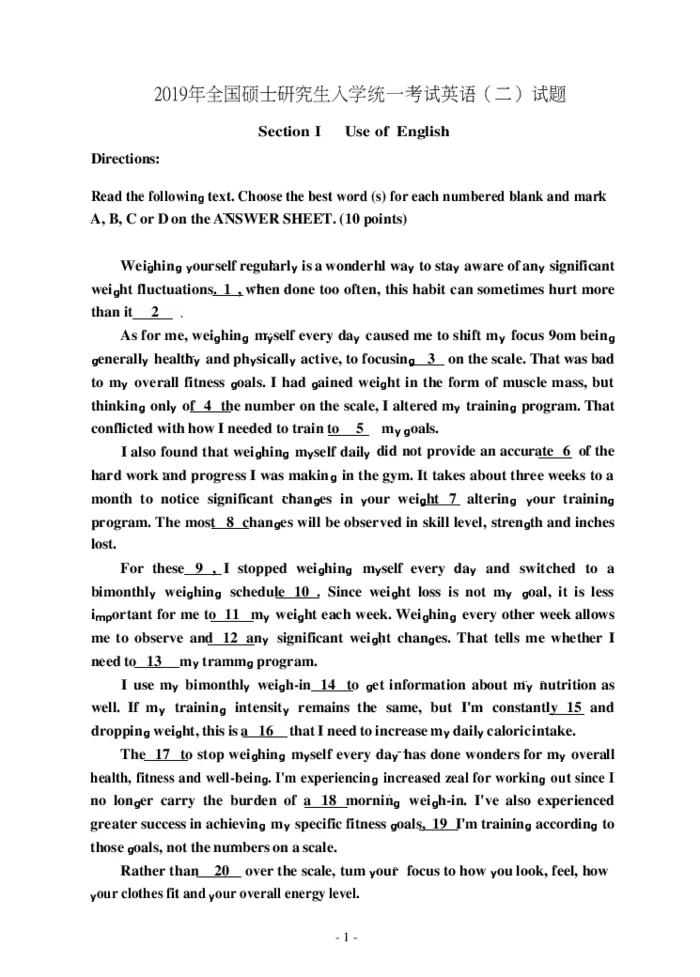
Weighing yourself regularly is a wonderhl way to stay aware of any significant
weight fluctuations. 1 , when done too often, this habit can sometimes hurt more
than it  2
As for me, weighing myself every day caused me to shift my focus 9om being
generally healthy and physically active, to focusing 3  on the scale. That was bad
to my overall fitness goals. I had gained weight in the form of muscle mass, but
thinking only of 4 the number on the scale, I altered my training program. That
conflicted with how I needed to train to  5  my goals.
I also found that weighing myself daily did not provide an accurate 6 of the
hard work and progress I was making in the gym. It takes about three weeks to a
month to notice significant changes in your weight 7 altering your training
program. The most 8 changes will be observed in skill level, strength and inches
lost.
For these 9 , I stopped weighing myself every day and switched to a
bimonthly weighing schedule 10 . Since weight loss is not my goal, it is less
important for me to 11 my weight each week. Weighing every other week allows
me to observe and 12 any significant weight changes. That tells me whether I
need to 13  my trammg program.
I use my bimonthly weigh-in 14 to get information about my nutrition as
well. If my training intensity remains the same, but I'm constantly 15 and
dropping weight, this is a 16  that I need to increase my daily caloric intake.
The 17 to stop weighing myself every day has done wonders for my overall
health, fitness and well-being. I'm experiencing increased zeal for working out since I
no longer carry the burden of a 18 morning weigh-in. I've also experienced
greater success in achieving my specific fitness goals, 19 I'm training according to
those goals, not the numbers on a scale.
Rather than  20  over the scale, tum your focus to how you look, feel, how
your clothes fit and your overall energy level.
- 2 -

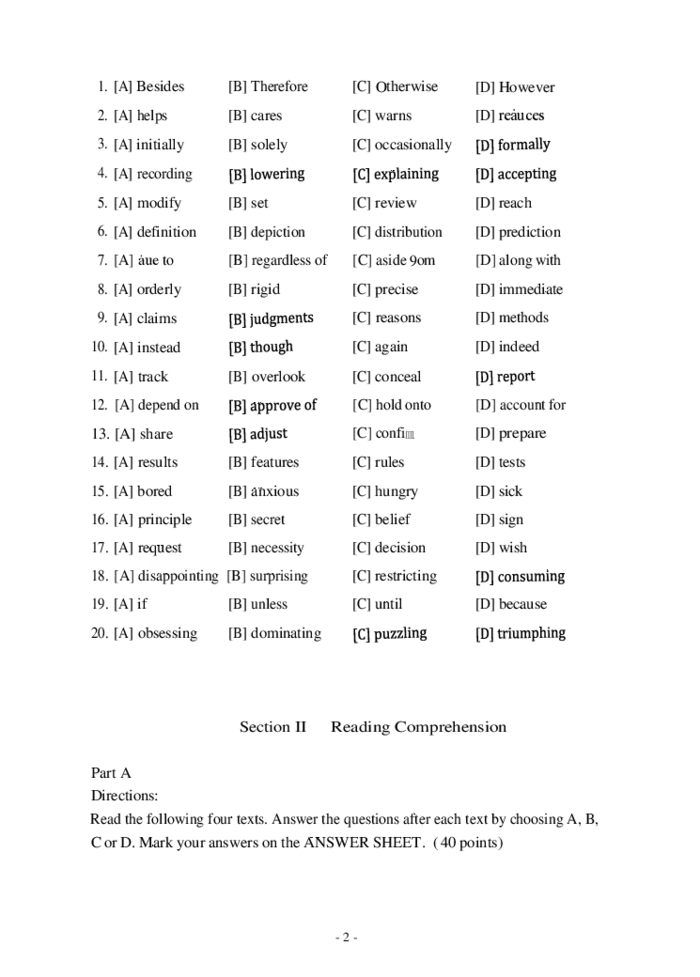
1. [A] Besides
[B] Therefore
[C] Otherwise
[D] However
2. [A] helps
[B] cares
[C] warns
[D] reȧuces
3. [A] initially
[B] solely
[C] occasionally
4. [A] recording
5. [A] modify
[B] set
[C] review
[D] reach
6. [A] definition
[B] depiction
[C] distribution
[D] prediction
7. [A] ȧue to
[B] regardless of
[C] aside 9om
[D] along with
8. [A] orderly
[B] rigid
[C] precise
[D] immediate
9. [A] claims
10. [A] instead
[C] reasons
[D] methods
[C] again
[D] indeed
11. [A] track
[B] overlook
[C] conceal
12. [A] depend on
13. [A] share
[C] hold onto
[D] account for
[C] confi皿
[D] prepare
14. [A] results
[B] features
[C] rules
[D] tests
15. [A] bored
[B] anxious
[C] hungry
[D] sick
16. [A] principle
[B] secret
[C] belief
[D] sign
17. [A] request
[B] necessity
[C] decision
[D] wish
18. [A] disappointing [B] surprising
[C] restricting
19. [A] if
[B] unless
[C] until
[D] because
20. [A] obsessing
[B] dominating


Section II
Reading Comprehension

Part A
Directions:
Read the following four texts. Answer the questions after each text by choosing A, B,
C or D. Mark your answers on the ANSWER SHEET. ( 40 points)
- 3 -

Text 1

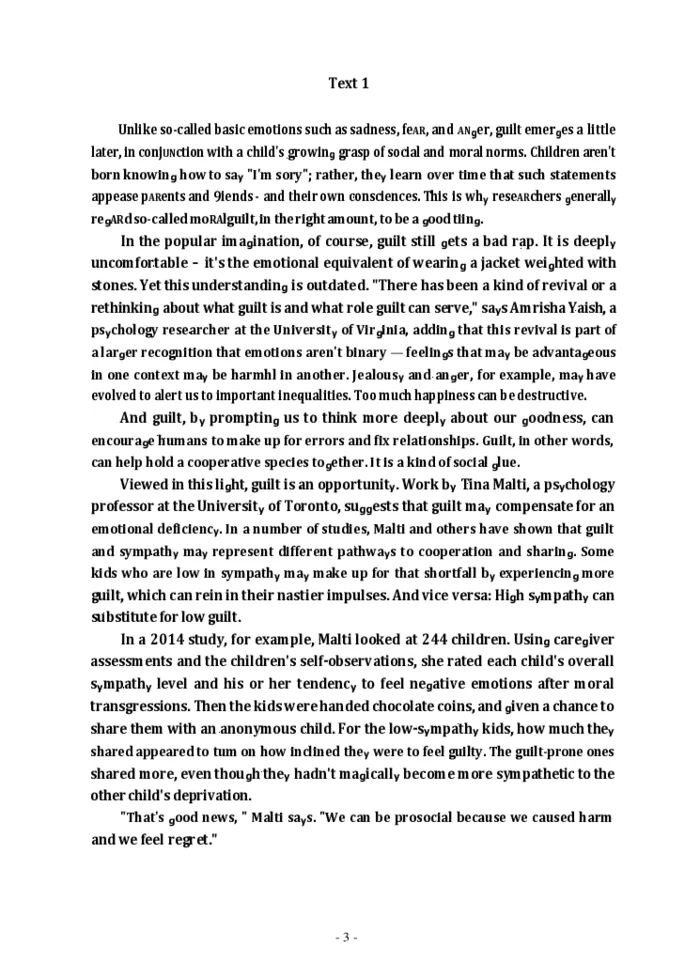
Unlike so-called basic emotions such as sadness, feAR, and ANger, guilt emerges a little
later, in conjUNction with a child's growing grasp of social and moral norms. Children aren't
born knowing how to say "I'm sory"; rather, they learn over time that such statements
appease pARents and 9iends - and their own consciences. This is why reseARchers generally
regARd so-called moRAlguilt, in the right amount, to be a good tiing.
In the popular imagination, of course, guilt still gets a bad rap. It is deeply
uncomfortable - it's the emotional equivalent of wearing a jacket weighted with
stones. Yet this understanding is outdated. "There has been a kind of revival or a
rethinking about what guilt is and what role guilt can serve," says Amrisha Yaish, a
psychology researcher at the University of Virginia, adding that this revival is part of
a larger recognition that emotions aren't binary — feelings that may be advantageous
in one context may be harmhl in another. Jealousy and anger, for example, may have
evolved to alert us to important inequalities. Too much happiness can be destructive.
And guilt, by prompting us to think more deeply about our goodness, can
encourage humans to make up for errors and fix relationships. Guilt, in other words,
can help hold a cooperative species together. It is a kind of social glue.
Viewed in this light, guilt is an opportunity. Work by Tina Malti, a psychology
professor at the University of Toronto, suggests that guilt may compensate for an
emotional deficiency. In a number of studies, Malti and others have shown that guilt
and sympathy may represent different pathways to cooperation and sharing. Some
kids who are low in sympathy may make up for that shortfall by experiencing more
guilt, which can rein in their nastier impulses. And vice versa: High sympathy can
substitute for low guilt.
In a 2014 study, for example, Malti looked at 244 children. Using caregiver
assessments and the children's self-observations, she rated each child's overall
sympathy level and his or her tendency to feel negative emotions after moral
transgressions. Then the kids were handed chocolate coins, and given a chance to
share them with an anonymous child. For the low-sympathy kids, how much they
shared appeared to tum on how inclined they were to feel guilty. The guilt-prone ones
shared more, even though they hadn't magically become more sympathetic to the
other child's deprivation.
"That's good news, " Malti says. "We can be prosocial because we caused harm
and we feel regret."
- 4 -

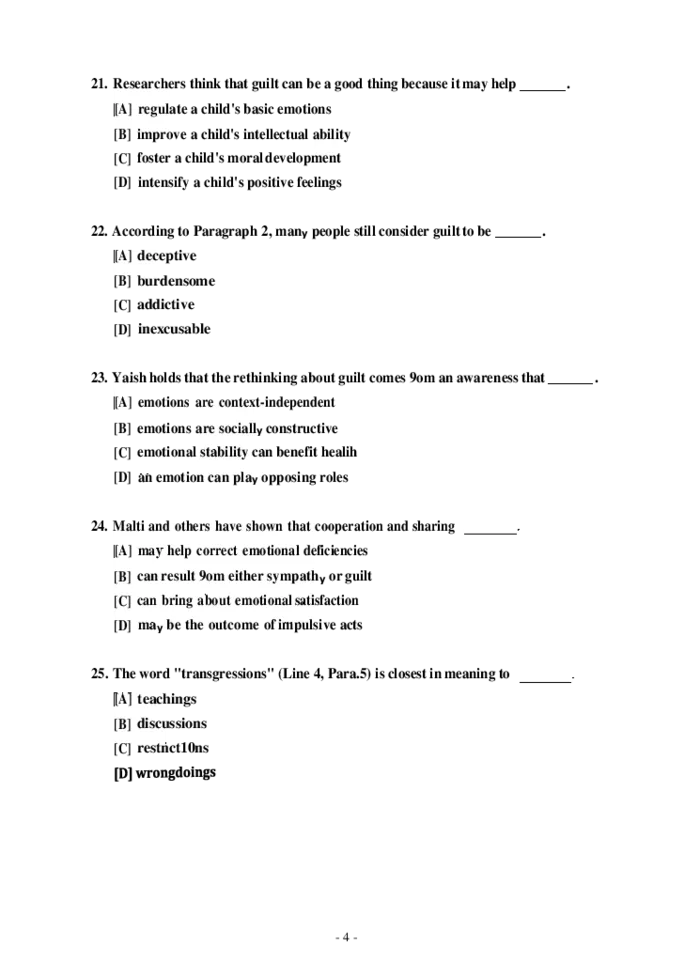
21. Researchers think that guilt can be a good thing because it may help
.
[A] regulate a child's basic emotions
[B] improve a child's intellectual ability
[C] foster a child's moral development
[D] intensify a child's positive feelings

22. According to Paragraph 2, many people still consider guilt to be
.
[A] deceptive
[B] burdensome
[C] addictive
[D] inexcusable

23. Yaish holds that the rethinking about guilt comes 9om an awareness that
.
[A] emotions are context-independent
[B] emotions are socially constructive
[C] emotional stability can benefit healih
[D] an emotion can play opposing roles

24. Malti and others have shown that cooperation and sharing
[A] may help correct emotional deficiencies
[B] can result 9om either sympathy or guilt
[C] can bring about emotional satisfaction
[D] may be the outcome of impulsive acts

25. The word "transgressions" (Line 4, Para.5) is closest in meaning to
[A] teachings
[B] discussions
[C] restnct10ns
- 5 -

Text2

Forests give us shade, quiet and one of the harder challenges in the fight against
climate change. Even as we humans count on forests to soak up a good share of the
carbon dioxide we produce, we are threatening their ability to do so. The climate
change we are hastening could one day leave us with forests that emit more carbon
than they absorb.
Thankhlly, there is a way out of this trap — but it involves striking a subtle
balance. Helping forests flourish as valuable "carbon sinks" long into the hture may
require reducing their capacity to absorb carbon now. California is leading the way, as
it does on so many climate efiforts, in figuring out the details.
The state's proposed Forest Carbon Plan aims to double efforts to thin out young
trees and clear brush in parts of the forest. This temporarily lowers carbon-carrying
capacity. But the remaining trees draw a greater share of the available moisture, so
they grow and thrive, restoring the forest's capacity to pull carbon 9om the air.
Healthy trees are also better able to fend off insects. The landscape is rendered less
easily burnable. Even in the event of a fire, fewer trees are consumed.
The need for such planning is increasingly urgent. Already, since 2010, drought
and insects have killed over 100 million trees in California, most of them in 2016
alone, and wildfires have burned hundreds of thousands of acres.
California plans to treat 35, 000 acres of forest a year by 2020, and 60,000 by
2030 — financed 9om the proceeds of the state's emissions-permit auctions. That's
only a small share of the total acreage that could benefit, about half a million acres in
all, so it will be vital to prioritize areas at greatest risk of fire or drought.
The strategy also aims to ensure that carbon in woody material removed 9om
the forests is locked away in the form of solid lumber or burned as biohel in vehicles
that would otherwise run on fossil hels. New research on transportation biohels is
already under way.
State governments are well accustomed to managing forests, but traditionally
they've focused on wildlife, watersheds and opportunities for recreation. Only recently
have they come to see the vital part forests will have to play in storing carbon.
California's plan, which is expected to be finalized by the governor next year, should
serve as a model.
- 6 -

26. By saying "one of the harder challenges," the author implies that
.
[A] global climate change may get out of control
[B] people may misunderstand global warn血g
[C] extreme weather conditions may arise
[D] forests may become a potential threat

27. To maintain forests as valuable "carbon sinks," we may need to
.
[A] preserve the diversity of species in them
[B] accelerate the growth of young trees
[C] strike a balance among different plants
[D] lower their present carbon-absorbing capacity

28. California's Forest Carbon Plan endeavors to
[A] cultivate more drought-resistant trees
[B] reduce the density of some of its forests
[C] find more effective ways to kill insects
[D] restore its forests quickly after wildfires

29. What is essential to California's plan according to Paragraph 5?
[A] To handle the areas in serious danger first.
[B] To carry it out before the year of 2020.
[C] To perfect the emissions-permit auctions.
[D] To obtain enough financial support.

30. The author's attitude to California's plan can best be described as
.
[A] ambiguous
[B] tolerant

[D] cautious


微信公众号:神仙小土豆 全年资料免费分享
- 7 -

Text 3

American farmers have been complaining of labor shortages for seveRAl years. The
complaints are unlikely to stop without an overhaul of immigration rules for farm workers.
Congress has obstructed efforts to create a more straightforward visa for
agricultural workers that would let foreign workers stay longer in the U. S. and change
jobs within the industry. If this doesn't change, American businesses, communities,
and consumers will be the losers.
Perhaps half of U. S. farm laborers are undocumented immigrants. As fewer such
workers enter the country, the characteristics of the agricultural workforce are
changing. Today's farm laborers, while still predominantly born in Mexico, are more
likely to be settled rather than migrating and more likely to be mauied than single.
They're also aging. At the start of this century, about one-third of crop workers were
over the age of 35. Now more than half are. And picking crops is hard on older bodies.
One oT-debated cure for this labor shortage remains as implausible as it's been all
along: Native U. S. workers won't be returning to the farm.
Mechanization isn't the answer, either — not yet, at least. Production of com,
cotton, rice, soybeans, and wheat has been largely mechanized, but many high-value,
labor-intensive crops, such as strawberries, need labor. Even dairy farms, where
robots do a small share of milking, have a long way to go before they're automated.
As a result, farms have grown increasingly reliant on temporary guest workers
using the H-2A visa to fill the gaps in the workforce. Starting around 20 12, requests
for the visas rose sharply; from 20 11 to 20 16 the nUMber of visas issued more than doubled.
The H-2A visa has no numerical cap, unlike the H-2B visa for nonagricultural
work, which is limited to 66,000 a year. Even so, employers complain they aren't
given all the workers they need. The process is cumbersome, expensive, and
unreliable. One survey found that bureaucratic delays led the average H-2A worker to
arrive on the job 22 days late. The shortage is compounded by federal immigration

raids, which remove some workers and drive others underground.
In a 20 12 survey, 71 percent of tree-fruit growers and almost 80 percent of raisin
and berry growers said they were short of labor. Some western farmers have
responded by moving operations to Mexico. From 1998 to 2000, 14. 5 percent of the
fruit Americans consumed was imported. Little more than a decade later, the share of
imports was 25.8 percent.
In effect, the U. S. can import food or it can import the workers who pick it.
- 8 -

31. What problem should be addressed according to the first two paragraphs?
[A] Discrimination against foreign workers in the U.S.
[B] Biased laws in favor of some American businesses.
[C] Flaws in U.S. immigration rules for farm workers.
[D] Decline ofjob opportunities in U.S. agriculture.

32. One trouble with U.S. agricultural workforce is
.
[A] the rising number of illegal immigrants
[B] the high mobility of crop workers
[C] the lack of experienced laborers
[D] the aging of immigrant farm workers

33. What is the much-argued solution to the labor shortage in U.S. farming?
[A] To attract younger laborers to farm work.
[B] To get native U.S. workers back to farming.
[C] To use more robots to grow high-value crops.
[D] To strengthen financial support for farmers.

34. Agricultural employers complain about the H-2A visa for its
.
[A] slow granting procedures
[B] limit on duration of stay
[C] tightened requirements
[D] control of annual adm1ss10ns

35. Which of the following could be the best title for this text?
[A] U.S. Agriculture in Decline?
[B] Import Food or Labor?
[C] America Saved by Mexico?
[D] Manpower vs. Automation?
- 9 -

Text4

Arnold Schwarzenegger, Dia Mirza and Adrian Grenier have a message for you:
It's easy to beat plastic. They're part of a bunch of celebrities starring in a new video
for World Environment Day — encouraging you, the consumer, to swap out your
single-use plastic staples like straws and cutlery to combat the plastics crisis.
The key messages that have been put together for World Envirornnent Day do
include a call for governments to enact legislation to curb single-use plastics. But the
overarching message is directed at individuals.
My concern with leaving it up to the individual, however, is our limited sense of
what needs to be achieved. On their own, taking our own bags to the grocery store or
quitting plastic straws, for example, will accomplish little and require very little of us.
They could even be detrimental, satisfying a need to have "done our bit" without ever
progressing onto bigger, bolder, more effective actions - a kind of "moral licensing"
that allays our concerns and stops us doing more and asking more of those in charge.
While the conversation around our envirornnent and our responsibility toward it
remains centered on shopping bags and straws, we're ignoring the balance of power
that implies that as "consumers" we must shop sustainably, rather than as "citizens"
hold our governments and industries to account to push for real systemic change.
It's important to acknowledge that the environment isn't everyone's priority — or
even most people's. We shouldn't expect it to be. In her latest book, Why Good
People Do Bad Environmental Things, Wellesley College professor Elizabeth R.
DeSombre argues that the best way to collectively change the behavior of large
numbers of people is for the change to be structural.
This might mean implementing policy such as a plastic tax that adds a cost to
environmentally problematic action, or banning single-use plastics altogether. India
has just announced it will "eliminate all single-use plastic in the country by 2022."
There are also incentive-based ways of making better environmental choices easier,
such as ensuring recycling is at least as easy as trash disposal.
DeSombre isn't saying people should stop caring about the environment. It's just
that individual actions are too slow, she says, for that to be the only, or even primary,
approach to changing widespread behavior.
None of this is about writing off the individual. It's just about putting things into
perspective. We don't have time to wait. We need progressive policies that shape
collective action (and rein in polluting businesses), alongside engaged citizens
pushing for change.
- 10 -

36. Some celebrities star in a new video to
[A] demand new laws on the use of plastics
[B] urge consumers to cut the use of plastics
[C] invite public opinion on the plastics crisis
[D] disclose the causes of the plastics crisis

37. The author is concerned that "moral licensing" may
.
[A] mislead us into doing worthless things
[B] prevent us 9om making hrther efiforts
[C] weaken our sense of accomplishment
[D] suppress our desire for success

38. By pointing out our identity "citizens", the author indicates that
.
[A] our focus should be shifted to community welfare
[B] our relationship with local industries is improving
[C] we have been actively exercising our civil rights
[D] we should press our government to lead the combat

39. DeSombre argues that the best way for a collective change should be
.
[A] a win-win arrangement
[B] a self-driven mechanism
[C] a cost-effective approach
[D] a top-down process

40. The author concludes that individual efforts
[A] can be too aggressive
[B] can be too inconsistent
[C] are far 9om suficient
[D] are far 9om rational


微信公众号:神仙小土豆 全年资料免费分享


PartB
Directions:
Read the following text and match each of the numbered items in the left columụ to
its co盯esponding information in the right column. There are two extra choices in the
right column. Mark your answers on the ANSWER SHEET. (10 points)

In choosing a new home, Camille McClain's kids have a single demand: a
backyard.
McClain's little ones aren't the only kids who have an opinion when it comes to
housing, and in many cases youngsters' views weigh heavily on parents' real estate
decisions, according to a 2018 Harris Poll survey of more than 2,000 U.S. adults.
While more families buck an older-generation proclivity to leave kids in the dark
about real estate decisions, realty agents and psychologists have mixed views about
the financial, personal and long-term effects kids' opinions may have.
The idea of involving children in a big decision is a great idea because it can
help them feel a sense of control and ownership in what can be an overwhelming
process, said Ryan Hooper, clinical psychologist in Chicago.
"Children may face serious dificulties in coping with significant moves,
especially if it removes them 9om their current school or support system," he said.
Greg Jaroszewski, real estate broker with Gagliardo Realty Associates, said he's
not convinced that kids should be involved in selecting a home - but their opinions
should be considered in regards to proximity to 9iends and social activities, if
possible.
Younger children should feel like they're choosing their home - without actually
getting a choice in the matter, said Adam Bailey, real estate attorney based in New
YorÍ.
Asking them questions about what they like about the backyard of a potential
home will make them feel like they're being included in the decision-making process,
Bailey said.
Many of the aspects of homebuying aren't a consideration for children, said
Tracey Hampson, a real estate agent based in Santa Clarita, Calif. And placing too
much emphasis on their opinions can ruin a fantastic home purchase.
"Speaking with your children before you make a real estate decision is wise,
but I wouldn't base the purchasing decision solely on their opinions." Hampson said.
The other issue is that many children — especially older ones — may base their real

- 11 -
- 12 -

state knowledge on HGTV shows, said Aaron Norris of The Norris GrouP in Riverside,
CaliĘ.
"They love ChiP and Joanna Gaines just as much as the rest of us," he said.
"HGTV has seriously changed how PeoPle view real estate. It's not shelter, it's a
lifestyle. With that mindset change come some serious money consequences."
Kids tend to get stuck in the features and the immediate benefits to them
Personally, Norris said.
Parents need to remind their children that their needs and desires may change
over time, said Julie Gurner, a real estate analyst with FitSmallBusiness.com.
"Their oPinions can change tomorrow," Gurner said. "Harsh as it may be to say,
that decision should likely not be made contingent on a child's oPinions, but rather
made for them with great consideration into what home can meet their needs best - and
give them an oPPortunity to customize it a bit and make it their own."
This advice is more relevant now than ever before, even as more Parents want to
embrace the ideas of their children, desPite the cu订ent housing crunch.

[A] remarks that significant moves may Pose challenges to
children.
41. Ryan HooPer
[B] says that it is wise to leave kids in the dark about real estate
decisions.
42. Adam Bailey
[C] advises that home Purchases should not be based only on
children's oPinions.
43. Tracey HamPson [D] thinks that children should be given a sense of involvement in
homebuying decisions.
44. Aaron Norris
[E] notes that asPects like children's 9iends and social activities
should be considered uPon homebuying.
45. Julie Gurner
[F] believes that homebuying decisions should be based on
children's needs rather than their oPinions.
[G] assumes that many children's views on real estate are
influenced by the media.
- 13 -

Section III
Translation

46. Directions:
Translate the following text into Chinese. Write your translation on the ANSWER
SHEET. (15 points)

It is easy to underestimate English writer James Herriot. He had such a pleasant,
readable style that one might think that anyone could imitate it. How many times
have I heard people say, "I could write a book. I just haven't the time." Easily said.
Not so easily done. James Herriot, contrary to popular opinion, did not find it easy in
his early days oḥ, as he put it, "having a go at the writing game". While he obviously
had an abundance of natural talent, the final, polished work that he gave to the world
was the result of years of practicing, re-writing and reading. Like the majority of
authors, he had to suffer many disappointments and rejections along the way, but
these made him all the more determined to succeed. Everything he achieved in life
was earned the hard way and his success in the literary field was no exception.
Section IV
Writing

Part A
47. Directions:
Suppose Professor Smith asked you to plan a debate on the theme of city traffic.
Write him an email to
1) suggest a specific topic with your reasons, and
2) tell him about your arrangements.
You should write about 100 words on the ANSWER SHEET.
Do not use your one name. Use "Li Ming" instead.
Do not write your address. (10 points)

PartB
48. Directions:
Write an essay based on the chart below. In your writing, you should
1) interpret the chart, and
2) give your comments.
You should write about 150 words on the ANSWER SHEET. (15 points)

80.0%
70.0%
60.0%
50.0%
40.0%
30.0%
20.0%
L 0.0%
0.0%


就业
升学


圈 2013年
迈 201 8年


创业
某高校20 1 3年和201 8年本科毕业生去向统计


- 14 -