2025 年高考第三次模拟考试(新高考八省专用)01
英语
(考试时间:120分钟 试卷满分:150分)
注意事项:
1.答卷前,考生务必将自己的姓名、考生号等填写在答题卡和试卷指定位置上。
2.回答选择题时,选出每小题答案后,用铅笔把答题卡对应题目的答案标号涂黑。如需改动,用橡
皮擦干净后,再选涂其他答案标号。回答非选择题时,将答案写在答题卡上。写在本试卷上无效。
3.考试结束后,将本试卷和答题卡一并交回。
第一部分 听力(共两节,满分 30 分)
第一节(共5小题;每小题1.5分,满分7.5分)
听下面5段对话。每段对话后有一个小题,从题中所给的A、B、C三个选项中选
出最佳选项。听完每段对话后,你都有 10秒钟的时间来回答有关小题和阅读下一小题。每段对话仅读一
遍。
1.Where does the conversation probably take place?
A.In a hotel. B.In a restaurant. C.In a travel agency.
2.When was the man waken up?
A.At 6:00. B.At 7:00. C.At 8:00.
3.Where does the conversation probably take place?
A.In an apartment. B.In a restaurant. C.In a shop.
4.What does the man suggest the woman do?
A.Forget the pressure. B.Work at the office. C.Have a rest.
5.What does the man think about chewing gum?
A.It’s not graceful.
B.It’s good for dental health.
C.It does harm to the environment.
第二节(共15小题;每小题1.5分,满分22.5分)
听下面 5段对话或独白。每段对话或独白后有几个小题,从题中所给的 A、B、C三个选项中选出最
佳选项。听每段对话或独白前,你将有时间阅读各个小题,每小题 5秒钟;听完后,各小题将给出5秒钟
的作答时间,每段对话或独白读两遍。
听第6段材料,回答第6、7题。6.What is the woman doing now?
A.Selecting a dress. B.Dancing with the man. C.Buying clothes.
7.Where will the speakers go?
A.A wedding ceremony. B.A dancing party. C.A concert.
听第7段材料,回到第8、9题。
8.What did the man mainly discuss with his teacher?
A.His test results. B.His illness. C.His mood.
9.Why did the teacher apologize to the man?
A.She gave him little support.
B.She didn’t remind him of the test.
C.She forgot about his absence from class.
听第8段材料,回答第10-12题。
10.What is the woman doing?
A.Promoting a club. B.Chairing a meeting. C.Hosting a program.
11.What do we know about The Dragon’s Back race?
A.It lasts three days. B.It is for beginners. C.It takes place in the UK.
12.Which is the hardest for the man?
A.Running downhill.
B.Suffering certain injuries.
C.Keeping pace with others.
听第9段材料,回答第13-16题。
13.Whose speech did the speakers listen to?
A.A developer’s. B.A student’s. C.A doctor’s.
14.What is the man’s goal in the field?
A.To set up a research group.
B.To work on advanced AI projects.
C.To develop policies and guidelines.
15.What does the man plan to do first to realize his dream?
A.Focus on learning and practicing.
B.Cooperate with the woman on a project.
C.Study the policies in the field of technology.
16.What is the woman’s next step regarding her interests?A.To start some AI projects.
B.To sign up for advanced courses.
C.To continue her work in the research group.
听第10段材料,回答第17-20题。
17.What can be seen in the image?
A.A lonely old polar bear. B.A struggling polar bear. C.A sleeping young polar bear.
18.Which word best describes the process of taking the image?
A.Challenging. B.Joyful. C.Disappointing.
19.What can the director’s words illustrate?
A.The beauty in nature. B.The impact of the image. C.The affection for photography.
20.What does Nima Sarikhani call on people to do?
A.Care about the safety of seafood.
B.Create new homes for polar bears.
C.Take action to prevent global warming.
第二部分 阅读(共两节,满分50分)
第一节 (共15小题;每小题2.5分,满分37.5分)
阅读下列短文,从每题所给的A、B、C、D四个选项中选出最佳选项。
A
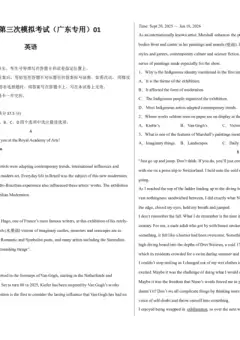
Our photography exhibition is back for its sixtieth year to reveal more of nature’ s stories.
It’ll take you on a visual adventure through different environments and give you a window into the wildlife
that calls them home.
·see first-hand how our activities, both good and bad, are shaping the natural world
·explore breathtaking images, from fierce predators on the hunt to stunning compositions
·witness powerful stories of survival, weakness and the delicate balance of life
Every photograph is a reminder of the wonder of the natural world.
Alongside the stunning photography, you’ll discover through soundscapes, films and expert insights, the
diversity and beauty of life on Earth and what we can do together to protect it.
You can join our hosts for a special tour of the Wildlife Photographer of the Year exhibition (available from 9:00
am to 9:45 am ) and discover the stories and details that didn’t make it into the captions (说明文字)。Time: 11
October 2024 to 29 June 2025
Address: East Pavilion Gallery, South Kensington, LondonPeak ticket prices
Weekends, school holidays and bank holidays.
Adult (17-59): £18
Child (4-16): £10.95
Family (2 adults,1 child): £37.50
Family (2 adults,2 children): £46
Family (2 adults,3 children): £54.95Off-peak ticket prices
Monday to Friday, excluding school holidays and bank holidays.
Adult (17-59): £15.50
Child (4-16): £9.25
Family (2 adults,1 child): £32.25
Family (2 adults,2 children): £39.50
Family (2 adults,3 children): £47
21.What can visitors expect of the exhibition?
A.Story-composing workshops. B.Lectures on photography.
C.A virtual reality adventure. D.An audiovisual tour.
22.How much will a family with two children pay for the exhibition on a school holiday?
A.£37.50. B.£39.50. C.£46. D.£49.50.
23.What is the main purpose of the exhibition?
A.To select the best wildlife photographer.
B.To present its history and significance.
C.To raise awareness of the natural world.
D.To collect funds for wildlife conservation.
B
“There is no way I can live out of a suitcase!” I thought as we packed up our home in Venice, Italy. At
fourteen years old, I couldn’t imagine leaving my friends, school, and all my “stuff” behind to travel the world full-
time with my family. That was when my mom had the idea of dropping everything to travel the world and create a
deeper connection between family members. Although I absolutely loved the idea of traveling the world freely, I
couldn’t imagine leaving my life behind.
To my surprise, during the travel, we have learned the most important moments are when we live happy
moments with our family and friends. As we travel, we barely carry anything with us except the essential thingslike clothes, a laptop, notebooks, and toiletries (洗漱用品). We each carry a backpack and all five of us share two
suitcases for clothes. After buying new souvenirs or new clothes, we give some of our old outfits away to people in
need and it makes us so happy to be able to give back wherever we can.
At the beginning, it was difficult for us to get used to never having a closet (衣橱), constantly changing hotel
rooms, and never fully unpacking before we were back on the road. But over time we have learned to appreciate the
value of having less — the freedom to live for experiences and the joy of traveling “light” in mind, body, and spirit.
Many of the wonderful new friends we have made on our journey have opened our eyes to how lucky we are. We
have met families in many parts of the world who live in small homes with no running water, yet they always have
huge smiles and are willing to share with us.
We now know that experiences and memories are the most valuable things in life and that they can only be
acquired when we let go of our need for possessions and focus on what really matters in life — enjoying our lives
each day with the people we love.
24.What was the author’s initial feeling about the idea of traveling the world?
A.Anxious and fearful. B.Interested but doubtful.
C.Pleased and excited. D.Confused but hopeful.
25.Why did the author’s mom decide to travel the world?
A.To build stronger family bonds. B.To escape their current life.
C.To enrich their travel experiences. D.To ease the work pressure.
26.What did the family do with their old clothes after acquiring new ones?
A.They directly threw them away. B.They kept them as souvenirs.
C.They donated them to people in need. D.They exchanged them with local residents.
27.What can be inferred from the last paragraph?
A.We should let go of every single possession.
B.Material wealth and possessions bring happiness.
C.The family used to place too much emphasis on wealth.
D.Material possessions should not be our ultimate goal.
C
“There are between 10 and 50 billion potentially habitable worlds in our galaxy”, says Bill Diamond. He is
the chief executive of the US based research organization Seti (Search for Extraterrestrial Intelligence). “Seti is
looking for science and technology beyond the solar system as the evidence of life and intelligence, and that’s byand large a needle in a haystack problem,” Mr Diamond says. “We’re looking for something that is likely
exceedingly rare and may be very difficult to find and extract from the background phenomena that you’re
observing at the same time.”
But the ability of AI to both handle massive datasets and to spot anomalies (异常现象) is transforming the
hunt for alien intelligence. Mr Diamond points to AI enabling the search for new types of radio signals from aliens.
Traditionally, Seti has looked for narrowband (窄频的) signals like those used by humans. “But there was always
the question, ‘What if there’s an alien advanced technology that is using wideband radio?’ And if that’s the case,
our traditional methods wouldn’t work; it would look like a bunch of noise on the screen.” However, Mr Diamond
says that the ability of AI to handle massive amounts of data means it’s possible to take millions of “snapshots” of
the snowy audio picture over time, and to start to look for patterns.
Researcher Peter Ma developed an AI system to examine telescope data and distinguish between possible
alien signals and interference. His team simulated both types of noise and trained the AI to identify them. Mr Ma
says that an alien signal can, for example, only appear when we point our telescopes at it and disappear when we
point away. The project has already identified eight potential alien signals that went undetected by traditional
analysis. However, Mr Ma believes that as the observations haven’t yet been repeated, they are probably false
positives.
It’s early days, and any promising results generated by AI need to be confirmed by other observations, or by
physics-based models, before they can be shouted from the rooftops. But as more and more data are collected and
analyzed, the chances of detecting alien life — if it exits — are increasing all the time.
28.What does Mr Diamond stress in Paragraph 1?
A.The ambition to explore the solar system. B.The challenge of spotting aliens.
C.The existence of alien intelligence. D.The capability of artificial intelligence.
29.What does Mr Diamond want to prove by mentioning “wideband radio” in Paragraph 2?
A.The high IQ of aliens. B.The deafening narrowband signal sources.
C.The potential for the application of AI. D.The occurrence of new patterns.
30.What will Mr Ma depend on to judge his discovery?
A.The repetitive signals. B.The identified data.
C.The simulated noise. D.The conventional analysis.
31.What does the underlined sentence in the last paragraph mean?
A.Before they can be imitated by physiclsts. B.Before they can be talked about privately.
C.Before they can be confirmed under observation. D.Before they can be made public.D
Human beings eat a lot of fish. Globally, seafood is a $500 billion industry and consumption has more than
doubled in the last half a century. But the oceans are not an unlimited resource, and seafood consumers are
increasingly concerned about overfishing, marine pollution, and the fishing industry’s poor human rights record.
Netflix’s hit anti-fishing documentary Seaspiracy shocked many people into rethinking their seafood
consumption. Although some marine scientists question the film’s claims that there is no such thing as a sustainable
fishing industry and we could run out of fish in 2048, there is no denying that the film does have its impact, with
quite a few viewers cutting down on fish or cutting it out altogether.
With more people than ever turning vegan, meat-free meat is now big business. Fish-free fish seems to
follow. Vegan seafood products are found on supermarket shelves mimicking dishes from fish and chips to canned
tuna. Fake fish currently accounts for only about 1% of the entire alternative-meat industry. But what began as a
tiny cottage industry serving a booming market is expanding rapidly. In 2018, London’s Sutton & Sons
became the first UK chippy to offer vegan fish and chips. Since then, the world has seen a surge in demand for fish-
free foodstuffs. In 2017, only 29 companies in the world produced alt-seafood products. Now there are more than
80, with seafood giants and multinationals moving in to claim their territory.
Most of the fake marine life on sale now is vegetable or fungi-based. Seafoods’ unique structures and
distinctive flavors are difficult to veganize convincingly. But by experimenting with new recipes and technologies,
it is possible to simulate its tastes and textures with varying degrees of success. Much of the innovation involves
repurposing plants in unexpected ways. For instance, Ahimi, made by US firm Ocean Hugger Food are tomato-
based sashimi (生鱼片) substitutes. Meanwhile, California’s Sophie’s Kitchen uses a fibrous Asian root vegetable
to create “tuna”, French manufacturer Odontella SAS offers artificial smoked salmon made from tofu and peas and
Swedish retailer Ikea sells vegan caviar (鱼子酱) made from seaweed.
Most fake fish products, of course, are unlikely to fool anyone. For those who never mind their smelling and
tasting like no creature that ever swims in any sea, they are great. But for some consumers, only genuine fish flesh
will do. Luckily, technology promises to offer an ocean-friendly alternative. Lab-grown fish meat, cultivated in a
vessel called a bioreactor, promises the real thing without animal cruelty or the environmental toll of industrial
fishing. Some agriculture companies are already producing lab-grown salmon, bluefin tuna, shrimp, lobster and
crab. But it’s a slow, expensive process and businesses are still figuring out how to produce seafood profitably.
32.What do we know about Seaspiracy?
A.It has aroused a heated debate among marine scientists.B.It’s a popular documentary advocating seafood consumption.
C.It calls for a sustainable fishing industry as fish is running out.
D.It has noticeable effects on the viewers’ consuming habits.
33.What’s the main idea of the third paragraph?
A.The popularity of fake fish is limited to a tiny part of the world.
B.Fake fish industry is developing fast globally due to growing demand.
C.Meat-free meat is now big business with more people turning vegan.
D.Seafood giants and multinationals are producing fish-free foodstuffs.
34.What does the underlined word “simulate” in the fourth paragraph probably mean?
A.replace B.imitate C.uncover D.increase
35.According to the passage, who is most likely to buy lab-grown salmon?
A.A millionaire who enjoys fish-free foodstuffs.
B.A vegan who is in favor of alt-seafood products.
C.A fish-flesh lover who cares for the environment.
D.An environmentalist who is picky about his diet.
第二节 (共5小题;每小题2.5分,满分12.5分)
阅读下面短文,从短文后的选项中选出可以填入空白处的最佳选项。选项中有两项为多余选项。
Classroom environments play a crucial role in students’ learning experiences. A setting filled with too many
things can look untidy. 36 Therefore, teachers are supposed to be careful with what they want their
classroom to look like. While controlling all factors may be challenging, teachers can manage the materials on
classroom walls to reduce distractions (分散注意力的事)。
37 A student’s working memory processes visual and verbal (口头的) information. Too many
posters, regulations, or information sources can overload a student’s working memory, making it difficult to focus
and process information.
38 The average preschool is overloaded with labels, lists, and rules, which can decrease children’s
ability to focus and learn. Decorations are sometimes mistaken for quality. Experts point out that reading and
writing performances are particularly affected by levels of stimulation, while math benefits from student-centered
and personalized classroom designs. Involving students in designing their learning space can give them a sense of
ownership and pride. 39
The color of the classroom is another critical factor. Red and orange can make students feel nervous, while
blue and green are calming. Younger children may respond well to bright colors like yellow, but older studentsbenefit from light shades of blue and green. The International Association of Color Consultants North America
emphasizes the importance of appropriate color design for creating conducive (有利的) learning environments and
promoting health. 40 Such settings are likely to cause students to become uninterested in learning.
Therefore, teachers should be mindful of the impacts of visual stimuli on their students and work to
minimize distractions for better academic performance.
A.It distracts students and negatively impacts their academic performance.
B.Classrooms often become text and picture-rich from early education levels.
C.Teachers should consider featuring student works to promote student worth.
D.Alternatively, colorless and poorly lit classrooms are often considered boring.
E.Classroom environments are intended to stimulate enthusiasm and participation.
F.Overstimulation in the environment increases competition for a student’s attention.
G.A combination of bright and light colors benefits academic performance and health.
第三部分 语言运用 (共两节,满分30分)
第一节 (共15小题;每小题1分,满分15分)
阅读下面短文,从每题所给的A、B、C、D四个选项中选出可以填入空白处的最佳选项。
Sarah Stewart’s favourite saying is “It’s never too late to pursue a dream”. At an age when many are settling
into retirement, Sarah decided to 41 her life. After decades as a midwife (助产士), wife and mother, the
62-year-old has 42 from delivering babies to delivering jokes by taking to the 43 as a comedian.
As Sarah got older, she started to 44 all the things she had desired to do but never 45 . When
she turned 60, Sarah began to explore the 46 of becoming a comedian. Having 47 a couple of
comedy courses and taken part in a few talk shows, she discovered she has the 48 to make people laugh.
But her journey to comedy hasn’t been without its 49 . Sarah has had to 50 between her
ambition and devotion. “Over the last couple of years, I’d been building to my first show “Midwife Crisis”. But in
May, my husband Mark was diagnosed with cancer. 51 , my priority was to support my husband but at
the same time I was 52 at the prospect of 53 this opportunity to attain a goal that I had
worked so hard for.”
Fortunately, Mark had a successful surgery and was being looked after by their daughter at home. With the
54 of their son and Mark’s friends, Sarah’s show was a hit.
Sarah has woven a thread of inspiration: Age is merely a 55 when it comes to pursuing one’s
dreams.
41.A.face B.enjoy C.rewrite D.summarize42.A.volunteered B.gone C.repeated D.measured
43.A.post B.step C.stage D.top
44.A.reflect on B.take over C.put aside D.make up
45.A.achieved B.avoided C.prepared D.changed
46.A.evidence B.satisfaction C.possibility D.consequence
47.A.guided B.assessed C.compared D.completed
48.A.interest B.ability C.duty D.chance
49.A.laughter B.challenges C.goals D.enthusiasm
50.A.balance B.suspect C.differ D.swing
51.A.However B.Unexpectedly C.Hesitantly D.Obviously
52.A.proud B.upset C.calm D.joyful
53.A.presenting B.seizing C.missing D.creating
54.A.assistance B.direction C.donation D.pressure
55.A.bond B.strength C.limit D.number
第二节 (共10小题;每小题1.5分,满分15分)
阅读下面短文,在空白处填入1个适当的单词或括号内单词的正确形式。
Since ancient times, China’s two primary land routes connecting it to 56 outside world have been
the Silk Road in the north, and Tea Horse Road in the south. The mountain village of Bingzhongluo-Tibetan for“
Village of Tibetans 57 (locate) on the high plateau (高原) of western Yunnan Province, 58 the
foot of Gaoligong Mountain.
Traveling along the Nujiang River, one can reach the 59 (south) Tibetan border town of
Chawalong-Tibetan for “Valley of Dry Heat”. But with no roads 60 (connect) the two places, since
ancient times the transport of all goods and supplies has relied 61 (entire)on horse caravans (马帮), The
journey of more than 90 kilometers winds through various 62 (route).Year-round caravans have plied
(定期往来) the Tea-Horse Road, 63 travel through the Hengduan Mountains, packing tea, salt, grains
and other goods, Traveling upstream along the Three Rivers,the route 64 (reach) Tibet, Nepal, Bhutan,
India and Western Asia, ultimately linking to Europe.Traveling downstream along the Three Rivers, the route
reaches Southeast Asia and the South Pacific. 65 (create) more than two thousand years ago, the
Tea-Horse Road is the highest and most dangerous of the world’s ancient routes, and to this day still shows positive
signs of life.第四部分 写作(共两节,满分40分)
第一节 (满分15分)
假定你是国际学校学生李华, 校英文报正在组织“AI赋能高中体育选修课”创意提案征集活动。请以此
为主题写一篇短文投稿。内容包括:
(1)你的提案及理由;
(2)预期效果。
注意:
(1)写作词数应为80个左右;
(2)请在答题纸的相应位置作答。
Proposal for AI-empowered PE Elective Courses
____________________________________________________________________________________________
____________________________________________________________________________________________
____________________________________________________________________________________________
第二节 (满分25分)
阅读下面材料,根据其内容和所给段落开头语续写两段,使之构成一篇完整的短文。
One week, we participated in a program that aimed to bring students fun and also strengthen their courage.
On the third morning, we left our camp for a hike. We picked our way along a stream in a park. There were six of
us. Tall and strong, Sam led the way.
After a while, we found a small waterfall and some smaller kids playing in the pool below together with their
camp leaders. Forked ribbons of water (分叉的带状水流) leapt about three meters into the pool.
We settled ourselves on a large stone above the waterfall. We unpacked our bags and spread out food, eating
and laughing. Minutes later, the others carried all the food and attempted to jump across the stream above the
waterfall. Soon, they crossed the first narrow ribbon of water and were now standing on the rocks that bordered the
second channel.
To me, the second channel looked so wide! Scared, I decided to stay right where I was. But they yelled back,
“Come on over here! If you want any juice, that is!” I was thirsty. Slowly, I picked my way across a group of rocks
till I reached a flat stone opposite where they were grouped. All had their backs to me; they were now busy aiming
small stones at a fallen tree on the bank.
I glanced down. The very cold water was running past the stone, inches away from my feet. I looked across
the belt of water towards the tempting fruit juice! This sight inspired me to take action. I bent down, tensed myselfto leap, and then glanced towards the left side.
Barely two meters away was the waterfall. Although it was small and there were adults below, I still feared.
My knees trembled; I drew back a couple of paces, staring at the running water.
“Come along, Jimmy!” Sam said in a gentle voice. I looked up. Sam stood on the other side, barely four feet
away from me. He must have seen me hesitating on the edge of the stone and sensed my terror at jumping across
this little stream! Embarrassed, I took off my glasses.
注意:
1.续写词数应为150个左右;
2.请按如下格式在答题卡的相应位置作答。
I wiped them, searching for a reason to avoid crossing the water.
____________________________________________________________________________________________
____________________________________________________________________________________________
____________________________________________________________________________________________
Then I gathered my courage, took a step forward, and jumped lightly across the channel.
____________________________________________________________________________________________
____________________________________________________________________________________________
____________________________________________________________________________________________