Unit 14  I remember meeting all of you in Grade 7
词句精讲精

词汇精讲
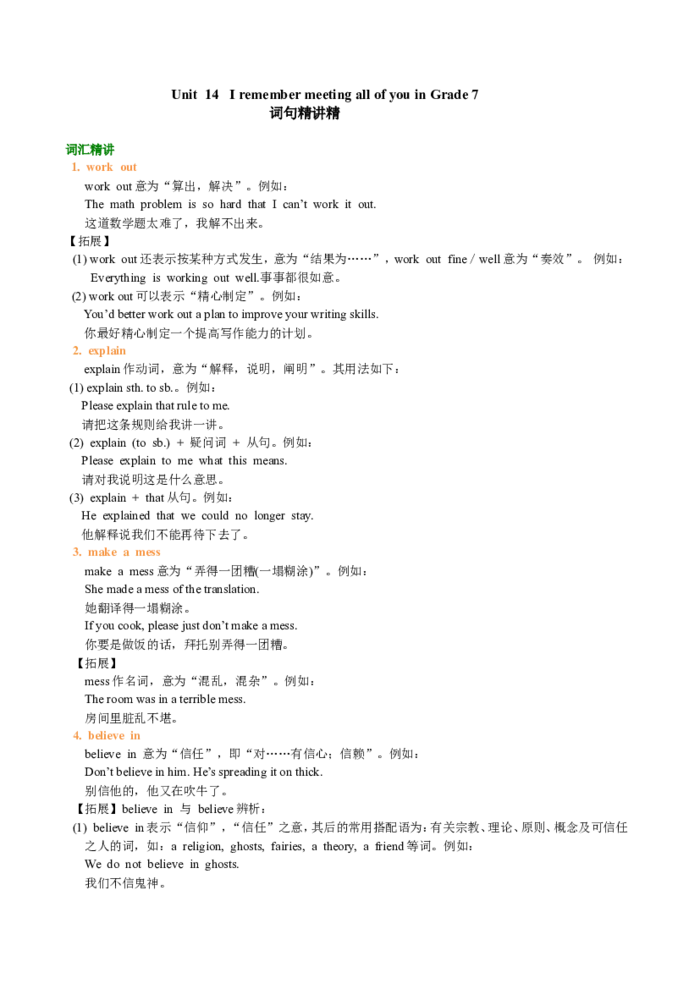
1. work out
work out 意为“算出,解决”。例如:
The math problem is so hard that I can’t work it out.
这道数学题太难了,我解不出来。
【拓展】
(1) work out 还表示按某种方式发生,意为“结果为……”,work out fine/well 意为“奏效”。 例如:
   Everything is working out well.事事都很如意。
(2) work out 可以表示“精心制定”。例如:
You’d better work out a plan to improve your writing skills.
你最好精心制定一个提高写作能力的计划。
2. explain
       explain 作动词,意为“解释,说明,阐明”。其用法如下:
(1) explain sth. to sb.。例如:
Please explain that rule to me.
请把这条规则给我讲一讲。
(2) explain (to sb.) + 疑问词 + 从句。例如:
  Please explain to me what this means.
请对我说明这是什么意思。
(3) explain + that 从句。例如:
  He explained that we could no longer stay.
他解释说我们不能再待下去了。
3. make a mess
make a mess 意为“弄得一团糟(一塌糊涂)”。例如:
She made a mess of the translation.
她翻译得一塌糊涂。
If you cook, please just don’t make a mess.
你要是做饭的话,拜托别弄得一团糟。
【拓展】
mess 作名词,意为“混乱,混杂”。例如:
The room was in a terrible mess.
房间里脏乱不堪。
4. believe in
believe in 意为“信任”,即“对……有信心;信赖”。例如:
Don’t believe in him. He’s spreading it on thick.
别信他的,他又在吹牛了。
【拓展】believe in 与 believe 辨析:
(1) believe in 表示“信仰”,“信任”之意,其后的常用搭配语为:有关宗教、理论、原则、概念及可信任
之人的词,如:a religion, ghosts, fairies, a theory, a friend 等词。例如:
We do not believe in ghosts.
我们不信鬼神。
(2) believe 表示“相信”,“信以为真”,它是及物动词,其后可直接跟宾语。例如:
  Do you believe his reports?
你相信他的报告吗?
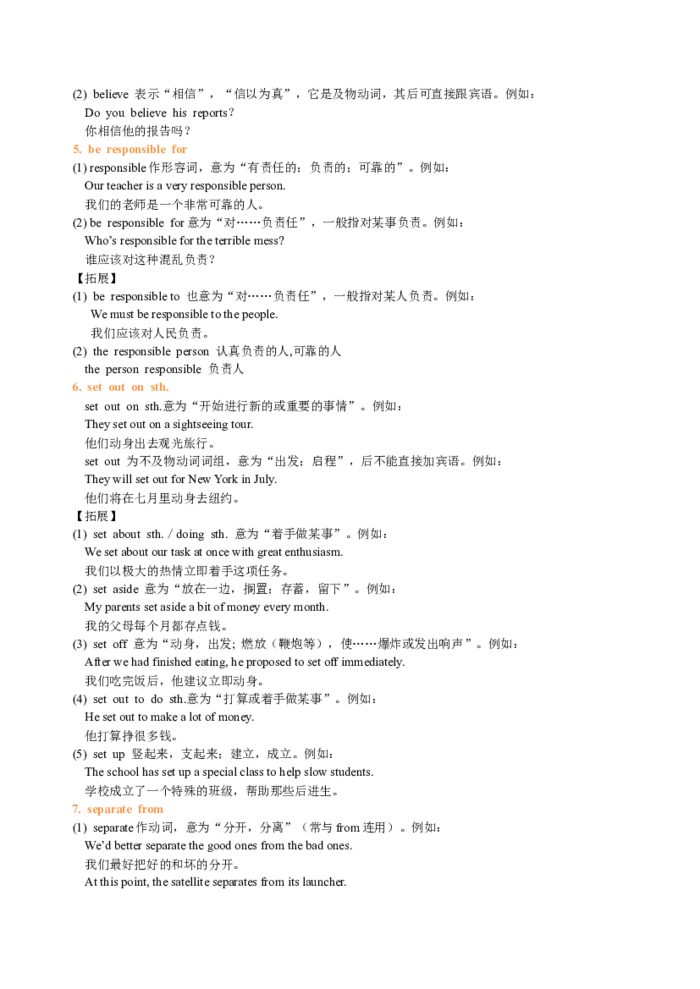
5. be responsible for
(1) responsible 作形容词,意为“有责任的;负责的;可靠的”。例如:
Our teacher is a very responsible person.
我们的老师是一个非常可靠的人。
(2) be responsible for 意为“对……负责任”,一般指对某事负责。例如:
Who’s responsible for the terrible mess?
谁应该对这种混乱负责?
【拓展】
(1) be responsible to 也意为“对……负责任”,一般指对某人负责。例如:
   We must be responsible to the people.
   我们应该对人民负责。
(2) the responsible person 认真负责的人,可靠的人
the person responsible 负责人
6. set out on sth.
set out on sth.意为“开始进行新的或重要的事情”。例如:
They set out on a sightseeing tour.
他们动身出去观光旅行。
set out 为不及物动词词组,意为“出发;启程”,后不能直接加宾语。例如:
They will set out for New York in July.
他们将在七月里动身去纽约。
【拓展】
(1) set about sth./doing sth. 意为“着手做某事”。例如:
We set about our task at once with great enthusiasm.
我们以极大的热情立即着手这项任务。
(2) set aside 意为“放在一边,搁置;存蓄,留下”。例如:
My parents set aside a bit of money every month.
  我的父母每个月都存点钱。
(3) set off 意为“动身,出发; 燃放(鞭炮等),使……爆炸或发出响声”。例如:
After we had finished eating, he proposed to set off immediately.
我们吃完饭后,他建议立即动身。
(4) set out to do sth.意为“打算或着手做某事”。例如:
He set out to make a lot of money.
他打算挣很多钱。
(5) set up 竖起来,支起来;建立,成立。例如:
The school has set up a special class to help slow students.
学校成立了一个特殊的班级,帮助那些后进生。
7. separate from
(1) separate 作动词,意为“分开,分离”(常与from 连用)。例如:
We’d better separate the good ones from the bad ones.
我们最好把好的和坏的分开。
At this point, the satellite separates from its launcher.
此时,卫星就脱离发射器。
 (2) separate 作形容词,意为“分开的,独立的,各自的”。例如:
  The children sleep in separate beds.
孩子们分别睡在各自的床上。
【拓展】
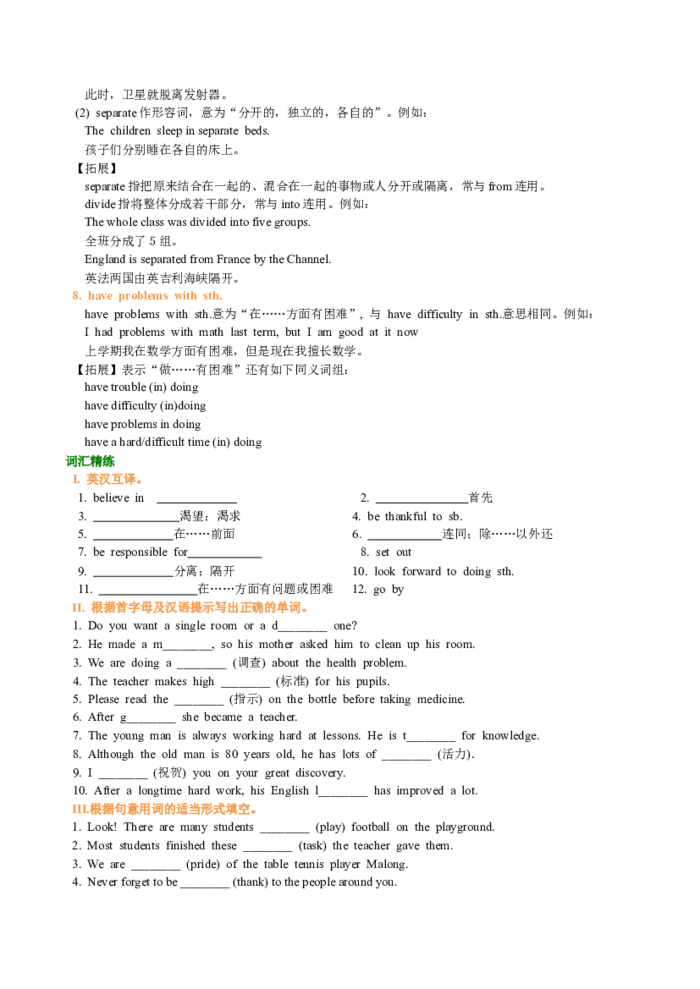
separate 指把原来结合在一起的、混合在一起的事物或人分开或隔离,常与from 连用。
divide 指将整体分成若干部分,常与into 连用。例如:
The whole class was divided into five groups.
全班分成了5组。
England is separated from France by the Channel.
英法两国由英吉利海峡隔开。
8. have problems with sth.
have problems with sth.意为“在……方面有困难”, 与 have difficulty in sth.意思相同。例如:
I had problems with math last term, but I am good at it now
上学期我在数学方面有困难,但是现在我擅长数学。
【拓展】表示“做……有困难”还有如下同义词组:
have trouble (in) doing
have difficulty (in)doing
have problems in doing
have a hard/difficult time (in) doing
词汇精练
I. 英汉互译。
1. believe in                                   2.                首先
3.               渴望;渴求                  4. be thankful to sb.
5.              在……前面                   6.             连同;除……以外还
7. be responsible for                            8. set out
9.              分离;隔开                   10. look forward to doing sth.
11.                 在……方面有问题或困难   12. go by
II. 根据首字母及汉语提示写出正确的单词。
1. Do you want a single room or a d________ one?
2. He made a m________, so his mother asked him to clean up his room.
3. We are doing a ________ (调查) about the health problem.
4. The teacher makes high ________ (标准) for his pupils.
5. Please read the ________ (指示) on the bottle before taking medicine.
6. After g________ she became a teacher.
7. The young man is always working hard at lessons. He is t________ for knowledge.
8. Although the old man is 80 years old, he has lots of ________ (活力).
9. I ________ (祝贺) you on your great discovery.
10. After a longtime hard work, his English l________ has improved a lot.
III.根据句意用词的适当形式填空。
1. Look! There are many students ________ (play) football on the playground.
2. Most students finished these ________ (task) the teacher gave them.
3. We are ________ (pride) of the table tennis player Malong.
4. Never forget to be ________ (thank) to the people around you.
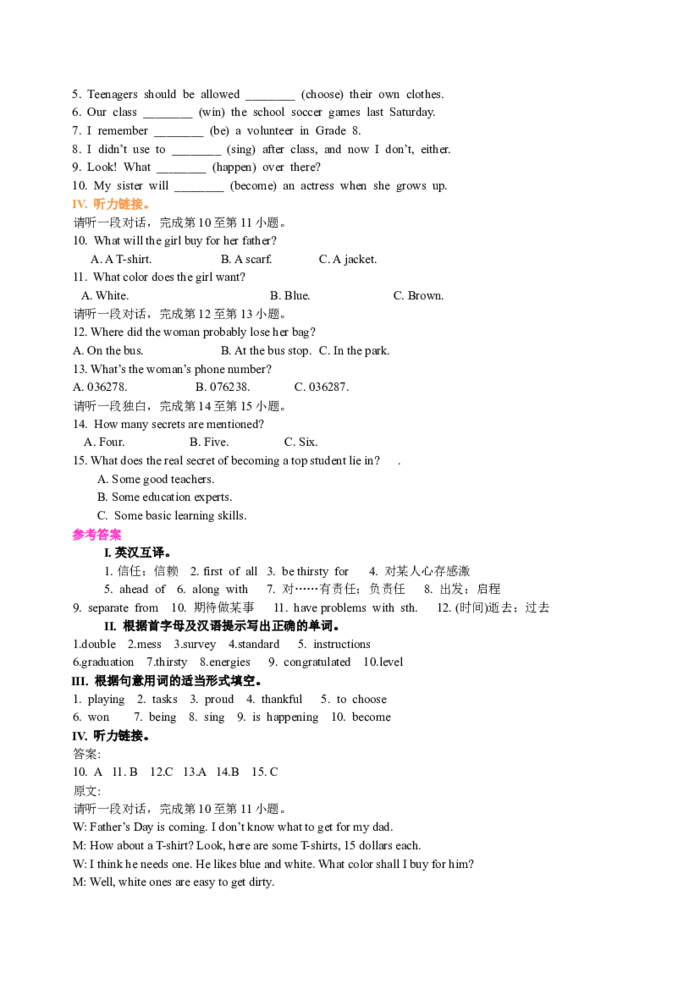
5. Teenagers should be allowed ________ (choose) their own clothes.
6. Our class ________ (win) the school soccer games last Saturday.
7. I remember ________ (be) a volunteer in Grade 8.
8. I didn’t use to ________ (sing) after class, and now I don’t, either.
9. Look! What ________ (happen) over there?
10. My sister will ________ (become) an actress when she grows up.
IV. 听力链接。
请听一段对话,完成第10 至第11 小题。
10.  What will the girl buy for her father?
   A. A T-shirt.
B. A scarf.              C. A jacket.
11.  What color does the girl want?
   A. White.
B. Blue.

C. Brown.
请听一段对话,完成第12 至第13 小题。
12. Where did the woman probably lose her bag?
A. On the bus.
B. At the bus stop.  C. In the park.
13. What’s the woman’s phone number?
A. 036278.
B. 076238.
C. 036287.
请听一段独白,完成第14 至第15 小题。
14.  How many secrets are mentioned?
    A. Four.                     B. Five.                  C. Six.
15. What does the real secret of becoming a top student lie in?      .
    A. Some good teachers.
    B. Some education experts.
    C. Some basic learning skills.
参考答案
I. 英汉互译。
1. 信任;信赖  2. first of all   3. be thirsty for
4. 对某人心存感激
5. ahead of  6. along with   7. 对……有责任;负责任   8. 出发;启程
9. separate from 10. 期待做某事   11. have problems with sth.   12. (时间)逝去;过去
II. 根据首字母及汉语提示写出正确的单词。
1.double 2.mess 3.survey 4.standard   5. instructions
6.graduation 7.thirsty 8.energies   9. congratulated  10.level
III. 根据句意用词的适当形式填空。
1. playing 2. tasks 3. proud 4. thankful   5. to choose
6. won   7. being 8. sing 9. is happening  10. become
IV. 听力链接。
答案:
10. A   11. B    12.C   13.A   14.B    15. C
原文:
请听一段对话,完成第10 至第11 小题。
W: Father’s Day is coming. I don’t know what to get for my dad.
M: How about a T-shirt? Look, here are some T-shirts, 15 dollars each.
W: I think he needs one. He likes blue and white. What color shall I buy for him?
M: Well, white ones are easy to get dirty.
W: Hmm. That’s right. I’ll buy a blue one. Thank you.
请听一段对话,完成第12 至第13 小题。
M: Good morning, Madam. Can I help you?
W: Yes. I’ve lost my bag.
M: Oh, I’m sorry to hear that. Now, where did you lose it?
W: Maybe in the park. I had it when I got off the bus.
M: Was there much money in the bag?
W: No, there wasn’t. I usually have forty or fifty pounds in it.
M: What else was in the bag?
W: Just my wallet.
M: Well, I’ll phone you tomorrow if we find it.
W: OK.
M: What’s your number?
W: It’s 036278. Thank you very much.
M: You’re welcome.
请听一段独白,完成第14 至第15 小题。
    Hello, boys and girls. Do you want to be top students? According to some teachers and education experts,
the children at the top of the class succeed by knowing a few basic skills that others can easily learn. Now, I’d
like to tell you some secrets of top students.
    First of all, study is the first thing. Once the books are open or the computer is on, phone calls are
unanswered and TV shows are unwatched. Study is business; business comes before everything.
    Second, study anywhere or everywhere. Study times are different for different children. Some work late at
night when the house is quiet. Others wake early. St ill others study as soon as they come home from school.
    Next, get organized. Don’t waste time looking for a pencil or missing paper. Keep everything right where one
can put one's hands on it.
    Then, use your time best. Even the best students put off their work sometimes. But when that happens, they
face it. If you want to be at the top, make sure to finish the work on time.
    Finally, take good notes and use them. Reading the text is important, but the teacher is going to test you on
what he or she considers the most important. That’s what you will find in your notes.
    If you follow what I tell you, you will become top students sooner or later.
句式精讲
1. He always took the time to explain things to me clearly whenever I couldn’t understand
anything.
whenever 作连词或副词,具体用法如下:
(1) 作连词,意为“任何时候,不论何时”。例如:

Come whenever you like.
你什么时候想来就来。
(2) 作连词,意为“每当、每逢、每次”。例如:
Whenever we see him we speak to him.
每次见到他,我们都和他说话。
You seem to have a ready-made answer, whenever I ask you a question.
每逢我问你问题, 你总好像有现成的答案。
(3) 作副词,意为“任何时间”,“任何时候”。例如:
On Monday, Wednesday or whenever.
星期一,星期三或随便什么时候。

It’s not urgent,so we can do it next week or whenever.
不是急事,我们可以下星期做或其他时候做。
(4) 作副词,意为“究竟什么时候”。例如:
Whenever did you buy that?
那你到底是什么时候买的?
2. I’m trying to keep my cool.
      cool 作名词,表示“冷静”。keep one’s cool 意为“保持沉着,不让自己失去控制”。例如:
      Even when you argue, you should try to keep your cool.
      即使在争辩时,你也要尽力保持冷静。
【拓展】
(1) cool 用作名词时,还可意为“凉爽;凉爽的时间(或地方)”。例如:
She walked into the cool of the hallway. 她走入了凉爽的过道。
(2) cool 用作形容词时,意为“凉爽的;冷静的,沉着的”,常做定语或表语。例如:
The hall is nice and cool.
大厅既漂亮又凉爽。
Be cool. Everything will be all right.
冷静一点,一切都会没问题的。
(3) cool 也可用于口语中,意为“很棒的,极好的,酷”。例如:
      That singing star is really cool.
那位歌星实在很棒。
3. First of all, I’d like to congratulate all the students who are here today.
first of all 意为“首先,第一” 常常放在句首,后用逗号隔开,表示重要性上的先后。例如:
First of all, let me tell you the news.
首先,让我告诉你这个消息。
【拓展】
    at first 意为“开始,起初”,强调顺序上的先后。例如:
  At first, let me introduce my friend Mike to you. Then…
  首先,我来给你介绍一下我的朋友Mike,然后……
  At first he refused to accept any responsibility but he ended up apologizing.
最初他拒不承认有任何责任, 到头来还是道了歉。
4. Please consider what they’ve done for you and what they mean to you.
consider 作动词,意为“考虑,认为”。它的后面跟名词、动名词或者从句作宾语。例如:
Please consider my suggestion.
请考虑我的建议。
Why don’t you consider visiting Qing Dao?
你为什么不考虑去青岛参观?
I consider that he is a selfish man.
我认为他是一个自私的人。
【拓展】
后接动名词作宾语的动词及短语可参考以下归纳:
完成,实践,值得,忙(finish, practice, be worth, be busy);
考虑,建议,不禁,想(consider, suggest, can’t help, feel like);
错过,习惯,(别)放弃(miss, be used to, give up);
继续,喜欢,(要)介意(keep on, enjoy, mind)。
5. Never fail to be thankful to the people around you.
(1) fail 作动词,意为“失败”,fail to do sth. 意为“未能做某事”。例如:
Yesterday he failed to find his wallet.
昨天他未能找到他的钱包。
He never failed to write to his mother every week.
他从未耽误过每周给他母亲写信。
(2) be thankful to 是固定短语,意为“感谢,感激”。例如:
  I am thankful to my teacher for helping me learn.
  我感谢我的老师帮我学习。
句式精练
I. 句型转换。
1. She said, “I like swimming.” (改为间接引语)
She said      she      swimming.
2. “Open the door, please,” the teacher said to me. (合并为一句)
The teacher asked me           the door.
3. I can work it out however difficult it is. (改为同义句)
I can work it out                difficult it is.
4. They are going to visit the village next week. (改为否定句)
They                visit the village next week.
5. There will be more robots in the future. (改为一般疑问句)
               more robots in the future?
6. Anna can draw pictures with the help of her mother. (改为同义句)
Anna can draw pictures      her          .
7. We are ready for the next exam. (改为同义句)
  We are


        the next exam.
8. Mary comes from England and our school is bigger than hers. (合并为一句)
Mary comes from England and her school is      than     .
9. It took me two

   hours

  to mend the bike. (对划线部分提问)
                 it      you to mend the bike?
10. The children are having fun in the park. (改为同义句)
   The children are                     in the park.
II. 根据汉语意思完成句子。
1. 他总是把事情弄得一团糟。他真是太愚蠢了!
   He always               of things. How foolish he is!
2. 不要紧张。你应该保持冷静。
   Don’t be nervous and you should               .
3. 我记得今天下午给我爸爸打过电话了。
   I remembered                this afternoon.
4. 我能自己算出这些答案。
   I can                     by myself.
5. 在我前面有很多困难的任务。
   I have many difficult tasks           me.
6. 教练要我们站成一排,准备训练。
  The coach asked us                          and get ready to
practice.
7. 他们希望能和我交朋友。
   They                friends with me.
8. 首先,我们需要开办一家公司。
                 , we need to set up a company.
9. 他们准备什么时候出发?
   When      they                    ?
10. 将来学生会在家里学习吗?
       students study at home               ?
III. 补全对话(从方框中选择最佳选项完成对话,有两项多余)。
A. Oh, yes, please. His number is in the phone book.
B. No, I’ll be all right. Thanks for your help.
C. My head hurts and I feel really hot.
D. Could you buy me a bottle of aspirin, please?
E. It doesn’t hurt very much.
F. I can’t. I will play Ping-Pong with our teacher this afternoon.
G. Do you think it’s a good idea?
John: Hello, Jim. May I come in?
Jim: Oh, hello, John. Yes, come in, please.
John: You don’t look well. What’s the matter?
Jim:
  1
John: Oh dear! Why don’t you go to bed for a rest?
Jim:
  2
John: shall I call him and tell him you’re ill?
Jim:
  3
John: OK. I’ll do that. I’m going to the shops now. Can I get you some medicine?
Jim:
  4
John: Yes, of course. Is there anything else I can do?
Jim:
  5
1._____  2._____  3._____  4._____  5._____
IV. 根据短文内容和所给中文提示,用单词的正确形式完成以下短文。
Jean Nicole is a yard sale lover. She appears almost in every yard sale. She doesn’t want to 1._______(错
过) any chance to buy good things, because they are much 2._______(便宜的) than those in shops. She is
interested in almost everything, such as gloves, old 3._______(硬币), paintings, tables and so on. Everybody
4.______(叫,称呼) her “Lady Yard-sale.”
Two weeks 5.________(以前), after Jean came back from a yard sale, she 6._______(进入) her store
room. She was surprised to find that she had bought so many things. Jean counted them and made a
7.________(清单).“Oh, dear! I can’t believe it. There are seven bicycles, 8.________(九) armchairs, and
fifteen cameras... And they haven’t been used even once.” She checked the numbers 9.________(再一次).It
made her mad. “How silly I am!” She thought. “I can no longer go to yard sales 10._______(除非) I hold my
own one to sell these things out. But will anyone buy them?”
参考答案
I. 句型转换。
1. that; liked
    2. to open
        3. no matter how
4. aren’t going to 5. Will there be
6. with; mother’s help
7. preparing for
8. smaller; ours
9. How long did; take
10. having a good/great time
II. 根据汉语意思完成句子。
   1. makes a mess
2. keep your cool
3. calling my father
4. work out these answers
5. ahead of
        6. to stand in a row
7. hope to make
8. First of all
9. are; going to set out
10. Will; in the future
III. 补全对话。从下面方框中选出适当的选项补全对话(有多余选项)。
1-5 C F A D B
IV. 根据短文内容和所给中文提示,用单词的正确形式完成以下短文。
1. miss / lose
2. cheaper
3. coins
4. calls
5. ago
6. entered
7. list
8. nine
9. again
10. unless