文档文本内容
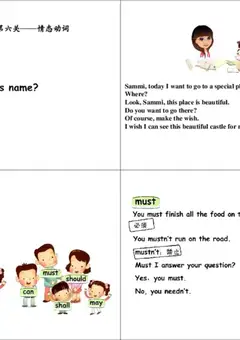
听褚老师讲神马是情态动词
语法一点就通— 情态动词
情态动词
情态动词
用法
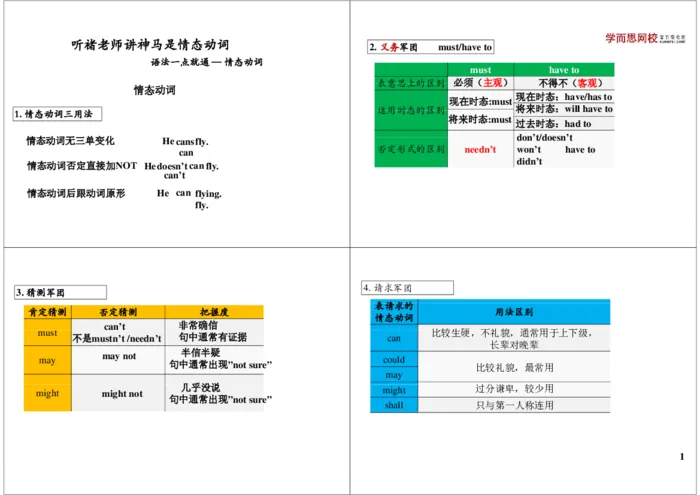
1. 情态动词三用法
H
情态动词无三单变化
He cans fly.
情态动词无三单变化
He
can fl
doesn’t
情态动词否定直接加NOT
can
He
can fly.
doesn’t
can’t
情态动词否定直接加NOT
He can fl i
情态动词后跟动词原形
He can flying.
情态动词后跟动词原形
fly.
2. 义务军团
must/have to
must
have to
表意思上的区别
必须(主观)
不得不(客观)
表意思上的区别
适用时态的区别
现在时态:have/has to
将来时态:will have to
必须(主观)
不得不(客观)
现在时态:must
适用时态的区别
将来时态:will have to
过去时态:had to
don’t/doesn’t
将来时态:must
否定形式的区别
don t/doesn t
won’t have to
didn’t
needn’t
3. 猜测军团
肯定猜测
否定猜测
把握度
t
can’t
非常确信
must
不是mustn’t /needn’t
句中通常有证据
may not
半信半疑
may
may not
句中通常出现”not sure”
几乎没说
might
might not
几乎没说
句中通常出现”not sure”
4. 请求军团
表请求的
表请求的
情态动词
用法区别
比较生硬
不礼貌
通常用于上下级
can
ld
比较生硬,不礼貌,通常用于上下级,
长辈对晚辈
could
may
比较礼貌,最常用
过分谦卑
较少用
might
shall
过分谦卑,较少用
只与第一人称连用
1
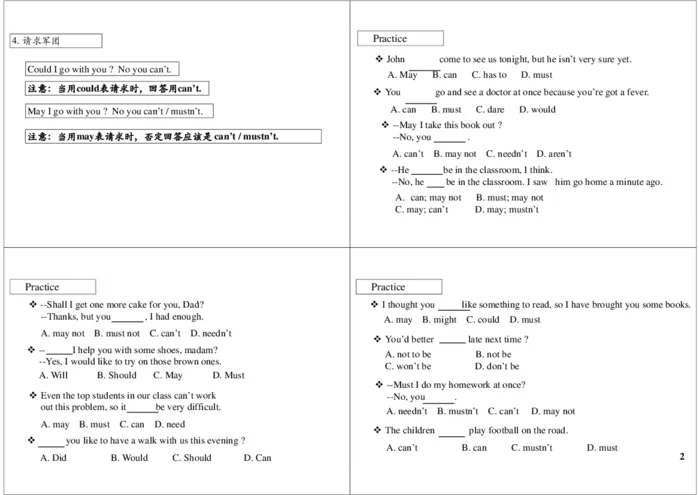
4. 请求军团
Could I go with you ? No you can’t.
注意:当用could表请求时,回答用can’t.
May I go with you ? No you can’t / mustn’t
May I go with you ? No you can t / mustn t.
注意:当用may表请求时
否定回答应该是can’t / mustn’t
注意:当用may表请求时,否定回答应该是can t / mustn t.
Practice
J h
i h b
h i
’
John come to see us tonight, but he isn’t very sure yet.
A. May B. can C. has to D. must
You go and see a doctor at once because you’re got a fever.
A can
B must
C dare
D would
A. can B. must C. dare D. would
--May I take this book out ?
--No you
--No, you .
A. can’t B. may not C. needn’t D. aren’t
--He be in the classroom, I think.
--No, he be in the classroom. I saw him go home a minute ago.
A. can; may not
B. must; may not
C. may; can’t D. may; mustn’t
Practice
Sh ll I
t
k f
D d?
--Shall I get one more cake for you, Dad?
--Thanks, but you , I had enough.
A
B
C
’
D
d ’
A. may not B. must not C. can’t D. needn’t
--
I help you with some shoes, madam?
--Yes, I would like to try on those brown ones.
A. Will B. Should C. May D. Must
Even the top students in our class can’t work
out this problem, so it be very difficult.
p
y
A. may B. must C. can D. need
lik t h
lk
ith
thi
i
?
you like to have a walk with us this evening ?
A. Did B. Would C. Should D. Can
Practice
I th
ht
lik
thi
t
d
I h
b
ht
b
k
I thought you like something to read, so I have brought you some books.
A. may B. might C. could D. must
You’d better late next time ?
A. not to be B. not be
. ot to be
. ot be
C. won’t be D. don’t be
Must I do my homework at once?
--Must I do my homework at once?
--No, you .
A needn’t
B mustn’t
C can’t
D may not
A. needn t B. mustn t C. can t D. may not
The children play football on the road.
A. can’t B. can C. mustn’t D. must
2
Practice
His arm is all right He
go and see the doctor
His arm is all right. He go and see the doctor.
A. has not to B. don’t have to
C. haven’t to D. doesn’t have to
C. ave
t to . does
t ave to
--Must we do our homework first ?
--No, you .You may have a rest first.
A
’
B
d ’
A. mustn’t B. needn’t
C. may not D. can’t
Practice
--
you like to see a film ?
-- Yes, I like .
,
A. Will; to B. would; to see
C. Would; to D. Will; to see
--Hi, Tom. Any idea where Jane is ?
--She in the classroom.
I saw her there just now.
A. shall be B. should have been
C. Must be D. might have been
Practice
--Do you know whose dictionary it is ?
--It Li Mei’s. Her name is on it.
A. can be B. must be
C should
D need be
C. should D. need be
3