文档文本内容
高 中
时 事
满大街的银杏树为什么还是濒危物种?
Why Ginkgoes Everywhere Are Still Endangered?
cover [ˈkʌvər]
v. 遮盖;包括;报道 / n. 封面;
遮盖物;庇护所
golden [ˈɡoʊldən]
adj. 金色的;绝好的
leaf [liːf]
n. 叶;叶片
surprisingly [sərˈpraɪzɪŋli]
adv. 令人惊讶地;出乎意料地
protect [prəˈtekt]
v. 保护
plant [plænt]
n. 植物;作物;车间;装置;工
厂;发电厂 / v. 种植;栽培;安
置;放置
remain [rɪˈmeɪn]
v. 剩下;留下;保持
distinguish [dɪˈstɪŋɡwɪʃ]
v. 区分;使有别于;辨认;使出
众
refer [rɪˈfɜːr]
v. 引用;提到;参考
survival [sərˈvaɪv(ə)l]
n. 生存;存活;幸存;残存物
natural [ˈnætʃrəl]
adj. 自然的;天然的
population [ˌpɑːpjuˈleɪʃ(ə)n]
n. 人口
reserve [rɪˈzɜːrv]
v. 保留;储备;预订 / n. 储备;
保留;保护区;候补
threat [θret]
n. 威胁;恐吓;凶兆
outside [ˌaʊtˈsaɪd]
adv. 在外面 / n. 外面;外边;外
部 / prep. 在...外 / adj. 外面的;
外界的
naturally [ˈnætʃrəli]
adv. 自然地;理所当然地
单词数:165个
@2025/11/10  ✅每日1篇时事阅读  ✅高效积累高中3500词
DATE:
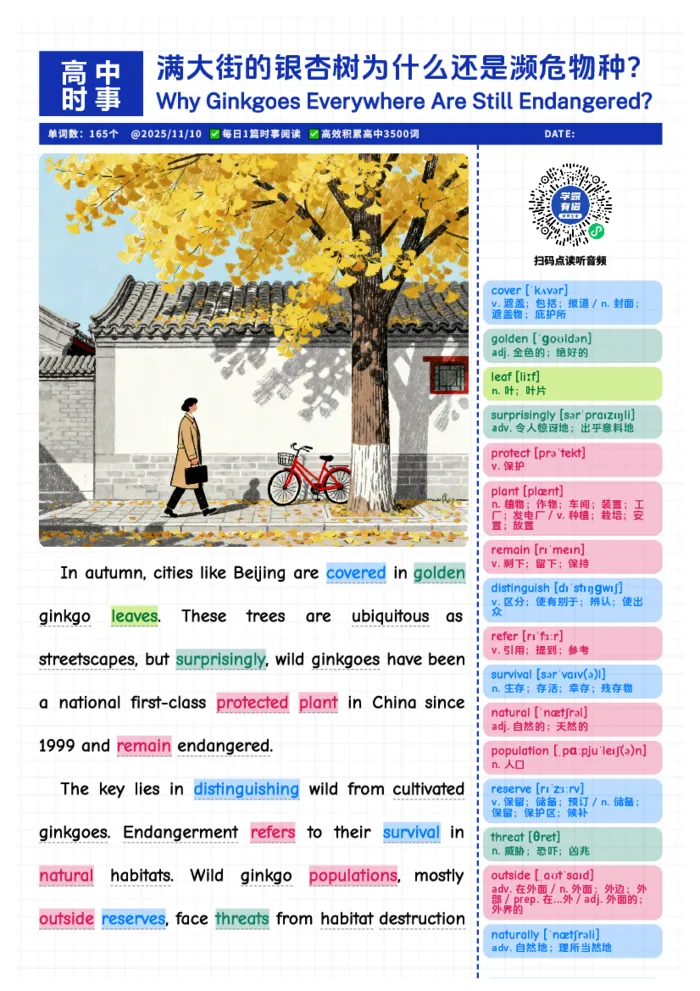
In autumn, cities like Beijing are covered in golden
ginkgo   leaves. These   trees   are   ubiquitous   as
streetscapes, but surprisingly, wild ginkgoes have been
a national first-class protected plant in China since
1999 and remain endangered.
The key lies in distinguishing wild from cultivated
ginkgoes. Endangerment   refers   to   their   survival in
natural   habitats. Wild   ginkgo   populations,   mostly
outside reserves, face threats from habitat destruction
扫码点读听音频
decade [ˈdekeɪd]
n. 十年
urban [ˈɜːrbən]
adj. 城市的;都市的
diversity [daɪˈvɜːrsəti]
n. 多样性;多样化
mostly [ˈmoʊstli]
adv. 主要地;大部分;通常
relate [rɪˈleɪt]
v. 讲;叙述;有关;把…联系起
来;认同;理解
lack [læk]
v. 缺乏;短缺 / n. 缺乏;短缺
survive [sərˈvaɪv]
v. 幸存;生存;存活
entire [ɪnˈtaɪər]
adj. 全部的;整个的;完全的
gene [dʒiːn]
n. 基因
disease [dɪˈziːz]
n. 病;疾病
wipe [waɪp]
v. 擦;抹;拭;消除 / n. 擦拭;
抹布
stem [stem]
n. 柄;茎;词干 / v. 阻止;起源
于(~ from)
secure [sɪˈkjʊr]
adj. 安全的;可靠的;稳定的 / v.
(使)安全;担保;(使)获得
ancient [ˈeɪnʃənt]
adj. 古代的;古老的 / n. 古人
future [ˈfjuːtʃər]
n. 未来;将来;前途 / adj. 将来
的;未来的
and human transplantation. No naturally regenerated
seedlings have been found near adult wild trees for a
decade.
Urban ginkgoes are mostly closely related, lacking
genetic diversity. As the only surviving species in its
entire class, the extinction of ginkgoes would mean
the loss of an entire botanical class. A single disease
could   wipe   out   all   cultivated   ginkgoes   due   to their
similar genes.
Known   as   "living   fossils"   existing   for   270 million
years,   ginkgoes   are   long-lived   thanks   to non-aging
stem   cells   and   strong   resistance. Yet   their   wild
population crisis reminds us that common cultivated
trees   don’t   equal   a   secure   future   for   this ancient
species.