文档文本内容
高 中
时 事
威力巨大的海啸是如何产生的?
How Do Powerful Tsunamis Form?
earthquake [ˈɜːrθkweɪk]
n. 地震
massive [ˈmæsɪv]
adj. 大而重的;大规模的
amount [əˈmaʊnt]
n. 数量;数额 / v. 总计;等于
sudden [ˈsʌd(ə)n]
adj. 突然的;忽然的 / n. 突然发
生
movement [ˈmuːvmənt]
n. 活动;运动;动作;乐章
create [kriˈeɪt]
v. 创造;创作
wave [weɪv]
n. 波;波浪;海浪;挥手 / v. 挥
手;挥舞;招手;起伏
race [reɪs]
n. 种族;赛跑;竞争 / v. 比赛;
快速移动
across [əˈkrɔːs]
adv. 横过;穿过;越过;在对面
/ prep. 穿过;横过;在…对面
ocean [ˈoʊʃ(ə)n]
n. 海洋;大海
cause [kɔːz]
n. 原因;理由;理想;事业 / v.
导致;引起
include [ɪnˈkluːd]
v. 包括;包含
volcano [vɑːlˈkeɪnoʊ]
n. 火山
explode [ɪkˈsploʊd]
v. (使)爆炸;爆发
displace [dɪsˈpleɪs]
单词数:150个
@2025/07/31   ✅每日1篇时事阅读  ✅高效积累高中3500词
DATE:
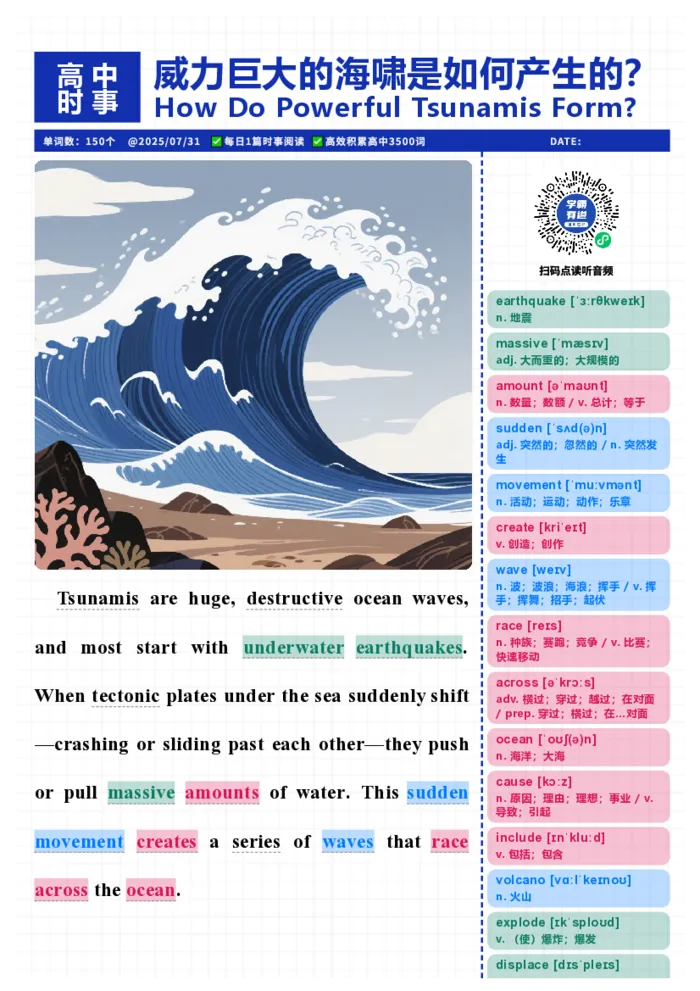
Tsunamis   are   huge,   destructive   ocean waves,
and   most   start   with   underwater   earthquakes.
When tectonic plates under the sea suddenly shift
—crashing or sliding past each other—they push
or pull massive amounts of water. This sudden
movement   creates   a   series   of   waves   that race
across the ocean.
扫码点读听音频
v. 取代;移置;免职;迫使…离
开家园
slide [slaɪd]
v. (使)滑动;下滑 / n. 幻灯
片;滑梯
reach [riːtʃ]
v. 达到;抵达 / n. 伸手可及的距
离
shallow [ˈʃæloʊ]
adj. 浅的;浅薄的
coastal [ˈkoʊst(ə)l]
adj. 海岸的;沿海岸的
grow [ɡroʊ]
v. 生长;成长;种植;渐渐变成
destroy [dɪˈstrɔɪ]
v. 破坏;摧毁
building [ˈbɪldɪŋ]
n. 建筑物;楼房 / v. 建
筑;“build”的现在分词
flood [flʌd]
n. 洪水;水灾 / v. 淹没;泛滥
city [ˈsɪti]
n. 城市
harm [hɑːrm]
v. 伤害;损害 / n. 伤害;损害
warning [ˈwɔːrnɪŋ]
n. 警示;警戒 / v. 警告;告
诫;“warn”的现在分词
protect [prəˈtekt]
v. 保护
Other   causes   include   underwater   volcanic
eruptions   or   landslides. A   volcano   exploding
under the sea can displace water quickly, while a
large   chunk   of   seabed   sliding   downward   also
pushes   water   upward,   forming   tsunami waves.
In deep oceans, these waves are not very tall—
often just 1 to 2 meters—but they move extremely
fast, up to 800 km/h, like a jet plane. As they
reach shallow coastal areas, the water piles up,
growing into walls of water tens of meters high.
These giant waves can destroy buildings, flood
cities,   and   harm   people. Though   tsunamis are
rare, understanding their causes helps us build
better warnings and protect coastal communities.