2025-2026 学年七年级上册英语单元测试
Unit 4·提升卷
学校:___________班级:___________姓名:___________分数:___________
(时间:90 分钟,满分:100 分)
一、单项选择。(本大题共15 小题,每小题1 分,共15 分)
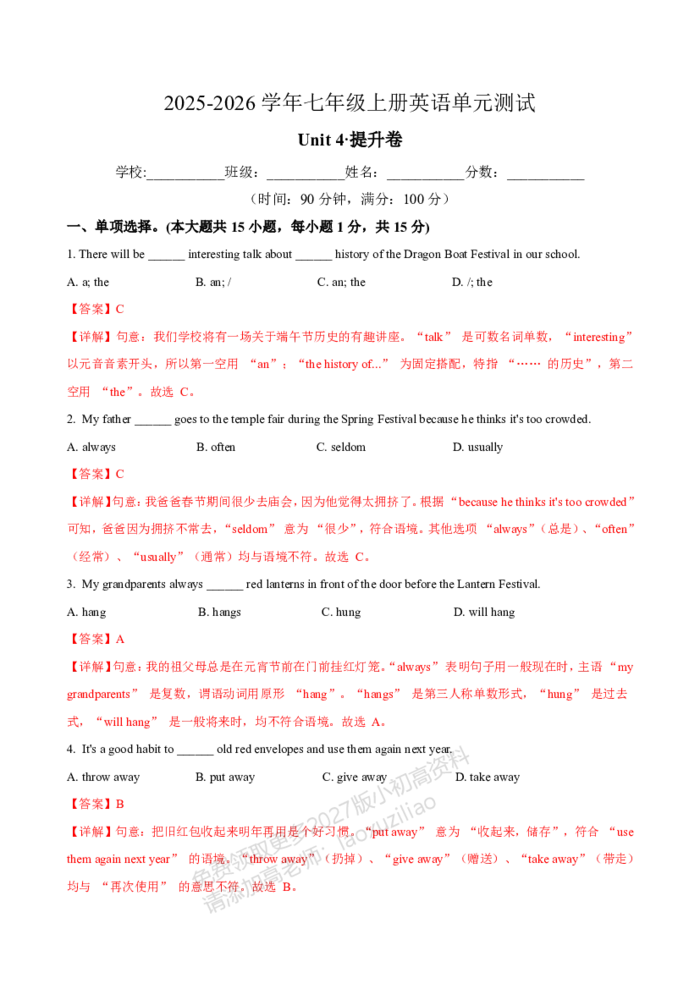
1. There will be ______ interesting talk about ______ history of the Dragon Boat Festival in our school.
A. a; the
B. an; /
C. an; the
D. /; the
【答案】C
【详解】句意:我们学校将有一场关于端午节历史的有趣讲座。“talk” 是可数名词单数,“interesting”
以元音音素开头,所以第一空用“an”;“the history of...” 为固定搭配,特指“…… 的历史”,第二
空用“the”。故选C。
2. My father ______ goes to the temple fair during the Spring Festival because he thinks it's too crowded.
A. always
B. often
C. seldom
D. usually
【答案】C
【详解】句意:我爸爸春节期间很少去庙会,因为他觉得太拥挤了。根据“because he thinks it's too crowded”
可知,爸爸因为拥挤不常去,“seldom” 意为“很少”,符合语境。其他选项“always”(总是)、“often”
(经常)、“usually”(通常)均与语境不符。故选C。
3. My grandparents always ______ red lanterns in front of the door before the Lantern Festival.
A. hang
B. hangs
C. hung
D. will hang
【答案】A
【详解】句意:我的祖父母总是在元宵节前在门前挂红灯笼。“always” 表明句子用一般现在时,主语“my
grandparents” 是复数,谓语动词用原形“hang”。“hangs” 是第三人称单数形式,“hung” 是过去
式,“will hang” 是一般将来时,均不符合语境。故选A。
4. It's a good habit to ______ old red envelopes and use them again next year.
A. throw away
B. put away
C. give away
D. take away
【答案】B
【详解】句意:把旧红包收起来明年再用是个好习惯。“put away” 意为“收起来,储存”,符合“use
them again next year” 的语境。“throw away”(扔掉)、“give away”(赠送)、“take away”(带走)
均与“再次使用” 的意思不符。故选B。
版小初高资料
2027
免费领取更多
laoxuziliao
:
请添加高老师
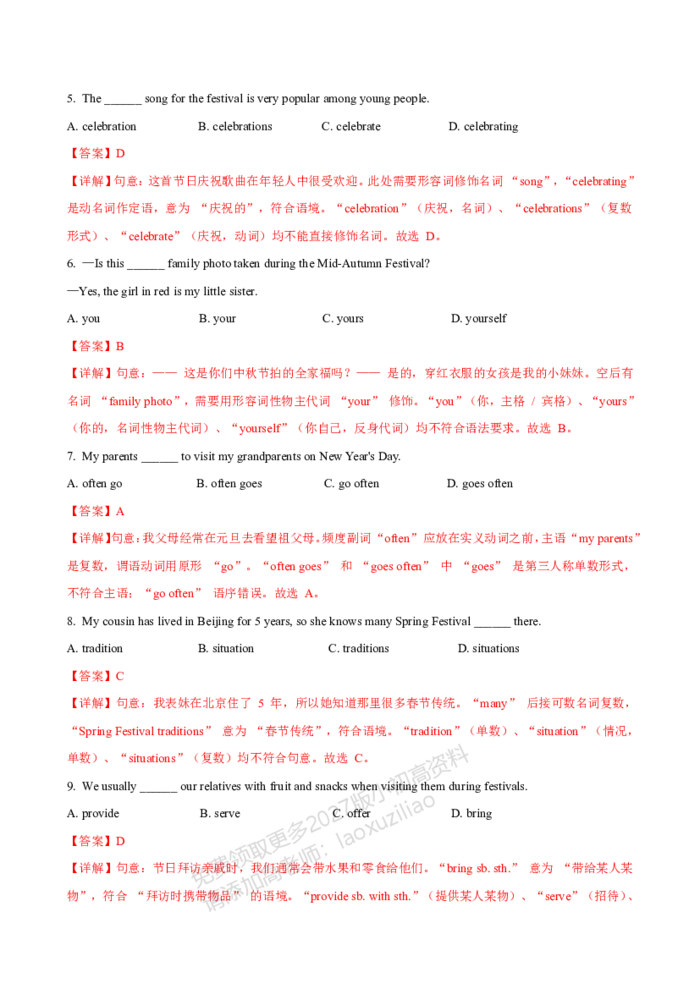
5. The ______ song for the festival is very popular among young people.
A. celebration
B. celebrations
C. celebrate
D. celebrating
【答案】D
【详解】句意:这首节日庆祝歌曲在年轻人中很受欢迎。此处需要形容词修饰名词“song”,“celebrating”
是动名词作定语,意为“庆祝的”,符合语境。“celebration”(庆祝,名词)、“celebrations”(复数
形式)、“celebrate”(庆祝,动词)均不能直接修饰名词。故选D。
6. —Is this ______ family photo taken during the Mid-Autumn Festival?
—Yes, the girl in red is my little sister.
A. you
B. your
C. yours
D. yourself
【答案】B
【详解】句意:—— 这是你们中秋节拍的全家福吗?—— 是的,穿红衣服的女孩是我的小妹妹。空后有
名词“family photo”,需要用形容词性物主代词“your” 修饰。“you”(你,主格/ 宾格)、“yours”
(你的,名词性物主代词)、“yourself”(你自己,反身代词)均不符合语法要求。故选B。
7. My parents ______ to visit my grandparents on New Year's Day.
A. often go
B. often goes
C. go often
D. goes often
【答案】A
【详解】句意:我父母经常在元旦去看望祖父母。频度副词“often”应放在实义动词之前,主语“my parents”
是复数,谓语动词用原形“go”。“often goes” 和“goes often” 中“goes” 是第三人称单数形式,
不符合主语;“go often” 语序错误。故选A。
8. My cousin has lived in Beijing for 5 years, so she knows many Spring Festival ______ there.
A. tradition
B. situation
C. traditions
D. situations
【答案】C
【详解】句意:我表妹在北京住了5 年,所以她知道那里很多春节传统。“many” 后接可数名词复数,
“Spring Festival traditions” 意为“春节传统”,符合语境。“tradition”(单数)、“situation”(情况,
单数)、“situations”(复数)均不符合句意。故选C。
9. We usually ______ our relatives with fruit and snacks when visiting them during festivals.
A. provide
B. serve
C. offer
D. bring
【答案】D
【详解】句意:节日拜访亲戚时,我们通常会带水果和零食给他们。“bring sb. sth.” 意为“带给某人某
物”,符合“拜访时携带物品” 的语境。“provide sb. with sth.”(提供某人某物)、“serve”(招待)、
版小初高资料
2027
免费领取更多
laoxuziliao
:
请添加高老师
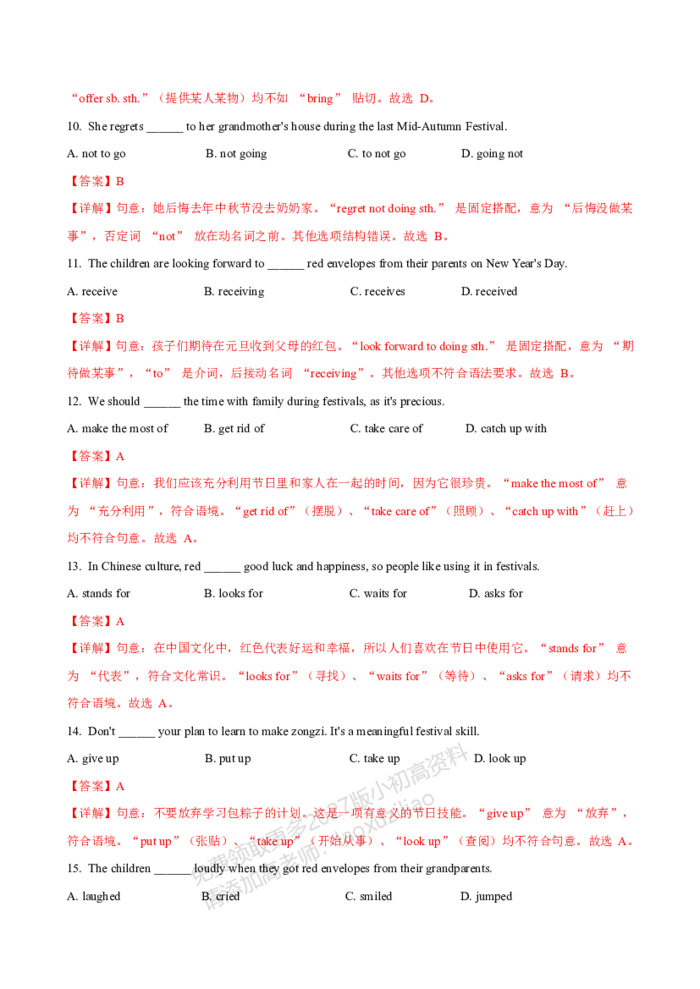
“offer sb. sth.”(提供某人某物)均不如“bring” 贴切。故选D。
10. She regrets ______ to her grandmother's house during the last Mid-Autumn Festival.
A. not to go
B. not going
C. to not go
D. going not
【答案】B
【详解】句意:她后悔去年中秋节没去奶奶家。“regret not doing sth.” 是固定搭配,意为“后悔没做某
事”,否定词“not” 放在动名词之前。其他选项结构错误。故选B。
11. The children are looking forward to ______ red envelopes from their parents on New Year's Day.
A. receive
B. receiving
C. receives
D. received
【答案】B
【详解】句意:孩子们期待在元旦收到父母的红包。“look forward to doing sth.” 是固定搭配,意为“期
待做某事”,“to” 是介词,后接动名词“receiving”。其他选项不符合语法要求。故选B。
12. We should ______ the time with family during festivals, as it's precious.
A. make the most of
B. get rid of
C. take care of
D. catch up with
【答案】A
【详解】句意:我们应该充分利用节日里和家人在一起的时间,因为它很珍贵。“make the most of” 意
为“充分利用”,符合语境。“get rid of”(摆脱)、“take care of”(照顾)、“catch up with”(赶上)
均不符合句意。故选A。
13. In Chinese culture, red ______ good luck and happiness, so people like using it in festivals.
A. stands for
B. looks for
C. waits for
D. asks for
【答案】A
【详解】句意:在中国文化中,红色代表好运和幸福,所以人们喜欢在节日中使用它。“stands for” 意
为“代表”,符合文化常识。“looks for”(寻找)、“waits for”(等待)、“asks for”(请求)均不
符合语境。故选A。
14. Don't ______ your plan to learn to make zongzi. It's a meaningful festival skill.
A. give up
B. put up
C. take up
D. look up
【答案】A
【详解】句意:不要放弃学习包粽子的计划。这是一项有意义的节日技能。“give up” 意为“放弃”,
符合语境。“put up”(张贴)、“take up”(开始从事)、“look up”(查阅)均不符合句意。故选A。
15. The children ______ loudly when they got red envelopes from their grandparents.
A. laughed
B. cried
C. smiled
D. jumped
版小初高资料
2027
免费领取更多
laoxuziliao
:
请添加高老师
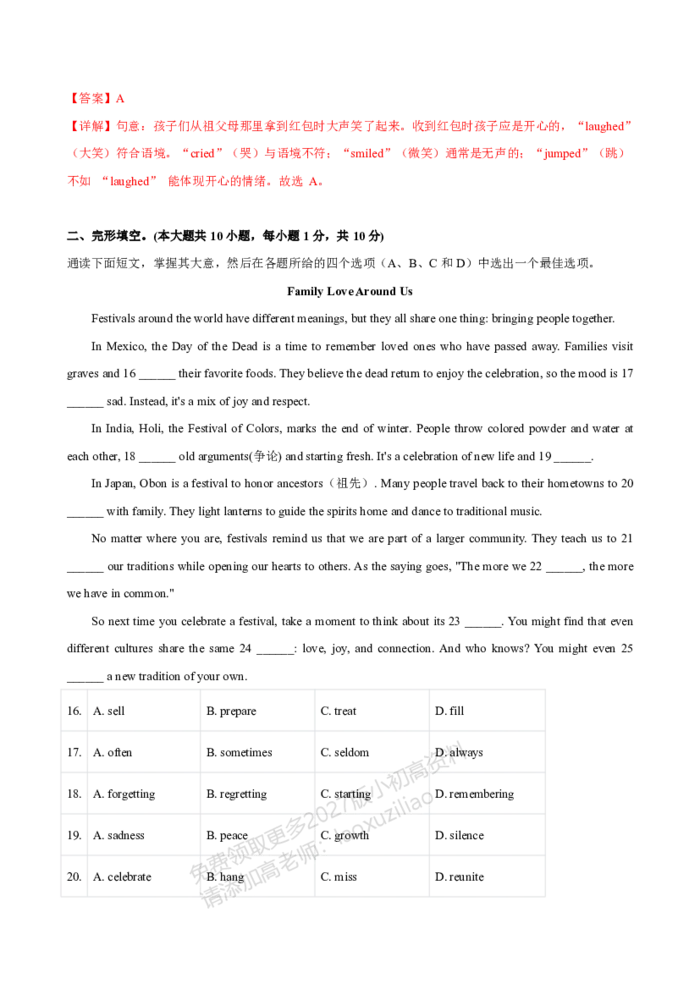
【答案】A
【详解】句意:孩子们从祖父母那里拿到红包时大声笑了起来。收到红包时孩子应是开心的,“laughed”
(大笑)符合语境。“cried”(哭)与语境不符;“smiled”(微笑)通常是无声的;“jumped”(跳)
不如“laughed” 能体现开心的情绪。故选A。
二、完形填空。(本大题共10 小题,每小题1 分,共10 分)
通读下面短文,掌握其大意,然后在各题所给的四个选项(A、B、C 和D)中选出一个最佳选项。
Family Love Around Us
Festivals around the world have different meanings, but they all share one thing: bringing people together.
In Mexico, the Day of the Dead is a time to remember loved ones who have passed away. Families visit
graves and 16 ______ their favorite foods. They believe the dead return to enjoy the celebration, so the mood is 17
______ sad. Instead, it's a mix of joy and respect.
In India, Holi, the Festival of Colors, marks the end of winter. People throw colored powder and water at
each other, 18 ______ old arguments(争论) and starting fresh. It's a celebration of new life and 19 ______.
In Japan, Obon is a festival to honor ancestors(祖先). Many people travel back to their hometowns to 20
______ with family. They light lanterns to guide the spirits home and dance to traditional music.
No matter where you are, festivals remind us that we are part of a larger community. They teach us to 21
______ our traditions while opening our hearts to others. As the saying goes, "The more we 22 ______, the more
we have in common."
So next time you celebrate a festival, take a moment to think about its 23 ______. You might find that even
different cultures share the same 24 ______: love, joy, and connection. And who knows? You might even 25
______ a new tradition of your own.
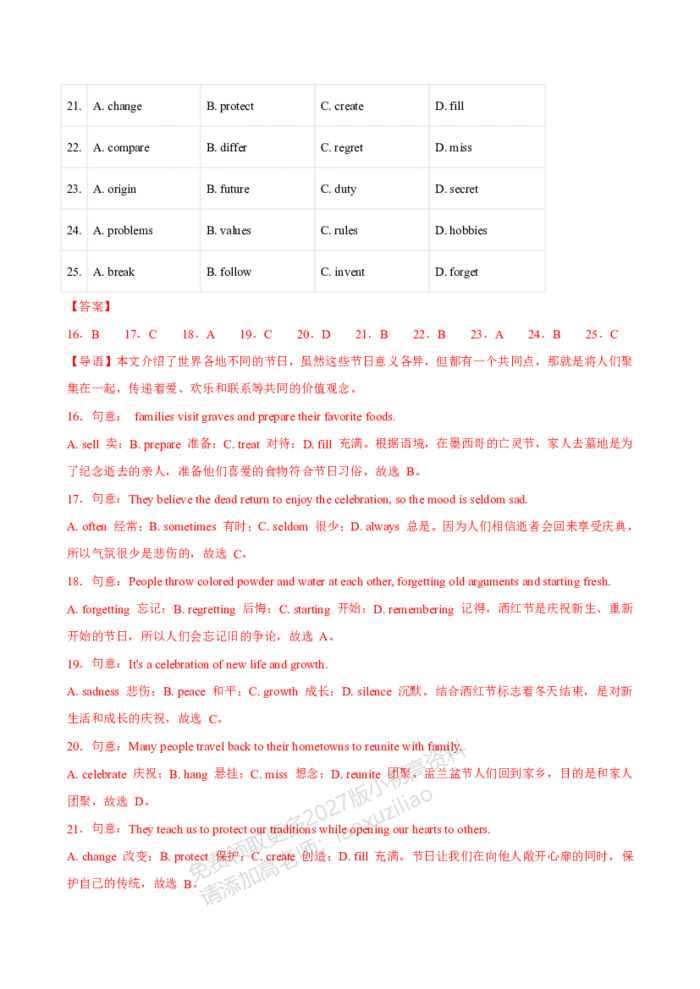
16.
A. sell
B. prepare
C. treat
D. fill
17.
A. often
B. sometimes
C. seldom
D. always
18.
A. forgetting
B. regretting
C. starting
D. remembering
19.
A. sadness
B. peace
C. growth
D. silence
20.
A. celebrate
B. hang
C. miss
D. reunite
版小初高资料
2027
免费领取更多
laoxuziliao
:
请添加高老师
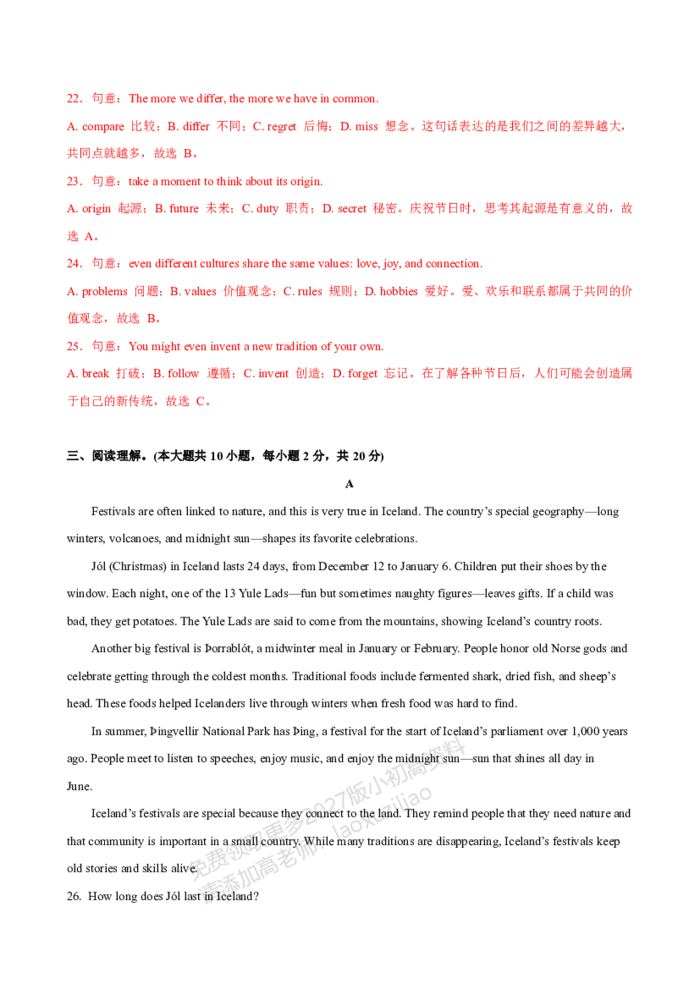
21.
A. change
B. protect
C. create
D. fill
22.
A. compare
B. differ
C. regret
D. miss
23.
A. origin
B. future
C. duty
D. secret
24.
A. problems
B. values
C. rules
D. hobbies
25.
A. break
B. follow
C. invent
D. forget
【答案】
16.B
17.C
18.A
19.C
20.D
21.B
22.B
23.A
24.B
25.C
【导语】本文介绍了世界各地不同的节日,虽然这些节日意义各异,但都有一个共同点,那就是将人们聚
集在一起,传递着爱、欢乐和联系等共同的价值观念。
16.句意:families visit graves and prepare their favorite foods.
A. sell 卖;B. prepare 准备;C. treat 对待;D. fill 充满。根据语境,在墨西哥的亡灵节,家人去墓地是为
了纪念逝去的亲人,准备他们喜爱的食物符合节日习俗,故选B。
17.句意:They believe the dead return to enjoy the celebration, so the mood is seldom sad.
A. often 经常;B. sometimes 有时;C. seldom 很少;D. always 总是。因为人们相信逝者会回来享受庆典,
所以气氛很少是悲伤的,故选C。
18.句意:People throw colored powder and water at each other, forgetting old arguments and starting fresh.
A. forgetting 忘记;B. regretting 后悔;C. starting 开始;D. remembering 记得。洒红节是庆祝新生、重新
开始的节日,所以人们会忘记旧的争论,故选A。
19.句意:It's a celebration of new life and growth.
A. sadness 悲伤;B. peace 和平;C. growth 成长;D. silence 沉默。结合洒红节标志着冬天结束,是对新
生活和成长的庆祝,故选C。
20.句意:Many people travel back to their hometowns to reunite with family.
A. celebrate 庆祝;B. hang 悬挂;C. miss 想念;D. reunite 团聚。盂兰盆节人们回到家乡,目的是和家人
团聚,故选D。
21.句意:They teach us to protect our traditions while opening our hearts to others.
A. change 改变;B. protect 保护;C. create 创造;D. fill 充满。节日让我们在向他人敞开心扉的同时,保
护自己的传统,故选B。
版小初高资料
2027
免费领取更多
laoxuziliao
:
请添加高老师
22.句意:The more we differ, the more we have in common.
A. compare 比较;B. differ 不同;C. regret 后悔;D. miss 想念。这句话表达的是我们之间的差异越大,
共同点就越多,故选B。
23.句意:take a moment to think about its origin.
A. origin 起源;B. future 未来;C. duty 职责;D. secret 秘密。庆祝节日时,思考其起源是有意义的,故
选A。
24.句意:even different cultures share the same values: love, joy, and connection.
A. problems 问题;B. values 价值观念;C. rules 规则;D. hobbies 爱好。爱、欢乐和联系都属于共同的价
值观念,故选B。
25.句意:You might even invent a new tradition of your own.
A. break 打破;B. follow 遵循;C. invent 创造;D. forget 忘记。在了解各种节日后,人们可能会创造属
于自己的新传统,故选C。
三、阅读理解。(本大题共10 小题,每小题2 分,共20 分)
A
Festivals are often linked to nature, and this is very true in Iceland. The country’s special geography—long
winters, volcanoes, and midnight sun—shapes its favorite celebrations.
Jól (Christmas) in Iceland lasts 24 days, from December 12 to January 6. Children put their shoes by the
window. Each night, one of the 13 Yule Lads—fun but sometimes naughty figures—leaves gifts. If a child was
bad, they get potatoes. The Yule Lads are said to come from the mountains, showing Iceland’s country roots.
Another big festival is Þorrablót, a midwinter meal in January or February. People honor old Norse gods and
celebrate getting through the coldest months. Traditional foods include fermented shark, dried fish, and sheep’s
head. These foods helped Icelanders live through winters when fresh food was hard to find.
In summer, Þingvellir National Park has Þing, a festival for the start of Iceland’s parliament over 1,000 years
ago. People meet to listen to speeches, enjoy music, and enjoy the midnight sun—sun that shines all day in
June.
Iceland’s festivals are special because they connect to the land. They remind people that they need nature and
that community is important in a small country. While many traditions are disappearing, Iceland’s festivals keep
old stories and skills alive.
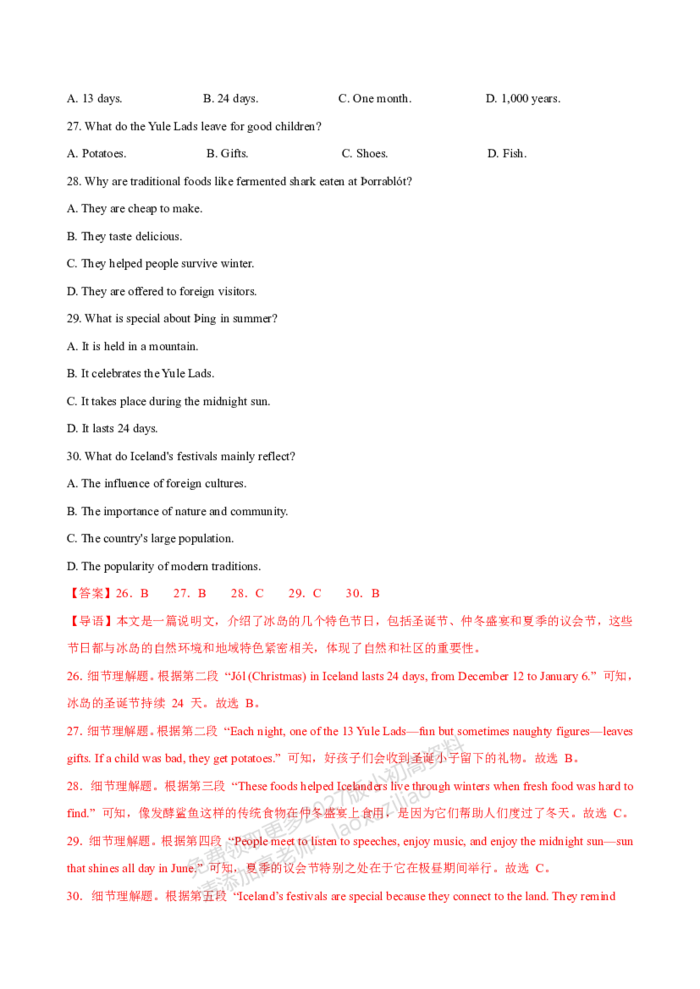
26. How long does Jól last in Iceland?
版小初高资料
2027
免费领取更多
laoxuziliao
:
请添加高老师
A. 13 days.
B. 24 days.
C. One month.
D. 1,000 years.
27. What do the Yule Lads leave for good children?
A. Potatoes.
B. Gifts.
C. Shoes.
D. Fish.
28. Why are traditional foods like fermented shark eaten at Þorrablót?
A. They are cheap to make.
B. They taste delicious.
C. They helped people survive winter.
D. They are offered to foreign visitors.
29. What is special about Þing in summer?
A. It is held in a mountain.
B. It celebrates the Yule Lads.
C. It takes place during the midnight sun.
D. It lasts 24 days.
30. What do Iceland's festivals mainly reflect?
A. The influence of foreign cultures.
B. The importance of nature and community.
C. The country's large population.
D. The popularity of modern traditions.
【答案】26.B
27.B
28.C
29.C
30.B
【导语】本文是一篇说明文,介绍了冰岛的几个特色节日,包括圣诞节、仲冬盛宴和夏季的议会节,这些
节日都与冰岛的自然环境和地域特色紧密相关,体现了自然和社区的重要性。
26.细节理解题。根据第二段“Jól (Christmas) in Iceland lasts 24 days, from December 12 to January 6.” 可知,
冰岛的圣诞节持续24 天。故选B。
27.细节理解题。根据第二段“Each night, one of the 13 Yule Lads—fun but sometimes naughty figures—leaves
gifts. If a child was bad, they get potatoes.” 可知,好孩子们会收到圣诞小子留下的礼物。故选B。
28.细节理解题。根据第三段“These foods helped Icelanders live through winters when fresh food was hard to
find.” 可知,像发酵鲨鱼这样的传统食物在仲冬盛宴上食用,是因为它们帮助人们度过了冬天。故选C。
29.细节理解题。根据第四段“People meet to listen to speeches, enjoy music, and enjoy the midnight sun—sun
that shines all day in June.” 可知,夏季的议会节特别之处在于它在极昼期间举行。故选C。
30.细节理解题。根据第五段“Iceland’s festivals are special because they connect to the land. They remind
版小初高资料
2027
免费领取更多
laoxuziliao
:
请添加高老师
people that they need nature and that community is important in a small country.” 可知,冰岛的节日主要反映了
自然和社区的重要性。故选B。
B
Korea is a country with rich traditional festivals, many of which are closely tied to family and seasons. These
festivals help people remember their history and stay connected to their roots.
Chuseok, also known as Korean Thanksgiving, is one of the biggest festivals. It falls in September or October,
when the harvest is ready. Families get together to share a big meal with special foods like songpyeon—small rice
cakes filled with beans or nuts. People also visit their ancestors’ graves to show respect and thank them for the
good harvest.
Seollal, the Korean New Year, is another important festival. It takes place in late January or early February,
following the lunar calendar. On this day, children wear colorful traditional clothes called hanbok. They bow to
their elders and receive sebaetdon—small amounts of money as a New Year’s gift. Families eat tteokguk, a soup
with rice cakes, which is thought to bring good luck for the new year.
Unlike Chuseok and Seollal, Dano is a spring festival. It comes in early June. Long ago, people would wash
their hair with iris water to keep healthy, and women would swing on swings to wish for a good harvest. Today,
some of these old customs are still kept alive in villages.
Korean festivals are more than just days off—they are a way to pass down traditions from one generation to
the next. They remind people of the importance of family, gratitude, and living in harmony with nature.
31. When does Chuseok usually take place?
A. In January or February.
B. In June.
C. In September or October.
D. In December.
32. What does the word “respect” mean in the paragraph 2?
A. 怀念
B. 尊敬
C. 重视
D. 忽略.
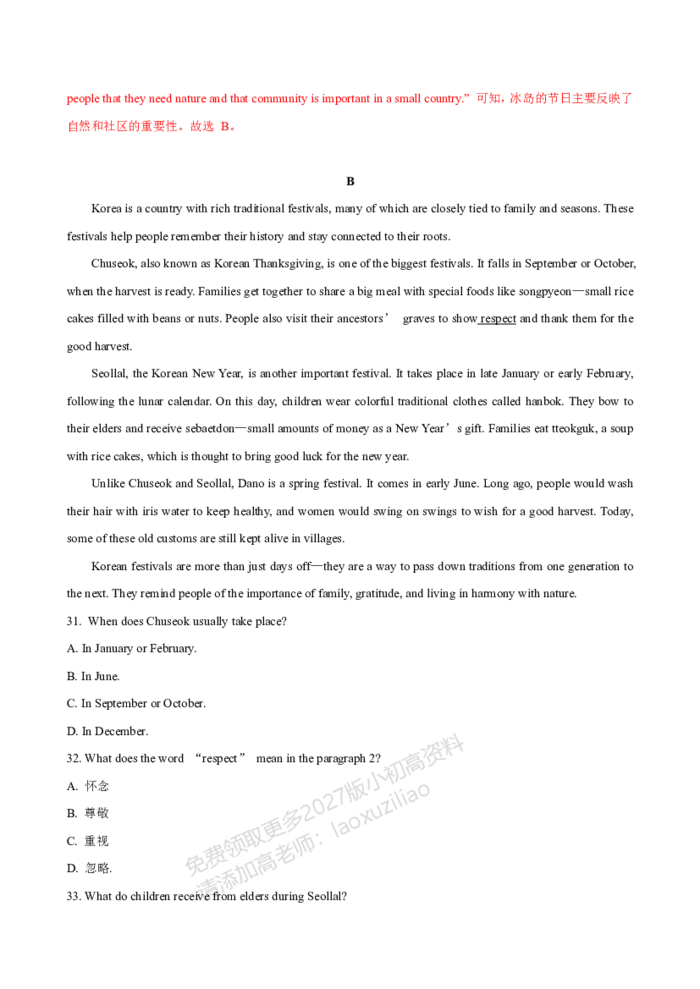
33. What do children receive from elders during Seollal?
版小初高资料
2027
免费领取更多
laoxuziliao
:
请添加高老师
A. Rice cakes.
B. Money.
C. Traditional clothes.
D. Iris water.
34. What is a custom of Dano?
A. Visiting ancestors’ graves.
B. Wearing hanbok.
C. Swinging on swings.
D. Eating tteokguk.
35. What is the main idea of the passage?
A. Korean festivals are all about eating special foods.
B. Korean festivals connect people to their family, history and nature.
C. Seollal is the most important festival in Korea.
D. Dano is different from other Korean festivals.
【答案】31.C 32.B 33.B 34.C 35.B
【导语】本文是一篇说明文,介绍了韩国的几个传统节日,包括秋夕、春节和端午,这些节日与家庭和季
节紧密相关,是传承传统、连接人们与家庭、历史和自然的重要方式。
31.细节理解题。根据第二段“Chuseok, also known as Korean Thanksgiving, is one of the biggest festivals. It
falls in September or October, when the harvest is ready.” 可知,秋夕通常在九月或十月举行。故选C。
32.词义猜测题。根据第二段“People also visit their ancestors’ graves to show respect and thank them for the
good harvest.” 可知,人们在秋夕拜访祖先的坟墓,结合语境和常识,这是为了表达对祖先的尊敬,所以
“respect” 意为“尊敬”。故选B。
33.细节理解题。根据第三段“On this day, children wear colorful traditional clothes called hanbok. They bow
to their elders and receive sebaetdon—small amounts of money as a New Year’s gift.” 可知,春节期间孩子们
会从长辈那里收到钱。故选B。
34.细节理解题。根据第四段“Unlike Chuseok and Seollal, Dano is a spring festival. It comes in early June.
Long ago, people would wash their hair with iris water to keep healthy, and women would swing on swings to
wish for a good harvest.” 可知,荡秋千是端午的习俗。故选C。
35.主旨大意题。根据第一段“Korea is a country with rich traditional festivals, many of which are closely tied
to family and seasons. These festivals help people remember their history and stay connected to their roots.”以及
版小初高资料
2027
免费领取更多
laoxuziliao
:
请添加高老师
最后一段“Korean festivals are more than just days off—they are a way to pass down traditions from one
generation to the next. They remind people of the importance of family, gratitude, and living in harmony with
nature.” 可知,本文主要讲述韩国的节日将人们与家庭、历史和自然联系在一起。故选B。
四、补全对话。(本大题共5 小题,每小题1 分,共5 分)
从选项中选择合适的句子,补全对话。其中有一项多余。
Tom: I'm learning about traditional festivals around the world. 36. ______
Lisa: Yes! Canada has some fun ones, like the Winter Carnival and Canada Day.
Tom: 37. ______
Lisa: The Winter Carnival is in February, usually in Quebec City. It's one of the biggest winter festivals.
Tom: 38. ______
Lisa: They build huge ice sculptures(雕塑), have parades, and even races on ice.
Tom: That sounds cool. What about Canada Day?
Lisa: It's on July 1st, celebrating the country's founding. 39. ______
Tom: 40. ______
Lisa: They often have barbecues, watch fireworks, and eat poutine—a dish with fries, cheese, and gravy.
Tom: Wow, I want to learn more about these festivals!
A. What do people eat on Canada Day?
B. When is the Winter Carnival held?
C. Do you know any Canadian festivals?
D. How do people celebrate it?
E. What's your favorite Canadian festival?
F. Is the Calgary Stampede a summer event?
G. Why do they have ice sculptures?
【答案】36.C 37.B 38.D 39.D 40.A
【导语】本文是汤姆和莉萨之间的对话,汤姆正在了解世界各地的传统节日,莉萨向他介绍了加拿大的冬
季狂欢节和加拿大日这两个有趣的节日,包括节日的时间、庆祝方式等内容。
36.根据下文莉萨的回答“Yes! Canada has some fun ones, like the Winter Carnival and Canada Day.” 可知,
版小初高资料
2027
免费领取更多
laoxuziliao
:
请添加高老师
莉萨回应了加拿大有哪些节日,所以汤姆的问题应该是询问对方是否知道加拿大的节日。C 选项“Do you
know any Canadian festivals?”(你知道加拿大的一些节日吗?)符合语境。故选C。
37.根据下文莉萨的回答“The Winter Carnival is in February, usually in Quebec City.” 可知,莉萨说明了
冬季狂欢节的时间,所以汤姆的问题应该是询问冬季狂欢节在什么时候举行。B 选项“When is the Winter
Carnival held?”(冬季狂欢节在什么时候举行?)符合语境。故选B。
38.根据下文莉萨的回答“They build huge ice sculptures, have parades, and even races on ice.” 可知,莉萨
描述了人们在冬季狂欢节的庆祝活动,所以汤姆的问题应该是询问人们如何庆祝这个节日。D 选项“How
do people celebrate it?”(人们如何庆祝它?)符合语境。故选D。
39.根据上文汤姆询问加拿大日,莉萨介绍了加拿大日在7 月1 日以及是为了庆祝国家成立,结合下文
莉萨描述了人们在加拿大日的活动,可知此处莉萨的话是引出人们如何庆祝加拿大日,所以这里应填询问
庆祝方式的句子。D 选项“How do people celebrate it?”(人们如何庆祝它?)符合语境。故选D。
40.根据下文莉萨的回答“They often have barbecues, watch fireworks, and eat poutine...” 可知,莉萨提到
了人们在加拿大日吃的食物,所以汤姆的问题应该是询问人们在加拿大日吃什么。A 选项“What do people
eat on Canada Day?”(人们在加拿大日吃什么?)符合语境。故选A。
五、完成句子。(本大题共10 小题,每小题2 分,共20 分)
41. 加拿大日的庆祝活动每年7 月1 日举行。
The Canada Day celebrations ______ ______ on July 1st every year.
【答案】take, place
【详解】“举行” 常用的固定搭配是take place。句子描述的是每年发生的事情,用一般现在时,主语
“celebrations” 是复数,动词用原形。所以第一个空填take,第二个空填place。
42. 在寒冷的冬日里,许多人想在冬季狂欢节喝热巧克力。
On cold winter days, many people ______ ______ drinking hot chocolate at the Winter Carnival.
【答案】feel, like
【详解】“想要做某事” 常用的固定搭配是feel like doing sth.。句子描述的是一般情况,用一般现在时,
主语“people” 是复数,动词用原形。所以第一个空填feel,第二个空填like。
43. 当老人搬不动沉重的节日装饰品时,一些年轻志愿者立刻来帮忙。
When the old man couldn't carry the heavy festival decorations, some young volunteers ______ ______ his help
immediately.
【答案】came, to
版小初高资料
2027
免费领取更多
laoxuziliao
:
请添加高老师
【详解】“来帮助某人” 常用的固定搭配是come to one's help。句子中“couldn't” 表明时态是一般过
去时,所以动词用过去式。第一个空填came,第二个空填to。
44. 真正的朋友总会支持彼此,即使在最繁忙的节日准备期间。
True friends always ______ ______ each other, even during the busiest festival preparations.
【答案】stand, by
【详解】“支持某人” 常用的固定搭配是stand by sb.。句子描述的是一般情况,用一般现在时,主语
“friends” 是复数,动词用原形。所以第一个空填stand,第二个空填by。
45. 游客们对魁北克冬季狂欢节上冰雕的规模感到震惊。
The tourists ______ ______ at the size of the ice sculptures at Quebec's Winter Carnival.
【答案】were, shocked
【详解】“对…… 感到震惊” 常用的固定搭配是be shocked at。句子描述的是过去发生的事情,主语
“tourists” 是复数,所以be 动词用were。第一个空填were,第二个空填shocked。
46. 人们在清明节常常去祭拜祖先。
People often go to honor their ancestors on ______ ______ ______ .
【答案】the, Tomb-Sweeping, Day
【详解】“清明节” 的固定表达是the Tomb-Sweeping Day,是专有名词,每个单词的首字母都要大写。
所以依次填the, Tomb-Sweeping, Day。
47. 他从未放弃过在节日期间帮助他人的想法。
He has never ______ ______ the idea of helping others during festivals.
【答案】given, up
【详解】“放弃” 常用的固定搭配是give up。句子中“has never” 表明时态是现在完成时,动词用过
去分词形式。所以第一个空填given,第二个空填up。
48. 春节期间,家家户户都充满了欢声笑语。
Every family ______ ______ joy and laughter during the Spring Festival.
【答案】is, full
【详解】“充满……”常用的固定搭配是be full of。句子描述的是一般情况,用一般现在时,主语“family”
在这里指“家庭”,是单数,所以be 动词用is。第一个空填is,第二个空填full。
49. 为了保护环境,我们不应该在节日里砍伐树木。
We shouldn't ______ ______ trees during festivals to protect the environment.
【答案】cut, down
版小初高资料
2027
免费领取更多
laoxuziliao
:
请添加高老师
【详解】“砍伐” 常用的固定搭配是cut down。“shouldn't” 后接动词原形。所以第一个空填cut,第
二个空填down。
50. 我的父母同意我在节日期间参加志愿者活动。
My parents ______ ______ me about participating in volunteer activities during festivals.
【答案】agree, with
【详解】“同意某人” 常用的固定搭配是agree with sb.。句子描述的是一般情况,用一般现在时,主语
“parents” 是复数,动词用原形。所以第一个空填agree,第二个空填with。
六、首字母填空。(本大题共10 小题,每小题1 分,共10 分)
阅读下面材料,在空白处填入适当的内容(1 个单词)或括号内单词的正确形式。
Holi, the Festival of Colors, is a popular celebration in India. It t
51
place in late February or early
March, when winter ends and spring begins. Thousands of people j____52____ in the fun across the country.
Holi has old stories behind it. People say it remembers the win of good over evil. On Holi's eve, called
Holika Dahan, big fires are lit. People gather around, hoping their bad thoughts will be gone—just like the evil
Holika, who was b____53____ in the fire in an old tale. Children often sing songs near the fire, adding to the
happy a____54____.
On Holi day, the streets are full of color. People go out with bags of colored powder (gulal) and water
balloons. They laugh and throw color at friends and even strangers. The air is f____55____ with shouts of "Happy
Holi!" and music from drums. Everyone looks forward to this c____56____ time.
Food is important too. Families make special treats. Gujiya, a sweet pastry with nuts and sugar, is loved by
many. They also drink thandai, a special drink. People share these foods to s____57____ love and happiness.
Holi is more than fun. It brings people together. No one thinks about differences like class or age. Everyone
joins the fun. It's a time to f____58____ and forget past fights. When they put color on each other, it means old
problems are gone, and a new start begins.
Now, Holi is celebrated in many countries. It spreads joy, unity, and the win of good everywhere. More and
more people learn about its special m____59____ and want to be part of it. It's truly a festival that connects people
from d____60____ parts of the world.
【答案】
51.takes
52.join
53.burned
54.atmosphere
55.filled
56.colorful
57.share
58.forgive
59.meaning
60.different
版小初高资料
2027
免费领取更多
laoxuziliao
:
请添加高老师
【导语】本文介绍了印度著名的洒红节,包括其举办时间、背后的传说、庆祝活动、相关美食以及节日的
意义,还提到如今洒红节已在多个国家流行。
51.句意:它在二月底或三月初举行,此时冬季结束,春季开始。“take place” 是固定短语,意为“举
行、发生”。主语“It” 是第三人称单数,且句子描述一般情况,用一般现在时,所以填takes。
52.句意:全国成千上万的人参与到这场欢乐中。“join in” 是固定搭配,意为“参与、加入”。句子
描述一般情况,用一般现在时,主语“people” 是复数,所以填join。
53.句意:就像古老传说中邪恶的霍利卡被烧死一样。根据“in the fire” 可知,此处指被烧死,“burn”
意为“燃烧”,这里用被动语态,填burned。
54.句意:孩子们经常在火边唱歌,增添了欢乐的气氛。“atmosphere” 意为“气氛”,符合语境,所
以填atmosphere。
55.句意:空气中充满了“洒红节快乐!” 的呼喊声和鼓声。“be filled with” 是固定短语,意为“充
满”,所以填filled。
56.句意:每个人都期待这个多彩的时刻。前文提到洒红节充满色彩,“colorful” 意为“多彩的”,符
合语境,所以填colorful。
57.句意:人们分享这些食物来传递爱和幸福。“share” 意为“分享”,此处表示通过分享食物传递情
感,所以填share。
58.句意:这是一个原谅和忘记过去争斗的时刻。根据“forget past fights” 可知,此处指原谅,“forgive”
意为“原谅”,所以填forgive。
59.句意:越来越多的人了解到它特殊的意义,并想参与其中。“meaning” 意为“意义”,符合语境,
所以填meaning。
60.句意:它确实是一个连接世界不同地区人们的节日。“different” 意为“不同的”,修饰“parts of
the world”,所以填different。
八、书面表达。(共10 分)
假设你有一位外国笔友,他对中国的传统节日很感兴趣。请你给他写一封信,介绍一个你最喜欢的中
国传统节日,包括这个节日的时间、人们的主要活动以及它对你的意义。
要求:
词数80-100 左右;
文中不得出现真实的人名、校名;
条理清晰,语句通顺。
版小初高资料
2027
免费领取更多
laoxuziliao
:
请添加高老师
___________________________________________________________________________________________
___________________________________________________________________________________________
___________________________________________________________________________________________
_________________
例文:
Dear Tom,
I'm glad you're interested in Chinese traditional festivals. My favorite is the Mid-Autumn Festival. It falls on
the 15th day of the eighth lunar month.
On this day, families get together. We eat mooncakes, which are round like the moon, and enjoy the bright
full moon. My parents often tell stories about the moon, like the tale of Chang'e.
For me, it's a time to feel the warmth of family. No matter how busy we are, we come together. I love this
festival very much.
Best wishes,
Li Ming
【解析】[总体分析]
①题材:本文是一篇应用文,为写给外国笔友的书信;
②时态:时态以一般现在时为主,用于介绍节日的常规情况和人们的习惯性活动;
③提示:写作要点包括介绍一个最喜欢的中国传统节日的时间、人们的主要活动以及对自己的意义,需在
80-100 词左右,且不能出现真实人名、校名,要保证条理清晰、语句通顺。
[写作步骤]
第一步,开头问候笔友,表明知道对方对中国传统节日感兴趣,并引出自己最喜欢的节日;
第二步,介绍该节日的具体时间;
第三步,描述人们在这个节日里的主要活动,如家庭团聚、吃特色食物等;
第四步,阐述这个节日对自己的意义;
第五步,结尾送上祝福并署名。
版小初高资料
2027
免费领取更多
laoxuziliao
:
请添加高老师