文档文本内容
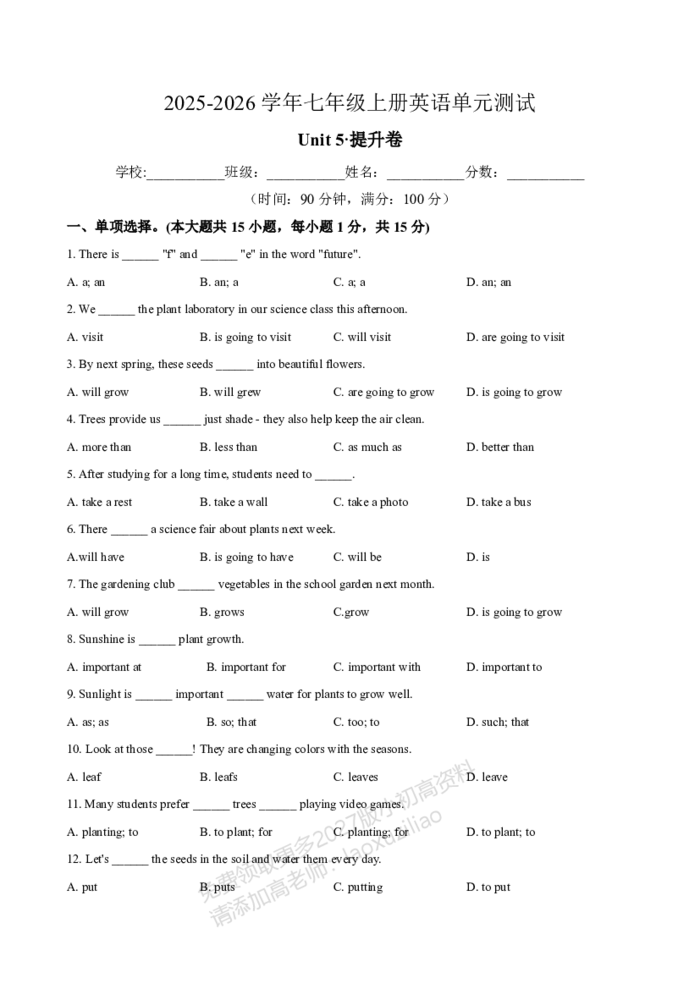
2025-2026 学年七年级上册英语单元测试
Unit 5·提升卷
学校:___________班级:___________姓名:___________分数:___________
(时间:90 分钟,满分:100 分)
一、单项选择。(本大题共15 小题,每小题1 分,共15 分)
1. There is ______ "f" and ______ "e" in the word "future".
A. a; an
B. an; a
C. a; a
D. an; an
2. We ______ the plant laboratory in our science class this afternoon.
A. visit
B. is going to visit
C. will visit
D. are going to visit
3. By next spring, these seeds ______ into beautiful flowers.
A. will grow
B. will grew
C. are going to grow
D. is going to grow
4. Trees provide us ______ just shade - they also help keep the air clean.
A. more than
B. less than
C. as much as
D. better than
5. After studying for a long time, students need to ______.
A. take a rest
B. take a wall
C. take a photo
D. take a bus
6. There ______ a science fair about plants next week.
A.will have
B. is going to have
C. will be
D. is
7. The gardening club ______ vegetables in the school garden next month.
A. will grow
B. grows
C.grow
D. is going to grow
8. Sunshine is ______ plant growth.
A. important at
B. important for
C. important with
D. important to
9. Sunlight is ______ important ______ water for plants to grow well.
A. as; as
B. so; that
C. too; to
D. such; that
10. Look at those ______! They are changing colors with the seasons.
A. leaf
B. leafs
C. leaves
D. leave
11. Many students prefer ______ trees ______ playing video games.
A. planting; to
B. to plant; for
C. planting; for
D. to plant; to
12. Let's ______ the seeds in the soil and water them every day.
A. put
B. puts
C. putting
D. to put
版小初高资料
2027
免费领取更多
laoxuziliao
:
请添加高老师
13. Gardening is very ______ among young people these days.
A. popular
B. popularly
C. more popular
D. most popular
14. —I'm going to study how plants make food.
—Plant science isn't really ______. I like animal science better.
A.my cup of tea
B. my cup of coffee
C. in my cup
D. a piece of cake
15. ______ necessary to protect our environment.
A. It's
B. Its
C. It
D. That's
二、完形填空。(本大题共10 小题,每小题1 分,共10 分)
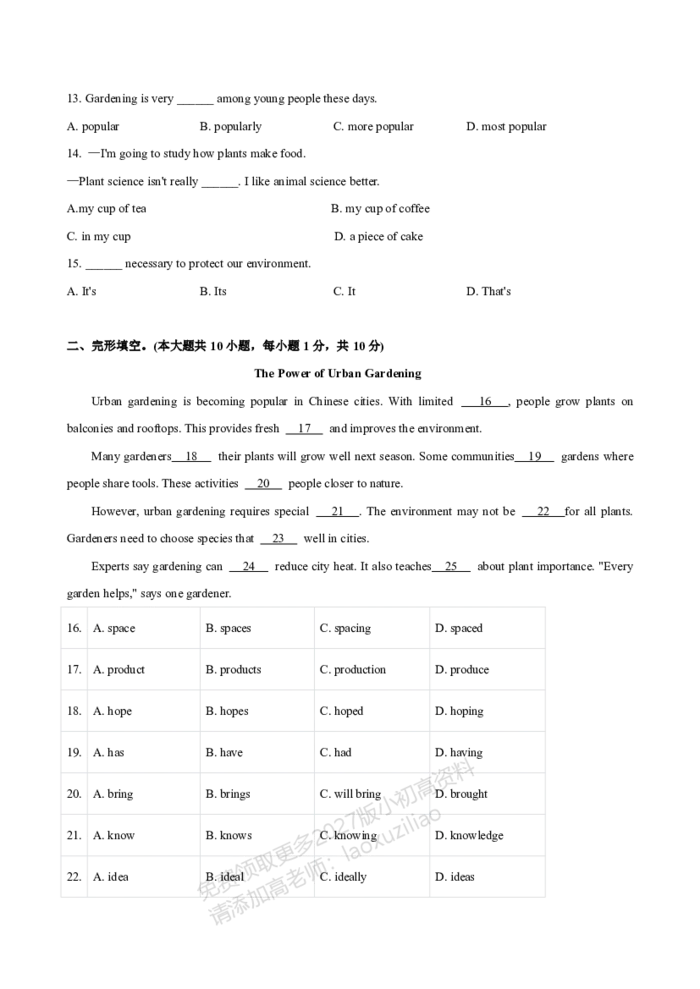
The Power of Urban Gardening
Urban gardening is becoming popular in Chinese cities. With limited
16
, people grow plants on
balconies and rooftops. This provides fresh
17
and improves the environment.
Many gardeners
18
their plants will grow well next season. Some communities
19
gardens where
people share tools. These activities
20
people closer to nature.
However, urban gardening requires special
21
. The environment may not be
22
for all plants.
Gardeners need to choose species that
23
well in cities.
Experts say gardening can
24
reduce city heat. It also teaches
25
about plant importance. "Every
garden helps," says one gardener.
16.
A. space
B. spaces
C. spacing
D. spaced
17.
A. product
B. products
C. production
D. produce
18.
A. hope
B. hopes
C. hoped
D. hoping
19.
A. has
B. have
C. had
D. having
20.
A. bring
B. brings
C. will bring
D. brought
21.
A. know
B. knows
C. knowing
D. knowledge
22.
A. idea
B. ideal
C. ideally
D. ideas
版小初高资料
2027
免费领取更多
laoxuziliao
:
请添加高老师
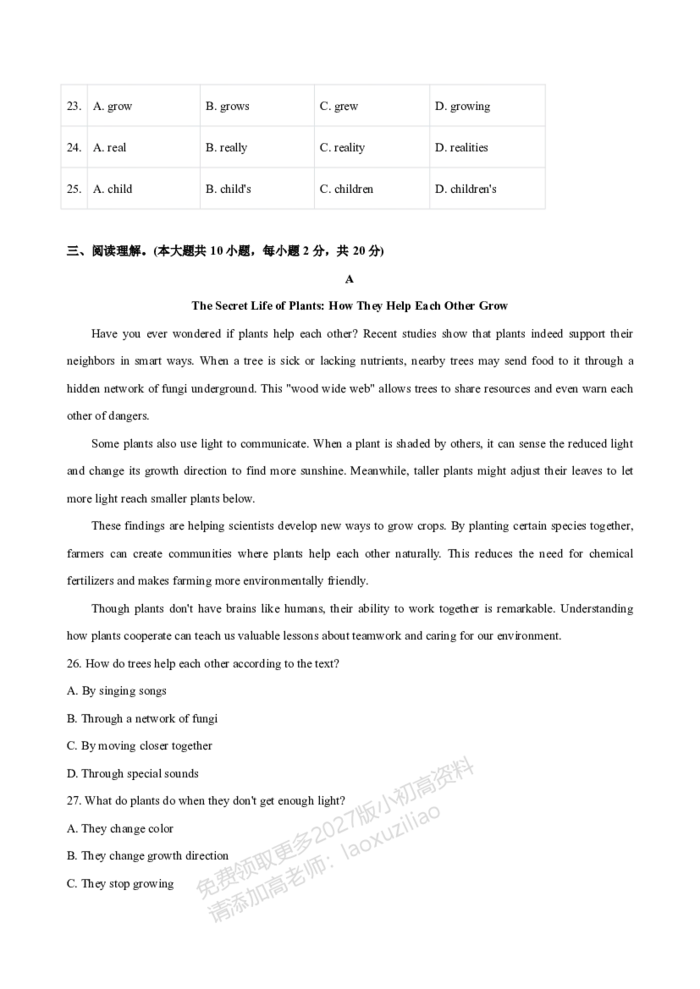
23.
A. grow
B. grows
C. grew
D. growing
24.
A. real
B. really
C. reality
D. realities
25.
A. child
B. child's
C. children
D. children's
三、阅读理解。(本大题共10 小题,每小题2 分,共20 分)
A
The Secret Life of Plants: How They Help Each Other Grow
Have you ever wondered if plants help each other? Recent studies show that plants indeed support their
neighbors in smart ways. When a tree is sick or lacking nutrients, nearby trees may send food to it through a
hidden network of fungi underground. This "wood wide web" allows trees to share resources and even warn each
other of dangers.
Some plants also use light to communicate. When a plant is shaded by others, it can sense the reduced light
and change its growth direction to find more sunshine. Meanwhile, taller plants might adjust their leaves to let
more light reach smaller plants below.
These findings are helping scientists develop new ways to grow crops. By planting certain species together,
farmers can create communities where plants help each other naturally. This reduces the need for chemical
fertilizers and makes farming more environmentally friendly.
Though plants don't have brains like humans, their ability to work together is remarkable. Understanding
how plants cooperate can teach us valuable lessons about teamwork and caring for our environment.
26. How do trees help each other according to the text?
A. By singing songs
B. Through a network of fungi
C. By moving closer together
D. Through special sounds
27. What do plants do when they don't get enough light?
A. They change color
B. They change growth direction
C. They stop growing
版小初高资料
2027
免费领取更多
laoxuziliao
:
请添加高老师
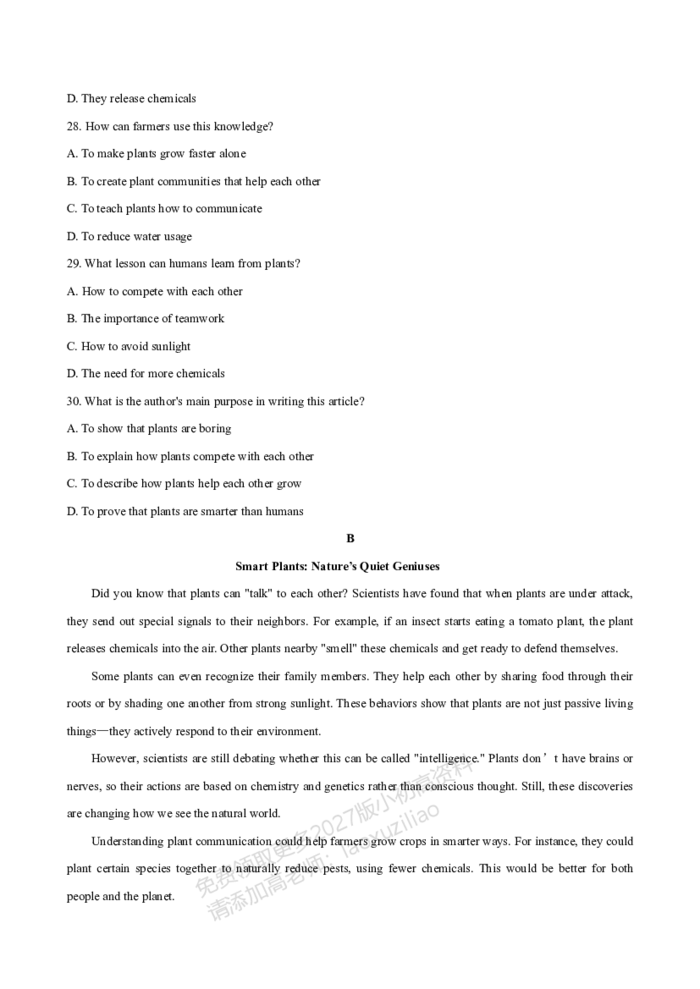
D. They release chemicals
28. How can farmers use this knowledge?
A. To make plants grow faster alone
B. To create plant communities that help each other
C. To teach plants how to communicate
D. To reduce water usage
29. What lesson can humans learn from plants?
A. How to compete with each other
B. The importance of teamwork
C. How to avoid sunlight
D. The need for more chemicals
30. What is the author's main purpose in writing this article?
A. To show that plants are boring
B. To explain how plants compete with each other
C. To describe how plants help each other grow
D. To prove that plants are smarter than humans
B
Smart Plants: Nature’s Quiet Geniuses
Did you know that plants can "talk" to each other? Scientists have found that when plants are under attack,
they send out special signals to their neighbors. For example, if an insect starts eating a tomato plant, the plant
releases chemicals into the air. Other plants nearby "smell" these chemicals and get ready to defend themselves.
Some plants can even recognize their family members. They help each other by sharing food through their
roots or by shading one another from strong sunlight. These behaviors show that plants are not just passive living
things—they actively respond to their environment.
However, scientists are still debating whether this can be called "intelligence." Plants don’t have brains or
nerves, so their actions are based on chemistry and genetics rather than conscious thought. Still, these discoveries
are changing how we see the natural world.
Understanding plant communication could help farmers grow crops in smarter ways. For instance, they could
plant certain species together to naturally reduce pests, using fewer chemicals. This would be better for both
people and the planet.
版小初高资料
2027
免费领取更多
laoxuziliao
:
请添加高老师
31. How do plants warn each other about danger?
A. By making sounds
B. By releasing chemicals
C. By changing colors
D. By moving their leaves
32. What can some plants do for their family members?
A. Sing to them
B. Share food through roots
C. Carry them to sunlight
D. Protect them from rain
33. Why do scientists debate whether plants are "intelligent"?
A. Because plants can run away
B. Because plants have brains
C. Because plants use chemistry, not conscious thought
D. Because plants can speak human languages
34. How can understanding plant communication help farmers?
A. It helps them play music to plants
B. It helps them use fewer chemicals
C. It helps plants grow faster than animals
D. It helps plants become taller
35. What is the main idea of the passage?
A. Plants are boring and do nothing
B. Plants are active and can communicate in their own way
C. Plants are more intelligent than humans
D. Plants should be replaced by robots
四、补全对话。(本大题共5 小题,每小题1 分,共5 分)
Teacher: Class, we're starting a tree-planting project. 36. ______
Student A: Because trees clean the air and make our school beautiful.
Teacher: Good! 37. ______
版小初高资料
2027
免费领取更多
laoxuziliao
:
请添加高老师
Student B: We should choose native trees that suit our climate.
Teacher: Right. 38. ______
Student C: We need to water them regularly and remove weeds.
Teacher: Excellent. 39. ______
Student D: We can measure their growth and check their health monthly.
Teacher: Perfect! 40. ______
All: Yes! Let's make our school greener!
A. How should we care for the trees?
B. Why should we plant trees?
C. What types of trees should we plant?
D. When is the best time to plant?
E. How can we track their progress?
F. Who will water the trees?
G. Are you all ready to start?
五、完成句子。(本大题共10 小题,每小题2 分,共20 分)
41. 叶子里的工人们将水和二氧化碳与阳光混合来制造食物。
The workers in the leaf ______ water and carbon dioxide ______ sunlight to make food.
42. 如果没有植物,空气质量会比现在差得多。
Without plants, the air quality ______ ______ much worse than it is now.
43. 科学家们正在寻找帮助植物在城市生长的新方法。
Scientists are ______ ______ new ways to help plants grow in cities.
44. 新公园会让我们的社区更美丽、更绿色。
The new park will ______ our neighborhood more beautiful and greener.
45. 许多学生周末更喜欢植树而不是玩电子游戏。
Many students ______ planting trees ______ playing video games on weekends.
六、句型转换。(本大题共5 小题,每小题2 分,共10 分)
56. I will have many presents.(改为否定句和一般疑问句)
版小初高资料
2027
免费领取更多
laoxuziliao
:
请添加高老师
_________________________________________. (否定句)
___________________________________________?(一般疑问句)
57. The scientists are going to study plant growth. (改为一般疑问句,并做出肯定回答)
___________________________________________?(一般疑问句)
_______________________________________.(肯定回答)
58.They will do heavy work.(改为一般疑问句,并做出否定回答)
___________________________________________?(一般疑问句)
_______________________________________. (否定回答)
59. We are going to build a new botanical garden. (对划线部分提问)
______ are you going to ______?
60. I’m going to finish the project tomorrow. (改为否定句和一般疑问句)
_________________________________________. (否定句)
___________________________________________?(一般疑问句)
七、首字母填空。(本大题共10 小题,每小题1 分,共10 分)
Our school is doing a special project on plants. We are studying how different plants g 46. ______ in our
school garden. Some plants need more s 47. ______ than others.
We water the plants every morning and measure their h 48. ______ every week. My group is studying tomato
plants. We hope they will p 49. ______ many red tomatoes soon.
Through this project, we are learning about the i 50. ______ of sunlight and water. We also see how plants
help the e 51. ______ by cleaning the air.
Our teacher says this hands-on e 52. ______ is better than just reading books. We are keeping a science j 53.
______ to record our observations.
This project teaches us to be responsible and care for n 54. ______. We now understand why plants are so v
55. ______ to our world.
八、书面表达。(共10 分)
题目:请以"My Experience with Plants"为题,写一篇记叙文。
内容要点:
1. 你与植物的一次具体经历(种植/观察/研究等);
版小初高资料
2027
免费领取更多
laoxuziliao
:
请添加高老师
2. 过程中的所见所闻所感;
3. 这次经历带给你的收获或启示。
要求:
词数80-100 左右;
文中不得出现真实的人名、校名;
条理清晰,语句通顺。
___________________________________________________________________________________________
___________________________________________________________________________________________
___________________________________________________________________________________________
___________________________________________________________________________________________
___________________________________________________________________________________________
___________________
版小初高资料
2027
免费领取更多
laoxuziliao
:
请添加高老师