文档文本内容
2025-2026 学年七年级上册英语单元测试
Unit 5·提升卷
学校:___________班级:___________姓名:___________分数:___________
(时间:90 分钟,满分:100 分)
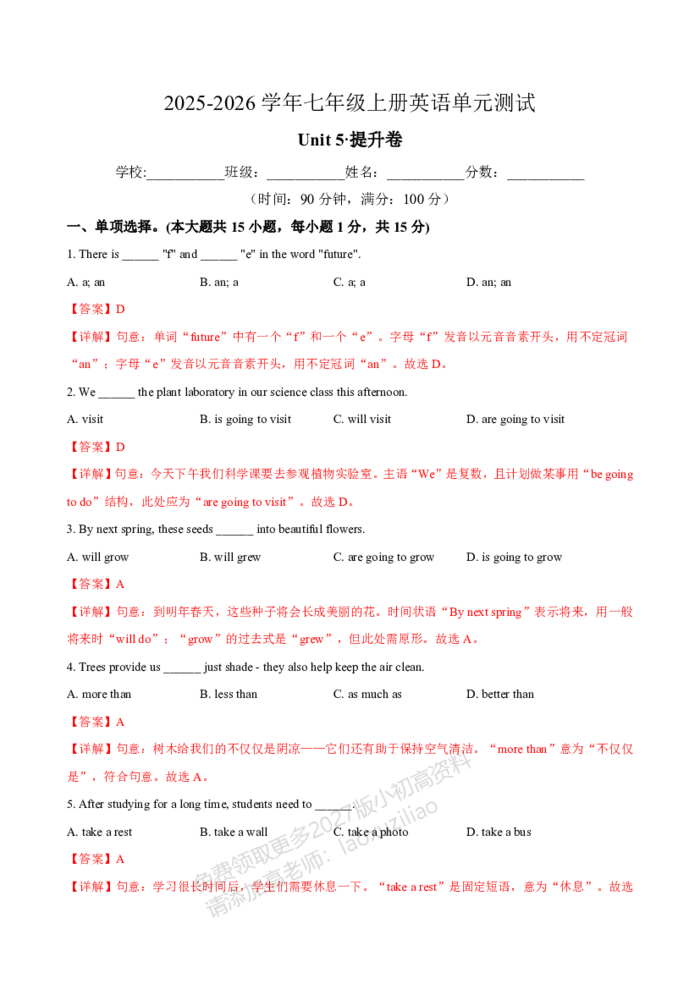
一、单项选择。(本大题共15 小题,每小题1 分,共15 分)
1. There is ______ "f" and ______ "e" in the word "future".
A. a; an
B. an; a
C. a; a
D. an; an
【答案】D
【详解】句意:单词“future”中有一个“f”和一个“e”。字母“f”发音以元音音素开头,用不定冠词
“an”;字母“e”发音以元音音素开头,用不定冠词“an”。故选D。
2. We ______ the plant laboratory in our science class this afternoon.
A. visit
B. is going to visit
C. will visit
D. are going to visit
【答案】D
【详解】句意:今天下午我们科学课要去参观植物实验室。主语“We”是复数,且计划做某事用“be going
to do”结构,此处应为“are going to visit”。故选D。
3. By next spring, these seeds ______ into beautiful flowers.
A. will grow
B. will grew
C. are going to grow
D. is going to grow
【答案】A
【详解】句意:到明年春天,这些种子将会长成美丽的花。时间状语“By next spring”表示将来,用一般
将来时“will do”;“grow”的过去式是“grew”,但此处需原形。故选A。
4. Trees provide us ______ just shade - they also help keep the air clean.
A. more than
B. less than
C. as much as
D. better than
【答案】A
【详解】句意:树木给我们的不仅仅是阴凉——它们还有助于保持空气清洁。“more than”意为“不仅仅
是”,符合句意。故选A。
5. After studying for a long time, students need to ______.
A. take a rest
B. take a wall
C. take a photo
D. take a bus
【答案】A
【详解】句意:学习很长时间后,学生们需要休息一下。“take a rest”是固定短语,意为“休息”。故选
版小初高资料
2027
免费领取更多
laoxuziliao
:
请添加高老师
A。
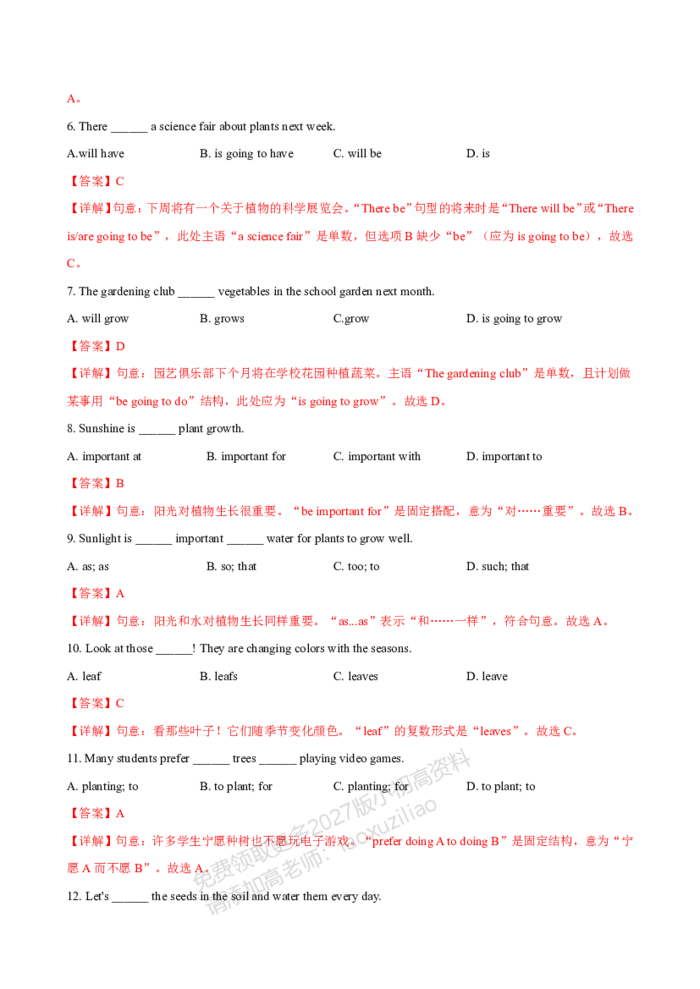
6. There ______ a science fair about plants next week.
A.will have
B. is going to have
C. will be
D. is
【答案】C
【详解】句意:下周将有一个关于植物的科学展览会。“There be”句型的将来时是“There will be”或“There
is/are going to be”,此处主语“a science fair”是单数,但选项B 缺少“be”(应为is going to be),故选
C。
7. The gardening club ______ vegetables in the school garden next month.
A. will grow
B. grows
C.grow
D. is going to grow
【答案】D
【详解】句意:园艺俱乐部下个月将在学校花园种植蔬菜。主语“The gardening club”是单数,且计划做
某事用“be going to do”结构,此处应为“is going to grow”。故选D。
8. Sunshine is ______ plant growth.
A. important at
B. important for
C. important with
D. important to
【答案】B
【详解】句意:阳光对植物生长很重要。“be important for”是固定搭配,意为“对……重要”。故选B。
9. Sunlight is ______ important ______ water for plants to grow well.
A. as; as
B. so; that
C. too; to
D. such; that
【答案】A
【详解】句意:阳光和水对植物生长同样重要。“as...as”表示“和……一样”,符合句意。故选A。
10. Look at those ______! They are changing colors with the seasons.
A. leaf
B. leafs
C. leaves
D. leave
【答案】C
【详解】句意:看那些叶子!它们随季节变化颜色。“leaf”的复数形式是“leaves”。故选C。
11. Many students prefer ______ trees ______ playing video games.
A. planting; to
B. to plant; for
C. planting; for
D. to plant; to
【答案】A
【详解】句意:许多学生宁愿种树也不愿玩电子游戏。“prefer doing A to doing B”是固定结构,意为“宁
愿A 而不愿B”。故选A。
12. Let's ______ the seeds in the soil and water them every day.
版小初高资料
2027
免费领取更多
laoxuziliao
:
请添加高老师
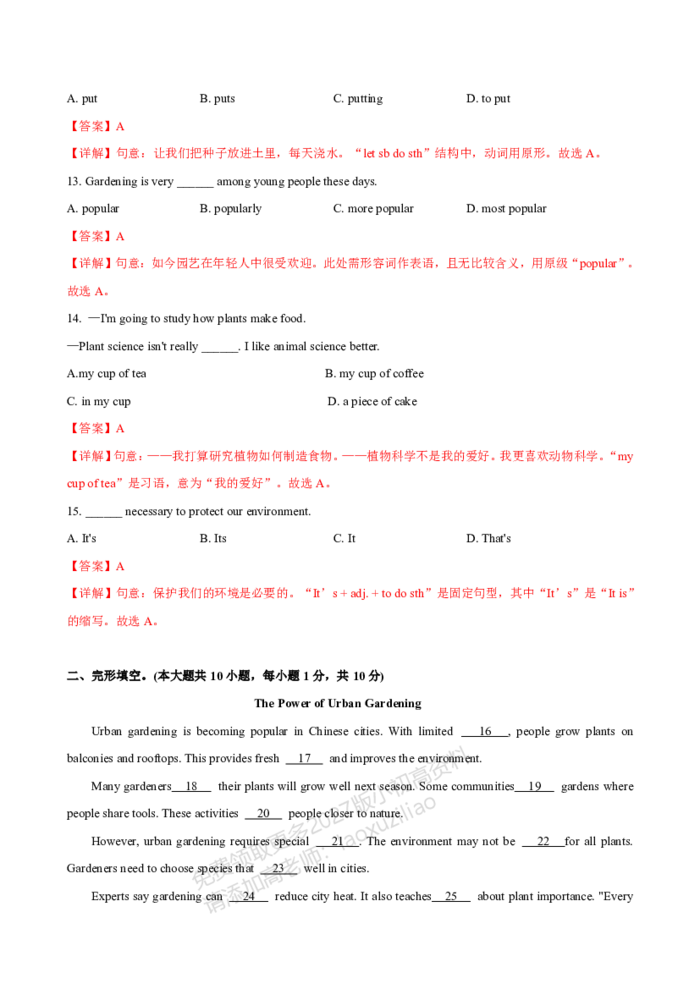
A. put
B. puts
C. putting
D. to put
【答案】A
【详解】句意:让我们把种子放进土里,每天浇水。“let sb do sth”结构中,动词用原形。故选A。
13. Gardening is very ______ among young people these days.
A. popular
B. popularly
C. more popular
D. most popular
【答案】A
【详解】句意:如今园艺在年轻人中很受欢迎。此处需形容词作表语,且无比较含义,用原级“popular”。
故选A。
14. —I'm going to study how plants make food.
—Plant science isn't really ______. I like animal science better.
A.my cup of tea
B. my cup of coffee
C. in my cup
D. a piece of cake
【答案】A
【详解】句意:——我打算研究植物如何制造食物。——植物科学不是我的爱好。我更喜欢动物科学。“my
cup of tea”是习语,意为“我的爱好”。故选A。
15. ______ necessary to protect our environment.
A. It's
B. Its
C. It
D. That's
【答案】A
【详解】句意:保护我们的环境是必要的。“It’s + adj. + to do sth”是固定句型,其中“It’s”是“It is”
的缩写。故选A。
二、完形填空。(本大题共10 小题,每小题1 分,共10 分)
The Power of Urban Gardening
Urban gardening is becoming popular in Chinese cities. With limited
16
, people grow plants on
balconies and rooftops. This provides fresh
17
and improves the environment.
Many gardeners
18
their plants will grow well next season. Some communities
19
gardens where
people share tools. These activities
20
people closer to nature.
However, urban gardening requires special
21
. The environment may not be
22
for all plants.
Gardeners need to choose species that
23
well in cities.
Experts say gardening can
24
reduce city heat. It also teaches
25
about plant importance. "Every
版小初高资料
2027
免费领取更多
laoxuziliao
:
请添加高老师
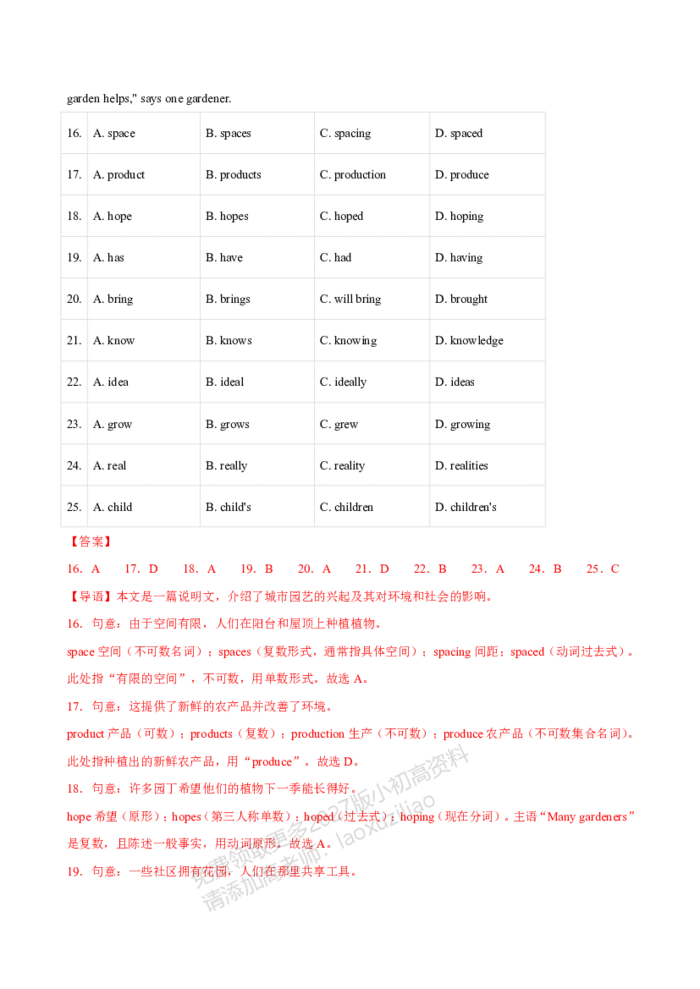
garden helps," says one gardener.
16.
A. space
B. spaces
C. spacing
D. spaced
17.
A. product
B. products
C. production
D. produce
18.
A. hope
B. hopes
C. hoped
D. hoping
19.
A. has
B. have
C. had
D. having
20.
A. bring
B. brings
C. will bring
D. brought
21.
A. know
B. knows
C. knowing
D. knowledge
22.
A. idea
B. ideal
C. ideally
D. ideas
23.
A. grow
B. grows
C. grew
D. growing
24.
A. real
B. really
C. reality
D. realities
25.
A. child
B. child's
C. children
D. children's
【答案】
16.A
17.D
18.A
19.B
20.A
21.D
22.B
23.A
24.B
25.C
【导语】本文是一篇说明文,介绍了城市园艺的兴起及其对环境和社会的影响。
16.句意:由于空间有限,人们在阳台和屋顶上种植植物。
space 空间(不可数名词);spaces(复数形式,通常指具体空间);spacing 间距;spaced(动词过去式)。
此处指“有限的空间”,不可数,用单数形式。故选A。
17.句意:这提供了新鲜的农产品并改善了环境。
product 产品(可数);products(复数);production 生产(不可数);produce 农产品(不可数集合名词)。
此处指种植出的新鲜农产品,用“produce”。故选D。
18.句意:许多园丁希望他们的植物下一季能长得好。
hope 希望(原形);hopes(第三人称单数);hoped(过去式);hoping(现在分词)。主语“Many gardeners”
是复数,且陈述一般事实,用动词原形。故选A。
19.句意:一些社区拥有花园,人们在那里共享工具。
版小初高资料
2027
免费领取更多
laoxuziliao
:
请添加高老师
has(第三人称单数);have(原形);had(过去式);having(现在分词)。主语“Some communities”
是复数,用动词原形。故选B。
20.句意:这些活动使人们更亲近自然。
bring 带来(原形);brings(第三人称单数);will bring(将来时);brought(过去式)。主语“These activities”
是复数,且陈述一般事实,用动词原形。故选A。
21.句意:然而,城市园艺需要特殊的知识。
know 知道(动词);knows(第三人称单数);knowing(现在分词);knowledge 知识(名词)。此处需
名词作宾语,指“专业知识”。故选D。
22.句意:环境可能并不适合所有植物。
idea 想法(名词);ideal 理想的(形容词);ideally 理想地(副词);ideas(复数)。此处需形容词作表
语,描述环境“不理想”。故选B。
23.句意:园丁需要选择在城市中生长良好的物种。
grow 生长(原形);grows(第三人称单数);grew(过去式);growing(现在分词)。定语从句中主语
“that”指代复数“species”,且陈述一般事实,用动词原形。故选A。
24.句意:专家说园艺可以真正减少城市热量。
real 真实的(形容词);really 真正地(副词);reality 现实(名词);realities(复数)。此处需副词修饰
动词“reduce”。故选B。
25.句意:它还教孩子们植物的重要性。
child 孩子(单数);child's(所有格);children 孩子们(复数);children's(所有格)。此处指教育对象
“孩子们”,用复数形式,且无所有关系。故选C。
三、阅读理解。(本大题共10 小题,每小题2 分,共20 分)
A
The Secret Life of Plants: How They Help Each Other Grow
Have you ever wondered if plants help each other? Recent studies show that plants indeed support their
neighbors in smart ways. When a tree is sick or lacking nutrients, nearby trees may send food to it through a
hidden network of fungi underground. This "wood wide web" allows trees to share resources and even warn each
other of dangers.
Some plants also use light to communicate. When a plant is shaded by others, it can sense the reduced light
and change its growth direction to find more sunshine. Meanwhile, taller plants might adjust their leaves to let
版小初高资料
2027
免费领取更多
laoxuziliao
:
请添加高老师
more light reach smaller plants below.
These findings are helping scientists develop new ways to grow crops. By planting certain species together,
farmers can create communities where plants help each other naturally. This reduces the need for chemical
fertilizers and makes farming more environmentally friendly.
Though plants don't have brains like humans, their ability to work together is remarkable. Understanding
how plants cooperate can teach us valuable lessons about teamwork and caring for our environment.
26. How do trees help each other according to the text?
A. By singing songs
B. Through a network of fungi
C. By moving closer together
D. Through special sounds
27. What do plants do when they don't get enough light?
A. They change color
B. They change growth direction
C. They stop growing
D. They release chemicals
28. How can farmers use this knowledge?
A. To make plants grow faster alone
B. To create plant communities that help each other
C. To teach plants how to communicate
D. To reduce water usage
29. What lesson can humans learn from plants?
A. How to compete with each other
B. The importance of teamwork
C. How to avoid sunlight
D. The need for more chemicals
30. What is the author's main purpose in writing this article?
A. To show that plants are boring
B. To explain how plants compete with each other
C. To describe how plants help each other grow
版小初高资料
2027
免费领取更多
laoxuziliao
:
请添加高老师
D. To prove that plants are smarter than humans
【答案】
26.B
27.B
28.B
29.B
30.C
【导语】本文是一篇说明文,介绍了植物如何通过地下真菌网络和光感应相互帮助,并探讨了这一发现对
农业和人类的启示。
26.细节理解题。根据第一段“nearby trees may send food to it through a hidden network of fungi underground”
可知,树木通过地下的真菌网络相互帮助。故选B。
27.细节理解题。根据第二段“it can sense the reduced light and change its growth direction to find more sunshine”
可知,植物在光照不足时会改变生长方向以寻找更多阳光。故选B。
28.细节理解题。根据第三段“farmers can create communities where plants help each other naturally”可知,
农民可以利用这一知识创建植物互助群落。故选B。
29.推理判断题。根据最后一段“Understanding how plants cooperate can teach us valuable lessons about
teamwork”可知,人类可以从植物身上学到团队合作的重要性。故选B。
30.主旨大意题。通读全文,文章主要描述了植物如何通过多种方式相互帮助生长,因此作者的写作目的
是阐述植物间的互助行为。故选C。
B
Smart Plants: Nature’s Quiet Geniuses
Did you know that plants can "talk" to each other? Scientists have found that when plants are under attack,
they send out special signals to their neighbors. For example, if an insect starts eating a tomato plant, the plant
releases chemicals into the air. Other plants nearby "smell" these chemicals and get ready to defend themselves.
Some plants can even recognize their family members. They help each other by sharing food through their
roots or by shading one another from strong sunlight. These behaviors show that plants are not just passive living
things—they actively respond to their environment.
However, scientists are still debating whether this can be called "intelligence." Plants don’t have brains or
nerves, so their actions are based on chemistry and genetics rather than conscious thought. Still, these discoveries
are changing how we see the natural world.
Understanding plant communication could help farmers grow crops in smarter ways. For instance, they could
plant certain species together to naturally reduce pests, using fewer chemicals. This would be better for both
people and the planet.
31. How do plants warn each other about danger?
版小初高资料
2027
免费领取更多
laoxuziliao
:
请添加高老师
A. By making sounds
B. By releasing chemicals
C. By changing colors
D. By moving their leaves
32. What can some plants do for their family members?
A. Sing to them
B. Share food through roots
C. Carry them to sunlight
D. Protect them from rain
33. Why do scientists debate whether plants are "intelligent"?
A. Because plants can run away
B. Because plants have brains
C. Because plants use chemistry, not conscious thought
D. Because plants can speak human languages
34. How can understanding plant communication help farmers?
A. It helps them play music to plants
B. It helps them use fewer chemicals
C. It helps plants grow faster than animals
D. It helps plants become taller
35. What is the main idea of the passage?
A. Plants are boring and do nothing
B. Plants are active and can communicate in their own way
C. Plants are more intelligent than humans
D. Plants should be replaced by robots
【答案】
31.B
32.B
33.C
34.B
35.B
【导语】本文是一篇说明文,介绍了植物通过释放化学物质等方式相互交流的现象,并探讨了这是否属于
智能行为以及其对农业的潜在影响。
31.细节理解题。根据第一段“the plant releases chemicals into the air. Other plants nearby ‘smell’ these
chemicals”可知,植物通过释放化学物质来警告危险。故选B。
版小初高资料
2027
免费领取更多
laoxuziliao
:
请添加高老师
32.细节理解题。根据第二段“They help each other by sharing food through their roots”可知,植物通过根
系分享食物来帮助家庭成员。故选B。
33.细节理解题。根据第三段“Plants don’t have brains or nerves, so their actions are based on chemistry and
genetics rather than conscious thought”可知,科学家争论的焦点在于植物的行为基于化学而非意识思考。故
选C。
34.细节理解题。根据第四段“using fewer chemicals. This would be better for both people and the planet”可
知,理解植物交流有助于减少化学农药的使用。故选B。
35.主旨大意题。通读全文,文章核心是说明植物能通过独特方式主动交流与响应环境。故选B。
四、补全对话。(本大题共5 小题,每小题1 分,共5 分)
Teacher: Class, we're starting a tree-planting project. 36. ______
Student A: Because trees clean the air and make our school beautiful.
Teacher: Good! 37. ______
Student B: We should choose native trees that suit our climate.
Teacher: Right. 38. ______
Student C: We need to water them regularly and remove weeds.
Teacher: Excellent. 39. ______
Student D: We can measure their growth and check their health monthly.
Teacher: Perfect! 40. ______
All: Yes! Let's make our school greener!
A. How should we care for the trees?
B. Why should we plant trees?
C. What types of trees should we plant?
D. When is the best time to plant?
E. How can we track their progress?
F. Who will water the trees?
G. Are you all ready to start?
【答案】
36.B
37.C
38.A
39.E
40.G
版小初高资料
2027
免费领取更多
laoxuziliao
:
请添加高老师
【导语】本文是老师和学生之间关于植树项目的对话。老师引导学生讨论植树的原因、树种选择、养护方
法以及进度跟踪,最后动员大家开始行动。
36.句意:为什么我们要植树?
根据下文学生A 的回答“Because trees clean the air and make our school beautiful.”(因为树木净化空气,
让学校更美丽。)可知,此处老师提问的是植树的原因。选项B“Why should we plant trees?”(为什么我
们要植树?)符合语境。故选B。
37.句意:我们应该种什么类型的树?
根据下文学生B 的回答“We should choose native trees that suit our climate.”(我们应该选择适合气候的本
地树木。)可知,此处老师询问的是树种选择。选项C“What types of trees should we plant?”(我们应该
种什么类型的树?)符合语境。故选C。
38.句意:我们应该如何照顾树木?
根据下文学生C 的回答“We need to water them regularly and remove weeds.”(我们需要定期浇水和除草。)
可知,此处老师询问的是树木的养护方法。选项A“How should we care for the trees?”(我们应该如何照
顾树木?)符合语境。故选A。
39.句意:我们如何跟踪它们的进展?
根据下文学生D 的回答“We can measure their growth and check their health monthly.”(我们可以每月测量
它们的生长情况和检查健康状况。)可知,此处老师询问的是如何跟踪树木的成长进度。选项E“How can
we track their progress?”(我们如何跟踪它们的进展?)符合语境。故选E。
40.句意:你们都准备好开始了吗?
根据下文全体学生的回答“Yes! Let's make our school greener!”(是的!让我们的学校更绿色!)可知,此
处老师是在动员大家开始行动。选项G“Are you all ready to start?”(你们都准备好开始了吗?)符合语境。
故选G。
五、完成句子。(本大题共10 小题,每小题2 分,共20 分)
41. 叶子里的工人们将水和二氧化碳与阳光混合来制造食物。
The workers in the leaf ______ water and carbon dioxide ______ sunlight to make food.
【答案】mix, with
【详解】句意:叶子里的工人们将水和二氧化碳与阳光混合来制造食物。“将……与……混合”英文固定
搭配为mix...with...。主语“workers”是复数,动词用原形mix。故填mix, with。
42. 如果没有植物,空气质量会比现在差得多。
版小初高资料
2027
免费领取更多
laoxuziliao
:
请添加高老师
Without plants, the air quality ______ ______ much worse than it is now.
【答案】would be
【详解】句意:如果没有植物,空气质量会比现在差得多。本句为虚拟语气,表示与现在事实相反的假设
(现实中植物是存在的),主句用“would + 动词原形”。故填would be。
43. 科学家们正在寻找帮助植物在城市生长的新方法。
Scientists are ______ ______ new ways to help plants grow in cities.
【答案】looking for
【详解】句意:科学家们正在寻找帮助植物在城市生长的新方法。“寻找”英文固定搭配为look for。根
据“are”可知,此处为现在进行时(are doing),故填looking for。
44. 新公园会让我们的社区更美丽、更绿色。
The new park will ______ our neighborhood more beautiful and greener.
【答案】make
【详解】句意:新公园会让我们的社区更美丽、更绿色。“让……变得……”此处表示“使成为”,用动
词make(make + 宾语+ 形容词宾补)。will 后接动词原形,故填make。
45. 许多学生周末更喜欢植树而不是玩电子游戏。
Many students ______ planting trees ______ playing video games on weekends.
【答案】prefer, to
【详解】句意:许多学生周末更喜欢植树而不是玩电子游戏。“更喜欢A 而不是B”英文固定搭配为prefer
A to B(A 和B 为平行结构)。故填prefer, to。
六、首字母填空。(本大题共10 小题,每小题1 分,共10 分)
Our school is doing a special project on plants. We are studying how different plants g 46. ______ in our
school garden. Some plants need more s 47. ______ than others.
We water the plants every morning and measure their h 48. ______ every week. My group is studying tomato
plants. We hope they will p 49. ______ many red tomatoes soon.
Through this project, we are learning about the i 50. ______ of sunlight and water. We also see how plants
help the e 51. ______ by cleaning the air.
Our teacher says this hands-on e 52. ______ is better than just reading books. We are keeping a science j 53.
______ to record our observations.
This project teaches us to be responsible and care for n 54. ______. We now understand why plants are so v
版小初高资料
2027
免费领取更多
laoxuziliao
:
请添加高老师
55. ______ to our world.
【答案】
46.grow
47.sunshine
48.height
49.produce
50.importance
51.environment
52.experience
53.journal
54.nature
55.valuable
【导语】本文介绍了学校开展的植物研究项目,包括种植过程、观察记录以及学到的自然知识。
46.句意:我们正在研究不同植物在我们学校花园里的生长情况。根据“how different plants g...”和首字
母提示,植物在花园里“生长”,grow 符合语境。故填grow。
47.句意:有些植物比其他植物需要更多的阳光。根据“than others”和首字母s 提示,植物生长需要“阳
光”,sunshine 符合语境。故填sunshine。
48.句意:我们每天早晨给植物浇水,每周测量它们的高度。根据“measure their h...”和首字母h 提示,
测量植物的“高度”,height 符合语境。故填height。
49.句意:我们希望它们很快能结出许多红番茄。根据“many red tomatoes”和首字母p 提示,番茄植物
“生产”果实,produce 符合语境。故填produce。
50.句意:通过这个项目,我们正在学习阳光和水的重要性。根据“of sunlight and water”和首字母i 提示,
阳光和水的“重要性”,importance 符合语境。故填importance。
51.句意:我们还看到植物通过净化空气来帮助环境。根据“by cleaning the air”和首字母e 提示,净化空
气有利于“环境”,environment 符合语境。故填environment。
52.句意:我们老师说这种动手实践比仅仅读书更好。根据“hands-on”和首字母e 提示,动手“实践”
或“经历”,experience 符合语境。故填experience。
53.句意:我们保存科学日志来记录观察结果。根据“science j...”和首字母j 提示,记录观察的“日志”,
journal 符合语境。故填journal。
54.句意:这个项目教会我们负责任和关爱自然。根据“care for n...”和首字母n 提示,关爱“自然”,
nature 符合语境。故填nature。
55.句意:我们现在明白了为什么植物对我们的世界如此重要。根据“so v...”和首字母v 提示,植物“有
价值”或“重要”,valuable 符合语境。故填valuable。
八、书面表达。(共10 分)
题目:请以"My Experience with Plants"为题,写一篇记叙文。
内容要点:
1. 你与植物的一次具体经历(种植/观察/研究等);
版小初高资料
2027
免费领取更多
laoxuziliao
:
请添加高老师
2. 过程中的所见所闻所感;
3. 这次经历带给你的收获或启示。
要求:
词数80-100 左右;
文中不得出现真实的人名、校名;
条理清晰,语句通顺。
___________________________________________________________________________________________
___________________________________________________________________________________________
___________________________________________________________________________________________
_________________
My Experience with Plants
Last spring, our class started a small gardening project. I was given a sunflower seed to plant. Every day, I
watered it and watched it grow. Slowly, a small green shoot appeared and grew taller each week.
One morning, I noticed the first yellow bud opening. It was amazing to see how the sunflower turned towards
the sunlight. I felt proud and happy because my care helped it grow.
This experience taught me that plants are living things that need our attention and care. I also learned the
importance of patience and responsibility. Now, I respect nature more and understand how even a small plant can
bring joy.
【解析】
[总体分析]
①题材:本文是一篇记叙文,描述个人与植物相关的经历;
②时态:主要使用一般过去时,叙述过去发生的经历;
③提示:需涵盖种植过程、观察细节、个人感受及收获启示,避免遗漏要点。
[写作步骤]
第一步:引入背景,描述种植向日葵的起因和日常照料过程;
第二步:详细观察记录生长阶段,突出开花时的惊喜和成就感;
第三步:总结从中学到的道理,如耐心、责任和对自然的尊重。
版小初高资料
2027
免费领取更多
laoxuziliao
:
请添加高老师