2025-2026 学年七年级上册英语单元测试
Unit 6·提升卷
学校:___________班级:___________姓名:___________分数:___________
(时间:90 分钟,满分:100 分)
一、单项选择。(本大题共15 小题,每小题1 分,共15 分)
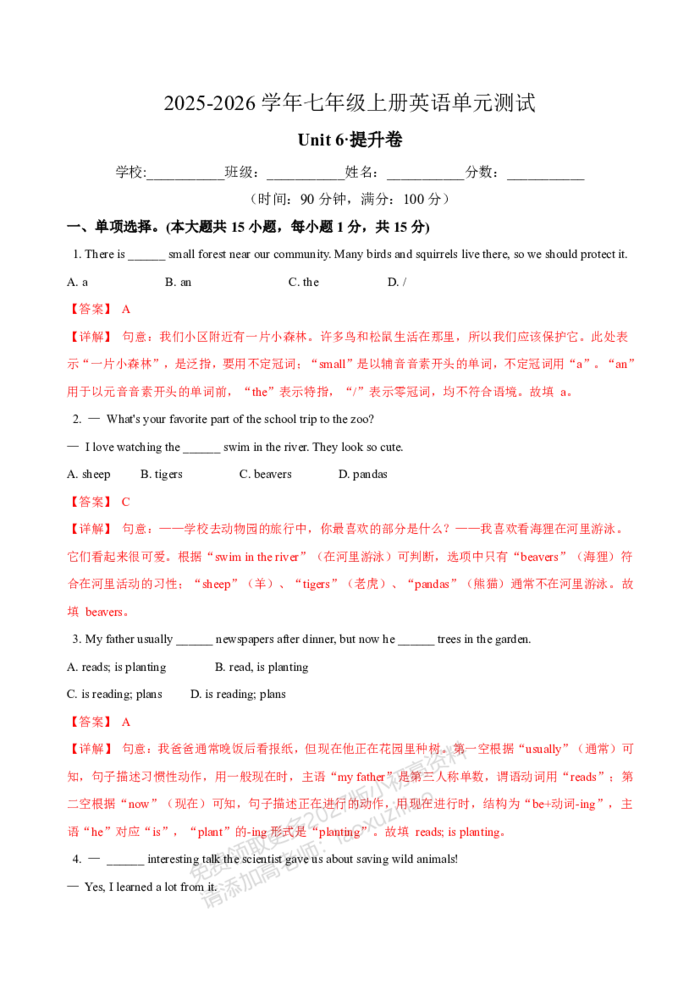
1. There is ______ small forest near our community. Many birds and squirrels live there, so we should protect it.
A. a
B. an
C. the
D. /
【答案】A
【详解】句意:我们小区附近有一片小森林。许多鸟和松鼠生活在那里,所以我们应该保护它。此处表
示“一片小森林”,是泛指,要用不定冠词;“small”是以辅音音素开头的单词,不定冠词用“a”。“an”
用于以元音音素开头的单词前,“the”表示特指,“/”表示零冠词,均不符合语境。故填a。
2. — What's your favorite part of the school trip to the zoo?
— I love watching the ______ swim in the river. They look so cute.
A. sheep
B. tigers
C. beavers
D. pandas
【答案】C
【详解】句意:——学校去动物园的旅行中,你最喜欢的部分是什么?——我喜欢看海狸在河里游泳。
它们看起来很可爱。根据“swim in the river”(在河里游泳)可判断,选项中只有“beavers”(海狸)符
合在河里活动的习性;“sheep”(羊)、“tigers”(老虎)、“pandas”(熊猫)通常不在河里游泳。故
填beavers。
3. My father usually ______ newspapers after dinner, but now he ______ trees in the garden.
A. reads; is planting
B. read, is planting
C. is reading; plans
D. is reading; plans
【答案】A
【详解】句意:我爸爸通常晚饭后看报纸,但现在他正在花园里种树。第一空根据“usually”(通常)可
知,句子描述习惯性动作,用一般现在时,主语“my father”是第三人称单数,谓语动词用“reads”;第
二空根据“now”(现在)可知,句子描述正在进行的动作,用现在进行时,结构为“be+动词-ing”,主
语“he”对应“is”,“plant”的-ing 形式是“planting”。故填reads; is planting。
4. — ______ interesting talk the scientist gave us about saving wild animals!
— Yes, I learned a lot from it.
版小初高资料
2027
免费领取更多
laoxuziliao
:
请添加高老师
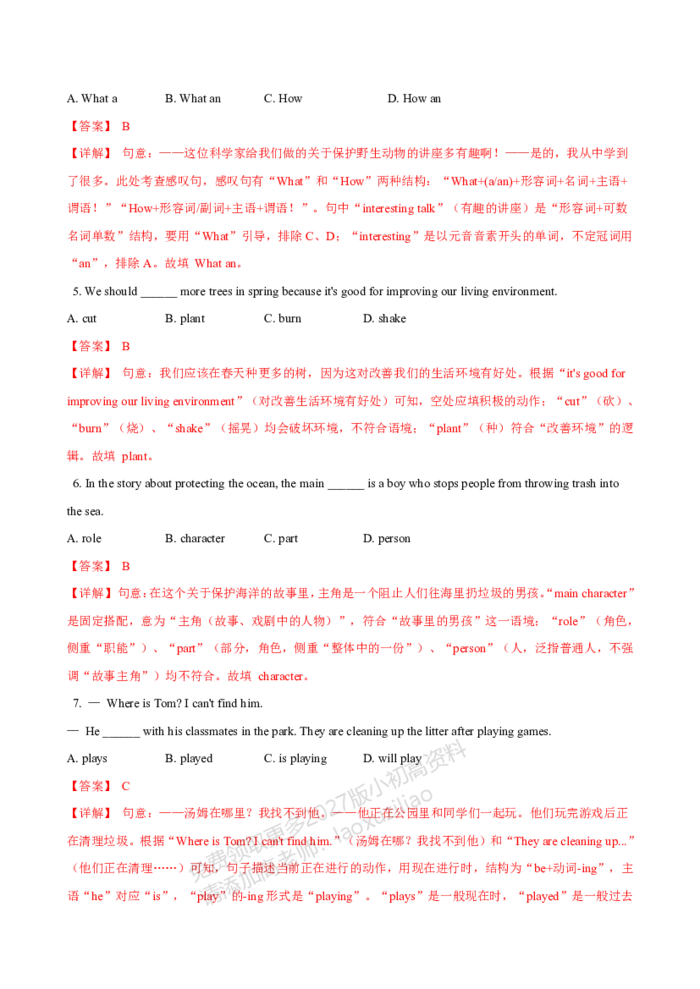
A. What a
B. What an
C. How
D. How an
【答案】B
【详解】句意:——这位科学家给我们做的关于保护野生动物的讲座多有趣啊!——是的,我从中学到
了很多。此处考查感叹句,感叹句有“What”和“How”两种结构:“What+(a/an)+形容词+名词+主语+
谓语!”“How+形容词/副词+主语+谓语!”。句中“interesting talk”(有趣的讲座)是“形容词+可数
名词单数”结构,要用“What”引导,排除C、D;“interesting”是以元音音素开头的单词,不定冠词用
“an”,排除A。故填What an。
5. We should ______ more trees in spring because it's good for improving our living environment.
A. cut
B. plant
C. burn
D. shake
【答案】B
【详解】句意:我们应该在春天种更多的树,因为这对改善我们的生活环境有好处。根据“it's good for
improving our living environment”(对改善生活环境有好处)可知,空处应填积极的动作;“cut”(砍)、
“burn”(烧)、“shake”(摇晃)均会破坏环境,不符合语境;“plant”(种)符合“改善环境”的逻
辑。故填plant。
6. In the story about protecting the ocean, the main ______ is a boy who stops people from throwing trash into
the sea.
A. role
B. character
C. part
D. person
【答案】B
【详解】句意:在这个关于保护海洋的故事里,主角是一个阻止人们往海里扔垃圾的男孩。“main character”
是固定搭配,意为“主角(故事、戏剧中的人物)”,符合“故事里的男孩”这一语境;“role”(角色,
侧重“职能”)、“part”(部分,角色,侧重“整体中的一份”)、“person”(人,泛指普通人,不强
调“故事主角”)均不符合。故填character。
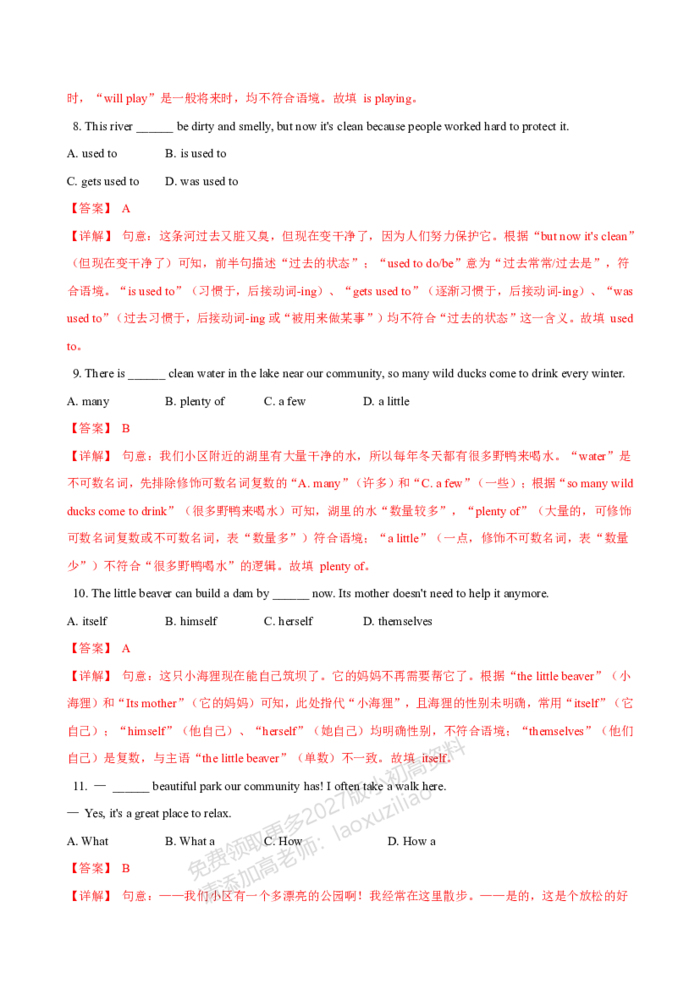
7. — Where is Tom? I can't find him.
— He ______ with his classmates in the park. They are cleaning up the litter after playing games.
A. plays
B. played
C. is playing
D. will play
【答案】C
【详解】句意:——汤姆在哪里?我找不到他。——他正在公园里和同学们一起玩。他们玩完游戏后正
在清理垃圾。根据“Where is Tom? I can't find him.”(汤姆在哪?我找不到他)和“They are cleaning up...”
(他们正在清理……)可知,句子描述当前正在进行的动作,用现在进行时,结构为“be+动词-ing”,主
语“he”对应“is”,“play”的-ing 形式是“playing”。“plays”是一般现在时,“played”是一般过去
版小初高资料
2027
免费领取更多
laoxuziliao
:
请添加高老师
时,“will play”是一般将来时,均不符合语境。故填is playing。
8. This river ______ be dirty and smelly, but now it's clean because people worked hard to protect it.
A. used to
B. is used to
C. gets used to
D. was used to
【答案】A
【详解】句意:这条河过去又脏又臭,但现在变干净了,因为人们努力保护它。根据“but now it's clean”
(但现在变干净了)可知,前半句描述“过去的状态”;“used to do/be”意为“过去常常/过去是”,符
合语境。“is used to”(习惯于,后接动词-ing)、“gets used to”(逐渐习惯于,后接动词-ing)、“was
used to”(过去习惯于,后接动词-ing 或“被用来做某事”)均不符合“过去的状态”这一含义。故填used
to。
9. There is ______ clean water in the lake near our community, so many wild ducks come to drink every winter.
A. many
B. plenty of
C. a few
D. a little
【答案】B
【详解】句意:我们小区附近的湖里有大量干净的水,所以每年冬天都有很多野鸭来喝水。“water”是
不可数名词,先排除修饰可数名词复数的“A. many”(许多)和“C. a few”(一些);根据“so many wild
ducks come to drink”(很多野鸭来喝水)可知,湖里的水“数量较多”,“plenty of”(大量的,可修饰
可数名词复数或不可数名词,表“数量多”)符合语境;“a little”(一点,修饰不可数名词,表“数量
少”)不符合“很多野鸭喝水”的逻辑。故填plenty of。
10. The little beaver can build a dam by ______ now. Its mother doesn't need to help it anymore.
A. itself
B. himself
C. herself
D. themselves
【答案】A
【详解】句意:这只小海狸现在能自己筑坝了。它的妈妈不再需要帮它了。根据“the little beaver”(小
海狸)和“Its mother”(它的妈妈)可知,此处指代“小海狸”,且海狸的性别未明确,常用“itself”(它
自己);“himself”(他自己)、“herself”(她自己)均明确性别,不符合语境;“themselves”(他们
自己)是复数,与主语“the little beaver”(单数)不一致。故填itself。
11. — ______ beautiful park our community has! I often take a walk here.
— Yes, it's a great place to relax.
A. What
B. What a
C. How
D. How a
【答案】B
【详解】句意:——我们小区有一个多漂亮的公园啊!我经常在这里散步。——是的,这是个放松的好
版小初高资料
2027
免费领取更多
laoxuziliao
:
请添加高老师
地方。此处考查感叹句,结构为“What+(a/an)+形容词+名词+主语+谓语!”或“How+形容词/副词+主语+
谓语!”。句中“beautiful park”(漂亮的公园)是“形容词+可数名词单数”结构,要用“What”引导,
排除C、D;“beautiful”是以辅音音素开头的单词,不定冠词用“a”,排除A。故填What a。
12. — I plan to join the “Green Guardians” to protect the environment.
— ______! It's a meaningful activity.
A. Good luck
B. You're welcome
C. That's a good idea
D. Never mind
【答案】C
【详解】句意:——我计划加入“绿色守护者”来保护环境。——这是个好主意!这是一项有意义的活
动。根据“It's a meaningful activity”(这是一项有意义的活动)可知,应答者是对对方的计划表示认可;
“That's a good idea”(这是个好主意)符合语境。“Good luck”(祝你好运,用于祝福)、“You're welcome”
(不客气,用于回应感谢)、“Never mind”(没关系,用于回应道歉或安慰)均不符合。故填That's a good
idea。
13. The little girl is afraid of ______ alone in the dark. She always asks her mom to stay with her.
A. stay
B. staying
C. stays
D. stayed
【答案】B
【详解】句意:这个小女孩害怕在黑暗中独自待着。她总是让妈妈陪着她。“be afraid of doing sth”是固
定搭配,意为“害怕做某事”,“of”是介词,后接动词-ing 形式;“stay”的-ing 形式是“staying”。“stay”
是动词原形,“stays”是第三人称单数形式,“stayed”是过去式,均不符合搭配要求。故填staying。
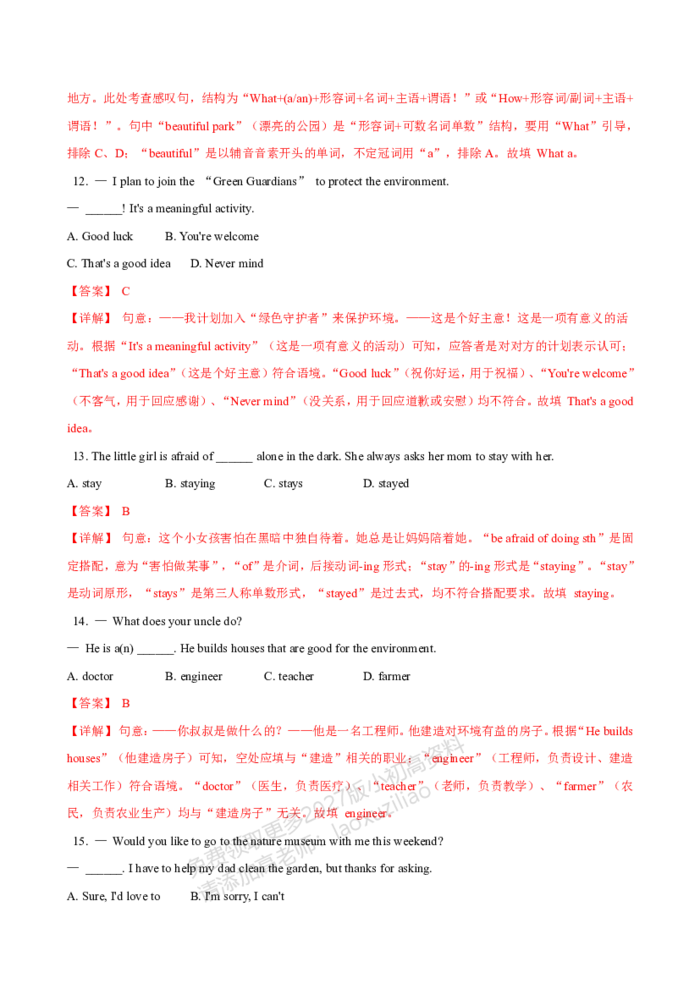
14. — What does your uncle do?
— He is a(n) ______. He builds houses that are good for the environment.
A. doctor
B. engineer
C. teacher
D. farmer
【答案】B
【详解】句意:——你叔叔是做什么的?——他是一名工程师。他建造对环境有益的房子。根据“He builds
houses”(他建造房子)可知,空处应填与“建造”相关的职业;“engineer”(工程师,负责设计、建造
相关工作)符合语境。“doctor”(医生,负责医疗)、“teacher”(老师,负责教学)、“farmer”(农
民,负责农业生产)均与“建造房子”无关。故填engineer。
15. — Would you like to go to the nature museum with me this weekend?
— ______. I have to help my dad clean the garden, but thanks for asking.
A. Sure, I'd love to
B. I'm sorry, I can't
版小初高资料
2027
免费领取更多
laoxuziliao
:
请添加高老师
C. That's all right
D. You're right
【答案】B
【详解】句意:——这个周末你愿意和我一起去自然博物馆吗?——很抱歉,我去不了。我得帮爸爸打
扫花园,但还是谢谢你的邀请。根据“I have to help my dad clean the garden”(我得帮爸爸打扫花园)可
知,应答者“无法接受邀请”;“I'm sorry, I can't”(很抱歉,我去不了)符合语境。“Sure, I'd love to”
(当然,我很乐意,用于接受邀请)、“That's all right”(没关系,用于回应道歉或感谢)、“You're right”
(你是对的,用于认可对方观点)均不符合。故填I'm sorry, I can't。
二、完形填空。(本大题共10 小题,每小题1 分,共10 分)
Amazing Pigeons in Our Life
Pigeons are easy to see in parks or on streets. Many people think they are just common birds, but they are
actually
16
. Henry used to dislike pigeons. He thought they were boring—they just knock around all day
and leave droppings
17
. He even felt scared when they flew madly to get food.
But everything changed after Henry did a school project about birds. He found that pigeons can
18
themselves in mirrors. That's a sign of cleverness! There are over 200 kinds of pigeons. Some can fly thousands of
kilometres and never get
19
. They can also fly at speeds over 100 km per hour—almost as fast as a car!
Now Henry often goes to the park to watch pigeons. He sometimes takes photos of them. He wants to tell
more people about how
20
pigeons are. He says, “We should never judge an animal before we really
21
it.”
Pigeons were helpful to humans long ago. They carried messages for people. Today, some pigeons still
22
scientists study the environment. They are our quiet but great friends.
We should
23
these amazing birds. For example, we can put bird feeders in safe places instead of
chasing them. Every small act can help pigeons live a better life. Let's
24
to care for these lovely animals
and make the world a
25
home for both humans and animals.
16.
A. boring
B. amazing
C. scary
D. lazy
17.
A. nowhere
B. somewhere
C. anywhere
D. everywhere
18.
A. recognise
B. see
C. watch
D. look
版小初高资料
2027
免费领取更多
laoxuziliao
:
请添加高老师
19.
A. happy
B. lost
C. sad
D. tired
20.
A. common
B. boring
C. fantastic
D. scary
21.
A. know
B. forget
C. ignore
D. dislike
22.
A. help
B. stop
C. prevent
D. keep
23.
A. hurt
B. protect
C. kill
D. chase
24.
A. try
B. refuse
C. forget
D. stop
25.
A. worse
B. smaller
C. better
D. bigger
【答案】
16.B
17.D
18.A
19.B
20.C
21.A
22.A
23.B
24.A
25.C
【导语】本文是一篇说明文,介绍了鸽子看似普通却极具“魅力”的特点——具备镜子自我识别的聪明特
质、种类繁多且飞行能力出色,还曾为人类传递信息、如今助力科学家研究环境;同时讲述了亨利对鸽子
从厌恶到欣赏的态度转变,最终呼吁人们保护鸽子,共同为人类与动物创造更美好的家园。
16.句意:很多人认为它们只是普通的鸟,但实际上它们令人惊叹。
A. boring 无聊的;B. amazing 令人惊叹的;C. scary 可怕的;D. lazy 懒惰的。根据前文“just common birds”
(只是普通的鸟)与转折词“but”可知,此处需填与“普通”相反的积极词汇;后文又详细介绍鸽子的聪
明(镜子识自我)、超强飞行能力等,均体现鸽子“令人惊叹”的特质,故选B。
17.句意:他觉得它们很无聊——整天到处闲逛,还到处留下粪便。
A. nowhere 无处;B. somewhere 某处(用于肯定句);C. anywhere 任何地方(用于否定句/疑问句);D.
everywhere 到处。结合亨利最初对鸽子的负面印象,“到处留下粪便”更符合“无聊、令人厌烦”的语境,
且本句为肯定句,“everywhere”能准确体现粪便分布范围广的特点,故选D。
18.句意:他发现鸽子能在镜子里认出自己。
A. recognise 认出;B. see 看见(强调结果);C. watch 观看(强调持续动作);D. look 看(强调动作,后
接宾语需加介词)。根据后文“That's a sign of cleverness!”(这是聪明的标志)可知,“认出自己”是高
智商的表现,而非单纯“看见”或“观看”,“recognise”符合“识别自我”的语义,故选A。
19.句意:有些鸽子能飞数千公里却从不迷路。
A. happy 开心的;B. lost 迷路的;C. sad 难过的;D. tired 疲惫的。结合“fly thousands of kilometres”(飞
版小初高资料
2027
免费领取更多
laoxuziliao
:
请添加高老师
数千公里)的语境,“从不迷路”是对鸽子飞行能力的突出描述,“get lost”为固定搭配,意为“迷路”,
符合逻辑,故选B。
20.句意:他想告诉更多人鸽子有多出色。
A. common 普通的;B. boring 无聊的;C. fantastic 出色的;D. scary 可怕的。根据亨利对鸽子态度的转变(从
厌恶到主动观察、拍照)及前文对鸽子优点的介绍,他想传递的是鸽子“出色”的特质,与前文“amazing”
呼应,故选C。
21.句意:他说:“我们在真正了解一种动物之前,绝不应该评判它。”
A. know 了解;B. forget 忘记;C. ignore 忽视;D. dislike 厌恶。亨利因做鸟类课题“了解”鸽子后才改变
态度,此处强调“了解”是评判动物的前提,与他的亲身经历一致,故选A。
22.句意:如今,有些鸽子还帮助科学家研究环境。
A. help 帮助;B. stop 阻止;C. prevent 防止;D. keep 保持。根据前文“Pigeons were helpful to humans long
ago. They carried messages for people.”(鸽子很久以前就对人类有帮助,曾传递信息)可知,此处延续“鸽
子对人类有帮助”的逻辑,“help sb. study”(帮助某人研究)符合语境,故选A。
23.句意:我们应该保护这些令人惊叹的鸟类。
A. hurt 伤害;B. protect 保护;C. kill 杀死;D. chase 追赶。根据后文“put bird feeders in safe places instead of
chasing them”(在安全处放喂鸟器,而非追赶它们)可知,此处是呼吁“保护”鸽子,与后文具体行动建
议呼应,故选B。
24.句意:让我们努力关爱这些可爱的动物,让世界成为人类和动物更好的家园。
A. try 努力;B. refuse 拒绝;C. forget 忘记;D. stop 停止。结合“care for these lovely animals”(关爱这些
可爱的动物)的积极语境,“try to do sth.”(努力做某事)体现主动付出的态度,符合呼吁保护动物的语
气,故选A。
25.句意:让我们努力关爱这些可爱的动物,让世界成为人类和动物更好的家园。
A. worse 更差的;B. smaller 更小的;C. better 更好的;D. bigger 更大的。保护动物的最终目的是让家园变
得“更好”,与前文“help pigeons live a better life”(帮鸽子生活得更好)形成语义呼应,故选C。
三、阅读理解。(本大题共10 小题,每小题2 分,共20 分)
A
Saving Bees: More Than Just Making Honey
Bees are not just insects that make honey—they are heroes for our planet. A recent study from a nature
magazine shows that one out of every three bites of food we eat depends on bees. They fly from flower to flower,
版小初高资料
2027
免费领取更多
laoxuziliao
:
请添加高老师
carrying pollen ( 花粉) that helps plants grow fruits and vegetables. Without bees, many crops like apples,
tomatoes and carrots would disappear.
But bees are in danger. Last year, a local newspaper reported that 30% of wild bee groups in our country have
died. The main reasons are the use of harmful chemicals in farms and the loss of their homes—bees can't find
enough flowers to live on because many fields are turned into buildings.
Luckily, people are taking action. Some schools ask students to plant flower boxes in classrooms. These
flowers give bees food and a place to rest. “Every small flower helps,” says a beekeeper from a local farm. “If
we all do a little, we can save these important friends.”
26. What does the underlined word “pollen” mean in the passage?
A. A kind of honey bees make
B. A powder that helps plants grow
C. A tool bees use to fly
D. A food bees eat
27. Why are bees important to humans according to the passage?
A. They make delicious honey for us.
B. They help most of our food crops grow.
C. They can protect us from harmful insects.
D. They build homes for other small animals.
28. What is the main reason for the death of wild bees?
A. They can't find enough water to drink.
B. They are eaten by other big animals.
C. Harmful chemicals and loss of homes.
D. They get sick from bad weather.
29. What do some schools do to help bees?
A. Teach students to keep bees at home.
B. Plant flower boxes in classrooms.
C. Stop using chemicals in school gardens.
D. Ask students to write articles about bees.
30. What is the main idea of the passage?
A. How bees make honey for humans.
版小初高资料
2027
免费领取更多
laoxuziliao
:
请添加高老师
B. Why bees are in danger and how we can help them.
C. What kinds of flowers bees like best.
D. How to keep bees in farms and schools.
【答案】26.B
27.B
28.C
29.B
30.B
【导语】本文是一篇说明文,介绍了蜜蜂不仅能酿造蜂蜜,更是地球的“英雄”——它们通过传播花粉助
力农作物生长,同时指出蜜蜂正面临因农药使用和栖息地丧失导致的生存危机,并介绍了学校等群体为保
护蜜蜂所采取的行动,呼吁人们关注和保护蜜蜂。
26.词义猜测题。根据后文“that helps plants grow fruits and vegetables”(帮助植物结出水果和蔬菜)可知,
“pollen”是能帮助植物生长的物质;结合常识,花粉是植物繁殖的重要物质,符合“帮助植物结果”的
描述。选项A“蜜蜂酿造的一种蜂蜜”、C“蜜蜂用来飞行的工具”、D“蜜蜂吃的食物”均不符合语境。
故选B。
27.细节理解题。根据第一段“A recent study from a nature magazine shows that one out of every three bites of
food we eat depends on bees. They fly from flower to flower, carrying pollen that helps plants grow fruits and
vegetables”可知,人类每三口食物中就有一口依赖蜜蜂,蜜蜂通过传播花粉帮助农作物生长,这是蜜蜂对
人类重要的核心原因。选项A“它们为我们酿造美味的蜂蜜”并非文章强调的主要重要性;C“它们能保
护我们免受有害昆虫侵害”、D“它们为其他小动物建造家园”在文中未提及。故选B。
28.细节理解题。根据第二段“The main reasons are the use of harmful chemicals in farms and the loss of their
homes—bees can't find enough flowers to live on because many fields are turned into buildings”可知,野生蜜蜂
死亡的主要原因是农田中有害化学物质的使用和栖息地的丧失。选项A“它们找不到足够的水喝”、B“它
们被其他大型动物吃掉”、D“它们因恶劣天气生病”均不是文中提到的主要原因。故选C。
29.细节理解题。根据第三段“Some schools ask students to plant flower boxes in classrooms. These flowers give
bees food and a place to rest”可知,一些学校通过在教室里种植花盆来帮助蜜蜂,为它们提供食物和休息场
所。选项A“教学生在家养蜂”、C“停止在学校花园使用化学物质”、D“让学生写关于蜜蜂的文章”在
文中未提及。故选B。
30.主旨大意题。文章第一段介绍蜜蜂对农作物生长的重要性,第二段说明蜜蜂面临的生存危机及原因,
第三段讲述人们(尤其是学校)为保护蜜蜂采取的行动,核心围绕“蜜蜂为何濒危以及我们如何帮助它们”
展开。选项A“蜜蜂如何为人类酿造蜂蜜”仅为文章开头的次要信息;C“蜜蜂最喜欢哪种花”、D“如何
在农场和学校养蜂”在文中未涉及。故选B。
B
The Young Volunteer Who Cleans Our Rivers
版小初高资料
2027
免费领取更多
laoxuziliao
:
请添加高老师
When 13-year-old Mia saw a news report about dirty rivers in her town, she decided to do something. “I saw
plastic bottles and old bags floating in the river near my home,” Mia told a youth magazine. “Fish were
swimming around trash, and that made me sad. I knew I had to help.”
Mia started a volunteer group called “ River Friends ”
last summer. Every Saturday morning, she and her
teammates—mostly her classmates—meet at the riverbank. They bring gloves and big bags to pick up litter. At
first, only 5 kids joined her. But after a local newspaper wrote a story about their work, more than 30 kids came to
help.
In six months, “River Friends” has collected over 2,000 kilograms of trash. The river looks much cleaner now.
Local fishermen say they see more fish swimming in the water. Mia's work even made the town government plant
more trees along the river—trees keep soil from falling into the water and make the river healthier.
Mia says her favorite part is seeing other kids join in. “Saving the river isn't just my job,” she says. “It's
everyone's job. When we work together, we can make a big difference.”
31. Why did Mia start the “River Friends” group?
A. She wanted to make friends with other kids.
B. She saw the river near her home was dirty.
C. Her teacher asked her to protect the environment.
D. She wanted to get a prize from the town government.
32. What does the underlined word “litter” mean in the passage?
A. Clean water in the river
B. Trash left in public places
C. Tools for fishing
D. Trees along the riverbank
33. How many kids joined “River Friends” after the newspaper story?
A. 5
B. 13
C. Over 30
D. 2,000
34. What did the town government do because of Mia's work?
A. They gave Mia a special prize.
B. They closed the dirty factories near the river.
C. They planted more trees along the river.
D. They asked all schools to join “River Friends”.
35. What can we learn from Mia's story?
版小初高资料
2027
免费领取更多
laoxuziliao
:
请添加高老师
A. Young people can also help protect the environment.
B. Cleaning rivers is the most important volunteer work.
C. Only adults can make a difference to the environment.
D. It's hard to clean a dirty river even with many people.
【答案】31.B
32.B
33.C
34.C
35.A
【导语】本文是一篇记叙文,讲述了13 岁的少女米娅(Mia)看到家乡河流被污染后,发起“河流之友”
志愿者小组,带领同学每周清理河道垃圾,在半年内收集2000 多公斤垃圾,不仅让河流变清洁,还促使
镇政府沿河种树,同时吸引更多孩子参与,展现了青少年在环境保护中的积极作用。
31.细节理解题。根据第一段“When 13-year-old Mia saw a news report about dirty rivers in her town, she
decided to do something”以及“I saw plastic bottles and old bags floating in the river near my home... I knew I
had to help”和第二段“Mia started a volunteer group called ‘River Friends' last summer”可知,米娅是因为
看到家附近的河流变脏,才发起“河流之友”小组。选项A“她想和其他孩子交朋友”、C“她的老师让
她保护环境”、D“她想从镇政府获得奖励”在文中均未提及。故选B。
32.词义猜测题。根据前文“I saw plastic bottles and old bags floating in the river”(我看到塑料瓶和旧袋子
在河里漂浮)以及“They bring gloves and big bags to pick up litter”(他们带手套和大袋子去捡litter)可知,
“litter”指的是河流中或公共场所遗留的垃圾。选项A“河里的干净水”、C“钓鱼工具”、D“河岸的树”
均不符合语境。故选B。
33.细节理解题。根据第二段“At first, only 5 kids joined her. But after a local newspaper wrote a story about
their work, more than 30 kids came to help”可知,报纸报道后,有超过30 名孩子加入了“河流之友”小组。
选项A“5 人”是最初的人数,B“13 人”是米娅的年龄,D“2000”是收集垃圾的重量,均不符合题意。
故选C。
34.细节理解题。根据第三段“Mia's work even made the town government plant more trees along the river”
可知,由于米娅的努力,镇政府在沿河种了更多树。选项A“他们给米娅颁发了特别奖励”、B“他们关
闭了河边的污染工厂”、D“他们要求所有学校加入‘河流之友'”在文中均未提及。故选C。
35.推理判断题。文章讲述13 岁的米娅通过发起志愿者小组清理河流、保护生态,且吸引更多同龄人参
与,甚至影响镇政府采取行动,由此可推断出“年轻人也能为保护环境出一份力”。选项B“清理河流是
最重要的志愿工作”中“最”的表述过于绝对,文中未提及;选项C“只有成年人才能改变环境”与米娅
的经历相悖;选项D“即使有很多人,清理脏河流也很难”与文中“在半年内收集2000 多公斤垃圾,河
流变干净”的内容不符。故选A。
版小初高资料
2027
免费领取更多
laoxuziliao
:
请添加高老师
四、补全对话。(本大题共5 小题,每小题1 分,共5 分)
A: Hi Tom! I heard our school's Animal Protection Club is planning a new activity. Do you know what it is?
B: Yes! They're going to organize a “Beaver Protection Day” this weekend. We'll visit the river near our
community to learn about beavers' lives.
A: Really? That sounds interesting! But I know little about beavers. 36 __________
B: Of course! Beavers are called “nature's engineers”. They build dams with branches and mud to make ponds
for themselves.
A: Wow, that's amazing! 37 __________
B: The ponds not only keep them safe from predators like wolves, but also provide homes for other animals like
frogs and fish.
A: That's cool! 38 __________
B: We'll meet at the school gate at 8:00 a.m. on Saturday. And we need to take notebooks to record what we see.
A: 39 __________
B: No, we don't need to take anything else. The club will prepare gloves and trash bags—we'll also pick up litter
by the river to keep their home clean.
A: That's a great idea! I really want to join. 40 __________
B: Sure! Just tell Ms Li, the club leader, before Friday. She'll add your name to the list.
A: Perfect! I'll go find her right now. Thanks, Tom!
A. Can you tell me more about them?
B. Do beavers live in groups?
C. When and where will we meet for the activity?
D. What do beavers like to eat?
E. Why do they build those ponds?
F. Do we need to take anything else besides notebooks?
G. Can I join this “Beaver Protection Day” activity?
【答案】36.A
37.E
38.C
39.F
40.G
【导语】本文是A 与Tom 之间的对话,两人围绕学校动物保护俱乐部即将举办的“海狸保护日”活动展
开交流。A 从对海狸的知识盲区出发,逐步询问海狸的特性、海狸造池塘的目的,再到了解活动的集合时
间地点、所需携带物品,最后表达加入意愿并确认加入方式,Tom 全程耐心解答,体现了对该环保活动的
版小初高资料
2027
免费领取更多
laoxuziliao
:
请添加高老师
关注与支持。
36.详解:根据上文“A: But I know little about beavers.”(但我对海狸了解不多),可知A 希望获取更多
关于海狸的信息;再结合下文“B: Of course! Beavers are called ‘nature's engineers’...(当然!海狸被称
为‘自然界的工程师’,它们用树枝和泥土筑坝,为自己建造池塘)”,B 的回答正是对海狸相关情况的
介绍。A 选项“Can you tell me more about them?(你能多告诉我一些关于它们的事情吗?)”恰好符合“询
问海狸信息”的语境,能够衔接上下文。故选A。
37.详解:根据上文“B: They build dams with branches and mud to make ponds for themselves.(它们用树枝
和泥土筑坝,为自己建造池塘)”,A 已知晓海狸会造池塘;再结合下文“B: The ponds not only keep them
safe from predators like wolves...(这些池塘不仅能保护它们免受狼等捕食者的伤害……)”,B 的回答解释
了池塘的作用,即海狸造池塘的目的。E 选项“Why do they build those ponds?(它们为什么建造那些池塘?)”
精准对应“询问造池塘目的”的需求,可自然衔接上下文。故选E。
38.详解:根据下文“B: We'll meet at the school gate at 8:00 a.m. on Saturday.(我们周六早上8 点在学校门
口集合)”,B 的回答明确包含“集合时间”和“集合地点”两个关键信息,由此可推断A 的提问应同时
涉及这两个维度。C 选项“When and where will we meet for the activity?(我们活动集合的时间和地点是什
么时候?)”直接针对“时间+地点”提问,与B 的回答完全匹配,符合语境。故选C。
39.详解:根据上文“B: And we need to take notebooks to record what we see.(而且我们需要带笔记本记录
看到的内容)”,A 已知晓活动需带笔记本;再结合下文“B: No, we don't need to take anything else.(不用,
我们不需要带其他东西了)”,B 的回答明确表示“无需额外带物品”,说明A 的提问是在确认“除笔记
本外是否还需带其他东西”。F 选项“Do we need to take anything else besides notebooks?(除了笔记本,我
们还需要带其他东西吗?)”与这一语境完全契合,可顺畅衔接对话。故选F。
40.详解:根据上文“A: I really want to join.(我真的很想参加)”,A 已表达加入活动的意愿;再结合下
文“B: Sure! Just tell Ms Li... She'll add your name to the list.(当然可以!周五之前告诉俱乐部负责人李老师
就行,她会把你的名字加到名单里)”,B 的回答是对“能否加入”的肯定及加入方式的说明,由此可推
断A 的提问是在确认自己能否参加该活动。G 选项“Can I join this ‘Beaver Protection Day’ activity?(我
能参加这个‘海狸保护日’活动吗?)”准确对应“确认加入资格”的需求,符合对话逻辑。故选G。
五、完成句子。(本大题共10 小题,每小题2 分,共20 分)
41. 每天下午,鸽子们通常在公园里悠闲地四处活动,很多孩子都喜欢看它们。
The pigeons usually ______ ______in the park every afternoon, so many children like to watch them.
【答案】knock, around
版小初高资料
2027
免费领取更多
laoxuziliao
:
请添加高老师
【详解】“在某处悠闲地四处活动”常用固定搭配**knock around**,符合“鸽子在公园活动”的语境。
句子主语“The pigeons”是复数,且时态为一般现在时(标志词“usually”),谓语动词用原形,故第一
空填knock,第二空填around。
42. 小明很担心他的宠物仓鼠,因为它已经一整天没喝水了。
Xiao Ming ______ ______ ______ his pet hamster because it hasn't drunk any water for a whole day.
【答案】is, worried, about
【详解】“担心……”的常用固定短语是**be worried about**,符合“小明担心仓鼠”的语境。句子主
语“Xiao Ming”是第三人称单数,时态为一般现在时(描述当前的担忧),故be 动词用is,依次填入is、
worried、about。
43. 这片森林里的小路很复杂,即使是当地人不留意也可能会迷路。
The paths in this forest are so complicated that even local people may ______ ______ ______ if they don't pay
attention.
【答案】lose, their, way
【详解】“迷路”的常用固定短语是**lose one's way**,符合“森林小路复杂易迷路”的语境。句子主
语“local people”是复数,故“one's”用“their”替代;情态动词“may”后接动词原形,故依次填入lose、
their、way。
44. 如果人们继续破坏河流环境,生活在这里的河狸总有一天会灭绝。
If people keep destroying the river environment, the beavers living here will ______ ______one day.
【答案】die, out
【详解】“灭绝”(指物种消失)的常用固定短语是**die out**,符合“河狸因环境破坏消失”的语境。
助动词“will”后接动词原形,故第一空填die,第二空填out。
45. 收到爷爷送的手工木制小船后,小男孩开心得不得了,坐在院子里玩了一下午。
After receiving the hand-made wooden boat from his grandpa, the little boy sat in the yard ______ ______
______ ______ ______, playing with it for the whole afternoon.
【答案】in, a, very, good, mood
【详解】“开心得不得了”可译为固定短语**in a very good mood**(表示“心情非常好”),在句中作
状语,修饰“sat”,符合“小男孩收到礼物后开心”的语境,故依次填入in、a、very、good、mood。
六、句型转换。(本大题共5 小题,每小题2 分,共10 分)
46. The beaver is cutting a tree with its teeth.(改为一般疑问句)
版小初高资料
2027
免费领取更多
laoxuziliao
:
请添加高老师
______ the beaver ______ a tree with its teeth?
【答案】Is, cutting
【详解】原句是现在进行时(结构:be+动词-ing),改为一般疑问句时,需将be 动词(is)提到句首,
首字母大写;后面的动词-ing 形式(cutting)保持不变。故填Is, cutting。
47. The students are picking up litter by the river.(改为否定句)
The students ______ ______ up litter by the river.
【答案】aren't, picking
【详解】原句是现在进行时(结构:be+动词-ing),改为否定句时,需在be 动词(are)后加not,缩写
为aren't;后面的动词-ing 形式(picking)保持不变。故填aren't, picking。
48. Henry is watching pigeons in the park now.(对划线部分提问,划线部分:watching pigeons)
______ ______ Henry ______ in the park now?
【答案】What, is, doing
【详解】划线部分“watching pigeons”表示“正在做的事情”,对“做什么”提问用疑问词What;原句是现在
进行时,需将be 动词(is)提到主语前,疑问词后接一般疑问句语序,“做”用实义动词do,其-ing 形式为
doing。故填What, is, doing。
49. 河狸建造的水坝多么神奇啊!
______ ______ dams the beavers build!
【答案】What, amazing
【详解】本题考查感叹句,中心词是可数名词复数“dams”(水坝),需用“What+形容词+可数名词复数+
主语+谓语!”结构;“神奇的”用形容词amazing。故填What, amazing。
50. 这些学生在公园清理垃圾时多认真啊!
______ ______ the students are cleaning up litter in the park!
【答案】How, carefully
【详解】本题考查感叹句,中心词是副词“认真地”(修饰动词短语“cleaning up litter”),需用“How+副词
+主语+谓语!”结构;“认真地”用副词carefully(形容词careful 的副词形式,修饰动词)。故填How, carefully。
七、首字母填空。(本大题共10 小题,每小题1 分,共10 分)
Our planet has a large ocean, home to thousands of sea creatures. But now it faces serious problems. One big
problem is plastic pollution. Many people throw plastic bags and bottles into the ocean. These are dangerous for
sea animals—sea turtles often eat plastic bags by mistake, which makes them s
51
and even kills them.
版小初高资料
2027
免费领取更多
laoxuziliao
:
请添加高老师
Another problem is overfishing. Some fishermen catch too many fish.
If this k
52
happening, there
will be f
53
and fewer fish soon. Also, factories pour dirty water into the ocean, killing small animals like
plankton. Plankton is important as food for big animals like whales. Without it, these animals will h
54
a
lot.
Luckily, more people are protecting the ocean. Some countries made strict r
55
to stop plastic waste.
Volunteers organize beach clean-ups. Schools teach students to reduce plastic use, like using cloth bags and not
buying bottles made of t
56
plastic.
Last month, our school students joined a beach clean-up. They worked h
57
for three hours and made
the beach cleaner. They felt proud of t
58
_.
Protecting the ocean is everyone's duty. It gives us food and balances the climate. We should tell more people
to join. Only by working t
59
can we make the ocean better for all l
60
things.
【答案】51.sick
52.keeps
53.fewer
54.hurt
55.rules
56.thick
57.hard
58.themselves
59.together
60.living
【导语】本文是一篇说明文,介绍了地球海洋当前面临的三大主要问题——塑料污染、过度捕捞和工厂污
水排放,同时提及各国、志愿者及学校为保护海洋所采取的行动,强调保护海洋是每个人的责任,呼吁人
们共同努力,为所有生物营造更好的海洋环境。
51.详解:根据前文“sea turtles often eat plastic bags by mistake”(海龟经常误吃塑料袋)以及后文“even kills
them”(甚至导致它们死亡)可知,误吃塑料袋会让海龟“生病”,结合首字母“s”,“sick”(生病的)符合语
境,此处“make sb. + 形容词”表示“使某人处于某种状态”。故填sick。
52.详解:根据前文“Some fishermen catch too many fish.”(一些渔民捕了太多鱼)以及后文“there will be...
and fewer fish soon”(很快鱼会越来越少)可知,此处指“如果这种情况持续发生”,结合首字母“k”,“keep”
(持续,保持)符合语境;主语“this”是第三人称单数,且时态为一般现在时,谓语动词用第三人称单数形
式“keeps”,“keep doing sth.”表示“持续做某事”。故填keeps。
53.详解:根据前文“Some fishermen catch too many fish. If this keeps happening”(一些渔民捕了太多鱼,如
果这种情况持续)以及后文“fewer fish”(更少的鱼)可知,鱼的数量会“越来越少”,结合首字母“f”,“fewer”
(更少的,修饰可数名词复数)符合语境,与“fewer fish”构成并列关系,体现数量递减。故填fewer。
54.详解:根据前文“factories pour dirty water into the ocean, killing small animals like plankton. Plankton is
important as food for big animals like whales.”(工厂将污水排入海洋,杀死浮游生物等小动物,而浮游生物
是鲸鱼等大型动物的重要食物)可知,没有浮游生物,这些大型动物会“深受其害”,结合首字母“h”,“hurt”
(受伤害,疼痛)符合语境,情态动词“will”后接动词原形。故填hurt。
版小初高资料
2027
免费领取更多
laoxuziliao
:
请添加高老师
55.详解:根据前文“Luckily, more people are protecting the ocean.”(幸运的是,更多人在保护海洋)以及
后文“to stop plastic waste”(阻止塑料垃圾)可知,一些国家制定了严格的“规定”,结合首字母“r”,“rule”
(规定,规则)符合语境,“rule”是可数名词,此处表示“多条规定”,用复数形式“rules”。故填rules。
56.详解:根据前文“Schools teach students to reduce plastic use, like using cloth bags”(学校教学生减少塑料
使用,比如使用布袋)以及后文“plastic”(塑料)可知,此处指“不购买由厚塑料制成的瓶子”,结合首字母
“t”,“thick”(厚的)符合语境,修饰名词“plastic”,体现塑料瓶的材质特点,符合“减少塑料使用”的环保
理念。故填thick。
57.详解:根据前文“our school students joined a beach clean-up”(我们学校的学生参加了海滩清理活动)以
及后文“for three hours and made the beach cleaner”(持续了三个小时,让海滩更干净了)可知,学生们“努
力地”工作,结合首字母“h”,“hard”(努力地)符合语境,“work hard”是固定搭配,意为“努力工作”。故填
hard。
58.详解:根据前文“They worked hard for three hours and made the beach cleaner”(他们努力工作了三个小
时,让海滩更干净了)可知,他们为“自己”感到骄傲,结合首字母“t”,“themselves”(他们自己)符合语境,
反身代词指代主语“They”,体现“自我骄傲”的情感。故填themselves。
59.详解:根据前文“Protecting the ocean is everyone's duty.”(保护海洋是每个人的责任)以及后文“can we
make the ocean better”(我们才能让海洋变得更好)可知,此处指“只有共同努力”,结合首字母“t”,“together”
(一起,共同)符合语境,“work together”是固定搭配,意为“共同努力”,符合“每个人都参与”的逻辑。故
填together。
60.详解:根据前文“make the ocean better for all”(让海洋对所有……来说变得更好)以及全文围绕“海洋
生物”展开可知,此处指“所有生物”,结合首字母“l”,“living”(活的,有生命的)符合语境,“living things”
是固定搭配,意为“生物”,涵盖海洋及地球上的所有生命体。故填living。
八、书面表达。(共10 分)
你根据以下提示,写一篇短文,描述你参加过的一次环保活动。
提示:
活动名称:社区海滩清洁活动;
活动过程:上周日上午和同学一起去海滩,捡塑料垃圾、分类垃圾,向游客宣传少用塑料袋;
活动收获:看到干净的海滩很开心,明白保护环境需要每个人的努力。
要求:
词数80-100;
版小初高资料
2027
免费领取更多
laoxuziliao
:
请添加高老师
可适当发挥,使内容更完整;
条理清晰,语句通顺,语法正确。要求:
___________________________________________________________________________________________
___________________________________________________________________________________________
___________________________________________________________________________________________
___________________
A Meaningful Community Beach Clean-Up
Last Sunday morning, I took part in a community beach clean-up with my classmates. When we got there, we
saw plastic bottles, bags and food wrappers everywhere on the sand. We put on gloves first, then picked up the
litter one by one. After that, we sorted the waste into different bins—plastic, paper and others. We also talked to
tourists, telling them to use fewer plastic bags to protect the beach.
When the beach became clean again, we all felt very happy. This activity made me understand that protecting the
environment needs everyone’s effort. We should do our part to keep our planet clean.
【解析】
[总体分析]
①题材:本文是一篇记叙文,描述一次参与过的环保活动;
②时态:以一般过去时为主(描述上周日发生的活动过程),结合一般现在时(表达活动带来的长期认知);
③提示:涵盖“活动名称、活动过程、活动收获”三大核心要点,补充“看到海滩垃圾的场景、活动前戴手套
的细节”使内容更完整,符合80-100 词要求,逻辑连贯且语法正确。
[写作步骤]
第一步,开篇点明活动名称(社区海滩清洁活动)、时间(上周日上午)和参与人员(“我”和同学),并
简单描述到达海滩时看到的垃圾场景,引出活动背景;
第二步,按时间顺序介绍活动过程:戴手套捡垃圾→分类垃圾→向游客宣传少用塑料袋,清晰呈现活动细
节;
第三步,描述活动收获:看到干净海滩的开心感受,以及从中明白“保护环境需要每个人努力”的道理,升
华主题。
版小初高资料
2027
免费领取更多
laoxuziliao
:
请添加高老师