文档文本内容
1. When did these events happen? Match each event (1-8) with an
appropriate time expression (A-H).
The past
1 The Beatles pop group
played together
2 Vaccinations were not
invented
3 Humans started painting
pictures in caves
4 Dinosaurs lived on earth
5 The first helicopter was
flown
A millions of years ago.
B in the 1940s.
C from 1960 to 1970.
D in 1961.
E about 30,000 years ago.
F until the eighteenth century.
G more than 2000 years ago.
H towards the end of the 20th century.
Looking back A
The past, time
1. When did these events happen? Match each event (1-8) with an
appropriate time expression (A-H).
6 The Great Wall of China
was built
7 Nelson Mandela became
president of South Africa
8 The first man went into
space
A millions of years ago.
B in the 1940s.
C from 1960 to 1970.
D in 1961.
E about 30,000 years ago.
F until the eighteenth century.
G more than 2000 years ago.
H towards the end of the 20th
century.
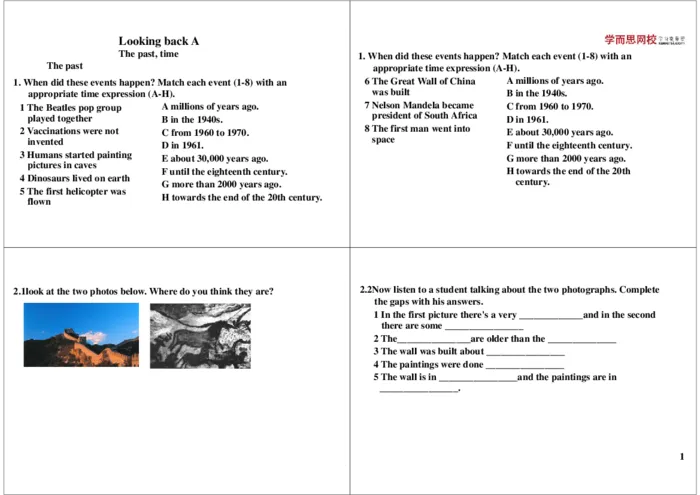
2.1look at the two photos below. Where do you think they are?
2.2Now listen to a student talking about the two photographs. Complete
the gaps with his answers.
1 In the first picture there's a very _____________and in the second
there are some ________________
2 The_______________are older than the ______________
3 The wall was built about ________________
4 The paintings were done ________________
5 The wall is in ________________and the paintings are in
________________.
1
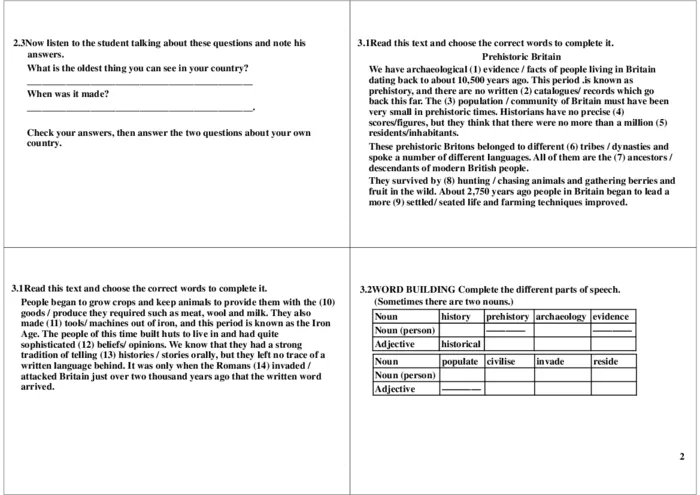
What is the oldest thing you can see in your country?
______________________________________________
When was it made?
______________________________________________.
Check your answers, then answer the two questions about your own
country.
2.3Now listen to the student talking about these questions and note his
answers.
3.1Read this text and choose the correct words to complete it.
Prehistoric Britain
We have archaeological (1) evidence / facts of people living in Britain
dating back to about 10,500 years ago. This period .is known as
prehistory, and there are no written (2) catalogues/ records which go
back this far. The (3) population / community of Britain must have been
very small in prehistoric times. Historians have no precise (4)
scores/figures, but they think that there were no more than a million (5)
residents/inhabitants.
These prehistoric Britons belonged to different (6) tribes / dynasties and
spoke a number of different languages. All of them are the (7) ancestors /
descendants of modern British people.
They survived by (8) hunting / chasing animals and gathering berries and
fruit in the wild. About 2,750 years ago people in Britain began to lead a
more (9) settled/ seated life and farming techniques improved.
3.1Read this text and choose the correct words to complete it.
People began to grow crops and keep animals to provide them with the (10)
goods / produce they required such as meat, wool and milk. They also
made (11) tools/ machines out of iron, and this period is known as the Iron
Age. The people of this time built huts to live in and had quite
sophisticated (12) beliefs/ opinions. We know that they had a strong
tradition of telling (13) histories / stories orally, but they left no trace of a
written language behind. It was only when the Romans (14) invaded /
attacked Britain just over two thousand years ago that the written word
arrived.
Noun
history
prehistory archaeology evidence
Noun (person)
————
————
Adjective
historical
3.2WORD BUILDING Complete the different parts of speech.
(Sometimes there are two nouns.)
Noun
populate
civilise
invade
reside
Noun (person)
Adjective
————
2
Noun
inhabit
descend
believe
survive
Noun (person) ————
Adjective
3.2WORD BUILDING Complete the different parts of speech.
(Sometimes there are two nouns.)
Noun discovery
abolition
cause
Verb
Noun invention
colonisation introduction
Verb
3.3Now do a mind map with the headings History, Prehistory and
Archaeology to help you remember the vocabulary. See pages
2-3 for an example.
3