学科网(北京)股份有限公司
2025 学年第二学期教学质量监测试卷
高二英语
注意事项:
1.本科目考试分试题卷和答题卷,考生须在答题纸上作答。
2.本试卷共10 页,全卷满分150 分,考试时间120 分钟。
第一部分听力(共两节,满分30 分)
第一节(共5 小题;每小题1.5 分,满分7.5 分)
听下面5 段录音。每段录音后有一个小题,从题中所给的A、B、C 三个选项中选出最佳选项。
听完每段录音后,你都有10 秒钟的时间来回答有关小题和阅读下一小题。每段录音播放两遍。
1. What is the man’s father doing?
A. Having a swim.
B. Reading an email.
C. Taking a bath.
2. What does the woman care most about the hotel?
A. The location.
B. The price.
C. The service.
3. Which exercise do the speakers prefer?
A. Skateboard.
B. Dance.
C. Basketball.
4. Which word best describes the man?
A. Diligent.
B. Tough.
C. Optimistic.
5. Why is the woman upset?
A. Her order hasn’t arrived.
B. The flower shop is closed.
C. She received the wrong delivery.
第二节(共15 小题;每小题1.5 分,满分22.5 分)
听下面5 段录音。每段录音后有几个小题,从题中所给的A、B、C 三个选项中选出最佳选项。
听完每段录音前,你将有时间阅读各个小题,每小题5 秒钟;听完后,每小题都有5 秒钟的
作答时间。每段录音播放两遍。
听第6 段录音,回答第6、7 题。
6. What do we know about the speakers?
A. They’re colleagues.
B. They’re close friends.
C. They’ve met before.
7. What will they do next?
公众号:一二试卷君
学科网(北京)股份有限公司
A. Enter the cinema.
B. Travel together.
C. Enjoy a meal.
听第7 段录音,回答第8 至10 题。
8. Why does the man make the call?
A. To rent an apartment.
B. To seek help for repair.
C. To complain about the service.
9. What needs to be dealt with first?
A. The fridge.
B. The switch.
C. The water heater.
10. What’s wrong with the gas water heater?
A. It can’t be used.
B. Its seal is broken.
C. It is out of order sometimes.
听第8 段录音,回答第11 至13 题。
11. Where does the man mainly work?
A. In a cafe.
B. In his house.
C. In an office.
12. What is the woman’s main problem?
A. Having no friends at work.
B. Being disturbed by her colleagues.
C. Driving long distances to work.
13. How does the man concentrate on his work?
A. By putting up no-talking signs.
B. By working in a separate office.
C. By setting his private workspace.
听第9 段录音,回答第14 至16 题。
14. Why does Lily want more pocket money?
A. To get as much as her friends.
B. To buy some clothes.
C. To pay for music lessons.
15. When can Lily have more pocket money?
A. When she is good at her schoolwork.
B. When she no longer argues with her mum.
C. When she is mature in her mum’s eyes.
公众号:一二试卷君
学科网(北京)股份有限公司
16. What does David suggest Lily do?
A. Have a discussion with her mum.
B. Make proper money management.
C. Sit down and wait calmly.
听第10 段录音,回答第17 至20 题。
17. In which state was a store opened last summer?
A. Montana.
B. Colorado.
C. California.
18. Who is the speaker thanking?
A. The company’s owner.
B. The company’s employees.
C. The company’s customers.
19. What does the speaker want the audience mainly to do?
A. Tell others about the new store.
B. Email the company their advice.
C. Comment on the company’s marketing plan.
20. How can people find out about the new job positions?
A. By sending the speaker an email.
B. By looking at the company’s website.
C. By applying directly at a new store.
第二部分阅读(共两节,满分50 分)
第一节(共15 小题;每小题2.5 分,满分37.5 分)
阅读下列短文,从每题所给的A、B、C、D 四个选项中选出最佳选项。
A
The four titles below are artful examples that combine rich experiences and emotion. Each is inspired by the
author’s love for their subject, language, and pushing the boundaries of biography.
Virginia Woolf, by Hermione Lee
Lee opens her classic 1997 by quoting a question posed by Woolf herself — “My God, how does one write a
Biography?” — and responds over the course of more than 700 magnificent pages. Lee is all too aware that Woolf
doubted the genre, and with that in mind, she produces something genuinely novelistic in scope, detail, and insight.
Positive Obsession: The Life and Times of Octavia E. Butler, by Susana M. Morris
公众号:一二试卷君
学科网(北京)股份有限公司
Morris’s book takes on the challenge of describing a complex female genius: the pioneering science-fiction
writer Octavia Butler. Butler described her will to write as a wild passion. Morris skillfully blends Butler’s difficult
and unique story with convincing analyses of how her fiction examined and predicted late-20th-and
early-21st-century America.
Master Slave Husband Wife: An Epic Journey from Slavery to Freedom, by Ilyon Woo
This book won a Pulitzer Prize in recognition of the depth of Woo’s research, the accomplishment of her
writing, and her generous idea of what a biography can be. Her focus is on Ellen and William Craft, an enslaved
couple who escaped from Georgia to the North in 1848 by dressing up as master and slave.
The Age of Phillis, by Honorée Fanonne Jeffers
Although this book was longlisted for the National Book Award for Poetry, it could easily have been
categorized as biography. Focusing on the groundbreaking 18th-century poet Phillis Wheatley, the collection
reimagines her childhood in West Africa. By moving through and beyond several genres, this book joins a rich new
tradition of “critical fabulation,” a mode of imaginative writing that fills in gaps of African American history.
21. What do the four books have in common?
A. They focus on unknown people.
B. They break the limits of biography.
C. They are Pulitzer Prize winners.
D. They belong to historical novels.
22. What can we learn about Octavia Butler?
A. She had a strong desire to write.
B. She lived an easy and smooth life.
C. She wrote many science books.
D. She detailed the history of America.
23. Whose book is also regarded as poetry?
A. Hermione Lee’s.
B. Susana M. Morris’s.
C. Ilyon Woo’s.
D. Honorée Fanonne Jeffers’s.
B
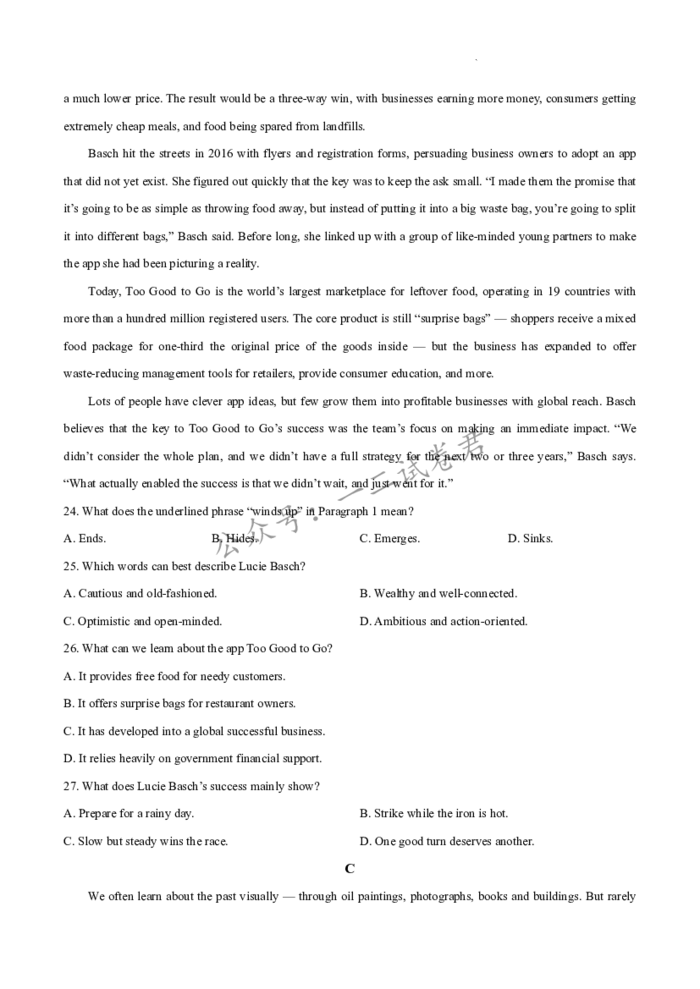
At 24, Lucie Basch left a good job at Nestlé, determined to develop an app to fight food waste. She had no
computer skills, no marketing experience, and no funding. What she did have, however, was great concern for just
how much good food winds up in the trash — about 30 percent of global production—which creates as much as 10
percent of greenhouse gas as it rots.
While food waste exists across the entire supply chain, Basch knew little about agriculture or food production.
She therefore turned to what she knew well: local bakeries, restaurants and grocery stores usually threw away
unsold food at closing time. If someone could connect that supply with customers, the food could instead be sold at
公众号:一二试卷君
学科网(北京)股份有限公司
a much lower price. The result would be a three-way win, with businesses earning more money, consumers getting
extremely cheap meals, and food being spared from landfills.
Basch hit the streets in 2016 with flyers and registration forms, persuading business owners to adopt an app
that did not yet exist. She figured out quickly that the key was to keep the ask small. “I made them the promise that
it’s going to be as simple as throwing food away, but instead of putting it into a big waste bag, you’re going to split
it into different bags,” Basch said. Before long, she linked up with a group of like-minded young partners to make
the app she had been picturing a reality.
Today, Too Good to Go is the world’s largest marketplace for leftover food, operating in 19 countries with
more than a hundred million registered users. The core product is still “surprise bags” — shoppers receive a mixed
food package for one-third the original price of the goods inside — but the business has expanded to offer
waste-reducing management tools for retailers, provide consumer education, and more.
Lots of people have clever app ideas, but few grow them into profitable businesses with global reach. Basch
believes that the key to Too Good to Go’s success was the team’s focus on making an immediate impact. “We
didn’t consider the whole plan, and we didn’t have a full strategy for the next two or three years,” Basch says.
“What actually enabled the success is that we didn’t wait, and just went for it.”
24. What does the underlined phrase “winds up” in Paragraph 1 mean?
A. Ends.
B. Hides.
C. Emerges.
D. Sinks.
25. Which words can best describe Lucie Basch?
A. Cautious and old-fashioned.
B. Wealthy and well-connected.
C. Optimistic and open-minded.
D. Ambitious and action-oriented.
26. What can we learn about the app Too Good to Go?
A. It provides free food for needy customers.
B. It offers surprise bags for restaurant owners.
C. It has developed into a global successful business.
D. It relies heavily on government financial support.
27. What does Lucie Basch’s success mainly show?
A. Prepare for a rainy day.
B. Strike while the iron is hot.
C. Slow but steady wins the race.
D. One good turn deserves another.
C
We often learn about the past visually — through oil paintings, photographs, books and buildings. But rarely
公众号:一二试卷君
学科网(北京)股份有限公司
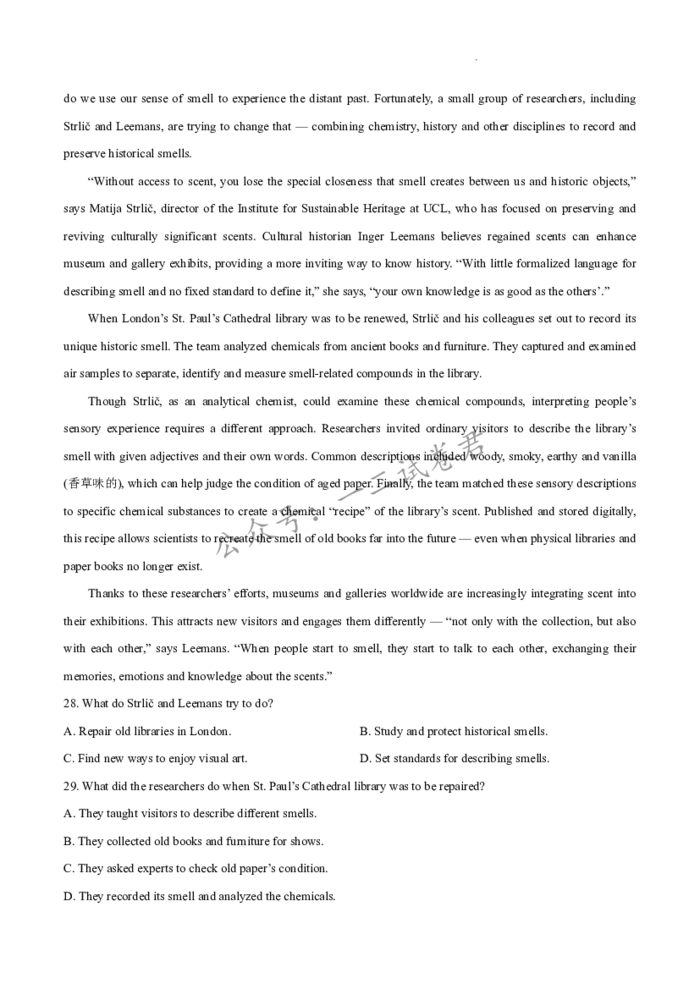
do we use our sense of smell to experience the distant past. Fortunately, a small group of researchers, including
Strlič and Leemans, are trying to change that — combining chemistry, history and other disciplines to record and
preserve historical smells.
“Without access to scent, you lose the special closeness that smell creates between us and historic objects,”
says Matija Strlič, director of the Institute for Sustainable Heritage at UCL, who has focused on preserving and
reviving culturally significant scents. Cultural historian Inger Leemans believes regained scents can enhance
museum and gallery exhibits, providing a more inviting way to know history. “With little formalized language for
describing smell and no fixed standard to define it,” she says, “your own knowledge is as good as the others’.”
When London’s St. Paul’s Cathedral library was to be renewed, Strlič and his colleagues set out to record its
unique historic smell. The team analyzed chemicals from ancient books and furniture. They captured and examined
air samples to separate, identify and measure smell-related compounds in the library.
Though Strlič, as an analytical chemist, could examine these chemical compounds, interpreting people’s
sensory experience requires a different approach. Researchers invited ordinary visitors to describe the library’s
smell with given adjectives and their own words. Common descriptions included woody, smoky, earthy and vanilla
(香草味的), which can help judge the condition of aged paper. Finally, the team matched these sensory descriptions
to specific chemical substances to create a chemical “recipe” of the library’s scent. Published and stored digitally,
this recipe allows scientists to recreate the smell of old books far into the future — even when physical libraries and
paper books no longer exist.
Thanks to these researchers’ efforts, museums and galleries worldwide are increasingly integrating scent into
their exhibitions. This attracts new visitors and engages them differently — “not only with the collection, but also
with each other,” says Leemans. “When people start to smell, they start to talk to each other, exchanging their
memories, emotions and knowledge about the scents.”
28. What do Strlič and Leemans try to do?
A. Repair old libraries in London.
B. Study and protect historical smells.
C. Find new ways to enjoy visual art.
D. Set standards for describing smells.
29. What did the researchers do when St. Paul’s Cathedral library was to be repaired?
A. They taught visitors to describe different smells.
B. They collected old books and furniture for shows.
C. They asked experts to check old paper’s condition.
D. They recorded its smell and analyzed the chemicals.
公众号:一二试卷君
学科网(北京)股份有限公司
30. Why were ordinary visitors involved in the research?
A. To replace the work of analytical chemists.
B. To identify specific chemical substances.
C. To provide authentic sensory descriptions.
D. To test the aging condition of old paper.
31. Which is the best title for the text?
A. New Ways to Visit Modern Museums
B. Bridging the Past and Present through Scents
C. The Importance of Protecting Ancient Libraries
D. How to Describe Historical Scents Accurately
D
There is nothing grand about Diamond Horn Palace. Located in an old and crowded neighborhood of Delhi,
this little shop sells car horns. Plain and modest as it looks, the store enjoys surprisingly booming business. “The
horns wear out easily due to frequent use,” says Mustafa Ahmed, its owner.
Mr. Ahmed’s thriving business should sound an alarm for India. Step onto any street in the country and it is
easy to hear why. According to UN data in 2022, Indian cities are among the loudest in the world. Noise levels on
Delhi’s streets average around 75 decibels (分贝) — four times the limit recommended by the UN’s World Health
Organisation (WHO). Peak readings in some cities have exceeded 100 decibels, roughly as loud as standing next to
a chainsaw.
Noise is no mere annoyance. A growing body of research shows that regular exposure to it can be a
public-health threat. More than 60 million Indians suffer from hearing loss, which researchers attribute partly to
noise pollution. A review of studies conducted in 2020 even found that exposure to louder road-traffic noise was
associated with greater risk of heart disease. A study from 2022, which tracked 2,680 children in Barcelona, found
that a five-decibel increase in traffic noise slowed the development of working memory by 11%.
Despite all these harms, remarkably little is being done. India’s Central Pollution Control Board, the main
regulator, has a duty to monitor and tackle noise. But it is struggling on both fronts. Its noise-monitoring network
only extends to around 80 stations across ten cities. Its call to maintain “silent zones” — areas near hospitals and
schools — has also fallen on deaf ears.
“Road traffic accounts for 75% of India’s urban noise,” estimates Dr Manohare. Poor planning has made
Indian traffic chaotic as trucks, motorcycles, bicycles and pedestrians compete for space. The horn has shifted from
a warning instrument into an all-purpose communication device. A desperate problem is inviting desperate
solutions. Some suggest replacing vehicle horns with the pleasant sounds of Indian musical instruments. Others
prefer an educational approach, hoping people can be aware of the harms of noise pollution and change their
behaviour.
公众号:一二试卷君
学科网(北京)股份有限公司
32. Why does the author mention Diamond Horn Palace?
A. To promote a local small shop.
B. To provide a successful business case.
C. To show its wide popularity.
D. To introduce the topic of noise pollution.
33. What can we learn about noise in Indian cities?
A. It is well controlled by authorities.
B. It is far beyond the safe limit.
C. It mainly comes from local factories.
D. It has little influence on children.
34. What is the situation of noise management in India?
A. It is ignored by the government.
B. It wins support from the public.
C. It is ineffective and quite limited.
D. It owns complete monitoring networks.
35. What is the last paragraph mainly about?
A. Causes of noise and possible measures.
B. Chaos of urban traffic rules.
C. Popular uses of vehicle horns.
D. New designs of vehicle horns.
第二节(共5 小题;每小题2.5 分,满分12.5 分)
阅读下面短文,从短文后的选项中选出能填入空白处的最佳选项。选项中有两项为多余选项。
From cashless payment to online meetings, much of our daily life nowadays exists deeply in the digital world.
Although using online tools and keeping social connections online is not inherently bad, a growing number of
people are choosing to disconnect from online life and follow the popular trend of “going analogue” (回归线下生
活).
Going analogue is not aimed at spending plenty of time and money on new hobbies.
36
You can
choose activities with rich sensory experiences, including getting close to nature, making handmade creations by
ourselves, and keeping regular physical movement.
37
Instead, turn to simple arts and crafts in spare time. You can try mindful colouring, flower pressing,
card-making and portrait sketching. To connect with the natural world, ride a bike to nearby greenspaces, read
quietly in the shade or do knitting to enjoy natural sounds.
38
You can also form offline daily habits: keep a paper journal, use a wall calendar, or cook with traditional
cookbooks instead of depending on smartphones. Besides enjoying personal quiet time, you can embrace offline
social moments too.
39
Small slow-living activities like growing herbs, learning knitting, writing postcards
and making photo albums can add warmth to spare time as well.
Going analogue doesn’t mean completely rejecting technology.
40
Those small changes let us feel the
real world, slow down our pace, and live a calmer and fuller life.
公众号:一二试卷君
学科网(北京)股份有限公司
A. Analogue hobbies are far more affordable.
B. It simply means setting aside screen-free time.
C. For creative people, you can give up mindless online scrolling.
D. Its real goal is to step away from virtual life and return to reality.
E. A headphone-free walk around also free you from the online world.
F. However, it could be sending an old-fashioned letter to a friend far away.
G. Board games and puzzles are ideal for quality time with family and friends.
第三部分语言运用(共两节,满分30 分)
第一节(共15 小题;每小题1 分,满分15 分)
阅读下面短文,从每题所给的A、B、C、D 四个选项中选出最佳选项。
Ten-year-old fashion designer Max Alexander has made history as the youngest person ever to hold a show at
Paris Fashion Week. This remarkable achievement follows an earlier
41
he set at just seven years old when
he earned a Guinness World Record for being the youngest designer to
42
a professional fashion show.
Paris Fashion Week stands as a top global fashion event where leading
43
from around the world
showcase their latest creative
44
. Max, who is based in Los Angeles, displayed fifteen beautiful dresses at
the event. His designs are
45
by lively floral patterns and bright cheerful
46
.
What makes Max special is that he only uses
47
materials that do little harm to the environment. He is
firmly
48
to the idea of protecting nature and cutting down waste in the fashion industry. He created one
amazing dress from a
49
1980s wedding dress. Many of his works use materials that break down
50
and leftover fabrics that companies would
51
throw away. Max explained that these materials would end
up in landfill and damage the environment if he did not reuse them.
Max’s mother
52
that he has been passionate about fashion since the age of four. Inspired by a dream
in which he pictured himself as a dress designer, he
53
sewing at an early age. Today, he already has his
own clothing
54
, which is well received by many young fashion lovers. For Max, appearing at Paris
Fashion Week is incredibly exciting, because, as he says, Paris is truly the home of fashion, with new fashion trends
55
and popularized here.
41. A. tradition
B. limit
C. record
D. example
42. A. advertise
B. report
C. sponsor
D. host
43. A. models
B. actors
C. photographers
D. designers
44. A. collections
B. inventions
C. images
D. projects
公众号:一二试卷君
学科网(北京)股份有限公司
45. A. accompanied
B. characterized
C. influenced
D. defined
46. A. tunes
B. melodies
C. colours
D. sights
47. A. sustainable
B. artificial
C. cozy
D. antique
48. A. addicted
B. committed
C. accustomed
D. opposed
49. A. remade
B. recovered
C. recycled
D. replaced
50. A. casually
B. constantly
C. immediately
D. naturally
51. A. otherwise
B. therefore
C. seldom
D. rather
52. A. imagined
B. admitted
C. envisioned
D. recalled
53. A. got over
B. took up
C. put off
D. carried on
54. A. slogan
B. mall
C. brand
D. package
55. A. rejected
B. born
C. purchased
D. observed
第二节(共10 小题;每小题1.5 分,满分15 分)
阅读下面短文,在空白处填入1 个适当的单词或括号内单词的正确形式。
Across the world, poets and tech experts are exploring how AI can deepen our appreciation of poetry, an art
form
56
(originate) in ancient civilizations. Recent experiments show that AI is capable of generating
verses with
57
(impress) rhythm and imagery, yet lacking the depth that comes from human life
experience.
However, it is not whether AI can write poems, but how human creators should relate to this powerful tool
58
makes the discussion complex. Some artists fear that AI may replace their creativity,
59
others see
it as a partner that can inspire new directions. Critics point out that even the most advanced AI can never capture
the subtle feelings
60
(contain) in lines written by poets who have suffered, loved, and observed the world
61
(close).
Long before AI became widely accessible, poets
62
(rely) only on their own imagination and
language skills. Today, however, many are keen
63
AI in creative processes, using it to polish drafts,
suggest metaphors, or even create multimedia poetry combining words, images and sound.
With AI continuing to evolve rapidly,
64
boundary between human and machine creativity will
remain a hot topic. It is our responsibility to ensure that technology serves art,
65
the other way around.
第四部分写作(共两节,满分40 分)
第一节(满分15 分)
假定你是李华,参与了本市国际马拉松比赛的志愿者工作。应组委会邀请,你将在志愿者分享会上作
公众号:一二试卷君
学科网(北京)股份有限公司
简短发言。请用英语写一篇发言稿,内容包括:
1.赛事感人瞬间;
2.你的感悟。
注意:
1.词数80 左右;
2.可适当增加细节,以使行文连贯。
Dear fellow volunteers and friends,
I’m Li Hua, a volunteer for the 2026 Marathon held in our city.
第二节(满分25 分)
阅读下面材料,根据其内容和所给段落开头语续写两段,使之构成一篇完整的短文。
I stared at the messy pile of bamboo strips on the table, my fingers sore and stiff, my heart flooded with
sinking frustration. For weeks, I’d been trying patiently to learn traditional bamboo weaving from Grandma, yet
every single careless attempt ended in a tangled (缠绕的), disorderly mess.
Grandma was a well-known master weaver in our small community; her rough aged hands moved nimbly (灵
巧地) and skillfully, turning plain ordinary bamboo strips into delicate baskets, beautiful folding fans, and even
vivid cute small animal figurines. The time-honored craft had been passed down in our family for generations,
carrying plain simple warmth and precious traditional folk wisdom.
“Patience, little one,” Grandma would always say softly, smiling gently as she patiently reworked my failed
clumsy pieces little by little. “Bamboo listens only to a calm and peaceful heart.” But I was far too eager and
restless to prove myself. The school’s Cultural Heritage Fair was coming in just three days, and I had proudly
promised my classmates that I would bring a fine unique handwoven bamboo artwork to share. The moment I
thought about those expecting eyes, my eyes burned hot with gathering helpless tears.
That afternoon, I stormed angrily into the quiet yard, throwing my rough half-finished basket heavily on the
green grass. “It’s useless! I’ll never get it right no matter how hard I try!” I shouted loudly, kicking a thin bamboo
strip across the soft lawn. Surprisingly, Grandma did not scold my bad temper at all. She just sat quietly on her old
wooden chair, weaving a lovely small bamboo bird with steady, unhurried fingers. After a long peaceful silence,
she raised her head, looked at me gently and said in a warm soft voice, “Let’s walk by the stream behind our house.
The bamboo growing there has much to teach you.”
公众号:一二试卷君
学科网(北京)股份有限公司
注意:
1.续写词数应为150 左右;
2.请按如下格式在答题卡的相应位置作答。
We walked slowly to the stream, where tall green bamboo danced gracefully in the wind.
At the Cultural Heritage Fair, my bamboo basket drew lots of attention.
公众号:一二试卷君