文档文本内容
Module4 教材提前看1
•
(教材原句)A great way to help you remember something is to
imagine a picture of it in your mind. (教材99页)
•
核心动词:imagine (v)想象
•
Imagine a life without exams
•
词组(1)imagine that+句子
•
我想象我住在一个大房子里
•
请想象你通过了考试
•
词组(2)imagine doing
•
想象在月亮上散步
•
(教材原句)A picture is worth a thousand words (教材99页)
•
worth (a)值
•
(1) be + worth +钱
•
How much does it cost?
•
我的表值1000美元
•
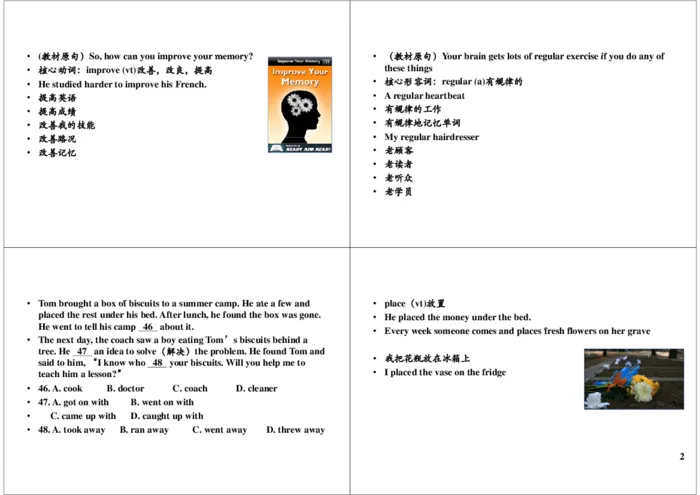
这个房子值100万美元
•
how much is the ring worth ?
•
(2)核心词组:be worth doing
•
这个房子值得买
•
这本书值得看
•
worthless
•
(教材原句)Memory is very important (P109)
•
(教材原句)Memory is very important (P109)
•
memory (n)记忆
•
My memory is not as good as it once was
•
My memory is not as good as it once was.
•
我童年的记忆
•
词组:记忆力好
•
词组:记忆力好
•
Have a good memory
H h
d
f
d
•
He has a good memory for words
•
词组:失忆
M
t
l
t
t t l
th i
th
t ld
•
Most people start to lose their memory as they get older
•
memorize (vt)记忆
记住
•
memorize (vt)记忆,记住
•
记住他的电话号码
•
记住宾馆地址
•
记住宾馆地址
•
write a memo (n)
•
memorable (a)
•
memorable (a)
•
一次难忘的经历
•
次难忘的旅行
•
一次难忘的旅行
•
一个难忘的电影
1
•
(教材原句)So how can you improve your memory?
•
(教材原句)So, how can you improve your memory?
•
核心动词:improve (vt)改善,改良,提高
•
He studied harder to improve his French
•
He studied harder to improve his French.
•
提高英语
•
提高成绩
•
提高成绩
•
改善我的技能
•
改善路况
•
改善路况
•
改善记忆
•
(教材原句)Your brain gets lots of regular exercise if you do any of
•
(教材原句)Your brain gets lots of regular exercise if you do any of
these things
•
核心形容词:regular (a)有规律的
核心形容词:regular (a)有规律的
•
A regular heartbeat
•
有规律的工作
有规律的工作
•
有规律地记忆单词
•
My regular hairdresser
•
My regular hairdresser
•
老顾客
•
老读者
•
老读者
•
老听众
•
老学员
•
老学员
•
Tom brought a box of biscuits to a summer camp He ate a few and
•
Tom brought a box of biscuits to a summer camp. He ate a few and
placed the rest under his bed. After lunch, he found the box was gone.
He went to tell his camp 46  about it.
p
•
The next day, the coach saw a boy eating Tom’s biscuits behind a
tree. He 47  an idea to solve(解决)the problem. He found Tom and
said to him, “I know who 48  your biscuits. Will you help me to
teach him a lesson?”
•
46. A. cook          B. doctor            C. coach            D. cleaner
•
47. A. got on with
B. went on with
•
C. came up with      D. caught up with
•
48. A. took away      B. ran away          C. went away        D. threw away
•
place(vt)放置
•
place(vt)放置
•
He placed the money under the bed.
•
Every week someone comes and places fresh flowers on her grave
•
Every week someone comes and places fresh flowers on her grave
•
我把花瓶放在冰箱上
•
我把花瓶放在冰箱上
•
I placed the vase on the fridge
2
•
Tom brought a box of biscuits to a summer camp He ate a few and
•
Tom brought a box of biscuits to a summer camp. He ate a few and
placed the rest under his bed. After lunch, he found the box was gone.
He went to tell his camp 46  about it.
p
•
The next day, the coach saw a boy eating Tom’s biscuits behind a
tree. He 47  an idea to solve(解决)the problem. He found Tom and
said to him, “I know who 48  your biscuits. Will you help me to
teach him a lesson?”
•
46. A. cook          B. doctor            C. coach            D. cleaner
•
47. A. got on with     B. went on with
•
C. came up with      D. caught up with
•
48. A. took away      B. ran away          C. went away        D. threw away
•
be+gone (a)
•
be+gone (a)
•
(1)人:
•
I came in the room but he was gone
•
I came in the room but he was gone
•
His wife is gone for several years.
•
(2)物:
•
(2)物:
•
Many of the old houses are gone now.
•
Tom brought a box of biscuits to a summer camp He ate a few and
•
Tom brought a box of biscuits to a summer camp. He ate a few and
placed the rest under his bed. After lunch, he found the box was gone.
He went to tell his camp 46  about it.
p
•
The next day, the coach saw a boy eating Tom’s biscuits behind a
tree. He 47  an idea to solve(解决)the problem. He found Tom and
said to him, “I know who 48  your biscuits. Will you help me to
teach him a lesson?”
•
46. A. cook          B. doctor            C. coach            D. cleaner
•
47. A. got on with
B. went on with
•
C. came up with      D. caught up with
•
48. A. took away      B. ran away          C. went away        D. threw away
•
Tom brought a box of biscuits to a summer camp He ate a few and
•
Tom brought a box of biscuits to a summer camp. He ate a few and
placed the rest under his bed. After lunch, he found the box was gone.
He went to tell his camp 46  about it.
p
•
The next day, the coach saw a boy eating Tom’s biscuits behind a
tree. He 47  an idea to solve(解决)the problem. He found Tom and
said to him, “I know who 48  your biscuits. Will you help me to
teach him a lesson?”
•
46. A. cook          B. doctor            C. coach            D. cleaner
•
47. A. got on with        B. went on with
•
C. came up with      D. caught up with
•
48. A. took away      B. ran away          C. went away        D. threw away
3
•
“Well yes
are you going to punish 49
sir?” Tom asked “No I
•
Well, yes… are you going to punish 49  , sir?
Tom asked.
No, I
am not,” the coach explained 50  . “That would only make him hate
you. I want you to write to your mother and ask for more 51  .”
y
y
y
•
49. A. me            B. him                 C. us                     D. them
•
50. A. shyly          B. angrily            C. excitedly         D. patiently
y y
g
y
y
p
y
•
51. A. gifts           B. biscuits           C. candies             D. toys
•
核心动词:explain (vt)解释
•
核心动词:explain (vt)解释
•
A dictionary explains the meaning of words.
•
explain sth to sb
•
他给我解释了他的计划
•
他给我解释了他的计划
•
explanation (n)解释
•
explanation (n)解释
•
He left the room without explanation.
我听不懂老师的解释
•
我听不懂老师的解释
•
“Well, yes… are you going to punish 49  , sir?” Tom asked. “No, I
”
i
0
“
i
am not,” the coach explained 50  . “That would only make him hate
you. I want you to write to your mother and ask for more 51  .”
49 A
B hi
C
D th
•
49. A. me            B. him                   C. us                     D. them
•
50. A. shyly          B. angrily            C. excitedly         D. patiently
51 A
ift
B bi
it
C
di
D t
•
51. A. gifts           B. biscuits           C. candies             D. toys
•
Tom received another box of biscuits by mail from his mother a few
y
days later. “Now,” said the coach, “go and 52  them with the boy
who stole your biscuits.” Tom didn’t understand the coach’s word,
3
i
f
i
i
53  he still followed his advice.
•
52. A. share          B. choose            C. divide            D. fill
•
53. A. if             B. but               C. since             D. though
•
核心动词:steal stole stolen (v)偷窃
•
核心动词:steal-stole-stolen (v)偷窃
•
特别小心:
•
I was stolen
•
I was stolen
•
My phone was stolen
•
词组:steal sth from sb
•
词组:steal sth from sb
•
他偷了我的手表
H
t l
t h ( )
•
He stole me a watch (x)
•
He stole my watch from me
我从老师那偷走了我的试卷
•
我从老师那偷走了我的试卷
4
•
Tom received another box of biscuits by mail from his mother a few
•
Tom received another box of biscuits by mail from his mother a few
days later. “Now,” said the coach, “go and 52  them with the boy
who stole your biscuits.” Tom didn’t understand the coach’s word,
y
,
53  he still followed his advice.
•
52. A. share          B. choose            C. divide            D. fill
•
53. A. if             B. but               C. since             D. though
•
Half an hour later the coach saw the two boys come up the hill arm in
•
Half an hour later the coach saw the two boys come up the hill, arm in
arm. The boy was trying to ask Tom to 54  his toy robot in payment
for(赔偿)the stolen biscuits. And Tom was refusing the gift from his
(
偿)
g
g
new friend. He said that a few biscuits were not so 55  .
•
In some situations, forgiveness(原谅)is better than punishment.
•
54. A. steal           B. mend                 C. make             D. accept
•
55. A. cheap          B. delicious          C. different           D. important
•
refuse (vt)拒绝
•
refuse (vt)拒绝
•
拒绝一个建议
•
拒绝一个礼物
•
拒绝一个礼物
•
拒绝一个邀请
•
核心词组:refuse to do 拒绝去做
•
核心词组:refuse to do 拒绝去做…
•
On cold mornings the car always refuses to start.
•
我拒绝给他解释这个题
•
我拒绝给他解释这个题
•
我拒绝明天爬山
这个病人拒绝看病
•
这个病人拒绝看病
•
Half an hour later the coach saw the two boys come up the hill arm in
•
Half an hour later the coach saw the two boys come up the hill, arm in
arm. The boy was trying to ask Tom to 54  his toy robot in payment
for(赔偿)the stolen biscuits. And Tom was refusing the gift from his
(
偿)
g
g
new friend. He said that a few biscuits were not so 55  .
•
In some situations, forgiveness(原谅)is better than punishment.
•
54. A. steal           B. mend                 C. make             D. accept
•
55. A. cheap          B. delicious          C. different           D. important
5