MBA 大师跟学团英语专属系统课
“翻译”课程讲义
主讲老师:王丽
微信公众号关注【王丽考研英语】获取考研英语备考最新独家资料
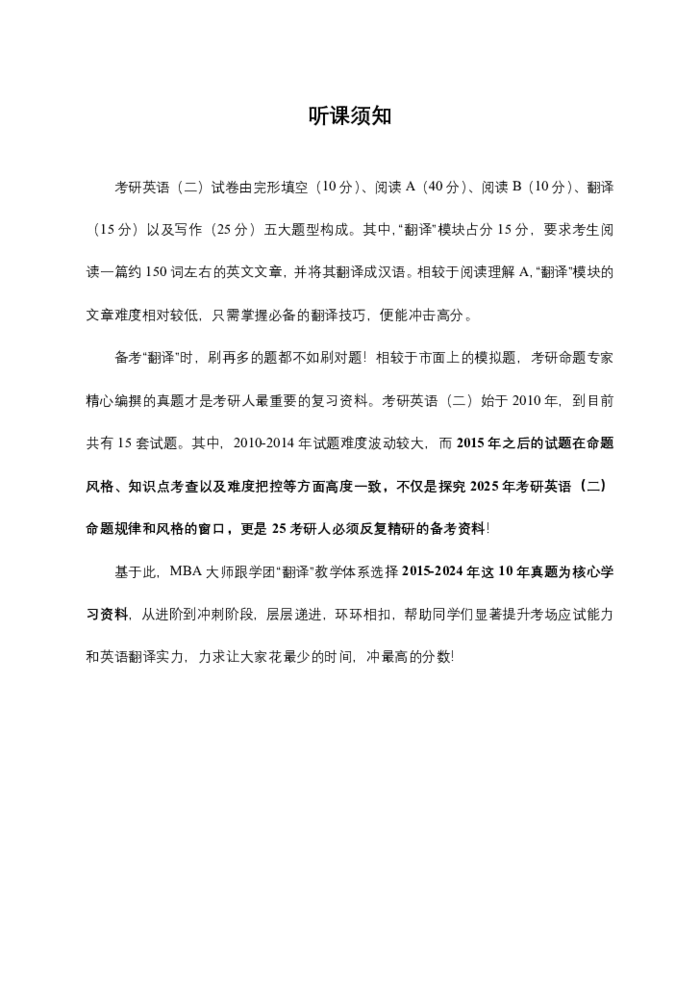
听课须知
考研英语(二)试卷由完形填空(10 分)、阅读A(40 分)、阅读B(10 分)、翻译
(15 分)以及写作(25 分)五大题型构成。其中,“翻译”模块占分15 分,要求考生阅
读一篇约150 词左右的英文文章,并将其翻译成汉语。相较于阅读理解A,“翻译”模块的
文章难度相对较低,只需掌握必备的翻译技巧,便能冲击高分。
备考“翻译”时,刷再多的题都不如刷对题!相较于市面上的模拟题,考研命题专家
精心编撰的真题才是考研人最重要的复习资料。考研英语(二)始于2010 年,到目前
共有15 套试题。其中,2010-2014 年试题难度波动较大,而2015 年之后的试题在命题
风格、知识点考查以及难度把控等方面高度一致,不仅是探究2025 年考研英语(二)
命题规律和风格的窗口,更是25 考研人必须反复精研的备考资料!
基于此,MBA 大师跟学团“翻译”教学体系选择2015-2024 年这10 年真题为核心学
习资料,从进阶到冲刺阶段,层层递进,环环相扣,帮助同学们显著提升考场应试能力
和英语翻译实力,力求让大家花最少的时间,冲最高的分数!
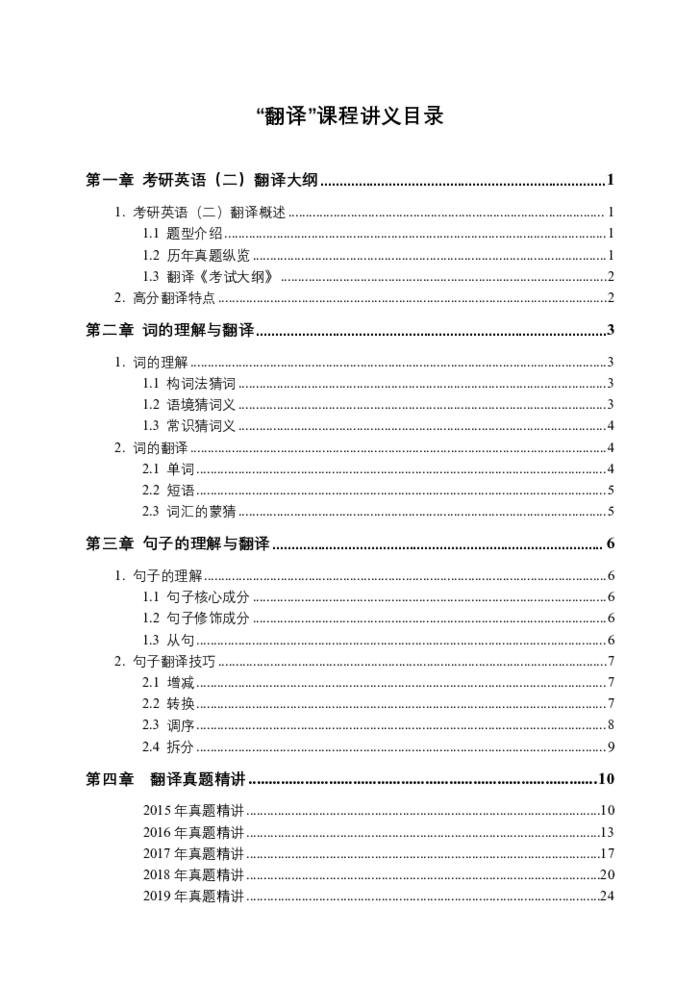
“翻译”课程讲义目录
第一章考研英语(二)翻译大纲...........................................................................1
1. 考研英语(二)翻译概述........................................................................................... 1
1.1 题型介绍..............................................................................................................1
1.2 历年真题纵览......................................................................................................1
1.3 翻译《考试大纲》..............................................................................................2
2. 高分翻译特点................................................................................................................2
第二章词的理解与翻译............................................................................................3
1. 词的理解........................................................................................................................3
1.1 构词法猜词..........................................................................................................3
1.2 语境猜词义..........................................................................................................3
1.3 常识猜词义..........................................................................................................4
2. 词的翻译........................................................................................................................4
2.1 单词......................................................................................................................4
2.2 短语......................................................................................................................5
2.3 词汇的蒙猜..........................................................................................................5
第三章句子的理解与翻译....................................................................................... 6
1. 句子的理解....................................................................................................................6
1.1 句子核心成分......................................................................................................6
1.2 句子修饰成分......................................................................................................6
1.3 从句......................................................................................................................6
2. 句子翻译技巧................................................................................................................7
2.1 增减......................................................................................................................7
2.2 转换......................................................................................................................7
2.3 调序......................................................................................................................8
2.4 拆分......................................................................................................................9
第四章
翻译真题精讲.......................................................................................10
2015 年真题精讲......................................................................................................10
2016 年真题精讲......................................................................................................13
2017 年真题精讲......................................................................................................17
2018 年真题精讲......................................................................................................20
2019 年真题精讲......................................................................................................24
1
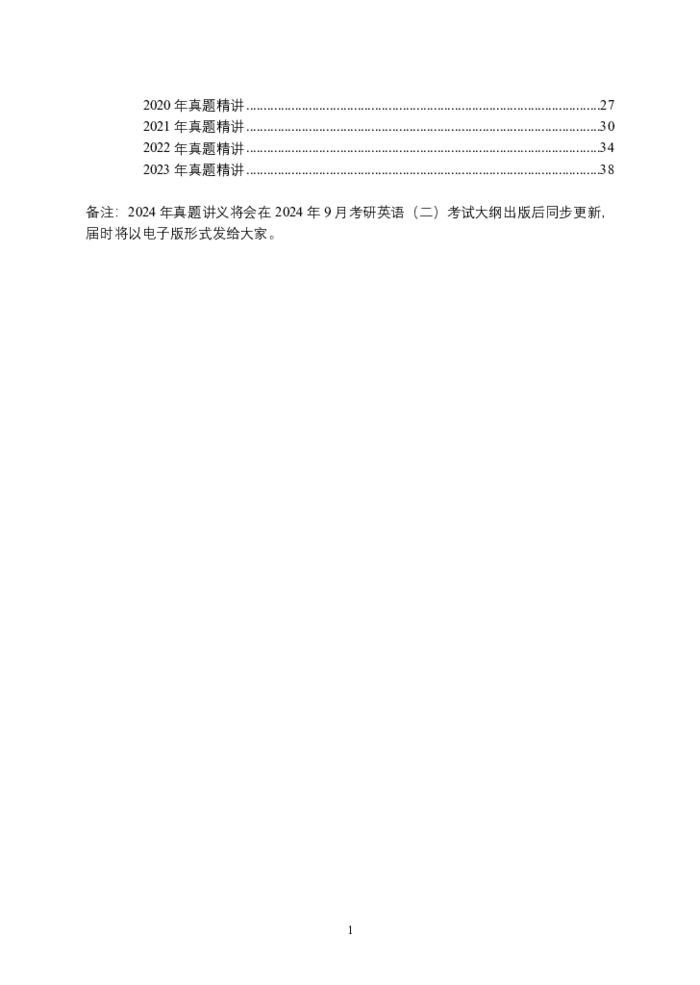
2020 年真题精讲......................................................................................................27
2021 年真题精讲......................................................................................................30
2022 年真题精讲......................................................................................................34
2023 年真题精讲......................................................................................................38
备注:2024 年真题讲义将会在2024 年9 月考研英语(二)考试大纲出版后同步更新,
届时将以电子版形式发给大家。
翻译大纲
第
1
页
第一章考研英语(二)翻译大纲
1. 考研英语(二)翻译概述
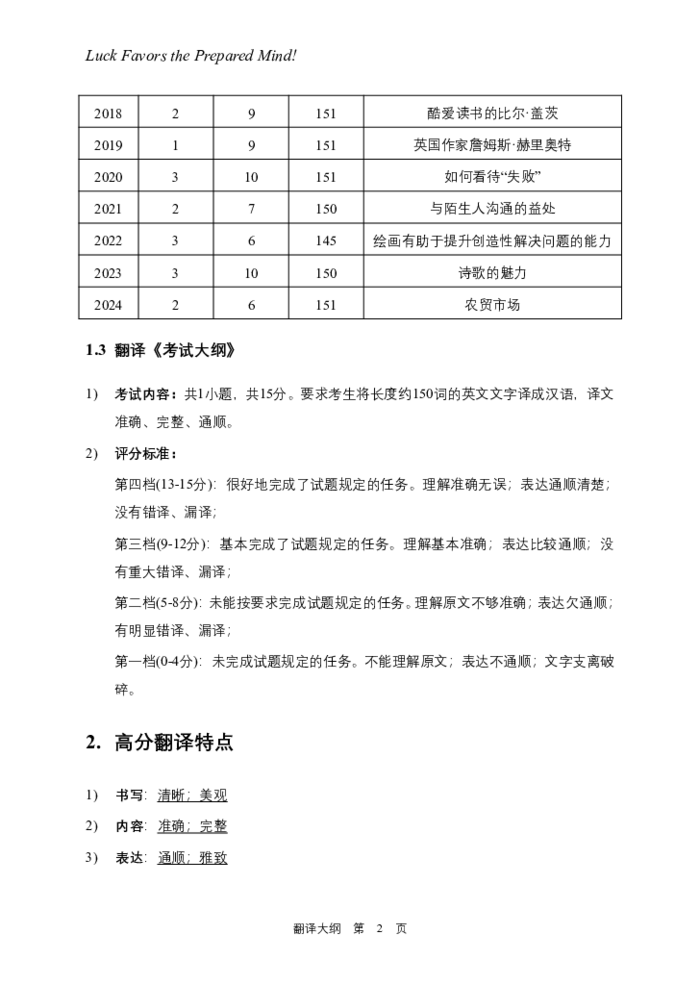
1.1 题型介绍
题型
文章篇幅
分值
答题时间
英语知识运用
(完形填空)
一篇文章,约350 词
10分
建议15分钟
阅读A
四篇文章,共1500-1600 词
40分
建议70分钟
阅读B
一篇文章,450-550 词
10分
建议20分钟
翻译
一篇文章,约150 词
15分
建议20分钟
写作
—
25分
建议55分钟
总计
约2600 词
100分
180分钟
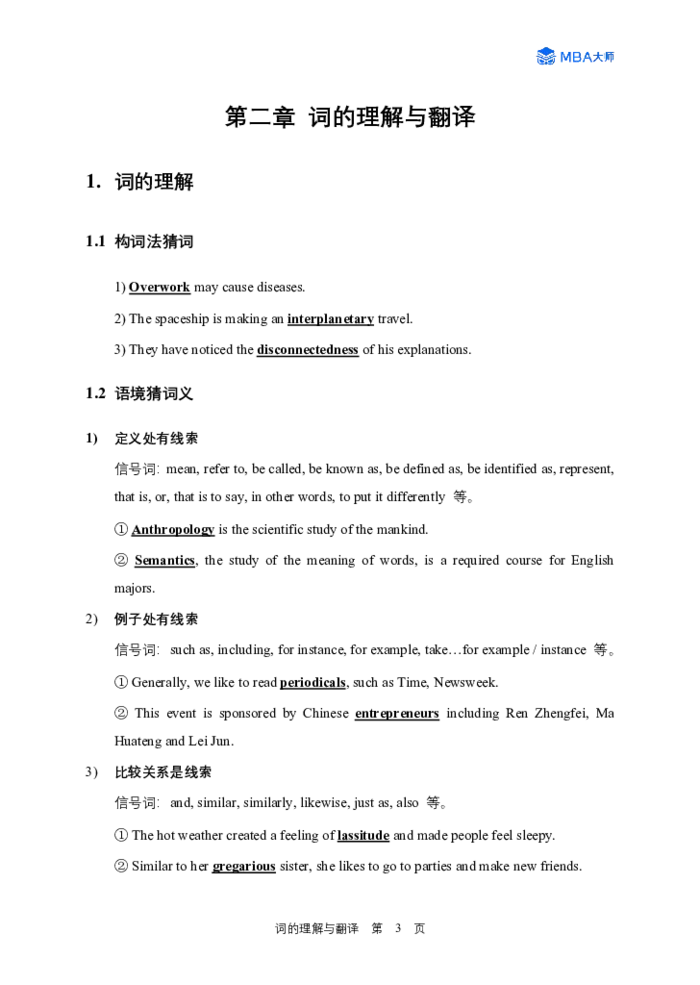
1.2 历年真题纵览
年份
段落
句子数量
总字数
翻译主题
2010
3
10
152
宁对承受力的个人理解
2011
3
7
150
信息行业温室气体排放问题及应对措施
2012
2
6
151
发展中国家面临的移民问题
2013
2
9
157
超强记忆力者的自述
2014
2
10
147
如何看待并践行乐观主义
2015
3
10
156
熟路效应
2016
1
7
146
超市设计的宗旨
2017
1
7
154
人生理想的追求和探索
Luck Favors the Prepared Mind!
翻译大纲
第
2
页
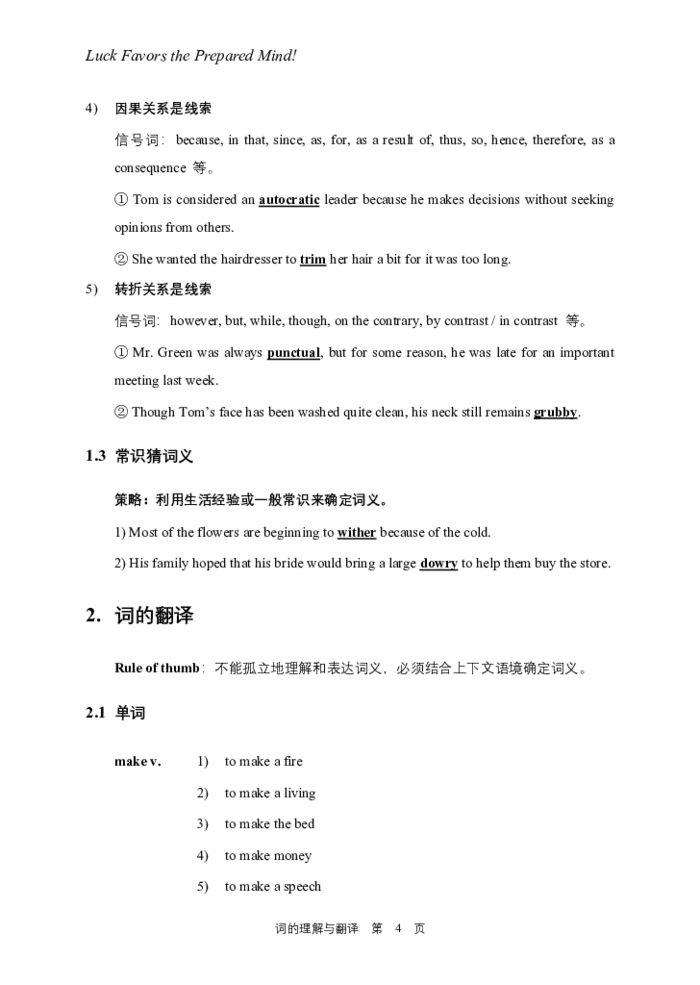
2018
2
9
151
酷爱读书的比尔·盖茨
2019
1
9
151
英国作家詹姆斯·赫里奥特
2020
3
10
151
如何看待“失败”
2021
2
7
150
与陌生人沟通的益处
2022
3
6
145
绘画有助于提升创造性解决问题的能力
2023
3
10
150
诗歌的魅力
2024
2
6
151
农贸市场
1.3 翻译《考试大纲》
1)
考试内容:共1小题,共15分。要求考生将长度约150词的英文文字译成汉语,译文
准确、完整、通顺。
2)
评分标准:
第四档(13-15分):很好地完成了试题规定的任务。理解准确无误;表达通顺清楚;
没有错译、漏译;
第三档(9-12分):基本完成了试题规定的任务。理解基本准确;表达比较通顺;没
有重大错译、漏译;
第二档(5-8分):未能按要求完成试题规定的任务。理解原文不够准确;表达欠通顺;
有明显错译、漏译;
第一档(0-4分):未完成试题规定的任务。不能理解原文;表达不通顺;文字支离破
碎。
2. 高分翻译特点
1)
书写:清晰;美观
2)
内容:准确;完整
3)
表达:通顺;雅致
词的理解与翻译
第
3
页
第二章词的理解与翻译
1. 词的理解
1.1 构词法猜词
1) Overwork may cause diseases.
2) The spaceship is making an interplanetary travel.
3) They have noticed the disconnectedness of his explanations.
1.2 语境猜词义
1)
定义处有线索
信号词:mean, refer to, be called, be known as, be defined as, be identified as, represent,
that is, or, that is to say, in other words, to put it differently 等。
①Anthropology is the scientific study of the mankind.
②Semantics, the study of the meaning of words, is a required course for English
majors.
2)
例子处有线索
信号词:such as, including, for instance, for example, take…for example / instance 等。
①Generally, we like to read periodicals, such as Time, Newsweek.
②This event is sponsored by Chinese entrepreneurs including Ren Zhengfei, Ma
Huateng and Lei Jun.
3)
比较关系是线索
信号词:and, similar, similarly, likewise, just as, also 等。
①The hot weather created a feeling of lassitude and made people feel sleepy.
②Similar to her gregarious sister, she likes to go to parties and make new friends.
Luck Favors the Prepared Mind!
词的理解与翻译
第
4
页
4)
因果关系是线索
信号词:because, in that, since, as, for, as a result of, thus, so, hence, therefore, as a
consequence 等。
①Tom is considered an autocratic leader because he makes decisions without seeking
opinions from others.
②She wanted the hairdresser to trim her hair a bit for it was too long.
5)
转折关系是线索
信号词:however, but, while, though, on the contrary, by contrast / in contrast 等。
①Mr. Green was always punctual, but for some reason, he was late for an important
meeting last week.
②Though Tom’s face has been washed quite clean, his neck still remains grubby.
1.3 常识猜词义
策略:利用生活经验或一般常识来确定词义。
1) Most of the flowers are beginning to wither because of the cold.
2) His family hoped that his bride would bring a large dowry to help them buy the store.
2. 词的翻译
Rule of thumb:不能孤立地理解和表达词义,必须结合上下文语境确定词义。
2.1 单词
make v.
1)
to make a fire
2)
to make a living
3)
to make the bed
4)
to make money
5)
to make a speech
词的理解与翻译
第
5
页
2.2 短语
pick v.
1)
Please pick up all your toys.
2)
Sales have picked up 14% this year.
3)
I’ll pick you up at 8 o’clock.
4)
His parents are afraid that he would pick up bad habits.
2.3 词汇的蒙猜
1)
They are asked to strike up a conversation with strangers.
蒙猜思路:他们被要求与陌生人strike up谈话。
2)
This region is distinctively different from my hometown.
蒙猜思路:这个地区与我的家乡distinctively不同。
Luck Favors the Prepared Mind!
句子的理解与翻译
第
6
页
第三章句子的理解与翻译
1. 句子的理解
1.1 句子核心成分
简单句基本句型:
主谓:The sun rises.
主系表:English is important.
主谓宾:I like English.
主谓宾宾:English brings me luck.
主谓宾补:English makes me happy.
1.2 句子修饰成分
状语:I read a book yesterday.
定语:I read a thought-provoking book written by William Shakespeare.
同位语:The thought-provoking book, Hamlet, was written by William Shakespeare.
1.3 从句
状语从句:I read a book when I was in the library.
主语从句:What he said is thought-provoking.
表语从句:The question is that I like this book.
宾语从句:He told me that I should read the book.
定语从句:I read a book which was written by William Shakespeare.
同位语从句:The fact that Shakespeare’s books are thought-provoking is known by
many people.
句子的理解与翻译
第
7
页
2. 句子翻译技巧
2.1 增减
1)
英汉差异:英语重形式,汉语重表义。
减译:英译汉时,往往需要省略冠词、代词、连词等,让译文更加通顺。
e.g. The moon was slowly rising above the sea.
参考译文:月亮慢慢从海上升起。
e.g. Don’t put your hands in your pockets.
参考译文:别把手搁在口袋里。
e.g. If winter comes, can spring be far behind?
参考译文:冬天来了,春天还会远吗?
2)
英汉差异:英语重时态,汉语需补充。
增译:英译汉时,通常要增译出时态,使译文更加精确。
e.g. Man, was, is and always will be trying to improve his living conditions.
参考译文:人类不管过去、现在还是将来都致力于提高自己的生活水平。
2.2 转换
1)
英汉差异:英语多静态,汉语多动态。
转换词性:英语中名词、介词使用较多,翻译时往往可以转换为动词。
e.g. I admire your decision to embrace the challenge.
参考译文:你决定接受挑战,这一点让我很羡慕。
e.g. She opened the window to let fresh air in.
参考译文:她打开窗户,让新鲜空气进来。
e.g. He is quite aware of his shortcomings.
参考译文:他很清楚自己的缺点。
Luck Favors the Prepared Mind!
句子的理解与翻译
第
8
页
2) 英汉差异:英语多被动,汉语多主动。
转换语态:英语中被动语态使用较多,翻译时往往转为主动语态。
e.g. The house was built in 1985.
参考译文:这座房子是1985年修建的。
e.g. By the end of the year, more than 1,000 children had been helped by the
organization.
参考译文:截止年底,该组织帮助了1000多名儿童。
e.g. It is known that smoking is detrimental to health.
参考译文:众所周知,吸烟有害健康。
2.3 调序
1)
英汉差异:英语状语较灵活,汉语状语多前置。
状语调序:汉语中的状语往往放在:①主语和谓语之间;②句首。
e.g. He opened the can with a knife.
参考译文:他用刀打开了罐头。
e.g. We had a meeting in his office at 10 o’clock yesterday morning.
参考译文:昨天上午10点,我们在他办公室开会。
e.g. He went on working though it was very late.
参考译文:虽然天色已晚,但是他仍继续工作。
2)
英汉差异:英语定语多后置,汉语定语多前置。
定语调序:①名词前面;②变成状语。
e.g. a lecture on translation skills
参考译文:一个关于翻译技巧的讲座
e.g. Could you lend me the magazine which you talked about yesterday?
参考译文:你能把昨天谈到的那本杂志借给我吗?
e.g. Computers, which have many advantages, cannot carry out creative work and
句子的理解与翻译
第
9
页
replace man.
参考译文:尽管计算机有很多优点,但是它们不能进行创造性工作,也不能替代人
的工作。
2.4 拆分
英汉差异:英语多长句,汉语多短句。
拆分信号词:①连词;②介词
连词:who, whose, if, whether, what, which, whom, where, when, while, because,
until, unless, although 等。
介词:of, in, for, on, with, at, about, into, like, without, beyond, among, by, down,
against, from, across, around, after, between, above, despite, as, before, near, behind, towards,
during, except, under, since, inside, through, until, off, throughout, within, along, over, with
regard to, according to, due to, owing to, because of, thanks to 等。
e.g. A big survey of Indian households in 2004 found that nearly 40% of emigrants had
more than a high-school education, compared with around 3.3% of Indians over the age of 25.
(2012, 翻译)
参考译文:2004年对印度家庭的一项大规模调查表明,将近40%移居国外的人拥有
高中以上学历,而与之形成鲜明对比的是:全印度25岁以上拥有高中以上学历的人约为
3.3%。
Luck Favors the Prepared Mind!
2015 年真题精讲
第
10
页
第四章
翻译真题精讲
2015 年真题精讲
Directions:
Translate the following text into Chinese. Write your translation on the ANSWER
SHEET. (15 points)
①Think about driving a route that’s very familiar. ②It could be your commute to work,
a trip into town or the way home. ③Whichever it is, you know every twist and turn like the
back of your hand. ④On these sorts of trips it’s easy to lose concentration on the driving and
pay little attention to the passing scenery. ⑤The consequence is that you perceive that the trip
has taken less time than it actually has.
①This is the well-travelled road effect: People tend to underestimate the time it takes to
travel a familiar route.
①The effect is caused by the way we allocate our attention. ②When we travel down a
well-known route, because we don’t have to concentrate much, time seems to flow more
quickly. ③And afterwards, when we come to think back on it, we can’t remember the journey
well because we didn’t pay much attention to it. ④So we assume it was shorter.
【听课前请先尝试翻译上方的英文文章】
我的译文:
2015 年真题精讲
第
11
页
1. 2015 年翻译词汇表
1.
route [ruːt] n. 路线
2.
familiar [fəˈmɪliə(r)] adj. 熟悉的(拓展:
unfamiliar adj. 不熟悉的,不了解的)
3.
commute [kəˈmjuːt] n. 长途上下班,通
勤
4.
trip [trɪp] n. 旅游,旅行
5.
twist [twɪst] v. 曲折,盘旋n.(河流或
道路的)曲折处,转弯处(拓展:twist
and turn (道路、溪流等)弯弯曲曲,
蜿蜒)
6.
sort [sɔːt] n. 种,类;v. 将……分类,
整理
7.
concentrate [ˈkɒnsntreɪt] v. 集中,汇集
(拓展:concentration n. 专心,专注)
8.
scenery [ˈsiːnəri] n. 风景,景色
9.
consequence [ˈkɒnsɪkwəns] n. 后果(拓
展:consequent adj. 随之发生的,作
为结果的)
10. perceive [pəˈsiːv] v. 将……视为,认为
(拓展:perception n. 认识,观念;
看法)
11. effect [ɪˈfekt] n. 影响,结果(拓展:
effective adj. 有效的;ineffective adj.
无效果的;effectiveness n. 有效性;in
effect 实际上;affect v. 影响)
12. well-travelled road effect 熟路效应
Luck Favors the Prepared Mind!
2015 年真题精讲
第
12
页
13. estimate [ˈestɪmət] v. & n. 估计,估算
(拓展:underestimate v. 低估;
overestimate v. 高估)
14. allocate [ˈæləkeɪt] v. 分配,划拨
15. well-known [ˌwelˈnəʊn] adj. 众所周知
的;熟悉的
16. afterwards [ˈɑːftəwədz] adv. 随后,后
来
17. journey [ˈdʒɜːni] n.(尤指长途的)旅
行,旅程
18. assume [əˈsuːm] v. 假设,认为(拓展:
assumption n. 假定,假设)
2. 2015 年翻译参考译文
Para.1 ①Think about driving a route that’s very familiar. ②It could be your commute
to work, a trip into town or the way home. ③Whichever it is, you know every twist and turn
like the back of your hand. ④On these sorts of trips it’s easy to lose concentration on the
driving and pay little attention to the passing scenery. ⑤The consequence is that you perceive
that the trip has taken less time than it actually has.
①设想你驾车行驶在非常熟悉的道路上。②它可以是上下班、进城或是回家的路。
③无论是哪条路线,蜿蜒曲直你都了如指掌。④在这样的路途中,你很容易心不在焉,
忽略沿途的风景。⑤结果你会认为在路上所花的时间比实际要短。
Para.2 ①This is the well-travelled road effect: People tend to underestimate the time it
takes to travel a familiar route.
①这就是“熟路效应”:人们走熟路时往往会低估所需时间。
Para.3 ①The effect is caused by the way we allocate our attention. ②When we travel
down a well-known route, because we don’t have to concentrate much, time seems to flow
more quickly. ③And afterwards, when we come to think back on it, we can’t remember the
journey well because we didn’t pay much attention to it. ④So we assume it was shorter.
①该效应是由我们分配注意力的方式造成的。②我们行驶在熟悉的道路上,不必非
常专注,时间似乎流逝得更快。③由于没有特别留意,事后我们回想这段旅程时,记忆
会比较模糊。④因此,我们会认为这段路程的时间相对较短。
2016 年真题精讲
第
13
页
2016 年真题精讲
Directions:
Translate the following text into Chinese. Write your translation on the ANSWER
SHEET. (15 points)
①The supermarket is designed to lure customers into spending as much time as possible
within its doors. ②The reason for this is simple: The longer you stay in the store, the more
stuff you’ll see, and the more stuff you see, the more you’ll buy. ③And supermarkets contain
a lot of stuff. ④The average supermarket, according to the Food Marketing Institute, carries
some 44,000 different items, and many carry tens of thousands more. ⑤The sheer volume of
available choice is enough to send shoppers into a state of information overload. ⑥According
to brain-scan experiments, the demands of so much decision-making quickly become too
much for us. ⑦After about 40 minutes of shopping, most people stop struggling to be
rationally selective, and instead begin shopping emotionally — which is the point at which
we accumulate the 50 percent of stuff in our cart that we never intended buying.
【听课前请先尝试翻译上方的英文文章】
我的译文:
Luck Favors the Prepared Mind!
2016 年真题精讲
第
14
页
1. 2016 年翻译词汇表
1.
supermarket [ˈsuːpəmɑːkɪt] n. 超级市
场
2.
design [dɪˈzaɪn] v. & n. 设计(拓展:
designer n.(服装、家具、设备等的)
设计师,设计者)
3.
lure [lʊə(r)] v. 引诱,吸引n. 吸引力,
诱惑力
4.
customer [ˈkʌstəmə(r)] n. 顾客,客户
5.
spend [spend] v. 花费;度过
6.
stuff [stʌf] n. 东西,物品v. 填满,装
满
7.
contain [kənˈteɪn] v. 包含,容纳
8.
average [ˈævərɪdʒ] n. 平均;平均数
adj. 平均的;普通的(拓展:on average
平均而言)
9.
institute [ˈɪnstɪtjuːt] n.(从事科研或教
育等的)机构,学院,研究院
10. carry [ˈkæri] v. 提,拿;备有(货物)
供销售
11. some [sʌm] det. 一些,若干adv. 大约
12. item [ˈaɪtəm] n. 一件商品(或物品)
13. sheer [ʃɪə(r)] adj. 纯粹的,十足的
14. volume [ˈvɒljuːm] n. 音量;(尤指巨
大的或正在增加的)量,总量
15. available [əˈveɪləbl] adj. 可利用的,可
获得的(拓展:availability n. 可用性,
可获得性)
16. state [steɪt] n. 国家;州;状态v. 陈
述(拓展:state government 州政府)
17. information [ˌɪnfəˈmeɪʃn] n. 资料,消
息
18. overload [əʊvəˈləʊd] n. 超负荷
19. brain-scan [breɪn skæn] n. 脑部扫描
(检查)
20. experiment [ɪkˈsperɪmənt] n. 实验
21. demand [dɪˈmɑːnd] v. & n. 需要,需求
2016 年真题精讲
第
15
页
22. decision-making [dɪˈsɪʒn meɪkɪŋ] n. 决
策
23. minute [ˈmɪnɪt] n. 分,分钟
24. struggle [ˈstrʌɡl] v. 奋斗,拼搏;艰难
地行进
25. rational [ˈræʃnəl] adj. 理性的(拓展:
rationally adv. 理性地)
26. select [sɪˈlekt] v. 选择,挑选(拓展:
selection n. 选择;selective adj.(做事、
购物等)认真挑拣的;选择性的
27. emotion [ɪˈməʊʃn] n. 情感,情绪(拓
展:emotional adj. 情感的,情绪的;
感情用事的,凭感情的;emotional
exchange 情感交流)
28. accumulate [əˈkjuːmjəleɪt] v. 积累,积
聚;堆积,聚集
29. percent [pəˈsɛnt] n. 百分比
30. cart [kɑːt] n.(超市里的)手推车,购
物车
31. intend [ɪnˈtend] v. 计划,打算(拓展:
intention n. 目的,计划,打算;
intentional adj. 故意的;intentionally
adv. 故意地;unintentionally adv. 无
意地)
2. 2016 年翻译参考译文
①The supermarket is designed to lure customers into spending as much time as possible
within its doors. ②The reason for this is simple: The longer you stay in the store, the more
stuff you’ll see, and the more stuff you see, the more you’ll buy. ③And supermarkets contain
a lot of stuff. ④The average supermarket, according to the Food Marketing Institute, carries
some 44,000 different items, and many carry tens of thousands more. ⑤The sheer volume of
available choice is enough to send shoppers into a state of information overload. ⑥According
to brain-scan experiments, the demands of so much decision-making quickly become too
much for us. ⑦After about 40 minutes of shopping, most people stop struggling to be
rationally selective, and instead begin shopping emotionally — which is the point at which
we accumulate the 50 percent of stuff in our cart that we never intended buying.
①超市的设计原则是吸引顾客尽可能长时间地在店内停留。②原因很简单:你在店
里待得越久,看到的商品就越多,购买的商品也会越多。③超市出售大量商品。④食品
营销协会的调查显示,普通超市出售大约4.4 万种不同的商品,许多超市甚至比普通超
Luck Favors the Prepared Mind!
2016 年真题精讲
第
16
页
市多出售上万种商品。⑤单单是琳琅满目的商品就足以让购物者眼花缭乱。⑥脑部扫描
实验表明,由此产生的大量决策需求很快会让人们不堪重负。⑦购物大约40 分钟后,
大多数人会停止尝试理性消费,转而开始感性购物——这时,购物车里的一半商品都是
之前并未打算购买的。
2017 年真题精讲
第
17
页
2017 年真题精讲
Directions:
Translate the following text into Chinese. Write your translation on the ANSWER
SHEET. (15 points)
①My dream has always been to work somewhere in an area between fashion and
publishing. ②Two years before graduating from secondary school, I took a sewing and
design course thinking that I would move on to a fashion design course. ③However, during
that course I realized I was not good enough in this area to compete with other creative
personalities in the future, so I decided that it was not the right path for me. ④Before
applying for university I told everyone that I would study journalism, because writing was,
and still is, one of my favorite activities. ⑤But, to be honest, I said it, because I thought that
fashion and me together was just a dream — I knew that no one could imagine me in the
fashion industry at all! ⑥So I decided to look for some fashion-related courses that included
writing. ⑦This is when I noticed the course “Fashion Media & Promotion.”
【听课前请先尝试翻译上方的英文文章】
我的译文:
Luck Favors the Prepared Mind!
2017 年真题精讲
第
18
页
1. 2017 年翻译词汇表
1.
fashion [ˈfæʃn] n. 风行一时的事物,时
尚
2.
publish [ˈpʌblɪʃ] v. 出版(书刊等)(拓
展:publishing n. 出版业)
3.
graduate [ˈɡrædʒueɪt] v. 毕业n. 毕业
生(拓展:undergraduate n. 在校本科
生;postgraduate n. 研究生;graduate
school 研究生院)
4.
secondary [ˈsekəndri] adj. 中等教育的,
中学的(拓展:secondary school 中等
学校,中学)
5.
sew [səʊ] v. 缝,缝纫(拓展:sewing
n. 缝纫(技巧))
6.
design [dɪˈzaɪn] v. & n. 设计
7.
course [kɔːs] n. 课程;过程;(一道)
菜
8.
realize [ˈriːəlaɪz] v. 实现,将……变为现
实;知道,意识到
9.
compete [kəmˈpiːt] v. 竞争,竞赛(拓
展:competitor n.
竞争对手;
competition n. 竞争,竞赛;competitive
adj. 有竞争力的)
10. create [kriˈeɪt] v. 创造,创作;造成(拓
展:creative adj. 创造性的;creativity
n. 创造力;creation n. 创造,创作;
recreation n. 重新创造;娱乐,消遣)
11. personality [ˌpɜːsəˈnæləti] n. 个性,性
格;有突出个性的人
12. decide [dɪˈsaɪd] v. 决定(拓展:decision
n. 决定;decide on 选定,选择)
13. path [paːθ] n. 小道,小路;(有助于
实现某事的)道路,途径(拓展:
pathway n. 路径)
14. apply [əˈplaɪ] v.
申请(拓展:
application n. 申请;apply for 申请;
apply to 适用于)
15. university [ˌjuːnɪˈvɜːsəti] n. 大学
2017 年真题精讲
第
19
页
16. journal [ˈdʒɜːnl] n. 杂志;日记(拓展:
journalist n. 新闻记者;journalistic adj.
新闻工作(者)的;journalism n. 新
闻业,新闻工作)
17. activity [ækˈtɪvəti] n. 活动
18. to be honest 说实话,老实说
19. imagine [ɪˈmædʒɪn] v. 想象,设想(拓
展:imagination n. 想象力,想象;
imaginative adj. 富有想象力的)
20. industry [ˈɪndəstri] n. 行业;工业
21. fashion-related [ˈfæʃn rɪˈleɪtɪd] adj. 与
时尚相关的
22. notice [ˈnəʊtɪs] v. 看到,注意(到)
23. Fashion Media & Promotion 时尚传媒
与推广
2. 2017 年翻译参考译文
①My dream has always been to work somewhere in an area between fashion and
publishing. ②Two years before graduating from secondary school, I took a sewing and
design course thinking that I would move on to a fashion design course. ③However, during
that course I realized I was not good enough in this area to compete with other creative
personalities in the future, so I decided that it was not the right path for me. ④Before
applying for university I told everyone that I would study journalism, because writing was,
and still is, one of my favorite activities. ⑤But, to be honest, I said it, because I thought that
fashion and me together was just a dream — I knew that no one could imagine me in the
fashion industry at all! ⑥So I decided to look for some fashion-related courses that included
writing. ⑦This is when I noticed the course “Fashion Media & Promotion.”
①我一直梦想能够从事和时尚或出版有关的工作。②中学毕业前两年,我选修了“缝
纫与设计”课程,心想以后可以再修一门时装设计课程。③然而,在学习那门课程期间,
我发现自己在这个领域不够出色,将来无法与那些富于创造力的人相媲美,于是,我断
定这条路并不适合我。④申请大学前,我将报考新闻专业挂在嘴边,因为无论当时还是
现在,写作都是我的一大爱好。⑤可是,坦率地讲,当时我那样说是因为时尚对我而言
只是个梦:我知道所有人都会觉得我从事时尚业是件匪夷所思的事情!⑥于是,我决定
寻找(一些)包含写作且与时尚相关的课程。⑦就在这时,我注意到了“时尚传媒与推
广”这门课。
Luck Favors the Prepared Mind!
2018 年真题精讲
第
20
页
2018 年真题精讲
Directions:
Translate the following text into Chinese. Write your translation on the ANSWER
SHEET. (15 points)
①A fifth grader gets a homework assignment to select his future career path from a list
of occupations. ②He ticks “astronaut” but quickly adds “scientist” to the list and selects it as
well. ③The boy is convinced that if he reads enough, he can explore as many career paths as
he likes. ④And so he reads — everything from encyclopedias to science fiction novels. ⑤He
reads so passionately that his parents have to institute a “no reading policy” at the dinner
table.
①That boy was Bill Gates, and he hasn’t stopped reading yet — not even after
becoming one of the most successful people on the planet. ②Nowadays, his reading material
has changed from science fiction and reference books: recently, he revealed that he reads at
least 50 nonfiction books a year. ③Gates chooses nonfiction titles because they explain how
the world works. ④“Each book opens up new avenues of knowledge,” Gates says.
【听课前请先尝试翻译上方的英文文章】
我的译文:
2018 年真题精讲
第
21
页
1. 2018 年翻译词汇表
1.
grade [ɡreɪd] n. 成绩(拓展:grader
n. ……年级学生)
2.
assignment [əˈsaɪnmənt] n. 任务
3.
select [sɪˈlekt] v. 选择,挑选(拓展:
selection n. 选择;selective adj. (做
事、购物等)认真挑拣的;选择性的
4.
career [kəˈrɪə(r)] n. 职业,职业生涯
5.
path [pæθ] n. 小道,小路;(有助于
实现某事的)道路,途径(拓展:
pathway n. 路径)
6.
occupy [ˈɒkjupaɪ] v. 占据;占领(拓
展:occupation n. 占据,占领;职业)
7.
tick [tɪk] v. 给(试卷、问题等)打钩
号;(钟表)发出嘀嗒声
8.
astronaut [ˈæstrənɔːt] n. 宇航员
9.
science [ˈsaɪəns] n. 科学(拓展:
scientist n. 科学家;scientific adj. 科
学的)
10. convince [kənˈvɪns] v. 说服,使信服
(拓展:convinced adj 确信的,信服
的;be convinced of 相信)
11. explore [ɪkˈsplɔː(r)] v. 探索;探讨,探
究(拓展:exploration n. 探索)
12. encyclopedia [ɪnˌsaɪkləˈpidiə] n. 百科
全书;(某一学科的)专科全书,大
全
13. fiction [ˈfɪkʃn] n. 小说;虚构的事,想
象的事(拓展:nonfiction n. 非小说类
文学作品,写实作品)
14. novel [ˈnɒvl] n. (长篇)小说adj. 新
Luck Favors the Prepared Mind!
2018 年真题精讲
第
22
页
颖的
15. passion [ˈpæʃn] n.
激情(拓展:
passionate adj. 热情的;passionately
adv. 热情地)
16. institute [ˈɪnstɪtjuːt] n.(从事科研或教
育等的)机构,学院,研究院v. 制
定
17. policy [ˈpɒləsi] n. 政策,方针
18. Bill Gates 比尔·盖茨(人名)
19. succeed [səkˈsiːd] v. 成功(拓展:
success n. 成功;successful adj. 成功
的)
20. planet [ˈplænɪt] n. 地球
21. material [məˈtɪəriəl] n. 材料,原料(拓
展:materialistic adj. 物质主义的(含贬
义))
22. change [tʃeɪndʒ] n. 变化v. 改变(拓
展:exchange v. 交换)
23. reference [ˈrefrəns] n. 参考;提及
24. reveal [rɪˈviːl] v. 揭示;展现,显露(拓
展:revealing adj. 泄密的)
25. title [ˈtaɪtl] n. 标题;(书的)一种,
一本
26. explain [ɪkˈspleɪn] v. 解释(拓展:
explanation n. 解释)
27. avenue [ˈævənjuː] n. 方法,途径;街,
大街(Avenue)
2. 2018 年翻译参考译文
Para.1 ①A fifth grader gets a homework assignment to select his future career path
from a list of occupations. ②He ticks “astronaut” but quickly adds “scientist” to the list and
selects it as well. ③The boy is convinced that if he reads enough, he can explore as many
career paths as he likes. ④And so he reads — everything from encyclopedias to science
fiction novels. ⑤He reads so passionately that his parents have to institute a “no reading
policy” at the dinner table.
①一名五年级学生拿到一份家庭作业:从职业清单中选出自己未来的职业道路。②
他先勾选了“宇航员”,随即又在表上增加了“科学家”并勾选了它。③这名男孩深信,只
要自己学富五车,就能随心选择不同的职业道路。④所以他博览群书,从百科全书到科
幻小说,无所不读。⑤由于他痴迷读书,他的父母无奈立下吃饭时间不许看书的规矩。
2018 年真题精讲
第
23
页
Para.2 ①That boy was Bill Gates, and he hasn’t stopped reading yet — not even after
becoming one of the most successful people on the planet. ②Nowadays, his reading material
has changed from science fiction and reference books: recently, he revealed that he reads at
least 50 nonfiction books a year. ③Gates chooses nonfiction titles because they explain how
the world works. ④“Each book opens up new avenues of knowledge,” Gates says.
①那个男孩就是比尔·盖茨,即便他已经成为全球最成功的人士之一,他仍然保持
阅读习惯。②如今,他已经不再读科幻小说和工具类书籍了:近日,他透露自己每年至
少阅读50 本纪实类书籍。③比尔·盖茨之所以选择纪实类书籍,是因为这些书能够解释
世界的运行原理。④“每本书都是知识的康庄大道”,盖茨感叹道。
Luck Favors the Prepared Mind!
2019 年真题精讲
第
24
页
2019 年真题精讲
Directions:
Translate the following text into Chinese. Write your translation on the ANSWER
SHEET. (15 points)
①It is easy to underestimate English writer James Herriot. ②He had such a pleasant,
readable style that one might think that anyone could imitate it. ③How many times have I
heard people say, “I could write a book. I just haven’t the time.” ④Easily said. ⑤Not so
easily done. ⑥James Herriot, contrary to popular opinion, did not find it easy in his early
days of, as he put it, “having a go at the writing game”. ⑦While he obviously had an
abundance of natural talent, the final, polished work that he gave to the world was the result
of years of practicing, re-writing and reading. ⑧Like the majority of authors, he had to suffer
many disappointments and rejections along the way, but these made him all the more
determined to succeed. ⑨Everything he achieved in life was earned the hard way and his
success in the literary field was no exception.
【听课前请先尝试翻译上方的英文文章】
我的译文:
2019 年真题精讲
第
25
页
1. 2019 年翻译词汇表
1.
estimate [ˈestɪmət] v. & n. 估计,估算
(拓展:underestimate v. 低估;
overestimate v. 高估)
2.
James Herriot 詹姆斯·赫里奥特
3.
pleasant [ˈpleznt] adj. 令人愉快的,舒
适的
4.
readable [ˈriːdəbl] adj. 可读性强的,读
起来有趣的
5.
style [staɪl] n. 风格,方式(拓展:
lifestyle n. 生活方式)
6.
imitate [ˈɪmɪteɪt] v. 模仿
7.
contrary to 与……相反
8.
popular [ˈpɒpjələ(r)] adj. 受欢迎的,流
行的;通俗的,大众化的(拓展:
popularize v. 普及,推广;popularity n.
普及;流行;gain popularity 受到欢迎)
9.
opinion [əˈpɪnjən] n. 意见,想法
10. have a go 尝试,试图(做某事)
11. obvious [ˈɒbviəs] adj. 明显的(拓展:
obviously adv. 明显地)
12. abundance [əˈbʌndəns] n. 充裕,丰富
(拓展:abundant adj. 充裕的,丰富
的)
13. nature [ˈneɪtʃə(r)] n. 自然(拓展:
natural adj. 自然的;正常的;天生的)
14. talent [ˈtælənt] n. 天资,天赋;天才;
人才(拓展:talented adj. 有才能的)
15. polish [ˈpɒlɪʃ] v. 修改,润色;擦亮,
擦光
16. major [ˈmeɪdʒə(r)] adj. 主要的n. 专
业(拓展:majority n. 大多数)
17. author [ˈɔːθə(r)] n. 作者
18. suffer [ˈsʌfə(r)] v. 遭受(困难),吃
苦头
Luck Favors the Prepared Mind!
2019 年真题精讲
第
26
页
19. disappoint [ˌdɪsəˈpɔɪnt] v. 使失望(拓
展:disappointed adj.
失望的;
disappointment n. 令人失望的人/事)
20. reject [rɪˈdʒekt] v. 排斥;拒绝(拓展:
rejection n. 拒绝)
21. determine [dɪˈtɜːmɪn] v. 确定;下决心
(拓展:determined adj. 坚定的)
22. succeed [səkˈsiːd] v. 成功(拓展:
success n. 成功;successful adj. 成功
的)
23. achieve [əˈtʃiːv] v. 完成,实现(拓展:
achievement n. 成绩,成就)
24. earn [ɜːn] v. 挣(钱);赢得
25. literary [ˈlɪtərəri] adj. 文学的
26. except [ɪkˈsept] v. 不包括,把……除外
(拓展:exception n. 例外;exceptional
adj. 杰出的,优秀的
2. 2019 年翻译参考译文
①It is easy to underestimate English writer James Herriot. ②He had such a pleasant,
readable style that one might think that anyone could imitate it. ③How many times have I
heard people say, “I could write a book. I just haven’t the time.” ④Easily said. ⑤Not so
easily done. ⑥James Herriot, contrary to popular opinion, did not find it easy in his early
days of, as he put it, “having a go at the writing game”. ⑦While he obviously had an
abundance of natural talent, the final, polished work that he gave to the world was the result
of years of practicing, re-writing and reading. ⑧Like the majority of authors, he had to suffer
many disappointments and rejections along the way, but these made him all the more
determined to succeed. ⑨Everything he achieved in life was earned the hard way and his
success in the literary field was no exception.
①人们容易低估英国作家詹姆斯·赫里奥特。②他的作品风格欢快易读,让人觉得
谁都可以模仿。③我曾多次听人说:“我也能写书,只是没有时间而已。”④说起来容易,
⑤做起来难。⑥与大众的想法不同,用詹姆斯·赫里奥特自己的话说,在“尝试写作游戏”
之初,他并不觉得容易。⑦毋庸置疑,赫里奥特天赋极高,但他奉献给世人的精湛作品
却是多年勤修苦练、数易其稿、博览群书所得来的。⑧与大多数作家一样,他一路走来,
也承受了许多失望和拒绝,但这一切却更加坚定了他获取成功的决心。⑨他一生的所有
成就都是艰苦努力的结果,在文学领域的成功也不例外。
2020 年真题精讲
第
27
页
2020 年真题精讲
Directions:
Translate the following text into Chinese. Write your translation on the ANSWER
SHEET. (15 points)
①It’s almost impossible to go through life without experiencing some kind of failure.
②But, the wonderful thing about failure is that it’s entirely up to us to decide how to look at
it.
①We can choose to see failure as “the end of the world”. ②Or we can look at failure as
the incredible learning experience that it often is. ③Every time we fail at something, we can
choose to look for the lesson we’re meant to learn. ④These lessons are very important;
they’re how we grow, and how we keep from making that same mistake again. ⑤Failures
stop us only if we let them.
①Failure can also teach us things about ourselves that we would never have learned
otherwise. ②For instance, failure can help you discover how strong a person you are.
③Failing at something can help you discover your truest friends, or help you find unexpected
motivation to succeed.
【听课前请先尝试翻译上方的英文文章】
我的译文:
Luck Favors the Prepared Mind!
2020 年真题精讲
第
28
页
1. 2020 年翻译词汇表
1.
possible [ˈpɒsəbl] adj. 可能的(拓展:
impossible adj. 不可能发生的,办不到
的)
2.
experience [ɪkˈspɪəriəns] n. 经验;经历
(拓展:experienced adj. 有经验的;
inexperienced adj. 无经验的)
3.
fail [feɪl] v. 失败;未能(做到)(拓
展:failure n. 失败;未能做某事)
4.
entire [ɪnˈtaɪə(r)] adj. 全部的,整个的
(拓展:entirely adv. 完全地,彻底地)
5.
decide [dɪˈsaɪd] v. 决定(拓展:decision
n. 决定;decide on 选定,选择)
6.
the end of the world 世界末日
7.
incredible [ɪnˈkredəbl] adj. 极好的,极
大的;不可相信的,难以置信的
8.
lesson [ˈlesn] n. 课,课程;经验,教
训
9.
otherwise [ˈʌðəwaɪz] adv. 否则;在其他
方面
10. for instance 例如,比如
11. discover [dɪˈskʌvə(r)] v. 发现;认识到
(拓展:discovery n. 发现)
12. expect [ɪkˈspekt] v. 预期;期待,期望
(拓展:expectation n. 愿景;期望;
expected adj. 预料的,预期的;
unexpected adj. 想不到的,意外的)
2020 年真题精讲
第
29
页
13. motivate [ˈməʊtɪveɪt] v. 激励(拓展:
motivation n. 激励,动机;动力;
demotivate v. 挫伤……的积极性)
14. succeed [səkˈsiːd] v. 成功(拓展:
success n. 成功;successful adj. 成功
的)
2. 2020 年翻译参考译文
Para.1 ①It’s almost impossible to go through life without experiencing some kind of
failure. ②But, the wonderful thing about failure is that it’s entirely up to us to decide how to
look at it.
①人的一生不经历某种失败几乎是不可能的。②但失败的妙处就在于,如何看待它
完全取决于我们自己。
Para.2 ①We can choose to see failure as “the end of the world”. ②Or we can look at
failure as the incredible learning experience that it often is. ③Every time we fail at something,
we can choose to look for the lesson we’re meant to learn. ④These lessons are very important;
they’re how we grow, and how we keep from making that same mistake again. ⑤Failures
stop us only if we let them.
①我们可以选择把失败视为“世界末日”。②也可以将其视为难得的学习经历,而实
际上也通常是这样。③失败时,我们可以主动总结、吸取教训。④这些教训意义重大,
令我们成长,以免重蹈覆辙。⑤除非我们自己放弃,否则失败无法阻止我们。
Para.3 ①Failure can also teach us things about ourselves that we would never have
learned otherwise. ②For instance, failure can help you discover how strong a person you are.
③Failing at something can help you discover your truest friends, or help you find unexpected
motivation to succeed.
①失败还可以教会我们认识自我,这是我们在别处永远无法学到的。②例如,失败
可以让我们意识到自己有多坚强。③失败能够帮你发现最真诚的朋友,或者助你找到意
料之外的成功动力。
Luck Favors the Prepared Mind!
2021 年真题精讲
第
30
页
2021 年真题精讲
Directions:
Translate the following text into Chinese. Write your translation on the ANSWER
SHEET. (15 points)
①We tend to think that friends and family members are our biggest sources of
connection, laughter and warmth. ②While that may well be true, researchers have also
recently found that interacting with strangers actually brings a boost in mood and feelings of
belonging that we didn’t expect.
①In one series of studies, researchers instructed Chicago-area commuters using public
transportation to strike up a conversation with someone near them. ②On average, participants
who followed this instruction felt better than those who had been told to stand or sit in silence.
③The researchers also argued that when we shy away from casual interactions with strangers,
it is often due to a misplaced anxiety that they might not want to talk to us. ④Much of the
time, however, this belief is false. ⑤As it turns out, many people are actually perfectly
willing to talk — and may even be flattered to receive your attention.
【听课前请先尝试翻译上方的英文文章】
我的译文:
2021 年真题精讲
第
31
页
1. 2021 年翻译词汇表
1.
source [sɔːs] n. 来源
2.
connect [kəˈnekt] v. 连接(拓展:
connection n. 联系,关联;connections
(能够提供帮助的)人际关系,人脉;
disconnect v. 使脱离)
3.
warmth [wɔːmθ] n. 温暖
4.
research [rɪˈsɜːtʃ] v. 研究,调查(拓展:
researcher n. 研究员)
5.
recent [ˈriːsnt] adj. 最近的,近来的(拓
展:recently adv. 最近,近来)
6.
interact [ˌɪntərˈækt] v. 交流,互动;相
互作用(拓展:interaction n. 交流;
相互作用)
7.
stranger [ˈstreɪndʒə(r)] n. 陌生人
8.
boost [buːst] v. 提高,促进n. 鼓舞,
帮助
9.
belong [bɪˈlɔːŋ] v. 适应,合得来(拓
展:belonging n. 归属感)
10. expect [ɪkˈspekt] v. 预期;期待,期望
(拓展:expectation n. 愿景;期望;
expected adj. 预料的,预期的;
unexpected adj. 想不到的,意外的)
11. instruct [ɪnˈstrʌkt] v. 指导,指示(拓
展:instructor n.
导师,讲师;
instruction n. 说明,指示)
12. Chicago-area 芝加哥地区
13. commute [kəˈmjuːt] v. 长途上下班,通
勤(拓展:commuter n. 每天长途上班
的人,通勤者)
14. public [ˈpʌblɪk] adj. 大众的,公众的
(拓展:publicly adv. 公开地;public
service 公共服务,公共设施)
15. transportation [ˌtrænspɔːˈteɪʃn] n.
交
通,运输
16. strike [ˈstraɪk] v. 击打;想起;达成(拓
展:striking adj. 惊人的,醒目的;
Luck Favors the Prepared Mind!
2021 年真题精讲
第
32
页
strikingly adv. 惊人地,醒目地;strike
a balance 达到平衡;strike up (和某
人)交谈起来)
17. conversation [ˌkɒnvəˈseɪʃn] n.(非正式
的)谈话,交谈
18. average [ˈævərɪdʒ] n. 平均;平均数
adj. 平均的;普通的(拓展:on average
平均来看)
19. participate [pɑːˈtɪsɪpeɪt] v. 参加,参与
(拓展:participant n. 参与者;
participation n. 参加,参与)
20. argue [ˈɑːɡjuː] v. 争论;表明,认为(拓
展:argument n. 争论;观点;arguably
adv. 可以说,按理说)
21. casual [ˈkæʒuəl] adj. 漫不经心的;非
正式的,随便的
22. misplace [ˌmɪsˈpleɪs] v. 把……放在一
时记不起的地方(拓展:misplaced adj.
不合时宜的;不应该的)
23. false [fɔːls] adj. 假的,不真实的;不
正确的,错的
24. flatter [ˈflætə(r)] v. 奉承,讨好;使感
到荣幸
25. receive [rɪˈsiːv] v. 得到,收到
2. 2021 年翻译参考译文
Para.1 ①We tend to think that friends and family members are our biggest sources of
connection, laughter and warmth. ②While that may well be true, researchers have also
recently found that interacting with strangers actually brings a boost in mood and feelings of
belonging that we didn’t expect.
①我们往往认为,朋友与家人是归属感、快乐与温馨的最大源泉。②尽管这个想法
可能正确,然而最近的研究表明,与陌生人互动,也能出人意料地改善心情,带来归属
感。
Para.2 ①In one series of studies, researchers instructed Chicago-area commuters using
public transportation to strike up a conversation with someone near them. ②On average,
participants who followed this instruction felt better than those who had been told to stand or
sit in silence. ③The researchers also argued that when we shy away from casual interactions
with strangers, it is often due to a misplaced anxiety that they might not want to talk to us.
2021 年真题精讲
第
33
页
④Much of the time, however, this belief is false. ⑤As it turns out, many people are actually
perfectly willing to talk — and may even be flattered to receive your attention.
①在某一系列研究中,研究人员让芝加哥地区的通勤者在搭乘公共交通时与旁边的
乘客攀谈。②总体来说,遵循此项指令的实验对象比那些被要求默默站着或坐着的人感
受更好。③研究人员还指出,我们之所以不好意思与陌生人聊天,常常是出于一种不必
要的担心,以为他们可能不想跟我们说话。④然而,在大多数时候,这种想法是错误的。
⑤正如研究结果所示,很多人实际上非常愿意交流,甚至可能会因为受到你的关注而倍
感荣幸。
Luck Favors the Prepared Mind!
2022 年真题精讲
第
34
页
2022 年真题精讲
Directions:
Translate the following text into Chinese. Write your translation on the ANSWER
SHEET. (15 points)
①Although we try our best, sometimes our paintings rarely turn out as originally
planned. ②Changes in the light, the limitations of your painting materials, and the lack of
experience and technique mean that what you start out trying to achieve may not come to life
the way that you expected.
①Although this can be frustrating and disappointing, it turns out that this can actually be
good for you. ②Unexpected results have two benefits: you pretty quickly learn to deal with
disappointment and realise that when one door closes, another opens. ③You also quickly
learn to adapt and come up with creative solutions to the problems the painting presents, and
thinking outside the box will become your second nature.
①In fact, creative problem-solving skills are incredibly useful in daily life, with which
you’re more likely to be able to find a solution when a problem arises.
【听课前请先尝试翻译上方的英文文章】
我的译文:
2022 年真题精讲
第
35
页
1. 2022 年翻译词汇表
1.
paint [peɪnt] v.(给……)涂颜料(拓展:
painting n. 绘画(作品))
2.
rare [reə(r)] adj. 珍贵的;稀少的,罕
见的(拓展:rarely adv. 很少,难得;
rarity n. 罕见的东西)
3.
origin [ˈɒrɪdʒɪn] n. 起源,源头(拓展:
original adj. 最初的;originally adv.
原先,最初)
4.
change [tʃeɪndʒ] n. 变化v. 改变(拓
展:exchange v. 交换)
5.
limit [ˈlɪmɪt] n. 限度;限制v. 限制
(拓展:limited adj. 有限的;limitation
n. 限制,制约)
6.
material [məˈtɪəriəl] n. 材料,原料(拓
展:materialistic adj. 物质主义的(含
贬义))
7.
lack [læk] n. & v. 缺乏(拓展:be
lacking in 缺乏)
8.
technique [tekˈniːk] n. 技巧
9.
achieve [əˈtʃiːv] v. 完成,实现(拓展:
achievement n. 成绩,成就)
10. expect [ɪkˈspekt] v. 预期;期待,期望
(拓展:expectation n. 愿景;期望;
expected adj. 预料的,预期的;
unexpected adj. 想不到的,意外的)
11. frustrate [frʌˈstreɪt] v. 使懊恼,使沮丧
(拓展:frustrated adj. 懊恼的,沮丧
的;frustrating adj. 令人懊恼的,令人
沮丧的)
12. disappoint [ˌdɪsəˈpɔɪnt] v. 使失望(拓
展:disappointed adj.
失望的;
disappointing adj. 令人失望的,令人
沮丧的;disappointment n. 失望,沮
丧)
13. adapt [əˈdæpt] v. 适应(拓展:adaption
n. 适应;adaptable adj. 有适应能力
Luck Favors the Prepared Mind!
2022 年真题精讲
第
36
页
的,能适应的)
14. come up with 想出,想到(主意、答
案等)
15. create [kriˈeɪt] v. 创造,创作;造成(拓
展:creative adj. 创造性的;creativity
n. 创造力;creation n. 创造,创作;
recreation n. 重新创造;娱乐,消遣)
16. solve [sɒlv] v. 解决(拓展:solvable adj.
可解决的;solution n. 解决办法)
17. present [ˈpreznt] adj. 出席的,在场的;
目前的v. 引起,造成(拓展:presence
n. 出席;存在;presently adv. 目前)
18. think outside the box 不拘一格地思
考,跳出框框思考
19. nature [ˈneɪtʃə(r)] n. 自然;本性,天性
(拓展:natural adj. 自然的;正常的;
天生的)
20. problem-solving [ˈprɒbləm sɒlvɪŋ] n.
解决问题
21. incredible [ɪnˈkredəbl] adj. 极好的,极
大的;不可相信的,难以置信的(拓
展:incredibly adv. 难以置信地)
22. arise [əˈraɪz] v. 发生,出现
2. 2022 年翻译参考译文
Para.1 ①Although we try our best, sometimes our paintings rarely turn out as originally
planned. ②Changes in the light, the limitations of your painting materials, and the lack of
experience and technique mean that what you start out trying to achieve may not come to life
the way that you expected.
①虽然我们竭尽所能,但有时我们的画作很少能达到预期的效果。②光线变化、画
材所限、经验技法不足,都意味着你最初想要呈现的效果可能无法如愿实现。
Para.2 ①Although this can be frustrating and disappointing, it turns out that this can
actually be good for you. ②Unexpected results have two benefits: you pretty quickly learn to
deal with disappointment and realise that when one door closes, another opens. ③You also
quickly learn to adapt and come up with creative solutions to the problems the painting
presents, and thinking outside the box will become your second nature.
①尽管这难免让人沮丧失望,但结果其实对你有益。②意想不到的结果有两个好处:
2022 年真题精讲
第
37
页
一是你将很快学会如何处理失望情绪,意识到当一扇门关闭时,另一扇门就会打开。③
二是你也会很快学会适应,想出创造性的解决方案,解决画作中出现的问题,随后,打
破思维定式将会成为你的一种习惯。
Para.3 ①In fact, creative problem-solving skills are incredibly useful in daily life, with
which you’re more likely to be able to find a solution when a problem arises.
①事实上,创造性解决问题的能力在日常生活中无比重要,有了这种能力,在出现
问题时,你更有可能找到解决方案。
Luck Favors the Prepared Mind!
2023 年真题精讲
第
38
页
2023 年真题精讲
Directions:
Translate the following text into Chinese. Write your translation on the ANSWER
SHEET. (15 points)
①In the late 18th century, William Wordsworth became famous for his poems about
nature. ②And he was one of the founders of a movement called Romanticism, which
celebrated the wonders of the natural world.
①Poetry is powerful. ②Its energy and rhythm can capture a reader, transport them to
another world and make them see things differently. ③Through carefully selected words and
phrases, poems can be dramatic, funny, beautiful, moving and inspiring.
①No one knows for sure when poetry began but it has been around for thousands of
years, even before people could write. ②It was a way to tell stories and pass down history.
③It is closely related to song and even when written it is usually created to be performed out
loud. ④Poems really come to life when they are recited. ⑤This can also help with
understanding them too, because the rhythm and sounds of the words become clearer.
【听课前请先尝试翻译上方的英文文章】
我的译文:
2023 年真题精讲
第
39
页
1. 2023 年翻译词汇表
1.
founder [ˈfaʊndə(r)] n. 创始人,创立
者,奠基者
2.
movement [ˈmuːvmənt] n. 运动
3.
Romanticism [rəʊˈmæntɪsɪzəm] n. 浪
漫主义(18世纪末19世纪初盛行于艺
术、音乐及文学领域,以情感强烈、
想象和回归自然为特征)
4.
celebrate [ˈselɪbreɪt] v. 颂扬,歌颂
5.
poetry [ˈpəʊətri] n. 诗,诗歌,诗作
6.
rhythm [ˈrɪðəm] n. 节奏,韵律
7.
capture [ˈkæptʃə(r)] v. 引起(注意、想
象、兴趣)
8.
transport [ˈtrænspɔ:t] v. 运输,运送;
被带入(另一个地点或时间)
9.
select [sɪˈlekt] v. 挑选
10. dramatic [drəˈmætɪk] adj. 戏剧性的
11. moving [ˈmuːvɪŋ] adj. 令人感动的
12. inspiring [ɪnˈspaɪərɪŋ] adj. 鼓舞人心的
13. pass down 传承
14. come to life 变得活跃,焕发活力
15. recite [rɪˈsaɪt] v. 背诵,吟诵
2. 2023 年翻译参考译文
Para.1 ①In the late 18th century, William Wordsworth became famous for his poems
Luck Favors the Prepared Mind!
2023 年真题精讲
第
40
页
about nature. ②And he was one of the founders of a movement called Romanticism, which
celebrated the wonders of the natural world.
①18 世纪晚期,威廉·华兹华斯因其有关大自然的诗作而闻名于世。②他还是浪漫
主义运动的开创者之一,该运动歌颂自然世界的奇观。
Para.2 ①Poetry is powerful. ②Its energy and rhythm can capture a reader, transport
them to another world and make them see things differently. ③Through carefully selected
words and phrases, poems can be dramatic, funny, beautiful, moving and inspiring.
①诗歌具有强大的力量。②它蕴含的能量和韵律可以吸引读者,把读者带入另一个
世界,让他们以不同的视角看待事物。③通过字斟句酌,诗歌可以扣人心弦、妙趣横生、
美好感人且鼓舞人心。
Para.3 ①No one knows for sure when poetry began but it has been around for
thousands of years, even before people could write. ②It was a way to tell stories and pass
down history. ③It is closely related to song and even when written it is usually created to be
performed out loud. ④Poems really come to life when they are recited. ⑤This can also help
with understanding them too, because the rhythm and sounds of the words become clearer.
①没有人确切知道诗歌始于何时,但它已存在数千年,甚至在人类能够写字之前就
已经出现。②诗歌是叙述故事和传承历史的一种方式。③它和歌曲密切相关,即使书写
出来的诗歌,往往也是为了大声朗诵而创作。④诗歌在诵读时才真正具有生命力。⑤这
也有助于理解诗歌,因为词语的韵律和发音会变得更加清晰。