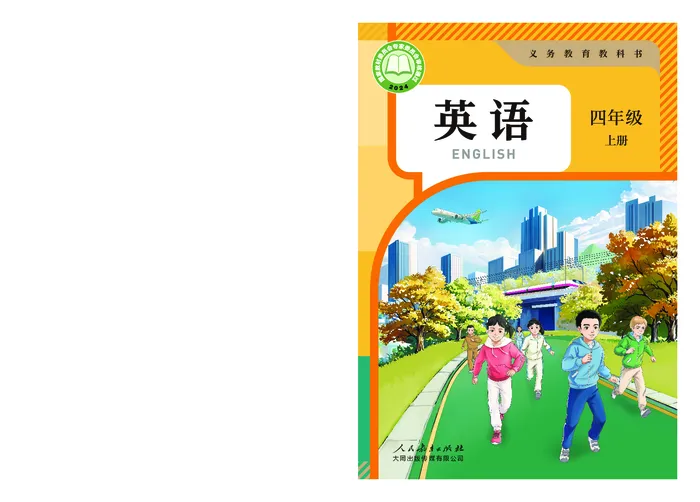
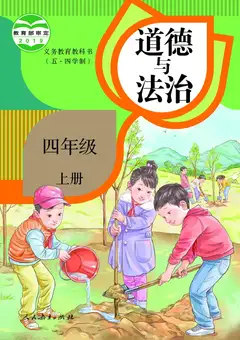
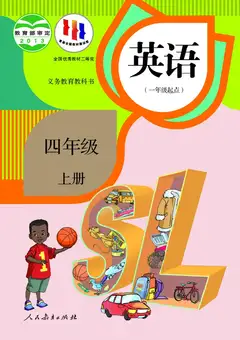
义 务 教 育 教 科 书
四年级
上册
大同出版传媒有限公司
义 务 教 育 教 科 书
人民教育出版社 课程教材研究所 编著
·北 京·
大同出版传媒有限公司
四年级
上册
亲爱的同学:
新的学年又开始了!在这里,我们会跟着高老师和文博、诗瑶、诗玥、明
宇、James、Joy等小伙伴一起继续奇妙的英语世界之旅。我们会学唱好听的
英文歌曲,听讲动人的英文故事,还将绘制地图、创作英文诗、设计理想中的
学校、制作社区模型、设计纸质的篮球架……
通过这些活动,我们一定能够又好又快又准地掌握用英语表达的本领,能
大声说出自己的想法、热烈讨论共同关心的话题、直接了解世界各地的风俗和
文化、原汁原味地把祖国的好故事讲给世界各地的人听。
学习英语最重要的方法是“用”。我们不仅要多听多读,更要大胆地多说
多写,反复练习,不要害怕出错。
让我们一起学习,共同进步吧!
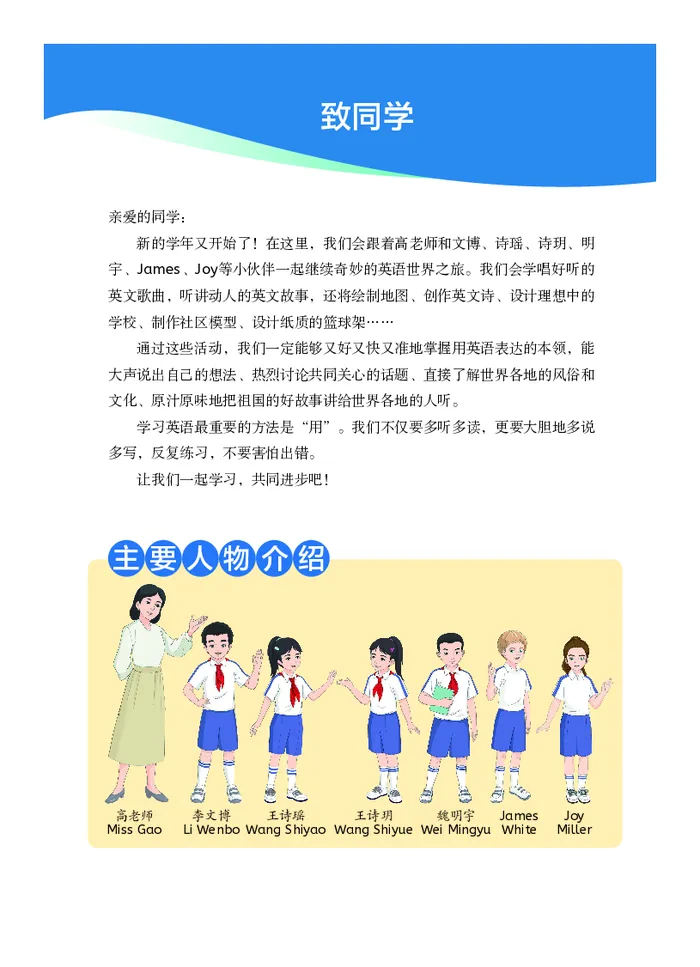
王诗瑶
Wang Shiyao
王诗玥
Wang Shiyue
高老师
Miss Gao
李文博
Li Wenbo
魏明宇
Wei Mingyu
主要人物介绍
致同学
Joy
Miller
James
White
1
2
3
4
5
6
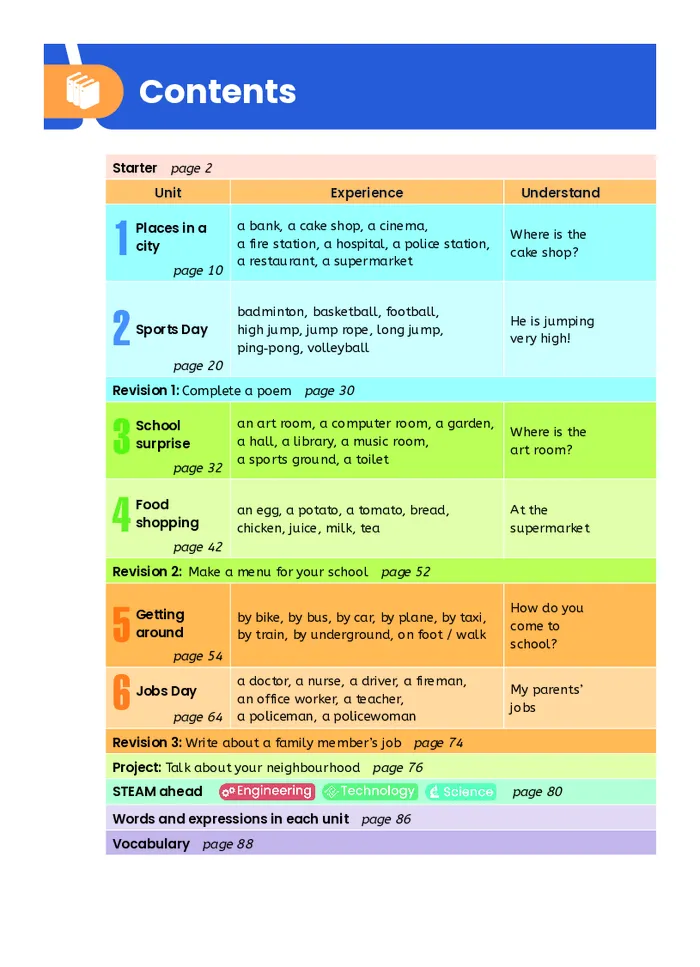
Starter page 2
Unit
Experience
Places in a
city
page 10
a bank, a cake shop, a cinema,
a fire station, a hospital, a police station,
a restaurant, a supermarket
Where is the
cake shop?
Sports Day
page 20
badminton, basketball, football,
high jump, jump rope, long jump,
ping-pong, volleyball
He is jumping
very high!
Revision 1: Complete a poem page 30
School
surprise
page 32
an art room, a computer room, a garden,
a hall, a library, a music room,
a sports ground, a toilet
Where is the
art room?
Food
shopping
page 42
an egg, a potato, a tomato, bread,
chicken, juice, milk, tea
At the
supermarket
Revision 2: Make a menu for your school page 52
Getting
around
page 54
by bike, by bus, by car, by plane, by taxi,
by train, by underground, on foot / walk
How do you
come to
school?
Jobs Day
page 64
a doctor, a nurse, a driver, a fireman,
an office worker, a teacher,
a policeman,, a policewoman
My parents’
jobs
Revision 3: Write about a family member’s job page 74
Project: Talk about your neighbourhood page 76
STEAM ahead
page 80
Words and expressions in each unit page 86
Vocabulary page 88
Understand
1
2
3
4
5
6
Contents
Discover
Develop
Explore
Apply
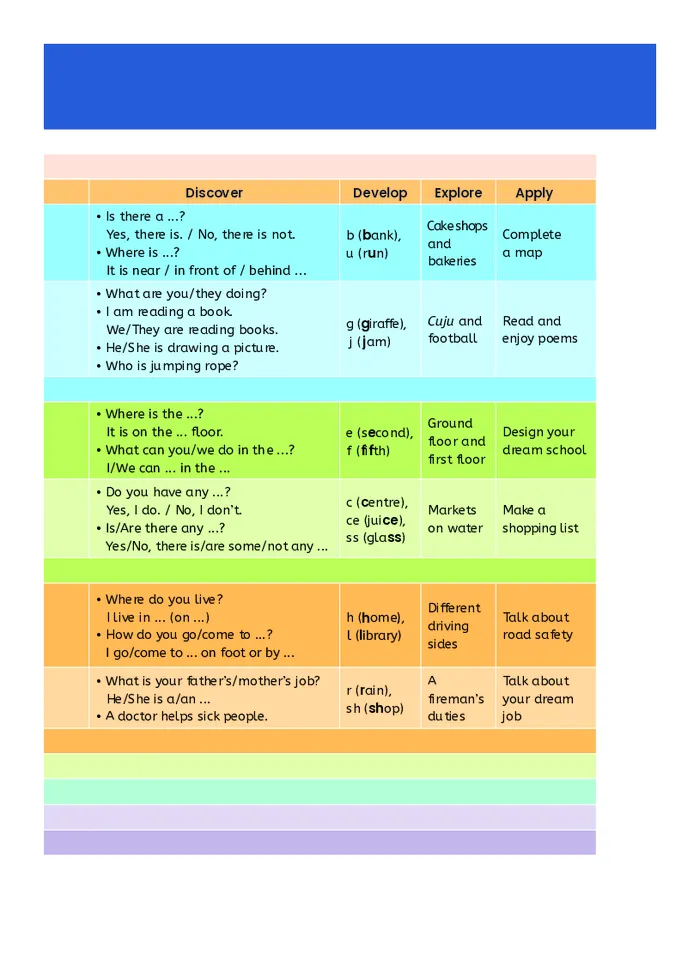
• Is there a ...?
�Yes, there is. / No, there is not.
• Where is …...?
�It is near / in front of / behind …...
b (bank),
u (run)
改Cake shops
and
bakeries
Complete
a map
• �What are you/they doing?
• �I am reading a book.
We/They are reading books.
• �He/She is drawing a picture.
• Who is jumping rope?
g (giraffe),
j (jam)
Cuju and
football
Read and
enjoy poems
• Where is the …...?
� �It is on the …... floor.
• �What can you/we do in the …...?
�I/We can ...… in the …...
e (second),
f (fifth)
Ground
floor and
first floor
Design your
dream school
• Do you have any ...?
�Yes, I do. / No, I don’t.
• �Is/Are there any …...?
Yes/No, there is/are some/not any ...
c (centre),
ce (juice),
ss (glass)
Markets
on water
Make a
shopping list
• Where do you live?
I live in ... (on ...)
• �How do you go/come to ...?
I go/come to ...… on foot or by ...
h (home),。,,,,
,l (library)
Different
driving
sides
Talk about
road safety
• �What is your father’s/mother’s job?
He/She is a/an ...
• �A doctor helps sick people.
r (rain),
sh (shop)
A
fireman’s
duties
Talk about
your dream
job
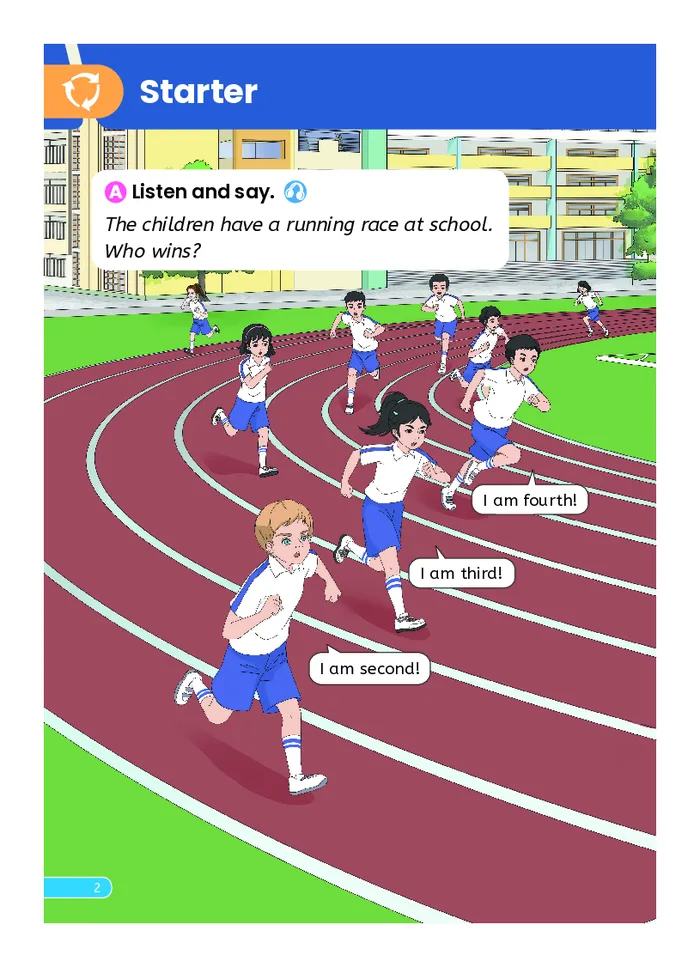
I am second!
Starter
I am fourth!
I am third!
Listen and say.
The children have a running race at school.
Who wins?
2
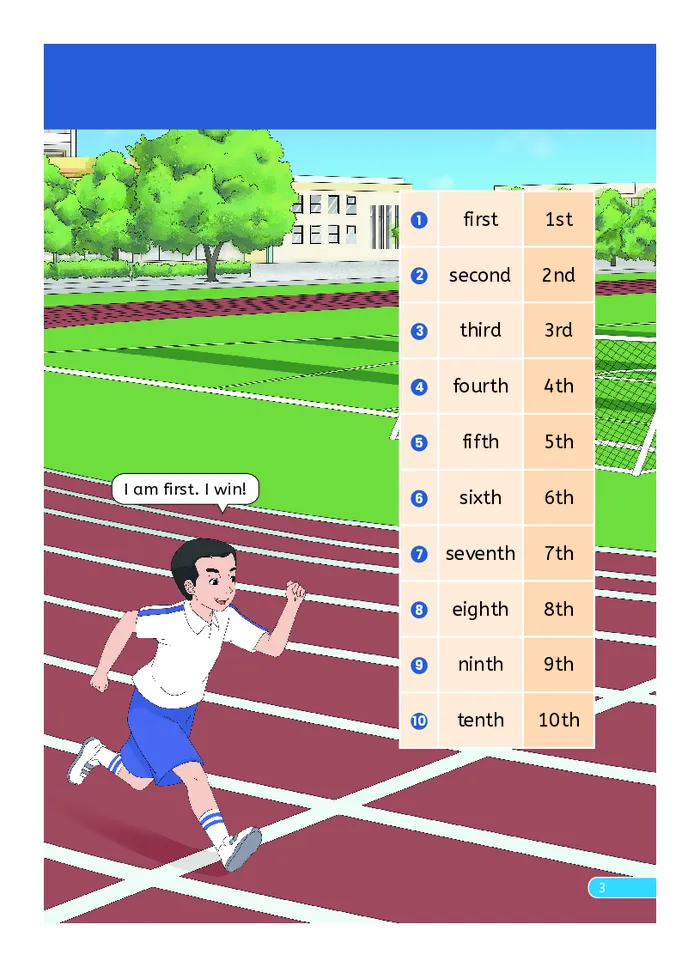
I am first. I win!
1
first
1st
2
second
2nd
3
third
3rd
4
fourth
4th
5
fifth
5th
6
sixth
6th
7
seventh
7th
8
eighth
8th
9
ninth
9th
10
tenth
10th
3
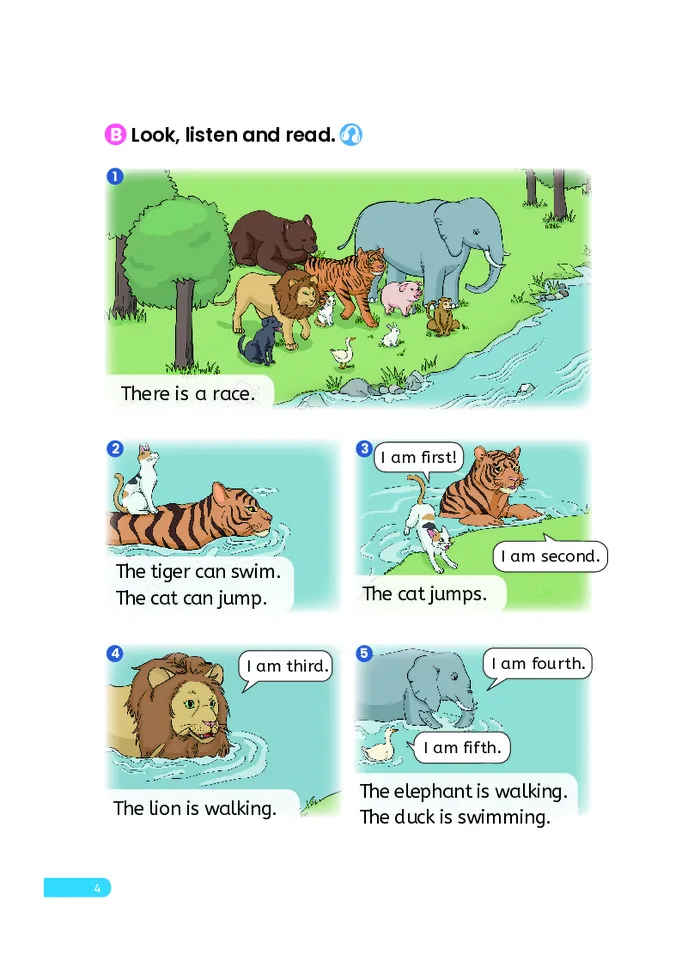
Look, listen and read.
There is a race.
The tiger can swim.
The cat can jump.
The elephant is walking.
The duck is swimming.
The lion is walking.
I am third.
I am fourth.
I am fifth.
The cat jumps.
I am second.
3
2
1
4
5
4
I am first!
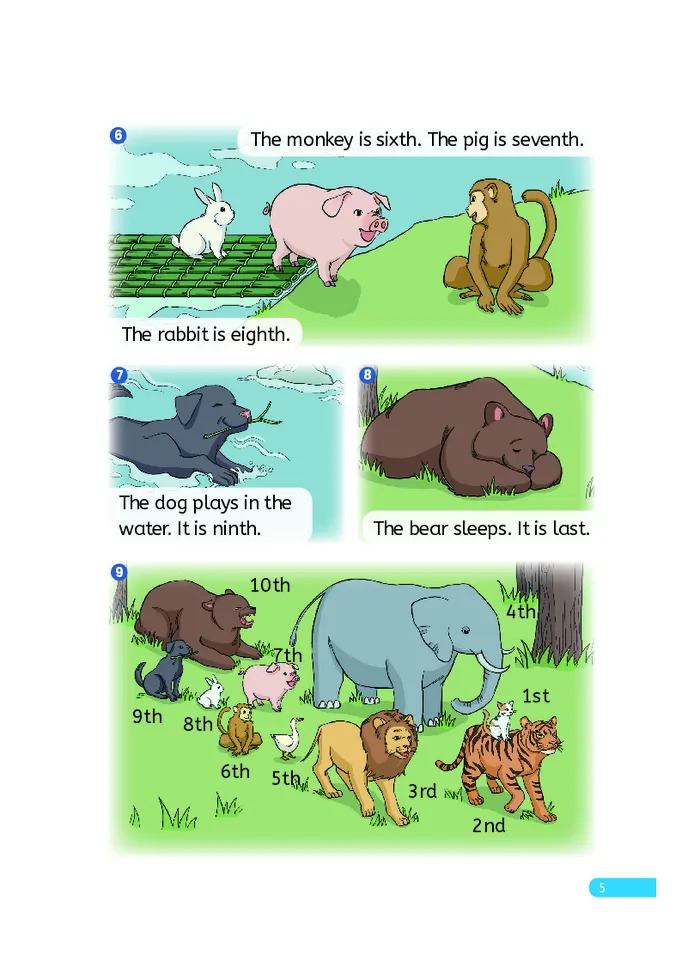
The rabbit is eighth.
The monkey is sixth. The pig is seventh.
The dog plays in the
water. It is ninth.
The bear sleeps. It is last.
7
9
8
6
9th
8th
6th
5th
3rd
2nd
1st
4th
7th
10th
5
1
2
3
4
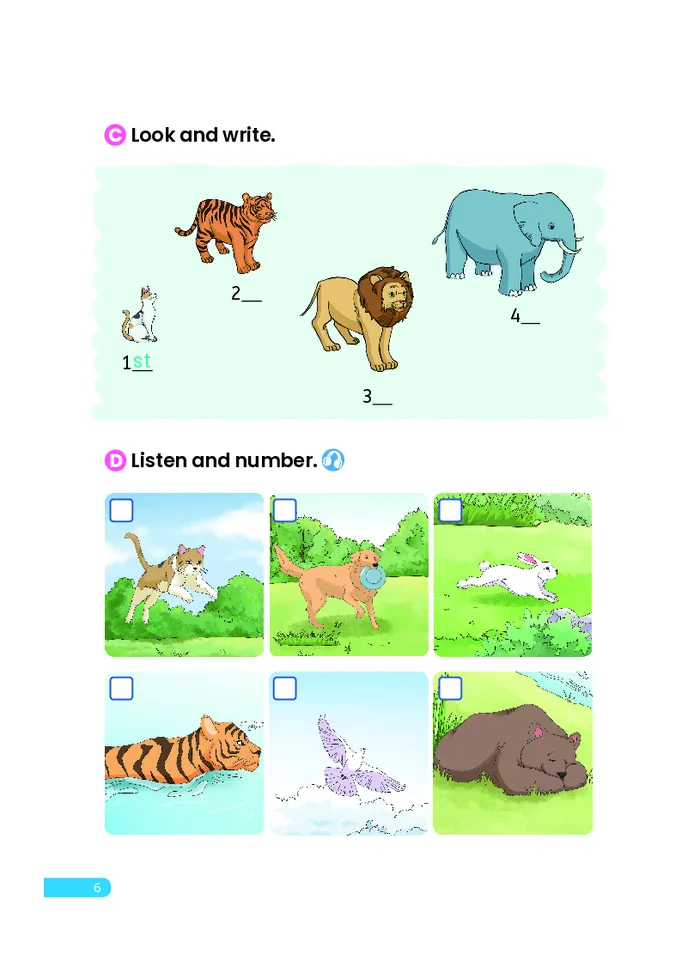
Listen and number.
Look and write.
st
6
1 It is a dog. It can run and jump.
A
B
C
2 It is a duck. It can fly and swim.
A
B
C
3 It is a fish. It can eat and jump.
A
B
C
Think and talk.
Is this ...…?
How many ...…
are there?
What can
you see?
Where is
the ...…?
What can ...… do?
What colour
is the ...…?
What is …...
doing?
Read and circle.
7
Excuse me, what does
“get dressed” mean?
Sorry, I cannot hear you.
Can you say it again, please?
…...
Shall we go to the library?
Sure.
G Look and role-play.
2
3
1
8
Can you wait for me
in the sports ground?
Yes, no problem.
Sorry, I am afraid
I cannot.
Would you like some biscuits?
Yes, please.
Here you are.
Thank you.
Mum, can you help me get
the water bottle, please?
Sure.
Thank you very much.
You are welcome.
5
6
7
4
9
Unit 1 Places in a city
Experience
Listen and talk.
Wenbo is visiting another city.
What places are in the city?
10
Listen and say.
In this unit, I will
• �talk about different places in a city.
• �ask and answer questions with “Is there ...…?”
• �talk about where places are in a city.
•� �say words with the “b” and “u” sounds.
Is there a bank
near here?
Where is it?
Yes, there is.
It is ...
a bank
a cinema
a cake shop
a fire station
a hospital
a police station
a restaurant
a supermarket
4
8
3
7
2
6
1
5
Get to know your neighbourhood.
Explore the streets near your home.
11
Look, listen and read.
Do Wenbo and his
mum want to wait
at the restaurant?
Why or why not?
3
2
1
Understand
Where is the cake shop?
Excuse me, is there a restaurant near here?
I am hungry, Mum. Can
we go to a restaurant?
Oh no! There are so many people here.
Sure.
I am very hungry.
Let’s go to the cake shop.
Thank you.
Yes, there is. It is
behind the bank.
12
� Reading tip
4
5
6
Excuse me, where is
the cake shop?
Oh no! The cake shop
is not open today!
I am VERY,
VERY hungry!
Let’s go to the
supermarket.
I am VERY,
VERY hungry!
I am very
hungry.
It is over there.
Thank you.
OH NO! It is raining.
They show strong feelings.
13
Think and say.
Is it a good day or a bad day for Wenbo and his mum?
Why?
Look and write.
Look at the pictures.
How does Mum feel?
A unhappy
B very unhappy
Read and order.
Where do Wenbo and his mum go?
a cake shop
1 a restaurant
a supermarket
Read and circle.
What is near the cake shop?
A B C D
Oh no!
OH NO!
14
Listen and sing.
Is there a cake shop near here?
Yes, there is.
Yes, there is.
There is a cake shop near here.
Is there a bank near here?
No, there is not.
No, there is not.
There is not a bank near here.
Look and talk.
Discover
Is there a cinema near here?
Yes/No, …...
Is there …...
1 a cake shop?
2 a restaurant?
3 a fire station?
4 a supermarket?
Yes, there is.
15
There is a hospital near my school.
It is in front of the police station.
Think and say.
What places are there near your school?
Where are they?
Look and role-play.
Wenhao wants to make a model of a small city.
He and Wenbo go to a model shop.
Where is the flower shop?
It is behind
the bank.
Where is the
supermarket?
It is in front of the
police station.
16
Develop
Read and say.
Is there a cake shop near you? Is there a bakery too?
Listen and say.
Listen and circle.
b
u
b
u
b
u
1
2
3
b
bank
u
run
Explore
Cake shops and bakeries
cup
nut
but
bus
A cake shop sells cakes of
different shapes and sizes.
A bakery sells bread. It sells
cakes and biscuits too.
17
Listen and number.
Think and draw.
Where do the boys go? Draw on the map in Part B.
Listen and circle.
What does Mum want from the supermarket?
A A cake.
B Some apples and milk.
C Some apple juice. D Some strawberries.
1 a cake shop
2 a restaurant
3 a supermarket
Apply
Complete a map
18
Ask, answer and number.
Make your own map. Where are these places?
1
Tick (
).
Self-assessment
I can ask and answer questions with “Is
there ...…?”
I can say words with the “b” and “u”
sounds.
I can talk about different places in a city.
I can talk about where places are in a city.
Is there a park near here?
Yes, there is.
Where is it?
It is behind the cinema.
1 a park
2 a hospital
3 a school
4 a supermarket
5 a toy shop
19
Wow! He is jumping
very high!
Unit 2 Sports Day
Experience
Listen and talk.
What sports are the children
doing in the sports ground?
20
Listen and say.
In this unit, I will
• �talk about different sports.
• say what people are doing.
• read and enjoy simple poems.
• say words with the “g/j” sound.
football
high jump
4
3
jump rope
long jump
6
5
ping-pong
volleyball
8
7
badminton
basketball
2
1
Keep moving. Do sport to stay
fit and healthy.
21
Look, listen and read.
Today is Sports Day.
There is football,
volleyball, basketball
and more. Let’s take a
look!
Understand
He is jumping very high!
2
1
Here is Wang Shiyao. What is she doing?
She is playing ping-pong. She is winning!
It is 10 to 7. Lots of people are taking
photos.
22
Sports Day is over. We are happy. We love
sport at our school. It is good to join in!
Who is that? It is Han Yuntao.
Wow! He is jumping very high!
This is the high jump. Look!
Wei Mingyu is running. He is
doing the long jump.
4
3
23
Read and circle.
1 Who is playing ping-pong?
A Han Yuntao.
B Li Wenbo.
C Wang Shiyao.
D Wei Mingyu.
2 What is Wei Mingyu doing?
A B C D
3 How does everyone feel?
A B
C D
Read and write.
Lots of people are
1 photos.
Wang Shiyao is
2 ping-pong.
Han Yuntao is
3 very high.
Wei Mingyu is
4 the long jump.
24
2
Look and role-play.
What are you doing?
I am reading a book.
What is Shiyue doing?
Listen and read.
She is drawing a picture.
What is Wenbo doing?
Discover
1 Wenbo / run
2 Dad / play football
3 Mum / take photos
4 Wenbo and Lele / jump rope
1
4
He is running….
3
25
Look and talk.
Lele / jump rope
Wenhao / play basketball
Mum and Dad /
play badminton
Wenbo / play volleyball
Who is jumping rope?
4
3
2
1
26
Lele is jumping rope.
Read and say.
Listen, circle and say.
Giant Jack has jelly and ginger juice for breakfast.
Listen and say.
Today, many people play
football around the world.
It can help us keep fit.
Cuju was an early kind of
football in ancient China.
g
giraffe
j
jam
Explore
Cuju and football
Develop
age
orange
jar
jump
27
Listen, read and write.
Circle and write.
1 There are verses in the poem.
A two
B four
C five
D eight
2 �Find the rhyming words from the poem for the
following words.
1 catch match
2 play
3 long
4 fun
a A line
d A verse
e Writer
b Rhyming words
c Title
There are lots of sports we like to play.
We play them on School Sports Day.
We like to jump both high and long,
And hit the ball when we play ping-pong.
In basketball, we throw and catch.
We kick the ball in a football match.
School Sports Day is so much fun.
There is a sport to play for everyone.
Sports Day
by Andy
1
2
4
5
3
Apply
Read and enjoy poems
28
Tick (
).
Self-assessment
I can talk about different sports.
I can say words with the “g/j” sound.
I can read and enjoy simple poems.
I can say what people are doing.
Look and write. Then listen and check.
Write and circle.
1 Give the poem a title.
2 Circle the rhyming words.
What is Wenbo doing?
He is 1 ball games.
What is he doing?
He is playing football with James.
What is Lele doing?
She is 2 photos.
What is she doing?
She is taking a photo of the
red rose.
29
cupcake
toys
lolly
break
boys
swings
Say and match.
Match the rhyming words.
things
trolley
Look and write.
behind
near
in front of
It is 1 .
It is 2 the cinema.
Where is the supermarket?
Where is the cake shop?
Where is the park?
It is 3 the cake shop.
in front of the cinema
Get ready!
Get set!
Revision 1 Complete a poem
30
We are walking to the toy shop.
The toy shop is behind the hospital.
We are looking at some toys—
Toys for girls and toys for 1 .
We are walking to the supermarket.
The supermarket is in front of the 2 .
Wenhao is getting a trolley.
I am getting an ice 3 .
We are walking to the cake shop.
The cake shop is 4 the cinema.
We are taking a break.
I am eating a 5 .
We are walking to the park.
The park is 6 the cake shop.
We are playing on the 7 .
This park has so many things!
by Li Wenbo
Write and read aloud.
boys
cinema
Use rhyming words at the end. Find the
rhyming words in Get ready!
.
Go!
31
We do not study here. We
play with our friends here.
Unit 3 School surprise
Experience
Listen and talk.
The children go on a treasure hunt at school.
Read the clue. Do you know the answer?
32
In this unit, I will
• talk about places in a school.
• �talk about what we can do in the
different places at school.
• �say words with the “e” and “f” sounds.
an art room
a library
a garden
a sports ground
a music room
a hall
a computer
room
a toilet
4
8
3
7
2
6
1
5
Listen and say.
Take pride in your school.
33
Look, listen and read.
I know! We can paint
pictures in the art room!
Where is
the art
room?
It is on the
second floor.
Where is the music room?
It is on the third floor.
It is the music room. We
can sing songs there.
Ding, ding, dong! Sing
a song! Hurry! Hurry!
Now sing along!
Understand
Where is the art room?
2
1
Colours, colours! Red, green
and blue. Be quick! The
colours are waiting for you.
34
Surprise! Happy Birthday!
It is on the
first floor.
It is the hall!
� Reading tip
Do you know other short forms?
G/F = Ground floor Mon. = Monday
1/F = First floor Tue. = Tuesday
...
...
4
3
How do Shiyao and Shiyue feel?
Where is the hall?
What can we do in this
place? We can relax
and see a play.
35
Read and write.
Read and say.
Where do the children go?
Read and circle.
Which floor do the children NOT go to?
A 1/F
B 2/F
C 3/F
D 4/F
Read and guess.
I read. He reads. She reads. In this place, there are
many books to read. It is the .
First, they go to
the sports ground.
Picture 4 is the
sports ground.
Second, …...
music room
3/F
art room
hall
Floor
Place
1
2
3
1
3
2
4
Where can you find a lot of books?
36
Listen and sing.
Where is the hall?
Please tell me. Please tell me.
It is on the ground floor, the ground floor.
We can meet, meet, meet in the hall.
Look and role-play.
Wenhao’s mum visits his school. Where are the different
places in the school?
It is on the
first floor.
Where is the
computer room?
3/F
2/F
1/F
G/F
Discover
37
Think and say.
Where are the different places in your school? What can
you do there?
Look and talk.
What can you
do in the hall?
I can see a play
in the hall.
Work and learn on a
computer. Join us in
the computer room!
The art room is a fun
place. Draw and paint
with us.
3/F
2
4
1/F
Shh! Please keep quiet
in the library. Read
books with us.
2/F
Drama time in the hall!
See a play with us.
G/F
1
3
38
Listen and say.
Read and say.
Listen, write and say.
Jack’s ather t lls Jack to g t it.
Sam is in the USA. Her classroom is on the first floor.
John is in the UK. His classroom is on the first floor.
Are they on the same floor?
Fourth floor
Third floor
Second floor
First floor
Third floor
Second floor
First floor
Ground floor
American English
British English
e
second
f
fifth
Explore
Ground floor and first floor
Develop
bed
pen
fire
fun
39
Listen and write.
Where are the children’s and Miss Gao’s favourite places?
1 What can Wenbo do in his favourite place?
A
B C D
2 Which is Shiyao’s favourite place?
A The art room.
B The library.
C The music room.
D The sports ground.
3 Which is Miss Gao’s favourite place?
A The art room.
B The garden.
C The hall.
D The library.
Listen and circle.
Apply
Design your dream school
1
3
2
40
3/F
1/F
G/F
2/F
Tick (
).
Self-assessment
I can talk about what we can do in the
different places at school.
I can say words with the “e” and “f”
sounds.
I can talk about places in a school.
Draw and talk.
In groups, plan and draw your dream school.
What rooms are there? Where are they?
There is a ...… in our
dream school.
It is on …...
I can ...… there.
41
Unit 4 Food shopping
Is there
any milk?
Experience
Listen and talk.
Wenbo, Lele and Mum are at the supermarket.
What can they buy?
42
Listen and say.
In this unit, I will
• �talk about food and drink.
• �use “any” and “some” before food and drink.
• �make a shopping list and ask and answer
questions.
• say words with the “c/ce/ss” sound.
Yes, there is.
an egg
chicken
a tomato
milk
juice
bread
a potato
tea
4
8
3
7
2
6
1
5
Be a smart shopper. Buy only the things
you need.
43
Understand
At the supermarket
Look, listen and read.
No, there is not
any bread.
Are there any eggs?
No, there are not
any eggs. Sorry.
I want bread, eggs,
milk and sausages.
4
3
2
1
Is there any
bread?
We are here!
44
I have some milk.
Do you have any
bread?
Yes, I do. I have
some eggs too.
Do you have
any sausages?
No, I don’t. I
have chicken.
Oh. Mum wants sausages.
And sausages and eggs!
The sausages are here.
Thank you!
Do you have
any sausages?
We have
bread and
milk.
Yes, I do. Come
with me!
Great!
And I have chocolate for you.
Thank you.
8
10
7
9
6
5
Good!
45
Read and circle.
What does Mum want? Circle four answers.
A B C
D E F
Think and say.
1 �Look at pages 44—45. How does Mum feel in
Picture 3 and Picture 10?
2 Why does Mum give Wenbo and Lele chocolate?
Read and match.
Look at pages 44—45. What do Mum, Wenbo and Lele
say?
Do you have any sausages?
a
b
I要s there any bread?
c
I have some milk.
2
3
1
46
Listen and talk.
Look and role-play.
Do you have any tomatoes?
Yes, I do.
No, I don’t.
Do you have any chicken?
Shiyao has ...
Discover
• tomatoes
• chicken
• oranges
• potatoes
• eggs
• bread
• juice
• milk
• tea
Shopping list
47
Yes, there is some juice.
No, there are not
any apples.
Are there
any apples?
Look and talk.
Is there any juice?
1 bread
2 juice
3 milk
4 apples
5 eggs
6 tomatoes
48
Listen and say.
Read and say.
Listen, write and say.
There are many markets on water in Asia. At these
markets, people sell things from boats. There are
fruits, local dishes and clothes.
c
centre
ce
juice
ss
glass
Explore
Markets on water
Develop
city
nice
class
circle
rice
dress
inema
poli
gra
fa
Mi
Do you want to visit a market on water? Do you know
any special markets? What can you buy there?
49
1 Which of these is a good title for the list?
A A shopping list
B My things
C Things I like
D What to bring
2 �What do we put in front of the items on a list?
A Letters.
B Lines.
C Points (•).
D Titles.
3 Which is NOT true about a list?
A We can find a title.
B We write in point form.
C We write all items on one line.
D We use points in front of the items.
• bread
• milk
• oranges
• apples
• eggs
• tomatoes
Read and circle.
Apply
Make a shopping list
50
Tick (
).
Self-assessment
I can use “any” and “some” before food
and drink.
I can make a shopping list and ask and
answer questions.
I can talk about food and drink.
I can say words with the “c/ce/ss” sound.
Look and role-play.
Yes, there is some bread.
bread
chicken
juice
apples
tea
potatoes
eggs
bananas
Is there any bread?
51
Look and role-play.
I can have baozi for
breakfast. I like baozi.
What food can you have here?
Revision 2 �Make a menu for
your school
Get ready!
Today’s menu
Come and enjoy meals on the third floor!
FOOD
DRINK
bread
noodles
baozi
fried rice
chicken rice
milk
orange juice
tea
lemon water
52
Look and talk.
Think and write.
Yes/No, …...
Do you have ...…?
Today’s menu
Come and enjoy meals on the 1 floor!
FOOD
DRINK
2
3
4
5
6
7
Go!
Get set!
53
I come by bus.
Unit 5 Getting around
How do you come
to the train station?
Experience
Listen and talk.
People travel all the time. Where do you live?
How do you and your family get around?
54
Listen and say.
by bike
by taxi
by car
by
underground
by train
by plane
by bus
on foot /
walk
4
8
3
7
2
6
1
5
55
In this unit, I will
• talk about transport.
• ask and say where people live.
• �ask how people travel and answer with “by” or “on”.
• say words with the “h” and “l” sounds.
Walk or use public transport to help the
environment.
I live in Green Hills.
Look, listen and read.
I come on foot.
How do you come
to school?
Cross roads at green lights.
Look left and right before
you cross.
Where do you live,
Han Yuntao?
By car
By bus
By underground
On foot
Class 1
How do you come to school?
girl
boy
Understand
How do you come to school?
What other ways can you come to school?
1
56
Li Wenbo: Are you going home?
Han Yuntao: �No. I am going to
a restaurant.
Li Wenbo: On foot?
Han Yuntao: No.
Li Wenbo: �How do you go to
the restaurant?
Han Yuntao: By car.
� Reading tip
When you are at school, say “I come to school” .…
When you are at home, say “I go to school” .…
One boy and three girls come to school by
car. Four boys and six girls come to school
by bus. Five boys and two girls come to
school by underground. Eight boys and
seven girls come to school on foot.
2
3
57
Read and circle.
How does Han Yuntao come to school?
A B C D
Read, write and circle.
1 How many other students come to school like
Han Yuntao?
2 �How many girls come to school by bus? Circle.
3 How many boys are in Class 1, Grade 4? Circle.
A 15
B 16
C 17
D 18
Read and write.
How does Han Yuntao go to the restaurant?
Think and say.
How do you come to school? Tell your classmates.
58
Listen and sing.
I come to school by bus I do,
By bus I do, by bus I do.
I come to school by bus I do,
All the way along.
Where do you live?
1
Liu
Zimeng
in Red Hills
on Long Road
2
3
Where do you live?
I live in Red Hills on Long Road.
Talk and write.
Discover
We can use “in” with
different places.
I live in China.
I live in Guangdong.
I live in Guangzhou.
I live in Haizhu.
I live in Ruibao.
59
Match and talk.
Think and say.
How do you go to Beijing? How do you go to Changsha?
I go to the park on foot
or by underground.
How do you go to the park?
1
2
3
4
5
60
Listen and say.
Listen and circle.
Listen and say.
Larry looked high and low in the library for his lost
homework about hamsters.
In most places, people drive on the right side of the
road. But in some places, people drive on the left side
of the road. Which places are they?
1
3
h
home
l
library
Develop
Explore
Different driving sides
h
l
2
h
l
h
l
61
Look and role-play.
Listen and circle.
1 Where are Li Wenbo and Han Yuntao?
A In a car.
B In a taxi.
C On a bus.
D On a train.
2 Where is Li Wenbo going?
A A cinema.
B A restaurant.
C A supermarket. D A train station.
3 What signs do they see? Circle three answers.
A Bikes only
B No bikes
C No buses
D No cars
E No walking
F Stop
What is that sign? I see
it next to the road.
It means “No bikes”. You
cannot ride a bike here.
Apply
Talk about road safety
62
Tick (
).
Self-assessment
I can ask how people travel and answer
with “by” or “on”.
I can talk about transport.
I can say words with the “h” and “l” sounds.
I can ask and say where people live.
Think and talk.
What signs are there on your street? Tell the class
about your area.
Where do you live?
What signs are there?
I live in Green Hills on Red Road.
People get around by bus, by bike
or on foot. Here is a “No parking”
sign. Here is a “No cars” sign.
How do people get
around in your area?
We get around by bus,
by bike or on foot.
I can see a “No cars” sign
and a “No parking” sign.
I live in Green Hills on Red Road.
63
He is a fireman. He puts out fires.
Unit 6 Jobs Day
Experience
Listen and talk.
It is Jobs Day at school.
What are the children’s jobs? What do they do?
64
Listen and say.
a driver
a doctor
an office
worker
a policeman
a fireman
a nurse
a teacher
a policewoman
3
1
5
7
5
5
4
2
6
8
65
In this unit, I will
• �talk about jobs.
• �talk about my dream job.
• �say words with the “r” and “sh” sounds.
Respect the people who work in
your community.
Look, listen and read.
Working parents
What is your father’s job?
What is your mother’s job?
I am Ma Kaijie. My mother is a policewoman.
She works in a police station. My father is a
fireman. He puts out fires.
Understand
My parents’ jobs
66
� Reading tip
Look for parts of a new word. They can help you
understand the new word.
I am Li Moli. My father is an English teacher. He
teaches children at a primary school. They all like
him! My mother is a doctor. She helps sick people.
They like her too.
I am Zhao Weining. My father is a driver. He drives
people around. My mother is a doctor. But she does
not help sick people—she helps sick trees!
The job of Ma Kaijie’s
father has something
to do with fires.
fireman
→
+
fire
man
67
Where does Li Moli’s father work?
Read and circle.
1 Who is Ma Kaijie’s mother?
A
B
C
D
2 Li Moli’s and Zhao Weining’s mothers are .
A doctors
B drivers
C policewomen
D teachers
Read and write.
Who can help you?
1 �You want to learn English.
’要s father
2 �You want to go to the zoo.
’要s father
3 You feel sick.
’要s mother
Find and write.
Look at these words. They form new words for jobs on
pages 66—67. Can you find them?
1 police
2 teach
3 fire
68
What do the children’s
parents do?
She is a policewoman.
What is your mother’s job?
1
2
4
3
5
Discover
Look and role-play.
69
Look, write and talk.
3 She is .
4 He .
1 She is a .
She .
nurse
Think and say.
What is your father’s/mother’s job? What does he/she do?
He helps sick people.
drive people around
help sick people
put out fires
teach children
She teaches children.
2 He is a .
He .
70
Listen and say.
Read and say.
Listen and say.
In a short rain shower, I run on the road in my shiny
running shoes.
r
rain
sh
shop
Develop
Explore
A fireman’s duties
room
run
short
shoes
He is a fireman. He puts out
fires. He helps people in
trouble. He even helps cats
and catches snakes.
In China, we call 119 when
there is a fire. In the UK,
people call 999. In the USA,
people call 911.
71
Read and circle.
1 Jessie eats ice cream.
2 Jessie tastes chocolate.
3 Jessie helps make new ice creams.
4 Jessie works in a shop.
5 Jessie rides a bike to work.
This is Jessie. She is an ice
cream taster. She tastes
different ice creams every
day. She thinks of new ice
creams too. Jessie works
in an ice cream shop. She
goes to work by bus.
Apply
Talk about your dream job
Ice cream taster Jessie
72
Tick (
).
Self-assessment
I can talk about jobs.
I can talk about my dream job.
I can say words with the “r” and “sh”
sounds.
Think and write.
Draw and talk.
Draw your dream job and talk about it.
A dream job
What is the name of the job?
What does the person do?
Where does the person work?
How does the person get to work?
This is Harry. He is a bed tester.
He tries different beds. He sleeps
in the beds. He works in a bed
shop. He goes to work by bike.
73
My mother
This is my 1 . She is a 2 .
She 3
people to different places.
She works on 4 .
She goes to work 5 .
Listen and write.
Think and write.
Choose a family member
to write about. Circle
him/her on the tree.
grandfather
mother
brother
me
sister
father
grandmother
Revision 3 �Write about
a family
member’s job
Get ready!
Get set!
74
This is .
is .
He/She .
works .
.
Write and draw.
What is his/her job?
Where does he/she work?
What does he/she do?
How does he/she go to work?
Who is this
family member?
My
Go!
75
(Draw)
’s
home
Think and talk.
In groups, ask and answer questions about your
neighbourhoods.
Think and write.
Write about the places in your neighbourhood.
Where do you live?
Yes/No, …...
Is there a …...?
a park
a cake shop
a supermarket
a restaurant
Project �Talk about your
neighbourhood
I live ...
76
’s
home
Think and draw.
Draw a map of the places in your neighbourhood.
Where is ...?
It is in front of /
behind / near ...…
77
Do a survey.
Ask ten people in your neighbourhood questions.
Sure!
1 Where do you live?
2 What is your job?
3 How do you go to work?
4 What is your favourite �place in this area?
Hello, we are doing
a class project.
Can you please
help answer
some questions?
1 Where do you live?
3 How do you go to work?
2 What is your job?
4 �What is your favourite
place in this area?
This area
Other areas
On foot
Questions
78
Tick (
).
Self-assessment
I can do a survey and complete a survey
report.
I can give a presentation with my group
members.
I know the places in my neighbourhood.
I can draw a map.
Write about the places and the survey results. Talk
about the places and the findings to your class.
I live
.
There is a
.
It is
.
There are
.
people live in this area.
live(s)
.
go(es) to work
.
Their favourite places are
.
Write and talk.
79
Read and make.
1 Fold two corners. This makes a cross.
2 Turn the paper. Fold the end over.
3 Turn the paper again. Pull in the sides.
STEAM ahead
1
Paper basketball hoop
80
Play the game.
4 Make the triangle flat.
5 Make the hoop. Fold the sides and stand it up.
Do you like it? Try making
a football goal next. Look
online for help.
81
Look and learn.
Look at the pictures. Which of these things do you
have in your school? How do you use them?
a blackboard
工a smartboard
a notebook
a computer
an overhead projector
a projector
2
Technology in schools
82
Look and discuss.
How do you use technology in your English classroom?
Do you use the following things? How do they help you
learn?
83
Read and learn.
Air
Water
hot-air balloons in Türkiye
a gondola in Venice, Italy
Do you know other means of transport in the
world? Look online to get more information.
Share it with your classmates.
Visitors can go on hot-air
balloons in Türkiye.
Visitors get around Venice,
Italy by gondola.
3
Transport around the world
84
Read and write.
Transport
Country
Air, land or water?
hot-air balloon
1
air
gondola
Italy
2
camel
Egypt
3
high-speed train
4
land
Land
a high-speed train in China
a camel in Egypt
China has lots of
high-speed trains.
Some can go 350 km/h.
Do you ride bikes? How about camels?
You can ride a camel in Egypt.
85
Words and expressions in each unit 单元核心词汇表
(注:黑体词为《义务教育英语课程标准(2022 年版)》中的二级词;
加* 黑体词为《义务教育英语课程标准(2022 年版)》中的三级词。)
Starter
first /fɜːst/ 第一(的)
second /ˈsekənd/ 第二(的)
third /θɜːd/ 第三(的)
fourth /fɔːθ/ 第四(的)
fifth /fɪfθ/ 第五(的)
sixth /sɪksθ/ 第六(的)
seventh /ˈsevnθ/ 第七(的)
eighth /eɪtθ/ 第八(的)
ninth /naɪnθ/ 第九(的)
tenth /tenθ/ 第十(的)
I am first. 我是第一。
The rabbit is eighth. 兔子是第八。
Unit 1
bank* /bæŋk/ 银行
cake shop 蛋糕店
cinema /ˈsɪnəmə/ 电影院
fire station 消防站
hospital /ˈhɒspɪtl/ 医院
police station 警察局
restaurant* /ˈrestrɒnt/ 餐馆;餐厅
supermarket /ˈsuːpəmɑːkɪt/ 超市
Is there a cinema near here?
这里附近有电影院吗?
Yes, there is. / No, there is not.
是的,这里有。/不,这里没有。
Where is the flower shop?
花店在哪里?
It is in front of / behind / near the
police station. 它在警察局的前面/
后面/附近。
Unit 2
badminton* /ˈbædmɪntən/
羽毛球运动
basketball /ˈbɑːskɪtbɔːl/
篮球;篮球运动
football /ˈfʊtbɔːl/ 足球;橄榄球
high jump 跳高
jump rope 跳绳
long jump 跳远
ping-pong /ˈpɪŋ pɒŋ/ 乒乓球运动
volleyball* /ˈvɒlibɔːl/ 排球运动
What are you doing? 你在干什么?
I am reading a book. 我在读书。
What is she doing? 她在干什么?
She is drawing a picture. 她在画画。
Who is jumping rope? 谁在跳绳?
Unit 3
art room 美术教室
computer room 计算机房
garden /ˈɡɑːdn/ 花园;果园;菜园
hall* /hɔ:l/ 礼堂
library /ˈlaɪbrəri/ 图书馆
music room 音乐教室
sports ground 运动场;操场
86
toilet /ˈtɔɪlət/ 厕所;卫生间
Where is the computer room?
计算机房在哪里?
It is on the first floor. 它在二楼。
What can you do in the hall?
你能在礼堂里干什么?
I can see a play in the hall.
我能在礼堂里看戏剧。
Unit 4
egg /eɡ/ 蛋
potato /pəˈteɪtəʊ/ 马铃薯;土豆
tomato /təˈmɑːtəʊ/ 番茄;西红柿
bread /bred/ 面包
chicken /ˈtʃɪkɪn/ 鸡肉
juice /dʒuːs/ 果汁
milk /mɪlk/ 奶
tea /ti:/ 茶;茶叶
Do you have any tomatoes/
chicken? 你有番茄/鸡肉吗?
Yes, I do. / No, I don’t.
是的,我有。/不,我没有。
Is there any juice? 有果汁吗?
Yes, there is some juice.
是的,有一些果汁。
Are there any apples? 有苹果吗?
No, there are not any apples.
不,一个苹果也没有。
Unit 5
by bike 骑自行车
by bus 乘公共汽车
by car 乘轿车
by plane 乘飞机
by taxi 乘出租车
by train 乘火车
by underground 乘地铁
on foot 步行
walk /wɔːk/ 走;散步
Where do you live? 你住在哪里?
I live in Red Hills on Long Road.
我住在长街上的红山社区。
How do you go to the park?
你怎么去公园?
I go to the park on foot or by
underground. 我步行或者乘地铁
去公园。
Unit 6
doctor /ˈdɒktə(r)/ 医生
nurse /nɜːs/ 护士
driver /ˈdraɪvə(r)/ 驾驶员;司机
fireman (pl. firemen)* /ˈfaɪəmən/
消防队员
office worker 办公室职员
teacher /ˈtiːtʃə(r)/ 教师;老师
policeman (pl. policemen)*
/pəˈliːsmən/ 男警察
policewoman (pl. policewomen)*
/pəˈliːswʊmən/ 女警察
What is your father’s/mother’s
job? 你的爸爸/妈妈做什么工作?
He/She is a doctor.
他/她是一名医生。
He/She helps sick people.
他/她帮助病人。
87
· A ·
afraid* /əˈfreɪd/ 害怕
p. 9
air /eə(r)/ 空中;天空
p. 84
along* /əˈlɒŋ/ 一起;向前
p. 34
American* /əˈmerɪkən/
美国的
p. 39
ancient* /ˈeɪnʃənt/ 古代的
p. 27
another* /əˈnʌðə(r)/
另一;不同的
p. 10
area* /ˈeəriə/ 地区
p. 63
art room 美术教室
p. 33
Asia* /ˈeɪʒə/ 亚洲
p. 49
· B ·
badminton* /ˈbædmɪntən/
羽毛球运动
p. 21
bakery /ˈbeɪkəri/ 面包店
p. 17
bank* /bæŋk/ 银行
p. 11
basketball /ˈbɑːskɪtbɔːl/
篮球;篮球运动
p. 21
bed /bed/ 床
p. 39
behind /bɪˈhaɪnd/
在……的后面
p. 12
biscuit* /ˈbɪskɪt/ 饼干
p. 9
boat /bəʊt/ 小船
p. 49
both* /bəʊθ/ 既……又……
p. 28
bottle* /ˈbɒtl/ 瓶子
p. 9
bread /bred/ 面包
p. 17
break* /breɪk/ 间歇;休息
p. 30
breakfast /ˈbrekfəst/ 早餐
p. 27
British* /ˈbrɪtɪʃ/ 英国的
p. 39
by bike 骑自行车
p. 55
by bus 乘公共汽车
p. 54
by car 乘轿车
p. 55
by plane 乘飞机
p. 55
by taxi 乘出租车
p. 55
by train 乘火车
p. 55
by underground 乘地铁
p. 55
· C ·
cake shop 蛋糕店
p. 11
camel /ˈkæml/ 骆驼
p. 85
catch /kætʃ/ 接住;捕捉
p. 28
check* /tʃek/ 检查
p. 29
chicken /ˈtʃɪkɪn/ 鸡肉
p. 43
chocolate* /ˈtʃɒklət/ 巧克力 p. 45
cinema /ˈsɪnəmə/ 电影院
p. 11
clue /kluː/ 线索
p. 32
community* /kəˈmjuːnəti/
社区
p. 65
computer room 计算机房
p. 33
corner* /ˈkɔːnə(r)/ 角
p. 80
cross* /krɒs/
穿越;十字形记号
p. 56
cup /kʌp/ 杯子
p. 17
Vocabulary 词汇表
(注:黑体词为《义务教育英语课程标准(2022 年版)》中的二级词;
加* 黑体词为《义务教育英语课程标准(2022 年版)》中的三级词。)
88
· D ·
dish* /dɪʃ/ 菜肴
p. 49
drama* /ˈdrɑːmə/ 戏;剧
p. 38
drive* /draɪv/
驾驶;驾车送(人)
p. 61
driver /ˈdraɪvə(r)/
驾驶员;司机
p. 65
· E ·
early /ˈɜːli/ 早期的
p. 27
egg /eɡ/ 蛋
p. 43
Egypt /ˈiːdʒɪpt/ 埃及
p. 85
eighth /eɪtθ/ 第八(的)
p. 3
environment* /ɪnˈvaɪrənmənt/
环境
p. 55
everybody/everyone*
/ˈevribɒdi/ /ˈevriwʌn/ 每人
p. 24
excuse me 劳驾;打扰
p. 8
· F ·
fifth /fɪfθ/ 第五(的)
p. 3
fire station 消防站
p. 11
fireman (pl. firemen)*
/ˈfaɪəmən/ 消防队员
p. 11
first /fɜːst/ 第一(的)
p. 3
fit* /fɪt/ 健康的
p. 21
flat* /flæt/ 平坦的
p. 81
floor /flɔː(r)/ 楼层
p. 34
fold /fəʊld/ 折叠
p. 80
football /ˈfʊtbɔːl/
足球;足球运动
p. 21
fourth /fɔːθ/ 第四(的)
p. 3
fried rice 炒饭
p. 52
· G ·
garden /ˈɡɑːdn/
花园;果园;菜园
p. 33
giant /ˈdʒaɪənt/ 巨人
p. 27
ginger /ˈdʒɪndʒə(r)/ 姜
p. 27
glass /ɡlɑːs/ 玻璃杯
p. 49
goal* /ɡəʊl/ 球门
p. 81
gondola /ˈɡɒndələ/
威尼斯小划船;贡多拉
p. 84
ground* /ɡraʊnd/ 地;地面
p. 35
· H ·
hall* /hɔːl/ 礼堂
p. 33
help /help/ 帮助
p. 9
high jump 跳高
p. 21
high* /haɪ/ 高的;向高处
p. 20
high-speed /ˌhaɪ ˈspiːd/
高速的
p. 85
hill /hɪl/ 小山
p. 56
hit* /hɪt/ 打;击
p. 28
hoop /huːp/ 篮筐
p. 80
hospital /ˈhɒspɪtl/ 医院
p. 11
hot-air balloon 热气球
p. 84
hunt* /hʌnt/ 搜索;寻找
p. 32
hurry /ˈhʌri/ 匆忙(做某事) p. 34
· I ·
ice cream 冰激凌
p. 72
in front of 在……前面
p. 16
89
information* /ˌɪnfəˈmeɪʃn/
信息
p. 84
Italy* /ˈɪtəli/ 意大利
p. 84
item /ˈaɪtəm/ 项目
p. 50
· J ·
jam /dʒæm/ 果酱
p. 27
jar /dʒɑː(r)/ 广口瓶
p. 27
jelly /ˈdʒeli/ 果冻
p. 27
job /dʒɒb/ 工作;职业
p. 64
join* /dʒɔɪn/ 参加;加入
p. 23
juice /dʒuːs/ 果汁
p. 18
jump rope 跳绳
p. 21
· K ·
kick* /kɪk/ 踢
p. 28
km /kɪˈlɒmɪtə(r)/ 千米
p. 85
· L ·
land* /lænd/ 陆地
p. 85
last /lɑːst/ 最后的
p. 5
let’s 让我们
p. 12
library /ˈlaɪbrəri/ 图书馆
p. 8
list* /lɪst/ 清单
p. 43
local* /ˈləʊkl/ 当地的
p. 49
lolly /ˈlɒli/ 棒棒糖
p. 30
long jump 跳远
p. 21
lots of 大量;许多
p. 22
low* /ləʊ/ 低的
p. 61
· M ·
man (pl. men) /mæn/ 男人
p. 67
map /mæp/ 地图
p. 18
market* /ˈmɑːkɪt/ 市场;集市 p. 49
match* /mætʃ/ 比赛
p. 28
meal* /miːl/ 餐;一顿饭
p. 52
mean* /miːn/ 意思是
p. 8
means /miːnz/ 方式
p. 84
menu* /ˈmenjuː/ 菜单
p. 52
milk /mɪlk/ 牛奶
p. 18
model* /ˈmɒdl/ 模型
p. 16
Monday* /ˈmʌndeɪ/ 星期一
p. 35
most* /məʊst/ 大多数
p. 61
music /ˈmjuːzɪk/ 音乐
p. 33
music room 音乐教室
p. 33
· N ·
near /nɪə(r)/ 在……附近
p. 11
neighbourhood /ˈneɪbəhʊd/
街区
p. 11
next /nekst/ 随后;紧接着
p. 62
next to 紧邻
p. 62
ninth /naɪnθ/ 第九(的)
p. 3
noodles /ˈnuːdlz/ 面条
p. 52
nurse /nɜːs/ 护士
p. 65
nut /nʌt/ 坚果
p. 17
· O ·
office worker 办公室职员
p. 65
on foot 步行
p. 55
online* /ˌɒnˈlaɪn/ 在网上
p. 81
only* /ˈəʊnli/ 只能;只有
p. 43
order* /ˈɔːdə(r)/ 安排;整理
p. 14
over /ˈəʊvə(r)/
穿过;结束;翻转
p. 13
90
overhead /ˌəʊvəˈhed/
在头顶上的
p. 82
· P ·
person* /ˈpɜːsn/ 人
p. 73
pig /pɪɡ/ 猪
p. 5
ping-pong /ˈpɪŋ pɒŋ/
乒乓球运动
p. 21
plan* /plæn/ 设计
p. 41
point* /pɔɪnt/ 点;要点
p. 50
police station 警察局
p. 11
policeman (pl. policemen)*
/pəˈliːsmən/ 男警察
p. 65
policewoman (pl. policewomen)*
/pəˈliːswʊmən/ 女警察
p. 65
potato /pəˈteɪtəʊ/
马铃薯;土豆
p. 43
presentation /ˌpreznˈteɪʃn/
介绍;报告
p. 79
pride* /praɪd/ 自豪;骄傲
p. 33
primary school 小学
p. 67
problem* /ˈprɒbləm/ 难题
p. 9
projector /prəˈdʒektə(r)/
投影仪
p. 82
public* /ˈpʌblɪk/ 公共的
p. 55
pull* /pʊl/ 拉
p. 80
put out fires 扑灭火灾
p. 70
· Q ·
quick* /kwɪk/ 快的;迅速的
p. 34
· R ·
race* /reɪs/ 赛跑;速度竞赛
p. 2
rain /reɪn/ 下雨;雨水
p. 13
relax* /rɪˈlæks/ 放松;休息
p. 35
report* /rɪˈpɔːt/ 汇报;报告
p. 79
restaurant* /ˈrestrɒnt/
餐馆;餐厅
p. 11
ride* /raɪd/ 骑
p. 62
rope* /rəʊp/ 绳;绳索
p. 21
· S ·
safety* /ˈseɪfti/ 安全
p. 62
sausage /ˈsɒsɪdʒ/ 香肠
p. 44
second /ˈsekənd/ 第二(的) p. 2
sell /sel/ 售卖;出售
p. 17
seventh /ˈsevnθ/ 第七(的) p. 3
shall* /ʃæl/ ……好吗
p. 8
share /ʃeə(r)/ 分享
p. 84
shiny /ˈʃaɪni/
有光泽的;反光的
p. 71
shopper /ˈʃɒpə(r)/
顾客;购物者
p. 43
shower* /ˈʃaʊə(r)/ 阵雨
p. 71
sick* /sɪk/ 生病的
p. 67
side* /saɪd/
一边;一侧;边缘
p. 61
sign* /saɪn/ 标志;指示牌
p. 62
sixth /sɪksθ/ 第六(的)
p. 3
smartboard /ˈsmɑːtbɔːd/
交互式白板;电子白板
p. 82
snake* /sneɪk/ 蛇
p. 71
so /səʊ/ 这么;如此
p. 12
special* /ˈspeʃl/ 特别的
p. 49
sports day 运动会
p. 20
sports ground 操场
p. 9
91
street /striːt/ 街道
p. 11
supermarket /ˈsuːpəmɑːkɪt/
超市
p. 11
surprise* /səˈpraɪz/
令人惊奇的事
p. 32
swing /swɪŋ/ 秋千
p. 30
· T ·
tablet /ˈtæblət/ 平板电脑
p. 82
take photos 照相
p. 25
taste* /teɪst/ 尝;品尝
p. 72
taster /ˈteɪstə(r)/ 试味员
p. 72
tea /tiː/ 茶;茶叶
p. 43
teach* /tiːtʃ/ 教;教导
p. 67
teacher /ˈtiːtʃə(r)/
教师;老师
p. 65
technology* /tekˈnɒlədʒi/
技术
p. 82
tenth /tenθ/ 第十(的)
p. 3
tester /ˈtestə(r)/ 测试员
p. 73
third /θɜːd/ 第三(的)
p. 2
throw* /θrəʊ/ 投;抛
p. 28
toilet /ˈtɔɪlət/ 厕所;卫生间
p. 33
tomato /təˈmɑːtəʊ/
番茄;西红柿
p. 43
transport /ˈtrænspɔːt/
交通工具
p. 55
travel /ˈtrævl/ 旅行
p. 54
triangle /ˈtraɪæŋɡl/ 三角形
p. 81
trolley /ˈtrɒli/ 手推车
p. 30
trouble* /ˈtrʌbl/ 困境
p. 71
true* /truː/ 确实的;如实的
p. 50
Tuesday* /ˈtjuːzdeɪ/ 星期二
p. 35
Türkiye /ˈtʊrkiːjɪ/ 土耳其
p. 84
· U ·
unhappy /ʌnˈhæpi/
不高兴的;不满的
p. 14
us /ʌs/ 我们
p. 27
USA* /ˌjuː es ˈeɪ/ 美国
p. 39
· V ·
Venice /ˈvenɪs/ 威尼斯
p. 84
verse /vɜːs/
诗节;歌曲的段落
p. 28
visitor /ˈvɪzɪtə(r)/
参观者;游客
p. 84
volleyball* /ˈvɒlibɔːl/
排球运动
p. 21
· W ·
wait /weɪt/ 等;等待
p. 9
walk /wɔːk/ 走;散步
p. 4
way /weɪ/ 方式;路;路线
p. 56
would* /wʊd/ 愿意;要
p. 9
92
后 记
本套教科书(三至六年级)由人民教育出版社依据教育部《义务教育英语课程标
准(2022年版)》编写,并与大同出版传媒有限公司合作出版。
本套教科书总结了上一版《义务教育教科书 英语》的编写经验,凝聚了教育专
家、学科专家、教材编写人员、教研人员及一线教师的集体智慧。本套教科书的统稿
人为李俏、魏亚晖,参加本册教科书编辑工作的还有耿洁冰。本套教科书封面设计由
中央美术学院设计团队完成,人民教育出版社设计部制作。本册教科书封面绘制为赵
炯,内文插图绘制为赵炯、沙棠文创,版式设计为莫文卿、友间文化。我们感谢所
有对教科书的编写、审读、试教、出版等提供过帮助与支持的专家、同仁和社会各界
朋友。
本册教科书出版之前,我们通过多种渠道与教科书选用作品的作者进行了联系,
得到了他们的大力支持。对此,我们表示衷心的感谢!
我们真诚地希望广大教师、学生及家长在使用本册教科书过程中提出宝贵的意
见和建议。我们将本着精益求精的态度,集思广益,不断修订,努力使教科书日趋
完善。
联系方式
电 话:0755-61119888转8358, 8354
010-58758866
电子邮箱:primary_english@126.com
人民教育出版社 课程教材研究所
大同出版传媒有限公司
2024年6月
绿色印刷产品
®
YINGYU
YIWU JIAOYU JIAOKESHU
四年级
上册
义务教育教科书