第11讲——模拟试题综合训练
南昌二模:2026届高三年级四月检测 英语
A
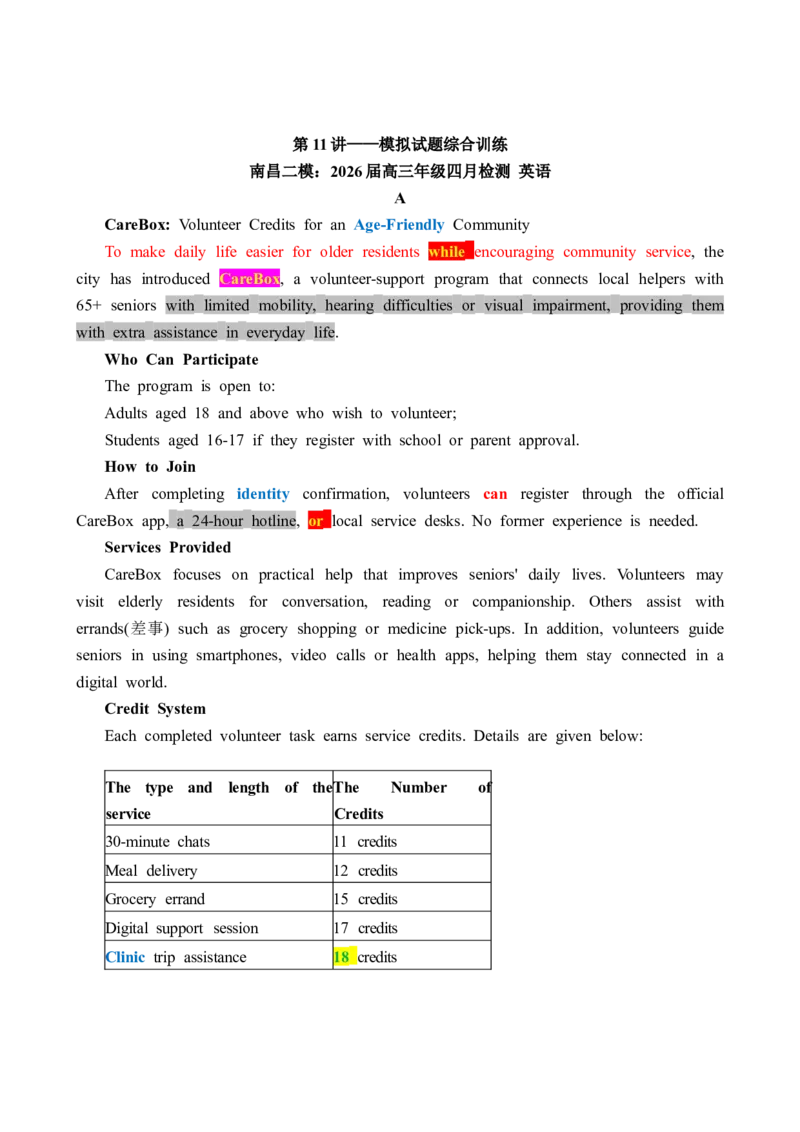
CareBox: Volunteer Credits for an Age-Friendly Community
To make daily life easier for older residents while encouraging community service, the
city has introduced CareBox, a volunteer-support program that connects local helpers with
65+ seniors with limited mobility, hearing difficulties or visual impairment, providing them
with extra assistance in everyday life.
Who Can Participate
The program is open to:
Adults aged 18 and above who wish to volunteer;
Students aged 16-17 if they register with school or parent approval.
How to Join
After completing identity confirmation, volunteers can register through the official
CareBox app, a 24-hour hotline, or local service desks. No former experience is needed.
Services Provided
CareBox focuses on practical help that improves seniors' daily lives. Volunteers may
visit elderly residents for conversation, reading or companionship. Others assist with
errands(差事) such as grocery shopping or medicine pick-ups. In addition, volunteers guide
seniors in using smartphones, video calls or health apps, helping them stay connected in a
digital world.
Credit System
Each completed volunteer task earns service credits. Details are given below:
The type and length of the The Number of
service Credits
30-minute chats 11 credits
Meal delivery 12 credits
Grocery errand 15 credits
Digital support session 17 credits
Clinic trip assistance 18 creditsThese credits, which appear in the app or on CareBox machines, can be saved, donated
to community projects or exchanged for transport passes and cultural activities. CareBox
machines are located in libraries, community centers and selected supermarkets.
1. What is the main purpose of the CareBox program?
A.To offer extra support for volunteers.
B.To pair volunteers with needy seniors.
C.To provide medical care for the elderly.
D.To bridge the digital divide among seniors.
2. What should volunteers do to join the program?
A.Fill out an online form.
B.Have prior experience.
C.Get their identity checked.
D.Download the official app.可以其他方式
3. What earns the most credits in the CareBox program?
A.Walking a senior to see a doctor.
B.Picking up groceries for a senior.
C.Chatting with a senior for half an hour.
D.Assisting a senior with a phone app.
B
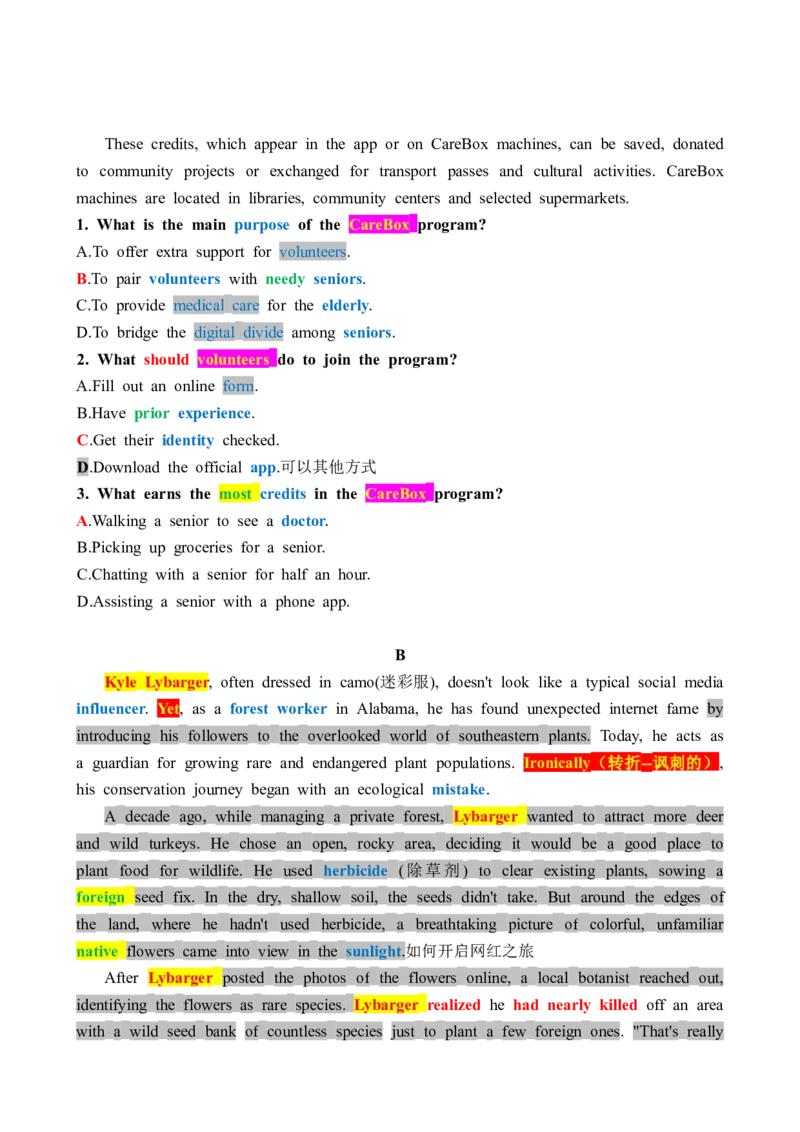
Kyle Lybarger, often dressed in camo(迷彩服), doesn't look like a typical social media
influencer. Yet, as a forest worker in Alabama, he has found unexpected internet fame by
introducing his followers to the overlooked world of southeastern plants. Today, he acts as
a guardian for growing rare and endangered plant populations. Ironically(转折--讽刺的),
his conservation journey began with an ecological mistake.
A decade ago, while managing a private forest, Lybarger wanted to attract more deer
and wild turkeys. He chose an open, rocky area, deciding it would be a good place to
plant food for wildlife. He used herbicide (除草剂) to clear existing plants, sowing a
foreign seed fix. In the dry, shallow soil, the seeds didn't take. But around the edges of
the land, where he hadn't used herbicide, a breathtaking picture of colorful, unfamiliar
native flowers came into view in the sunlight.如何开启网红之旅
After Lybarger posted the photos of the flowers online, a local botanist reached out,
identifying the flowers as rare species. Lybarger realized he had nearly killed off an area
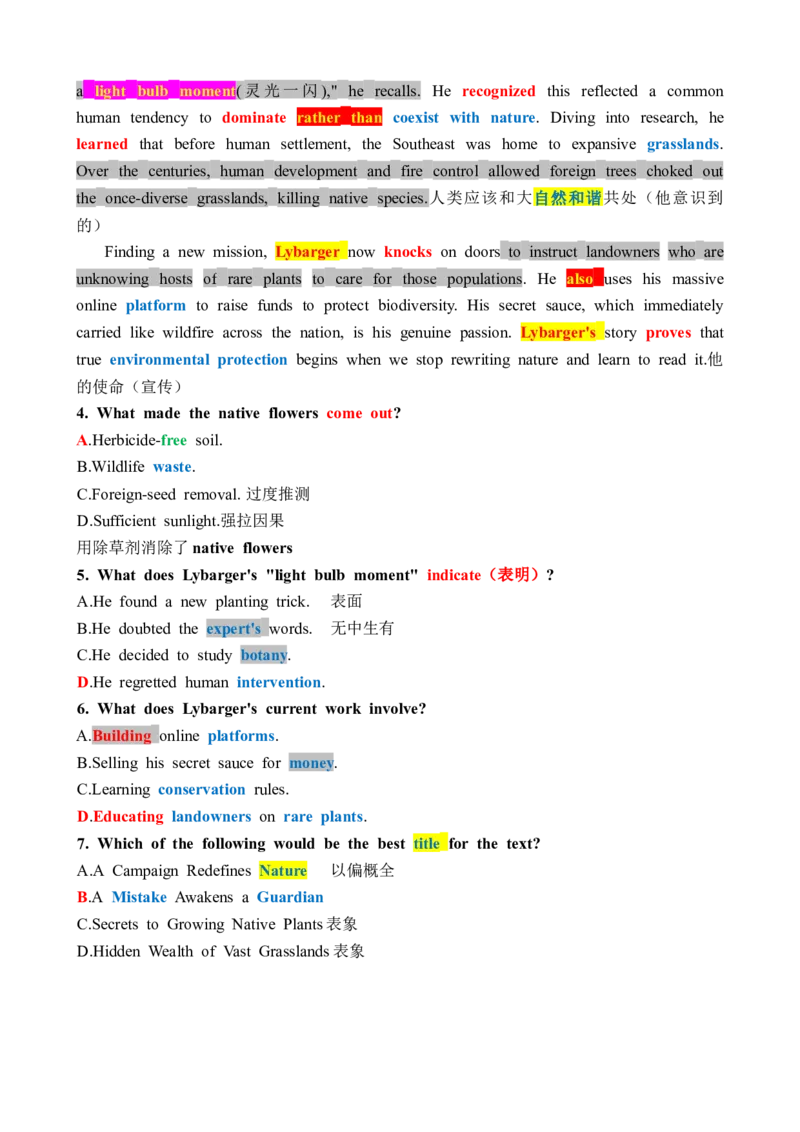
with a wild seed bank of countless species just to plant a few foreign ones. "That's reallya light bulb moment(灵光一闪)," he recalls. He recognized this reflected a common
human tendency to dominate rather than coexist with nature. Diving into research, he
learned that before human settlement, the Southeast was home to expansive grasslands.
Over the centuries, human development and fire control allowed foreign trees choked out
the once-diverse grasslands, killing native species.人类应该和大自然和谐共处(他意识到
的)
Finding a new mission, Lybarger now knocks on doors to instruct landowners who are
unknowing hosts of rare plants to care for those populations. He also uses his massive
online platform to raise funds to protect biodiversity. His secret sauce, which immediately
carried like wildfire across the nation, is his genuine passion. Lybarger's story proves that
true environmental protection begins when we stop rewriting nature and learn to read it.他
的使命(宣传)
4. What made the native flowers come out?
A.Herbicide-free soil.
B.Wildlife waste.
C.Foreign-seed removal. 过度推测
D.Sufficient sunlight.强拉因果
用除草剂消除了native flowers
5. What does Lybarger's "light bulb moment" indicate(表明)?
A.He found a new planting trick. 表面
B.He doubted the expert's words. 无中生有
C.He decided to study botany.
D.He regretted human intervention.
6. What does Lybarger's current work involve?
A.Building online platforms.
B.Selling his secret sauce for money.
C.Learning conservation rules.
D.Educating landowners on rare plants.
7. Which of the following would be the best title for the text?
A.A Campaign Redefines Nature 以偏概全
B.A Mistake Awakens a Guardian
C.Secrets to Growing Native Plants表象
D.Hidden Wealth of Vast Grasslands表象C
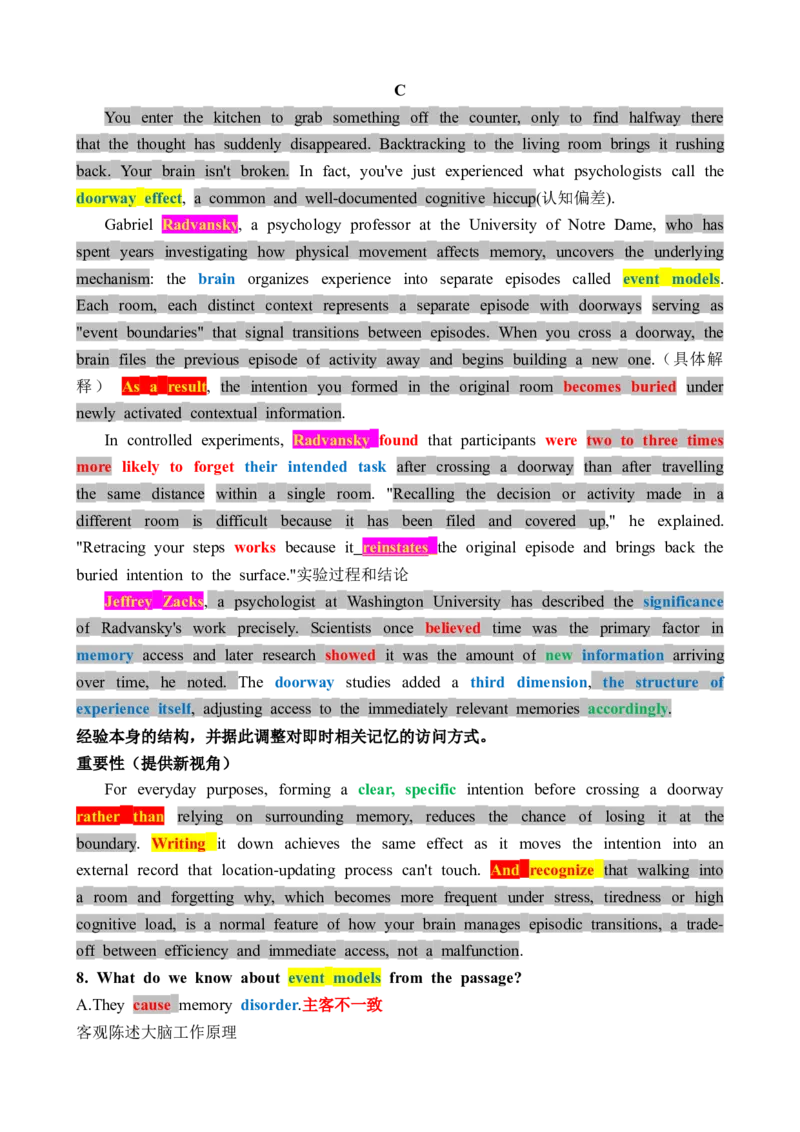
You enter the kitchen to grab something off the counter, only to find halfway there
that the thought has suddenly disappeared. Backtracking to the living room brings it rushing
back. Your brain isn't broken. In fact, you've just experienced what psychologists call the
doorway effect, a common and well-documented cognitive hiccup(认知偏差).
Gabriel Radvansky, a psychology professor at the University of Notre Dame, who has
spent years investigating how physical movement affects memory, uncovers the underlying
mechanism: the brain organizes experience into separate episodes called event models.
Each room, each distinct context represents a separate episode with doorways serving as
"event boundaries" that signal transitions between episodes. When you cross a doorway, the
brain files the previous episode of activity away and begins building a new one.(具体解
释) As a result, the intention you formed in the original room becomes buried under
newly activated contextual information.
In controlled experiments, Radvansky found that participants were two to three times
more likely to forget their intended task after crossing a doorway than after travelling
the same distance within a single room. "Recalling the decision or activity made in a
different room is difficult because it has been filed and covered up," he explained.
"Retracing your steps works because it reinstate s the original episode and brings back the
buried intention to the surface."实验过程和结论
Jeffrey Zacks, a psychologist at Washington University has described the significance
of Radvansky's work precisely. Scientists once believed time was the primary factor in
memory access and later research showed it was the amount of new information arriving
over time, he noted. The doorway studies added a third dimension, the structure of
experience itself, adjusting access to the immediately relevant memories accordingly.
经验本身的结构,并据此调整对即时相关记忆的访问方式。
重要性(提供新视角)
For everyday purposes, forming a clear, specific intention before crossing a doorway
rather than relying on surrounding memory, reduces the chance of losing it at the
boundary. Writing it down achieves the same effect as it moves the intention into an
external record that location-updating process can't touch. And recognize that walking into
a room and forgetting why, which becomes more frequent under stress, tiredness or high
cognitive load, is a normal feature of how your brain manages episodic transitions, a trade-
off between efficiency and immediate access, not a malfunction.
8. What do we know about event models from the passage?
A.They cause memory disorder.主客不一致
客观陈述大脑工作原理工作原理+你的行为促发了混乱
B.They mix different life experiences.
C.They are erased by doorways.
D.They are linked to specific contexts.中性
9. What does the underlined word "reinstates" mean in Paragraph 3?
A.Restores. --retrace
B.Replaces.
C.Reconstructs.
D.Restricts
10. What is the significance of Radvansky's studies according to Zacks?
A.Confirming the role of information.
B.Offering new memory perspectives.
C.Revolutionizing memory loss research.
D.Correcting traditional memory views.
11. What is recommended to prevent the doorway effect?
A.Avoiding the event boundaries.
B.Reducing the multitask chances.
C.Externalizing the specific intention.
D.Embracing the declining memory.
D
Static electricity(静电) is a common phenomenon that we experience daily. Take off a
sweater in winter, and you might hear a sudden sound; brush a balloon against your hair,
and the hair stands on end. Yet, this familiar event— known scientifically as the
triboelectricity effect(摩擦起电效应)—has puzzled scientists for centuries. For a long time,
researchers relied on the "triboelectric series". This was a fixed ranking system designed to
determine exactly which materials would charge positively or negatively upon contact.---引
出主题(电)
However, the deep rules of this effect confused researchers because experiments often
produced contradictory results. Identical testing procedures using the exact same materials
frequently resulted in different charges, going against the established ranking. Consequently,
disappointed scientists often dismissed these confusing results as human error, wrong
methods, or poor equipment. This lack of reliability blocked the progress of related
scientific studies for a long time.(背景--问题)
Recently, new research has brought a major breakthrough. Scientists suggest that what
looked like chaos is actually a natural change over time. In a detailed study, researchersfound that a material's charging behaviour heavily depends on its "contact history".
Repeated physical interactions cause tiny surface shape changes. This physical wear
systematically shifts the material's tendency toward negative charging. The discovery
perfectly explains the historical mistakes: scientists were testing worn materials without
knowing it.(新研究--矛盾是因为改变)
In a follow-up field study, the team studied oxide materials(氧化物) such as sand, and
identified the hidden chemical factor driving their electrical behavior: carbon-carrying
substances. These substances, which are everywhere in the atmosphere, gradually coat all
exposed surfaces with an invisible layer. When researchers heated the materials to high
temperatures to completely remove this environmental pollution, they observed something
amazing: the direction of the charge exchange went in the opposite direction, proving that
the unseen pollution secretly governed the electrical reaction.解释发现
These exciting findings challenge the conventional idea of a fixed ranking. A material's
electrical identity is actually dynamic, shaped by its physical history and environmental
exposure. By mapping these hidden factors, scientists are turning a long-held mystery into a
predictable science. This deeper understanding will help develop battery-free wearable
devices, prevent disastrous industrial explosions, and even evaluate the potential damage of
lunar dust to future space missions.
12. How does the author introduce the topic?
A.By providing everyday examples.
B.By listing experimental data.
C.By raising a scientific question.
D.By sharing a fabulous story.
13. What affects the material's charging tendency?
A.The initial physical state.
B.The testing methods.
C.The surface shape shifts.
D.The experiment equipment.
14. What conclusion can be drawn from the field study?
A.Oxides produce environmental pollution.
B.Invisible coatings control electrical responses. --围绕主旨
C.Heating changes oxide structures. 未提及改变结构
D.Carbon protects oxides against pollution.
15. What does the last paragraph focus on?
无贬义,排除AD,无数据,排除B
Device对应applicationsA.Limitations and predictions.
B.Statistics and practices.
C.Evaluations and applications.
D.Difficulties and opportunities.
第二节(共5小题;每小题2.5分,满分12.5分)
阅读下面短文,从短文后的选项中选出可以填入空白处的最佳选项。选项中有两项为多余选
项。
On a recent trip to Costa Rica, I visited a well-established ecological coffee farm. This
farm is less about tasty coffee drinks and sweet treats. 16 G I had pictured simply
seeing coffee beans and tasting drinks, but being at an actual farm was totally different
and amazing.
The first surprise was the spectacular setting. 17 B The farm is green and natural.
The open-air guest center overlooks a waterfall and a gorge(峡谷) full of tropical greenery.
Everything here is designed to blend perfectly with nature. Walking along paths bordered
with palm trees and tropical plants made me feel more like hiking in nature.
18 A Before this trip, when I heard about a coffee tasting, I imagined sweet,
frozen drinks. In fact, it turned out to be a sensory workshop similar to a wine tasting,
with rich flavors and special ways to evaluate the coffee. Sampling several kinds of coffee
grown and roasted right on the farm truly opened my eyes to its complex natural flavors.
Beyond the tasting, the tour also offered surprising scientific facts. For instance, I
learned a coffee plant takes almost five years to produce beans. 19 F The longer a bean
has been roasted, the less caffeine it has. That means lighter roasts actually have more
caffeine than darker ones. The staff said grinding (研磨) and brewing(冲泡) them as a
pour-over can get the best flavor.
Before leaving, I enjoyed a cup of freshly brewed coffee. Knowing that it takes
roughly fifty beans and years of patience to produce a single cup, I realized the enormous
effort behind it. 2 0 C
A. My initial idea of coffee tasting was quite simple.
C. This special experience changed how I viewed my daily coffee.
F. Another unexpected thing I learned was about the roasting process.
B. Erase all thoughts of a flat and dull farm from your mind.
D. So you won't be able to sample a cup from your personal plant.
E. It's also a beautiful (后文无呼应)and instructive farm to offer you a great trip.
G. It's actually ( 和 less 呼 应 ) focused on coffee development, sustainability, and
education.语言运用(共两节,满分30分)
第一节(共15小题;每小题1分,满分15分)
阅读下面短文,从每题所给的A、B、C、D四个选项中选出可以填入空白处的最佳选项。
When Sydney tech expert Paul Conyngham learned that his eight-year-old dog, Rosie,
had been given just months to live, he refused to give up on her. Instead, he opened his
21 and got to work.
Rosie, a rescue dog before Paul 22 her, was found with cancer in 2024. Paul 23
no expense on chemotherapy(化疗) and surgery for Rosie, which slowed the spread but
24 to cure the disease. Seeing Rosie getting sicker and losing 25 , with conventional
animal medicine options 26 , Paul decided to build a custom(定制) mRNA cancer
vaccine(疫苗) for her.
Having no background in biology, the tech expert turned to AI which 27 genomic
sequencing(基因组测序) and directed him toward the University of New South Wales
(UNSW). After having Rosie's DNA sequenced, Paul compared her cells to 28 the
diseased part through the AI to work out a potential treatment. Soon he settled on a plan,
but the drugmaker he contacted 2 9 to help with it.
Paul didn't get 30 . He kept trying, reaching out to scientists and sharing data
analyses despite being a(n) 31 . Pall Thordarson, a nanomedicine expert at UNSW,
stepped in and developed the vaccine with Paul's 32 . Within two months, the world's
first cancer vaccine was 3 3 made for a dog.
Rosie was fairly mobile again, chasing rabbits in the park. "Rosie is my best mate,
who's been with me through tough times. When she was 34 to death, I had to do my
part for her." Paul said, "I'm glad this treatment bought her more time and quality of life."
Rosie's case is 35 , pointing to AI's potential to produce breakthroughs in
medicine, perhaps turning those considered deadly diseases into routine ones.
21. A.mail B.laptop C.account D.drawer
22. A.chased B.abandoned C.trapped D.adopted
23. A.spent B.charged C.spared 留 出 D.collected 负 负 得 正 spare no
expense不惜代价
24. A.failed B.managed C.tended D.intended
25. A.eyesight B.hearing C.mobility D.balance
26. A.coming up B.running out C.holding on D.taking off
27. A.ignored B.created C.limited D.suggested
28. A.change B.locate C.replace D.protect
29. A.afforded B.struggled C.declined D.volunteered
30. A.discouraged B.relieved C.stressed D.inspired31. A.professional B.favorite C.outsider D.victim
32. A.data B.evidence C.symptoms D.signals
33. A.commonly B.occasionally C.accidentally D.specially
34. A.led B.sentenced C.attached D.frozen
35. A.groundbreaking B.one-sided C.laborsaving D.well-designed
第二节(共10小题;每小题1.5分,满分15分)
阅读下面短文,在空白处填入1个适当的单词或括号内单词的正确形式。
In the Beijing department store SKP, customers queued and even camped overnight for
products from Laopu Gold, 36 a fast-rising Chinese heritage gold brand, even as global
gold prices skyrocketed.
This phenomenon is no exception. Over the past several months, from Beijing to
Shanghai and Chengdu, stories of consumers waiting for hours to acquire a crafted gold
piece 37 have become (become) nothing new. Chinese people used to purchase gold
jewelry 3 8 largely (large) for its metal value, often 3 9 prioritizing (prioritize) weight over
aesthetics(美学). There's such a wide variety of styles 40 to choose (choose) from
nowadays, and even lightweight gold jewelry is beautifully designed.
Heritage gold, or gufa huangjin, is not a single technique 41 bu t a collection of
ancient handcrafted arts. It involves three steps: hammering(锤击) to achieve a shiny
appearance, filigree(掐丝) in which gold 42 is drawn (draw) into delicate wires and
chasing, the art of hand carving. The result is jewelry distinguished by its delicate design
and detailed patterns.
The 43 popularity (popular) of heritage gold originates from multiple factors. First, it
matches cultural identity and has respect for tradition. Second, it meets aesthetic needs for
daily wear and gifts. Third, as a precious gift 44 that/which is passed down through
generations, it carries family memories and emotional value. 45 With the unique
Eastern aesthetics reclaiming cultural value, heritage gold is once again demonstrating its
charm and strength to the world.