MBA 大师跟学团英语专属系统课
“阅读A” 课程讲义
- 2023 年真题精讲-
(Text 4 )
主讲老师:王丽
关注【王丽考研英语】公众号获取2024 考研英语备考独家资料
A little progress each day adds up to big results.
第3 页
Text 4
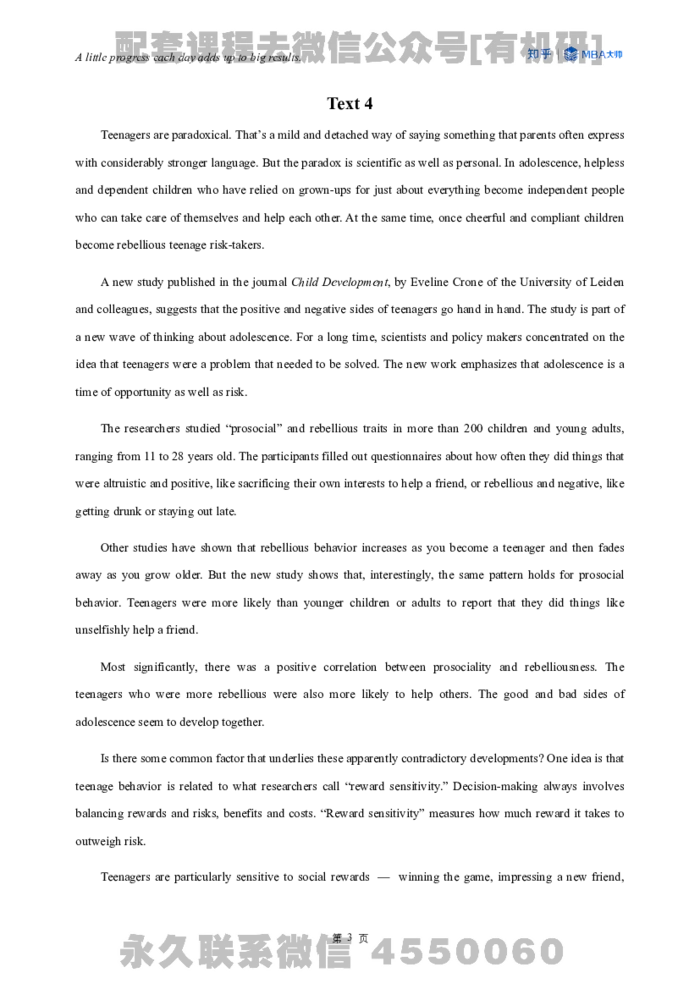
Teenagers are paradoxical. That’s a mild and detached way of saying something that parents often express
with considerably stronger language. But the paradox is scientific as well as personal. In adolescence, helpless
and dependent children who have relied on grown-ups for just about everything become independent people
who can take care of themselves and help each other. At the same time, once cheerful and compliant children
become rebellious teenage risk-takers.
A new study published in the journal Child Development, by Eveline Crone of the University of Leiden
and colleagues, suggests that the positive and negative sides of teenagers go hand in hand. The study is part of
a new wave of thinking about adolescence. For a long time, scientists and policy makers concentrated on the
idea that teenagers were a problem that needed to be solved. The new work emphasizes that adolescence is a
time of opportunity as well as risk.
The researchers studied “prosocial” and rebellious traits in more than 200 children and young adults,
ranging from 11 to 28 years old. The participants filled out questionnaires about how often they did things that
were altruistic and positive, like sacrificing their own interests to help a friend, or rebellious and negative, like
getting drunk or staying out late.
Other studies have shown that rebellious behavior increases as you become a teenager and then fades
away as you grow older. But the new study shows that, interestingly, the same pattern holds for prosocial
behavior. Teenagers were more likely than younger children or adults to report that they did things like
unselfishly help a friend.
Most significantly, there was a positive correlation between prosociality and rebelliousness. The
teenagers who were more rebellious were also more likely to help others. The good and bad sides of
adolescence seem to develop together.
Is there some common factor that underlies these apparently contradictory developments? One idea is that
teenage behavior is related to what researchers call “reward sensitivity.” Decision-making always involves
balancing rewards and risks, benefits and costs. “Reward sensitivity” measures how much reward it takes to
outweigh risk.
Teenagers are particularly sensitive to social rewards — winning the game, impressing a new friend,
A little progress each day adds up to big results.
第4 页
getting that boy to notice you. Reward sensitivity, like prosocial behavior and risk-taking, seems to go up in
adolescence and then down again as we age. Somehow, when you hit 30, the chance that something exciting
and new will happen at that party just doesn’t seem to outweigh the effort of getting up off the couch.
36. According to Paragraph 1, children growing into adolescence tend to
.
[A] develop opposite personality traits
[B] see the world in an unreasonable way
[C] have fond memories of their past
[D] show affection for their parents
37. It can be learned from Paragraph 2 that Crone’s study
.
[A] explores teenagers’ social responsibilities
[B] examines teenagers’ emotional problems
[C] provides a new insight into adolescence
[D] highlights negative adolescent behavior
38. What does Crone’s study find about prosocial behavior?
[A] It results from the wish to cooperate.
[B] It is cultivated through education.
[C] It is subject to family influence.
[D] It tends to peak in adolescence.
39. It can be learned from the last two paragraphs that teenagers
.
[A] overstress their influence on others
[B] care a lot about social recognition
[C] become anxious about their future
[D] endeavor to live a joyful life
40. What is the text mainly about?
[A] Why teenagers are self-contradictory.
[B] Why teenagers are risk-sensitive.
[C] How teenagers develop prosociality.
[D] How teenagers become independent.
A little progress each day adds up to big results.
第5 页
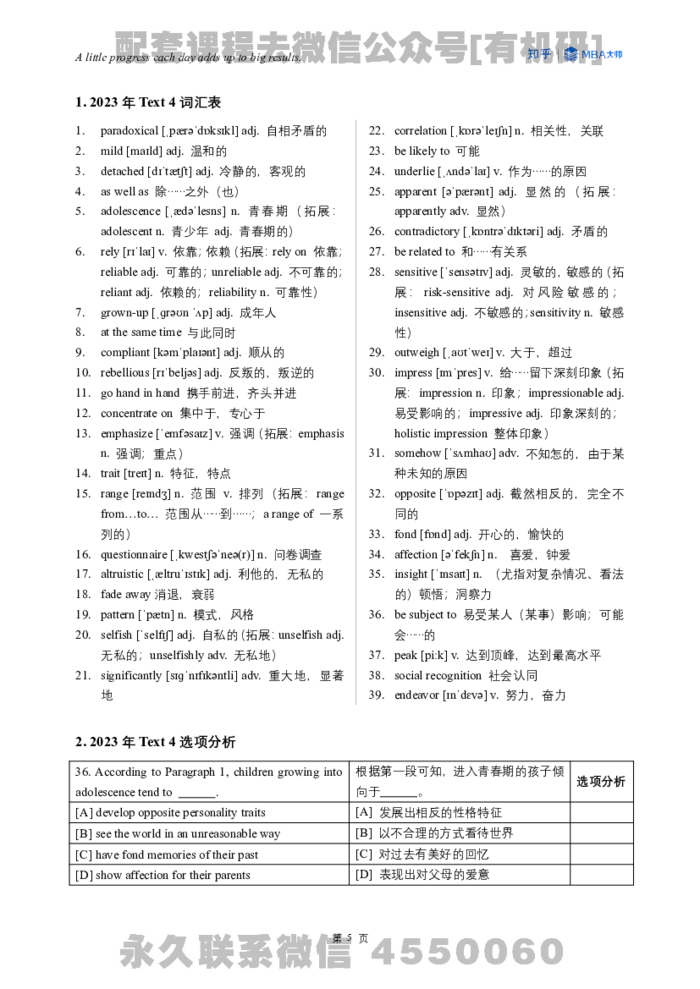
1. 2023 年Text 4 词汇表
1.
paradoxical [ˌpærəˈdɒksɪkl] adj. 自相矛盾的
2.
mild [maɪld] adj. 温和的
3.
detached [dɪˈtætʃt] adj. 冷静的,客观的
4.
as well as 除……之外(也)
5.
adolescence [ˌædəˈlesns] n. 青春期(拓展:
adolescent n. 青少年adj. 青春期的)
6.
rely [rɪˈlaɪ] v. 依靠;依赖(拓展:rely on 依靠;
reliable adj. 可靠的;unreliable adj. 不可靠的;
reliant adj. 依赖的;reliability n. 可靠性)
7.
grown-up [ˌɡrəʊn ˈʌp] adj. 成年人
8.
at the same time 与此同时
9.
compliant [kəmˈplaɪənt] adj. 顺从的
10. rebellious [rɪˈbeljəs] adj. 反叛的,叛逆的
11.
go hand in hand 携手前进,齐头并进
12. concentrate on 集中于,专心于
13. emphasize [ˈemfəsaɪz] v. 强调(拓展:emphasis
n. 强调;重点)
14. trait [treɪt] n. 特征,特点
15. range [reɪndʒ] n. 范围v. 排列(拓展:range
from…to… 范围从……到……;a range of 一系
列的)
16. questionnaire [ˌkwestʃəˈneə(r)] n. 问卷调查
17. altruistic [ˌæltruˈɪstɪk] adj. 利他的,无私的
18. fade away 消退,衰弱
19. pattern [ˈpætn] n. 模式,风格
20. selfish [ˈselfɪʃ] adj. 自私的(拓展:unselfish adj.
无私的;unselfishly adv. 无私地)
21. significantly [sɪɡˈnɪfɪkəntli] adv. 重大地,显著
地
22. correlation [ˌkɒrəˈleɪʃn] n. 相关性,关联
23. be likely to 可能
24. underlie [ˌʌndəˈlaɪ] v. 作为……的原因
25. apparent [əˈpærənt] adj. 显然的(拓展:
apparently adv. 显然)
26. contradictory [ˌkɒntrəˈdɪktəri] adj. 矛盾的
27. be related to 和……有关系
28. sensitive [ˈsensətɪv] adj. 灵敏的,敏感的(拓
展:risk-sensitive adj. 对风险敏感的;
insensitive adj. 不敏感的;sensitivity n. 敏感
性)
29. outweigh [ˌaʊtˈweɪ] v. 大于,超过
30. impress [ɪmˈpres] v. 给……留下深刻印象(拓
展:impression n. 印象;impressionable adj.
易受影响的;impressive adj. 印象深刻的;
holistic impression 整体印象)
31. somehow [ˈsʌmhaʊ] adv. 不知怎的,由于某
种未知的原因
32. opposite [ˈɒpəzɪt] adj. 截然相反的,完全不
同的
33. fond [fɒnd] adj. 开心的,愉快的
34. affection [əˈfekʃn] n.
喜爱,钟爱
35. insight [ˈɪnsaɪt] n. (尤指对复杂情况、看法
的)顿悟;洞察力
36. be subject to 易受某人(某事)影响;可能
会……的
37. peak [piːk] v. 达到顶峰,达到最高水平
38. social recognition 社会认同
39. endeavor [ɪnˈdɛvə] v. 努力,奋力
2. 2023 年Text 4 选项分析
36. According to Paragraph 1, children growing into
adolescence tend to
.
根据第一段可知,进入青春期的孩子倾
向于
。
选项分析
[A] develop opposite personality traits
[A] 发展出相反的性格特征
[B] see the world in an unreasonable way
[B] 以不合理的方式看待世界
[C] have fond memories of their past
[C] 对过去有美好的回忆
[D] show affection for their parents
[D] 表现出对父母的爱意
A little progress each day adds up to big results.
第6 页
37. It can be learned from Paragraph 2 that Crone’s
study
.
从第二段可以看出,克罗恩的研
究
。
选项分析
[A] explores teenagers’ social responsibilities
[A] 调查青少年的社会责任
[B] examines teenagers’ emotional problems
[B] 研究青少年的情绪问题
[C] provides a new insight into adolescence
[C] 提供了对青少年的新见解
[D] highlights negative adolescent behavior
[D] 强调青少年的消极行为
38. What does Crone’s study find about prosocial
behavior?
克罗恩的研究对亲社会行为有何发
现?
选项分析
[A] It results from the wish to cooperate.
[A] 它源于对于合作的意愿。
[B] It is cultivated through education.
[B] 它是通过教育培养出来的。
[C] It is subject to family influence.
[C] 它受到家庭因素的影响。
[D] It tends to peak in adolescence.
[D] 它往往在青春期达到顶峰。
39. It can be learned from the last two paragraphs that
teenagers
.
从最后两段可以看出,青少年
。
选项分析
[A] overstress their influence on others
[A] 过分强调其对他人的影响
[B] care a lot about social recognition
[B] 非常在意社会认可
[C] become anxious about their future
[C] 对自己的未来感到焦虑
[D] endeavor to live a joyful life
[D] 努力过快乐的生活
40. What is the text mainly about?
本文主要讲述什么?
选项分析
[A] Why teenagers are self-contradictory.
[A] 为什么青少年会自相矛盾。
[B] Why teenagers are risk-sensitive.
[B] 为什么青少年对风险敏感。
[C] How teenagers develop prosociality.
[C] 青少年如何发展亲社会性。
[D] How teenagers become independent.
[D] 青少年如何变得独立。
3. 2023 年Text 4 全文翻译
Para. 1 ①Teenagers are paradoxical. ②That’s a mild and detached way of saying something that parents
often express with considerably stronger language. ③But the paradox is scientific as well as personal. ④In
adolescence, helpless and dependent children who have relied on grown-ups for just about everything become
independent people who can take care of themselves and help each other. ⑤At the same time, once cheerful
and compliant children become rebellious teenage risk-takers.
①青少年是自相矛盾的。②这种说法还算温柔客气,家长的言辞通常激烈得多。③但是,这种违
逆不仅符合科学道理,也反映个人的心境。④在青春期,无助又无法自立、万事几乎都离不开家长的
孩子成长为独立的成人,不仅有能力照顾自己,还会互相帮助。⑤同时,性格也从愉悦乖巧变得叛逆
A little progress each day adds up to big results.
第7 页
和爱冒险。
Para. 2 ①A new study published in the journal Child Development, by Eveline Crone of the University
of Leiden and colleagues, suggests that the positive and negative sides of teenagers go hand in hand. ②The
study is part of a new wave of thinking about adolescence. ③For a long time, scientists and policy makers
concentrated on the idea that teenagers were a problem that needed to be solved. ④The new work emphasizes
that adolescence is a time of opportunity as well as risk.
①莱顿大学的伊芙琳·克罗恩(Eveline Crone)与同事在学术期刊《儿童发展》上发表的一项新研
究表明,青少年性格中的积极与消极因素密切相关。②这项研究是青春期研究新思潮的一部分。③长
期以来,科学家与政策制定者专注于“青少年是亟须解决的难题”这个观点。④而最新研究则强调,青春
期既是机遇期也是风险期。
Para. 3 ①The researchers studied “prosocial” and rebellious traits in more than 200 children and young
adults, ranging from 11 to 28 years old. ②The participants filled out questionnaires about how often they did
things that were altruistic and positive, like sacrificing their own interests to help a friend, or rebellious and
negative, like getting drunk or staying out late.
①伊芙琳·克罗恩等人在该论文中研究分析了200 余名年龄跨度在11-28 之间的儿童与青年的亲社
会和叛逆性格特征。②参与者在问卷中回答自己做出利他性积极行为(如牺牲自身利益帮助朋友)和
叛逆性消极行为(如醉酒或晚归)的频率。
Para. 4 ①Other studies have shown that rebellious behavior increases as you become a teenager and then
fades away as you grow older. ②But the new study shows that, interestingly, the same pattern holds for
prosocial behavior. ③Teenagers were more likely than younger children or adults to report that they did
things like unselfishly help a friend.
①其它研究表明,随着儿童成长为青少年,叛逆行为增多,之后随着年龄进一步增长而逐步减少。
②但这项新的研究提出了一个有趣的发现,同样的模式也适用于亲社会行为。③与儿童或成人相比,
青少年更愿意反映他们做过类似于无私帮助朋友这样的事。
Para. 5 ①Most significantly, there was a positive correlation between prosociality and rebelliousness. ②
The teenagers who were more rebellious were also more likely to help others. ③The good and bad sides of
adolescence seem to develop together.
①这项研究最重要的发现是,亲社会与叛逆之间存在正相关关系。②越叛逆的青少年也更愿意帮
助他人,③青年期好的与坏的方面似乎是共同发展的。
Para. 6 ①Is there some common factor that underlies these apparently contradictory developments? ②
A little progress each day adds up to big results.
第8 页
One idea is that teenage behavior is related to what researchers call “reward sensitivity.” ③Decision-making
always involves balancing rewards and risks, benefits and costs. ④“Reward sensitivity” measures how much
reward it takes to outweigh risk.
①这两种貌似水火不容的性格发展趋势背后是否有共同的影响因素?②一种观点认为,青少年行
为与研究人员口中的“回报敏感性”有关。③决策永远是在回报与风险、收益与成本之间寻找平衡。④“回
报敏感性”测量的是需要多少回报才能覆盖风险。
Para. 7 ①Teenagers are particularly sensitive to social rewards — winning the game, impressing a new
friend, getting that boy to notice you. ②Reward sensitivity, like prosocial behavior and risk-taking, seems to
go up in adolescence and then down again as we age. ③Somehow, when you hit 30, the chance that
something exciting and new will happen at that party just doesn’t seem to outweigh the effort of getting up off
the couch.
①青少年对社交回报尤其敏感:在竞技中获胜,给新朋友留下美好印象,让心仪的异性注意到自
己。②回报敏感性和亲社会行为或冒险的情况类似,在青春期表现显著,而随着年龄的增长逐渐减弱。
③不知为什么,一过而立之年,人就宁可宅在沙发上,也不再愿意去社交聚会上寻求刺激和新鲜。
4. 2023 年Text 4 参考答案
36-40:ACDBA