











文档内容
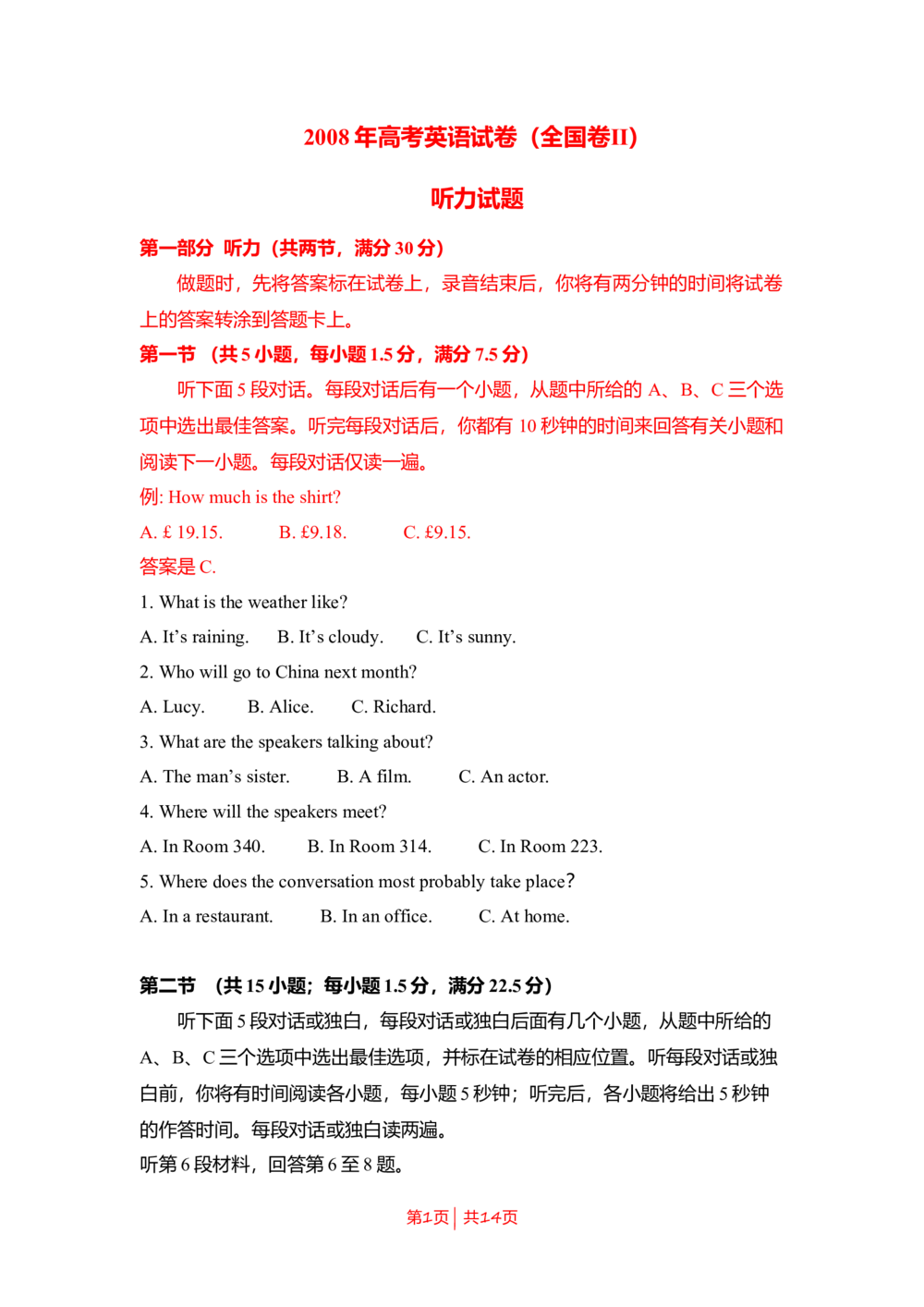
2008年高考英语试卷(全国卷Ⅱ)
听力试题
第一部分 听力(共两节,满分30分)
做题时,先将答案标在试卷上,录音结束后,你将有两分钟的时间将试卷
上的答案转涂到答题卡上。
第一节 (共5小题,每小题1.5分,满分7.5分)
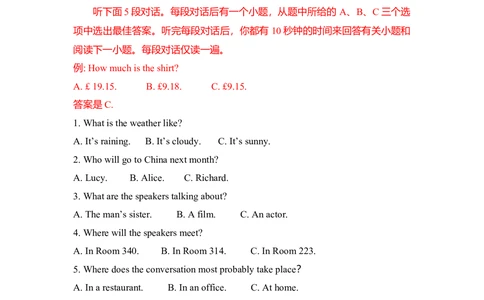
听下面5段对话。每段对话后有一个小题,从题中所给的 A、B、C三个选
项中选出最佳答案。听完每段对话后,你都有 10秒钟的时间来回答有关小题和
阅读下一小题。每段对话仅读一遍。
例: How much is the shirt?
A. £ 19.15. B. £9.18. C. £9.15.
答案是C.
1. What is the weather like?
A. It’s raining. B. It’s cloudy. C. It’s sunny.
2. Who will go to China next month?
A. Lucy. B. Alice. C. Richard.
3. What are the speakers talking about?
A. The man’s sister. B. A film. C. An actor.
4. Where will the speakers meet?
A. In Room 340. B. In Room 314. C. In Room 223.
5. Where does the conversation most probably take place?
A. In a restaurant. B. In an office. C. At home.
第二节 (共15小题;每小题1.5分,满分22.5分)
听下面5段对话或独白,每段对话或独白后面有几个小题,从题中所给的
A、B、C三个选项中选出最佳选项,并标在试卷的相应位置。听每段对话或独
白前,你将有时间阅读各小题,每小题5秒钟;听完后,各小题将给出5秒钟
的作答时间。每段对话或独白读两遍。
听第6段材料,回答第6至8题。
第1页 | 共14页6. Why did the woman go to New York?
A. To spend some time with the baby.
B. To look after her sister.
C. To find a new job.
7. How old was the baby when the woman left New York?
A. Two months. B. Five months. C. Seven months.
8. What did the woman like doing most with the baby?
A. Holding him. B. Playing with him. C. Feeding him.
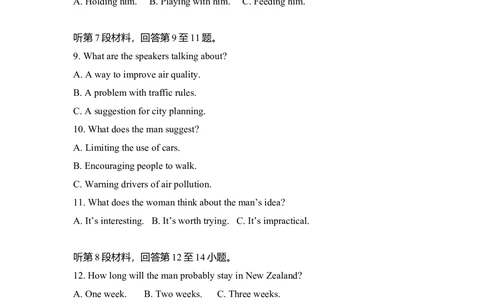
听第7段材料,回答第9至11题。
9. What are the speakers talking about?
A. A way to improve air quality.
B. A problem with traffic rules.
C. A suggestion for city planning.
10. What does the man suggest?
A. Limiting the use of cars.
B. Encouraging people to walk.
C. Warning drivers of air pollution.
11. What does the woman think about the man’s idea?
A. It’s interesting. B. It’s worth trying. C. It’s impractical.
听第8段材料,回答第12至14小题。
12. How long will the man probably stay in New Zealand?
A. One week. B. Two weeks. C. Three weeks.
13. What advice does the woman give to the man?
A. Go to New Zealand after Christmas.
B. Book his flight as soon as possible.
C. Save more money for his trip.
14. What can we learn about flights to New Zealand at Christmas time?
A. They require early booking.
B. They can be twice as expensive.
第2页 | 共14页C. They are on special offer.
听第9段材料,回答第15至17题。
15. Why did Jane call Mike?
A. To ask him to meet her.
B. To tell him about Tom.
C. To borrow his car.
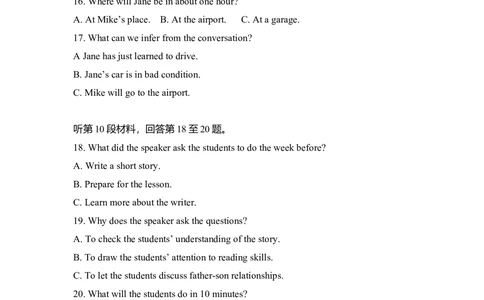
16. Where will Jane be in about one hour?
A. At Mike’s place. B. At the airport. C. At a garage.
17. What can we infer from the conversation?
A Jane has just learned to drive.
B. Jane’s car is in bad condition.
C. Mike will go to the airport.
听第10段材料,回答第18至20题。
18. What did the speaker ask the students to do the week before?
A. Write a short story.
B. Prepare for the lesson.
C. Learn more about the writer.
19. Why does the speaker ask the questions?
A. To check the students’ understanding of the story.
B. To draw the students’ attention to reading skills.
C. To let the students discuss father-son relationships.
20. What will the students do in 10 minutes?
A. Ask more questions. B. Discuss in groups. C. Give their answers.
第3页 | 共14页听力试题答案及原文
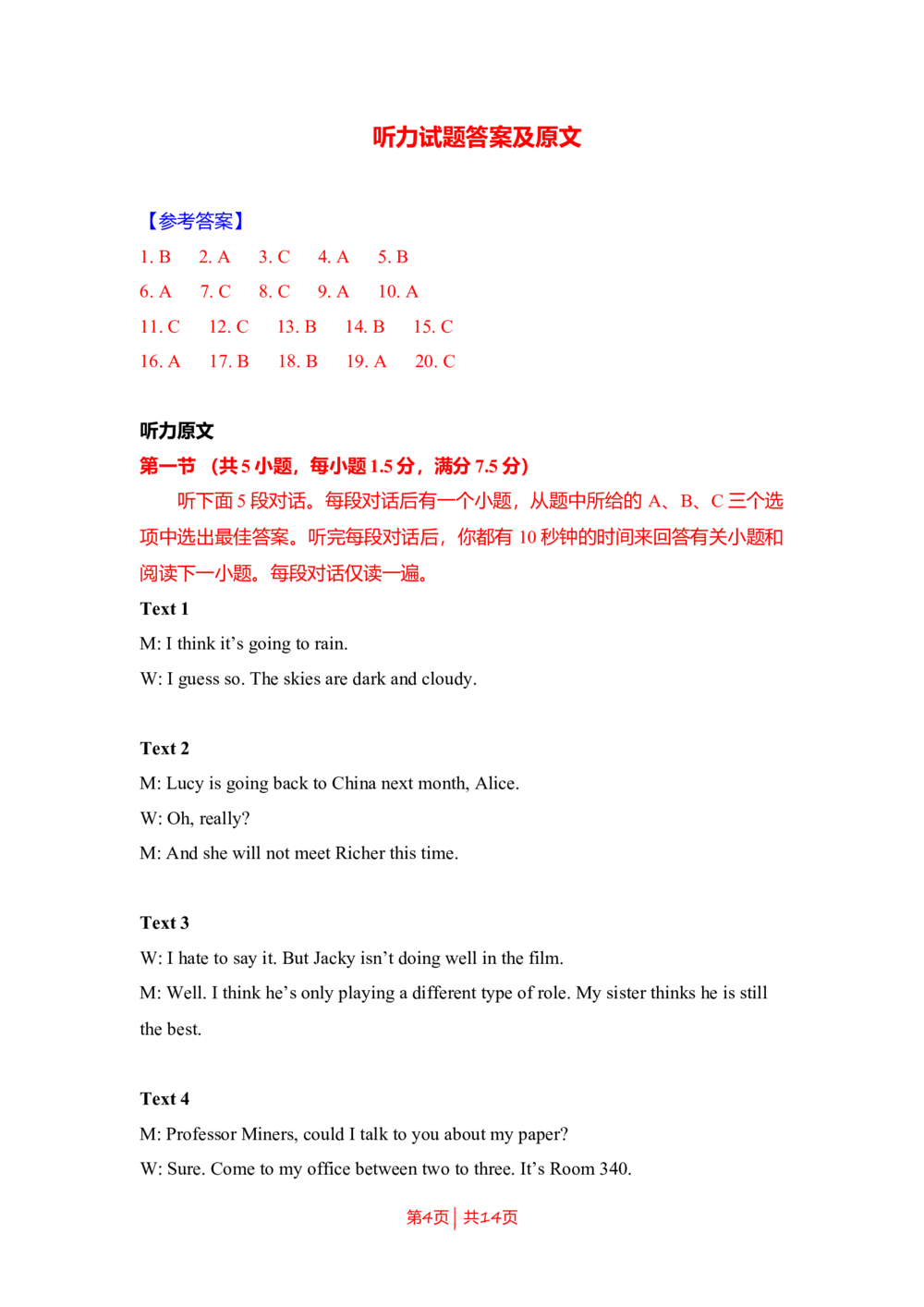
【参考答案】
1. B 2. A 3. C 4. A 5. B
6. A 7. C 8. C 9. A 10. A
11. C 12. C 13. B 14. B 15. C
16. A 17. B 18. B 19. A 20. C
听力原文
第一节 (共5小题,每小题1.5分,满分7.5分)
听下面5段对话。每段对话后有一个小题,从题中所给的 A、B、C三个选
项中选出最佳答案。听完每段对话后,你都有 10秒钟的时间来回答有关小题和
阅读下一小题。每段对话仅读一遍。
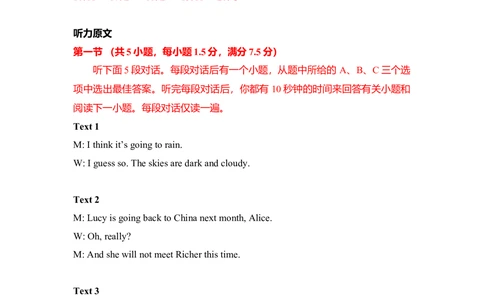
Text 1
M: I think it’s going to rain.
W: I guess so. The skies are dark and cloudy.
Text 2
M: Lucy is going back to China next month, Alice.
W: Oh, really?
M: And she will not meet Richer this time.
Text 3
W: I hate to say it. But Jacky isn’t doing well in the film.
M: Well. I think he’s only playing a different type of role. My sister thinks he is still
the best.
Text 4
M: Professor Miners, could I talk to you about my paper?
W: Sure. Come to my office between two to three. It’s Room 340.
第4页 | 共14页Text 5
W: OK. Time to go home.
M: I can’t. I haven’t finished the report about the newly opened restaurant.
W: Well. If you carry on working like that, you’ll make yourself ill.
第二节 (共15小题;每小题1.5分,满分22.5分)
听下面5段对话或独白,每段对话或独白后面有几个小题,从题中所给的
A、B、C三个选项中选出最佳选项,并标在试卷的相应位置。听每段对话或独
白前,你将有时间阅读各小题,每小题5秒钟;听完后,各小题将给出5秒钟
的作答时间。每段对话或独白读两遍。
Text 6
M: I haven’t seen you for a long time. Where have you been?
W: I went to New York to visit my sister and stayed there for two months. Actually, I
really went to meet my new nephew.
M: That’s great! How old is he?
W: Well. He was five months old when I got there. And he could possibly be the most
beautiful baby I have ever seen.
M: What did you do in your sister’s home?
W: I helped the baby and played with him a lot, which was nice. But what I enjoyed
most was feeding him.
Text 7
M: Air pollution is so bad in this city. I think the government should stop people from
driving cars on certain days.
W: You have a point. Air pollution is a problem. But not letting people drive on
certain days is a bad idea. People have to go to work by car.
M: I’m afraid I don’t agree with you there. Reducing air pollution is really important.
People are so used to driving that they don’t think about ways to do things. If we stop
them from driving on certain days, maybe they could think of new ways to get
第5页 | 共14页around.
W: I see your point. But I still think it wouldn’t be possible to stop people from
driving.
Text 8
M: Let’s go and have lunch together.
W: OK!
M: By the way, I’m thinking of going to New Zealand around Christmas for three
weeks. It’s such a beautiful country. I’ve never been there before.
W: Have you booked the flight?
M: Not yet. I’m planning to book my flight in two weeks’ time
W: Book your flight right now.
M: Why?
W: Because the longer you leave it, the more expensive it will be. As a matter of fact,
the prices may double at Christmas time. New Zealanders usually go home for
Christmas.
M: Then I’m going to book my flight tomorrow morning.
Text 9
M: Hello!
W: Hello, Mike! This is Jane.
M: Oh. Hello, Jane!
W: Listen, Mike! I’ve got a real problem.
M: What is it?
W: The car’s broken down.
M: Oh, not again.
W: Yeah. I checked the oil and I checked almost everything. It’s just not starting at
all.
M: You have to get rid of it, you know.
W:I know ,Iknow. But look, the thing is, I’ve got to pick Tom up at the airport. Can
I……?
第6页 | 共14页M: Use my car? Yes, of course.
W: That’ll be great! It’s very kind of you.
M: Come on when you like. I don’t need it till tonight.
W: OK! I’ll be around in about an hour. Thanks a lot!
M: It’s all right. See you then!
W: See you!
Text 10
W: OK! When we met last week, we talked about different kinds of short stories and
some well-known short story writers. I remember that many of you said you liked the
American writer Earnest Hemingway, right? I hope you all followed my advice and
finished reading his story “A day’s wait”, because as I said, we’re going to study it
together in today’s lesson. Now since you’re supposed to have read this story, let’s
have some discussion. Please look at the four questions on the blackboard. First, when
and where does the story take place? Second, what does the boy read for in the story
and what kind of person does he show himself to be? Third, what kind of person is the
boy’s father? Four, what is the writer’s main purpose of writing the story? I’d like you
to work in groups of four or five and present your answers in ten minutes. Is
everything clear?
2008年高考英语试卷(全国卷II)
参考答案
第一部分 英语知识运用(共三节,满分50分)
第一节 语音知识(共5小题;每小题1分,满分5分)
1. B 2. B 3. C 4. D 5. A
第二节 语法和词汇知识(共15小题;每小题1分,满分15分)
6. B 7. D 8. A 9. C 10. B 11. A 12. C 13. C
14. A 15. D 16. C 17. D 18. B 19. D 20. A
第三节 完形填空(共20小题;每小题1.5分,满分30分)
第7页 | 共14页21. C 22. B 23. D 24. A 25. C 26. C 27. B 28. D
29. B 30. D 31. B 32. C 33. A 34. C 35. A 36. B
37. D 38. A 39. A 40. D
第二部分 阅读理解(共25小题;第一节每小题2分,第二节每小题1分;满
分45分)
第一节(共20小题;每小题2分,满分40分)
41. D 42. C 43. D 44. B 45. D 46. B 47. A 48. C
49. A 50. C 51. A 52. B 53. D 54. C 55. B 56. B
57. A 58. D 59. C 60. A
第二节(共5小题; 每小题1分, 满分5分)
61. D 62. A 63. F 64. B 65. E
第三部分 写作(共三节, 满分55分)
第一节 单词拼写 (共10小题; 每小题1分, 满分10分)
66. recognize (-ise) 67. sandwich 68. February 69. translated 70. swimming
71. neighbor(u)rs 72. dictation 73. opposite 74. regular 75. downstairs
第二节 短文该错(共10小题; 每小题1.5分, 满分15分)
If I have the honor to be chose to work for the 76. chosen
29th Olympic Games, I will at first improve my 77. at
English so that I can talk easily about foreign visitors. 78. with/ to
Second, I will learn more about /\ history of the 79. the
Olympics as good as the 2008 Olympic Games. Third, 80. well
since I was familiar with Beijing, I can help visitors find 81. am
their ways in the city. Finally, I should be able to tell 82. way
visitors about our history and culture and show 83. √
them their great achievements. In short, I will do 84. our
my best to help making the Games a success. 85. make
第三节 书面表达(满分30分)
第8页 | 共14页参考例文:
June 8, 2008
Dear Peter,
I’m glad to receive your letter asking for my advice on how to learn Chinese
well.
Here are a few suggestions. First, it is important to take a Chinese course, as
you’ll be able to learn from the teacher and practice with your fellow students. Then,
it also helps to watch TV and read books, newspapers and magazines in Chinese
whenever possible.
Besides, it should be a good idea to learn and sing Chinese songs, because by
doing so you’ll learn and remember Chinese words more easily. You can also make
more Chinese friends. They will tell you a lot about China and help you learn
Chinese.
Try and write me in Chinese next time.
Best wishes,
Li Hua
2008年高考英语试卷(全国卷II)
参考答案与试题解析
一、单词辨音
1. B 2. B 3. C 4. D 5. A
二、语法和词汇知识
6. B 7. D 8. A 9. C 10. B
11. A 12.C 13.C 14.A 15.D
16. C 17. D 18. B 19. D 20. A
三、完形填空
26.C 27.B 28.D 29.B 30.D
31.B 32.C 33.A 34.C 35.A
第9页 | 共14页36.B 37.D 38.A 39.A 40. D
这是一篇叙述母爱和家庭教育的记叙文,母亲每天给孩子们带的午饭中放入一
个纸条,写上对他们的提醒、希望或鼓励,孩子上大学的时候觉得不需要这样
了,可是母亲还是一如既往地这样做,至到他毕业。后来,当儿子毕业后吃到
母亲带的午饭却因没有看到纸条而失落时,我们也明白了,那不仅仅是几句话,
也包含着一个母亲对孩子们的爱和教育。
读懂这篇文章之后,让我们也深受启发,循着作者的思路,我们来完成这道题
目。我们分析选项的时候会发现,各选项间的区分度是比较大的,如果在理解
文章的基础上来做,只要能推测出缺少一个什么意思的词,是比较容易的。下
面我们来结合题目做一下详细的解析:
21. 此题可用排除法,纸条是I放在午饭中的,B、D显然不对,A项carry这个
词是携带的意思,与题意也不合,include除包括以外,还有放入,算进去的意
思,合题意。
22. 此题要结合前面a thank-you for,既是感谢的时刻,应用special特别的才对。
23. 与上题一样,要结合空后面的意思选择,为要举行的考试或体育比赛写的话,
该是鼓励的。
24-26. 可由上下文的意思分析选出。
27. 母亲写条,孩子读。
29. 可由下文提到的我从最小的孩子走了以后,尤其希望大儿子回来推断出大儿
子是想回家住几个月。
30. 这些是做完了的事,所以用completing.
31. 完成学业,经过实习以后,他终于成了技术助手,用finally符合语境。
32. except for除了,as for至于;孩子住得远,只是除去短短的假期回家拜访。
34. 做以前一直在做的事,still仍旧。
36. surprise前文提到过大儿子在上大学的时候说过不需要母亲的纸条了,所以,
对于现在大儿子对见不到纸条的失望,母亲感到的是惊奇。
38、39. 儿子见不到母亲的纸条,很失望,所以打电话问是不是自己做得不好了。
40. 可用排除法,laughingly笑着,符合当时母亲对儿子的态度。
四、阅读理解
第10页 | 共14页41.D 42. C 43.D 44.B 45.D
46.B 47. A 48.C 49.A 50.C
51.A 52. B 53.D 54.C 55.B
56.B 57. A 58.D 59.C 60.A
61.D 62. A 63. F 64.B 65.E
A
这是一篇老师和学生之间的感人的故事。老师开始不喜欢不讲卫生的学生,
但后来得知这个学生失去了母爱,在圣诞节,还收到了学生送的香水礼物。老
师深受感动,对学生更加关注。后来,学生学业有成,一直对老师的信任和鼓
励怀着感恩的心情。老师也在此事中深受启发,找到了教学的真谛。
41. 从文章的第一自然段可以看出,老师对学生们说爱每一个学生,在那时,她
是不喜欢Teddy的。所以说她告诉学生的不是她真实的想法。
42. 文章第二段第一句说到Teddy的母亲死了,可以判断出他是缺少母爱的。
43. 第三段可以看出,她从教具体的学科转变为教学生,给学生更多的关注。
44. 后数第二段Teddy的话可以看出,是老师的信任和鼓励让他走向了成功,所
以他要谢谢老师。
B
这是一篇杂志上的文章,Jonathan教授想知道同一个人的口音在半个世纪的
前后会不会发生变化,研究人员发现 Queen’s English的读音员发生了这样的变
化,文章中也分析了发生变化的原因。
45. 第二段Jonathan教授的话中可以得出。
46. 此题文中不能找到全部的依据,可以排除C、D, 如果你看到过如下的文章,
或是对英女王英语发音有所了解,做起来准确率就会更高。
一个很有趣的对英女王英语发音的研究报告,非常搞笑:
Queen Elizabeth II's famous cut-glass accent, the Queen's English, is now
soundingless upper-class, a scientific analysis of her famous Christmas broadcasts
found.
研究人员通过分析英女王伊丽莎白二世发表的著名圣诞致辞发现,她那著名的
“女王式发音”如今已少了些“贵族”的味道。
第11页 | 共14页Researchers analysed each of her messages to the Commonwealth since her
1952accession using digital technology to track the shift in her pronunciation from the
aristocratic Upper Received to the less plummy Standard Received.
研究人员对女王1952年即位以来的每个圣诞致辞进行了分析,并采用数码技术
对她的贵族式发音向标准发音的转变进行了追踪记录。
Jonathan Harrington, professor of phonetics at Germany's University of Munich,
wanted to discover whether dialect changes recorded over the past half-century would
take place within one person.
德国慕尼黑大学的语音学教授乔纳森.哈林顿试图通过研究发现,一个人的口
音在50年内是否会发生变化。
“As far as I know, there just is nobody else for whom there is this sort of broadcast
archive,” he said.
他说:“就我所知,一般人是没有类似的演说记录档案的。”
He said the aristocratic way of pronouncing vowels had gradually ceased to bea
class apart over the decades.
他说,几十年来女王的贵族式元音发音已逐渐消失。
“Her accent sounds slightly less aristocratic than it did 50 years ago. But these are
very, very subtle and slow changes that we don't notice from year to year,”he
explained.
哈林顿教授解释说:“女王的口音和 50年前相比已经没有明显的贵族味,但这
一变化十分细微而且很缓慢,我们几乎察觉不到。”
“We may be able to relate it to changes in the class structure.”
“女王口音的变化主要和社会等级结构的变化有关。”
He told The Daily Telegraph newspaper: “In 1952 she would have been heard
referring to ‘thet men in the bleck het'. Now it would be‘that man in the black hat'. ”
他在接受《每日电讯》的采访时说:“1952 年,女王说 thet men in the bleck
het,而现在她则会说成that man in the black hat。”
“Similarly, she would have spoken of‘the citay' and‘dutay', rather than‘citee'
and‘dutee'. In the 1950s she would have been‘lorst', but by the 1970s lost.”
“同样,女王过去会说‘the citay' and‘dutay',现在则是‘citee' and‘dutee'。上世纪
第12页 | 共14页50年代,她会说lorst,但到了70年代就变成了lost。”
The queen's annual broadcast is a personal message to the Commonwealth.
每年圣诞节,女王都会向整个英联邦发表圣诞祝辞。
A Christmas institution, the 10-minute broadcast is televised at 3:00 pm in
Britainas many families are recovering from their traditional turkey lunch.
这个10分钟的圣诞祝辞已成了英国的圣诞习俗,会在每年圣诞节的下午3点通
过电视台向英国民众播放,此时大多数家庭已经吃完传统的圣诞火鸡午餐了。
The results were published in the Journal of Phonetics quarterly magazine.
这项研究结果在《语音》季刊上发表。
47. 文章是关于语音的文章,应当是发表在与之有关的杂志上。
48. 文章是针对一个人的口音在半世纪前后的变化及分析写的,所以C最恰当。
C
本文讲到用事实骗人的方法,故意只说出事实的部分,并举了几个例子证明。
49. 从文中第二、三段可以分析出,他买了200美元的彩票,中了100美元,所
以实际上他还是损失了100美元。
50. 文章说到骗人者故意隐瞒部分不利的事实,那我们可以得出:不能只看表面,
要做深入的调查分析,事实得全了,就辨别出真假了。
51. 300-100=200 million jobs.
52. 后数第二段第二句。
D
这是一篇说明文。在cocoa中发现了theobromine, 被认为是现在最好的治疗咳
嗽的药,并且介绍了证明它疗效高于同类药的实验,最后,还说明了它的副作
用小。
53. 从文中第二段可以看出。
54. 第四段最后一句。
55. 第四段介绍可以看出,三个组分别服用三种药,看哪一种疗效更好。
56. 文章开头就说了Something in chocolate could be used to stop coughs.接下来介
绍cocoa中发现的theobromine是治疗咳嗽的最好的药,还用实验作了证实,因
第13页 | 共14页此,B项最合题意。当然我们也可以用排除法做此题,其它三个选项与文章内
容不符。
E
像这样的文章我们最好用查读法,先看题目,再在文中查找与题目有关的内容。
57. 在介绍的这四个地方中找到Capitol Square即找到了答案。
58. 只查找这四个地方开放的时间,找到周一开放的就是了。
59. 查找有lunch单词的,然后印证是提供午饭就好了。
60. 把这几个事实带到原文相关的部分对比,发现只有A项是正确的。
第14页 | 共14页