浙江省 2017 年 11 月新高考英语试题
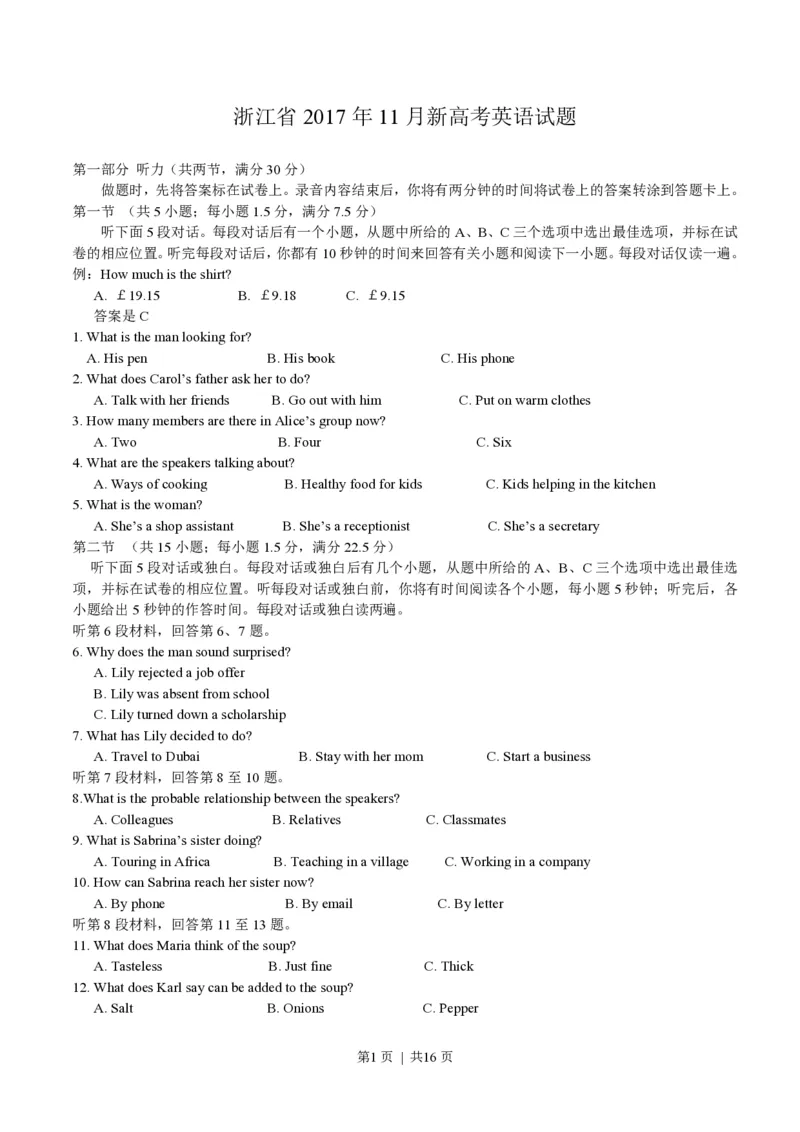
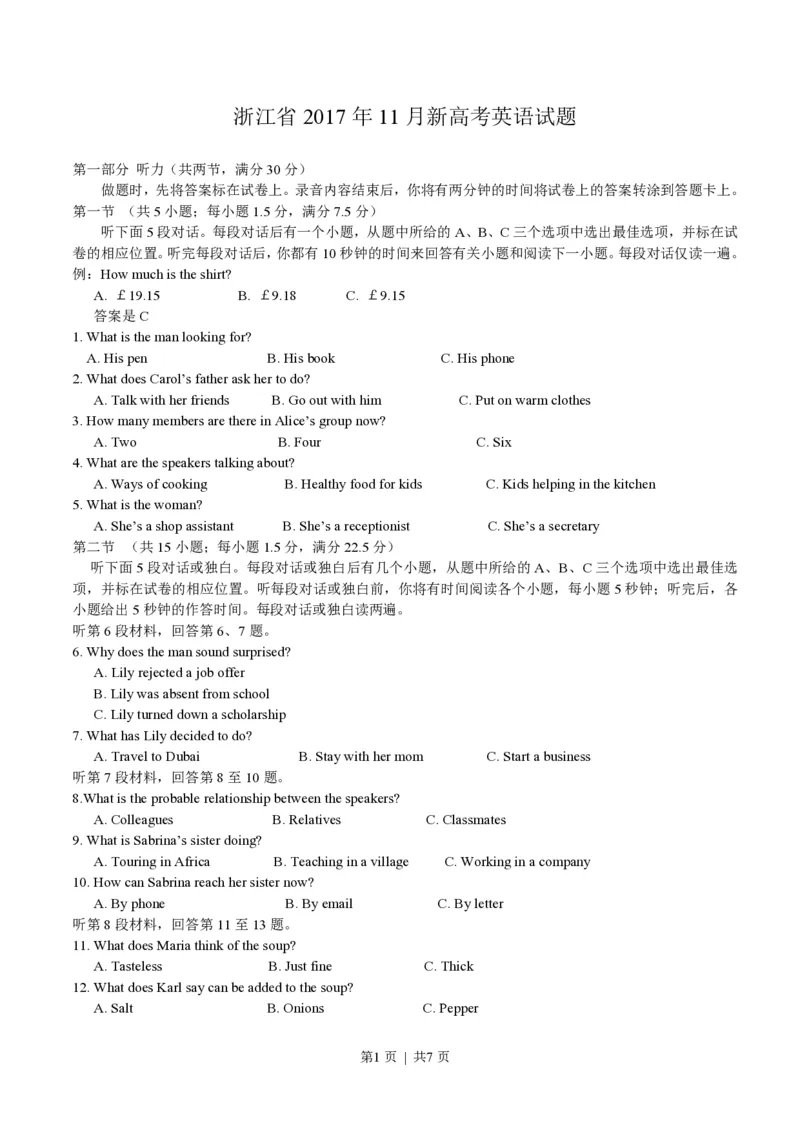
第一部分 听力(共两节,满分30分)
做题时,先将答案标在试卷上。录音内容结束后,你将有两分钟的时间将试卷上的答案转涂到答题卡上。
第一节 (共5小题;每小题1.5分,满分7.5分)
听下面5段对话。每段对话后有一个小题,从题中所给的A、B、C三个选项中选出最佳选项,并标在试
卷的相应位置。听完每段对话后,你都有10秒钟的时间来回答有关小题和阅读下一小题。每段对话仅读一遍。
例:How much is the shirt?
A. £19.15 B. £9.18 C. £9.15
答案是C
1. What is the man looking for?
A. His pen B. His book C. His phone
2. What does Carol’s father ask her to do?
A. Talk with her friends B. Go out with him C. Put on warm clothes
3. How many members are there in Alice’s group now?
A. Two B. Four C. Six
4. What are the speakers talking about?
A. Ways of cooking B. Healthy food for kids C. Kids helping in the kitchen
5. What is the woman?
A. She’s a shop assistant B. She’s a receptionist C. She’s a secretary
第二节 (共15小题;每小题1.5分,满分22.5分)
听下面5段对话或独白。每段对话或独白后有几个小题,从题中所给的A、B、C三个选项中选出最佳选
项,并标在试卷的相应位置。听每段对话或独白前,你将有时间阅读各个小题,每小题5秒钟;听完后,各
小题给出5秒钟的作答时间。每段对话或独白读两遍。
听第6段材料,回答第6、7题。
6. Why does the man sound surprised?
A. Lily rejected a job offer
B. Lily was absent from school
C. Lily turned down a scholarship
7. What has Lily decided to do?
A. Travel to Dubai B. Stay with her mom C. Start a business
听第7段材料,回答第8至10题。
8.What is the probable relationship between the speakers?
A. Colleagues B. Relatives C. Classmates
9. What is Sabrina’s sister doing?
A. Touring in Africa B. Teaching in a village C. Working in a company
10. How can Sabrina reach her sister now?
A. By phone B. By email C. By letter
听第8段材料,回答第11至13题。
11. What does Maria think of the soup?
A. Tasteless B. Just fine C. Thick
12. What does Karl say can be added to the soup?
A. Salt B. Onions C. Pepper
第1页 | 共16页13. Where are the speakers?
A. At home B. At a restaurant C. At a friend’s house
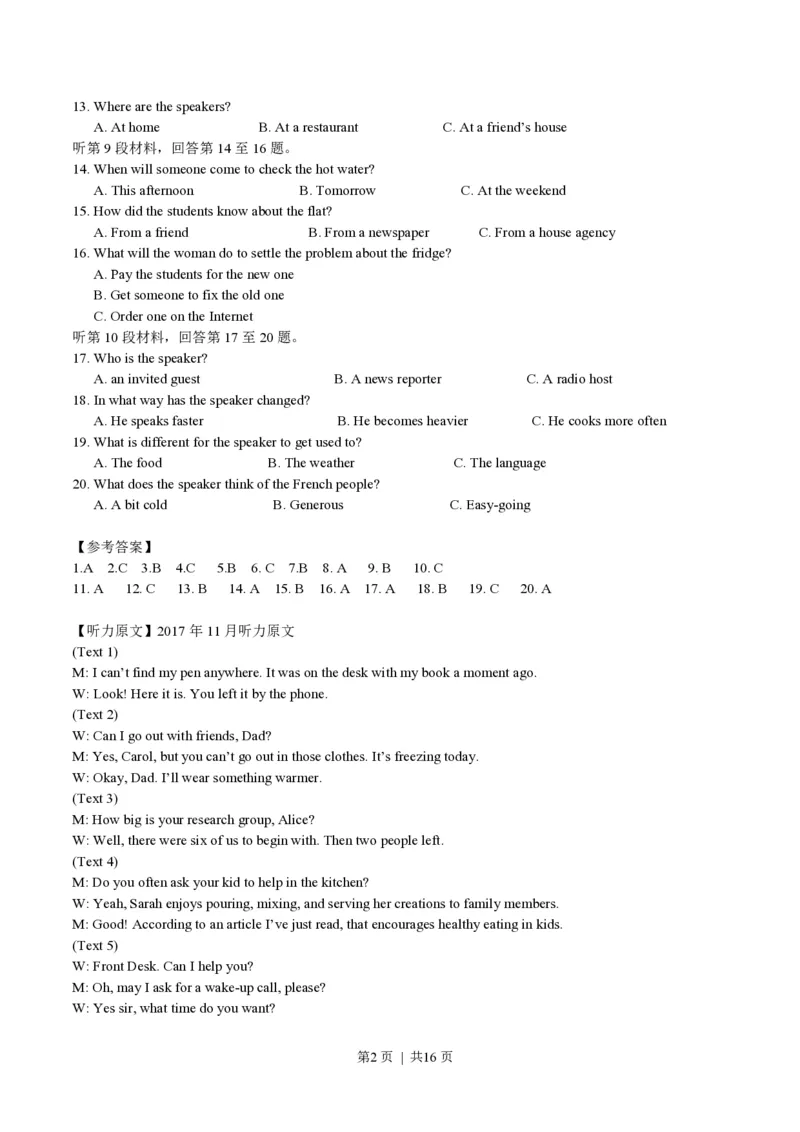
听第9段材料,回答第14至16题。
14. When will someone come to check the hot water?
A. This afternoon B. Tomorrow C. At the weekend
15. How did the students know about the flat?
A. From a friend B. From a newspaper C. From a house agency
16. What will the woman do to settle the problem about the fridge?
A. Pay the students for the new one
B. Get someone to fix the old one
C. Order one on the Internet
听第10段材料,回答第17至20题。
17. Who is the speaker?
A. an invited guest B. A news reporter C. A radio host
18. In what way has the speaker changed?
A. He speaks faster B. He becomes heavier C. He cooks more often
19. What is different for the speaker to get used to?
A. The food B. The weather C. The language
20. What does the speaker think of the French people?
A. A bit cold B. Generous C. Easy-going
【参考答案】
1.A 2.C 3.B 4.C 5.B 6. C 7.B 8. A 9. B 10. C
11. A 12. C 13. B 14. A 15. B 16. A 17. A 18. B 19. C 20. A
【听力原文】2017年11月听力原文
(Text 1)
M: I can’t find my pen anywhere. It was on the desk with my book a moment ago.
W: Look! Here it is. You left it by the phone.
(Text 2)
W: Can I go out with friends, Dad?
M: Yes, Carol, but you can’t go out in those clothes. It’s freezing today.
W: Okay, Dad. I’ll wear something warmer.
(Text 3)
M: How big is your research group, Alice?
W: Well, there were six of us to begin with. Then two people left.
(Text 4)
M: Do you often ask your kid to help in the kitchen?
W: Yeah, Sarah enjoys pouring, mixing, and serving her creations to family members.
M: Good! According to an article I’ve just read, that encourages healthy eating in kids.
(Text 5)
W: Front Desk. Can I help you?
M: Oh, may I ask for a wake-up call, please?
W: Yes sir, what time do you want?
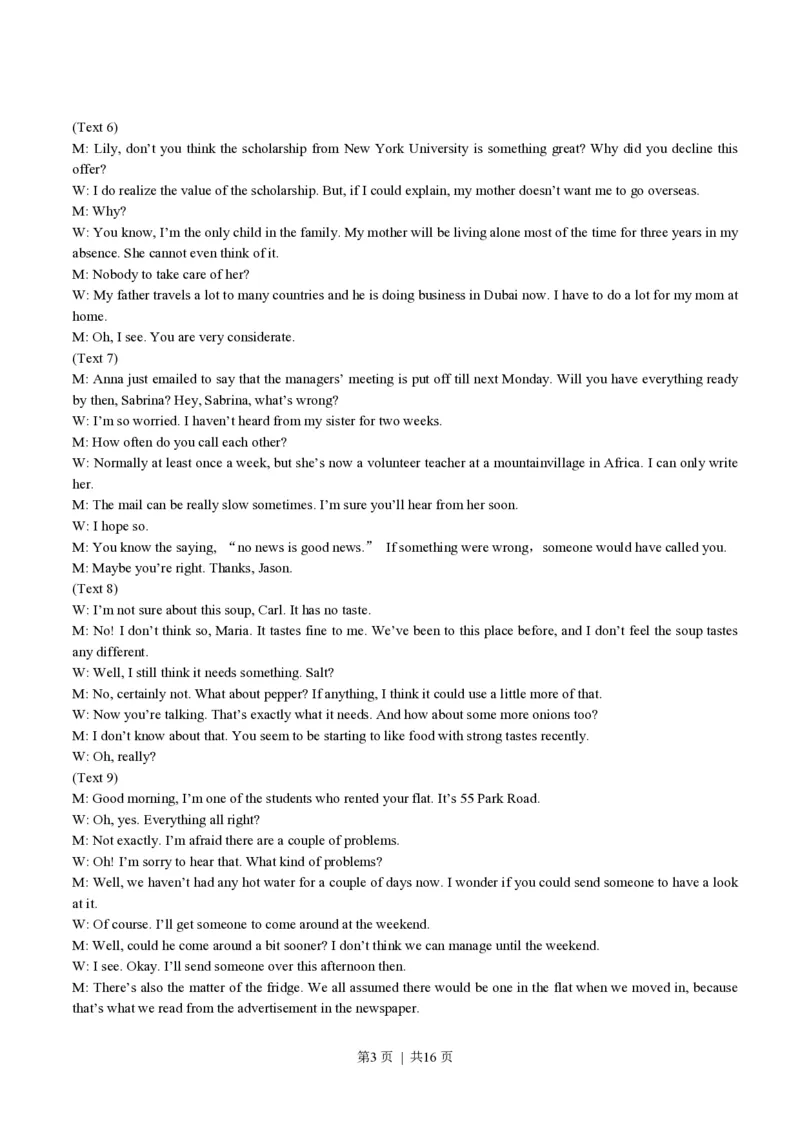
第2页 | 共16页(Text 6)
M: Lily, don’t you think the scholarship from New York University is something great? Why did you decline this
offer?
W: I do realize the value of the scholarship. But, if I could explain, my mother doesn’t want me to go overseas.
M: Why?
W: You know, I’m the only child in the family. My mother will be living alone most of the time for three years in my
absence. She cannot even think of it.
M: Nobody to take care of her?
W: My father travels a lot to many countries and he is doing business in Dubai now. I have to do a lot for my mom at
home.
M: Oh, I see. You are very considerate.
(Text 7)
M: Anna just emailed to say that the managers’ meeting is put off till next Monday. Will you have everything ready
by then, Sabrina? Hey, Sabrina, what’s wrong?
W: I’m so worried. I haven’t heard from my sister for two weeks.
M: How often do you call each other?
W: Normally at least once a week, but she’s now a volunteer teacher at a mountainvillage in Africa. I can only write
her.
M: The mail can be really slow sometimes. I’m sure you’ll hear from her soon.
W: I hope so.
M: You know the saying, “no news is good news.” If something were wrong,someone would have called you.
M: Maybe you’re right. Thanks, Jason.
(Text 8)
W: I’m not sure about this soup, Carl. It has no taste.
M: No! I don’t think so, Maria. It tastes fine to me. We’ve been to this place before, and I don’t feel the soup tastes
any different.
W: Well, I still think it needs something. Salt?
M: No, certainly not. What about pepper? If anything, I think it could use a little more of that.
W: Now you’re talking. That’s exactly what it needs. And how about some more onions too?
M: I don’t know about that. You seem to be starting to like food with strong tastes recently.
W: Oh, really?
(Text 9)
M: Good morning, I’m one of the students who rented your flat. It’s 55 Park Road.
W: Oh, yes. Everything all right?
M: Not exactly. I’m afraid there are a couple of problems.
W: Oh! I’m sorry to hear that. What kind of problems?
M: Well, we haven’t had any hot water for a couple of days now. I wonder if you could send someone to have a look
at it.
W: Of course. I’ll get someone to come around at the weekend.
M: Well, could he come around a bit sooner? I don’t think we can manage until the weekend.
W: I see. Okay. I’ll send someone over this afternoon then.
M: There’s also the matter of the fridge. We all assumed there would be one in the flat when we moved in, because
that’s what we read from the advertisement in the newspaper.
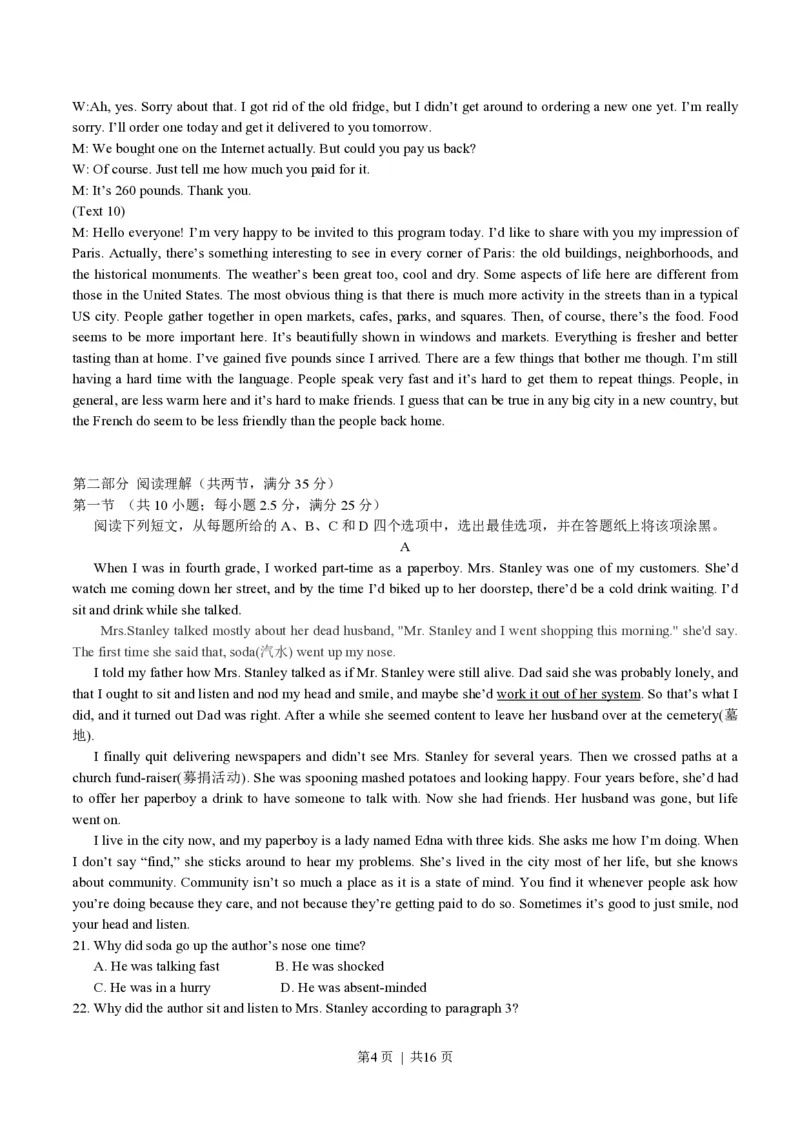
第3页 | 共16页W:Ah, yes. Sorry about that. I got rid of the old fridge, but I didn’t get around to ordering a new one yet. I’m really
sorry. I’ll order one today and get it delivered to you tomorrow.
M: We bought one on the Internet actually. But could you pay us back?
W: Of course. Just tell me how much you paid for it.
M: It’s 260 pounds. Thank you.
(Text 10)
M: Hello everyone! I’m very happy to be invited to this program today. I’d like to share with you my impression of
Paris. Actually, there’s something interesting to see in every corner of Paris: the old buildings, neighborhoods, and
the historical monuments. The weather’s been great too, cool and dry. Some aspects of life here are different from
those in the United States. The most obvious thing is that there is much more activity in the streets than in a typical
US city. People gather together in open markets, cafes, parks, and squares. Then, of course, there’s the food. Food
seems to be more important here. It’s beautifully shown in windows and markets. Everything is fresher and better
tasting than at home. I’ve gained five pounds since I arrived. There are a few things that bother me though. I’m still
having a hard time with the language. People speak very fast and it’s hard to get them to repeat things. People, in
general, are less warm here and it’s hard to make friends. I guess that can be true in any big city in a new country, but
the French do seem to be less friendly than the people back home.
第二部分 阅读理解(共两节,满分35分)
第一节 (共10小题;每小题2.5分,满分25分)
阅读下列短文,从每题所给的A、B、C和D四个选项中,选出最佳选项,并在答题纸上将该项涂黑。
A
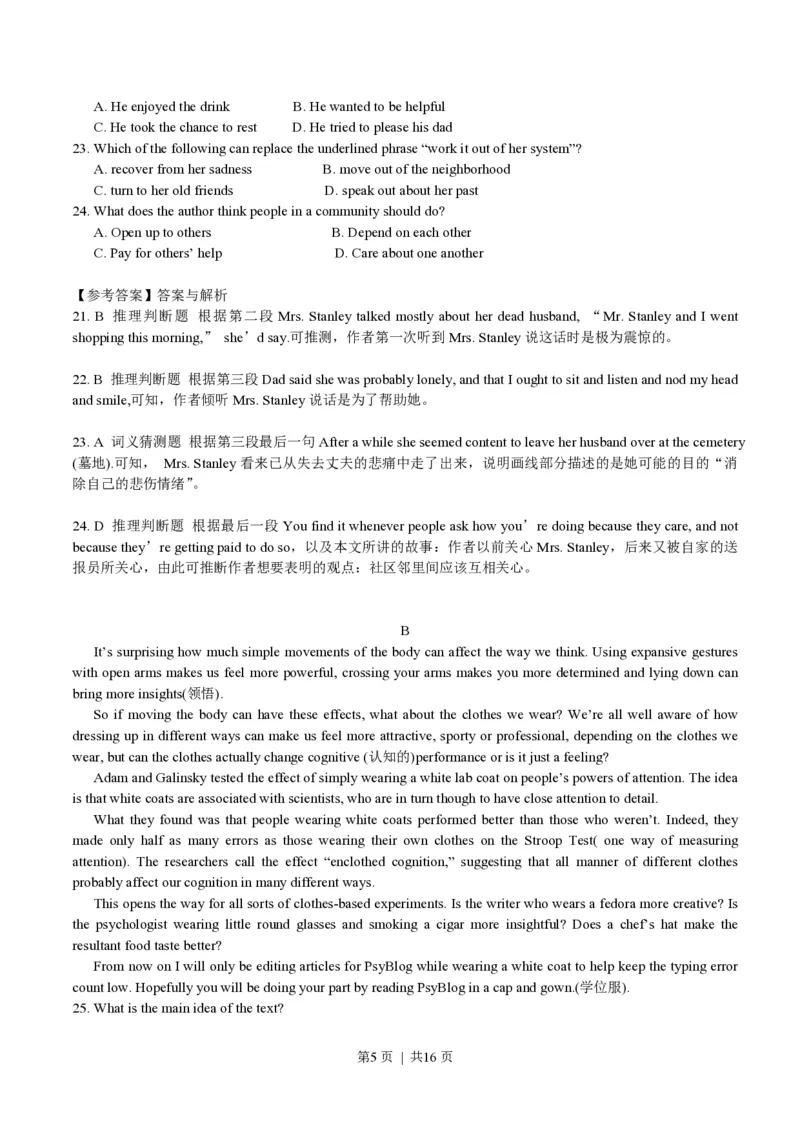
When I was in fourth grade, I worked part-time as a paperboy. Mrs. Stanley was one of my customers. She’d
watch me coming down her street, and by the time I’d biked up to her doorstep, there’d be a cold drink waiting. I’d
sit and drink while she talked.
Mrs.Stanley talked mostly about her dead husband, "Mr. Stanley and I went shopping this morning." she'd say.
The first time she said that, soda(汽水) went up my nose.
I told my father how Mrs. Stanley talked as if Mr. Stanley were still alive. Dad said she was probably lonely, and
that I ought to sit and listen and nod my head and smile, and maybe she’d work it out of her system. So that’s what I
did, and it turned out Dad was right. After a while she seemed content to leave her husband over at the cemetery(墓
地).
I finally quit delivering newspapers and didn’t see Mrs. Stanley for several years. Then we crossed paths at a
church fund-raiser(募捐活动). She was spooning mashed potatoes and looking happy. Four years before, she’d had
to offer her paperboy a drink to have someone to talk with. Now she had friends. Her husband was gone, but life
went on.
I live in the city now, and my paperboy is a lady named Edna with three kids. She asks me how I’m doing. When
I don’t say “find,” she sticks around to hear my problems. She’s lived in the city most of her life, but she knows
about community. Community isn’t so much a place as it is a state of mind. You find it whenever people ask how
you’re doing because they care, and not because they’re getting paid to do so. Sometimes it’s good to just smile, nod
your head and listen.
21. Why did soda go up the author’s nose one time?
A. He was talking fast B. He was shocked
C. He was in a hurry D. He was absent-minded
22. Why did the author sit and listen to Mrs. Stanley according to paragraph 3?
第4页 | 共16页A. He enjoyed the drink B. He wanted to be helpful
C. He took the chance to rest D. He tried to please his dad
23. Which of the following can replace the underlined phrase “work it out of her system”?
A. recover from her sadness B. move out of the neighborhood
C. turn to her old friends D. speak out about her past
24. What does the author think people in a community should do?
A. Open up to others B. Depend on each other
C. Pay for others’ help D. Care about one another
【参考答案】答案与解析
21. B 推理判断题 根据第二段 Mrs. Stanley talked mostly about her dead husband, “Mr. Stanley and I went
shopping this morning,” she’d say.可推测,作者第一次听到Mrs. Stanley说这话时是极为震惊的。
22. B 推理判断题 根据第三段Dad said she was probably lonely, and that I ought to sit and listen and nod my head
and smile,可知,作者倾听Mrs. Stanley说话是为了帮助她。
23. A 词义猜测题 根据第三段最后一句After a while she seemed content to leave her husband over at the cemetery
(墓地).可知, Mrs. Stanley看来已从失去丈夫的悲痛中走了出来,说明画线部分描述的是她可能的目的“消
除自己的悲伤情绪”。
24. D 推理判断题 根据最后一段You find it whenever people ask how you’re doing because they care, and not
because they’re getting paid to do so,以及本文所讲的故事:作者以前关心Mrs. Stanley,后来又被自家的送
报员所关心,由此可推断作者想要表明的观点:社区邻里间应该互相关心。
B
It’s surprising how much simple movements of the body can affect the way we think. Using expansive gestures
with open arms makes us feel more powerful, crossing your arms makes you more determined and lying down can
bring more insights(领悟).
So if moving the body can have these effects, what about the clothes we wear? We’re all well aware of how
dressing up in different ways can make us feel more attractive, sporty or professional, depending on the clothes we
wear, but can the clothes actually change cognitive (认知的)performance or is it just a feeling?
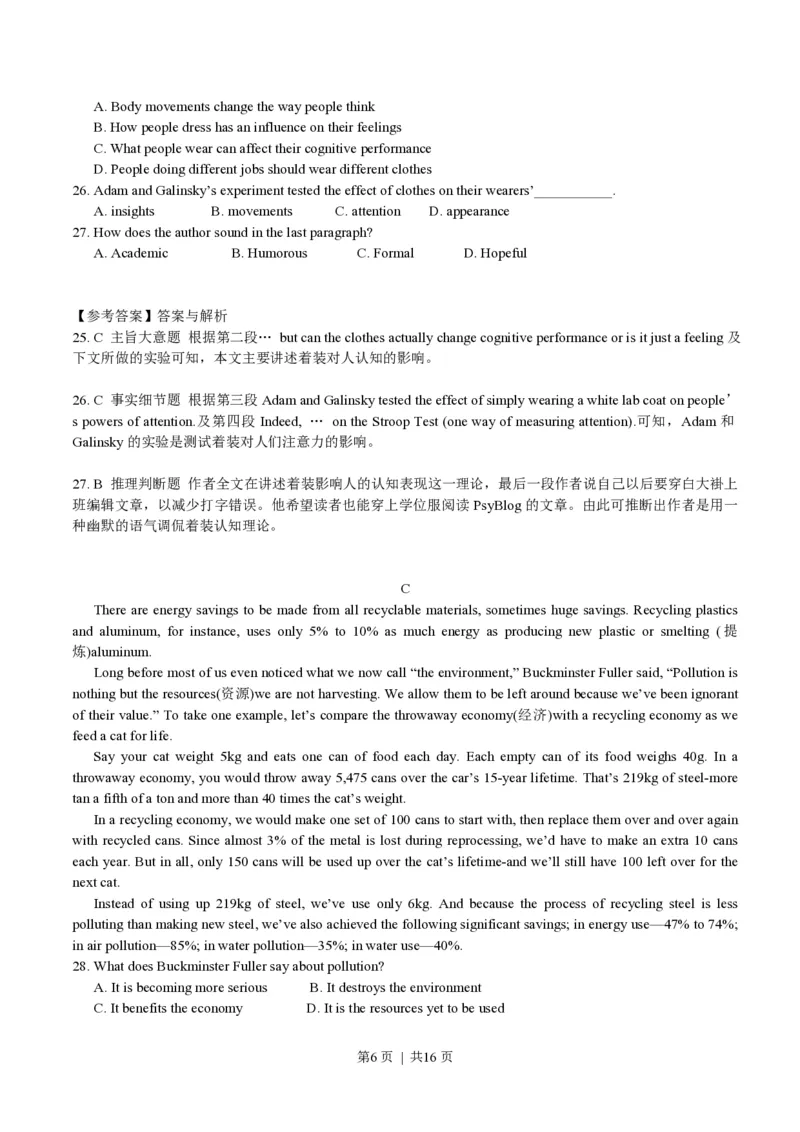
Adam and Galinsky tested the effect of simply wearing a white lab coat on people’s powers of attention. The idea
is that white coats are associated with scientists, who are in turn though to have close attention to detail.
What they found was that people wearing white coats performed better than those who weren’t. Indeed, they
made only half as many errors as those wearing their own clothes on the Stroop Test( one way of measuring
attention). The researchers call the effect “enclothed cognition,” suggesting that all manner of different clothes
probably affect our cognition in many different ways.
This opens the way for all sorts of clothes-based experiments. Is the writer who wears a fedora more creative? Is
the psychologist wearing little round glasses and smoking a cigar more insightful? Does a chef’s hat make the
resultant food taste better?
From now on I will only be editing articles for PsyBlog while wearing a white coat to help keep the typing error
count low. Hopefully you will be doing your part by reading PsyBlog in a cap and gown.(学位服).
25. What is the main idea of the text?
第5页 | 共16页A. Body movements change the way people think
B. How people dress has an influence on their feelings
C. What people wear can affect their cognitive performance
D. People doing different jobs should wear different clothes
26. Adam and Galinsky’s experiment tested the effect of clothes on their wearers’___________.
A. insights B. movements C. attention D. appearance
27. How does the author sound in the last paragraph?
A. Academic B. Humorous C. Formal D. Hopeful
【参考答案】答案与解析
25. C 主旨大意题 根据第二段… but can the clothes actually change cognitive performance or is it just a feeling及
下文所做的实验可知,本文主要讲述着装对人认知的影响。
26. C 事实细节题 根据第三段Adam and Galinsky tested the effect of simply wearing a white lab coat on people’
s powers of attention.及第四段 Indeed, … on the Stroop Test (one way of measuring attention).可知,Adam 和
Galinsky的实验是测试着装对人们注意力的影响。
27. B 推理判断题 作者全文在讲述着装影响人的认知表现这一理论,最后一段作者说自己以后要穿白大褂上
班编辑文章,以减少打字错误。他希望读者也能穿上学位服阅读PsyBlog的文章。由此可推断出作者是用一
种幽默的语气调侃着装认知理论。
C
There are energy savings to be made from all recyclable materials, sometimes huge savings. Recycling plastics
and aluminum, for instance, uses only 5% to 10% as much energy as producing new plastic or smelting (提
炼)aluminum.
Long before most of us even noticed what we now call “the environment,” Buckminster Fuller said, “Pollution is
nothing but the resources(资源)we are not harvesting. We allow them to be left around because we’ve been ignorant
of their value.” To take one example, let’s compare the throwaway economy(经济)with a recycling economy as we
feed a cat for life.
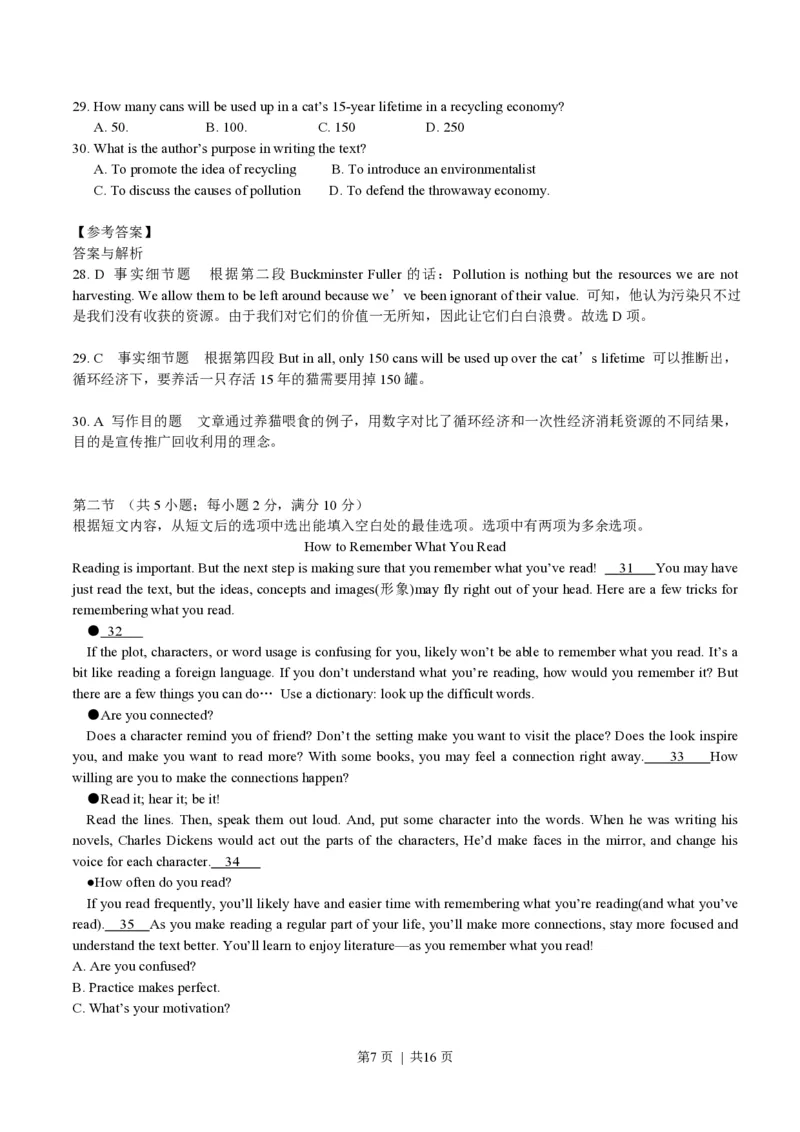
Say your cat weight 5kg and eats one can of food each day. Each empty can of its food weighs 40g. In a
throwaway economy, you would throw away 5,475 cans over the car’s 15-year lifetime. That’s 219kg of steel-more
tan a fifth of a ton and more than 40 times the cat’s weight.
In a recycling economy, we would make one set of 100 cans to start with, then replace them over and over again
with recycled cans. Since almost 3% of the metal is lost during reprocessing, we’d have to make an extra 10 cans
each year. But in all, only 150 cans will be used up over the cat’s lifetime-and we’ll still have 100 left over for the
next cat.
Instead of using up 219kg of steel, we’ve use only 6kg. And because the process of recycling steel is less
polluting than making new steel, we’ve also achieved the following significant savings; in energy use—47% to 74%;
in air pollution—85%; in water pollution—35%; in water use—40%.
28. What does Buckminster Fuller say about pollution?
A. It is becoming more serious B. It destroys the environment
C. It benefits the economy D. It is the resources yet to be used
第6页 | 共16页29. How many cans will be used up in a cat’s 15-year lifetime in a recycling economy?
A. 50. B. 100. C. 150 D. 250
30. What is the author’s purpose in writing the text?
A. To promote the idea of recycling B. To introduce an environmentalist
C. To discuss the causes of pollution D. To defend the throwaway economy.
【参考答案】
答案与解析
28. D 事实细节题 根据第二段 Buckminster Fuller 的话:Pollution is nothing but the resources we are not
harvesting. We allow them to be left around because we’ve been ignorant of their value. 可知,他认为污染只不过
是我们没有收获的资源。由于我们对它们的价值一无所知,因此让它们白白浪费。故选D项。
29. C 事实细节题 根据第四段But in all, only 150 cans will be used up over the cat’s lifetime 可以推断出,
循环经济下,要养活一只存活15年的猫需要用掉150罐。
30. A 写作目的题 文章通过养猫喂食的例子,用数字对比了循环经济和一次性经济消耗资源的不同结果,
目的是宣传推广回收利用的理念。
第二节 (共5小题;每小题2分,满分10分)
根据短文内容,从短文后的选项中选出能填入空白处的最佳选项。选项中有两项为多余选项。
How to Remember What You Read
Reading is important. But the next step is making sure that you remember what you’ve read! 31 You may have
just read the text, but the ideas, concepts and images(形象)may fly right out of your head. Here are a few tricks for
remembering what you read.
● 32
If the plot, characters, or word usage is confusing for you, likely won’t be able to remember what you read. It’s a
bit like reading a foreign language. If you don’t understand what you’re reading, how would you remember it? But
there are a few things you can do… Use a dictionary: look up the difficult words.
●Are you connected?
Does a character remind you of friend? Don’t the setting make you want to visit the place? Does the look inspire
you, and make you want to read more? With some books, you may feel a connection right away. 33 How
willing are you to make the connections happen?
●Read it; hear it; be it!
Read the lines. Then, speak them out loud. And, put some character into the words. When he was writing his
novels, Charles Dickens would act out the parts of the characters, He’d make faces in the mirror, and change his
voice for each character. 34
●How often do you read?
If you read frequently, you’ll likely have and easier time with remembering what you’re reading(and what you’ve
read). 35 As you make reading a regular part of your life, you’ll make more connections, stay more focused and
understand the text better. You’ll learn to enjoy literature—as you remember what you read!
A. Are you confused?
B. Practice makes perfect.
C. What’s your motivation?
第7页 | 共16页D. Memory is sometimes a tricky thing.
E. Marking helps you remember what you read.
F. But other books require a bit more work on your part
G. You can do the same thing when you are reading the text!
【参考答案】答案与解析
31. D 该空白后的内容为:你可能刚刚读过某篇文章,但却对文章所传达的思想,概念以及形象等一片茫然。
接下来作者给出了几条能记住所读内容的方法。D项说明了阅读有时很让人棘手,与空白后所表述含义一致,
故为正确选项。
32. A 本段主要说明能记住所读内容的前提是读懂,这就需要首先通过查字典等办法扫清生词障碍。由
confusing及don’t understand等词可推知答案为A。
33. F 该空白后的内容为将正在阅读的内容与已有知识之间建立联系。有些书的内容会让你立即产生这种联
想,因此推断该空白处的内容也是与建立联系有关,F选项含义为“其他书则更多地需要你自己努力了”,与
上下文顺畅连接,另外other books也与空白前的some books相对应。
34. G 本段给出的方法是要求读者能全身心投入到所读内容中去,列举了狄更斯的例子旨在说明这种方法的
可行性,因此读者也可以使用这种方法记住所读内容,G项符合文意。
35. B 空白前提到了将阅读作为一种日常活动,空白处则说明了这样做的好处。由此可推知,该空白处内容
与经常阅读相关,选项F (熟能生巧)符合语境。
第三部分:语言运用(共两节,满分45分)
第一节 完形填空(共20小题;每小题1.5分,满分30分)
阅读下面短文,从短文后各题所给的 A、B、C和D四个选项中,选出可以填入空白处的最佳选项,并在答
题纸上将该项涂黑。
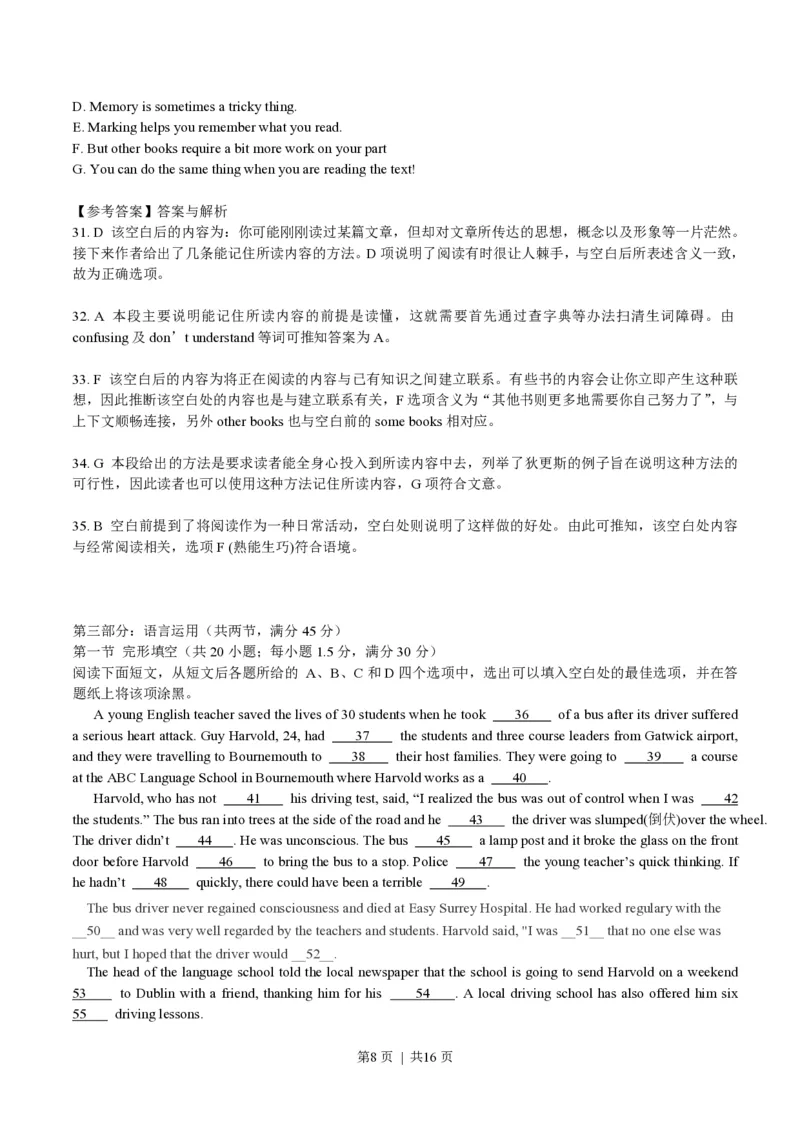
A young English teacher saved the lives of 30 students when he took 36 of a bus after its driver suffered
a serious heart attack. Guy Harvold, 24, had 37 the students and three course leaders from Gatwick airport,
and they were travelling to Bournemouth to 38 their host families. They were going to 39 a course
at the ABC Language School in Bournemouth where Harvold works as a 40 .
Harvold, who has not 41 his driving test, said, “I realized the bus was out of control when I was 42
the students.” The bus ran into trees at the side of the road and he 43 the driver was slumped(倒伏)over the wheel.
The driver didn’t 44 . He was unconscious. The bus 45 a lamp post and it broke the glass on the front
door before Harvold 46 to bring the bus to a stop. Police 47 the young teacher’s quick thinking. If
he hadn’t 48 quickly, there could have been a terrible 49 .
The bus driver never regained consciousness and died at Easy Surrey Hospital. He had worked regulary with the
__50__ and was very well regarded by the teachers and students. Harvold said, "I was __51__ that no one else was
hurt, but I hoped that the driver would __52__.
The head of the language school told the local newspaper that the school is going to send Harvold on a weekend
53 to Dublin with a friend, thanking him for his 54 . A local driving school has also offered him six
55 driving lessons.
第8页 | 共16页36. A. control B. care C. advantage D. note
37. A. taken in B. picked up C. tracked down D. helped out
38. A. greet B. thank C. invite D. meet
39. A. present B. introduce C. take D. organize
40. A. driver B. doctor C. librarian D. teacher
41. A. given B. marked C. passed D. conducted
42. A. speaking to B. waiting for C. returning to D. looking for
43. A. learned B. noticed C. mentioned D. doubted
44. A. sleep B. cry C. move D. recover
45. A. ran over B. went by C. carried D. hit
46. A. remembered B. continued C. prepared D. managed
47. A. witnessed B. recorded C. praised D. understood
48. A. appeared B. reacted C. escaped D. interrupted
49. A. delay B. accident C. mistake D. experience
50. A. airport B. hospital C. school D. police
51. A. happy B. fortunate C. touched D. sorry
52. A. survive B. retire C. relax D. succeed
53. A. project B. trip C. dinner D. duty
54. A. bravery B. skill C. quality D. knowledge
55. A. necessary B. easy C. different D. free
【答案与解析】
36. A 本题所在句子提到巴士司机心脏病发作了,再根据第二段描述的当时的场景可知,司机趴倒在方向盘
上,失去了知觉,无法再操控巴士了,因此这位英语老师即后面提到的Harvold控制了巴士。take control of sth
“控制某物”。
37. B 句中from Gatwick airport说明这些学生和另外三位课程主管是从机场坐的巴士,四个选项中picked sb up
“接载某人”符合语境。taked in “理解、领会”;tracked down“追踪到”;helped out“帮······分担
工作”。
38. D 本题所在句子的下文提到这些学生是去英国伯恩茅斯一家语言学校学习语言的,因此他们乘坐巴士去
他们的寄宿家庭与房东见面。meet在句中表示“初次与人结识;见面”。
39. C 文中出现的人物有学生、老师、课程主管,地点有ABC语言学校,因此可推测,这些学生是要去语言
学校上课的。take a course意为“上课”。
40. D 根据第一段第一句提到的A young English teacher saved the lives of 30 students …以及下文的信息可知,
这位英语老师正是Harvold。
41. C 根据最后一段最后一句提到的驾校给Harvold提供学车的课程可以判断他还没有通过驾照考试。
42. A Harvold和学生们一起乘坐巴士去寄宿家庭,根据这一情景可知speaking to符合语境。当时他正和学生
们在车上交谈。
第9页 | 共16页43. B Harvold正和学生们交谈的时候,巴士失控撞到了路旁的树上,这时,Harvold应当是朝着司机的方向看
过去,所以noticed符合语境。
44. C 本题所在句子的下一句提到司机不省人事,因此选项C符合句意。
45. D 上文提到巴士撞到了路边的树木,根据本题所在的句子可知巴士的前玻璃因撞击而破碎了,因此hit符
合语境。
46. D 上文提到Harvold救了30个学生的性命,因此可判断他成功控制了已失控的巴士。manage to do sth意
为“设法做成某事”。
47. C Harvold成功控制了失控的巴士,避免了更糟糕的局面,警察对此行为应当是赞扬的,因此praised符合
语境。
48. B 在巴士失控的危机关头,需要的是快速反应,因此reacted符合语境。
49. B 失控的巴士如果不尽快得到控制会造成更严重的事故,因此选项B符合语境。
50. C 本题所在的句子提到,老师和学生对这位巴士司机评价很好。因此可推断,他经常和这个学校合作。
51. A 学生们安然无恙,作为老师,Harvold应当是感到高兴的,所以happy符合语境。
52. A 上文提到巴士司机没能苏醒,还是遇难了。本题所在的句子的后半句表达了Harvold的愿望,希望这位
司机能活下来就好了。因此survive符合语境。
53. B 根据本题所在句子中的thanking him …可知学校奖励了Harvold,四个选项中只有trip符合语境。
54. A 根据上文可知,Harvold在危急关头,快速反应,避免了更糟糕的事故的发生,因此这是一次勇敢的行
为。
55. D 根据本题所在句子中的also可知,驾校也对Harvold的英勇行为给予了奖励,因此free符合语境。
第二节(共10小题;每小题1.5分,满分15分)
阅读下面材料,在空白处填入适当的内容(1个单词)或括号内单词的正确形式。
Easy Ways to Build Vocabulary
It’s not all that hard to build an advanced and large vocabulary. Like many things in life, it’s 56 ongoing
process, and the best part of the process is that there’s enough room for improvement, 57 means you’ll just
keep getting better and better. Of course you have to work at it. You wouldn’t think that a few 58 (month) of
exercise in your teens would be enough 59 the rest of your life, and that’s also true for building your
vocabulary—you have to keep at it daily, and pretty soon you will find that you have an excellent vocabulary.
One of the 60 (effect) ways to build vocabulary is to read good books. You need to 61 (real)read at
least one good book a week, preferably a classic. This isn’t as hard as it 62 (sound), and it is far better than
any other method because you improve your vocabulary while 63 (read) an interesting piece of literature.
第10页 | 共16页Another nice thing is that you learn both new words and 64 (they)use unconsciously, meaning that you will
tend to use the words 65 (learn)this way in conversations almost automatically.
【答案与解析】
56. an【冠词】由语境可知“和生活中许多事情一样,积累词汇也是一个不断发展的过程”,因此用不定冠词
an表示泛指。
57. which【定语从句关系词】分析句子结构可知, 57 means you’ll … 空白处所填的词指代逗号前的
there’s enough room for improvement,which在句中为关系代词,引导非限定性定语从句,并在句中作主语。
58. months【名词单复数】month为可数名词,且由a few可知month应用复数形式。
59. for【介词】be enough for sth 对······已足够。
60. effective【词性转换】此处要表达的是“有效的方法之一”,因此填effective。
61. really【词性转换】此处应用副词修饰不定式to read,因此填really。
62. sounds【谓语动词】 本句意为“这件事并不像听起来那么难”,描述的是一般事实,且主语为it,因此用
sound的一般现在时第三人称单数形式。
63. reading【非谓语动词(现在分词)】逻辑主语you与动词read为主动关系,故用现在分词reading ... 作状
语;也可视为状语从句while you are reading... 的省略形式。
64. their【代词】此句意为“另一个好处是你不知不觉中学习到了新词和它们的用法”,use在此处是名词,故
用形容词性物主代词their作定语。
65. learned / learnt【非谓语动词(过去分词)】learned / learnt作后置定语修饰words,表示“已学过的词”, words
与learn是被动的关系,因此用过去分词。
第四部分 写作(共两节,满分40分)
第一节应用文写作(满分15分)
假定你是李华,得知外教Mr. Hall寒假不回国,想邀请他到你家过春节。请给他写一封信,内容包括:
1.时间;
2.一同过节的家人;
3.活动。
注意:1. 词数100左右;
2.可以适当增加细节,以使行文连贯。
第11页 | 共16页【参考范文】
一
Dear Mr. Hall,
I’m writing to invite you to come to my home to celebrate the Spring Festival on January 19. It’s traditionally a time
for family reunion, so my parents and my brother will all be there. We’ll make dumplings together and have a big
dinner. We’ll also play card games and watch the Spring Festival Gala on TV. You may even get a gift from my
parents. If you’re able to come, I’ll go and pick you up at your place.
Best,
Li Hua
二
Dear Mr. Hall,
I’m writing on behalf of my whole family to invite you to join us for dinner at 6:30 pm, Feb.13 at my house for the
Spring Festival — the most important festival for Chinese people, during which we will put up various decorations to
increase atmosphere of holiday, especially red paper-cutting with the character “fu”, meaning blessing. What’s more,
you can also try the local food at dinner and there will be your favorite dumplings. Only in this holiday can my entire
family get together. Your presence is highly expected.
We are looking forward to your reply.
Yours,
Li Hua
三
Dear Mr. Hall,
I am writing to invite you sincerely to spend the Spring Festival with my family for I’ve heard you are not going back
to your hometown. The time scheduled is at 6:30 pm. Prior to the Spring Festival, lots of activities will be
第12页 | 共16页well-prepared, such as making dumplings and setting off fireworks. It would be a great pleasure if you could come
and have fun with us. My parents and grandparents are expecting your arrival with sincerity. If you’d like to
participate, please let us know at your earliest convenience.
Yours sincerely,
Li Hua
第二节 读后续写(满分25分)
阅读下面短文,根据所给情节进行续写,使之构成一个完整的故事。
A Vacation with My Mother
I had an interesting childhood. It was filled with surprises and amusements, all because of my mother---loving,
sweet, yet absent-minded and forgetful. One strange family trip we took when I was eleven tells a lot about her.
My two sets of grandparents lived in Colorado and North Dakota, and my parents decided to spend a few
weeks driving to those states and seeing all the sights along the way. As the first day of our trip approached,
David, my eight-year-old brother, and I unwillingly said good-bye to all of our friends. Who knew if we’d ever
see them again? Finally, the moment of our departure arrived, and we loaded suitcases, books, games, camping
equipment, and a tent into the car and bravely drove off. We bravely drove off again two hours later after we’d
returned home to get the purse and traveler’s checks Mom had forgotten.
David and I were always a little nervous when using gas station bathrooms if Mom was driving while Dad
slept: “You stand outside the door and play lookout(放哨) while I go, and I’ll stand outside the door and play
lookout while you go.” I had terrible pictures in my mind: “Honey, where are the kids?” “What?! Oh, Gosh…I
thought they were being awfully quiet.” We were never actually left behind in a strange city, but we weren’t
about to take any chances.
On the fourth or fifth night, we had trouble finding a hotel with a vacancy. After driving in vain for some
time, Mom suddenly got a great idea: Why didn’t we find a house with a likely-looking backyard and ask if we
could set up tent there? David and I became nervous. To our great relief, Dad turned down the idea. Mom never
could understand our objections(反对). If a strange family showed up on her front doorstep, Mom would have
been delighted. She thinks everyone in the world is as nice as she is. We finally found a vacancy in the next
town.
注意:
1.所续写短文的词数应为150左右;
2.至少使用5个短文中标有下划线的关键词语;
3.续写部分分为两段,每段的开头已为你写好;
4.续写完成后,请用下划线标出你所使用的关键词语。
Para1: The next day we remembered the brand-new tent we had brought with us.
第13页 | 共16页Para2: We drove through several states and saw lots of great sights along the way.
【参考答案】
◆ 题型解读
读后续写既考查学生对所学语言知识的运用能力,又考查学生的发散思维能力和创造力。该题型要求考生首
先要读懂已有信息,不仅能读懂字面含义,还要理清文章的脉络和关系。续写这篇短文时,考生需要明白故
事的发展进程、前因后果、地理位置变化、人物特征和情感等。在此基础上,考生顺着文章的思路,根据线
索,发挥想象,对其后的情节进行合理预测,并用英语表达出来。同时,在组织语言时,切记使用5个以上
给出的提示词。
读后续写表面看来难度不小,但在平时教学过程中,若能抓好词汇教学,注重词汇运用能力的培养,写出好
的续写篇章是不成问题的。至于发散思维的培养,在高考备考阶段,如果能按话题进行词汇复习,将孤立的
词汇通过话题联系起来,必然能起到事半功倍的效果。
◆ 续写分析
前文提要:
第一段:童年有趣,总是充满惊喜和欢乐,皆因母亲可爱又迷糊健忘的性格。
第二段:准备出游,万事俱备,但出发两小时后又返回家中,因为妈妈忘了钱包等。
第三段:兄弟俩对母亲的粗心大意可谓是心有余悸,生怕妈妈把他们落在加油站的厕所里独自上路,以至于
上厕所要轮流“放哨”。
第四段:妈妈是善良的,自然认为所有人都和自己一样善良,所以在找不到有空房的酒店时,妈妈才提议去
别人的院子里搭帐篷。兄弟俩很紧张,还好爸爸否决了这个提议。最终一家人还是住进了酒店。
续写线索:
第一段所给首句:The next day we remembered the brand-new tent we had brought with us.
本段开头与前文衔接不太自然,却也就给考生提供了更为广阔的想象空间。既然记起了帐篷,那么可以围绕
帐篷展开段落,可以体现母亲的“健忘”,也可突出母亲的“善良”,落脚在一些比较有趣的事上,与第一段
“surprise and amusements”呼应。
第二段所给首句:We drove through several states and saw lots of great sights along the way.
与前文“意外不断”不同,本段画风突变,转而写风景,续写可往心情愉悦的方面写。此处可以用一些描述
景色环境的表达来烘托氛围,最终可把故事的落脚点放在“亲情”“生活的乐趣”“母亲的趣事”等方面。
第14页 | 共16页◆续写词汇
已给提示词汇:
absent-minded, forgetful, trip, David, camping, tent, Mom, Dad, trouble, nice
话题激活词汇:
情感:happy, glad, wonderful, terrific, great
动作:laugh, smile
交通、旅行:drive, pull over, set the brake, set out, set off, trip, journey
环境:scenery, mountain, range, valley, river, lake, forest, sun, set, wind, blow
Possible versions:
1.
Paragraph 1:
The next day we remembered the brand-new tent we had brought with us. But then we were half an hour away from
the hotel, where the tent was left behind. Dad recommended buying a new one, while Mom insisted on our going
back to fetch it, saying “Forgetful people like me may lose things repeatedly, so it’s unwise to give up the tent.”
Finally, we got back the tent and hit the road again. If Mom hadn’t been that absent-minded, it would have saved us
the trouble of going back again and again.
Paragraph 2:
We drove through several states and saw lots of great sights along the way. One day, towards evening, we found a
great camping site at the foot of a high mountain. David and I helped Dad put up the tent, and Mom was busy
preparing supper. When the setting sun cast an orange light over the mountains, the tent was set up and the meal was
ready. Sitting around the camp fire, we talked and laughed. Every time we mentioned the funny incidents of the
journey a pleasant smile would spread over Mom’s face. (续写词数163)
2.
Paragraph 1:
The next day we remembered the brand-new tent we had brought with us. To our delight, Mom gave up the idea of
camping in some stranger’s backyard. Instead, we found a wonderful camping site in the wild. It was a clearing in the
woods by a small lake, where Dad could catch some fish for dinner. We had no trouble setting up our tent, but we
were disappointed to find that Mom forgot to pack up pillows. Needless to say, we all woke up with a sore neck the
第15页 | 共16页next morning.
Paragraph 2:
We drove through several states and saw lots of great sights along the way. It was a fantastic trip. We crossed big
rivers and vast plains, climbed high mountains, and overlooked deep valleys. During the trip, Mom’s being
absent-minded not only got us into much trouble, but also gave us many funny moments. But luckily, she was not so
forgetful as to leave me and David behind in the gas station bathrooms. We all arrived at grandparents’ home safe
and sound. (续写词数147)
第16页 | 共16页