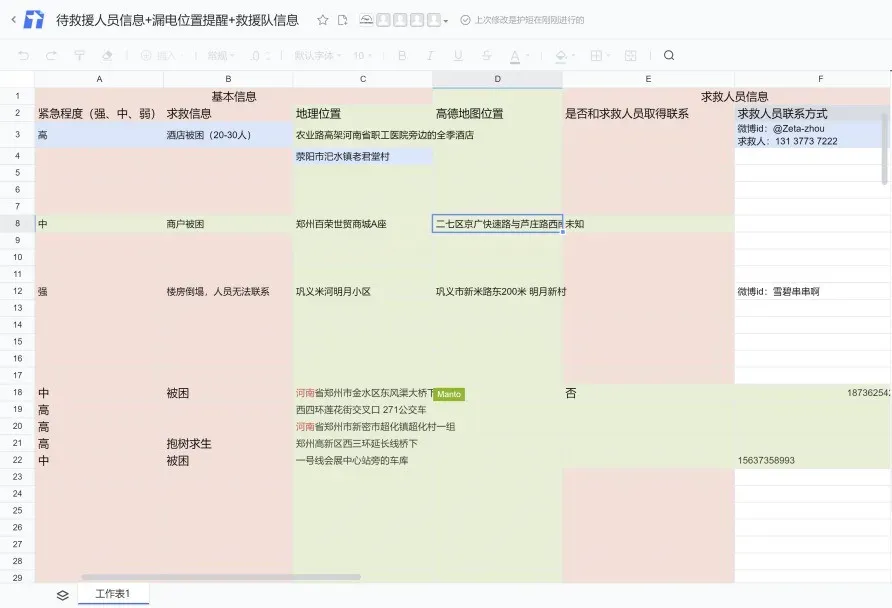
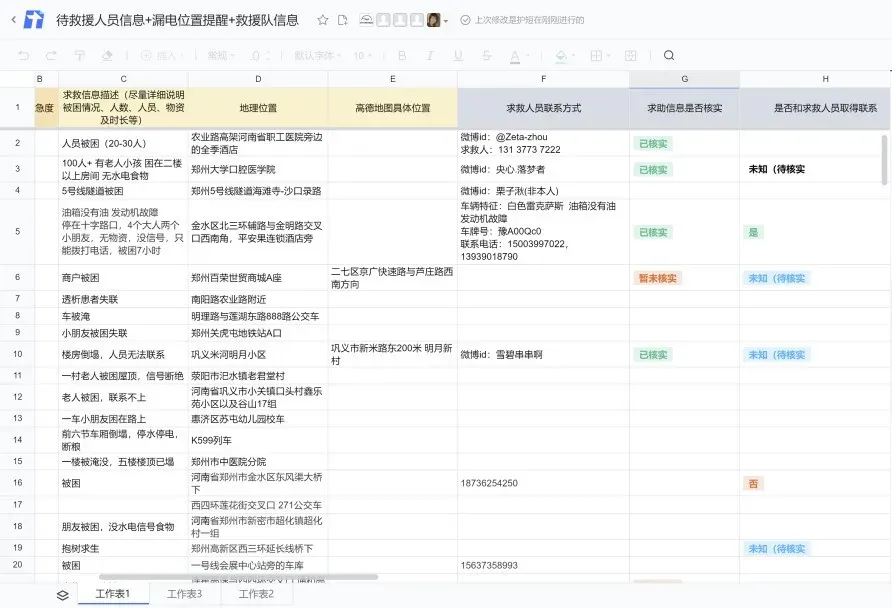
When an unprecedented rainstorm swamped Zhengzhou, Henan province, on the afternoon of July 20, timely rescue for those trapped in dire situations was imperative yet challenging, considering the immense scale of emergency. A few hours later, an online, real-time excel spreadsheet was created, allowing people trapped in the rain and local rescuers, to reach each other. In the following 24 hours, this form became literally “a bridge over troubled waters”. The spreadsheet was established at 8:57 pm, July 20, at the Tencent Docs, a free online document platform that allows for multi-person collaboration. In the following 24 hours, it was updated for more than 270 times. As of 7 o’clock in the evening, Thursday, the document has been viewed 6.5 million times. Information was categorized and prioritized based on urgency level. Pregnant women, infants, and the elderly, were prioritized. Warnings of dangerous places, such as those with electricity shortages, were posted. Information featuring local volunteers and temporary shelters were also listed, including specific contact numbers and locations. Hundreds received aid thanks to the spreadsheet, which has become a lifeline, as the rest of the country closely follows disaster relief work in Henan province. Li Rui, a graduate student in finance from Shanghai University of Finance and Economics who initiated the life-saving project, has since been hailed as a hero. At 7:56 pm, July 20, Li, a Henan native, posted, “I want to help those in need,” on Sina Weibo, after seeing a large amount of online posts from her hometown seeking help. Li then posted a moment on her WeChat account, encouraging volunteers to join her to collect online help-seeking information, make a priority list, then contact those trapped in the rain, as well as local rescuers, and to follow up on each case. The appeal was soon responded to by 33 students from the university. One hour later, the spreadsheet was born. To enhance efficiency, the team was divided into two groups, one responsible for collecting and verifying online information, while the other, composed of volunteers from Henan province, was in charge of assisting in local rescues. “At first, we collected real time information on weibo on our own, leading to redundant information. The method was later replaced by Python to maximize efficiency,” Li said. “I also remind volunteers to type in precise, concise information on the document, to make it easy to understand,” she added. The document is now managed by professional group from Tencent, as the amount of data to manage is growing. The team cooperates with local volunteer and rescuing organizations as well as media groups, creating a group chat on WeChat for communication. “I felt miserable when noticing an online help-seeking message from a woman about to give birth. She must be desperate, worrying if her child might not be brought into the world because of the deadly rain,” recalled Jing Yujie, one of the volunteers from the university, who put the information into the document. Thanks to the document, the woman and her child were rescued. “My hometown suffered floods in 2018. I have always been grateful to the rescuers and people who donated food and clothing. I hope everyone can do their best to help anyone facing natural disasters,” Jing said. Li recalled, at 10:38 pm on July 20, she sent the first message to a person seeking help. “It was not until 1:08 the next morning that I finally got a reply saying he has been rescued and expressing gratitude to us,” she said. “Despite staying up late these few days, the replies are the best gift for us,” Li said.
 夜雨聆风
夜雨聆风