ARTICLE · 1419861
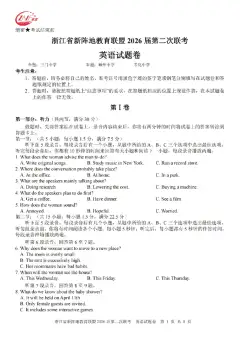
浙江省新阵地教育联盟2026届第二次联考英语试题卷(详解版)

试卷来自“IAI English”公众号,解析来自龚露高考英语公众号,特此感谢!
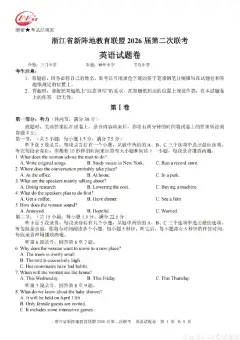
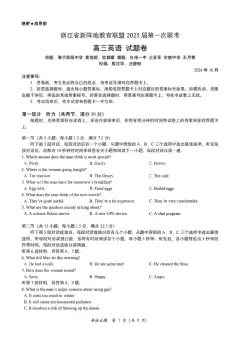
浙江省新阵地教育联盟2026届第二次联考英语试题卷
命题:三门中学陈燕等审题:嵊州中学罗庆菊奉化中学蒋建君校稿:殷沈华、金浙方
第一部分听力(共两节,满分 30 分)
第一节(共 5 小题;每小题 1.5 分,满分 7.5 分)
听下面 5 段对话。每段对话后有一个小题,从题中所给的 A、B、C 三个选项中选出最佳选项。听完每段对话后,你都有 10 秒钟的时间来回答有关小题和阅读下一小题。每段录音读两遍。
1.What does the woman advise the man to do?
A. Write original songs.B. Study music in New York.C. Run a record store.
2.Where does the conversation probably take place?
A. At the office.B. At home.C. In a park.
3.What are the speakers mainly talking about?
A. Doing research.B. Lowering the cost.C. Buying a machine.
4.What do the speakers plan to do first?
A. Get a coffee.B. Have dinner.C. See a film.
5.How does the woman sound?
A. Annoyed.B. Hopeful.C. Worried.
第二节(共 15 小题;每小题 1.5 分,满分 22.5 分)
听下面 5 段对话或独白。每段对话或独白后有几个小题,从题中所给的 A、B、C 三个选项中选出最佳选项。听每段对话或独白前,你将有时间阅读各个小题,每小题 5 秒钟;听完后,各小题将给出 5 秒钟的作答时间。每段录音读两遍。
听第 6 段录音,回答第 6、7 题。
6. Why does the woman want to move to a new place?
A. The room is overly small.B. The rent is excessively high.C. Her roommates have bad habits.
7.When will the woman see the house?
A. This Wednesday.B. This Friday.C. This Thursday.
听第 7 段录音,回答第 8、9 题。
8. What do we know about the baby shower?
A. It will be held on April 11th.B. Only female guests are invited.C. It includes some interactive games.
9.What will the man do this afternoon?
A. Go shopping.B. Plan a party.C. Visit Nancy.
听第 8 段录音,回答第 10 至 13 题。
10. How will the speakers go to Monterey?
A. By car.B. By plane.C. By train.
11. When will the speakers arrive in Monterey next Friday?
A. In the morning.B. At noon.C. In the afternoon.
12. What are the speakers going to do next Saturday?
A. Watch the whale.B. Ride along the coast.C. Visit the Monterey Bay Aquarium.
13. What does the woman offer to do for the trip?
A. Book a hotel.B. Pack beach chairs.C. Prepare food.
听第 9 段录音,回答第 14 至 17 题。
14. What is the probable relationship between the speakers?
A. Fellow workers.B. Doctor and patient.C. Waitress and customer.
15. What did the man do last week?
A. He joined a gym.B. He had a physical check-up.C. He got a membership card.
16. What kind of milk does the man finally choose for himself?
A. Fat-free milk.B. Regular milk.C. Oat milk.
17. How much will the man pay?
A. $5.5.B. $8.C. $10.
听第 10 段录音,回答第 18 至 20 题。
18. Who is Peter Benchley?
A. A writer.B. A filmmaker.C. An actor.
19. How did Peter Benchley feel about the effect of the film Jaws?
A. Proud.B. Encouraged.C. Regretful.
20. What did Peter Benchley do in his later years?
A. He wrote a new book about sharks.
B. He worked hard to protect sea animals.
C. He worked for the London Daily Express.
第二部分阅读理解(共两节,满分 50 分)
第一节(共 15 小题;每小题 2.5 分,满分 37.5 分)
阅读下列短文,从每题所给的 A、B、C 和 D 四个选项中,选出最佳选项。
A
Inspired by The Economist’s recent alternative summer reading list for CEOs, the 10Eighty, a leading HR consultancy firm, offers the following suggestions for summer reading.
The Undercover Economist
A favourite of the 10Eighty team is Tim Harford’s The Undercover Economist — if you’ve ever wondered why the gap between the rich and the poor is so great, then this book is for you. Relatable and engaging, Harford highlights the relevance of economics to everyday life, from buying a coffee to sitting in a traffic jam. He exposes how coffee shops, supermarkets and airlines convince us to part with our money, shedding light on how to apply economic principles to everyday life.
Slow Productivity
10Eighty’s researcher also recommends Slow Productivity by Cal Newport for the summer reading list. In the modern workplace workers feel pushed to the edge by continual meetings, overflowing inboxes, non-stop busywork, and office rules that laugh at autonomy and agency. Newport offers alternative strategies for knowledge workers to do the best work of their lives by taking a slower approach to work that matters.
Tom Sawyer
Few books are better at sparking eagerness to act than Mark Twain’s Tom Sawyer. Forced to paint a fence white rather than play with his friends, naughty Tom finds a way to make it seem so appealing that the local kids want to do it — and end up paying Tom for the privilege. Business-school professors call it “psychic rewards”.
What is your favorite from this summer reading list? Why not share your ideas with us below?
21.How does Tim Harford make economics accessible in The Undercover Economist?
A. By analyzing economic theories in depth.B. By revealing how businesses fuel spending.
C. By explaining the cause of the wealth gap.D. By connecting economic concepts to daily life.
22.What does Cal Newport suggest knowledge workers do?
A. Follow office rules strictly.B. Accelerate work pace.
C. Slow down to tackle key tasks.D. Schedule frequent meetings.
23.According to the passage, why is Tom Sawyer recommended for summer reading?
A. It stimulates motivation effectively.B. It describes the life of a clever boy.
C. It tells an exciting kids’ adventure tale.D. It shows how to deal with naughty kids.
B
It begins with a steady buzz, echoing through the towering forests of Alaska. It’s a signal, but not one to be alarmed by. It’s less “Duck and cover,” more “Come and get it!”
So you step outside your house, where there are few roads and fewer neighbors, and see it. A single-engine plane flies low, just a few dozen feet above the ground. The plane’s door whips open, and a black package is thrown out, plummeting (速降) to earth with a yellow tail hanging behind.
Congratulations, you’ve just been turkey bombed!
The “bomb” is a 15-pound frozen turkey stuffed into a trash bag, tied with yellow caution tape for easy visibility. Since 2021, Alaska native Esther Keim has been dropping them from the air to remote Alaskans who might otherwise be eating squirrel, moose or Spam for Thanksgiving dinner.
Thanksgiving falls at a tricky time of the year in this part of the country. It’s a time when rivers, which often serve as highways in Alaska’s remote areas, are too frozen for boats to travel but not frozen enough for cars. Their only option for reaching “civilization” is seven hours on a snowmobile. Or, if you’re not a pilot like Keim, you can take to the air.
Keim began her turkey-bombing flights after visiting her family in Skwentna, an isolated village. A neighbor mentioned how a squirrel he hunted barely fed his family of four. This reminded Keim of her childhood, when a family friend would drop a turkey — and sometimes a box of candy inside the package just for her — from his plane to her family every year. “I am gonna drop turkeys to remote Alaskans without road access,” says Keim. “It wouldn’t be a big deal, but it’d bring me a lot of joy to bless other people like we were blessed.”
Now Keim is working to turn this personal effort into a non-profit called the Alaska Turkey Drop Project. The project has received enough donations from some individuals and local businesses, with others donating their time and goods. Every year, that noisy plane soaring through Alaska’s sky brings not just turkeys, but a heartwarming reminder of connection in the wilderness.
24.What can be learned about the “bomb”?
A. It’s a dangerous explosive.B. It’s sent to Alaskans for Christmas.
C. It’s a frozen turkey with yellow tape.D. It’s dropped from a high-flying plane.
25.Why is Thanksgiving a challenging time in remote Alaska?
A. Pilots avoid snowy flights.B. Snowmobiles are only for short trips.
C. All roads are blocked by snow.D. Half-frozen rivers are unfit for boats or cars.
26.What inspired Keim to start the “bombing” flights?
A. A demand for her nonprofit project.B. A suggestion from her family.
C. Neighbor’s hardship and childhood favor.D. Hunting squirrels with neighbors.
27.Which of the following best describes Keim?
A. Caring and inquiring.B. Sympathetic and innovative.
C. Decisive and tolerant.D. Adventurous and ambitious.
C
Near the Dominican Republic’s coast, tiny lab-grown “coral babies” are attached to spider-like metal structures in underwater nurseries. This is the assisted coral fertilization program led by local marine protection group Fundemar, offering a glimmer of hope for the world’s declining coral reefs.
The technology is critically important amid severe reef degradation. Seventy percent of the Dominican Republic’s coral reefs now have less than 5% coral cover. Climate change not only kills corals directly through warming oceans but also significantly reduces the natural reproduction chances of surviving individuals. “What was once normal in coral reefs is no longer possible for many species,” noted Andreina Valdez, a biologist at Fundemar.
Assisted fertilization fills this gap by artificially facilitating gamete fusion (配子融合). The implementation follows a precise process. Each year, a few days after the full moon at dusk, corals release millions of eggs and sperm. Fundemar’s team collects these gametes, performs artificial fertilization in the lab, and nurtures the larvae (幼体) until they are robust enough for transplantation to reefs. Though only 1% of the 2.5 million embryos cultivated annually survive in the wild, this rate still outperforms natural reproduction on degraded reefs.
It holds distinct advantages over the non-sexual reproduction used in the past. Non-sexual reproduction involves transplanting fragments of healthy corals, which is faster but produces genetically identical clones vulnerable to mass disease outbreaks. In contrast, assisted sexual reproduction creates genetically diverse individuals, significantly lowering the risk of widespread die-offs. Originating in Australia, the technology has now expanded across the Caribbean, with projects in Mexico, Curacao, Puerto Rico, Cuba, and Jamaica.
However, a fundamental challenge remains: climate change. UNESCO data shows oceans are warming twice as fast as 20 years ago, increasing coral bleaching risks. Expert Mark Eakin stated, “You can’t conserve something if you don’t have it. So these programs are helping to expand the population that’s out there.” Yet he urgently warns, “Without tackling the 800-pound gorilla of climate change, much restoration work could be wiped out.” But, for Fundemar, current efforts matter, “We are investing immense effort to protect what we love, and we trust many around the world are doing the same.”
28.What is the purpose of the first paragraph?
A. To explain the reason of coral decline.B. To advocate for coral protection.
C. To present a coral conservation project.D. To highlight coral’s economic value.
29.What does the underlined phrase “this gap” in paragraph 3 refer to?
A. The challenge of climate change.B. The lack of funding for marine research.
C. The absence of underwater nurseries.D. The failure of natural coral reproduction.
30.What is the primary advantage of assisted fertilization?
A. Faster growth.B. Wide-spread application.
C. Genetic diversity.D. Lower disease-resistance.
31.What is Mark Eakin’s attitude toward assisted fertilization?
A. Entirely supportive.B. Clearly indifferent.
C. Strongly opposed.D. Cautiously hopeful.
D
For decades, horror enthusiasts have been broadly perceived as cold, unfeeling individuals who get pleasure from witnessing suffering. Critics and even some academics have labeled them as adrenaline (肾上腺素) addicts lacking empathy, suggesting that their interest in films like Saw stems from psychological deficiency. However, recent research challenges these long-held assumptions, proposing a more detailed and complex understanding of why people are drawn to horror.
The claim that horror fans must lack empathy has been supported by some early studies. Yet, a closer examination reveals methodological flaws: mixing up the enjoyment of cruelty with a general interest in horror narratives. When such flawed studies are ruled out, the supposed link between low empathy and horror enjoyment disappears. And, recently, more reliable research confirms that horror fans show no less empathy or compassion than others; on some measures, they even score higher.
Another popular theory suggests that horror fans are simply chasing an adrenaline rush. While this may be true for some enthusiasts, newer studies unfold a more complex picture. Researchers have identified different types of fans: some are indeed “adrenaline junkies”, but others, termed “white knucklers”, use horror to confront and overcome personal fears. A third group, “dark copers”, finds an emotional release in fictional horror, using it to process real-life difficulties.
Beyond these motivations, a key personality trait driving horror fandom is “morbid curiosity” — a natural desire to learn about threatening or death-related subjects. This curiosity may be beneficial. Studies indicate that individuals with higher morbid curiosity are often better prepared for real-life crises and show greater resilience during stressful times. Horror fans, it seems, may be practising emotional regulation when they play with their fears through scary entertainment.
The evidence paints a picture of horror fans being empathetic, curious and psychologically sophisticated. Horror is a testament to human adaptability and our remarkable capacity to find meaning, connection and even growth in the face of our deepest fears. Recognising this not only helps us understand horror fans more accurately, but also illuminates something profound about human nature itself.
32.What does the underlined word “deficiency” mean in paragraph 1?
A. Weakness.B. Strength.C. Curiosity.D. Misunderstanding.
33.What led to the results of early studies?
A. The limited sample size of participants.B. The confusion of vital key concepts.
C. The ignorance of horror-cruelty connections.D. The adoption of outdated methodology.
34.What can we infer about people with higher morbid curiosity?
A. They may lack emotional regulation skills.B. They may be more adaptable to challenges.
C. They may become more sensitive to adversity.D. They may be more exposed to real-life crises.
35.What can be a suitable title for the text?
A. Dismissing Myths: The Truth about Horror FansB. Horror Films: Impact on Audience Empathy
C. Horror Enthusiasts: Living Proof of Empathy LossD. Morbid Curiosity: The Ultimate Goal of Horror
第二节(共 5 小题;每小题 2.5 分,满分 12.5 分)
阅读下面短文,从短文后的选项中选出能填入空白处的最佳选项。选项中有两项为多余选项。
What Do Our Dreams Tell Us?
Dreams are an integral part of healthy sleep. The average person spends roughly two hours dreaming each night. Yet even with this significant time, the phenomenon remains mysterious.
What role do dreams play? Dream researcher Alan Siegel calls dreams an entrance to our inner selves — they help process emotions and tackle tough problems we struggle with while awake. Meanwhile, expert Robert Stickgold argues that dreams spring from memory. 36It lets us absorb lessons, heal from hurt, and grow wiser through experience. Put simply, their research shows that dreams are the brain’s innate way to work through our inner struggles and make sense of our memories.
Certain dream themes feel universal across cultures. 37Whether tumbling from a great height or tripping down stairs, these dreams often spark intense fear. A sense of helplessness lingers too. They tend to symbolize lost control or hidden insecurity. In contrast, flying dreams are deeply uplifting. Soaring through the air, weightless and free — it fills dreamers with joy. 38Such dreams usually reflect a yearning for freedom or independence.
Dreaming of exams is another widespread experience. These dreams often come from anxiety — about being unprepared, rushed, or judged in real life. 39Even negative pre-exam dreams can boost actual test performance. After all, the brain processes stress ahead of time. Similarly, dreams of getting lost are frequent. Wandering unfamiliar streets, missing a train, or struggling to find a destination — these reflect uncertainty and confusion. They often mirror life’s transition periods: career changes, relationship shifts, or personal growth. 40
Dreams are deeply personal. You’re the best interpreter of your own dreams. Paying attention to their themes and the feelings they stir can unlock profound insights — and for Lily, that light came from a stranger. These insights help you better understand your inner world and build greater self-awareness.
A. Falling is one of the most common.
B. Interestingly, there exists a silver lining.
C. It also brings a strong sense of empowerment.
D. Such mental activities simply sort unconnected ideas.
E. Replaying past events, big and small, is nature’s clever design.
F. In these times, it’s normal to feel adrift or unsure of our next steps.
G. Transition periods usually disappear when confusion fades in dreams.
第三部分语言知识运用(共两节,满分 30 分)
第一节(共 15 小题;每小题 1 分,满分 15 分)
阅读下面短文,从短文后各题所给的 A、B、C 和 D 四个选项中,选出可以填入空白处的最佳选项。
Every dream lost in the dark longs for a ray of light - and for Lily, that light came from a stranger.
Months earlier, Lily stared at her glowing laptop,41deeply. Her novel centered on Kate had remained42at 10,000 words for a month; not a single new word came to her. In a moment of overwhelming 43, she closed the laptop sharply. She murmured, “I’m fooling myself. I’ll never be a 44.”
Writing was her lifelong passion, but to support her family and pursue a steady livelihood, she 45her writing ambition and took up teaching. For thirty years, she fostered students’ imagination, while her own literary passion slowly 46. Yet when she finally embarked on writing the novel, the complete absence of 47crushed her last hope.
One day, after hours of another 48writing, she walked outside to refresh her mind. Her mind still clouded and her phone now dead, she found herself 49— just then Patrick Kincaid kindly offered her a ride. Sensing her low mood, he encouraged her to share her 50. Lily confessed she was struggling to 51Kate’s story, unable to find her creative rhythm. He smiled gently, “Stop forcing Kate’s plot — let your heart guide your words.”
His words stirred something deep within her. That night, she wrote 52, weaving threads of her own life into Kate’s journey. Six weeks later, she completed the first 53. With Patrick’s encouragement, she perfected the manuscript, found a literary agent, and had the book 54. On its title page, she wrote, “For dreamers in the dark — and the ones who brought them 55.”
Dreams never fade away; they just wait for a spark to bloom, and now, she was the spark.
41.A. sighingB. complainingC. yawningD. regretting
42.A. completedB. setC. stuckD. aimed
43.A. panicB. defeatC. resolutionD. embarrassment
44.A. teacherB. agentC. novelistD. guide
45.A. went afterB. set asideC. held ontoD. lived out
46.A. roseB. awokeC. eruptedD. faded
47.A. inspirationB. supportC. courageD. patience
48.A. productiveB. effortlessC. continuousD. fruitless
49.A. at a distanceB. on the goC. at a lossD. in a rush
50.A. troublesB. opinionsC. fearD. novel
51.A. polishB. shapeC. reviseD. adapt
52.A. freelyB. anxiouslyC. restlesslyD. cautiously
53.A. sceneB. outlineC. chapterD. draft
54.A. translatedB. promotedC. releasedD. delivered
55.A. peaceB. honorC. dignityD. light
第二节:(共 10 小题;每小题 1.5 分,满分 15 分)
阅读下面短文,在空白处填入 1 个适当的单词或括号内单词的正确形式。
The third UNESCO High-Level Forum for Museums, held in Hangzhou on April 23rd, 56.______ (draw) over 190 museum curators and experts from more than 60 countries. The event focused on AI’s revolutionary effect on the museum industry. AI tools, 57.______(tailor) for relic detection, help museums better catalog relics and identify invisible damages in artifacts. However, Gabor Zsigmond, 58.______ (direct) of the Hungarian National Museum, stressed that human proofreading of AI outputs remained crucial in the AI era.
Participants discussed 59.______ AI could bring to exhibition planning. Given a theme, AI can select exhibits and construct frameworks using 60.______ (exist) content. May Khuen Chung, leader of the National Museum of Singapore, mentioned museums’ ability to analyze databases 61.______ and customize content to individual preferences, which reflected AI’s practical value. Despite AI’s advantages, concerns over copyright issues and ethical problems were raised and taken 62.______ into account. Additionally, Britt Romstad noted the need to build more equity into digital spaces.
After the forum, attendees visited the Archaeological Ruins of Liangzhu City, 63______a UNESCO World Heritage Site. Gehane Nabil, impressed by prehistoric stone tools, said the commonalities between Chinese and Egyptian civilizations were 64.______ (true) remarkable. These shared elements, she added, would become the 65. ______(link) that unite human beings.
第四部分:写作(共两节,满分 40 分)
第一节:(满分 15 分)
你将参加英语课上的 “一分钟演讲” 活动。请你针对部分同学在教学楼随意玩球的现象写一篇演讲稿,内容包括:(1)介绍具体情况;(2)呼吁文明活动。
注意:(1)写作词数应为 80 左右;(2)请按如下格式在答题纸的相应位置作答。
Say No to Playing Balls in Teaching Buildings
Good morning, everyone!
Thank you!
第二节:(满分 25 分)
阅读下面短文,根据所给情节进行续写,使之构成一个完整的故事。
I frowned at myself in the dressing-room mirror. I was wearing white tights, a white leotard (紧身连衣裤), and a white cap that hid most of my hair. I was one of 10 snowflakes in my dance school's Winter Wonderland show.
“Grandma, I really don't feel like being in the show,” I said. Grandma Lani looked at me gently. “Why, mo'opuna?” Mo'opuna means “grandchild” in Hawaiian. Grandma Lani has always lived in Hawaii. “You love to dance.” I used to love to dance. Then Ms. Tuttle gave the part of the Snow Queen to Christine Abrams. Christine got to wear a blue leotard and a feathery skirt that drifted out like a cloud every time she twirled. And she got to do a dance once all by herself. The snowflakes just had to run and spin to look like a snowstorm. I sighed. “I don't like our dance. And no one would notice if I weren't there. There are so many of us.” “I would notice,” she reassured me softly.
As Christine walked toward us, Grandma paused and smiled at her. “What a beautiful costume!” Christine glided away, her skirt waving behind her. I hung my head. Grandma took my hand, “What's bothering my Avery?” “And you won't be able to tell me apart from the other snowflakes,” I whispered.
Grandma was about to speak. Then something outside the window caught her eye. She grabbed my hand and my coat and pulled me out of the dressing room and through the doors to the outside. It was snowing. Grandma held her breath and I suddenly thought of something, “Grandma, have you ever seen snow before?” “No, mo'opuna. In Hawaii, it snows only on the very tops of mountains.”
I had seen snow lots of times, but now I tried to see it differently, as if it was new. I saw snowflakes twisting through the air in different directions, sparkling and shining at us. So many snowflakes came together to create something magical. “Aloha,” Grandma whispered to the sky. Aloha can mean many things, including “love”, “hello”, and “good-bye”. “I don't know when I'll see something like that again.” “I do,” I said.
注意:(1)续写词数应为 150 个左右;(2)请按如下格式在答题卡的相应位置作答。
Back in the dressing room, I knew something within me had quietly changed.
As the curtain fell, I heard Grandma’s applause rising above the rest.
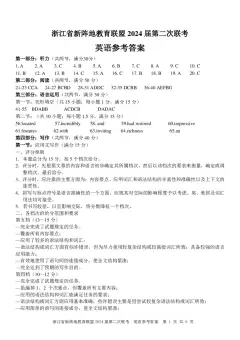
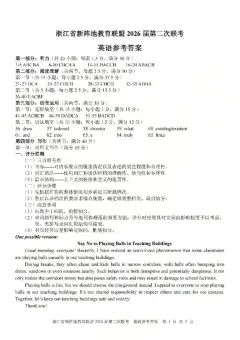
浙江省新阵地教育联盟2026届第二次联考英语参考答案
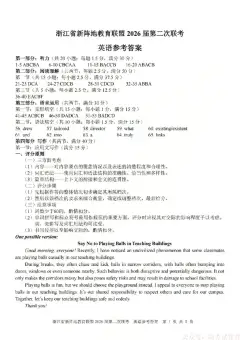
1-5 ABCBA 6-10 CBCAA11-15 BACCB 16-20 ABACB
21-23 DCA24-27 CDCB28-31 CDCD 32-35 ABBA 36-40 EACBF
41-45 ACBCB 46-50 DADCA 51-55 BADCD
56. drew57. tailored58. director 59. what 60. existing/existent61. and 62. into63. a64. truly 65. links
第四部分写作(共两节,满分 40 分)
第一节:应用文写作(满分 15 分)
Say No to Playing Balls in Teaching Buildings
Good morning, everyone! Recently, I have noticed an uncivilized phenomenon that some classmates are playing balls casually in our teaching buildings.
During breaks, they often chase and kick balls in narrow corridors, with balls often bumping into doors, windows or even someone nearby. Such behavior is both disruptive and potentially dangerous. It not only makes the corridors messy but also poses safety risks and may result in damage to school facilities.
Playing balls is fun, but we should choose the playground instead. I appeal to everyone to stop playing balls in our teaching buildings. It’s our shared responsibility to respect others and care for our campus. Together, let’s keep our teaching buildings safe and orderly. Thank you!
第二节:读后续写(满分 25 分)
Back in the dressing room, I knew something within me had quietly changed. The frustration about being a nameless snowflake faded, replaced by a heartfelt desire to let Grandma feel the magic of snow through my dance. Backstage, I adjusted my white cap and straightened my leotard, no longer envying Christine’s blue costume. When the music started, I joined the other snowflakes. I didn’t just perform—I poured my heart into every spin and step, imagining each movement as a tiny snowflake dancing for Grandma. I moved like the snowflakes we’d watched, twisting gently and then swirling faster. For the first time, I felt proud to be part of the group; each of us was a tiny yet essential piece of the magical scene that Grandma cherished deeply.
As the curtain fell, I heard Grandma’s applause rising above the rest. I darted off the stage, white tights swishing, and crashed into her arms. She held me tight, eyes glistening with joy. “You did it, mo’opuna. You made the snow come alive—without you, that storm wouldn’t have been complete.” Just then, Christine wandered over with a genuine smile, saying our snowflake dance was the most magical part of the show. I smiled back sincerely, all the earlier jealousy completely gone. I didn’t care if Grandma could tell me apart from others; what I did care about was that I’d shared the snow’s magic with her. I squeezed her hand tightly and whispered “Aloha” softly, knowing this tiny “snowflake” had become a precious gift for both of us.
听力原文
Text 1
W: Mike, what kind of job are you looking for?
M: Ideally, something related to music, perhaps a job in a New York record store.
W: Why not try to create your own songs? (1) You’re talented.
Text 2(第 2 题为推断题)
W: Jeff, I just got a call from the office. There’s a computer problem and I have to check it immediately. Could you watch Joey for a while?
M: Sure. He just fell asleep ten minutes ago. It was probably because he got tired from playing in the park in the afternoon.
Text 3(第 3 题为主旨大意题)
W: Mr. Ward, that machine is really expensive, but we really need it for our research.
M: Don’t worry, Monica. Our company will pay the cost.
W: OK, then I’ll place the order.
Text 4
M: Would you like to go to the movies at 8:30 tonight?
W: I’d love to. How about meeting at the steakhouse at 6:00 p.m.? So we can eat something there.
M: Terrific. The Blue Café is only 200 meters away from the cinema. We can check it out after dinner.
W: Okay. (4)
Text 5(第 5 题为推断题)
M: I left my exercise book at home. Can I hand it in tomorrow?
W: Again? It is Wednesday today. And this is the third time this week! Why didn’t you check your
schoolbag before going to school? It’s just an excuse.
Text 6
M: Hello, this is Mark speaking.
W: Hi, my name is Sarah. I saw your advertisement at the campus housing office. And I’m looking for a new place to live. (6) Is the room still available?
M: Sure! It’s a bit small, but it’s bright and fully furnished. What’s more, the price is also reasonable.
W: That sounds nice. My current place is terrible—my roommates often stay up late having parties
and never do the cleaning. So I’m moving out. (6)
M: I understand. At the moment, only another student and I live here. We are both quiet and we clean the house every Wednesday. Actually, we just finished cleaning before you called today. (7)
W: Great. Would it be possible to view it the day after tomorrow? (7)
M: OK, see you then. (7)
Text 7
W: Hey, I just got an invitation to Nancy’s baby shower. It’s going to be on April 5th at 11:00 a.m. at her house.
M: Oh, are they planning anything special for the party?
W: Yes, there will be some baby-themed games, and even some guessing contests—like the baby’s
weight and due date. (8)
M: That sounds fun. Is it just for women, or are men invited too?
W: It’s a party for Nancy’s relatives and close friends. Nancy wanted all of them to be there, regardless of gender.
M: Nice. Do we need to bring something for the baby? Maybe some soft toys or baby clothes?
W: Nancy said that everyone didn’t need to bring a gift, but I still decided to give her a baby bottle.
M: Good idea. Then could you accompany me to the mall to choose a suitable gift this afternoon? (9)
W: Sure. (9)
◆ baby shower 迎婴聚会
◆ due date 预产期
Text 8
M: We have three days off next week. Do you have any plans?
W: No. What about you?
M: I really want to take a walk on the beach in Monterey. (10) It won’t be crowded at this time of year.
Would you like to join me?
W: Yes. Maybe we can drive there next Friday. We won’t be able to take the beach chairs if we take
the train or plane. (10) (12)
M: Good idea! It must be an interesting trip. (13) It takes two hours to drive there. We can start out at
10:00 a.m. This way, we’ll arrive there in time for lunch. (10) (11) In the afternoon, we can rent
bikes to ride along the coast and explore the shops after checking in at our hotel.
W: Oh, don’t forget to bring your camera. Then we can take some photos.
M: No problem. On the second day, how about going on a whale-watching tour? (12)
W: Great! (12) Finally, let’s pay a visit to the Monterey Bay Aquarium on Sunday morning before heading back home.
M: Perfect. I’ll check the car and pack the beach chairs.
W: I’ll take care of snacks! (13)
Text 9(第 14 题为推断题)
W: Good morning, sir. What can I do for you?
M: Hi. I would like to order a cup of coffee. I need a large iced coffee.
W: What kind of milk would you like? (16) We have regular milk, fat-free milk, and oat milk.
M: Which one is the healthiest? Last week, I had a medical examination. (15) And the report shows that I have high blood pressure and high blood sugar, so I need to drink something healthier.
W: Oh, I see. Why not do some workouts at the gym? It’s good for your health.
M: Yes, I’m planning to sign up for training courses at a gym. So what kind of milk do you recommend?
W: Either fat-free milk or oat milk is fine.
M: Okay, I will take fat-free milk, please. (16) And I’d also like a medium iced latte. It’s for my colleague, and regular milk will be fine. How much are they?
W: $5.5 for the iced coffee and $4.5 for the iced latte. But if you have a membership card, I can give
you a 20% discount. (17)
M: Great. This is my membership card. (17)
◆ oat milk 燕麦奶
◆ latte 拿铁
Text 10
Jaws was a bestselling novel that was adapted into one of the most influential films in history. In 1975, a director named Steven Spielberg turned the book’s title character, a great white shark, into cinema’s biggest monster since King Kong. The movie became a box-office record breaker at the time, and the book sold nearly 20 million copies. Meanwhile, Peter Benchley, the author of Jaws, became a household name for his thrilling storytelling. (18) However, the success of Jaws had an unintended consequence. The film accidentally caused a fishing craze that played a part in reducing the shark population. The effect was so upsetting for Benchley that he dedicated the rest of his life to ocean conservation. He even told the London Daily Express in 2006: “With what I know now, I could never write that book today.” (19) Benchley spent his later years campaigning against shark overfishing and producing documentaries to promote marine conservation. (20) Spielberg also felt sorry for the negative impact his film had on nature.
浙江省新阵地教育联盟2026届第二次联考英语试题卷解析
试卷来自“IAI English”公众号,解析来自龚露高考英语公众号,特此感谢!
详细解析:
21-23 DCA24-27 CDCB28-31 CDCD32-35 ABBA
A篇
A篇介绍了人力资源咨询公司10Eighty 受《经济学人》启发,为首席执行官们推荐了《卧底经济学家》《慢生产力》《汤姆・索亚历险记》三本夏日读物,并分别介绍了每本书的核心价值与推荐理由。
21. D 根据文中 “Relatable and engaging, Harford highlights the relevance of economics to everyday life, from buying a coffee to sitting in a traffic jam.” 可知,Tim Harford 在书中将经济学概念与日常生活联系起来,让经济学变得通俗易懂,D 选项符合文意;A “深入分析经济理论” 文中未提及;B “揭示企业如何刺激消费” 只是书中内容的一部分,并非让经济学易懂的核心方式;C “解释贫富差距的原因” 是书能解答的问题,而非让经济学易懂的方法。
22. C 根据 “Newport offers alternative strategies for knowledge workers to do the best work of their lives by taking a slower approach to work that matters.” 可知,Cal Newport 建议知识工作者放慢节奏,专注处理重要的核心工作,C 选项正确;A “严格遵守办公室规则”、B “加快工作节奏”、D “安排频繁的会议” 均与文中提到的现代职场的问题点相悖,是作者不提倡的做法。
23. A 根据 “Few books are better at sparking eagerness to act than Mark Twain's Tom Sawyer.” 可知,《汤姆・索亚历险记》被推荐的原因是它能有效激发人们的行动动力,A 选项 “有效激发积极性” 与之相符;B “描述一个聪明男孩的生活”、C “讲述激动人心的儿童冒险故事” 是书籍的内容,而非推荐理由;D “展示如何应对调皮的孩子” 与文中 “商业学校教授称之为‘精神奖励’” 的核心推荐点无关。
B篇
B篇讲述了阿拉斯加的 Esther Keim 从 2021 年开始,通过飞机向偏远地区的居民空投冷冻火鸡,让他们能度过感恩节,如今她正将这一个人善举发展为非营利项目,为荒野中的人们带来联结的温暖。
24. C 根据 “The 'bomb' is a 15-pound frozen turkey stuffed into a trash bag, tied with yellow caution tape for easy visibility.” 可知,所谓的 “炸弹” 是绑着黄色警示胶带的冷冻火鸡,C 选项正确;A “危险的爆炸物” 与文意完全相反;B “为圣诞节送给阿拉斯加人” 错误,文中明确是为了感恩节;D “从高空飞行的飞机扔下” 错误,文中提到 “a single-engine plane flies low, just a few dozen feet above the ground”,飞机是低空飞行。
25. D 根据 “It's a time when rivers, which often serve as highways in Alaska's remote areas, are too frozen for boats to travel but not frozen enough for cars.” 可知,偏远阿拉斯加的感恩节之所以艰难,是因为河流半冻状态下,船只无法航行、汽车也无法通行,D 选项正确;A “飞行员避开雪天飞行” 文中未提及;B “雪地摩托仅适用于短途旅行” 错误,文中提到雪地摩托到 “文明地区” 需要 7 小时,并非短途;C “所有道路都被雪堵塞” 文中未提及,核心问题是河流无法使用。
26. C 根据 “A neighbor mentioned how a squirrel he hunted barely fed his family of four. This reminded Keim of her childhood, when a family friend would drop a turkey...from his plane to her family every year.” 可知,邻居的生活困境和童年时他人给予自己家的善意,激励 Keim 开始了空投火鸡的行动,C 选项正确;A “对她非营利项目的需求” 错误,非营利项目是后续才计划开展的;B “家人的建议” 文中未提及;D “和邻居一起猎松鼠” 与文意不符,只是邻居提到了猎松鼠的经历。
27. B Keim 看到邻居的困境后心生怜悯,开展空投火鸡的善举,体现了她的富有同情心(Sympathetic);她想到用飞机空投的方式为偏远地区的人送去感恩节火鸡,将个人善举发展为非营利项目,体现了她的创新精神(innovative),B 选项正确;A “好奇的”、C “宽容的”、D “有野心的” 文中均无相关细节体现。
C篇
C篇介绍了多米尼加共和国的海洋保护组织Fundemar 开展人工辅助珊瑚受精项目,通过实验室培育珊瑚幼体移植到珊瑚礁,弥补珊瑚自然繁殖的不足,该技术虽有基因多样性等优势,但气候变化仍是其面临的核心挑战。
28. C 第一段开篇描述了多米尼加共和国海岸的水下苗圃中,实验室培育的珊瑚幼体被固定在金属结构上的场景,随后点明这是当地海洋保护组织Fundemar 开展的人工辅助珊瑚受精项目,为濒危的珊瑚礁带来希望,核心目的是呈现这一珊瑚保护项目,C 选项正确;A “解释珊瑚减少的原因” 是第二段的内容;B “倡导珊瑚保护” 是文章的潜在意图,并非第一段的直接目的;D “强调珊瑚的经济价值” 文中未提及。
29. D 根据前文 “Climate change...significantly reduces the natural reproduction chances of surviving individuals. 'What was once normal in coral reefs is no longer possible for many species,'” 可知,气候变化导致珊瑚自然繁殖的机会大幅减少,许多珊瑚物种无法正常自然繁殖,因此 “this gap” 指代的是珊瑚自然繁殖的失败,D 选项正确;A “气候变化的挑战”、B “海洋研究资金的缺乏”、C “水下苗圃的缺失” 均与前文提到的繁殖问题无关。
30. C 根据 “In contrast, assisted sexual reproduction creates genetically diverse individuals, significantly lowering the risk of widespread die-offs.” 可知,人工辅助受精的主要优势是能培育出基因多样性的珊瑚个体,降低大规模死亡的风险,C 选项正确;A “生长更快” 是无性繁殖的特点;B “应用广泛” 是该技术的发展现状,并非优势;D “抗病性更低” 与文意相反,基因多样性能提升抗病性。
31. D Mark Eakin 首先表示 “these programs are helping to expand the population that's out there”,认可该项目对扩大珊瑚种群的作用,同时又紧急警告“Without tackling the 800-pound gorilla of climate change, much restoration work could be wiped out”,指出气候变化的核心问题不解决,修复工作可能付诸东流,由此可见他对人工辅助受精的态度是谨慎乐观(Cautiously hopeful),D 选项正确;A “完全支持”、B “明显漠不关心”、C “强烈反对” 均不符合其观点。
D篇
D篇介绍了长期以来人们认为恐怖爱好者冷漠、缺乏同理心,而最新研究推翻了这一偏见,发现恐怖爱好者的同理心并不弱,其喜爱恐怖内容的动机多样,且病态好奇心这一特质还能让他们更好地应对现实危机。
32. A 前文提到批评者和一些学者认为恐怖爱好者是缺乏同理心的肾上腺素成瘾者,认为他们对恐怖电影的兴趣源于心理上的缺陷,因此“deficiency” 的含义为 “缺陷、弱点”,与 A 选项“Weakness” 同义;B “优势”、C “好奇心”、D “误解” 均不符合语境。
33. B 根据 “Yet, a closer examination reveals methodological flaws: mixing up the enjoyment of cruelty with a general interest in horror narratives.” 可知,早期研究的问题在于将 “对残忍的喜爱” 和 “对恐怖故事的普遍兴趣” 这两个关键概念混淆了,B 选项正确;A “参与者样本量有限”、D “采用过时的研究方法” 文中未提及;C “忽视恐怖与残忍的联系” 与文意相反,是混淆了二者的概念。
34. B 根据 “Studies indicate that individuals with higher morbid curiosity are often better prepared for real-life crises and show greater resilience during stressful times.” 可知,病态好奇心更强的人能更好地应对现实危机,在压力下表现出更强的适应力,由此可推断他们更能适应挑战,B 选项正确;A “缺乏情绪调节能力” 错误,文中提到恐怖爱好者通过恐怖娱乐锻炼情绪调节能力;C “对逆境更敏感”、D “更多地暴露在现实危机中” 文中均未提及。
35. A 文章开篇推翻了 “恐怖爱好者冷漠、缺乏同理心” 的传统偏见,随后通过研究分析了恐怖爱好者喜爱恐怖内容的多样动机,指出他们同理心并不弱,且病态好奇心还有积极作用,核心是打破对恐怖爱好者的误解,揭示其真实面貌,A 选项 “打破误解:恐怖爱好者的真相” 适合作为标题;B“恐怖电影:对观众同理心的影响” 只是文章的部分内容,并非核心;C“恐怖爱好者:同理心缺失的活生生例子” 与文章观点相悖;D“病态好奇心:恐怖的终极目标” 错误,病态好奇心是恐怖爱好者的一个特质,并非恐怖的目标。
七选五
36-40 EACBF
本篇围绕 “梦境告诉我们什么” 展开,介绍了梦境对处理情绪、梳理记忆的作用,分析了坠落、飞翔、考试、迷路等普遍梦境主题的象征意义,并指出关注梦境能帮助人们了解内心、提升自我认知。
36. E 前文提到 Robert Stickgold 认为梦境源于记忆,空后指出这能让我们吸收经验、从伤害中恢复、变得更智慧,E 选项 “重放大大小小的过往事件,是大自然的巧妙设计” 承接 “梦境源于记忆”,且 “重放过往事件” 与空后的 “吸收经验、从伤害中恢复” 相呼应,符合语境。
37. A 前文提到某些梦境主题在不同文化中都很普遍,空后描述了坠落的梦境场景及带来的感受,A 选项 “坠落是最常见的梦境之一” 作为总起句,引出下文对坠落梦境的具体分析,符合逻辑。
38. C 前文提到飞翔的梦境让人心情愉悦,空后指出这类梦境反映了对自由或独立的渴望,C 选项 “它还带来强烈的成就感” 承接前文对飞翔梦境的正面感受,“还(also)” 与前文形成递进,符合语境。
39. B 前文提到考试梦源于现实中的焦虑,空后指出即使负面的考前梦也能提高实际考试表现,体现出转折的积极意义,B 选项 “有趣的是,事情总有一线希望” 起到承上启下的作用,衔接前后文的转折关系,符合逻辑。
40. F 前文提到迷路的梦境反映了不确定性和困惑,通常映射人生的过渡阶段(职业变化、关系转变、个人成长),F 选项 “在这些时期,感到迷茫或不确定下一步该做什么是很正常的” 中的 “these times” 指代前文的 “人生的过渡阶段”,承接前文对迷路梦境象征意义的分析,符合语境。
完形填空
41-45 ACBCB46-50 DADCA51-55 BADCD
本篇文章主要讲述了Lily因写作受挫放弃梦想,后受丈夫鼓励重拾笔,最终完成小说并出版,重燃希望。整体难度适中偏易。文章结构清晰,主题励志,词汇与语法考点常规,符合高考完形填空命题趋势,适合高三学生巩固训练。
41. A 根据上文“Lily stared at her glowing laptop”以及下文“deeply”可知,她盯着电脑,深深地叹气,表达内心的沮丧和无奈。sighing意为“叹气”,符合语境。complaining抱怨,yawning打哈欠,regretting后悔,均不能准确描述她面对写作困境时的情绪反应。
42. C 根据下文“at 10,000 words for a month; not a single new word came to her”可知,她的小说停留在一万字一个月了,没有进展。stuck意为“卡住,停滞”,符合文意。completed完成,set设置,aimed旨在,均与语境不符。
43. B 上文提到她的小说没有进展,她感到挫败,这里说“在一阵巨大的挫败感中”,她猛地合上电脑。defeat意为“挫败,失败”,符合语境。panic恐慌,resolution决心,embarrassment尴尬,均不如defeat准确反映她此刻的心情。
44. C 根据前文她试图写小说却毫无进展,以及后文她做了三十年教师可知,她此时自我怀疑,认为自己永远成不了小说家。novelist意为“小说家”,符合上下文。teacher教师,agent代理人,guide向导,均与她的写作梦想不符。
45. B 根据下文“took up teaching”以及“for thirty years”可知,为了养家糊口和稳定的生活,她暂时搁置了写作的抱负。set aside意为“搁置,留出”,符合文意。went after追求,held onto坚持,lived out实践,均与为了生计而放弃写作的逻辑相悖。
46. D 上文说她搁置了写作抱负,做了三十年教师,这期间她的文学热情应该是慢慢消退了。faded意为“消退,逐渐消失”,符合语境。rose上升,awoke醒来,erupted爆发,均与长期的搁置和等待相矛盾。
47. A 当她终于开始写小说时,却完全缺乏灵感,这粉碎了她最后的希望。inspiration意为“灵感”,符合前文她写不出新词的困境。support支持,courage勇气,patience耐心,均不是她写作遇到的核心问题。
48. D 根据上文“crushed her last hope”以及下文“she walked outside to refresh her mind”可知,她又经历了一段毫无成果的写作时光。fruitless意为“无成果的,徒劳的”,符合语境。productive多产的,effortless不费力的,continuous持续的,均与她的写作困境相反。
49. C 根据上文“Her mind still clouded and her phone now dead”以及帕特里克主动提供搭车帮助可知,她当时不知所措,迷失了方向。at a loss意为“不知所措,迷茫”,符合语境。at a distance在远处,on the go忙个不停,in a rush匆忙,均不符合她当时的状态。
50. A 根据上文“Sensing her low mood”以及下文“Lily confessed she was struggling”可知,帕特里克鼓励她分享自己的烦恼。troubles意为“烦恼,困难”,符合语境。opinions观点,fear恐惧,novel小说,均不如troubles能概括她正在经历的写作困境。
51. B 根据下文“unable to find her creative rhythm”以及帕特里克建议“Stop forcing Kate’s plot”可知,莉莉正在努力塑造凯特的故事。shape意为“塑造,形成”,符合语境。polish润色,revise修订,adapt改编,均是在有初稿的基础上进行的,而她现在连创作节奏都找不到。
52. A 根据下文“weaving threads of her own life into Kate’s journey”以及帕特里克的建议“let your heart guide your words”可知,她这次写作不再受束缚,而是自由地书写。freely意为“自由地”,符合语境。anxiously焦虑地,restlessly不安地,cautiously谨慎地,均与听从内心、自由书写的心境相反。
53. D 根据上文“That night, she wrote...”以及下文“Six weeks later, she completed the first...”可知,经过六周的写作,她完成了初稿。draft意为“草稿,初稿”,符合写作的流程。scene场景,outline大纲,chapter章节,均不能准确指代经过六周写作完成的整体稿件。
54. C 根据上文“found a literary agent”以及下文“On its title page”可知,她找到了经纪人,并且书得以出版发行。released意为“发行,发布”,符合书籍出版的语境。translated翻译,promoted推广,delivered递送,均不符合书籍从经纪人到出版的过程。
55. D 根据文章开头“Every dream lost in the dark longs for a ray of light”以及标题页的题词“For dreamers in the dark — and the ones who brought them...”可知,这里应填入与“light”呼应的词,指那些给黑暗中追梦者带来光明的人。light意为“光”,与开篇主题完美呼应。peace和平,honor荣誉,dignity尊严,均不能与“dark”形成直接的对比和呼应。
语法填空
56.drew 57.tailored 58.director59.what 60.existing/existent 61.and 62.into 63.a64.truly 65.links
本篇介绍了在杭州举办的第三届联合国教科文组织博物馆高层论坛的参会情况、论坛核心议题(人工智能对博物馆行业的变革性影响),以及参会者对人工智能应用的探讨、相关顾虑和论坛后参观良渚古城遗址的感受,语法填空则围绕该篇短文考查了动词时态、非谓语、词性转换、连词、冠词、固定搭配等核心语法点。
59. 设空处引导宾语从句,作discussed的宾语;从句中bring后缺宾语,且指 “事物”,故用what,表示 “参会者探讨了人工智能能为展览策划带来什么”。
60.设空处修饰名词content(内容),需用形容词;exist(存在,动词)的形容词形式为existing(现存的,现有的)或existent(存在的),均可修饰名词,意为 “利用现有内容”。
62. 考查固定短语take...into account,意为 “考虑……”,句中为被动形式were taken into account,表示 “有关版权和伦理问题的担忧被提出并得到考虑”。
来源:转自网络