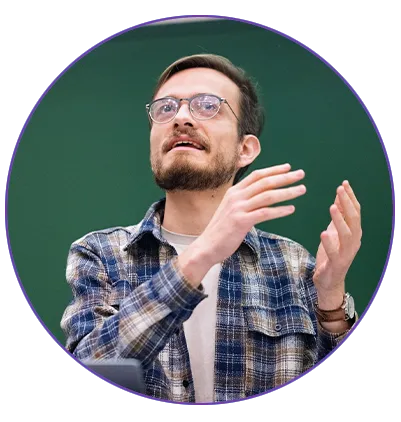
Zoom会议ID:856 1751 9948会议密码: 843651 Emile van Krieken, 博士后
阿姆斯特丹自由大学 计算机科学系
摘 要
Neurosymbolic machine learning methods combine neural networks for neural perception with symbolic reasoning. They promise to reliably solve tasks like visual reasoning. I will introduce neurosymbolic predictors, which can somewhat guarantee this reliability and never violate safety constraints.Then, I will talk about a large issue for neurosymbolic predictors, namely "reasoning shortcuts”: neurosymbolic predictors sometimes completely solve a problem without learning a proper understanding of underlying concepts. I will explain some methods for tackling reasoning shortcuts, including a new method using diffusion models. Instead of being overconfident in reasoning shortcuts, this method properly expresses uncertainty.
报告人简介
In 2024, Emile graduated from his PhD at the Vrije Universiteit Amsterdam with distinction (Cum Laude). His PhD thesis investigated fundamental questions in neurosymbolic machine learning: "How can we extend learning algorithms meant for continuous operators to logical operators (which tend to be discrete)? and how can we do so efficiently?”. This thesis won the BNVKI thesis award for the best AI thesis in the Netherlands and Belgium.After a postdoc at the University of Edinburgh focused on the reliability of neurosymbolic machine learning, he returned to Amsterdam for a postdoc at the learning and reasoning group at VU, working jointly with the Video and Image Sensing Lab at UvA. His current research focuses on neurosymbolic methods for generative AI models like LLMs and diffusion models, and on commonsense reasoning, particularly in visual domains.欢迎参加
 夜雨聆风
夜雨聆风