 夜雨聆风
夜雨聆风今日相关 / Relevant Today
AI4Protein 前沿追踪
AI 深度解读
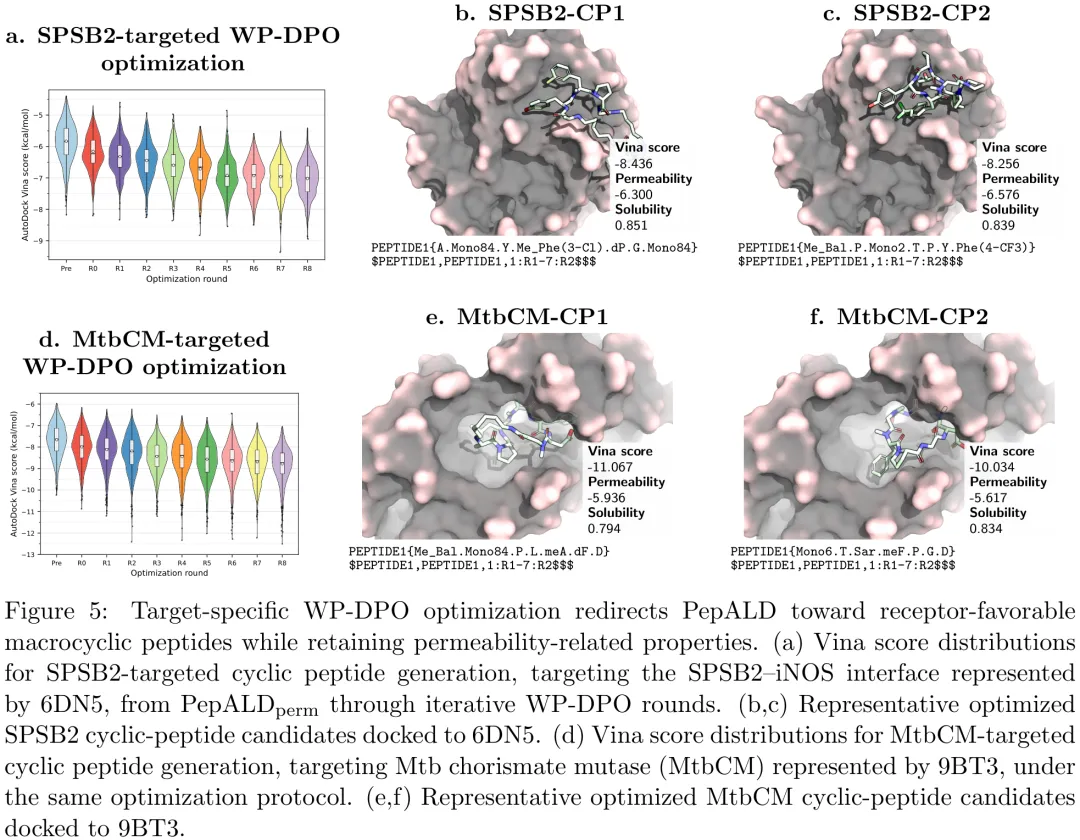
PepALD 模型旨在解决宏环肽(macrocyclic peptides)的生成难题,特别是如何结合扩散模型的连续空间采样能力与自回归模型对序列上下文及成环拓扑结构的理解。该方法创新性地提出了一个包含因果上下文编码器、上下文条件化去噪网络以及环键预测器的协同架构。其中,因果上下文编码器利用前序生成的单体嵌入构建位置特定的上下文向量,引导扩散模型在 Uni-Mol 潜在空间中迭代去噪以生成连续嵌入;随后通过混合解码器将连续样本投影回合法的 HELM 单体。为了解决宏环肽特有的成环问题,模型引入了 R 基团感知的环键预测器,在自回归生成的每一步中,不仅预测当前残基,还同步评估其与所有前序残基之间形成环键的可能性及连接类型(如侧链 - 侧链、骨架 - 骨架等)。训练策略分为两阶段:首先利用去噪和辅助 token 预测损失预训练编码器与去噪器,随后在 curated 宏环肽数据集上进行微调,并加入自回归环键目标以学习成环拓扑结构。该设计有效融合了扩散模型的多样性生成优势与自回归模型对化学约束和序列逻辑的把控,实现了高质量宏环肽序列及其拓扑结构的联合生成。
中文摘要
摘要:大环肽是靶向细胞内位点的有前景的治疗候选分子,但其设计需要同时控制非天然单体化学、环拓扑结构、膜渗透性以及靶点结合能力。现有的基于 SMILES 或 HELM 字符串的生成模型要么在冗长的原子级序列空间中运行,要么将单体视为缺乏充分化学基础的符号标记。我们提出了 PepALD,这是一种用于从头设计大环肽的自回归潜在扩散(ALD)基础模型。该模型采用结构化化学嵌入表示 HELM 单体,在化学感知的潜在空间中通过上下文条件扩散生成每个残基,在自回归生成过程中预测考虑 R 基团的环闭合,并利用获胜者保护的扩散适配偏好优化将去噪器与亲和力奖励对齐。计算机模拟实验表明,PepALD 在生成质量和奖励优化性能方面均优于代表性的大环肽生成基线模型。
Paper Key Illustration
原文
PepALD: Macrocyclic Peptide Generation via Autoregressive Latent Diffusion
Abstract: Macrocyclic peptides are promising therapeutic candidates for intracellular targets, but their design requires simultaneous control over non-natural monomer chemistry, ring topology, membrane permeability, and target binding. Existing SMILES- or HELM-string generative models either operate in long atom-level sequence spaces or treat monomers as symbolic tokens with limited chemical grounding. We introduce PepALD, an Autoregressive Latent Diffusion (ALD) foundation model for \textit{de novo} macrocyclic peptide generation. The model represents HELM monomers with structured chemical embeddings, generates each residue through context-conditioned diffusion in chemically informed latent space, predicts R-group-aware ring closures during autoregressive generation, and aligns the denoiser to affinity rewards using winner-protected diffusion-adapted preference optimization. In silico experiments demonstrate PepALD's generation quality and reward-optimization performance against representative peptide generation baselines.
链接:https://arxiv.org/pdf/2606.14510
AI 深度解读
该研究旨在评估不同记忆存储介质(无记忆、Markdown 文本、Git 版本控制、向量嵌入、知识图谱)对大语言模型在数学推理(MATH-500)和通用知识问答(GPQA)任务上的提升效果。研究首先通过受控实验发现,在样本量较小(n=40)时,Git 介质表现出显著的准确率提升,但扩大样本量至 n=98 后,这种优势消失,所有介质的置信区间均包含零,表明在小样本下观察到的 Git 增益属于统计波动而非真实效应。此外,在 ScienceWorld 基准测试中,由于模型本身存在能力下限(floor effect),无法观察到跨任务学习的曲线,因此该结果被排除在核心结论之外。最终研究证实,Git 介质在提供审计能力的工程权衡上具有价值,但在纯准确率提升方面并未优于其他介质,且不存在某种特定记忆介质能可靠地增强模型跨问题泛化能力的证据。
中文摘要
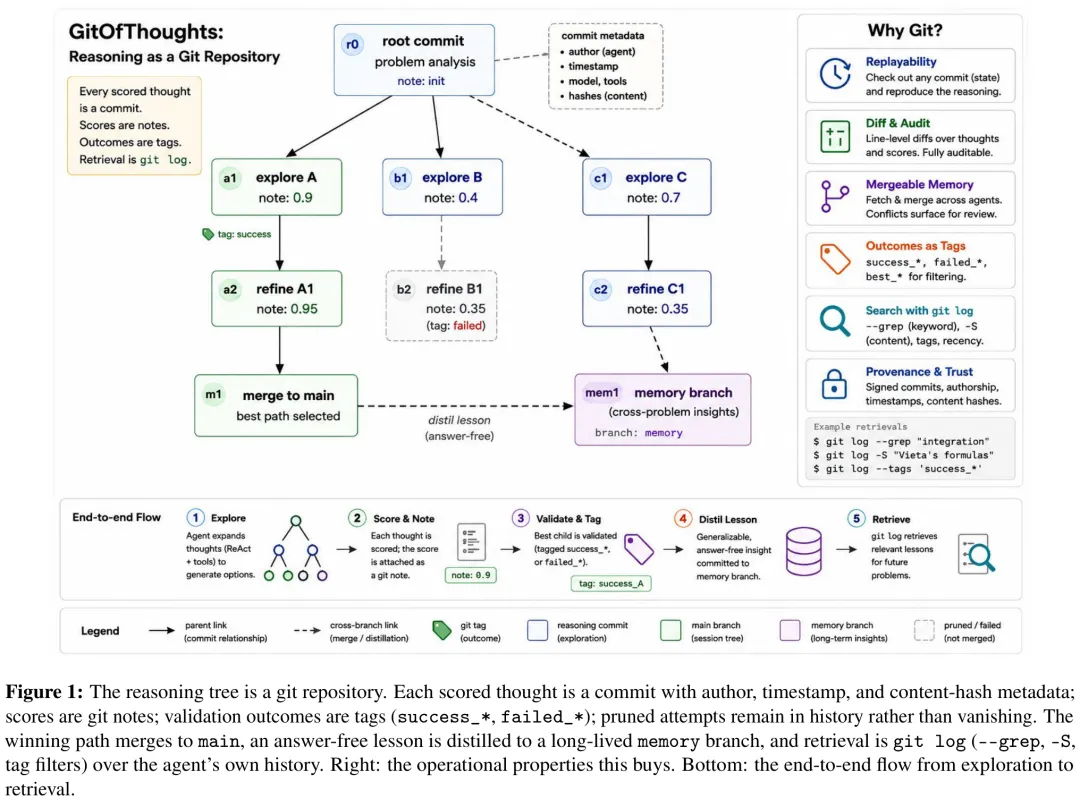
摘要:大语言模型(LLM)的推理过程具有瞬时性:思维链随上下文窗口消失,被剪枝的搜索分支不留记录,内存缓冲区无法进行差异对比、合并或审计。除推理外,所有其他复杂的软件过程(代码、基础设施、数据、实验)均受版本控制,而推理则不然。我们提出了 GitOfThoughts,它将智能体的推理树存储为 Git 仓库:每个评分过的思维步骤作为一个提交(commit),评分作为备注(notes),结果作为标签(tags),检索则是对智能体自身历史的“git log”操作。这使得推理过程可重放、可审计,并能在近乎零工程成本的情况下跨智能体进行合并。随后,我们提出了一个更具挑战性的问题:在任何存储介质中,记忆是否真的能提高准确率?在五种存储介质(无记忆、Markdown、向量、图、Git)、两个基准测试、两个模型规模以及预先注册的重复实验中,针对新问题的结论是否定的。没有任何一种记忆格式能可靠地提升效果,一个早期看似有希望的结果在其预先注册的重复实验中也未能复现。记忆仅在超过我们所谓的“可复制性阈值”时才有效:当检索到的案例与当前问题高度相似(相似度 >~ 0.8)时,准确率会显著提升;低于该阈值则无明显增益。这种增益源于答案检索,而非方法迁移:即使模型规模扩大 4.5 倍,使其在高度相似案例上的收益翻倍,仍无法从已解决的示例中提取可迁移的方法。我们发现的唯一通用杠杆是测试时采样。因此,将 Git 作为存储介质的理由在于其可审计性、溯源性和在准确率对等条件下的可合并性。我们记录了一项被撤回的结果和一个被证伪的假设,以体现我们所秉持的评估标准。
Paper Key Illustration
原文
GitOfThoughts: Version-Controlled Reasoning and Agent Memory You Can Replay, Diff, and Merge
Abstract: Large language model (LLM) reasoning is ephemeral: chains of thought vanish with the context window, pruned search branches leave no record, and memory buffers cannot be diffed, merged, or audited. Every other complex software process (code, infrastructure, data, experiments) is version-controlled; reasoning is not. We introduce GitOfThoughts, which stores an agent's reasoning tree as a git repository: every scored thought is a commit, scores are notes, outcomes are tags, and retrieval is "git log" over the agent's own history. This makes reasoning replayable, auditable, and mergeable across agents at near-zero engineering cost. We then ask the harder question: does memory, in any substrate, actually improve accuracy? Across five substrates (none, markdown, vector, graph, git), two benchmarks, two model scales, and pre-registered replications, the answer for novel problems is no. No memory format reliably helps, and a promising early result collapsed under its own pre-registered replication. Memory pays only above what we call the copyability threshold: when the retrieved case is a near-duplicate of the current problem (similarity >~ 0.8), accuracy jumps sharply; below it, nothing. The gain is answer retrieval, not method transfer: a 4.5x larger model doubles the near-duplicate payoff yet still cannot extract a transferable method from a worked example. The only general lever we find is test-time sampling. The case for git-as-substrate is therefore auditability, provenance, and mergeability at accuracy parity. We document a retracted result and a refuted hypothesis to model the evaluation standard we hold ourselves to.
链接:https://arxiv.org/pdf/2606.14470
AI 深度解读
本文针对当前代码大模型训练数据中存在的巨大冗余与方言碎片化问题,提出了一种‘商空间’(Quotient Space)理论框架。研究指出,现有模型不仅学习了代码的行为逻辑,还被迫学习了大量非本质的实现细节(如框架选择、文件命名、CI 配置等),导致训练效率低下且推理成本高昂。为此,作者主张在训练前将人类软件仓库转化为‘规范化的行为与变更载体’,即通过定义行为预言机(Behavior Oracle)建立等价关系,剔除所有不改变产品行为的‘轨道噪声’,仅保留规范化的标准形式及其证明义务。该方法论的核心在于区分‘行为商空间’与‘实现轨道’,旨在构建一个统一的、可证明的软件规范标准,取代当前分散且互不兼容的本地方言。研究设定了明确的验证标准:在同等模型架构下,使用规范化后的代码库进行训练,应能显著降低搜索成本、减少达到目标变更所需的 Token 数量,并降低生产环境中的摊销成本。若实验未能证明这种‘底物压缩’带来的实质性收益,则该理论假设将被证伪。
中文摘要
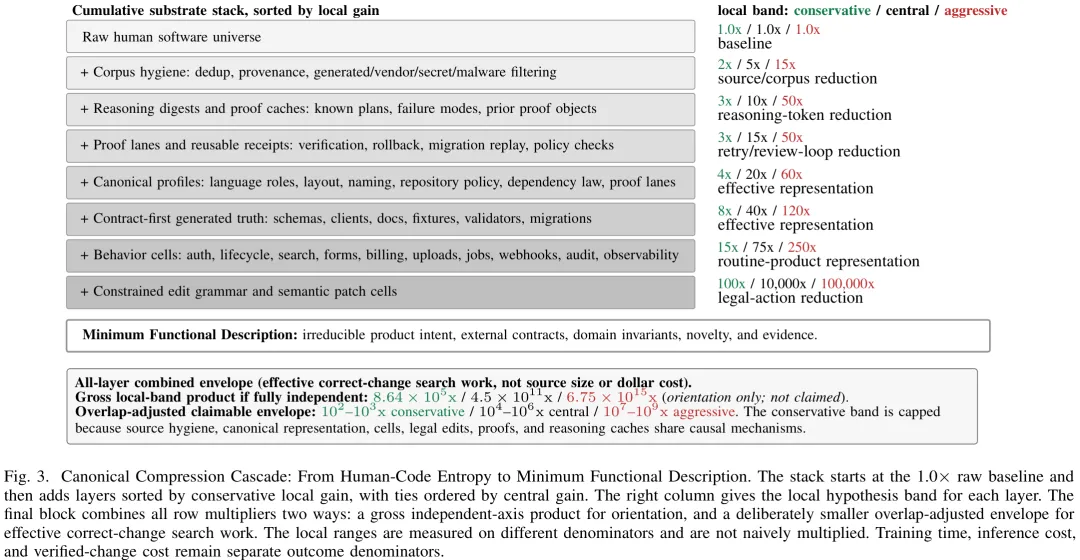
摘要:前沿编码模型可能在人类代码库中花费大量容量去学习程序行为,同时也学习偶然熵。此类代码库包含宝贵信号:测试、事故、迁移、边界情况、产品判断及运营历史。这些信号与框架更迭、命名漂移、生成源歧义、依赖仪式、CI 方言、薄弱证明路径以及面向人类的审查习俗相互纠缠。我们提出“代理优先的标准代码”,这是一种携带证明的底层架构,可将常规产品软件重写为标准行为画像、类型化变更代数、证明车道、受限编辑语法、语义补丁单元、运行时负记忆以及携带证明的变更对象。核心假设是:在声明的预言机下,通过对软件进行行为等价商运算,可将等价编码坍缩为具有显式证据和证明义务的受控代表。最终目标是分摊至每个经验证的正确变更的成本,涵盖源代码、上下文、推理、工具、验证、安全、溯源、审查、失败循环、缺陷以及在共同预言机下的铸造成本。报告中的缩减区间仅为假设,而非实测的前沿结果。所提出的界限是“无事故地平线”:可移除的事故减少至残余新颖性、证据、治理、风险及未来期权占主导地位。对于受支持的常规产品发行版,这提供了一个可辩护的规划目标,即全成本降低约 100 倍,而非对所有软件的保证。在 Qwen2.5-Coder-14B 上的初步 QLoRA 实验表明,64,088 条标准轨迹是可学习的,并能抑制测试中发现的禁止语言标记,但尚未确立行为保持、扩展经济学或经验证变更的成本。本研究的贡献是一个可证伪的程序,其核心在于最小功能描述长度与经验证变更的成本。
Paper Key Illustration
原文
No Accidental Software Agent First Canonical Code for Human Code Entropy Reduction and 30 to 500 times Lower Frontier Model Requirements
Abstract: Frontier coding models may spend substantial capacity learning not only program behavior, but also accidental entropy in human repositories. Such repositories contain valuable signals: tests, incidents, migrations, edge cases, product judgment, and operational history. These signals are entangled with framework churn, naming drift, generated-source ambiguity, dependency rituals, CI dialects, weak proof routes, and human-oriented review customs. We propose agent-first canonical code, a proof-carrying substrate that rewrites routine product software into canonical behavior profiles, typed change algebra, proof lanes, constrained edit grammars, semantic patch cells, runtime negative memory, and proof-carrying change objects. The core hypothesis is that quotienting software by behavior equivalence under a declared oracle can collapse equivalent encodings into governed representatives with explicit evidence and proof obligations. The endpoint is amortized cost per verified correct change, including source, context, reasoning, tools, verification, security, provenance, review, failed loops, defects, and foundry cost under a common oracle. Reported reduction bands are hypotheses, not measured frontier results. The proposed limit is a No-Accident Horizon: removable accident decreases until residual novelty, evidence, governance, risk, and future optionality dominate. For supported routine-product distributions, this gives a defensible planning target near 100-fold all-in cost reduction, not a guarantee for all software. Preliminary QLoRA experiments on Qwen2.5-Coder-14B show that 64,088 canonical trajectories are learnable and suppress tested forbidden-language markers, but do not establish behavior preservation, scaling economics, or verified-change cost. The contribution is a falsifiable program centered on minimum functional description length and verified-change cost.
链接:https://arxiv.org/pdf/2606.14357
AI 深度解读
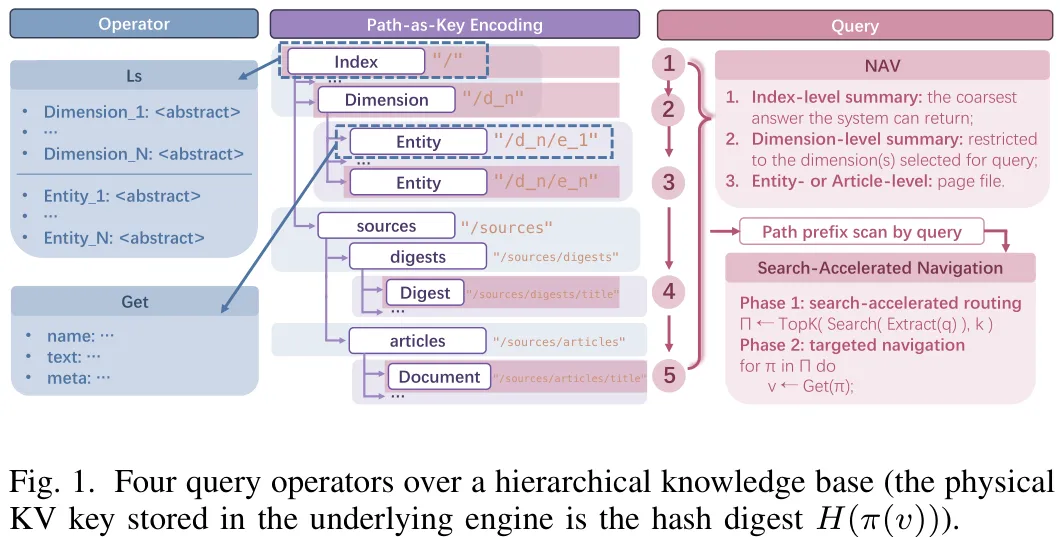
该研究针对知识图谱 Wiki 在大规模数据下的架构演进问题,提出了一套数据驱动的 Schema 设计与演化框架。研究首先将 Schema 设计建模为受约束的全局优化问题,旨在平衡存储开销、在线查询延迟与答案正确性。针对冷启动难题,提出了‘意图锚定模式归纳(IASI)’方法,利用大语言模型直接生成目录骨架,并引入非均匀采样策略以消除低信息量文档的偏差。在系统演化方面,定义了两种局部算子,通过单调改进保证 Schema 随数据增长自动优化。此外,研究还定义了导航查询的渐进式语义及读写一致性要求,设计了一种无锁的离线写入与在线查询协议,确保在读写不对称场景下系统的高可用性与数据新鲜度。
中文摘要
摘要:大语言模型(LLM)策展的分层知识库,即一种节点对底层语料库进行总结的树状维基结构,已成为检索增强应用的主要基础,但其存储层仍被视为实现细节。该工作负载具有分层、查询密集且持续演化的特点,而现有的存储模型无法同时原生捕获这三种属性。我们提出了 WikiKV,这是一种专为该工作负载设计的基于路径索引的键值存储模型,包含三个组成部分:(i) 一种数据驱动的架构,通过意图锚定架构归纳(Intent-Anchored Schema Induction)启动分层,并通过持续演化算子对其进行优化;(ii) 一种针对路径索引存储模型的一致性协议,该协议在不使用读路径锁的情况下,防止了并发离线重写导致的部分读取观察;(iii) 一种预算导航算子,其搜索加速的路由机制将 LLM 辅助的下沉步骤预期数量从 d 降低至 O(1),同时保留了随时可用的语义特性,并提供逐步优化的答案。我们通过微信官方账号 AI 助手的实际部署对 WikiKV 进行了评估,并在 AuthTrace 数据集上将其与多种基线进行了基准测试。结果显示,WikiKV 在四种查询算子上实现了相对于关系型、图数据库及 FS 后端均较低的均衡操作延迟,端到端答案正确率达到 63.2%,超越了多个检索增强生成(RAG)基线,且在低度和高度扇入的多文档问题上,性能差距进一步扩大。消融研究进一步证实了 WikiKV 各组件的有效性。
Paper Key Illustration
原文
WikiKV: Schema-Evolving Path-Indexed Storage for Hierarchical Knowledge Navigation
Abstract: LLM-curated hierarchical knowledge bases, namely a tree-structured wiki whose nodes summarize an underlying corpus, have become a dominant substrate for retrieval-augmented applications, yet their storage layer is still treated as an implementation detail. This workload is hierarchical, query-intensive, and continuously evolving, and no existing storage model natively captures all three properties at once. We present WikiKV, a path-indexed key-value storage model purpose-built for this workload, comprising three components: (i) a data-driven schema that bootstraps the hierarchy via Intent-Anchored Schema Induction and refines it through Continuous Evolution Operators; (ii) a consistency protocol for the path-indexed storage model that precludes partial-read observations under concurrent offline rewrites without read-path locking; and (iii) a budgeted navigation operator whose search-accelerated routing reduces the expected number of LLM-assisted descent steps from d to O(1) while preserving anytime semantics with progressively refined answers. We evaluate WikiKV through real-world deployment for the WeChat Official Account AI Assistant and benchmark it against diverse baselines on the AuthTrace dataset, where it achieves balanced low per-operator latency across four query operators against relational, graph, and FS backends, and reaches 63.2% end-to-end answer correctness, exceeding multiple RAG baselines, with the gap widening on low- and high-fan-in multi-document questions. Ablation study further confirms the effectiveness of WikiKV's components.
链接:https://arxiv.org/pdf/2606.14275
AI 深度解读
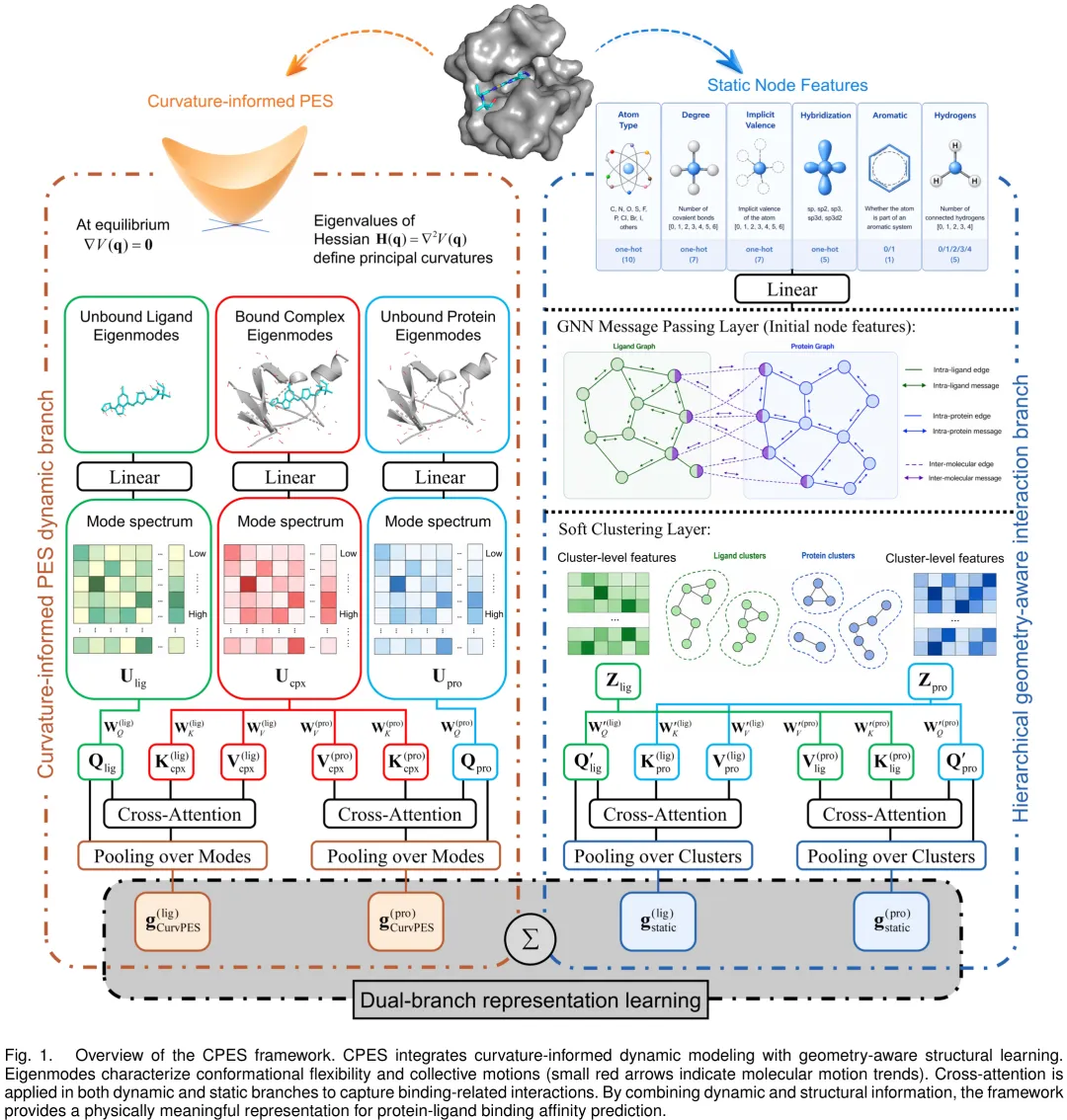
该研究提出了一种基于曲率信息的势能面描述方法,旨在提升蛋白质 - 配体结合亲和力预测的准确性。研究首先从物理原理出发,严格证明了在 SE(3) 刚体变换(旋转和平移)下,势能函数的不变性及其 Hessian 矩阵的正交相似变换性质。这一数学特性保证了 Hessian 矩阵的特征值(即势能面的局部曲率)在坐标变换下保持不变,而特征向量则随坐标系旋转,从而确立了曲率特征作为描述分子构象内在几何性质的鲁棒指标。
在方法层面,研究采用各向异性网络模型(ANM)对势能面进行二阶几何近似。该方法假设势能仅依赖于节点间的距离涨落,并通过构建各向异性刚度矩阵来刻画相互作用:仅对沿参考方向的分量施加约束,而允许垂直于该方向的位移自由运动。由此组装出的全局 Hessian 矩阵呈现出典型的图拉普拉斯块结构,其中对角块累积了所有关联相互作用的贡献,非对角块则编码了成对耦合。通过对该矩阵进行对称特征分解,并剔除刚体零模及近零模,研究提取了低频率特征值作为全局曲率描述符。这些低频率模式对应于势能面最平坦的方向,主导了分子的整体柔性和构象可及性。
最终,该方法被应用于构建未结合配体、未结合蛋白质及复合物三种状态下的曲率特征描述符。通过将曲率特征与结合亲和力预测相结合,该研究为理解蛋白质 - 配体相互作用提供了新的物理视角,即利用势能面的局部曲率(刚度)分布来量化结合稳定性,为基于图论的分子动力学模拟和药物设计提供了坚实的代数基础。
中文摘要
摘要:基于结构的药物发现中,准确预测蛋白质 - 配体结合亲和力至关重要。近年来,几何深度学习方法通过将蛋白质 - 配体复合物表示为三维图,取得了令人瞩目的性能。然而,大多数现有方法主要依赖于单个结合构象中的静态相互作用几何结构,而忽视了分子柔性和结合诱导的构象变化。为克服这一局限,我们提出了一种曲率感知的势能面(CPES)图神经网络,用于预测蛋白质 - 配体结合亲和力。该方法引入基于物理的曲率表示以建模构象柔性。CPES 首先从平衡构象处评估的势能面海森矩阵推导曲率谱描述符,其本征值定义了势能面的局部主曲率。随后,利用谱交叉注意力机制将未结合状态的配体和蛋白质与结合复合物进行比较,从而捕捉结合诱导的构象动力学变化。同时,通过几何感知的消息传递、软聚类和双向交叉注意力,从静态结构特征中学习分层蛋白质 - 配体相互作用表示。最后,CPES 将曲率感知的动态表示与静态相互作用表示融合,用于亲和力回归。在多个基准数据集上的广泛评估表明,CPES 在预测性能上有所提升,并提供了物理可解释性。
Paper Key Illustration
原文
Curvature-Informed Potential Energy Surface for Protein-Ligand Binding Affinity Prediction
Abstract: Accurate prediction of protein-ligand binding affinity is essential for structure-based drug discovery. Recent geometric deep learning methods have achieved promising performance by representing protein-ligand complexes as three-dimensional graphs. However, most existing approaches mainly rely on static interaction geometry from a single bound conformation, while neglecting molecular flexibility and binding-induced conformational changes. To address this limitation, we propose a curvature-informed potential energy surface (CPES) graph neural network for protein-ligand binding affinity prediction, which incorporates physics-informed curvature representations to model conformational flexibility. CPES first derives curvature spectral descriptors from the Hessian of the potential energy surface evaluated at equilibrium configurations, whose eigenvalues define the local principal curvatures of the potential energy surface. It then uses spectral cross-attention to compare the unbound ligand and protein with the bound complex, thereby capturing binding-induced changes in conformational dynamics. In parallel, hierarchical protein-ligand interaction representations are learned from static structural features through geometry-aware message passing, soft clustering, and bidirectional cross-attention. Finally, CPES fuses the curvature-informed dynamic representations with static interaction representations for affinity regression. Extensive evaluations on multiple benchmark datasets demonstrate that CPES achieves improved predictive performance and offers physical interpretability.
链接:https://arxiv.org/pdf/2606.14217
AI 深度解读
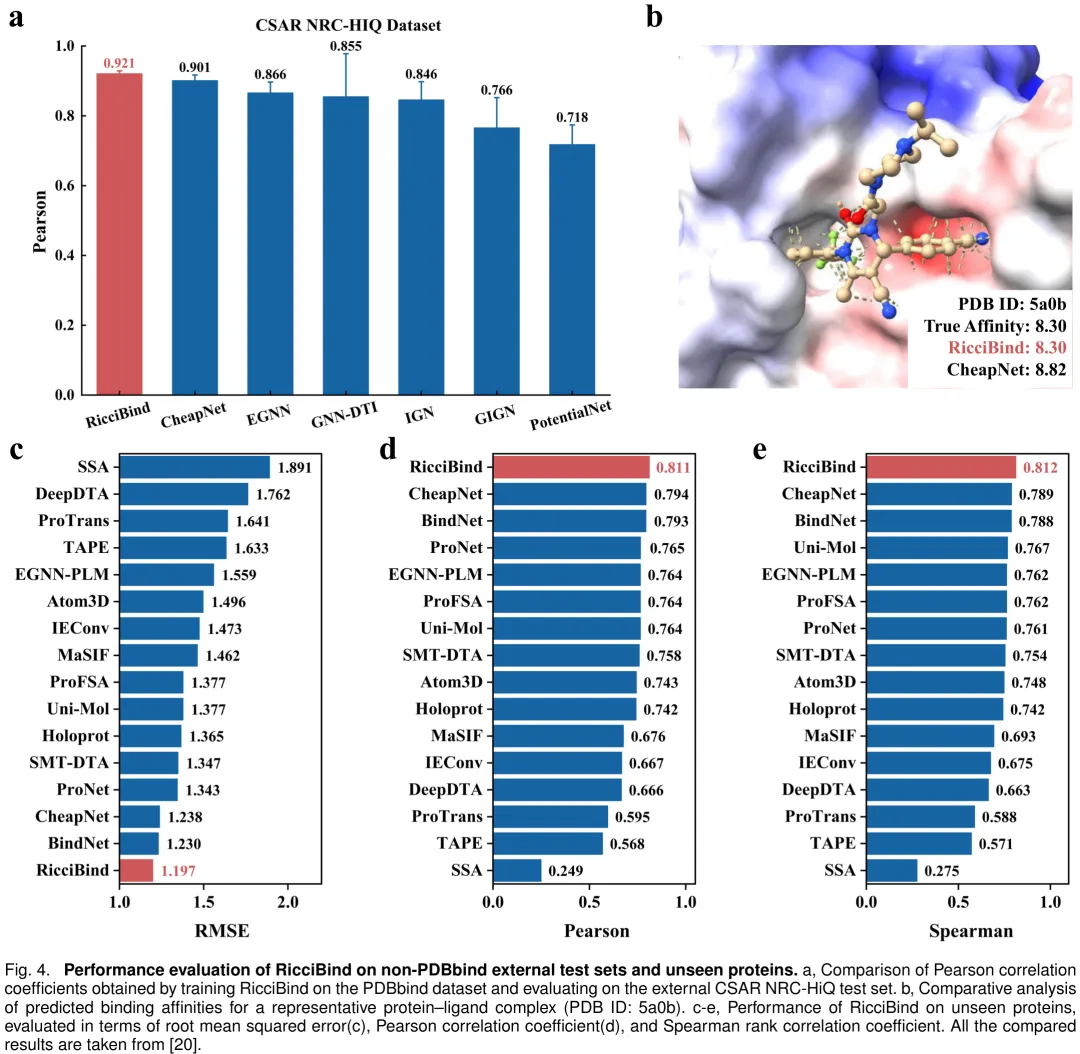
针对蛋白质 - 配体结合亲和力预测任务,现有基于接触图的方法忽略了分子内在结构与三维空间真实相互作用机制,而基于结构的方法虽能利用 3D 信息,但受限于体素化稀疏性或计算效率问题。RicciBind 提出了一种分层表征范式,核心在于引入 Ollivier-Ricci 曲率(ORC)作为几何先验。ORC 作为黎曼几何中 Ricci 曲率的离散类比,能有效捕捉图结构的局部几何与拓扑属性,缓解消息传递中的过平滑与过挤压问题。RicciBind 将 ORC 应用于图嵌入与分层表征两个阶段:首先构建包含共价键与非共价相互作用边的分子图,利用 ORC 指导原子聚类以形成功能簇,并通过最优传输进行簇匹配,从而构建出物理一致且信息丰富的复合物表征。该方法不仅增强了模型对复杂相互作用模式的捕捉能力,还通过曲率引导的原子聚类提供了几何基础,显著提升了结合亲和力预测的准确性与模型的可解释性。
中文摘要
摘要:蛋白质 - 配体结合亲和力(PLA)预测在药物发现中至关重要。尽管基于机器学习的方法取得了显著进展,但现有方法难以同时表征局部的几何组织与全局协调的跨分子相互作用,从而限制了其对复杂结合机制的建模能力。在此,我们提出了 RicciBind,这是一种几何表示框架,它将曲率引导的分层结构学习与基于最优传输(OT)的跨域对齐相结合,以模拟分子相互作用。具体而言,RicciBind 利用 Ricci 曲率捕捉分子结构内部的局部相互作用紧密度,增强结构感知能力,并将原子相互作用组织为曲率感知的分层表示。随后,基于 OT 的聚类匹配机制在几何约束下对齐不同域中的蛋白质和配体聚类,实现全局一致的对应关系,并揭示超越局部邻域的高阶相互作用模式。通过将曲率引导的结构编码与 OT 驱动的跨域对齐相结合,RicciBind 有效建模了复杂的相互作用语义,显著提高了结合亲和力预测的准确性和可解释性。广泛的实验表明,RicciBind 在 PLA 基准测试和虚拟筛选任务中均取得了优越的预测性能和泛化能力。消融研究进一步证实了 Ricci 曲率在增强分子相互作用表示中的关键作用。
Paper Key Illustration
原文
Curvature-Guided Geometric Representation for Protein-Ligand Binding Affinity Prediction
Abstract: Protein-ligand binding affinity (PLA) prediction is critical in drug discovery. Despite the notable advancements in machine learning-based approaches, existing methods struggle to jointly characterize local geometric organization and globally coordinated cross-molecular interactions, limiting their ability to model complex binding mechanisms. Here, we propose RicciBind, a geometric representation framework that integrates curvature-guided hierarchical structure learning with optimal transport (OT)-based cross-domain alignment to model molecular interactions. Specifically, RicciBind leverages Ricci curvature to capture local interaction tightness within molecular structures, enhancing structural awareness and organizing atomic interactions into curvature-aware hierarchical representations. An OT-based cluster matching mechanism then aligns protein and ligand clusters across heterogeneous domains under geometric constraints, enabling globally consistent correspondences and revealing higher-order interaction patterns beyond local neighborhoods. By coupling curvature-guided structure encoding with OT-driven cross-domain alignment, RicciBind effectively models complex interaction semantics and substantially improves both the accuracy and interpretability of binding affinity prediction. Extensive experiments demonstrate that RicciBind achieved superior predictive performance and generalization across PLA benchmarks and virtual screening tasks. Ablation studies further confirmed the essential role of Ricci curvature in enhancing molecular interaction representations.
链接:https://arxiv.org/pdf/2606.14159
AI 深度解读
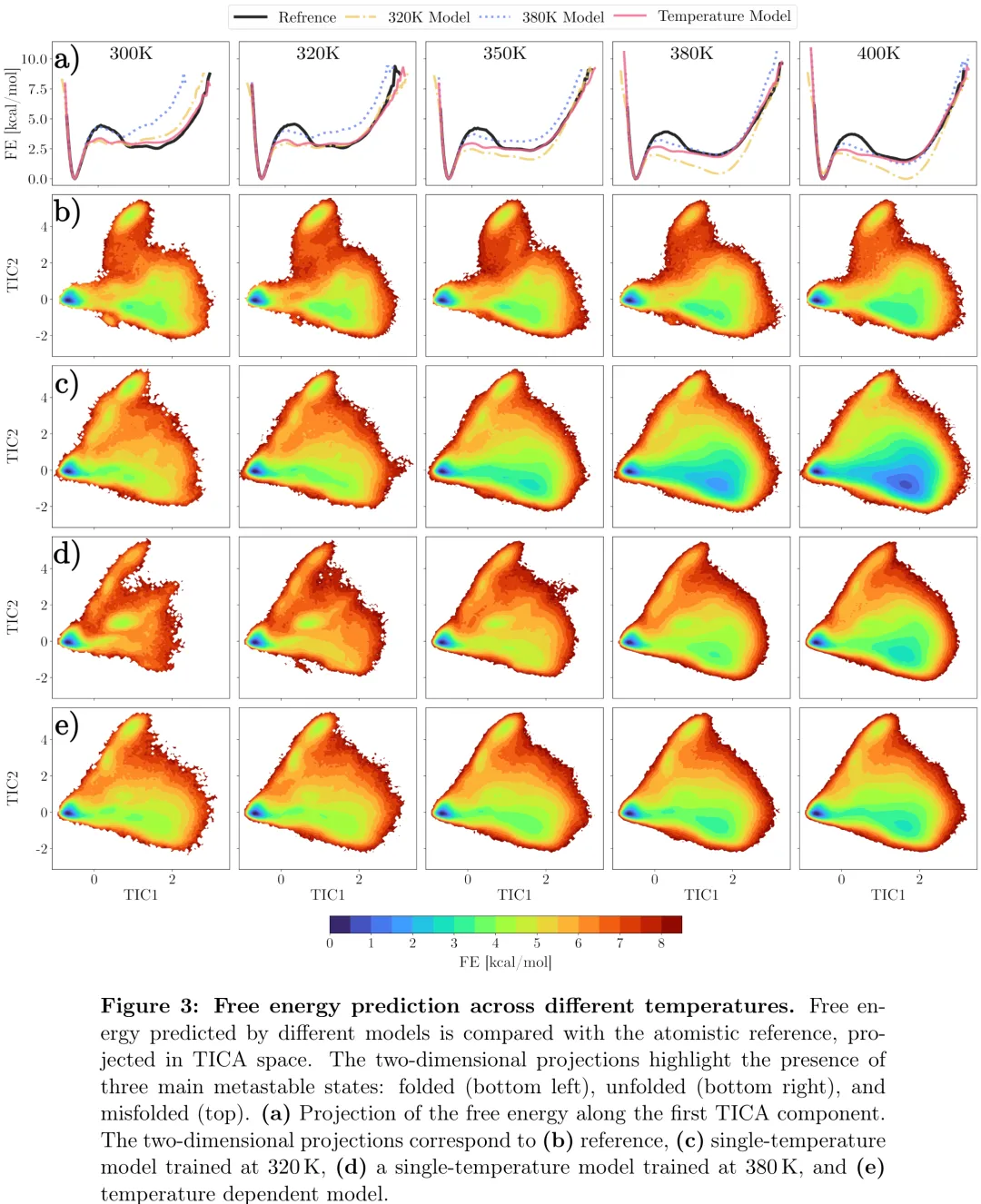
该研究提出了一种基于图神经网络(GNN)的粗粒化分子力场框架,旨在同时预测蛋白质折叠的自由能景观(PMF)及其能量与熵的独立贡献。研究针对 Chignolin 迷你蛋白构建了涵盖 300K 至 400K 的多温度分子动力学数据集,并采用 Cα 映射方案进行粗粒化表示。为克服传统神经网络难以严格满足热力学约束的缺陷,作者设计了一种受约束的神经网络架构:通过引入特定的线性算子,强制模型输出的能量与熵项满足热力学关系式(即能量对温度的偏导数与熵的关系)。在模型构建上,利用多目标损失函数结合力匹配(Force Matching)与能量匹配(Energy Matching)进行训练,并引入了温度依赖的键长、键角及二面角先验项以维持物理合理性。该方法不仅实现了在不同温度间的热力学性质传递,还通过解析推导处理了温度引起的能量偏移,确保了在计算热力学可观测量(如热容)时的准确性,为构建可解释且物理自洽的机器学习力场提供了新范式。
中文摘要
摘要:粗粒化(CG)分子模拟为研究大型复杂生物系统提供了一种高效的原子分子动力学替代方案。引入机器学习粗粒化(MLCG)模型后,CG 模拟的精度得到了显著提升。然而,这些模型通常仅针对单一热力学状态点设计,缺乏温度可迁移性,且无法用于预测如热容等与温度相关的物理量。本文提出了一种面向蛋白质的、基于热力学原理且具备温度可迁移性的 MLCG 框架,该框架将粗粒化平均力势(PMF)显式分解为能量项和熵项。模型架构强制约束了 PMF 能量项与熵项之间精确的热力学关系,从而确保了在不同温度区间内进行物理自洽的外推和插值。我们利用涵盖 300 K 至 400 K 五个温度点、总计 250 μs 分子动力学模拟数据的 Chignolin 蛋白广泛数据集对该框架进行了验证,结果表明其能够复现参考原子自由能表面的温度依赖性,并修正了缺乏温度意识的基线模型。此外,我们证明可以通过应用一种廉价的后处理温度依赖性校正来准确恢复不同温度下的原子热容,而无需重新训练 MLCG 势函数。总体而言,本工作为复杂生物分子系统的热力学可迁移 MLCG 模拟提供了一条基于物理原理的实现路径。
Paper Key Illustration
原文
Temperature transferable Machine Learned Coarse Grained model for proteins
Abstract: Coarse-grained (CG) molecular simulations offer an efficient alternative to atomistic molecular dynamics to study large and complex biological systems. The accuracy of CG simulations has been increased dramatically by the introduction of machine-learned coarse-grained (MLCG) models. However, these models are typically designed to be used at a single thermodynamic point, lack temperature transferability, and can not be used to predict temperature dependent quantities like the heat capacity. Here we introduce a thermodynamically informed, temperature-transferable MLCG framework for proteins that explicitly decomposes the CG potential of mean force (PMF) into its energetic and entropic components. The model architecture enforces an exact thermodynamic relation between the energetic and entropic components of the PMF and guarantees physically consistent extrapolation and interpolation across temperature regimes. We validate this framework on an extensive dataset spanning a total of 250 μs of molecular dynamics simulations across five temperatures between 300 K and 400 K for the Chignolin protein, and demonstrate that it reproduces the temperature dependency of the reference atomistic free energy surfaces, correcting the temperature-unaware baselines. Furthermore, we show that it is possible to apply an inexpensive, post-hoc temperature-dependent correction that does not require retraining the MLCG potential, accurately recovering the atomistic heat capacity at different temperatures. Overall, this work provides a physically grounded pathway toward thermodynamically transferable MLCG simulations of complex biomolecular systems.
链接:https://arxiv.org/pdf/2606.14111
今日热门 / Popular Today
ArXiv 高热度精选
AI 深度解读
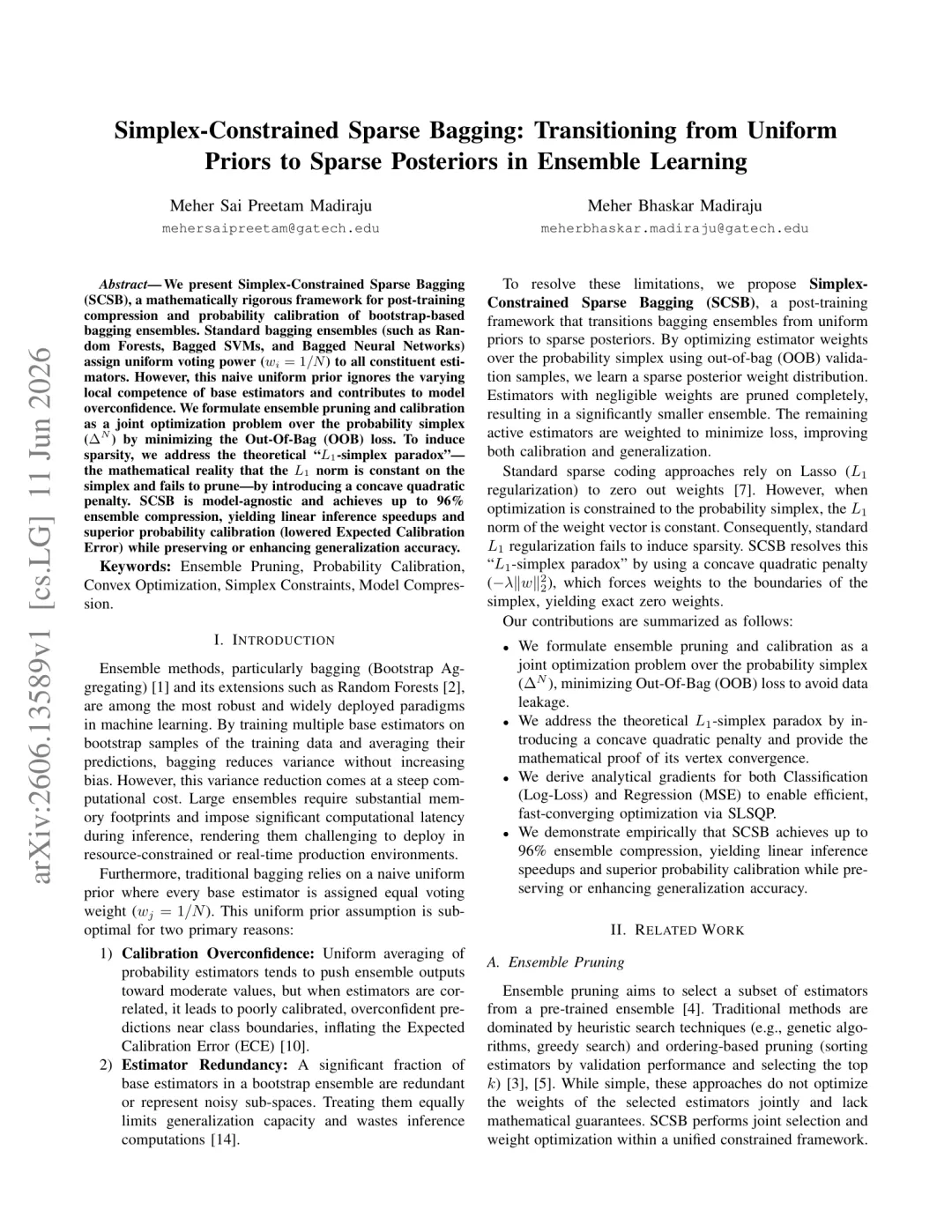
本文提出了一种名为简单约束稀疏袋装(SCSB)的集成压缩与校准方法,旨在解决传统袋装法模型冗余、推理延迟高及概率校准不佳的问题。研究针对标准袋装法中基模型数量过多导致的计算开销大,以及 Lasso 正则化在概率单纯形上存在理论局限(如无法保证凸优化解的唯一性或最优性)等痛点,设计了一种基于单纯形约束的稀疏化策略。该方法利用袋装法固有的“袋外”(OOB)预测数据作为初始化锚点,通过求解带有凹二次惩罚项的单纯形优化问题,在无需划分验证集或进行交叉验证的情况下,自动剔除冗余基模型。实验结果表明,SCSB 能够稳定地剪枝 68% 至 96% 的基模型,在保持甚至提升泛化准确率的同时,显著降低了逻辑损失(Log-Loss)并改善了期望校准误差(ECE)。在推理速度方面,该方法相对于标准袋装法实现了 2.6 倍至 5.7 倍的延迟加速,且该加速比随模型剪枝比例的增加而线性增长。此外,研究还探讨了将 SCSB 扩展至深度学习集成(如随机森林、XGBoost)及支持向量机(SVM)的潜力,并提出了基于输入特征的局部校准等未来研究方向。总体而言,SCSB 提供了一种数学严谨、即插即用的解决方案,特别适用于对延迟敏感的生产环境中的鲁棒袋装集成部署。
中文摘要
摘要:我们提出了简单形约束稀疏包袋法(Simplex-Constrained Sparse Bagging, SCSB),这是一个用于基于自助法的包袋集成模型的后训练压缩与概率校准的数学严谨框架。标准包袋集成模型(如随机森林、包袋支持向量机和包袋神经网络)赋予所有基础估计器均匀的投票权重。然而,这种朴素均匀先验忽略了基础估计器局部能力的差异,并导致模型过度自信。我们将集成剪枝与校准建模为在概率单纯形上的联合优化问题,通过最小化袋外(Out-Of-Bag, OOB)损失来实现。为诱导稀疏性,我们针对理论上的“L1-单纯形悖论”——即 L1 范数在单纯形上为常数且无法实现剪枝的数学事实——引入了凹二次惩罚项。SCSB 具有模型无关性,可实现高达 96% 的集成压缩,在保持或提升泛化准确性的同时,带来线性推理速度提升和更优的概率校准(降低期望校准误差)。
Paper Key Illustration
原文
Simplex-Constrained Sparse Bagging: Transitioning from Uniform Priors to Sparse Posteriors in Ensemble Learning
Abstract: We present Simplex-Constrained Sparse Bagging (SCSB), a mathematically rigorous framework for post-training compression and probability calibration of bootstrap-based bagging ensembles. Standard bagging ensembles (such as Random Forests, Bagged SVMs, and Bagged Neural Networks) assign uniform voting power to all constituent estimators. However, this naive uniform prior ignores the varying local competence of base estimators and contributes to model overconfidence. We formulate ensemble pruning and calibration as a joint optimization problem over the probability simplex by minimizing the Out-Of-Bag (OOB) loss. To induce sparsity, we address the theoretical "L1-simplex paradox" -- the mathematical reality that the L1 norm is constant on the simplex and fails to prune -- by introducing a concave quadratic penalty. SCSB is model-agnostic and achieves up to 96% ensemble compression, yielding linear inference speedups and superior probability calibration (lowered Expected Calibration Error) while preserving or enhancing generalization accuracy.
链接:https://arxiv.org/pdf/2606.13589
AI 深度解读
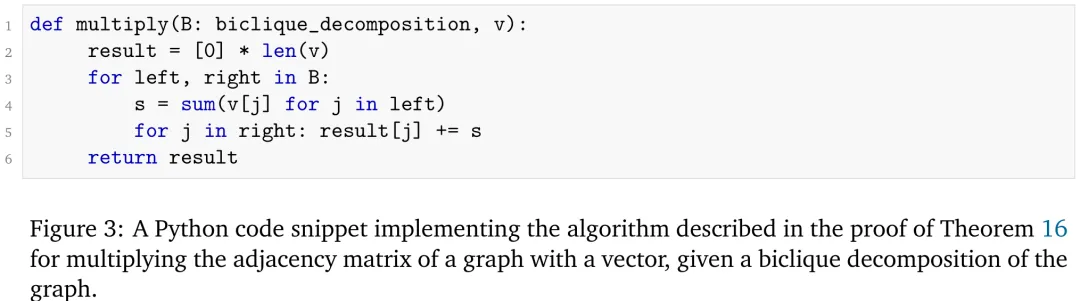
该研究提出了一种基于‘总连续性(total contiguity)’的图分解理论,旨在解决图的双团分解问题。研究首先定义了图的总连续性,即所有顶点在特定 Welzl 序下的区间数量之和,并证明任意总连续性为 t 的图,其双团分解规模可控制在 O(t log n) 量级。针对具有小邻域复杂度的图类(如 VC 维有界图或线性邻域复杂度图),研究利用 Welzl 序及相关算法,证明了其连续性具有多项式或对数上界。在算法层面,论文构建了一种基于汉明距离最小生成树的近似算法:通过计算顶点邻域特征向量的对称差作为边权,利用深度优先遍历与双树捷径技术,在 O(n^2 log n) 时间内高效计算出反映图连续性的排序,从而实现了理论界与算法实现的有效结合。
中文摘要
图的二部团分解是指将其边划分为若干个完全二部子图。我们考虑一类图,其顶点可被排序,使得每个顶点的邻域均为若干个子线性数量区间的并集。我们观察到,这类图具有紧凑的二部团分解表示形式,且分解规模较小。此处,分解的规模定义为其二部团中顶点数的总和。结合 Welzl 于 1988 年证明的低邻域复杂度图存在合适顶点排序这一结果,我们恢复并扩展了若干已知结论,精度达到对数因子级别。这些结果涵盖了 Zarankiewicz 问题的上界、矩阵乘法、量子电路复杂度以及“结构良好”实例中的最短路径算法等领域。
Paper Key Illustration
原文
Biclique decompositions from Welzl orders
Abstract: A biclique decomposition of a graph is a partition of its edges into complete bipartite subgraphs. We consider graphs whose vertices can be ordered such that the neighborhood of every vertex is the union of a sublinear number of intervals. We observe that these graphs admit compact representations in the form of biclique decompositions of small size. Here, the size of a decomposition is measured as the sum of the number of vertices of its bicliques. Combining this result with the existence of suitable vertex orderings for graphs of low neighborhood complexity, as proven by Welzl in 1988, we recover and extend several known results up to logarithmic factors. These results include upper bounds on the Zarankiewicz problem, matrix multiplication, quantum circuit complexity, and shortest path algorithms in ``well-structured'' instances.
链接:https://arxiv.org/pdf/2606.09785
AI 深度解读
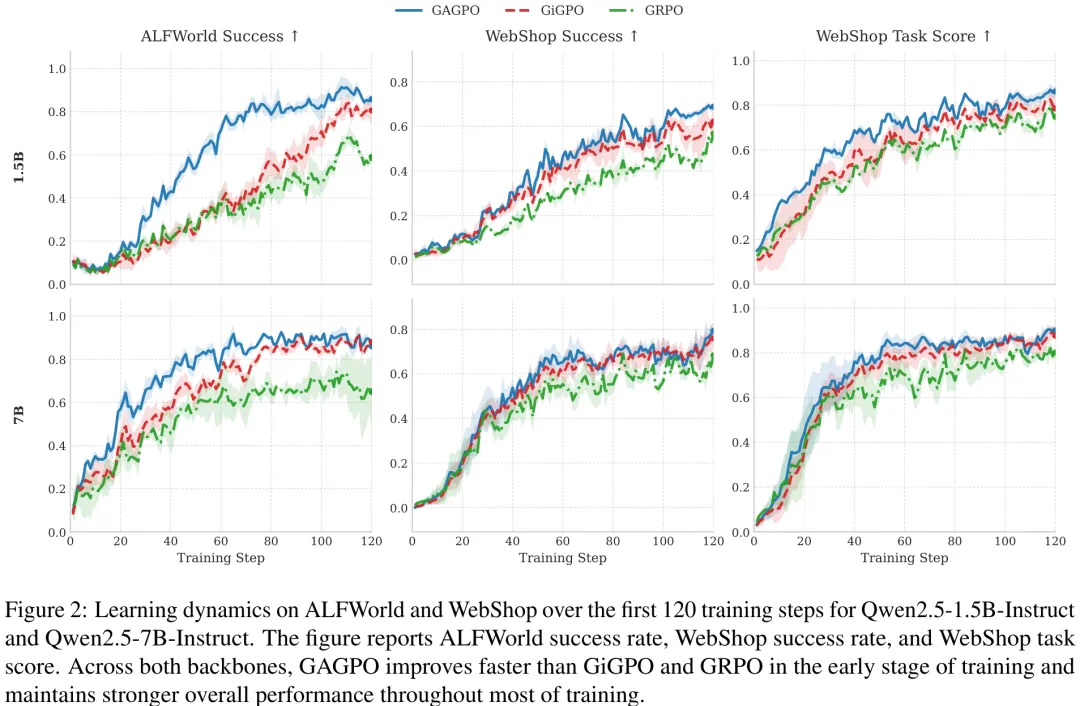
本文提出了一种名为 GAGPO 的新颖强化学习算法,旨在解决多轮对话智能体训练中的信用分配难题。该方法通过计算动作序列内 token 层级的对数比率并取平均,构建了序列级的奖励比率,从而在保持分组策略优化(Grouped Policy Optimization)简洁性的同时,引入了时间传播且与步骤对齐的信用信号。实验在 ALFWorld 和 WebShop 两个多轮智能体基准上,针对 Qwen2.5-1.5B 和 Qwen2.5-7B 模型进行了评估。结果显示,GAGPO 在训练初期收敛速度显著快于 GiGPO 和 GRPO 等基线方法,并在整个训练过程中保持了更强的整体性能。此外,优化过程中的梯度范数更平滑、熵损失下降更快、优势函数的方差更低且极值更集中,表明该方法具有更稳定的优化动态和更低方差的价值信号。
中文摘要
摘要:强化学习已成为训练大型语言模型智能体(agent)后训练的强大范式,但在多轮交互环境中,信用分配(credit assignment)仍是一个挑战。智能体通常仅在回合结束时接收到稀疏的轨迹级奖励,这使得难以确定哪些中间动作促成了成功或失败。因此,在不依赖昂贵辅助价值模型的情况下,将延迟结果反向传播至各个决策步骤,仍是一个开放性问题。我们提出了广义优势分组策略优化(GAGPO),这是一种无评论者(critic-free)的强化学习方法,旨在实现精确的、与步骤对齐的时间信用分配。GAGPO 基于采样的轨迹构建非参数化分组价值代理,并利用其计算 TD/GAE 风格的时间优势,通过递归方式将结果监督信号沿时间轴反向传播。结合分组优势归一化和动作级重要性比率,GAGPO 能够直接从多轮轨迹中提取稳定且局部的优化信号。在 ALFWorld 和 WebShop 上的实验表明,GAGPO 的表现优于现有的强化学习基线。进一步分析显示,该方法在早期阶段的学习速度更快、交互效率更高,且优化动态更为平滑,表明 GAGPO 为多轮智能体强化学习提供了一个简单而有效的框架。
Paper Key Illustration
原文
GAGPO: Generalized Advantage Grouped Policy Optimization
Abstract: Reinforcement learning has become a powerful paradigm for post-training large language model agents, yet credit assignment in multi-turn environments remains a challenge. Agents often receive sparse, trajectory-level rewards only at the end of an episode, making it difficult to determine which intermediate actions contributed to success or failure. As a result, propagating delayed outcomes back to individual decision steps without relying on costly auxiliary value models remains an open problem. We propose Generalized Advantage Grouped Policy Optimization (GAGPO), a critic-free reinforcement learning method for precise, step-aligned temporal credit assignment. GAGPO constructs a non-parametric grouped value proxy from sampled rollouts and uses it to compute TD/GAE-style temporal advantages, recursively propagating outcome supervision backward through time. Combined with group-wise advantage normalization and an action-level importance ratio, GAGPO extracts stable, localized optimization signals directly from multi-turn trajectories. Experiments on ALFWorld and WebShop show that GAGPO outperforms strong reinforcement learning baselines. Further analyses demonstrate faster early-stage learning, improved interaction efficiency, and smoother optimization dynamics, suggesting that GAGPO offers a simple yet effective framework for multi-turn agentic reinforcement learning.
链接:https://arxiv.org/pdf/2605.13217
AI 深度解读
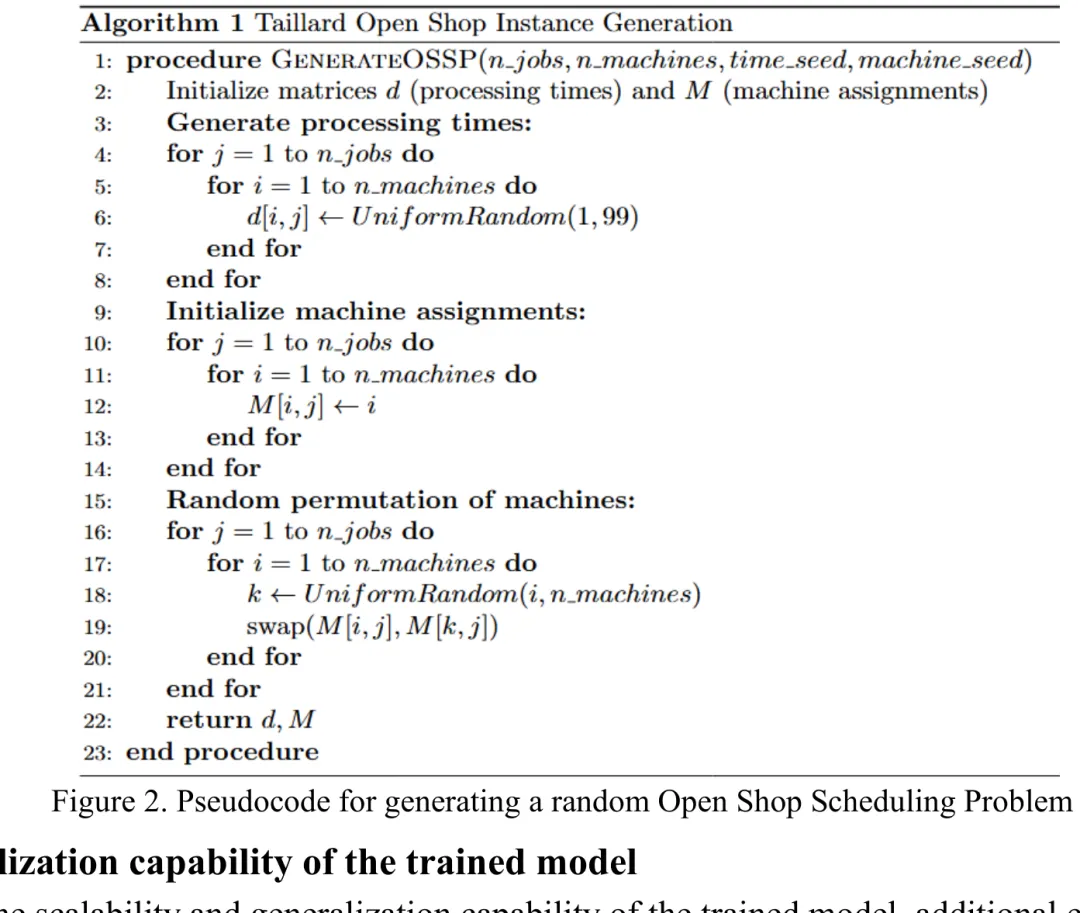
本研究针对开放车间调度问题(OSSP),提出了一种基于 Transformer 架构与近端策略优化(PPO)算法的智能调度策略。研究首先通过 Optuna 自动优化确定了模型超参数,包括嵌入维度 32、编码器层数 1、学习率 1.15×10⁻⁴ 等,并在配备 RTX 3070 Ti 的工作站上完成训练。模型在 Taillard 基准数据集(4×4 至 20×20)上表现出良好的可行性,其生成的调度方案平均完工时间(Makespan)与基准最优解的差距随问题规模增大而缩小,从 7×7 时的 28.80% 降至 20×20 时的 15.59%,表明模型能捕捉到大规模问题中更有效的调度模式。在泛化能力测试中,该模型未经微调直接应用于 40×40 至 100×100 的大规模随机生成实例,其性能稳定且优于最短/最长处理时间等经典启发式规则(SPT/LPT),与最早完工时间规则(EST)表现相当。研究通过计算相对于工作负载下界的相对间隙(Gap),证实了该策略在未见过的超大规模问题上仍能保持稳定的解质量,证明了 Transformer-PPO 架构在解决复杂调度问题时的可扩展性与鲁棒性。
中文摘要
摘要:开放车间调度问题(OSSP)广泛存在于众多工业和服务场景中,但随着作业和机器数量的增加,其计算复杂性显著上升。尽管精确算法在大规模问题上迅速变得不可行,而经典的调度规则和元启发式算法往往需要大量调优以在大规模下保持解的质量。本研究利用编码器 - 解码器架构及多头注意力机制,开发了一种基于 Transformer 的 OSSP 调度策略。该模型仅以加工时间矩阵为输入,在 Taillard 标准算例(4×4、5×5、7×7 和 10×10)上进行训练,生成的可行调度方案的最大完工时间通常优于已知最优值的 15%–30%。为评估可扩展性,将训练好的策略直接应用于从 40×40 到 100×100 的随机生成算例,无需重新训练,并与经典调度启发式规则(包括 SPT、LPT、MWKR 和 EST)进行对比。在这些大规模算例中,Transformer 相对于标准下界的平均间隙为 12.89%–15.12%。与 EST 相比,Transformer 仍保持竞争力,差距通常较小,而显著优于 SPT 和 LPT。这些结果表明,基于小规模 OSSP 算例训练的 Transformer 策略能够泛化至规模大得多的问题,并为经典调度规则提供了一种特征轻量、基于学习的替代方案。
Paper Key Illustration
原文
A Deep Reinforcement Learning (DRL)-Based Transformer Method for Solving the Open Shop Scheduling Problem
Abstract: The open shop scheduling problem (OSSP) arises in many industrial and service settings but remains computationally challenging as the number of jobs and machines increases. While exact methods quickly become intractable, classical dispatching rules and metaheuristics may require substantial tuning to maintain solution quality at large scales. This study develops a Transformer-based scheduling policy for OSSP using an encoder-decoder architecture with multi-head attention. The model is trained on Taillard benchmark instances (4x4, 5x5, 7x7, and 10x10) using only the processing-time matrix as input and produces feasible schedules with makespans typically within 15-30% of best-known values. To evaluate scalability, the trained policy is applied without retraining to randomly generated instances from 40x40 to 100x100 and compared against classical dispatching heuristics, including SPT, LPT, MWKR, and EST. Across these large instances, the Transformer achieved average gaps of 12.89-15.12% relative to a standard lower bound. Compared with EST, the Transformer remained competitive, typically within a modest margin, while substantially outperforming SPT and LPT. These results indicate that a Transformer policy trained on small OSSP instances can generalize to substantially larger problems and provide a feature-light, learning-based alternative to classical dispatching rules.
链接:https://arxiv.org/pdf/2606.13682
AI 深度解读
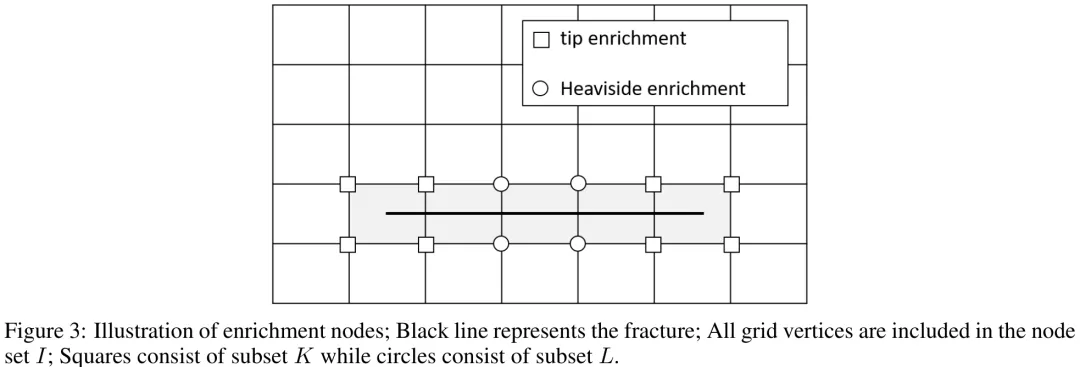
该研究提出了一种基于扩展有限元法(XFEM)与离散裂缝介质法(EDFM)耦合的岩石水力 - 力学模型,旨在模拟水力压裂过程中裂缝的扩展行为。研究首先建立了多相流在基质与裂缝中的流动方程,其中裂缝内的流体速度遵循泊肃叶定律,并考虑了残余饱和度对相对渗透率的影响。在力学方面,模型采用线性弹性断裂力学理论,引入等效应力强度因子(Keq_I)来描述裂缝尖端的应力状态,并结合 Irwin 定律与 J 积分建立裂缝扩展准则。当等效应力强度因子达到临界断裂韧性 Kc 时,裂缝发生扩展;反之则保持静态平衡。数值离散上,研究采用有限体积法处理流动方程以保证局部质量守恒,同时利用有限元法近似力学方程,并将位移节点布置在网格顶点以处理裂缝的不连续性。通过时间分区与网格划分,模型实现了基质与裂缝网格的独立处理与连接,能够有效模拟准静态条件下的裂缝稳定扩展过程,为理解复杂地质条件下的裂缝演化机制提供了理论框架。
中文摘要
针对多孔介质中流体驱动裂缝扩展及一般多相流动的集成模型,对于水力压裂、废物地下处置以及各类应用中的地质灾害防治等系统的研究与工程实践具有重要价值。本文扩展了 Ren 等人(2018)提出的耦合多相流动与孔隙力学模型,使其能够容纳裂缝扩展(FP)过程。所提出的耦合扩展有限元(XFEM)与嵌入离散裂缝法(EDFM)方案采用独立裂缝网格,并将其嵌入静态背景网格中。裂缝扩展的起始与演化由等效应力强度因子(SIF)准则控制,并通过域积分法(J 积分)计算相关参数。本文提出了一种自适应时间推进方案,能够快速调整时间分辨率以适应底层时间尺度。该模型经解析解验证,展现出准确且自适应地协同模拟流体输运、变形以及多条裂缝扩展的能力。
Paper Key Illustration
原文
An integrated numerical model for coupled poro-hydro-mechanics and fracture propagation using embedded meshes
Abstract: Integrated models for fluid-driven fracture propagation and general multiphase flow in porous media are valuable to the study and engineering of several systems, including hydraulic fracturing, underground disposal of waste, and geohazard mitigation across such applications. This work extends the coupled model multiphase flow and poromechanical model of \cite{ren2018embedded} to admit fracture propagation (FP). The coupled XFEM-EDFM scheme utilizes a separate fracture mesh that is embedded on a static background mesh. The onset and dynamics of fracture propagation (FP) are governed by the equivalent stress intensity factor (SIF) criterion. A domain-integral method (J integral) is applied to compute this information. An adaptive time-marching scheme is proposed to rapidly restrict and grow temporal resolution to match the underlying time-scales. The proposed model is verified with analytical solutions, and shows the capability to accurately and adaptively co-simulate fluid transport and deformation as well as the propagation of multiple fractures.
链接:https://arxiv.org/pdf/2008.03186
Subscribe to arXiv's Daily Preprint Notifications